Robert Wilks, M.A.
Partly adapted from Barron’sTOEFL iBT, Barron’s Educational Series, Inc.
Reflect…
Have you written essays in your other university courses (in
any language)?
What did you write about?What were the academic
purposes of the essays that you have written?
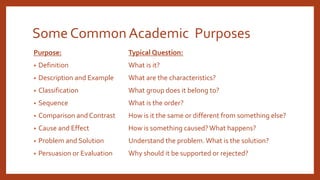
Some Common Academic Purposes
Purpose: Typical Question:
• Definition What is it?
• Description and Example What are the characteristics?
• Classification What group does it belong to?
• Sequence What is the order?
• Comparison and Contrast How is it the same or different from something else?
• Cause and Effect How is something caused?What happens?
• Problem and Solution Understand the problem. What is the solution?
• Persuasion or Evaluation Why should it be supported or rejected?
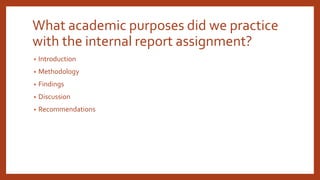
What academic purposes did we practice
with the internal report assignment?
• Introduction
• Methodology
• Findings
• Discussion
• Recommendations
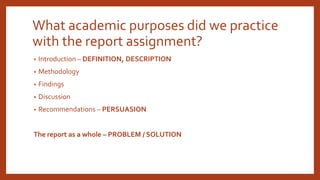
What academic purposes did we practice
with the report assignment?
• Introduction – DEFINITION, DESCRIPTION
• Methodology
• Findings
• Discussion
• Recommendations – PERSUASION
The report as a whole – PROBLEM / SOLUTION
If you saw these chapter headings in a textbook,
what academic purpose might you expect?
• “The Atmosphere”
If you saw these chapter headings in a textbook,
what academic purpose might you expect?
• “The Atmosphere” DEFINITION OR DESCRIPTION
If you saw these chapter headings in a textbook,
what academic purpose might you expect?
• “The Atmosphere” DEFINITION OR DESCRIPTION
• “Forces WithinThe Atmosphere”
If you saw these chapter headings in a textbook,
what academic purpose might you expect?
• “The Atmosphere” DEFINITION OR DESCRIPTION
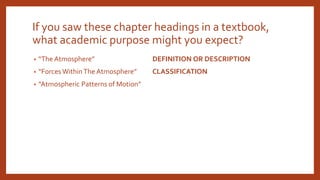
• “Forces WithinThe Atmosphere” CLASSIFICATION
If you saw these chapter headings in a textbook,
what academic purpose might you expect?
• “The Atmosphere” DEFINITION OR DESCRIPTION
• “Forces WithinThe Atmosphere” CLASSIFICATION
• “Atmospheric Patterns of Motion”
If you saw these chapter headings in a textbook,
what academic purpose might you expect?
• “The Atmosphere” DEFINITION OR DESCRIPTION
• “Forces WithinThe Atmosphere” CLASSIFICATION
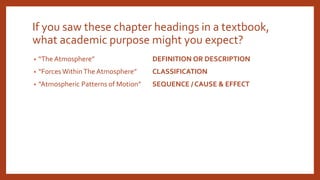
• “Atmospheric Patterns of Motion” SEQUENCE / CAUSE & EFFECT
If you saw these chapter headings in a textbook,
what academic purpose might you expect?
• “The Atmosphere” DEFINITION OR DESCRIPTION
• “Forces WithinThe Atmosphere” CLASSIFICATION
• “Atmospheric Patterns of Motion” SEQUENCE / CAUSE & EFFECT
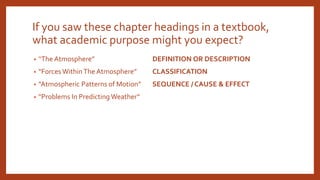
• “Problems In Predicting Weather”
If you saw these chapter headings in a textbook,
what academic purpose might you expect?
• “The Atmosphere” DEFINITION OR DESCRIPTION
• “Forces WithinThe Atmosphere” CLASSIFICATION
• “Atmospheric Patterns of Motion” SEQUENCE / CAUSE & EFFECT
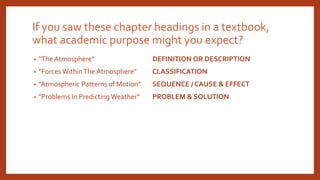
• “Problems In Predicting Weather” PROBLEM & SOLUTION
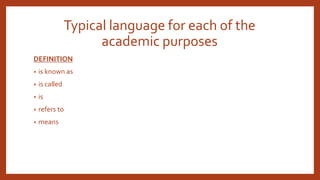
Typical language for each of the
academic purposes
DEFINITION
• is known as
• is called
• is
• refers to
• means
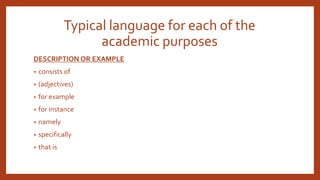
Typical language for each of the
academic purposes
DESCRIPTION OR EXAMPLE
• consists of
• (adjectives)
• for example
• for instance
• namely
• specifically
• that is
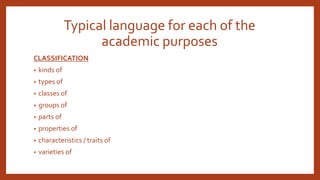
Typical language for each of the
academic purposes
CLASSIFICATION
• kinds of
• types of
• classes of
• groups of
• parts of
• properties of
• characteristics / traits of
• varieties of
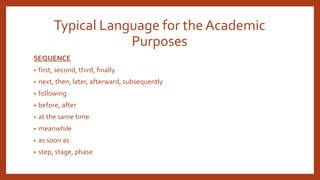
Typical Language for the Academic
Purposes
SEQUENCE
• first, second, third, finally
• next, then, later, afterward, subsequently
• following
• before, after
• at the same time
• meanwhile
• as soon as
• step, stage, phase
Typical Language for the Academic
Purposes
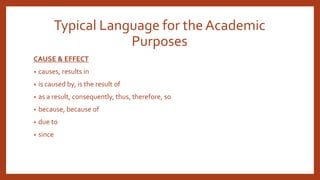
CAUSE & EFFECT
• causes, results in
• is caused by, is the result of
• as a result, consequently, thus, therefore, so
• because, because of
• due to
• since
Typical Language for the Academic
Purposes
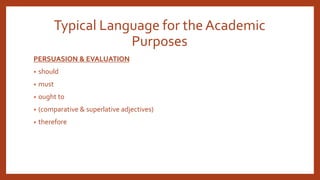
PERSUASION & EVALUATION
• should
• must
• ought to
• (comparative & superlative adjectives)
• therefore
Typical Language for the Academic
Purposes
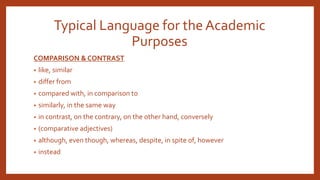
COMPARISON & CONTRAST
• like, similar
• differ from
• compared with, in comparison to
• similarly, in the same way
• in contrast, on the contrary, on the other hand, conversely
• (comparative adjectives)
• although, even though, whereas, despite, in spite of, however
• instead

Academic purposes for virtual

  • 1.
    Robert Wilks, M.A. Partlyadapted from Barron’sTOEFL iBT, Barron’s Educational Series, Inc.
  • 2.
    Reflect… Have you writtenessays in your other university courses (in any language)? What did you write about?What were the academic purposes of the essays that you have written?
  • 3.
    Some Common AcademicPurposes Purpose: Typical Question: • Definition What is it? • Description and Example What are the characteristics? • Classification What group does it belong to? • Sequence What is the order? • Comparison and Contrast How is it the same or different from something else? • Cause and Effect How is something caused?What happens? • Problem and Solution Understand the problem. What is the solution? • Persuasion or Evaluation Why should it be supported or rejected?
  • 4.
    What academic purposesdid we practice with the internal report assignment? • Introduction • Methodology • Findings • Discussion • Recommendations
  • 5.
    What academic purposesdid we practice with the report assignment? • Introduction – DEFINITION, DESCRIPTION • Methodology • Findings • Discussion • Recommendations – PERSUASION The report as a whole – PROBLEM / SOLUTION
  • 6.
    If you sawthese chapter headings in a textbook, what academic purpose might you expect? • “The Atmosphere”
  • 7.
    If you sawthese chapter headings in a textbook, what academic purpose might you expect? • “The Atmosphere” DEFINITION OR DESCRIPTION
  • 8.
    If you sawthese chapter headings in a textbook, what academic purpose might you expect? • “The Atmosphere” DEFINITION OR DESCRIPTION • “Forces WithinThe Atmosphere”
  • 9.
    If you sawthese chapter headings in a textbook, what academic purpose might you expect? • “The Atmosphere” DEFINITION OR DESCRIPTION • “Forces WithinThe Atmosphere” CLASSIFICATION
  • 10.
    If you sawthese chapter headings in a textbook, what academic purpose might you expect? • “The Atmosphere” DEFINITION OR DESCRIPTION • “Forces WithinThe Atmosphere” CLASSIFICATION • “Atmospheric Patterns of Motion”
  • 11.
    If you sawthese chapter headings in a textbook, what academic purpose might you expect? • “The Atmosphere” DEFINITION OR DESCRIPTION • “Forces WithinThe Atmosphere” CLASSIFICATION • “Atmospheric Patterns of Motion” SEQUENCE / CAUSE & EFFECT
  • 12.
    If you sawthese chapter headings in a textbook, what academic purpose might you expect? • “The Atmosphere” DEFINITION OR DESCRIPTION • “Forces WithinThe Atmosphere” CLASSIFICATION • “Atmospheric Patterns of Motion” SEQUENCE / CAUSE & EFFECT • “Problems In Predicting Weather”
  • 13.
    If you sawthese chapter headings in a textbook, what academic purpose might you expect? • “The Atmosphere” DEFINITION OR DESCRIPTION • “Forces WithinThe Atmosphere” CLASSIFICATION • “Atmospheric Patterns of Motion” SEQUENCE / CAUSE & EFFECT • “Problems In Predicting Weather” PROBLEM & SOLUTION
  • 14.
    Typical language foreach of the academic purposes DEFINITION • is known as • is called • is • refers to • means
  • 15.
    Typical language foreach of the academic purposes DESCRIPTION OR EXAMPLE • consists of • (adjectives) • for example • for instance • namely • specifically • that is
  • 16.
    Typical language foreach of the academic purposes CLASSIFICATION • kinds of • types of • classes of • groups of • parts of • properties of • characteristics / traits of • varieties of
  • 17.
    Typical Language forthe Academic Purposes SEQUENCE • first, second, third, finally • next, then, later, afterward, subsequently • following • before, after • at the same time • meanwhile • as soon as • step, stage, phase
  • 18.
    Typical Language forthe Academic Purposes CAUSE & EFFECT • causes, results in • is caused by, is the result of • as a result, consequently, thus, therefore, so • because, because of • due to • since
  • 19.
    Typical Language forthe Academic Purposes PERSUASION & EVALUATION • should • must • ought to • (comparative & superlative adjectives) • therefore
  • 20.
    Typical Language forthe Academic Purposes COMPARISON & CONTRAST • like, similar • differ from • compared with, in comparison to • similarly, in the same way • in contrast, on the contrary, on the other hand, conversely • (comparative adjectives) • although, even though, whereas, despite, in spite of, however • instead