OUTLINE OF THE PRESENTATION
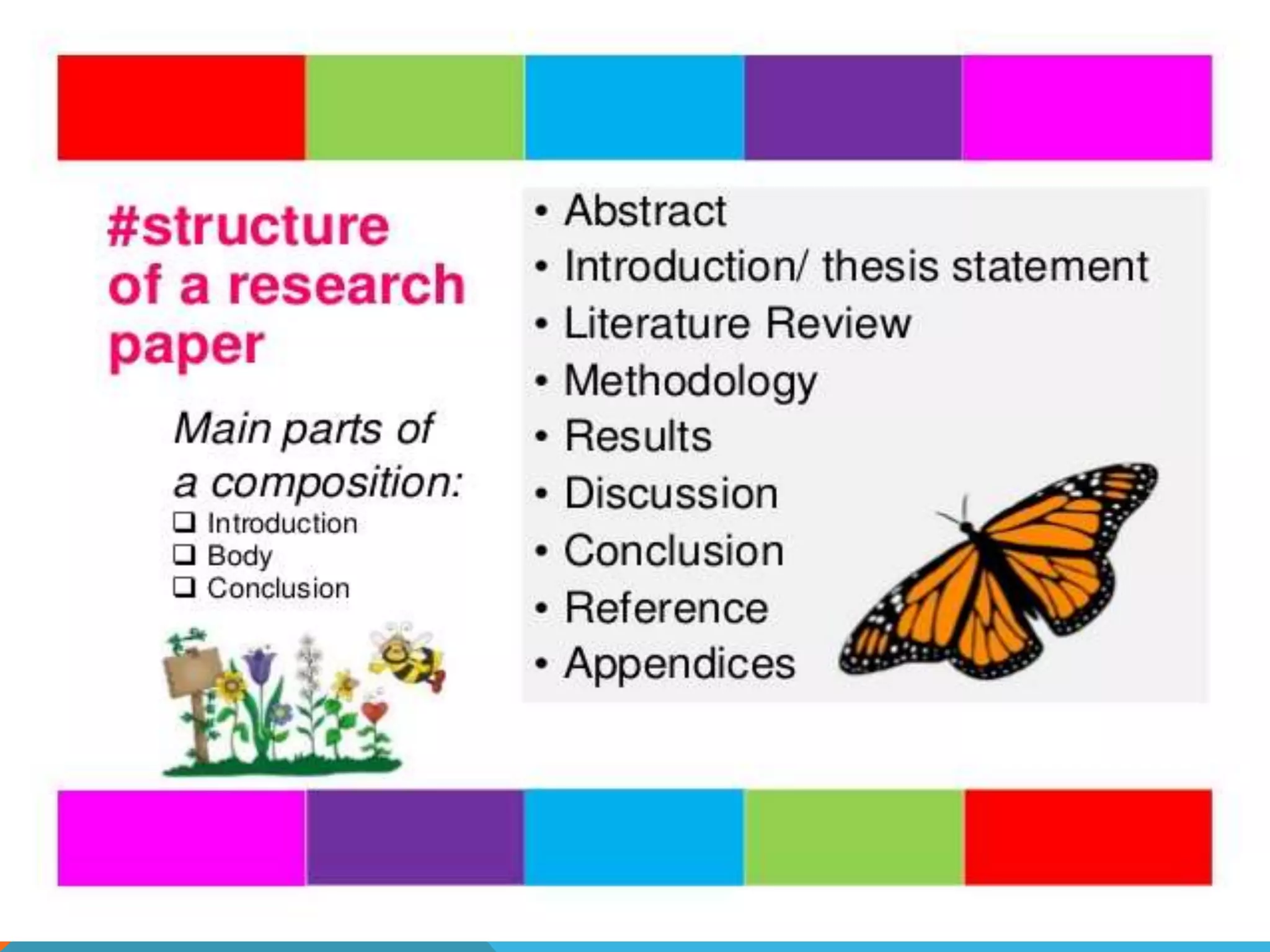
1Structure
II Substance
III Style
Iv Verbs
V Anthromorphosism
Writing a thesis very is simple, if you
know how?
• Substance
• Language of Research
• Style of writing
SUBSTANCE/ HOW TO START THESIS
• Begin at the beginning keep records
• Write with the reader in mind
• think, plan, write, revise
Write (your chapters) in four drafts:
(a) First: putting the facts together
(b) Second: checking for coherence and fluency of
ideas
(c) Third: readability
(d) Fourth: editing
• One word
• one line
• one sentence
• one paragraph
• one page
• one chapter.
STYLE: LANGUAGE
• Craft of writing good English
• Avoid Ambiguity and assure clarity
• Precision
• Brevity
• Punctuation
• The I/We Active/Passive controversy
• Spelling and grammar
USING APPROPRIATE WORDS
• Use formal vocabulary
● Use appropriate transitions
● Avoid Redundancy
● Beware of commonly misused words
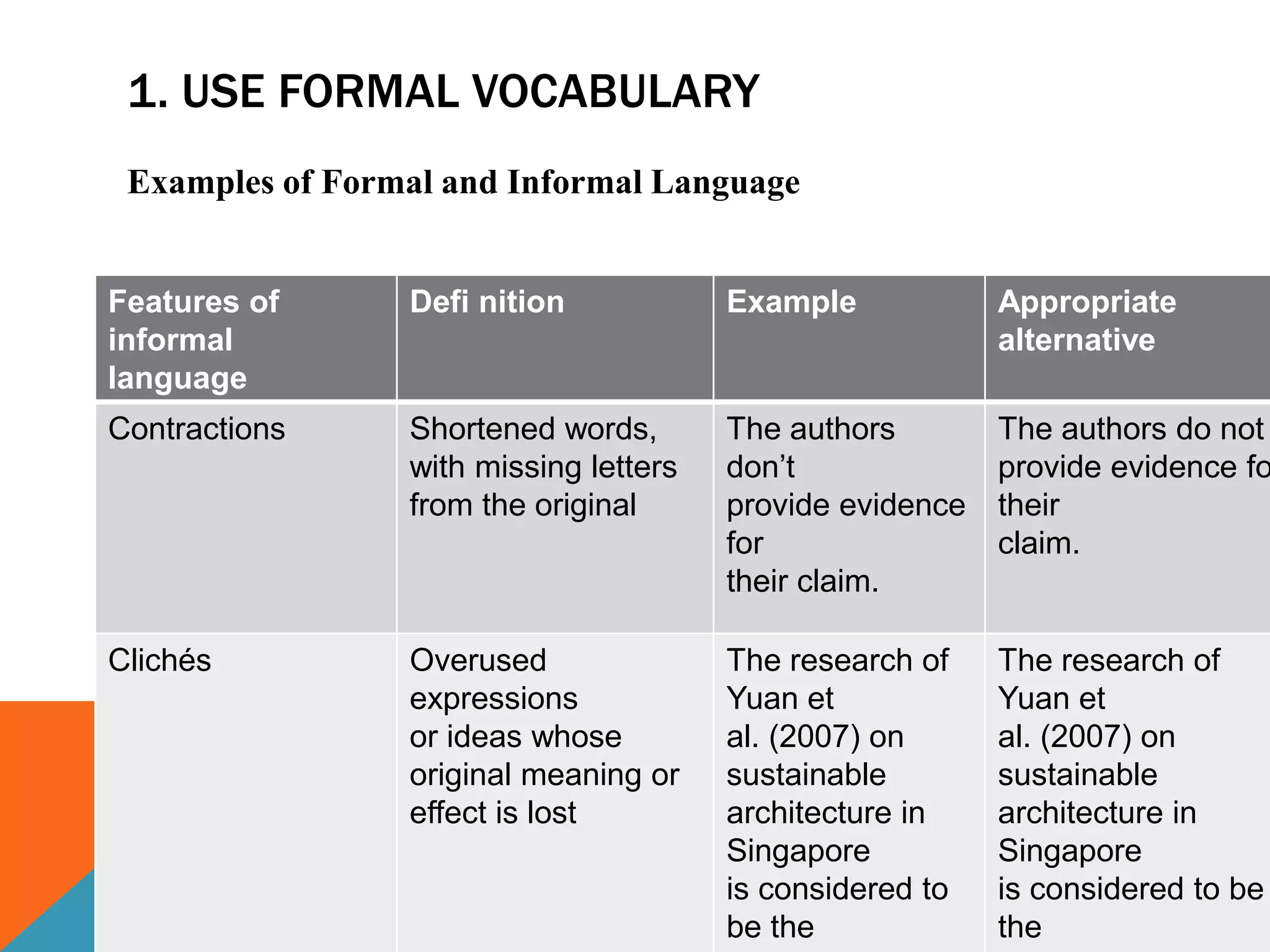
1. USE FORMAL VOCABULARY
Examples of Formal and Informal Language
Features of
informal
language
Defi nition Example Appropriate
alternative
Contractions Shortened words,
with missing letters
from the original
The authors
don’t
provide evidence
for
their claim.
The authors do not
provide evidence fo
their
claim.
Clichés Overused
expressions
or ideas whose
original meaning or
effect is lost
The research of
Yuan et
al. (2007) on
sustainable
architecture in
Singapore
is considered to
be the
The research of
Yuan et
al. (2007) on
sustainable
architecture in
Singapore
is considered to be
the
Characteristics of a Dull Paper/ Thesis
Sand-Jenson in Oikos 2007, 116 723 (C&E News Sept 10, 2007)
1. Avoid Focus
2. Avoid originality and personality
3. Do not indicate any potential implications
4. Omit necessary steps of reasoning
5. Use abbreviations and technical terms that only
specialists in the field can understand
6. Make it sound too serious with no significant
discussion
7. Focus only on statistics
8.Support every statement with a reference
HOW VERBS CHANGE YOUR MEANING
THROUGHOUT YOUR RESEARCH
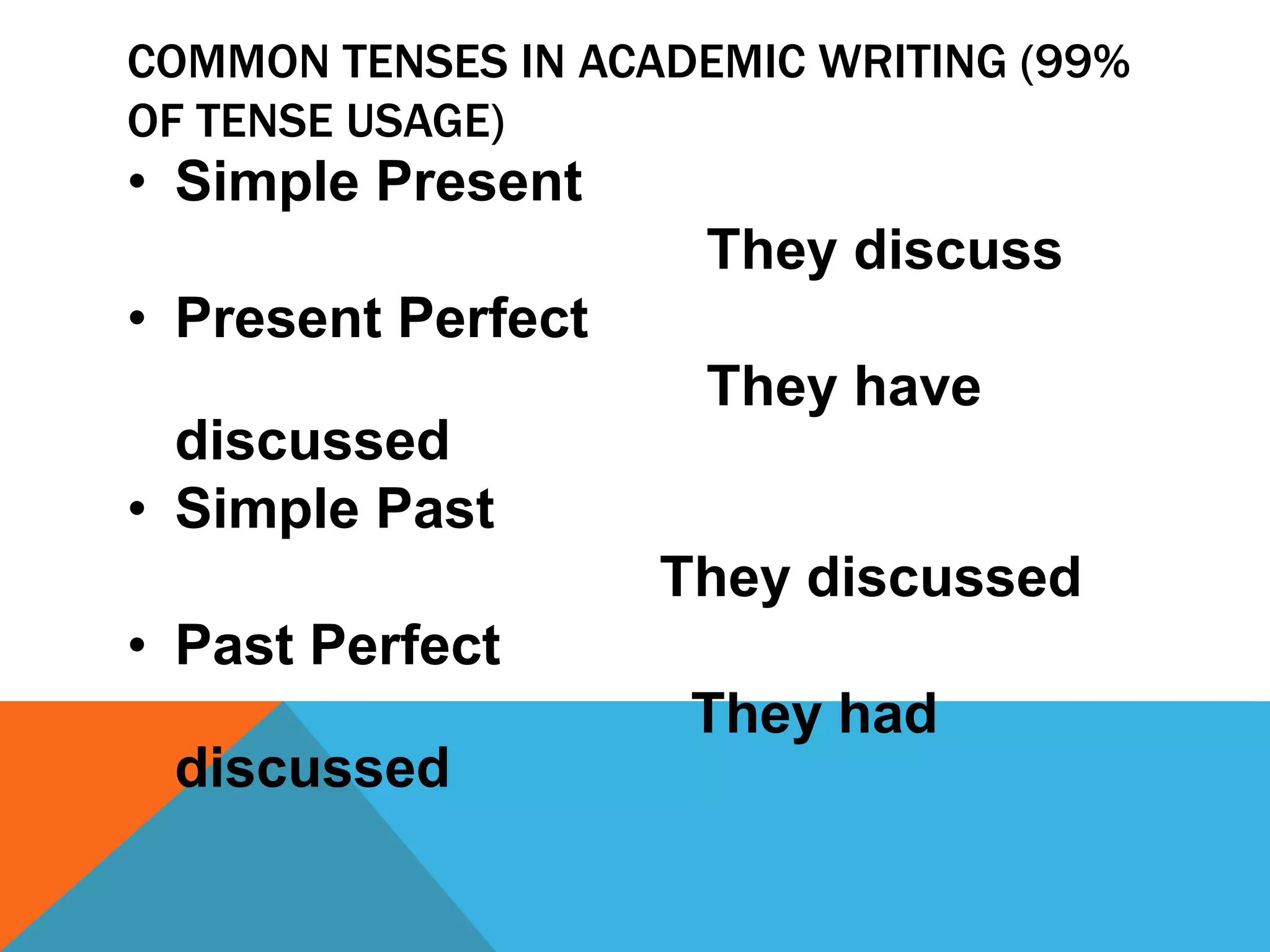
COMMON TENSES IN ACADEMIC WRITING (99%
OF TENSE USAGE)
• Simple Present
They discuss
• Present Perfect
They have
discussed
• Simple Past
They discussed
• Past Perfect
They had
discussed
USE THE PRESENT TENSE WHEN
STATING OR REFERRING TO AN
ESTABLISHED FACT
• Fine motor skills require integrating muscular,
skeletal, and neurological functions.
• The salt in most oceans is approximately 97%
sodium chloride (Ritchie, 1999).
HOW TO USE THE PAST TENSE
• Use the past tense when describing the
methods of your study.
A questionnaire was administered to
evaluate the current impact of nursing
innovation in neonatal intensive care units.
• Use the Past Tense when reporting data obtained
through your research or your literature review.
“One-third of Internet users in Europe were infected by malware in
2010.”
• When writing research-focused statements (referring to your
own study), use the past tense
“The purpose of this study was to determine whether or not a genetic
correlation exists between performance levels at high and low
temperatures.”
• When to Use the Present Perfect Tense
Use the present perfect tense when referring to
multiple previous studies.
Hahn et al. (2009) and Thomas (2010) have investigated
the economic performance and management quality of
banks in Taiwan.
How to Use the Future Tense
The future tense is rarely used in research thesis.
Possibly use for future work or projections
Should be used in proposals
OVERVIEW OF THE TENSES IN THE
INTRODUCTION
Stage one: Motivation starting with current
knowledge or previous studies - Present or
Present perfect tense
Stage two: Literature review - Present, Present
perfect, or Past tense
CONTINUE….
Stage Three: Knowledge gap – Present or
Present perfect tense
Stage Four: Problem statement – Present or
Past tense
Stage Five: Rationale for study – Tentative
present tense
TENSES USED FOR RESULTS
• Locating figures: Present tense
• Presenting the findings: Past tense
“Subjects in this study spent more time engaged
in activities that matched their interests and
skill levels.”
• Comparing results with the results of other studies:
Present tense and modals
• Commenting on results: Present tense and/or tentative
verbs
REPORTING VERBS FOR THE AIM OF
STUDY
• Investigate
• Examine
• Analyze
• Focus on
• Identify
• Report (on)
REPORTING VERBS FOR THE RESULTS
show (that)
find (that)
identify (x) as
reveal (that)
establish (that)
confirm (that)
conclude (that)
REPORTING VERBS FOR OPINION
state (that)
believe (that)
argue (that)
point out (that)
consider (that)
hold (that)
claim (that)
POOR REPORTING VERBS: MENTION
The verb 'mention' is unsuitable for reporting
the results of experiments and studies.
“Smith (2010) mentioned three factors which
can lead to obesity.”
The verb 'mention' makes the 'three factors'
seem unimportant and not supported by
evidence or analysis.
POOR REPORTING VERB: SAY
Can use 'say' to introduce a direct spoken
quotation.
“Johnson says that further research into the
causes of X is needed.”
Frequent use of the verb 'say' can make
writing informal.
POSITIVE REPORTING VERBS FOR
AGREEING WITH AN AUTHOR’S OPINION
• Acknowledges
• Affirms
• Certifies
• Explains
• Identifies
• Observes
NEGATIVE REPORTING VERBS FOR
DISAGREEING WITH AN AUTHOR’S OPINION
• Accuses
• Claims
• Guesses
• Proclaims
• Expects
• Hopes
EXAMPLES OF STRONG, NEUTRAL, AND WEAK
REPORTING VERBS BY FUNCTION
Verb Function: Agreement
Weaker position: admits, concedes
Neutral position: accepts,
acknowledges, agrees, concurs,
confirms, recognizes
Stronger position: applauds,
congratulates, extols, praises,
supports
VERB FUNCTION: DISAGREEMENT AND
QUESTIONING
Weaker position:
doubts, questions
Neutral position:
challenges, debates, disagrees, questions,
requests, wonders
Stronger position:
accuses, attacks, complains, contradicts, criticizes, denies,
discards, disclaims, discounts, dismisses, disputes,
disregards, negates, objects to, opposes, refutes, rejects
VERB FUNCTION: DISCUSSION
Weaker position: comments
Neutral position: discusses, explores
Stronger position: reasons
AVOID ANTHROPOMORPHISM
• “An interpretation of what is not human or personal
in terms of human or personal characteristics.”
(Merriam-Webster, 2010)
• "Do not attribute human characteristics to
nonhuman animals or to inanimate sources." (APA;
2010, section 3.09)
• Incorrect: “The National Education Association
(NEA) feels that school reform is inappropriate.”
• Correct: “Officials of the National Education
Association (NEA) feel that school reform is
inappropriate.”
SOME ANTHROPOMORPHISMS FOUND IN
STUDENT WRITING
• Incorrect: “The article discussed issues related to
CBU in TFT-LCDs.”
• Correct: “Rogers (2010) discussed issues related
to CBU in TFT-LCDs.”
Incorrect: “This experiment will attempt to
demonstrate that X can affect Y.”
Correct: “The purpose of this experiment is to
demonstrate that X can affect Y.”
CONTINUE….
Incorrect: “The statistics argued in favor of adding
X to Y.”
Correct: “The statistics indicated that X should be
added to Y.”
Incorrect: “The university wanted to discover a way
to increase student enrollment.”
Correct: “The university administrators wanted to
discover a way to increase student enrollment.”
Thanks for
Listening

Langauge of the research

  • 2.
    OUTLINE OF THEPRESENTATION 1Structure II Substance III Style Iv Verbs V Anthromorphosism
  • 4.
    Writing a thesisvery is simple, if you know how? • Substance • Language of Research • Style of writing
  • 6.
    SUBSTANCE/ HOW TOSTART THESIS • Begin at the beginning keep records • Write with the reader in mind • think, plan, write, revise Write (your chapters) in four drafts: (a) First: putting the facts together (b) Second: checking for coherence and fluency of ideas (c) Third: readability (d) Fourth: editing
  • 7.
    • One word •one line • one sentence • one paragraph • one page • one chapter.
  • 8.
    STYLE: LANGUAGE • Craftof writing good English • Avoid Ambiguity and assure clarity • Precision • Brevity • Punctuation • The I/We Active/Passive controversy • Spelling and grammar
  • 10.
    USING APPROPRIATE WORDS •Use formal vocabulary ● Use appropriate transitions ● Avoid Redundancy ● Beware of commonly misused words
  • 11.
    1. USE FORMALVOCABULARY Examples of Formal and Informal Language Features of informal language Defi nition Example Appropriate alternative Contractions Shortened words, with missing letters from the original The authors don’t provide evidence for their claim. The authors do not provide evidence fo their claim. Clichés Overused expressions or ideas whose original meaning or effect is lost The research of Yuan et al. (2007) on sustainable architecture in Singapore is considered to be the The research of Yuan et al. (2007) on sustainable architecture in Singapore is considered to be the
  • 14.
    Characteristics of aDull Paper/ Thesis Sand-Jenson in Oikos 2007, 116 723 (C&E News Sept 10, 2007) 1. Avoid Focus 2. Avoid originality and personality 3. Do not indicate any potential implications 4. Omit necessary steps of reasoning 5. Use abbreviations and technical terms that only specialists in the field can understand 6. Make it sound too serious with no significant discussion 7. Focus only on statistics 8.Support every statement with a reference
  • 15.
    HOW VERBS CHANGEYOUR MEANING THROUGHOUT YOUR RESEARCH
  • 16.
    COMMON TENSES INACADEMIC WRITING (99% OF TENSE USAGE) • Simple Present They discuss • Present Perfect They have discussed • Simple Past They discussed • Past Perfect They had discussed
  • 17.
    USE THE PRESENTTENSE WHEN STATING OR REFERRING TO AN ESTABLISHED FACT • Fine motor skills require integrating muscular, skeletal, and neurological functions. • The salt in most oceans is approximately 97% sodium chloride (Ritchie, 1999).
  • 18.
    HOW TO USETHE PAST TENSE • Use the past tense when describing the methods of your study. A questionnaire was administered to evaluate the current impact of nursing innovation in neonatal intensive care units.
  • 19.
    • Use thePast Tense when reporting data obtained through your research or your literature review. “One-third of Internet users in Europe were infected by malware in 2010.” • When writing research-focused statements (referring to your own study), use the past tense “The purpose of this study was to determine whether or not a genetic correlation exists between performance levels at high and low temperatures.”
  • 20.
    • When toUse the Present Perfect Tense Use the present perfect tense when referring to multiple previous studies. Hahn et al. (2009) and Thomas (2010) have investigated the economic performance and management quality of banks in Taiwan. How to Use the Future Tense The future tense is rarely used in research thesis. Possibly use for future work or projections Should be used in proposals
  • 21.
    OVERVIEW OF THETENSES IN THE INTRODUCTION Stage one: Motivation starting with current knowledge or previous studies - Present or Present perfect tense Stage two: Literature review - Present, Present perfect, or Past tense
  • 22.
    CONTINUE…. Stage Three: Knowledgegap – Present or Present perfect tense Stage Four: Problem statement – Present or Past tense Stage Five: Rationale for study – Tentative present tense
  • 23.
    TENSES USED FORRESULTS • Locating figures: Present tense • Presenting the findings: Past tense “Subjects in this study spent more time engaged in activities that matched their interests and skill levels.” • Comparing results with the results of other studies: Present tense and modals • Commenting on results: Present tense and/or tentative verbs
  • 24.
    REPORTING VERBS FORTHE AIM OF STUDY • Investigate • Examine • Analyze • Focus on • Identify • Report (on)
  • 25.
    REPORTING VERBS FORTHE RESULTS show (that) find (that) identify (x) as reveal (that) establish (that) confirm (that) conclude (that)
  • 26.
    REPORTING VERBS FOROPINION state (that) believe (that) argue (that) point out (that) consider (that) hold (that) claim (that)
  • 27.
    POOR REPORTING VERBS:MENTION The verb 'mention' is unsuitable for reporting the results of experiments and studies. “Smith (2010) mentioned three factors which can lead to obesity.” The verb 'mention' makes the 'three factors' seem unimportant and not supported by evidence or analysis.
  • 28.
    POOR REPORTING VERB:SAY Can use 'say' to introduce a direct spoken quotation. “Johnson says that further research into the causes of X is needed.” Frequent use of the verb 'say' can make writing informal.
  • 29.
    POSITIVE REPORTING VERBSFOR AGREEING WITH AN AUTHOR’S OPINION • Acknowledges • Affirms • Certifies • Explains • Identifies • Observes
  • 30.
    NEGATIVE REPORTING VERBSFOR DISAGREEING WITH AN AUTHOR’S OPINION • Accuses • Claims • Guesses • Proclaims • Expects • Hopes
  • 31.
    EXAMPLES OF STRONG,NEUTRAL, AND WEAK REPORTING VERBS BY FUNCTION Verb Function: Agreement Weaker position: admits, concedes Neutral position: accepts, acknowledges, agrees, concurs, confirms, recognizes Stronger position: applauds, congratulates, extols, praises, supports
  • 32.
    VERB FUNCTION: DISAGREEMENTAND QUESTIONING Weaker position: doubts, questions Neutral position: challenges, debates, disagrees, questions, requests, wonders Stronger position: accuses, attacks, complains, contradicts, criticizes, denies, discards, disclaims, discounts, dismisses, disputes, disregards, negates, objects to, opposes, refutes, rejects
  • 33.
    VERB FUNCTION: DISCUSSION Weakerposition: comments Neutral position: discusses, explores Stronger position: reasons
  • 34.
    AVOID ANTHROPOMORPHISM • “Aninterpretation of what is not human or personal in terms of human or personal characteristics.” (Merriam-Webster, 2010) • "Do not attribute human characteristics to nonhuman animals or to inanimate sources." (APA; 2010, section 3.09) • Incorrect: “The National Education Association (NEA) feels that school reform is inappropriate.” • Correct: “Officials of the National Education Association (NEA) feel that school reform is inappropriate.”
  • 35.
    SOME ANTHROPOMORPHISMS FOUNDIN STUDENT WRITING • Incorrect: “The article discussed issues related to CBU in TFT-LCDs.” • Correct: “Rogers (2010) discussed issues related to CBU in TFT-LCDs.” Incorrect: “This experiment will attempt to demonstrate that X can affect Y.” Correct: “The purpose of this experiment is to demonstrate that X can affect Y.”
  • 36.
    CONTINUE…. Incorrect: “The statisticsargued in favor of adding X to Y.” Correct: “The statistics indicated that X should be added to Y.” Incorrect: “The university wanted to discover a way to increase student enrollment.” Correct: “The university administrators wanted to discover a way to increase student enrollment.”
  • 37.

Editor's Notes