Academic English
Prepared by: Ari Najm Omar
6/12/2017
Academic English Definition
Academic English is the style of
language used in the fields of
education, science, technology, and
global connections. It is used by
teachers, students, postgraduates,
researchers, writers, columnists and
journalists (Ruiz-Garrido et al. 1-2).
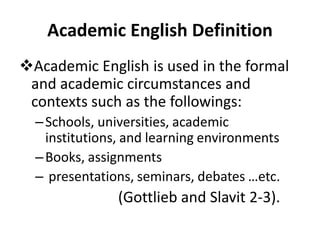
Academic English Definition
Academic English is used in the formal
and academic circumstances and
contexts such as the followings:
–Schools, universities, academic
institutions, and learning environments
–Books, assignments
– presentations, seminars, debates …etc.
(Gottlieb and Slavit 2-3).
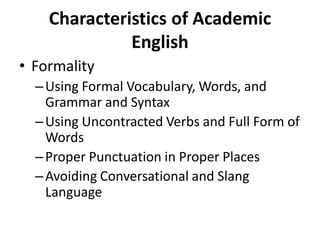
Characteristics of Academic
English
• Formality
–Using Formal Vocabulary, Words, and
Grammar and Syntax
–Using Uncontracted Verbs and Full Form of
Words
–Proper Punctuation in Proper Places
–Avoiding Conversational and Slang
Language
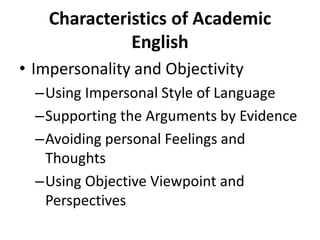
Characteristics of Academic
English
• Impersonality and Objectivity
–Using Impersonal Style of Language
–Supporting the Arguments by Evidence
–Avoiding personal Feelings and
Thoughts
–Using Objective Viewpoint and
Perspectives
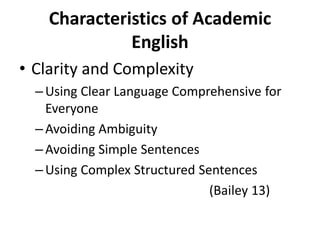
Characteristics of Academic
English
• Clarity and Complexity
– Using Clear Language Comprehensive for
Everyone
– Avoiding Ambiguity
– Avoiding Simple Sentences
– Using Complex Structured Sentences
(Bailey 13)
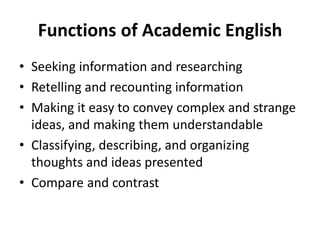
Functions of Academic English
• Seeking information and researching
• Retelling and recounting information
• Making it easy to convey complex and strange
ideas, and making them understandable
• Classifying, describing, and organizing
thoughts and ideas presented
• Compare and contrast
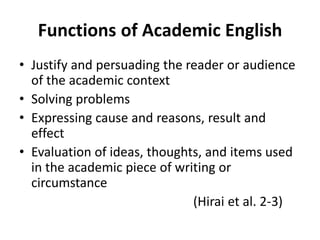
Functions of Academic English
• Justify and persuading the reader or audience
of the academic context
• Solving problems
• Expressing cause and reasons, result and
effect
• Evaluation of ideas, thoughts, and items used
in the academic piece of writing or
circumstance
(Hirai et al. 2-3)
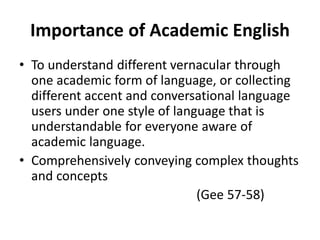
Importance of Academic English
• To understand different vernacular through
one academic form of language, or collecting
different accent and conversational language
users under one style of language that is
understandable for everyone aware of
academic language.
• Comprehensively conveying complex thoughts
and concepts
(Gee 57-58)
Importance of Academic English
• Expand students’ ability to understand
different topics easily
• Improving students’ ability to express and
present complex concepts
(Gottlieb and Slavit 30-31)
Works Cited
• Gottlieb, Margo & Gisela Ernst-Slavit. 2014.
Academic Language in Diverse Classroom.
London: Sage Publications.
• Gee, James Paul. “What is Academic
Language?”. In: Roseberry, Ann S. and Beth
Warren. Teaching Science to English Language
Learners. 2008. Arlington: National Science
Teachers Association.
Works Cited
• Bailey, Stephen. 2011. Academic Writing: A
Handbook for International Students. 3rd ed.
Abingdon: Routledge.
• Hirai, Debra L. Cook eta al. 2010. Academic
Language/Literacy Strategies for Adolescents.
Abingdon: Routledge.
• Ruiz-Garrido, M. F., Palmer-Silveira, J. C. and
Fortanet-Gómez I. 2010. English for Professional
and Academic Purposes. Amsterdam: Rodopi.

Academic english

  • 1.
    Academic English Prepared by:Ari Najm Omar 6/12/2017
  • 2.
    Academic English Definition AcademicEnglish is the style of language used in the fields of education, science, technology, and global connections. It is used by teachers, students, postgraduates, researchers, writers, columnists and journalists (Ruiz-Garrido et al. 1-2).
  • 3.
    Academic English Definition AcademicEnglish is used in the formal and academic circumstances and contexts such as the followings: –Schools, universities, academic institutions, and learning environments –Books, assignments – presentations, seminars, debates …etc. (Gottlieb and Slavit 2-3).
  • 4.
    Characteristics of Academic English •Formality –Using Formal Vocabulary, Words, and Grammar and Syntax –Using Uncontracted Verbs and Full Form of Words –Proper Punctuation in Proper Places –Avoiding Conversational and Slang Language
  • 5.
    Characteristics of Academic English •Impersonality and Objectivity –Using Impersonal Style of Language –Supporting the Arguments by Evidence –Avoiding personal Feelings and Thoughts –Using Objective Viewpoint and Perspectives
  • 6.
    Characteristics of Academic English •Clarity and Complexity – Using Clear Language Comprehensive for Everyone – Avoiding Ambiguity – Avoiding Simple Sentences – Using Complex Structured Sentences (Bailey 13)
  • 7.
    Functions of AcademicEnglish • Seeking information and researching • Retelling and recounting information • Making it easy to convey complex and strange ideas, and making them understandable • Classifying, describing, and organizing thoughts and ideas presented • Compare and contrast
  • 8.
    Functions of AcademicEnglish • Justify and persuading the reader or audience of the academic context • Solving problems • Expressing cause and reasons, result and effect • Evaluation of ideas, thoughts, and items used in the academic piece of writing or circumstance (Hirai et al. 2-3)
  • 9.
    Importance of AcademicEnglish • To understand different vernacular through one academic form of language, or collecting different accent and conversational language users under one style of language that is understandable for everyone aware of academic language. • Comprehensively conveying complex thoughts and concepts (Gee 57-58)
  • 10.
    Importance of AcademicEnglish • Expand students’ ability to understand different topics easily • Improving students’ ability to express and present complex concepts (Gottlieb and Slavit 30-31)
  • 11.
    Works Cited • Gottlieb,Margo & Gisela Ernst-Slavit. 2014. Academic Language in Diverse Classroom. London: Sage Publications. • Gee, James Paul. “What is Academic Language?”. In: Roseberry, Ann S. and Beth Warren. Teaching Science to English Language Learners. 2008. Arlington: National Science Teachers Association.
  • 12.
    Works Cited • Bailey,Stephen. 2011. Academic Writing: A Handbook for International Students. 3rd ed. Abingdon: Routledge. • Hirai, Debra L. Cook eta al. 2010. Academic Language/Literacy Strategies for Adolescents. Abingdon: Routledge. • Ruiz-Garrido, M. F., Palmer-Silveira, J. C. and Fortanet-Gómez I. 2010. English for Professional and Academic Purposes. Amsterdam: Rodopi.