Basic Uses of
Punctuation in
English
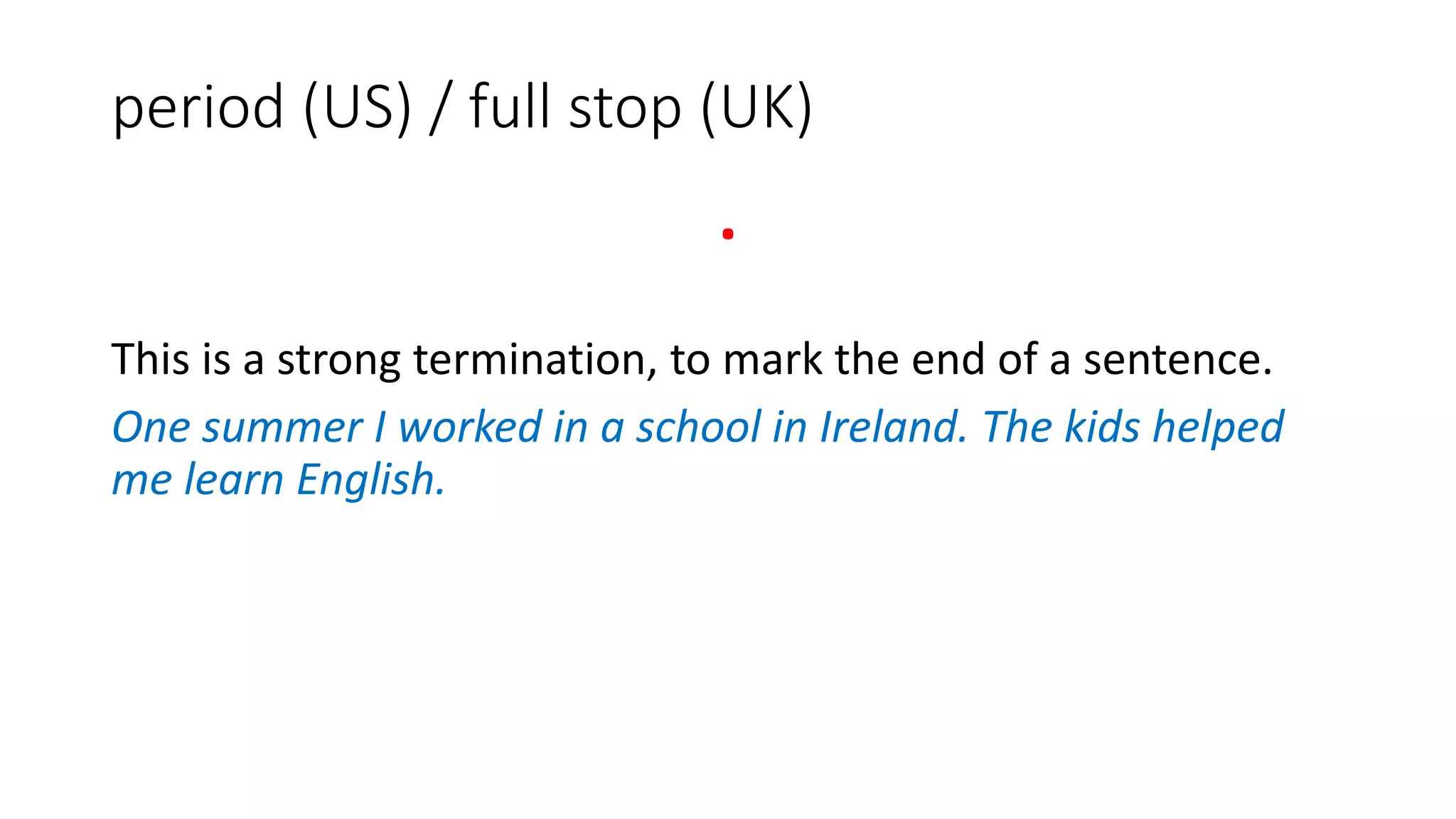
period (US) / full stop (UK)
.
This is a strong termination, to mark the end of a sentence.
One summer I worked in a school in Ireland. The kids helped
me learn English.
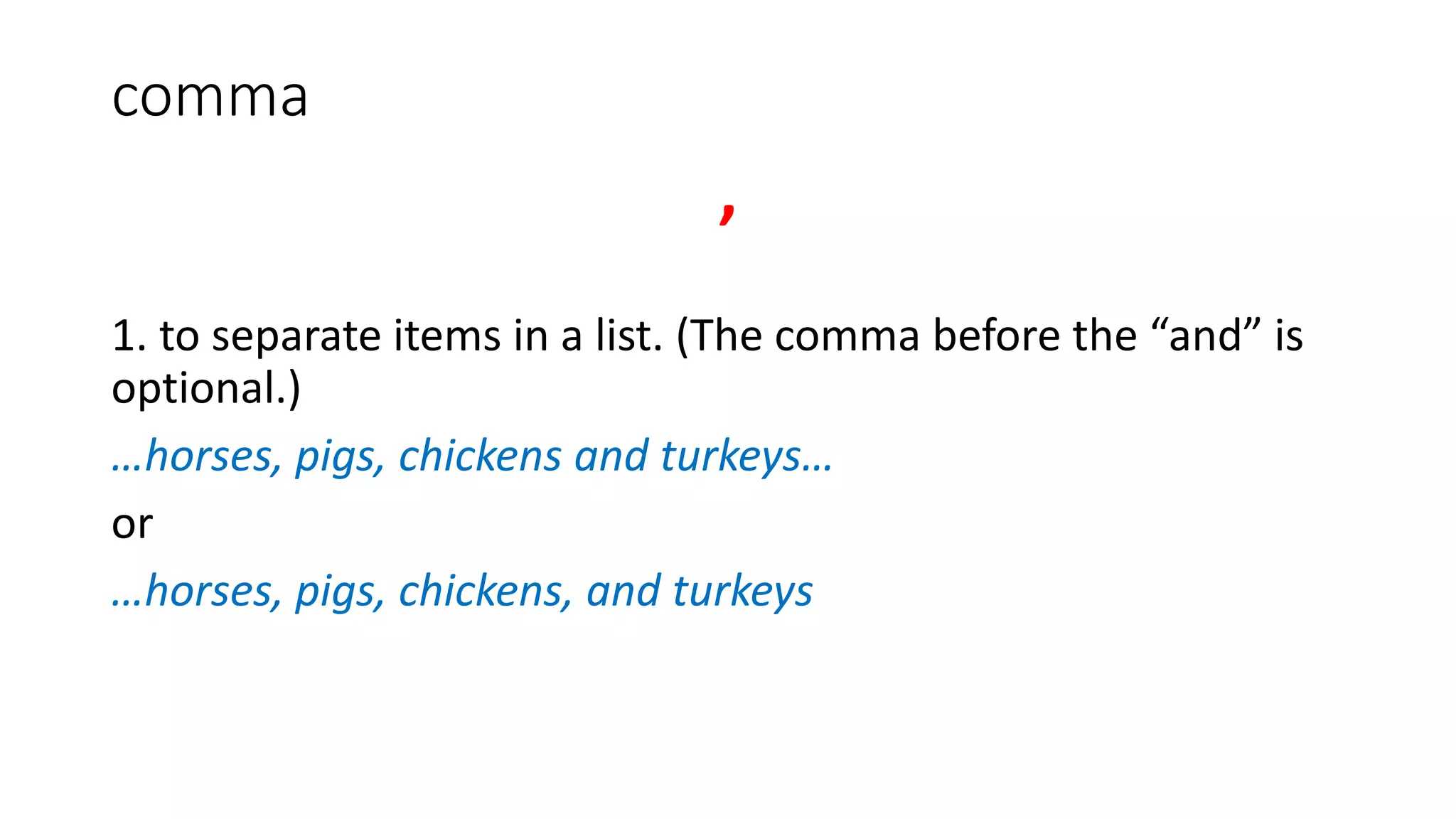
comma
,
1. to separate items in a list. (The comma before the “and” is
optional.)
…horses, pigs, chickens and turkeys…
or
…horses, pigs, chickens, and turkeys
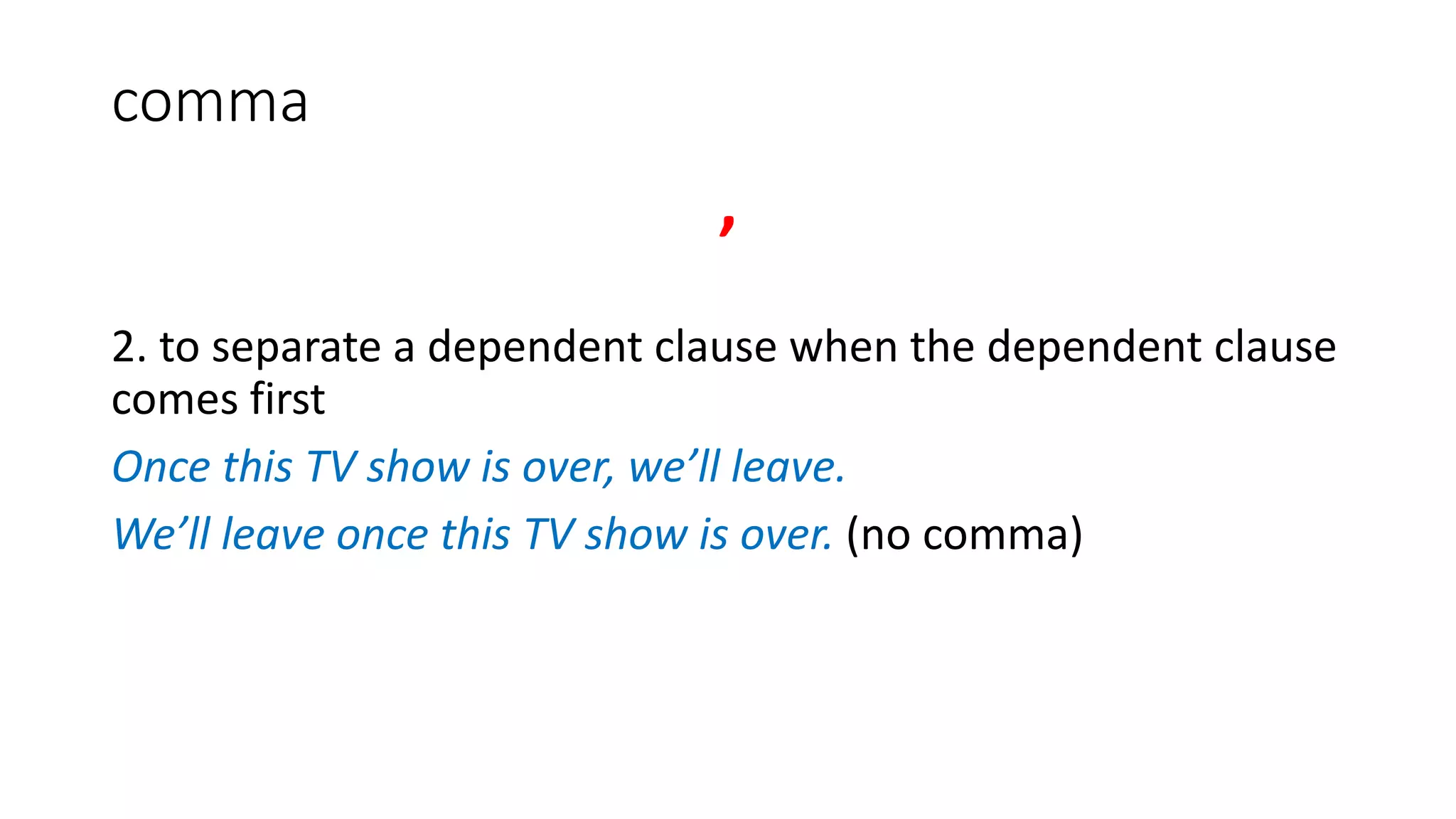
comma
,
2. to separate a dependent clause when the dependent clause
comes first
Once this TV show is over, we’ll leave.
We’ll leave once this TV show is over. (no comma)
comma
,
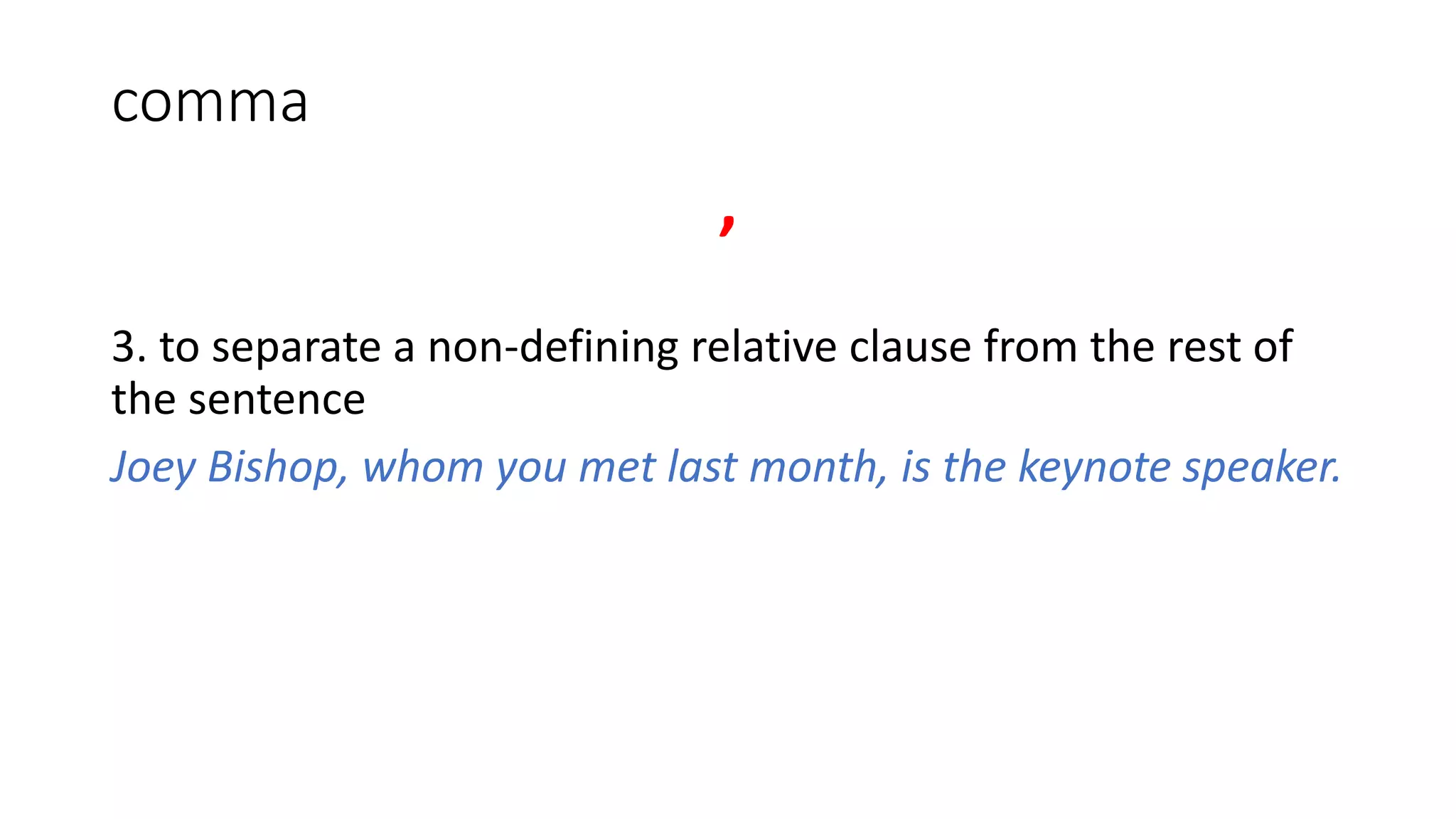
3. to separate a non-defining relative clause from the rest of
the sentence
Joey Bishop, whom you met last month, is the keynote speaker.
comma
,
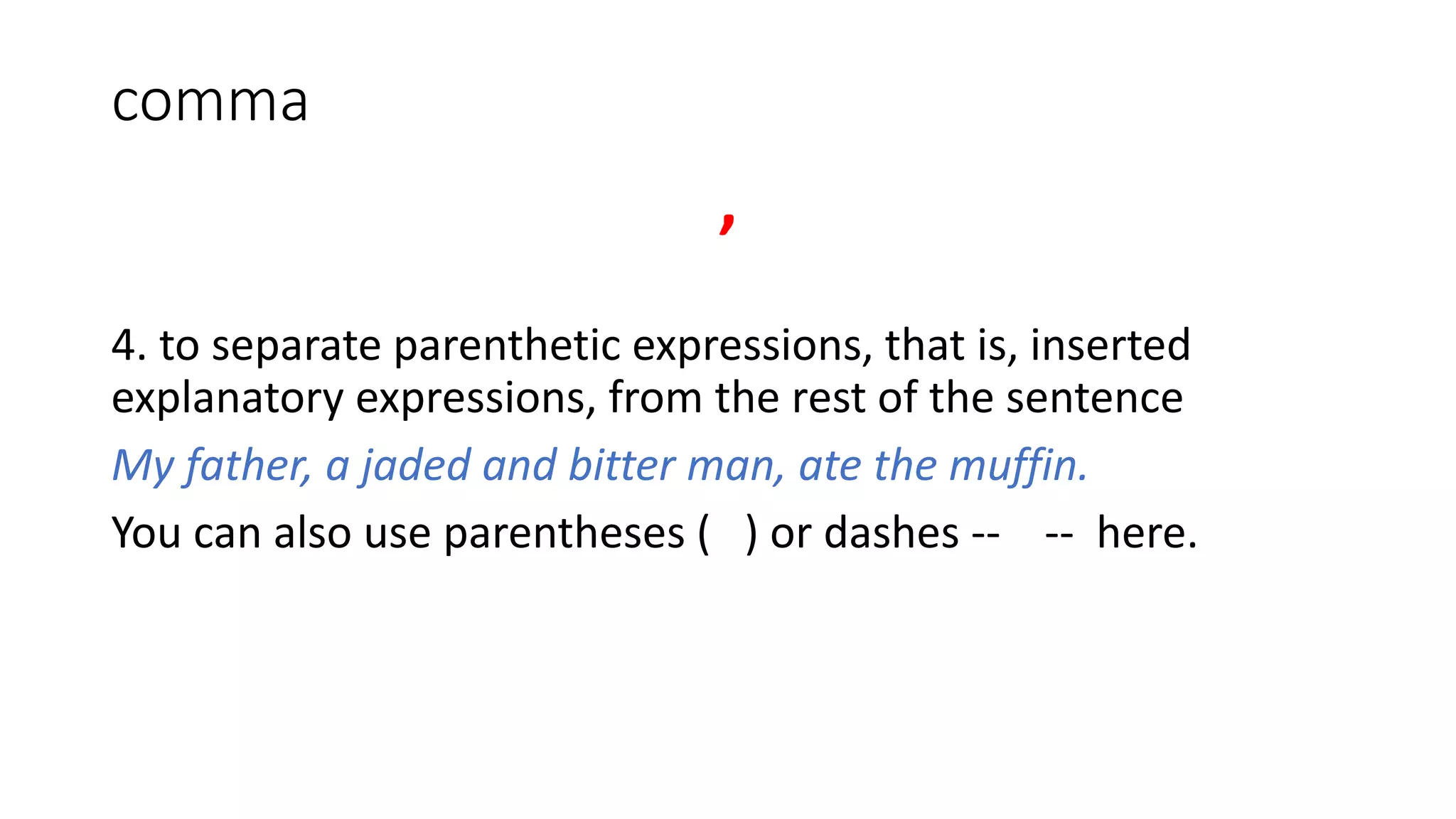
4. to separate parenthetic expressions, that is, inserted
explanatory expressions, from the rest of the sentence
My father, a jaded and bitter man, ate the muffin.
You can also use parentheses ( ) or dashes -- -- here.
comma
,
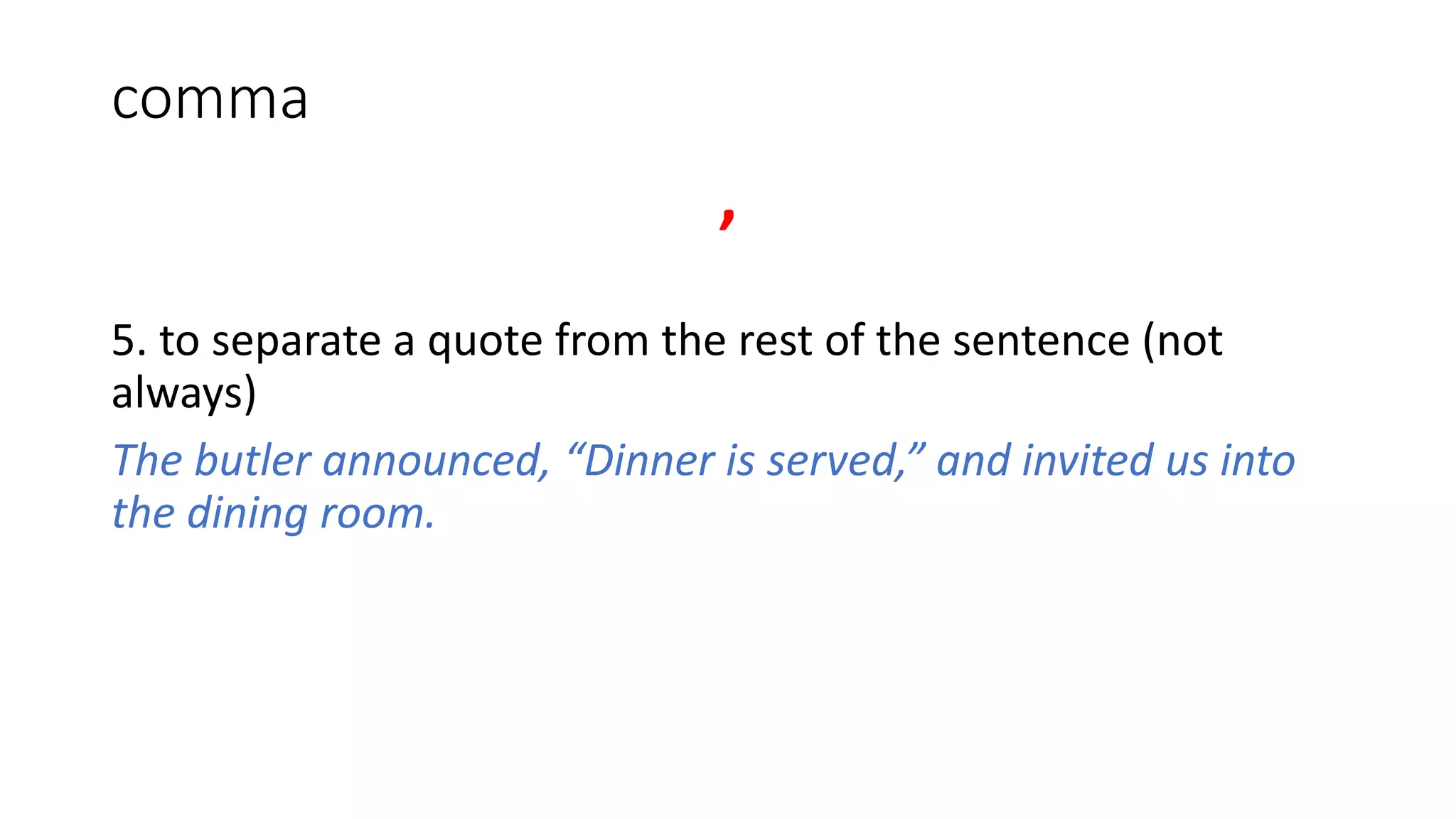
5. to separate a quote from the rest of the sentence (not
always)
The butler announced, “Dinner is served,” and invited us into
the dining room.
comma
,
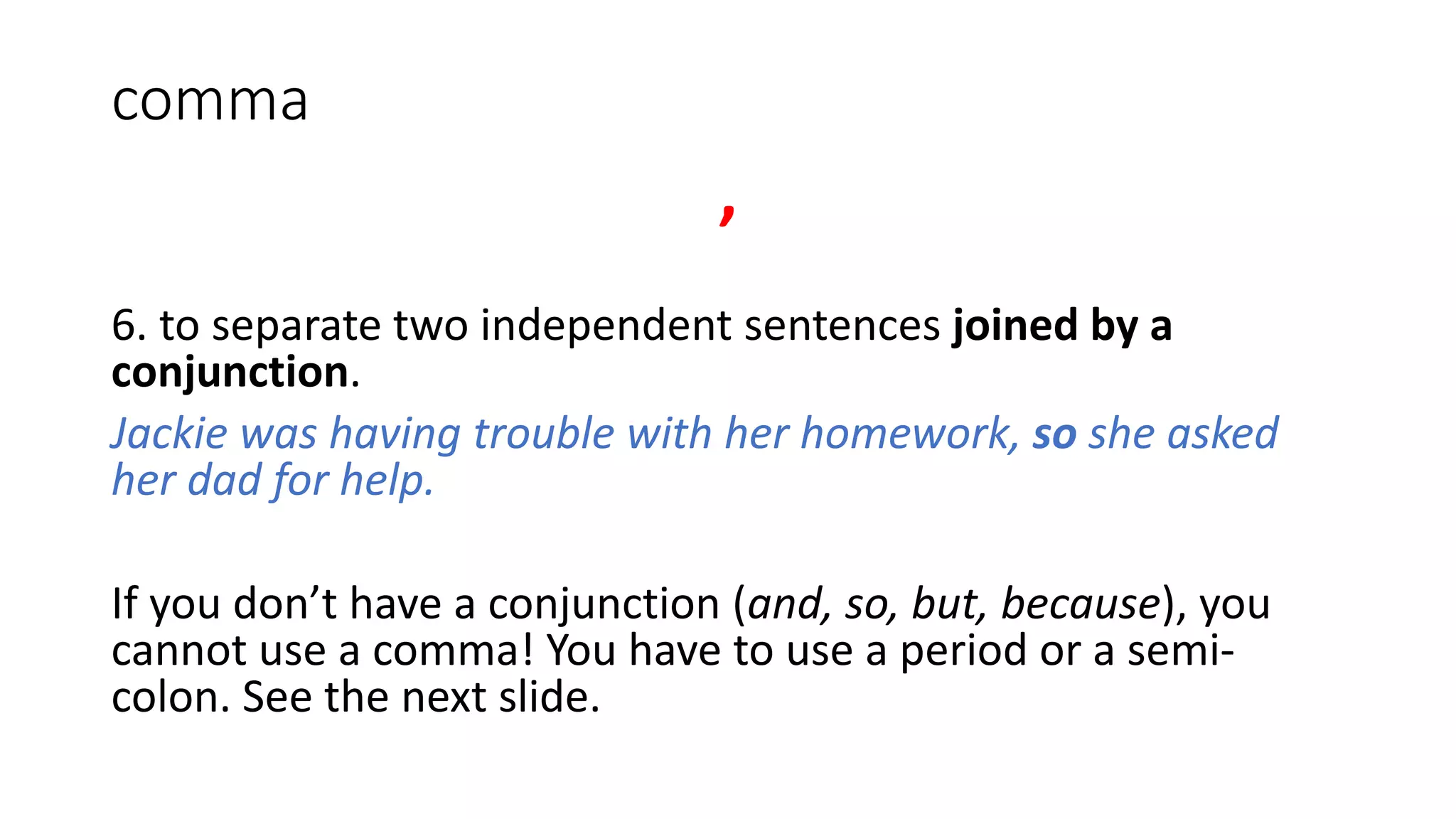
6. to separate two independent sentences joined by a
conjunction.
Jackie was having trouble with her homework, so she asked
her dad for help.
If you don’t have a conjunction (and, so, but, because), you
cannot use a comma! You have to use a period or a semi-
colon. See the next slide.
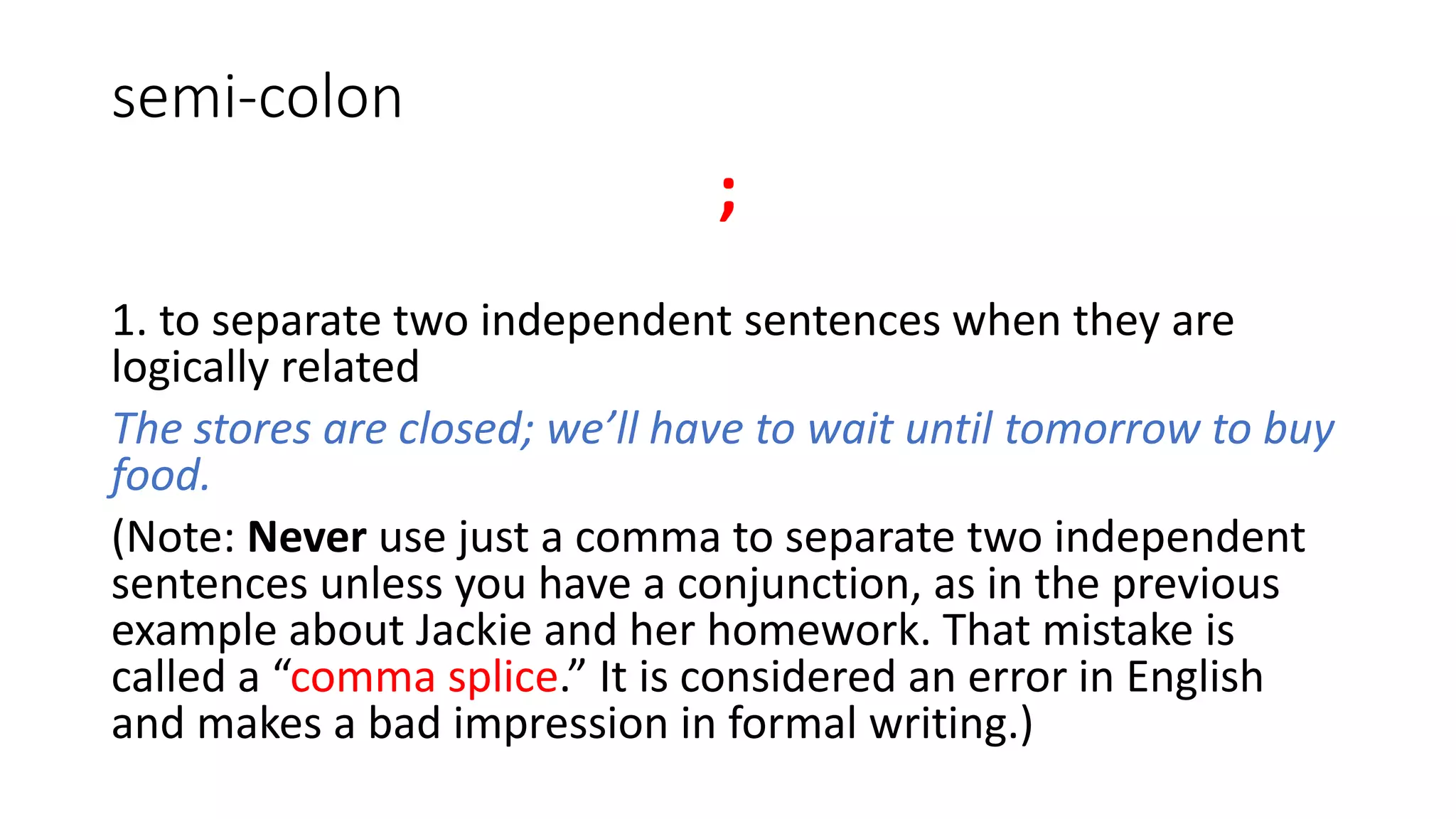
semi-colon
;
1. to separate two independent sentences when they are
logically related
The stores are closed; we’ll have to wait until tomorrow to buy
food.
(Note: Never use just a comma to separate two independent
sentences unless you have a conjunction, as in the previous
example about Jackie and her homework. That mistake is
called a “comma splice.” It is considered an error in English
and makes a bad impression in formal writing.)
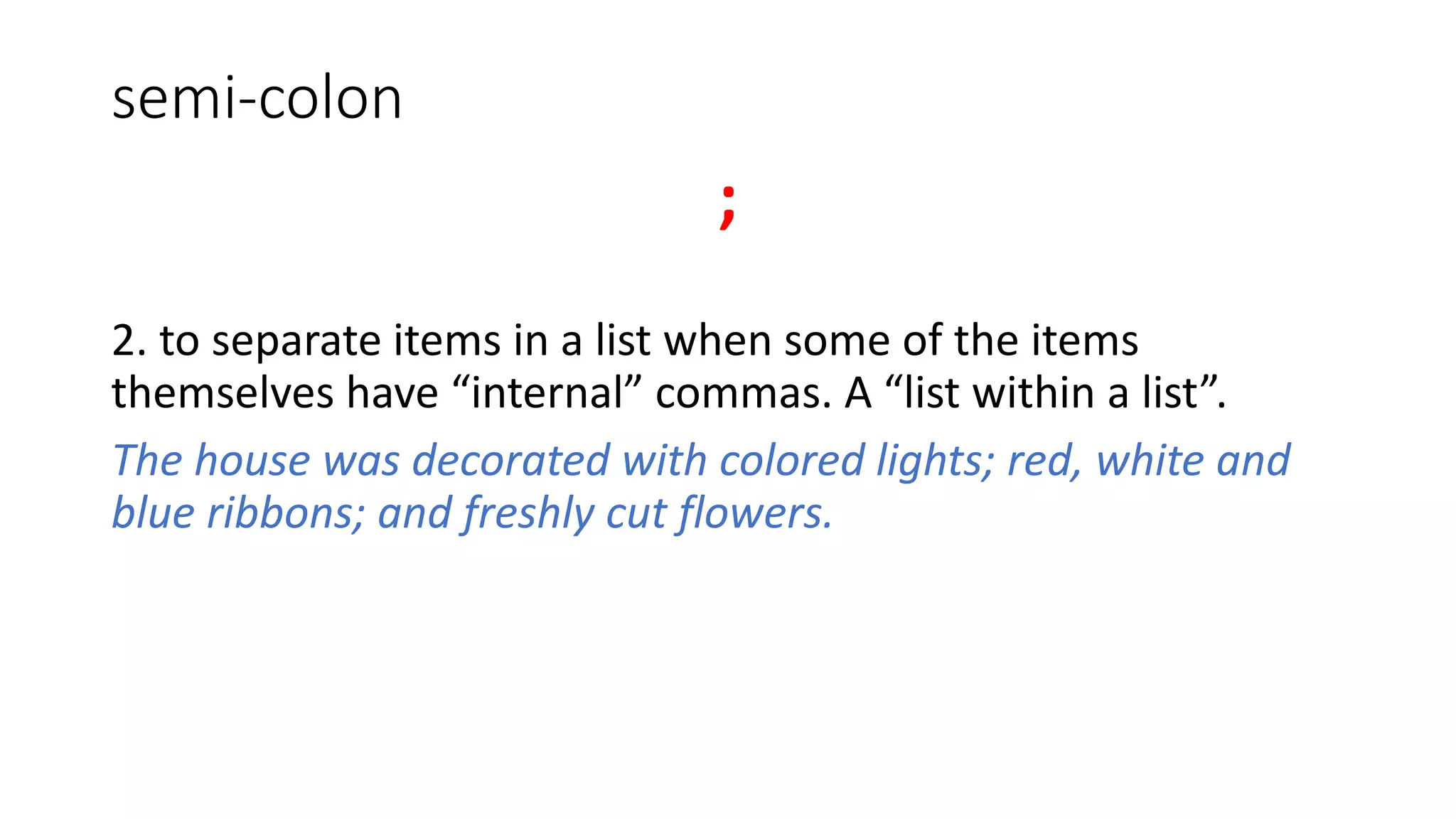
semi-colon
;
2. to separate items in a list when some of the items
themselves have “internal” commas. A “list within a list”.
The house was decorated with colored lights; red, white and
blue ribbons; and freshly cut flowers.
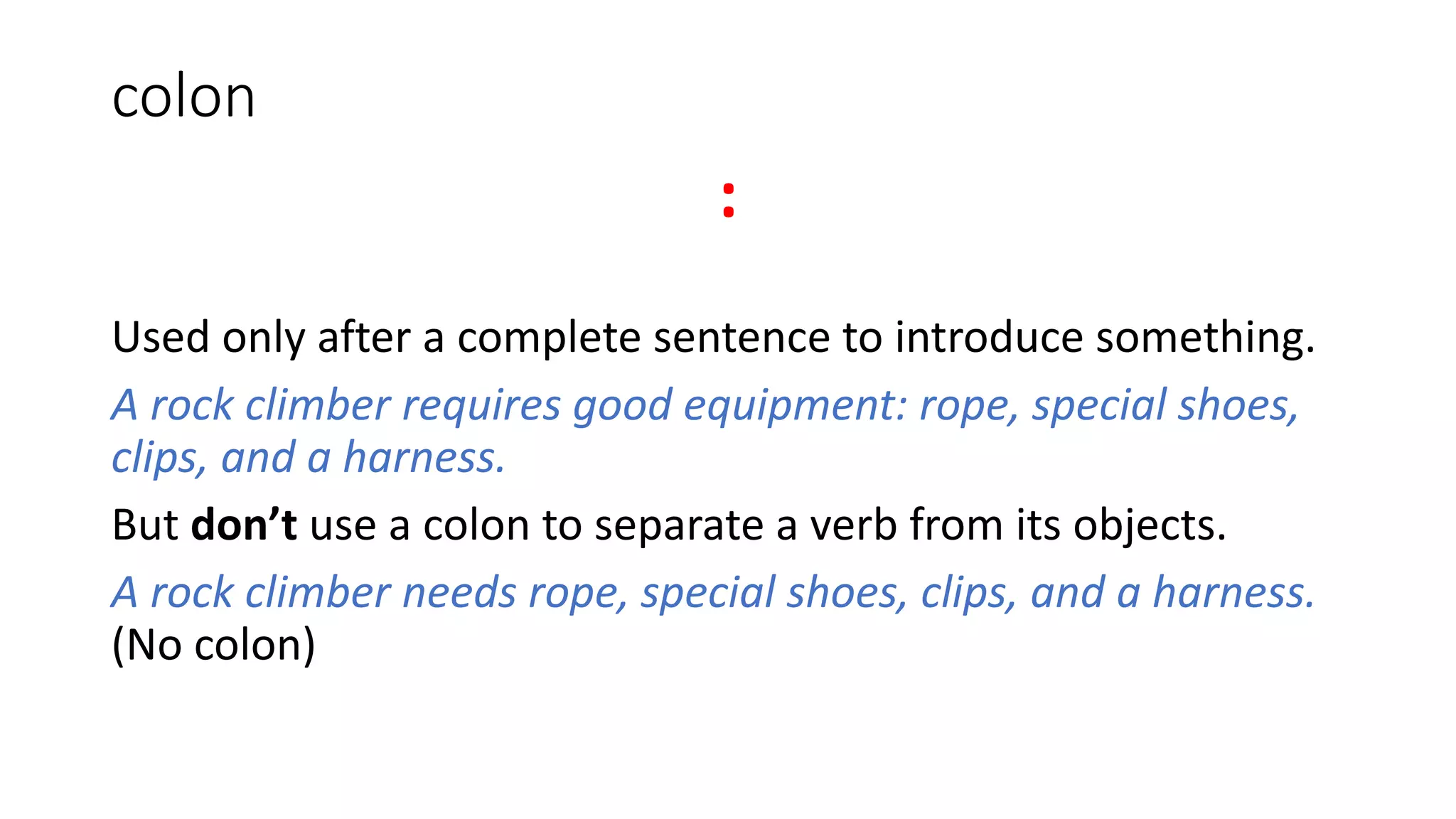
colon
:
Used only after a complete sentence to introduce something.
A rock climber requires good equipment: rope, special shoes,
clips, and a harness.
But don’t use a colon to separate a verb from its objects.
A rock climber needs rope, special shoes, clips, and a harness.
(No colon)
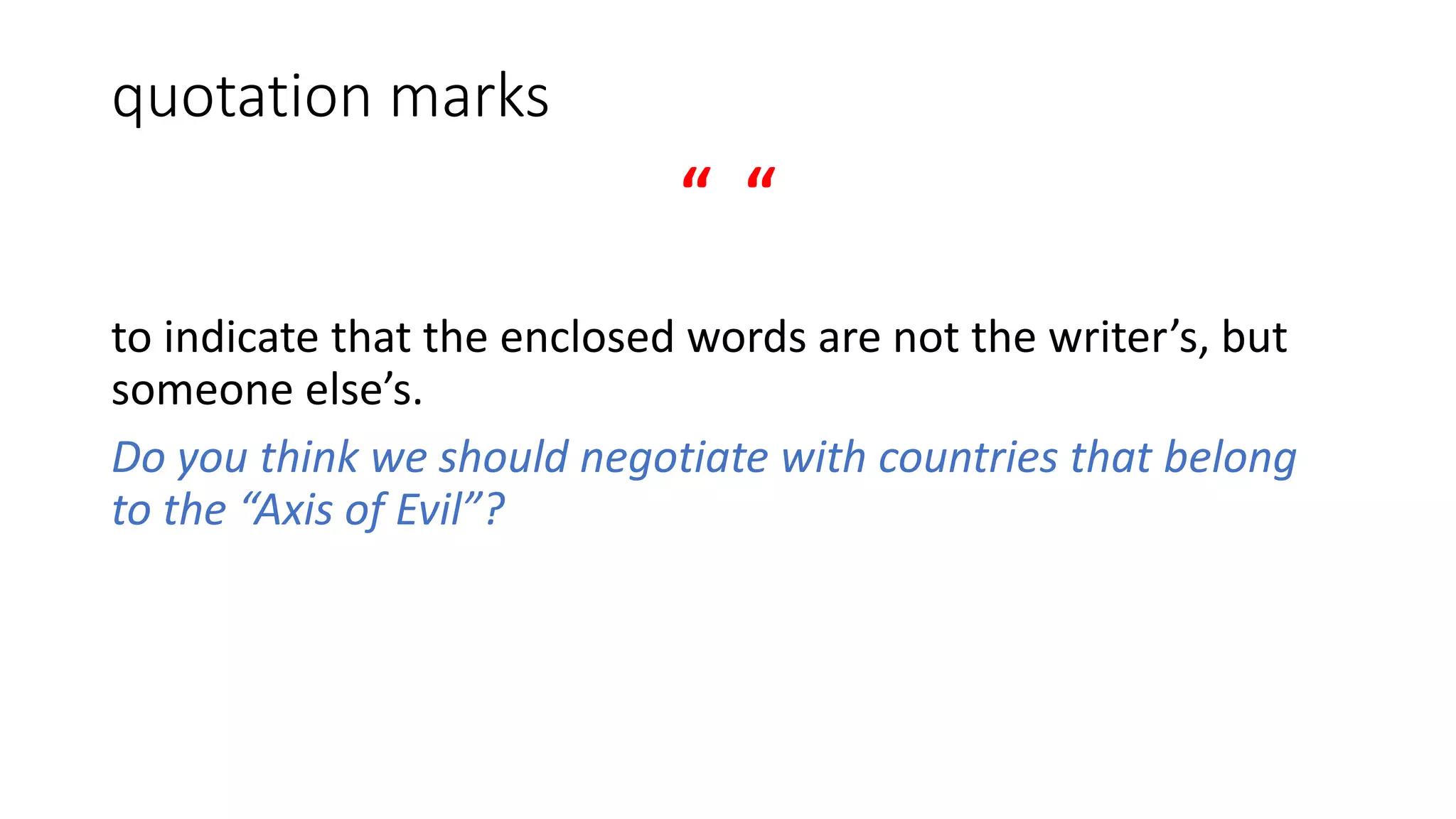
quotation marks
“ “
to indicate that the enclosed words are not the writer’s, but
someone else’s.
Do you think we should negotiate with countries that belong
to the “Axis of Evil”?
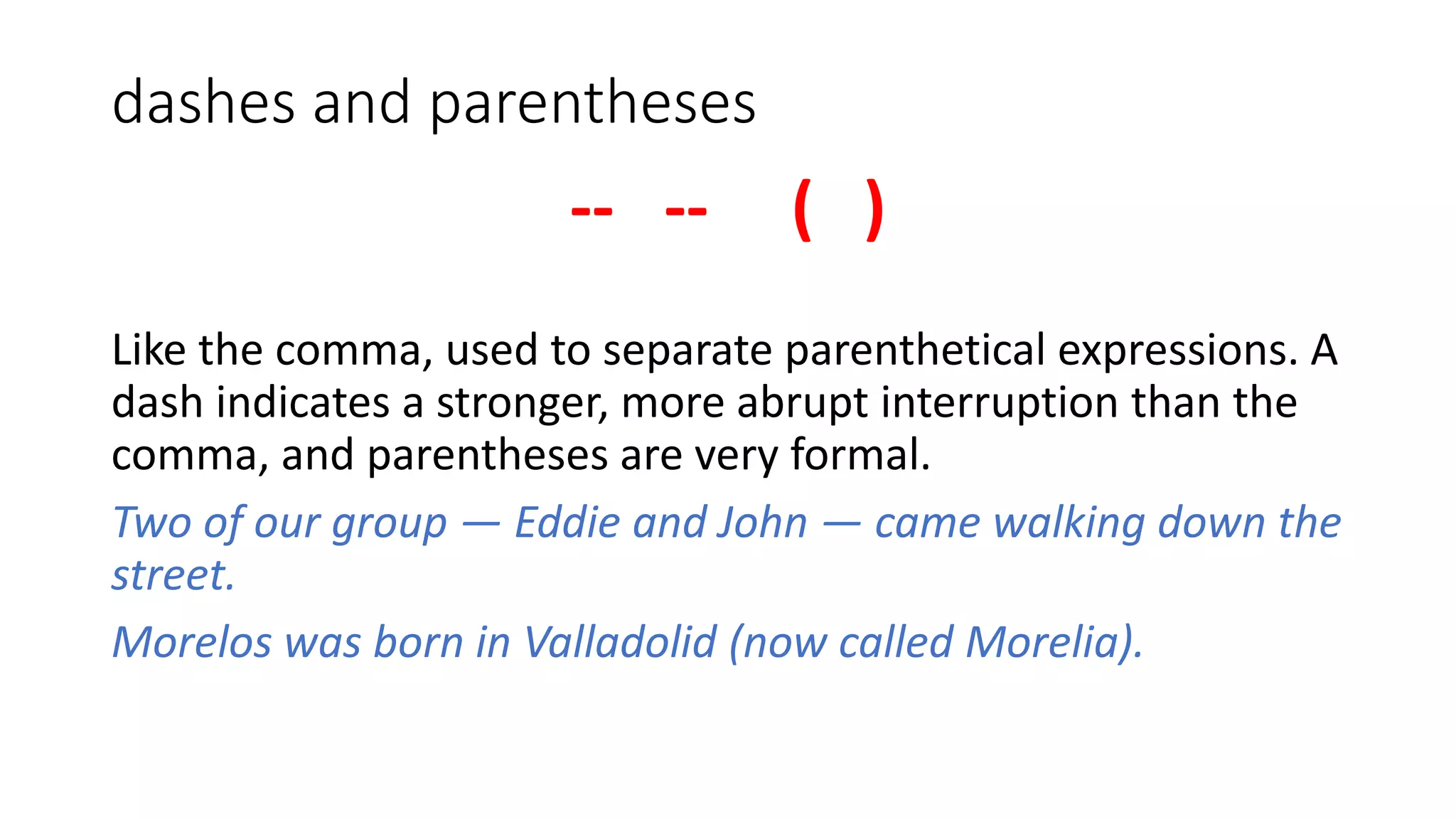
dashes and parentheses
-- -- ( )
Like the comma, used to separate parenthetical expressions. A
dash indicates a stronger, more abrupt interruption than the
comma, and parentheses are very formal.
Two of our group — Eddie and John — came walking down the
street.
Morelos was born in Valladolid (now called Morelia).
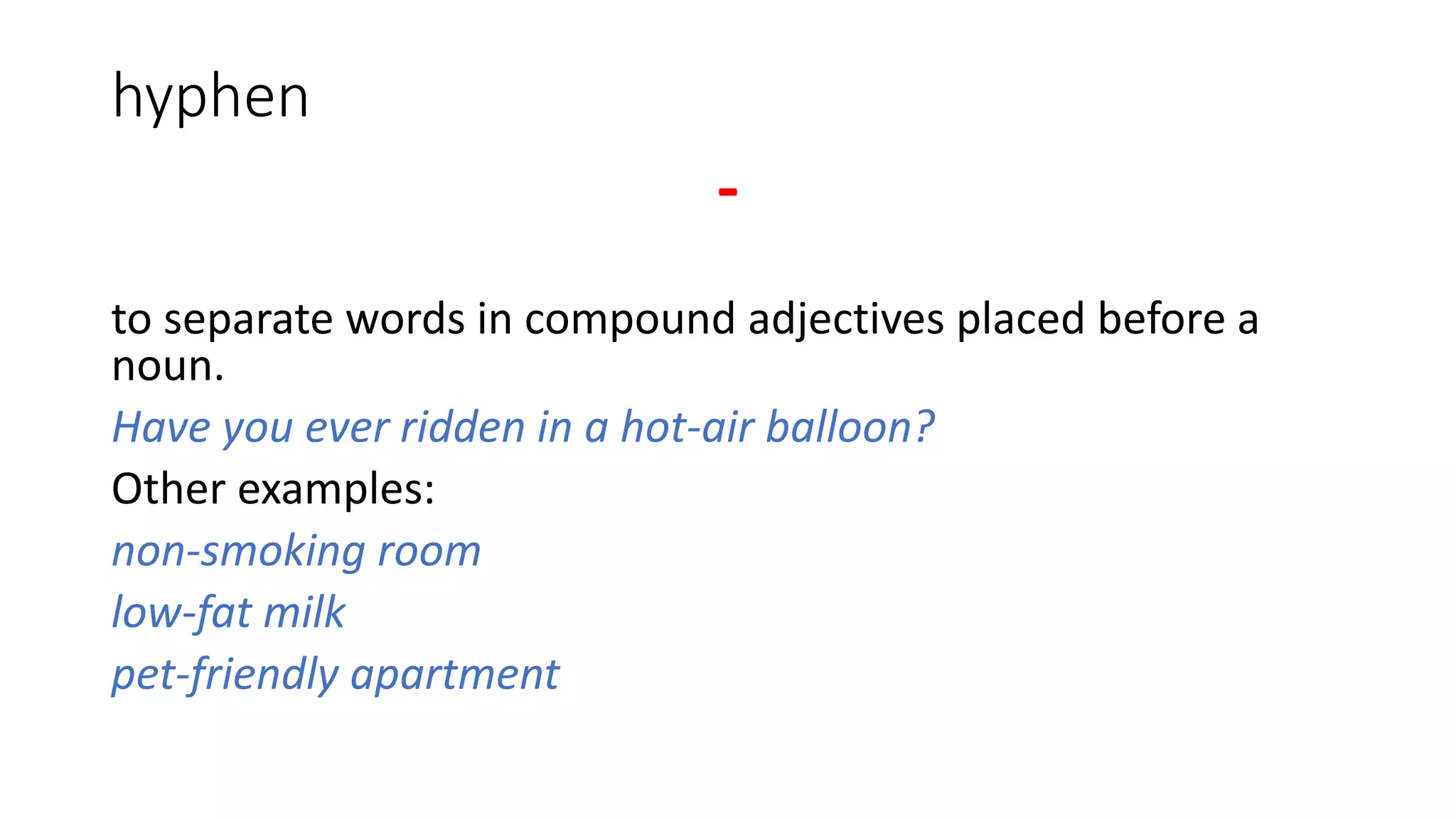
hyphen
-
to separate words in compound adjectives placed before a
noun.
Have you ever ridden in a hot-air balloon?
Other examples:
non-smoking room
low-fat milk
pet-friendly apartment

Basic uses of punctuation

  • 1.
  • 2.
    period (US) /full stop (UK) . This is a strong termination, to mark the end of a sentence. One summer I worked in a school in Ireland. The kids helped me learn English.
  • 3.
    comma , 1. to separateitems in a list. (The comma before the “and” is optional.) …horses, pigs, chickens and turkeys… or …horses, pigs, chickens, and turkeys
  • 4.
    comma , 2. to separatea dependent clause when the dependent clause comes first Once this TV show is over, we’ll leave. We’ll leave once this TV show is over. (no comma)
  • 5.
    comma , 3. to separatea non-defining relative clause from the rest of the sentence Joey Bishop, whom you met last month, is the keynote speaker.
  • 6.
    comma , 4. to separateparenthetic expressions, that is, inserted explanatory expressions, from the rest of the sentence My father, a jaded and bitter man, ate the muffin. You can also use parentheses ( ) or dashes -- -- here.
  • 7.
    comma , 5. to separatea quote from the rest of the sentence (not always) The butler announced, “Dinner is served,” and invited us into the dining room.
  • 8.
    comma , 6. to separatetwo independent sentences joined by a conjunction. Jackie was having trouble with her homework, so she asked her dad for help. If you don’t have a conjunction (and, so, but, because), you cannot use a comma! You have to use a period or a semi- colon. See the next slide.
  • 9.
    semi-colon ; 1. to separatetwo independent sentences when they are logically related The stores are closed; we’ll have to wait until tomorrow to buy food. (Note: Never use just a comma to separate two independent sentences unless you have a conjunction, as in the previous example about Jackie and her homework. That mistake is called a “comma splice.” It is considered an error in English and makes a bad impression in formal writing.)
  • 10.
    semi-colon ; 2. to separateitems in a list when some of the items themselves have “internal” commas. A “list within a list”. The house was decorated with colored lights; red, white and blue ribbons; and freshly cut flowers.
  • 11.
    colon : Used only aftera complete sentence to introduce something. A rock climber requires good equipment: rope, special shoes, clips, and a harness. But don’t use a colon to separate a verb from its objects. A rock climber needs rope, special shoes, clips, and a harness. (No colon)
  • 12.
    quotation marks “ “ toindicate that the enclosed words are not the writer’s, but someone else’s. Do you think we should negotiate with countries that belong to the “Axis of Evil”?
  • 13.
    dashes and parentheses ---- ( ) Like the comma, used to separate parenthetical expressions. A dash indicates a stronger, more abrupt interruption than the comma, and parentheses are very formal. Two of our group — Eddie and John — came walking down the street. Morelos was born in Valladolid (now called Morelia).
  • 14.
    hyphen - to separate wordsin compound adjectives placed before a noun. Have you ever ridden in a hot-air balloon? Other examples: non-smoking room low-fat milk pet-friendly apartment