Discussant: Amalia D. Aquino
Educ 501
Dr . Rodolfo E. Acosta
WHAT IS ACADEMIC
FREEDOM?
To pursue knowledge wherever it may lead,
without undue or unreasonable interference
Freedom granted to
academic institutions to
determine professional
standards for the
academy.
Freedom of teachers and students
to teach, study, and pursue
knowledge and research without
unreasonable interference or
restriction from law, institutional
regulations, or public pressure.
Freedom granted to
faculty to research
and teach according
to their interests.
PURPOSE OF ACADEMIC FREEDOM
1. Freedom of inquiry by students and faculty
members is essential to the mission of the
academy; it is essential for the advance of
science and therefore it is important for the
whole society.
2. Scholarship cannot flourish in an atmosphere
of suspicion and distrust. Teachers and
students must always remain free to inquire, to
study and to evaluate.
3. Guarantee academics as a bastion of free
speech and thought, independent of the
politics and public sentiments of the day.
4. Academic freedom is intended to ensure that
professors are free to perform sensible
research and voice reasonable views
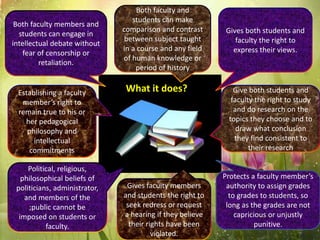
Protects a faculty member’s
authority to assign grades
to grades to students, so
long as the grades are not
capricious or unjustly
punitive.
Give both students and
faculty the right to study
and do research on the
topics they choose and to
draw what conclusion
they find consistent to
their research
Establishing a faculty
member’s right to
remain true to his or
her pedagogical
philosophy and
intellectual
commitments
Both faculty and
students can make
comparison and contrast
between subject taught
in a course and any field
of human knowledge or
period of history
Gives both students and
faculty the right to
express their views.
Both faculty members and
students can engage in
intellectual debate without
fear of censorship or
retaliation.
Political, religious,
philosophical beliefs of
politicians, administrator,
and members of the
;public cannot be
imposed on students or
faculty.
Gives faculty members
and students the right to
seek redress or request
a hearing if they believe
their rights have been
violated.
What it does?
What It
Doesn’t
Do?
Academic freedom does not
mean a faculty member can
harass, threaten, intimidate,
ridicule, or impose his or her
views on students.Students academic
freedom does not deny
faculty members the right
to require students to
master course material
and the fundamentals of
the disciplines that faculty
teach.
Neither academic freedom
nor tenure protects an
incompetent teacher from
losing his or her job. Thus, it
does not grant an
unqualified of lifetime
employment.
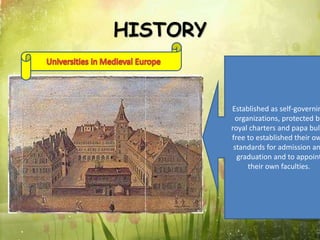
HISTORY
Established as self-governin
organizations, protected by
royal charters and papa bull
free to established their ow
standards for admission an
graduation and to appoint
their own faculties.
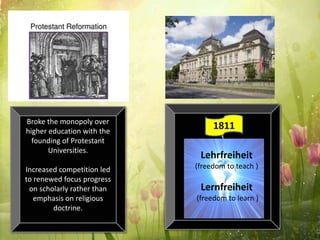
1
Broke the monopoly over
higher education with the
founding of Protestant
Universities.
Increased competition led
to renewed focus progress
on scholarly rather than
emphasis on religious
doctrine.
Lehrfreiheit
(freedom to teach )
Lernfreiheit
(freedom to learn )
1811
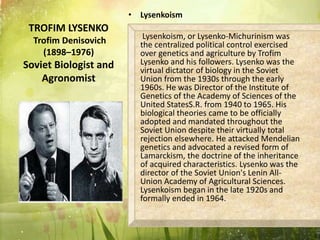
TROFIM LYSENKO
Trofim Denisovich
(1898–1976)
Soviet Biologist and
Agronomist
• Lysenkoism
Lysenkoism, or Lysenko-Michurinism was
the centralized political control exercised
over genetics and agriculture by Trofim
Lysenko and his followers. Lysenko was the
virtual dictator of biology in the Soviet
Union from the 1930s through the early
1960s. He was Director of the Institute of
Genetics of the Academy of Sciences of the
United StatesS.R. from 1940 to 1965. His
biological theories came to be officially
adopted and mandated throughout the
Soviet Union despite their virtually total
rejection elsewhere. He attacked Mendelian
genetics and advocated a revised form of
Lamarckism, the doctrine of the inheritance
of acquired characteristics. Lysenko was the
director of the Soviet Union's Lenin All-
Union Academy of Agricultural Sciences.
Lysenkoism began in the late 1920s and
formally ended in 1964.
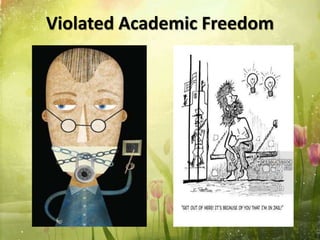
Violated Academic Freedom
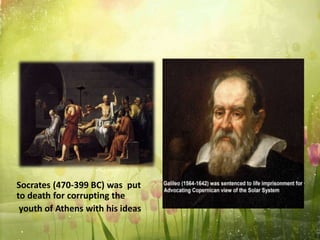
Socrates (470-399 BC) was put
to death for corrupting the
youth of Athens with his ideas
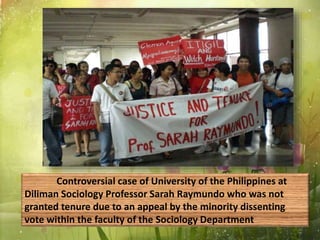
Controversial case of University of the Philippines at
Diliman Sociology Professor Sarah Raymundo who was not
granted tenure due to an appeal by the minority dissenting
vote within the faculty of the Sociology Department
Academic Freedom
of students
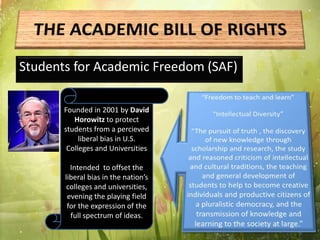
Students for Academic Freedom (SAF)
Founded in 2001 by David
Horowitz to protect
students from a percieved
liberal bias in U.S.
Colleges and Universities
Intended to offset the
liberal bias in the nation’s
colleges and universities,
evening the playing field
for the expression of the
full spectrum of ideas.
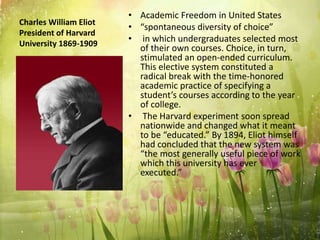
Charles William Eliot
President of Harvard
University 1869-1909
• Academic Freedom in United States
• “spontaneous diversity of choice”
• in which undergraduates selected most
of their own courses. Choice, in turn,
stimulated an open-ended curriculum.
This elective system constituted a
radical break with the time-honored
academic practice of specifying a
student’s courses according to the year
of college.
• The Harvard experiment soon spread
nationwide and changed what it meant
to be “educated.” By 1894, Eliot himself
had concluded that the new system was
“the most generally useful piece of work
which this university has ever
executed.”
In the U.S.
Students academic freedom is legitimately
regulated by the faculty’s freedom to determine
which viewpoints are supported by scholarly
standards, peer view, and established norms in
their disciplines.
“ The professor in the classroom should
encourage free discussion, inquiry and
expression. Student performance should be
evaluated solely on academic basis, not on
opinions or conduct in matters unrelated to
academic standards.”
- Pertinent to classroom discussion and subject
matter.
- Not expressed in a disruptive manner
or
- Silent
- Passive
- Non- disruptive
Academic Freedom
FACULTY
“ Teachers are entitled to freedom in the
classroom in discussing their subjects, but
they should be careful not to introduced into
their teaching controversial matter that has no
relation to their subject. Limitation of
academic freedom because of religious or
other aims of the institution should be clearly
stated in writing at the time of the
appointment” (AAUP)
In United States
Academic Freedom is derived from the guarantee of
free speech under the first Amendment; the
constitutions of other countries typically grant a
separate right to free learning, teaching and research.
1940 Academic Freedom & Tenure
“ Teachers are entitled to freedom in the
classroom in discussing their subjects”
AcademicFreedom
Colleges and
Universities
 The curriculum belongs to the institution, not
the faculty.
The institution can demand certain standards
of teaching and evaluate the faculty against
those standards.
The admission process belongs to the
institution, not the faculty.
For Colleges and Universities
• English University
concept.
The freedom to
appoint faculty, set
standards and admit
students.
The Supreme Court of the
United States
“ Four essential freedoms”
Who may teach?
What may be taught?
How it should be taught?
Who may be admitted to
study?
Academic Freedom has two main principles:
• “that academics, both inside and outside the
classroom, have unrestricted liberty to question and
test received wisdom and to put forward controversial
and unpopular opinions, whether or not these are
deemed offensive”
• That academic institutions have no right to curb the
exercise of this freedom by member of their staff, or to
use it as grounds for disciplinary action or dismissal.
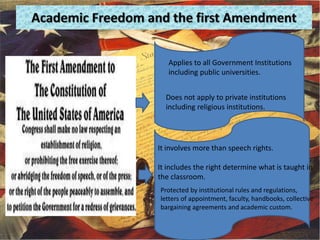
Applies to all Government Institutions
including public universities.
Does not apply to private institutions
including religious institutions.
It involves more than speech rights.
It includes the right determine what is taught in
the classroom.
Protected by institutional rules and regulations,
letters of appointment, faculty, handbooks, collective
bargaining agreements and academic custom.

Academic freedom

  • 1.
    Discussant: Amalia D.Aquino Educ 501 Dr . Rodolfo E. Acosta
  • 2.
    WHAT IS ACADEMIC FREEDOM? Topursue knowledge wherever it may lead, without undue or unreasonable interference Freedom granted to academic institutions to determine professional standards for the academy. Freedom of teachers and students to teach, study, and pursue knowledge and research without unreasonable interference or restriction from law, institutional regulations, or public pressure. Freedom granted to faculty to research and teach according to their interests.
  • 3.
    PURPOSE OF ACADEMICFREEDOM 1. Freedom of inquiry by students and faculty members is essential to the mission of the academy; it is essential for the advance of science and therefore it is important for the whole society. 2. Scholarship cannot flourish in an atmosphere of suspicion and distrust. Teachers and students must always remain free to inquire, to study and to evaluate. 3. Guarantee academics as a bastion of free speech and thought, independent of the politics and public sentiments of the day. 4. Academic freedom is intended to ensure that professors are free to perform sensible research and voice reasonable views
  • 4.
    Protects a facultymember’s authority to assign grades to grades to students, so long as the grades are not capricious or unjustly punitive. Give both students and faculty the right to study and do research on the topics they choose and to draw what conclusion they find consistent to their research Establishing a faculty member’s right to remain true to his or her pedagogical philosophy and intellectual commitments Both faculty and students can make comparison and contrast between subject taught in a course and any field of human knowledge or period of history Gives both students and faculty the right to express their views. Both faculty members and students can engage in intellectual debate without fear of censorship or retaliation. Political, religious, philosophical beliefs of politicians, administrator, and members of the ;public cannot be imposed on students or faculty. Gives faculty members and students the right to seek redress or request a hearing if they believe their rights have been violated. What it does?
  • 5.
    What It Doesn’t Do? Academic freedomdoes not mean a faculty member can harass, threaten, intimidate, ridicule, or impose his or her views on students.Students academic freedom does not deny faculty members the right to require students to master course material and the fundamentals of the disciplines that faculty teach. Neither academic freedom nor tenure protects an incompetent teacher from losing his or her job. Thus, it does not grant an unqualified of lifetime employment.
  • 6.
    HISTORY Established as self-governin organizations,protected by royal charters and papa bull free to established their ow standards for admission an graduation and to appoint their own faculties.
  • 7.
    1 Broke the monopolyover higher education with the founding of Protestant Universities. Increased competition led to renewed focus progress on scholarly rather than emphasis on religious doctrine. Lehrfreiheit (freedom to teach ) Lernfreiheit (freedom to learn ) 1811
  • 8.
    TROFIM LYSENKO Trofim Denisovich (1898–1976) SovietBiologist and Agronomist • Lysenkoism Lysenkoism, or Lysenko-Michurinism was the centralized political control exercised over genetics and agriculture by Trofim Lysenko and his followers. Lysenko was the virtual dictator of biology in the Soviet Union from the 1930s through the early 1960s. He was Director of the Institute of Genetics of the Academy of Sciences of the United StatesS.R. from 1940 to 1965. His biological theories came to be officially adopted and mandated throughout the Soviet Union despite their virtually total rejection elsewhere. He attacked Mendelian genetics and advocated a revised form of Lamarckism, the doctrine of the inheritance of acquired characteristics. Lysenko was the director of the Soviet Union's Lenin All- Union Academy of Agricultural Sciences. Lysenkoism began in the late 1920s and formally ended in 1964.
  • 9.
  • 10.
    Socrates (470-399 BC)was put to death for corrupting the youth of Athens with his ideas
  • 12.
    Controversial case ofUniversity of the Philippines at Diliman Sociology Professor Sarah Raymundo who was not granted tenure due to an appeal by the minority dissenting vote within the faculty of the Sociology Department
  • 13.
  • 14.
    Students for AcademicFreedom (SAF) Founded in 2001 by David Horowitz to protect students from a percieved liberal bias in U.S. Colleges and Universities Intended to offset the liberal bias in the nation’s colleges and universities, evening the playing field for the expression of the full spectrum of ideas.
  • 15.
    Charles William Eliot Presidentof Harvard University 1869-1909 • Academic Freedom in United States • “spontaneous diversity of choice” • in which undergraduates selected most of their own courses. Choice, in turn, stimulated an open-ended curriculum. This elective system constituted a radical break with the time-honored academic practice of specifying a student’s courses according to the year of college. • The Harvard experiment soon spread nationwide and changed what it meant to be “educated.” By 1894, Eliot himself had concluded that the new system was “the most generally useful piece of work which this university has ever executed.”
  • 16.
    In the U.S. Studentsacademic freedom is legitimately regulated by the faculty’s freedom to determine which viewpoints are supported by scholarly standards, peer view, and established norms in their disciplines.
  • 17.
    “ The professorin the classroom should encourage free discussion, inquiry and expression. Student performance should be evaluated solely on academic basis, not on opinions or conduct in matters unrelated to academic standards.”
  • 18.
    - Pertinent toclassroom discussion and subject matter. - Not expressed in a disruptive manner or - Silent - Passive - Non- disruptive
  • 19.
  • 21.
    “ Teachers areentitled to freedom in the classroom in discussing their subjects, but they should be careful not to introduced into their teaching controversial matter that has no relation to their subject. Limitation of academic freedom because of religious or other aims of the institution should be clearly stated in writing at the time of the appointment” (AAUP)
  • 22.
    In United States AcademicFreedom is derived from the guarantee of free speech under the first Amendment; the constitutions of other countries typically grant a separate right to free learning, teaching and research. 1940 Academic Freedom & Tenure “ Teachers are entitled to freedom in the classroom in discussing their subjects”
  • 23.
  • 24.
     The curriculumbelongs to the institution, not the faculty. The institution can demand certain standards of teaching and evaluate the faculty against those standards. The admission process belongs to the institution, not the faculty.
  • 25.
    For Colleges andUniversities • English University concept. The freedom to appoint faculty, set standards and admit students. The Supreme Court of the United States “ Four essential freedoms” Who may teach? What may be taught? How it should be taught? Who may be admitted to study?
  • 26.
    Academic Freedom hastwo main principles: • “that academics, both inside and outside the classroom, have unrestricted liberty to question and test received wisdom and to put forward controversial and unpopular opinions, whether or not these are deemed offensive” • That academic institutions have no right to curb the exercise of this freedom by member of their staff, or to use it as grounds for disciplinary action or dismissal.
  • 27.
    Applies to allGovernment Institutions including public universities. Does not apply to private institutions including religious institutions. It involves more than speech rights. It includes the right determine what is taught in the classroom. Protected by institutional rules and regulations, letters of appointment, faculty, handbooks, collective bargaining agreements and academic custom.