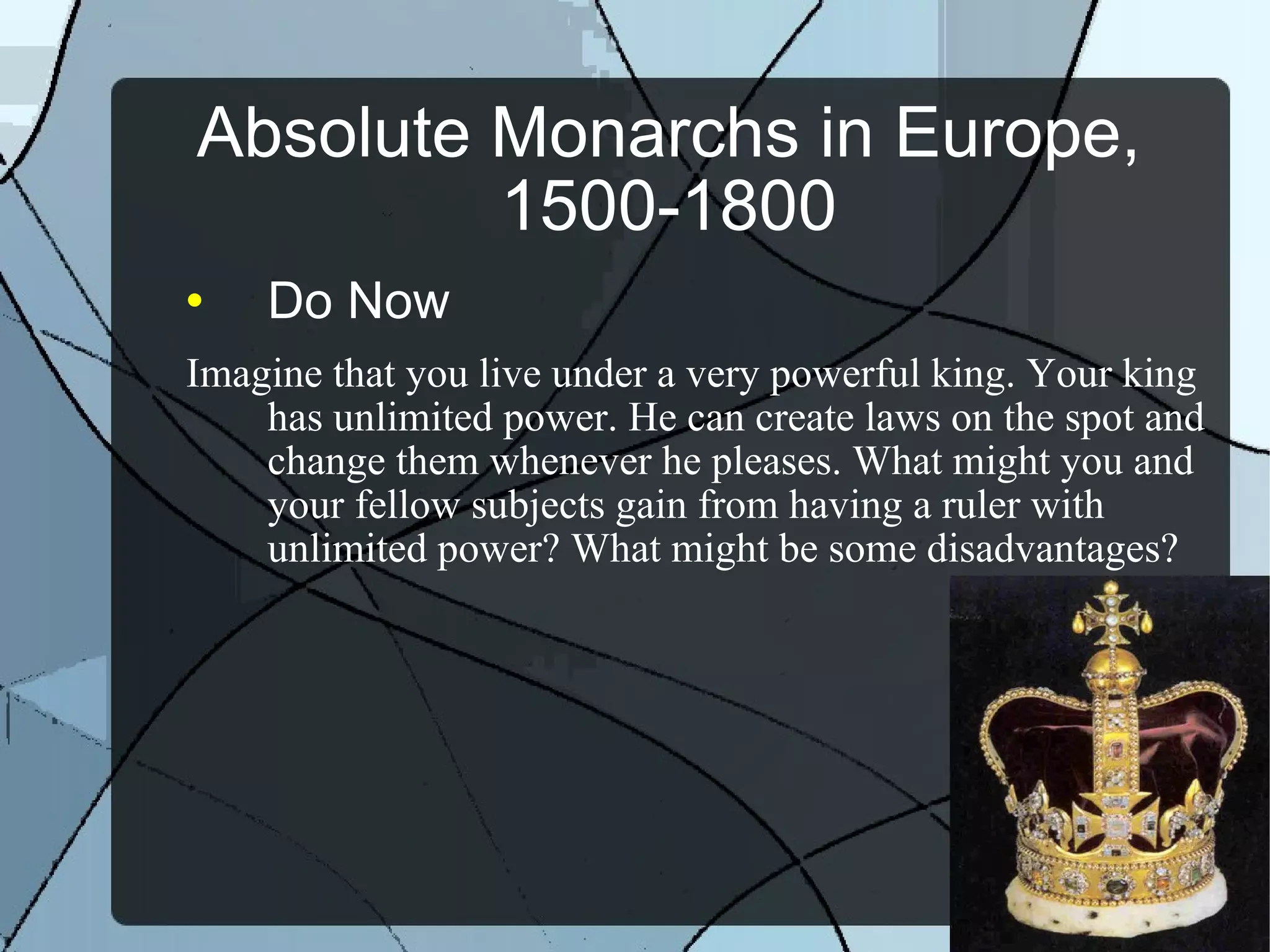
Absolute Monarchs in Europe, 1500-1800 Do Now Imagine that you live under a very powerful king. Your king has unlimited power. He can create laws on the spot and change them whenever he pleases. What might you and your fellow subjects gain from having a ruler with unlimited power? What might be some disadvantages?
Absolutism Absolutism- the political belief that all of the power within a country should be held by one person. Absolute monarchs- kings or queens who claim the authority to rule without limits on their power. Divine right- the idea that monarchs are chosen by God to rule.
Absolutism Throughout History What are some civilizations we've studied in previous units which had absolute rulers? Can you think of some countries today that are absolutist? What aspects of these societies make them absolutist?
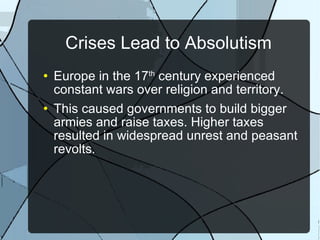
Growing Power of Europe's Monarchs Prior to the Protestant Reformation, the Catholic Church was the dominant power in Europe. After the Reformation, its power was diminished. Monarchs filled the power vacuum by assuming greater control of their countries.
Crises Lead to Absolutism Europe in the 17 th  century experienced constant wars over religion and territory. This caused governments to build bigger armies and raise taxes. Higher taxes resulted in widespread unrest and peasant revolts.
Crises Lead to Absolutism, part 2 In response to unrest, monarchs tried to impose order by increasing their own power. They regulated everything including religious worship, social gatherings, and the economy.
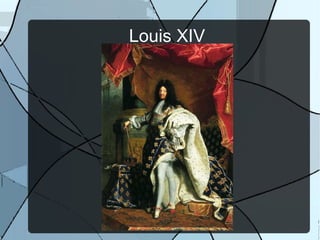
Louis XIV
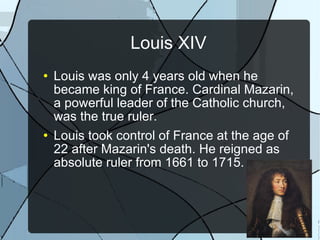
Louis XIV Louis was only 4 years old when he became king of France. Cardinal Mazarin, a powerful leader of the Catholic church, was the true ruler. Louis took control of France at the age of 22 after Mazarin's death. He reigned as absolute ruler from 1661 to 1715.
Louis' Legacy Louis' reign was disastrous for France economically for several reasons. Thousands of protestant artisans and business people fled France after he canceled a policy protecting religious freedom. France's economy slowed as a result. Louis lived an opulent lifestyle. He spent a fortune to surround himself with luxury.
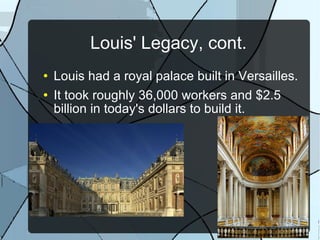
Louis' Legacy, cont. Louis had a royal palace built in Versailles. It took roughly 36,000 workers and $2.5 billion in today's dollars to build it.
Louis' Legacy, cont. Louis also spent heavily on wars intended to expand French territory. By the time Louis died, the royal family's debt was more than double what it had been when he became ruler. It would be roughly $21 billion in today's dollars. The tax burden imposed on the poor to pay off this debt would plague Louis' heirs.
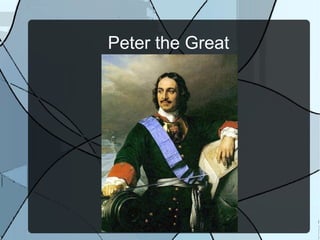
Peter the Great
What do you think? Compare Louis XIV and Peter the Great. Who was a more effective absolute monarch? Who would you rather live under?
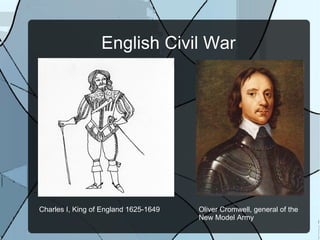
English Civil War Charles I, King of England 1625-1649 Oliver Cromwell, general of the New Model Army
Charles I vs Parliament Charles relied on Parliament to raise money for a war against Spain and France but they refused to give him funds unless he agreed to these four demands: He could not imprison subjects without due cause, levy taxes with Parliament's consent, house soldiers in private homes, or impose martial law in peacetime. Do any of these demands sound familiar?
Charles I vs Parliament, cont. Charles ignored the demands of Parliament and caused further unrest in his kingdom by trying to force the Anglican Church on the people of Scotland. The outraged Scots threatened to invade England. Desperate for money to thwart the invasion, Charles called Parliament into session. Parliament used this opportunity to pass laws to limit royal power.
Charles I vs Parliament, cont. Charles attempted to have Parliament's leaders arrested but they escaped and he was chased out of London by an angry mob. Charles raised an army of men who were loyal to him and went to war with the supporters of Parliament.
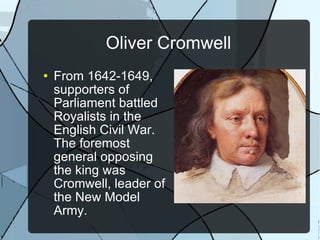
Oliver Cromwell From 1642-1649, supporters of Parliament battled Royalists in the English Civil War. The foremost general opposing the king was Cromwell, leader of the New Model Army.
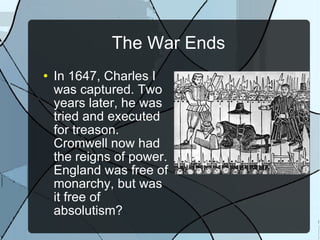
The War Ends In 1647, Charles I was captured. Two years later, he was tried and executed for treason. Cromwell now had the reigns of power. England was free of monarchy, but was it free of absolutism?
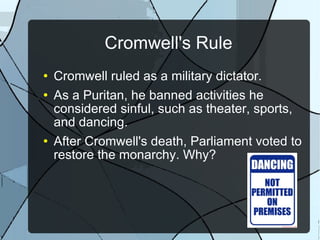
Cromwell's Rule Cromwell ruled as a military dictator. As a Puritan, he banned activities he considered sinful, such as theater, sports, and dancing. After Cromwell's death, Parliament voted to restore the monarchy. Why?
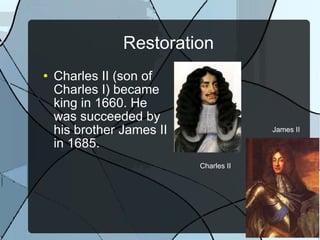
Restoration Charles II (son of Charles I) became king in 1660. He was succeeded by his brother James II in 1685. Charles II James II
The Glorious Revolution English Protestants feared James II because he was Catholic. They convinced his Protestant daughter Mary and her husband William of Orange, a Dutch prince, to overthrow James. James fled the country from Williams army. This bloodless coup is known as the Glorious Revolution.
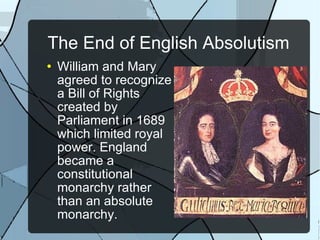
The End of English Absolutism William and Mary agreed to recognize a Bill of Rights created by Parliament in 1689 which limited royal power. England became a constitutional monarchy rather than an absolute monarchy.

Absolutism pp

  • 1.
    Absolute Monarchs inEurope, 1500-1800 Do Now Imagine that you live under a very powerful king. Your king has unlimited power. He can create laws on the spot and change them whenever he pleases. What might you and your fellow subjects gain from having a ruler with unlimited power? What might be some disadvantages?
  • 2.
    Absolutism Absolutism- thepolitical belief that all of the power within a country should be held by one person. Absolute monarchs- kings or queens who claim the authority to rule without limits on their power. Divine right- the idea that monarchs are chosen by God to rule.
  • 3.
    Absolutism Throughout HistoryWhat are some civilizations we've studied in previous units which had absolute rulers? Can you think of some countries today that are absolutist? What aspects of these societies make them absolutist?
  • 4.
    Growing Power ofEurope's Monarchs Prior to the Protestant Reformation, the Catholic Church was the dominant power in Europe. After the Reformation, its power was diminished. Monarchs filled the power vacuum by assuming greater control of their countries.
  • 5.
    Crises Lead toAbsolutism Europe in the 17 th century experienced constant wars over religion and territory. This caused governments to build bigger armies and raise taxes. Higher taxes resulted in widespread unrest and peasant revolts.
  • 6.
    Crises Lead toAbsolutism, part 2 In response to unrest, monarchs tried to impose order by increasing their own power. They regulated everything including religious worship, social gatherings, and the economy.
  • 7.
  • 8.
    Louis XIV Louiswas only 4 years old when he became king of France. Cardinal Mazarin, a powerful leader of the Catholic church, was the true ruler. Louis took control of France at the age of 22 after Mazarin's death. He reigned as absolute ruler from 1661 to 1715.
  • 9.
    Louis' Legacy Louis'reign was disastrous for France economically for several reasons. Thousands of protestant artisans and business people fled France after he canceled a policy protecting religious freedom. France's economy slowed as a result. Louis lived an opulent lifestyle. He spent a fortune to surround himself with luxury.
  • 10.
    Louis' Legacy, cont.Louis had a royal palace built in Versailles. It took roughly 36,000 workers and $2.5 billion in today's dollars to build it.
  • 11.
    Louis' Legacy, cont.Louis also spent heavily on wars intended to expand French territory. By the time Louis died, the royal family's debt was more than double what it had been when he became ruler. It would be roughly $21 billion in today's dollars. The tax burden imposed on the poor to pay off this debt would plague Louis' heirs.
  • 12.
  • 13.
    What do youthink? Compare Louis XIV and Peter the Great. Who was a more effective absolute monarch? Who would you rather live under?
  • 14.
    English Civil WarCharles I, King of England 1625-1649 Oliver Cromwell, general of the New Model Army
  • 15.
    Charles I vsParliament Charles relied on Parliament to raise money for a war against Spain and France but they refused to give him funds unless he agreed to these four demands: He could not imprison subjects without due cause, levy taxes with Parliament's consent, house soldiers in private homes, or impose martial law in peacetime. Do any of these demands sound familiar?
  • 16.
    Charles I vsParliament, cont. Charles ignored the demands of Parliament and caused further unrest in his kingdom by trying to force the Anglican Church on the people of Scotland. The outraged Scots threatened to invade England. Desperate for money to thwart the invasion, Charles called Parliament into session. Parliament used this opportunity to pass laws to limit royal power.
  • 17.
    Charles I vsParliament, cont. Charles attempted to have Parliament's leaders arrested but they escaped and he was chased out of London by an angry mob. Charles raised an army of men who were loyal to him and went to war with the supporters of Parliament.
  • 18.
    Oliver Cromwell From1642-1649, supporters of Parliament battled Royalists in the English Civil War. The foremost general opposing the king was Cromwell, leader of the New Model Army.
  • 19.
    The War EndsIn 1647, Charles I was captured. Two years later, he was tried and executed for treason. Cromwell now had the reigns of power. England was free of monarchy, but was it free of absolutism?
  • 20.
    Cromwell's Rule Cromwellruled as a military dictator. As a Puritan, he banned activities he considered sinful, such as theater, sports, and dancing. After Cromwell's death, Parliament voted to restore the monarchy. Why?
  • 21.
    Restoration Charles II(son of Charles I) became king in 1660. He was succeeded by his brother James II in 1685. Charles II James II
  • 22.
    The Glorious RevolutionEnglish Protestants feared James II because he was Catholic. They convinced his Protestant daughter Mary and her husband William of Orange, a Dutch prince, to overthrow James. James fled the country from Williams army. This bloodless coup is known as the Glorious Revolution.
  • 23.
    The End ofEnglish Absolutism William and Mary agreed to recognize a Bill of Rights created by Parliament in 1689 which limited royal power. England became a constitutional monarchy rather than an absolute monarchy.