Absolute Monarchy
Really?
RAP-Q
1) What was the feudal system used by
previous years of the Middle Ages?
2) What factors led to a change to more power
to the monarchs?
For three minutes discuss with a partner next to
you and be prepared to share with class
Transition
-- Old Feudal system
- new middle class (merchants,craftsmen)
-- Old Problems
- Poor Economy, Religious Wars, Plague
-- Weapon technology
-- New Monarchs pave way
-- Philosophy Change
- less religious after 1648
France’s Louis XIV
-- Successful monarchy
-- Control the Nobles
-- Mercantilism
-- Useless Costly Wars
-- Peasants
Spain
-- Philip II bankrupt in 1596 (wars)
-- Philip III bankrupt in 1607 (court)
-- No longer a world power by 1640
-- Philip IV reforms failed
Holy Roman Empire/Germany
-- No real central rule or powerful monarchy
-- 300 districts, decides own religion
-- Frederick the Elector of Prussia deal with
nobles
-- Habsburg Family (Leopold I) of Austria gains
lands but never centralized
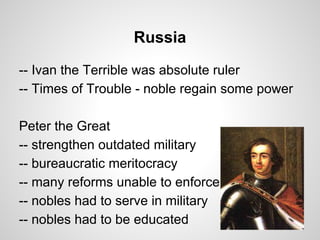
Russia
-- Ivan the Terrible was absolute ruler
-- Times of Trouble - noble regain some power
Peter the Great
-- strengthen outdated military
-- bureaucratic meritocracy
-- many reforms unable to enforce
-- nobles had to serve in military
-- nobles had to be educated
So how absolute was absolute?
1) What is necessary to have absolute power?
2) Who do you have to control?
3) What allies can you make to keep power?
Limits to Absolute Monarchy
-- Kings had to rely on local agents to carry out
policies
-- Kings had to control or buy off nobles to
maintain power
-- King used middle class in France as ally
-- Landed aristocracy were a powerful force
everywhere
Question
Louis XIV built his great palace of Versailles for
all of the following reasons EXCEPT
a) to control the aristocracy
b) to show on a grand scale the wealth and
power of France monarchy
c) to rule outside of the confines of Paris
d) to allow for better communication with his
people
Resources
-- http://www.fidnet.com/~weid/rulers.html
-- http://www.slideshare.net/papefons/the-17th-
century-absolute-monarchy-and-the-decline-of-
the-hispanic-empire?from_search=6
-- http://www2.sunysuffolk.
edu/westn/modernroots.html

Absolute monarchy

  • 1.
  • 2.
    RAP-Q 1) What wasthe feudal system used by previous years of the Middle Ages? 2) What factors led to a change to more power to the monarchs? For three minutes discuss with a partner next to you and be prepared to share with class
  • 3.
    Transition -- Old Feudalsystem - new middle class (merchants,craftsmen) -- Old Problems - Poor Economy, Religious Wars, Plague -- Weapon technology -- New Monarchs pave way -- Philosophy Change - less religious after 1648
  • 4.
    France’s Louis XIV --Successful monarchy -- Control the Nobles -- Mercantilism -- Useless Costly Wars -- Peasants
  • 5.
    Spain -- Philip IIbankrupt in 1596 (wars) -- Philip III bankrupt in 1607 (court) -- No longer a world power by 1640 -- Philip IV reforms failed
  • 6.
    Holy Roman Empire/Germany --No real central rule or powerful monarchy -- 300 districts, decides own religion -- Frederick the Elector of Prussia deal with nobles -- Habsburg Family (Leopold I) of Austria gains lands but never centralized
  • 7.
    Russia -- Ivan theTerrible was absolute ruler -- Times of Trouble - noble regain some power Peter the Great -- strengthen outdated military -- bureaucratic meritocracy -- many reforms unable to enforce -- nobles had to serve in military -- nobles had to be educated
  • 8.
    So how absolutewas absolute? 1) What is necessary to have absolute power? 2) Who do you have to control? 3) What allies can you make to keep power?
  • 9.
    Limits to AbsoluteMonarchy -- Kings had to rely on local agents to carry out policies -- Kings had to control or buy off nobles to maintain power -- King used middle class in France as ally -- Landed aristocracy were a powerful force everywhere
  • 10.
    Question Louis XIV builthis great palace of Versailles for all of the following reasons EXCEPT a) to control the aristocracy b) to show on a grand scale the wealth and power of France monarchy c) to rule outside of the confines of Paris d) to allow for better communication with his people
  • 11.