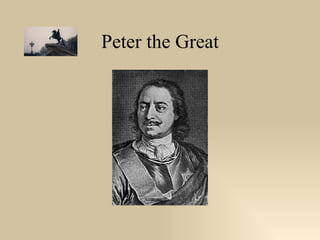
Peter the Great
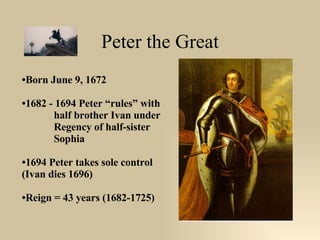
Peter the Great Born June 9, 1672 1682 - 1694 Peter “rules” with  half brother Ivan under Regency of half-sister  Sophia 1694 Peter takes sole control (Ivan dies 1696) Reign = 43 years (1682-1725)
Peter the Great Introduced new (Western) technologies to Russia Successful in battle against the Turks Successful in the Great Northern War vs. Sweden Implemented several internal reforms Modified government policies & strictly enforced them Increase Russia’s territory (particularly access to Baltic) Built St. Petersburg
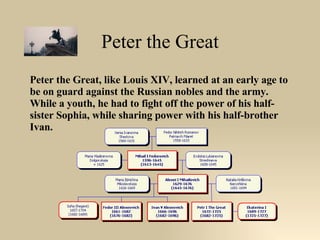
Peter the Great Peter the Great, like Louis XIV, learned at an early age to be on guard against the Russian nobles and the army. While a youth, he had to fight off the power of his half-sister Sophia, while sharing power with his half-brother Ivan.
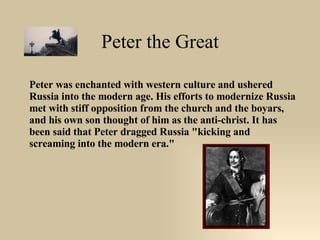
Peter the Great Peter was enchanted with western culture and ushered Russia into the modern age. His efforts to modernize Russia met with stiff opposition from the church and the boyars, and his own son thought of him as the anti-christ. It has been said that Peter dragged Russia "kicking and screaming into the modern era."
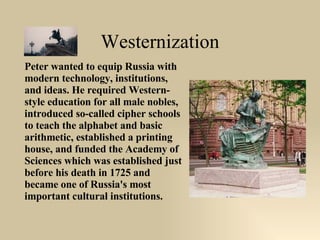
Westernization Peter wanted to equip Russia with modern technology, institutions, and ideas. He required Western-style education for all male nobles, introduced so-called cipher schools to teach the alphabet and basic arithmetic, established a printing house, and funded the Academy of Sciences which was established just before his death in 1725 and became one of Russia's most important cultural institutions.
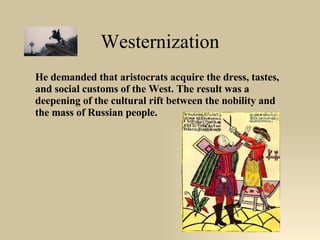
Westernization He demanded that aristocrats acquire the dress, tastes, and social customs of the West. The result was a deepening of the cultural rift between the nobility and the mass of Russian people.
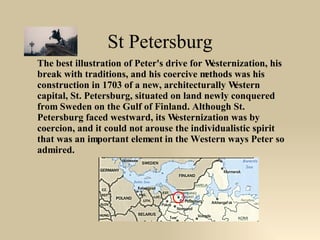
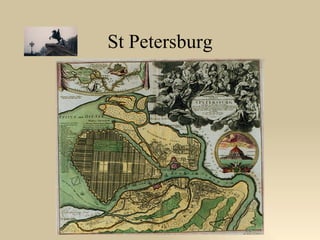
St Petersburg The best illustration of Peter's drive for Westernization, his break with traditions, and his coercive methods was his construction in 1703 of a new, architecturally Western capital, St. Petersburg, situated on land newly conquered from Sweden on the Gulf of Finland. Although St. Petersburg faced westward, its Westernization was by coercion, and it could not arouse the individualistic spirit that was an important element in the Western ways Peter so admired.
St Petersburg
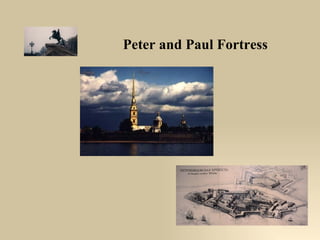
Peter and Paul Fortress
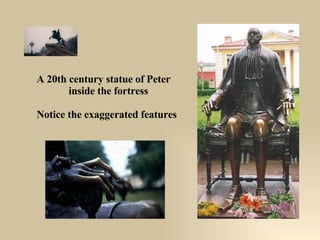
A 20th century statue of Peter inside the fortress Notice the exaggerated features
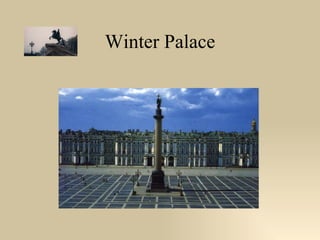
Winter Palace
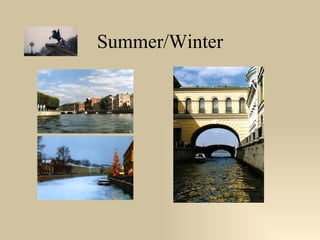
Summer/Winter
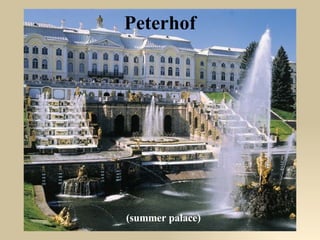
Peterhof (summer palace)
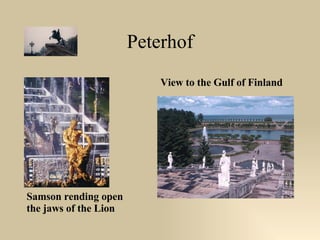
Peterhof View to the Gulf of Finland Samson rending open the jaws of the Lion
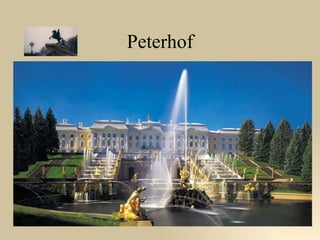
Peterhof
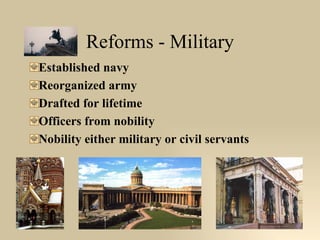
Reforms - Military Established navy Reorganized army Drafted for lifetime Officers from nobility Nobility either military or civil servants
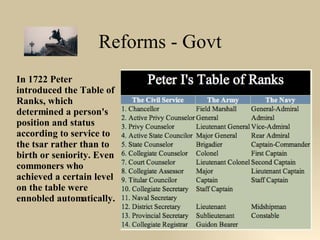
Reforms - Govt In 1722 Peter introduced the Table of Ranks, which determined a person's position and status according to service to the tsar rather than to birth or seniority. Even commoners who achieved a certain level on the table were ennobled automatically.
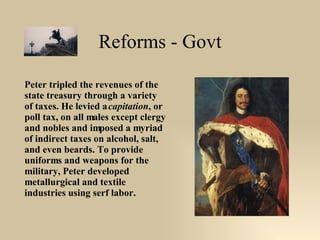
Reforms - Govt Peter tripled the revenues of the state treasury through a variety of taxes. He levied a  capitation , or poll tax, on all males except clergy and nobles and imposed a myriad of indirect taxes on alcohol, salt, and even beards. To provide uniforms and weapons for the military, Peter developed metallurgical and textile industries using serf labor.
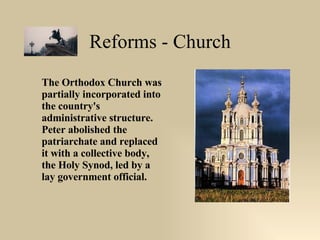
Reforms - Church The Orthodox Church was partially incorporated into the country's administrative structure. Peter abolished the patriarchate and replaced it with a collective body, the Holy Synod, led by a lay government official.
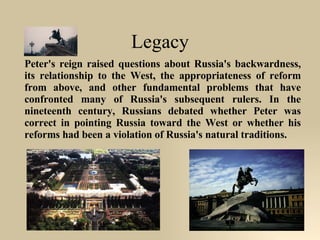
Legacy Peter's reign raised questions about Russia's backwardness, its relationship to the West, the appropriateness of reform from above, and other fundamental problems that have confronted many of Russia's subsequent rulers. In the nineteenth century, Russians debated whether Peter was correct in pointing Russia toward the West or whether his reforms had been a violation of Russia's natural traditions.
Sources www.english.upenn.edu/~jlynch/FrankenDemo/Gifs/pgreat.html   www.pbs.org/weta/faceofrussia   http://fp.uni.edu/bruess/   http://www.galen-frysinger.org/russia.htm http://www.biketracks.net/russia.htm http://www.cohums.ohiostate.edu/english/People/odlin.1/courses/571/peteng.htm   www.csli.stanford.edu/~jbernd/russia/peteri.html   http://www.umass.edu/tei/ogia/gallery/russia2/index.html http://www.dartmouth.edu/~russ15/russia_PI/peter_great_pt1.html http://www.peterhof.org/ind.html http://www.1upinfo.com/country-guide-study/russia/russia20.html http://www.russia.net/history/sp.html

Peter the Great

  • 1.
  • 2.
    Peter the GreatBorn June 9, 1672 1682 - 1694 Peter “rules” with half brother Ivan under Regency of half-sister Sophia 1694 Peter takes sole control (Ivan dies 1696) Reign = 43 years (1682-1725)
  • 3.
    Peter the GreatIntroduced new (Western) technologies to Russia Successful in battle against the Turks Successful in the Great Northern War vs. Sweden Implemented several internal reforms Modified government policies & strictly enforced them Increase Russia’s territory (particularly access to Baltic) Built St. Petersburg
  • 4.
    Peter the GreatPeter the Great, like Louis XIV, learned at an early age to be on guard against the Russian nobles and the army. While a youth, he had to fight off the power of his half-sister Sophia, while sharing power with his half-brother Ivan.
  • 5.
    Peter the GreatPeter was enchanted with western culture and ushered Russia into the modern age. His efforts to modernize Russia met with stiff opposition from the church and the boyars, and his own son thought of him as the anti-christ. It has been said that Peter dragged Russia "kicking and screaming into the modern era."
  • 6.
    Westernization Peter wantedto equip Russia with modern technology, institutions, and ideas. He required Western-style education for all male nobles, introduced so-called cipher schools to teach the alphabet and basic arithmetic, established a printing house, and funded the Academy of Sciences which was established just before his death in 1725 and became one of Russia's most important cultural institutions.
  • 7.
    Westernization He demandedthat aristocrats acquire the dress, tastes, and social customs of the West. The result was a deepening of the cultural rift between the nobility and the mass of Russian people.
  • 8.
    St Petersburg Thebest illustration of Peter's drive for Westernization, his break with traditions, and his coercive methods was his construction in 1703 of a new, architecturally Western capital, St. Petersburg, situated on land newly conquered from Sweden on the Gulf of Finland. Although St. Petersburg faced westward, its Westernization was by coercion, and it could not arouse the individualistic spirit that was an important element in the Western ways Peter so admired.
  • 9.
  • 10.
  • 11.
    A 20th centurystatue of Peter inside the fortress Notice the exaggerated features
  • 12.
  • 13.
  • 14.
  • 15.
    Peterhof View tothe Gulf of Finland Samson rending open the jaws of the Lion
  • 16.
  • 17.
    Reforms - MilitaryEstablished navy Reorganized army Drafted for lifetime Officers from nobility Nobility either military or civil servants
  • 18.
    Reforms - GovtIn 1722 Peter introduced the Table of Ranks, which determined a person's position and status according to service to the tsar rather than to birth or seniority. Even commoners who achieved a certain level on the table were ennobled automatically.
  • 19.
    Reforms - GovtPeter tripled the revenues of the state treasury through a variety of taxes. He levied a capitation , or poll tax, on all males except clergy and nobles and imposed a myriad of indirect taxes on alcohol, salt, and even beards. To provide uniforms and weapons for the military, Peter developed metallurgical and textile industries using serf labor.
  • 20.
    Reforms - ChurchThe Orthodox Church was partially incorporated into the country's administrative structure. Peter abolished the patriarchate and replaced it with a collective body, the Holy Synod, led by a lay government official.
  • 21.
    Legacy Peter's reignraised questions about Russia's backwardness, its relationship to the West, the appropriateness of reform from above, and other fundamental problems that have confronted many of Russia's subsequent rulers. In the nineteenth century, Russians debated whether Peter was correct in pointing Russia toward the West or whether his reforms had been a violation of Russia's natural traditions.
  • 22.
    Sources www.english.upenn.edu/~jlynch/FrankenDemo/Gifs/pgreat.html www.pbs.org/weta/faceofrussia http://fp.uni.edu/bruess/ http://www.galen-frysinger.org/russia.htm http://www.biketracks.net/russia.htm http://www.cohums.ohiostate.edu/english/People/odlin.1/courses/571/peteng.htm www.csli.stanford.edu/~jbernd/russia/peteri.html http://www.umass.edu/tei/ogia/gallery/russia2/index.html http://www.dartmouth.edu/~russ15/russia_PI/peter_great_pt1.html http://www.peterhof.org/ind.html http://www.1upinfo.com/country-guide-study/russia/russia20.html http://www.russia.net/history/sp.html