Ancient Regimen in crisis
4th
ESO
MAIRA GIL CAMARÓN
Introduction
17th
century
Wars: religion wars
Famine: poor harvest
Disease: plagues
Economic crisis: inflation
 Monarchs tried to impose order by increasing their own
power  ABSOLUTE MONARC
Theory of Absolutism
These rulers wanted to be absolute monarchs, kings or
queens who held all of the power within their state’s
boundaries. Their goal was to control every aspect of
society. Absolute monarchs believe in divine right, the idea
that God created the monarchy and that the monarch acted
as God’s representative on earth. An absolute monarch
answered only to God, not to his/her subjects
What was the Old Regimen?
This is a term used by the French revolutionaries to
designate the political situation in place prior to the French
revolution (1789)
An absolutist political system
An agrarian economy
A stratified society
The great influence of religion on people, culture,
education and art
Later on, historians used this terms to designate the period
between 15th
and 18th
centuries
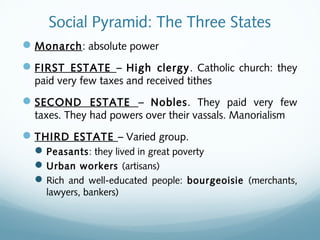
Social Pyramid: The Three States
Monarch: absolute power
FIRST ESTATE – High clergy. Catholic church: they
paid very few taxes and received tithes
SECOND ESTATE – Nobles. They paid very few
taxes. They had powers over their vassals. Manorialism
THIRD ESTATE – Varied group.
Peasants: they lived in great poverty
Urban workers (artisans)
Rich and well-educated people: bourgeoisie (merchants,
lawyers, bankers)
Population Growth
Little population growth during the Old Regimen: the birth
rate was high due to the absence of effective birth control
systems; mortality rate was high because of poor diet, the
backwardness of medicine and lack of hygiene
Decline in mortality:
Absence of epidemics
Decline in the numbers of wars
Agriculture / Craftsmanship
Agriculture
New crops
New techniques: from biennial rotation to continuous
rotation
Craftsmanship
Domestic System
Manufacturing
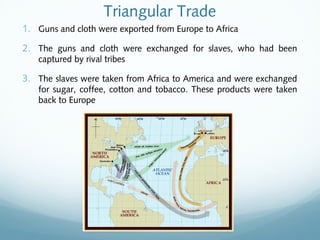
Triangular Trade
1. Guns and cloth were exported from Europe to Africa
2. The guns and cloth were exchanged for slaves, who had been
captured by rival tribes
3. The slaves were taken from Africa to America and were exchanged
for sugar, coffee, cotton and tobacco. These products were taken
back to Europe
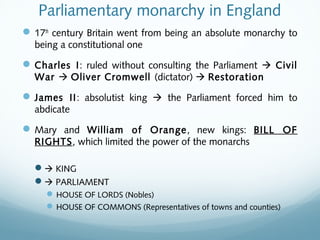
Parliamentary monarchy in England
17th
century Britain went from being an absolute monarchy to
being a constitutional one
Charles I: ruled without consulting the Parliament  Civil
War  Oliver Cromwell (dictator)  Restoration
James II: absolutist king  the Parliament forced him to
abdicate
Mary and William of Orange, new kings: BILL OF
RIGHTS, which limited the power of the monarchs
 KING
 PARLIAMENT
HOUSE OF LORDS (Nobles)
HOUSE OF COMMONS (Representatives of towns and counties)
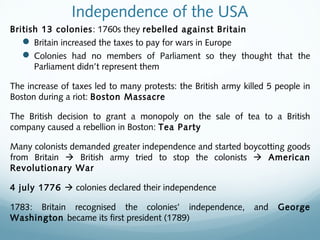
Independence of the USA
British 13 colonies: 1760s they rebelled against Britain
 Britain increased the taxes to pay for wars in Europe
 Colonies had no members of Parliament so they thought that the
Parliament didn’t represent them
The increase of taxes led to many protests: the British army killed 5 people in
Boston during a riot: Boston Massacre
The British decision to grant a monopoly on the sale of tea to a British
company caused a rebellion in Boston: Tea Party
Many colonists demanded greater independence and started boycotting goods
from Britain  British army tried to stop the colonists  American
Revolutionary War
4 july 1776  colonies declared their independence
1783: Britain recognised the colonies’ independence, and George
Washington became its first president (1789)
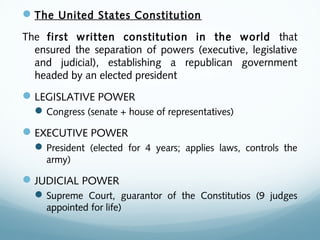
The United States Constitution
The first written constitution in the world that
ensured the separation of powers (executive, legislative
and judicial), establishing a republican government
headed by an elected president
LEGISLATIVE POWER
Congress (senate + house of representatives)
EXECUTIVE POWER
President (elected for 4 years; applies laws, controls the
army)
JUDICIAL POWER
Supreme Court, guarantor of the Constitutios (9 judges
appointed for life)
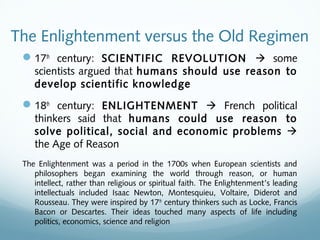
The Enlightenment versus the Old Regimen
17th
century: SCIENTIFIC REVOLUTION  some
scientists argued that humans should use reason to
develop scientific knowledge
18th
century: ENLIGHTENMENT  French political
thinkers said that humans could use reason to
solve political, social and economic problems 
the Age of Reason
The Enlightenment was a period in the 1700s when European scientists and
philosophers began examining the world through reason, or human
intellect, rather than religious or spiritual faith. The Enlightenment’s leading
intellectuals included Isaac Newton, Montesquieu, Voltaire, Diderot and
Rousseau. They were inspired by 17th
century thinkers such as Locke, Francis
Bacon or Descartes. Their ideas touched many aspects of life including
politics, economics, science and religion
Enlightenment New Ideas
SOCIAL CHANGES: They opposed stratified society
and defended social mobility
ECONOMIC CHANGES:
They opposed Mercantilism and defended agriculture
and productive work as the source of national wealth:
Physiocracy (F. Quesnay)
They opposed state regulations and defended free
trade: Economic Liberalism (A. Smith)
POLITICAL CHANGES
Montesquieu: separation of powers (executive, legislative,
judicial)
Rousseau: social contract between the ruler and the
individual (constitution)
Voltaire: parliament
The Enlightenment Despotism
Some absolute monarchs introduced reforms based
on reason and science:
They invested in agriculture and manufacturing, and
introduced new crops
They supported the arts, sciences and education
They made the tax system fairer by reducing the privileges of
the Church and the nobles
They made the laws the same in the whole country
They increased religions tolerance
However, these monarchs rejected Enlightenment ideas like
equally, deism and the separation of powers
Spreading the new ideas of the Enlightenment
Scientific and technological progress
They believed that science and technology should work
together to help society to progress  advances in medicine,
transport… Watt invented the steam engine
Spread of knowledge
18th
century was a time of ideas, knowledge and people.
Universities and scientific academies were created;
coffee houses and private literary salons became more
widespread
Making the Encyclopedia
Enlightenment thinkers believed in improving society through
education. They therefore wrote a book called the
Encyclopedia which aimed to gather all the knowledge in the
world. It was edited by Diderot and included articles by
Voltaire, Rousseau and Montesquieu. In total there were 28
volumes with over 3,000 ilustrations and it took more than 20
years to complete the work.
The Bourbon monarchy in Spain
The War of Succession
Charles II died without a heir and it caused the Spanish
War of Succession: an internal conflict that became
international due to the pretenders to the throne:
Philip of Bourbon (Duke of Anjou), supported by Castile
and France
Charles of Habsburg, supported by some European powers
(Britain, the Dutch Republic, Portugal, the Austrian Empire)
When Charles inherited the German Empire, lost interest in
becoming king of Spain. His allies wanted to prevent the
possible union of Spain and Austria  Treaty of Utrech
(1713) recognised Philip V as king in exchange for
territories in Europe and Spain
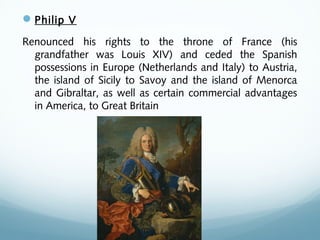
Philip V
Renounced his rights to the throne of France (his
grandfather was Louis XIV) and ceded the Spanish
possessions in Europe (Netherlands and Italy) to Austria,
the island of Sicily to Savoy and the island of Menorca
and Gibraltar, as well as certain commercial advantages
in America, to Great Britain
Territorial uniformity
Philip V’s aim was to be the absolute monarch of a centralised
and modern state.
Previously, Spanish monarchs had ruled over a number of
separate kingdoms, each with their own parliaments, laws and
customs. With the Nueva Planta Decrees, Philip turned
these kingdoms into a single country: Spain
 He abolished special laws (fueros) of the Crown of Aragon
(Catalonia, Valencia, Aragon and Mallorca)
 He introduced Castilian law in the whole Spain. The Council of
Castile also took decisions about the whole country
 He made Madrid the capital city of the whole Spain
 He made Castilian Spanish the official language of Spain
 He created intendentes, who were powerful civil servants named
by the king, to control the local authorities, collected taxes and
introduced economic reforms
Enlightenment in Spain
The agrarian issue in Spain
Spain = large rural society, the most of the land was controlled by the
nobility and clergy
Spanish Enlightenment thinkers wanted the economic growth, the
reform of society, the improvement of education and the
modernisation of culture  Sociedades Económicas de Amigos
del País
Spanish Enlightenment thinkers proposed reforms to stimulate
population growth and improve the standard of living
Enlightenment reformism
Charles III ruled as an Enlightened despotic monarch: he was an
absolute monarch but chose some Enlightenment thinkers as advisors
to undertook a series or reforms
The absence of an important bourgeoisie, conservatism and the
influence of the Catholic Church hindered the expansion of the
Enlightenment ideas in Spain
18th
century growth
 An increase in agricultural production: new crops, irrigation
and viticulture
 Protection of manufacturing stimulated an increase in
production
 Liberalisation of trade (1778)  overseas expansion from
commercial companies and the end of the monopoly on trading
with America
 No increase in industrial development  Enlightenment thinkers
insisted on the need for land reforms to liberalise the ownership
of the land: JOVELLANOS
Abolish mortmain and communal land
Cultivate communal land and wasteland
Dissolve the Mesta and fence of the estates
Improve farmers’ lease contracts
Limit entailed estates

Ancient Regimen in Crisis

  • 1.
    Ancient Regimen incrisis 4th ESO MAIRA GIL CAMARÓN
  • 2.
    Introduction 17th century Wars: religion wars Famine:poor harvest Disease: plagues Economic crisis: inflation  Monarchs tried to impose order by increasing their own power  ABSOLUTE MONARC
  • 3.
    Theory of Absolutism Theserulers wanted to be absolute monarchs, kings or queens who held all of the power within their state’s boundaries. Their goal was to control every aspect of society. Absolute monarchs believe in divine right, the idea that God created the monarchy and that the monarch acted as God’s representative on earth. An absolute monarch answered only to God, not to his/her subjects
  • 4.
    What was theOld Regimen? This is a term used by the French revolutionaries to designate the political situation in place prior to the French revolution (1789) An absolutist political system An agrarian economy A stratified society The great influence of religion on people, culture, education and art Later on, historians used this terms to designate the period between 15th and 18th centuries
  • 5.
    Social Pyramid: TheThree States Monarch: absolute power FIRST ESTATE – High clergy. Catholic church: they paid very few taxes and received tithes SECOND ESTATE – Nobles. They paid very few taxes. They had powers over their vassals. Manorialism THIRD ESTATE – Varied group. Peasants: they lived in great poverty Urban workers (artisans) Rich and well-educated people: bourgeoisie (merchants, lawyers, bankers)
  • 6.
    Population Growth Little populationgrowth during the Old Regimen: the birth rate was high due to the absence of effective birth control systems; mortality rate was high because of poor diet, the backwardness of medicine and lack of hygiene Decline in mortality: Absence of epidemics Decline in the numbers of wars
  • 7.
    Agriculture / Craftsmanship Agriculture Newcrops New techniques: from biennial rotation to continuous rotation Craftsmanship Domestic System Manufacturing
  • 8.
    Triangular Trade 1. Gunsand cloth were exported from Europe to Africa 2. The guns and cloth were exchanged for slaves, who had been captured by rival tribes 3. The slaves were taken from Africa to America and were exchanged for sugar, coffee, cotton and tobacco. These products were taken back to Europe
  • 9.
    Parliamentary monarchy inEngland 17th century Britain went from being an absolute monarchy to being a constitutional one Charles I: ruled without consulting the Parliament  Civil War  Oliver Cromwell (dictator)  Restoration James II: absolutist king  the Parliament forced him to abdicate Mary and William of Orange, new kings: BILL OF RIGHTS, which limited the power of the monarchs  KING  PARLIAMENT HOUSE OF LORDS (Nobles) HOUSE OF COMMONS (Representatives of towns and counties)
  • 10.
    Independence of theUSA British 13 colonies: 1760s they rebelled against Britain  Britain increased the taxes to pay for wars in Europe  Colonies had no members of Parliament so they thought that the Parliament didn’t represent them The increase of taxes led to many protests: the British army killed 5 people in Boston during a riot: Boston Massacre The British decision to grant a monopoly on the sale of tea to a British company caused a rebellion in Boston: Tea Party Many colonists demanded greater independence and started boycotting goods from Britain  British army tried to stop the colonists  American Revolutionary War 4 july 1776  colonies declared their independence 1783: Britain recognised the colonies’ independence, and George Washington became its first president (1789)
  • 11.
    The United StatesConstitution The first written constitution in the world that ensured the separation of powers (executive, legislative and judicial), establishing a republican government headed by an elected president LEGISLATIVE POWER Congress (senate + house of representatives) EXECUTIVE POWER President (elected for 4 years; applies laws, controls the army) JUDICIAL POWER Supreme Court, guarantor of the Constitutios (9 judges appointed for life)
  • 12.
    The Enlightenment versusthe Old Regimen 17th century: SCIENTIFIC REVOLUTION  some scientists argued that humans should use reason to develop scientific knowledge 18th century: ENLIGHTENMENT  French political thinkers said that humans could use reason to solve political, social and economic problems  the Age of Reason The Enlightenment was a period in the 1700s when European scientists and philosophers began examining the world through reason, or human intellect, rather than religious or spiritual faith. The Enlightenment’s leading intellectuals included Isaac Newton, Montesquieu, Voltaire, Diderot and Rousseau. They were inspired by 17th century thinkers such as Locke, Francis Bacon or Descartes. Their ideas touched many aspects of life including politics, economics, science and religion
  • 13.
    Enlightenment New Ideas SOCIALCHANGES: They opposed stratified society and defended social mobility ECONOMIC CHANGES: They opposed Mercantilism and defended agriculture and productive work as the source of national wealth: Physiocracy (F. Quesnay) They opposed state regulations and defended free trade: Economic Liberalism (A. Smith) POLITICAL CHANGES Montesquieu: separation of powers (executive, legislative, judicial) Rousseau: social contract between the ruler and the individual (constitution) Voltaire: parliament
  • 14.
    The Enlightenment Despotism Someabsolute monarchs introduced reforms based on reason and science: They invested in agriculture and manufacturing, and introduced new crops They supported the arts, sciences and education They made the tax system fairer by reducing the privileges of the Church and the nobles They made the laws the same in the whole country They increased religions tolerance However, these monarchs rejected Enlightenment ideas like equally, deism and the separation of powers
  • 15.
    Spreading the newideas of the Enlightenment Scientific and technological progress They believed that science and technology should work together to help society to progress  advances in medicine, transport… Watt invented the steam engine Spread of knowledge 18th century was a time of ideas, knowledge and people. Universities and scientific academies were created; coffee houses and private literary salons became more widespread Making the Encyclopedia Enlightenment thinkers believed in improving society through education. They therefore wrote a book called the Encyclopedia which aimed to gather all the knowledge in the world. It was edited by Diderot and included articles by Voltaire, Rousseau and Montesquieu. In total there were 28 volumes with over 3,000 ilustrations and it took more than 20 years to complete the work.
  • 16.
    The Bourbon monarchyin Spain The War of Succession Charles II died without a heir and it caused the Spanish War of Succession: an internal conflict that became international due to the pretenders to the throne: Philip of Bourbon (Duke of Anjou), supported by Castile and France Charles of Habsburg, supported by some European powers (Britain, the Dutch Republic, Portugal, the Austrian Empire) When Charles inherited the German Empire, lost interest in becoming king of Spain. His allies wanted to prevent the possible union of Spain and Austria  Treaty of Utrech (1713) recognised Philip V as king in exchange for territories in Europe and Spain
  • 17.
    Philip V Renounced hisrights to the throne of France (his grandfather was Louis XIV) and ceded the Spanish possessions in Europe (Netherlands and Italy) to Austria, the island of Sicily to Savoy and the island of Menorca and Gibraltar, as well as certain commercial advantages in America, to Great Britain
  • 18.
    Territorial uniformity Philip V’saim was to be the absolute monarch of a centralised and modern state. Previously, Spanish monarchs had ruled over a number of separate kingdoms, each with their own parliaments, laws and customs. With the Nueva Planta Decrees, Philip turned these kingdoms into a single country: Spain  He abolished special laws (fueros) of the Crown of Aragon (Catalonia, Valencia, Aragon and Mallorca)  He introduced Castilian law in the whole Spain. The Council of Castile also took decisions about the whole country  He made Madrid the capital city of the whole Spain  He made Castilian Spanish the official language of Spain  He created intendentes, who were powerful civil servants named by the king, to control the local authorities, collected taxes and introduced economic reforms
  • 19.
    Enlightenment in Spain Theagrarian issue in Spain Spain = large rural society, the most of the land was controlled by the nobility and clergy Spanish Enlightenment thinkers wanted the economic growth, the reform of society, the improvement of education and the modernisation of culture  Sociedades Económicas de Amigos del País Spanish Enlightenment thinkers proposed reforms to stimulate population growth and improve the standard of living Enlightenment reformism Charles III ruled as an Enlightened despotic monarch: he was an absolute monarch but chose some Enlightenment thinkers as advisors to undertook a series or reforms The absence of an important bourgeoisie, conservatism and the influence of the Catholic Church hindered the expansion of the Enlightenment ideas in Spain
  • 20.
    18th century growth  Anincrease in agricultural production: new crops, irrigation and viticulture  Protection of manufacturing stimulated an increase in production  Liberalisation of trade (1778)  overseas expansion from commercial companies and the end of the monopoly on trading with America  No increase in industrial development  Enlightenment thinkers insisted on the need for land reforms to liberalise the ownership of the land: JOVELLANOS Abolish mortmain and communal land Cultivate communal land and wasteland Dissolve the Mesta and fence of the estates Improve farmers’ lease contracts Limit entailed estates