Prof. Stephanie Hanlon-Nugent 
Abridged version part 1 
Grammar and 
Style 
Misused words, punctuation, 
grammar and AP Style 
Source: “The Elements of News Writing” by James Kershner
Punctuation — Commas 
❖ Commas separate items in a series. 
❖ The flag is red, white and blue.
Punctuation — Commas 
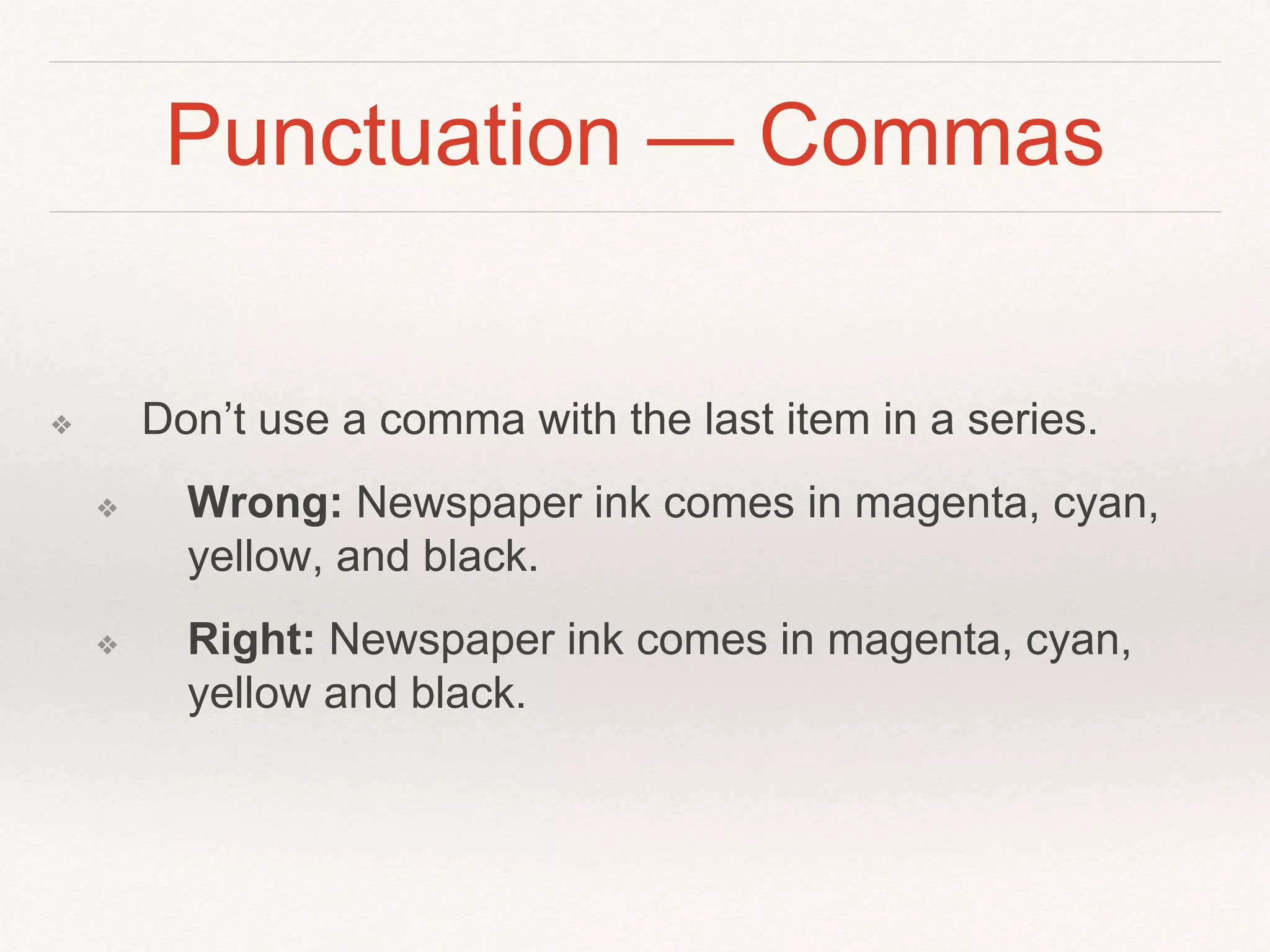
❖ Don’t use a comma with the last item in a series. 
❖ Wrong: Newspaper ink comes in magenta, cyan, 
yellow, and black. 
❖ Right: Newspaper ink comes in magenta, cyan, 
yellow and black.
Punctuation — Commas 
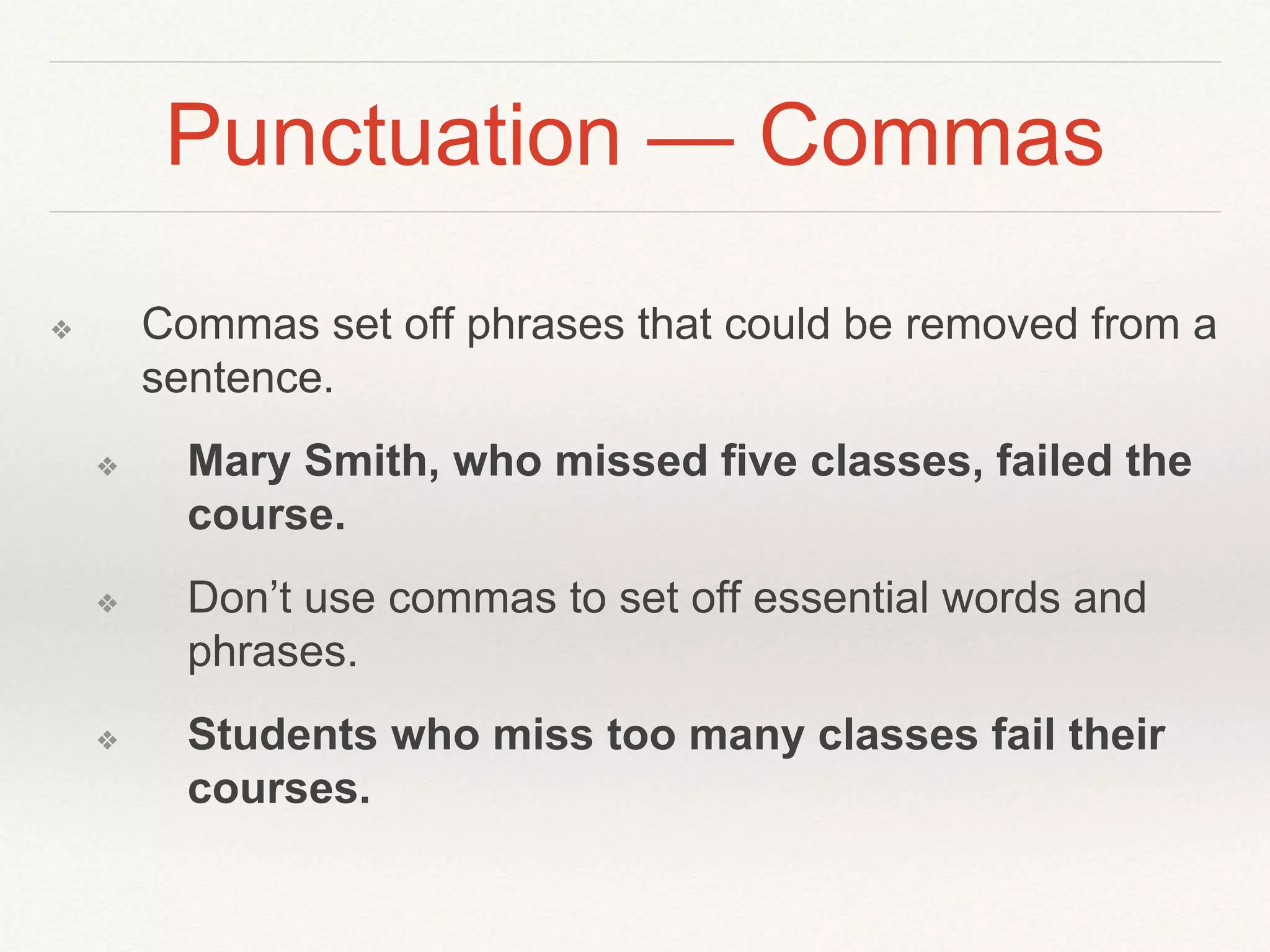
❖ Commas set off phrases that could be removed from a 
sentence. 
❖ Mary Smith, who missed five classes, failed the 
course. 
❖ Don’t use commas to set off essential words and 
phrases. 
❖ Students who miss too many classes fail their 
courses.
Punctuation — Commas 
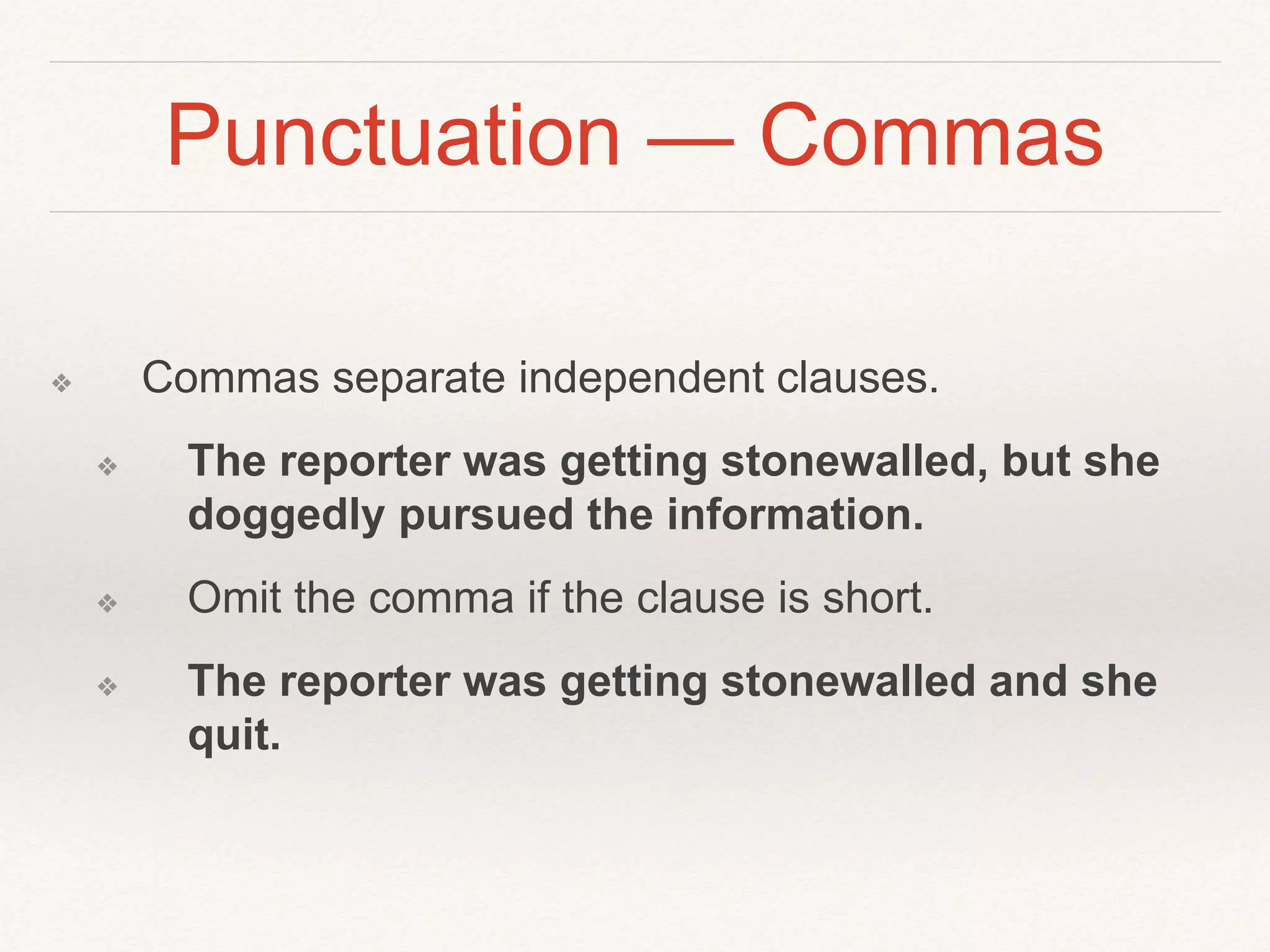
❖ Commas separate independent clauses. 
❖ The reporter was getting stonewalled, but she 
doggedly pursued the information. 
❖ Omit the comma if the clause is short. 
❖ The reporter was getting stonewalled and she 
quit.
Punctuation — Commas 
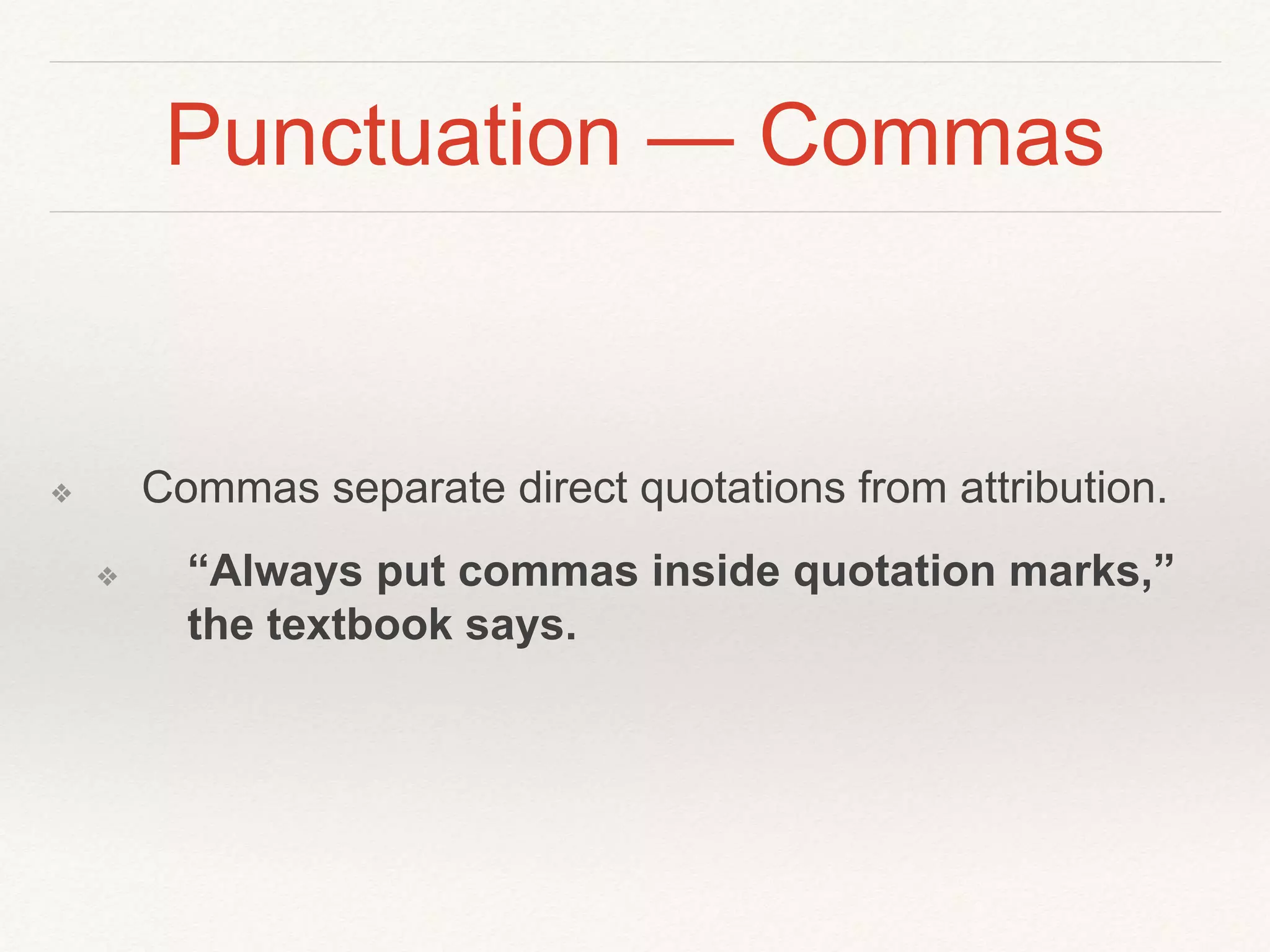
❖ Commas separate direct quotations from attribution. 
❖ “Always put commas inside quotation marks,” 
the textbook says.
Punctuation — Commas 
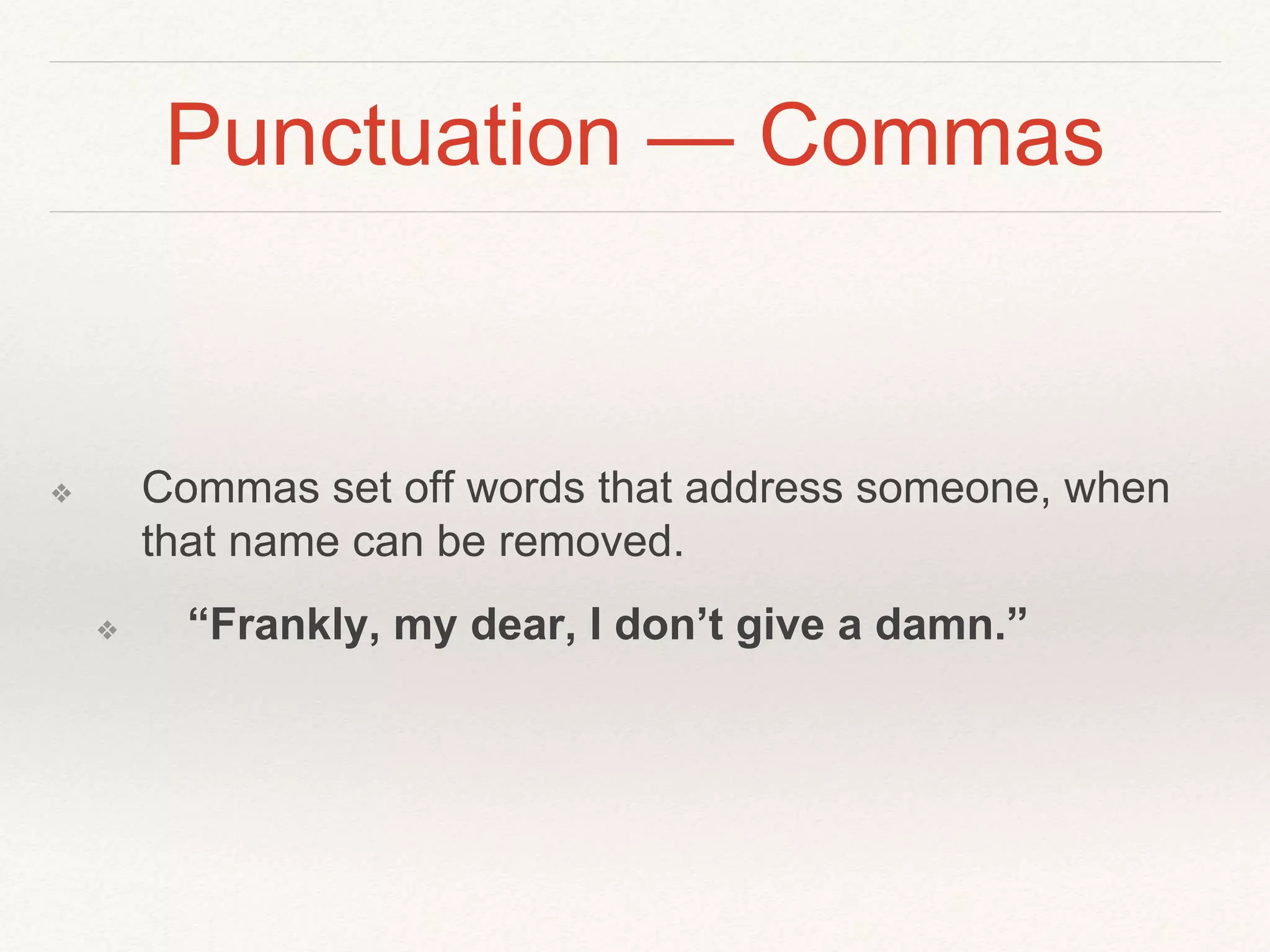
❖ Commas set off words that address someone, when 
that name can be removed. 
❖ “Frankly, my dear, I don’t give a damn.”
Punctuation — Commas 
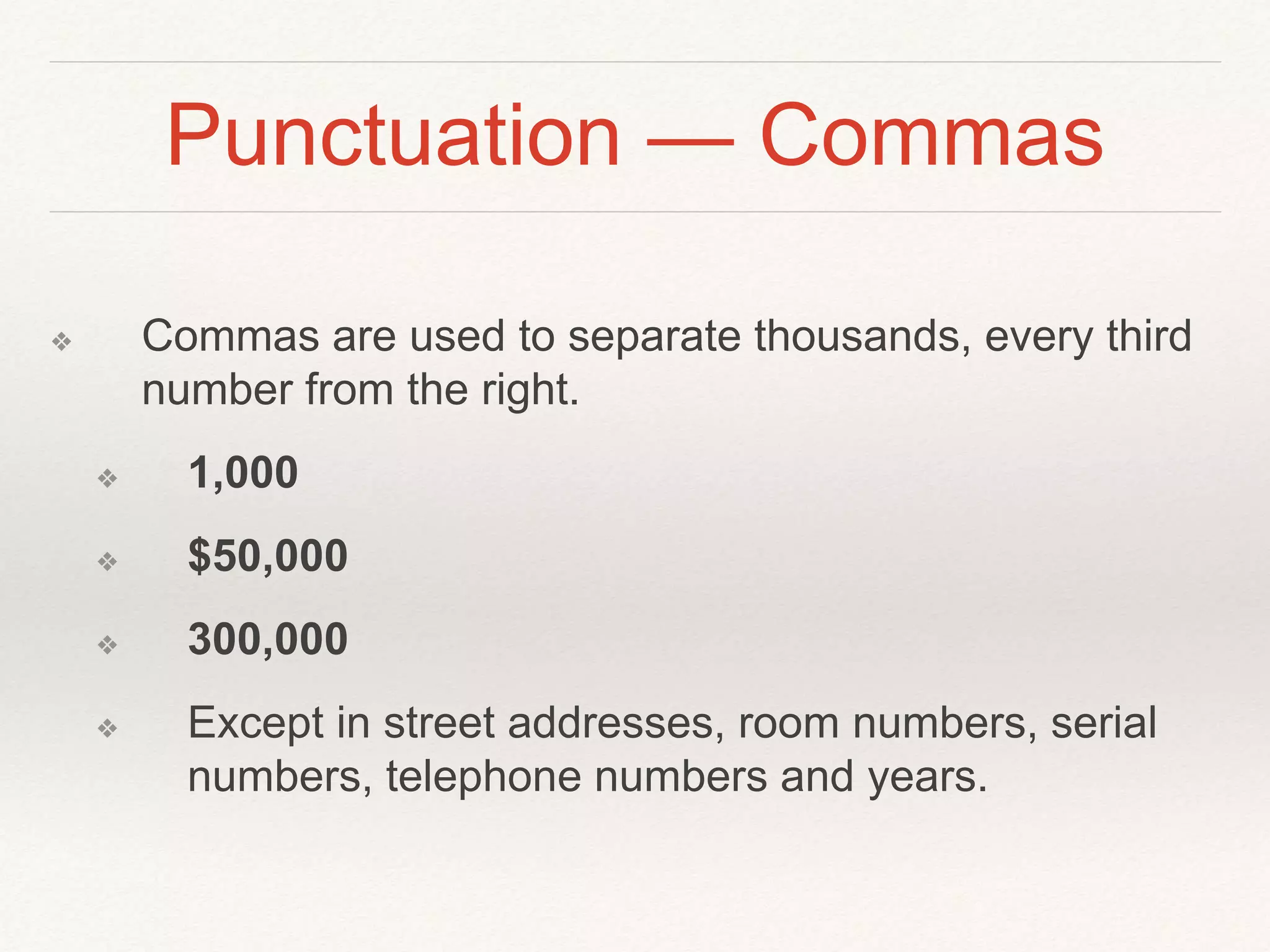
❖ Commas are used to separate thousands, every third 
number from the right. 
❖ 1,000 
❖ $50,000 
❖ 300,000 
❖ Except in street addresses, room numbers, serial 
numbers, telephone numbers and years.
Punctuation — Commas 
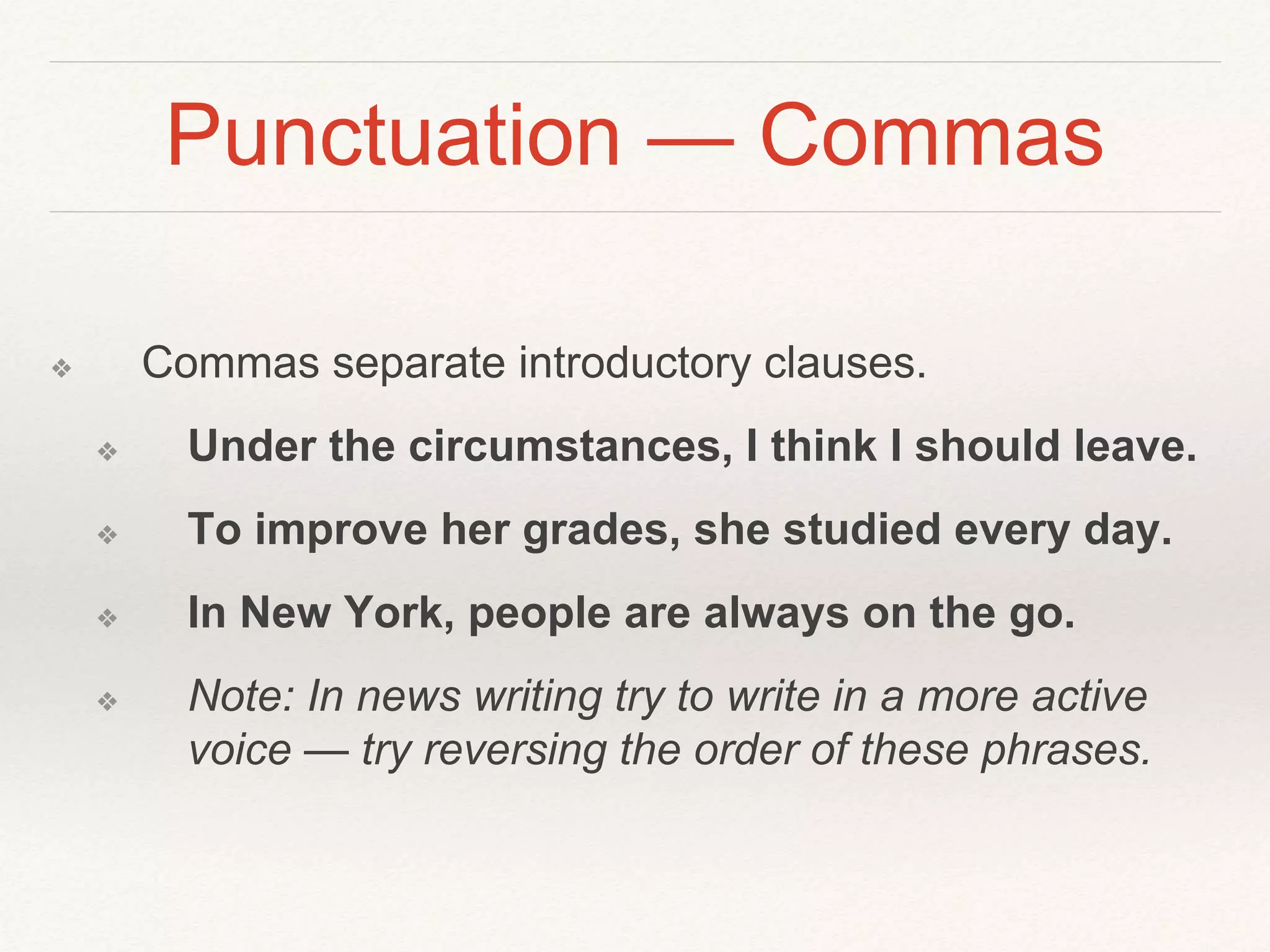
❖ Commas separate introductory clauses. 
❖ Under the circumstances, I think I should leave. 
❖ To improve her grades, she studied every day. 
❖ In New York, people are always on the go. 
❖ Note: In news writing try to write in a more active 
voice — try reversing the order of these phrases.
Punctuation — Commas 
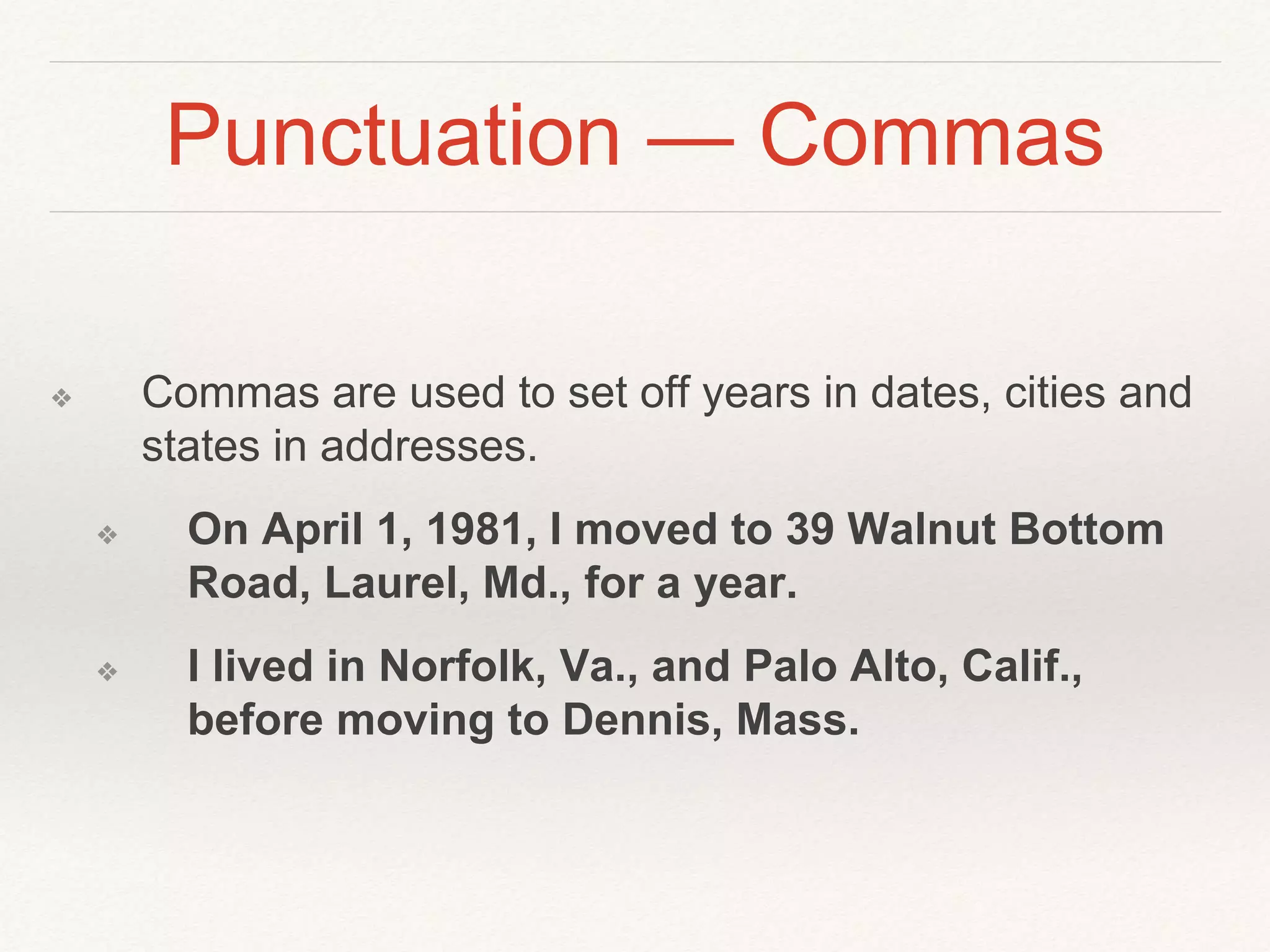
❖ Commas are used to set off years in dates, cities and 
states in addresses. 
❖ On April 1, 1981, I moved to 39 Walnut Bottom 
Road, Laurel, Md., for a year. 
❖ I lived in Norfolk, Va., and Palo Alto, Calif., 
before moving to Dennis, Mass.
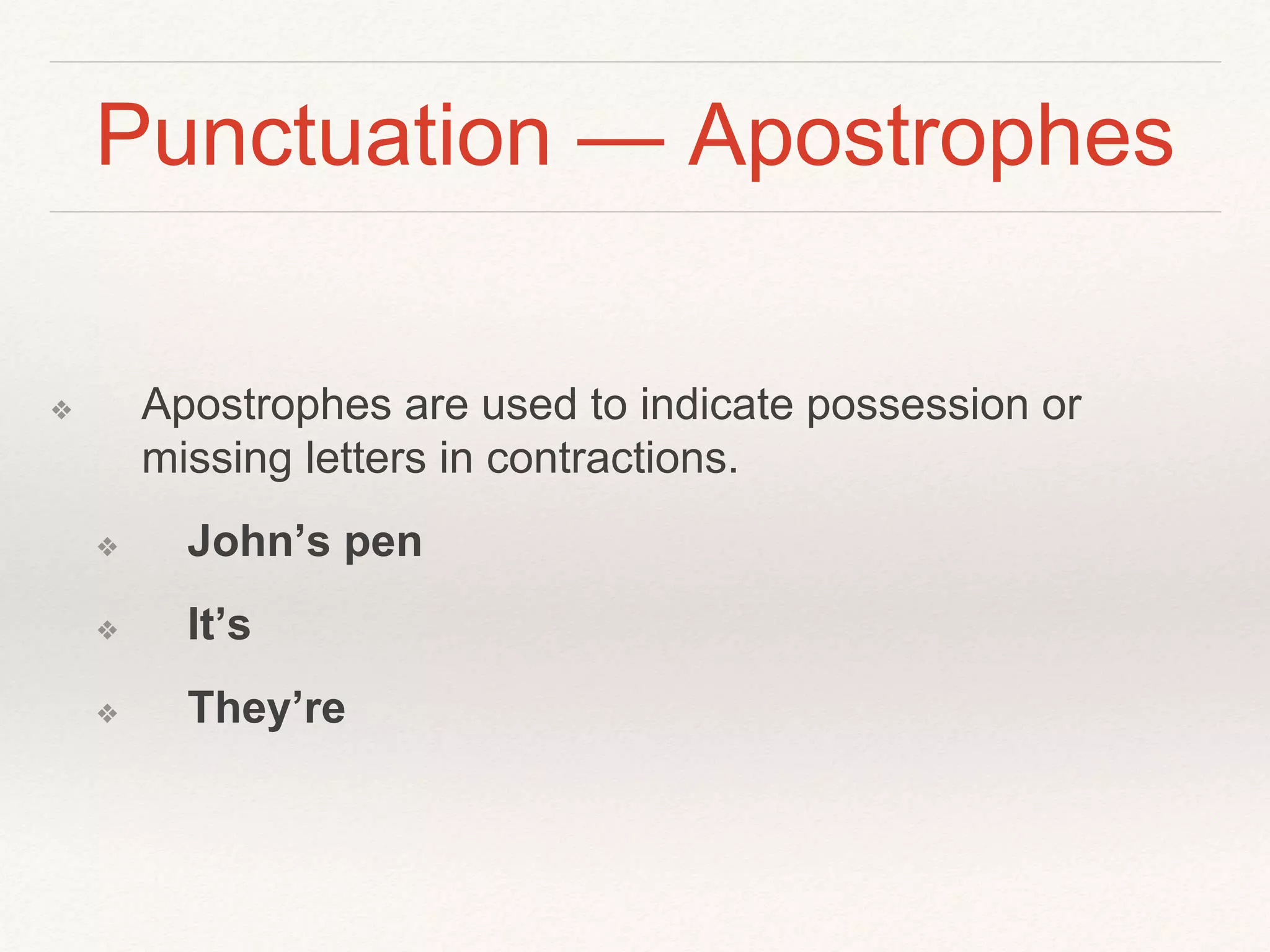
Punctuation — Apostrophes 
❖ Apostrophes are used to indicate possession or 
missing letters in contractions. 
❖ John’s pen 
❖ It’s 
❖ They’re
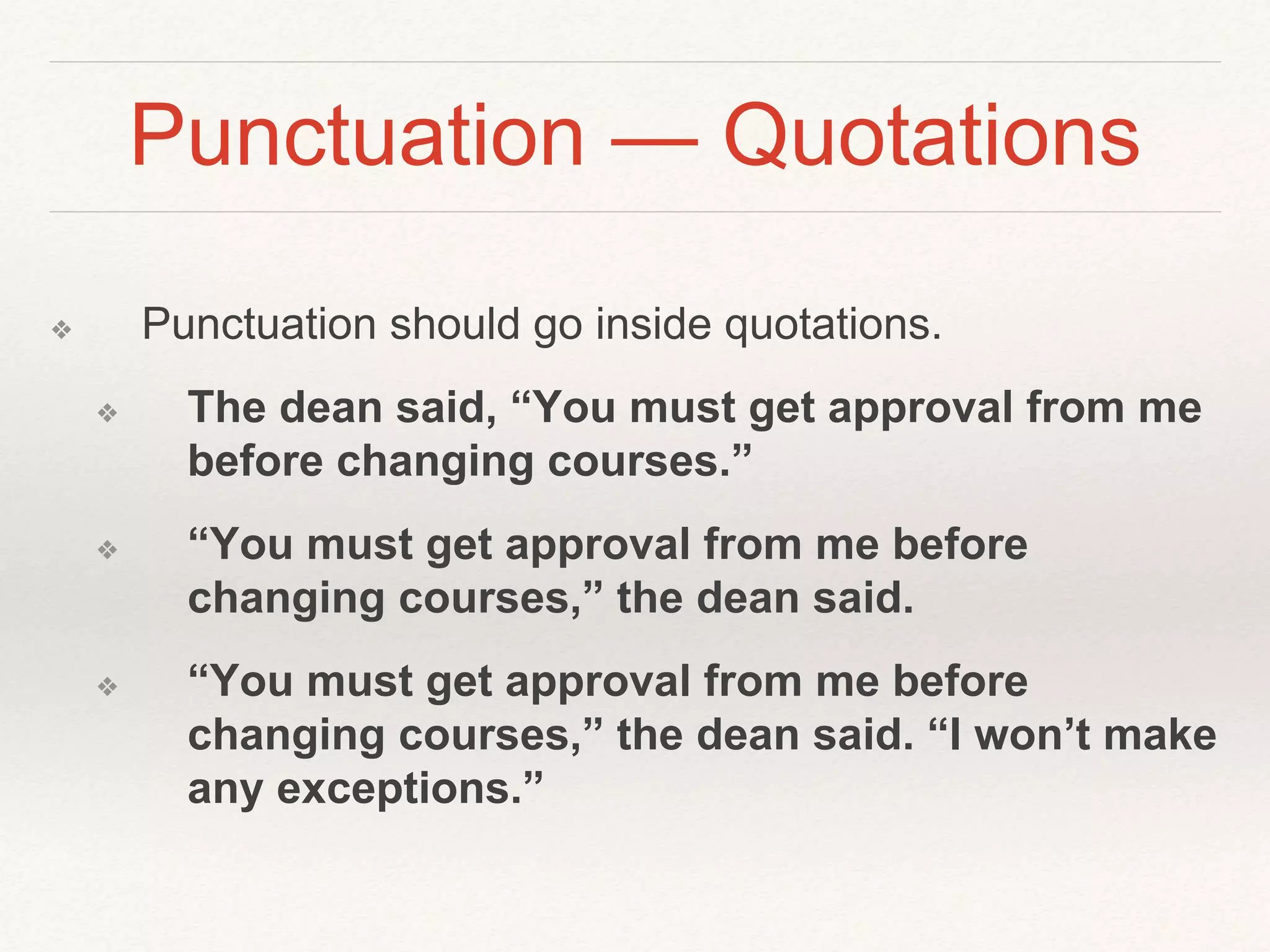
Punctuation — Quotations 
❖ Punctuation should go inside quotations. 
❖ The dean said, “You must get approval from me 
before changing courses.” 
❖ “You must get approval from me before 
changing courses,” the dean said. 
❖ “You must get approval from me before 
changing courses,” the dean said. “I won’t make 
any exceptions.”
Punctuation — Quotations 
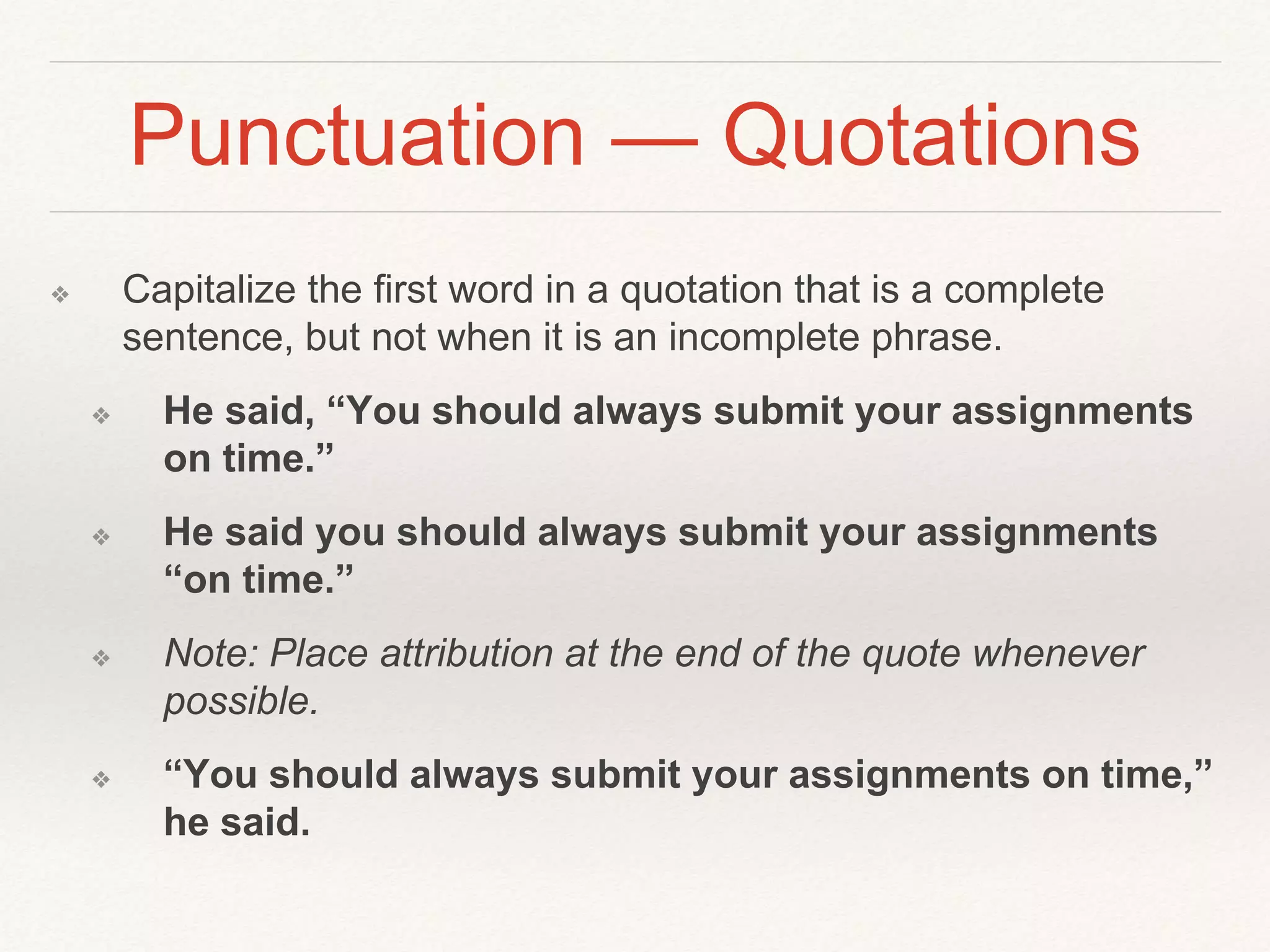
❖ Capitalize the first word in a quotation that is a complete 
sentence, but not when it is an incomplete phrase. 
❖ He said, “You should always submit your assignments 
on time.” 
❖ He said you should always submit your assignments 
“on time.” 
❖ Note: Place attribution at the end of the quote whenever 
possible. 
❖ “You should always submit your assignments on time,” 
he said.
Punctuation — Quotations 
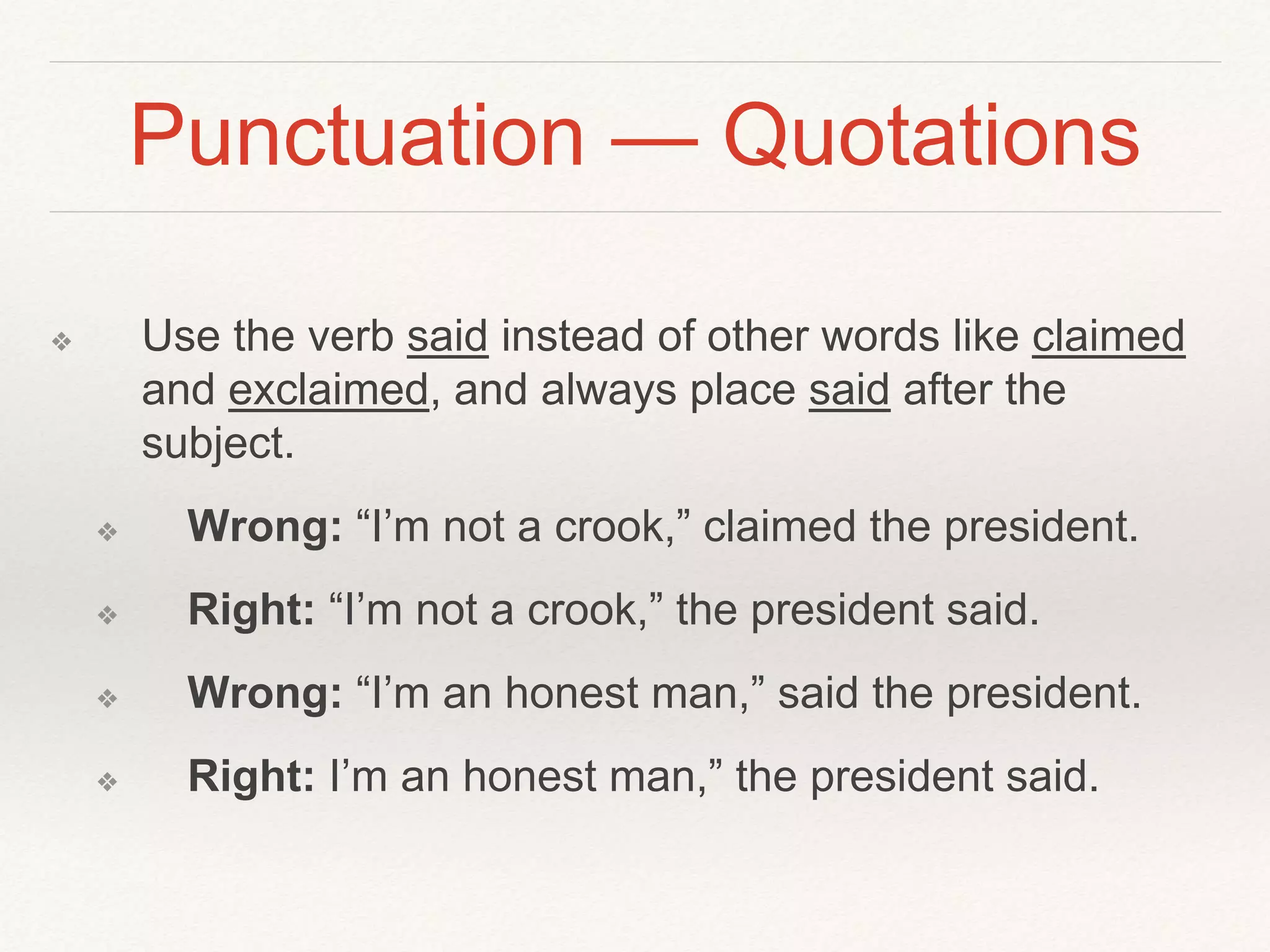
❖ Use the verb said instead of other words like claimed 
and exclaimed, and always place said after the 
subject. 
❖ Wrong: “I’m not a crook,” claimed the president. 
❖ Right: “I’m not a crook,” the president said. 
❖ Wrong: “I’m an honest man,” said the president. 
❖ Right: I’m an honest man,” the president said.
Punctuation — Quotations 
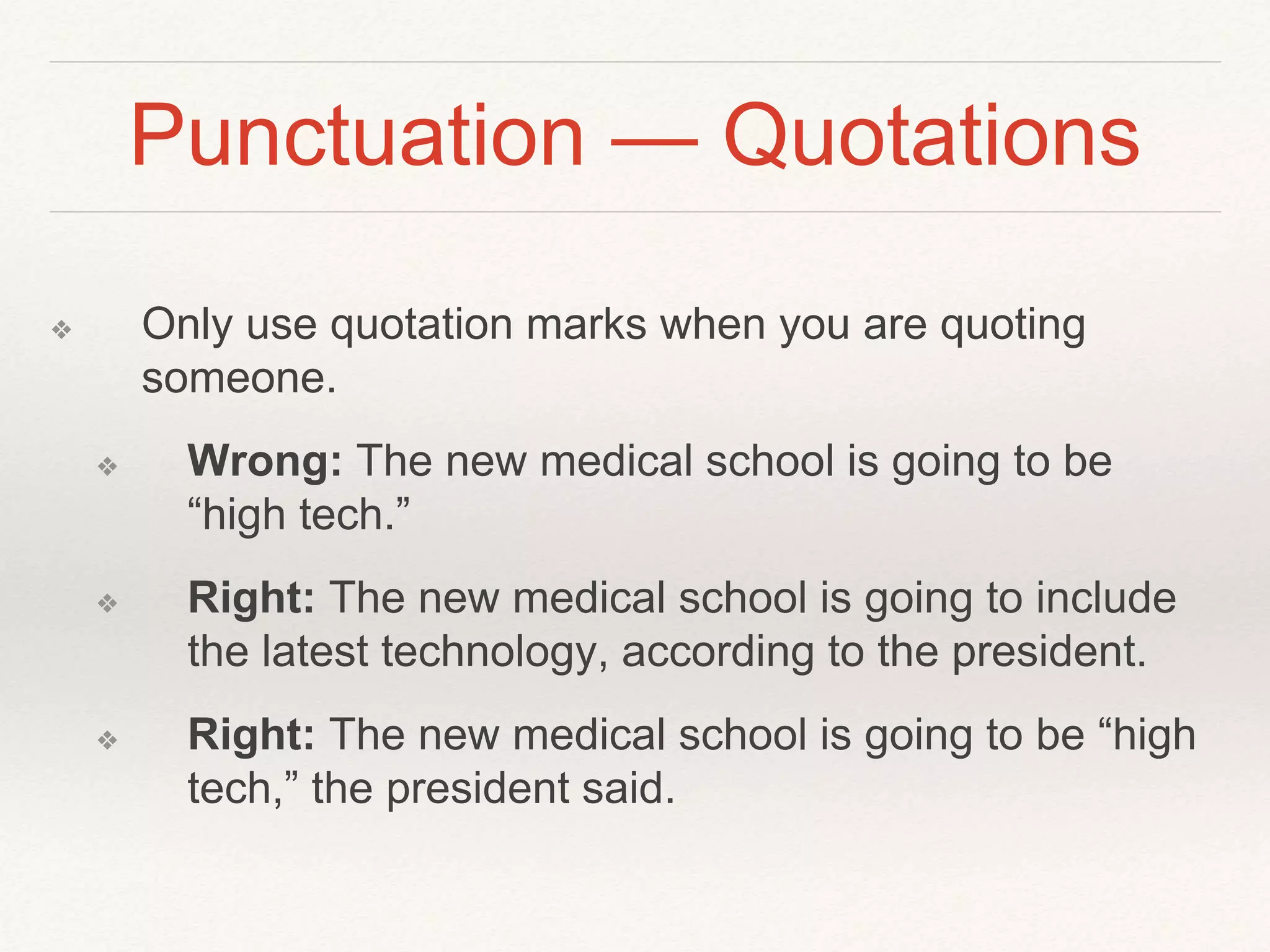
❖ Only use quotation marks when you are quoting 
someone. 
❖ Wrong: The new medical school is going to be 
“high tech.” 
❖ Right: The new medical school is going to include 
the latest technology, according to the president. 
❖ Right: The new medical school is going to be “high 
tech,” the president said.
Punctuation — Quotations 
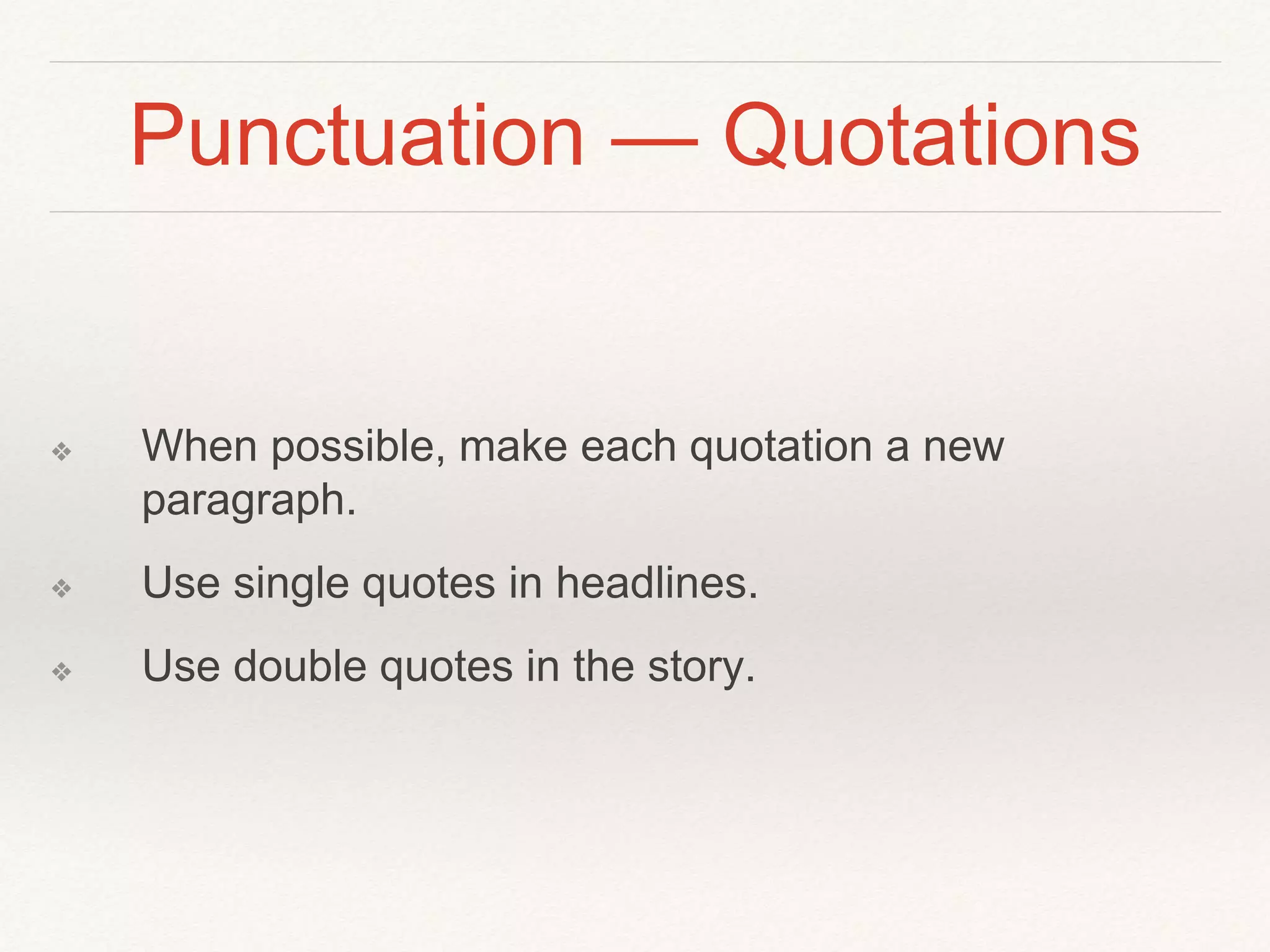
❖ When possible, make each quotation a new 
paragraph. 
❖ Use single quotes in headlines. 
❖ Use double quotes in the story.
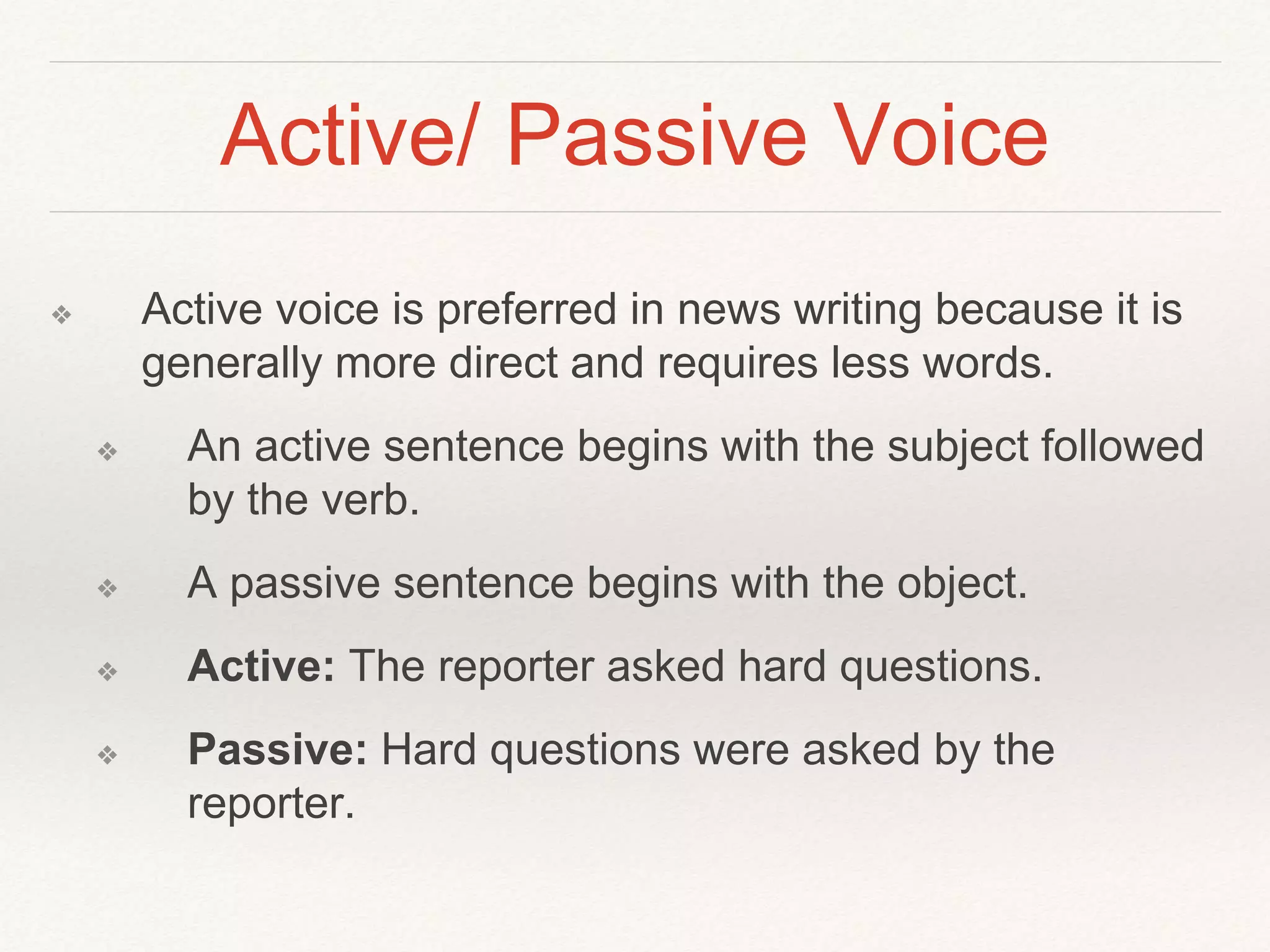
Active/ Passive Voice 
❖ Active voice is preferred in news writing because it is 
generally more direct and requires less words. 
❖ An active sentence begins with the subject followed 
by the verb. 
❖ A passive sentence begins with the object. 
❖ Active: The reporter asked hard questions. 
❖ Passive: Hard questions were asked by the 
reporter.
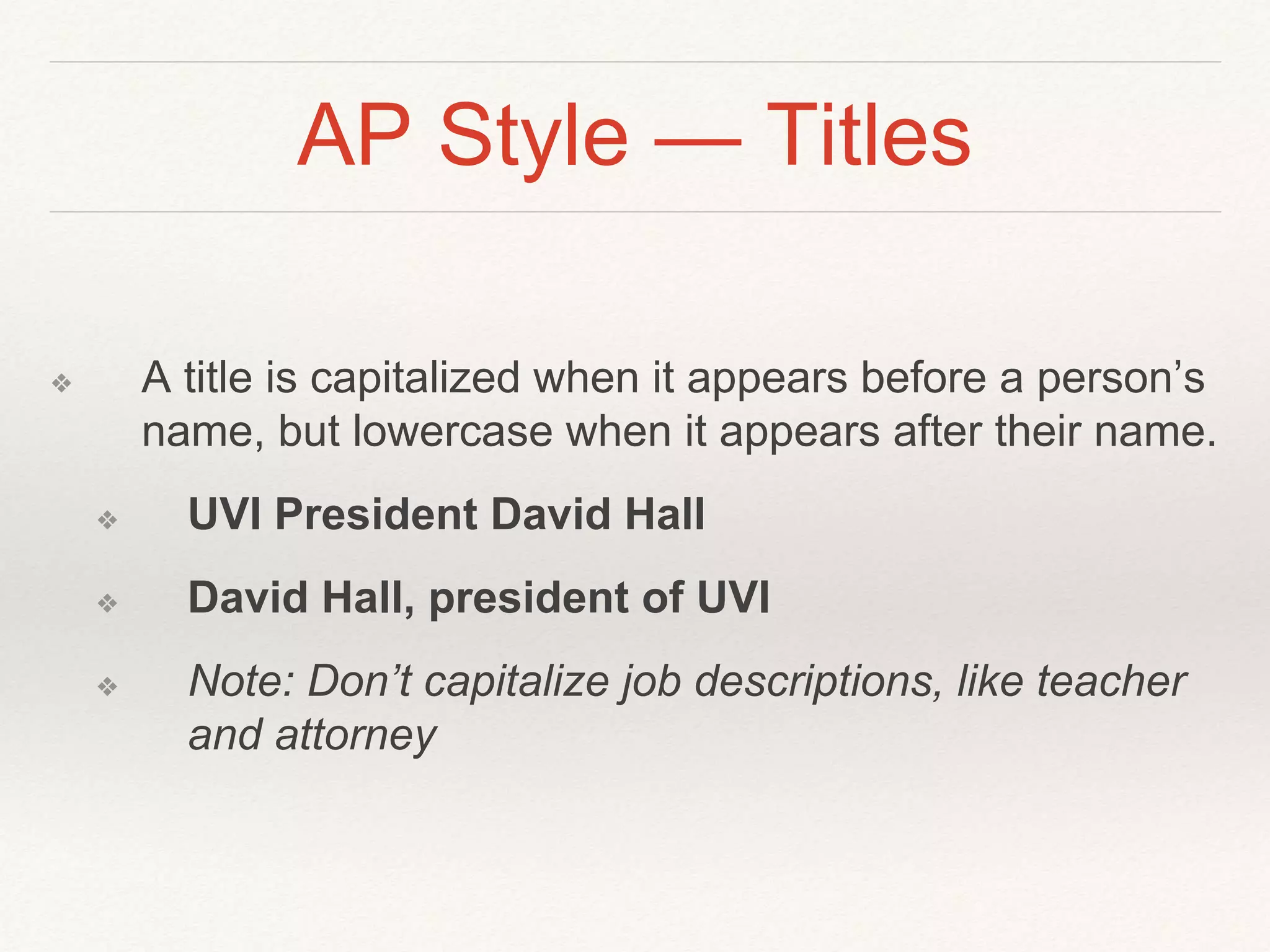
AP Style — Titles 
❖ A title is capitalized when it appears before a person’s 
name, but lowercase when it appears after their name. 
❖ UVI President David Hall 
❖ David Hall, president of UVI 
❖ Note: Don’t capitalize job descriptions, like teacher 
and attorney
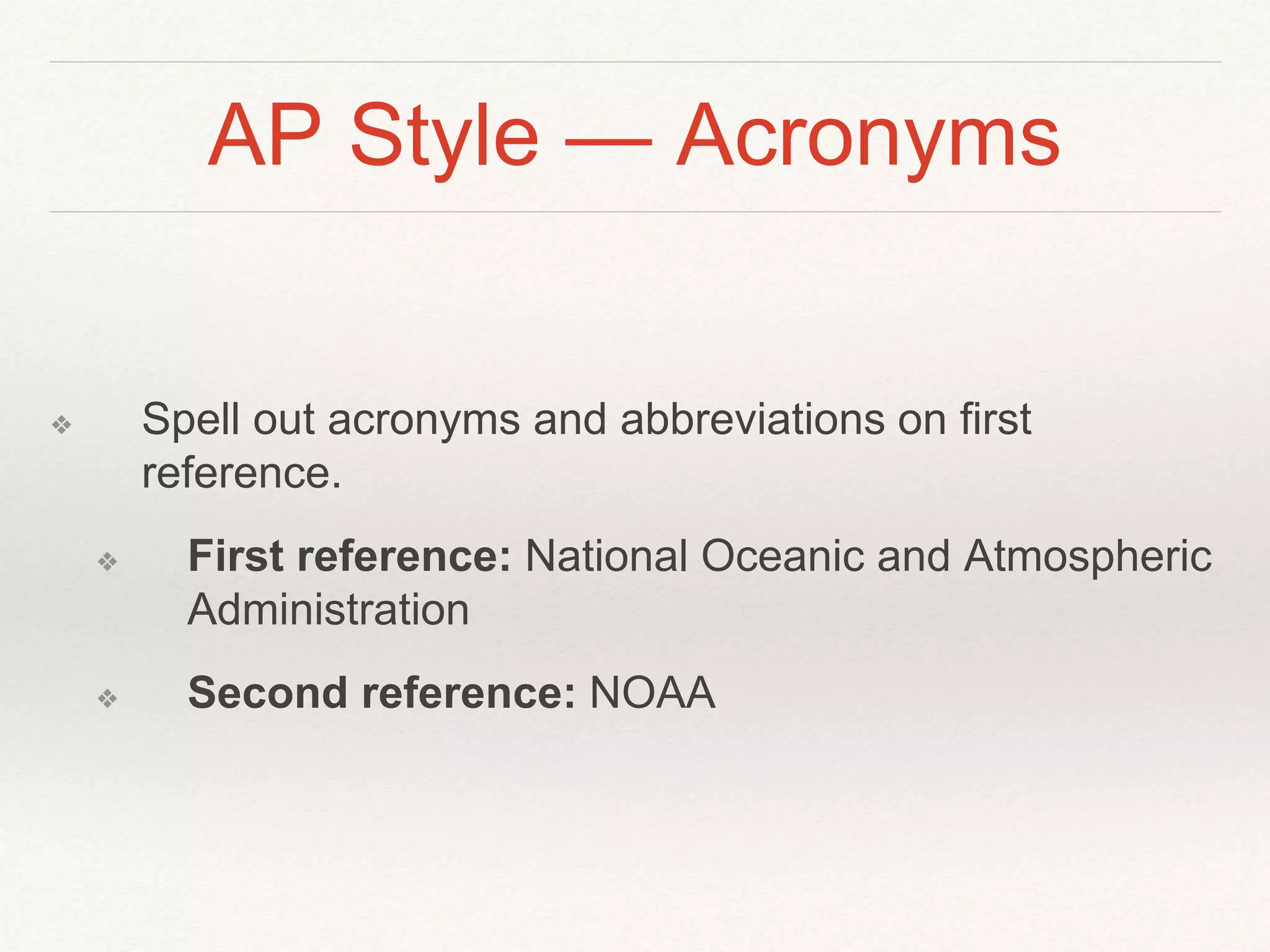
AP Style — Acronyms 
❖ Spell out acronyms and abbreviations on first 
reference. 
❖ First reference: National Oceanic and Atmospheric 
Administration 
❖ Second reference: NOAA
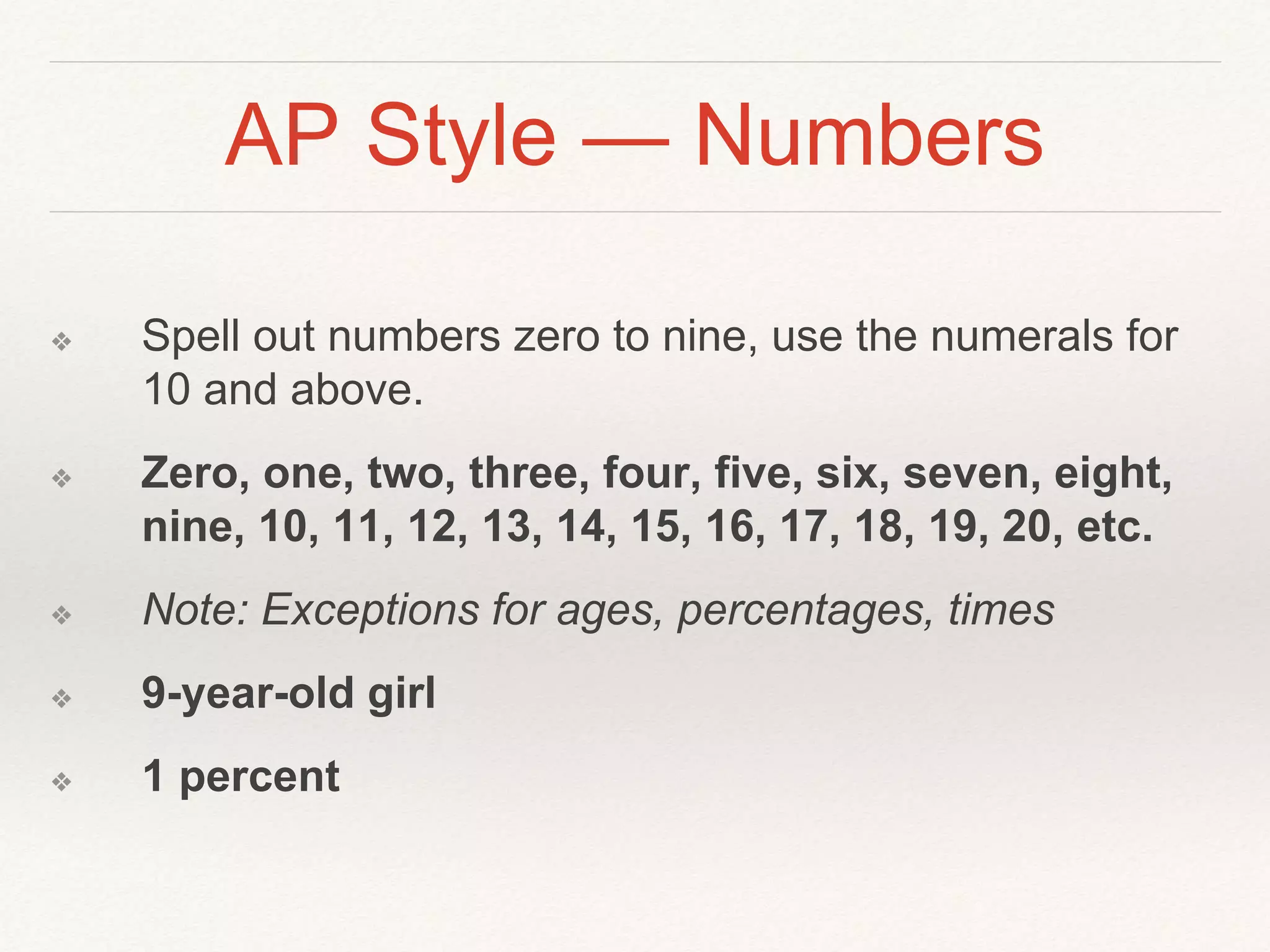
AP Style — Numbers 
❖ Spell out numbers zero to nine, use the numerals for 
10 and above. 
❖ Zero, one, two, three, four, five, six, seven, eight, 
nine, 10, 11, 12, 13, 14, 15, 16, 17, 18, 19, 20, etc. 
❖ Note: Exceptions for ages, percentages, times 
❖ 9-year-old girl 
❖ 1 percent
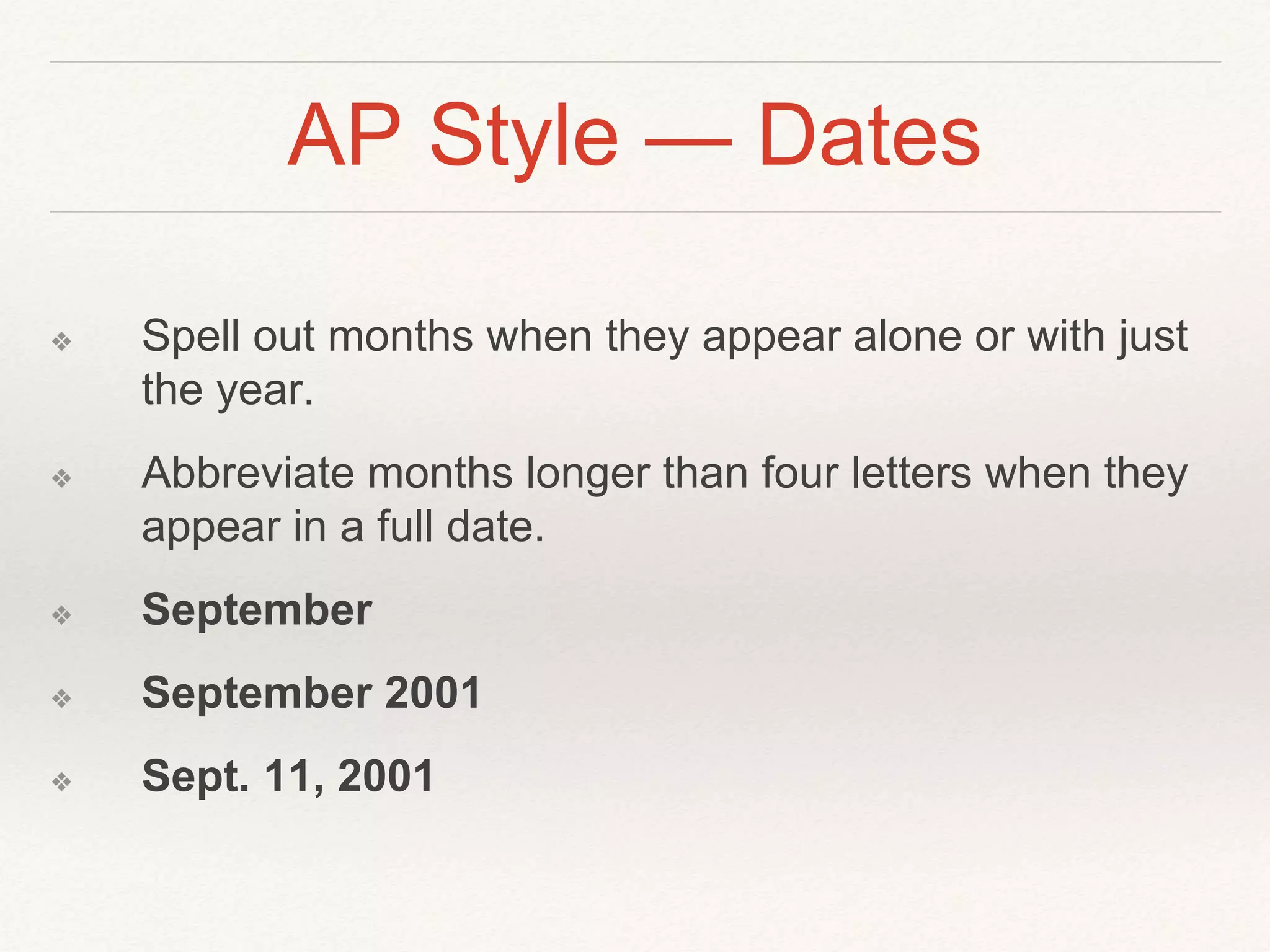
AP Style — Dates 
❖ Spell out months when they appear alone or with just 
the year. 
❖ Abbreviate months longer than four letters when they 
appear in a full date. 
❖ September 
❖ September 2001 
❖ Sept. 11, 2001
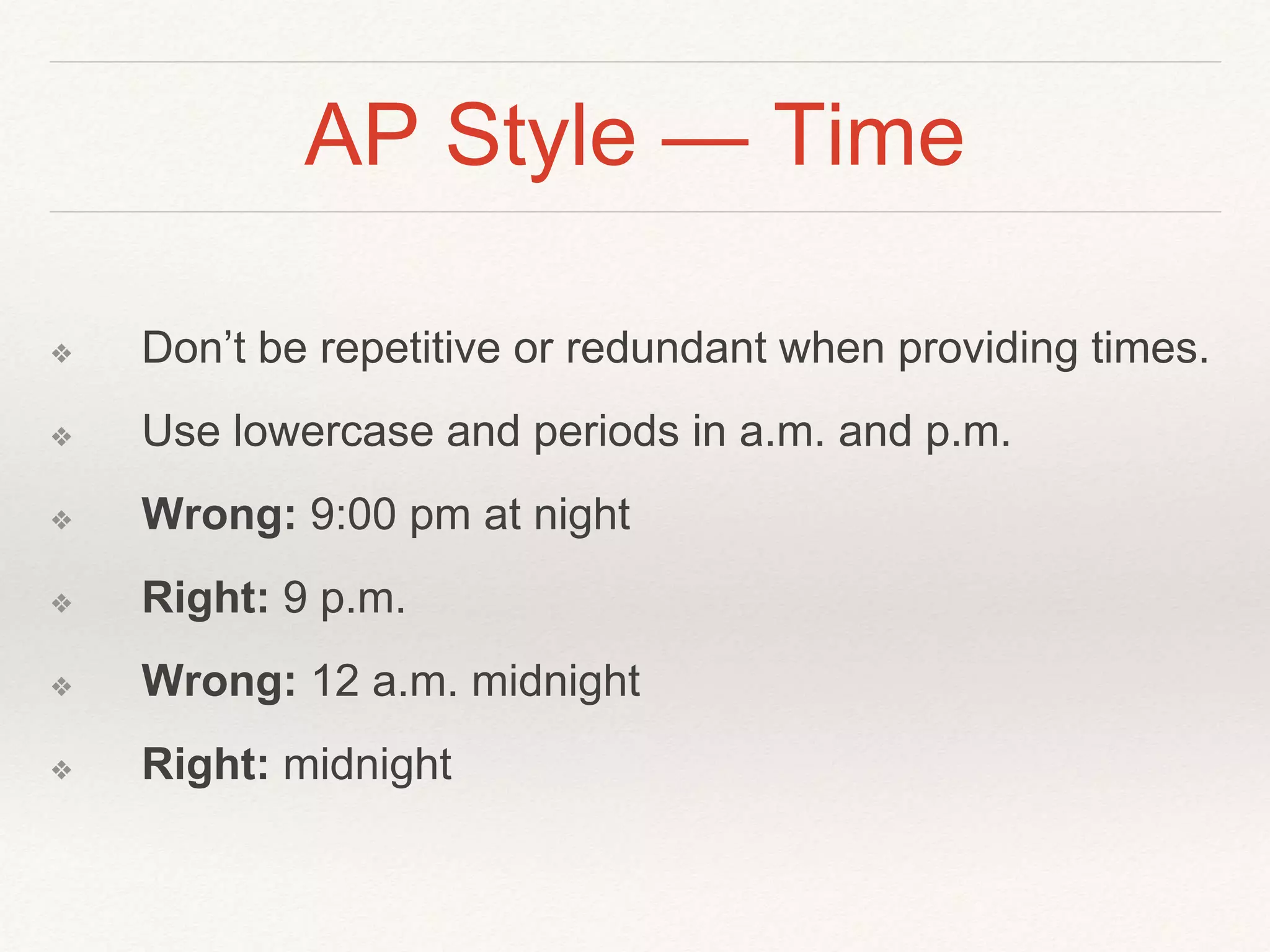
AP Style — Time 
❖ Don’t be repetitive or redundant when providing times. 
❖ Use lowercase and periods in a.m. and p.m. 
❖ Wrong: 9:00 pm at night 
❖ Right: 9 p.m. 
❖ Wrong: 12 a.m. midnight 
❖ Right: midnight
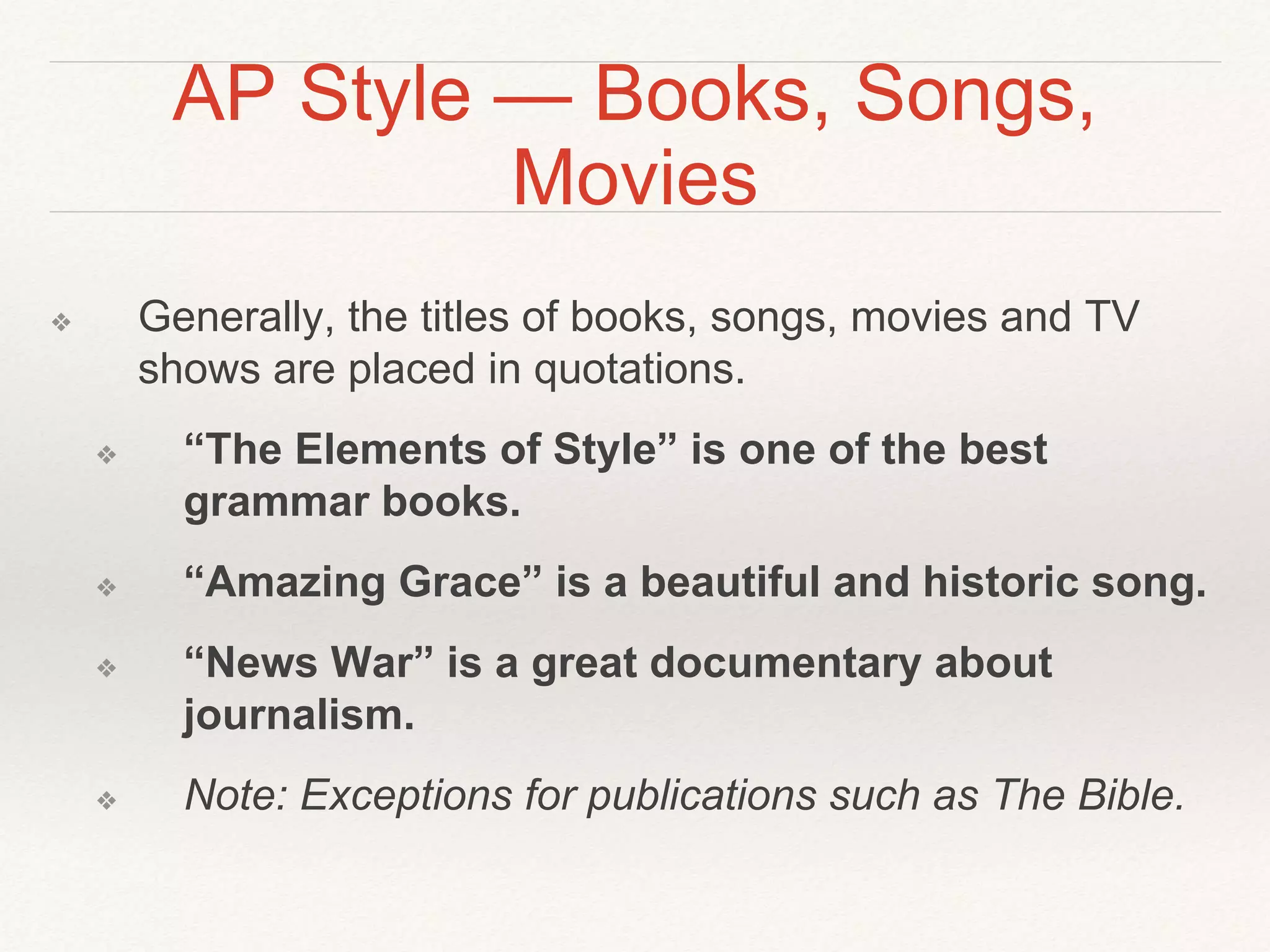
AP Style — Books, Songs, 
Movies 
❖ Generally, the titles of books, songs, movies and TV 
shows are placed in quotations. 
❖ “The Elements of Style” is one of the best 
grammar books. 
❖ “Amazing Grace” is a beautiful and historic song. 
❖ “News War” is a great documentary about 
journalism. 
❖ Note: Exceptions for publications such as The Bible.
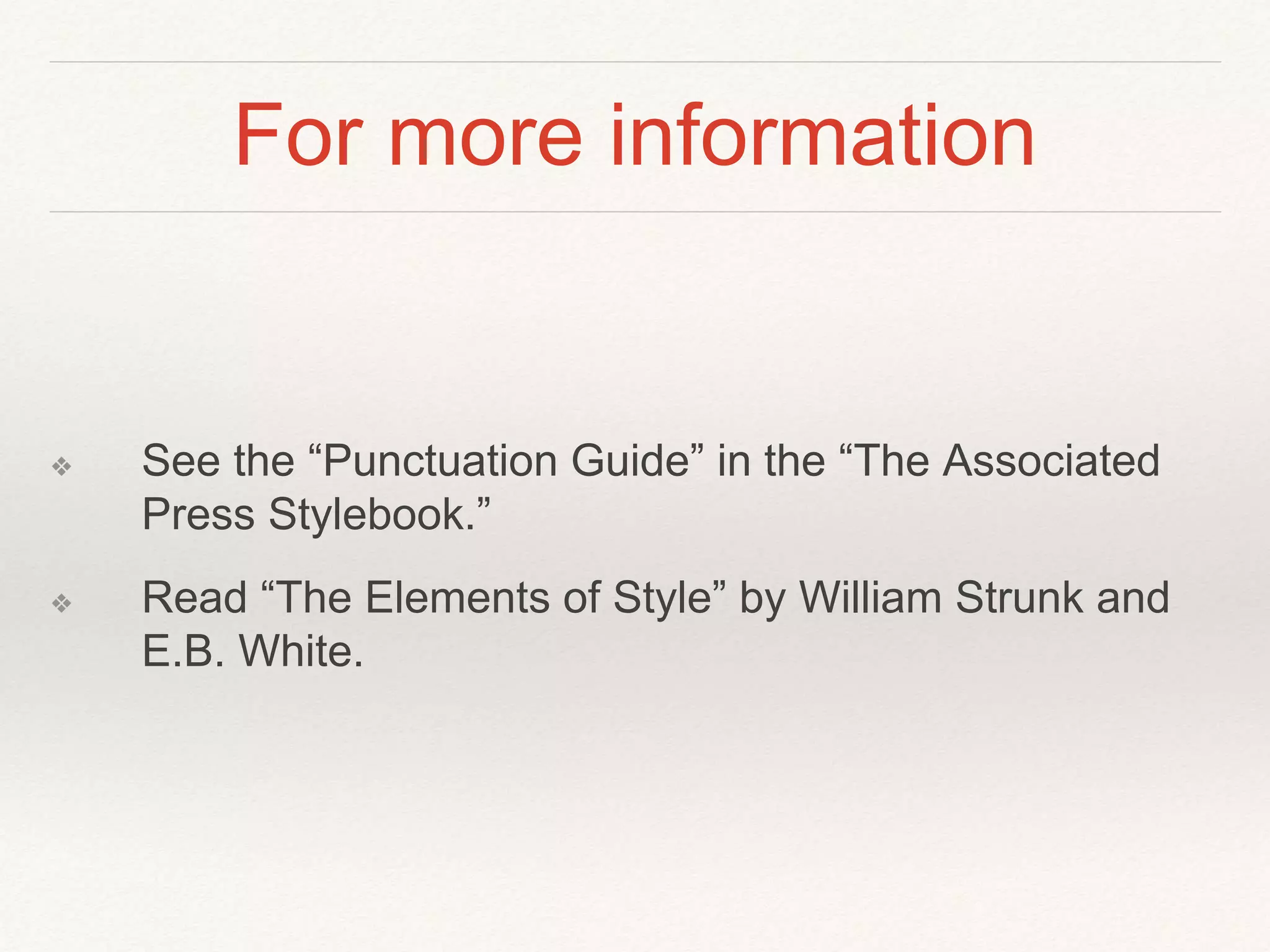
For more information 
❖ See the “Punctuation Guide” in the “The Associated 
Press Stylebook.” 
❖ Read “The Elements of Style” by William Strunk and 
E.B. White.

Abridged version ap grammar and style by hanlon-nugent

  • 1.
    Prof. Stephanie Hanlon-Nugent Abridged version part 1 Grammar and Style Misused words, punctuation, grammar and AP Style Source: “The Elements of News Writing” by James Kershner
  • 2.
    Punctuation — Commas ❖ Commas separate items in a series. ❖ The flag is red, white and blue.
  • 3.
    Punctuation — Commas ❖ Don’t use a comma with the last item in a series. ❖ Wrong: Newspaper ink comes in magenta, cyan, yellow, and black. ❖ Right: Newspaper ink comes in magenta, cyan, yellow and black.
  • 4.
    Punctuation — Commas ❖ Commas set off phrases that could be removed from a sentence. ❖ Mary Smith, who missed five classes, failed the course. ❖ Don’t use commas to set off essential words and phrases. ❖ Students who miss too many classes fail their courses.
  • 5.
    Punctuation — Commas ❖ Commas separate independent clauses. ❖ The reporter was getting stonewalled, but she doggedly pursued the information. ❖ Omit the comma if the clause is short. ❖ The reporter was getting stonewalled and she quit.
  • 6.
    Punctuation — Commas ❖ Commas separate direct quotations from attribution. ❖ “Always put commas inside quotation marks,” the textbook says.
  • 7.
    Punctuation — Commas ❖ Commas set off words that address someone, when that name can be removed. ❖ “Frankly, my dear, I don’t give a damn.”
  • 8.
    Punctuation — Commas ❖ Commas are used to separate thousands, every third number from the right. ❖ 1,000 ❖ $50,000 ❖ 300,000 ❖ Except in street addresses, room numbers, serial numbers, telephone numbers and years.
  • 9.
    Punctuation — Commas ❖ Commas separate introductory clauses. ❖ Under the circumstances, I think I should leave. ❖ To improve her grades, she studied every day. ❖ In New York, people are always on the go. ❖ Note: In news writing try to write in a more active voice — try reversing the order of these phrases.
  • 10.
    Punctuation — Commas ❖ Commas are used to set off years in dates, cities and states in addresses. ❖ On April 1, 1981, I moved to 39 Walnut Bottom Road, Laurel, Md., for a year. ❖ I lived in Norfolk, Va., and Palo Alto, Calif., before moving to Dennis, Mass.
  • 11.
    Punctuation — Apostrophes ❖ Apostrophes are used to indicate possession or missing letters in contractions. ❖ John’s pen ❖ It’s ❖ They’re
  • 12.
    Punctuation — Quotations ❖ Punctuation should go inside quotations. ❖ The dean said, “You must get approval from me before changing courses.” ❖ “You must get approval from me before changing courses,” the dean said. ❖ “You must get approval from me before changing courses,” the dean said. “I won’t make any exceptions.”
  • 13.
    Punctuation — Quotations ❖ Capitalize the first word in a quotation that is a complete sentence, but not when it is an incomplete phrase. ❖ He said, “You should always submit your assignments on time.” ❖ He said you should always submit your assignments “on time.” ❖ Note: Place attribution at the end of the quote whenever possible. ❖ “You should always submit your assignments on time,” he said.
  • 14.
    Punctuation — Quotations ❖ Use the verb said instead of other words like claimed and exclaimed, and always place said after the subject. ❖ Wrong: “I’m not a crook,” claimed the president. ❖ Right: “I’m not a crook,” the president said. ❖ Wrong: “I’m an honest man,” said the president. ❖ Right: I’m an honest man,” the president said.
  • 15.
    Punctuation — Quotations ❖ Only use quotation marks when you are quoting someone. ❖ Wrong: The new medical school is going to be “high tech.” ❖ Right: The new medical school is going to include the latest technology, according to the president. ❖ Right: The new medical school is going to be “high tech,” the president said.
  • 16.
    Punctuation — Quotations ❖ When possible, make each quotation a new paragraph. ❖ Use single quotes in headlines. ❖ Use double quotes in the story.
  • 17.
    Active/ Passive Voice ❖ Active voice is preferred in news writing because it is generally more direct and requires less words. ❖ An active sentence begins with the subject followed by the verb. ❖ A passive sentence begins with the object. ❖ Active: The reporter asked hard questions. ❖ Passive: Hard questions were asked by the reporter.
  • 18.
    AP Style —Titles ❖ A title is capitalized when it appears before a person’s name, but lowercase when it appears after their name. ❖ UVI President David Hall ❖ David Hall, president of UVI ❖ Note: Don’t capitalize job descriptions, like teacher and attorney
  • 19.
    AP Style —Acronyms ❖ Spell out acronyms and abbreviations on first reference. ❖ First reference: National Oceanic and Atmospheric Administration ❖ Second reference: NOAA
  • 20.
    AP Style —Numbers ❖ Spell out numbers zero to nine, use the numerals for 10 and above. ❖ Zero, one, two, three, four, five, six, seven, eight, nine, 10, 11, 12, 13, 14, 15, 16, 17, 18, 19, 20, etc. ❖ Note: Exceptions for ages, percentages, times ❖ 9-year-old girl ❖ 1 percent
  • 21.
    AP Style —Dates ❖ Spell out months when they appear alone or with just the year. ❖ Abbreviate months longer than four letters when they appear in a full date. ❖ September ❖ September 2001 ❖ Sept. 11, 2001
  • 22.
    AP Style —Time ❖ Don’t be repetitive or redundant when providing times. ❖ Use lowercase and periods in a.m. and p.m. ❖ Wrong: 9:00 pm at night ❖ Right: 9 p.m. ❖ Wrong: 12 a.m. midnight ❖ Right: midnight
  • 23.
    AP Style —Books, Songs, Movies ❖ Generally, the titles of books, songs, movies and TV shows are placed in quotations. ❖ “The Elements of Style” is one of the best grammar books. ❖ “Amazing Grace” is a beautiful and historic song. ❖ “News War” is a great documentary about journalism. ❖ Note: Exceptions for publications such as The Bible.
  • 24.
    For more information ❖ See the “Punctuation Guide” in the “The Associated Press Stylebook.” ❖ Read “The Elements of Style” by William Strunk and E.B. White.