PunctuationApostrophes, Quotation Marks, & Commas
ApostropheThe two main uses of apostrophes areTo show the omission of one or more letters in a contraction (it is usually best to avoid contractions in formal writing)To show ownership or possession
Apostrophe in ContractionsA contraction is formed when 2 words are combined to make 1 word.An apostrophe is used to show where letters are omitted. Some common contractions:I + am= I’m		it + is= it’s		it + not= isn’tI + have= I’ve	I + had= I’d		who + is= who’sCould + not= couldn’t	do + not= don’t	they + are= they’re* Will + not has an unusual contraction, won’t.
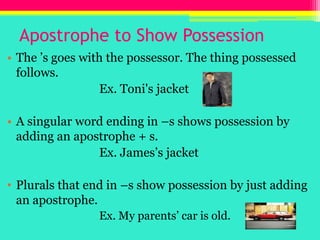
Apostrophe to Show PossessionThe ’s goes with the possessor. The thing possessed follows.				Ex. Toni's jacketA singular word ending in –s shows possession by adding an apostrophe + s.				Ex. James’s jacketPlurals that end in –s show possession by just adding an apostrophe.Ex. My parents’ car is old.
Apostrophe versus Possessive PronounsDo not use an apostrophe with possessive pronouns (his, hers, its, yours, ours, theirs). They already show ownership.Incorrect: The store lost its’ lease.Correct: The store lost its lease.
Quotation MarksThe two main uses of quotation marks areTo set off the exact words of a speaker or writerTo set off the titles of short works
Quotation of Exact WordsUse quotations to show exact words.Ex. “Say something tender,” whispered Lola.Every quotation begins with a capital letter. If it is split, the 2nd part doesn’t start with a capital.Ex. “I love you so much,” she said, “that it hurts.”Commas are used to separate the quoted part of the sentence from the rest.Commas & periods that come at the end of the quotation go inside the quotation marks.
Title of Short WorksUse quotations when mentioning the titles of short works:Articles in books, newspapers, magazinesChapters in a bookTitles of short storiesTitles of poemsTitles of songsTitles of essays
CommasCommas are used as follows:To separate items in a seriesTo set off introductory materialBefore & after words that interrupt the flow of thought in a sentenceBefore 2 complete thoughts connected by and, but, for, or, nor, so, yetTo set off a quotation from the rest of a sentenceCertain everyday material* Commas often mark a slight pause or break.
Items in a SeriesUse commas to separate items in a series.Ex. Do you drink tea with milk, lemon, or honey?The last comma in a series is optional, but often used.
Comma After Introductory MaterialUse a comma to set off introductory material.Ex. After punching the alarm clock with his fist, Bill went back to sleep.Ex. In addition, he held a broom in his hand.A comma is also used to set off extra material at the end of a sentence.Ex. A sudden breeze came in, driving out the stuffiness.
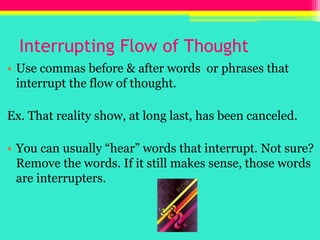
Interrupting Flow of ThoughtUse commas before & after words  or phrases that interrupt the flow of thought.Ex. That reality show, at long last, has been canceled.You can usually “hear” words that interrupt. Not sure? Remove the words. If it still makes sense, those words are interrupters.
Between Complete ThoughtsUse a comma between two complete thoughts connected by and, but, for, or, nor, so, yet.Ex. Rick works Monday nights, so he records the game.The comma is optional when the complete thoughts are short.Ex. Grace has a headache and Mark has a fever.
Everyday MaterialUse commas with everyday material, such asPersons spoken to. Ex. Tina, where are my shoes?Dates. Ex. March 4, 2007, is when Sam was born.Addresses. Ex. He lives at 8 Tan St., Tampa, Florida.Openings & Closings of letters. Ex. Dear Santa, Numbers. Ex. The charity raised $10,000.

Punctuation

  • 1.
  • 2.
    ApostropheThe two mainuses of apostrophes areTo show the omission of one or more letters in a contraction (it is usually best to avoid contractions in formal writing)To show ownership or possession
  • 3.
    Apostrophe in ContractionsAcontraction is formed when 2 words are combined to make 1 word.An apostrophe is used to show where letters are omitted. Some common contractions:I + am= I’m it + is= it’s it + not= isn’tI + have= I’ve I + had= I’d who + is= who’sCould + not= couldn’t do + not= don’t they + are= they’re* Will + not has an unusual contraction, won’t.
  • 4.
    Apostrophe to ShowPossessionThe ’s goes with the possessor. The thing possessed follows. Ex. Toni's jacketA singular word ending in –s shows possession by adding an apostrophe + s. Ex. James’s jacketPlurals that end in –s show possession by just adding an apostrophe.Ex. My parents’ car is old.
  • 5.
    Apostrophe versus PossessivePronounsDo not use an apostrophe with possessive pronouns (his, hers, its, yours, ours, theirs). They already show ownership.Incorrect: The store lost its’ lease.Correct: The store lost its lease.
  • 6.
    Quotation MarksThe twomain uses of quotation marks areTo set off the exact words of a speaker or writerTo set off the titles of short works
  • 7.
    Quotation of ExactWordsUse quotations to show exact words.Ex. “Say something tender,” whispered Lola.Every quotation begins with a capital letter. If it is split, the 2nd part doesn’t start with a capital.Ex. “I love you so much,” she said, “that it hurts.”Commas are used to separate the quoted part of the sentence from the rest.Commas & periods that come at the end of the quotation go inside the quotation marks.
  • 8.
    Title of ShortWorksUse quotations when mentioning the titles of short works:Articles in books, newspapers, magazinesChapters in a bookTitles of short storiesTitles of poemsTitles of songsTitles of essays
  • 9.
    CommasCommas are usedas follows:To separate items in a seriesTo set off introductory materialBefore & after words that interrupt the flow of thought in a sentenceBefore 2 complete thoughts connected by and, but, for, or, nor, so, yetTo set off a quotation from the rest of a sentenceCertain everyday material* Commas often mark a slight pause or break.
  • 10.
    Items in aSeriesUse commas to separate items in a series.Ex. Do you drink tea with milk, lemon, or honey?The last comma in a series is optional, but often used.
  • 11.
    Comma After IntroductoryMaterialUse a comma to set off introductory material.Ex. After punching the alarm clock with his fist, Bill went back to sleep.Ex. In addition, he held a broom in his hand.A comma is also used to set off extra material at the end of a sentence.Ex. A sudden breeze came in, driving out the stuffiness.
  • 12.
    Interrupting Flow ofThoughtUse commas before & after words or phrases that interrupt the flow of thought.Ex. That reality show, at long last, has been canceled.You can usually “hear” words that interrupt. Not sure? Remove the words. If it still makes sense, those words are interrupters.
  • 13.
    Between Complete ThoughtsUsea comma between two complete thoughts connected by and, but, for, or, nor, so, yet.Ex. Rick works Monday nights, so he records the game.The comma is optional when the complete thoughts are short.Ex. Grace has a headache and Mark has a fever.
  • 14.
    Everyday MaterialUse commaswith everyday material, such asPersons spoken to. Ex. Tina, where are my shoes?Dates. Ex. March 4, 2007, is when Sam was born.Addresses. Ex. He lives at 8 Tan St., Tampa, Florida.Openings & Closings of letters. Ex. Dear Santa, Numbers. Ex. The charity raised $10,000.