“There are 8 million
            stories in the naked city.”
             AP helps you tell them.


Writing in AP style
By Sarah Bennett
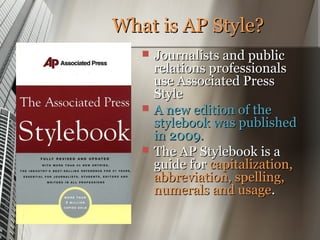
What is AP Style?
      Journalists and public
       relations professionals
       use Associated Press
       Style
      A new edition of the
       stylebook was published
       in 2009.
      The AP Stylebook is a
       guide for capitalization,
       abbreviation, spelling,
       numerals and usage.
Major differences between
       academic writing and AP Style
   No reference list or in-
    text citations.
   Small paragraphs: 1-2
    sentences per paragraph.
   Clear and concise writing.
    Avoid wordiness, long
    sentences, difficult
    vocabulary and jargon.
   AP Style allows
    contractions.
Finding information in the AP
                  Stylebook

   Information is listed alphabetically.
       Example: “Titles” is under T and
        “composition titles” is under C.
 Many entries will point the reader to
  other entries within the stylebook for
  more information.
 The actual stylebook makes up most
  of the AP Stylebook; however, there
  are also a chapters on punctuation,
  media law, and sports and business
  writing.
Paraphrasing
   When paraphrasing information,
    attribute it to a source at the beginning
    or end of a sentence.
       Example: Several factors could determine
        how quickly a fire engulfs a resident’s
        room, Frederick said.
   Important rule: It is always said.
    Don’t use pointed out, claimed or any
    other verb that could be perceived as
    biased.
   A person’s name or a pronoun always
    precedes said.
Paraphrasing, cont.
   Always attribute
    information that came
    from a source and is
    not general
    knowledge.
   As with academic
    writing, when in
    doubt, cite.
Direct quotes
   If the quote is one sentence,
    attribution for direct quotes
    goes at the end of the quote.
       Example: “Shouting is not
        going to help,” McCaskill said.
   If the quote is more than
    one sentence, the
    attribution goes after the
    first sentence and before
    the rest of the quote.
       Example: “My job is to
        represent the people of
        Missouri,” she said. “Period.”
   See entry “quotations in
    the news” in the AP
    Stylebook
Commas in a series
   AP Style deletes the comma in a
    series that comes before the
    conjunction.
       Example: It contained a bed, desk,
        posters and other items one would find
        in a typical dorm room.
   See the “comma” entry in the
    punctuation guideline chapter
    of the AP Stylebook.
Capitalization
   Capitalize common nouns when they are
    part of a full name.
       Example: The Democratic Party holds the
        majority in the Senate.
   Some words derive from a proper noun and
    depend on that word for their meaning.
    These should be capitalized.
       Examples: Christian, English, Marxism
   Other words no longer depend on proper
    nouns for their meaning and do not need to
    be capitalized.
       Example: french fries
   See the “capitalization” entry in the
    AP Stylebook.
Trademarked words
         Words that are
          trademarked are always
          capitalized.
             Examples: Ferris wheel,
              Frisbee, Kitty Litter,
              Dumpster, Taser
         Trademarked words
          should be avoided if
          possible. Instead, use
          generic terms like cat
          box filler or trash
          receptacle.
         See the “trademark”
          entry in the AP
          Stylebook.
Titles
   Titles are capitalized only when used
    before a name.
     Examples: President Barack Obama
      addressed the nation last night.
     The president resigned from office.
   Put long titles after names for easier
    readability. A title with more than two
    words is generally considered long.
       Example: Steve Robinette, acting assistant
        provost of the extended campus, said it
        would be easier for Pang to work more
        with her father.
Titles, cont.
   An exception: When attributing
    information to a source with a long title, it is
    acceptable to put said before the name to
    avoid confusing.
       Example: “I don’t think the numbers were
        drastically different,” said Jane Robison, director
        of the International Center.
Titles, cont.
   Titles that are descriptive of occupations
    should not be capitalized.
       Example: assistant coach Mike Jones
   Do not use courtesy titles like “Mr.” or
    “Mrs.”
   Only include political party affiliations
    when relevant to story. Approaches to
    identifying party affiliation:
       Democratic Sen. Claire McCaskill of Missouri
        said
       Sen. Claire McCaskill, D-Mo., said
   See the “titles” entry in the AP
    Stylebook.
Composition titles
   Principle words in titles are capitalized,
    including prepositions or conjunctions of
    four or more letters.
       Examples: “Gone With the Wind” “Courage
        Under Fire”
   Articles are capitalized when they are the
    first or last word in a title.
       Example: “The Last Unicorn”
   AP Style requires quotation marks around
    titles, not italics or underlining.
   The Bible, reference books and software
    programs do not need quotations.
   See the “composition titles” entry in
    the AP Stylebook.
Abbreviations
   United States is abbreviated as
    U.S.
   Abbreviate these titles before a
    full name: Dr., Gov., Lt. Gov.,
    Rep., the Rev. and Sen. Spell out
    all of these titles (except Dr.)
    before a name in a quotation. No
    courtesy titles.
   Do not use Dr. as a title for a
    professor. Use doctorate degree
    and only establish academic
    credentials when it’s relevant to
    the story.
Abbreviations, cont.
   Most abbreviations are spelled out on first
    reference and abbreviated on second
    reference.
       Example: Agency for International
        Development (AID)
       Some abbreviations are acceptable in all
        references such as FBI, CIA and AFL-CIO
   After a name, abbreviate junior or senior as
    Jr. or Sr.
   After the name of a business, abbreviate
    company, corporation, incorporated and
    limited.
   See the “abbreviations and
    acronyms” entry in the AP Stylebook.
Dates
 When a month is used
  with a specific date,
  abbreviate: Jan., Feb.,
  Aug., Sept., Oct., Nov.
  and Dec. Spell out
  March, April, May, June
  and July.
 Spell out months when
  used alone or with a year
  only.
State abbreviations
   Spell out all names of states when they
    stand alone.
   Eight states are never abbreviated:
    Alaska, Hawaii, Idaho, Iowa, Maine,
    Ohio, Texas and Utah.
   All other states are abbreviated when
    used with the name of a city, town, etc.,
    whether in datelines or in text.
   Some cities, such as New York City, St.
    Louis or Chicago, do not need a state
    after them.
Prefixes
   Use a hyphen if the
    prefix ends in a vowel
    and the word that
    follows begins with the
    same vowel.
       Examples: re-entry,
        anti-inflammatory
       Cooperate and
        coordinate are
        exceptions to this
   Use a hyphen if the
    word that follows is
    capitalized.
       Example: The
        soundtrack was written
        by ex-Beatle Paul
        McCartney.
Compound Modifiers
   When a compound modifier
    precedes a noun, use hyphens to link
    all the words in the compound,
    except very or all adverbs ending in –
    ly.
       Examples: full-time job, second-rate
        play
   See the “hyphen” entry in the
    guide to punctuation chapter of
    the AP Stylebook.
Numbers
   Spell out one through
    nine. Use figures for
    10 and up.
   If a sentence begins
    with a numeral,
    either spell it out or
    rewrite the sentence.
    Figures for years are
    the exception.
   Always use numerals
    for ratios and ages.
Numbers, cont.
   For dimensions, use figures and spell
    out inches, feet, etc.
       Example: She is 5 feet 4 inches tall.
 For percentages, write out percent.
  Do not use the % sign.
 Use numerals for decimal points.
       Example: Unemployment increased 1.7
        percent this year.
   See the “numerals” entry in the
    AP Stylebook.
Money
   Use a $ sign and numerals for an exact
    figure.
   For amounts less than a dollar, use
    numerals.
       Example: It cost 99 cents.
   Use a $ sign and numerals to two
    decimal points for amounts of $1
    million and up.
       Example: The plan costs $74.91 million.
   Spell out special cases.
       Example: She loaned me a dollar.
Apostrophes
      For singular common nouns
       ending in s, add ‘s unless the
       next word begins with s.
          The waitress’s order book,
           the waitress’ sugar
      For singular proper names
       ending in s, use only an
       apostrophe.
          Jesus’ disciples, Phyllis’
           refrigerator
      See the “possessives”
       entry in the AP
       Stylebook as well as the
       “apostrophe” entry in
       the punctuation
       guideline.
Spelling guidelines
           Adviser, not advisor
               See also: protester
           OK, not okay
           E-mail, not email
           Doughnut, not donut
           Toward, not towards
               See also: backward,
                forward, afterward,
                etc.
           Health care, not
            healthcare
               See also: all right, not
                alright
Word choice
   The stylebook is particular about words
    with similar but different meanings.
       Examples: adopt, approve, enact and pass
          Adopt or approve: amendments, ordinances,
           resolutions and rules are adopted or approved.
          Pass: bills are passed.
          Enact: laws are enacted.

       Allude and refer
          Allude: to allude to something is to speak of it
           without specifically mentioning it.
          Refer: to refer is to mention it directly.
Ap style

Ap style

  • 1.
    “There are 8million stories in the naked city.” AP helps you tell them. Writing in AP style By Sarah Bennett
  • 2.
    What is APStyle?  Journalists and public relations professionals use Associated Press Style  A new edition of the stylebook was published in 2009.  The AP Stylebook is a guide for capitalization, abbreviation, spelling, numerals and usage.
  • 3.
    Major differences between academic writing and AP Style  No reference list or in- text citations.  Small paragraphs: 1-2 sentences per paragraph.  Clear and concise writing. Avoid wordiness, long sentences, difficult vocabulary and jargon.  AP Style allows contractions.
  • 4.
    Finding information inthe AP Stylebook  Information is listed alphabetically.  Example: “Titles” is under T and “composition titles” is under C.  Many entries will point the reader to other entries within the stylebook for more information.  The actual stylebook makes up most of the AP Stylebook; however, there are also a chapters on punctuation, media law, and sports and business writing.
  • 5.
    Paraphrasing  When paraphrasing information, attribute it to a source at the beginning or end of a sentence.  Example: Several factors could determine how quickly a fire engulfs a resident’s room, Frederick said.  Important rule: It is always said. Don’t use pointed out, claimed or any other verb that could be perceived as biased.  A person’s name or a pronoun always precedes said.
  • 6.
    Paraphrasing, cont.  Always attribute information that came from a source and is not general knowledge.  As with academic writing, when in doubt, cite.
  • 7.
    Direct quotes  If the quote is one sentence, attribution for direct quotes goes at the end of the quote.  Example: “Shouting is not going to help,” McCaskill said.  If the quote is more than one sentence, the attribution goes after the first sentence and before the rest of the quote.  Example: “My job is to represent the people of Missouri,” she said. “Period.”  See entry “quotations in the news” in the AP Stylebook
  • 8.
    Commas in aseries  AP Style deletes the comma in a series that comes before the conjunction.  Example: It contained a bed, desk, posters and other items one would find in a typical dorm room.  See the “comma” entry in the punctuation guideline chapter of the AP Stylebook.
  • 9.
    Capitalization  Capitalize common nouns when they are part of a full name.  Example: The Democratic Party holds the majority in the Senate.  Some words derive from a proper noun and depend on that word for their meaning. These should be capitalized.  Examples: Christian, English, Marxism  Other words no longer depend on proper nouns for their meaning and do not need to be capitalized.  Example: french fries  See the “capitalization” entry in the AP Stylebook.
  • 10.
    Trademarked words  Words that are trademarked are always capitalized.  Examples: Ferris wheel, Frisbee, Kitty Litter, Dumpster, Taser  Trademarked words should be avoided if possible. Instead, use generic terms like cat box filler or trash receptacle.  See the “trademark” entry in the AP Stylebook.
  • 11.
    Titles  Titles are capitalized only when used before a name.  Examples: President Barack Obama addressed the nation last night.  The president resigned from office.  Put long titles after names for easier readability. A title with more than two words is generally considered long.  Example: Steve Robinette, acting assistant provost of the extended campus, said it would be easier for Pang to work more with her father.
  • 12.
    Titles, cont.  An exception: When attributing information to a source with a long title, it is acceptable to put said before the name to avoid confusing.  Example: “I don’t think the numbers were drastically different,” said Jane Robison, director of the International Center.
  • 13.
    Titles, cont.  Titles that are descriptive of occupations should not be capitalized.  Example: assistant coach Mike Jones  Do not use courtesy titles like “Mr.” or “Mrs.”  Only include political party affiliations when relevant to story. Approaches to identifying party affiliation:  Democratic Sen. Claire McCaskill of Missouri said  Sen. Claire McCaskill, D-Mo., said  See the “titles” entry in the AP Stylebook.
  • 14.
    Composition titles  Principle words in titles are capitalized, including prepositions or conjunctions of four or more letters.  Examples: “Gone With the Wind” “Courage Under Fire”  Articles are capitalized when they are the first or last word in a title.  Example: “The Last Unicorn”  AP Style requires quotation marks around titles, not italics or underlining.  The Bible, reference books and software programs do not need quotations.  See the “composition titles” entry in the AP Stylebook.
  • 15.
    Abbreviations  United States is abbreviated as U.S.  Abbreviate these titles before a full name: Dr., Gov., Lt. Gov., Rep., the Rev. and Sen. Spell out all of these titles (except Dr.) before a name in a quotation. No courtesy titles.  Do not use Dr. as a title for a professor. Use doctorate degree and only establish academic credentials when it’s relevant to the story.
  • 16.
    Abbreviations, cont.  Most abbreviations are spelled out on first reference and abbreviated on second reference.  Example: Agency for International Development (AID)  Some abbreviations are acceptable in all references such as FBI, CIA and AFL-CIO  After a name, abbreviate junior or senior as Jr. or Sr.  After the name of a business, abbreviate company, corporation, incorporated and limited.  See the “abbreviations and acronyms” entry in the AP Stylebook.
  • 17.
    Dates  When amonth is used with a specific date, abbreviate: Jan., Feb., Aug., Sept., Oct., Nov. and Dec. Spell out March, April, May, June and July.  Spell out months when used alone or with a year only.
  • 18.
    State abbreviations  Spell out all names of states when they stand alone.  Eight states are never abbreviated: Alaska, Hawaii, Idaho, Iowa, Maine, Ohio, Texas and Utah.  All other states are abbreviated when used with the name of a city, town, etc., whether in datelines or in text.  Some cities, such as New York City, St. Louis or Chicago, do not need a state after them.
  • 20.
    Prefixes  Use a hyphen if the prefix ends in a vowel and the word that follows begins with the same vowel.  Examples: re-entry, anti-inflammatory  Cooperate and coordinate are exceptions to this  Use a hyphen if the word that follows is capitalized.  Example: The soundtrack was written by ex-Beatle Paul McCartney.
  • 21.
    Compound Modifiers  When a compound modifier precedes a noun, use hyphens to link all the words in the compound, except very or all adverbs ending in – ly.  Examples: full-time job, second-rate play  See the “hyphen” entry in the guide to punctuation chapter of the AP Stylebook.
  • 22.
    Numbers  Spell out one through nine. Use figures for 10 and up.  If a sentence begins with a numeral, either spell it out or rewrite the sentence. Figures for years are the exception.  Always use numerals for ratios and ages.
  • 23.
    Numbers, cont.  For dimensions, use figures and spell out inches, feet, etc.  Example: She is 5 feet 4 inches tall.  For percentages, write out percent. Do not use the % sign.  Use numerals for decimal points.  Example: Unemployment increased 1.7 percent this year.  See the “numerals” entry in the AP Stylebook.
  • 24.
    Money  Use a $ sign and numerals for an exact figure.  For amounts less than a dollar, use numerals.  Example: It cost 99 cents.  Use a $ sign and numerals to two decimal points for amounts of $1 million and up.  Example: The plan costs $74.91 million.  Spell out special cases.  Example: She loaned me a dollar.
  • 25.
    Apostrophes  For singular common nouns ending in s, add ‘s unless the next word begins with s.  The waitress’s order book, the waitress’ sugar  For singular proper names ending in s, use only an apostrophe.  Jesus’ disciples, Phyllis’ refrigerator  See the “possessives” entry in the AP Stylebook as well as the “apostrophe” entry in the punctuation guideline.
  • 26.
    Spelling guidelines  Adviser, not advisor  See also: protester  OK, not okay  E-mail, not email  Doughnut, not donut  Toward, not towards  See also: backward, forward, afterward, etc.  Health care, not healthcare  See also: all right, not alright
  • 27.
    Word choice  The stylebook is particular about words with similar but different meanings.  Examples: adopt, approve, enact and pass  Adopt or approve: amendments, ordinances, resolutions and rules are adopted or approved.  Pass: bills are passed.  Enact: laws are enacted.  Allude and refer  Allude: to allude to something is to speak of it without specifically mentioning it.  Refer: to refer is to mention it directly.