Guide to
AP Style
Associated Press in Brief
 Associated Press founded in 1848
 Cooperative effort among six New York newspapers pooling
resources for gathering international news
 Currently world's single largest news organization (over 3700
employees in 121 countries)
 More than a billion people read, hear or see AP news daily
 The Associated Press Stylebook, first published in 1977
What is AP Style
 Commonly accepted journalistic standards for
usage, spelling, grammar and punctuation.
 Keep writing style easy to read, concise and
free of bias.
 Standard style guide for most U.S.
newspapers, magazines and public relations
firms.
Why AP Style?
1. Accurate
2. Clear
3. Tight
4. Neutral (non-offensive)
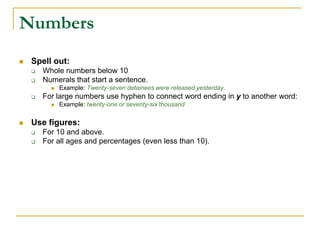
Numbers
 Spell out:
 Whole numbers below 10
 Numerals that start a sentence.
 Example: Twenty-seven detainees were released yesterday.
 For large numbers use hyphen to connect word ending in y to another word:
 Example: twenty-one or seventy-six thousand
 Use figures:
 For 10 and above.
 For all ages and percentages (even less than 10).
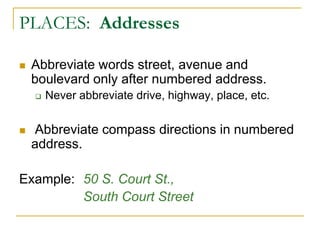
PLACES: Addresses
 Abbreviate words street, avenue and
boulevard only after numbered address.
 Never abbreviate drive, highway, place, etc.
 Abbreviate compass directions in numbered
address.
Example: 50 S. Court St.,
South Court Street
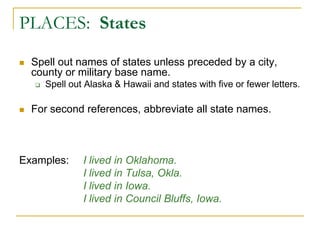
PLACES: States
 Spell out names of states unless preceded by a city,
county or military base name.
 Spell out Alaska & Hawaii and states with five or fewer letters.
 For second references, abbreviate all state names.
Examples: I lived in Oklahoma.
I lived in Tulsa, Okla.
I lived in Iowa.
I lived in Council Bluffs, Iowa.
TIME: Days vs. dates?
 Always use numerals without st, nd, rd or th in dates.
 Avoid using yesterday, today and tomorrow
 story publication could be delayed
 When writing about events use months and dates
 Example: "April 30" and "June 5."
 When referring to a month, day and year, set off year with commas.
 Example: Aug. 20, 1964, was the day they had all been waiting for.
TIME: Months
 Never abbreviate months not immediately
precede a date
 Abbreviate only if month's name is six letters
or longer
Example: We got married in September last year.
They were married Aug. 6 last year and
divorced March 5.
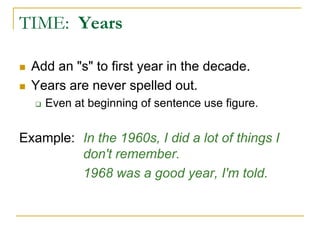
TIME: Years
 Add an "s" to first year in the decade.
 Years are never spelled out.
 Even at beginning of sentence use figure.
Example: In the 1960s, I did a lot of things I
don't remember.
1968 was a good year, I'm told.
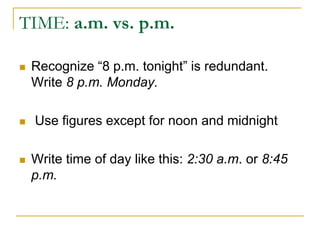
TIME: a.m. vs. p.m.
 Recognize “8 p.m. tonight” is redundant.
Write 8 p.m. Monday.
 Use figures except for noon and midnight
 Write time of day like this: 2:30 a.m. or 8:45
p.m.
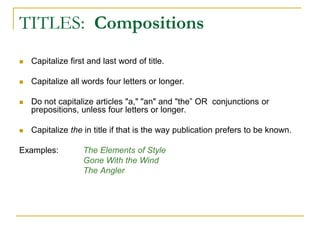
TITLES: Compositions
 Capitalize first and last word of title.
 Capitalize all words four letters or longer.
 Do not capitalize articles "a," "an" and "the” OR conjunctions or
prepositions, unless four letters or longer.
 Capitalize the in title if that is the way publication prefers to be known.
Examples: The Elements of Style
Gone With the Wind
The Angler
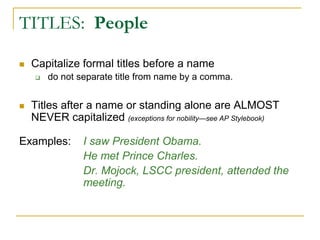
TITLES: People
 Capitalize formal titles before a name
 do not separate title from name by a comma.
 Titles after a name or standing alone are ALMOST
NEVER capitalized (exceptions for nobility—see AP Stylebook)
Examples: I saw President Obama.
He met Prince Charles.
Dr. Mojock, LSCC president, attended the
meeting.
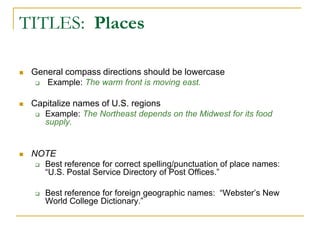
TITLES: Places
 General compass directions should be lowercase
 Example: The warm front is moving east.
 Capitalize names of U.S. regions
 Example: The Northeast depends on the Midwest for its food
supply.
 NOTE
 Best reference for correct spelling/punctuation of place names:
“U.S. Postal Service Directory of Post Offices.”
 Best reference for foreign geographic names: “Webster’s New
World College Dictionary.”
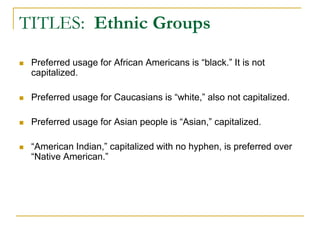
TITLES: Ethnic Groups
 Preferred usage for African Americans is “black.” It is not
capitalized.
 Preferred usage for Caucasians is “white,” also not capitalized.
 Preferred usage for Asian people is “Asian,” capitalized.
 “American Indian,” capitalized with no hyphen, is preferred over
“Native American.”
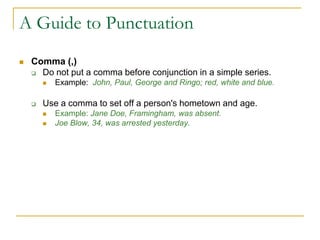
A Guide to Punctuation
 Comma (,)
 Do not put a comma before conjunction in a simple series.
 Example: John, Paul, George and Ringo; red, white and blue.
 Use a comma to set off a person's hometown and age.
 Example: Jane Doe, Framingham, was absent.
 Joe Blow, 34, was arrested yesterday.
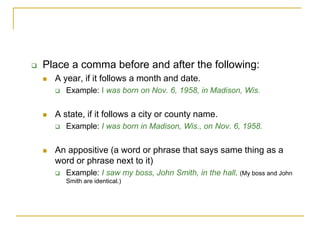
 Place a comma before and after the following:
 A year, if it follows a month and date.
 Example: I was born on Nov. 6, 1958, in Madison, Wis.
 A state, if it follows a city or county name.
 Example: I was born in Madison, Wis., on Nov. 6, 1958.
 An appositive (a word or phrase that says same thing as a
word or phrase next to it)
 Example: I saw my boss, John Smith, in the hall. (My boss and John
Smith are identical.)
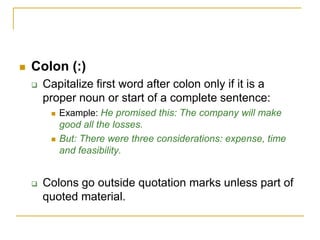
 Colon (:)
 Capitalize first word after colon only if it is a
proper noun or start of a complete sentence:
 Example: He promised this: The company will make
good all the losses.
 But: There were three considerations: expense, time
and feasibility.
 Colons go outside quotation marks unless part of
quoted material.
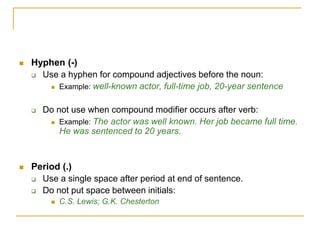
 Hyphen (-)
 Use a hyphen for compound adjectives before the noun:
 Example: well-known actor, full-time job, 20-year sentence
 Do not use when compound modifier occurs after verb:
 Example: The actor was well known. Her job became full time.
He was sentenced to 20 years.
 Period (.)
 Use a single space after period at end of sentence.
 Do not put space between initials:
 C.S. Lewis; G.K. Chesterton
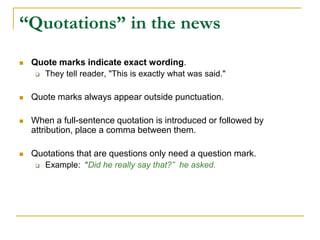
“Quotations” in the news
 Quote marks indicate exact wording.
 They tell reader, "This is exactly what was said."
 Quote marks always appear outside punctuation.
 When a full-sentence quotation is introduced or followed by
attribution, place a comma between them.
 Quotations that are questions only need a question mark.
 Example: “Did he really say that?” he asked.
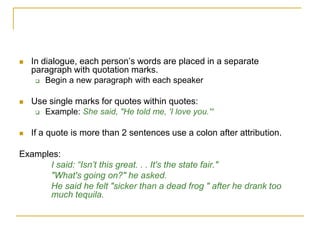
 In dialogue, each person’s words are placed in a separate
paragraph with quotation marks.
 Begin a new paragraph with each speaker
 Use single marks for quotes within quotes:
 Example: She said, "He told me, 'I love you.'“
 If a quote is more than 2 sentences use a colon after attribution.
Examples:
I said: “Isn’t this great. . . It's the state fair."
"What's going on?" he asked.
He said he felt "sicker than a dead frog " after he drank too
much tequila.
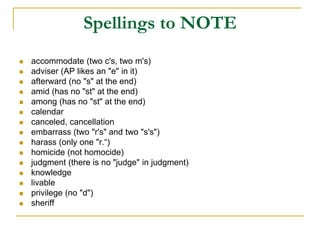
Spellings to NOTE
 accommodate (two c's, two m's)
 adviser (AP likes an "e" in it)
 afterward (no "s" at the end)
 amid (has no "st" at the end)
 among (has no "st" at the end)
 calendar
 canceled, cancellation
 embarrass (two "r's" and two "s's")
 harass (only one "r.“)
 homicide (not homocide)
 judgment (there is no "judge" in judgment)
 knowledge
 livable
 privilege (no "d")
 sheriff
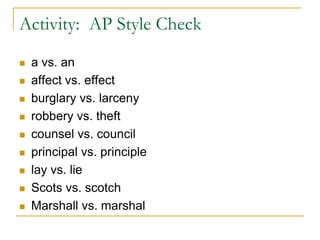
Activity: AP Style Check
 a vs. an
 affect vs. effect
 burglary vs. larceny
 robbery vs. theft
 counsel vs. council
 principal vs. principle
 lay vs. lie
 Scots vs. scotch
 Marshall vs. marshal
SOURCES
 Guide to AP style by Dr. Michael S. Sweeney, Utah State University
http://www.usu.edu/journalism/faculty/sweeney/resources/ap.html
 Quick Reference Associated Press Style
www.bu.edu/com/writingprgm/ap_styleguide1.pdf

AP Style Guide

  • 1.
  • 2.
    Associated Press inBrief  Associated Press founded in 1848  Cooperative effort among six New York newspapers pooling resources for gathering international news  Currently world's single largest news organization (over 3700 employees in 121 countries)  More than a billion people read, hear or see AP news daily  The Associated Press Stylebook, first published in 1977
  • 3.
    What is APStyle  Commonly accepted journalistic standards for usage, spelling, grammar and punctuation.  Keep writing style easy to read, concise and free of bias.  Standard style guide for most U.S. newspapers, magazines and public relations firms.
  • 4.
    Why AP Style? 1.Accurate 2. Clear 3. Tight 4. Neutral (non-offensive)
  • 5.
    Numbers  Spell out: Whole numbers below 10  Numerals that start a sentence.  Example: Twenty-seven detainees were released yesterday.  For large numbers use hyphen to connect word ending in y to another word:  Example: twenty-one or seventy-six thousand  Use figures:  For 10 and above.  For all ages and percentages (even less than 10).
  • 6.
    PLACES: Addresses  Abbreviatewords street, avenue and boulevard only after numbered address.  Never abbreviate drive, highway, place, etc.  Abbreviate compass directions in numbered address. Example: 50 S. Court St., South Court Street
  • 7.
    PLACES: States  Spellout names of states unless preceded by a city, county or military base name.  Spell out Alaska & Hawaii and states with five or fewer letters.  For second references, abbreviate all state names. Examples: I lived in Oklahoma. I lived in Tulsa, Okla. I lived in Iowa. I lived in Council Bluffs, Iowa.
  • 8.
    TIME: Days vs.dates?  Always use numerals without st, nd, rd or th in dates.  Avoid using yesterday, today and tomorrow  story publication could be delayed  When writing about events use months and dates  Example: "April 30" and "June 5."  When referring to a month, day and year, set off year with commas.  Example: Aug. 20, 1964, was the day they had all been waiting for.
  • 9.
    TIME: Months  Neverabbreviate months not immediately precede a date  Abbreviate only if month's name is six letters or longer Example: We got married in September last year. They were married Aug. 6 last year and divorced March 5.
  • 10.
    TIME: Years  Addan "s" to first year in the decade.  Years are never spelled out.  Even at beginning of sentence use figure. Example: In the 1960s, I did a lot of things I don't remember. 1968 was a good year, I'm told.
  • 11.
    TIME: a.m. vs.p.m.  Recognize “8 p.m. tonight” is redundant. Write 8 p.m. Monday.  Use figures except for noon and midnight  Write time of day like this: 2:30 a.m. or 8:45 p.m.
  • 12.
    TITLES: Compositions  Capitalizefirst and last word of title.  Capitalize all words four letters or longer.  Do not capitalize articles "a," "an" and "the” OR conjunctions or prepositions, unless four letters or longer.  Capitalize the in title if that is the way publication prefers to be known. Examples: The Elements of Style Gone With the Wind The Angler
  • 13.
    TITLES: People  Capitalizeformal titles before a name  do not separate title from name by a comma.  Titles after a name or standing alone are ALMOST NEVER capitalized (exceptions for nobility—see AP Stylebook) Examples: I saw President Obama. He met Prince Charles. Dr. Mojock, LSCC president, attended the meeting.
  • 14.
    TITLES: Places  Generalcompass directions should be lowercase  Example: The warm front is moving east.  Capitalize names of U.S. regions  Example: The Northeast depends on the Midwest for its food supply.  NOTE  Best reference for correct spelling/punctuation of place names: “U.S. Postal Service Directory of Post Offices.”  Best reference for foreign geographic names: “Webster’s New World College Dictionary.”
  • 15.
    TITLES: Ethnic Groups Preferred usage for African Americans is “black.” It is not capitalized.  Preferred usage for Caucasians is “white,” also not capitalized.  Preferred usage for Asian people is “Asian,” capitalized.  “American Indian,” capitalized with no hyphen, is preferred over “Native American.”
  • 16.
    A Guide toPunctuation  Comma (,)  Do not put a comma before conjunction in a simple series.  Example: John, Paul, George and Ringo; red, white and blue.  Use a comma to set off a person's hometown and age.  Example: Jane Doe, Framingham, was absent.  Joe Blow, 34, was arrested yesterday.
  • 17.
     Place acomma before and after the following:  A year, if it follows a month and date.  Example: I was born on Nov. 6, 1958, in Madison, Wis.  A state, if it follows a city or county name.  Example: I was born in Madison, Wis., on Nov. 6, 1958.  An appositive (a word or phrase that says same thing as a word or phrase next to it)  Example: I saw my boss, John Smith, in the hall. (My boss and John Smith are identical.)
  • 18.
     Colon (:) Capitalize first word after colon only if it is a proper noun or start of a complete sentence:  Example: He promised this: The company will make good all the losses.  But: There were three considerations: expense, time and feasibility.  Colons go outside quotation marks unless part of quoted material.
  • 19.
     Hyphen (-) Use a hyphen for compound adjectives before the noun:  Example: well-known actor, full-time job, 20-year sentence  Do not use when compound modifier occurs after verb:  Example: The actor was well known. Her job became full time. He was sentenced to 20 years.  Period (.)  Use a single space after period at end of sentence.  Do not put space between initials:  C.S. Lewis; G.K. Chesterton
  • 20.
    “Quotations” in thenews  Quote marks indicate exact wording.  They tell reader, "This is exactly what was said."  Quote marks always appear outside punctuation.  When a full-sentence quotation is introduced or followed by attribution, place a comma between them.  Quotations that are questions only need a question mark.  Example: “Did he really say that?” he asked.
  • 21.
     In dialogue,each person’s words are placed in a separate paragraph with quotation marks.  Begin a new paragraph with each speaker  Use single marks for quotes within quotes:  Example: She said, "He told me, 'I love you.'“  If a quote is more than 2 sentences use a colon after attribution. Examples: I said: “Isn’t this great. . . It's the state fair." "What's going on?" he asked. He said he felt "sicker than a dead frog " after he drank too much tequila.
  • 22.
    Spellings to NOTE accommodate (two c's, two m's)  adviser (AP likes an "e" in it)  afterward (no "s" at the end)  amid (has no "st" at the end)  among (has no "st" at the end)  calendar  canceled, cancellation  embarrass (two "r's" and two "s's")  harass (only one "r.“)  homicide (not homocide)  judgment (there is no "judge" in judgment)  knowledge  livable  privilege (no "d")  sheriff
  • 23.
    Activity: AP StyleCheck  a vs. an  affect vs. effect  burglary vs. larceny  robbery vs. theft  counsel vs. council  principal vs. principle  lay vs. lie  Scots vs. scotch  Marshall vs. marshal
  • 24.
    SOURCES  Guide toAP style by Dr. Michael S. Sweeney, Utah State University http://www.usu.edu/journalism/faculty/sweeney/resources/ap.html  Quick Reference Associated Press Style www.bu.edu/com/writingprgm/ap_styleguide1.pdf