The Patriarch Abraham
• Played a major role in the establishment of the three
monotheistic religions: namely, Judaism, Christianity,
and Islam, which account for more than half of the
world’s total population. As such, these organized
religions are collectively known as ABRAHAMIC
RELIGIONS.
• The importance of Abraham in these three religions lies
in the fact that the patriarch appears as an elemental
(primary) figure for monotheistic belief system and a
paragon (exemplar) for extreme devotion.
Commonalities in Abrahamic Religions
1. They all worship one supreme being.
• Ancient Hebrews – Elohim, Adonai, or Yahweh
• Present day Judaism – “Lord” or “God”
• Muslims – Allah
2. Prophets and apostles play major roles
• Judaism has 48 prophets and 7 prophetesses.
• Early prophets include Abraham, Isaac, Jacob, Moses, Aaron,
and Joshua.
• Christianity has 12 apostles, some of whom wrote parts of the
New Testament
• Islam believes that Muhammad is the final prophet or the “Seal of the
Prophets.”
3. Prior to the establishment as organized religions, the role of divine
revelation or intervention is associated among their progenitors
(ancestors).
• God instructed Abraham to sacrifice his son Isaac at Mount Moriah.
• God presented the 10 Commandments to Moses at Mount Sinai.
• God sacrificed His son Jesus Christ through crucifixion as the plan to
salvation.
• God commanded Muhammad to establish a new religion at a cave in
Mount Hira.
Familiarize yourself with the diagram above showing the genealogy of
Abraham. Can you identify some of the listed names based on your
knowledge of your religion?
Listed names in the Genealogy of Abraham My knowledge of my religion
The Indian Mosaic
•India is one of the oldest surviving civilizations, with its
history dating back to at least 6500 BCE. The many
conquerors that came to India were gradually absorbed
into the native Indian religions.
• The Harappan civilization, Aryan influence, local dynasties,
and the Muslim conquest all had their fair share in building
the intricate Indian mosaic. As a result, variety and
complexity characterize Indian culture.
• Four great religions originated in India – Hinduism,
Buddhism, Jainism, and Sikhism – and a myriad of minor
cults and local sects.
B. GEOGRAPHY OF FAITH
The Western Frontier
• West Asia is the home of three great religions (J, C, I).
• Religions have increasingly become involved in domestic politics of West Asia,
resulting in prolonged conflicts among countries that have claimed thousands of lives.
• The Levant: Lebanon, Jordan, Israel, Syria, and Palestine.
• Israel remains the only country in the world with a Jewish-majority population
comprising almost 75% of its citizens
• The Arabian Peninsula, the world’s largest peninsula, consists of countries that are
predominantly Islamic in character. (Saudi Arabia, Qatar, Bahrain, Kuwait, United Arab
Emirates, Yemen, and Oman). Most West Asian countries follow Shi’a and Sunni
denominations of Islam. Iran and Iraq associate themselves with the Shi’a sect while
Muslims in Saudi Arabia belong to Sunni branch.
• The topography of West Asia is characterized by vast areas of mountainous terrains
which played significant roles in many religious beliefs as these landforms provide
ideal settings where gods live or where gods and mortals meet.
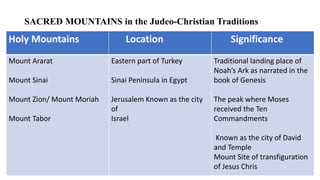
SACRED MOUNTAINS in the Judeo-Christian Traditions
Holy Mountains Location Significance
Mount Ararat
Mount Sinai
Mount Zion/ Mount Moriah
Mount Tabor
Eastern part of Turkey
Sinai Peninsula in Egypt
Jerusalem Known as the city
of
Israel
Traditional landing place of
Noah’s Ark as narrated in the
book of Genesis
The peak where Moses
received the Ten
Commandments
Known as the city of David
and Temple
Mount Site of transfiguration
of Jesus Chris

abraham.pptx

  • 1.
    The Patriarch Abraham •Played a major role in the establishment of the three monotheistic religions: namely, Judaism, Christianity, and Islam, which account for more than half of the world’s total population. As such, these organized religions are collectively known as ABRAHAMIC RELIGIONS. • The importance of Abraham in these three religions lies in the fact that the patriarch appears as an elemental (primary) figure for monotheistic belief system and a paragon (exemplar) for extreme devotion.
  • 3.
    Commonalities in AbrahamicReligions 1. They all worship one supreme being. • Ancient Hebrews – Elohim, Adonai, or Yahweh • Present day Judaism – “Lord” or “God” • Muslims – Allah 2. Prophets and apostles play major roles • Judaism has 48 prophets and 7 prophetesses. • Early prophets include Abraham, Isaac, Jacob, Moses, Aaron, and Joshua. • Christianity has 12 apostles, some of whom wrote parts of the New Testament
  • 4.
    • Islam believesthat Muhammad is the final prophet or the “Seal of the Prophets.” 3. Prior to the establishment as organized religions, the role of divine revelation or intervention is associated among their progenitors (ancestors). • God instructed Abraham to sacrifice his son Isaac at Mount Moriah. • God presented the 10 Commandments to Moses at Mount Sinai. • God sacrificed His son Jesus Christ through crucifixion as the plan to salvation. • God commanded Muhammad to establish a new religion at a cave in Mount Hira.
  • 5.
    Familiarize yourself withthe diagram above showing the genealogy of Abraham. Can you identify some of the listed names based on your knowledge of your religion? Listed names in the Genealogy of Abraham My knowledge of my religion
  • 6.
    The Indian Mosaic •Indiais one of the oldest surviving civilizations, with its history dating back to at least 6500 BCE. The many conquerors that came to India were gradually absorbed into the native Indian religions. • The Harappan civilization, Aryan influence, local dynasties, and the Muslim conquest all had their fair share in building the intricate Indian mosaic. As a result, variety and complexity characterize Indian culture. • Four great religions originated in India – Hinduism, Buddhism, Jainism, and Sikhism – and a myriad of minor cults and local sects.
  • 7.
    B. GEOGRAPHY OFFAITH The Western Frontier • West Asia is the home of three great religions (J, C, I). • Religions have increasingly become involved in domestic politics of West Asia, resulting in prolonged conflicts among countries that have claimed thousands of lives. • The Levant: Lebanon, Jordan, Israel, Syria, and Palestine. • Israel remains the only country in the world with a Jewish-majority population comprising almost 75% of its citizens • The Arabian Peninsula, the world’s largest peninsula, consists of countries that are predominantly Islamic in character. (Saudi Arabia, Qatar, Bahrain, Kuwait, United Arab Emirates, Yemen, and Oman). Most West Asian countries follow Shi’a and Sunni denominations of Islam. Iran and Iraq associate themselves with the Shi’a sect while Muslims in Saudi Arabia belong to Sunni branch. • The topography of West Asia is characterized by vast areas of mountainous terrains which played significant roles in many religious beliefs as these landforms provide ideal settings where gods live or where gods and mortals meet.
  • 8.
    SACRED MOUNTAINS inthe Judeo-Christian Traditions Holy Mountains Location Significance Mount Ararat Mount Sinai Mount Zion/ Mount Moriah Mount Tabor Eastern part of Turkey Sinai Peninsula in Egypt Jerusalem Known as the city of Israel Traditional landing place of Noah’s Ark as narrated in the book of Genesis The peak where Moses received the Ten Commandments Known as the city of David and Temple Mount Site of transfiguration of Jesus Chris

Editor's Notes

  • #3 Ang ibig sabihin ng genealogy ang mga angkan ni Abraham o tinatawag na saling lahi