PPT ON HINDUISM 
BY , 
RAVINDRA SINGH KRISHNIA.
What is Hinduism? 
One of the oldest religions of humanity 
The religion of the Indian people 
Gave birth to Buddhism, Jainism, Sikhism 
Tolerance and diversity: "Truth is one, paths 
are many" 
Many deities but a single, impersonal 
Ultimate Reality 
A philosophy and a way of life – focused both 
on this world and beyond
How did Hinduism begin? 
No particular founder 
Indus River Valley Civilization >5000 years 
ago 
Aryans enter 4000 - 3500 years ago 
Vedic Tradition 3500 – 2500 years ago: 
rituals and many gods (polytheism) 
sacred texts (Vedas) 
social stratification (caste system) 
Upanishads (metaphysical philosophy) 2800 
– 2400 years ago 
Vedic Tradition develops into Hinduism
What are the Sacred Texts? 
Shruti (“heard”) – oldest, most authoritative: 
Four Vedas (“truth”) – myths, rituals, 
chants 
Upanishads - metaphysical speculation 
Plus other texts 
Smriti (“remembered”) – the Great Indian 
Epics: 
Ramayana 
Mahabharata (includes Bhagavad-Gita) 
Plus others
What do Hindus believe? 
One impersonal Ultimate Reality – Brahman 
Manifest as many personal deities 
True essence of life – Atman, the soul, is 
Brahman trapped in matter (“That art thou”) 
Reincarnation – atman is continually born 
into this world lifetime after lifetime 
(Samsara) 
Karma – spiritual impurity due to actions 
keeps us bound to this world (good and bad) 
Ultimate goal of life – to release Atman and 
reunite with the divine, becoming as one with 
Brahman (Moksha)
How does Hinduism direct 
life in this world? 
Respect for all life – vegetarian 
Human life as supreme: 
Four “stations” of life (Caste) - priests & 
teachers, nobles & warriors, merchant 
class, servant class 
Four stages of life – student, householder, 
retired, renunciant 
Four duties of life – pleasure, success, 
social responsibilities, religious 
responsibilities (moksha)
What are the spiritual 
practices of Hinduism? 
The Four Yogas - seeking union with the 
divine: 
Karma Yoga – the path of action through 
selfless service (releases built up karma 
without building up new karma) 
Jnana Yoga – the path of knowledge 
(understanding the true nature of reality 
and the self) 
Raja Yoga – the path of meditation 
Bhakti Yoga – the path of devotion 
Guru – a spiritual teacher, especially helpful 
for Jnana and Raja yoga
How do Hindus worship? 
Bhakti Yoga is seeking union with the divine 
through loving devotion to manifest deities 
In the home (household shrines) 
In the Temples (priests officiate) 
Puja – making offerings to and decorating the 
deity images 
Darsan – “seeing” the deity (not idol worship) 
Prasad – taking the divine within your own being 
through eating of food shared with the deity
Who do Hindus worship? – 
the major gods of the Hindu 
Pantheon 
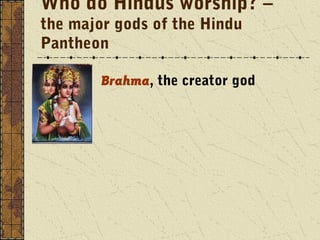
Brahma, the creator god
Who do Hindus worship? – 
the major gods of the Hindu 
Pantheon 
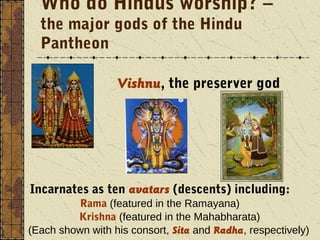
Vishnu, the preserver god 
Incarnates as ten avatars (descents) including: 
Rama (featured in the Ramayana) 
Krishna (featured in the Mahabharata) 
(Each shown with his consort, Sita and Radha, respectively)
Who do Hindus worship? – 
the major gods of the Hindu 
Pantheon 
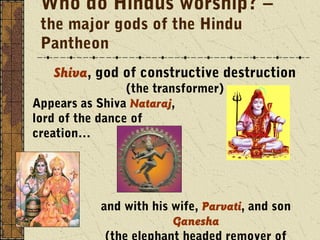
Shiva, god of constructive destruction 
(the transformer) 
Appears as Shiva Nataraj, 
lord of the dance of 
creation… 
and with his wife, Parvati, and son 
Ganesha 
(the elephant headed remover of
What about the goddesses? 
Devi – the feminine divine 
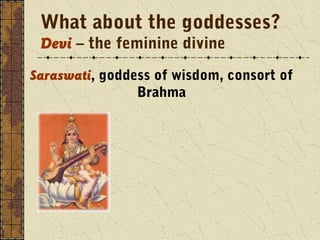
Saraswati, goddess of wisdom, consort of 
Brahma
What about the goddesses? 
Devi – the feminine divine 
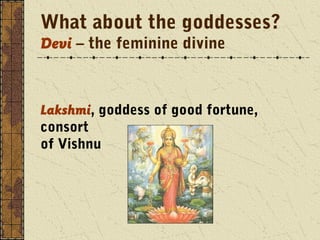
Lakshmi, goddess of good fortune, 
consort 
of Vishnu
What about the goddesses? 
Devi – the feminine divine 
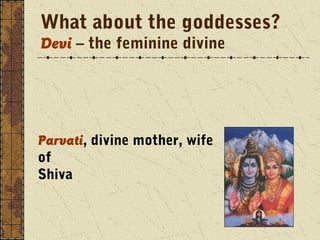
Parvati, divine mother, wife 
of 
Shiva
What about the goddesses? 
Devi – the feminine divine 
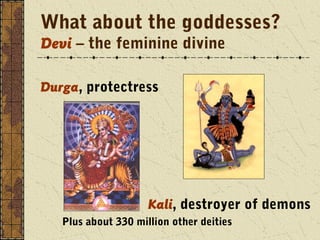
Durga, protectress 
Kali, destroyer of demons 
Plus about 330 million other deities
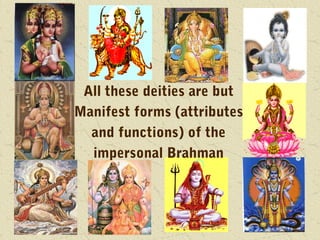
All these deities are but 
Manifest forms (attributes 
and functions) of the 
impersonal Brahman
And we too are manifest 
forms of God! 
“We are not human beings 
having spiritual experiences; 
We are spiritual beings 
having a human experience!” 
“That art Thou” 
Hinduism is about recognizing the all pervasiveness of the divine
Dhanayvaad…..

Hinduism

  • 1.
    PPT ON HINDUISM BY , RAVINDRA SINGH KRISHNIA.
  • 2.
    What is Hinduism? One of the oldest religions of humanity The religion of the Indian people Gave birth to Buddhism, Jainism, Sikhism Tolerance and diversity: "Truth is one, paths are many" Many deities but a single, impersonal Ultimate Reality A philosophy and a way of life – focused both on this world and beyond
  • 3.
    How did Hinduismbegin? No particular founder Indus River Valley Civilization >5000 years ago Aryans enter 4000 - 3500 years ago Vedic Tradition 3500 – 2500 years ago: rituals and many gods (polytheism) sacred texts (Vedas) social stratification (caste system) Upanishads (metaphysical philosophy) 2800 – 2400 years ago Vedic Tradition develops into Hinduism
  • 4.
    What are theSacred Texts? Shruti (“heard”) – oldest, most authoritative: Four Vedas (“truth”) – myths, rituals, chants Upanishads - metaphysical speculation Plus other texts Smriti (“remembered”) – the Great Indian Epics: Ramayana Mahabharata (includes Bhagavad-Gita) Plus others
  • 5.
    What do Hindusbelieve? One impersonal Ultimate Reality – Brahman Manifest as many personal deities True essence of life – Atman, the soul, is Brahman trapped in matter (“That art thou”) Reincarnation – atman is continually born into this world lifetime after lifetime (Samsara) Karma – spiritual impurity due to actions keeps us bound to this world (good and bad) Ultimate goal of life – to release Atman and reunite with the divine, becoming as one with Brahman (Moksha)
  • 6.
    How does Hinduismdirect life in this world? Respect for all life – vegetarian Human life as supreme: Four “stations” of life (Caste) - priests & teachers, nobles & warriors, merchant class, servant class Four stages of life – student, householder, retired, renunciant Four duties of life – pleasure, success, social responsibilities, religious responsibilities (moksha)
  • 7.
    What are thespiritual practices of Hinduism? The Four Yogas - seeking union with the divine: Karma Yoga – the path of action through selfless service (releases built up karma without building up new karma) Jnana Yoga – the path of knowledge (understanding the true nature of reality and the self) Raja Yoga – the path of meditation Bhakti Yoga – the path of devotion Guru – a spiritual teacher, especially helpful for Jnana and Raja yoga
  • 8.
    How do Hindusworship? Bhakti Yoga is seeking union with the divine through loving devotion to manifest deities In the home (household shrines) In the Temples (priests officiate) Puja – making offerings to and decorating the deity images Darsan – “seeing” the deity (not idol worship) Prasad – taking the divine within your own being through eating of food shared with the deity
  • 9.
    Who do Hindusworship? – the major gods of the Hindu Pantheon Brahma, the creator god
  • 10.
    Who do Hindusworship? – the major gods of the Hindu Pantheon Vishnu, the preserver god Incarnates as ten avatars (descents) including: Rama (featured in the Ramayana) Krishna (featured in the Mahabharata) (Each shown with his consort, Sita and Radha, respectively)
  • 11.
    Who do Hindusworship? – the major gods of the Hindu Pantheon Shiva, god of constructive destruction (the transformer) Appears as Shiva Nataraj, lord of the dance of creation… and with his wife, Parvati, and son Ganesha (the elephant headed remover of
  • 12.
    What about thegoddesses? Devi – the feminine divine Saraswati, goddess of wisdom, consort of Brahma
  • 13.
    What about thegoddesses? Devi – the feminine divine Lakshmi, goddess of good fortune, consort of Vishnu
  • 14.
    What about thegoddesses? Devi – the feminine divine Parvati, divine mother, wife of Shiva
  • 15.
    What about thegoddesses? Devi – the feminine divine Durga, protectress Kali, destroyer of demons Plus about 330 million other deities
  • 16.
    All these deitiesare but Manifest forms (attributes and functions) of the impersonal Brahman
  • 17.
    And we tooare manifest forms of God! “We are not human beings having spiritual experiences; We are spiritual beings having a human experience!” “That art Thou” Hinduism is about recognizing the all pervasiveness of the divine
  • 18.