DAOISM
LESSON 13:
INTRODUCTION TO WORLD
RELIGIONS AND BELIEF
SYSTEMS
GROUP 5
DAOISM
▪ Daoism, also spelled Taoism, indigenous religio-philosophical
tradition that has shaped Chinese life for more than 2,000 years.
In the broadest sense, a Daoist attitude toward life can be seen in
the accepting and yielding, the joyful and carefree sides of the
Chinese character, an attitude that offsets and complements the
moral and duty-conscious, austere and purposeful character
ascribed to Confucianism. Daoism is also characterized by a
positive, active attitude toward the occult and the metaphysical
(theories on the nature of reality), whereas the agnostic,
pragmatic Confucian tradition considers these issues of only
marginal importance, although the reality of such issues is, by
most Confucians, not denied.
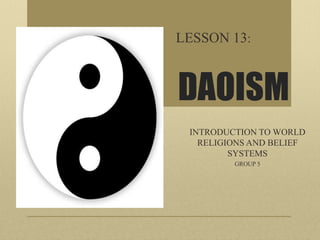
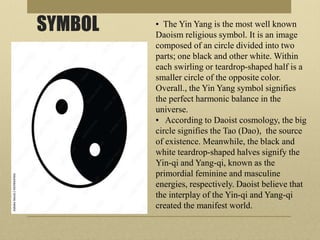
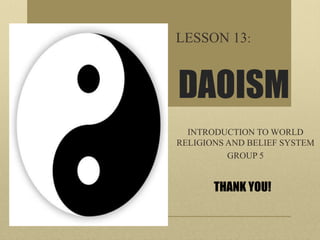
SYMBOL ▪ The Yin Yang is the most well known
Daoism religious symbol. It is an image
composed of an circle divided into two
parts; one black and other white. Within
each swirling or teardrop-shaped half is a
smaller circle of the opposite color.
Overall., the Yin Yang symbol signifies
the perfect harmonic balance in the
universe.
▪ According to Daoist cosmology, the big
circle signifies the Tao (Dao), the source
of existence. Meanwhile, the black and
white teardrop-shaped halves signify the
Yin-qi and Yang-qi, known as the
primordial feminine and masculine
energies, respectively. Daoist believe that
the interplay of the Yin-qi and Yang-qi
created the manifest world.
HISTORICAL BACKGROUND
Laozi (Lao-tzu), meaning "Old Master," is believed to
have authored the Dao De Jing (Tao te ching or The
Book of the Way and its Power), dating back to around
third century B.C.E. According to myth, Laczi was
conceived by n shooting star and was born of a virgin
mother, who kept him in her womb for 82 years. He is
considered as the first important Daoist who is believed
to be a senior contemporary of Kung Fuzi (some said he
even became Kung Fuzzi's adviser) although there is
much debate on his date and identity. The Chinese
historian Sima Qian wrote a biography of Laozi in the
Historical Records (Shih Chi) in the late 2nd century
B.C.E. According to his biography, he worked as a
government archivist but became frustrated with
government corruption, and sensing his unavoidable
disgrace he left. Laozi agreeably wrote two chapters
about the Dao (Way) and De (individual power), which
came to be named Dao De Jing or Laozi..
SACRED SCRIPTURES
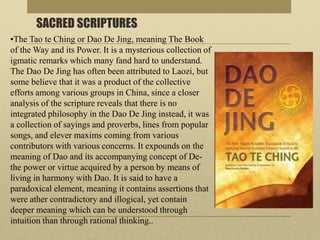
▪The Tao te Ching or Dao De Jing, meaning The Book
of the Way and its Power. It is a mysterious collection of
igmatic remarks which many fand hard to understand.
The Dao De Jing has often been attributed to Laozi, but
some believe that it was a product of the collective
efforts among various groups in China, since a closer
analysis of the scripture reveals that there is no
integrated philosophy in the Dao De Jing instead, it was
a collection of sayings and proverbs, lines from popular
songs, and elever maxims coming from various
contributors with various concerns. It expounds on the
meaning of Dao and its accompanying concept of De-
the power or virtue acquired by a person by means of
living in harmony with Dao. It is said to have a
paradoxical element, meaning it contains assertions that
were ather contradictory and illogical, yet contain
deeper meaning which can be understood through
intuition than through rational thinking..
SACRED SCRIPTURES
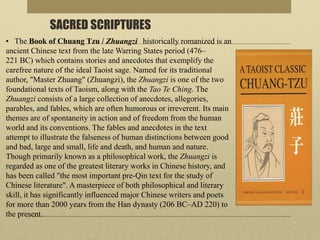
▪ The Book of Chuang Tzu / Zhuangzi historically romanized is an
ancient Chinese text from the late Warring States period (476–
221 BC) which contains stories and anecdotes that exemplify the
carefree nature of the ideal Taoist sage. Named for its traditional
author, "Master Zhuang" (Zhuangzi), the Zhuangzi is one of the two
foundational texts of Taoism, along with the Tao Te Ching. The
Zhuangzi consists of a large collection of anecdotes, allegories,
parables, and fables, which are often humorous or irreverent. Its main
themes are of spontaneity in action and of freedom from the human
world and its conventions. The fables and anecdotes in the text
attempt to illustrate the falseness of human distinctions between good
and bad, large and small, life and death, and human and nature.
Though primarily known as a philosophical work, the Zhuangzi is
regarded as one of the greatest literary works in Chinese history, and
has been called "the most important pre-Qin text for the study of
Chinese literature". A masterpiece of both philosophical and literary
skill, it has significantly influenced major Chinese writers and poets
for more than 2000 years from the Han dynasty (206 BC–AD 220) to
the present.
CONCEPTS/ BELIEFS
Daoism can be best understood by discussing its
concepts and beliefs. Some of its concepts include the;
•Dao or the “way of nature”
• De “ virtue/ proper” adherence to Dao or “ action
through inaction” which gives importance to humility
and noncompetition, naturalness, and naturalism, and
non- aggression;
• Yin Yang or the balance of nature or universe; and
• Chi-Qi or the natural energy of life force that
sustains living beings,
THE DAO
▪ Tao or Dao is the natural order of the universe, whose character one's
intuition must discern to realize the potential for individual wisdom, as
conceived in the context of East Asian philosophy, East Asian religions or
any other philosophy or religion that aligns to this principle. This intuitive
knowing of life cannot be grasped as a concept. Rather, it is known
through actual living experience of one's everyday being. Its name, Tao or
Dao (Chinese (help·info)), came from Chinese, where it signifies the way,
path, route, road, or sometimes more loosely doctrine, principle, or holistic
belief.
▪ The Tao lends its name to the religious tradition Wade–Giles, Tao
Chiao; Pinyin, Daojiao and philosophical tradition (Wade–Giles, Tao
chia; Pinyin, Daojia) that are both referred to in English with the single
term Taoism.
DEITY/GOD (DAO AS THE ORIGIN OF ALL BEINGS)
▪ Unlike the Abrahamic religious, Daoism does not have a God, for Daoists
believe that the universe originated from the Dao, which created and controls
the universe and distanly guides things on their way. Instead, they worship
dieties, who are gods of a particular role, and they traditionally worship Laozi
not only as the first god of Daoism but also as the representation of the Dao.
Most of the dieties worshipped by the Daoists were borrowed from other
cultures, but they are within the universe and are subject to the Dao. The
Daoist pantheon has often been described as a divine administration which
reflects the secular governments of Imperial China.
▪ For the Daoists, the Dao possesses heavenly qualities, is mysterious,
indescribable, lies under the surface of sense perception, and unifies obvious
opposites on a different level. Daoists also believe that the Dao can only be
found inside us, in thoughtful emptiness from which all power and
lifeoriginates in all directions; it is “Nothing” within all of us where all our
energy comes from.
THE DE
▪ The De, which means virtue or the proper adherence to Dao, is another basic concept
in Daoism. It encourages inaction in nature and advocates the quiet and passive nature
of a person so that the Dao, or the creative principle in the universe, may act through
them without interference. People should simply follow the Dao and must do nothing on
their own. In this regard, Laozi professed a distance for culture and civilization for they
are .products of human activity and proof of humanity’s tampering with nature.
▪ “Non-competition in Emptiness” is said to be the other side of the principle of
“inaction in nature”. For Daoists, inaction means a person’s outward actions, and
emptiness is the corresponding inner state, which also means “absence of desire”.
Daoists believe that when a person becomes peaceful, that person acquires power to
overcome all things without having to complete with others. In line with this, humility
and avoiding competition with others are two virtues which Daoists value most. Lastly,
“contentment with what is” is another expression of inaction in nature and of non-
competition in emptiness. By following the way of nature, a person can attain
comtentment. For Laoizi, the way of happiness is contentment. “There is no greater sin
that the desire for possession, no greater curse than the lack of contentment.”
WU-WEI
Wu wei is an ancient Chinese concept literally meaning
"inexertion", "inaction", or "effortless action“ . Wu
wei emerged in the Spring and Autumn period, and
from Confucianism, to become an important concept in
Chinese statecraft and Taoism. It was most commonly used
to refer to an ideal form of government,including the
behavior of the emperor. Describing a state of unconflicting
personal harmony, free-flowing spontaneity and savoir-faire,
it generally also more properly denotes a state of spirit or
mind, and in Confucianism accords with
conventional morality.
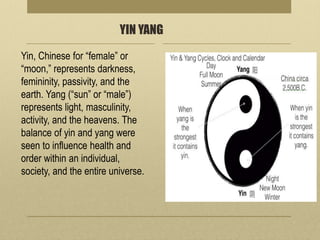
YIN YANG
Yin, Chinese for “female” or
“moon,” represents darkness,
femininity, passivity, and the
earth. Yang (“sun” or “male”)
represents light, masculinity,
activity, and the heavens. The
balance of yin and yang were
seen to influence health and
order within an individual,
society, and the entire universe.
QI/CHI
In traditional Chinese culture and the East Asian
cultural sphere, qi, also ki or chi in Wade–
Giles romanization, is believed to be a vital
force forming part of any living entity. Literally
meaning "vapor", "air", or "breath", the word qi is
often translated as "vital energy", "vital force",
"material energy", or simply as "energy". Qi is the
central underlying principle in Chinese traditional
medicine and in Chinese martial arts. The
practice of cultivating and balancing qi is
called qigong.
WORSHIP AND OBSERVANCES
Ritual or liturgical expressions are important to the Daoist
religion. These include ritual initiation meant for purification
and renewal in the life-cycle and development of the human
person. Daoist priests are licensed to perform rituals of specific
traditions . One form of ritual is exorcism, performed in cases
od sickness with the goal of gaining victory over the evil
spirits. Other rituals are performed in the formof festivals,
especially New Year. In these rituals, incense is a cebtral aspect,
together with the sacrificial offering of sacred writings such as
paper charms which contain the prayers of individual, bearing
their names and the intentions which are burned as part of the
rutual. Those who will perform such as rituals are encourage to
prepare for them by fasting and by having a spirit of forgiveness
and reconciliation.
MEDITATIVE PRACTICES
Humility and non-competition are among the most important virtues in
Daoism. These virtues, together with naturalness and naturalism, as well as
non-aggression and passive rule, manifest the fundamental virtue of wu wei.
The physical appearance of the Daoist sage exemplifies the virtue of humility,
for on the outside the sage may dress shabbily but his mind is full of wisdom
and his heart, full of compassion. The sage also manifests the virtue of non-
competition by not competing but emerging victorious nonetheless. The sage
has achieved oneness with the Dao by understanding its simplicity; his mind
is undistracted that is why he is able to discover the simplicity in the Dao. In
this regard, he is likened to a cat, which has much in common with the sage.
Like the cat which does not deviate from its own nature and being fully aware
of the situation at hand, it always lands on its feet no matter what. (Brodd
World Religions: A Voyage of Discovery).
MORAL PRACTICES
Physical and spiritual techniques are just as important as ethical or moral
techniques or practices. Daoists put emphasis on ethical behavior by
incor- porating it into their practices. They value the need for a moral life,
of good works as well as of ritual atonement for misbehavior (Ching
1993). Daoism values the virtues of naturalness, behaving as nature
dictates, not as caused by social pressure or personal pride; and
naturalism, which entails resisting temptation to meddle with nature.
Daoists tend not to initiate action; instead they wait for events to make
action necessary, avoiding letting their own desires and compulsions push
them into doing things. Generally, Daoism, just like other religions,
disapprove of killing, stealing, lying, and promiscuity. It promotes
philanthropic, selfless, and humane behavior. Good behavior is seen as an
essential part not only of self-improvement but the world as a whole.
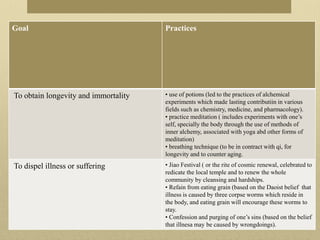
Goal Practices
To obtain longevity and immortality • use of potions (led to the practices of alchemical
experiments which made lasting contributiin in various
fields such as chemistry, medicine, and pharmacology).
• practice meditation ( includes experiments with one’s
self, specially the body through the use of methods of
inner alchemy, associated with yoga abd other forms of
meditation)
• breathing technique (to be in contract with qi, for
longevity and to counter aging.
To dispel illness or suffering • Jiao Festival ( or the rite of cosmic renewal, celebrated to
redicate the local temple and to renew the whole
community by cleansing and hardships.
• Refain from eating grain (based on the Daoist belief that
illness is caused by three corpse worms which reside in
the body, and eating grain will encourage these worms to
stay.
• Confession and purging of one’s sins (based on the belief
that illnesa may be caused by wrongdoings).
SELECTED ISSUES
FATALISM
Like any other religion, Daoism has its share of issues. One of
them is that Daoism has often been criticized for propagating
laziness or espousing a fatalistic attitude in life by letting nature
take its course and reminding Daoists to just go with the flow. A
closer examination of the wu-wei, however, would reveal that
inaction in Daoism simply means avoiding unnatural actions by
not doing forced or aggressive actions. It means performing all
one's actions with natural and unforced attitude.
SUPERSTITION
Another issue encountered by Daoism is the belief in superstitious practices For
instance, there is a misconception that Daoists involves sorcery, which includes the
drawing of signs, chants, and other practices which led to the potion that Daoism
promotes superstitious practices. But the practice of ancestor worship has been an
aspect of Chinese culture which found its way in Daoism, similar to the Shinto
practice among the Japanese, this Daoists often find themselves in temples, praying
to their ancestors for guidance in their everyday lives. Dacists also pray as a way of
remembering their source to repay kindness and sow gratitude. They believe that all
things have spirits, and that deities of the heavens and earth are all around us. They
are always) around us to guide, protect, and bless us, thus we should always see to it
that we show our gratitude to them by performing rituals such as praying and using
incense as a medium of communicating with the deities, for they believe that when
the precious incense burns in the golden incense burner, the smoke travels up to the
heavens. According to Daoist scriptures, the offering of three sticks of incense is
important if one wishes to convey a message to the deities, who in turn will shower
them with blessings Daoists believe that the left hand must be used to offer the
incense, because the left hand represents the yang, which symbolizes respect. They
believe that by doing so, they are showing sincerity to the deities, and they
believethat a rincore heart can reach the heavens
URBAN DEVELOPMENT
Another issue in Daoism is environmentalism. Daoists believe in
the dictum "leave nature alone and nature will thrive." Daoism has
advocated a utopian vision of society characterized by order and
harmony, and an emphasis on self-cultivation as a means of
achieving social harmony. One should have a healthy relationship
with nature and it should begin with one's own body. Daoism
advocates the idea that we should follow the lead of nature instead
of controlling it, for humans are natural creatures who should live
in harmony with nature. Daoism emphasized the balance of
opposites and the interde pendence of all things, which can be
interpreted as an ancient equivalent of today's notion of the
ecosystem. China's excessive movement toward urban
development at present is seen as being inconsistent with the
Daoist belief in the importance of living in harmony with nature.
Daoists believe that social harmony will be achieved through a
return to nature.
DAOISM
LESSON 13:
INTRODUCTION TO WORLD
RELIGIONS AND BELIEF SYSTEM
GROUP 5
THANK YOU!

DAOISM.pptx

  • 1.
    DAOISM LESSON 13: INTRODUCTION TOWORLD RELIGIONS AND BELIEF SYSTEMS GROUP 5
  • 2.
    DAOISM ▪ Daoism, alsospelled Taoism, indigenous religio-philosophical tradition that has shaped Chinese life for more than 2,000 years. In the broadest sense, a Daoist attitude toward life can be seen in the accepting and yielding, the joyful and carefree sides of the Chinese character, an attitude that offsets and complements the moral and duty-conscious, austere and purposeful character ascribed to Confucianism. Daoism is also characterized by a positive, active attitude toward the occult and the metaphysical (theories on the nature of reality), whereas the agnostic, pragmatic Confucian tradition considers these issues of only marginal importance, although the reality of such issues is, by most Confucians, not denied.
  • 3.
    SYMBOL ▪ TheYin Yang is the most well known Daoism religious symbol. It is an image composed of an circle divided into two parts; one black and other white. Within each swirling or teardrop-shaped half is a smaller circle of the opposite color. Overall., the Yin Yang symbol signifies the perfect harmonic balance in the universe. ▪ According to Daoist cosmology, the big circle signifies the Tao (Dao), the source of existence. Meanwhile, the black and white teardrop-shaped halves signify the Yin-qi and Yang-qi, known as the primordial feminine and masculine energies, respectively. Daoist believe that the interplay of the Yin-qi and Yang-qi created the manifest world.
  • 4.
    HISTORICAL BACKGROUND Laozi (Lao-tzu),meaning "Old Master," is believed to have authored the Dao De Jing (Tao te ching or The Book of the Way and its Power), dating back to around third century B.C.E. According to myth, Laczi was conceived by n shooting star and was born of a virgin mother, who kept him in her womb for 82 years. He is considered as the first important Daoist who is believed to be a senior contemporary of Kung Fuzi (some said he even became Kung Fuzzi's adviser) although there is much debate on his date and identity. The Chinese historian Sima Qian wrote a biography of Laozi in the Historical Records (Shih Chi) in the late 2nd century B.C.E. According to his biography, he worked as a government archivist but became frustrated with government corruption, and sensing his unavoidable disgrace he left. Laozi agreeably wrote two chapters about the Dao (Way) and De (individual power), which came to be named Dao De Jing or Laozi..
  • 5.
    SACRED SCRIPTURES ▪The Taote Ching or Dao De Jing, meaning The Book of the Way and its Power. It is a mysterious collection of igmatic remarks which many fand hard to understand. The Dao De Jing has often been attributed to Laozi, but some believe that it was a product of the collective efforts among various groups in China, since a closer analysis of the scripture reveals that there is no integrated philosophy in the Dao De Jing instead, it was a collection of sayings and proverbs, lines from popular songs, and elever maxims coming from various contributors with various concerns. It expounds on the meaning of Dao and its accompanying concept of De- the power or virtue acquired by a person by means of living in harmony with Dao. It is said to have a paradoxical element, meaning it contains assertions that were ather contradictory and illogical, yet contain deeper meaning which can be understood through intuition than through rational thinking..
  • 6.
    SACRED SCRIPTURES ▪ TheBook of Chuang Tzu / Zhuangzi historically romanized is an ancient Chinese text from the late Warring States period (476– 221 BC) which contains stories and anecdotes that exemplify the carefree nature of the ideal Taoist sage. Named for its traditional author, "Master Zhuang" (Zhuangzi), the Zhuangzi is one of the two foundational texts of Taoism, along with the Tao Te Ching. The Zhuangzi consists of a large collection of anecdotes, allegories, parables, and fables, which are often humorous or irreverent. Its main themes are of spontaneity in action and of freedom from the human world and its conventions. The fables and anecdotes in the text attempt to illustrate the falseness of human distinctions between good and bad, large and small, life and death, and human and nature. Though primarily known as a philosophical work, the Zhuangzi is regarded as one of the greatest literary works in Chinese history, and has been called "the most important pre-Qin text for the study of Chinese literature". A masterpiece of both philosophical and literary skill, it has significantly influenced major Chinese writers and poets for more than 2000 years from the Han dynasty (206 BC–AD 220) to the present.
  • 7.
    CONCEPTS/ BELIEFS Daoism canbe best understood by discussing its concepts and beliefs. Some of its concepts include the; •Dao or the “way of nature” • De “ virtue/ proper” adherence to Dao or “ action through inaction” which gives importance to humility and noncompetition, naturalness, and naturalism, and non- aggression; • Yin Yang or the balance of nature or universe; and • Chi-Qi or the natural energy of life force that sustains living beings,
  • 8.
    THE DAO ▪ Taoor Dao is the natural order of the universe, whose character one's intuition must discern to realize the potential for individual wisdom, as conceived in the context of East Asian philosophy, East Asian religions or any other philosophy or religion that aligns to this principle. This intuitive knowing of life cannot be grasped as a concept. Rather, it is known through actual living experience of one's everyday being. Its name, Tao or Dao (Chinese (help·info)), came from Chinese, where it signifies the way, path, route, road, or sometimes more loosely doctrine, principle, or holistic belief. ▪ The Tao lends its name to the religious tradition Wade–Giles, Tao Chiao; Pinyin, Daojiao and philosophical tradition (Wade–Giles, Tao chia; Pinyin, Daojia) that are both referred to in English with the single term Taoism.
  • 9.
    DEITY/GOD (DAO ASTHE ORIGIN OF ALL BEINGS) ▪ Unlike the Abrahamic religious, Daoism does not have a God, for Daoists believe that the universe originated from the Dao, which created and controls the universe and distanly guides things on their way. Instead, they worship dieties, who are gods of a particular role, and they traditionally worship Laozi not only as the first god of Daoism but also as the representation of the Dao. Most of the dieties worshipped by the Daoists were borrowed from other cultures, but they are within the universe and are subject to the Dao. The Daoist pantheon has often been described as a divine administration which reflects the secular governments of Imperial China. ▪ For the Daoists, the Dao possesses heavenly qualities, is mysterious, indescribable, lies under the surface of sense perception, and unifies obvious opposites on a different level. Daoists also believe that the Dao can only be found inside us, in thoughtful emptiness from which all power and lifeoriginates in all directions; it is “Nothing” within all of us where all our energy comes from.
  • 10.
    THE DE ▪ TheDe, which means virtue or the proper adherence to Dao, is another basic concept in Daoism. It encourages inaction in nature and advocates the quiet and passive nature of a person so that the Dao, or the creative principle in the universe, may act through them without interference. People should simply follow the Dao and must do nothing on their own. In this regard, Laozi professed a distance for culture and civilization for they are .products of human activity and proof of humanity’s tampering with nature. ▪ “Non-competition in Emptiness” is said to be the other side of the principle of “inaction in nature”. For Daoists, inaction means a person’s outward actions, and emptiness is the corresponding inner state, which also means “absence of desire”. Daoists believe that when a person becomes peaceful, that person acquires power to overcome all things without having to complete with others. In line with this, humility and avoiding competition with others are two virtues which Daoists value most. Lastly, “contentment with what is” is another expression of inaction in nature and of non- competition in emptiness. By following the way of nature, a person can attain comtentment. For Laoizi, the way of happiness is contentment. “There is no greater sin that the desire for possession, no greater curse than the lack of contentment.”
  • 11.
    WU-WEI Wu wei isan ancient Chinese concept literally meaning "inexertion", "inaction", or "effortless action“ . Wu wei emerged in the Spring and Autumn period, and from Confucianism, to become an important concept in Chinese statecraft and Taoism. It was most commonly used to refer to an ideal form of government,including the behavior of the emperor. Describing a state of unconflicting personal harmony, free-flowing spontaneity and savoir-faire, it generally also more properly denotes a state of spirit or mind, and in Confucianism accords with conventional morality.
  • 12.
    YIN YANG Yin, Chinesefor “female” or “moon,” represents darkness, femininity, passivity, and the earth. Yang (“sun” or “male”) represents light, masculinity, activity, and the heavens. The balance of yin and yang were seen to influence health and order within an individual, society, and the entire universe.
  • 13.
    QI/CHI In traditional Chineseculture and the East Asian cultural sphere, qi, also ki or chi in Wade– Giles romanization, is believed to be a vital force forming part of any living entity. Literally meaning "vapor", "air", or "breath", the word qi is often translated as "vital energy", "vital force", "material energy", or simply as "energy". Qi is the central underlying principle in Chinese traditional medicine and in Chinese martial arts. The practice of cultivating and balancing qi is called qigong.
  • 14.
    WORSHIP AND OBSERVANCES Ritualor liturgical expressions are important to the Daoist religion. These include ritual initiation meant for purification and renewal in the life-cycle and development of the human person. Daoist priests are licensed to perform rituals of specific traditions . One form of ritual is exorcism, performed in cases od sickness with the goal of gaining victory over the evil spirits. Other rituals are performed in the formof festivals, especially New Year. In these rituals, incense is a cebtral aspect, together with the sacrificial offering of sacred writings such as paper charms which contain the prayers of individual, bearing their names and the intentions which are burned as part of the rutual. Those who will perform such as rituals are encourage to prepare for them by fasting and by having a spirit of forgiveness and reconciliation.
  • 15.
    MEDITATIVE PRACTICES Humility andnon-competition are among the most important virtues in Daoism. These virtues, together with naturalness and naturalism, as well as non-aggression and passive rule, manifest the fundamental virtue of wu wei. The physical appearance of the Daoist sage exemplifies the virtue of humility, for on the outside the sage may dress shabbily but his mind is full of wisdom and his heart, full of compassion. The sage also manifests the virtue of non- competition by not competing but emerging victorious nonetheless. The sage has achieved oneness with the Dao by understanding its simplicity; his mind is undistracted that is why he is able to discover the simplicity in the Dao. In this regard, he is likened to a cat, which has much in common with the sage. Like the cat which does not deviate from its own nature and being fully aware of the situation at hand, it always lands on its feet no matter what. (Brodd World Religions: A Voyage of Discovery).
  • 16.
    MORAL PRACTICES Physical andspiritual techniques are just as important as ethical or moral techniques or practices. Daoists put emphasis on ethical behavior by incor- porating it into their practices. They value the need for a moral life, of good works as well as of ritual atonement for misbehavior (Ching 1993). Daoism values the virtues of naturalness, behaving as nature dictates, not as caused by social pressure or personal pride; and naturalism, which entails resisting temptation to meddle with nature. Daoists tend not to initiate action; instead they wait for events to make action necessary, avoiding letting their own desires and compulsions push them into doing things. Generally, Daoism, just like other religions, disapprove of killing, stealing, lying, and promiscuity. It promotes philanthropic, selfless, and humane behavior. Good behavior is seen as an essential part not only of self-improvement but the world as a whole.
  • 17.
    Goal Practices To obtainlongevity and immortality • use of potions (led to the practices of alchemical experiments which made lasting contributiin in various fields such as chemistry, medicine, and pharmacology). • practice meditation ( includes experiments with one’s self, specially the body through the use of methods of inner alchemy, associated with yoga abd other forms of meditation) • breathing technique (to be in contract with qi, for longevity and to counter aging. To dispel illness or suffering • Jiao Festival ( or the rite of cosmic renewal, celebrated to redicate the local temple and to renew the whole community by cleansing and hardships. • Refain from eating grain (based on the Daoist belief that illness is caused by three corpse worms which reside in the body, and eating grain will encourage these worms to stay. • Confession and purging of one’s sins (based on the belief that illnesa may be caused by wrongdoings).
  • 18.
    SELECTED ISSUES FATALISM Like anyother religion, Daoism has its share of issues. One of them is that Daoism has often been criticized for propagating laziness or espousing a fatalistic attitude in life by letting nature take its course and reminding Daoists to just go with the flow. A closer examination of the wu-wei, however, would reveal that inaction in Daoism simply means avoiding unnatural actions by not doing forced or aggressive actions. It means performing all one's actions with natural and unforced attitude.
  • 19.
    SUPERSTITION Another issue encounteredby Daoism is the belief in superstitious practices For instance, there is a misconception that Daoists involves sorcery, which includes the drawing of signs, chants, and other practices which led to the potion that Daoism promotes superstitious practices. But the practice of ancestor worship has been an aspect of Chinese culture which found its way in Daoism, similar to the Shinto practice among the Japanese, this Daoists often find themselves in temples, praying to their ancestors for guidance in their everyday lives. Dacists also pray as a way of remembering their source to repay kindness and sow gratitude. They believe that all things have spirits, and that deities of the heavens and earth are all around us. They are always) around us to guide, protect, and bless us, thus we should always see to it that we show our gratitude to them by performing rituals such as praying and using incense as a medium of communicating with the deities, for they believe that when the precious incense burns in the golden incense burner, the smoke travels up to the heavens. According to Daoist scriptures, the offering of three sticks of incense is important if one wishes to convey a message to the deities, who in turn will shower them with blessings Daoists believe that the left hand must be used to offer the incense, because the left hand represents the yang, which symbolizes respect. They believe that by doing so, they are showing sincerity to the deities, and they believethat a rincore heart can reach the heavens
  • 20.
    URBAN DEVELOPMENT Another issuein Daoism is environmentalism. Daoists believe in the dictum "leave nature alone and nature will thrive." Daoism has advocated a utopian vision of society characterized by order and harmony, and an emphasis on self-cultivation as a means of achieving social harmony. One should have a healthy relationship with nature and it should begin with one's own body. Daoism advocates the idea that we should follow the lead of nature instead of controlling it, for humans are natural creatures who should live in harmony with nature. Daoism emphasized the balance of opposites and the interde pendence of all things, which can be interpreted as an ancient equivalent of today's notion of the ecosystem. China's excessive movement toward urban development at present is seen as being inconsistent with the Daoist belief in the importance of living in harmony with nature. Daoists believe that social harmony will be achieved through a return to nature.
  • 21.
    DAOISM LESSON 13: INTRODUCTION TOWORLD RELIGIONS AND BELIEF SYSTEM GROUP 5 THANK YOU!