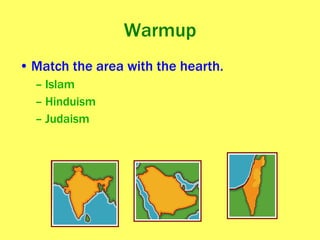
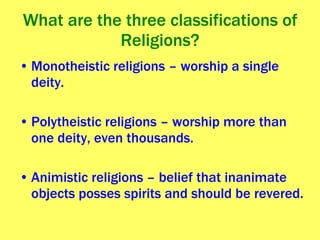
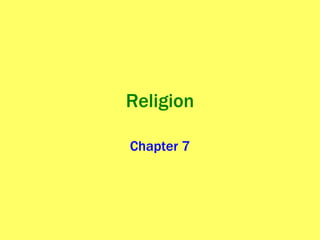
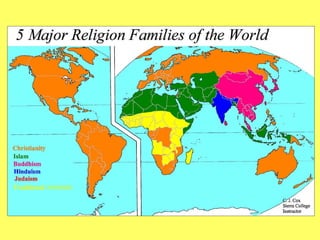
Warmup Match the area with the hearth. Islam Hinduism Judaism
What are the three classifications of Religions? Monotheistic religions – worship a single deity. Polytheistic religions – worship more than one deity, even thousands. Animistic religions – belief that inanimate objects posses spirits and should be revered.
Religion Chapter 7
What is Religion and What  Role does it Play in Culture? Key Question:
Warmup What was the Soviet Union’s official religious policy? How did they control ethnic and religious groups?
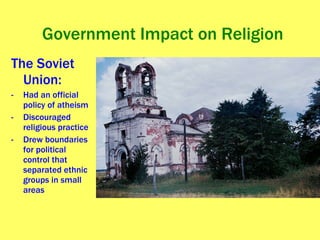
Government Impact on Religion The Soviet Union: Had an official policy of atheism Discouraged religious practice Drew boundaries for political control that separated ethnic groups in small areas
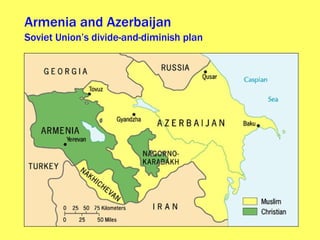
Armenia and Azerbaijan Soviet Union’s divide-and-diminish plan
Religion “ a system of beliefs and practices that attempts to order life in terms of culturally perceived ultimate priorities.”  - Stoddard and Prorak “ perceived ultimate priorities” often translate into a list of things a follower “should” do and ways a follower “should” behave.
Religion A set of beliefs  existence of a higher power, spirits or god an explanation of the origins and purpose of humans and their role on earth Which involves rituals, festivals, rites of passage and space (religious landscapes)
Branch :  A large and fundamental division within a religion. Denomination :  A division  within a branch  of a religion. Sect :  A relatively small denominational group that has broken away from an established church. Religious Divisions
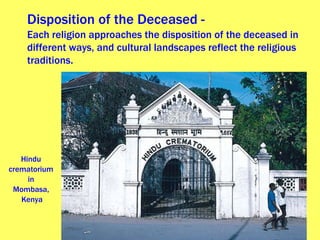
Disposition of the Deceased -   Each religion approaches the disposition of the deceased in different ways, and cultural landscapes reflect the religious traditions. Hindu  crematorium  in  Mombasa,  Kenya
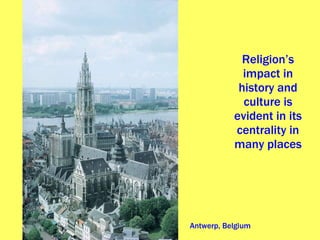
Religion’s impact in history and culture is evident in its centrality in many places Antwerp, Belgium
Describe how religion and language affect and change each other to shape cultures. (Consider what happens to a society’s religion and language when a different religion or language diffuses into the place).
Where did the Major Religions of the World Originate, and How do Religions Diffuse? Key Question:
Classifications of Religions Monotheistic religions – worship a single deity. Polytheistic religions – worship more than one deity, even thousands. Animistic religions – belief that inanimate objects posses spirits and should be revered.
Classifications of Religions Universalizing religions – religions that actively seek converts because members believe they offer  belief systems of universal appropriateness and appeal.  Ethnic religions – religions whose adherents are born into the faith and whose members do not actively seek converts.
How do Universalizing and Ethnic Religions Differ? Universalizing   Appeal to people everywhere Individual founder (prophet) Message diffused widely (missionaries) Followers distributed widely. Holidays based on events in founder’s life. Ethnic Has meaning in particular place only. Unknown source. Content focused on place and landscape of origin. Followers highly clustered. Holidays based on local climate and agricultural practice.
Warmup Pick up one of the sheets on Jordan’s desk. Please don’t write on, but attempt to answer questions 1-3 as our warmup today.
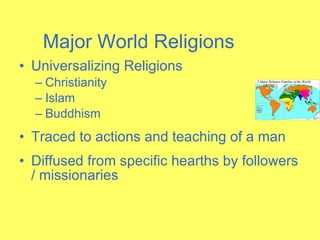
Major World Religions Universalizing Religions Christianity Islam Buddhism Traced to actions and teaching of a man Diffused from specific hearths by followers / missionaries
Major World Religions Ethnic Religions Hinduism  Judaism all Animistic Religions No specific founder limited diffusion / no missionaries
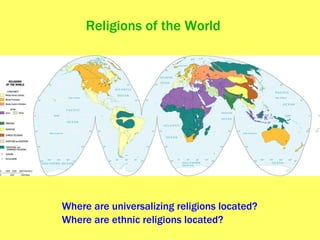
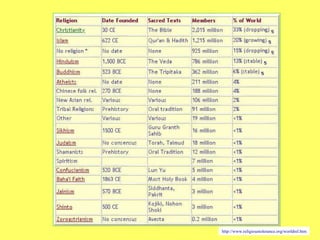
Religions of the World Where are universalizing religions located? Where are ethnic religions located?
 
http://www.religioustolerance.org/worldrel.htm
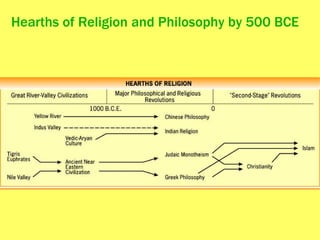
Hearths of Religion and Philosophy by 500 BCE
From the Hearth of South Asia
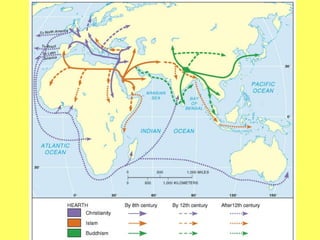
From the Hearth of South Asia Hinduism – originated in Indus River Valley over 4000 years ago. *  ritual bathing, karma, reincarnation, moksha sacred text:  Vedas sacred sites:  Ganges River social manifestation:  caste system diffusion:  through South Asia and into Southeast Asia, mainly India
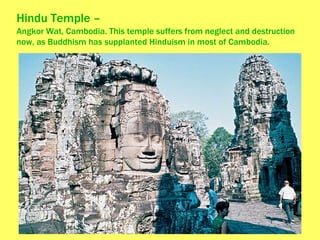
Hindu Temple – Angkor Wat, Cambodia. This temple suffers from neglect and destruction now, as Buddhism has supplanted Hinduism in most of Cambodia.
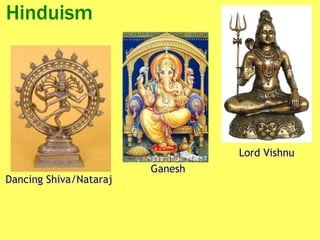
Hinduism Lord Vishnu Dancing Shiva/Nataraj Ganesh
 
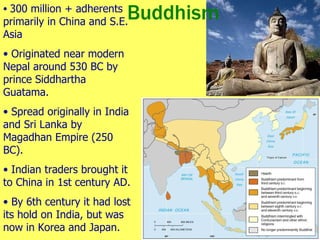
Buddhism 300 million + adherents primarily in China and S.E. Asia Originated near modern Nepal around 530 BC by prince Siddhartha Guatama. Spread originally in India and Sri Lanka by Magadhan Empire (250 BC). Indian traders brought it to China in 1st century AD. By 6th century it had lost its hold on India, but was now in Korea and Japan.
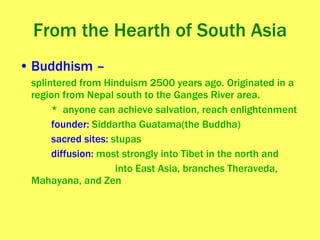
From the Hearth of South Asia Buddhism – splintered from Hinduism 2500 years ago. Originated in a region from Nepal south to the Ganges River area. *  anyone can achieve salvation, reach enlightenment founder:  Siddartha Guatama(the Buddha) sacred sites:  stupas diffusion:  most strongly into Tibet in the north and  into East Asia, branches Theraveda, Mahayana, and Zen
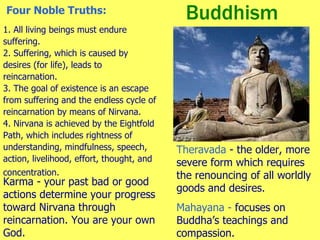
Buddhism Four Noble Truths: 1. All living beings must endure suffering. 2. Suffering, which is caused by desires (for life), leads to reincarnation. 3. The goal of existence is an escape from suffering and the endless cycle of reincarnation by means of Nirvana. 4. Nirvana is achieved by the Eightfold Path, which includes rightness of understanding, mindfulness, speech, action, livelihood, effort, thought, and concentration.   Theravada   - the older, more severe form which requires the renouncing of all worldly goods and desires. Mahayana -  focuses on Buddha’s teachings and compassion. Karma - your past bad or good actions determine your progress toward Nirvana through reincarnation. You are your own God.
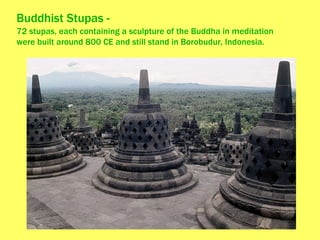
Buddhist Stupas - 72 stupas, each containing a sculpture of the Buddha in meditation were built around 800 CE and still stand in Borobudur, Indonesia.
 
 
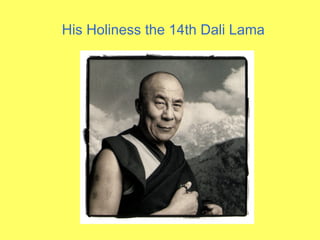
His Holiness the 14th Dali Lama
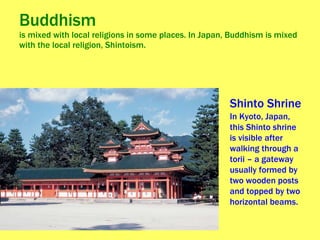
Buddhism  is mixed with local religions in some places. In Japan, Buddhism is mixed with the local religion, Shintoism. Shinto Shrine  In Kyoto, Japan, this Shinto shrine is visible after walking through a torii – a gateway usually formed by two wooden posts and topped by two horizontal beams.
From the Hearth of Huang He (Yellow) River Valley
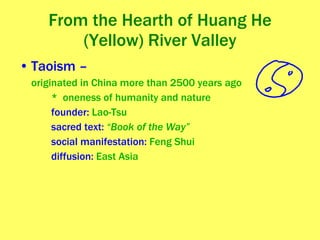
From the Hearth of Huang He (Yellow) River Valley Taoism – originated in China more than 2500 years ago *  oneness of humanity and nature founder:  Lao-Tsu sacred text:  “Book of the Way” social manifestation:  Feng Shui diffusion:  East Asia
From the Hearth of Huang He (Yellow) River Valley Confucianism  – originated in China about 2500 years ago  *  real meaning of life lay in the present founder:  Confucius sacred text:  “Confucian Classics” diffusion:  East Asia, Southeast Asia
From the Hearth of the  Eastern Mediterranean
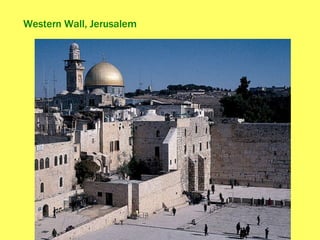
From the Hearth of the  Eastern Mediterranean Judaism – originated in Southwest Asia about 4000 years ago.  *  first major monotheistic religion, covenant between God (one God) and Abraham (the chosen people) sacred text:  Torah founder:  Abraham sacred sites:  Jerusalem (Western Wall), land between the Mediterranean and the Jordan River social manifestation:  Zionism diffusion:  into European cities during the diaspora,  into N. America during WWII, into Israel over last 50 years
Western Wall, Jerusalem
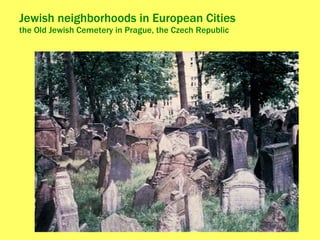
Jewish neighborhoods in European Cities  the Old Jewish Cemetery in Prague, the Czech Republic
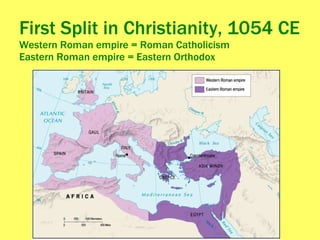
From the Hearth of the  Eastern Mediterranean Christianity – originated in Southwest Asia about 2000 years ago.  *  monotheistic religion, follow teachings of Jesus to achieve eternal life sacred text:  Bible founder:  Jesus (son of God) sacred sites:  Bethlehem, Jerusalem split in the church:  * split into Eastern Orthodox and Roman Catholic churches in 1054  * Protestant sect split off in 1400s and 1500s diffusion:  into Western Europe, and then world wide during colonialism and after.
Catholicism  - largest branch Headed by the Pope direct link to God Ceremonial - 7 sacraments  baptism, marriage, Eucharist, etc. Very traditional Christianity
Eastern Orthodoxy  - 5th Century split Rivalry between Pope and Patriarch of Constantinople (Istanbul) Rome remained center for Roman Catholicism Rejected Roman Catholicism doctrine  by 1054 officially split National Churches Russian, Greek, Serbian Orthodox, etc. Christianity
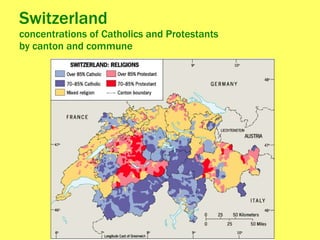
Protestantism  - (1517) Reformation era No Pope needed individual has direct link to God Grace through faith rather than sacraments  forgiveness for sins through indiv. prayers Spread though N. Europe and England arose same time as 1466 Gutenberg Bible and the printing press Christianity
First Split in Christianity, 1054 CE  Western Roman empire = Roman Catholicism Eastern Roman empire = Eastern Orthodox
Switzerland concentrations of Catholics and Protestants  by canton and commune
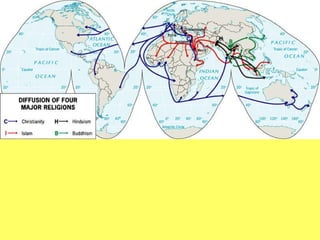
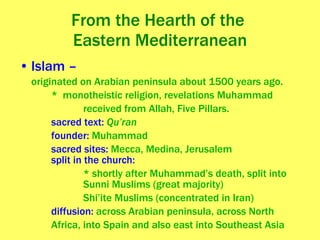
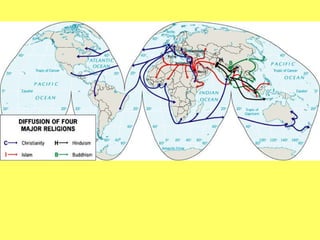
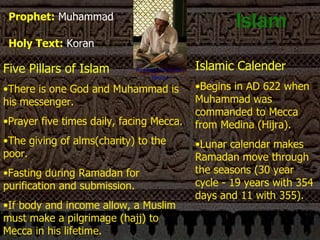
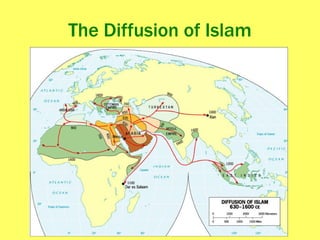
From the Hearth of the  Eastern Mediterranean Islam – originated on Arabian peninsula about 1500 years ago.  *  monotheistic religion, revelations Muhammad received from Allah, Five Pillars. sacred text:  Qu’ran founder:  Muhammad sacred sites:  Mecca, Medina, Jerusalem split in the church: * shortly after Muhammad’s death, split into  Sunni Muslims (great majority) Shi’ite Muslims (concentrated in Iran) diffusion:  across Arabian peninsula, across North Africa, into Spain and also east into Southeast Asia
 
Islam Five Pillars of Islam There is one God and Muhammad is his messenger. Prayer five times daily, facing Mecca. The giving of alms(charity) to the poor. Fasting during Ramadan for purification and submission. If body and income allow, a Muslim must make a pilgrimage (hajj) to Mecca in his lifetime. Islamic Calender Begins in AD 622 when Muhammad was commanded to Mecca from Medina (Hijra). Lunar calendar makes Ramadan move through the seasons (30 year cycle - 19 years with 354 days and 11 with 355). Reading the Koran, Brunei Prophet:   Muhammad Holy Text:   Koran
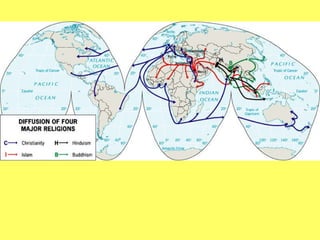
The Diffusion of Islam
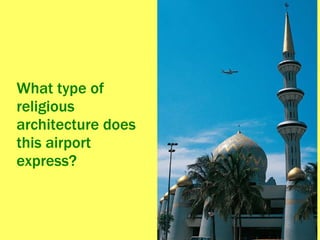
What type of religious architecture does this airport express?
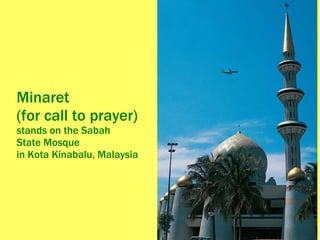
Minaret  (for call to prayer) stands on the Sabah  State Mosque  in Kota Kinabalu, Malaysia
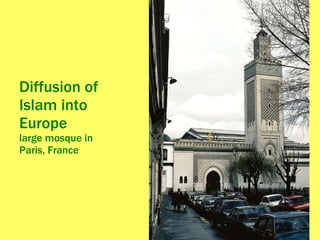
Diffusion of Islam into Europe large mosque in Paris, France
The Rest of the Map
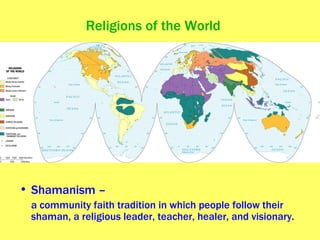
Religions of the World Shamanism – a community faith tradition in which people follow their shaman, a religious leader, teacher, healer, and visionary.
Not on the Map
Rise of Secularism Secularism – indifference to or rejection of organized religious affiliations and ideas. - Where is secularism on the rise and why?
Migration plays a large role in the diffusion of religions, both universalizing and ethnic. As Europe becomes more secular, migrants from outside of Europe continue to settle in the region. Imagine Europe 30 years from now. Predict where in Europe secularism will be the most prominent and where religious adherence will strengthen.
How is Religion seen in the Cultural Landscape? Key Question:
Sacred Sites and Pilgrimage Sacred Sites places or spaces people infuse with religious meaning. Pilgrimage purposeful travel to a religious site to pay respects or participate in a ritual at the site.
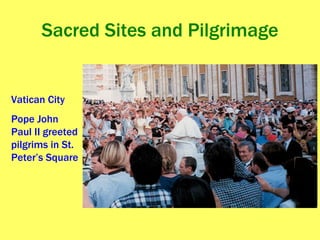
Sacred Sites and Pilgrimage Vatican City Pope John Paul II greeted pilgrims in St. Peter’s Square
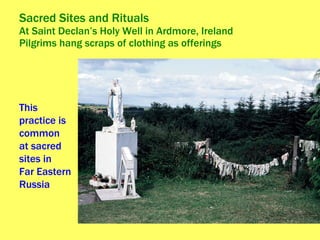
Sacred Sites and Rituals At Saint Declan’s Holy Well in Ardmore, Ireland Pilgrims hang scraps of clothing as offerings  This practice is common at sacred sites in  Far Eastern Russia
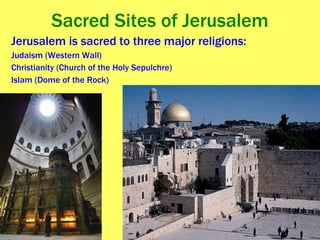
Sacred Sites of Jerusalem Jerusalem is sacred to three major religions: Judaism (Western Wall) Christianity (Church of the Holy Sepulchre) Islam (Dome of the Rock)
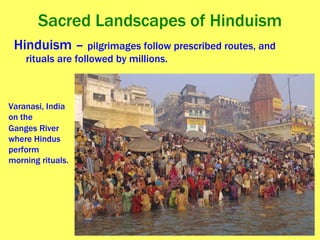
Sacred Landscapes of Hinduism Hinduism –  pilgrimages follow prescribed routes, and rituals are followed by millions. Varanasi, India on the  Ganges River where Hindus perform morning rituals.
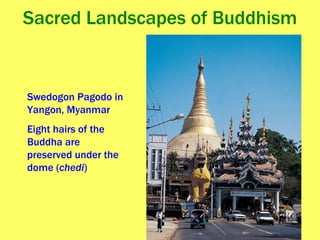
Sacred Landscapes of Buddhism Swedogon Pagodo in Yangon, Myanmar Eight hairs of the Buddha are preserved under the dome ( chedi )
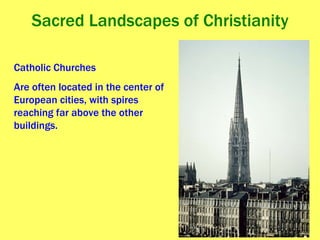
Sacred Landscapes of Christianity Catholic Churches  Are often located in the center of European cities, with spires reaching far above the other buildings.
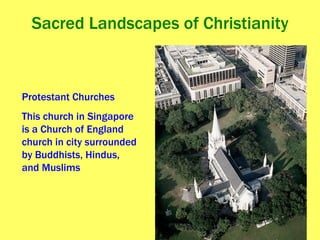
Sacred Landscapes of Christianity Protestant Churches This church in Singapore is a Church of England church in city surrounded by Buddhists, Hindus, and Muslims
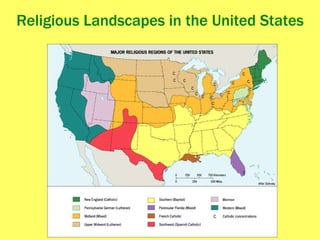
Religious Landscapes in the United States
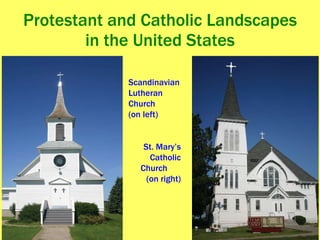
Protestant and Catholic Landscapes in the United States Scandinavian Lutheran Church  (on left) St. Mary’s Catholic Church  (on right)
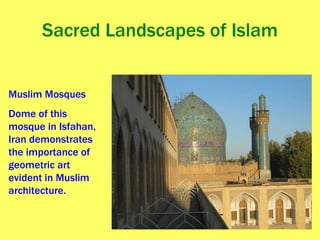
Sacred Landscapes of Islam Muslim Mosques Dome of this mosque in Isfahan, Iran demonstrates the importance of geometric art evident in Muslim architecture.
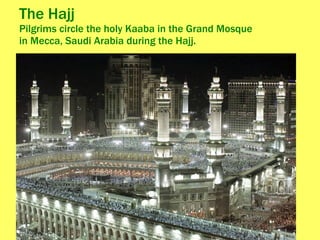
The Hajj Pilgrims circle the holy Kaaba in the Grand Mosque  in Mecca, Saudi Arabia during the Hajj.
Choose a pilgrimage site, such as Mecca, Vatican City, or the Western Wall, and describe how the act of pilgrimage (in some cases by millions) alters this place’s cultural landscape and environment.
 
What Role does Religion play in Political Conflicts? Key Question:
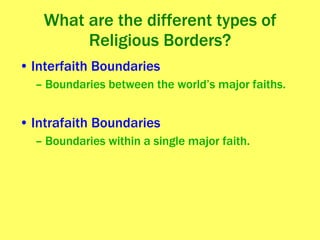
What are the different types of Religious Borders? Interfaith Boundaries Boundaries between the world’s major faiths. Intrafaith Boundaries Boundaries within a single major faith.
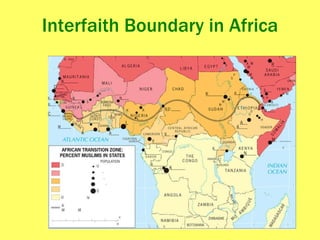
Interfaith Boundary in Africa
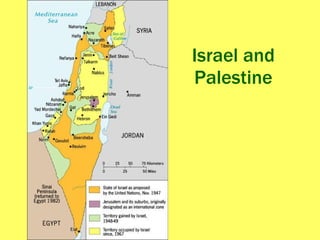
Israel and Palestine
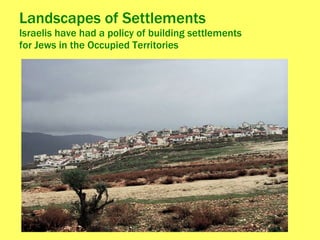
Landscapes of Settlements Israelis have had a policy of building settlements  for Jews in the Occupied Territories
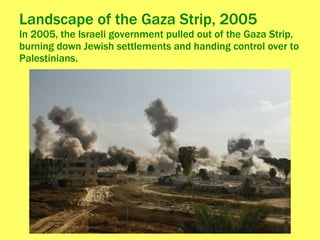
Landscape of the Gaza Strip, 2005 In 2005, the Israeli government pulled out of the Gaza Strip, burning down Jewish settlements and handing control over to Palestinians.
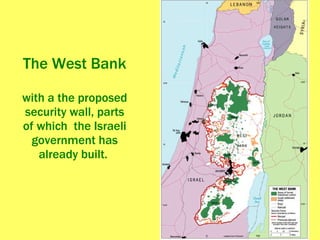
The West Bank with a the proposed security wall, parts of which  the Israeli government has already built.
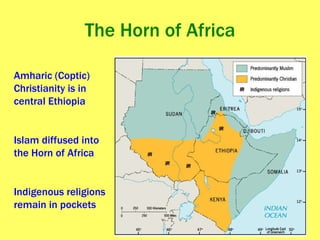
The Horn of Africa Amharic (Coptic) Christianity is in central Ethiopia Islam diffused into the Horn of Africa Indigenous religions remain in pockets ,
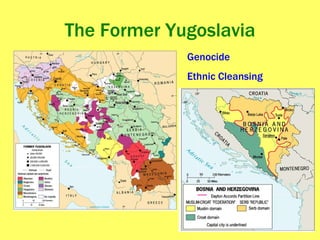
The Former Yugoslavia Genocide  Ethnic Cleansing
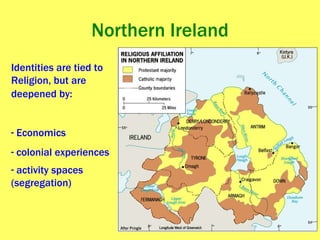
Northern Ireland Identities are tied to Religion, but are  deepened by: Economics colonial experiences activity spaces  (segregation)
Religious  Fundamentalism and Extremism Religious fundamentalism – a return to the basics of their faith. found in Christianity, Judaism, and Islam   Religious extremism –  fundamentalism carried to the point of violence. found in Christianity, Judaism, and Islam
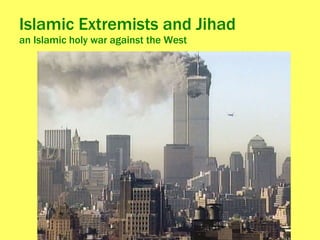
Islamic Extremists and Jihad an Islamic holy war against the West
Boal’s studies in Northern Ireland demonstrate that solving a religious conflict is typically not about theology; it is about identity. You are assigned the potentially Nobel Prize-winning task of “solving” the conflict either in Northern Ireland or in Israel and Palestine. Using Boal’s example, determine how you can alter activity spaces and change identities to create the conditions for long-lasting peace in one of these major conflict zones.

Ch07

  • 1.
    Warmup Match thearea with the hearth. Islam Hinduism Judaism
  • 2.
    What are thethree classifications of Religions? Monotheistic religions – worship a single deity. Polytheistic religions – worship more than one deity, even thousands. Animistic religions – belief that inanimate objects posses spirits and should be revered.
  • 3.
  • 4.
    What is Religionand What Role does it Play in Culture? Key Question:
  • 5.
    Warmup What wasthe Soviet Union’s official religious policy? How did they control ethnic and religious groups?
  • 6.
    Government Impact onReligion The Soviet Union: Had an official policy of atheism Discouraged religious practice Drew boundaries for political control that separated ethnic groups in small areas
  • 7.
    Armenia and AzerbaijanSoviet Union’s divide-and-diminish plan
  • 8.
    Religion “ asystem of beliefs and practices that attempts to order life in terms of culturally perceived ultimate priorities.” - Stoddard and Prorak “ perceived ultimate priorities” often translate into a list of things a follower “should” do and ways a follower “should” behave.
  • 9.
    Religion A setof beliefs existence of a higher power, spirits or god an explanation of the origins and purpose of humans and their role on earth Which involves rituals, festivals, rites of passage and space (religious landscapes)
  • 10.
    Branch : A large and fundamental division within a religion. Denomination : A division within a branch of a religion. Sect : A relatively small denominational group that has broken away from an established church. Religious Divisions
  • 11.
    Disposition of theDeceased - Each religion approaches the disposition of the deceased in different ways, and cultural landscapes reflect the religious traditions. Hindu crematorium in Mombasa, Kenya
  • 12.
    Religion’s impact inhistory and culture is evident in its centrality in many places Antwerp, Belgium
  • 13.
    Describe how religionand language affect and change each other to shape cultures. (Consider what happens to a society’s religion and language when a different religion or language diffuses into the place).
  • 14.
    Where did theMajor Religions of the World Originate, and How do Religions Diffuse? Key Question:
  • 15.
    Classifications of ReligionsMonotheistic religions – worship a single deity. Polytheistic religions – worship more than one deity, even thousands. Animistic religions – belief that inanimate objects posses spirits and should be revered.
  • 16.
    Classifications of ReligionsUniversalizing religions – religions that actively seek converts because members believe they offer belief systems of universal appropriateness and appeal. Ethnic religions – religions whose adherents are born into the faith and whose members do not actively seek converts.
  • 17.
    How do Universalizingand Ethnic Religions Differ? Universalizing Appeal to people everywhere Individual founder (prophet) Message diffused widely (missionaries) Followers distributed widely. Holidays based on events in founder’s life. Ethnic Has meaning in particular place only. Unknown source. Content focused on place and landscape of origin. Followers highly clustered. Holidays based on local climate and agricultural practice.
  • 18.
    Warmup Pick upone of the sheets on Jordan’s desk. Please don’t write on, but attempt to answer questions 1-3 as our warmup today.
  • 19.
    Major World ReligionsUniversalizing Religions Christianity Islam Buddhism Traced to actions and teaching of a man Diffused from specific hearths by followers / missionaries
  • 20.
    Major World ReligionsEthnic Religions Hinduism Judaism all Animistic Religions No specific founder limited diffusion / no missionaries
  • 21.
    Religions of theWorld Where are universalizing religions located? Where are ethnic religions located?
  • 22.
  • 23.
  • 24.
    Hearths of Religionand Philosophy by 500 BCE
  • 25.
    From the Hearthof South Asia
  • 26.
    From the Hearthof South Asia Hinduism – originated in Indus River Valley over 4000 years ago. * ritual bathing, karma, reincarnation, moksha sacred text: Vedas sacred sites: Ganges River social manifestation: caste system diffusion: through South Asia and into Southeast Asia, mainly India
  • 27.
    Hindu Temple –Angkor Wat, Cambodia. This temple suffers from neglect and destruction now, as Buddhism has supplanted Hinduism in most of Cambodia.
  • 28.
    Hinduism Lord VishnuDancing Shiva/Nataraj Ganesh
  • 29.
  • 30.
    Buddhism 300 million+ adherents primarily in China and S.E. Asia Originated near modern Nepal around 530 BC by prince Siddhartha Guatama. Spread originally in India and Sri Lanka by Magadhan Empire (250 BC). Indian traders brought it to China in 1st century AD. By 6th century it had lost its hold on India, but was now in Korea and Japan.
  • 31.
    From the Hearthof South Asia Buddhism – splintered from Hinduism 2500 years ago. Originated in a region from Nepal south to the Ganges River area. * anyone can achieve salvation, reach enlightenment founder: Siddartha Guatama(the Buddha) sacred sites: stupas diffusion: most strongly into Tibet in the north and into East Asia, branches Theraveda, Mahayana, and Zen
  • 32.
    Buddhism Four NobleTruths: 1. All living beings must endure suffering. 2. Suffering, which is caused by desires (for life), leads to reincarnation. 3. The goal of existence is an escape from suffering and the endless cycle of reincarnation by means of Nirvana. 4. Nirvana is achieved by the Eightfold Path, which includes rightness of understanding, mindfulness, speech, action, livelihood, effort, thought, and concentration. Theravada - the older, more severe form which requires the renouncing of all worldly goods and desires. Mahayana - focuses on Buddha’s teachings and compassion. Karma - your past bad or good actions determine your progress toward Nirvana through reincarnation. You are your own God.
  • 33.
    Buddhist Stupas -72 stupas, each containing a sculpture of the Buddha in meditation were built around 800 CE and still stand in Borobudur, Indonesia.
  • 34.
  • 35.
  • 36.
    His Holiness the14th Dali Lama
  • 37.
    Buddhism ismixed with local religions in some places. In Japan, Buddhism is mixed with the local religion, Shintoism. Shinto Shrine In Kyoto, Japan, this Shinto shrine is visible after walking through a torii – a gateway usually formed by two wooden posts and topped by two horizontal beams.
  • 38.
    From the Hearthof Huang He (Yellow) River Valley
  • 39.
    From the Hearthof Huang He (Yellow) River Valley Taoism – originated in China more than 2500 years ago * oneness of humanity and nature founder: Lao-Tsu sacred text: “Book of the Way” social manifestation: Feng Shui diffusion: East Asia
  • 40.
    From the Hearthof Huang He (Yellow) River Valley Confucianism – originated in China about 2500 years ago * real meaning of life lay in the present founder: Confucius sacred text: “Confucian Classics” diffusion: East Asia, Southeast Asia
  • 41.
    From the Hearthof the Eastern Mediterranean
  • 42.
    From the Hearthof the Eastern Mediterranean Judaism – originated in Southwest Asia about 4000 years ago. * first major monotheistic religion, covenant between God (one God) and Abraham (the chosen people) sacred text: Torah founder: Abraham sacred sites: Jerusalem (Western Wall), land between the Mediterranean and the Jordan River social manifestation: Zionism diffusion: into European cities during the diaspora, into N. America during WWII, into Israel over last 50 years
  • 43.
  • 44.
    Jewish neighborhoods inEuropean Cities the Old Jewish Cemetery in Prague, the Czech Republic
  • 45.
    From the Hearthof the Eastern Mediterranean Christianity – originated in Southwest Asia about 2000 years ago. * monotheistic religion, follow teachings of Jesus to achieve eternal life sacred text: Bible founder: Jesus (son of God) sacred sites: Bethlehem, Jerusalem split in the church: * split into Eastern Orthodox and Roman Catholic churches in 1054 * Protestant sect split off in 1400s and 1500s diffusion: into Western Europe, and then world wide during colonialism and after.
  • 46.
    Catholicism -largest branch Headed by the Pope direct link to God Ceremonial - 7 sacraments baptism, marriage, Eucharist, etc. Very traditional Christianity
  • 47.
    Eastern Orthodoxy - 5th Century split Rivalry between Pope and Patriarch of Constantinople (Istanbul) Rome remained center for Roman Catholicism Rejected Roman Catholicism doctrine by 1054 officially split National Churches Russian, Greek, Serbian Orthodox, etc. Christianity
  • 48.
    Protestantism -(1517) Reformation era No Pope needed individual has direct link to God Grace through faith rather than sacraments forgiveness for sins through indiv. prayers Spread though N. Europe and England arose same time as 1466 Gutenberg Bible and the printing press Christianity
  • 49.
    First Split inChristianity, 1054 CE Western Roman empire = Roman Catholicism Eastern Roman empire = Eastern Orthodox
  • 50.
    Switzerland concentrations ofCatholics and Protestants by canton and commune
  • 51.
    From the Hearthof the Eastern Mediterranean Islam – originated on Arabian peninsula about 1500 years ago. * monotheistic religion, revelations Muhammad received from Allah, Five Pillars. sacred text: Qu’ran founder: Muhammad sacred sites: Mecca, Medina, Jerusalem split in the church: * shortly after Muhammad’s death, split into Sunni Muslims (great majority) Shi’ite Muslims (concentrated in Iran) diffusion: across Arabian peninsula, across North Africa, into Spain and also east into Southeast Asia
  • 52.
  • 53.
    Islam Five Pillarsof Islam There is one God and Muhammad is his messenger. Prayer five times daily, facing Mecca. The giving of alms(charity) to the poor. Fasting during Ramadan for purification and submission. If body and income allow, a Muslim must make a pilgrimage (hajj) to Mecca in his lifetime. Islamic Calender Begins in AD 622 when Muhammad was commanded to Mecca from Medina (Hijra). Lunar calendar makes Ramadan move through the seasons (30 year cycle - 19 years with 354 days and 11 with 355). Reading the Koran, Brunei Prophet: Muhammad Holy Text: Koran
  • 54.
  • 55.
    What type ofreligious architecture does this airport express?
  • 56.
    Minaret (forcall to prayer) stands on the Sabah State Mosque in Kota Kinabalu, Malaysia
  • 57.
    Diffusion of Islaminto Europe large mosque in Paris, France
  • 58.
    The Rest ofthe Map
  • 59.
    Religions of theWorld Shamanism – a community faith tradition in which people follow their shaman, a religious leader, teacher, healer, and visionary.
  • 60.
  • 61.
    Rise of SecularismSecularism – indifference to or rejection of organized religious affiliations and ideas. - Where is secularism on the rise and why?
  • 62.
    Migration plays alarge role in the diffusion of religions, both universalizing and ethnic. As Europe becomes more secular, migrants from outside of Europe continue to settle in the region. Imagine Europe 30 years from now. Predict where in Europe secularism will be the most prominent and where religious adherence will strengthen.
  • 63.
    How is Religionseen in the Cultural Landscape? Key Question:
  • 64.
    Sacred Sites andPilgrimage Sacred Sites places or spaces people infuse with religious meaning. Pilgrimage purposeful travel to a religious site to pay respects or participate in a ritual at the site.
  • 65.
    Sacred Sites andPilgrimage Vatican City Pope John Paul II greeted pilgrims in St. Peter’s Square
  • 66.
    Sacred Sites andRituals At Saint Declan’s Holy Well in Ardmore, Ireland Pilgrims hang scraps of clothing as offerings This practice is common at sacred sites in Far Eastern Russia
  • 67.
    Sacred Sites ofJerusalem Jerusalem is sacred to three major religions: Judaism (Western Wall) Christianity (Church of the Holy Sepulchre) Islam (Dome of the Rock)
  • 68.
    Sacred Landscapes ofHinduism Hinduism – pilgrimages follow prescribed routes, and rituals are followed by millions. Varanasi, India on the Ganges River where Hindus perform morning rituals.
  • 69.
    Sacred Landscapes ofBuddhism Swedogon Pagodo in Yangon, Myanmar Eight hairs of the Buddha are preserved under the dome ( chedi )
  • 70.
    Sacred Landscapes ofChristianity Catholic Churches Are often located in the center of European cities, with spires reaching far above the other buildings.
  • 71.
    Sacred Landscapes ofChristianity Protestant Churches This church in Singapore is a Church of England church in city surrounded by Buddhists, Hindus, and Muslims
  • 72.
    Religious Landscapes inthe United States
  • 73.
    Protestant and CatholicLandscapes in the United States Scandinavian Lutheran Church (on left) St. Mary’s Catholic Church (on right)
  • 74.
    Sacred Landscapes ofIslam Muslim Mosques Dome of this mosque in Isfahan, Iran demonstrates the importance of geometric art evident in Muslim architecture.
  • 75.
    The Hajj Pilgrimscircle the holy Kaaba in the Grand Mosque in Mecca, Saudi Arabia during the Hajj.
  • 76.
    Choose a pilgrimagesite, such as Mecca, Vatican City, or the Western Wall, and describe how the act of pilgrimage (in some cases by millions) alters this place’s cultural landscape and environment.
  • 77.
  • 78.
    What Role doesReligion play in Political Conflicts? Key Question:
  • 79.
    What are thedifferent types of Religious Borders? Interfaith Boundaries Boundaries between the world’s major faiths. Intrafaith Boundaries Boundaries within a single major faith.
  • 80.
  • 81.
  • 82.
    Landscapes of SettlementsIsraelis have had a policy of building settlements for Jews in the Occupied Territories
  • 83.
    Landscape of theGaza Strip, 2005 In 2005, the Israeli government pulled out of the Gaza Strip, burning down Jewish settlements and handing control over to Palestinians.
  • 84.
    The West Bankwith a the proposed security wall, parts of which the Israeli government has already built.
  • 85.
    The Horn ofAfrica Amharic (Coptic) Christianity is in central Ethiopia Islam diffused into the Horn of Africa Indigenous religions remain in pockets ,
  • 86.
    The Former YugoslaviaGenocide Ethnic Cleansing
  • 87.
    Northern Ireland Identitiesare tied to Religion, but are deepened by: Economics colonial experiences activity spaces (segregation)
  • 88.
    Religious Fundamentalismand Extremism Religious fundamentalism – a return to the basics of their faith. found in Christianity, Judaism, and Islam Religious extremism – fundamentalism carried to the point of violence. found in Christianity, Judaism, and Islam
  • 89.
    Islamic Extremists andJihad an Islamic holy war against the West
  • 90.
    Boal’s studies inNorthern Ireland demonstrate that solving a religious conflict is typically not about theology; it is about identity. You are assigned the potentially Nobel Prize-winning task of “solving” the conflict either in Northern Ireland or in Israel and Palestine. Using Boal’s example, determine how you can alter activity spaces and change identities to create the conditions for long-lasting peace in one of these major conflict zones.