Abnormalities of Teeth
Dr. Arsalan Malik
Assistant Professor & HOD (Oral Pathology)
ِ‫يم‬ ِ‫ح‬َّ‫الر‬ ِ‫من‬ْ‫ح‬َّ‫الر‬ ِ‫هللا‬ ِ‫م‬ْ‫س‬ِ‫ب‬
1
Environmental Alterations of Teeth
 Developmental tooth defects
 Post developmental structural tooth loss
 Discoloration of teeth
 Localized disturbances in eruption
2
Factors Associated with Enamel Defects
Systemic
◦ Birth related trauma
◦ Chromosomal abnormalities
◦ Chemicals
◦ Infections
◦ Inherited diseases
◦ Malnutrition
◦ Metabolic disorders
◦ Neurological disorders
Local
◦ Acute mechanical trauma
◦ Local infection
◦ Electrical
◦ Irradiation
3
Enamel Defects
 Matrix Formation
 Mineralization
 Maturation
4
Enamel Defects
Enamel Hypoplasia
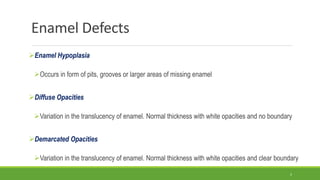
Occurs in form of pits, grooves or larger areas of missing enamel
Diffuse Opacities
Variation in the translucency of enamel. Normal thickness with white opacities and no boundary
Demarcated Opacities
Variation in the translucency of enamel. Normal thickness with white opacities and clear boundary
5
Turner’s Hypoplasia
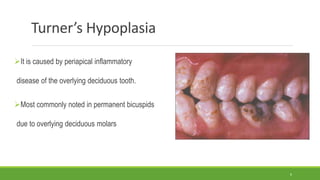
It is caused by periapical inflammatory
disease of the overlying deciduous tooth.
Most commonly noted in permanent bicuspids
due to overlying deciduous molars
6
Turner’s Hypoplasia
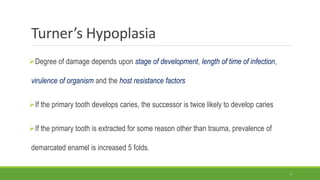
Degree of damage depends upon stage of development, length of time of infection,
virulence of organism and the host resistance factors
If the primary tooth develops caries, the successor is twice likely to develop caries
If the primary tooth is extracted for some reason other than trauma, prevalence of
demarcated enamel is increased 5 folds.
7
Molar Incisor Hypomineralization
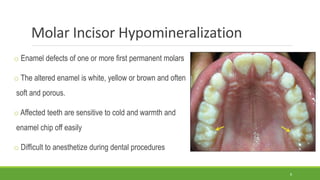
o Enamel defects of one or more first permanent molars
o The altered enamel is white, yellow or brown and often
soft and porous.
o Affected teeth are sensitive to cold and warmth and
enamel chip off easily
o Difficult to anesthetize during dental procedures
8
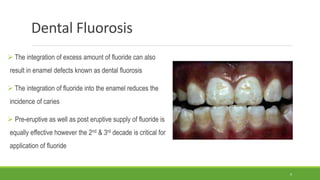
Dental Fluorosis
 The integration of excess amount of fluoride can also
result in enamel defects known as dental fluorosis
 The integration of fluoride into the enamel reduces the
incidence of caries
 Pre-eruptive as well as post eruptive supply of fluoride is
equally effective however the 2nd & 3rd decade is critical for
application of fluoride
9
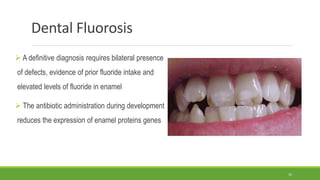
Dental Fluorosis
 A definitive diagnosis requires bilateral presence
of defects, evidence of prior fluoride intake and
elevated levels of fluoride in enamel
 The antibiotic administration during development
reduces the expression of enamel proteins genes
10
Post Developmental Loss Of Structure
Attrition
Abrasion
Erosion
Abfraction
11
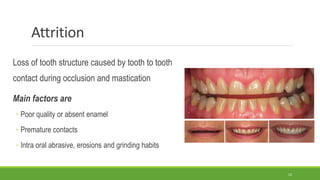
Attrition
Loss of tooth structure caused by tooth to tooth
contact during occlusion and mastication
Main factors are
◦ Poor quality or absent enamel
◦ Premature contacts
◦ Intra oral abrasive, erosions and grinding habits
12
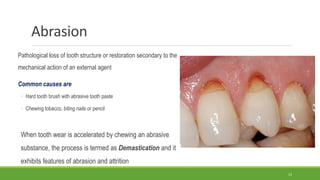
Abrasion
Pathological loss of tooth structure or restoration secondary to the
mechanical action of an external agent
Common causes are
◦ Hard tooth brush with abrasive tooth paste
◦ Chewing tobacco, biting nails or pencil
When tooth wear is accelerated by chewing an abrasive
substance, the process is termed as Demastication and it
exhibits features of abrasion and attrition
13
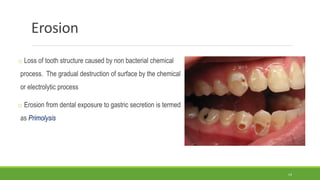
Erosion
o Loss of tooth structure caused by non bacterial chemical
process. The gradual destruction of surface by the chemical
or electrolytic process
o Erosion from dental exposure to gastric secretion is termed
as Primolysis
14
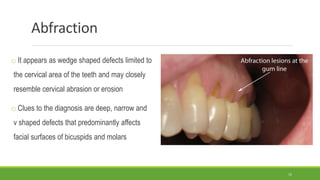
Abfraction
o It appears as wedge shaped defects limited to
the cervical area of the teeth and may closely
resemble cervical abrasion or erosion
o Clues to the diagnosis are deep, narrow and
v shaped defects that predominantly affects
facial surfaces of bicuspids and molars
15
Resorption
 Destruction of tooth can also occur through resorption, which is accomplished by cells
located in the pulp (Internal resorption) or in the periodontal ligament (External
resorption)
 Internal resorption is a relatively rare occurrence and mostly it develops after trauma to
the pulpal tissues of the tooth
 It continues as long as vital pulp tissue remains and may result in communication of
pulp with the PDL.
16
Factors Associated with External Resorption
 Cysts
 Dental trauma
 Excessive mechanical forces
 Excess occlusal forces
 Hormonal imbalance
 Peget’s disease of bone
 Periodontal treatment
 Tumours
 Reimplantation of teeth
17
Clinical Features
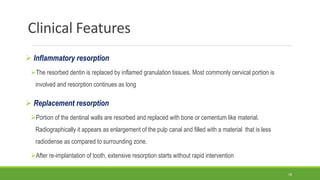
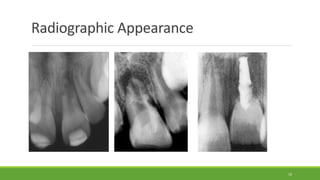
 Inflammatory resorption
The resorbed dentin is replaced by inflamed granulation tissues. Most commonly cervical portion is
involved and resorption continues as long
 Replacement resorption
Portion of the dentinal walls are resorbed and replaced with bone or cementum like material.
Radiographically it appears as enlargement of the pulp canal and filled with a material that is less
radiodense as compared to surrounding zone.
After re-implantation of tooth, extensive resorption starts without rapid intervention
18
Radiographic Appearance
19
Histopathological Features
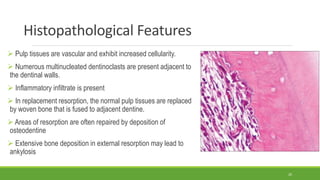
 Pulp tissues are vascular and exhibit increased cellularity.
 Numerous multinucleated dentinoclasts are present adjacent to
the dentinal walls.
 Inflammatory infiltrate is present
 In replacement resorption, the normal pulp tissues are replaced
by woven bone that is fused to adjacent dentine.
 Areas of resorption are often repaired by deposition of
osteodentine
 Extensive bone deposition in external resorption may lead to
ankylosis
20
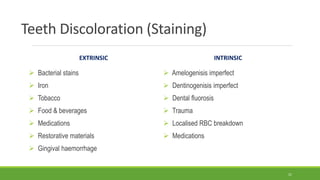
Teeth Discoloration (Staining)
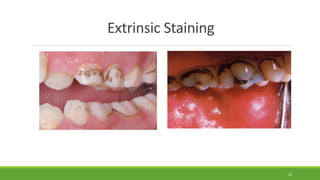
EXTRINSIC
 Bacterial stains
 Iron
 Tobacco
 Food & beverages
 Medications
 Restorative materials
 Gingival haemorrhage
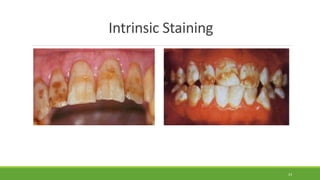
INTRINSIC
 Amelogenisis imperfect
 Dentinogenisis imperfect
 Dental fluorosis
 Trauma
 Localised RBC breakdown
 Medications
21
Extrinsic Staining
22
Intrinsic Staining
23
Localized Disturbances in Eruption
 Impaction
 Teeth that cease to erupt before emergence are called Impacted
 Ankylosis
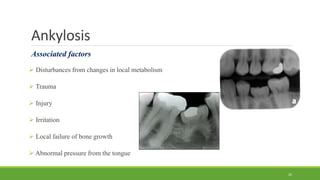
 Eruption continues after emergence of teeth to compensate for masticatory wear and the growth of
jaws. The cessation of eruption after emergence is termed Ankylosis
24
Impaction
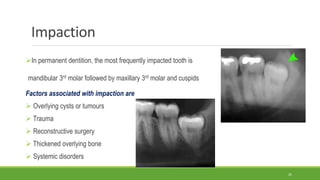
In permanent dentition, the most frequently impacted tooth is
mandibular 3rd molar followed by maxillary 3rd molar and cuspids
Factors associated with impaction are
 Overlying cysts or tumours
 Trauma
 Reconstructive surgery
 Thickened overlying bone
 Systemic disorders
25
Ankylosis
Associated factors
 Disturbances from changes in local metabolism
 Trauma
 Injury
 Irritation
 Local failure of bone growth
 Abnormal pressure from the tongue
26
Developmental Alterations of Teeth
 Number
Hypodontia
Hyperdontia
 Size
Microdontia
Macrodontia
 Shape
Gemination
Fusion
Concresence
Taurodontism
Hypercementosis
Dilaceration
Dens invaginatus
Dens Evaginatus
 Structure
Amelogenisis Imperfecta
Dentinogenisis Imperfecta
Dentin Dysplasia type I
Dentin Dysplasia type II
Regional Odontodysplasia
27
Hypodontia
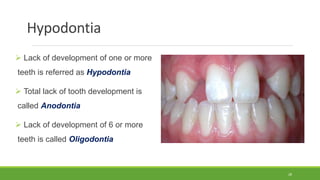
 Lack of development of one or more
teeth is referred as Hypodontia
 Total lack of tooth development is
called Anodontia
 Lack of development of 6 or more
teeth is called Oligodontia
28
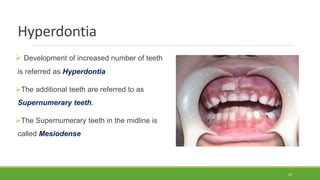
Hyperdontia
 Development of increased number of teeth
is referred as Hyperdontia
The additional teeth are referred to as
Supernumerary teeth.
The Supernumerary teeth in the midline is
called Mesiodense
29
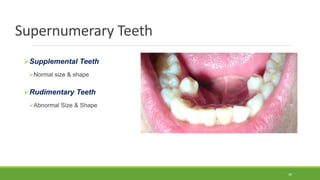
Supernumerary Teeth
Supplemental Teeth
Normal size & shape
Rudimentary Teeth
Abnormal Size & Shape
30
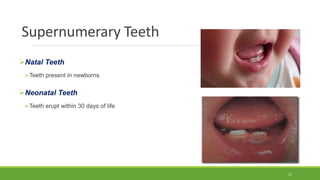
Supernumerary Teeth
Natal Teeth
Teeth present in newborns
Neonatal Teeth
Teeth erupt within 30 days of life
31
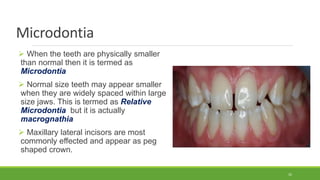
Microdontia
 When the teeth are physically smaller
than normal then it is termed as
Microdontia
 Normal size teeth may appear smaller
when they are widely spaced within large
size jaws. This is termed as Relative
Microdontia but it is actually
macrognathia
 Maxillary lateral incisors are most
commonly effected and appear as peg
shaped crown.
32
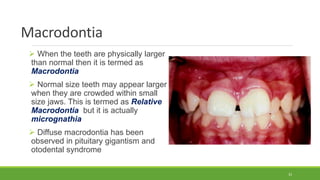
Macrodontia
 When the teeth are physically larger
than normal then it is termed as
Macrodontia
 Normal size teeth may appear larger
when they are crowded within small
size jaws. This is termed as Relative
Macrodontia but it is actually
micrognathia
 Diffuse macrodontia has been
observed in pituitary gigantism and
otodental syndrome
33
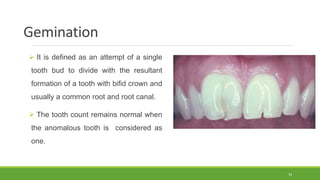
Gemination
 It is defined as an attempt of a single
tooth bud to divide with the resultant
formation of a tooth with bifid crown and
usually a common root and root canal.
 The tooth count remains normal when
the anomalous tooth is considered as
one.
34
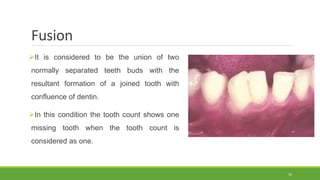
Fusion
It is considered to be the union of two
normally separated teeth buds with the
resultant formation of a joined tooth with
confluence of dentin.
In this condition the tooth count shows one
missing tooth when the tooth count is
considered as one.
35
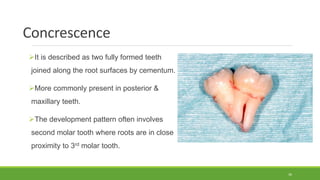
Concrescence
It is described as two fully formed teeth
joined along the root surfaces by cementum.
More commonly present in posterior &
maxillary teeth.
The development pattern often involves
second molar tooth where roots are in close
proximity to 3rd molar tooth.
36
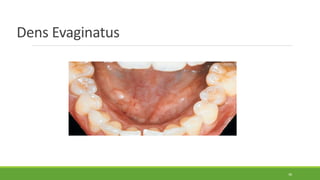
Dens Evaginatus
 It is a cusp like elevation of enamel located in the central groove or lingual ridge of the buccal
cusp of premolar or molar tooth.
 The accessory cusp usually consist of enamel & dentine with pulp present in half of the cases
 The accessory cusp creates occlusal interference that are associated with clinical problems.
 Pulp necrosis is common and may occur through a direct exposure or invasion of patent,
immature dentinal tubules.
37
Dens Evaginatus
38
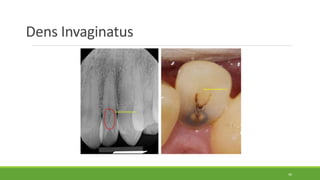
Dens Invaginatus
Deep surface invagination of the crown or root that is lined by enamel.
The depth of invagination varies from a slight enlargement of the cingulum pit to a deep
infolding that extends to apex.
Occasionally the invagination may be large and resemble a tooth within tooth appearance
called den in dente.
39
Dens Invaginatus
40
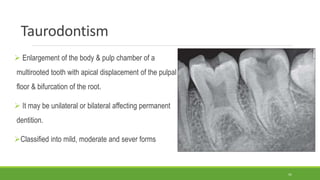
Taurodontism
 Enlargement of the body & pulp chamber of a
multirooted tooth with apical displacement of the pulpal
floor & bifurcation of the root.
 It may be unilateral or bilateral affecting permanent
dentition.
Classified into mild, moderate and sever forms
41
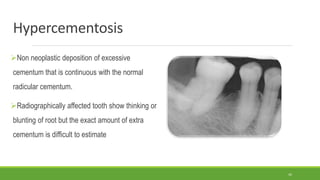
Hypercementosis
Non neoplastic deposition of excessive
cementum that is continuous with the normal
radicular cementum.
Radiographically affected tooth show thinking or
blunting of root but the exact amount of extra
cementum is difficult to estimate
42
Associated Factors
Local
 Abnormal occlusal trauma
 Adjacent inflammation
 Repair of vital root fracture
 Unopposed teeth
Systemic
 Acromegaly
 Arthritis
 Calcinosis
 Thyroid goiter
 Gardner Syndrome
 Vitamin A deficiency
43
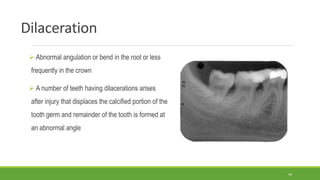
Dilaceration
 Abnormal angulation or bend in the root or less
frequently in the crown
 A number of teeth having dilacerations arises
after injury that displaces the calcified portion of the
tooth germ and remainder of the tooth is formed at
an abnormal angle
44
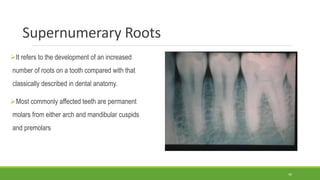
Supernumerary Roots
It refers to the development of an increased
number of roots on a tooth compared with that
classically described in dental anatomy.
Most commonly affected teeth are permanent
molars from either arch and mandibular cuspids
and premolars
45
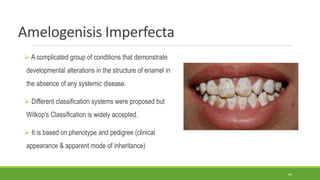
Amelogenisis Imperfecta
 A complicated group of conditions that demonstrate
developmental alterations in the structure of enamel in
the absence of any systemic disease.
 Different classification systems were proposed but
Witkop’s Classification is widely accepted.
 It is based on phenotype and pedigree (clinical
appearance & apparent mode of inheritance)
46
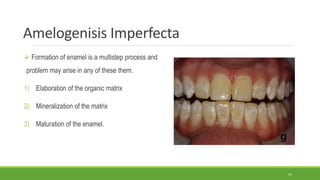
Amelogenisis Imperfecta
 Formation of enamel is a multistep process and
problem may arise in any of these them.
1) Elaboration of the organic matrix
2) Mineralization of the matrix
3) Maturation of the enamel.
47
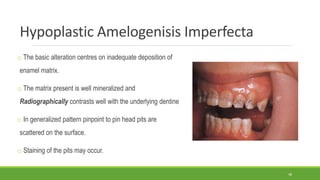
Hypoplastic Amelogenisis Imperfecta
o The basic alteration centres on inadequate deposition of
enamel matrix.
o The matrix present is well mineralized and
Radiographically contrasts well with the underlying dentine
o In generalized pattern pinpoint to pin head pits are
scattered on the surface.
o Staining of the pits may occur.
48
Hypoplastic Amelogenisis Imperfecta
o In localized pattern, the affected teeth demonstrate horizontal rows of pits, linear
depression or one large area of hypocalcification.
o In other patterns of this disorder, enamel may appear smooth, thin, hard and glossy.
o Radiographically demonstrate a thin radio-opaque line of enamel.
49
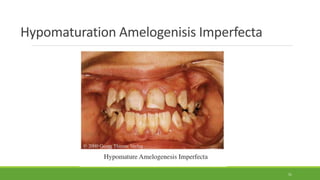
Hypomaturation Amelogenisis Imperfecta
• Enamel matrix is laid down properly and begin to mineralize but there is defect in
maturation of enamel crystal structure
• Affected teeth are normal in shape but show mottled appearance and tend to chip easily
• Radiographically its density is similar to dentine
50
Hypomaturation Amelogenisis Imperfecta
51
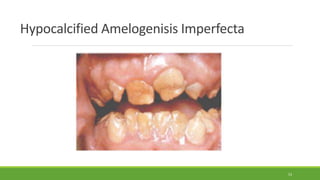
Hypocalcified Amelogenisis Imperfecta
o Enamel matrix is laid down properly but failed to mineralize properly
o Affected teeth are proper in shape but very soft & easily lost
o It has more tendency of calculus deposition on it
o Radiographically the density of enamel & dentine is similar
o After some duration time of eruption, cuspal enamel is lost leaving occlusal surfaces
irregular
52
Hypocalcified Amelogenisis Imperfecta
53
Histopathological Features
These are not evident in routine preparations because decalcification of the teeth is
necessary before processing and all the enamel is lost in it
Ground sections of Non decalcified teeth are prepared for examination
The alterations are highly diverse and depend upon the type of variation in enamel structure
54
Treatment
o Main problems are aesthetics, dental sensitivity and loss of vertical dimension
o In some types, increased prevalence of caries, anterior open bite, delayed eruption and associated
gingival enlargement are observed
o Crown placement
o Full dentures
o Veneers
oGlass Ionomer Cements restorations
55
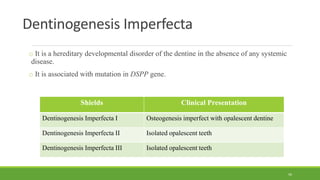
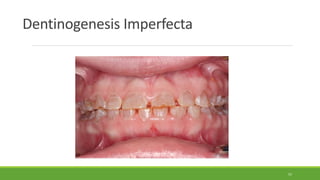
Dentinogenesis Imperfecta
o It is a hereditary developmental disorder of the dentine in the absence of any systemic
disease.
o It is associated with mutation in DSPP gene.
Shields Clinical Presentation
Dentinogenesis Imperfecta I Osteogenesis imperfect with opalescent dentine
Dentinogenesis Imperfecta II Isolated opalescent teeth
Dentinogenesis Imperfecta III Isolated opalescent teeth
56
Dentinogenesis Imperfecta
57
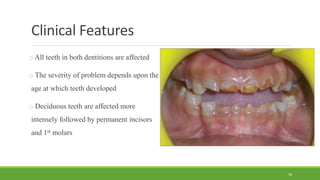
Clinical Features
o All teeth in both dentitions are affected
o The severity of problem depends upon the
age at which teeth developed
o Deciduous teeth are affected more
intensely followed by permanent incisors
and 1st molars
58
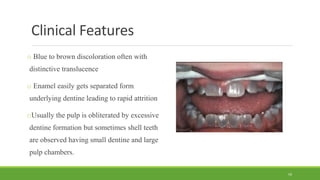
Clinical Features
o Blue to brown discoloration often with
distinctive translucence
o Enamel easily gets separated form
underlying dentine leading to rapid attrition
oUsually the pulp is obliterated by excessive
dentine formation but sometimes shell teeth
are observed having small dentine and large
pulp chambers.
59
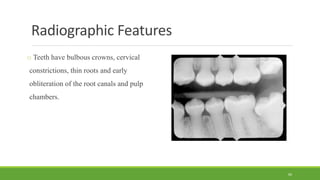
Radiographic Features
o Teeth have bulbous crowns, cervical
constrictions, thin roots and early
obliteration of the root canals and pulp
chambers.
60
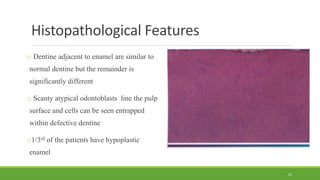
Histopathological Features
o Dentine adjacent to enamel are similar to
normal dentine but the remainder is
significantly different
o Scanty atypical odontoblasts line the pulp
surface and cells can be seen entrapped
within defective dentine
o1/3rd of the patients have hypoplastic
enamel
61
Treatment
o Teeth are not good candidates for crown placement because of cervical fractures
o Overly dentures placed on teeth with fluoride releasing material is being practiced in
some cases
o In cases with lose of vertical dimension, metal crowns are used with adhesive bonding
agents
o On occlusal surfaces composites are being used
62

Abnormalities of teeth

  • 1.
    Abnormalities of Teeth Dr.Arsalan Malik Assistant Professor & HOD (Oral Pathology) ِ‫يم‬ ِ‫ح‬َّ‫الر‬ ِ‫من‬ْ‫ح‬َّ‫الر‬ ِ‫هللا‬ ِ‫م‬ْ‫س‬ِ‫ب‬ 1
  • 2.
    Environmental Alterations ofTeeth  Developmental tooth defects  Post developmental structural tooth loss  Discoloration of teeth  Localized disturbances in eruption 2
  • 3.
    Factors Associated withEnamel Defects Systemic ◦ Birth related trauma ◦ Chromosomal abnormalities ◦ Chemicals ◦ Infections ◦ Inherited diseases ◦ Malnutrition ◦ Metabolic disorders ◦ Neurological disorders Local ◦ Acute mechanical trauma ◦ Local infection ◦ Electrical ◦ Irradiation 3
  • 4.
    Enamel Defects  MatrixFormation  Mineralization  Maturation 4
  • 5.
    Enamel Defects Enamel Hypoplasia Occursin form of pits, grooves or larger areas of missing enamel Diffuse Opacities Variation in the translucency of enamel. Normal thickness with white opacities and no boundary Demarcated Opacities Variation in the translucency of enamel. Normal thickness with white opacities and clear boundary 5
  • 6.
    Turner’s Hypoplasia It iscaused by periapical inflammatory disease of the overlying deciduous tooth. Most commonly noted in permanent bicuspids due to overlying deciduous molars 6
  • 7.
    Turner’s Hypoplasia Degree ofdamage depends upon stage of development, length of time of infection, virulence of organism and the host resistance factors If the primary tooth develops caries, the successor is twice likely to develop caries If the primary tooth is extracted for some reason other than trauma, prevalence of demarcated enamel is increased 5 folds. 7
  • 8.
    Molar Incisor Hypomineralization oEnamel defects of one or more first permanent molars o The altered enamel is white, yellow or brown and often soft and porous. o Affected teeth are sensitive to cold and warmth and enamel chip off easily o Difficult to anesthetize during dental procedures 8
  • 9.
    Dental Fluorosis  Theintegration of excess amount of fluoride can also result in enamel defects known as dental fluorosis  The integration of fluoride into the enamel reduces the incidence of caries  Pre-eruptive as well as post eruptive supply of fluoride is equally effective however the 2nd & 3rd decade is critical for application of fluoride 9
  • 10.
    Dental Fluorosis  Adefinitive diagnosis requires bilateral presence of defects, evidence of prior fluoride intake and elevated levels of fluoride in enamel  The antibiotic administration during development reduces the expression of enamel proteins genes 10
  • 11.
    Post Developmental LossOf Structure Attrition Abrasion Erosion Abfraction 11
  • 12.
    Attrition Loss of toothstructure caused by tooth to tooth contact during occlusion and mastication Main factors are ◦ Poor quality or absent enamel ◦ Premature contacts ◦ Intra oral abrasive, erosions and grinding habits 12
  • 13.
    Abrasion Pathological loss oftooth structure or restoration secondary to the mechanical action of an external agent Common causes are ◦ Hard tooth brush with abrasive tooth paste ◦ Chewing tobacco, biting nails or pencil When tooth wear is accelerated by chewing an abrasive substance, the process is termed as Demastication and it exhibits features of abrasion and attrition 13
  • 14.
    Erosion o Loss oftooth structure caused by non bacterial chemical process. The gradual destruction of surface by the chemical or electrolytic process o Erosion from dental exposure to gastric secretion is termed as Primolysis 14
  • 15.
    Abfraction o It appearsas wedge shaped defects limited to the cervical area of the teeth and may closely resemble cervical abrasion or erosion o Clues to the diagnosis are deep, narrow and v shaped defects that predominantly affects facial surfaces of bicuspids and molars 15
  • 16.
    Resorption  Destruction oftooth can also occur through resorption, which is accomplished by cells located in the pulp (Internal resorption) or in the periodontal ligament (External resorption)  Internal resorption is a relatively rare occurrence and mostly it develops after trauma to the pulpal tissues of the tooth  It continues as long as vital pulp tissue remains and may result in communication of pulp with the PDL. 16
  • 17.
    Factors Associated withExternal Resorption  Cysts  Dental trauma  Excessive mechanical forces  Excess occlusal forces  Hormonal imbalance  Peget’s disease of bone  Periodontal treatment  Tumours  Reimplantation of teeth 17
  • 18.
    Clinical Features  Inflammatoryresorption The resorbed dentin is replaced by inflamed granulation tissues. Most commonly cervical portion is involved and resorption continues as long  Replacement resorption Portion of the dentinal walls are resorbed and replaced with bone or cementum like material. Radiographically it appears as enlargement of the pulp canal and filled with a material that is less radiodense as compared to surrounding zone. After re-implantation of tooth, extensive resorption starts without rapid intervention 18
  • 19.
  • 20.
    Histopathological Features  Pulptissues are vascular and exhibit increased cellularity.  Numerous multinucleated dentinoclasts are present adjacent to the dentinal walls.  Inflammatory infiltrate is present  In replacement resorption, the normal pulp tissues are replaced by woven bone that is fused to adjacent dentine.  Areas of resorption are often repaired by deposition of osteodentine  Extensive bone deposition in external resorption may lead to ankylosis 20
  • 21.
    Teeth Discoloration (Staining) EXTRINSIC Bacterial stains  Iron  Tobacco  Food & beverages  Medications  Restorative materials  Gingival haemorrhage INTRINSIC  Amelogenisis imperfect  Dentinogenisis imperfect  Dental fluorosis  Trauma  Localised RBC breakdown  Medications 21
  • 22.
  • 23.
  • 24.
    Localized Disturbances inEruption  Impaction  Teeth that cease to erupt before emergence are called Impacted  Ankylosis  Eruption continues after emergence of teeth to compensate for masticatory wear and the growth of jaws. The cessation of eruption after emergence is termed Ankylosis 24
  • 25.
    Impaction In permanent dentition,the most frequently impacted tooth is mandibular 3rd molar followed by maxillary 3rd molar and cuspids Factors associated with impaction are  Overlying cysts or tumours  Trauma  Reconstructive surgery  Thickened overlying bone  Systemic disorders 25
  • 26.
    Ankylosis Associated factors  Disturbancesfrom changes in local metabolism  Trauma  Injury  Irritation  Local failure of bone growth  Abnormal pressure from the tongue 26
  • 27.
    Developmental Alterations ofTeeth  Number Hypodontia Hyperdontia  Size Microdontia Macrodontia  Shape Gemination Fusion Concresence Taurodontism Hypercementosis Dilaceration Dens invaginatus Dens Evaginatus  Structure Amelogenisis Imperfecta Dentinogenisis Imperfecta Dentin Dysplasia type I Dentin Dysplasia type II Regional Odontodysplasia 27
  • 28.
    Hypodontia  Lack ofdevelopment of one or more teeth is referred as Hypodontia  Total lack of tooth development is called Anodontia  Lack of development of 6 or more teeth is called Oligodontia 28
  • 29.
    Hyperdontia  Development ofincreased number of teeth is referred as Hyperdontia The additional teeth are referred to as Supernumerary teeth. The Supernumerary teeth in the midline is called Mesiodense 29
  • 30.
    Supernumerary Teeth Supplemental Teeth Normalsize & shape Rudimentary Teeth Abnormal Size & Shape 30
  • 31.
    Supernumerary Teeth Natal Teeth Teethpresent in newborns Neonatal Teeth Teeth erupt within 30 days of life 31
  • 32.
    Microdontia  When theteeth are physically smaller than normal then it is termed as Microdontia  Normal size teeth may appear smaller when they are widely spaced within large size jaws. This is termed as Relative Microdontia but it is actually macrognathia  Maxillary lateral incisors are most commonly effected and appear as peg shaped crown. 32
  • 33.
    Macrodontia  When theteeth are physically larger than normal then it is termed as Macrodontia  Normal size teeth may appear larger when they are crowded within small size jaws. This is termed as Relative Macrodontia but it is actually micrognathia  Diffuse macrodontia has been observed in pituitary gigantism and otodental syndrome 33
  • 34.
    Gemination  It isdefined as an attempt of a single tooth bud to divide with the resultant formation of a tooth with bifid crown and usually a common root and root canal.  The tooth count remains normal when the anomalous tooth is considered as one. 34
  • 35.
    Fusion It is consideredto be the union of two normally separated teeth buds with the resultant formation of a joined tooth with confluence of dentin. In this condition the tooth count shows one missing tooth when the tooth count is considered as one. 35
  • 36.
    Concrescence It is describedas two fully formed teeth joined along the root surfaces by cementum. More commonly present in posterior & maxillary teeth. The development pattern often involves second molar tooth where roots are in close proximity to 3rd molar tooth. 36
  • 37.
    Dens Evaginatus  Itis a cusp like elevation of enamel located in the central groove or lingual ridge of the buccal cusp of premolar or molar tooth.  The accessory cusp usually consist of enamel & dentine with pulp present in half of the cases  The accessory cusp creates occlusal interference that are associated with clinical problems.  Pulp necrosis is common and may occur through a direct exposure or invasion of patent, immature dentinal tubules. 37
  • 38.
  • 39.
    Dens Invaginatus Deep surfaceinvagination of the crown or root that is lined by enamel. The depth of invagination varies from a slight enlargement of the cingulum pit to a deep infolding that extends to apex. Occasionally the invagination may be large and resemble a tooth within tooth appearance called den in dente. 39
  • 40.
  • 41.
    Taurodontism  Enlargement ofthe body & pulp chamber of a multirooted tooth with apical displacement of the pulpal floor & bifurcation of the root.  It may be unilateral or bilateral affecting permanent dentition. Classified into mild, moderate and sever forms 41
  • 42.
    Hypercementosis Non neoplastic depositionof excessive cementum that is continuous with the normal radicular cementum. Radiographically affected tooth show thinking or blunting of root but the exact amount of extra cementum is difficult to estimate 42
  • 43.
    Associated Factors Local  Abnormalocclusal trauma  Adjacent inflammation  Repair of vital root fracture  Unopposed teeth Systemic  Acromegaly  Arthritis  Calcinosis  Thyroid goiter  Gardner Syndrome  Vitamin A deficiency 43
  • 44.
    Dilaceration  Abnormal angulationor bend in the root or less frequently in the crown  A number of teeth having dilacerations arises after injury that displaces the calcified portion of the tooth germ and remainder of the tooth is formed at an abnormal angle 44
  • 45.
    Supernumerary Roots It refersto the development of an increased number of roots on a tooth compared with that classically described in dental anatomy. Most commonly affected teeth are permanent molars from either arch and mandibular cuspids and premolars 45
  • 46.
    Amelogenisis Imperfecta  Acomplicated group of conditions that demonstrate developmental alterations in the structure of enamel in the absence of any systemic disease.  Different classification systems were proposed but Witkop’s Classification is widely accepted.  It is based on phenotype and pedigree (clinical appearance & apparent mode of inheritance) 46
  • 47.
    Amelogenisis Imperfecta  Formationof enamel is a multistep process and problem may arise in any of these them. 1) Elaboration of the organic matrix 2) Mineralization of the matrix 3) Maturation of the enamel. 47
  • 48.
    Hypoplastic Amelogenisis Imperfecta oThe basic alteration centres on inadequate deposition of enamel matrix. o The matrix present is well mineralized and Radiographically contrasts well with the underlying dentine o In generalized pattern pinpoint to pin head pits are scattered on the surface. o Staining of the pits may occur. 48
  • 49.
    Hypoplastic Amelogenisis Imperfecta oIn localized pattern, the affected teeth demonstrate horizontal rows of pits, linear depression or one large area of hypocalcification. o In other patterns of this disorder, enamel may appear smooth, thin, hard and glossy. o Radiographically demonstrate a thin radio-opaque line of enamel. 49
  • 50.
    Hypomaturation Amelogenisis Imperfecta •Enamel matrix is laid down properly and begin to mineralize but there is defect in maturation of enamel crystal structure • Affected teeth are normal in shape but show mottled appearance and tend to chip easily • Radiographically its density is similar to dentine 50
  • 51.
  • 52.
    Hypocalcified Amelogenisis Imperfecta oEnamel matrix is laid down properly but failed to mineralize properly o Affected teeth are proper in shape but very soft & easily lost o It has more tendency of calculus deposition on it o Radiographically the density of enamel & dentine is similar o After some duration time of eruption, cuspal enamel is lost leaving occlusal surfaces irregular 52
  • 53.
  • 54.
    Histopathological Features These arenot evident in routine preparations because decalcification of the teeth is necessary before processing and all the enamel is lost in it Ground sections of Non decalcified teeth are prepared for examination The alterations are highly diverse and depend upon the type of variation in enamel structure 54
  • 55.
    Treatment o Main problemsare aesthetics, dental sensitivity and loss of vertical dimension o In some types, increased prevalence of caries, anterior open bite, delayed eruption and associated gingival enlargement are observed o Crown placement o Full dentures o Veneers oGlass Ionomer Cements restorations 55
  • 56.
    Dentinogenesis Imperfecta o Itis a hereditary developmental disorder of the dentine in the absence of any systemic disease. o It is associated with mutation in DSPP gene. Shields Clinical Presentation Dentinogenesis Imperfecta I Osteogenesis imperfect with opalescent dentine Dentinogenesis Imperfecta II Isolated opalescent teeth Dentinogenesis Imperfecta III Isolated opalescent teeth 56
  • 57.
  • 58.
    Clinical Features o Allteeth in both dentitions are affected o The severity of problem depends upon the age at which teeth developed o Deciduous teeth are affected more intensely followed by permanent incisors and 1st molars 58
  • 59.
    Clinical Features o Blueto brown discoloration often with distinctive translucence o Enamel easily gets separated form underlying dentine leading to rapid attrition oUsually the pulp is obliterated by excessive dentine formation but sometimes shell teeth are observed having small dentine and large pulp chambers. 59
  • 60.
    Radiographic Features o Teethhave bulbous crowns, cervical constrictions, thin roots and early obliteration of the root canals and pulp chambers. 60
  • 61.
    Histopathological Features o Dentineadjacent to enamel are similar to normal dentine but the remainder is significantly different o Scanty atypical odontoblasts line the pulp surface and cells can be seen entrapped within defective dentine o1/3rd of the patients have hypoplastic enamel 61
  • 62.
    Treatment o Teeth arenot good candidates for crown placement because of cervical fractures o Overly dentures placed on teeth with fluoride releasing material is being practiced in some cases o In cases with lose of vertical dimension, metal crowns are used with adhesive bonding agents o On occlusal surfaces composites are being used 62