Precancerous Lesions &
Conditions
Arsalan Wahid Malik
PRECANCEROUS LESION
• It’s a morphologically altered tissue in which cancer is
more likely to occur than in its apparently normal
counterpart
• E.g. erythroplakia
PRECANCEROUS CONDITIONS
• Its a generalized state associated with a significantly
increased risk of cancer developing.
• E.g. betel quid chewing
PRECANCEROUS LESIONS
• Leukoplakia
• Erythroplakia
• Speckled Leukoplakia
• Candidal Leukoplakia
LEUKOPLAKIA
• A predominantly white
lesion of the oral mucosa
that cannot be
characterized as any
other definable lesion.
ETIOLOGICAL FACTORS
• Idiopathic leukoplakia
• No evident etiological factor recognized
• Non- idiopathic leukoplakia
• Evident predisposing factors recognized
• Tobacco
• Infections
• Candida
• EBV
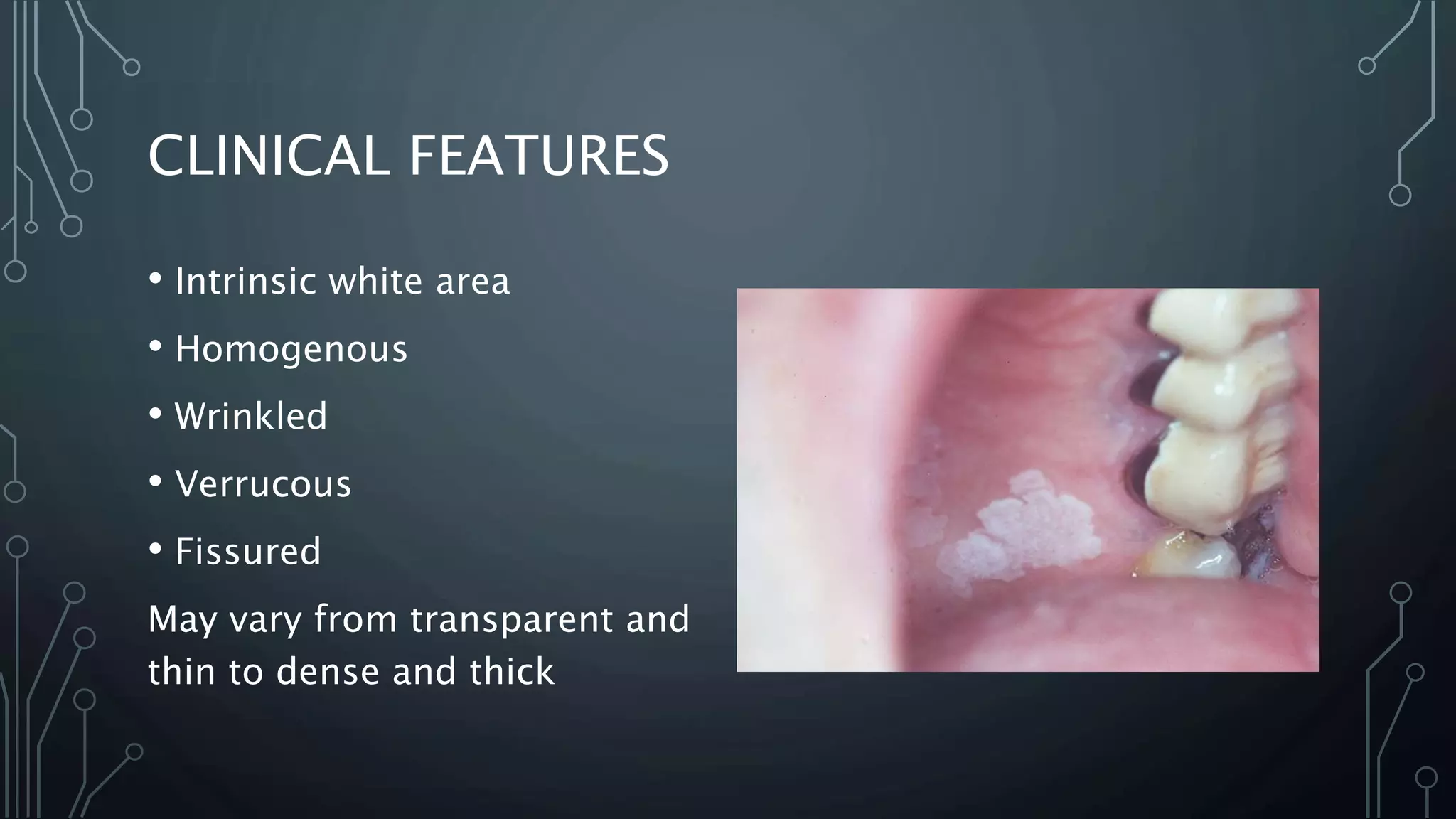
CLINICAL FEATURES
• Intrinsic white area
• Homogenous
• Wrinkled
• Verrucous
• Fissured
May vary from transparent and
thin to dense and thick
HISTOLOGICAL FEATURES
• Hyperkeratosis with or
without epithelial dysplasia
• Squamous cell carcinoma
• Dysplasia can be categorized
as mild, moderate and severe
ERYTHROPLAKIA
• It is relatively uncommon and
appears as a bright red patch
that is well defined from the
surrounding mucosa and has
a velvet-like surface texture
ERYTHROPLAKIA
• High incidence of cellular
atypia
• Atrophy of the epithelium
• Candida as primary or
secondary infection
• Biopsy is mandatory
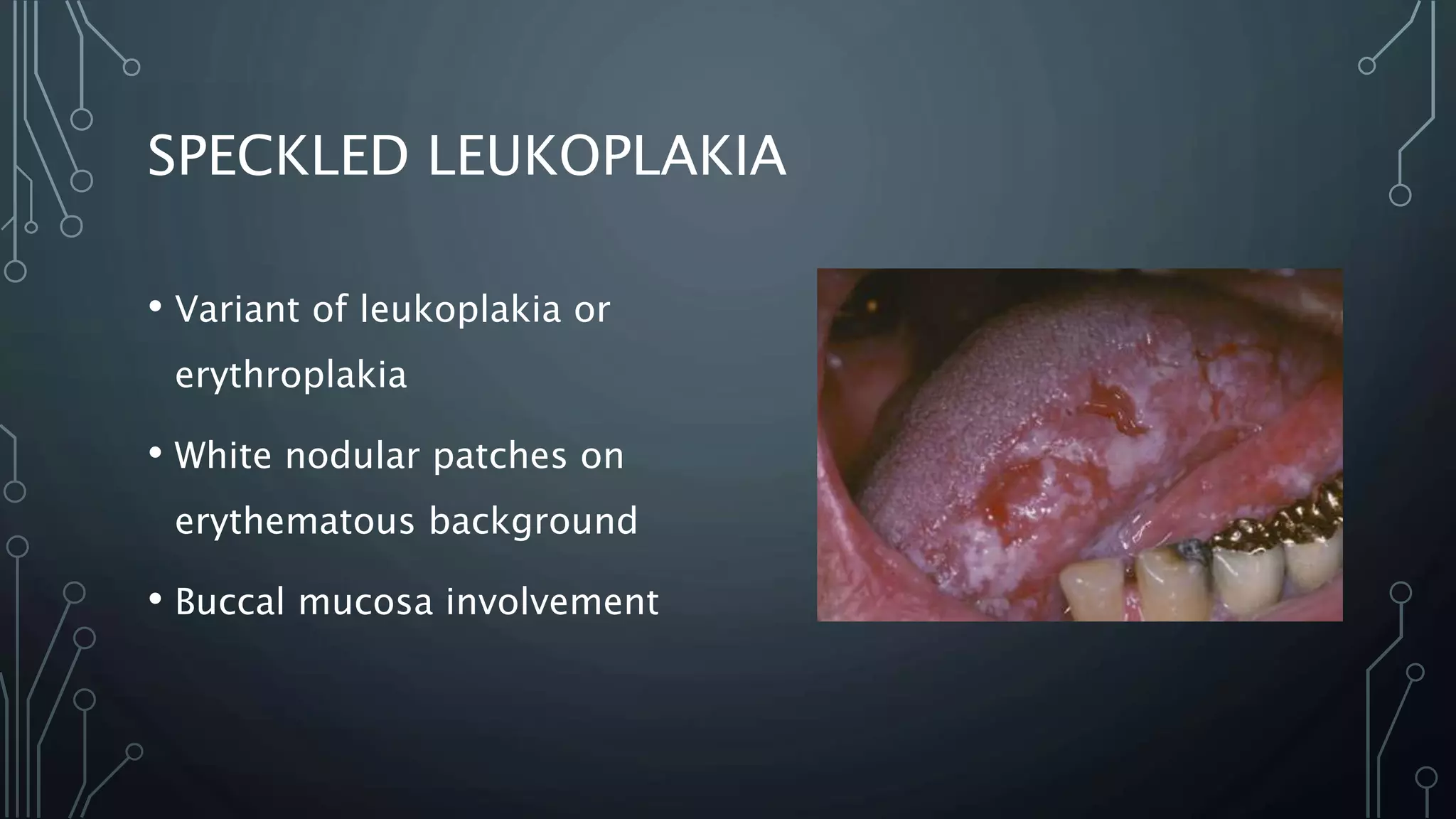
SPECKLED LEUKOPLAKIA
• Variant of leukoplakia or
erythroplakia
• White nodular patches on
erythematous background
• Buccal mucosa involvement
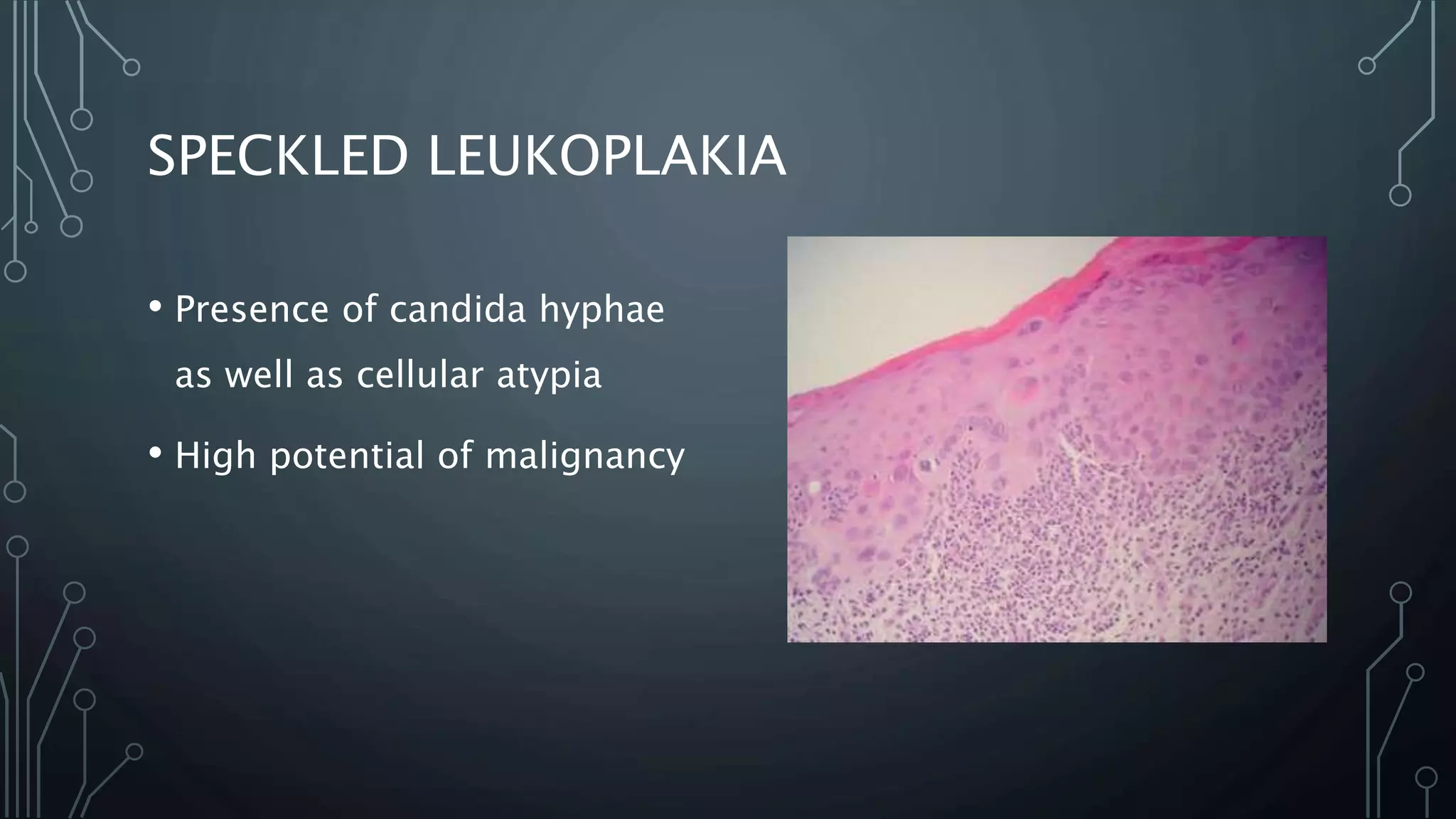
SPECKLED LEUKOPLAKIA
• Presence of candida hyphae
as well as cellular atypia
• High potential of malignancy
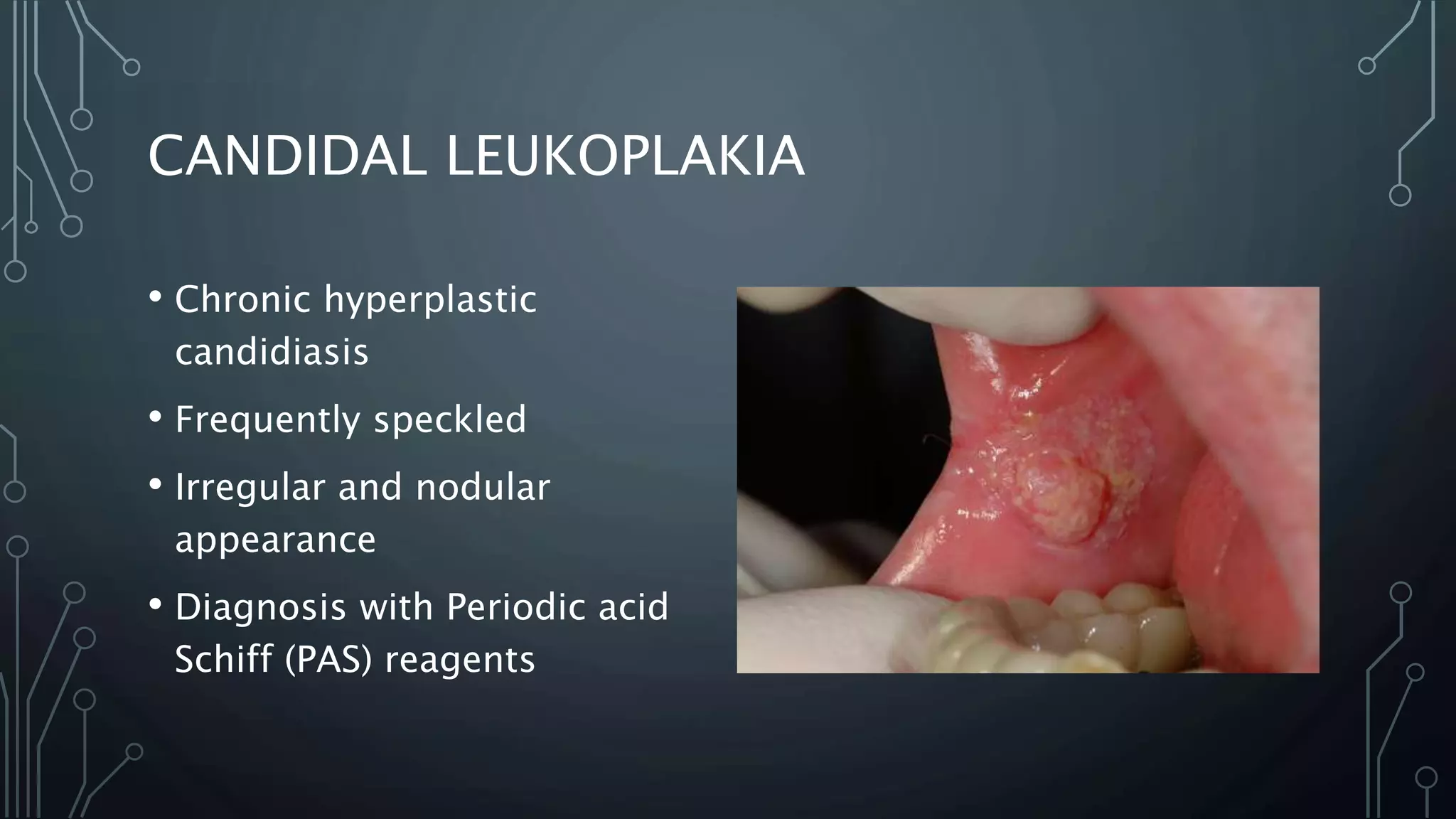
CANDIDAL LEUKOPLAKIA
• Chronic hyperplastic
candidiasis
• Frequently speckled
• Irregular and nodular
appearance
• Diagnosis with Periodic acid
Schiff (PAS) reagents
MALIGNANT TRANSFORMATION
• 4 - 8 % in oral leukoplakias will have malignant transformation
• 15 % will regress spontaneously
• Sublingual leukoplakias have 40 % transformation potential
• Erythroplakia have greatest tendency of malignant
transformation (80 %)
MANAGEMENT
• Proper defining the area
• Cryosurgery
• CO2 laser
• Systemic antifungals
PRECANCEROUS CONDITIONS
• Most Common Conditions
• Oral Sub mucous Fibrosis (OSF)
• Sidropenic Dysphagia
• Lichen Planus
• Less Common Conditions
• Discoid lupus erythematosus
• Tertiary Syphilis
ORAL SUBMUCOUS FIBROSIS
• Oral submucous fibrosis
(OSF) is a condition in
which fibrous tissue is
laid down in the corium
of the oral mucosa
ORAL SUBMUCOUS FIBROSIS
• Small vesicle > ulcers>
epithelial atrophy
• Stiffening of oral mucosa
• Difficulty opening the
mouth
• Marbled mucosal
ORAL SUBMUCOUS FIBROSIS
• Induced by chewing areca nut
• particularly common in Asian communities.
• Probably a genetic predisposition for OSF
• Have an increased risk of developing oral carcinoma
• There does not seem to be any satisfactory treatment for OSF
although intralesional steroids have been used.
• Primary prevention by reducing the use of areca nut products
would appear to be the best way forward to reduce the
incidence of OSF.
SIDEROPENIC DYSPHAGIA
• Also called Paterson Kelley syndrome
• Affects middle aged females having
iron deficiency
• Mucosa appear shiny red and atrophic
• Oral leukoplakia and oral carcinoma
can develop
LICHEN PLANUS
• Erosive type has most common premalignant potential
ORAL CARCINOMA AND CARCINOGENESIS
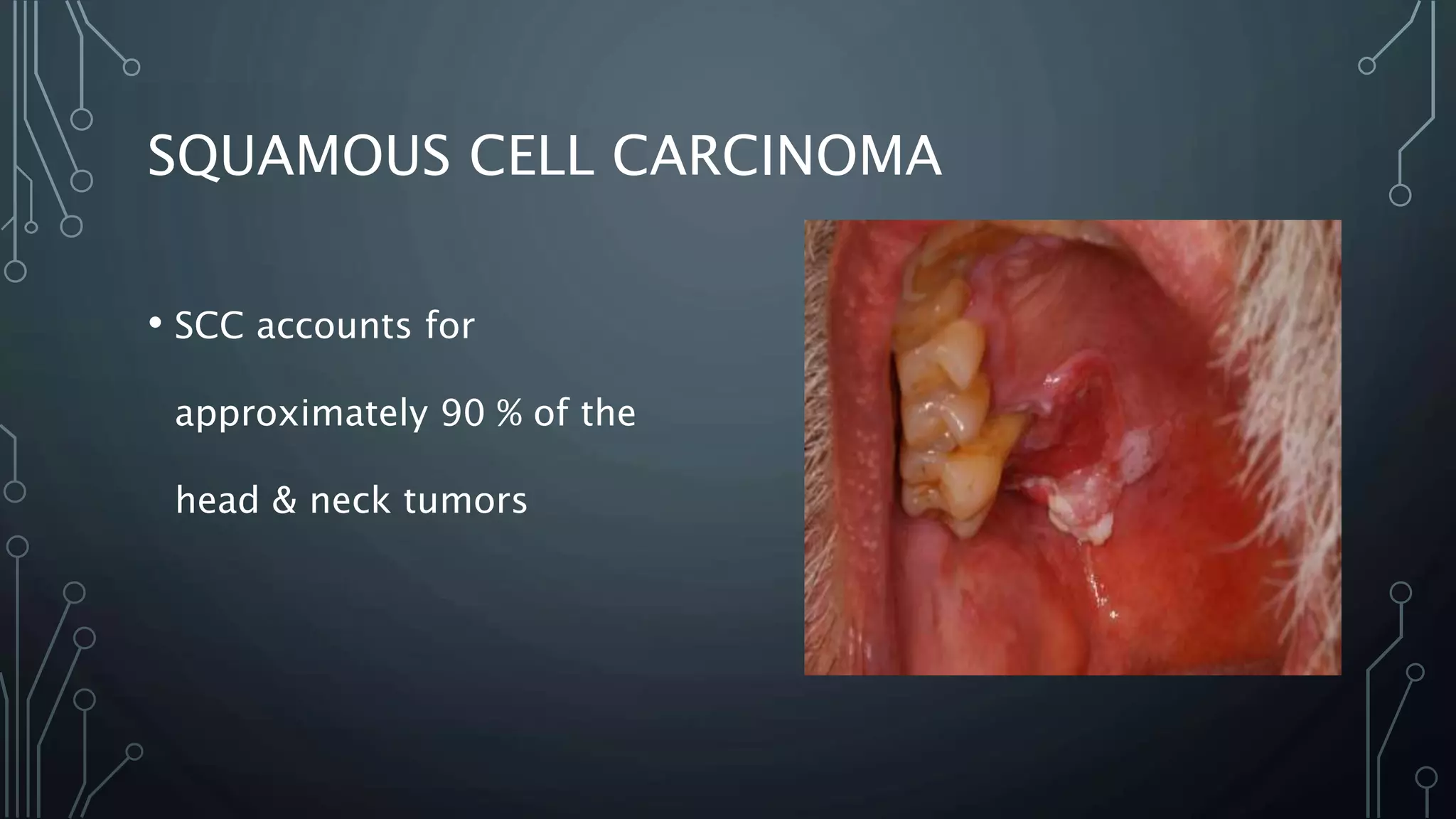
SQUAMOUS CELL CARCINOMA
• SCC accounts for
approximately 90 % of the
head & neck tumors
ETIOLOGICAL FACTORS
• Tobacco use
• Alcohol consumption
• Sunlight
• Diet and nutritional status
• Chronic candida infections
• Viral infections
• Immunodeficiency
TOBACCO USE
•Smokable
• Associated more commonly with lung carcinoma
•Chewable
• Associated more commonly with oral cancer
TOBACCO USE
• Nicotine, ethanol and caffeine (frequently used)
• Betel quid
• Areca nut
• Betel leaf
• Lime
• Tobacco
• Catechu
ALCOHOL CONSUMPTION
• Independent risk factor for oral carcinoma
• Combined effect of alcohol and tobacco is greater
than individual effect of both
DIET & NUTRITIONAL STATUS
• Deficiency of vitamin A, E and C
• Lack of dietary iron
• Increased intake of red meat
CLINICAL FEATURES
•Persistent ulceration
•Induration
•Proliferative growth
•Sudden loosening of
teeth
•Lymph node
involvement
MANAGEMENT OF ORAL CA
• Surgery
• Chemotherapy
• Combination of both
• Depends on
• Patient preference
• Biological age
• General health
• Site & staging of cancer
RADIATION MUCOSITIS
• Progressive and generalized erythematous appearance
• Ulceration of oral mucosa
• Extreme pain
• Xerostomia
• Atrophic oral epithelium
MANAGEMENT
•Acute phase
• Simple non astringent mouthwash
• Anti inflammatory and antimicrobial mouthwash
• miconazol
•Log term therapy
• Artificial salivas
• Benzydamin hydrochloride mouthwash
• Fluoride Application
OSTEORADIONECROSIS
• Painful necrosis with sloughing of the
overlying bone
• Vascularity of bone compromised
• Non vital bone
ORAL COMPLICATIONS OF RADIOTHERAPY
• Early onset
• Mucositis
• Altered taste
• Xerostomia
• Secondary infections
• Demineralization of teeth
• Hypersensitivity
• Late onset
• Radiation caries
• Osteoradionecrosis
• Trismus
PREVENTION & MANAGEMENT
(RADIATION MUCOSITIS)
• Maintenance of oral hygiene
• Selective decontamination
• Mouthwashes
• Miconazol gel
• Topical steroids
PREVENTION & MANAGEMENT
(OSTEORADIONECROSIS)
• Avoid trauma to the oral mucosa
• Arrange extractions before radiotherapy
• Conserve teeth if possible
• Extractions must be under antibiotic cover
• Rinse with chlorhexidine 0.2 %
• Consider the use of hyperbaric oxygen
PREVENTION OF ORAL CARCINOMA
•Primary
•Advice on stop smoking and chewing
tobacco
•Advise moderation of alcohol intake
•Dietary advice
PREVENTION OF ORAL CARCINOMA
•Secondary
• Screen entire oral mucosa
• Recognize abnormalities
• Identify candida infection
• Refer any suspicious lesion to hospital
PREVENTION OF ORAL CARCINOMA
•Tertiary
• Importance of routine intra oral & extra oral
examination
• Regular review
• Dietary advice
• Low threshold for referral
• Chemoprevention

Precancerous lesions & conditions

  • 1.
  • 2.
    PRECANCEROUS LESION • It’sa morphologically altered tissue in which cancer is more likely to occur than in its apparently normal counterpart • E.g. erythroplakia
  • 3.
    PRECANCEROUS CONDITIONS • Itsa generalized state associated with a significantly increased risk of cancer developing. • E.g. betel quid chewing
  • 4.
    PRECANCEROUS LESIONS • Leukoplakia •Erythroplakia • Speckled Leukoplakia • Candidal Leukoplakia
  • 5.
    LEUKOPLAKIA • A predominantlywhite lesion of the oral mucosa that cannot be characterized as any other definable lesion.
  • 6.
    ETIOLOGICAL FACTORS • Idiopathicleukoplakia • No evident etiological factor recognized • Non- idiopathic leukoplakia • Evident predisposing factors recognized • Tobacco • Infections • Candida • EBV
  • 7.
    CLINICAL FEATURES • Intrinsicwhite area • Homogenous • Wrinkled • Verrucous • Fissured May vary from transparent and thin to dense and thick
  • 8.
    HISTOLOGICAL FEATURES • Hyperkeratosiswith or without epithelial dysplasia • Squamous cell carcinoma • Dysplasia can be categorized as mild, moderate and severe
  • 9.
    ERYTHROPLAKIA • It isrelatively uncommon and appears as a bright red patch that is well defined from the surrounding mucosa and has a velvet-like surface texture
  • 10.
    ERYTHROPLAKIA • High incidenceof cellular atypia • Atrophy of the epithelium • Candida as primary or secondary infection • Biopsy is mandatory
  • 11.
    SPECKLED LEUKOPLAKIA • Variantof leukoplakia or erythroplakia • White nodular patches on erythematous background • Buccal mucosa involvement
  • 12.
    SPECKLED LEUKOPLAKIA • Presenceof candida hyphae as well as cellular atypia • High potential of malignancy
  • 13.
    CANDIDAL LEUKOPLAKIA • Chronichyperplastic candidiasis • Frequently speckled • Irregular and nodular appearance • Diagnosis with Periodic acid Schiff (PAS) reagents
  • 14.
    MALIGNANT TRANSFORMATION • 4- 8 % in oral leukoplakias will have malignant transformation • 15 % will regress spontaneously • Sublingual leukoplakias have 40 % transformation potential • Erythroplakia have greatest tendency of malignant transformation (80 %)
  • 15.
    MANAGEMENT • Proper definingthe area • Cryosurgery • CO2 laser • Systemic antifungals
  • 16.
    PRECANCEROUS CONDITIONS • MostCommon Conditions • Oral Sub mucous Fibrosis (OSF) • Sidropenic Dysphagia • Lichen Planus • Less Common Conditions • Discoid lupus erythematosus • Tertiary Syphilis
  • 17.
    ORAL SUBMUCOUS FIBROSIS •Oral submucous fibrosis (OSF) is a condition in which fibrous tissue is laid down in the corium of the oral mucosa
  • 18.
    ORAL SUBMUCOUS FIBROSIS •Small vesicle > ulcers> epithelial atrophy • Stiffening of oral mucosa • Difficulty opening the mouth • Marbled mucosal
  • 19.
    ORAL SUBMUCOUS FIBROSIS •Induced by chewing areca nut • particularly common in Asian communities. • Probably a genetic predisposition for OSF • Have an increased risk of developing oral carcinoma • There does not seem to be any satisfactory treatment for OSF although intralesional steroids have been used. • Primary prevention by reducing the use of areca nut products would appear to be the best way forward to reduce the incidence of OSF.
  • 20.
    SIDEROPENIC DYSPHAGIA • Alsocalled Paterson Kelley syndrome • Affects middle aged females having iron deficiency • Mucosa appear shiny red and atrophic • Oral leukoplakia and oral carcinoma can develop
  • 21.
    LICHEN PLANUS • Erosivetype has most common premalignant potential
  • 22.
    ORAL CARCINOMA ANDCARCINOGENESIS
  • 23.
    SQUAMOUS CELL CARCINOMA •SCC accounts for approximately 90 % of the head & neck tumors
  • 24.
    ETIOLOGICAL FACTORS • Tobaccouse • Alcohol consumption • Sunlight • Diet and nutritional status • Chronic candida infections • Viral infections • Immunodeficiency
  • 25.
    TOBACCO USE •Smokable • Associatedmore commonly with lung carcinoma •Chewable • Associated more commonly with oral cancer
  • 26.
    TOBACCO USE • Nicotine,ethanol and caffeine (frequently used) • Betel quid • Areca nut • Betel leaf • Lime • Tobacco • Catechu
  • 27.
    ALCOHOL CONSUMPTION • Independentrisk factor for oral carcinoma • Combined effect of alcohol and tobacco is greater than individual effect of both
  • 28.
    DIET & NUTRITIONALSTATUS • Deficiency of vitamin A, E and C • Lack of dietary iron • Increased intake of red meat
  • 29.
    CLINICAL FEATURES •Persistent ulceration •Induration •Proliferativegrowth •Sudden loosening of teeth •Lymph node involvement
  • 30.
    MANAGEMENT OF ORALCA • Surgery • Chemotherapy • Combination of both • Depends on • Patient preference • Biological age • General health • Site & staging of cancer
  • 31.
    RADIATION MUCOSITIS • Progressiveand generalized erythematous appearance • Ulceration of oral mucosa • Extreme pain • Xerostomia • Atrophic oral epithelium
  • 32.
    MANAGEMENT •Acute phase • Simplenon astringent mouthwash • Anti inflammatory and antimicrobial mouthwash • miconazol •Log term therapy • Artificial salivas • Benzydamin hydrochloride mouthwash • Fluoride Application
  • 33.
    OSTEORADIONECROSIS • Painful necrosiswith sloughing of the overlying bone • Vascularity of bone compromised • Non vital bone
  • 34.
    ORAL COMPLICATIONS OFRADIOTHERAPY • Early onset • Mucositis • Altered taste • Xerostomia • Secondary infections • Demineralization of teeth • Hypersensitivity • Late onset • Radiation caries • Osteoradionecrosis • Trismus
  • 35.
    PREVENTION & MANAGEMENT (RADIATIONMUCOSITIS) • Maintenance of oral hygiene • Selective decontamination • Mouthwashes • Miconazol gel • Topical steroids
  • 36.
    PREVENTION & MANAGEMENT (OSTEORADIONECROSIS) •Avoid trauma to the oral mucosa • Arrange extractions before radiotherapy • Conserve teeth if possible • Extractions must be under antibiotic cover • Rinse with chlorhexidine 0.2 % • Consider the use of hyperbaric oxygen
  • 37.
    PREVENTION OF ORALCARCINOMA •Primary •Advice on stop smoking and chewing tobacco •Advise moderation of alcohol intake •Dietary advice
  • 38.
    PREVENTION OF ORALCARCINOMA •Secondary • Screen entire oral mucosa • Recognize abnormalities • Identify candida infection • Refer any suspicious lesion to hospital
  • 39.
    PREVENTION OF ORALCARCINOMA •Tertiary • Importance of routine intra oral & extra oral examination • Regular review • Dietary advice • Low threshold for referral • Chemoprevention