Frog Dissection
Biology Do NowGet Your Lab notebooksTitle the Lab FROG DISSECTIONLeave space for Purpose sectionLabel Background SectionCopy the following terms into the background section of your lab notebook:Glossary of TermsDorsal: toward the backVentral: toward the bellyLateral: toward the sidesMedian: near the middleAnterior: toward the headPosterior: toward the hind end (tail)Superficial: on or near the surfaceDeep: some distance below the surfaceSagittal: relating to the midplane with bisects the left and right sidesTransverse: relating to the plane separating anterior and posteriorHorizontal: relating to the plane separating dorsal and ventralProximal: near to the point of referenceDistal: far from the point of referencePectoral: relating to the chest and shoulder regionPelvic: relating to the hip regionDermal - relating to the skinLongitudinal - lengthwise
	• Describe the appearance of various organs found in the frog.• Name locate and identify the organs that make up various systems of the frog.• Compare and contrast frog anatomy to our past dissections.• Contrast and compare various frog's organs to human.Objective
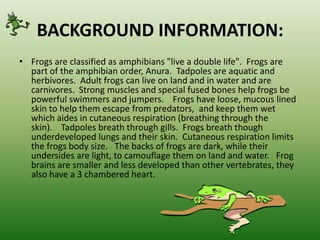
Materials:Safety goggles, dissecting pins, gloves, forceps, scissors, paper towel,  dissecting probe, preserved frog, dissection tray.Purpose:In this lab, you will dissect an frog in order to observe the external and internal structures of frog anatomy
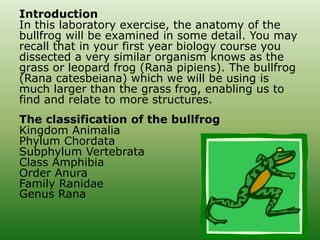
BACKGROUND INFORMATION:Frogs are classified as amphibians "live a double life".  Frogs are part of the amphibian order, Anura.  Tadpoles are aquatic and herbivores.  Adult frogs can live on land and in water and are carnivores.  Strong muscles and special fused bones help frogs be powerful swimmers and jumpers.    Frogs have loose, mucous lined skin to help them escape from predators,  and keep them wet which aides in cutaneous respiration (breathing through the skin).    Tadpoles breath through gills.  Frogs breath though underdeveloped lungs and their skin.  Cutaneous respiration limits the frogs body size.   The backs of frogs are dark, while their undersides are light, to camouflage them on land and water.   Frog brains are smaller and less developed than other vertebrates, they also have a 3 chambered heart. 
IntroductionIn this laboratory exercise, the anatomy of the bullfrog will be examined in some detail. You may recall that in your first year biology course you dissected a very similar organism knows as the grass or leopard frog (Ranapipiens). The bullfrog (Ranacatesbeiana) which we will be using is much larger than the grass frog, enabling us to find and relate to more structures.The classification of the bullfrogKingdom AnimaliaPhylum ChordataSubphylum VertebrataClass AmphibiaOrder AnuraFamily RanidaeGenus Rana
The frog is a vertebrate, which means that many aspects of its structural organization are common with all other vertebrates, including man. The similarity of structures among related organisms shows evidence of common ancestry. In a way, studying the frog is like studying a human. As the leading theme of this lab, ask yourself: for every structure observed in the frog, there is an equivalent structure in your own body - what is the structure and where is it located.As the second leading theme, pay particular attention to the relationships among organs and groups of organs. Structural parts are not "just there" in random locations. Their specific layout within the body contributes to making certain functions possible.Therefore, for every structure seen, you should determine the following:What organ system it belongs to
How it is connected with other components
Its general function
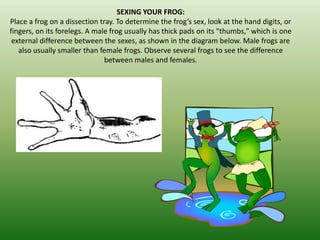
Its specific function (if applicable)SEXING YOUR FROG:Place a frog on a dissection tray. To determine the frog’s sex, look at the hand digits, or fingers, on its forelegs. A male frog usually has thick pads on its "thumbs," which is one external difference between the sexes, as shown in the diagram below. Male frogs are also usually smaller than female frogs. Observe several frogs to see the difference between males and females.   SEXING YOUR FROG:Place a frog on a dissection tray. To determine the frog’s sex, look at the hand digits, or fingers, on its forelegs. A male frog usually has thick pads on its "thumbs," which is one external difference between the sexes, as shown in the diagram below. Male frogs are also usually smaller than female frogs. Observe several frogs to see the difference between males and females.
Group Roles4 people per groupDissector 1glovesDissector 2/Lab material personglovesObserver/recorder 1 Read instructions out loud to groupObserver/recorder 2Record observations (those dissecting can copy later)
Pre-Lab ProceduresTurn in a sheet of paper to teacher with group members names and group roles of each personCollect hand out from teacherEVERYONE in group needs to copy materials and procedures into lab notebooksGet two pairs of glovers per group (for the 2 dissectors)All hair must be tied back, all loose clothing as wellAbsolutely no cell phones permitted in lab
You are expected to have exhausted all possibilities in attempting to located structures BEFORE asking for assistance.

Frog dissection powerpoint

  • 1.
  • 2.
    Biology Do NowGetYour Lab notebooksTitle the Lab FROG DISSECTIONLeave space for Purpose sectionLabel Background SectionCopy the following terms into the background section of your lab notebook:Glossary of TermsDorsal: toward the backVentral: toward the bellyLateral: toward the sidesMedian: near the middleAnterior: toward the headPosterior: toward the hind end (tail)Superficial: on or near the surfaceDeep: some distance below the surfaceSagittal: relating to the midplane with bisects the left and right sidesTransverse: relating to the plane separating anterior and posteriorHorizontal: relating to the plane separating dorsal and ventralProximal: near to the point of referenceDistal: far from the point of referencePectoral: relating to the chest and shoulder regionPelvic: relating to the hip regionDermal - relating to the skinLongitudinal - lengthwise
  • 3.
    • Describe theappearance of various organs found in the frog.• Name locate and identify the organs that make up various systems of the frog.• Compare and contrast frog anatomy to our past dissections.• Contrast and compare various frog's organs to human.Objective
  • 4.
    Materials:Safety goggles, dissectingpins, gloves, forceps, scissors, paper towel,  dissecting probe, preserved frog, dissection tray.Purpose:In this lab, you will dissect an frog in order to observe the external and internal structures of frog anatomy
  • 5.
    BACKGROUND INFORMATION:Frogs areclassified as amphibians "live a double life".  Frogs are part of the amphibian order, Anura.  Tadpoles are aquatic and herbivores.  Adult frogs can live on land and in water and are carnivores.  Strong muscles and special fused bones help frogs be powerful swimmers and jumpers.    Frogs have loose, mucous lined skin to help them escape from predators,  and keep them wet which aides in cutaneous respiration (breathing through the skin).    Tadpoles breath through gills.  Frogs breath though underdeveloped lungs and their skin.  Cutaneous respiration limits the frogs body size.   The backs of frogs are dark, while their undersides are light, to camouflage them on land and water.   Frog brains are smaller and less developed than other vertebrates, they also have a 3 chambered heart. 
  • 6.
    IntroductionIn this laboratoryexercise, the anatomy of the bullfrog will be examined in some detail. You may recall that in your first year biology course you dissected a very similar organism knows as the grass or leopard frog (Ranapipiens). The bullfrog (Ranacatesbeiana) which we will be using is much larger than the grass frog, enabling us to find and relate to more structures.The classification of the bullfrogKingdom AnimaliaPhylum ChordataSubphylum VertebrataClass AmphibiaOrder AnuraFamily RanidaeGenus Rana
  • 7.
    The frog isa vertebrate, which means that many aspects of its structural organization are common with all other vertebrates, including man. The similarity of structures among related organisms shows evidence of common ancestry. In a way, studying the frog is like studying a human. As the leading theme of this lab, ask yourself: for every structure observed in the frog, there is an equivalent structure in your own body - what is the structure and where is it located.As the second leading theme, pay particular attention to the relationships among organs and groups of organs. Structural parts are not "just there" in random locations. Their specific layout within the body contributes to making certain functions possible.Therefore, for every structure seen, you should determine the following:What organ system it belongs to
  • 8.
    How it isconnected with other components
  • 9.
  • 10.
    Its specific function(if applicable)SEXING YOUR FROG:Place a frog on a dissection tray. To determine the frog’s sex, look at the hand digits, or fingers, on its forelegs. A male frog usually has thick pads on its "thumbs," which is one external difference between the sexes, as shown in the diagram below. Male frogs are also usually smaller than female frogs. Observe several frogs to see the difference between males and females.  SEXING YOUR FROG:Place a frog on a dissection tray. To determine the frog’s sex, look at the hand digits, or fingers, on its forelegs. A male frog usually has thick pads on its "thumbs," which is one external difference between the sexes, as shown in the diagram below. Male frogs are also usually smaller than female frogs. Observe several frogs to see the difference between males and females.
  • 11.
    Group Roles4 peopleper groupDissector 1glovesDissector 2/Lab material personglovesObserver/recorder 1 Read instructions out loud to groupObserver/recorder 2Record observations (those dissecting can copy later)
  • 12.
    Pre-Lab ProceduresTurn ina sheet of paper to teacher with group members names and group roles of each personCollect hand out from teacherEVERYONE in group needs to copy materials and procedures into lab notebooksGet two pairs of glovers per group (for the 2 dissectors)All hair must be tied back, all loose clothing as wellAbsolutely no cell phones permitted in lab
  • 13.
    You are expectedto have exhausted all possibilities in attempting to located structures BEFORE asking for assistance.