INTRODUCTION
-Medicinal plants constitute an important component
of the plant resource spectrum of Kerala. It is
estimated that out of 4600 flowering plants ,about
900 possess medicinal values.
-About 60-65% of plants required for ayurvedic
medicines and almost 80% of plants used in Sidha
medicine are found in forest of kerala.
-The demand for Ayurvedic medicine in the state is
growing at a compound rate of 10-12% per annum.
-Govt of Kerala through Department of Agriculture is
supporting cultivation of medicinal plants.
YEAR AREA
2012-13 2,378 Ha
2011-12 2,006 Ha
KAU RELEASED VARIETIES
KAU has released 8 varieties:
1.KACHOLAM-Kasthuri & Rajani
2.ADAPATHIYAN-Jeeva
3.CHETHIKODUVELI-Agni & Mridula
4.ADALOTAKAM-Ajagandhi & Vasika
5.THIPALLI-Viswam
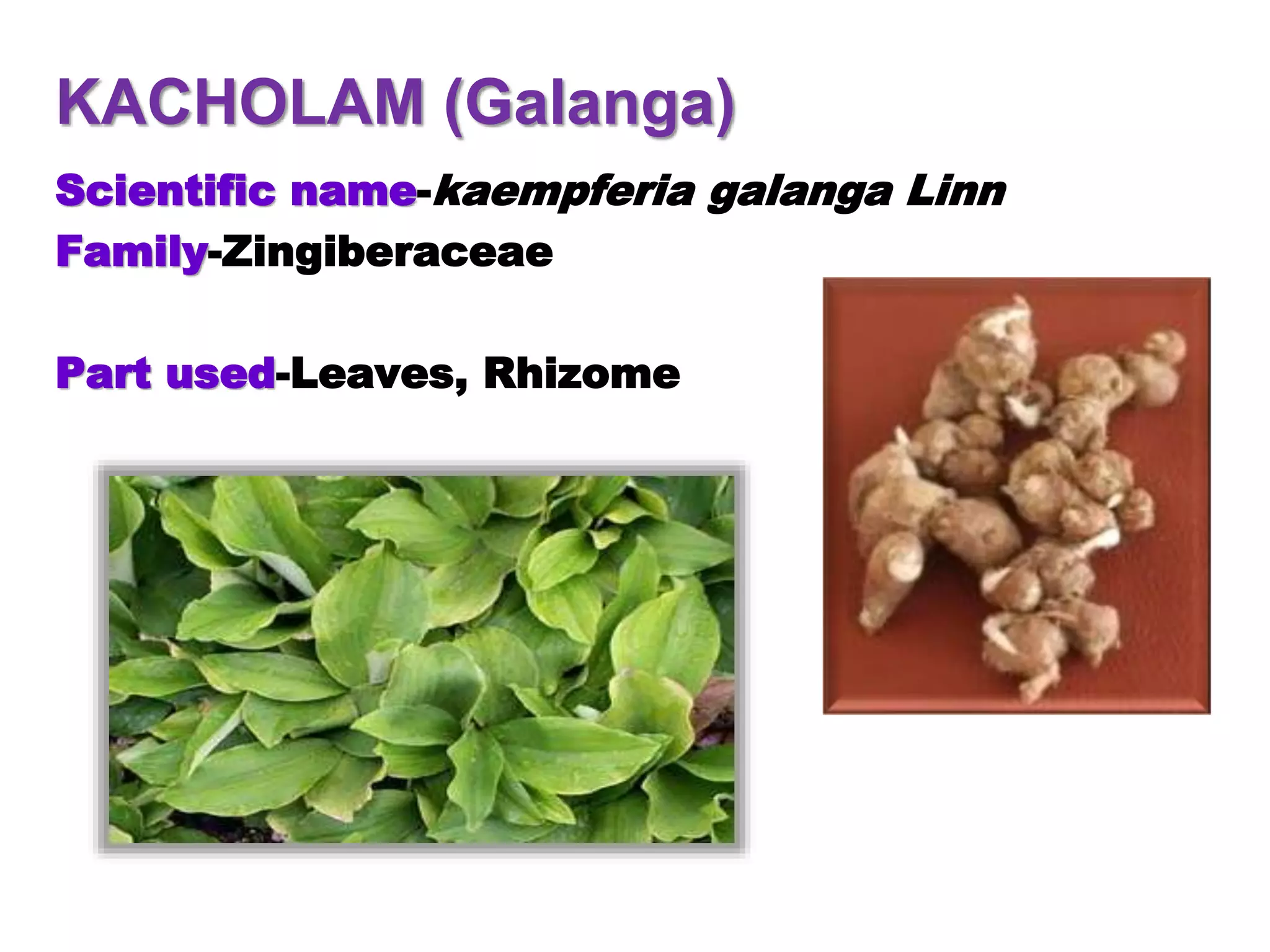
KACHOLAM (Galanga)
Scientific name-kaempferia galanga Linn
Family-Zingiberaceae
Part used-Leaves, Rhizome
Medicinal Properties & use
-Respiratory ailment :Cough ,bronchitis &
asthma.
-carminative &expectorant.
-Adding rhizome powder in herbal shampoo
helps to prevent dandruff.
-Administering dry rhizome powder mixed
with honey can prevent vomiting.
-For tooth ache ,apply rhizome pulp on the
gum.
VARIETIES
KASTHURI RAJANI
Leaves-More in no. &
larger in size
Leaves-Fewer & small
Rhizome-Light brown &
larger in size
Rhizome-Medium bold,
creamy white & more in
number
Productivity-900 kg /acre
dry rhizome
Productivity-870 kg/acre
dry rhizome
(High oleoresin content-
7.68%)
‘Kasthuri' (left) is a variety highly suited
for perfumery, while `Rajani' (right) is best
preferred for medicinal value.
ADAPATHIYAN (Holostemma)
Scientific name-Holostemma adakodien
Family-Asclipidaceae
Part used-Root
Medicinal Properties & use
-It is useful in opthalmopathy, bronchitis ,
cough, burning sensation ,constipation &
fever.
-It is used in the preparation of VIDARYADI
GANAM,DHANWANDHARAM,
BALARISHTA,ANUTHAILA.
-It is useful in eye disease & it imparts
resistance to disease.
VARIETIES
JEEVA
-Clonal Selection
-Purple cordate plant type with long
internodes.
-High yield of thick, sweet
roots(1.50 t/ ha dry root) ,fresh
tuber yield(4.5 t/ha),with high
soluble sugar content(8.33%).
CHETHIKODUVELI (Red flowered
leadwort)
Scientific name-Plumbago indica linn
Plumbago rosea linn
Family-Plumbaginaceae
Part used-Root
Medicinal Properties & use
-Esteemed remedy for leucoderma, leprosy &
other skin disease.
-Koduveli tubers are effective in piles & skin
diseases.
-Preparation “AGNITHUNDIVATI” in which
koduveli is important ingredient is highly
effective for problems related to
indigestion.
-Effective in piles & skin diseases.
-Also used in cancer treatment.
VARIETIES
AGNI(2006) MRIDHULA(2006)
-Clonal selection -Clonal selection
-Higher yield(root)-
2.65t/ha dry
High plumbagin content
0.80%
-Higher yield(root)-
2.94t/ha dry
low plumbagin content
0.22%
-suitable for the
extraction of plumbagin
-Can be used without
curing in the preparation
of indigenous medicines
-Robust ,tall plants ,long
broad leaves , thick
roots.
Medium tall plants ,small
leaves , lengthy narrow
roots
-Productivity
3400 kg raw roots/acre
1100 kg dry roots/acre
-Productivity
4000 raw roots/acre
1200 dry roots/acre
ADALOTAKAM
Scientific name-Adathoda beddomei clarke
Family-Acanthaceae
Part used-Root, Leaves, whole plant.
Medicinal Properties & use
-The leaf juice mixed with honey can reduce cough.
-Inhaling the smoke from burning of dried leaf, gives
relief to asthma.
-The leaf juice is used in anaemia and haemorrhage.
-Use of leaf juice and jaggery mixture helps to
control excessive bleeding during menstrual
periods.
-Flowers and leaves are considered efficacious
against rheumatic painful swellings and form a
good application to scabies and other skin
complaints.
-The juice of the leaves cures vomiting, thirst, fever,
dermatitis, jaundice and diseases due to the
morbidity of kapha and pitta.
-Roots form ingredient of several ayurvedic
medicines.
-Formulations: Vasavaleha, Vasarishta,
Vasahareethaki, Kanakasava,
Visagulachadhikashayam, Punarnavasava
-The shrub is the source of the drug vasaka
well known in the indigenous systems of
medicines.
- It is a reputed remedy for cough, asthma,
bronchitis and other respiratory disorders
due to its expectorant action.
VARIETIES
AJAGANDHI
-Medium tall plants with long and broad
leaves.
- High proportion of leaves and preferred for
leaf crop.
- Vasicine content in root - 2.46%.
- Productivity: 16 t whole plant /acre(fresh)
6 t whole plant /acre(dry)
AJAGANDHI
VASIKA
-Medium tall plants with long and
narrow leaves.
- High proportion of roots and preferred
for root crop.
- Vasicine content in root - 2.55%.
-Productivity:
14 t whole plant /acre (fresh)
4.5 t whole plant /acre (dry)
VASIKA
THIPALLI (Long pepper)
Scientific name-Piper longum linn
Family-Piperaceae
Part used-Root, Dried Spikes.
Medicinal Properties & use
-The well known ayurvedic formulations like Trikatu,
Panchakolam etc. contains Thipplai as the main ingredient
-Trikatu contains Thippali, black pepper and dried ginger
Panchakolam contains Thippali spikes, Thipplai root, Wild
Thippali root, Koduveli tubers and dried ginger
-The root and fruit decoction are used in acute and chronic
bronchitis and cough.
-2 g thippali fried in ghee, taken twice a day prevents cough.
It is useful in relieving cold, headache, arthritic pains, back
pain etc.
-Thippali spikes and root detoxifies liver and cures digestive
problems.
-It is also used against insomnia, fits etc.
-It is an ingredient of medicinal preparations used to cure
fever, jaundice, snake venom, leprosy, kidney problems etc.
- It also improves eye vision and is effective against night
blindness.
-Thippali is also useful as a spice ingredient in food
preparations. Addition of Thippali in pickles improves its
shelf life.
-Formulations:
Trikatu choornam, Pipalarishta, Pippalyasava, Panchakola,
Pippalayadilauha, Lavana bhaskar churam, vyoshativatakam,
Abhayarishtam, Drasharishtam,
Chyavanaprasham,Agastyarasayanam,Thaleespatradichoorna
mm,Karppoorai choornam.
VARIETIES
Viswam(1996)
-It is a Sri Lankan
type.(Chemmathipali)
-Bearing period –
240 to 270 days /year
-Yield
-800-850 kg dry spikes/ha
-300 -350 kg per acre from
second year onwards
(Coconut gardens)
-Alkaloid content - 2.83%
CONCLUSION
 Scope for commercial cultivation of medicinal plants as per
crop is very much limited in kerala due to the smaller land
holding size & high pressure on land.
 But medicinal plants fits well into a variety of cropping
systems ,ensuring effective harnessing of solar energy &
increasing return from unit area to farmers.
 Homestead in the state are ideal for cultivating medicinal
plants .Many of medicinal plants comes up well in shaded
condition & hence can be profitably intercropped in coconut
& rubber plantations.
 Most profitable medicinal plants are
Thippali,vayambu,Sarpagandhi,satavari etc.
 More of research work has to be carried out in medicinal
plants in order to completely harness the immense benefit
associated with the plants.
REFERENCE
• Ajithkumar, R. Potential of medicinal
plants.www.oldkerala.gov.in
• Agricultural statistics 2012-13,Department of
Economics,Kearala.January 2014,Trivandrum.
• Package of practice recommendations,Crops
2011,KAU,Thrisur.
Medicinal plant varieties released from Kerala Agricultural University

Medicinal plant varieties released from Kerala Agricultural University

  • 2.
    INTRODUCTION -Medicinal plants constitutean important component of the plant resource spectrum of Kerala. It is estimated that out of 4600 flowering plants ,about 900 possess medicinal values. -About 60-65% of plants required for ayurvedic medicines and almost 80% of plants used in Sidha medicine are found in forest of kerala. -The demand for Ayurvedic medicine in the state is growing at a compound rate of 10-12% per annum. -Govt of Kerala through Department of Agriculture is supporting cultivation of medicinal plants.
  • 3.
    YEAR AREA 2012-13 2,378Ha 2011-12 2,006 Ha
  • 4.
    KAU RELEASED VARIETIES KAUhas released 8 varieties: 1.KACHOLAM-Kasthuri & Rajani 2.ADAPATHIYAN-Jeeva 3.CHETHIKODUVELI-Agni & Mridula 4.ADALOTAKAM-Ajagandhi & Vasika 5.THIPALLI-Viswam
  • 5.
    KACHOLAM (Galanga) Scientific name-kaempferiagalanga Linn Family-Zingiberaceae Part used-Leaves, Rhizome
  • 6.
    Medicinal Properties &use -Respiratory ailment :Cough ,bronchitis & asthma. -carminative &expectorant. -Adding rhizome powder in herbal shampoo helps to prevent dandruff. -Administering dry rhizome powder mixed with honey can prevent vomiting. -For tooth ache ,apply rhizome pulp on the gum.
  • 7.
    VARIETIES KASTHURI RAJANI Leaves-More inno. & larger in size Leaves-Fewer & small Rhizome-Light brown & larger in size Rhizome-Medium bold, creamy white & more in number Productivity-900 kg /acre dry rhizome Productivity-870 kg/acre dry rhizome (High oleoresin content- 7.68%)
  • 8.
    ‘Kasthuri' (left) isa variety highly suited for perfumery, while `Rajani' (right) is best preferred for medicinal value.
  • 9.
    ADAPATHIYAN (Holostemma) Scientific name-Holostemmaadakodien Family-Asclipidaceae Part used-Root
  • 10.
    Medicinal Properties &use -It is useful in opthalmopathy, bronchitis , cough, burning sensation ,constipation & fever. -It is used in the preparation of VIDARYADI GANAM,DHANWANDHARAM, BALARISHTA,ANUTHAILA. -It is useful in eye disease & it imparts resistance to disease.
  • 11.
    VARIETIES JEEVA -Clonal Selection -Purple cordateplant type with long internodes. -High yield of thick, sweet roots(1.50 t/ ha dry root) ,fresh tuber yield(4.5 t/ha),with high soluble sugar content(8.33%).
  • 13.
    CHETHIKODUVELI (Red flowered leadwort) Scientificname-Plumbago indica linn Plumbago rosea linn Family-Plumbaginaceae Part used-Root
  • 14.
    Medicinal Properties &use -Esteemed remedy for leucoderma, leprosy & other skin disease. -Koduveli tubers are effective in piles & skin diseases. -Preparation “AGNITHUNDIVATI” in which koduveli is important ingredient is highly effective for problems related to indigestion. -Effective in piles & skin diseases. -Also used in cancer treatment.
  • 15.
    VARIETIES AGNI(2006) MRIDHULA(2006) -Clonal selection-Clonal selection -Higher yield(root)- 2.65t/ha dry High plumbagin content 0.80% -Higher yield(root)- 2.94t/ha dry low plumbagin content 0.22% -suitable for the extraction of plumbagin -Can be used without curing in the preparation of indigenous medicines -Robust ,tall plants ,long broad leaves , thick roots. Medium tall plants ,small leaves , lengthy narrow roots -Productivity 3400 kg raw roots/acre 1100 kg dry roots/acre -Productivity 4000 raw roots/acre 1200 dry roots/acre
  • 17.
    ADALOTAKAM Scientific name-Adathoda beddomeiclarke Family-Acanthaceae Part used-Root, Leaves, whole plant.
  • 18.
    Medicinal Properties &use -The leaf juice mixed with honey can reduce cough. -Inhaling the smoke from burning of dried leaf, gives relief to asthma. -The leaf juice is used in anaemia and haemorrhage. -Use of leaf juice and jaggery mixture helps to control excessive bleeding during menstrual periods. -Flowers and leaves are considered efficacious against rheumatic painful swellings and form a good application to scabies and other skin complaints. -The juice of the leaves cures vomiting, thirst, fever, dermatitis, jaundice and diseases due to the morbidity of kapha and pitta. -Roots form ingredient of several ayurvedic medicines.
  • 19.
    -Formulations: Vasavaleha, Vasarishta, Vasahareethaki,Kanakasava, Visagulachadhikashayam, Punarnavasava -The shrub is the source of the drug vasaka well known in the indigenous systems of medicines. - It is a reputed remedy for cough, asthma, bronchitis and other respiratory disorders due to its expectorant action.
  • 20.
    VARIETIES AJAGANDHI -Medium tall plantswith long and broad leaves. - High proportion of leaves and preferred for leaf crop. - Vasicine content in root - 2.46%. - Productivity: 16 t whole plant /acre(fresh) 6 t whole plant /acre(dry)
  • 21.
  • 22.
    VASIKA -Medium tall plantswith long and narrow leaves. - High proportion of roots and preferred for root crop. - Vasicine content in root - 2.55%. -Productivity: 14 t whole plant /acre (fresh) 4.5 t whole plant /acre (dry)
  • 23.
  • 24.
    THIPALLI (Long pepper) Scientificname-Piper longum linn Family-Piperaceae Part used-Root, Dried Spikes.
  • 25.
    Medicinal Properties &use -The well known ayurvedic formulations like Trikatu, Panchakolam etc. contains Thipplai as the main ingredient -Trikatu contains Thippali, black pepper and dried ginger Panchakolam contains Thippali spikes, Thipplai root, Wild Thippali root, Koduveli tubers and dried ginger -The root and fruit decoction are used in acute and chronic bronchitis and cough. -2 g thippali fried in ghee, taken twice a day prevents cough. It is useful in relieving cold, headache, arthritic pains, back pain etc. -Thippali spikes and root detoxifies liver and cures digestive problems.
  • 26.
    -It is alsoused against insomnia, fits etc. -It is an ingredient of medicinal preparations used to cure fever, jaundice, snake venom, leprosy, kidney problems etc. - It also improves eye vision and is effective against night blindness. -Thippali is also useful as a spice ingredient in food preparations. Addition of Thippali in pickles improves its shelf life. -Formulations: Trikatu choornam, Pipalarishta, Pippalyasava, Panchakola, Pippalayadilauha, Lavana bhaskar churam, vyoshativatakam, Abhayarishtam, Drasharishtam, Chyavanaprasham,Agastyarasayanam,Thaleespatradichoorna mm,Karppoorai choornam.
  • 27.
    VARIETIES Viswam(1996) -It is aSri Lankan type.(Chemmathipali) -Bearing period – 240 to 270 days /year -Yield -800-850 kg dry spikes/ha -300 -350 kg per acre from second year onwards (Coconut gardens) -Alkaloid content - 2.83%
  • 29.
    CONCLUSION  Scope forcommercial cultivation of medicinal plants as per crop is very much limited in kerala due to the smaller land holding size & high pressure on land.  But medicinal plants fits well into a variety of cropping systems ,ensuring effective harnessing of solar energy & increasing return from unit area to farmers.  Homestead in the state are ideal for cultivating medicinal plants .Many of medicinal plants comes up well in shaded condition & hence can be profitably intercropped in coconut & rubber plantations.  Most profitable medicinal plants are Thippali,vayambu,Sarpagandhi,satavari etc.  More of research work has to be carried out in medicinal plants in order to completely harness the immense benefit associated with the plants.
  • 30.
    REFERENCE • Ajithkumar, R.Potential of medicinal plants.www.oldkerala.gov.in • Agricultural statistics 2012-13,Department of Economics,Kearala.January 2014,Trivandrum. • Package of practice recommendations,Crops 2011,KAU,Thrisur.