Arterial Blood Gas Analysis
INTRODUCTION
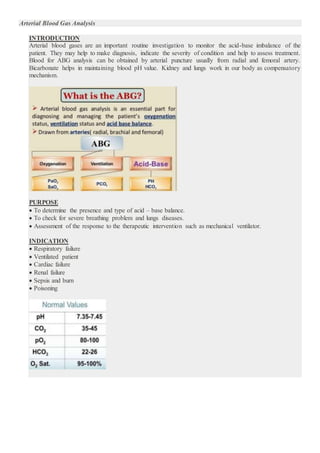
Arterial blood gases are an important routine investigation to monitor the acid-base imbalance of the
patient. They may help to make diagnosis, indicate the severity of condition and help to assess treatment.
Blood for ABG analysis can be obtained by arterial puncture usually from radial and femoral artery.
Bicarbonate helps in maintaining blood pH value. Kidney and lungs work in our body as compensatory
mechanism.
PURPOSE
 To determine the presence and type of acid – base balance.
 To check for severe breathing problem and lungs diseases.
 Assessment of the response to the therapeutic intervention such as mechanical ventilator.
INDICATION
 Respiratory failure
 Ventilated patient
 Cardiac failure
 Renal failure
 Sepsis and burn
 Poisoning
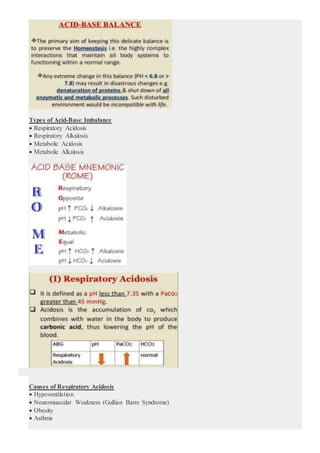
Types of Acid-Base Imbalance
 Respiratory Acidosis
 Respiratory Alkalosis
 Metabolic Acidosis
 Metabolic Alkalosis
Causes of Respiratory Acidosis
 Hypoventilation
 Neuromuscular Weakness (Gullian Barre Syndrome)
 Obesity
 Asthma
Clinical Manifestation
 Muscular Weakness
 Tachypnea
 Blurred Vision
 Confusion
 Memory loss
 Restlessness
Management
Pharmacological
• Opoid Antagonist:- Nalaxone
• β2 Antagonist:- Formoterol, Albuterol
• Anticholinergic:- Ipratropium bromide
• Corticosteroids: Prednisone, Prednisolone
Non pharmacological
• Dialysis:- To clear the toxin from blood.
• Oxygen Therapy:- To minimize the chance of hypoxemia.
• Ventilator Support:- To subside the respiratory problem.
Causes
 Hyperventilation
 Fluid loss
 Liver disease
 Alteration in gas exchange
 Pneumonia
 Stress
Clinical Manifestation
 Palpitation
 Tetany (muscle spasm)
 Convulsion
 Paralysis
 Chest pain
Management
Pharmacological
• Antibiotic: Levofloxin
•Antipyretic: Acetaminophen
•Anxiolytic: Benzodiazapam
Non-pharmacological
• Breath into a paper bag.
•Restrict oxygen intake into the lungs.
•To reassure the patient who is anxious.
• Treat the underlying causes.
•If intubated, reduce minute ventilation by adjusting rate, tidal volume.
Causes
• Alcohol
• Cancer
• Diarrhea
• Liver failure
• Poisoning by aspirin and methanol
• Sever dehydration
• Seizure
Clinical Manifestation
 Diarrhoea
 Chest pain
 Rapid breathing
 Hypotension
 Arrhythmia
 Joint pain
Management
Pharmacological
• Ringer lactate
• Diuretics
• Administer bicarbonates
Non-pharmacological
• To provide IV fluid.
• Stop drinking alcohol.
• To provide plenty of fluid.
Causes
• Alcohol abuse
• Hyperaldesteron
• Diarrhoea and vomiting
• High fever
• Diuretic therapy
• Cystic fibrosis
Clinical Manifestation
 Bradypnea (initial symptom)
 Apnea go on 15 sec and longer
 Decrease blood pressure
 Rapid heart rate
 Irritability
 Cyanosis
 Coma
Management
Pharmacological
• Potassium sparing diuretics: Amiloride
• Antipyretic:- Acetazolamide
• Infuse HCL
Non-pharmacological
• Dialysis
• To check vital sign of the patient.
• To provide antacid and laxative.
Nursing Management
• Impaired gas exchange
• Ineffective Breathing pattern
• Ineffective tissue perfusion
• Risk of infection at puncture site
• Risk of injury
Procedure of Arterial Blood Gas analysis
Equipment Required
A clean tray containing:
• Gloves
• Antiseptic solution
• Local anesthesia
• 0.5 ml sodium heparin (1:1000)
• 2 – 3 ml syringe with 20, 23 and 25 gauze needle.
• Paper bag
Preparation of client
 To record the temperature of the client.
 Record inspired oxygen concentration of the client.
 Heparnised the syringe to prevent blood clotting.
 To reduce anxiety of the client.
 Allen’s test
ALLEN’S TEST
The Allen’s test is done to assess the arterial blood flow to the hand.
This test can be performed for either the ulnar or the radial artery.
Sample Collection
 Wash hands and wear gloves.
 Place pillow under the patient’s wrist.
 Palpate the artery, i.e., radial, brachial or femoral to be punctured.
 Obliterate both radial and ulnar arteries at wrist by pressing them with both thumbs.
 Ask the patient to clench and unclench the fist until blanching of skin occurs.
 Release the pressure on the ulnar artery by removing the thumb on it.
 Watch for return of circulation to skin with in 15 sec.
 Palpate the radial artery for pulsation.
 Puncture the artery at 45-60° angle.
 The arterial blood rushes into the syringe with a great force.
 We should withdraw 2-3 ml of blood for sample.
 Once the sample has been taken, withdraw the needle and apply firm pressure over the site of puncture
with dry sponge.
 Remove the air bubble from syringe and needle.
 Capping the needle.
 Place the capped syringe into an ice container.
 Maintain firm pressure on puncture site for 5 min.
 If patient is on anticoagulants use the high pressure dressing.
Follow-up
 Send the collected sample to the laboratory immediately.
 Assess for cold hands or numbness.
 Change the ventilator settings.
Complication of ABG
 Bleeding
 Infection at puncture site
 Blood accumulating under skin
 Local pain
 Thrombus in artery
 Feeling faint
 Numbness of hand
Contraindication of ABG
 Coagulopathy
 Artherosclerosis
 Infection at insertion site
 Abnormal modified Allen’s test
 Use of thrombolytic agent

ABG analysis

  • 1.
    Arterial Blood GasAnalysis INTRODUCTION Arterial blood gases are an important routine investigation to monitor the acid-base imbalance of the patient. They may help to make diagnosis, indicate the severity of condition and help to assess treatment. Blood for ABG analysis can be obtained by arterial puncture usually from radial and femoral artery. Bicarbonate helps in maintaining blood pH value. Kidney and lungs work in our body as compensatory mechanism. PURPOSE  To determine the presence and type of acid – base balance.  To check for severe breathing problem and lungs diseases.  Assessment of the response to the therapeutic intervention such as mechanical ventilator. INDICATION  Respiratory failure  Ventilated patient  Cardiac failure  Renal failure  Sepsis and burn  Poisoning
  • 2.
    Types of Acid-BaseImbalance  Respiratory Acidosis  Respiratory Alkalosis  Metabolic Acidosis  Metabolic Alkalosis Causes of Respiratory Acidosis  Hypoventilation  Neuromuscular Weakness (Gullian Barre Syndrome)  Obesity  Asthma
  • 3.
    Clinical Manifestation  MuscularWeakness  Tachypnea  Blurred Vision  Confusion  Memory loss  Restlessness Management Pharmacological • Opoid Antagonist:- Nalaxone • β2 Antagonist:- Formoterol, Albuterol • Anticholinergic:- Ipratropium bromide • Corticosteroids: Prednisone, Prednisolone Non pharmacological • Dialysis:- To clear the toxin from blood. • Oxygen Therapy:- To minimize the chance of hypoxemia. • Ventilator Support:- To subside the respiratory problem. Causes  Hyperventilation  Fluid loss  Liver disease  Alteration in gas exchange  Pneumonia  Stress Clinical Manifestation  Palpitation  Tetany (muscle spasm)  Convulsion  Paralysis  Chest pain Management Pharmacological
  • 4.
    • Antibiotic: Levofloxin •Antipyretic:Acetaminophen •Anxiolytic: Benzodiazapam Non-pharmacological • Breath into a paper bag. •Restrict oxygen intake into the lungs. •To reassure the patient who is anxious. • Treat the underlying causes. •If intubated, reduce minute ventilation by adjusting rate, tidal volume. Causes • Alcohol • Cancer • Diarrhea • Liver failure • Poisoning by aspirin and methanol • Sever dehydration • Seizure Clinical Manifestation  Diarrhoea  Chest pain  Rapid breathing  Hypotension  Arrhythmia  Joint pain Management Pharmacological • Ringer lactate • Diuretics • Administer bicarbonates Non-pharmacological • To provide IV fluid. • Stop drinking alcohol. • To provide plenty of fluid.
  • 5.
    Causes • Alcohol abuse •Hyperaldesteron • Diarrhoea and vomiting • High fever • Diuretic therapy • Cystic fibrosis Clinical Manifestation  Bradypnea (initial symptom)  Apnea go on 15 sec and longer  Decrease blood pressure  Rapid heart rate  Irritability  Cyanosis  Coma Management Pharmacological • Potassium sparing diuretics: Amiloride • Antipyretic:- Acetazolamide • Infuse HCL Non-pharmacological • Dialysis • To check vital sign of the patient. • To provide antacid and laxative. Nursing Management • Impaired gas exchange • Ineffective Breathing pattern • Ineffective tissue perfusion • Risk of infection at puncture site • Risk of injury Procedure of Arterial Blood Gas analysis Equipment Required A clean tray containing:
  • 6.
    • Gloves • Antisepticsolution • Local anesthesia • 0.5 ml sodium heparin (1:1000) • 2 – 3 ml syringe with 20, 23 and 25 gauze needle. • Paper bag Preparation of client  To record the temperature of the client.  Record inspired oxygen concentration of the client.  Heparnised the syringe to prevent blood clotting.  To reduce anxiety of the client.  Allen’s test ALLEN’S TEST The Allen’s test is done to assess the arterial blood flow to the hand. This test can be performed for either the ulnar or the radial artery. Sample Collection  Wash hands and wear gloves.  Place pillow under the patient’s wrist.  Palpate the artery, i.e., radial, brachial or femoral to be punctured.  Obliterate both radial and ulnar arteries at wrist by pressing them with both thumbs.  Ask the patient to clench and unclench the fist until blanching of skin occurs.  Release the pressure on the ulnar artery by removing the thumb on it.  Watch for return of circulation to skin with in 15 sec.  Palpate the radial artery for pulsation.  Puncture the artery at 45-60° angle.  The arterial blood rushes into the syringe with a great force.
  • 7.
     We shouldwithdraw 2-3 ml of blood for sample.  Once the sample has been taken, withdraw the needle and apply firm pressure over the site of puncture with dry sponge.  Remove the air bubble from syringe and needle.  Capping the needle.  Place the capped syringe into an ice container.  Maintain firm pressure on puncture site for 5 min.  If patient is on anticoagulants use the high pressure dressing. Follow-up  Send the collected sample to the laboratory immediately.  Assess for cold hands or numbness.  Change the ventilator settings. Complication of ABG  Bleeding  Infection at puncture site  Blood accumulating under skin  Local pain  Thrombus in artery  Feeling faint  Numbness of hand Contraindication of ABG  Coagulopathy  Artherosclerosis  Infection at insertion site  Abnormal modified Allen’s test  Use of thrombolytic agent