ABBERATIONS OF
REFRACTIVEERROR
DR.Dhivya
shri s
23/10/20
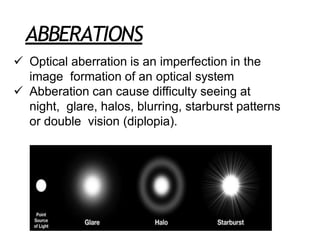
ABBERATIONS
 Optical aberration is an imperfection in the
image formation of an optical system
 Abberation can cause difficulty seeing at
night, glare, halos, blurring, starburst patterns
or double vision (diplopia).
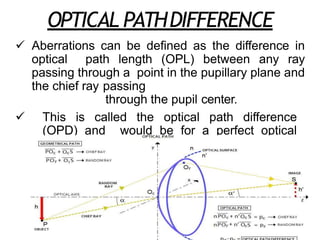
OPTICAL PATHDIFFERENCE
 Aberrations can be defined as the difference in
optical path length (OPL) between any ray
passing through a point in the pupillary plane and
the chief ray passing
through the pupil center.
 This is called the optical path difference
(OPD) and would be for a perfect optical
system
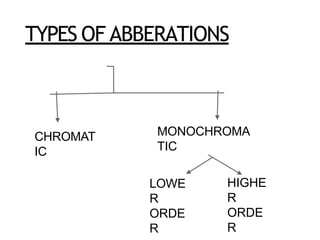
TYPES OF ABBERATIONS
CHROMAT
IC
MONOCHROMA
TIC
LOWE
R
ORDE
R
HIGHE
R
ORDE
R
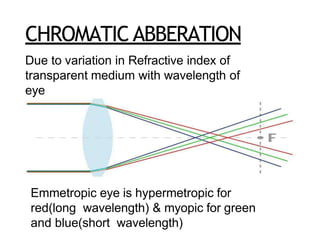
CHROMATIC ABBERATION
Due to variation in Refractive index of
transparent medium with wavelength of
eye
Emmetropic eye is hypermetropic for
red(long wavelength) & myopic for green
and blue(short wavelength)
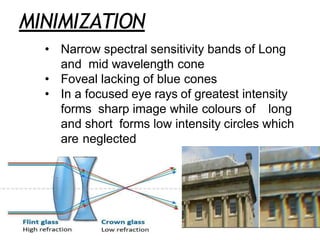
MINIMIZATION
• Narrow spectral sensitivity bands of Long
and mid wavelength cone
• Foveal lacking of blue cones
• In a focused eye rays of greatest intensity
forms sharp image while colours of long
and short forms low intensity circles which
are neglected
MONOCHROMATIC ABBERATIONS
 Monochromatic aberrations are caused by
the geometry of the lens and occur both
when light is reflected and when it is
refracted.
 They appear even when using
monochromatic light, hence the name.
WAVEFRONT ABBEROMETER
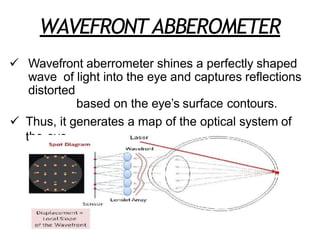
 Wavefront aberrometer shines a perfectly shaped
wave of light into the eye and captures reflections
distorted
based on the eye’s surface contours.
 Thus, it generates a map of the optical system of
the eye
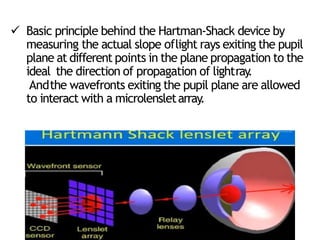
 Basic principle behind the Hartman-Shack device by
measuring the actual slope oflight rays exiting the pupil
plane at different points in the plane propagation to the
ideal the direction of propagation of lightray
.
Andthe wavefronts exiting the pupil plane are allowed
to interact with a microlensletarray
.
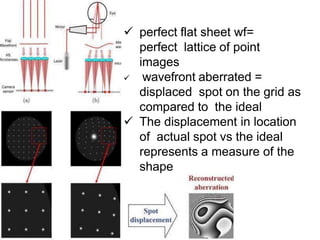
 perfect flat sheet wf=
perfect lattice of point
images
 wavefront aberrated =
displaced spot on the grid as
compared to the ideal
 The displacement in location
of actual spot vs the ideal
represents a measure of the
shape

WAVEFRONTMAPS
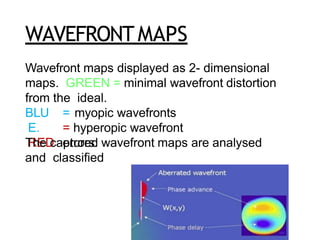
Wavefront maps displayed as 2- dimensional
maps. GREEN = minimal wavefront distortion
from the ideal.
BLU
E.
RED
= myopic wavefronts
= hyperopic wavefront
errors.
The captured wavefront maps are analysed
and classified
ZERNIKE & FOURIERPOLYNOMIALS
 Zernike and Fourier
transforms are
polynomial equations
that have been
adapted for this
purpose
 Based on this
monochromatic eye
aberrations are addressed
as:
(1)lower-order
aberrations, n<3, and (2)
LOWER ORDERABBERATIONS
 Lower order aberrations
include
 astigmatism,
 positive defocus (myopia),
and negative defocus
(hyperopia).
 They are minimized by
spherical and cylindrical
corrections
HIGHER ORDERABBERATIONS
 Higher order aberrations (HOAs) of the
eye are unable to be corrected by
cylinder or spherical corrections and
include
 spherical aberrations
 oblique abberations ,
 coma and
 trefoil.
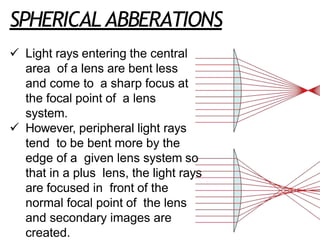
SPHERICAL ABBERATIONS
 Light rays entering the central
area of a lens are bent less
and come to a sharp focus at
the focal point of a lens
system.
 However, peripheral light rays
tend to be bent more by the
edge of a given lens system so
that in a plus lens, the light rays
are focused in front of the
normal focal point of the lens
and secondary images are
created.
DIMINISHING SPHERICAL
ABERRATIONS
 Peculiar curvature of cornea i. e.
Flatter periphery than centre
 Peculiar structure of crystalline lens,
wherein the central portions have a
greater density and are arranged in
layers of greater curvature than the
peripheral portion
 Iris blocks the peripheral rays from
entering the eye, so only refraction of
paraxial rays of light takes place
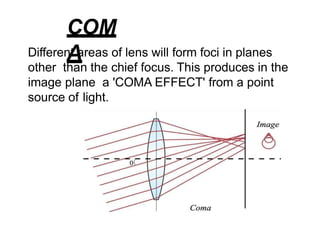
COM
A
Different areas of lens will form foci in planes
other than the chief focus. This produces in the
image plane a 'COMA EFFECT' from a point
source of light.
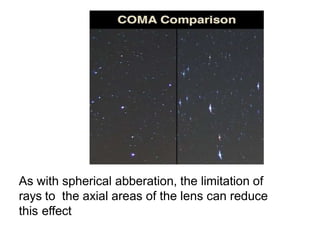
As with spherical abberation, the limitation of
rays to the axial areas of the lens can reduce
this effect
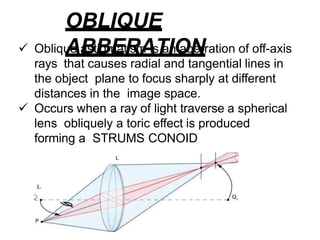
OBLIQUE
ABBERATION
 Oblique astigmatism is an aberration of off-axis
rays that causes radial and tangential lines in
the object plane to focus sharply at different
distances in the image space.
 Occurs when a ray of light traverse a spherical
lens obliquely a toric effect is produced
forming a STRUMS CONOID
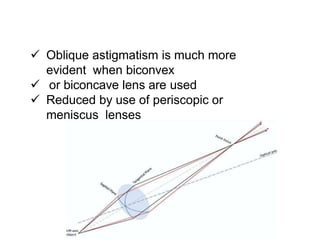
 Oblique astigmatism is much more
evident when biconvex
 or biconcave lens are used
 Reduced by use of periscopic or
meniscus lenses
NATURAL MECHANISMS TO
DECREASE ABBERATION
• Cutting of peripheral rays by iris
• High refractive index of the core of nucleus of
the lens than that of peripheral cortex
• Low sensitivity of peripheral retina
• Stiles-Crawford effect, I. e. More sensitivity of
the retina to perpendicular rays than the
oblique rays.
THANK YOU

abberationsofre2-201118180028.pptx

  • 1.
  • 2.
    ABBERATIONS  Optical aberrationis an imperfection in the image formation of an optical system  Abberation can cause difficulty seeing at night, glare, halos, blurring, starburst patterns or double vision (diplopia).
  • 3.
    OPTICAL PATHDIFFERENCE  Aberrationscan be defined as the difference in optical path length (OPL) between any ray passing through a point in the pupillary plane and the chief ray passing through the pupil center.  This is called the optical path difference (OPD) and would be for a perfect optical system
  • 4.
  • 5.
    CHROMATIC ABBERATION Due tovariation in Refractive index of transparent medium with wavelength of eye Emmetropic eye is hypermetropic for red(long wavelength) & myopic for green and blue(short wavelength)
  • 6.
    MINIMIZATION • Narrow spectralsensitivity bands of Long and mid wavelength cone • Foveal lacking of blue cones • In a focused eye rays of greatest intensity forms sharp image while colours of long and short forms low intensity circles which are neglected
  • 7.
    MONOCHROMATIC ABBERATIONS  Monochromaticaberrations are caused by the geometry of the lens and occur both when light is reflected and when it is refracted.  They appear even when using monochromatic light, hence the name.
  • 8.
    WAVEFRONT ABBEROMETER  Wavefrontaberrometer shines a perfectly shaped wave of light into the eye and captures reflections distorted based on the eye’s surface contours.  Thus, it generates a map of the optical system of the eye
  • 9.
     Basic principlebehind the Hartman-Shack device by measuring the actual slope oflight rays exiting the pupil plane at different points in the plane propagation to the ideal the direction of propagation of lightray . Andthe wavefronts exiting the pupil plane are allowed to interact with a microlensletarray .
  • 10.
     perfect flatsheet wf= perfect lattice of point images  wavefront aberrated = displaced spot on the grid as compared to the ideal  The displacement in location of actual spot vs the ideal represents a measure of the shape 
  • 11.
    WAVEFRONTMAPS Wavefront maps displayedas 2- dimensional maps. GREEN = minimal wavefront distortion from the ideal. BLU E. RED = myopic wavefronts = hyperopic wavefront errors. The captured wavefront maps are analysed and classified
  • 12.
    ZERNIKE & FOURIERPOLYNOMIALS Zernike and Fourier transforms are polynomial equations that have been adapted for this purpose  Based on this monochromatic eye aberrations are addressed as: (1)lower-order aberrations, n<3, and (2)
  • 13.
    LOWER ORDERABBERATIONS  Lowerorder aberrations include  astigmatism,  positive defocus (myopia), and negative defocus (hyperopia).  They are minimized by spherical and cylindrical corrections
  • 14.
    HIGHER ORDERABBERATIONS  Higherorder aberrations (HOAs) of the eye are unable to be corrected by cylinder or spherical corrections and include  spherical aberrations  oblique abberations ,  coma and  trefoil.
  • 15.
    SPHERICAL ABBERATIONS  Lightrays entering the central area of a lens are bent less and come to a sharp focus at the focal point of a lens system.  However, peripheral light rays tend to be bent more by the edge of a given lens system so that in a plus lens, the light rays are focused in front of the normal focal point of the lens and secondary images are created.
  • 16.
    DIMINISHING SPHERICAL ABERRATIONS  Peculiarcurvature of cornea i. e. Flatter periphery than centre  Peculiar structure of crystalline lens, wherein the central portions have a greater density and are arranged in layers of greater curvature than the peripheral portion  Iris blocks the peripheral rays from entering the eye, so only refraction of paraxial rays of light takes place
  • 17.
    COM A Different areas oflens will form foci in planes other than the chief focus. This produces in the image plane a 'COMA EFFECT' from a point source of light.
  • 18.
    As with sphericalabberation, the limitation of rays to the axial areas of the lens can reduce this effect
  • 19.
    OBLIQUE ABBERATION  Oblique astigmatismis an aberration of off-axis rays that causes radial and tangential lines in the object plane to focus sharply at different distances in the image space.  Occurs when a ray of light traverse a spherical lens obliquely a toric effect is produced forming a STRUMS CONOID
  • 20.
     Oblique astigmatismis much more evident when biconvex  or biconcave lens are used  Reduced by use of periscopic or meniscus lenses
  • 21.
    NATURAL MECHANISMS TO DECREASEABBERATION • Cutting of peripheral rays by iris • High refractive index of the core of nucleus of the lens than that of peripheral cortex • Low sensitivity of peripheral retina • Stiles-Crawford effect, I. e. More sensitivity of the retina to perpendicular rays than the oblique rays.
  • 22.