
Abdominal X-ray
Dr. Mathew Joseph MBBS,MD(2nd Year),BCCPM
Junior Resident
Department of Anatomy
All India Institute of Medical Sciences - Rishikesh
Learning Objectives
Indications
Technique
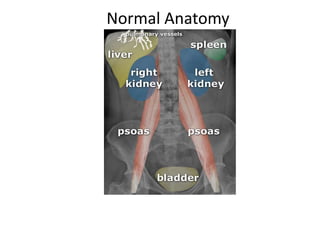
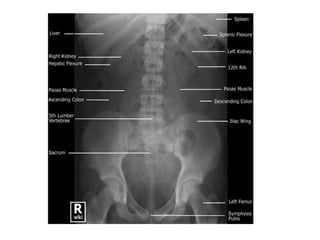
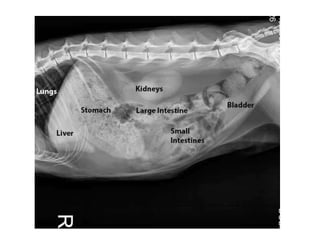
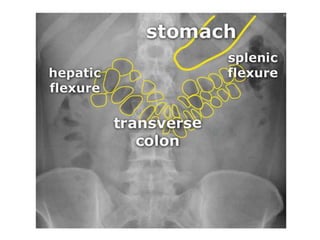
Normal Anatomy
Common questions accompanying requests for
an abdominal X-ray (AXR): Indications
• Intraperitoneal free air?
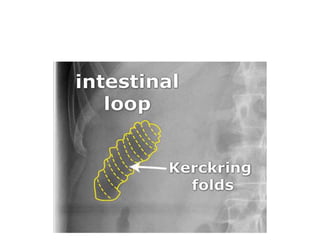
• Widened intestinal loops?
• Kidney stones/ureteral stones/bladder
stones?
• Foreign body?
• Position of gastric tube/duodenal tube?
Indications:
• Bowel obstruction
• Perforation
• Renal pathology
• Acute abdomen
• Foreign body localization
• Toxic megacolon
• Aortic aneurysm
• Control or preliminary films for contrast studies
• Detection of calcification or abnormal gas collection
Technique
Positions:
• Standing
• Supine
• Lateral
• Technique for supine AP (anterior-posterior)
image
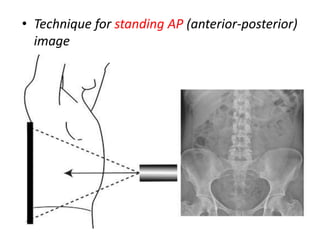
• Technique for standing AP (anterior-posterior)
image
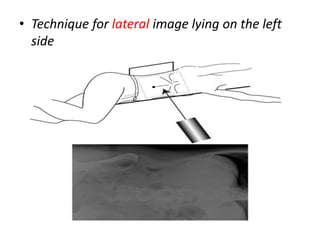
• Technique for lateral image lying on the left
side
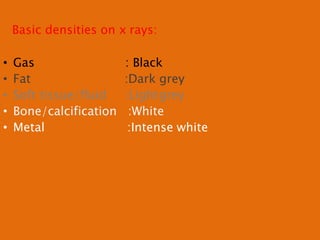
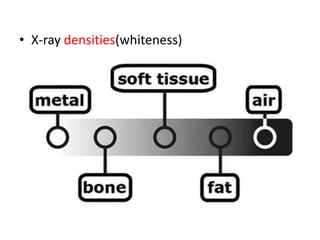
Basic densities on x rays:
• Gas : Black
• Fat :Dark grey
• Soft tissue/fluid :Lightgrey
• Bone/calcification :White
• Metal :Intense white
• X-ray densities(whiteness)
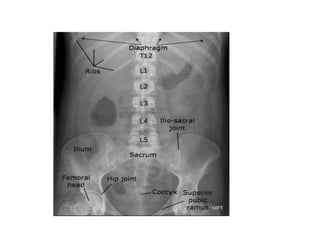
Normal Anatomy
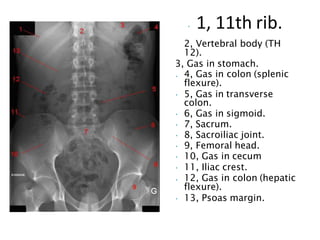
1, 11th rib.
2, Vertebral body (TH
12).
3, Gas in stomach.
4, Gas in colon (splenic
flexure).
5, Gas in transverse
colon.
6, Gas in sigmoid.
7, Sacrum.
8, Sacroiliac joint.
9, Femoral head.
10, Gas in cecum
11, Iliac crest.
12, Gas in colon (hepatic
flexure).
13, Psoas margin.
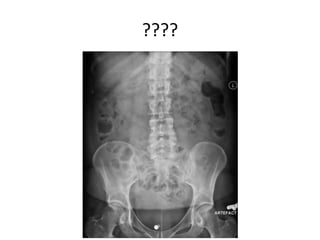
????
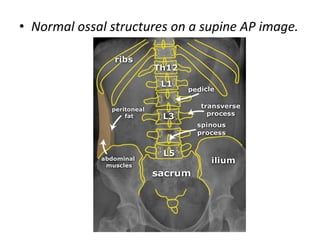
• Normal ossal structures on a supine AP image.
Left lateral image
Checklist:
• The following points may be used as a guide
to assess an AXR.
1. Technique: is this a standing or supine image?
2. Are the psoas muscle contours visible? (If not,
caution: pathology)
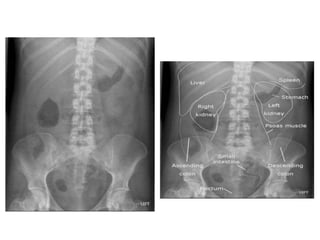
3. Try to trace the liver/kidney/spleen contours.
4. Are there calcifications or radio-opaque
structures?
4. Determine the position of the stomach, small
intestinal loops and colonic loops. Is the
distribution of intestinal gas normal? Dilated
intestinal loops?
5. Evidence of free air?
6. Examine the skeletal system. Are there
fractures, cortex interruptions, ossal lesions?
7. Changes versus previous examinations?
Abdominal x ray

Abdominal x ray

  • 1.
    Abdominal X-ray Dr. MathewJoseph MBBS,MD(2nd Year),BCCPM Junior Resident Department of Anatomy All India Institute of Medical Sciences - Rishikesh
  • 2.
  • 3.
    Common questions accompanyingrequests for an abdominal X-ray (AXR): Indications • Intraperitoneal free air? • Widened intestinal loops? • Kidney stones/ureteral stones/bladder stones? • Foreign body? • Position of gastric tube/duodenal tube?
  • 4.
    Indications: • Bowel obstruction •Perforation • Renal pathology • Acute abdomen • Foreign body localization • Toxic megacolon • Aortic aneurysm • Control or preliminary films for contrast studies • Detection of calcification or abnormal gas collection
  • 5.
  • 6.
    • Technique forsupine AP (anterior-posterior) image
  • 7.
    • Technique forstanding AP (anterior-posterior) image
  • 8.
    • Technique forlateral image lying on the left side
  • 9.
    Basic densities onx rays: • Gas : Black • Fat :Dark grey • Soft tissue/fluid :Lightgrey • Bone/calcification :White • Metal :Intense white
  • 10.
  • 11.
  • 15.
    1, 11th rib. 2,Vertebral body (TH 12). 3, Gas in stomach. 4, Gas in colon (splenic flexure). 5, Gas in transverse colon. 6, Gas in sigmoid. 7, Sacrum. 8, Sacroiliac joint. 9, Femoral head. 10, Gas in cecum 11, Iliac crest. 12, Gas in colon (hepatic flexure). 13, Psoas margin.
  • 16.
  • 17.
    • Normal ossalstructures on a supine AP image.
  • 18.
  • 22.
    Checklist: • The followingpoints may be used as a guide to assess an AXR. 1. Technique: is this a standing or supine image? 2. Are the psoas muscle contours visible? (If not, caution: pathology) 3. Try to trace the liver/kidney/spleen contours. 4. Are there calcifications or radio-opaque structures?
  • 23.
    4. Determine theposition of the stomach, small intestinal loops and colonic loops. Is the distribution of intestinal gas normal? Dilated intestinal loops? 5. Evidence of free air? 6. Examine the skeletal system. Are there fractures, cortex interruptions, ossal lesions? 7. Changes versus previous examinations?