

Nightingale's environmental
theory
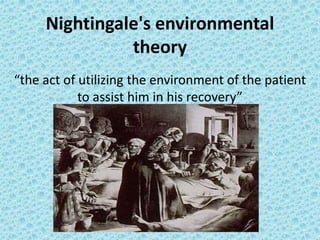
“the act of utilizing the environment of the patient
to assist him in his recovery”
OUTLINE
• Biography : Background of the
theorist
• Nightingale’s theory :
evolution & introduction
• Types of environment
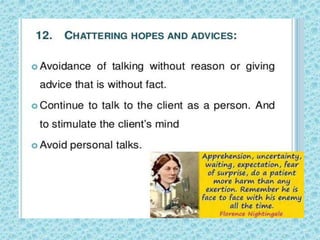
• Nightingale’s thirteen canons
• Major concepts of nursing
according to nightingale.
• Nightingale’s environmental
model as a framework for
nursing practice
• The Nightingale’s
environmental model
• Metaparadigms
• Characteristics of theory
• Nursing process and
nightingale’s environmental
Theory
• Exercise
FLORENCE NIGHTINGALE
Biography :
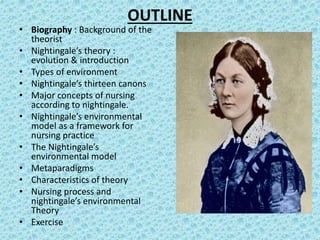
Florence Nightingale (1820–1910)
• Nightingale was born in 1820 in Florence, Italy.
• considered the founder of education and scientific
nursing
• widely known as "The Lady with the Lamp”
• Nursing training in 1851
• Worked as a nursing superintendent at the institution
for the care of sick , where she instituted many
changes to improve patient care.
• Pioneered the concept of formal nursing education
• Her experience in treating sick or injured soldiers
Crimean war strongly influenced her philosophy of
nursing
• Begin the nightingale school of nursing at st.
Thomas hospital, king’s college in London
• Based her ideas on individuals ,societal and
professional values
• Her strongest influence was education,
observation
• She formulated her values through years of
working with charities, hospitals and military
Books:
• In 1860 , NIGHTINGALE published notes on
nursing: what it is, what it is not.
• notes on hospital (1963)
• Sick nursing and health nursing(1893)
• Considered the “1st nursing theorist”
• Information has been obtained through
interpretations of her writings
• Her theory influenced three other groups of
theories :
Adaptation theory
Need theory
Stress theory
• Was a guide to organize and manipulate the
environment for persons requiring nursing care
• Died : 13 august , 1910 in London
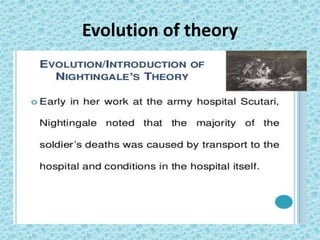
Evolution of theory
Nightingale's environmental Theory
of Nursing
 The first published Nursing theory 1860
 Core concept is environment
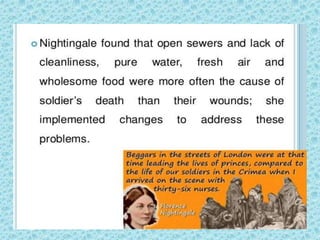
 Witnessed in 1850’s ,the vermin, deaths with in an enormous
barracks hospital, would focus on improving the environment
to assist soldiers to merely survive.
 This success gave her a strong data base on which to view
nursing in her own unique way.
 Persons are in relation with environment
 Stresses the health properties of physical environment
 Nursing puts patient in the “best condition” for nature to act
upon them
 Health is “the positive of which the pathology is negative”
 “Nature alone cures”
• When aspects of the
environment is out of
balance , the client must
see energy to counter
these environmental
stresses
• Viewed disease as a
reparative process
• The health of the home ,
community and critical
components in an
individual health
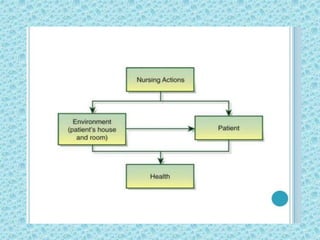
• Theory basis: The interrelationship of a healthful
environment with nursing
• External influences can suppresses disease
• Theory goal: Nurses help patients retain their own vitality
by meeting their basic needs by control of environment
• Nursing focus: Control of the environment for individuals,
families and communities.
• A patient who had surgery, appendectomy , and relate
what Nightingale processes. medicine is seen as
functioning to remove the diseased part, whereas nursing
places the patient in an environment in which nature can
assist post operative patients to reach their optimum
health conditions.
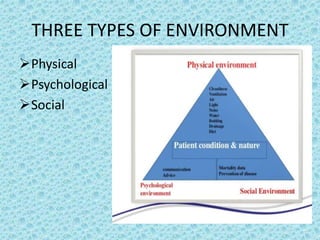
THREE TYPES OF ENVIRONMENT
Physical
Psychological
Social
PHYSICAL ENVIRONMENT
• Consist of physical elements where the patient
is being treated
• Basic factors affects all other aspects of the
environment
• Cleanliness of envt relates directly to disease
prevention and patient mortality
• Aspects of physical environment influence
social and psychological environment of
person
PSYCHOLOGICAL ENVIRONMENT
• Can be affected by a negative physical
environment which can cause stress
• Requires basic activities to keep mind active
(i.e. manual work , a pleasing envt, view of
sun light)
• Involves communication with patient
• Communication should be therapeutic ,
soothing and unhurried
• Variety and advice.
SOCIAL ENVIRONMENT
• Involves collecting data on illness and disease
prevention
• Includes such components of the physical
environment as clean air , water and proper
drainage
• Consists person’s home or hospital room or
total community affects the patient
environment
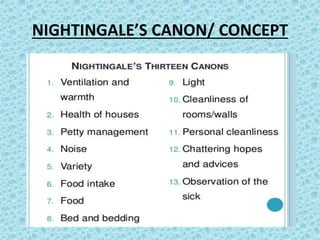
NIGHTINGALE’S CANON/ CONCEPT
MAJOR COMPONENTS OF HEALTHFUL
ENVIRONMENT
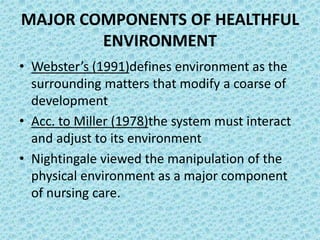
• Webster’s (1991)defines environment as the
surrounding matters that modify a coarse of
development
• Acc. to Miller (1978)the system must interact
and adjust to its environment
• Nightingale viewed the manipulation of the
physical environment as a major component
of nursing care.
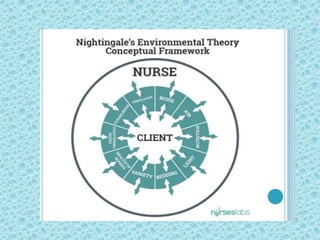
MAJOR COMPONENTS OF HEALTHFUL
ENVIORNMENT
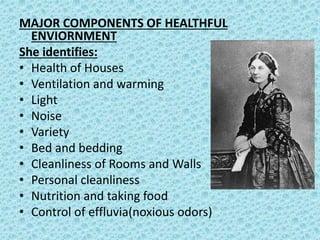
She identifies:
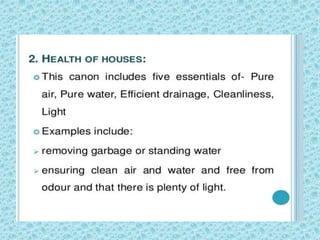
• Health of Houses
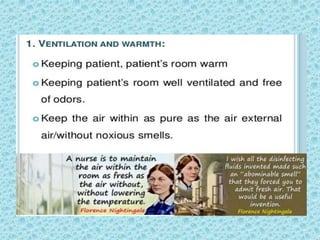
• Ventilation and warming
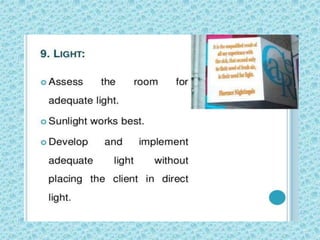
• Light
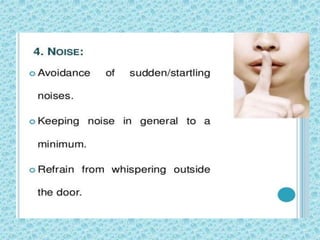
• Noise
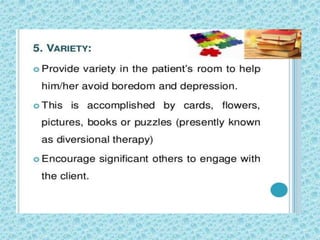
• Variety
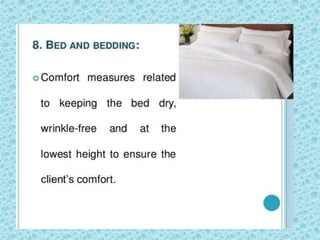
• Bed and bedding
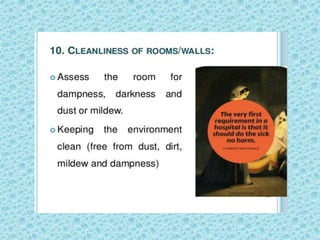
• Cleanliness of Rooms and Walls
• Personal cleanliness
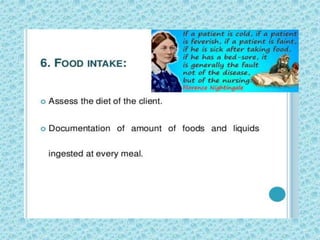
• Nutrition and taking food
• Control of effluvia(noxious odors)
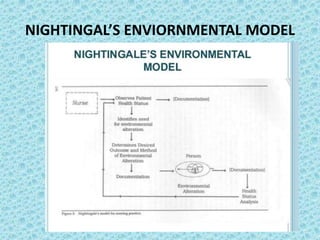
NIGHTINGAL’S ENVIORNMENTAL MODEL
NIGHTINGALE’S THEORY AND FOUR
MAJOR CONCEPTS
Metaparadigms:
1.PERSON :
• Referred by Nightingale as the’ patient’
• Person is a human being acted upon by a
nurse or affected by the environment
• Person has reparative powers to deal with
disease
• Recovery is with in the patient’s power
2.NURSING:
• ‘Is to put the patient in the best condition for
nature to act upon him’
• Aims to provide fresh air , light, warmth ,
cleanliness , a proper diet
• Facilitates patients reparative process by
ensuring the best possible environment
• Influence the environment to affect health
• Supports the nursing process
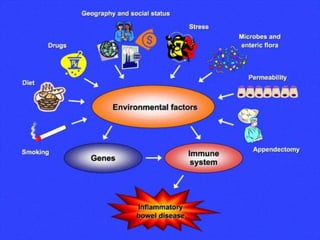
3.ENVIRONMENT:
• Foundational component of Nightingale’s
theory
• External conditions and forces affect the life
and development of individual
• Includes everything from person’s food to a
nurses verbal and non-verbal interactions in
the person
4.HEALTH:
• Is maintained by using a person's healing
power to their fullest extent
• Is maintained by controlling environmental
factors to prevent disease
• Health and disease are the focus of the nurse
,who helps a person through healing process
Characteristics of the theory
• Theories must be logical in nature
• Theories should be relatively simple yet
generalized
• Theories can be basis for hypothesis that can
be tested
• Theories helps in increasing the general body
of knowledge through the research
• Theories can be utilized by the practitioners to
guide and improve their practice
NIGHTINGALE AND THE NURSING
PROCESS
Assessment:
1.Ventilation and warming :
 Room temperature controlled ,uses an extra
blanket when patient feels cold
 Cleanliness of rooms and walls :Hospital
environment meets these satisfactorily
 Noise: 2-bed room is located near nurse
station – pt states that she has trouble in
sleeping at night due to the noise
• Taking food :can feed herself
• Light: large window in the room provides natural
lighting
• Personal cleanliness :Able to bathe with
assistance
• Observation of the sick : check vital signs
• Wounds are healing normally
DIAGNOSIS:
• Disturbed Sleep pattern related to noisy
environment as evidenced by restlessness,
tiredness, and lack of sleep.
OUTCOMES:
• Adequate amount sleep to support healing
PLANNING AND IMLEMENTATION :
• Encourage night staff to hold all conversations
quietly
• Lights are dimmed in room and call light with in
reach
• Offer earplug or watch her favorite TV show
• Encourage her to participate as much as possible
to help her become more comfortable in this new
environment
EVALUATION:
EXERCISE-1
Application of Nightingale’s theory in nursing
process.
Case of Ms. Sunita:
• Ms. Sunita, age 48 years, had admitted in female
medical ward of IGMC, Shimla, for a diagnosis of
Fever. She had complaints of high body temp.
with headache, chills, rigor, malaise, anorexia,
insomnia etc. She was in hospital for 5 days. Her
laboratory report shows that plenty of WBC’s in
urine RE and waiting for blood and urine report.
Chest X-ray normal.
Nightingale's environmental theory- Ms. Ritika soni

Nightingale's environmental theory- Ms. Ritika soni

  • 1.
    Nightingale's environmental theory “the actof utilizing the environment of the patient to assist him in his recovery”
  • 2.
    OUTLINE • Biography :Background of the theorist • Nightingale’s theory : evolution & introduction • Types of environment • Nightingale’s thirteen canons • Major concepts of nursing according to nightingale. • Nightingale’s environmental model as a framework for nursing practice • The Nightingale’s environmental model • Metaparadigms • Characteristics of theory • Nursing process and nightingale’s environmental Theory • Exercise
  • 3.
    FLORENCE NIGHTINGALE Biography : FlorenceNightingale (1820–1910) • Nightingale was born in 1820 in Florence, Italy. • considered the founder of education and scientific nursing • widely known as "The Lady with the Lamp” • Nursing training in 1851 • Worked as a nursing superintendent at the institution for the care of sick , where she instituted many changes to improve patient care. • Pioneered the concept of formal nursing education • Her experience in treating sick or injured soldiers Crimean war strongly influenced her philosophy of nursing
  • 4.
    • Begin thenightingale school of nursing at st. Thomas hospital, king’s college in London • Based her ideas on individuals ,societal and professional values • Her strongest influence was education, observation • She formulated her values through years of working with charities, hospitals and military
  • 5.
    Books: • In 1860, NIGHTINGALE published notes on nursing: what it is, what it is not. • notes on hospital (1963) • Sick nursing and health nursing(1893)
  • 6.
    • Considered the“1st nursing theorist” • Information has been obtained through interpretations of her writings • Her theory influenced three other groups of theories : Adaptation theory Need theory Stress theory • Was a guide to organize and manipulate the environment for persons requiring nursing care • Died : 13 august , 1910 in London
  • 7.
  • 10.
    Nightingale's environmental Theory ofNursing  The first published Nursing theory 1860  Core concept is environment  Witnessed in 1850’s ,the vermin, deaths with in an enormous barracks hospital, would focus on improving the environment to assist soldiers to merely survive.  This success gave her a strong data base on which to view nursing in her own unique way.  Persons are in relation with environment  Stresses the health properties of physical environment  Nursing puts patient in the “best condition” for nature to act upon them  Health is “the positive of which the pathology is negative”  “Nature alone cures”
  • 11.
    • When aspectsof the environment is out of balance , the client must see energy to counter these environmental stresses • Viewed disease as a reparative process • The health of the home , community and critical components in an individual health
  • 12.
    • Theory basis:The interrelationship of a healthful environment with nursing • External influences can suppresses disease • Theory goal: Nurses help patients retain their own vitality by meeting their basic needs by control of environment • Nursing focus: Control of the environment for individuals, families and communities. • A patient who had surgery, appendectomy , and relate what Nightingale processes. medicine is seen as functioning to remove the diseased part, whereas nursing places the patient in an environment in which nature can assist post operative patients to reach their optimum health conditions.
  • 13.
    THREE TYPES OFENVIRONMENT Physical Psychological Social
  • 14.
    PHYSICAL ENVIRONMENT • Consistof physical elements where the patient is being treated • Basic factors affects all other aspects of the environment • Cleanliness of envt relates directly to disease prevention and patient mortality • Aspects of physical environment influence social and psychological environment of person
  • 15.
    PSYCHOLOGICAL ENVIRONMENT • Canbe affected by a negative physical environment which can cause stress • Requires basic activities to keep mind active (i.e. manual work , a pleasing envt, view of sun light) • Involves communication with patient • Communication should be therapeutic , soothing and unhurried • Variety and advice.
  • 16.
    SOCIAL ENVIRONMENT • Involvescollecting data on illness and disease prevention • Includes such components of the physical environment as clean air , water and proper drainage • Consists person’s home or hospital room or total community affects the patient environment
  • 18.
  • 32.
    MAJOR COMPONENTS OFHEALTHFUL ENVIRONMENT • Webster’s (1991)defines environment as the surrounding matters that modify a coarse of development • Acc. to Miller (1978)the system must interact and adjust to its environment • Nightingale viewed the manipulation of the physical environment as a major component of nursing care.
  • 33.
    MAJOR COMPONENTS OFHEALTHFUL ENVIORNMENT She identifies: • Health of Houses • Ventilation and warming • Light • Noise • Variety • Bed and bedding • Cleanliness of Rooms and Walls • Personal cleanliness • Nutrition and taking food • Control of effluvia(noxious odors)
  • 35.
  • 37.
    NIGHTINGALE’S THEORY ANDFOUR MAJOR CONCEPTS Metaparadigms: 1.PERSON : • Referred by Nightingale as the’ patient’ • Person is a human being acted upon by a nurse or affected by the environment • Person has reparative powers to deal with disease • Recovery is with in the patient’s power
  • 38.
    2.NURSING: • ‘Is toput the patient in the best condition for nature to act upon him’ • Aims to provide fresh air , light, warmth , cleanliness , a proper diet • Facilitates patients reparative process by ensuring the best possible environment • Influence the environment to affect health • Supports the nursing process
  • 39.
    3.ENVIRONMENT: • Foundational componentof Nightingale’s theory • External conditions and forces affect the life and development of individual • Includes everything from person’s food to a nurses verbal and non-verbal interactions in the person
  • 41.
    4.HEALTH: • Is maintainedby using a person's healing power to their fullest extent • Is maintained by controlling environmental factors to prevent disease • Health and disease are the focus of the nurse ,who helps a person through healing process
  • 42.
    Characteristics of thetheory • Theories must be logical in nature • Theories should be relatively simple yet generalized • Theories can be basis for hypothesis that can be tested • Theories helps in increasing the general body of knowledge through the research • Theories can be utilized by the practitioners to guide and improve their practice
  • 43.
    NIGHTINGALE AND THENURSING PROCESS Assessment: 1.Ventilation and warming :  Room temperature controlled ,uses an extra blanket when patient feels cold  Cleanliness of rooms and walls :Hospital environment meets these satisfactorily  Noise: 2-bed room is located near nurse station – pt states that she has trouble in sleeping at night due to the noise
  • 44.
    • Taking food:can feed herself • Light: large window in the room provides natural lighting • Personal cleanliness :Able to bathe with assistance • Observation of the sick : check vital signs • Wounds are healing normally DIAGNOSIS: • Disturbed Sleep pattern related to noisy environment as evidenced by restlessness, tiredness, and lack of sleep.
  • 45.
    OUTCOMES: • Adequate amountsleep to support healing PLANNING AND IMLEMENTATION : • Encourage night staff to hold all conversations quietly • Lights are dimmed in room and call light with in reach • Offer earplug or watch her favorite TV show • Encourage her to participate as much as possible to help her become more comfortable in this new environment EVALUATION:
  • 46.
    EXERCISE-1 Application of Nightingale’stheory in nursing process. Case of Ms. Sunita: • Ms. Sunita, age 48 years, had admitted in female medical ward of IGMC, Shimla, for a diagnosis of Fever. She had complaints of high body temp. with headache, chills, rigor, malaise, anorexia, insomnia etc. She was in hospital for 5 days. Her laboratory report shows that plenty of WBC’s in urine RE and waiting for blood and urine report. Chest X-ray normal.

Editor's Notes