 Theory is a creative and rigorous structuring
of ideas that projects a tentative ,purposeful
, and systematic view of phenomena. (Chinn
& Kramer, 2004)
 Theory is a set of concepts , definitions, and
propositions that projects a systematic view
of phenomena by designing specific
interrelationships among concepts for
purposes of describing , explaining ,
predicting and, /or controlling phenomena.(
Chinn & Jacob)
 Nursing Theory is a conceptualization of
some aspect of reality (invented or
discovered ) That pertains to nursing. The
conceptualization is articulated for the
purpose of describing , explaining, predicting
or prescribing nursing care. (Meleis1997)
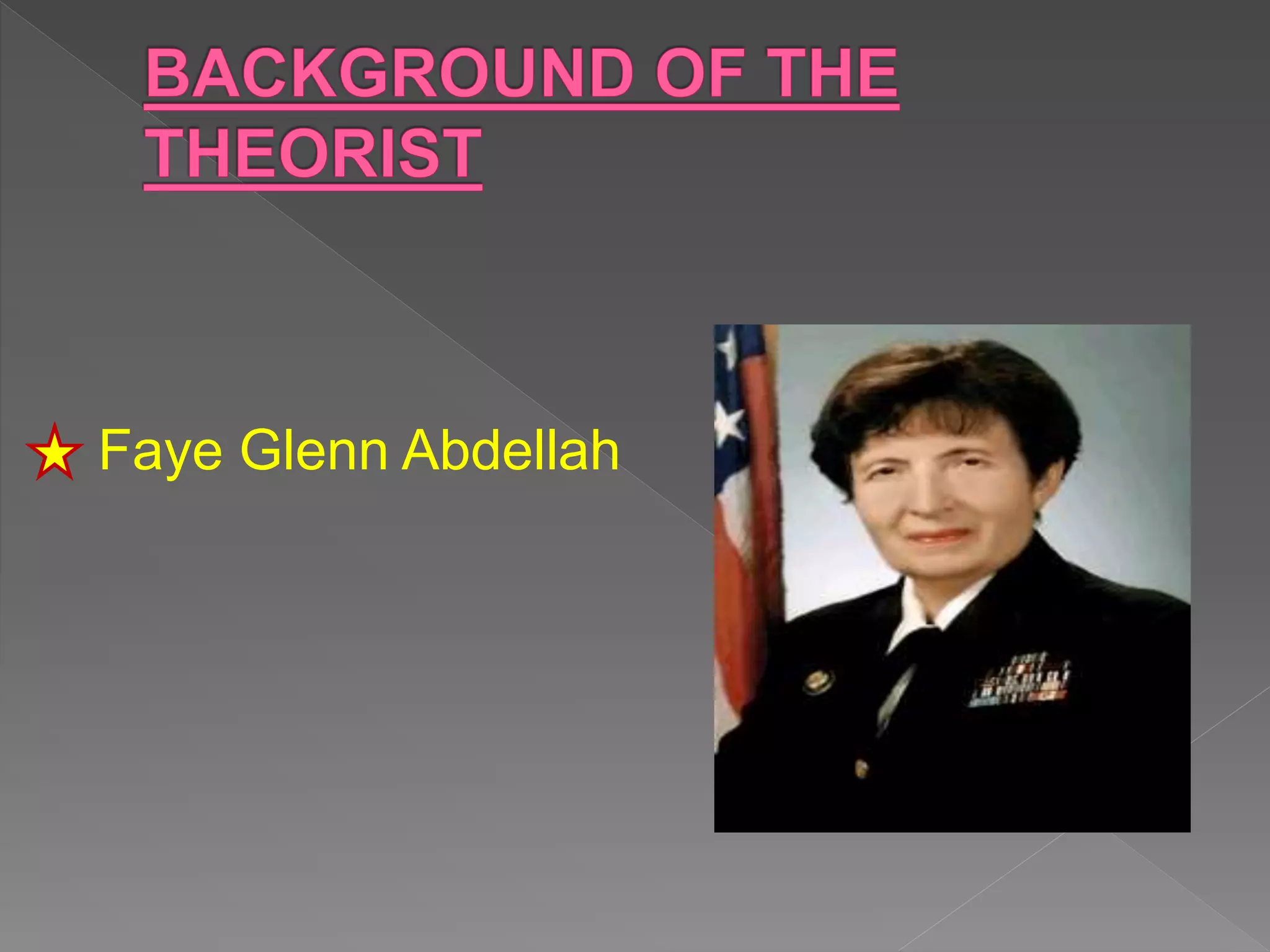
Faye Glenn Abdellah
 Born in New York City on 13th March 1919
 Graduated from Fitkin Memorial Hospital
School of Nursing Neptune , New Jersy in
1942.
 B.S; MA; Ed D from Teachers College ,
Columbia University , New York in 1945-
1955 .
 Chief Nurse officer at USPHS in 1970
 Deputy Surgeon General in 1982-1989
 CharterFellow of the American academy of
Nursing
 She had worked as a Staff Nurse, Head
Nurse, and Faculty member at Yale
university
 As Public health Nurse and a Researcher at
Columbia University
 Author of more than 146 books
 The major component of Abdellah’s typology
is a list of nursing problems , or healthcare
needs of the client.
 She defined a nursing problem as any
condition presented or faced by a client or
family for which a nurse can offer
assistance.
 The problem can be an overt (an apparent
condition faced by a client or family ) or
covert (a concealed or hidden condition).
 They also identified 10 steps to identify the
client’s problems
 The assumptions Abdellah’s “21 Nursing
Problems Theory” relate to change and
anticipated changes that affect nursing; the
need to appreciate the interconnectedness
of social enterprises and social problems;.
 the impact of problems such as poverty,
racism, pollution, education, and so forth on
health and health care delivery; changing
nursing education; continuing education for
professional nurses; and development of
nursing leaders from underserved groups
 identifying the problem,
 selecting pertinent data,
 formulating hypotheses,
 testing hypotheses through the collection of
data, and
 revising hypotheses when necessary on the
basis of conclusions obtained from the data.
 Better nursing care after evidence-based
researches
 Nursing is patient centered which focuses on
the health needs of the individual
 21 Nursing problems as the guidelines in
nursing care
 To include family of the patient in the nursing
care plan
 To maintain good hygiene and physical
comfort
 To promote optimal activity: exercise, rest,
sleep
 To promote safety through prevention of
accident, injury, or other trauma and through
prevention of the spread of infection
 To maintain good body mechanics and
prevent and correct deformity
 To facilitate the maintenance of a supply of
oxygen to all body cells
 To facilitate the maintenance of nutrition for
all body cells
 To facilitate the maintenance of elimination
 To facilitate the maintenance of fluid and
electrolyte balance
 To recognize the physiologic responses of
the body to disease conditions—pathologic,
physiologic, and compensatory
 To facilitate the maintenance of regulatory
mechanisms and functions
 To facilitate the maintenance of sensory
function
 To identify and accept positive and negative
expressions, feelings, and reactions
 To identify and accept interrelatedness of
emotions and organic illness
 To facilitate the maintenance of effective verbal
and nonverbal communication
 To promote the development of productive
interpersonal relationships
 To facilitate progress toward achievement and
personal spiritual goals
 To create or maintain a therapeutic environment
 To facilitate awareness of self as an
individual with varying physical, emotional,
and developmental needs
 To accept the optimum possible goals in the
light of limitations, physical and emotional
 To use community resources as an aid in
resolving problems that arise from illness
 To understand the role of social problems as
influencing factors in the cause of illness
 Learn to know the patient.
 Sort out relevant and significant data.
 Make generalizations about available data in
relation to similar nursing problems
presented by other patients.
 Identify the therapeutic plan.
 Test generalizations with the patient and
make additional generalizations.
 Validate the patient’s conclusions about his
nursing problems.
 Continue to observe and evaluate the patient
over a period of time to identify any attitudes
and clues affecting his or her behavior.
 Explore the patient and his or her family’s
reactions to the therapeutic plan and involve
them in the plan.
 Identify how the nurses feel about the
patient’s nursing problems.
 Discuss and develop a comprehensive
nursing care plan.
 Quality professional nursing care requires
that nurses be able to identify and solve
overt and covert nursing problems. These
requirements can be met by the problem-
solving process involves
ASSESSMENT
NURSING DIAGNOSISEVALUATION
IMPLEMENTATION PLANNING
 Mr Ramu, 52 yrs ,experienced severe chest
pain and admitted on Cardiac ICU. In
addition he experienced shortness of
breadth, tachycardia and profuse
diaphoresis. He had gone through similar
episodes since past 2 years.
 Acute pain related to severe chest pain as
evidenced by pain scale shows 8 on 1-10 scale.
 Decreased cardiac output related to inadequate
blood pump by heart as evidenced by
alterations in rate and rhythm
 Ineffective breathing pattern related to
dyspnea as evidenced by decreased oxygen
supply to the cells
 Impaired gas exchange related to shortness
of breadth as evidenced by spo2-86%
 Ineffective tissue perfusion related to
decreased cardiac output as evidenced by
difficulty of breathing
 Activity intolerance related to imbalance
between oxygen demand as evidenced by
dyspnea
 Deficient knowledge related to regarding
condition as evidenced by lack of
understanding
 Generalizable
 To guide various activities
 Language
 Logical in nature.
 Strong nurse-centered orientation
 Lack of emphasis
 Framework seems to focus quite heavily
 Inconsistent with the concept of holism
Abdellah's ppt current

Abdellah's ppt current

  • 3.
     Theory isa creative and rigorous structuring of ideas that projects a tentative ,purposeful , and systematic view of phenomena. (Chinn & Kramer, 2004)
  • 4.
     Theory isa set of concepts , definitions, and propositions that projects a systematic view of phenomena by designing specific interrelationships among concepts for purposes of describing , explaining , predicting and, /or controlling phenomena.( Chinn & Jacob)
  • 5.
     Nursing Theoryis a conceptualization of some aspect of reality (invented or discovered ) That pertains to nursing. The conceptualization is articulated for the purpose of describing , explaining, predicting or prescribing nursing care. (Meleis1997)
  • 6.
  • 7.
     Born inNew York City on 13th March 1919  Graduated from Fitkin Memorial Hospital School of Nursing Neptune , New Jersy in 1942.  B.S; MA; Ed D from Teachers College , Columbia University , New York in 1945- 1955 .
  • 8.
     Chief Nurseofficer at USPHS in 1970  Deputy Surgeon General in 1982-1989  CharterFellow of the American academy of Nursing  She had worked as a Staff Nurse, Head Nurse, and Faculty member at Yale university
  • 9.
     As Publichealth Nurse and a Researcher at Columbia University  Author of more than 146 books
  • 10.
     The majorcomponent of Abdellah’s typology is a list of nursing problems , or healthcare needs of the client.  She defined a nursing problem as any condition presented or faced by a client or family for which a nurse can offer assistance.
  • 11.
     The problemcan be an overt (an apparent condition faced by a client or family ) or covert (a concealed or hidden condition).  They also identified 10 steps to identify the client’s problems
  • 12.
     The assumptionsAbdellah’s “21 Nursing Problems Theory” relate to change and anticipated changes that affect nursing; the need to appreciate the interconnectedness of social enterprises and social problems;.
  • 13.
     the impactof problems such as poverty, racism, pollution, education, and so forth on health and health care delivery; changing nursing education; continuing education for professional nurses; and development of nursing leaders from underserved groups
  • 14.
     identifying theproblem,  selecting pertinent data,  formulating hypotheses,  testing hypotheses through the collection of data, and  revising hypotheses when necessary on the basis of conclusions obtained from the data.
  • 15.
     Better nursingcare after evidence-based researches  Nursing is patient centered which focuses on the health needs of the individual  21 Nursing problems as the guidelines in nursing care  To include family of the patient in the nursing care plan
  • 16.
     To maintaingood hygiene and physical comfort  To promote optimal activity: exercise, rest, sleep  To promote safety through prevention of accident, injury, or other trauma and through prevention of the spread of infection
  • 17.
     To maintaingood body mechanics and prevent and correct deformity  To facilitate the maintenance of a supply of oxygen to all body cells  To facilitate the maintenance of nutrition for all body cells  To facilitate the maintenance of elimination
  • 18.
     To facilitatethe maintenance of fluid and electrolyte balance  To recognize the physiologic responses of the body to disease conditions—pathologic, physiologic, and compensatory  To facilitate the maintenance of regulatory mechanisms and functions
  • 19.
     To facilitatethe maintenance of sensory function  To identify and accept positive and negative expressions, feelings, and reactions  To identify and accept interrelatedness of emotions and organic illness
  • 20.
     To facilitatethe maintenance of effective verbal and nonverbal communication  To promote the development of productive interpersonal relationships  To facilitate progress toward achievement and personal spiritual goals  To create or maintain a therapeutic environment
  • 21.
     To facilitateawareness of self as an individual with varying physical, emotional, and developmental needs  To accept the optimum possible goals in the light of limitations, physical and emotional
  • 22.
     To usecommunity resources as an aid in resolving problems that arise from illness  To understand the role of social problems as influencing factors in the cause of illness
  • 23.
     Learn toknow the patient.  Sort out relevant and significant data.  Make generalizations about available data in relation to similar nursing problems presented by other patients.
  • 24.
     Identify thetherapeutic plan.  Test generalizations with the patient and make additional generalizations.  Validate the patient’s conclusions about his nursing problems.
  • 25.
     Continue toobserve and evaluate the patient over a period of time to identify any attitudes and clues affecting his or her behavior.  Explore the patient and his or her family’s reactions to the therapeutic plan and involve them in the plan.
  • 26.
     Identify howthe nurses feel about the patient’s nursing problems.  Discuss and develop a comprehensive nursing care plan.
  • 27.
     Quality professionalnursing care requires that nurses be able to identify and solve overt and covert nursing problems. These requirements can be met by the problem- solving process involves
  • 28.
  • 29.
     Mr Ramu,52 yrs ,experienced severe chest pain and admitted on Cardiac ICU. In addition he experienced shortness of breadth, tachycardia and profuse diaphoresis. He had gone through similar episodes since past 2 years.
  • 30.
     Acute painrelated to severe chest pain as evidenced by pain scale shows 8 on 1-10 scale.  Decreased cardiac output related to inadequate blood pump by heart as evidenced by alterations in rate and rhythm
  • 31.
     Ineffective breathingpattern related to dyspnea as evidenced by decreased oxygen supply to the cells  Impaired gas exchange related to shortness of breadth as evidenced by spo2-86%
  • 32.
     Ineffective tissueperfusion related to decreased cardiac output as evidenced by difficulty of breathing  Activity intolerance related to imbalance between oxygen demand as evidenced by dyspnea
  • 33.
     Deficient knowledgerelated to regarding condition as evidenced by lack of understanding
  • 34.
     Generalizable  Toguide various activities  Language  Logical in nature.
  • 35.
     Strong nurse-centeredorientation  Lack of emphasis  Framework seems to focus quite heavily  Inconsistent with the concept of holism