THE LIFE OFABDELLAH (1919-2017)
■ March 13, 1919: was born in New York to a father of
Algerian heritage and a Scottish mother.
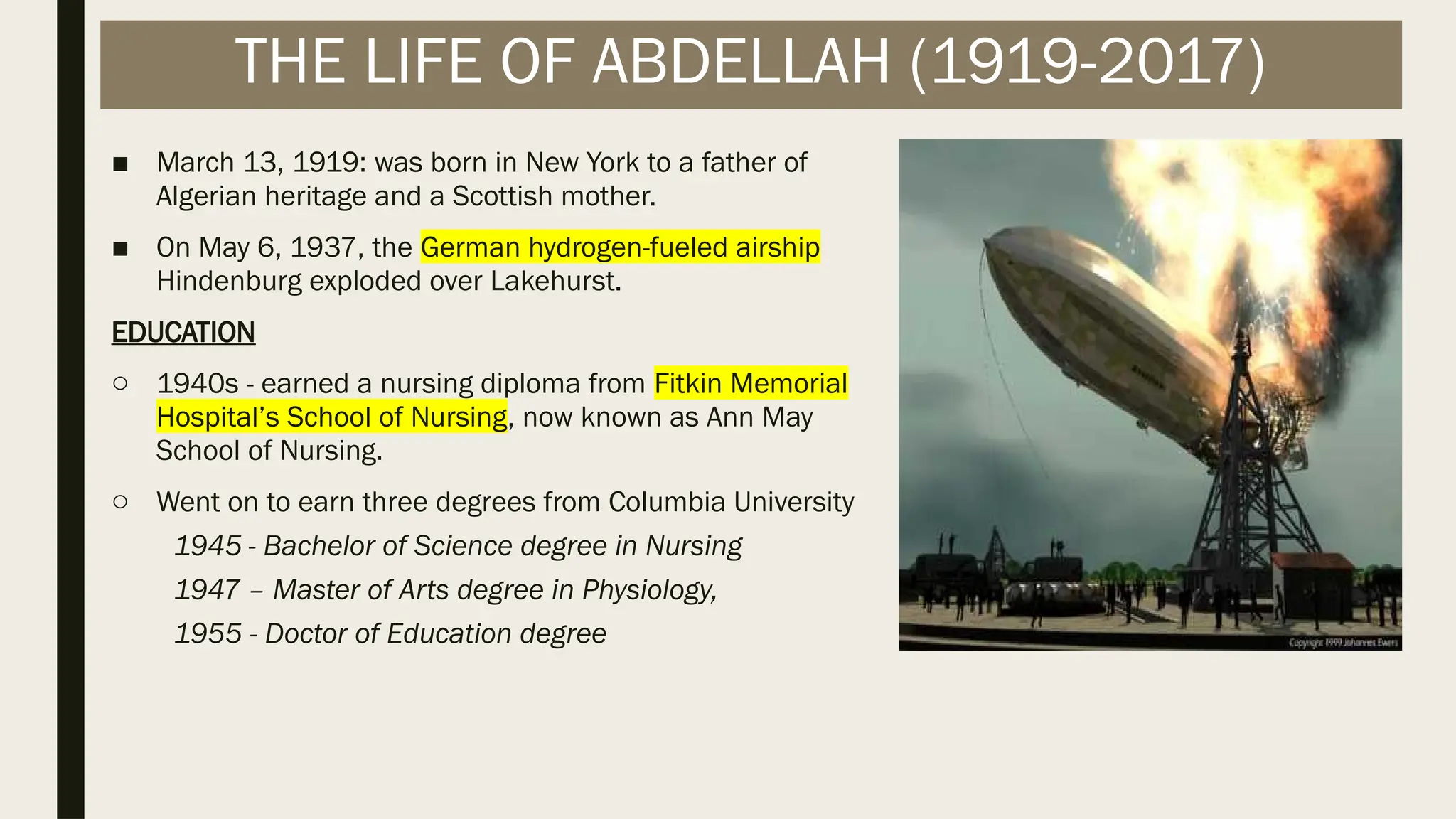
■ On May 6, 1937, the German hydrogen-fueled airship
Hindenburg exploded over Lakehurst.
EDUCATION
o 1940s - earned a nursing diploma from Fitkin Memorial
Hospital’s School of Nursing, now known as Ann May
School of Nursing.
o Went on to earn three degrees from Columbia University
1945 - Bachelor of Science degree in Nursing
1947 – Master of Arts degree in Physiology,
1955 - Doctor of Education degree
3.
CAREER AND APPOINTMENTS
1.EDUCATOR
1945-1949 - faculty of Yale University
■ She was required to teach a class called “120 Principles of Nursing Practice,”
using a standard nursing textbook published by the National League for
Nursing
■ The book included guidelines that had no scientific basis, which challenged
Abdellah to explain everything she called the “brilliant” students.
2. RESEARCHER
1949 - joined the Public Health Service
■ Her first assignment was with the division of nursing that focused on
research and studies.
■ They performed studies with numerous hospitals to improve nursing practice.
■ Nursing education, she argued, should be based on research.
1957, Abdellah spearheaded a research team in Manchester, Connecticut, that
established the groundwork for what became known as progressive patient care.
- In this framework, critical care patients were treated in an intensive care unit,
followed by a transition to immediate care and then home care.
THE LIFE OF ABDELLAH (1919-2017)
4.
CAREER AND APPOINTMENTS
3.Military Nursing Service
- 1949 to 1989 - 40-year career as a Commissioned Officer in
the U.S. Public Health Service
■ Assigned to work with the Korean people during the Korean
War.
■ She was alternatively assigned to Japan, China, Russia,
Australia, and the Scandinavian countries to identify the
Public Health Service’s role in dealing with various health
problems.
- 1970 to 1987 - served as Chief Nurse Officer from and was
the first nurse to achieve the rank of a two-star Flag Officer
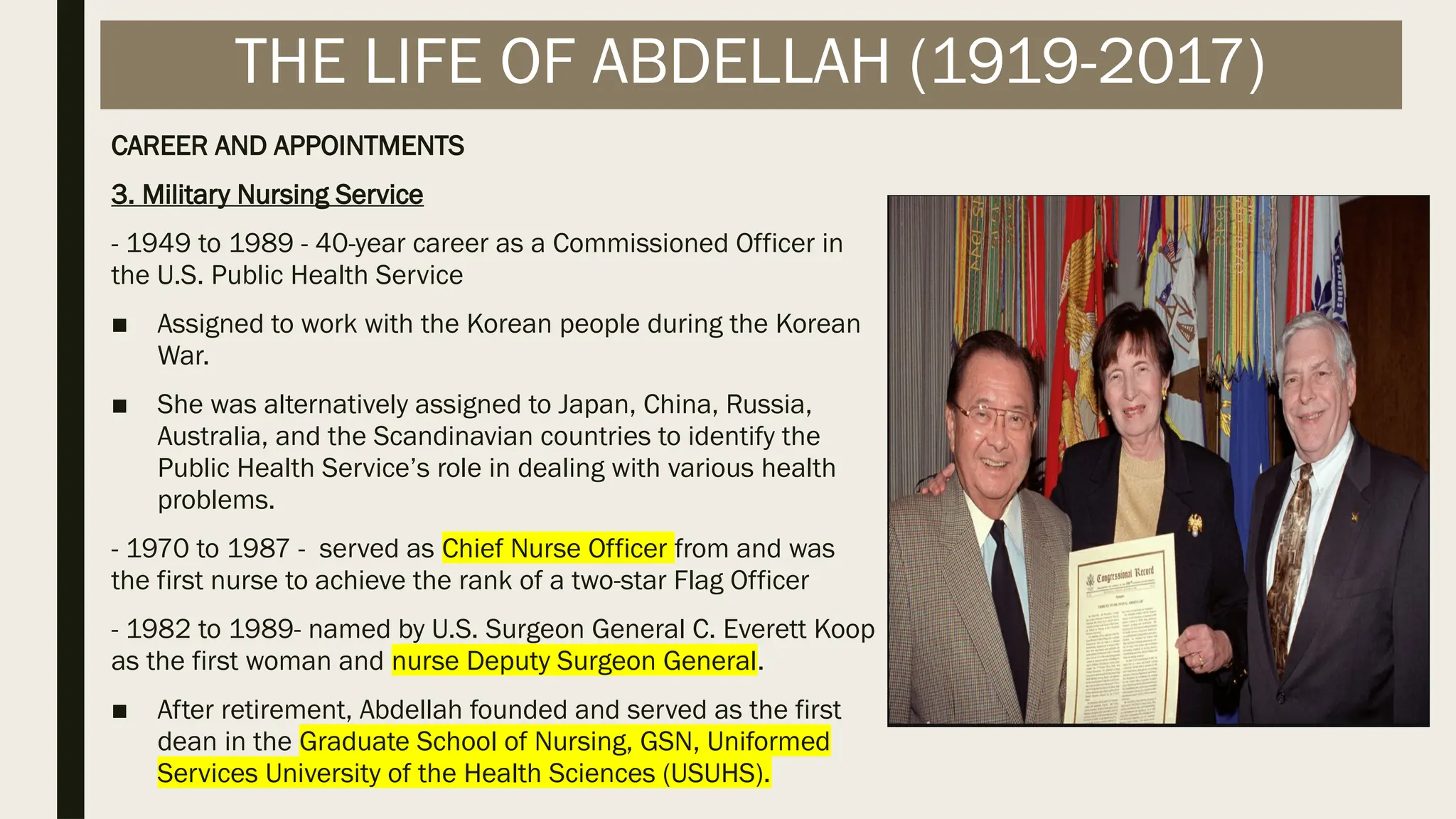
- 1982 to 1989- named by U.S. Surgeon General C. Everett Koop
as the first woman and nurse Deputy Surgeon General.
■ After retirement, Abdellah founded and served as the first
dean in the Graduate School of Nursing, GSN, Uniformed
Services University of the Health Sciences (USUHS).
THE LIFE OF ABDELLAH (1919-2017)
5.
OTHER WORKS ANDAWARS
■ She also served as a research consultant to the World Health
Organization.
■ She has been active in professional nursing associations and is a
prolific author, with more than 150 publications. (incl. Better
Nursing Care Through Nursing Research and Patient-Centered
Approaches to Nursing. )
■ She also developed educational materials in many areas of public
health, including AIDS, hospice care, and drug addiction.
■ in 1994, was named a “living legend” by the American Academy
of Nursing.
■ In 2000, was inducted into the National Women’s Hall of Fame
for a lifetime spent establishing and leading essential health care
programs for the United States.
■ In 2012, Abdellah was inducted into the American Nurses
Association Hall of Fame for a lifetime of contributions to nursing.
■ Her contributions to nursing and public health have been
recognized with almost 90 professional and academic honors.
THE LIFE OF ABDELLAH (1919-2017)
6.
ABDELLAH’S 21 NURSINGPROBLEMS THEORY
■ According to Faye Glenn Abdellah’s theory, “Nursing is based on an
art and science that molds the attitudes, intellectual competencies,
and technical skills of the individual nurse into the desire and
ability to help people, sick or well, cope with their health needs.”
■ “Twenty-One Nursing Problems Theory” that has interrelated the
concepts of health, nursing problems, and problem-solving.
■ She used Henderson’s 14 basic human needs and nursing
research to establish the classification of nursing problems.
■ The patient-centered approach to nursing was developed from
Abdellah’s practice, and the theory is considered a human needs
theory.
7.
1. Person:
■ Allpersons have self-help abilities and the capacity to learn, both of which vary
from one individual to another
2. Health:
■ A state when the individual has no unmet needs and no anticipated or actual
impairments
3. Environment:
■ Included in “planning of optimum health on local, state, national, and
international levels”
4. Nursing:
■ An all-inclusive service that is based on the discipline of art and science that
serves individuals, sick or well, cope with their health needs
METAPARADIGM OF NURSING
8.
Health
■ “total healthneeds” and
“a healthy state of mind
and body.”
■ Health may be defined as
the dynamic pattern of
functioning whereby
there is a continued
interaction with internal
and external forces that
results in the optimal use
of necessary resources to
minimize vulnerabilities.
MAJOR CONCEPTS
Nursing Problems
■ The client’s health needs
can be viewed as
problems, overt as an
apparent condition, or
covert as a hidden or
concealed one.
■ Because covert problems
can be emotional,
sociological, and
interpersonal in nature,
they are often missed or
misunderstood. Yet, in
many instances, solving
the covert problems may
solve the overt problems
as well.
Problem Solving
■ The problem-solving
process can meet these
requirements by
identifying the problem,
selecting pertinent data,
formulating hypotheses,
testing hypotheses
through collecting data,
and revising hypotheses
when necessary based
on conclusions obtained
from the data.
1.To maintain goodhygiene and
physical comfort.
2.To promote optimal activity: exercise,
rest, sleep
3.To promote safety by preventing accidents,
injuries, or other trauma and preventing the
spread of infection.
4.To maintain good body mechanics and
prevent and correct the deformity.
5.To facilitate the maintenance of a supply
of oxygen to all body cells.
6.To facilitate the maintenance
of nutrition for all body cells.
7.To facilitate the maintenance of elimination.
8.To facilitate the maintenance of fluid and
electrolyte balance.
9.To recognize the physiologic responses of
the body to disease conditions—pathologic,
physiologic, and compensatory.
10.To facilitate the maintenance of regulatory
11.To facilitate the maintenance of sensory
function.
12.To identify and accept positive and
negative expressions, feelings, and
reactions.
13.To identify and accept interrelatedness of
emotions and organic illness.
14.To facilitate the maintenance of effective
verbal and nonverbal communication.
15.To promote the development of
productive interpersonal relationships.
16.To facilitate progress toward achievement
and personal spiritual goals.
17.To create or maintain a therapeutic
environment.
18.To facilitate awareness of self as an
individual with varying physical,
emotional, and developmental needs.
19.To accept the optimum possible goals in
the light of limitations, physical and
emotional.
20.To use community resources as an aid in
Abdellah’s 21 Nursing
Problems
Problem-solving Method
10 Stepsto identify the Patient’s
Problem
1. Learn to know the patient.
2. Sort out relevant and significant data.
3. Make generalizations about available data concerning similar nursing
problems presented by other patients.
4. Identify the therapeutic plan.
5. Test generalizations with the patient and make additional
generalizations.
6. Validate the patient’s conclusions about his nursing problems.
7. Continue to observe and evaluate the patient over a period of time to
identify any attitudes and clues affecting his or her behavior.
8. Explore the patient and their family’s reactions to the therapeutic plan
and involve them in the plan.
9. Identify how the nurses feel about the patient’s nursing problems.
10. Discuss and develop a comprehensive nursing care plan.
16.
ABDELLAH’S 11 NURSINGSKILLS
1. Observation of health status
2. Skills of communication
3. Application of knowledge
4. The teaching of patients and families
5. Planning and organization of work
6. Use of resource materials
7. Use of personnel resources
8. Problem-solving
9. The direction of work of others
10. Therapeutic uses of the self
11. Nursing procedure
17.
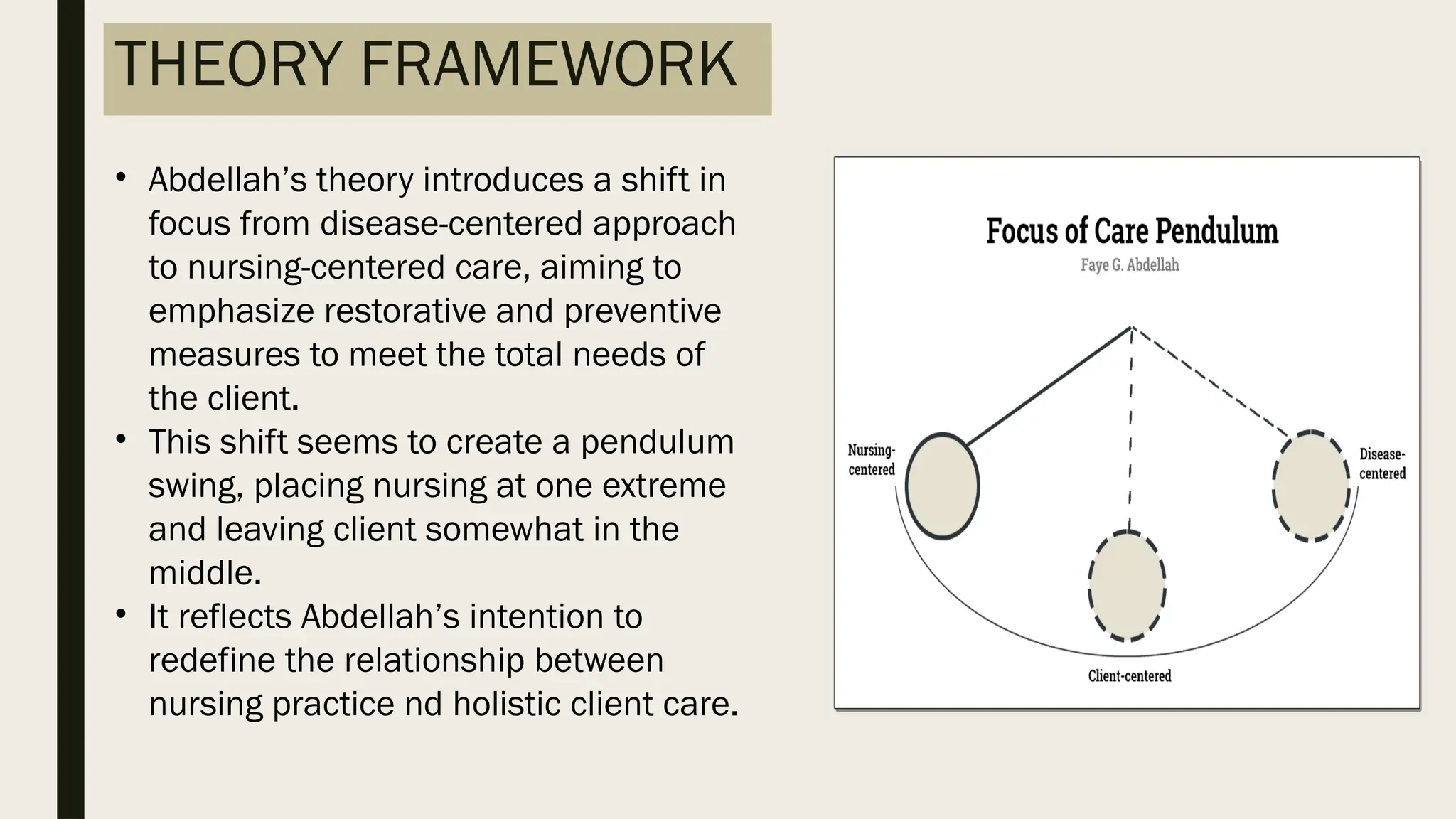
THEORY FRAMEWORK
• Abdellah’stheory introduces a shift in
focus from disease-centered approach
to nursing-centered care, aiming to
emphasize restorative and preventive
measures to meet the total needs of
the client.
• This shift seems to create a pendulum
swing, placing nursing at one extreme
and leaving client somewhat in the
middle.
• It reflects Abdellah’s intention to
redefine the relationship between
nursing practice nd holistic client care.
18.
APPLICATIONS
A. Nursing Practice
The theory outlines a systematic approach to patient care, encompassing the five essential stages:
Assessment, Nursing Diagnosis, Planning, Implementation, and Evaluation (ADPIE)
■ In the assessment phase, the nursing problems implement a standard procedure for data
collection. A principle underlying the problem-solving approach is that for each identified problem,
pertinent data is collected. The overt or covert nature of problems necessitates a direct or indirect
approach, respectively.
■ The outcome of the collection of data in the first phase concludes the patient’s possible problems,
which can be grouped under one or more of the broader nursing problems. This will further lead to
the nursing diagnosis.
■ After formulating the diagnosis, a nursing care plan is developed, and appropriate nursing
interventions are determined. The nurse now sets those interventions in action, which complete
the implementation phase of the nursing process.
■ The evaluation takes place after the interventions have been carried out. The most convenient
evaluation would be the nurse’s progress or lack of progress toward achieving the goals
established in the planning phase.
19.
APPLICATIONS
B. Nursing Research
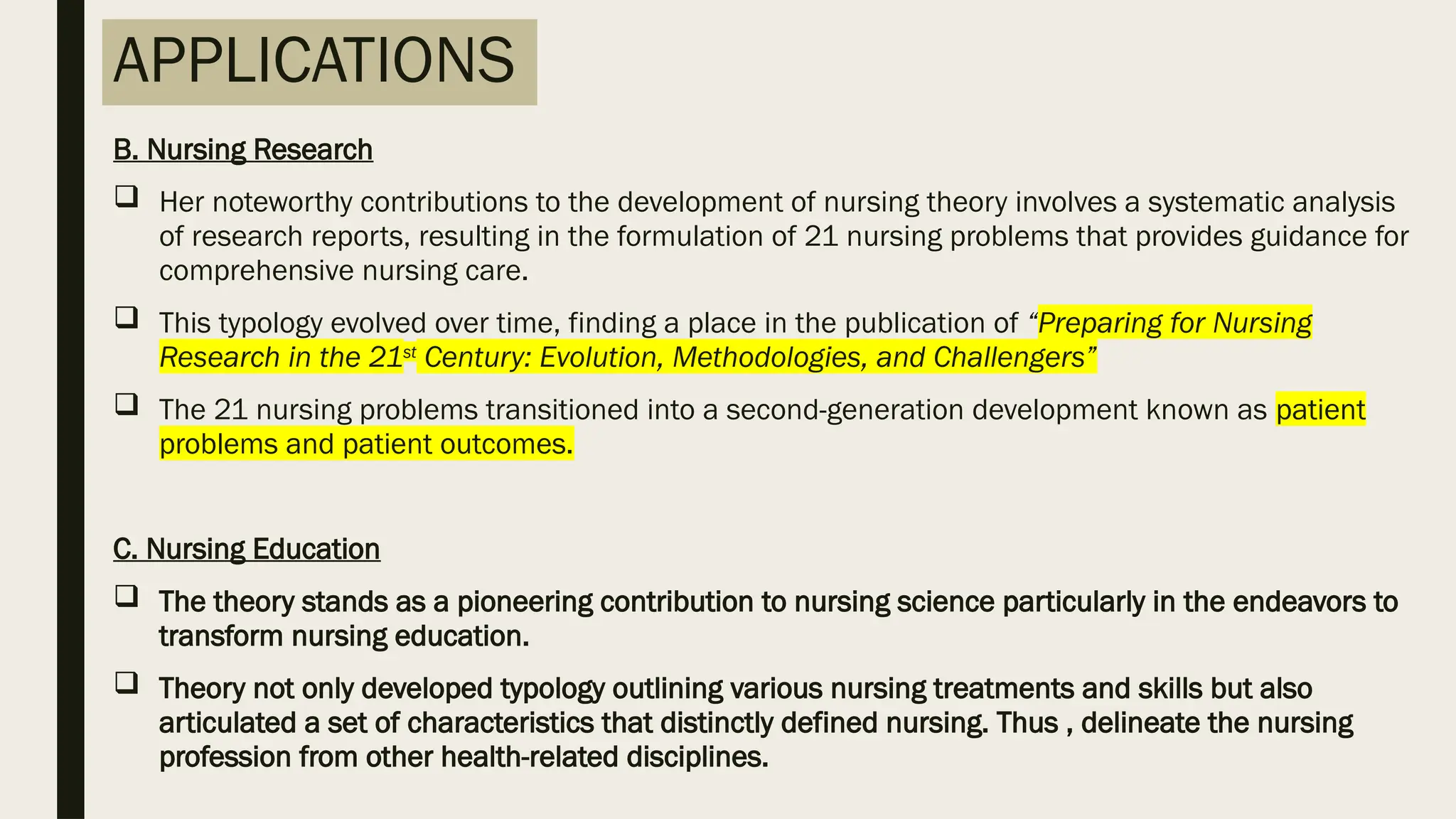
Her noteworthy contributions to the development of nursing theory involves a systematic analysis
of research reports, resulting in the formulation of 21 nursing problems that provides guidance for
comprehensive nursing care.
This typology evolved over time, finding a place in the publication of “Preparing for Nursing
Research in the 21st
Century: Evolution, Methodologies, and Challengers”
The 21 nursing problems transitioned into a second-generation development known as patient
problems and patient outcomes.
C. Nursing Education
The theory stands as a pioneering contribution to nursing science particularly in the endeavors to
transform nursing education.
Theory not only developed typology outlining various nursing treatments and skills but also
articulated a set of characteristics that distinctly defined nursing. Thus , delineate the nursing
profession from other health-related disciplines.
20.
ACTIVITY
■ THERE are10 scenarios provided. Using Abdellah’s theory, provide which of the typologies of 21
nursing problems is appropriate for the scenarios.
■ Group yourself into 10. 1 group will have 1 scenario.
21.
QUIZ No. 1
STRICTLYNO ERASURES
Part I – Identification (5 items)
1. The 21 Nursing Problems Theory adapted from which Theorist?
2. Year when Faye Abdellah earned her Doctor of Education degree.
3. The term for hidden or concealed health problems in Abdellah’s theory.
4. Name of the research framework where critical patients are treated in
ICU, then moved to immediate care, then home care.
5. The first woman and nurse to become Deputy Surgeon General of the
United States.
22.
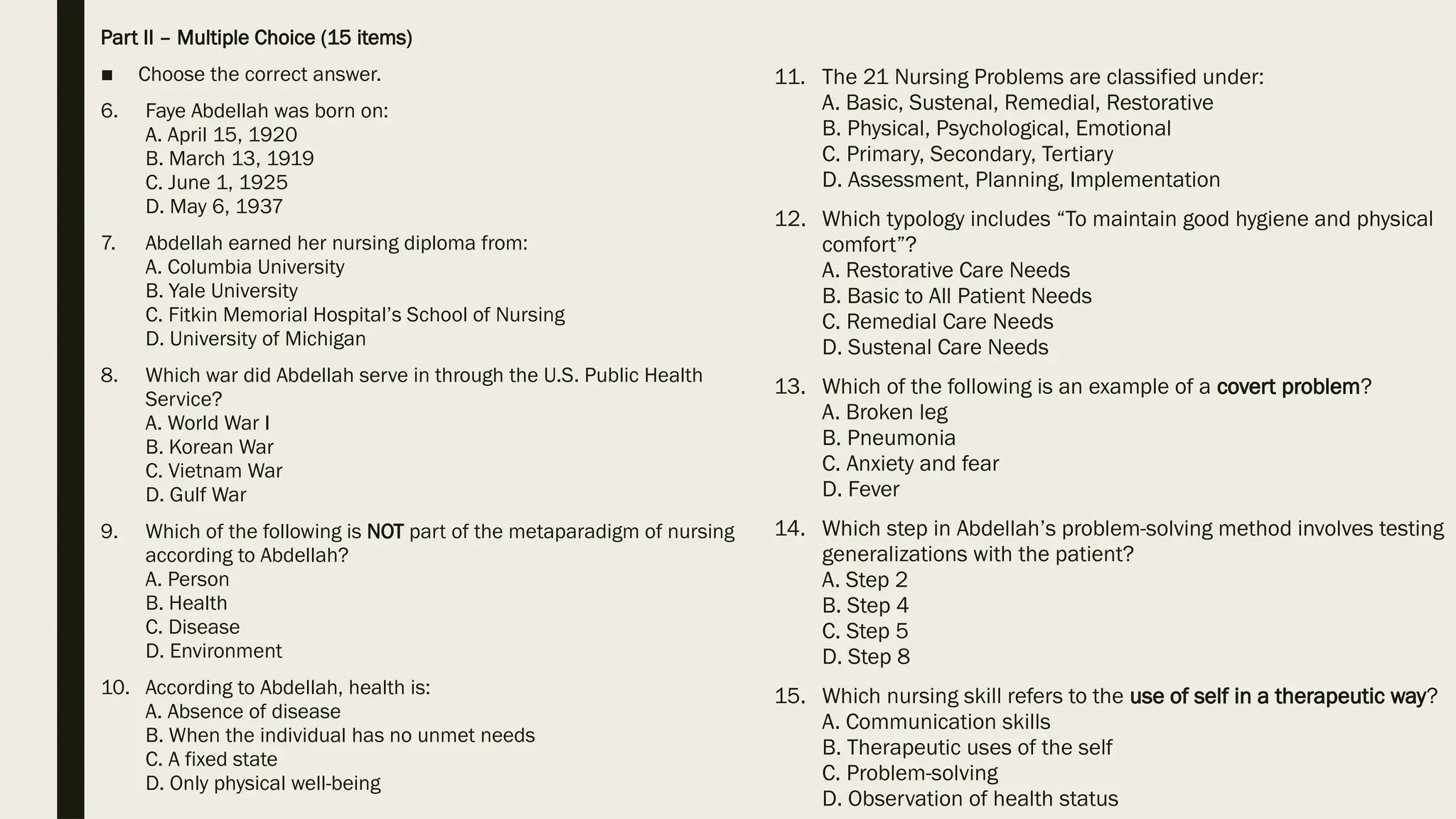
Part II –Multiple Choice (15 items)
■ Choose the correct answer.
6. Faye Abdellah was born on:
A. April 15, 1920
B. March 13, 1919
C. June 1, 1925
D. May 6, 1937
7. Abdellah earned her nursing diploma from:
A. Columbia University
B. Yale University
C. Fitkin Memorial Hospital’s School of Nursing
D. University of Michigan
8. Which war did Abdellah serve in through the U.S. Public Health
Service?
A. World War I
B. Korean War
C. Vietnam War
D. Gulf War
9. Which of the following is NOT part of the metaparadigm of nursing
according to Abdellah?
A. Person
B. Health
C. Disease
D. Environment
10. According to Abdellah, health is:
A. Absence of disease
B. When the individual has no unmet needs
C. A fixed state
D. Only physical well-being
11. The 21 Nursing Problems are classified under:
A. Basic, Sustenal, Remedial, Restorative
B. Physical, Psychological, Emotional
C. Primary, Secondary, Tertiary
D. Assessment, Planning, Implementation
12. Which typology includes “To maintain good hygiene and physical
comfort”?
A. Restorative Care Needs
B. Basic to All Patient Needs
C. Remedial Care Needs
D. Sustenal Care Needs
13. Which of the following is an example of a covert problem?
A. Broken leg
B. Pneumonia
C. Anxiety and fear
D. Fever
14. Which step in Abdellah’s problem-solving method involves testing
generalizations with the patient?
A. Step 2
B. Step 4
C. Step 5
D. Step 8
15. Which nursing skill refers to the use of self in a therapeutic way?
A. Communication skills
B. Therapeutic uses of the self
C. Problem-solving
D. Observation of health status
23.
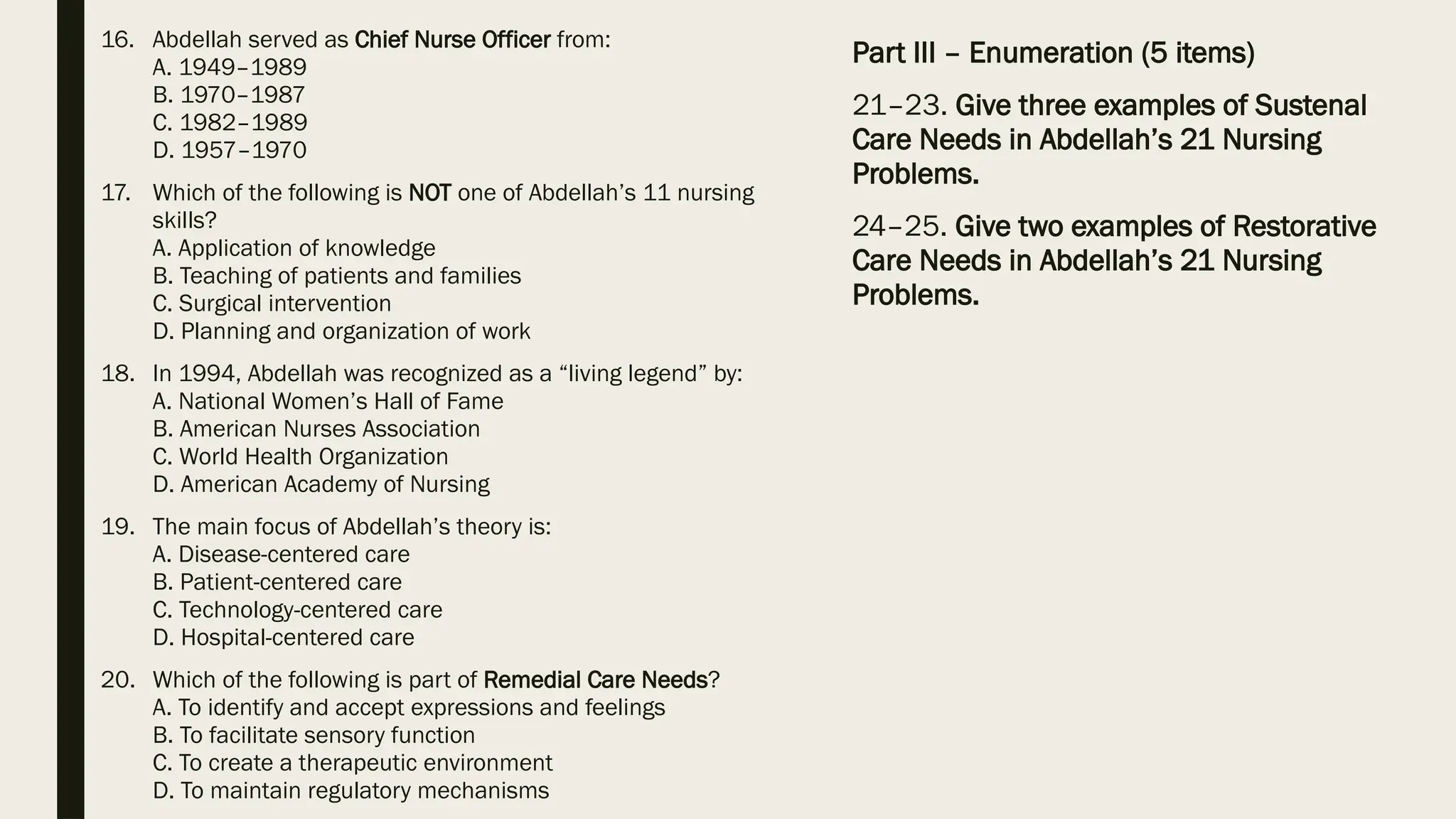
16. Abdellah servedas Chief Nurse Officer from:
A. 1949–1989
B. 1970–1987
C. 1982–1989
D. 1957–1970
17. Which of the following is NOT one of Abdellah’s 11 nursing
skills?
A. Application of knowledge
B. Teaching of patients and families
C. Surgical intervention
D. Planning and organization of work
18. In 1994, Abdellah was recognized as a “living legend” by:
A. National Women’s Hall of Fame
B. American Nurses Association
C. World Health Organization
D. American Academy of Nursing
19. The main focus of Abdellah’s theory is:
A. Disease-centered care
B. Patient-centered care
C. Technology-centered care
D. Hospital-centered care
20. Which of the following is part of Remedial Care Needs?
A. To identify and accept expressions and feelings
B. To facilitate sensory function
C. To create a therapeutic environment
D. To maintain regulatory mechanisms
Part III – Enumeration (5 items)
21–23. Give three examples of Sustenal
Care Needs in Abdellah’s 21 Nursing
Problems.
24–25. Give two examples of Restorative
Care Needs in Abdellah’s 21 Nursing
Problems.
24.
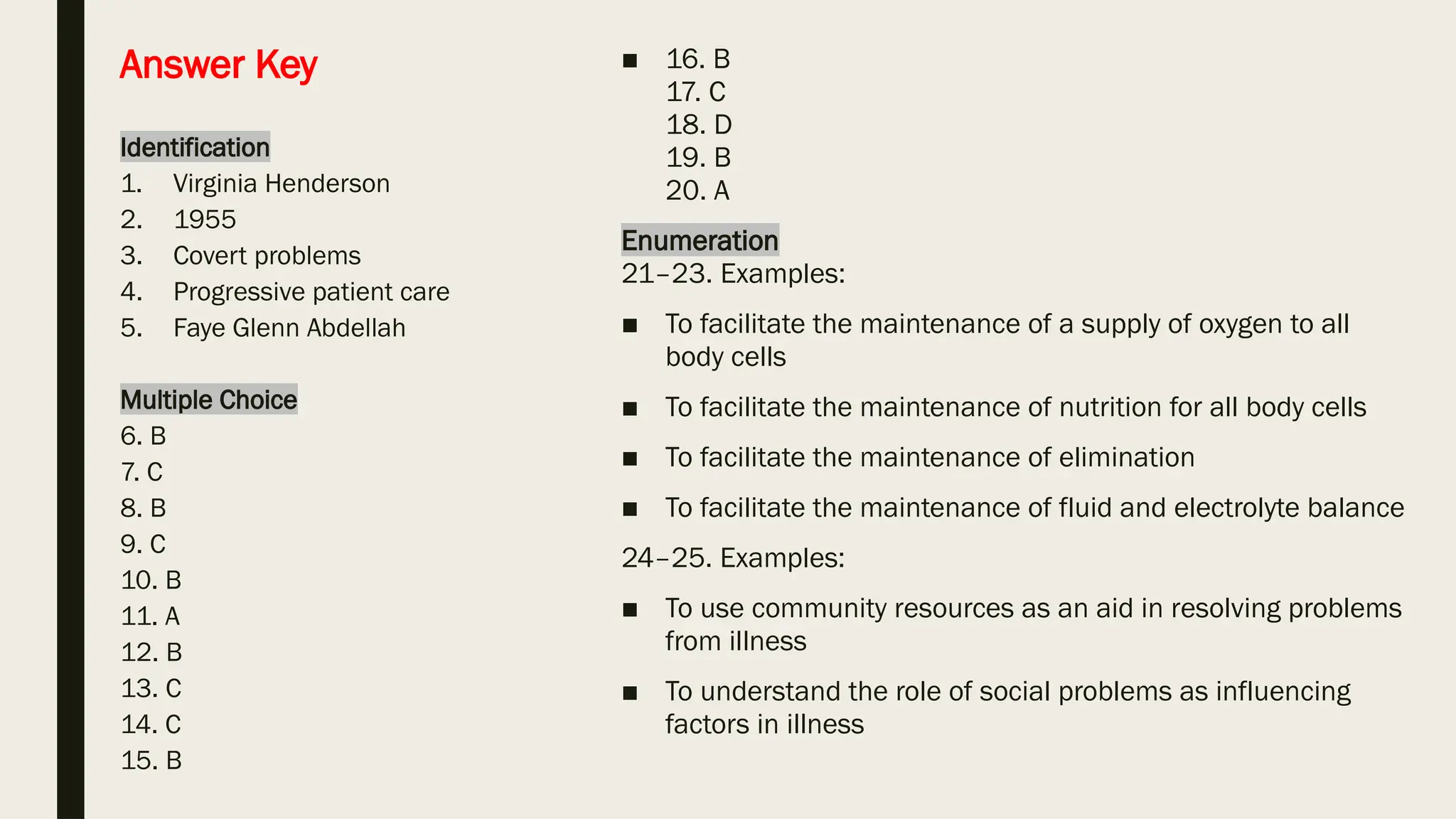
Answer Key
Identification
1. VirginiaHenderson
2. 1955
3. Covert problems
4. Progressive patient care
5. Faye Glenn Abdellah
Multiple Choice
6. B
7. C
8. B
9. C
10. B
11. A
12. B
13. C
14. C
15. B
■ 16. B
17. C
18. D
19. B
20. A
Enumeration
21–23. Examples:
■ To facilitate the maintenance of a supply of oxygen to all
body cells
■ To facilitate the maintenance of nutrition for all body cells
■ To facilitate the maintenance of elimination
■ To facilitate the maintenance of fluid and electrolyte balance
24–25. Examples:
■ To use community resources as an aid in resolving problems
from illness
■ To understand the role of social problems as influencing
factors in illness
Editor's Notes
#2 That incident became the turning point in Abdellah’s life. It was that time when she realized that she would never again be powerless to assist when people were in such a dire need of assistance. It was at that moment she vowed that she would learn to nurse and become a professional nurse.