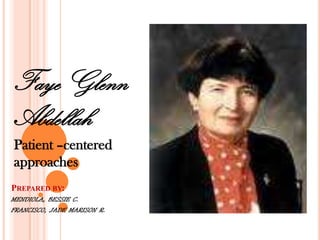
Faye Glenn AbdellahPatient –centered approachesPrepared by:mendiola, bessie c.francisco, jade marison r.
BiographyBorn on March 13,1919 in New York City.
She graduated magna cum laude from Fitkin Memorial Hospital School of Nursing in Neptune, New Jersey in 1942 (now Ann May School of Nursing).
She obtained her Bachelor of Science in 1945, her Master  of Arts in 1947, her Doctor of Education in 1955 from the Teachers Colleges at Columbia.
She was appointed Chief Nurse Officer of the U.S Public Health Service (USPHS) in 1970 and serve that position in 17 years.
First woman to serve as Deputy Surgeon General of the United States.
She was inducted into the US National Women’s Hall of Fame in 2000 due to her contributions in the field of Education and Nursing ResearchShe has been a staff nurse, a head nurse, a faculty member at Yale University and Columbia University.
A public health nurse, and an author of more than 150 articles and books.
She has been a research consultant to the World Health Organization.
She is a recipient of more than 79 academic honors and professional awards in her excellence in Nursing.
She developed a list of 21 unique nursing problems related to human needs."Although Abdellah spoke of the patient-centered approaches, she wrote nurses identifying and solving specific problems. This identification and classification of problems was called the typology of 21 nursing problems. Abdellah's  typology was divided into three areas: (1) the physical, sociological, and emotional needs of the patient; (2) the types of interpersonal relationships between the nurse and the patient; and  (3) the common elements of patient care. Adbellah and her colleagues thought the typology would provide a method to evaluate a student's experiences and also a method to evaluate a nurse's competency based on outcome measures.“
Twenty-One Nursing Problems                        (Categorized according to needs)
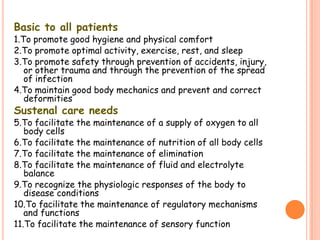
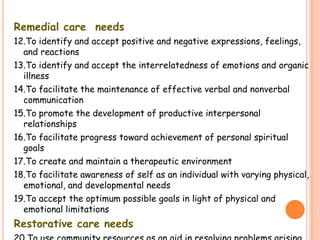
Basic to all patients1.To promote good hygiene and physical comfort2.To promote optimal activity, exercise, rest, and sleep3.To promote safety through prevention of accidents, injury, or other trauma and through the prevention of the spread of infection4.To maintain good body mechanics and prevent and correct deformitiesSustenal care needs5.To facilitate the maintenance of a supply of oxygen to all body cells6.To facilitate the maintenance of nutrition of all body cells7.To facilitate the maintenance of elimination8.To facilitate the maintenance of fluid and electrolyte balance9.To recognize the physiologic responses of the body to disease conditions10.To facilitate the maintenance of regulatory mechanisms and functions11.To facilitate the maintenance of sensory function

Faye Glenn A

  • 1.
    Faye Glenn AbdellahPatient–centered approachesPrepared by:mendiola, bessie c.francisco, jade marison r.
  • 2.
    BiographyBorn on March13,1919 in New York City.
  • 3.
    She graduated magnacum laude from Fitkin Memorial Hospital School of Nursing in Neptune, New Jersey in 1942 (now Ann May School of Nursing).
  • 4.
    She obtained herBachelor of Science in 1945, her Master of Arts in 1947, her Doctor of Education in 1955 from the Teachers Colleges at Columbia.
  • 5.
    She was appointedChief Nurse Officer of the U.S Public Health Service (USPHS) in 1970 and serve that position in 17 years.
  • 6.
    First woman toserve as Deputy Surgeon General of the United States.
  • 7.
    She was inductedinto the US National Women’s Hall of Fame in 2000 due to her contributions in the field of Education and Nursing ResearchShe has been a staff nurse, a head nurse, a faculty member at Yale University and Columbia University.
  • 8.
    A public healthnurse, and an author of more than 150 articles and books.
  • 9.
    She has beena research consultant to the World Health Organization.
  • 10.
    She is arecipient of more than 79 academic honors and professional awards in her excellence in Nursing.
  • 11.
    She developed alist of 21 unique nursing problems related to human needs."Although Abdellah spoke of the patient-centered approaches, she wrote nurses identifying and solving specific problems. This identification and classification of problems was called the typology of 21 nursing problems. Abdellah's typology was divided into three areas: (1) the physical, sociological, and emotional needs of the patient; (2) the types of interpersonal relationships between the nurse and the patient; and (3) the common elements of patient care. Adbellah and her colleagues thought the typology would provide a method to evaluate a student's experiences and also a method to evaluate a nurse's competency based on outcome measures.“
  • 12.
    Twenty-One Nursing Problems (Categorized according to needs)
  • 13.
    Basic to allpatients1.To promote good hygiene and physical comfort2.To promote optimal activity, exercise, rest, and sleep3.To promote safety through prevention of accidents, injury, or other trauma and through the prevention of the spread of infection4.To maintain good body mechanics and prevent and correct deformitiesSustenal care needs5.To facilitate the maintenance of a supply of oxygen to all body cells6.To facilitate the maintenance of nutrition of all body cells7.To facilitate the maintenance of elimination8.To facilitate the maintenance of fluid and electrolyte balance9.To recognize the physiologic responses of the body to disease conditions10.To facilitate the maintenance of regulatory mechanisms and functions11.To facilitate the maintenance of sensory function