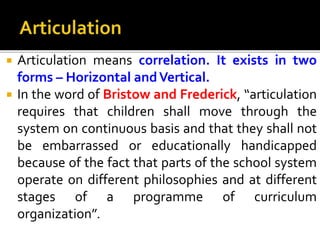
 Articulation means correlation. It exists in two
forms – Horizontal andVertical.
 In the word of Bristow and Frederick, “articulation
requires that children shall move through the
system on continuous basis and that they shall not
be embarrassed or educationally handicapped
because of the fact that parts of the school system
operate on different philosophies and at different
stages of a programme of curriculum
organization”.
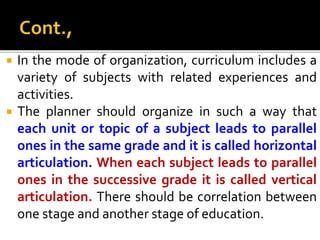
 In the mode of organization, curriculum includes a
variety of subjects with related experiences and
activities.
 The planner should organize in such a way that
each unit or topic of a subject leads to parallel
ones in the same grade and it is called horizontal
articulation. When each subject leads to parallel
ones in the successive grade it is called vertical
articulation. There should be correlation between
one stage and another stage of education.
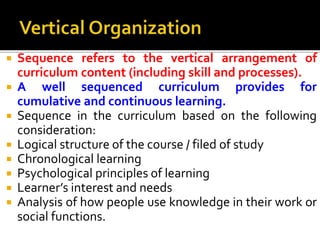
 Sequence refers to the vertical arrangement of
curriculum content (including skill and processes).
 A well sequenced curriculum provides for
cumulative and continuous learning.
 Sequence in the curriculum based on the following
consideration:
 Logical structure of the course / filed of study
 Chronological learning
 Psychological principles of learning
 Learner’s interest and needs
 Analysis of how people use knowledge in their work or
social functions.
 The sequence of content in mathematics, for
instance, is based on the logical structure of the
discipline.
 Mathematics starts from the simplest concepts,
principles, and operations to the most complex.
One cannot understand calculus if he has not yet
taken prerequisite courses like algebra,
trigonometry and analytic geometry.
 Continuity refers to the repetition of related
elements of contents.
 Continuity allows for the recurrence of
knowledge, skills, or processes, with increased
depth, breadth, and competence.
 For example of continuity in the curriculum is
knowledge of concepts and skills in manipulating
numerical fractions in elementary mathematics
and algebraic fractions in high school. The two
courses do not follow one another, but the learning
experiences in the latter are built on past
experiences.
 A horizontal curriculum means that what is studied in
one particular course in an institution is in line with other,
similar classes both in terms of course content and
evaluation (across different subjects).
 EXAMPLE: A Chemistry class might require students to take
Algebra II to balance the molecules; H2 + O2 g H2O
 Horizontal integration refers to the arrangement of content
based on the relatedness of topics, themes, skills or
processes in two or more subjects / courses in the same
grade.
 Horizontal integration is accomplished by integrating
separate subjects that are related (e.g arithmetic,
geometry, statistics, and algebra in mathematics I, II, III,
and IV)
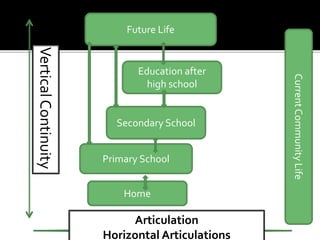
Primary School
Home
Secondary School
Education after
high school
Future Life
CurrentCommunityLife
VerticalContinuity
Articulation
Horizontal Articulations
 The balance in the curriculum means structure and
order in the scope and sequence leading to the
achievement of educational objectives.
 Balance is an important factor in the curriculum
provided by the school, subjects to be offered and
programmes of studies to be recommended, time
allotments for various subjects and activities, the use
of textbooks and aids.
 Too much or too little of these elements maybe
disastrous to the curriculum.
 Keeping the curriculum “ in balance ” requires fine
timing and review for its effectiveness and relevance.
 Continuity is also called as “Vertical Articulation”.
 It means that there is a smooth movement from one
stage to another stage.
 The school should plan the programme so that the
transition of the child from home environment to
school environment will be smooth and pleasant.
 Continuity is not only related to transition from one
stage to another stage but also to classroom situation.
 The teacher must have continuity with regard to his
teaching of lessons and activities. Today’s class work
must be the basis for tomorrow’s class work and so
on.
Abc curriculum

Abc curriculum

  • 2.
     Articulation meanscorrelation. It exists in two forms – Horizontal andVertical.  In the word of Bristow and Frederick, “articulation requires that children shall move through the system on continuous basis and that they shall not be embarrassed or educationally handicapped because of the fact that parts of the school system operate on different philosophies and at different stages of a programme of curriculum organization”.
  • 3.
     In themode of organization, curriculum includes a variety of subjects with related experiences and activities.  The planner should organize in such a way that each unit or topic of a subject leads to parallel ones in the same grade and it is called horizontal articulation. When each subject leads to parallel ones in the successive grade it is called vertical articulation. There should be correlation between one stage and another stage of education.
  • 4.
     Sequence refersto the vertical arrangement of curriculum content (including skill and processes).  A well sequenced curriculum provides for cumulative and continuous learning.  Sequence in the curriculum based on the following consideration:  Logical structure of the course / filed of study  Chronological learning  Psychological principles of learning  Learner’s interest and needs  Analysis of how people use knowledge in their work or social functions.
  • 5.
     The sequenceof content in mathematics, for instance, is based on the logical structure of the discipline.  Mathematics starts from the simplest concepts, principles, and operations to the most complex. One cannot understand calculus if he has not yet taken prerequisite courses like algebra, trigonometry and analytic geometry.
  • 6.
     Continuity refersto the repetition of related elements of contents.  Continuity allows for the recurrence of knowledge, skills, or processes, with increased depth, breadth, and competence.  For example of continuity in the curriculum is knowledge of concepts and skills in manipulating numerical fractions in elementary mathematics and algebraic fractions in high school. The two courses do not follow one another, but the learning experiences in the latter are built on past experiences.
  • 7.
     A horizontalcurriculum means that what is studied in one particular course in an institution is in line with other, similar classes both in terms of course content and evaluation (across different subjects).  EXAMPLE: A Chemistry class might require students to take Algebra II to balance the molecules; H2 + O2 g H2O  Horizontal integration refers to the arrangement of content based on the relatedness of topics, themes, skills or processes in two or more subjects / courses in the same grade.  Horizontal integration is accomplished by integrating separate subjects that are related (e.g arithmetic, geometry, statistics, and algebra in mathematics I, II, III, and IV)
  • 8.
    Primary School Home Secondary School Educationafter high school Future Life CurrentCommunityLife VerticalContinuity Articulation Horizontal Articulations
  • 9.
     The balancein the curriculum means structure and order in the scope and sequence leading to the achievement of educational objectives.  Balance is an important factor in the curriculum provided by the school, subjects to be offered and programmes of studies to be recommended, time allotments for various subjects and activities, the use of textbooks and aids.  Too much or too little of these elements maybe disastrous to the curriculum.  Keeping the curriculum “ in balance ” requires fine timing and review for its effectiveness and relevance.
  • 10.
     Continuity isalso called as “Vertical Articulation”.  It means that there is a smooth movement from one stage to another stage.  The school should plan the programme so that the transition of the child from home environment to school environment will be smooth and pleasant.  Continuity is not only related to transition from one stage to another stage but also to classroom situation.  The teacher must have continuity with regard to his teaching of lessons and activities. Today’s class work must be the basis for tomorrow’s class work and so on.