Cajetan Pinto, Global R&D Manager Machines Service, March 4, 2009


    Life Expectancy Analysis Program
    for Electrical Machine Insulation

© ABB Group
October 29, 2009 | Slide 1
Presentation overview


                             Life Cycle Management Approach
                             Reliability and failure statistics
                             Planning your Strategy
                             LEAP Methodology & Use
                             LEAP Standard
                             Case Studies
                             Benefits


© ABB Group
October 29, 2009 | Slide 2
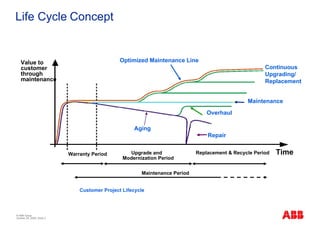
Life Cycle Concept


   Value to                                      Optimized Maintenance Line
   customer                                                                                             Continuous
   through                                                                                              Upgrading/
   maintenance                                                                                          Replacement


                                                                                                 Maintenance
                                                                                  Overhaul

                                                      Aging
                                                                                  Repair


                             Warranty Period         Upgrade and              Replacement & Recycle Period   Time
                                                  Modernization Period

                                                         Maintenance Period


                                 Customer Project Lifecycle


© ABB Group
October 29, 2009 | Slide 3
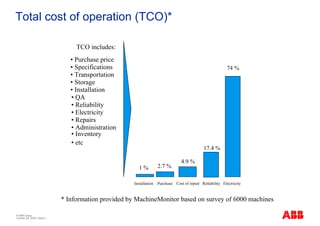
Total cost of operation (TCO)*

                                  TCO includes:
                                • Purchase price
                                • Specifications                                                          74 %
                                • Transportation
                                • Storage
                                • Installation
                                • QA
                                • Reliability
                                • Electricity
                                • Repairs
                                • Administration
                                • Inventory
                                • etc
                                                                                             17.4 %

                                                                                4.9 %
                                                        1%         2.7 %

                                                      Installation Purchase Cost of repair Reliability Electricity


                             * Information provided by MachineMonitor based on survey of 6000 machines

© ABB Group
October 29, 2009 | Slide 4
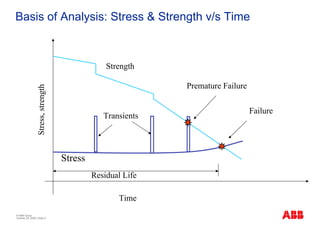
Basis of Analysis: Stress & Strength v/s Time


                                                   Strength

                                                               Premature Failure
                   Stress, strength


                                                                                   Failure
                                                  Transients


                                      Stress
                                               Residual Life

                                                      Time
© ABB Group
October 29, 2009 | Slide 5
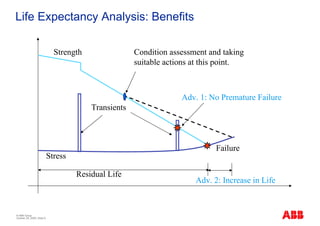
Life Expectancy Analysis: Benefits

                               Strength                Condition assessment and taking
                                                       suitable actions at this point.


                                                                    Adv. 1: No Premature Failure
                                          Transients


                                                                              Failure
                             Stress

                                      Residual Life
                                                                        Adv. 2: Increase in Life


© ABB Group
October 29, 2009 | Slide 6
Reliability
    &
    Failure Statistics


© ABB Group
October 29, 2009 | Slide 7
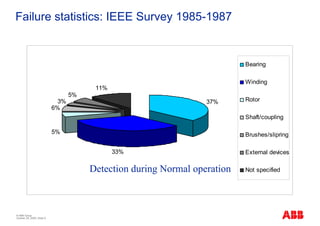
Failure statistics: IEEE Survey 1985-1987


                                                                             Bearing

                                                                             Winding
                                          11%
                                    5%
                               3%                                   37%      Rotor
                             6%
                                                                             Shaft/coupling

                             5%                                              Brushes/slipring

                                                33%                          External devices

                                         Detection during Normal operation   Not specified


© ABB Group
October 29, 2009 | Slide 8
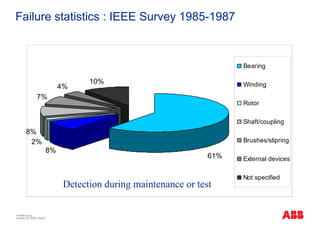
Failure statistics : IEEE Survey 1985-1987


                                                                        Bearing

                                     10%                                Winding
                              4%
                  7%
                                                                        Rotor

                                                                        Shaft/coupling
        8%
         2%                                                             Brushes/slipring
                         8%
                                                                  61%   External devices

                                                                        Not specified
                               Detection during maintenance or test

© ABB Group
October 29, 2009 | Slide 9
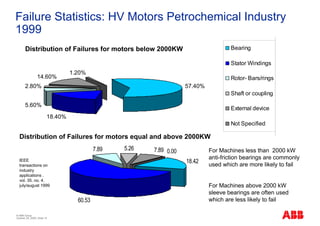
Failure Statistics: HV Motors Petrochemical Industry
1999
       Distribution of Failures for motors below 2000KW                                 Bearing

                                                                                        Stator Windings
                                   1.20%
                  14.60%                                                                Rotor- Bars/rings
       2.80%                                                           57.40%
                                                                                        Shaft or coupling

       5.60%
                                                                                        External device
                          18.40%
                                                                                        Not Specified

  Distribution of Failures for motors equal and above 2000KW
                                             7.89   5.26   7.89 0.00            For Machines less than 2000 kW
  IEEE
                                                                                anti-friction bearings are commonly
                                                                       18.42
  transactions on                                                               used which are more likely to fail
  industry
  applications .
  vol. 35. no. 4.
  july/august 1999                                                              For Machines above 2000 kW
                                                                                sleeve bearings are often used
                                     60.53                                      which are less likely to fail

© ABB Group
October 29, 2009 | Slide 10
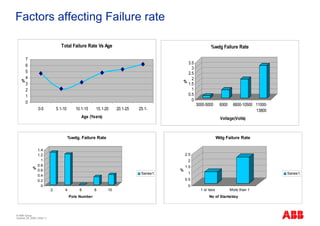
Factors affecting Failure rate

                                    Total Failure Rate Vs Age                                                 %wdg Failure Rate

      7
                                                                                                3.5
      6
                                                                                                  3
      5                                                                                         2.5
      4                                                                                           2
    %                                                                                         %
      3                                                                                         1.5
      2                                                                                           1
      1                                                                                         0.5
                                                                                                  0
      0
                                                                                                      3000-5000      6000    6600-10500 11000-
                   0-5            5.1-10      10.1-15    15.1-20     20.1-25   25.1-                                                    13800
                                                 Age (Years)                                                          Voltage(Volts)


                                           %wdg. Failure Rate                                                       Wdg Failure Rate

                1.4
                1.2                                                                           2.5
                  1                                                                             2
                0.8                                                                           1.5
              %
                0.6                                                                       %
                                                                                Series1         1                                                Series1
                0.4
                0.2                                                                           0.5
                  0                                                                             0
                              2        4        6        8      10                                      1 or less           More than 1
                                           Pole Number                                                       No of Starts/day


© ABB Group
October 29, 2009 | Slide 11
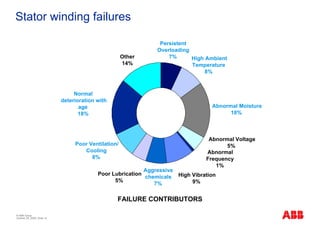
Stator winding failures

                                                                  Persistent
                                                                 Overloading
                                                       Other         7%      High Ambient
                                                       14%                   Temperature
                                                                                  8%


                                   Normal
                              deterioration with
                                     age                                              Abnormal Moisture
                                     18%                                                    18%


                                                                                     Abnormal Voltage
                                   Poor Ventilation/                                       5%
                                      Cooling                                       Abnormal
                                         8%                                         Frequency
                                                                                       1%
                                                             Aggressive
                                            Poor Lubrication              High Vibration
                                                             chemicals
                                                  5%                           9%
                                                                7%

                                                   FAILURE CONTRIBUTORS

© ABB Group
October 29, 2009 | Slide 12
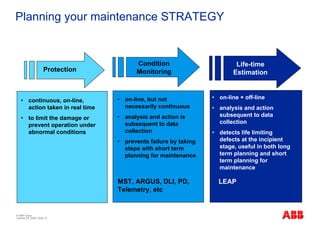
Planning your maintenance STRATEGY


                                          Condition                         Life-time
                       Protection         Monitoring                       Estimation


                                    • on-line, but not             • on-line + off-line
    • continuous, on-line,
      action taken in real time       necessarily continuous       • analysis and action
                                    • analysis and action is         subsequent to data
    • to limit the damage or
                                      subsequent to data             collection
      prevent operation under
      abnormal conditions             collection                   • detects life limiting
                                    • prevents failure by taking     defects at the incipient
                                      steps with short term          stage, useful in both long
                                      planning for maintenance       term planning and short
                                                                     term planning for
                                                                     maintenance

                                    MST, ARGUS, DLI, PD,             LEAP
                                    Telemetry, etc


© ABB Group
October 29, 2009 | Slide 13
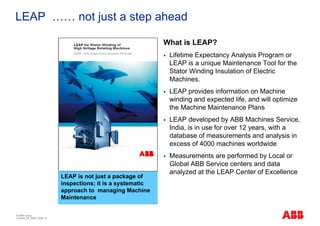
LEAP …… not just a step ahead

                                                                What is LEAP?
                                                                 Lifetime Expectancy Analysis Program or
                                                                 LEAP is a unique Maintenance Tool for the
                                                                 Stator Winding Insulation of Electric
                                                                 Machines.
                                                                 LEAP provides information on Machine
                                                                 winding and expected life, and will optimize
                                                                 the Machine Maintenance Plans
                                                                 LEAP developed by ABB Machines Service,
                                                                 India, is in use for over 12 years, with a
                                                                 database of measurements and analysis in
                                                                 excess of 4000 machines worldwide
                                                                 Measurements are performed by Local or
                                                                 Global ABB Service centers and data
                                                                 analyzed at the LEAP Center of Excellence
                              LEAP is not just a package of
                              inspections; it is a systematic
                              approach to managing Machine
                              Maintenance

© ABB Group
October 29, 2009 | Slide 14
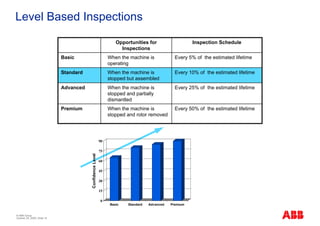
Level Based Inspections

                                                                     Opportunities for                    Inspection Schedule
                                                                       Inspections
                              Basic                              When the machine is              Every 5% of the estimated lifetime
                                                                 operating
                              Standard                           When the machine is              Every 10% of the estimated lifetime
                                                                 stopped but assembled
                              Advanced                           When the machine is              Every 25% of the estimated lifetime
                                                                 stopped and partially
                                                                 dismantled
                              Premium                            When the machine is              Every 50% of the estimated lifetime
                                                                 stopped and rotor removed


                                                            90

                                                            75
                                         Confidence Level


                                                            60

                                                            45

                                                            30

                                                            15

                                                            0
                                                                  Basic   Standard   Advanced   Premium


© ABB Group
October 29, 2009 | Slide 15
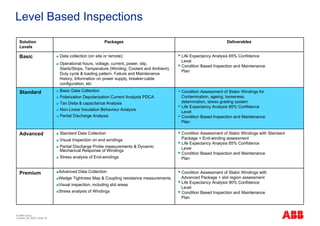
Level Based Inspections
  Solution                                             Packages                                                  Deliverables
  Levels

  Basic                       Data collection (on site or remote):                        Life Expectancy Analysis 65% Confidence
                                                                                          Level
                              Operational hours, voltage, current, power, slip,
                                                                                          Condition Based Inspection and Maintenance
                              Starts/Stops, Temperature (Winding, Coolant and Ambient),
                                                                                          Plan
                              Duty cycle & loading pattern, Failure and Maintenance
                              history, Information on power supply, breaker-cable
                              configuration, etc

  Standard                    Basic Data Collection                                       Condition Assessment of Stator Windings for
                              Polarization Depolarization Current Analysis PDCA           Contamination, ageing, looseness,
                              Tan Delta & capacitance Analysis                            delamination, stress grading system
                                                                                          Life Expectancy Analysis 80% Confidence
                              Non-Linear Insulation Behaviour Analysis
                                                                                          Level
                              Partial Discharge Analysis                                  Condition Based Inspection and Maintenance
                                                                                          Plan

  Advanced                    Standard Data Collection                                    Condition Assessment of Stator Windings with Standard
                              Visual Inspection on end windings                           Package + End-winding assessment
                                                                                          Life Expectancy Analysis 85% Confidence
                              Partial Discharge Probe measurements & Dynamic              Level
                              Mechanical Response of Windings
                                                                                          Condition Based Inspection and Maintenance
                              Stress analysis of End-windings                             Plan


  Premium                     Advanced Data Collection                                    Condition Assessment of Stator Windings with
                              Wedge Tightness Map & Coupling resistance measurements      Advanced Package + slot region assessment
                                                                                          Life Expectancy Analysis 90% Confidence
                              Visual inspection, including slot areas
                                                                                          Level
                              Stress analysis of Windings                                 Condition Based Inspection and Maintenance
                                                                                          Plan


© ABB Group
October 29, 2009 | Slide 16
LEAP Methodology
    &
    Use of LEAP


© ABB Group
October 29, 2009 | Slide 17
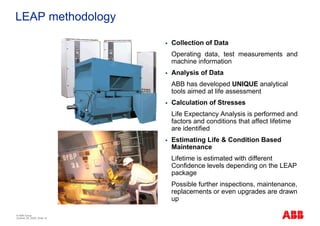
LEAP methodology

                              Collection of Data
                              Operating data, test measurements and
                              machine information
                              Analysis of Data
                              ABB has developed UNIQUE analytical
                              tools aimed at life assessment
                              Calculation of Stresses
                              Life Expectancy Analysis is performed and
                              factors and conditions that affect lifetime
                              are identified
                              Estimating Life & Condition Based
                              Maintenance
                              Lifetime is estimated with different
                              Confidence levels depending on the LEAP
                              package
                              Possible further inspections, maintenance,
                              replacements or even upgrades are drawn
                              up

© ABB Group
October 29, 2009 | Slide 18
LEAP
    Standard


© ABB Group
October 29, 2009 | Slide 19
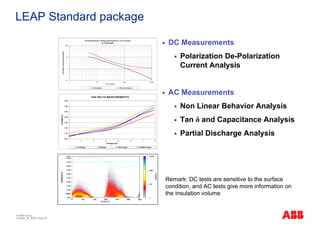
LEAP Standard package

                                                                      100
                                                                                       P o la r iz a tio n -D e p o la r iz a tio n C u r r e n ts
                                                                                                             U PHASE                                                              DC Measurements

                                     Pol-Depol Currents (microAmp)
                                                                       10
                                                                                                                                                                                      Polarization De-Polarization
                                                                        1
                                                                                                                                                                                      Current Analysis
                                                                      0 .1
                                                                             1                        10                                     100                      1000
                                                                                                                  T im e (s e c )

                                                                                                 C h a r g in g                          D is c h a r g in g


                                                                                              TAN DELTA MEASUREMENTS
                                                                                                                                                                                  AC Measurements
                                                                     4.00


                                                                     3.50


                                                                     3.00
                                                                                                                                                                                      Non Linear Behavior Analysis
                              Tan Delta (%)


                                                                                                                                                                                      Tan δ and Capacitance Analysis
                                                                     2.50


                                                                     2.00


                                                                     1.50


                                                                     1.00


                                                                     0.50
                                                                                                                                                                                      Partial Discharge Analysis
                                                                             1     2             3                4                 5                    6      7            8
                                                                                                                     Voltage (kV)

                                                                                 U Phase                   V Phase                      W Phase                UVW Phase


                                                                                                                                                                                 Remark: DC tests are sensitive to the surface
                                                                                                                                                                                 condition, and AC tests give more information on
                                                                                                                                                                                 the insulation volume


© ABB Group
October 29, 2009 | Slide 20
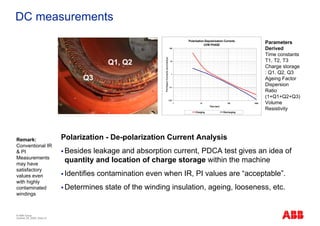
DC measurements
                                                                                                             Polarization-Depolarization Currents
                                                                                                                         UVW PHASE
                                                                                                                                                               Parameters
                                                                                                  100                                                          Derived
                                                                                                                                                               Time constants


                                                             Pol-D epol C urrents (m icroA m p)
                                            Q1, Q2                                                 10                                                          T1, T2, T3
                                                                                                                                                               Charge storage
                                                                                                    1
                                                                                                                                                               : Q1, Q2, Q3
                                    Q3                                                                                                                         Ageing Factor
                                                                                                   0.1
                                                                                                                                                               Dispersion
                                                                                                                                                               Ratio
                                                                                                                                                               (1+Q1+Q2+Q3)
                                                                                                  0.01
                                                                                                         1           10                      100        1000   Volume
                                                                                                                             Time (sec)
                                                                                                                                                               Resistivity
                                                                                                                  Charging                Discharging


Remark:                       Polarization - De-polarization Current Analysis
Conventional IR
& PI                           Besides leakage and absorption current, PDCA test gives an idea of
Measurements
may have
                               quantity and location of charge storage within the machine
satisfactory
values even                    Identifies contamination even when IR, PI values are “acceptable”.
with highly
contaminated                   Determines state of the winding insulation, ageing, looseness, etc.
windings


© ABB Group
October 29, 2009 | Slide 21
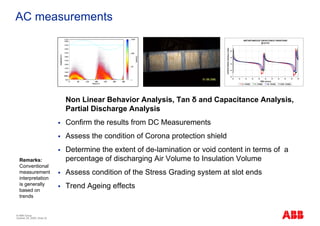
AC measurements
                                                                                                                                  INSTANTANEOUS CAPACITANCE VARIATIONS
                                                                                                                                                @ 5.8 kV


                                                                                 CAPACITANCE (Arbitrary Units)
                                                                                                                 110


                                                                                                                 65


                                                                                                                 20


                                                                                                                 -25


                                                                                                                 -70
                                                                                                                       40   42      44       46      48        50        52     54       56        58   60

                                                                                                                                                          TIME (msecs)
                                                                                                                                 U - PHASE        V - PHASE         W - PHASE        UVW - PHASE


                              Non Linear Behavior Analysis, Tan δ and Capacitance Analysis,
                              Partial Discharge Analysis
                              Confirm the results from DC Measurements
                              Assess the condition of Corona protection shield
                              Determine the extent of de-lamination or void content in terms of a
  Remarks:                    percentage of discharging Air Volume to Insulation Volume
  Conventional
  measurement                 Assess condition of the Stress Grading system at slot ends
  interpretation
  is generally                Trend Ageing effects
  based on
  trends


© ABB Group
October 29, 2009 | Slide 22
LEAP
    from the Case Book


© ABB Group
October 29, 2009 | Slide 23
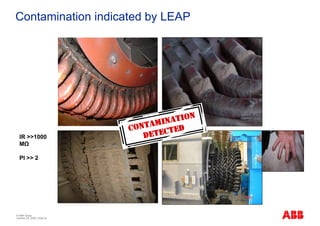
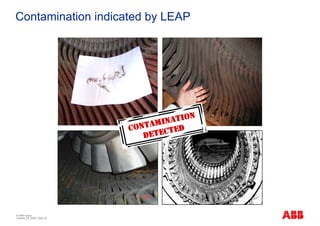
Contamination indicated by LEAP


  IR >>1000
  MΩ

  PI >> 2


© ABB Group
October 29, 2009 | Slide 24
Contamination indicated by LEAP


© ABB Group
October 29, 2009 | Slide 25
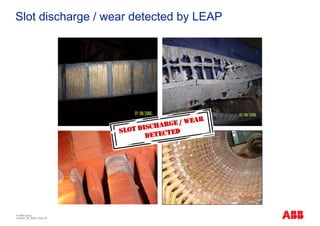
Slot discharge / wear detected by LEAP


© ABB Group
October 29, 2009 | Slide 26
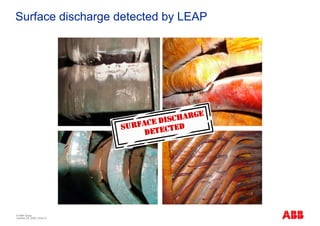
Surface discharge detected by LEAP


© ABB Group
October 29, 2009 | Slide 27
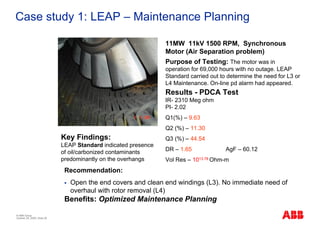
Case study 1: LEAP – Maintenance Planning

                                                                 11MW 11kV 1500 RPM, Synchronous
                                                                 Motor (Air Separation problem)
                                                                 Purpose of Testing: The motor was in
                                                                 operation for 69,000 hours with no outage. LEAP
                                                                 Standard carried out to determine the need for L3 or
                                                                 L4 Maintenance. On-line pd alarm had appeared.
                                                                 Results - PDCA Test
                                                                 IR- 2310 Meg ohm
                                                                 PI- 2.02
                                                                 Q1(%) – 9.63
                                                                 Q2 (%) – 11.30
                              Key Findings:                      Q3 (%) – 44.54
                              LEAP Standard indicated presence
                              of oil/carbonized contaminants     DR – 1.65              AgF – 60.12
                              predominantly on the overhangs     Vol Res – 1013.78 Ohm-m
                               Recommendation:
                                 Open the end covers and clean end windings (L3). No immediate need of
                                 overhaul with rotor removal (L4)
                               Benefits: Optimized Maintenance Planning
© ABB Group
October 29, 2009 | Slide 28
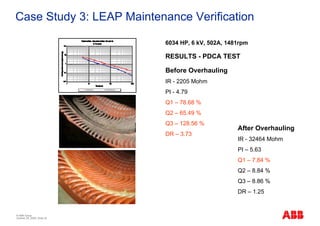
Case Study 3: LEAP Maintenance Verification

                              6034 HP, 6 kV, 502A, 1481rpm

                              RESULTS - PDCA TEST

                              Before Overhauling
                              IR - 2205 Mohm
                              PI - 4.79
                              Q1 – 78.68 %
                                                         Q1, Q2
                              Q2 – 65.49 %
                              Q3 – 128.56 %
                                     Q3               After Overhauling
                              DR – 3.73
                                                      IR - 32464 Mohm
                                                      PI – 5.63
                                                      Q1 – 7.84 %
                                                      Q2 – 8.84 %
                                                      Q3 – 8.86 %
                                                      DR – 1.25


© ABB Group
October 29, 2009 | Slide 32
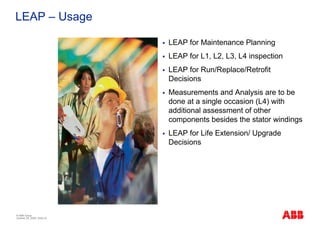
LEAP – Usage

                              LEAP for Maintenance Planning
                              LEAP for L1, L2, L3, L4 inspection
                              LEAP for Run/Replace/Retrofit
                              Decisions
                              Measurements and Analysis are to be
                              done at a single occasion (L4) with
                              additional assessment of other
                              components besides the stator windings
                              LEAP for Life Extension/ Upgrade
                              Decisions


© ABB Group
October 29, 2009 | Slide 33
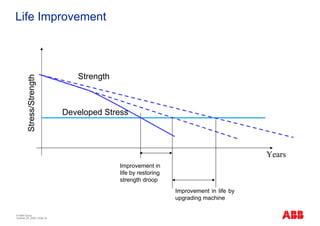
Life Improvement


                                 Strength
          Stress/Strength


                              Developed Stress


                                                                                         Years
                                            Improvement in
                                            life by restoring
                                            strength droop
                                                                Improvement in life by
                                                                upgrading machine

© ABB Group
October 29, 2009 | Slide 34
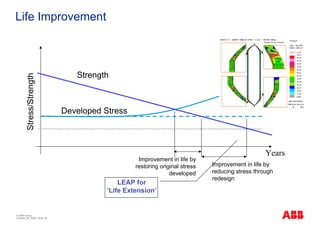
Life Improvement


                                 Strength
         Stress/Strength


                              Developed Stress


                                                                                                  Years
                                                   Improvement in life by
                                                  restoring original stress   Improvement in life by
                                                                developed     reducing stress through
                                                                              redesign
                                             LEAP for
                                         ‘Life Extension’


© ABB Group
October 29, 2009 | Slide 35
LEAP – How is it different?

                              Methodology is not dependent on old records of measurements
                              performed. Single occasion of measurements will suffice for making
                              decisions. Parameters are derived from measurements to quantify
                              problems such as contamination, ageing and looseness.

                              65-72% of failures are related to Thermal and Ambient reasons which
                              may not be detected by measurements that rely only on partial
                              discharges. ABB’s measurements and analysis focuses also on
                              detection non-partial discharge related problems.

                              Analysis software is UNIQUE and parameters derived from analysis can
                              be utilized in Life Expectancy Calculations

                              Sophisticated FEM analysis can be deployed during L3 and L4
                              maintenance.

                              Can be related to time and integrated into a Maintenance Plan

© ABB Group
October 29, 2009 | Slide 36
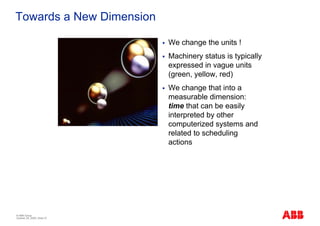
Towards a New Dimension

                              We change the units !
                              Machinery status is typically
                              expressed in vague units
                              (green, yellow, red)
                              We change that into a
                              measurable dimension:
                              time that can be easily
                              interpreted by other
                              computerized systems and
                              related to scheduling
                              actions


© ABB Group
October 29, 2009 | Slide 37
LEAP - Value for the Customer

                              Optimizes Maintenance Planning of
                              Electrical Machines by moving from
                              Scheduled Maintenance to Condition
                              Based Maintenance
                              Life Extension of machines would lead
                              to increased earnings capability and
                              thereby greater return on investment.
                              Facilitate decision making (short and
                              long term maintenance planning)
                              Focus mainly on essential maintenance,
                              and machines that are vulnerable,
                              thereby reducing downtime at lower risk
                              levels
                              Provides important “lifetime ” inputs for
                              more realistic estimates of Life Cycle
                              Costing

© ABB Group
October 29, 2009 | Slide 38
© ABB Group
October 29, 2009 | Slide 39

ABB Life Expectancy Analysis Program Diagnostics

  • 1.
    Cajetan Pinto, GlobalR&D Manager Machines Service, March 4, 2009 Life Expectancy Analysis Program for Electrical Machine Insulation © ABB Group October 29, 2009 | Slide 1
  • 2.
    Presentation overview Life Cycle Management Approach Reliability and failure statistics Planning your Strategy LEAP Methodology & Use LEAP Standard Case Studies Benefits © ABB Group October 29, 2009 | Slide 2
  • 3.
    Life Cycle Concept Value to Optimized Maintenance Line customer Continuous through Upgrading/ maintenance Replacement Maintenance Overhaul Aging Repair Warranty Period Upgrade and Replacement & Recycle Period Time Modernization Period Maintenance Period Customer Project Lifecycle © ABB Group October 29, 2009 | Slide 3
  • 4.
    Total cost ofoperation (TCO)* TCO includes: • Purchase price • Specifications 74 % • Transportation • Storage • Installation • QA • Reliability • Electricity • Repairs • Administration • Inventory • etc 17.4 % 4.9 % 1% 2.7 % Installation Purchase Cost of repair Reliability Electricity * Information provided by MachineMonitor based on survey of 6000 machines © ABB Group October 29, 2009 | Slide 4
  • 5.
    Basis of Analysis:Stress & Strength v/s Time Strength Premature Failure Stress, strength Failure Transients Stress Residual Life Time © ABB Group October 29, 2009 | Slide 5
  • 6.
    Life Expectancy Analysis:Benefits Strength Condition assessment and taking suitable actions at this point. Adv. 1: No Premature Failure Transients Failure Stress Residual Life Adv. 2: Increase in Life © ABB Group October 29, 2009 | Slide 6
  • 7.
    Reliability & Failure Statistics © ABB Group October 29, 2009 | Slide 7
  • 8.
    Failure statistics: IEEESurvey 1985-1987 Bearing Winding 11% 5% 3% 37% Rotor 6% Shaft/coupling 5% Brushes/slipring 33% External devices Detection during Normal operation Not specified © ABB Group October 29, 2009 | Slide 8
  • 9.
    Failure statistics :IEEE Survey 1985-1987 Bearing 10% Winding 4% 7% Rotor Shaft/coupling 8% 2% Brushes/slipring 8% 61% External devices Not specified Detection during maintenance or test © ABB Group October 29, 2009 | Slide 9
  • 10.
    Failure Statistics: HVMotors Petrochemical Industry 1999 Distribution of Failures for motors below 2000KW Bearing Stator Windings 1.20% 14.60% Rotor- Bars/rings 2.80% 57.40% Shaft or coupling 5.60% External device 18.40% Not Specified Distribution of Failures for motors equal and above 2000KW 7.89 5.26 7.89 0.00 For Machines less than 2000 kW IEEE anti-friction bearings are commonly 18.42 transactions on used which are more likely to fail industry applications . vol. 35. no. 4. july/august 1999 For Machines above 2000 kW sleeve bearings are often used 60.53 which are less likely to fail © ABB Group October 29, 2009 | Slide 10
  • 11.
    Factors affecting Failurerate Total Failure Rate Vs Age %wdg Failure Rate 7 3.5 6 3 5 2.5 4 2 % % 3 1.5 2 1 1 0.5 0 0 3000-5000 6000 6600-10500 11000- 0-5 5.1-10 10.1-15 15.1-20 20.1-25 25.1- 13800 Age (Years) Voltage(Volts) %wdg. Failure Rate Wdg Failure Rate 1.4 1.2 2.5 1 2 0.8 1.5 % 0.6 % Series1 1 Series1 0.4 0.2 0.5 0 0 2 4 6 8 10 1 or less More than 1 Pole Number No of Starts/day © ABB Group October 29, 2009 | Slide 11
  • 12.
    Stator winding failures Persistent Overloading Other 7% High Ambient 14% Temperature 8% Normal deterioration with age Abnormal Moisture 18% 18% Abnormal Voltage Poor Ventilation/ 5% Cooling Abnormal 8% Frequency 1% Aggressive Poor Lubrication High Vibration chemicals 5% 9% 7% FAILURE CONTRIBUTORS © ABB Group October 29, 2009 | Slide 12
  • 13.
    Planning your maintenanceSTRATEGY Condition Life-time Protection Monitoring Estimation • on-line, but not • on-line + off-line • continuous, on-line, action taken in real time necessarily continuous • analysis and action • analysis and action is subsequent to data • to limit the damage or subsequent to data collection prevent operation under abnormal conditions collection • detects life limiting • prevents failure by taking defects at the incipient steps with short term stage, useful in both long planning for maintenance term planning and short term planning for maintenance MST, ARGUS, DLI, PD, LEAP Telemetry, etc © ABB Group October 29, 2009 | Slide 13
  • 14.
    LEAP …… notjust a step ahead What is LEAP? Lifetime Expectancy Analysis Program or LEAP is a unique Maintenance Tool for the Stator Winding Insulation of Electric Machines. LEAP provides information on Machine winding and expected life, and will optimize the Machine Maintenance Plans LEAP developed by ABB Machines Service, India, is in use for over 12 years, with a database of measurements and analysis in excess of 4000 machines worldwide Measurements are performed by Local or Global ABB Service centers and data analyzed at the LEAP Center of Excellence LEAP is not just a package of inspections; it is a systematic approach to managing Machine Maintenance © ABB Group October 29, 2009 | Slide 14
  • 15.
    Level Based Inspections Opportunities for Inspection Schedule Inspections Basic When the machine is Every 5% of the estimated lifetime operating Standard When the machine is Every 10% of the estimated lifetime stopped but assembled Advanced When the machine is Every 25% of the estimated lifetime stopped and partially dismantled Premium When the machine is Every 50% of the estimated lifetime stopped and rotor removed 90 75 Confidence Level 60 45 30 15 0 Basic Standard Advanced Premium © ABB Group October 29, 2009 | Slide 15
  • 16.
    Level Based Inspections Solution Packages Deliverables Levels Basic Data collection (on site or remote): Life Expectancy Analysis 65% Confidence Level Operational hours, voltage, current, power, slip, Condition Based Inspection and Maintenance Starts/Stops, Temperature (Winding, Coolant and Ambient), Plan Duty cycle & loading pattern, Failure and Maintenance history, Information on power supply, breaker-cable configuration, etc Standard Basic Data Collection Condition Assessment of Stator Windings for Polarization Depolarization Current Analysis PDCA Contamination, ageing, looseness, Tan Delta & capacitance Analysis delamination, stress grading system Life Expectancy Analysis 80% Confidence Non-Linear Insulation Behaviour Analysis Level Partial Discharge Analysis Condition Based Inspection and Maintenance Plan Advanced Standard Data Collection Condition Assessment of Stator Windings with Standard Visual Inspection on end windings Package + End-winding assessment Life Expectancy Analysis 85% Confidence Partial Discharge Probe measurements & Dynamic Level Mechanical Response of Windings Condition Based Inspection and Maintenance Stress analysis of End-windings Plan Premium Advanced Data Collection Condition Assessment of Stator Windings with Wedge Tightness Map & Coupling resistance measurements Advanced Package + slot region assessment Life Expectancy Analysis 90% Confidence Visual inspection, including slot areas Level Stress analysis of Windings Condition Based Inspection and Maintenance Plan © ABB Group October 29, 2009 | Slide 16
  • 17.
    LEAP Methodology & Use of LEAP © ABB Group October 29, 2009 | Slide 17
  • 18.
    LEAP methodology Collection of Data Operating data, test measurements and machine information Analysis of Data ABB has developed UNIQUE analytical tools aimed at life assessment Calculation of Stresses Life Expectancy Analysis is performed and factors and conditions that affect lifetime are identified Estimating Life & Condition Based Maintenance Lifetime is estimated with different Confidence levels depending on the LEAP package Possible further inspections, maintenance, replacements or even upgrades are drawn up © ABB Group October 29, 2009 | Slide 18
  • 19.
    LEAP Standard © ABB Group October 29, 2009 | Slide 19
  • 20.
    LEAP Standard package 100 P o la r iz a tio n -D e p o la r iz a tio n C u r r e n ts U PHASE DC Measurements Pol-Depol Currents (microAmp) 10 Polarization De-Polarization 1 Current Analysis 0 .1 1 10 100 1000 T im e (s e c ) C h a r g in g D is c h a r g in g TAN DELTA MEASUREMENTS AC Measurements 4.00 3.50 3.00 Non Linear Behavior Analysis Tan Delta (%) Tan δ and Capacitance Analysis 2.50 2.00 1.50 1.00 0.50 Partial Discharge Analysis 1 2 3 4 5 6 7 8 Voltage (kV) U Phase V Phase W Phase UVW Phase Remark: DC tests are sensitive to the surface condition, and AC tests give more information on the insulation volume © ABB Group October 29, 2009 | Slide 20
  • 21.
    DC measurements Polarization-Depolarization Currents UVW PHASE Parameters 100 Derived Time constants Pol-D epol C urrents (m icroA m p) Q1, Q2 10 T1, T2, T3 Charge storage 1 : Q1, Q2, Q3 Q3 Ageing Factor 0.1 Dispersion Ratio (1+Q1+Q2+Q3) 0.01 1 10 100 1000 Volume Time (sec) Resistivity Charging Discharging Remark: Polarization - De-polarization Current Analysis Conventional IR & PI Besides leakage and absorption current, PDCA test gives an idea of Measurements may have quantity and location of charge storage within the machine satisfactory values even Identifies contamination even when IR, PI values are “acceptable”. with highly contaminated Determines state of the winding insulation, ageing, looseness, etc. windings © ABB Group October 29, 2009 | Slide 21
  • 22.
    AC measurements INSTANTANEOUS CAPACITANCE VARIATIONS @ 5.8 kV CAPACITANCE (Arbitrary Units) 110 65 20 -25 -70 40 42 44 46 48 50 52 54 56 58 60 TIME (msecs) U - PHASE V - PHASE W - PHASE UVW - PHASE Non Linear Behavior Analysis, Tan δ and Capacitance Analysis, Partial Discharge Analysis Confirm the results from DC Measurements Assess the condition of Corona protection shield Determine the extent of de-lamination or void content in terms of a Remarks: percentage of discharging Air Volume to Insulation Volume Conventional measurement Assess condition of the Stress Grading system at slot ends interpretation is generally Trend Ageing effects based on trends © ABB Group October 29, 2009 | Slide 22
  • 23.
    LEAP from the Case Book © ABB Group October 29, 2009 | Slide 23
  • 24.
    Contamination indicated byLEAP IR >>1000 MΩ PI >> 2 © ABB Group October 29, 2009 | Slide 24
  • 25.
    Contamination indicated byLEAP © ABB Group October 29, 2009 | Slide 25
  • 26.
    Slot discharge /wear detected by LEAP © ABB Group October 29, 2009 | Slide 26
  • 27.
    Surface discharge detectedby LEAP © ABB Group October 29, 2009 | Slide 27
  • 28.
    Case study 1:LEAP – Maintenance Planning 11MW 11kV 1500 RPM, Synchronous Motor (Air Separation problem) Purpose of Testing: The motor was in operation for 69,000 hours with no outage. LEAP Standard carried out to determine the need for L3 or L4 Maintenance. On-line pd alarm had appeared. Results - PDCA Test IR- 2310 Meg ohm PI- 2.02 Q1(%) – 9.63 Q2 (%) – 11.30 Key Findings: Q3 (%) – 44.54 LEAP Standard indicated presence of oil/carbonized contaminants DR – 1.65 AgF – 60.12 predominantly on the overhangs Vol Res – 1013.78 Ohm-m Recommendation: Open the end covers and clean end windings (L3). No immediate need of overhaul with rotor removal (L4) Benefits: Optimized Maintenance Planning © ABB Group October 29, 2009 | Slide 28
  • 29.
    Case Study 3:LEAP Maintenance Verification 6034 HP, 6 kV, 502A, 1481rpm RESULTS - PDCA TEST Before Overhauling IR - 2205 Mohm PI - 4.79 Q1 – 78.68 % Q1, Q2 Q2 – 65.49 % Q3 – 128.56 % Q3 After Overhauling DR – 3.73 IR - 32464 Mohm PI – 5.63 Q1 – 7.84 % Q2 – 8.84 % Q3 – 8.86 % DR – 1.25 © ABB Group October 29, 2009 | Slide 32
  • 30.
    LEAP – Usage LEAP for Maintenance Planning LEAP for L1, L2, L3, L4 inspection LEAP for Run/Replace/Retrofit Decisions Measurements and Analysis are to be done at a single occasion (L4) with additional assessment of other components besides the stator windings LEAP for Life Extension/ Upgrade Decisions © ABB Group October 29, 2009 | Slide 33
  • 31.
    Life Improvement Strength Stress/Strength Developed Stress Years Improvement in life by restoring strength droop Improvement in life by upgrading machine © ABB Group October 29, 2009 | Slide 34
  • 32.
    Life Improvement Strength Stress/Strength Developed Stress Years Improvement in life by restoring original stress Improvement in life by developed reducing stress through redesign LEAP for ‘Life Extension’ © ABB Group October 29, 2009 | Slide 35
  • 33.
    LEAP – Howis it different? Methodology is not dependent on old records of measurements performed. Single occasion of measurements will suffice for making decisions. Parameters are derived from measurements to quantify problems such as contamination, ageing and looseness. 65-72% of failures are related to Thermal and Ambient reasons which may not be detected by measurements that rely only on partial discharges. ABB’s measurements and analysis focuses also on detection non-partial discharge related problems. Analysis software is UNIQUE and parameters derived from analysis can be utilized in Life Expectancy Calculations Sophisticated FEM analysis can be deployed during L3 and L4 maintenance. Can be related to time and integrated into a Maintenance Plan © ABB Group October 29, 2009 | Slide 36
  • 34.
    Towards a NewDimension We change the units ! Machinery status is typically expressed in vague units (green, yellow, red) We change that into a measurable dimension: time that can be easily interpreted by other computerized systems and related to scheduling actions © ABB Group October 29, 2009 | Slide 37
  • 35.
    LEAP - Valuefor the Customer Optimizes Maintenance Planning of Electrical Machines by moving from Scheduled Maintenance to Condition Based Maintenance Life Extension of machines would lead to increased earnings capability and thereby greater return on investment. Facilitate decision making (short and long term maintenance planning) Focus mainly on essential maintenance, and machines that are vulnerable, thereby reducing downtime at lower risk levels Provides important “lifetime ” inputs for more realistic estimates of Life Cycle Costing © ABB Group October 29, 2009 | Slide 38
  • 36.
    © ABB Group October29, 2009 | Slide 39