Busbar Design Basics
High electrical conductivity only silver is better than copper Good thermal conductor heat reaches surface quickly Strong (at working temperature) to withstand short circuit stresses low creep Easy to joint resistant to corrosion Materials for Busbar Systems
Busbar System Current Ratings Busbar ratings are determined only by the maximum desired working temperature At working temperature: heat generated = heat lost
Busbar System Current Ratings Busbar ratings depend on: Working and ambient temperatures Heat lost from the busbar by convection by radiation Heat generated in the busbar
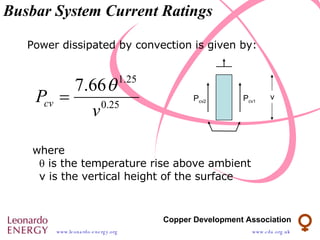
Power dissipated by convection is given by: where     is the temperature rise above ambient v is the vertical height of the surface Busbar System Current Ratings P cv1 P cv2 v
Convection (for 80 C temperature rise) Busbar System Current Ratings
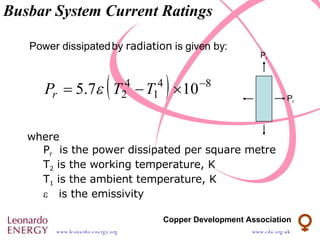
Power dissipated  by  radiation  is given by : where P r   is the power dissipated per square metre T 2  is the working temperature, K T 1  is the ambient temperature, K    is the emissivity Busbar System Current Ratings P r P r
The emissivity,   , describes how effectively the surface radiates heat For a perfectly polished surface, the value is close to zero - a very poor radiator For a matt black surface, the value is close to 1 - a very good radiator Busbar System Current Ratings
Bright copper has an emissivity of about 0.1 During use, the emissivity of the copper surface increases - and the current rating increases - as the copper darkens to reach an emissivity value of about 0.7 Tin plated copper has an emissivity of about 0.3 to 0.5 But painting bars reduces the current rating! Busbar System Current Ratings
Busbar System Current Ratings No radiation heat loss from internal surfaces P r P r P r P r P r P r
Radiation (for 30 C ambient) Busbar System Current Ratings
for 100 mm vertical height, 30 C ambient Busbar System Current Ratings
The power generated by current in the busbar is: where     is the resistivity of the material a   is the cross sectional area l   is the length Busbar System Current Ratings
At some temperature, the heat generated in the busbar is equal to the total heat lost by convection and radiation. Busbar System Current Ratings
Calculation method: 1 Select working and ambient temperatures 2 Assume initial current density of 8 amps/mm 2 3 Find appropriate size in standard range 4 Calculate heat generated due to current 5 Calculate heat loss at working temperature 6 If 4>5, increase size and return to 4  When 4=<5, this is  smallest possible  size Minimum size calculation
The  most economic  size gives the lowest  lifetime cost .  It is the minimum total cost of  material installation and  energy costs  over the circuit lifetime. Higher  purchase cost -  lower  running costs Best economic sizing
Best economic sizing
Economic Sizing of Busbars
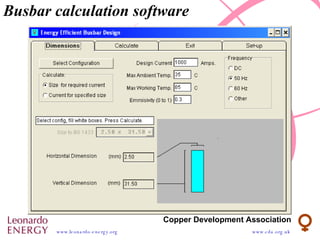
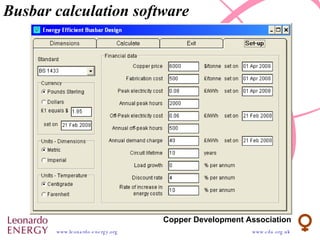
Busbar calculation software
Further considerations Having calculated the size of the bar, there are three further considerations: voltage drop skin effect increases apparent resistance by reducing effective area - important for: thick busbars high frequencies harmonics generated by non-linear loads  short circuit current
Summary of Busbar Material Characteristics High Conductivity low loss, low voltage drop >101.5 % IACS Easy Formability due to small grain size and advanced production technology easy to bend without surface deformation Good Flatness simple reliable jointing Good Straightness easy installation, lower joint stress
 

Busbar Design

  • 1.
  • 2.
    High electrical conductivityonly silver is better than copper Good thermal conductor heat reaches surface quickly Strong (at working temperature) to withstand short circuit stresses low creep Easy to joint resistant to corrosion Materials for Busbar Systems
  • 3.
    Busbar System CurrentRatings Busbar ratings are determined only by the maximum desired working temperature At working temperature: heat generated = heat lost
  • 4.
    Busbar System CurrentRatings Busbar ratings depend on: Working and ambient temperatures Heat lost from the busbar by convection by radiation Heat generated in the busbar
  • 5.
    Power dissipated byconvection is given by: where  is the temperature rise above ambient v is the vertical height of the surface Busbar System Current Ratings P cv1 P cv2 v
  • 6.
    Convection (for 80C temperature rise) Busbar System Current Ratings
  • 7.
    Power dissipated by radiation is given by : where P r is the power dissipated per square metre T 2 is the working temperature, K T 1 is the ambient temperature, K  is the emissivity Busbar System Current Ratings P r P r
  • 8.
    The emissivity,  , describes how effectively the surface radiates heat For a perfectly polished surface, the value is close to zero - a very poor radiator For a matt black surface, the value is close to 1 - a very good radiator Busbar System Current Ratings
  • 9.
    Bright copper hasan emissivity of about 0.1 During use, the emissivity of the copper surface increases - and the current rating increases - as the copper darkens to reach an emissivity value of about 0.7 Tin plated copper has an emissivity of about 0.3 to 0.5 But painting bars reduces the current rating! Busbar System Current Ratings
  • 10.
    Busbar System CurrentRatings No radiation heat loss from internal surfaces P r P r P r P r P r P r
  • 11.
    Radiation (for 30C ambient) Busbar System Current Ratings
  • 12.
    for 100 mmvertical height, 30 C ambient Busbar System Current Ratings
  • 13.
    The power generatedby current in the busbar is: where  is the resistivity of the material a is the cross sectional area l is the length Busbar System Current Ratings
  • 14.
    At some temperature,the heat generated in the busbar is equal to the total heat lost by convection and radiation. Busbar System Current Ratings
  • 15.
    Calculation method: 1Select working and ambient temperatures 2 Assume initial current density of 8 amps/mm 2 3 Find appropriate size in standard range 4 Calculate heat generated due to current 5 Calculate heat loss at working temperature 6 If 4>5, increase size and return to 4 When 4=<5, this is smallest possible size Minimum size calculation
  • 16.
    The mosteconomic size gives the lowest lifetime cost . It is the minimum total cost of material installation and energy costs over the circuit lifetime. Higher purchase cost - lower running costs Best economic sizing
  • 17.
  • 18.
  • 19.
  • 20.
  • 21.
  • 22.
  • 23.
    Further considerations Havingcalculated the size of the bar, there are three further considerations: voltage drop skin effect increases apparent resistance by reducing effective area - important for: thick busbars high frequencies harmonics generated by non-linear loads short circuit current
  • 24.
    Summary of BusbarMaterial Characteristics High Conductivity low loss, low voltage drop >101.5 % IACS Easy Formability due to small grain size and advanced production technology easy to bend without surface deformation Good Flatness simple reliable jointing Good Straightness easy installation, lower joint stress
  • 25.

Editor's Notes

  • #2 Welcome to this LE webcast. It discusses the design of busbar systems, including the choice of material, how to size busbars for a particular current rating and how to optimise the lifetime costs.