



MANAGEMENT IN ACUTE AORTIC
SYNDROME : WHEN IS TEVAR NEED?
F2 Parach Sirisriro
3rd Dec 2018
REFERENCE
Rutherford's Vascular Surgery and Endovascular Therapy, Chapter
81, 3183-3221.e
Textbook
Journal
- Members, A. T. F., et al. (2014). "2014 ESC Guidelines on the diagnosis and management of
acute pulmonary embolism: The Task Force for the Diagnosis and Management of Acute
Pulmonary Embolism of the European Society of Cardiology (ESC) Endorsed by the
European Respiratory Society (ERS)." European heart journal 35(43): 3033-3073.
- Erbel, R., et al. (2015). "Corrigendum to: 2014 ESC Guidelines on the diagnosis
and treatment of aortic diseases." European heart journal 36(41): 2779-2779.
JAMA. 2016;316(7):754-763. doi:10.1001/jama.2016.10026
- Choe, C. H. and R. R. Arya (2017). Management of Acute Aortic Syndromes.
Evidence-Based Critical Care, Springer: 163-170.
- Wells, C. M. and K. Subramaniam (2011). Acute aortic syndrome. Anesthesia and
Perioperative Care for Aortic Surgery, Springer: 17-36.
REFERENCE
• Hiratzka, L. F., et al. (2010). "2010 ACCF/AHA/AATS/ACR/ASA/SCA/SCAI/SIR/STS/SVM guidelines for
the diagnosis and management of patients with thoracic aortic disease." Journal of the American
College of Cardiology 55(14): e27-e129.
• Group, J. J. W. (2013). "Guidelines for diagnosis and treatment of aortic aneurysm and aortic
dissection (JCS 2011)." Circulation Journal 77(3): 789-828.
• Mussa, F. F., et al. (2016). "Acute aortic dissection and intramural hematoma: a systematic review."
Jama 316(7): 754-763.
• Rozado, J., et al. (2017). "Comparing American, European and Asian practice guidelines for aortic
diseases." Journal of thoracic disease 9(Suppl 6): S551.
Song, C., et al. (2016). "The new indication of TEVAR for uncomplicated type B aortic dissection."
Medicine 95(25).
OUTLINE
Definition
Pathology and Classification
Clinical presentation and complication
Treatment
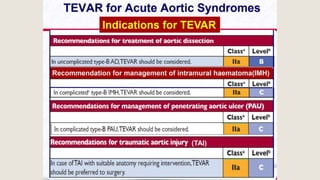
Indication for TEVAR
Conclusion
DEFINITION
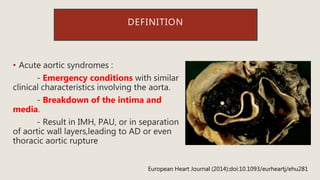
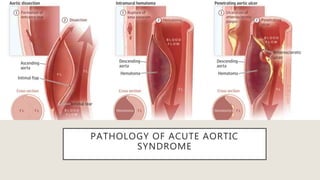
• Acute aortic syndromes :
- Emergency conditions with similar
clinical characteristics involving the aorta.
- Breakdown of the intima and
media.
- Result in IMH, PAU, or in separation
of aortic wall layers,leading to AD or even
thoracic aortic rupture
European Heart Journal (2014):doi:10.1093/eurheartj/ehu281
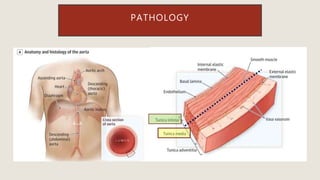
PATHOLOGY
PATHOLOGY OF ACUTE AORTIC
SYNDROME
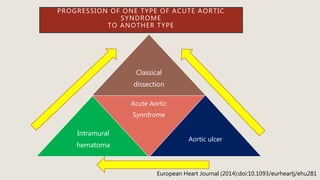
PROGRESSION OF ONE TYPE OF ACUTE AORTIC
SYNDROME
TO ANOTHER TYPE
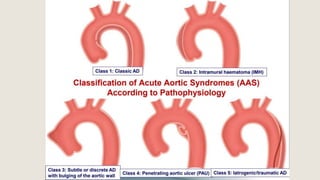
Classical
dissection
Intramural
hematoma
Acute Aortic
Synrdrome
Aortic ulcer
European Heart Journal (2014):doi:10.1093/eurheartj/ehu281
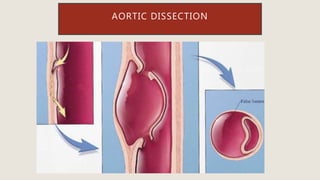
AORTIC DISSECTION
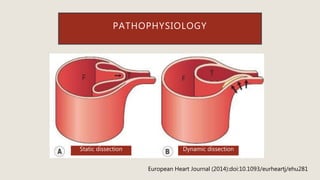
PATHOPHYSIOLOGY
Static dissection Dynamic dissection
European Heart Journal (2014):doi:10.1093/eurheartj/ehu281
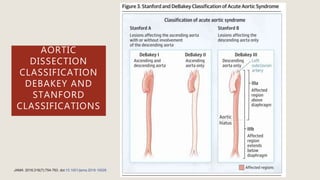
AORTIC
DISSECTION
CLASSIFICATION
DEBAKEY AND
STANFORD
CLASSIFICATIONS
JAMA. 2016;316(7):754-763. doi:10.1001/jama.2016.10026
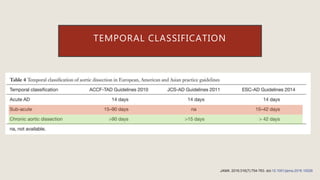
TEMPORAL CLASSIFICATION
JAMA. 2016;316(7):754-763. doi:10.1001/jama.2016.10026
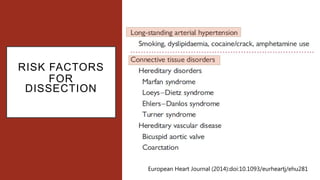
RISK FACTORS
FOR
DISSECTION
European Heart Journal (2014):doi:10.1093/eurheartj/ehu281
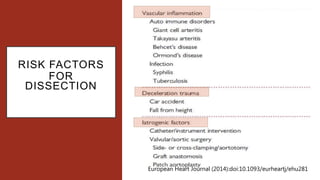
RISK FACTORS
FOR
DISSECTION
European Heart Journal (2014):doi:10.1093/eurheartj/ehu281
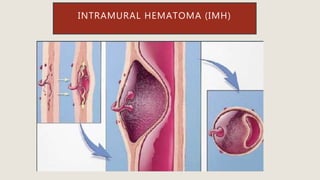
INTRAMURAL HEMATOMA (IMH)
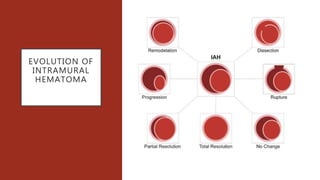
EVOLUTION OF
INTRAMURAL
HEMATOMA
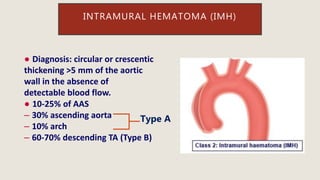
● Diagnosis: circular or crescentic
thickening >5 mm of the aortic
wall in the absence of
detectable blood flow.
● 10-25% of AAS
– 30% ascending aorta
– 10% arch
– 60-70% descending TA (Type B)
INTRAMURAL HEMATOMA (IMH)
Type A
● Diagnosis → CT/MRI
– Unenhanced acquisition + contrast-enhanced acquisition in CT →
sensitivity 96%
● Type-A IMH
– In-hospital mortality similar to type-A AD
– 30-40% evolve into AD
● Type-B IMH
– In-hospital mortality similar to type-B AD
INTRAMURAL HEMATOMA (IMH)
JAMA. 2016;316(7):754-763. doi:10.1001/jama.2016.10026
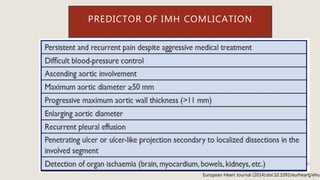
PREDICTOR OF IMH COMLICATION
European Heart Journal (2014):doi:10.1093/eurheartj/ehu2
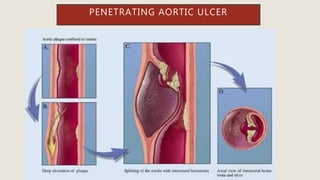
PENETRATING AORTIC ULCER
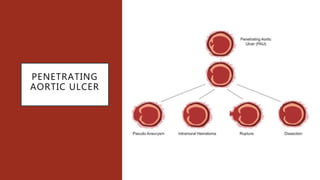
PENETRATING
AORTIC ULCER
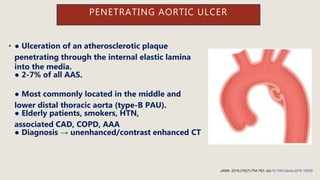
• ● Ulceration of an atherosclerotic plaque
penetrating through the internal elastic lamina
into the media.
● 2-7% of all AAS.
● Most commonly located in the middle and
lower distal thoracic aorta (type-B PAU).
● Elderly patients, smokers, HTN,
associated CAD, COPD, AAA
● Diagnosis → unenhanced/contrast enhanced CT
PENETRATING AORTIC ULCER
JAMA. 2016;316(7):754-763. doi:10.1001/jama.2016.10026
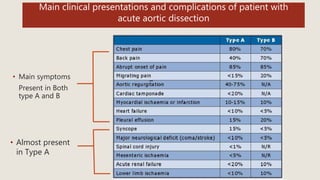
Clinical presentation and complication
• Main symptoms
Present in Both
type A and B
• Almost present
in Type A
Main clinical presentations and complications of patient with
acute aortic dissection
−
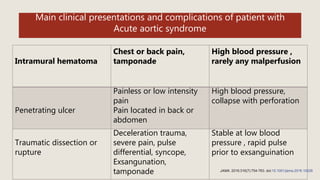
Main clinical presentations and complications of patient with
Acute aortic syndrome
Intramural hematoma
Chest or back pain,
tamponade
High blood pressure ,
rarely any malperfusion
Penetrating ulcer
Painless or low intensity
pain
Pain located in back or
abdomen
High blood pressure,
collapse with perforation
Traumatic dissection or
rupture
Deceleration trauma,
severe pain, pulse
differential, syncope,
Exsangunation,
tamponade
Stable at low blood
pressure , rapid pulse
prior to exsanguination
JAMA. 2016;316(7):754-763. doi:10.1001/jama.2016.10026
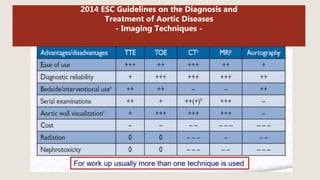
2014 ESC Guidelines on the Diagnosis and
Treatment of Aortic Diseases
- Imaging Techniques -
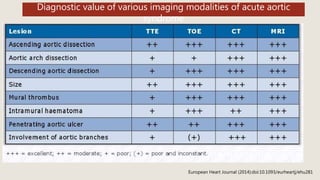
Diagnostic value of various imaging modalities of acute aortic
syndrome
European Heart Journal (2014):doi:10.1093/eurheartj/ehu281
Management and indication for TEVAR
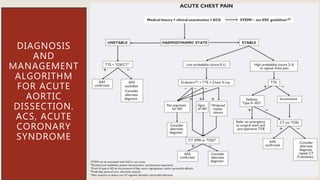
DIAGNOSIS
AND
MANAGEMENT
ALGORITHM
FOR ACUTE
AORTIC
DISSECTION.
ACS, ACUTE
CORONARY
SYNDROME
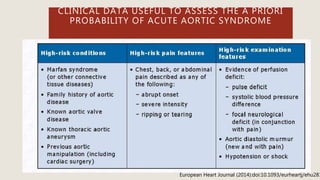
CLINICAL DATA USEFUL TO ASSESS THE A PRIORI
PROBABILITY OF ACUTE AORTIC SYNDROME
European Heart Journal (2014):doi:10.1093/eurheartj/ehu281
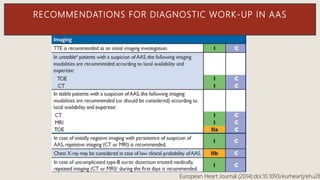
RECOMMENDATIONS FOR DIAGNOSTIC WORK-UP IN AAS
European Heart Journal (2014):doi:10.1093/eurheartj/ehu28
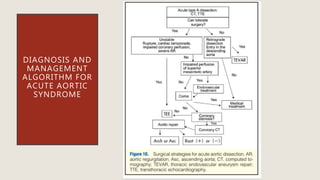
DIAGNOSIS AND
MANAGEMENT
ALGORITHM FOR
ACUTE AORTIC
SYNDROME
European Heart Journal (2014):doi:10.1093/eurheartj/ehu281
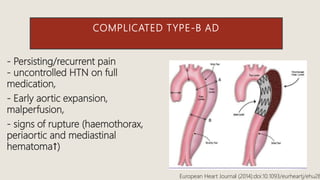
COMPLICATED TYPE-B AD
- Persisting/recurrent pain
- uncontrolled HTN on full
medication,
- Early aortic expansion,
malperfusion,
- signs of rupture (haemothorax,
periaortic and mediastinal
hematoma↑)
European Heart Journal (2014):doi:10.1093/eurheartj/ehu28
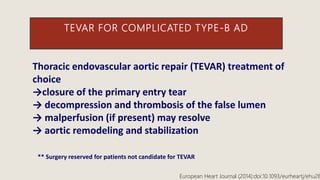
TEVAR FOR COMPLICATED TYPE-B AD
Thoracic endovascular aortic repair (TEVAR) treatment of
choice
→closure of the primary entry tear
→ decompression and thrombosis of the false lumen
→ malperfusion (if present) may resolve
→ aortic remodeling and stabilization
** Surgery reserved for patients not candidate for TEVAR
European Heart Journal (2014):doi:10.1093/eurheartj/ehu28
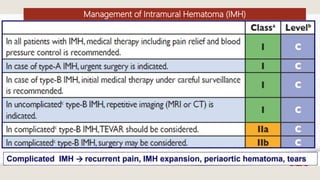
Management of Intramural Hematoma (IMH)
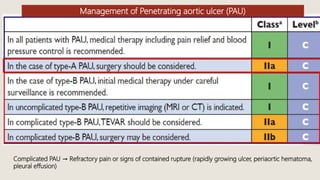
Management of Penetrating aortic ulcer (PAU)
Complicated PAU → Refractory pain or signs of contained rupture (rapidly growing ulcer, periaortic hematoma,
pleural effusion)
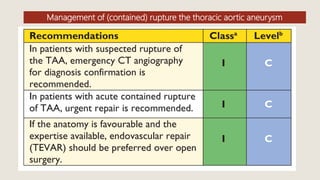
Management of (contained) rupture the thoracic aortic aneurysm
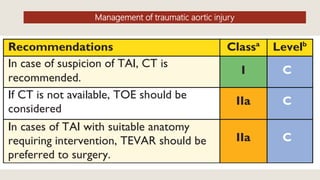
Management of traumatic aortic injury
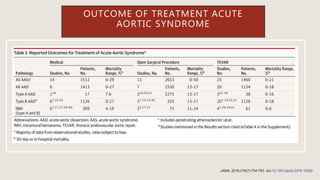
OUTCOME OF TREATMENT ACUTE
AORTIC SYNDROME
JAMA. 2016;316(7):754-763. doi:10.1001/jama.2016.10026
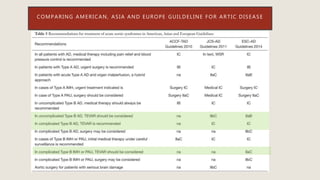
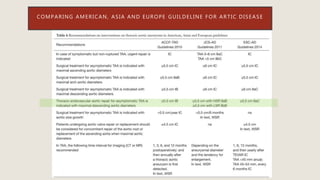
COMPARING AMERICAN, ASIA AND EUROPE GUILDELINE FOR ARTIC DISEASE
Conclusion
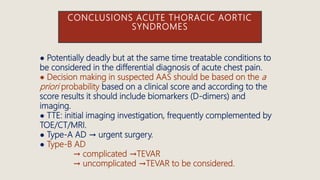
CONCLUSIONS ACUTE THORACIC AORTIC
SYNDROMES
● Potentially deadly but at the same time treatable conditions to
be considered in the differential diagnosis of acute chest pain.
● Decision making in suspected AAS should be based on the a
priori probability based on a clinical score and according to the
score results it should include biomarkers (D-dimers) and
imaging.
● TTE: initial imaging investigation, frequently complemented by
TOE/CT/MRI.
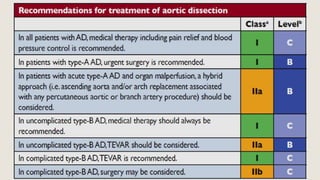
● Type-A AD → urgent surgery.
● Type-B AD
→ complicated →TEVAR
→ uncomplicated →TEVAR to be considered.
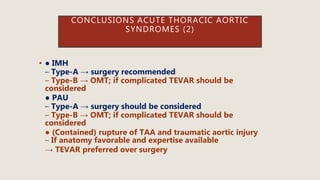
CONCLUSIONS ACUTE THORACIC AORTIC
SYNDROMES (2)
• ● IMH
– Type-A → surgery recommended
– Type-B → OMT; if complicated TEVAR should be
considered
● PAU
– Type-A → surgery should be considered
– Type-B → OMT; if complicated TEVAR should be
considered
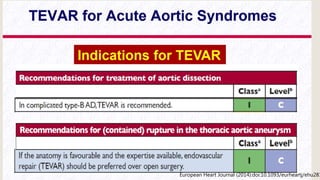
● (Contained) rupture of TAA and traumatic aortic injury
– If anatomy favorable and expertise available
→ TEVAR preferred over surgery
THANK YOU

AAS 3 dec 2018

  • 1.
    MANAGEMENT IN ACUTEAORTIC SYNDROME : WHEN IS TEVAR NEED? F2 Parach Sirisriro 3rd Dec 2018
  • 2.
    REFERENCE Rutherford's Vascular Surgeryand Endovascular Therapy, Chapter 81, 3183-3221.e Textbook Journal - Members, A. T. F., et al. (2014). "2014 ESC Guidelines on the diagnosis and management of acute pulmonary embolism: The Task Force for the Diagnosis and Management of Acute Pulmonary Embolism of the European Society of Cardiology (ESC) Endorsed by the European Respiratory Society (ERS)." European heart journal 35(43): 3033-3073. - Erbel, R., et al. (2015). "Corrigendum to: 2014 ESC Guidelines on the diagnosis and treatment of aortic diseases." European heart journal 36(41): 2779-2779. JAMA. 2016;316(7):754-763. doi:10.1001/jama.2016.10026 - Choe, C. H. and R. R. Arya (2017). Management of Acute Aortic Syndromes. Evidence-Based Critical Care, Springer: 163-170. - Wells, C. M. and K. Subramaniam (2011). Acute aortic syndrome. Anesthesia and Perioperative Care for Aortic Surgery, Springer: 17-36.
  • 3.
    REFERENCE • Hiratzka, L.F., et al. (2010). "2010 ACCF/AHA/AATS/ACR/ASA/SCA/SCAI/SIR/STS/SVM guidelines for the diagnosis and management of patients with thoracic aortic disease." Journal of the American College of Cardiology 55(14): e27-e129. • Group, J. J. W. (2013). "Guidelines for diagnosis and treatment of aortic aneurysm and aortic dissection (JCS 2011)." Circulation Journal 77(3): 789-828. • Mussa, F. F., et al. (2016). "Acute aortic dissection and intramural hematoma: a systematic review." Jama 316(7): 754-763. • Rozado, J., et al. (2017). "Comparing American, European and Asian practice guidelines for aortic diseases." Journal of thoracic disease 9(Suppl 6): S551. Song, C., et al. (2016). "The new indication of TEVAR for uncomplicated type B aortic dissection." Medicine 95(25).
  • 4.
    OUTLINE Definition Pathology and Classification Clinicalpresentation and complication Treatment Indication for TEVAR Conclusion
  • 5.
    DEFINITION • Acute aorticsyndromes : - Emergency conditions with similar clinical characteristics involving the aorta. - Breakdown of the intima and media. - Result in IMH, PAU, or in separation of aortic wall layers,leading to AD or even thoracic aortic rupture European Heart Journal (2014):doi:10.1093/eurheartj/ehu281
  • 6.
  • 8.
    PATHOLOGY OF ACUTEAORTIC SYNDROME
  • 9.
    PROGRESSION OF ONETYPE OF ACUTE AORTIC SYNDROME TO ANOTHER TYPE Classical dissection Intramural hematoma Acute Aortic Synrdrome Aortic ulcer European Heart Journal (2014):doi:10.1093/eurheartj/ehu281
  • 10.
  • 11.
    PATHOPHYSIOLOGY Static dissection Dynamicdissection European Heart Journal (2014):doi:10.1093/eurheartj/ehu281
  • 12.
  • 13.
  • 14.
    RISK FACTORS FOR DISSECTION European HeartJournal (2014):doi:10.1093/eurheartj/ehu281
  • 15.
    RISK FACTORS FOR DISSECTION European HeartJournal (2014):doi:10.1093/eurheartj/ehu281
  • 16.
  • 17.
  • 18.
    ● Diagnosis: circularor crescentic thickening >5 mm of the aortic wall in the absence of detectable blood flow. ● 10-25% of AAS – 30% ascending aorta – 10% arch – 60-70% descending TA (Type B) INTRAMURAL HEMATOMA (IMH) Type A
  • 19.
    ● Diagnosis →CT/MRI – Unenhanced acquisition + contrast-enhanced acquisition in CT → sensitivity 96% ● Type-A IMH – In-hospital mortality similar to type-A AD – 30-40% evolve into AD ● Type-B IMH – In-hospital mortality similar to type-B AD INTRAMURAL HEMATOMA (IMH) JAMA. 2016;316(7):754-763. doi:10.1001/jama.2016.10026
  • 20.
    PREDICTOR OF IMHCOMLICATION European Heart Journal (2014):doi:10.1093/eurheartj/ehu2
  • 21.
  • 22.
  • 23.
    • ● Ulcerationof an atherosclerotic plaque penetrating through the internal elastic lamina into the media. ● 2-7% of all AAS. ● Most commonly located in the middle and lower distal thoracic aorta (type-B PAU). ● Elderly patients, smokers, HTN, associated CAD, COPD, AAA ● Diagnosis → unenhanced/contrast enhanced CT PENETRATING AORTIC ULCER JAMA. 2016;316(7):754-763. doi:10.1001/jama.2016.10026
  • 24.
  • 25.
    • Main symptoms Presentin Both type A and B • Almost present in Type A Main clinical presentations and complications of patient with acute aortic dissection −
  • 26.
    Main clinical presentationsand complications of patient with Acute aortic syndrome Intramural hematoma Chest or back pain, tamponade High blood pressure , rarely any malperfusion Penetrating ulcer Painless or low intensity pain Pain located in back or abdomen High blood pressure, collapse with perforation Traumatic dissection or rupture Deceleration trauma, severe pain, pulse differential, syncope, Exsangunation, tamponade Stable at low blood pressure , rapid pulse prior to exsanguination JAMA. 2016;316(7):754-763. doi:10.1001/jama.2016.10026
  • 27.
    2014 ESC Guidelineson the Diagnosis and Treatment of Aortic Diseases - Imaging Techniques -
  • 28.
    Diagnostic value ofvarious imaging modalities of acute aortic syndrome European Heart Journal (2014):doi:10.1093/eurheartj/ehu281
  • 29.
  • 30.
  • 31.
    CLINICAL DATA USEFULTO ASSESS THE A PRIORI PROBABILITY OF ACUTE AORTIC SYNDROME European Heart Journal (2014):doi:10.1093/eurheartj/ehu281
  • 32.
    RECOMMENDATIONS FOR DIAGNOSTICWORK-UP IN AAS European Heart Journal (2014):doi:10.1093/eurheartj/ehu28
  • 33.
  • 35.
    European Heart Journal(2014):doi:10.1093/eurheartj/ehu281
  • 36.
    COMPLICATED TYPE-B AD -Persisting/recurrent pain - uncontrolled HTN on full medication, - Early aortic expansion, malperfusion, - signs of rupture (haemothorax, periaortic and mediastinal hematoma↑) European Heart Journal (2014):doi:10.1093/eurheartj/ehu28
  • 37.
    TEVAR FOR COMPLICATEDTYPE-B AD Thoracic endovascular aortic repair (TEVAR) treatment of choice →closure of the primary entry tear → decompression and thrombosis of the false lumen → malperfusion (if present) may resolve → aortic remodeling and stabilization ** Surgery reserved for patients not candidate for TEVAR European Heart Journal (2014):doi:10.1093/eurheartj/ehu28
  • 39.
  • 40.
    Management of Penetratingaortic ulcer (PAU) Complicated PAU → Refractory pain or signs of contained rupture (rapidly growing ulcer, periaortic hematoma, pleural effusion)
  • 41.
    Management of (contained)rupture the thoracic aortic aneurysm
  • 42.
  • 43.
    OUTCOME OF TREATMENTACUTE AORTIC SYNDROME JAMA. 2016;316(7):754-763. doi:10.1001/jama.2016.10026
  • 44.
    COMPARING AMERICAN, ASIAAND EUROPE GUILDELINE FOR ARTIC DISEASE
  • 45.
    COMPARING AMERICAN, ASIAAND EUROPE GUILDELINE FOR ARTIC DISEASE
  • 46.
  • 47.
    CONCLUSIONS ACUTE THORACICAORTIC SYNDROMES ● Potentially deadly but at the same time treatable conditions to be considered in the differential diagnosis of acute chest pain. ● Decision making in suspected AAS should be based on the a priori probability based on a clinical score and according to the score results it should include biomarkers (D-dimers) and imaging. ● TTE: initial imaging investigation, frequently complemented by TOE/CT/MRI. ● Type-A AD → urgent surgery. ● Type-B AD → complicated →TEVAR → uncomplicated →TEVAR to be considered.
  • 48.
    CONCLUSIONS ACUTE THORACICAORTIC SYNDROMES (2) • ● IMH – Type-A → surgery recommended – Type-B → OMT; if complicated TEVAR should be considered ● PAU – Type-A → surgery should be considered – Type-B → OMT; if complicated TEVAR should be considered ● (Contained) rupture of TAA and traumatic aortic injury – If anatomy favorable and expertise available → TEVAR preferred over surgery
  • 49.