

SUPERIOR
MESENTERIC
VEIN
ANEURYSM
MANAGEMENT
PARACH SIRISRIRO
9 JAN 2018
Interesting case
 Thai female 74 yrs
 U/D DM type II , HT , DLP
 Hx previous Open cholecystectomy due to
acute cholecystitis since 1996
 Known case SMV aneurysm dx 29/4/2005
( previous CT whole abdomen : Aneurysmal
dilatation of the SMV extending to main portal
vein measuring diameter 3.6 cm )
Chief complaint : Abdominal discomfort 1
month PTA
 Present illness :
 1 month PTA : she presented abdominal pain
at suprapubic with distension
 Pain characteristic : Intermittent dull-aching
at suprapubic , radiated to back
 Associated symptoms : constipation and loss
appetite
 She denied vomiting, jaundice , fever
,diarrheal or dysuria
 Otherwise : healthy
Interesting case (Cont.)
 Physical examination
 Vital sign : BT 36.3 O C BP 120/83 HR 80 RR
20
 GA : a woman with normal consciousness
 HEENT : not pale , no jaundice , dry lips
without sunken eyeball
 H&L : WNL
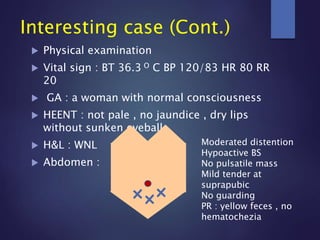
 Abdomen :
Interesting case (Cont.)
Moderated distention
Hypoactive BS
No pulsatile mass
Mild tender at
suprapubic
No guarding
PR : yellow feces , no
hematochezia
What is the
proper
management ?
OUTLINE
• D E F I N I T I O N S , A E T I O L O G Y A N D
P A T H O G E N E S I S
• ANATOMIC LOCATION
• CLINICAL PRESENTATION
• C O M P L I C A T I O N
• M A N A G E M E N T
• S U R G I C A L I N T E R V E N T I O N
• T R E A T M E N T O U T C O M E
R E F E R E N C E
1. Barzilai R, Kleckner MS. Hemocholecyst following ruptured
aneurysm of portal vein. Arch Surg 1956;72:725e7.
2. Leonsins AJ, Siew S. Fusiform aneurysmal dilatation of the
portal vein. Postgrad Med J 1960;36:570e4.
3. Sedgwick CE. Cisternal dilatation of portal vein associated
with
portal hypertension and partial biliary obstruction. Lahey
ClinBull 1960;11:234e7.
4. Hermann RE, Shafer WH. Aneurysm of the portal vein and
portal
vein hypertension, first reported case. Ann Surg
1965;162:1101e4.
5. Thomas TV. Aneurysm of the portal vein: report of two
cases, one resulting in thrombosis and spontaneous rupture.
Surgery1967;61(4):550e5.
6. Liebowitz HR, Rousselot LM. Saccular aneurysm of portal vein
with agnogenic myeloid metaplasia. N Y State J Med 1967;
67(11): 1443e7.
7. Vine HS, Sequeira JC, Windrich WC, Sacks BA. Portal vein
aneurysm. AJR 1979;132:557e60.
8. Moreno, J. A., et al. (2011). "Extrahepatic portal vein
aneurysm." Journal of vascular surgery 54(1): 225-226.
9. Fleming, M. D., et al. (2015). "Operative interventions for
extrahepatic portomesenteric venous aneurysms and long-
term outcomes." Annals of vascular surgery 29(4): 654-
660.
10. Sfyroeras, G., et al. (2009). "Visceral venous aneurysms:
clinical presentation, natural history and their management:
a systematic review." European Journal of Vascular and
Endovascular Surgery 38(4): 498-505.
11. Ma, R., et al. (2012). "Extra-hepatic portal vein aneurysm: A
case report, overview of the literature and suggested
management algorithm." International journal of surgery
case reports 3(11): 555-558.
R E F E R E N C E
I N T R O D U C T I O N
SMV aneurysm is one of subgroup of Portal
venous aneurysm (PVA)
Portal venous aneurysm (PVA) is a term used to
describe aneurysms of the 1. portal vein (PV) 2.
Superior mesenteric vein (SMV) 3. splenic vein (SV) in
the region of spleno-portal junction.
They are rare with less than 200 cases reported
in the literature since it was first described in 1956.
Barzilai R, Kleckner MS. Hemocholecyst following ruptured aneurysm of portal vein; report of a case. AMA Archives of
Surgery 1956;72(4):725–7.
D E F I N I T I O N S , A E T I O L O G Y A N D
P A T H O G E N E S I S
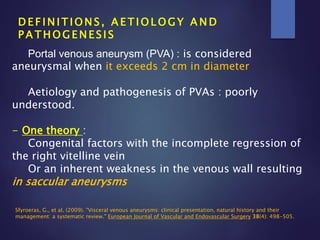
Portal venous aneurysm (PVA) : is considered
aneurysmal when it exceeds 2 cm in diameter
Aetiology and pathogenesis of PVAs : poorly
understood.
- One theory :
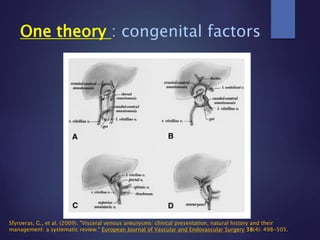
Congenital factors with the incomplete regression of
the right vitelline vein
Or an inherent weakness in the venous wall resulting
in saccular aneurysms
Sfyroeras, G., et al. (2009). "Visceral venous aneurysms: clinical presentation, natural history and their
management: a systematic review." European Journal of Vascular and Endovascular Surgery 38(4): 498-505.
One theory : congenital factors
Sfyroeras, G., et al. (2009). "Visceral venous aneurysms: clinical presentation, natural history and their
management: a systematic review." European Journal of Vascular and Endovascular Surgery 38(4): 498-505.
- Second theory acquired factors, portal
hypertension, and decompensation of vein wall
strength resulting in fusiform aneurysms.
- Portal hypertension has been reported in
about 30%
- Liver cirrhosis in 12% to 28% of patients
with PVA
D E F I N I T I O N S , A E T I O L O G Y A N D
P A T H O G E N E S I S
Sfyroeras, G., et al. (2009). "Visceral venous aneurysms: clinical presentation, natural history and their
management: a systematic review." European Journal of Vascular and Endovascular Surgery 38(4): 498-505.
A N A T O M I C L O C A T I O N
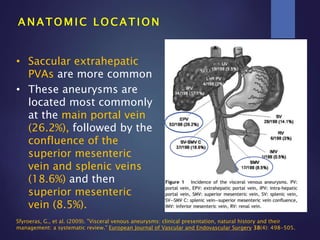
• Saccular extrahepatic
PVAs are more common
• These aneurysms are
located most commonly
at the main portal vein
(26.2%), followed by the
confluence of the
superior mesenteric
vein and splenic veins
(18.6%) and then
superior mesenteric
vein (8.5%).
Sfyroeras, G., et al. (2009). "Visceral venous aneurysms: clinical presentation, natural history and their
management: a systematic review." European Journal of Vascular and Endovascular Surgery 38(4): 498-505.
C L I N I C A L P R E S E N T A T I O N
• Abdominal pain is reported in 44.7% (55 of 123
patients)
• GI bleeding in 7.3% (9 of 123 patients)
• Asymptomatic and discovered incidentally during
abdominal scanning in 38.2% of the patients (47 of
123).
Sfyroeras, G., et al. (2009). "Visceral venous aneurysms: clinical presentation, natural history and their
management: a systematic review." European Journal of Vascular and Endovascular Surgery 38(4): 498-505.
C O M P L I C A T I O N
• Thrombosis , Rupture , Compression
• Complete thrombosis occurred in 24 patients
(13.6%) and non-occlusive thrombus existed in six.
• Rupture is described in four patients (2.2%); The
diameter of the ruptured aneurysms was 2 cm in
three of the four cases.
• In two cases, the aneurysm compressed the
common bile duct, the
duodenum in two and the inferior vena cava in one.
Sfyroeras, G., et al. (2009). "Visceral venous aneurysms: clinical presentation, natural history and their
management: a systematic review." European Journal of Vascular and Endovascular Surgery 38(4): 498-505.
 The management of large aneurysms in
asymptomatic patients is still controversial and
should be decided on a case-by-case
 Further studies are required to assess the
long-term risk of complications
M A N A G E M E N T I N A S Y M P T O M A T I C
Sfyroeras, G., et al. (2009). "Visceral venous aneurysms: clinical presentation, natural history and their
management: a systematic review." European Journal of Vascular and Endovascular Surgery 38(4): 498-505.
S U R G I C A L M A N A G E M E N T
• 88% of patients showing no progression of
aneurysm size or complications on subsequent
follow up
• Symptomatic or expanding aneurysms are
indications for surgical intervention.
Surgical intervention depends on associated features.
Patients with portal hypertension and portal vein
thrombosis usually undergone shunt
surgery
Patients without portal hypertension
aneurysmorrhaphy  resecting out redundant
parts of the venous wall and re-suturingSfyroeras, G., et al. (2009). "Visceral venous aneurysms: clinical presentation, natural history and their
management: a systematic review." European Journal of Vascular and Endovascular Surgery 38(4): 498-505.
M A N A G E M E N T I N T H R O M B O S I S
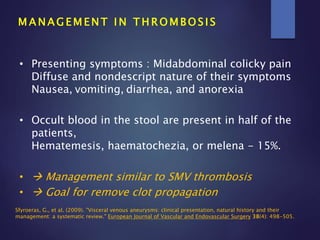
• Presenting symptoms : Midabdominal colicky pain
Diffuse and nondescript nature of their symptoms
Nausea, vomiting, diarrhea, and anorexia
• Occult blood in the stool are present in half of the
patients,
Hematemesis, haematochezia, or melena - 15%.
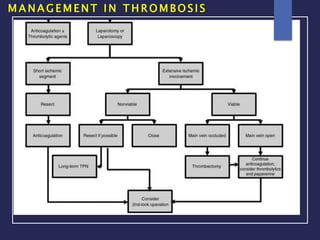
•  Management similar to SMV thrombosis
•  Goal for remove clot propagation
Sfyroeras, G., et al. (2009). "Visceral venous aneurysms: clinical presentation, natural history and their
management: a systematic review." European Journal of Vascular and Endovascular Surgery 38(4): 498-505.
M A N A G E M E N T I N T H R O M B O S I S
 If acutely thrombosed,
percutaneous treatment by a combination of
transarterial thrombolysis and transhepatic
aspiration thrombectomy is an alternative to
surgical thrombectomy and aneurysm resection.
 This approach, followed by oral anticoagulant
therapy, led to immediate relief of abdominal
pain and prevented rethrombosis at mid-term
M A N A G E M E N T I N T H R O M B O S I S
Ma, R., et al. (2012). "Extra-hepatic portal vein aneurysm: A case report,
overview of the literature and suggested management algorithm."
International journal of surgery case reports 3(11): 555-558.
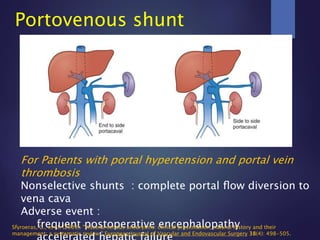
Portovenous shunt
For Patients with portal hypertension and portal vein
thrombosis
Nonselective shunts : complete portal flow diversion to
vena cava
Adverse event :
frequent postoperative encephalopathySfyroeras, G., et al. (2009). "Visceral venous aneurysms: clinical presentation, natural history and their
management: a systematic review." European Journal of Vascular and Endovascular Surgery 38(4): 498-505.
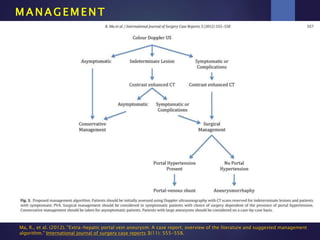
M A N A G E M E N T
Ma, R., et al. (2012). "Extra-hepatic portal vein aneurysm: A case report, overview of the literature and suggested management
algorithm." International journal of surgery case reports 3(11): 555-558.
S U R G I C A L A P P R O A C H F O R S M V A N E U R Y S M
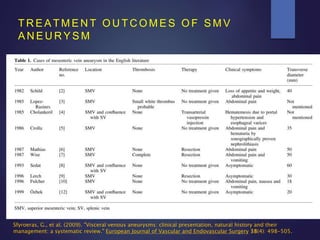
• 4 patients with superior mesenteric vein aneurysm
with surgical intervention
– 2 aneurysmorrhaphy
– one aneurysmectomy
– one arterial thrombolysis and transhepatic
thrombus aspiration.
• Aneurysmorrhaphy : procedure of choice for
saccular aneurysm
• Aneurysmectomy + the conduit used to replace the
portal vein can be an allograft from cadaveric
donor, or a synthetic graft : In cases of fusiform
aneurysmsMa, R., et al. (2012). "Extra-hepatic portal vein aneurysm: A case report, overview of the literature and
suggested management algorithm." International journal of surgery case reports 3(11): 555-558.
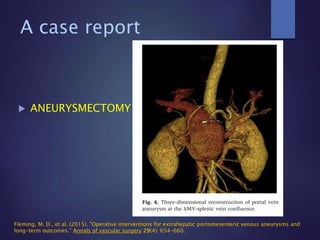
A case report
 ANEURYSMECTOMY
Fleming, M. D., et al. (2015). "Operative interventions for extrahepatic portomesenteric venous aneurysms and
long-term outcomes." Annals of vascular surgery 29(4): 654-660.
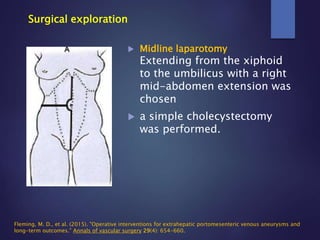
Surgical exploration
 Midline laparotomy
Extending from the xiphoid
to the umbilicus with a right
mid-abdomen extension was
chosen
 a simple cholecystectomy
was performed.
Fleming, M. D., et al. (2015). "Operative interventions for extrahepatic portomesenteric venous aneurysms and
long-term outcomes." Annals of vascular surgery 29(4): 654-660.
S U R G I C A L M A N A G E M E N T
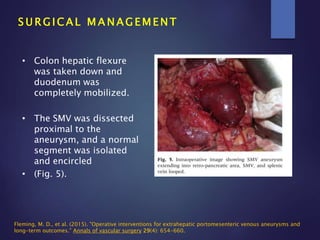
• Colon hepatic flexure
was taken down and
duodenum was
completely mobilized.
• The SMV was dissected
proximal to the
aneurysm, and a normal
segment was isolated
and encircled
• (Fig. 5).
Fleming, M. D., et al. (2015). "Operative interventions for extrahepatic portomesenteric venous aneurysms and
long-term outcomes." Annals of vascular surgery 29(4): 654-660.
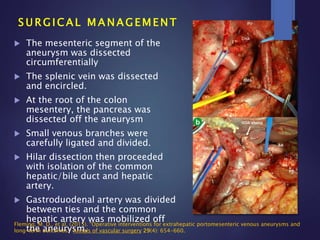
 The mesenteric segment of the
aneurysm was dissected
circumferentially
 The splenic vein was dissected
and encircled.
 At the root of the colon
mesentery, the pancreas was
dissected off the aneurysm
 Small venous branches were
carefully ligated and divided.
 Hilar dissection then proceeded
with isolation of the common
hepatic/bile duct and hepatic
artery.
 Gastroduodenal artery was divided
between ties and the common
hepatic artery was mobilized off
the aneurysm.
S U R G I C A L M A N A G E M E N T
Fleming, M. D., et al. (2015). "Operative interventions for extrahepatic portomesenteric venous aneurysms and
long-term outcomes." Annals of vascular surgery 29(4): 654-660.
 Next the duodenum and its venous branches
were dissected off the aneurysm.
 The aneurysm was then dissected
circumferentially within the pancreatic
channel, thereby achieving full mobility.
 A healthy portal vein segment was isolated at
mid-hilar level below the bifurcation.
 After systemic heparinization, clamps were
applied to the SMV, portal vein, and the
splenic vein, and the aneurysm was resected.
S U R G I C A L M A N A G E M E N T
Fleming, M. D., et al. (2015). "Operative interventions for extrahepatic portomesenteric venous aneurysms and
long-term outcomes." Annals of vascular surgery 29(4): 654-660.
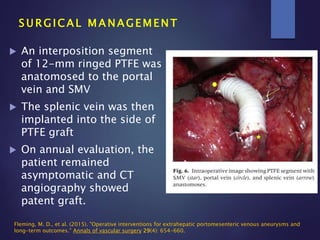
 An interposition segment
of 12-mm ringed PTFE was
anatomosed to the portal
vein and SMV
 The splenic vein was then
implanted into the side of
PTFE graft
 On annual evaluation, the
patient remained
asymptomatic and CT
angiography showed
patent graft.
S U R G I C A L M A N A G E M E N T
Fleming, M. D., et al. (2015). "Operative interventions for extrahepatic portomesenteric venous aneurysms and
long-term outcomes." Annals of vascular surgery 29(4): 654-660.
Case report
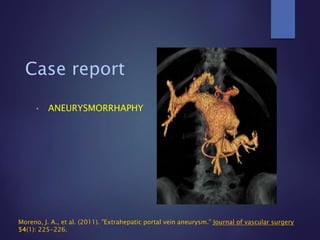
• ANEURYSMORRHAPHY
Moreno, J. A., et al. (2011). "Extrahepatic portal vein aneurysm." Journal of vascular surgery
54(1): 225-226.
C A S E R E P O R T
• Female 49-year-old
• CC : Intermittent epigastric and right upper
quadrant abdominal pain no significant medical or
surgical history.
• Physical examination was negative except mild
right upper quadrant tenderness.
Moreno, J. A., et al. (2011). "Extrahepatic portal vein aneurysm." Journal of vascular surgery
54(1): 225-226.
S U R G I C A L A P P R O A C H
• Laboratory tests were within normal
limits;
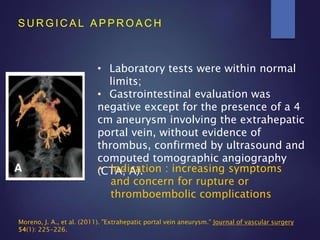
• Gastrointestinal evaluation was
negative except for the presence of a 4
cm aneurysm involving the extrahepatic
portal vein, without evidence of
thrombus, confirmed by ultrasound and
computed tomographic angiography
(CTA; A).• Indication : increasing symptoms
and concern for rupture or
thromboembolic complications
Moreno, J. A., et al. (2011). "Extrahepatic portal vein aneurysm." Journal of vascular surgery
54(1): 225-226.
S U R G I C A L A P P R O A C H
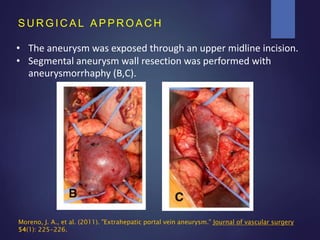
• The aneurysm was exposed through an upper midline incision.
• Segmental aneurysm wall resection was performed with
aneurysmorrhaphy (B,C).
Moreno, J. A., et al. (2011). "Extrahepatic portal vein aneurysm." Journal of vascular surgery
54(1): 225-226.
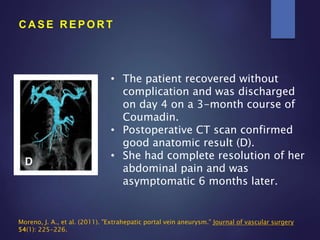
• The patient recovered without
complication and was discharged
on day 4 on a 3-month course of
Coumadin.
• Postoperative CT scan confirmed
good anatomic result (D).
• She had complete resolution of her
abdominal pain and was
asymptomatic 6 months later.
C A S E R E P O R T
Moreno, J. A., et al. (2011). "Extrahepatic portal vein aneurysm." Journal of vascular surgery
54(1): 225-226.
T R E A T M E N T O U T C O M E S O F S M V
A N E U R Y S M
Sfyroeras, G., et al. (2009). "Visceral venous aneurysms: clinical presentation, natural history and their
management: a systematic review." European Journal of Vascular and Endovascular Surgery 38(4): 498-505.
T R E A T M E N T O U T C O M E
Sfyroeras, G., et al. (2009). "Visceral venous aneurysms: clinical presentation, natural history and their management: a
systematic review." European Journal of Vascular and Endovascular Surgery 38(4): 498-505.
M A N A G E M E N T
Sfyroeras, G., et al. (2009). "Visceral venous aneurysms: clinical presentation, natural history and their management: a
systematic review." European Journal of Vascular and Endovascular Surgery 38(4): 498-505.
CONCLUSION
 Aneurysmal disease in the venous system is uncommon.
 The majority of venous aneurysms occur in peripheral
vessels.
 Visceral venous aneurysms (VVA) are rare, the most common
being portal mesenteric vein aneurysms.
 Because of their rare nature, limited information concerning
the natural history, presentation, and management of VVA is
known.
 Many VVA are asymptomatic; others cause mass effect or
other complications.
 Rupture is a rare complication, occurring in only 2.2% of VVA
 VVAs causing symptoms usually require operative
intervention.
 The management of asymptomatic aneurysms is less
clear.
CONCLUSION
Thank
You

Smv aneurysm

  • 1.
  • 2.
    Interesting case  Thaifemale 74 yrs  U/D DM type II , HT , DLP  Hx previous Open cholecystectomy due to acute cholecystitis since 1996  Known case SMV aneurysm dx 29/4/2005 ( previous CT whole abdomen : Aneurysmal dilatation of the SMV extending to main portal vein measuring diameter 3.6 cm ) Chief complaint : Abdominal discomfort 1 month PTA
  • 3.
     Present illness:  1 month PTA : she presented abdominal pain at suprapubic with distension  Pain characteristic : Intermittent dull-aching at suprapubic , radiated to back  Associated symptoms : constipation and loss appetite  She denied vomiting, jaundice , fever ,diarrheal or dysuria  Otherwise : healthy Interesting case (Cont.)
  • 4.
     Physical examination Vital sign : BT 36.3 O C BP 120/83 HR 80 RR 20  GA : a woman with normal consciousness  HEENT : not pale , no jaundice , dry lips without sunken eyeball  H&L : WNL  Abdomen : Interesting case (Cont.) Moderated distention Hypoactive BS No pulsatile mass Mild tender at suprapubic No guarding PR : yellow feces , no hematochezia
  • 5.
  • 6.
    OUTLINE • D EF I N I T I O N S , A E T I O L O G Y A N D P A T H O G E N E S I S • ANATOMIC LOCATION • CLINICAL PRESENTATION • C O M P L I C A T I O N • M A N A G E M E N T • S U R G I C A L I N T E R V E N T I O N • T R E A T M E N T O U T C O M E
  • 7.
    R E FE R E N C E 1. Barzilai R, Kleckner MS. Hemocholecyst following ruptured aneurysm of portal vein. Arch Surg 1956;72:725e7. 2. Leonsins AJ, Siew S. Fusiform aneurysmal dilatation of the portal vein. Postgrad Med J 1960;36:570e4. 3. Sedgwick CE. Cisternal dilatation of portal vein associated with portal hypertension and partial biliary obstruction. Lahey ClinBull 1960;11:234e7. 4. Hermann RE, Shafer WH. Aneurysm of the portal vein and portal vein hypertension, first reported case. Ann Surg 1965;162:1101e4. 5. Thomas TV. Aneurysm of the portal vein: report of two cases, one resulting in thrombosis and spontaneous rupture. Surgery1967;61(4):550e5. 6. Liebowitz HR, Rousselot LM. Saccular aneurysm of portal vein with agnogenic myeloid metaplasia. N Y State J Med 1967; 67(11): 1443e7. 7. Vine HS, Sequeira JC, Windrich WC, Sacks BA. Portal vein aneurysm. AJR 1979;132:557e60.
  • 8.
    8. Moreno, J.A., et al. (2011). "Extrahepatic portal vein aneurysm." Journal of vascular surgery 54(1): 225-226. 9. Fleming, M. D., et al. (2015). "Operative interventions for extrahepatic portomesenteric venous aneurysms and long- term outcomes." Annals of vascular surgery 29(4): 654- 660. 10. Sfyroeras, G., et al. (2009). "Visceral venous aneurysms: clinical presentation, natural history and their management: a systematic review." European Journal of Vascular and Endovascular Surgery 38(4): 498-505. 11. Ma, R., et al. (2012). "Extra-hepatic portal vein aneurysm: A case report, overview of the literature and suggested management algorithm." International journal of surgery case reports 3(11): 555-558. R E F E R E N C E
  • 9.
    I N TR O D U C T I O N SMV aneurysm is one of subgroup of Portal venous aneurysm (PVA) Portal venous aneurysm (PVA) is a term used to describe aneurysms of the 1. portal vein (PV) 2. Superior mesenteric vein (SMV) 3. splenic vein (SV) in the region of spleno-portal junction. They are rare with less than 200 cases reported in the literature since it was first described in 1956. Barzilai R, Kleckner MS. Hemocholecyst following ruptured aneurysm of portal vein; report of a case. AMA Archives of Surgery 1956;72(4):725–7.
  • 10.
    D E FI N I T I O N S , A E T I O L O G Y A N D P A T H O G E N E S I S Portal venous aneurysm (PVA) : is considered aneurysmal when it exceeds 2 cm in diameter Aetiology and pathogenesis of PVAs : poorly understood. - One theory : Congenital factors with the incomplete regression of the right vitelline vein Or an inherent weakness in the venous wall resulting in saccular aneurysms Sfyroeras, G., et al. (2009). "Visceral venous aneurysms: clinical presentation, natural history and their management: a systematic review." European Journal of Vascular and Endovascular Surgery 38(4): 498-505.
  • 11.
    One theory :congenital factors Sfyroeras, G., et al. (2009). "Visceral venous aneurysms: clinical presentation, natural history and their management: a systematic review." European Journal of Vascular and Endovascular Surgery 38(4): 498-505.
  • 12.
    - Second theoryacquired factors, portal hypertension, and decompensation of vein wall strength resulting in fusiform aneurysms. - Portal hypertension has been reported in about 30% - Liver cirrhosis in 12% to 28% of patients with PVA D E F I N I T I O N S , A E T I O L O G Y A N D P A T H O G E N E S I S Sfyroeras, G., et al. (2009). "Visceral venous aneurysms: clinical presentation, natural history and their management: a systematic review." European Journal of Vascular and Endovascular Surgery 38(4): 498-505.
  • 13.
    A N AT O M I C L O C A T I O N • Saccular extrahepatic PVAs are more common • These aneurysms are located most commonly at the main portal vein (26.2%), followed by the confluence of the superior mesenteric vein and splenic veins (18.6%) and then superior mesenteric vein (8.5%). Sfyroeras, G., et al. (2009). "Visceral venous aneurysms: clinical presentation, natural history and their management: a systematic review." European Journal of Vascular and Endovascular Surgery 38(4): 498-505.
  • 14.
    C L IN I C A L P R E S E N T A T I O N • Abdominal pain is reported in 44.7% (55 of 123 patients) • GI bleeding in 7.3% (9 of 123 patients) • Asymptomatic and discovered incidentally during abdominal scanning in 38.2% of the patients (47 of 123). Sfyroeras, G., et al. (2009). "Visceral venous aneurysms: clinical presentation, natural history and their management: a systematic review." European Journal of Vascular and Endovascular Surgery 38(4): 498-505.
  • 15.
    C O MP L I C A T I O N • Thrombosis , Rupture , Compression • Complete thrombosis occurred in 24 patients (13.6%) and non-occlusive thrombus existed in six. • Rupture is described in four patients (2.2%); The diameter of the ruptured aneurysms was 2 cm in three of the four cases. • In two cases, the aneurysm compressed the common bile duct, the duodenum in two and the inferior vena cava in one. Sfyroeras, G., et al. (2009). "Visceral venous aneurysms: clinical presentation, natural history and their management: a systematic review." European Journal of Vascular and Endovascular Surgery 38(4): 498-505.
  • 16.
     The managementof large aneurysms in asymptomatic patients is still controversial and should be decided on a case-by-case  Further studies are required to assess the long-term risk of complications M A N A G E M E N T I N A S Y M P T O M A T I C Sfyroeras, G., et al. (2009). "Visceral venous aneurysms: clinical presentation, natural history and their management: a systematic review." European Journal of Vascular and Endovascular Surgery 38(4): 498-505.
  • 17.
    S U RG I C A L M A N A G E M E N T • 88% of patients showing no progression of aneurysm size or complications on subsequent follow up • Symptomatic or expanding aneurysms are indications for surgical intervention. Surgical intervention depends on associated features. Patients with portal hypertension and portal vein thrombosis usually undergone shunt surgery Patients without portal hypertension aneurysmorrhaphy  resecting out redundant parts of the venous wall and re-suturingSfyroeras, G., et al. (2009). "Visceral venous aneurysms: clinical presentation, natural history and their management: a systematic review." European Journal of Vascular and Endovascular Surgery 38(4): 498-505.
  • 18.
    M A NA G E M E N T I N T H R O M B O S I S • Presenting symptoms : Midabdominal colicky pain Diffuse and nondescript nature of their symptoms Nausea, vomiting, diarrhea, and anorexia • Occult blood in the stool are present in half of the patients, Hematemesis, haematochezia, or melena - 15%. •  Management similar to SMV thrombosis •  Goal for remove clot propagation Sfyroeras, G., et al. (2009). "Visceral venous aneurysms: clinical presentation, natural history and their management: a systematic review." European Journal of Vascular and Endovascular Surgery 38(4): 498-505.
  • 19.
    M A NA G E M E N T I N T H R O M B O S I S
  • 20.
     If acutelythrombosed, percutaneous treatment by a combination of transarterial thrombolysis and transhepatic aspiration thrombectomy is an alternative to surgical thrombectomy and aneurysm resection.  This approach, followed by oral anticoagulant therapy, led to immediate relief of abdominal pain and prevented rethrombosis at mid-term M A N A G E M E N T I N T H R O M B O S I S Ma, R., et al. (2012). "Extra-hepatic portal vein aneurysm: A case report, overview of the literature and suggested management algorithm." International journal of surgery case reports 3(11): 555-558.
  • 21.
    Portovenous shunt For Patientswith portal hypertension and portal vein thrombosis Nonselective shunts : complete portal flow diversion to vena cava Adverse event : frequent postoperative encephalopathySfyroeras, G., et al. (2009). "Visceral venous aneurysms: clinical presentation, natural history and their management: a systematic review." European Journal of Vascular and Endovascular Surgery 38(4): 498-505.
  • 22.
    M A NA G E M E N T Ma, R., et al. (2012). "Extra-hepatic portal vein aneurysm: A case report, overview of the literature and suggested management algorithm." International journal of surgery case reports 3(11): 555-558.
  • 23.
    S U RG I C A L A P P R O A C H F O R S M V A N E U R Y S M • 4 patients with superior mesenteric vein aneurysm with surgical intervention – 2 aneurysmorrhaphy – one aneurysmectomy – one arterial thrombolysis and transhepatic thrombus aspiration. • Aneurysmorrhaphy : procedure of choice for saccular aneurysm • Aneurysmectomy + the conduit used to replace the portal vein can be an allograft from cadaveric donor, or a synthetic graft : In cases of fusiform aneurysmsMa, R., et al. (2012). "Extra-hepatic portal vein aneurysm: A case report, overview of the literature and suggested management algorithm." International journal of surgery case reports 3(11): 555-558.
  • 24.
    A case report ANEURYSMECTOMY Fleming, M. D., et al. (2015). "Operative interventions for extrahepatic portomesenteric venous aneurysms and long-term outcomes." Annals of vascular surgery 29(4): 654-660.
  • 25.
    Surgical exploration  Midlinelaparotomy Extending from the xiphoid to the umbilicus with a right mid-abdomen extension was chosen  a simple cholecystectomy was performed. Fleming, M. D., et al. (2015). "Operative interventions for extrahepatic portomesenteric venous aneurysms and long-term outcomes." Annals of vascular surgery 29(4): 654-660.
  • 26.
    S U RG I C A L M A N A G E M E N T • Colon hepatic flexure was taken down and duodenum was completely mobilized. • The SMV was dissected proximal to the aneurysm, and a normal segment was isolated and encircled • (Fig. 5). Fleming, M. D., et al. (2015). "Operative interventions for extrahepatic portomesenteric venous aneurysms and long-term outcomes." Annals of vascular surgery 29(4): 654-660.
  • 27.
     The mesentericsegment of the aneurysm was dissected circumferentially  The splenic vein was dissected and encircled.  At the root of the colon mesentery, the pancreas was dissected off the aneurysm  Small venous branches were carefully ligated and divided.  Hilar dissection then proceeded with isolation of the common hepatic/bile duct and hepatic artery.  Gastroduodenal artery was divided between ties and the common hepatic artery was mobilized off the aneurysm. S U R G I C A L M A N A G E M E N T Fleming, M. D., et al. (2015). "Operative interventions for extrahepatic portomesenteric venous aneurysms and long-term outcomes." Annals of vascular surgery 29(4): 654-660.
  • 28.
     Next theduodenum and its venous branches were dissected off the aneurysm.  The aneurysm was then dissected circumferentially within the pancreatic channel, thereby achieving full mobility.  A healthy portal vein segment was isolated at mid-hilar level below the bifurcation.  After systemic heparinization, clamps were applied to the SMV, portal vein, and the splenic vein, and the aneurysm was resected. S U R G I C A L M A N A G E M E N T Fleming, M. D., et al. (2015). "Operative interventions for extrahepatic portomesenteric venous aneurysms and long-term outcomes." Annals of vascular surgery 29(4): 654-660.
  • 29.
     An interpositionsegment of 12-mm ringed PTFE was anatomosed to the portal vein and SMV  The splenic vein was then implanted into the side of PTFE graft  On annual evaluation, the patient remained asymptomatic and CT angiography showed patent graft. S U R G I C A L M A N A G E M E N T Fleming, M. D., et al. (2015). "Operative interventions for extrahepatic portomesenteric venous aneurysms and long-term outcomes." Annals of vascular surgery 29(4): 654-660.
  • 30.
    Case report • ANEURYSMORRHAPHY Moreno,J. A., et al. (2011). "Extrahepatic portal vein aneurysm." Journal of vascular surgery 54(1): 225-226.
  • 31.
    C A SE R E P O R T • Female 49-year-old • CC : Intermittent epigastric and right upper quadrant abdominal pain no significant medical or surgical history. • Physical examination was negative except mild right upper quadrant tenderness. Moreno, J. A., et al. (2011). "Extrahepatic portal vein aneurysm." Journal of vascular surgery 54(1): 225-226.
  • 32.
    S U RG I C A L A P P R O A C H • Laboratory tests were within normal limits; • Gastrointestinal evaluation was negative except for the presence of a 4 cm aneurysm involving the extrahepatic portal vein, without evidence of thrombus, confirmed by ultrasound and computed tomographic angiography (CTA; A).• Indication : increasing symptoms and concern for rupture or thromboembolic complications Moreno, J. A., et al. (2011). "Extrahepatic portal vein aneurysm." Journal of vascular surgery 54(1): 225-226.
  • 33.
    S U RG I C A L A P P R O A C H • The aneurysm was exposed through an upper midline incision. • Segmental aneurysm wall resection was performed with aneurysmorrhaphy (B,C). Moreno, J. A., et al. (2011). "Extrahepatic portal vein aneurysm." Journal of vascular surgery 54(1): 225-226.
  • 34.
    • The patientrecovered without complication and was discharged on day 4 on a 3-month course of Coumadin. • Postoperative CT scan confirmed good anatomic result (D). • She had complete resolution of her abdominal pain and was asymptomatic 6 months later. C A S E R E P O R T Moreno, J. A., et al. (2011). "Extrahepatic portal vein aneurysm." Journal of vascular surgery 54(1): 225-226.
  • 35.
    T R EA T M E N T O U T C O M E S O F S M V A N E U R Y S M Sfyroeras, G., et al. (2009). "Visceral venous aneurysms: clinical presentation, natural history and their management: a systematic review." European Journal of Vascular and Endovascular Surgery 38(4): 498-505.
  • 36.
    T R EA T M E N T O U T C O M E Sfyroeras, G., et al. (2009). "Visceral venous aneurysms: clinical presentation, natural history and their management: a systematic review." European Journal of Vascular and Endovascular Surgery 38(4): 498-505.
  • 37.
    M A NA G E M E N T Sfyroeras, G., et al. (2009). "Visceral venous aneurysms: clinical presentation, natural history and their management: a systematic review." European Journal of Vascular and Endovascular Surgery 38(4): 498-505.
  • 38.
    CONCLUSION  Aneurysmal diseasein the venous system is uncommon.  The majority of venous aneurysms occur in peripheral vessels.  Visceral venous aneurysms (VVA) are rare, the most common being portal mesenteric vein aneurysms.  Because of their rare nature, limited information concerning the natural history, presentation, and management of VVA is known.  Many VVA are asymptomatic; others cause mass effect or other complications.  Rupture is a rare complication, occurring in only 2.2% of VVA
  • 39.
     VVAs causingsymptoms usually require operative intervention.  The management of asymptomatic aneurysms is less clear. CONCLUSION
  • 40.

Editor's Notes

  • #10 Due to rare case the aetiology, natural history and management choices are still relatively unclear
  • #11 One theory : a congenital weakness in the vein wall, possibly related to failure of the right vitelline vein to regress.
  • #12 A Early in fetal development, the right and left vitelline veins are connected by three transverse anastomoses that surround the foregut. The anastomoses are cranial-ventral, dorsal, and caudal-ventral. B,C, a normal formation of extrahepatic portal vein. D that incomplete regression of the right vitelline vein at the level of the caudal-ventral anastomosis results in a small diverticulum that may develop into an aneurysm.
  • #13 A second theory favors acquired factors, such as portal venous hypertension that allows decompensation of vein wall strength.
  • #15 Other symptoms such as fever, abdominal distension, nausea, loss of appetite, weight loss, vomit, malaise and jaundice are infrequently
  • #16 Thrombosis , Rupture , Compression Complete thrombosis occurred in 24 patients (13.6%) and non-occlusive thrombus existed in six. Rupture is described in four patients (2.2%); one of them during the postpartum period. Of the four ruptured, two are splenic vein aneurysms, one intrahepatic and one aneurysm of the right portal vein. The diameter of the ruptured aneurysms was 2 cm in three of the four cases. In two cases, the aneurysm compressed the common bile duct, the duodenum in two and the inferior vena cava in one.
  • #17 basis with discussion with the patient about the risks and benefits
  • #18 Shunt surgery : aims to decompress the portal venous system rather than treat the aneurysm itself reduced pressures to prevent progressive dilatation of the aneurysm. aneurysmorrhaphy : , reducing the risk of future thrombosis and rupture
  • #19 Patient with thrombosis usually present with Midabdominal colicky pain Diffuse and nondescript nature of their symptoms - delay Nausea, vomiting, diarrhea, and anorexia
  • #20 1 diagnosis of acute SMV thrombosis by CTWA : pneumatosis intestinalis: due to transmural infarction dilated and fluid filled lumen filling defect in the superior mesenteric vein and branches (seen in 90% of cases) mesenteric congestion and stranding ascites 2. Nosign of infarction start anticoagulant 3. With sign of infarction : underwent laparotomy or laparoscopy
  • #22 Nonselective shunts drain all portal blood flow into the vena cava. Nonselective shunts include the end-to-side portacaval shunt, side-to-side portacaval shunt, mesocaval shunt, and proximal splenorenal shunt.
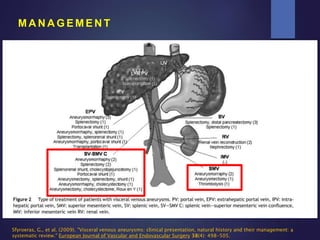
  • #23 Management algorithm to assess SMVA patient
  • #24 Aneurysmorrhaphy is the easiest procedure to excise the aneurysm, mainly when it is saccular, and restore normal luminal diameter of the portal vein. Aneurysmectomy + the conduit used to replace the portal vein can be an allograft from cadaveric donor, or a synthetic graft : In cases of fusiform aneurysms
  • #36 10 patient in the English literature Thrombosis complication 10% Treatment with surgical intervention 3 2 patient due to increase symptoms and diameter size 5 cm 1 patient without symptoms but concern for rupture or thromboembolic complications
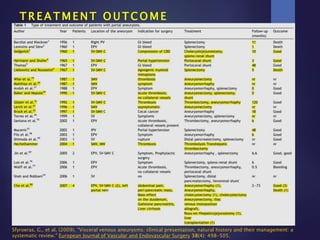
  • #37 Outcome of surgical intervention in SMV aneurysm from 1956 to 2007 8 aneurysmorrhaphy 1 not record 6 good outcome 1 patient who underwent orthotropic liver transplantation developed multiorgan failure 2 months after the surgery and subsequently died 3 aneurysmectomy 2 not record 1 good outcome 3 portocaval shunt 3 good outcome