ABG  seriesANAS  SAHLE , MDDAMASCUSE   HOSPITAL
MORE  FORESTSMORE  OXYGENLONGER  LIFE
Acid-Base Disorders and the ABG 1
OUTLINEACID-BASE DISORDERSHIGH  AG  METABOLIC  ACIDOSISNORMAL  AG  METABOLIC  ACIDOSISMETABOLIC  ALKALOSISOXYGENATION AXIESA-a GRADIENT
ABG - IntroductionBlood gas and pH analysis has more immediacy and potential impact on patient care than any other laboratory determination.(National committee for Laboratory Standards).Cornerstone  in the diagnosis & management of clinical oxygenation and acid-base disturbances.Of all the concepts employed in the diagnosis and treatment of respiratory disorders, few are more important or less well understood than those of blood gas interpretation.
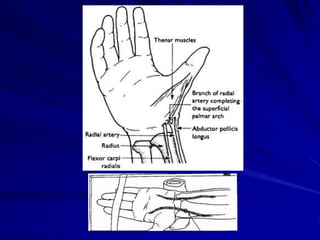
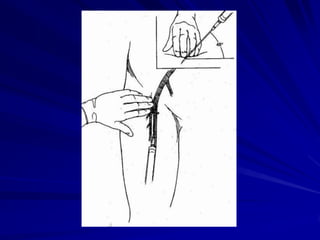
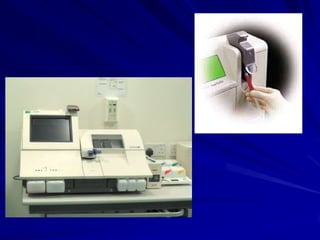
Getting an arterial blood gas sample
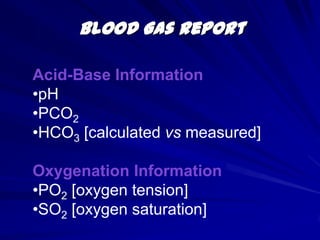
Blood Gas ReportAcid-Base InformationpH
PCO2
HCO3 [calculated vs measured]Oxygenation InformationPO2 [oxygen tension]
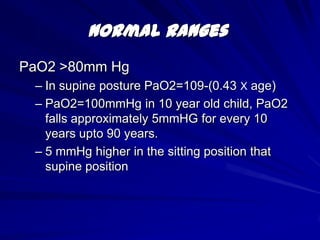
SO2 [oxygen saturation]Normal RangesPaO2 >80mm HgIn supine posture PaO2=109-(0.43 Х age)PaO2=100mmHg in 10 year old child, PaO2 falls approximately 5mmHG for every 10 years upto 90 years.5 mmHg higher in the sitting position that supine position
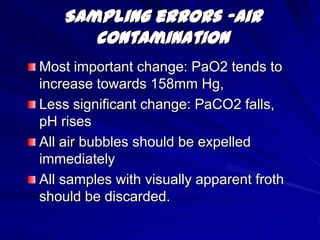
Sampling errors -Air contaminationMost important change: PaO2 tends to increase towards 158mm Hg,Less significant change: PaCO2 falls, pH risesAll air bubbles should be expelled immediatelyAll samples with visually apparent froth should be discarded.
Anticoagulant effects0.05ml of heparin(1,000units/ml) is required to anticoagulate 1 ml of blood.Dead space of a standard 5ml syringe with 22G needle is 0.2ml; i.e. filling the syringe dead space with heparin provides sufficient volume to anticoagulate a 4ml blood sample.Heparin – weak acid equilibrated with room airInitially PaCO2 falls,  In extreme dilution pH and bicarbonate fallsPaO2 usually unchanged.
Time delay - metabolismSamples should be analyzed within 20 min to avoid error.Placing the sample in iced water  slows metabolism to 10%.
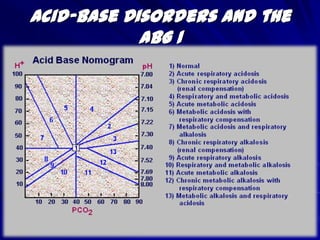
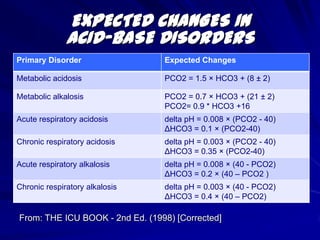
EXPECTED CHANGES IN ACID-BASE DISORDERS From: THE ICU BOOK - 2nd Ed. (1998) [Corrected]
Overview of Acid-Base Physiology
Henderson-Hasselbalch Equation
Renal Regulation of Acid-Base
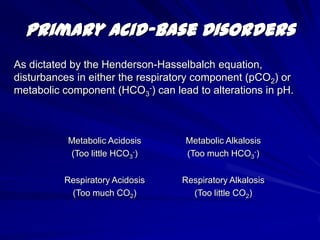
Primary Acid-Base DisordersAs dictated by the Henderson-Hasselbalch equation, disturbances in either the respiratory component (pCO2) or metabolic component (HCO3-) can lead to alterations in pH.
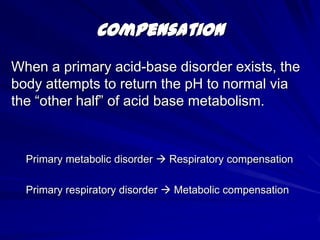
CompensationWhen a primary acid-base disorder exists, the body attempts to return the pH to normal via the “other half” of acid base metabolism.     Primary metabolic disorder  Respiratory compensation     Primary respiratory disorder  Metabolic compensation
Compensation (continued)
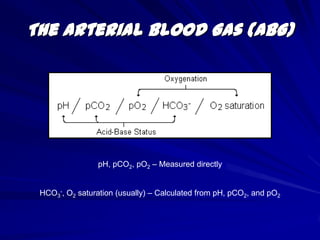
The Arterial Blood Gas (ABG)pH, pCO2, pO2 – Measured directlyHCO3-, O2 saturation (usually) – Calculated from pH, pCO2, and pO2
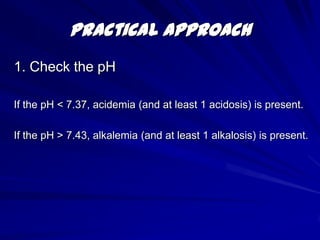
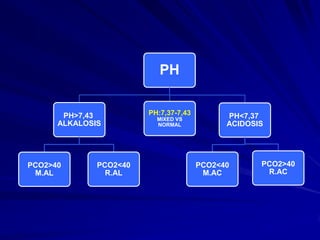
Practical Approach1. Check the pHIf the pH < 7.37, acidemia (and at least 1 acidosis) is present.If the pH > 7.43, alkalemia (and at least 1 alkalosis) is present.
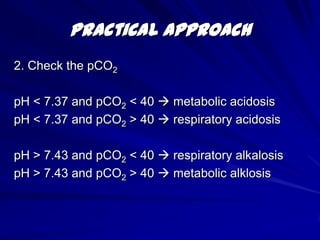
Practical Approach2. Check the pCO2pH < 7.37 and pCO2 < 40  metabolic acidosispH < 7.37 and pCO2 > 40  respiratory acidosispH > 7.43 and pCO2 < 40  respiratory alkalosispH > 7.43 and pCO2 > 40  metabolic alklosis
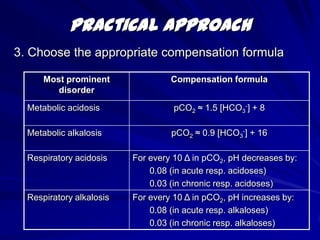
Practical Approach3. Choose the appropriate compensation formula
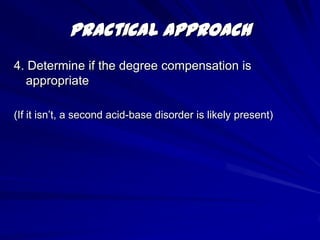
Practical Approach4. Determine if the degree compensation is appropriate(If it isn’t, a second acid-base disorder is likely present)
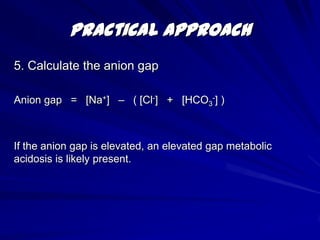
Practical Approach5. Calculate the anion gap Anion gap   =   [Na+]   –   ( [Cl-]   +   [HCO3-] )If the anion gap is elevated, an elevated gap metabolic acidosis is likely present.
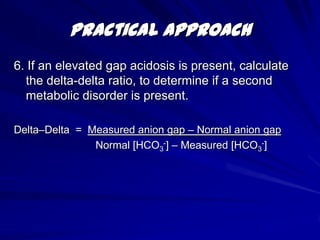
Practical Approach6. If an elevated gap acidosis is present, calculate the delta-delta ratio, to determine if a second metabolic disorder is present.Delta–Delta  =  Measured anion gap – Normal anion gap			      Normal [HCO3-] – Measured [HCO3-]
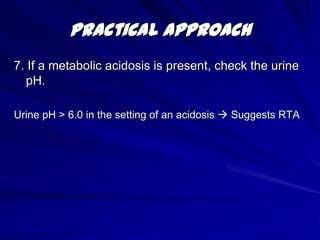
Practical Approach7. If a metabolic acidosis is present, check the urine pH.Urine pH > 6.0 in the setting of an acidosis  Suggests RTA
Practical Approach8. Generate a differential diagnosisIf multiple disorders are present, they may be:		All related to the same process		All independent of one another
Differential Diagonsis for Acid-Base Disorders
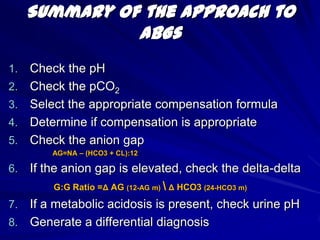
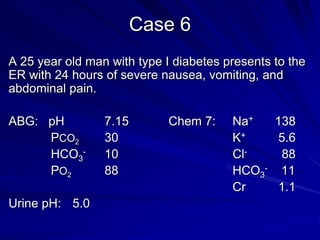
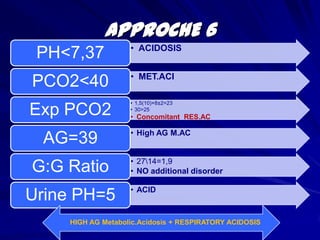
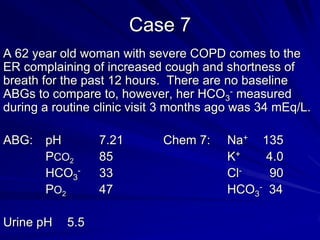
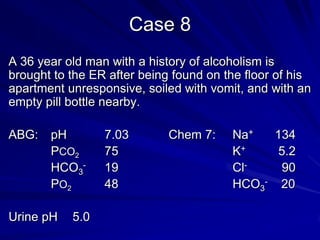
Summary of the Approach to ABGsCheck the pHCheck the pCO2Select the appropriate compensation formulaDetermine if compensation is appropriateCheck the anion gap AG=NA – (HCO3 + CL):12If the anion gap is elevated, check the delta-deltaG:G Ratio =Δ AG (12-AG m) \Δ HCO3 (24-HCO3 m)If a metabolic acidosis is present, check urine pHGenerate a differential diagnosis
Gap:gap ratio??
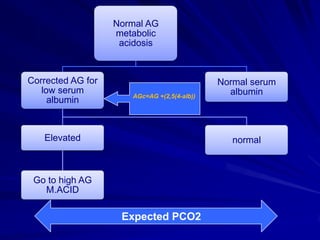
AGc=AG +(2,5(4-alb))Expected PCO2
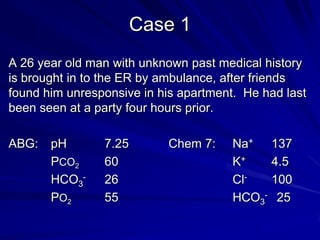
Case 1A 26 year old man with unknown past medical history is brought in to the ER by ambulance, after friends found him unresponsive in his apartment.  He had last been seen at a party four hours prior.ABG:	   pH 		7.25		Chem 7:	Na+	  137	   PCO2 	60				K+	  4.5	   HCO3- 	26				Cl- 	  100	   PO2		55 				HCO3-   25
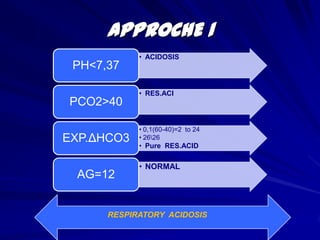
APPROCHE 1RESPIRATORY  ACIDOSIS
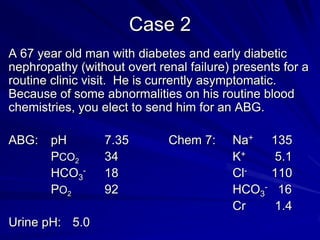
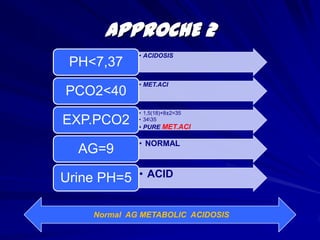
Case 2A 67 year old man with diabetes and early diabetic nephropathy (without overt renal failure) presents for a routine clinic visit.  He is currently asymptomatic.  Because of some abnormalities on his routine blood chemistries, you elect to send him for an ABG.ABG:	   pH 		7.35		Chem 7:	Na+	  135	   PCO2 	34				K+	   5.1	   HCO3- 	18				Cl- 	  110	   PO2		92 				HCO3-   16	   						Cr	   1.4Urine pH:	5.0
APPROCHE 2Normal  AG METABOLIC  ACIDOSIS
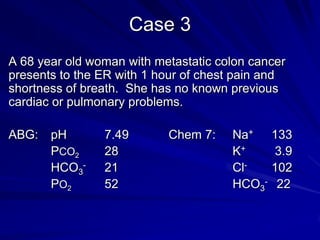
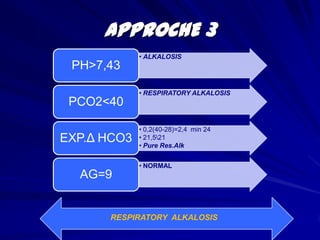
Case 3A 68 year old woman with metastatic colon cancer presents to the ER with 1 hour of chest pain and shortness of breath.  She has no known previous cardiac or pulmonary problems.ABG:	   pH 		7.49		Chem 7:	Na+	  133	   PCO2	28				K+	   3.9	   HCO3- 	21				Cl- 	  102	   PO2		52				HCO3-    22
APPROCHE 3RESPIRATORY  ALKALOSIS
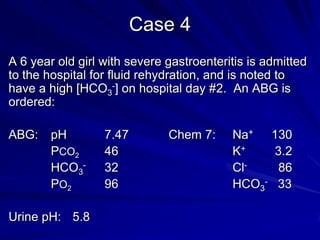
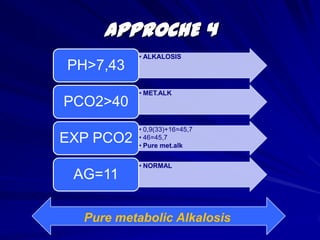
Case 4A 6 year old girl with severe gastroenteritis is admitted to the hospital for fluid rehydration, and is noted to have a high [HCO3-] on hospital day #2.  An ABG is ordered:ABG:	   pH 		7.47		Chem 7:	Na+	  130	   PCO2	46				K+	   3.2	   HCO3- 	32				Cl- 	    86	   PO2		96 				HCO3-   33Urine pH:	5.8
APPROCHE 4Pure metabolic Alkalosis
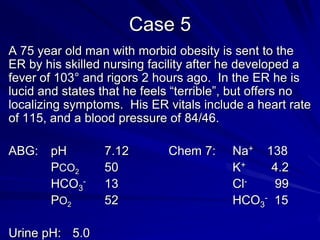
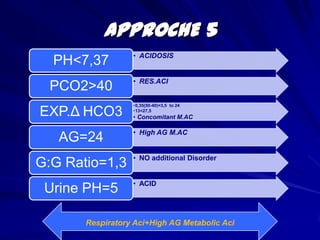
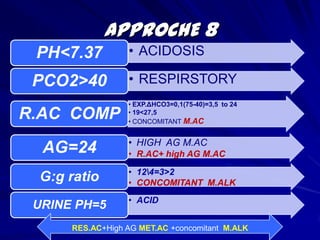
Case 5A 75 year old man with morbid obesity is sent to the ER by his skilled nursing facility after he developed a fever of 103° and rigors 2 hours ago.  In the ER he is lucid and states that he feels “terrible”, but offers no localizing symptoms.  His ER vitals include a heart rate of 115, and a blood pressure of 84/46.ABG:	   pH 		7.12		Chem 7:	Na+      138	   PCO2	50				K+	  4.2	   HCO3- 	13				Cl- 	   99	   PO2		52				HCO3-   15Urine pH:	5.0
APPROCHE 5Respiratory Aci+High AG Metabolic Aci

ABG1 SERIES

  • 1.
    ABG seriesANAS SAHLE , MDDAMASCUSE HOSPITAL
  • 2.
    MORE FORESTSMORE OXYGENLONGER LIFE
  • 3.
  • 4.
    OUTLINEACID-BASE DISORDERSHIGH AG METABOLIC ACIDOSISNORMAL AG METABOLIC ACIDOSISMETABOLIC ALKALOSISOXYGENATION AXIESA-a GRADIENT
  • 5.
    ABG - IntroductionBloodgas and pH analysis has more immediacy and potential impact on patient care than any other laboratory determination.(National committee for Laboratory Standards).Cornerstone in the diagnosis & management of clinical oxygenation and acid-base disturbances.Of all the concepts employed in the diagnosis and treatment of respiratory disorders, few are more important or less well understood than those of blood gas interpretation.
  • 6.
    Getting an arterialblood gas sample
  • 10.
  • 11.
  • 12.
    HCO3 [calculated vsmeasured]Oxygenation InformationPO2 [oxygen tension]
  • 13.
    SO2 [oxygen saturation]NormalRangesPaO2 >80mm HgIn supine posture PaO2=109-(0.43 Х age)PaO2=100mmHg in 10 year old child, PaO2 falls approximately 5mmHG for every 10 years upto 90 years.5 mmHg higher in the sitting position that supine position
  • 14.
    Sampling errors -AircontaminationMost important change: PaO2 tends to increase towards 158mm Hg,Less significant change: PaCO2 falls, pH risesAll air bubbles should be expelled immediatelyAll samples with visually apparent froth should be discarded.
  • 15.
    Anticoagulant effects0.05ml ofheparin(1,000units/ml) is required to anticoagulate 1 ml of blood.Dead space of a standard 5ml syringe with 22G needle is 0.2ml; i.e. filling the syringe dead space with heparin provides sufficient volume to anticoagulate a 4ml blood sample.Heparin – weak acid equilibrated with room airInitially PaCO2 falls, In extreme dilution pH and bicarbonate fallsPaO2 usually unchanged.
  • 16.
    Time delay -metabolismSamples should be analyzed within 20 min to avoid error.Placing the sample in iced water slows metabolism to 10%.
  • 17.
    EXPECTED CHANGES INACID-BASE DISORDERS From: THE ICU BOOK - 2nd Ed. (1998) [Corrected]
  • 18.
  • 19.
  • 20.
  • 21.
    Primary Acid-Base DisordersAsdictated by the Henderson-Hasselbalch equation, disturbances in either the respiratory component (pCO2) or metabolic component (HCO3-) can lead to alterations in pH.
  • 22.
    CompensationWhen a primaryacid-base disorder exists, the body attempts to return the pH to normal via the “other half” of acid base metabolism. Primary metabolic disorder  Respiratory compensation Primary respiratory disorder  Metabolic compensation
  • 23.
  • 24.
    The Arterial BloodGas (ABG)pH, pCO2, pO2 – Measured directlyHCO3-, O2 saturation (usually) – Calculated from pH, pCO2, and pO2
  • 25.
    Practical Approach1. Checkthe pHIf the pH < 7.37, acidemia (and at least 1 acidosis) is present.If the pH > 7.43, alkalemia (and at least 1 alkalosis) is present.
  • 26.
    Practical Approach2. Checkthe pCO2pH < 7.37 and pCO2 < 40  metabolic acidosispH < 7.37 and pCO2 > 40  respiratory acidosispH > 7.43 and pCO2 < 40  respiratory alkalosispH > 7.43 and pCO2 > 40  metabolic alklosis
  • 27.
    Practical Approach3. Choosethe appropriate compensation formula
  • 28.
    Practical Approach4. Determineif the degree compensation is appropriate(If it isn’t, a second acid-base disorder is likely present)
  • 29.
    Practical Approach5. Calculatethe anion gap Anion gap = [Na+] – ( [Cl-] + [HCO3-] )If the anion gap is elevated, an elevated gap metabolic acidosis is likely present.
  • 30.
    Practical Approach6. Ifan elevated gap acidosis is present, calculate the delta-delta ratio, to determine if a second metabolic disorder is present.Delta–Delta = Measured anion gap – Normal anion gap Normal [HCO3-] – Measured [HCO3-]
  • 31.
    Practical Approach7. Ifa metabolic acidosis is present, check the urine pH.Urine pH > 6.0 in the setting of an acidosis  Suggests RTA
  • 32.
    Practical Approach8. Generatea differential diagnosisIf multiple disorders are present, they may be: All related to the same process All independent of one another
  • 33.
    Differential Diagonsis forAcid-Base Disorders
  • 34.
    Summary of theApproach to ABGsCheck the pHCheck the pCO2Select the appropriate compensation formulaDetermine if compensation is appropriateCheck the anion gap AG=NA – (HCO3 + CL):12If the anion gap is elevated, check the delta-deltaG:G Ratio =Δ AG (12-AG m) \Δ HCO3 (24-HCO3 m)If a metabolic acidosis is present, check urine pHGenerate a differential diagnosis
  • 36.
  • 38.
  • 39.
    Case 1A 26year old man with unknown past medical history is brought in to the ER by ambulance, after friends found him unresponsive in his apartment. He had last been seen at a party four hours prior.ABG: pH 7.25 Chem 7: Na+ 137 PCO2 60 K+ 4.5 HCO3- 26 Cl- 100 PO2 55 HCO3- 25
  • 40.
  • 41.
    Case 2A 67year old man with diabetes and early diabetic nephropathy (without overt renal failure) presents for a routine clinic visit. He is currently asymptomatic. Because of some abnormalities on his routine blood chemistries, you elect to send him for an ABG.ABG: pH 7.35 Chem 7: Na+ 135 PCO2 34 K+ 5.1 HCO3- 18 Cl- 110 PO2 92 HCO3- 16 Cr 1.4Urine pH: 5.0
  • 42.
    APPROCHE 2Normal AG METABOLIC ACIDOSIS
  • 43.
    Case 3A 68year old woman with metastatic colon cancer presents to the ER with 1 hour of chest pain and shortness of breath. She has no known previous cardiac or pulmonary problems.ABG: pH 7.49 Chem 7: Na+ 133 PCO2 28 K+ 3.9 HCO3- 21 Cl- 102 PO2 52 HCO3- 22
  • 44.
  • 45.
    Case 4A 6year old girl with severe gastroenteritis is admitted to the hospital for fluid rehydration, and is noted to have a high [HCO3-] on hospital day #2. An ABG is ordered:ABG: pH 7.47 Chem 7: Na+ 130 PCO2 46 K+ 3.2 HCO3- 32 Cl- 86 PO2 96 HCO3- 33Urine pH: 5.8
  • 46.
  • 47.
    Case 5A 75year old man with morbid obesity is sent to the ER by his skilled nursing facility after he developed a fever of 103° and rigors 2 hours ago. In the ER he is lucid and states that he feels “terrible”, but offers no localizing symptoms. His ER vitals include a heart rate of 115, and a blood pressure of 84/46.ABG: pH 7.12 Chem 7: Na+ 138 PCO2 50 K+ 4.2 HCO3- 13 Cl- 99 PO2 52 HCO3- 15Urine pH: 5.0
  • 48.