SEMINAR PRESENTATION
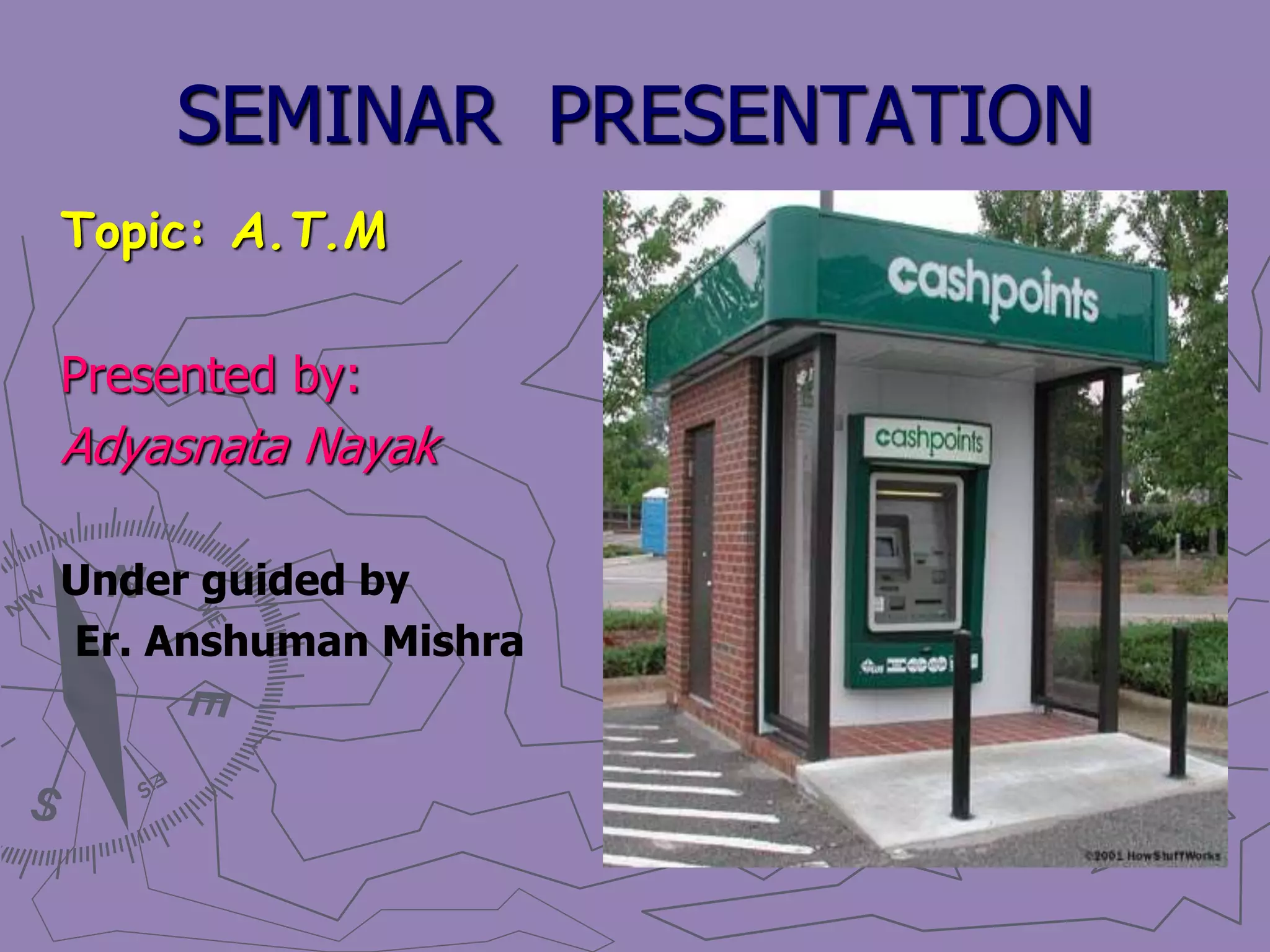
Topic: A.T.M
Presented by:
Adyasnata Nayak
Under guided by
Er. Anshuman Mishra
CONTENTS
 INTRODUCTION
 HISTORY
 PARTS OF ATM
 WORK OF ATM
 SAFE USASE
 BENEFITS
 USE
 SERVICE
 CONCLUSION
An automated teller machine (ATM)
is a computerized telecommunications device by which
customers can access their bank accounts in order to make
cash withdrawals and check their account balances in a
public space without the need for a human clerk or bank teller.
Security is provided by the customer
entering a personal identification number (PIN).
ATMs are known by various casual terms including
automated banking machine, money machine, cash machine,
hole-in-the-wall, cashpoint or Bancomat (in Europe and Russia).
HISTORY
A mechanical cash dispenser was developed and built by Luther George
Simjian and installed in 1939 in New York .
The idea of a PIN stored on the card was developed by the British engineer
John Rose in 1965.
Then ATM was invented by Scot John Shepherd-Barron in 1967.
The world's first ATM was installed in a branch of Barclays in London in
1967.
The modern, networked ATM was invented in Dallas, by Don Wetzel in 1968.
ATMs first came into wide UK use in 1973 ,the IBM 2984 was designed at
the request of Lloyds Bank.
Notable historical models of ATMs include the IBM 3624 and 473x series,
Diebold 10xx and TABS 9000 series, and NCR 5xxx series.
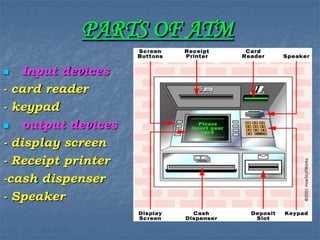
PARTS OF ATM
 Input devices
- card reader
- keypad
 output devices
- display screen
- Receipt printer
-cash dispenser
- Speaker
Parts of the Machine:
An ATM has two input devices:
Card reader –
The card reader captures the account information stored on the
magnetic strip on the back of an ATM/debit or credit card.
The host processor uses this information to route the transaction to the
cardholder's bank.
Keypad - The keypad lets the cardholder tell the bank what kind of
transaction is required (cash withdrawal, balance inquiry, etc.) and for
what amount.
Also, the bank requires the cardholder's personal identification number
(PIN) for verify
Federal law requires that the PIN block be sent to
the host processor in encrypted form.
Contd…
An ATM has four output devices:
Speaker - The speaker provides beep sounds so that cardholder’s are
will take out the money.
Display screen - The display screen prompts the cardholder through
each step of the transaction process.
Leased-line machines commonly use a monochrome or
color CRT (cathode ray tube) display.
Dial-up machines commonly use a monochrome or color LCD.
Receipt printer - The receipt printer provides the cardholder with a paper
receipt of the transaction.
Cash dispenser - The heart of an ATM is the safe and cash-dispensing
mechanism.
The entire bottom portion of most small ATMs is a safe that contains the cash.
Contd…
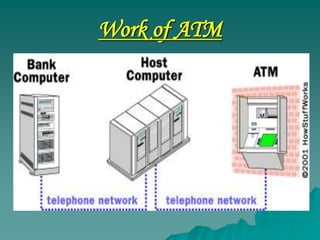
Work of ATM
An ATM is simply a data terminal with two input and four output devices.
Like any other data terminal, the ATM has to connect to, and communicate
through, a host processor.
The host processor is analogous to an Internet service provider (ISP)
in that it is the gateway through which ATM networks become
available to the cardholder (the person wanting the cash).
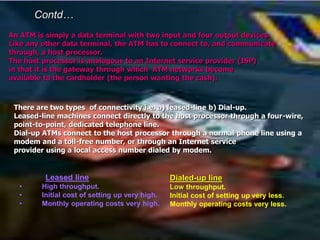
There are two types of connectivity i.e. a) leased-line b) Dial-up.
Leased-line machines connect directly to the host processor through a four-wire,
point-to-point, dedicated telephone line.
Dial-up ATMs connect to the host processor through a normal phone line using a
modem and a toll-free number, or through an Internet service
provider using a local access number dialed by modem.
Contd…
Leased line
• High throughput.
• Initial cost of setting up very high.
• Monthly operating costs very high.
Dialed-up line
Low throughput.
Initial cost of setting up very less.
Monthly operating costs very less.
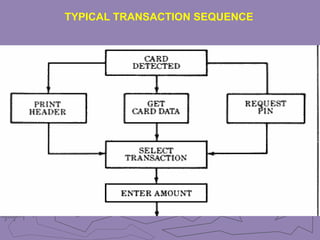
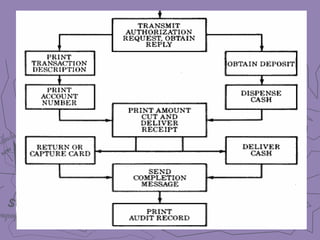
TYPICAL TRANSACTION SEQUENCE
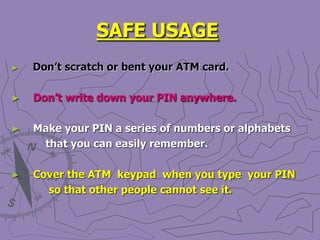
SAFE USAGE
► Don’t scratch or bent your ATM card.
► Don’t write down your PIN anywhere.
► Make your PIN a series of numbers or alphabets
that you can easily remember.
► Cover the ATM keypad when you type your PIN
so that other people cannot see it.
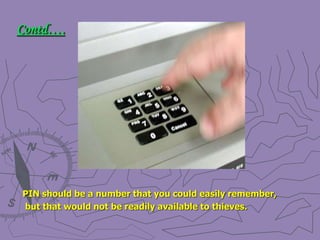
Contd….
PIN should be a number that you could easily remember,
but that would not be readily available to thieves.
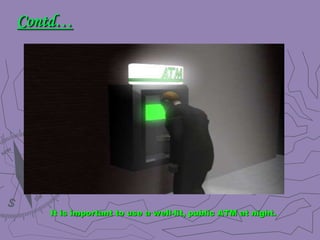
Contd…
It is important to use a well-lit, public ATM at night.
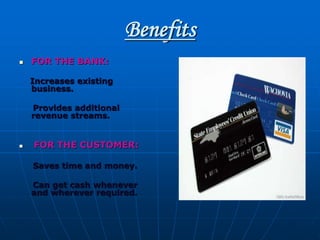
Benefits
 FOR THE BANK:
Increases existing
business.
Provides additional
revenue streams.
 FOR THE CUSTOMER:
Saves time and money.
Can get cash whenever
and wherever required.
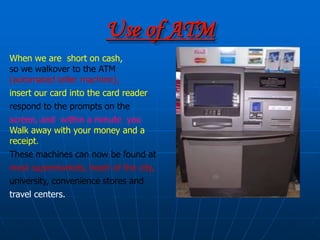
Use of ATM
When we are short on cash,
so we walkover to the ATM
(automated teller machine),
insert our card into the card reader,
respond to the prompts on the
screen, and within a minute you
Walk away with your money and a
receipt.
These machines can now be found at
most supermarkets, heart of the city,
university, convenience stores and
travel centers.
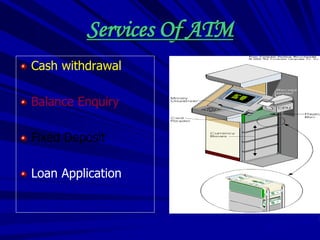
Cash withdrawal
Balance Enquiry
Fixed Deposit
Loan Application
Services Of ATM
CONCLUSION
• Since ATMs are used in banking field
it creates easier path for
transaction. It reduces the
employees & also their works. Less
time is required for transaction. ATM
is working for 24 hours in a day.
• So ATM is otherwise called as EASY
BANKING.
A T M.ppt

A T M.ppt

  • 1.
    SEMINAR PRESENTATION Topic: A.T.M Presentedby: Adyasnata Nayak Under guided by Er. Anshuman Mishra
  • 2.
    CONTENTS  INTRODUCTION  HISTORY PARTS OF ATM  WORK OF ATM  SAFE USASE  BENEFITS  USE  SERVICE  CONCLUSION
  • 3.
    An automated tellermachine (ATM) is a computerized telecommunications device by which customers can access their bank accounts in order to make cash withdrawals and check their account balances in a public space without the need for a human clerk or bank teller. Security is provided by the customer entering a personal identification number (PIN). ATMs are known by various casual terms including automated banking machine, money machine, cash machine, hole-in-the-wall, cashpoint or Bancomat (in Europe and Russia).
  • 4.
    HISTORY A mechanical cashdispenser was developed and built by Luther George Simjian and installed in 1939 in New York . The idea of a PIN stored on the card was developed by the British engineer John Rose in 1965. Then ATM was invented by Scot John Shepherd-Barron in 1967. The world's first ATM was installed in a branch of Barclays in London in 1967. The modern, networked ATM was invented in Dallas, by Don Wetzel in 1968. ATMs first came into wide UK use in 1973 ,the IBM 2984 was designed at the request of Lloyds Bank. Notable historical models of ATMs include the IBM 3624 and 473x series, Diebold 10xx and TABS 9000 series, and NCR 5xxx series.
  • 5.
    PARTS OF ATM Input devices - card reader - keypad  output devices - display screen - Receipt printer -cash dispenser - Speaker
  • 6.
    Parts of theMachine: An ATM has two input devices: Card reader – The card reader captures the account information stored on the magnetic strip on the back of an ATM/debit or credit card. The host processor uses this information to route the transaction to the cardholder's bank. Keypad - The keypad lets the cardholder tell the bank what kind of transaction is required (cash withdrawal, balance inquiry, etc.) and for what amount. Also, the bank requires the cardholder's personal identification number (PIN) for verify Federal law requires that the PIN block be sent to the host processor in encrypted form. Contd…
  • 7.
    An ATM hasfour output devices: Speaker - The speaker provides beep sounds so that cardholder’s are will take out the money. Display screen - The display screen prompts the cardholder through each step of the transaction process. Leased-line machines commonly use a monochrome or color CRT (cathode ray tube) display. Dial-up machines commonly use a monochrome or color LCD. Receipt printer - The receipt printer provides the cardholder with a paper receipt of the transaction. Cash dispenser - The heart of an ATM is the safe and cash-dispensing mechanism. The entire bottom portion of most small ATMs is a safe that contains the cash. Contd…
  • 8.
  • 9.
    An ATM issimply a data terminal with two input and four output devices. Like any other data terminal, the ATM has to connect to, and communicate through, a host processor. The host processor is analogous to an Internet service provider (ISP) in that it is the gateway through which ATM networks become available to the cardholder (the person wanting the cash). There are two types of connectivity i.e. a) leased-line b) Dial-up. Leased-line machines connect directly to the host processor through a four-wire, point-to-point, dedicated telephone line. Dial-up ATMs connect to the host processor through a normal phone line using a modem and a toll-free number, or through an Internet service provider using a local access number dialed by modem. Contd… Leased line • High throughput. • Initial cost of setting up very high. • Monthly operating costs very high. Dialed-up line Low throughput. Initial cost of setting up very less. Monthly operating costs very less.
  • 10.
  • 12.
    SAFE USAGE ► Don’tscratch or bent your ATM card. ► Don’t write down your PIN anywhere. ► Make your PIN a series of numbers or alphabets that you can easily remember. ► Cover the ATM keypad when you type your PIN so that other people cannot see it.
  • 13.
    Contd…. PIN should bea number that you could easily remember, but that would not be readily available to thieves.
  • 14.
    Contd… It is importantto use a well-lit, public ATM at night.
  • 15.
    Benefits  FOR THEBANK: Increases existing business. Provides additional revenue streams.  FOR THE CUSTOMER: Saves time and money. Can get cash whenever and wherever required.
  • 16.
    Use of ATM Whenwe are short on cash, so we walkover to the ATM (automated teller machine), insert our card into the card reader, respond to the prompts on the screen, and within a minute you Walk away with your money and a receipt. These machines can now be found at most supermarkets, heart of the city, university, convenience stores and travel centers.
  • 17.
    Cash withdrawal Balance Enquiry FixedDeposit Loan Application Services Of ATM
  • 18.
    CONCLUSION • Since ATMsare used in banking field it creates easier path for transaction. It reduces the employees & also their works. Less time is required for transaction. ATM is working for 24 hours in a day. • So ATM is otherwise called as EASY BANKING.