NAME : P.RANJITH
ROLL.NO. : P187104
CLASS : 2nd Msc.Mathematics
Subject Title : SMART ELECTRONICS
Subject code :
Assignment Title : ATM
Assignment No : 03
An automated teller machine (ATM) is a computerized
telecommunications device that provides the customers of a
financial institution / bank with access to financial
transactions in a public space without the need for a human
clerk or bank teller round clock (24 hrs a day)
An automated teller machine (ATM) is a computerized
telecommunications device that provides the customers of a
financial institution / bank with access to financial
transactions in a public space without the need for a human
clerk or bank teller round clock (24 hrs a day)
On most modern ATMs, the customer is identified by
inserting a plastic ATM card with a magnetic stripe or a
plastic smartcard with a chip, that contains a unique card
number and some security information.
Security is provided by the customer entering a personal
identification number (PIN).
 On most modern ATMs, the customer is identified by
inserting a plastic ATM card with a magnetic stripe or a plastic
smartcard with a chip, that contains a unique card number and
some security information.
 Security is provided by the customer entering a
personal identification number (PIN).
 24-hour access to cash
 View Account Balances & Mini-statements
 Order a Cheque Book / Account Statement
 Transfer Funds between accounts
 Refill your Prepaid card
 Pay your utility bills
 Deposit cash or cheques
 Change your PIN
 Learn about other products
The ATM was invented by Scot John Shepherd-Barron.
The world's first ATM was installed in a branch of Barclays in the northern London
borough of Enfield, Middlesex, in 1967.
A mechanical cash dispenser was developed and built by Luther George Simjian and
installed in 1939 in New York City by the City Bank of New York
The first person to use the machine was Reg Varney of "On the Buses" fame, a British
Television programme from the 1960s
 The ATM was invented by Scot John Shepherd-Barron.
 The world's first ATM was installed in a branch of Barclays in
the northern London borough of Enfield, Middlesex, in 1967.
 A mechanical cash dispenser was developed and built by
Luther George Simjian and installed in 1939 in New York City
by the City Bank of New York
 The first person to use the machine was Reg Varney of "On
the Buses" fame, a British Television programme from the
1960s
 The idea of a PIN stored on the card was developed by the
British engineer John Rose in
1965.
 The modern, networked ATM was invented in Dallas, Texas,
by Don Wetzel in 1968
 Notable historical models of ATMs include the IBM 3624
and 473x series, Diebold 10xx and TABS 9000 series, and NCR
5xxx series.
reg varney using the first ATM in 1967
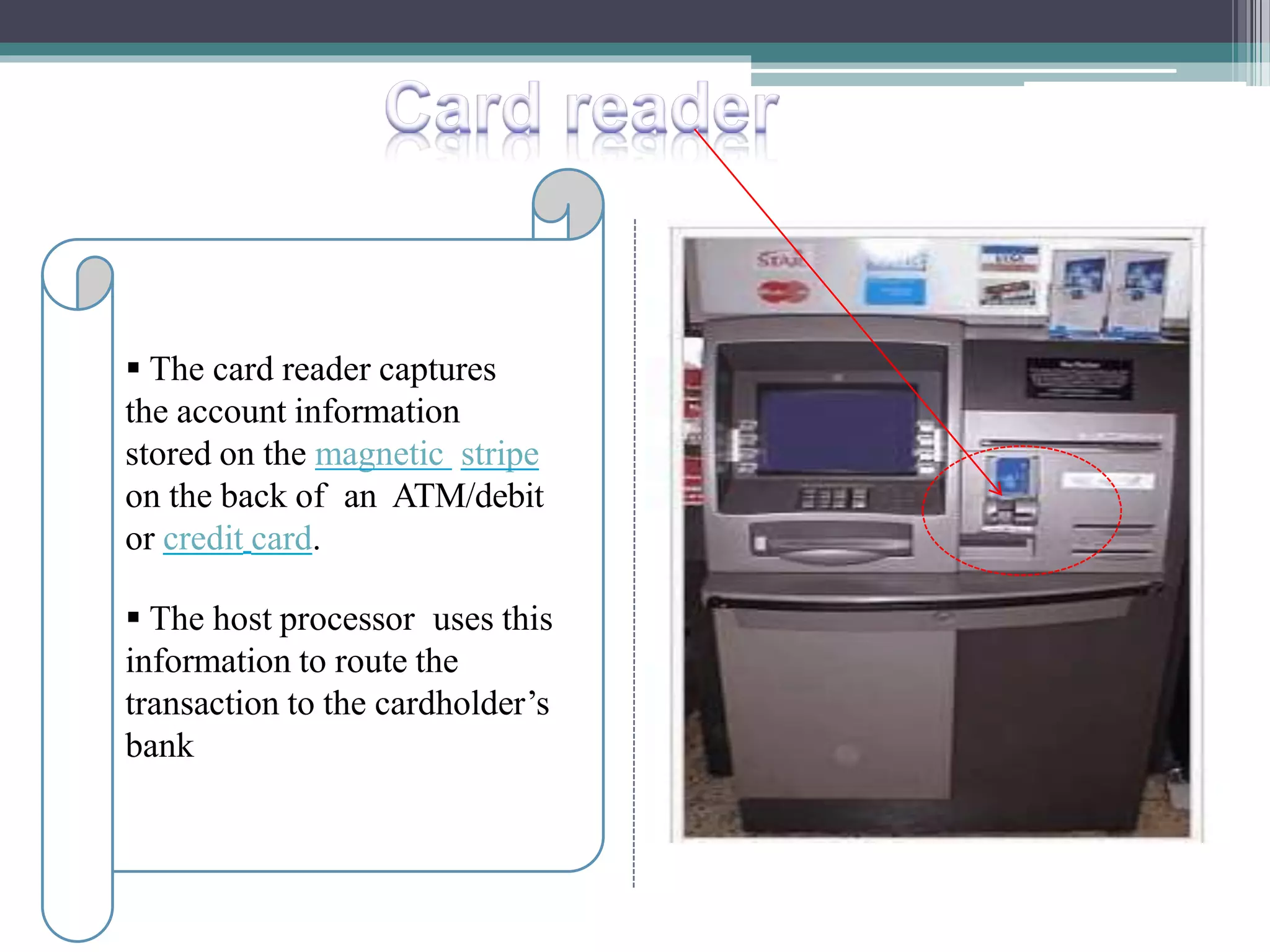
o Card reader
o Keypad
o Speaker
o Display screen
o Receipt printer
o Cash dispenser
 The card reader captures
the account information
stored on the magnetic stripe
on the back of an ATM/debit
or credit card.
 The host processor uses this
information to route the
transaction to the cardholder’s
bank
The keypad lets the
cardholder tell the bank
what kind of transaction is
required (cash withdrawal,
balance inquiry, etc.) and
for what amount. Also, the
bank requires the
cardholder's personal
identification number
(PIN) for verification.
Federal law
requires that the PIN block
be sent to the host processor
in encrypted form.
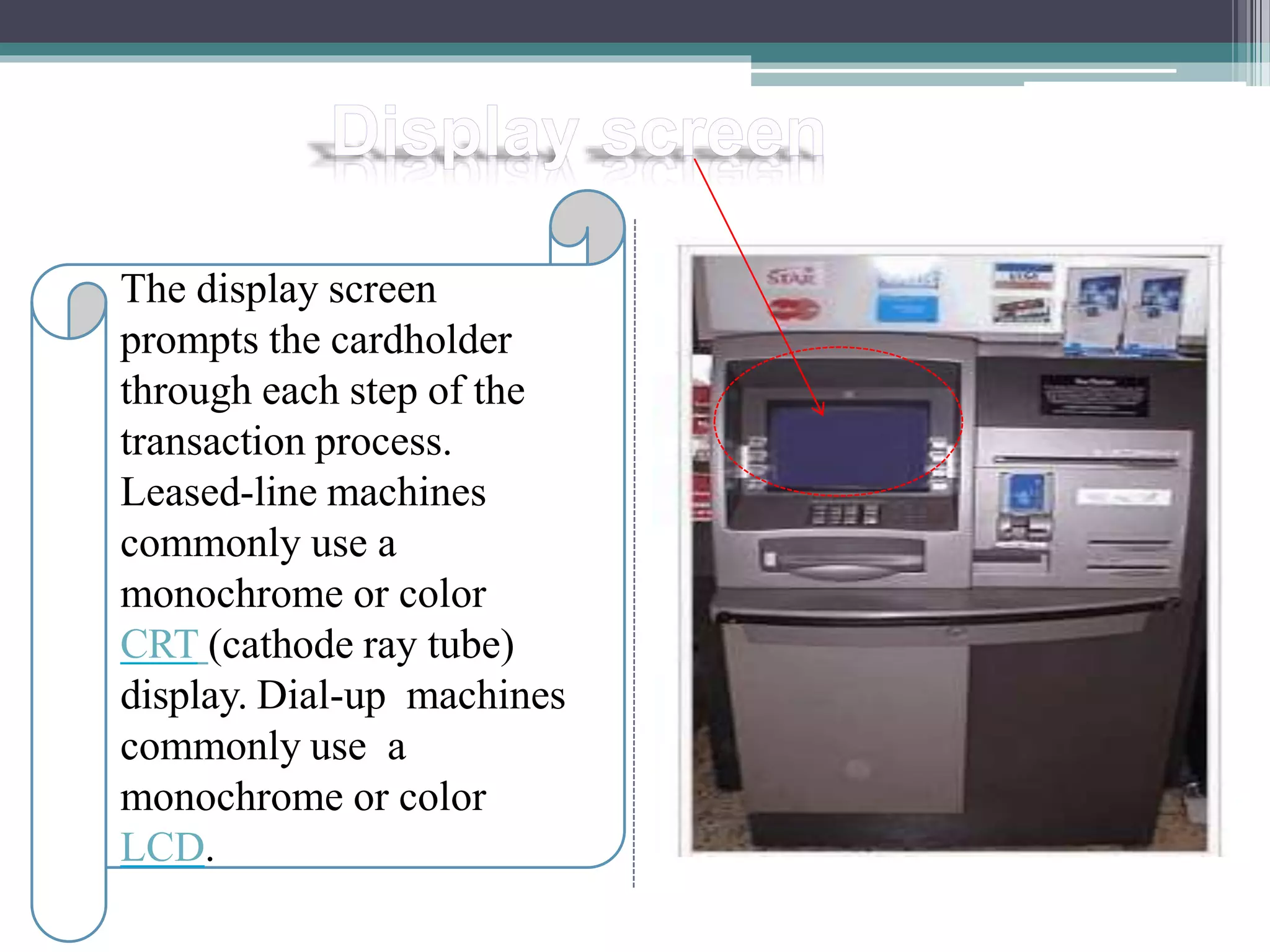
The display screen
prompts the cardholder
through each step of the
transaction process.
Leased-line machines
commonly use a
monochrome or color
CRT (cathode ray tube)
display. Dial-up machines
commonly use a
monochrome or color
LCD.
The receipt printer
provides the
cardholder with a
paper receipt of the
transaction
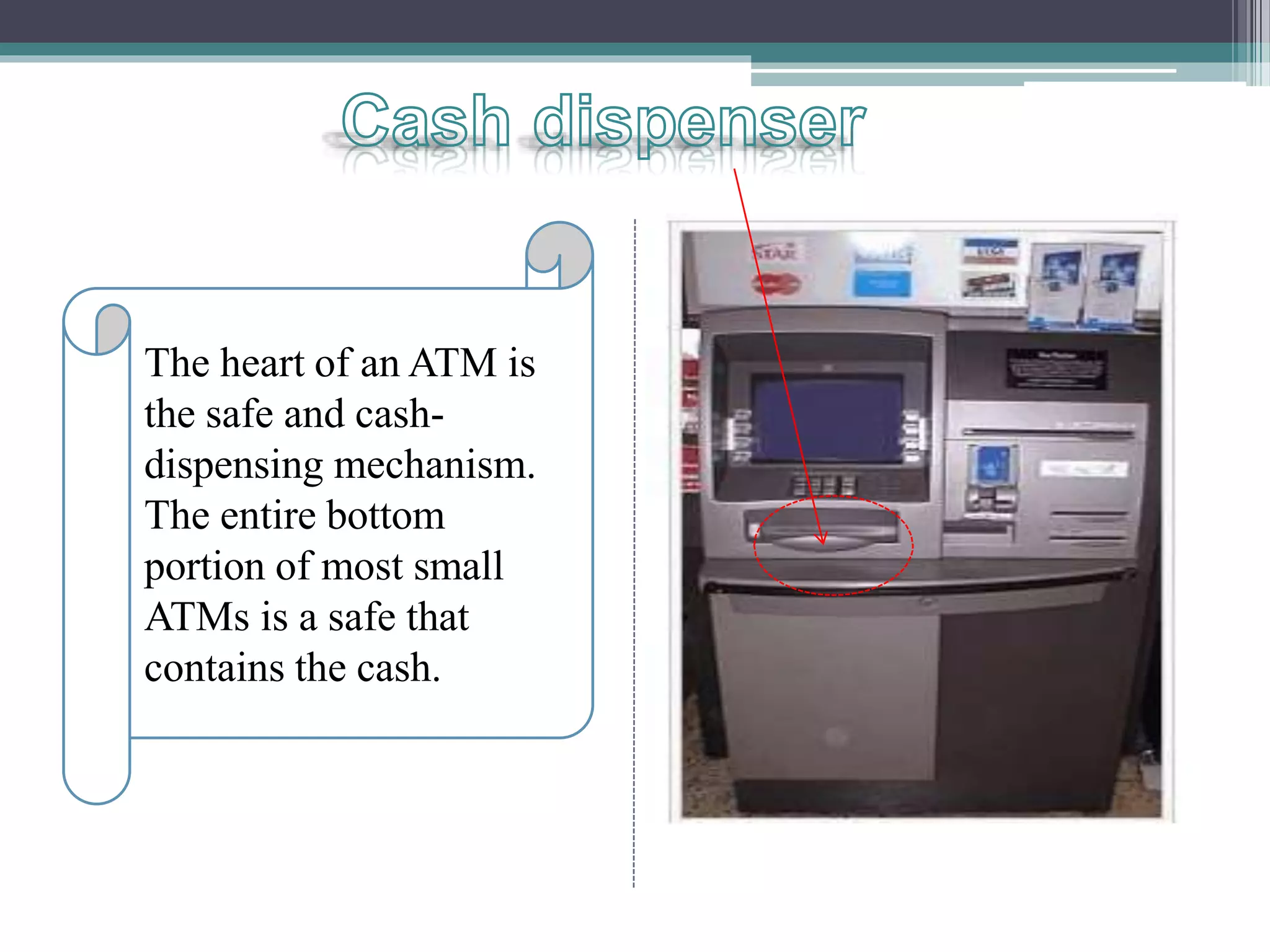
The heart of an ATM is
the safe and cash-
dispensing mechanism.
The entire bottom
portion of most small
ATMs is a safe that
contains the cash.
On-Line ATMs
Off -line ATMs
On- site ATMs
Off-Site ATMs
Mobile ATMs
Biometric ATMs
Talking ATMs
ATMs For Blinds
Drive In ATMs
o The ATM provides 24 hours service
o The ATM provides privacy in banking communications
o The ATMs reduce the work load banks staff
o The ATM may give customer new currency notes
o The ATMs are convenient to banks customers
o The ATM is very beneficial for travelers
o The ATM provide services without any error
 Don't write down your PIN. If you must write it down, do not store it
in your wallet or purse.
 Avoid using birth dates, initials, house numbers or your phone
number.
 Make your PIN a series of letters or numbers that you can
easily remember, but that cannot easily be associated with you
personally.
 Store your ATM card in your purse or wallet, in an area where it
won't get scratched or bent.
 Get your card out BEFORE you approach the ATM. You'll be more
vulnerable to attack if you're standing in front of the ATM, fumbling
through your wallet for your card.
 Stand directly in front of the ATM keypad when typing in your PIN.
This prevents anyone waiting to use the machine from seeing your
personal information.
 After your transaction, take your receipt, card and money
away. Do not stand in front of the machine and countyour
money.
 If you are using a drive-up ATM, get your vehicle as close to
the machine as possible to prevent anyone from coming upto
your window. Also make sure that your doors are locked
before you drive up to the machine.
 Do not leave your car running while using a walk-upATM.
Take your keys with you and lock the doors before your
transaction.
 If someone or something makes you uncomfortable, cancel
your transaction and leave the machine immediately. Follow
up with your bank to make sure the transaction wascancelled
and alert the bank to any suspiciouspeople.
Atm machine

Atm machine

  • 1.
    NAME : P.RANJITH ROLL.NO.: P187104 CLASS : 2nd Msc.Mathematics Subject Title : SMART ELECTRONICS Subject code : Assignment Title : ATM Assignment No : 03
  • 2.
    An automated tellermachine (ATM) is a computerized telecommunications device that provides the customers of a financial institution / bank with access to financial transactions in a public space without the need for a human clerk or bank teller round clock (24 hrs a day) An automated teller machine (ATM) is a computerized telecommunications device that provides the customers of a financial institution / bank with access to financial transactions in a public space without the need for a human clerk or bank teller round clock (24 hrs a day)
  • 3.
    On most modernATMs, the customer is identified by inserting a plastic ATM card with a magnetic stripe or a plastic smartcard with a chip, that contains a unique card number and some security information. Security is provided by the customer entering a personal identification number (PIN).  On most modern ATMs, the customer is identified by inserting a plastic ATM card with a magnetic stripe or a plastic smartcard with a chip, that contains a unique card number and some security information.  Security is provided by the customer entering a personal identification number (PIN).
  • 4.
     24-hour accessto cash  View Account Balances & Mini-statements  Order a Cheque Book / Account Statement  Transfer Funds between accounts  Refill your Prepaid card  Pay your utility bills  Deposit cash or cheques  Change your PIN  Learn about other products
  • 5.
    The ATM wasinvented by Scot John Shepherd-Barron. The world's first ATM was installed in a branch of Barclays in the northern London borough of Enfield, Middlesex, in 1967. A mechanical cash dispenser was developed and built by Luther George Simjian and installed in 1939 in New York City by the City Bank of New York The first person to use the machine was Reg Varney of "On the Buses" fame, a British Television programme from the 1960s  The ATM was invented by Scot John Shepherd-Barron.  The world's first ATM was installed in a branch of Barclays in the northern London borough of Enfield, Middlesex, in 1967.  A mechanical cash dispenser was developed and built by Luther George Simjian and installed in 1939 in New York City by the City Bank of New York
  • 6.
     The firstperson to use the machine was Reg Varney of "On the Buses" fame, a British Television programme from the 1960s  The idea of a PIN stored on the card was developed by the British engineer John Rose in 1965.  The modern, networked ATM was invented in Dallas, Texas, by Don Wetzel in 1968  Notable historical models of ATMs include the IBM 3624 and 473x series, Diebold 10xx and TABS 9000 series, and NCR 5xxx series.
  • 7.
    reg varney usingthe first ATM in 1967
  • 9.
    o Card reader oKeypad o Speaker o Display screen o Receipt printer o Cash dispenser
  • 12.
     The cardreader captures the account information stored on the magnetic stripe on the back of an ATM/debit or credit card.  The host processor uses this information to route the transaction to the cardholder’s bank
  • 13.
    The keypad letsthe cardholder tell the bank what kind of transaction is required (cash withdrawal, balance inquiry, etc.) and for what amount. Also, the bank requires the cardholder's personal identification number (PIN) for verification. Federal law requires that the PIN block be sent to the host processor in encrypted form.
  • 14.
    The display screen promptsthe cardholder through each step of the transaction process. Leased-line machines commonly use a monochrome or color CRT (cathode ray tube) display. Dial-up machines commonly use a monochrome or color LCD.
  • 15.
    The receipt printer providesthe cardholder with a paper receipt of the transaction
  • 16.
    The heart ofan ATM is the safe and cash- dispensing mechanism. The entire bottom portion of most small ATMs is a safe that contains the cash.
  • 17.
    On-Line ATMs Off -lineATMs On- site ATMs Off-Site ATMs Mobile ATMs Biometric ATMs Talking ATMs ATMs For Blinds Drive In ATMs
  • 18.
    o The ATMprovides 24 hours service o The ATM provides privacy in banking communications o The ATMs reduce the work load banks staff o The ATM may give customer new currency notes o The ATMs are convenient to banks customers o The ATM is very beneficial for travelers o The ATM provide services without any error
  • 19.
     Don't writedown your PIN. If you must write it down, do not store it in your wallet or purse.  Avoid using birth dates, initials, house numbers or your phone number.  Make your PIN a series of letters or numbers that you can easily remember, but that cannot easily be associated with you personally.  Store your ATM card in your purse or wallet, in an area where it won't get scratched or bent.  Get your card out BEFORE you approach the ATM. You'll be more vulnerable to attack if you're standing in front of the ATM, fumbling through your wallet for your card.  Stand directly in front of the ATM keypad when typing in your PIN. This prevents anyone waiting to use the machine from seeing your personal information.
  • 20.
     After yourtransaction, take your receipt, card and money away. Do not stand in front of the machine and countyour money.  If you are using a drive-up ATM, get your vehicle as close to the machine as possible to prevent anyone from coming upto your window. Also make sure that your doors are locked before you drive up to the machine.  Do not leave your car running while using a walk-upATM. Take your keys with you and lock the doors before your transaction.  If someone or something makes you uncomfortable, cancel your transaction and leave the machine immediately. Follow up with your bank to make sure the transaction wascancelled and alert the bank to any suspiciouspeople.