Automatic
teller machine
What is an ATM ??
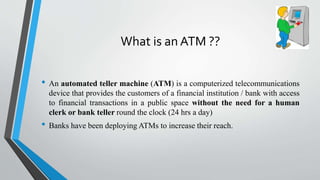
• An automated teller machine (ATM) is a computerized telecommunications
device that provides the customers of a financial institution / bank with access
to financial transactions in a public space without the need for a human
clerk or bank teller round the clock (24 hrs a day)
• Banks have been deploying ATMs to increase their reach.
ATM security
• On most modern ATMs, the customer is identified by inserting a plastic ATM
card with a magnetic stripe or a plastic smartcard with a chip, that contains
a unique card number and some security information.
• Security is provided by the customer entering a personal identification
number (PIN).
HISTORY OF ATM
• The first Automated Teller Machine (ATM) was introduced in the year 1967 by
Barclays Bank in Enfield Town in North London.
• The main objective of introducing the ATM was reducing customer’s time, lesser
bank distribution cost and enhancing the efficiency of banking institutes.
• The first person to use the machine was Reg Varney of "On the Buses" fame, a
British Television programme from the 1960s
• The idea of a PIN stored on the card was developed by the British engineer John
Rose in 1965.
Functions of ATM
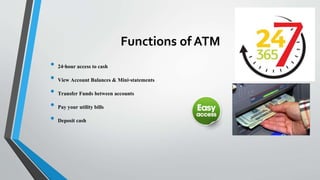
• 24-hour access to cash
• View Account Balances & Mini-statements
• Transfer Funds between accounts
• Pay your utility bills
• Deposit cash
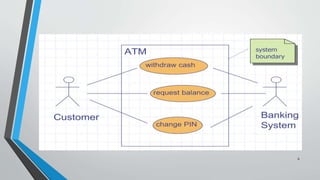
How does it come together?
6
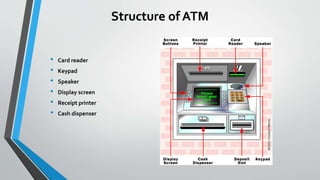
Structure of ATM
• Card reader
• Keypad
• Speaker
• Display screen
• Receipt printer
• Cash dispenser
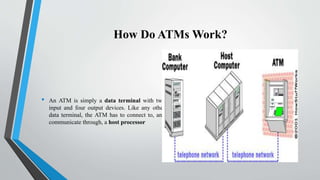
How Do ATMs Work?
• An ATM is simply a data terminal with two
input and four output devices. Like any other
data terminal, the ATM has to connect to, and
communicate through, a host processor
LOCATION OF ATM
• ATMs are placed not only near or inside the premises of banks, but also in
locations such as shopping centers/malls, airports, grocery stores, petrol/gas
stations, restaurants, or any place large numbers of people may gather.
SECURITY
• Don't write down your PIN. If you must write it down, do not store it in your
wallet or purse.
• Make your PIN a series of letters or numbers that you can easily remember,
but that cannot easily be associated with you personally.
• Avoid using birth dates, initials, house numbers or your phone number.
Types of ATMs
• On- siteATMs
• Off-Site Atms
• Mobile Atms
• BiometricATMs
• Talking Atms
• ATMs For Blinds
• Drive In Atms
• White label ATMs
• Brown label ATMs
• Green label ATMs
• Orange label ATMs
• Yellow label ATMs
• Pink label ATMs
ABSTRACT
The ATM System is the project which is used to access their bank accounts in order to
make cash withdrawals. Whenever the user need to make cash withdraws, they can
enter their PIN number (personal identification number) , Once their withdrawn was
successful, the amount will be debited in their account.
The ATM will service one customer at a time. A customer will be required to enter
ATM personal identification number (PIN). he customer will then be able to perform
one or more transactions. Also customer must be able to make a balance inquiry
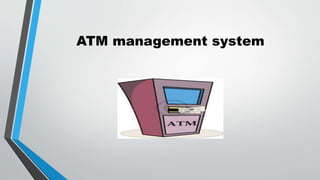
ATM management system
Making of program
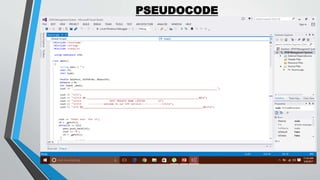
This program consists on system management of ATM and its functions. ATM machines based
on functions, loops and switch cases.
And based on C++ language.
LOOPS
In computer programming, a loop is a sequence of instruction s that is continually repeated
until a certain condition is reached.
USAGE OF LOOP
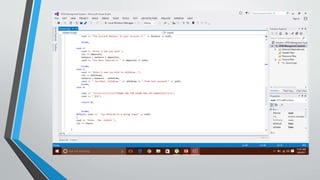
We used WHILE loop in program for continuity of program.ATM machines need to work
regularly .
IF ELSE CONDITION
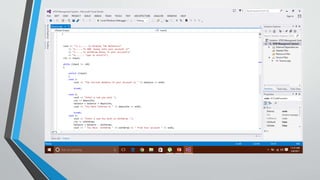
Then we used if else condition to show the users. We added pin code
option for every user to log in if pin code is wrong then program will
automatically close.
Users have their own pins from which they will able to withdraw or
deposit money from their account.
Switch case
In computer programming languages, a switch statement is a type of
selection control mechanism used to allow the value of a variable or
expression to change the control flow of program execution via a
multiway branch.
USAGE OF SWITCH CASE
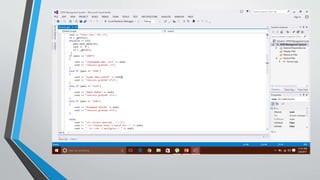
We used switch case to make categories of different users and their
accounts. From which they can deposit or withdraw their money.
References:
https://www.gidforums.com/t-17106.html
http://cplus14.blogspot.com/2013/04/atm-machine-project.html
PSEUDOCODE
ATM project presentation

ATM project presentation

  • 1.
  • 2.
    What is anATM ?? • An automated teller machine (ATM) is a computerized telecommunications device that provides the customers of a financial institution / bank with access to financial transactions in a public space without the need for a human clerk or bank teller round the clock (24 hrs a day) • Banks have been deploying ATMs to increase their reach.
  • 3.
    ATM security • Onmost modern ATMs, the customer is identified by inserting a plastic ATM card with a magnetic stripe or a plastic smartcard with a chip, that contains a unique card number and some security information. • Security is provided by the customer entering a personal identification number (PIN).
  • 4.
    HISTORY OF ATM •The first Automated Teller Machine (ATM) was introduced in the year 1967 by Barclays Bank in Enfield Town in North London. • The main objective of introducing the ATM was reducing customer’s time, lesser bank distribution cost and enhancing the efficiency of banking institutes. • The first person to use the machine was Reg Varney of "On the Buses" fame, a British Television programme from the 1960s • The idea of a PIN stored on the card was developed by the British engineer John Rose in 1965.
  • 5.
    Functions of ATM •24-hour access to cash • View Account Balances & Mini-statements • Transfer Funds between accounts • Pay your utility bills • Deposit cash
  • 6.
    How does itcome together? 6
  • 7.
    Structure of ATM •Card reader • Keypad • Speaker • Display screen • Receipt printer • Cash dispenser
  • 8.
    How Do ATMsWork? • An ATM is simply a data terminal with two input and four output devices. Like any other data terminal, the ATM has to connect to, and communicate through, a host processor
  • 9.
    LOCATION OF ATM •ATMs are placed not only near or inside the premises of banks, but also in locations such as shopping centers/malls, airports, grocery stores, petrol/gas stations, restaurants, or any place large numbers of people may gather.
  • 10.
    SECURITY • Don't writedown your PIN. If you must write it down, do not store it in your wallet or purse. • Make your PIN a series of letters or numbers that you can easily remember, but that cannot easily be associated with you personally. • Avoid using birth dates, initials, house numbers or your phone number.
  • 11.
    Types of ATMs •On- siteATMs • Off-Site Atms • Mobile Atms • BiometricATMs • Talking Atms • ATMs For Blinds • Drive In Atms • White label ATMs • Brown label ATMs • Green label ATMs • Orange label ATMs • Yellow label ATMs • Pink label ATMs
  • 12.
    ABSTRACT The ATM Systemis the project which is used to access their bank accounts in order to make cash withdrawals. Whenever the user need to make cash withdraws, they can enter their PIN number (personal identification number) , Once their withdrawn was successful, the amount will be debited in their account. The ATM will service one customer at a time. A customer will be required to enter ATM personal identification number (PIN). he customer will then be able to perform one or more transactions. Also customer must be able to make a balance inquiry
  • 13.
  • 14.
    Making of program Thisprogram consists on system management of ATM and its functions. ATM machines based on functions, loops and switch cases. And based on C++ language.
  • 15.
    LOOPS In computer programming,a loop is a sequence of instruction s that is continually repeated until a certain condition is reached. USAGE OF LOOP We used WHILE loop in program for continuity of program.ATM machines need to work regularly .
  • 16.
    IF ELSE CONDITION Thenwe used if else condition to show the users. We added pin code option for every user to log in if pin code is wrong then program will automatically close. Users have their own pins from which they will able to withdraw or deposit money from their account.
  • 17.
    Switch case In computerprogramming languages, a switch statement is a type of selection control mechanism used to allow the value of a variable or expression to change the control flow of program execution via a multiway branch. USAGE OF SWITCH CASE We used switch case to make categories of different users and their accounts. From which they can deposit or withdraw their money.
  • 18.
  • 19.