Introduction to
Quantum
Computing
Giannicola Scarpa
Facultad de Matemáticas UCM
Overview
Part I: What is Quantum
Computing?
• Qubits, quantum operations,
measurements
Part II: Are quantum computers
more powerful?
• Simple example, main algorithms,
complexity classes
Part III: Some quantum
cryptography
• Non-locality (certified randomness),
quantum key distribution,
quantum position verification
Part I:
What is Quantum
Computation?
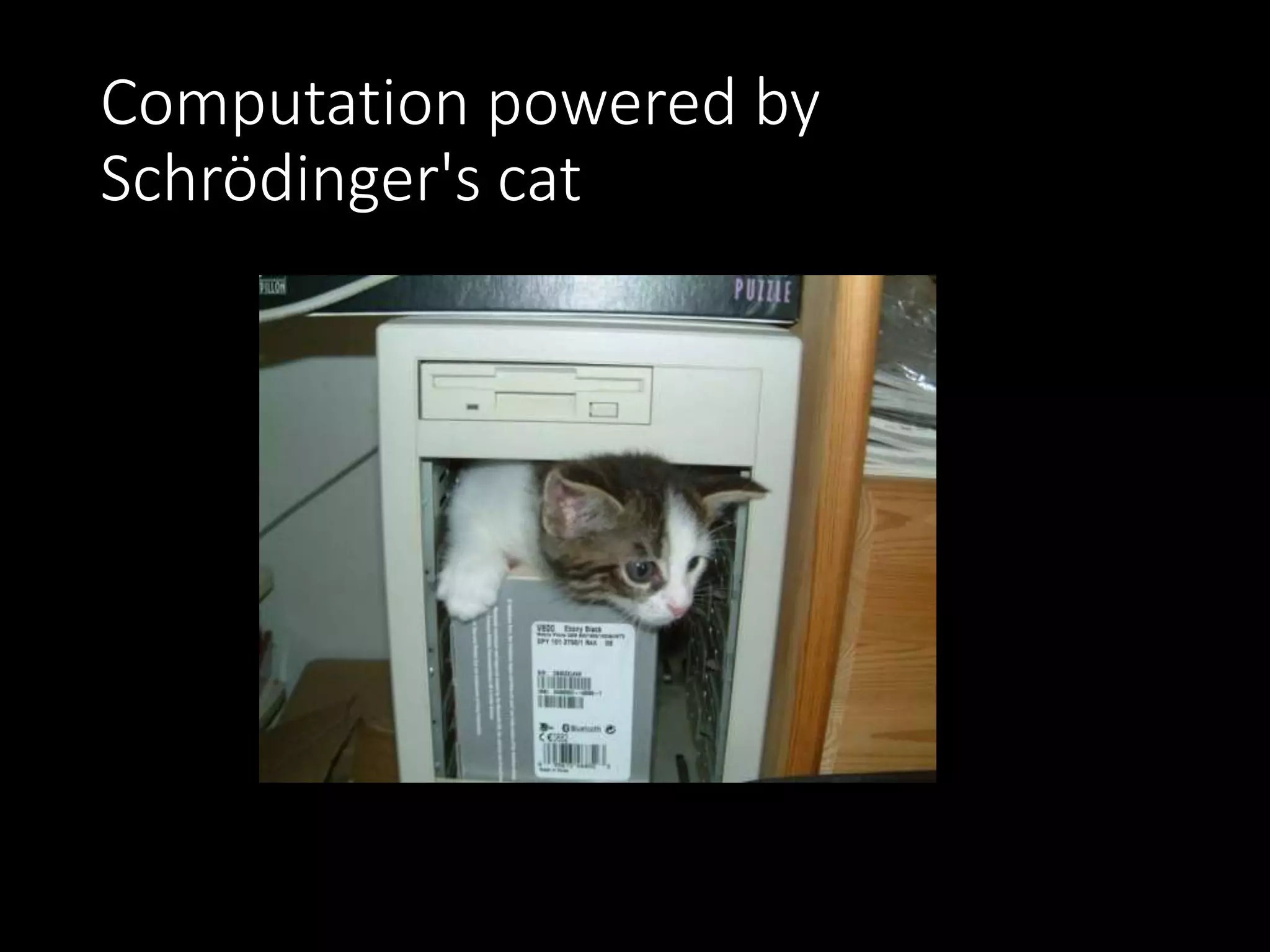
Computation powered by
Schrödinger's cat
Computation powered by
Schrödinger's cat
Some History
• First quantum paper: Max Planck, 1900
• The field developed strongly during the 1920s
• A Turing Machine (1936) is a classical object
• 1980s: Quantum Computing “updates” the model
to the latest physics
• Uses some non-intuitive concepts:
Superposition, collapse of the wave function,
interference, entanglement, no-cloning...
• You will know about all of these in a hour or so.
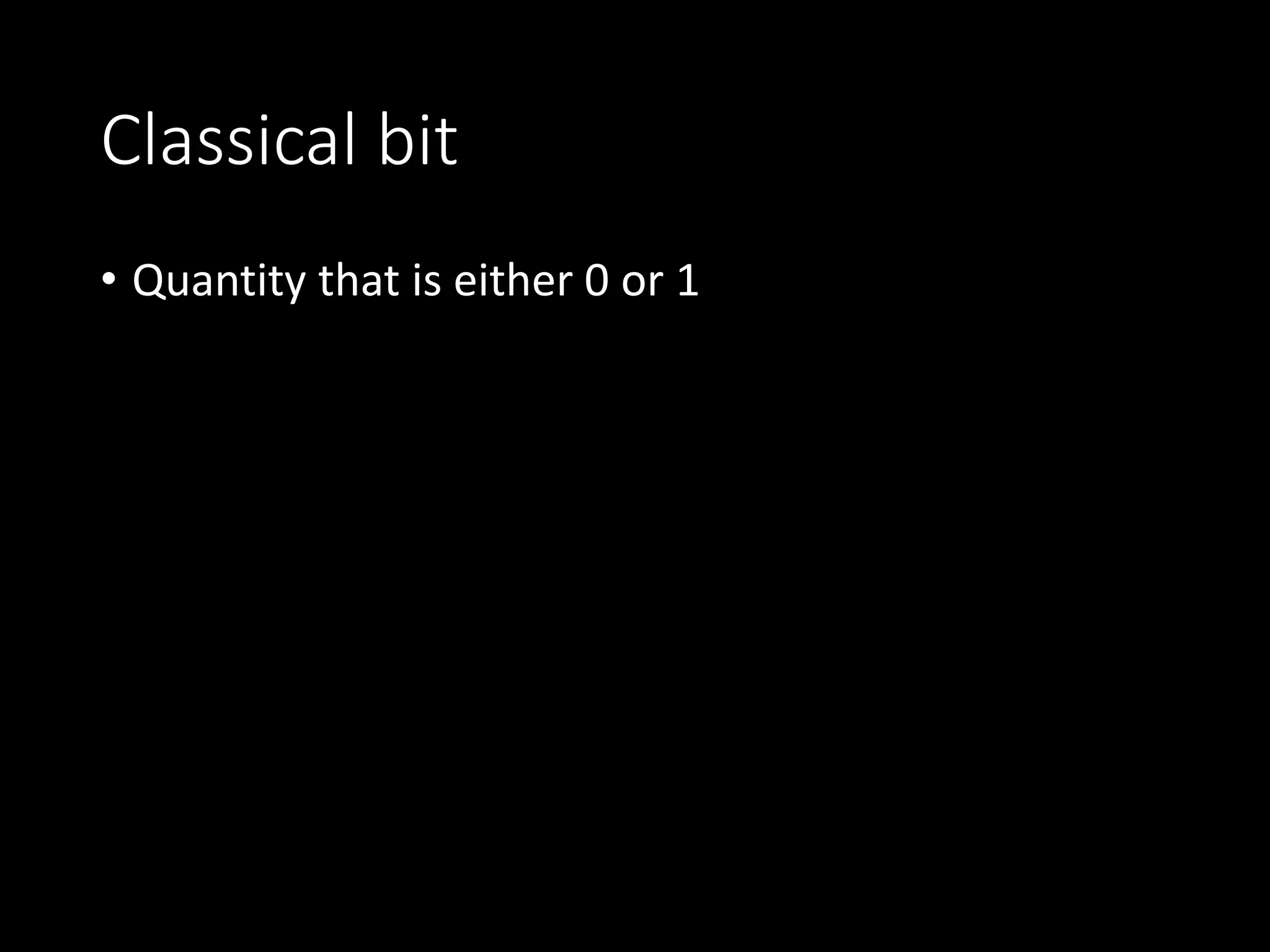
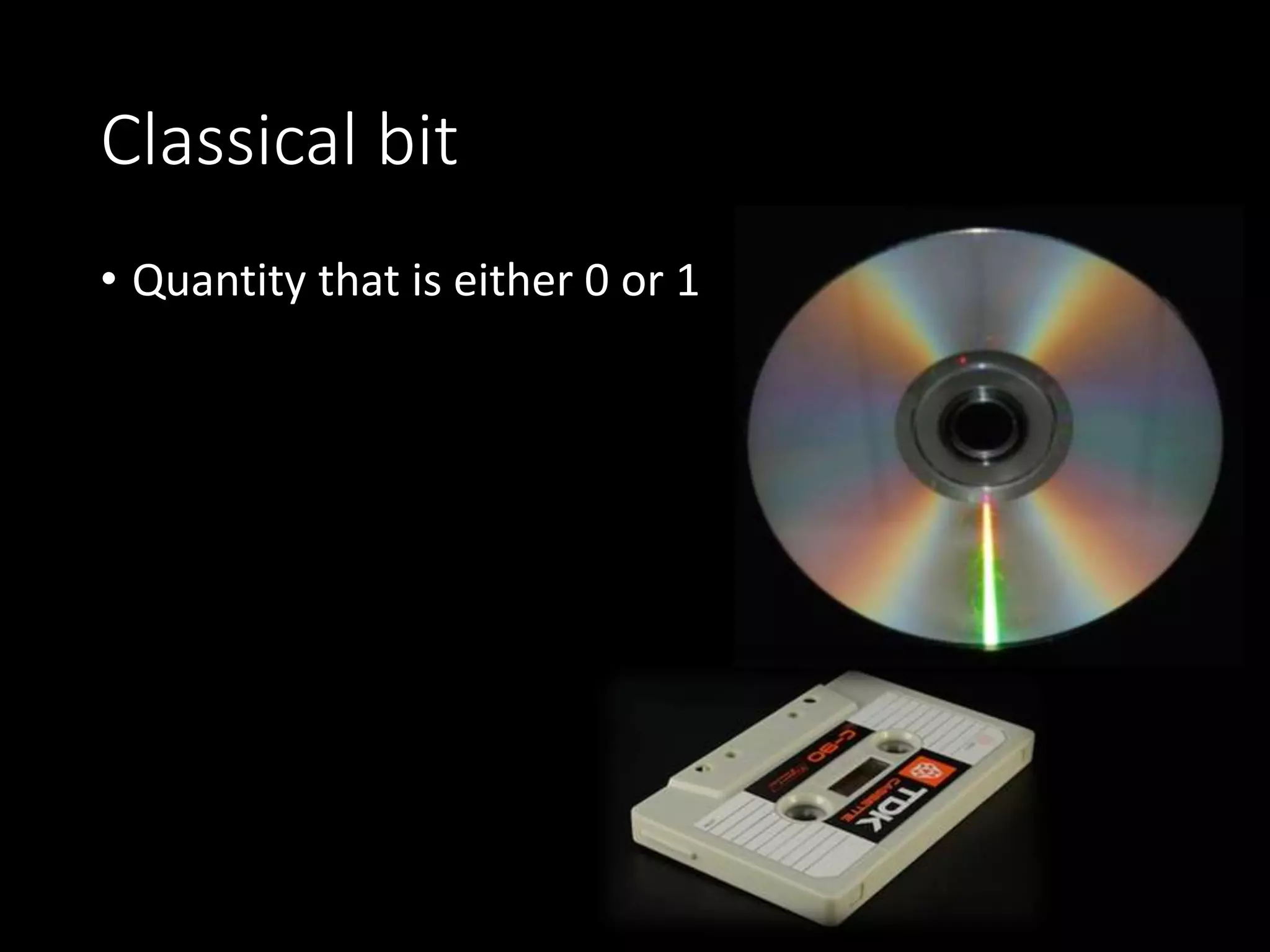
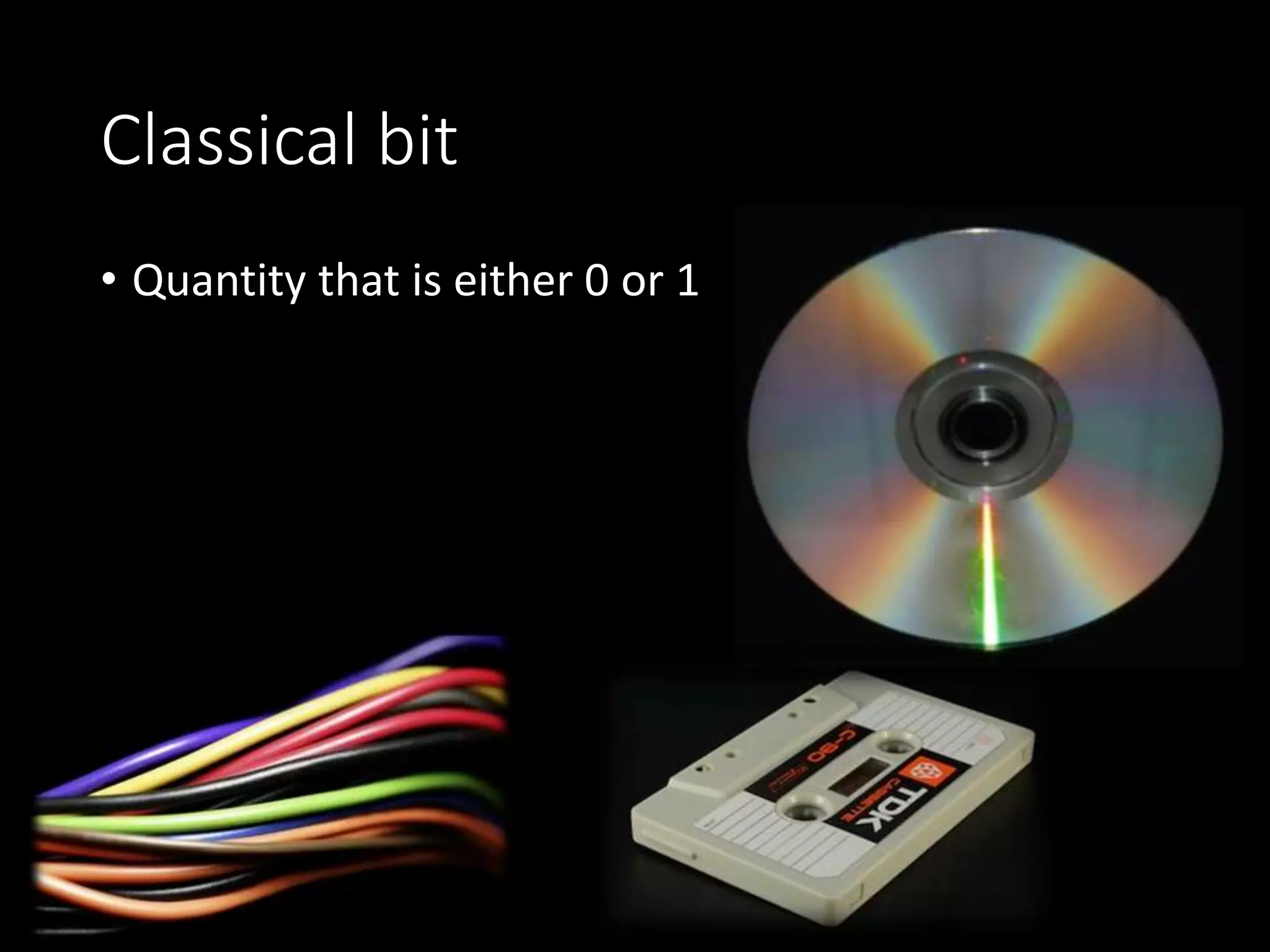
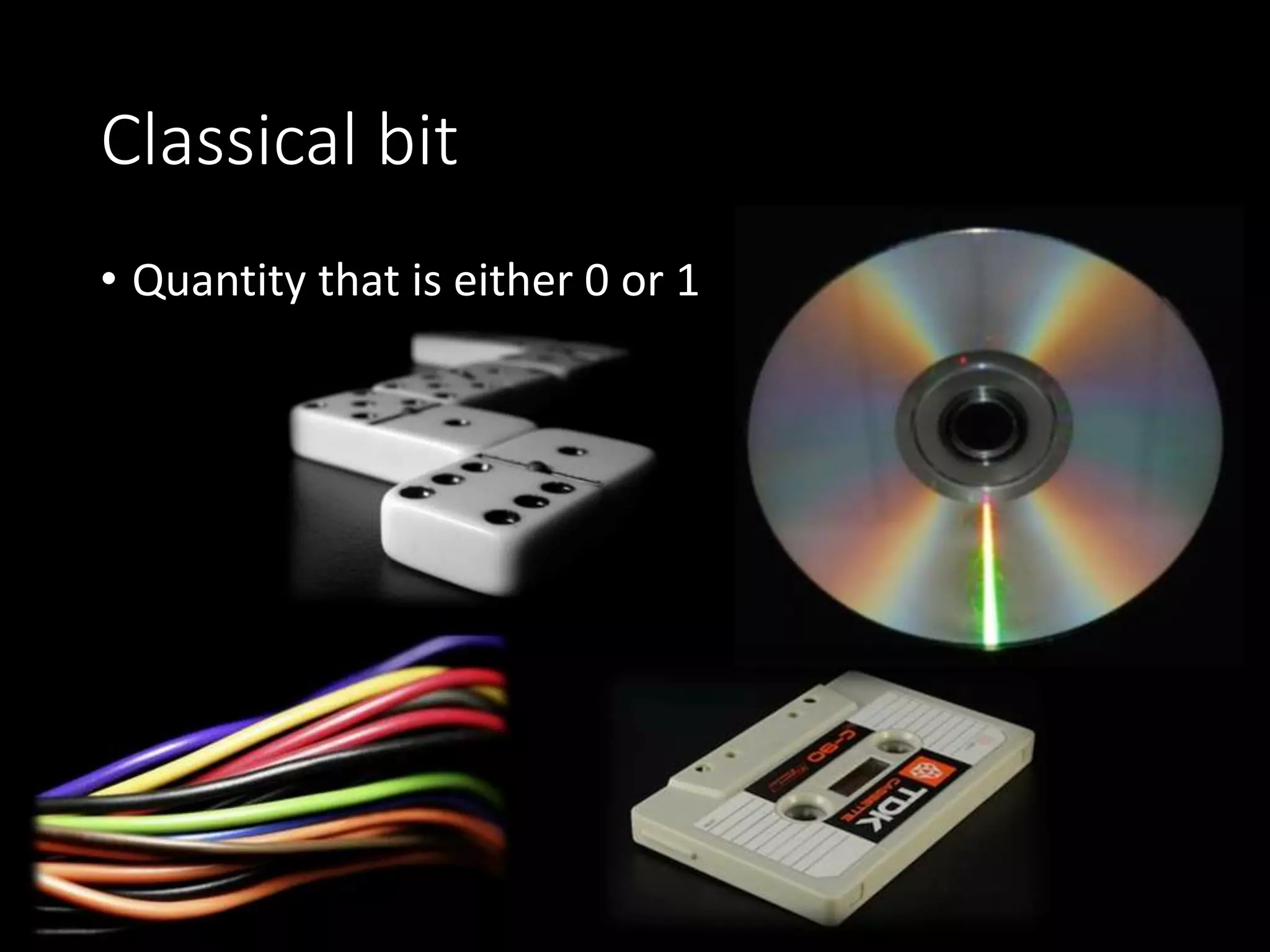
Classical bit
Classical bit
• Quantity that is either 0 or 1
Classical bit
• Quantity that is either 0 or 1
Classical bit
• Quantity that is either 0 or 1
Classical bit
• Quantity that is either 0 or 1
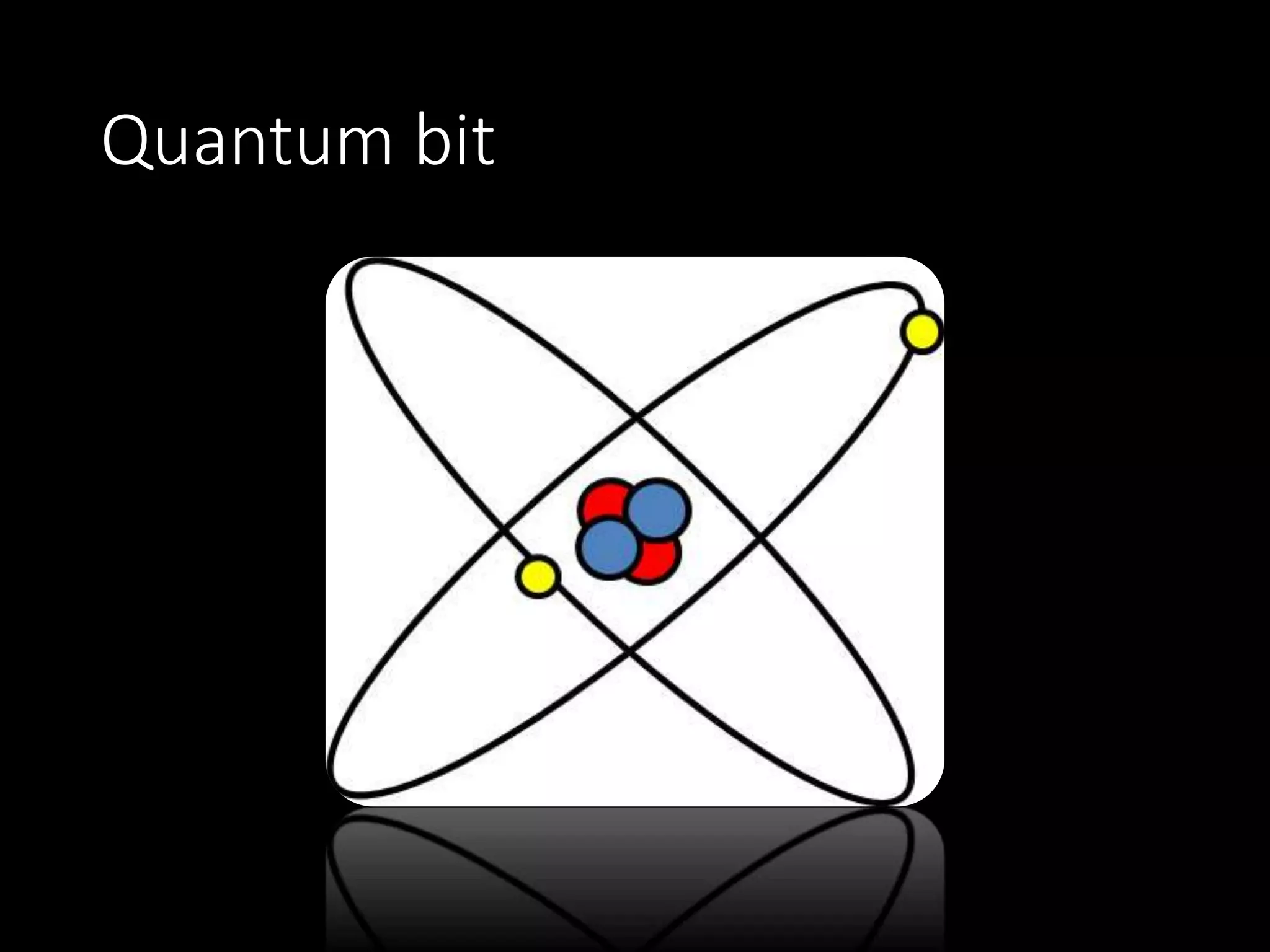
Quantum bit
Quantum bit
Quantum bit
10
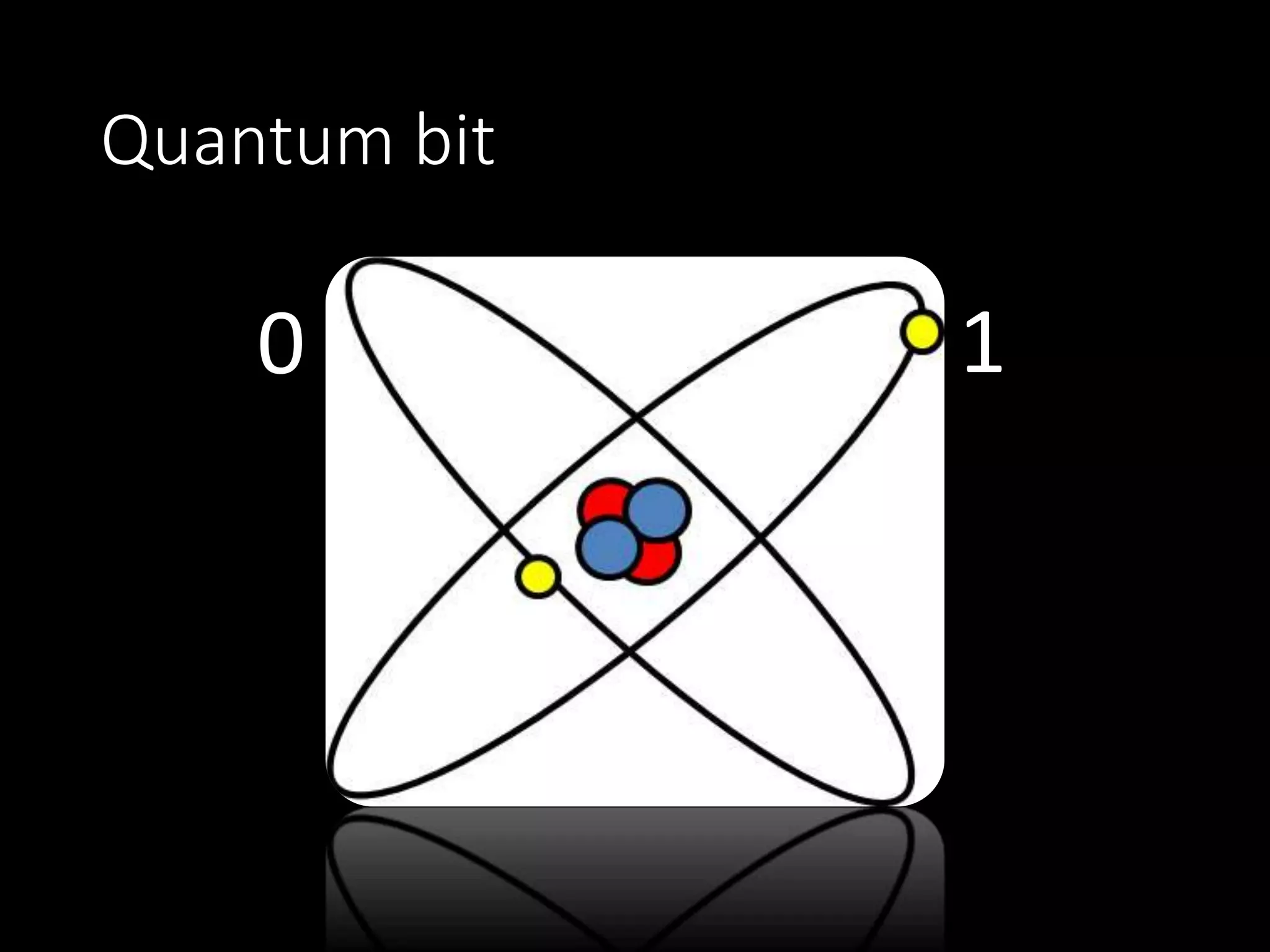
Quantum bit
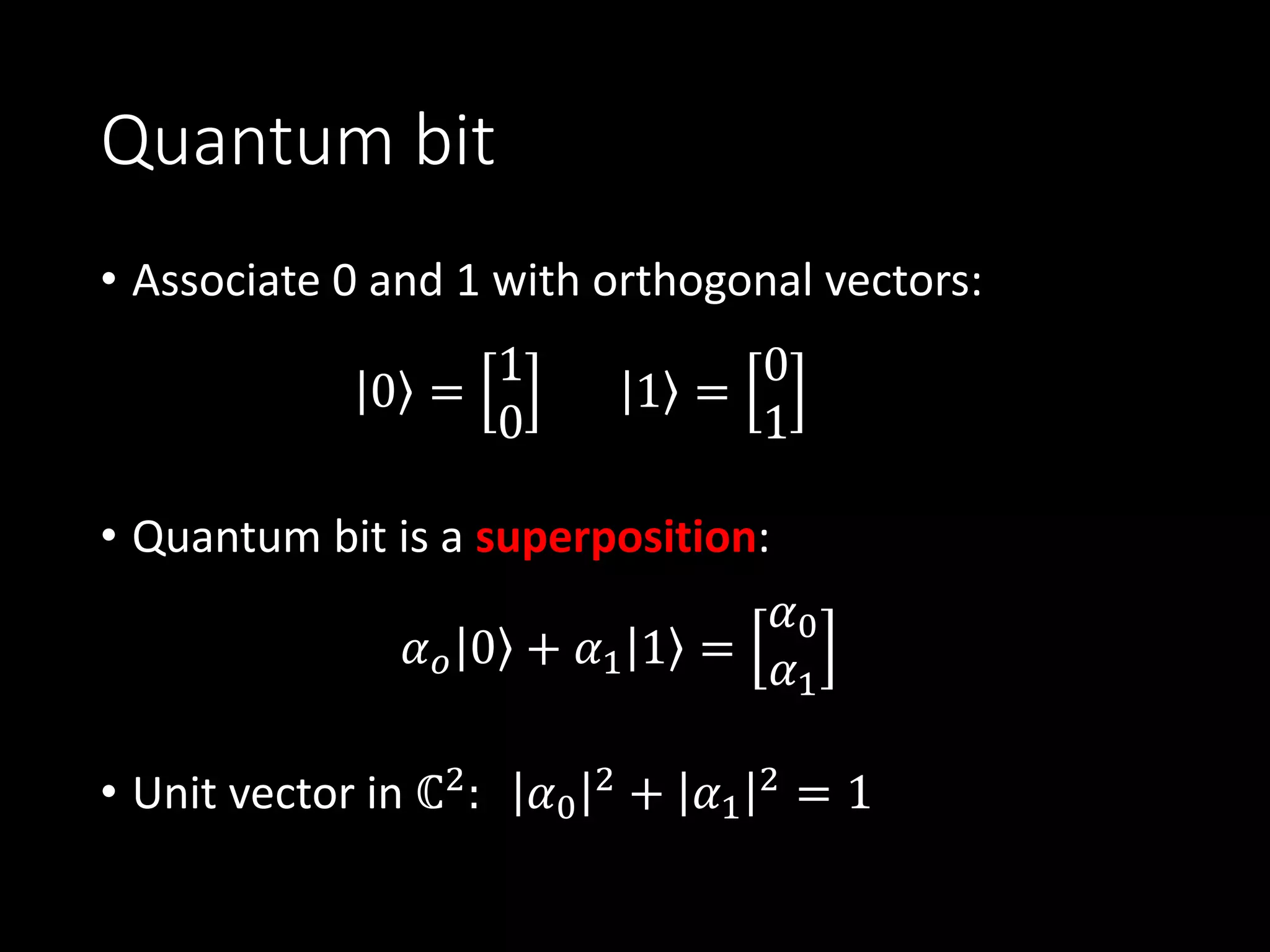
• Associate 0 and 1 with orthogonal vectors:
0 =
1
0
1 =
0
1
• Quantum bit is a superposition:
𝛼 𝑜 0 + 𝛼1 1 =
𝛼0
𝛼1
• Unit vector in ℂ2: 𝛼0
2 + 𝛼1
2 = 1
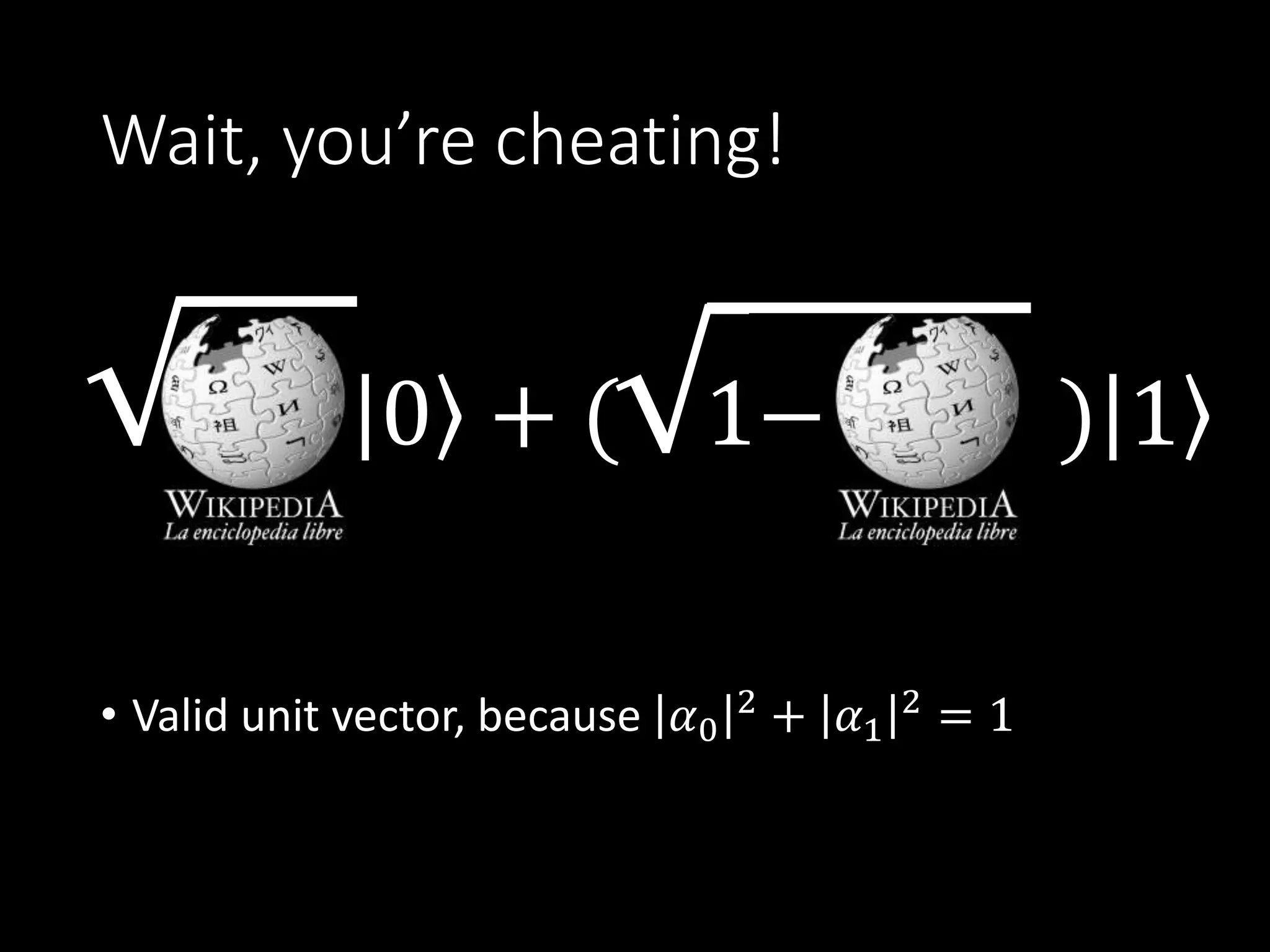
Wait, you’re cheating!
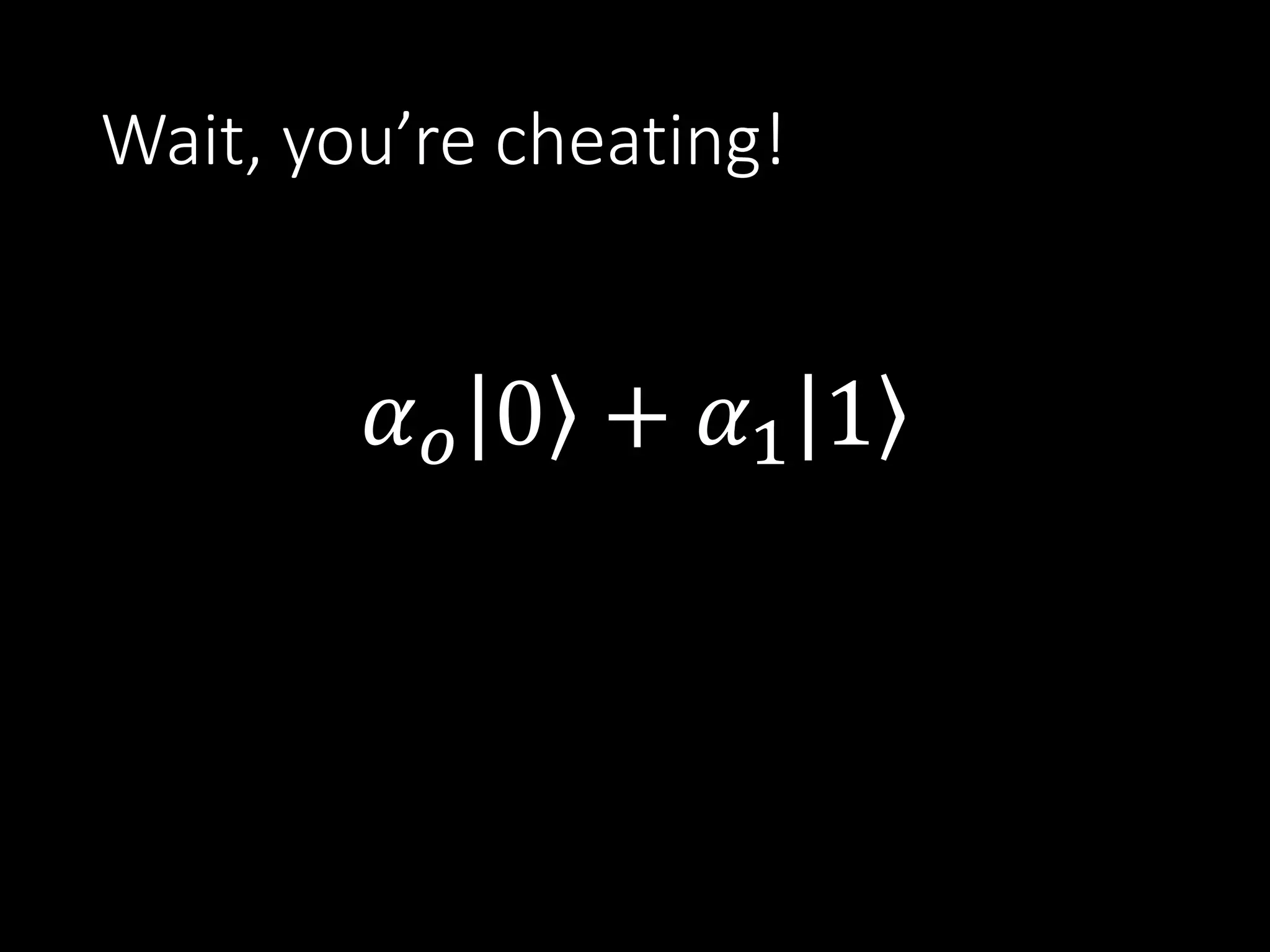
𝛼 𝑜 0 + 𝛼1 1
Wait, you’re cheating!
𝛼 𝑜 0 + 𝛼1 1
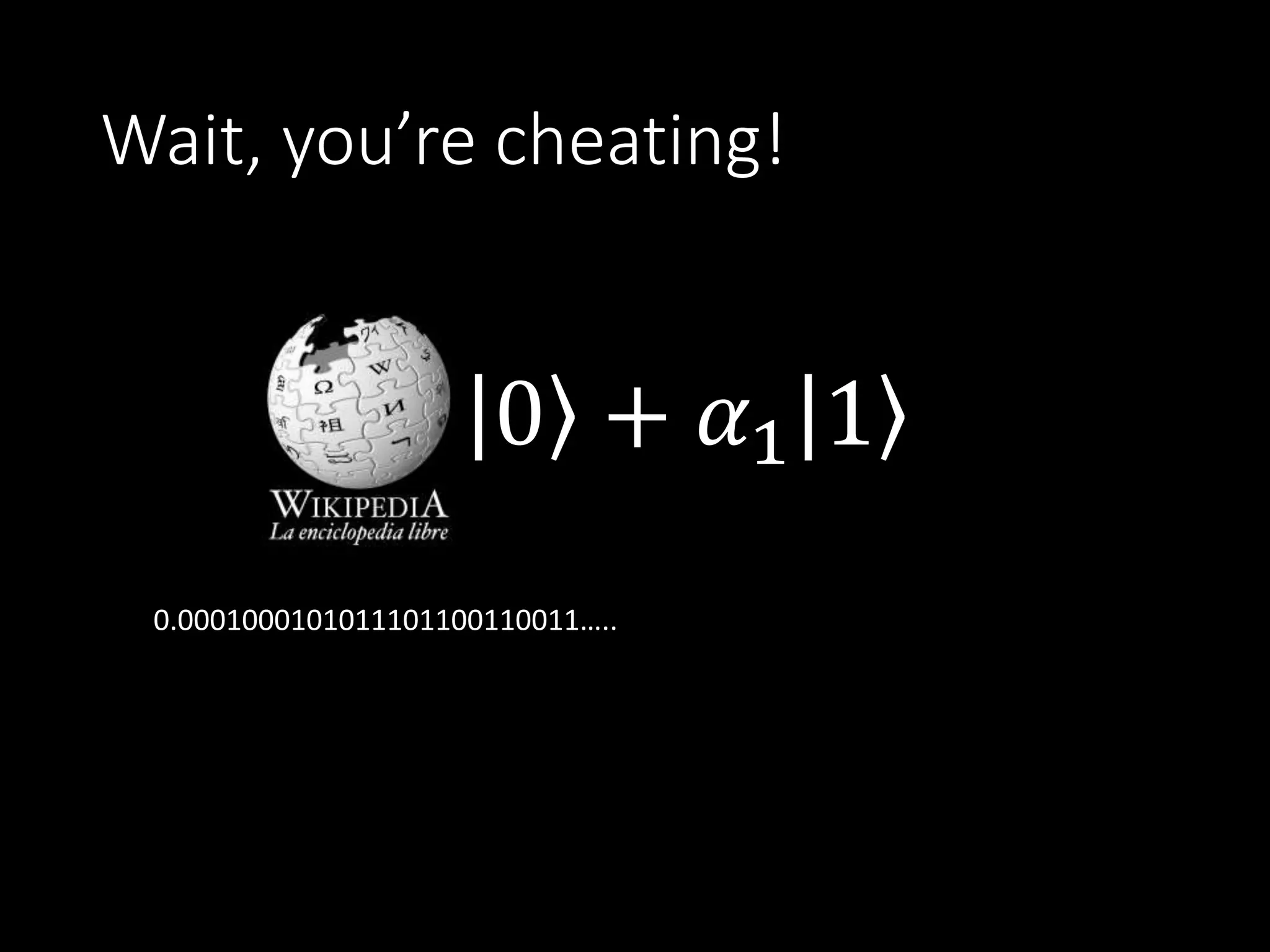
0.0001000101011101100110011…..
Wait, you’re cheating!
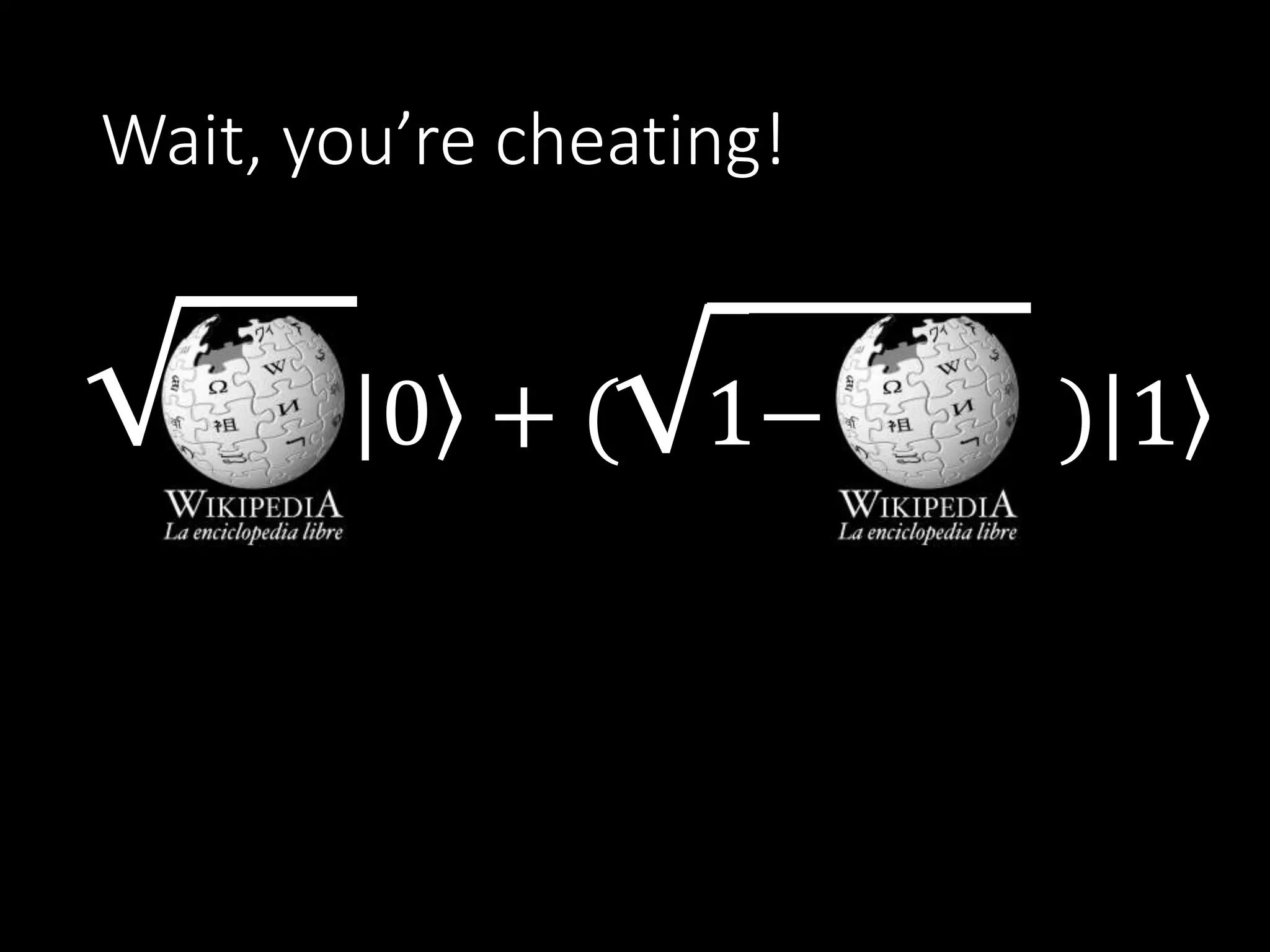
𝛼 𝑜 0 + ( 1− ) 1
Wait, you’re cheating!
𝛼 𝑜 0 + ( 1− ) 1
• Valid unit vector, because 𝛼0
2
+ 𝛼1
2
= 1
Wait, you’re cheating!
𝛼 𝑜 0 + ( 1− ) 1
• Valid unit vector, because 𝛼0
2
+ 𝛼1
2
= 1
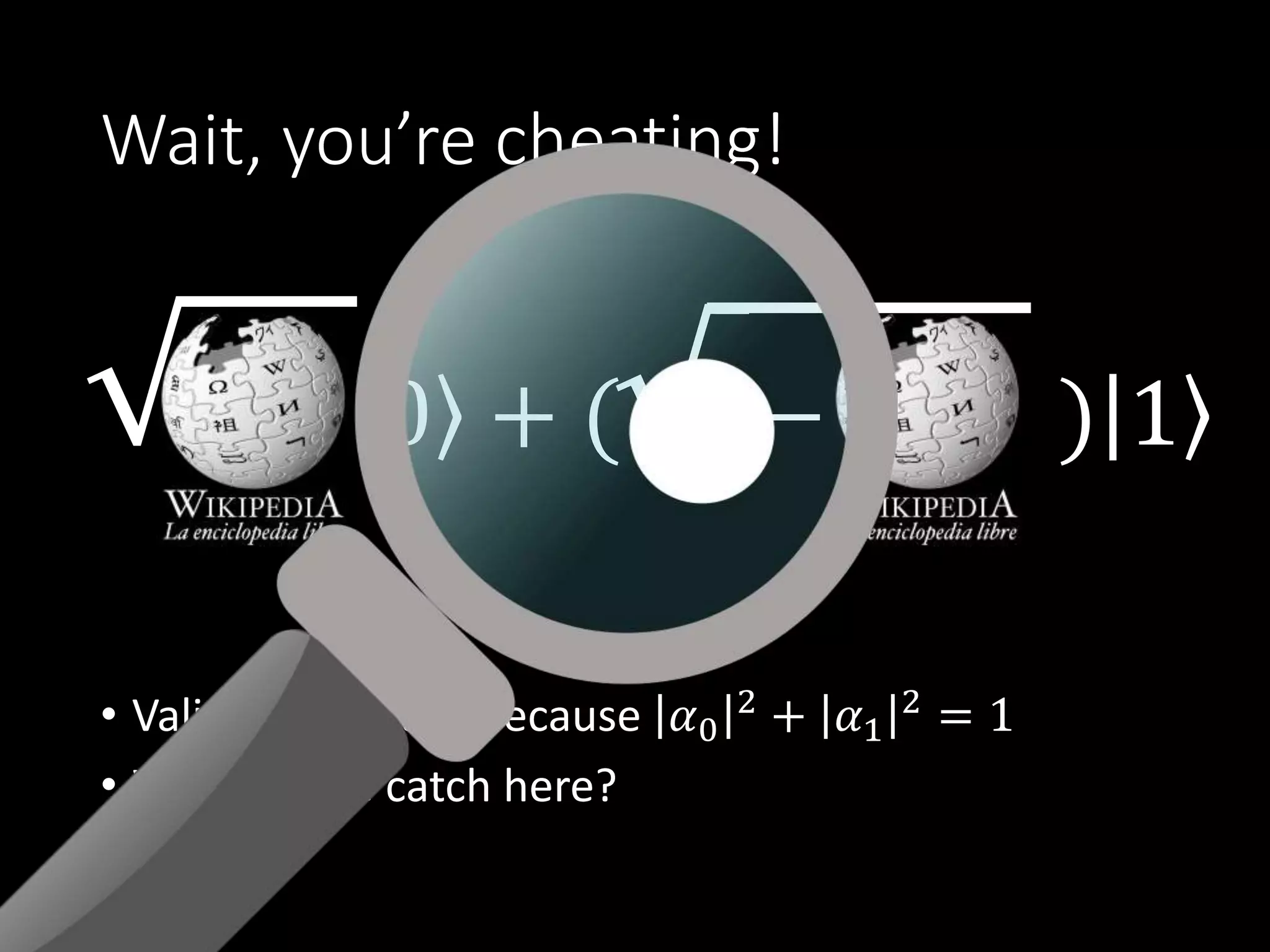
• Where’s the catch here?
Measurement
0
Measurement
0
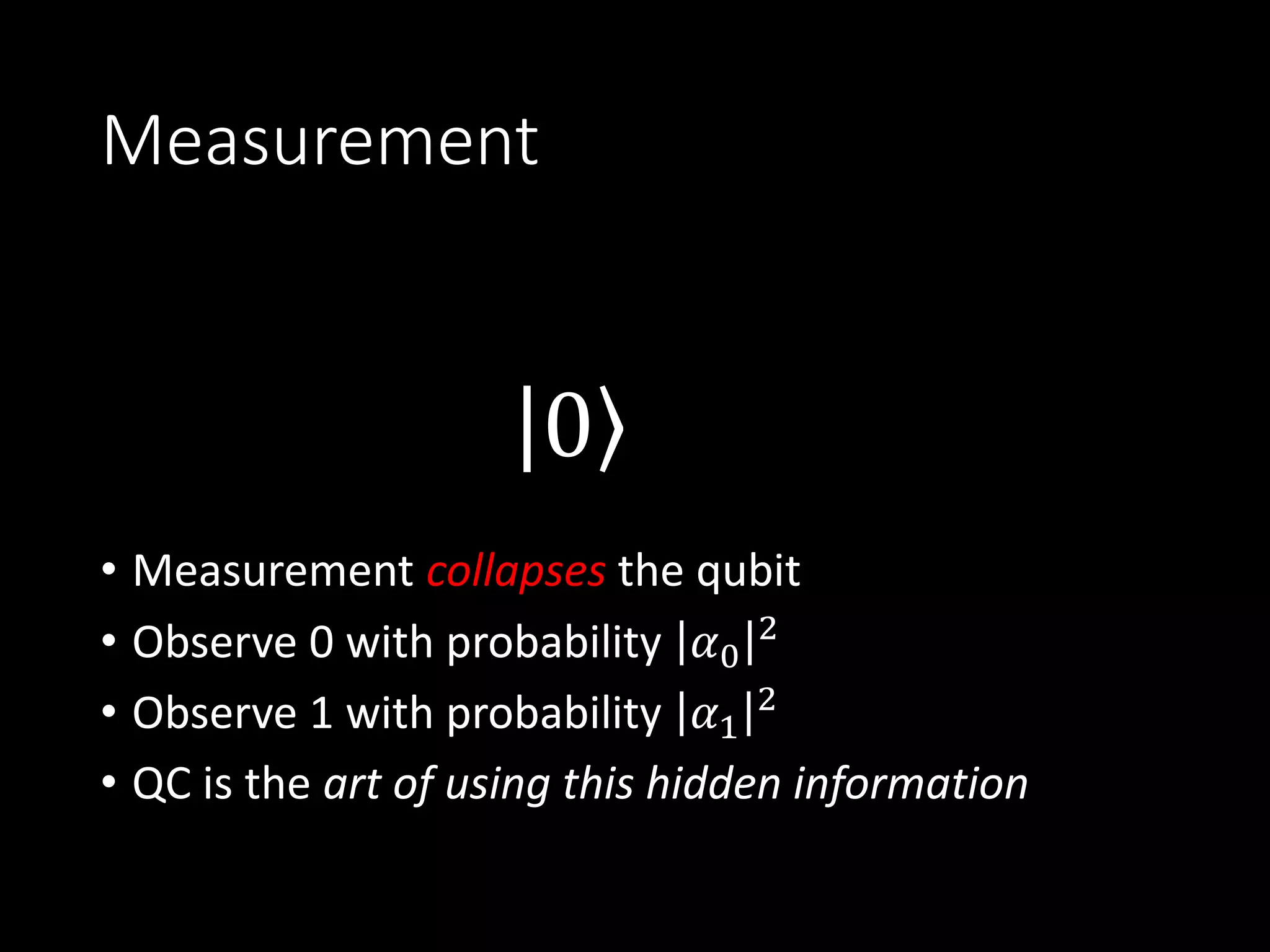
• Measurement collapses the qubit
• Observe 0 with probability 𝛼0
2
• Observe 1 with probability 𝛼1
2
• QC is the art of using this hidden information
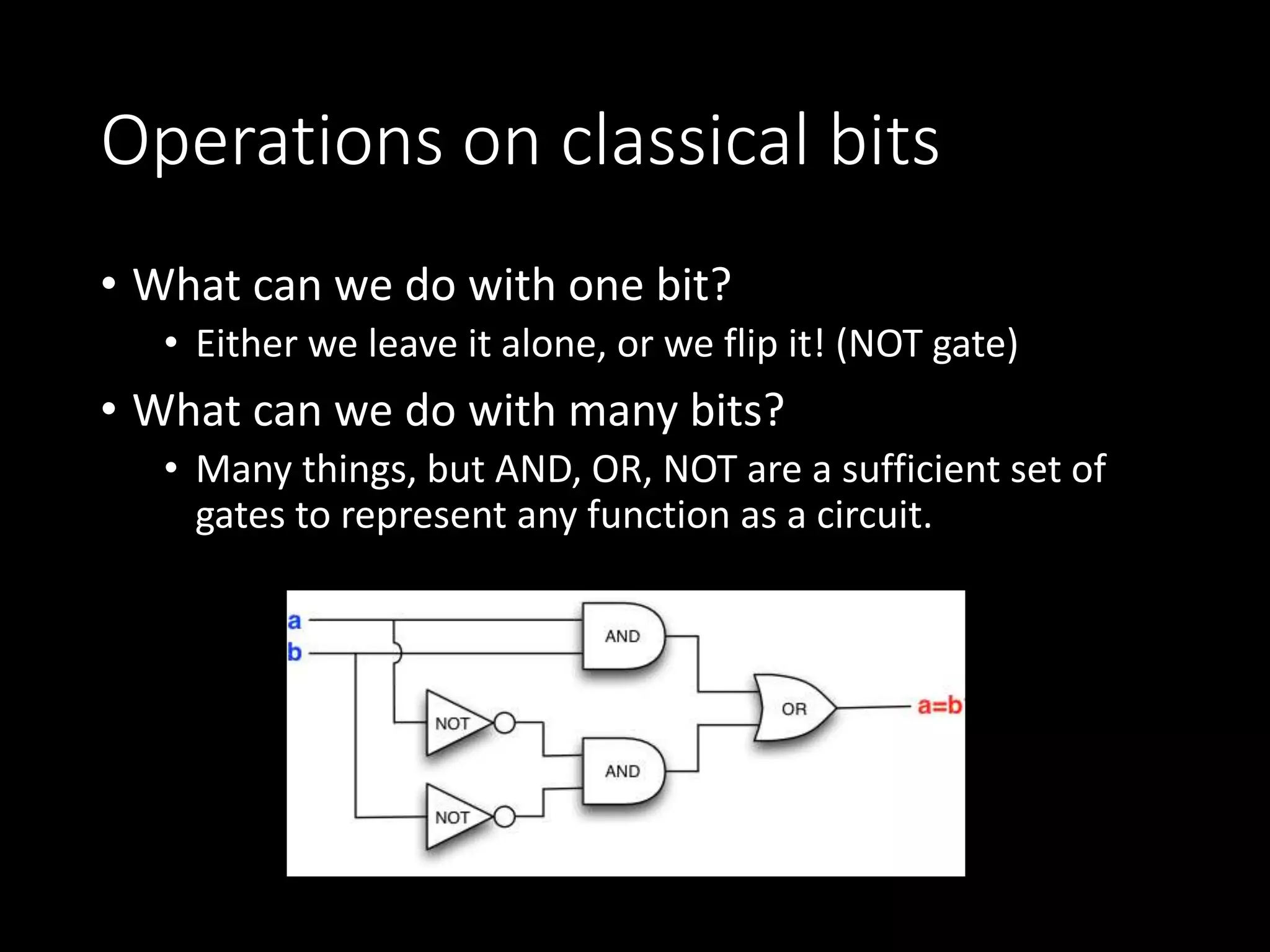
Operations on classical bits
• What can we do with one bit?
• Either we leave it alone, or we flip it! (NOT gate)
• What can we do with many bits?
• Many things, but AND, OR, NOT are a sufficient set of
gates to represent any function as a circuit.
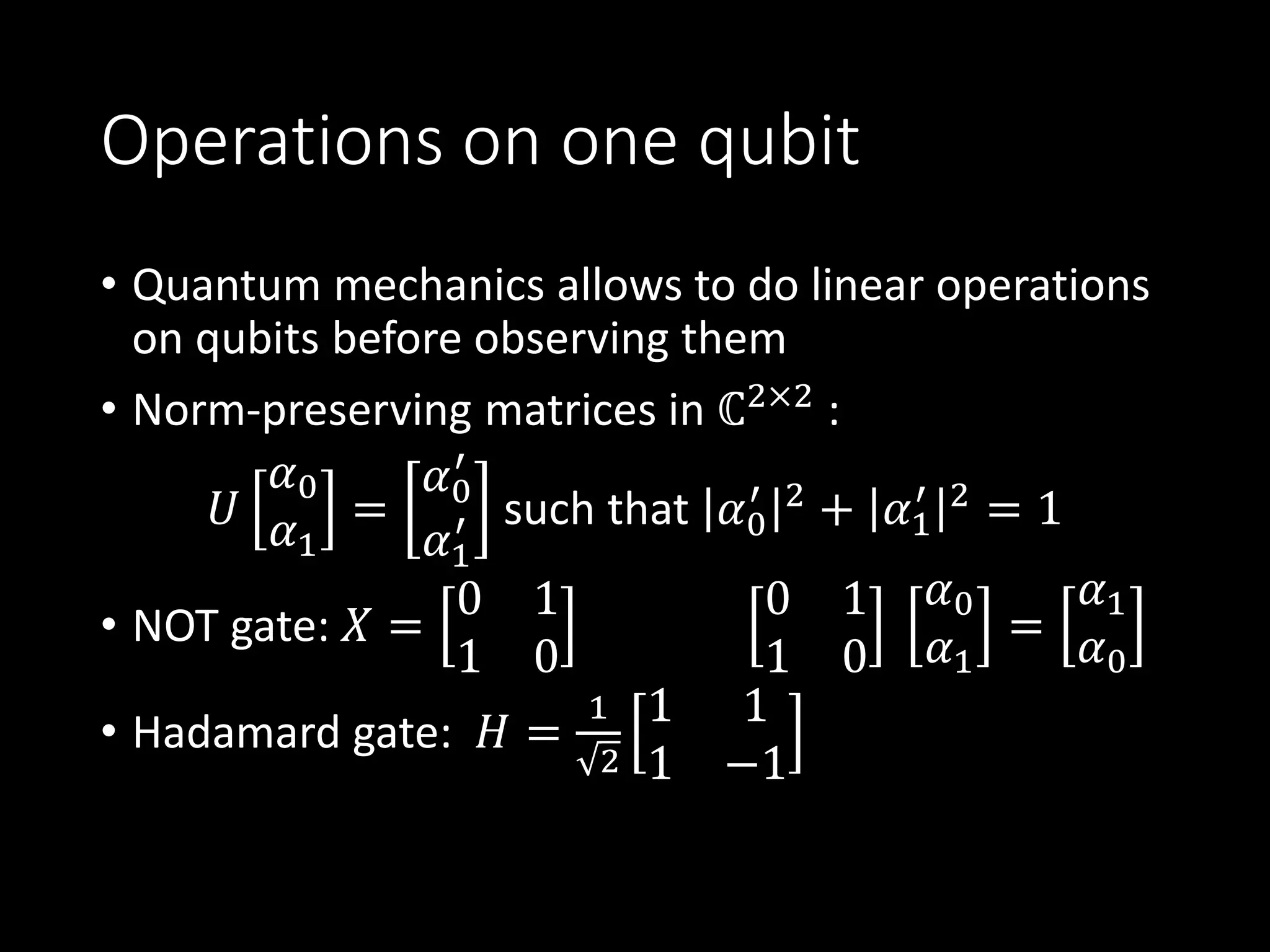
Operations on one qubit
• Quantum mechanics allows to do linear operations
on qubits before observing them
• Norm-preserving matrices in ℂ2×2
:
𝑈
𝛼0
𝛼1
=
𝛼0
′
𝛼1
′ such that 𝛼0
′ 2 + 𝛼1
′ 2 = 1
• NOT gate: 𝑋 =
0 1
1 0
0 1
1 0
𝛼0
𝛼1
=
𝛼1
𝛼0
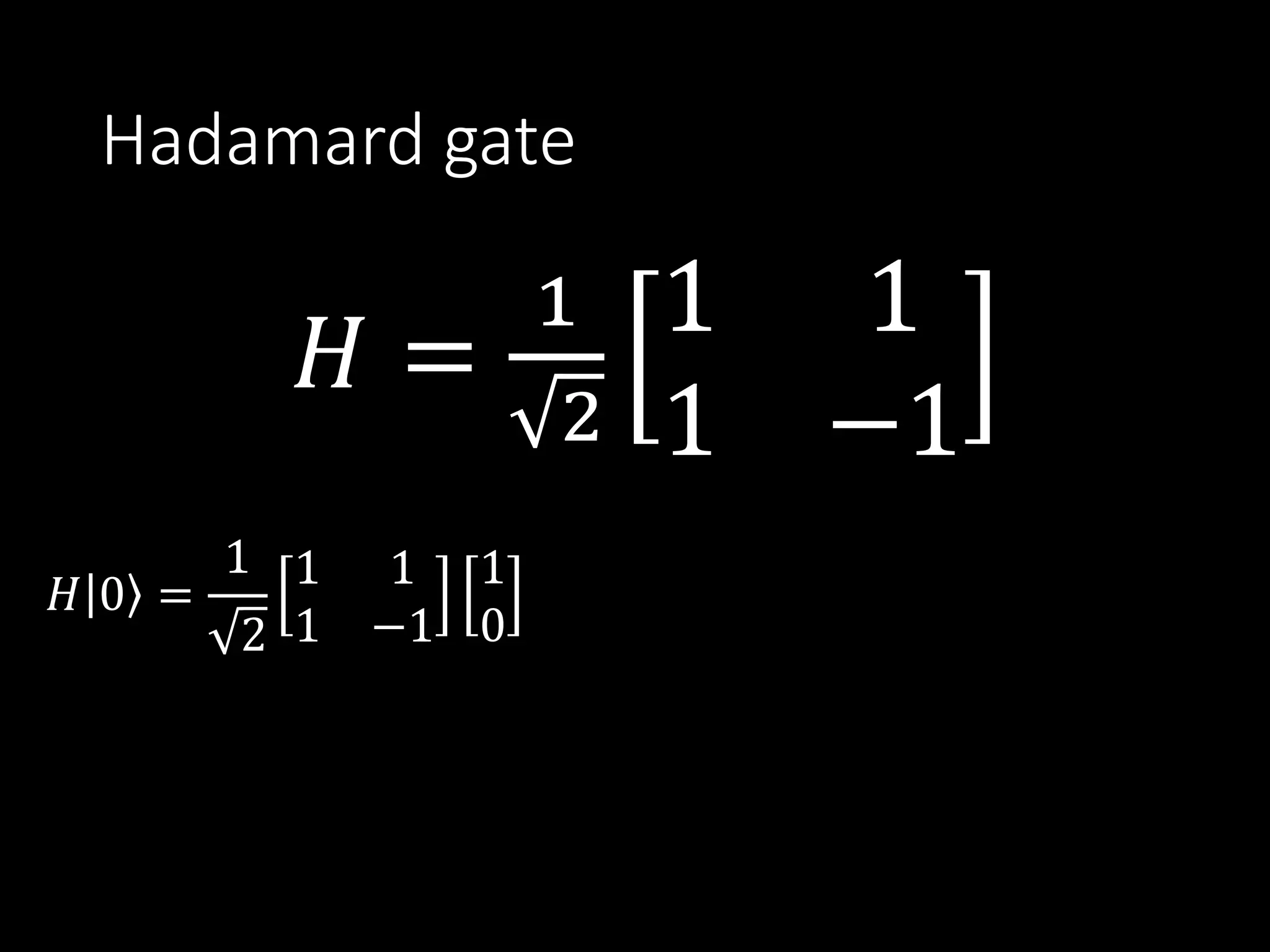
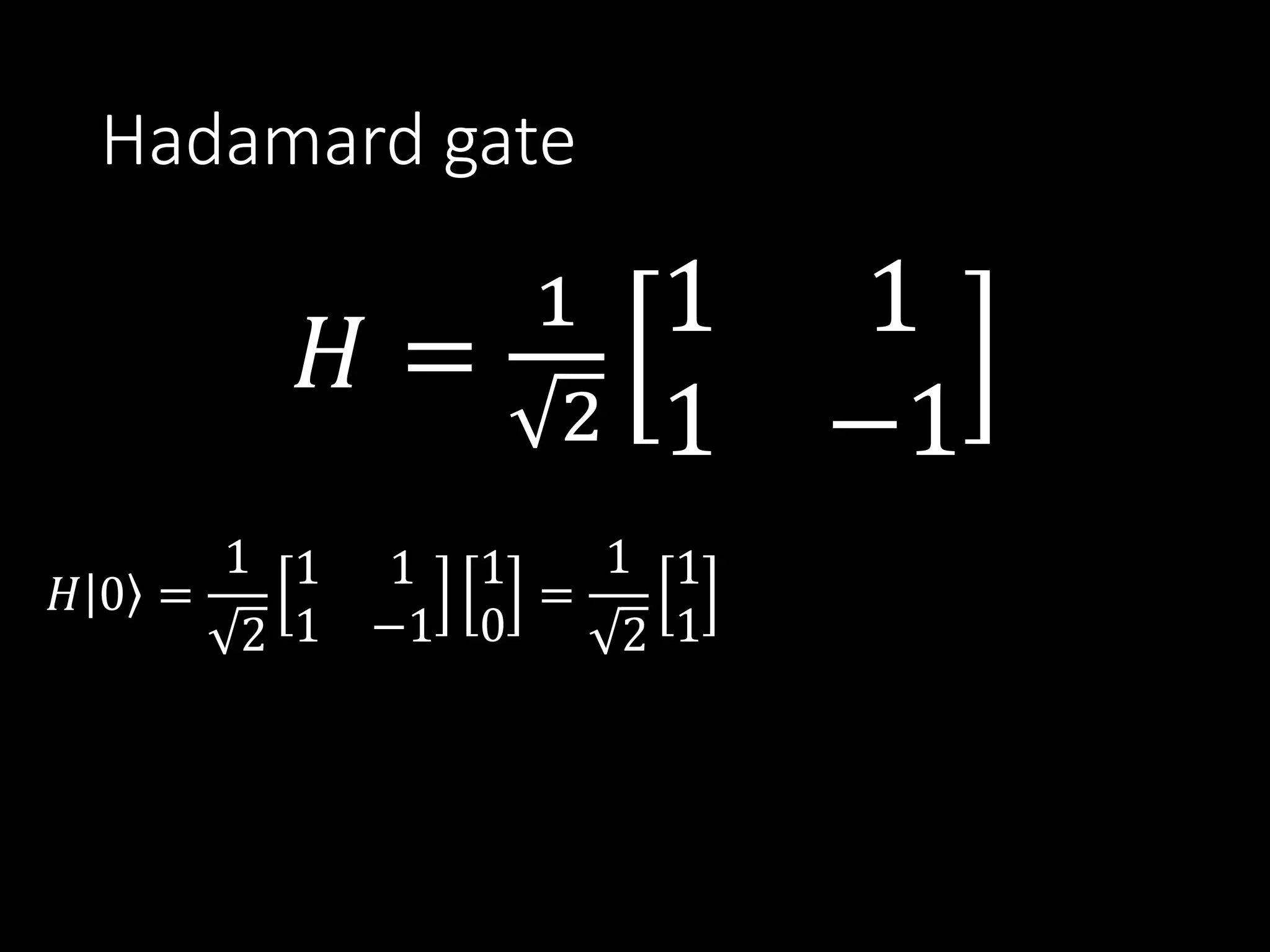
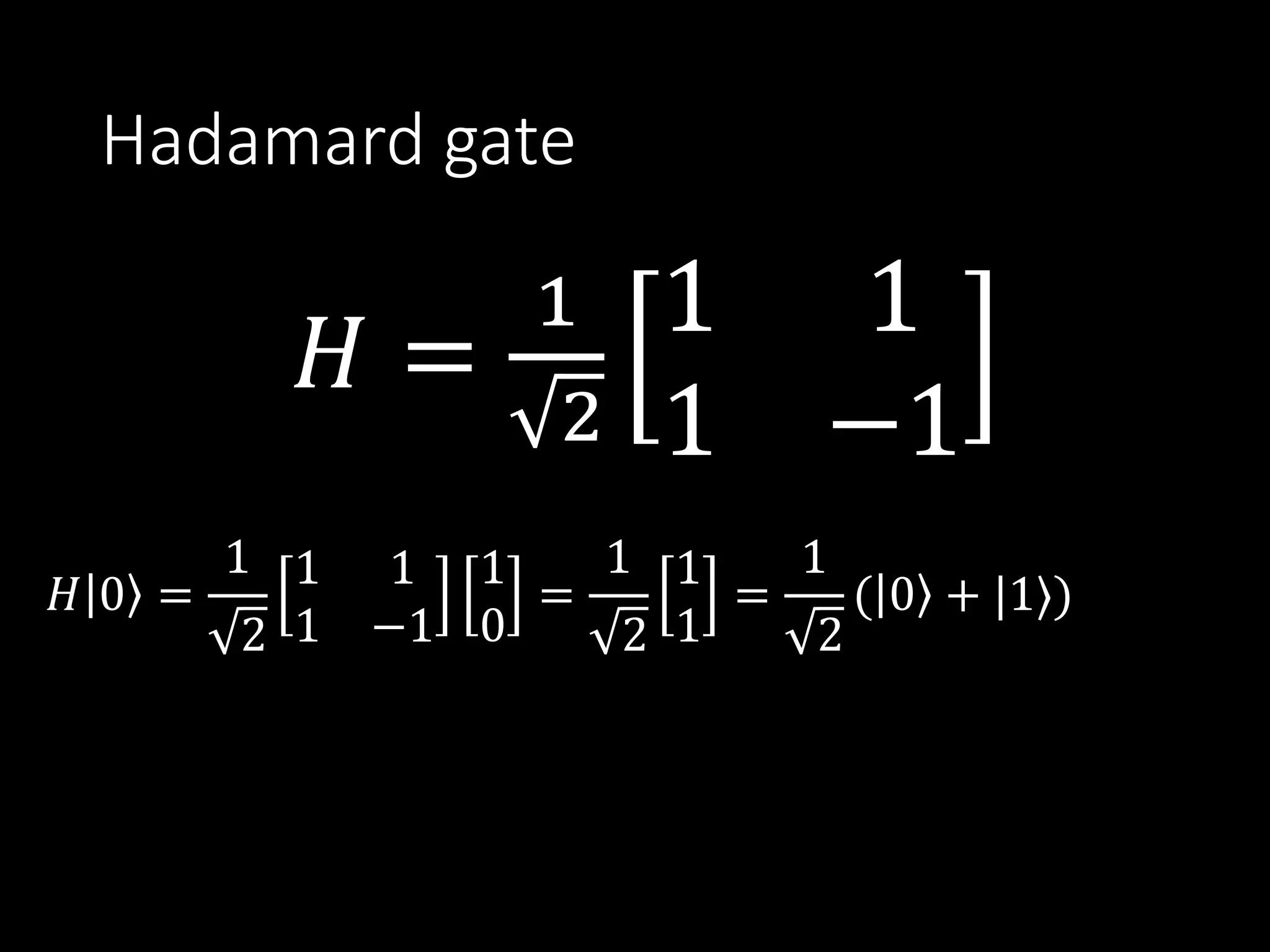
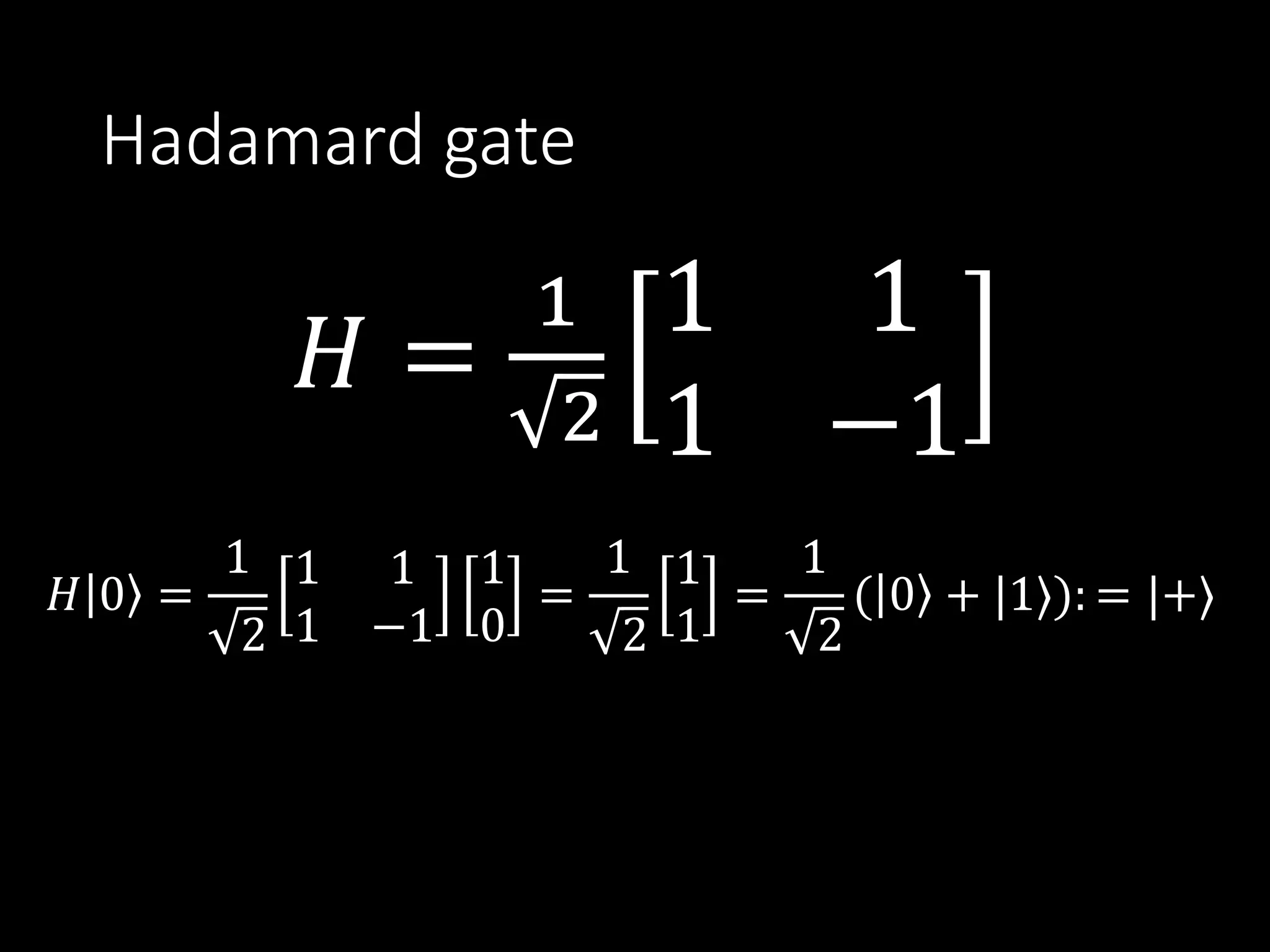
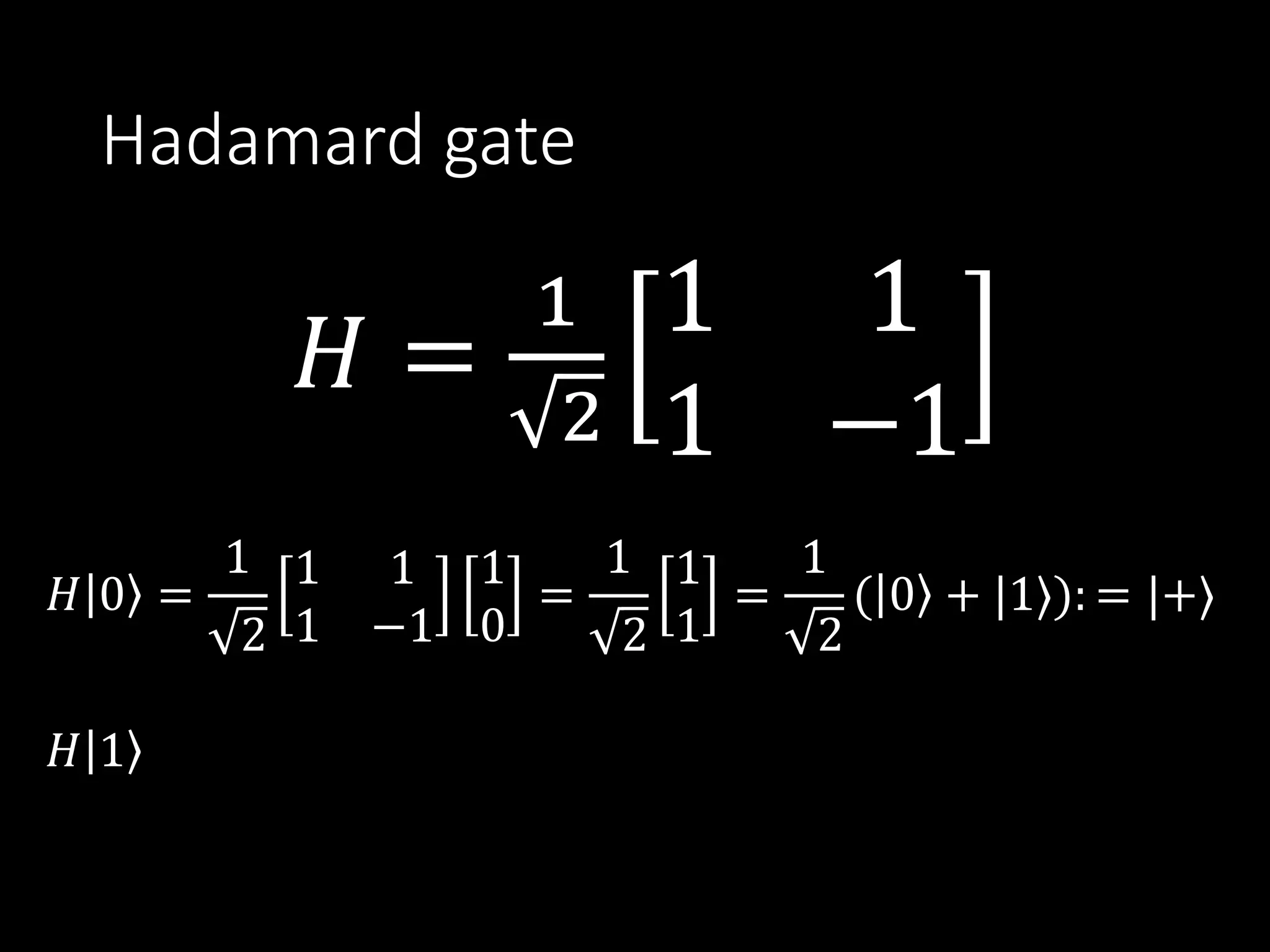
• Hadamard gate: 𝐻 =
1
2
1 1
1 −1
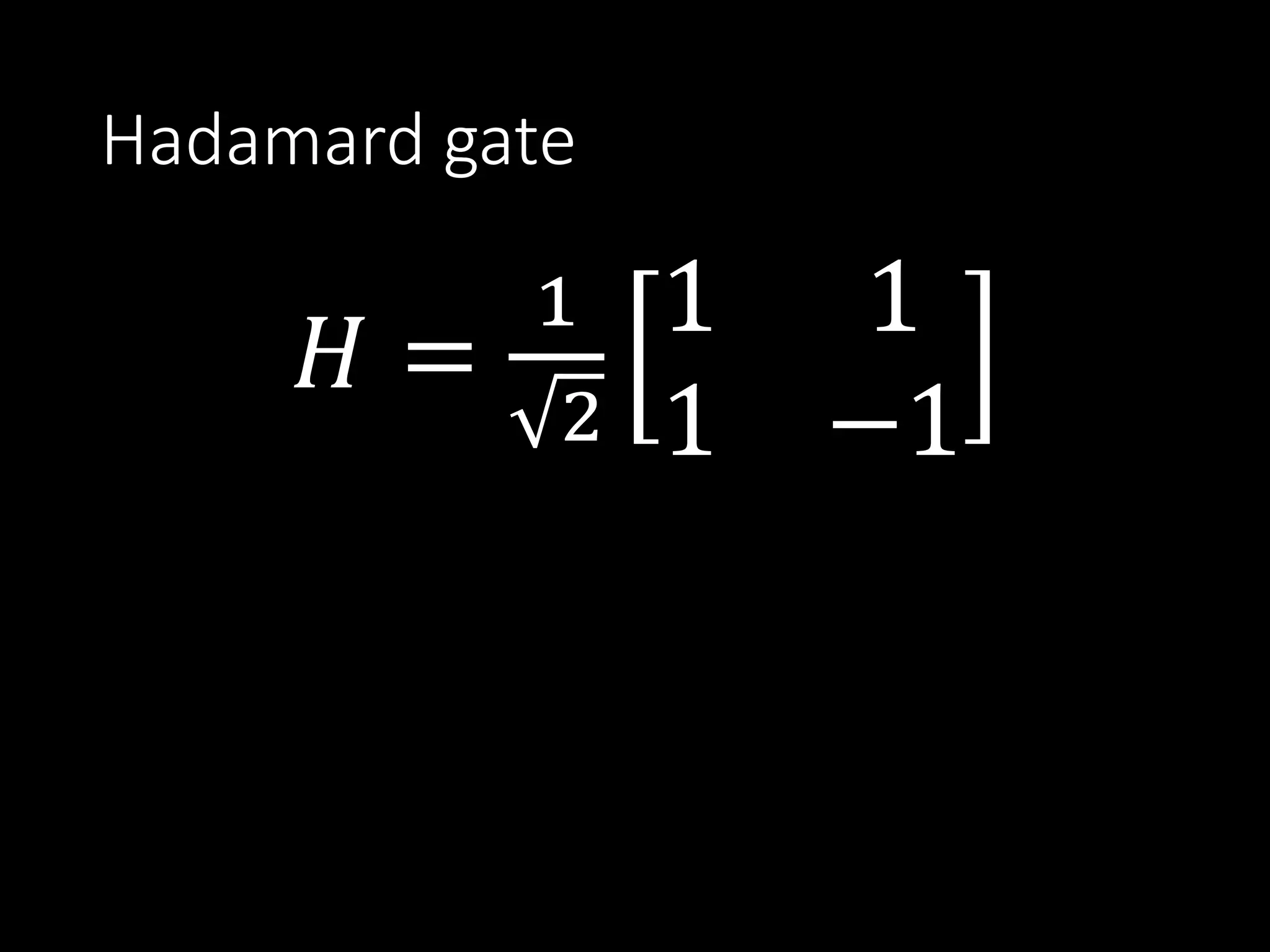
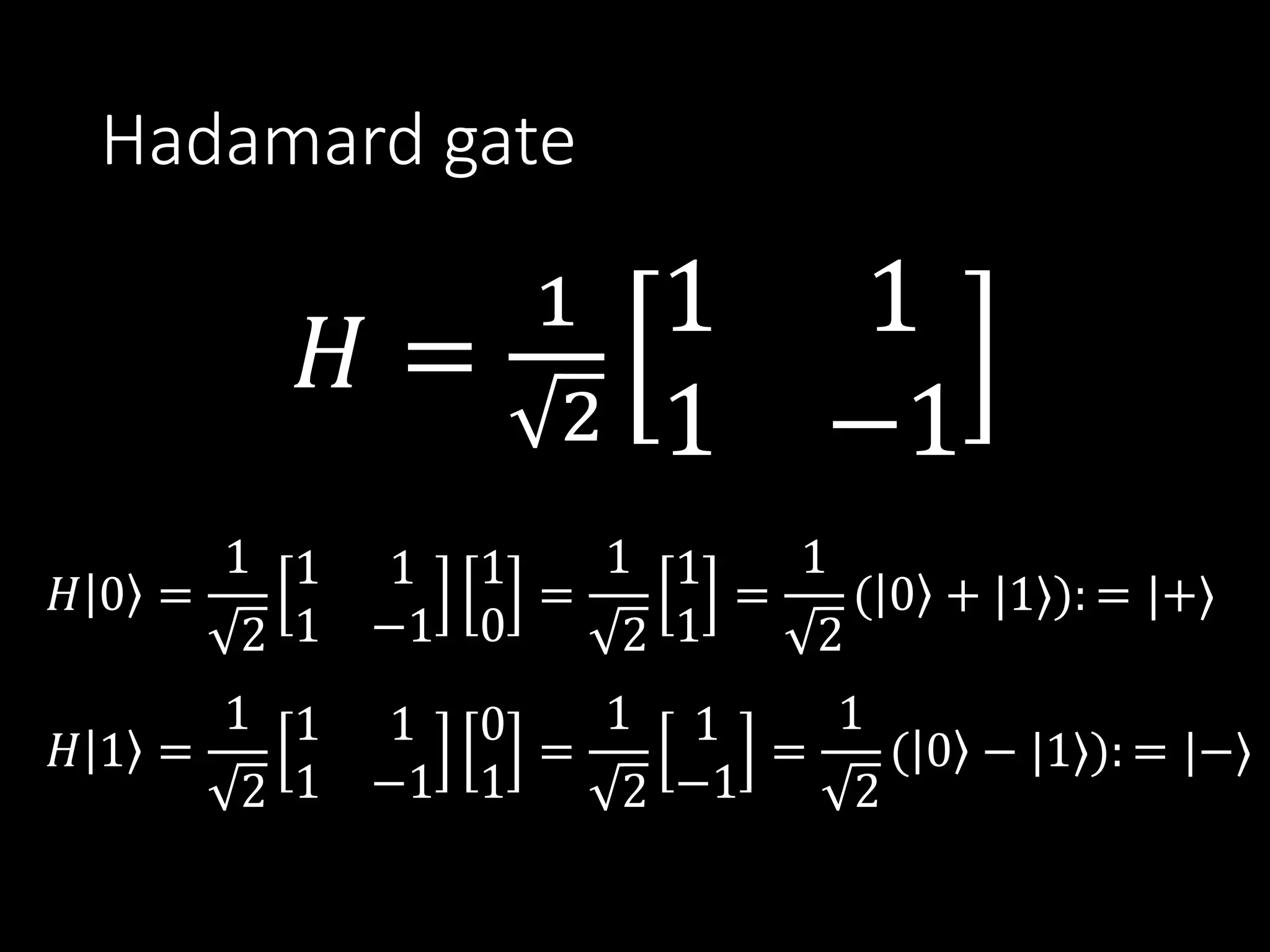
Hadamard gate
𝐻 =
1
2
1 1
1 −1
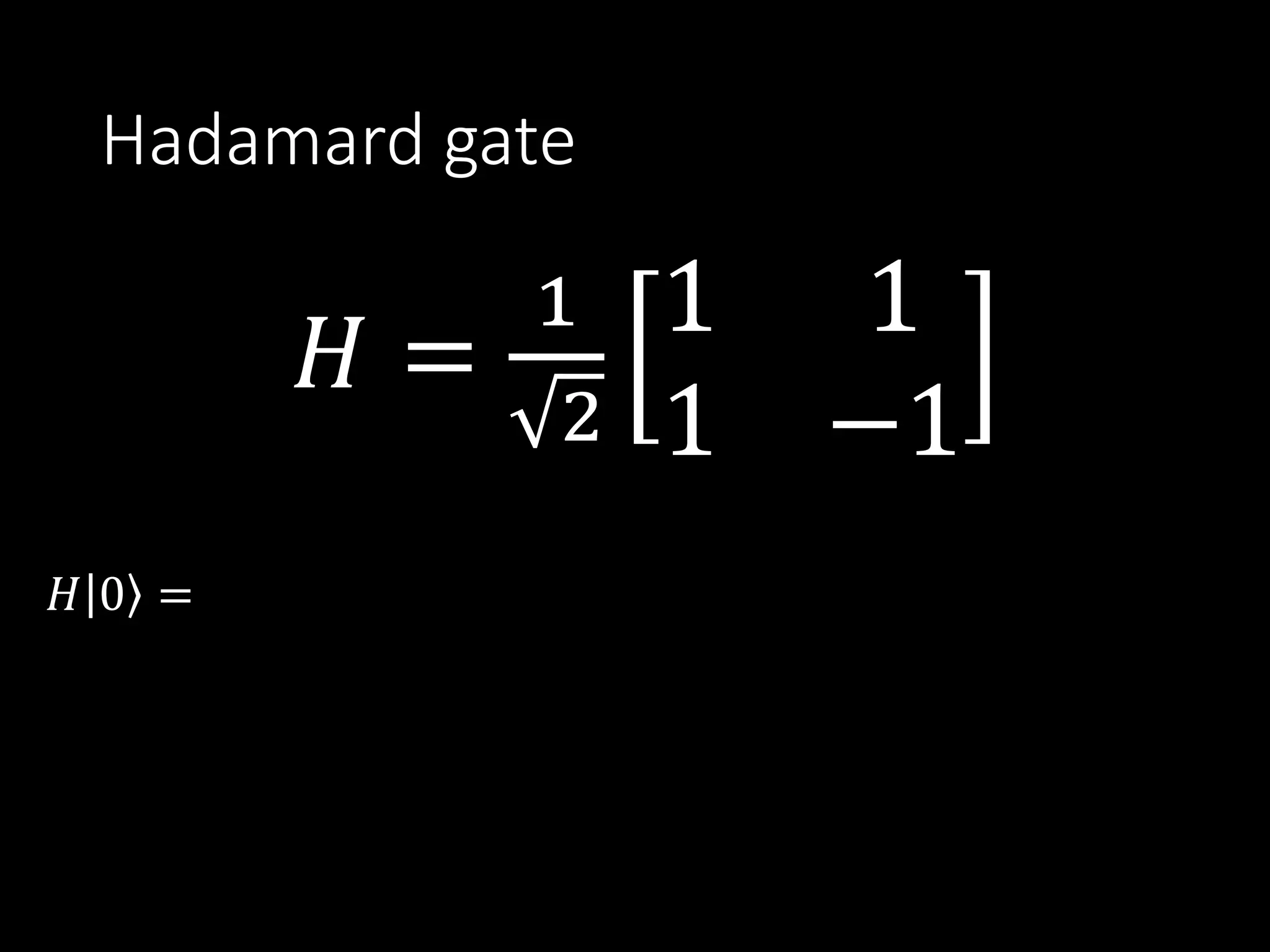
Hadamard gate
𝐻 =
1
2
1 1
1 −1
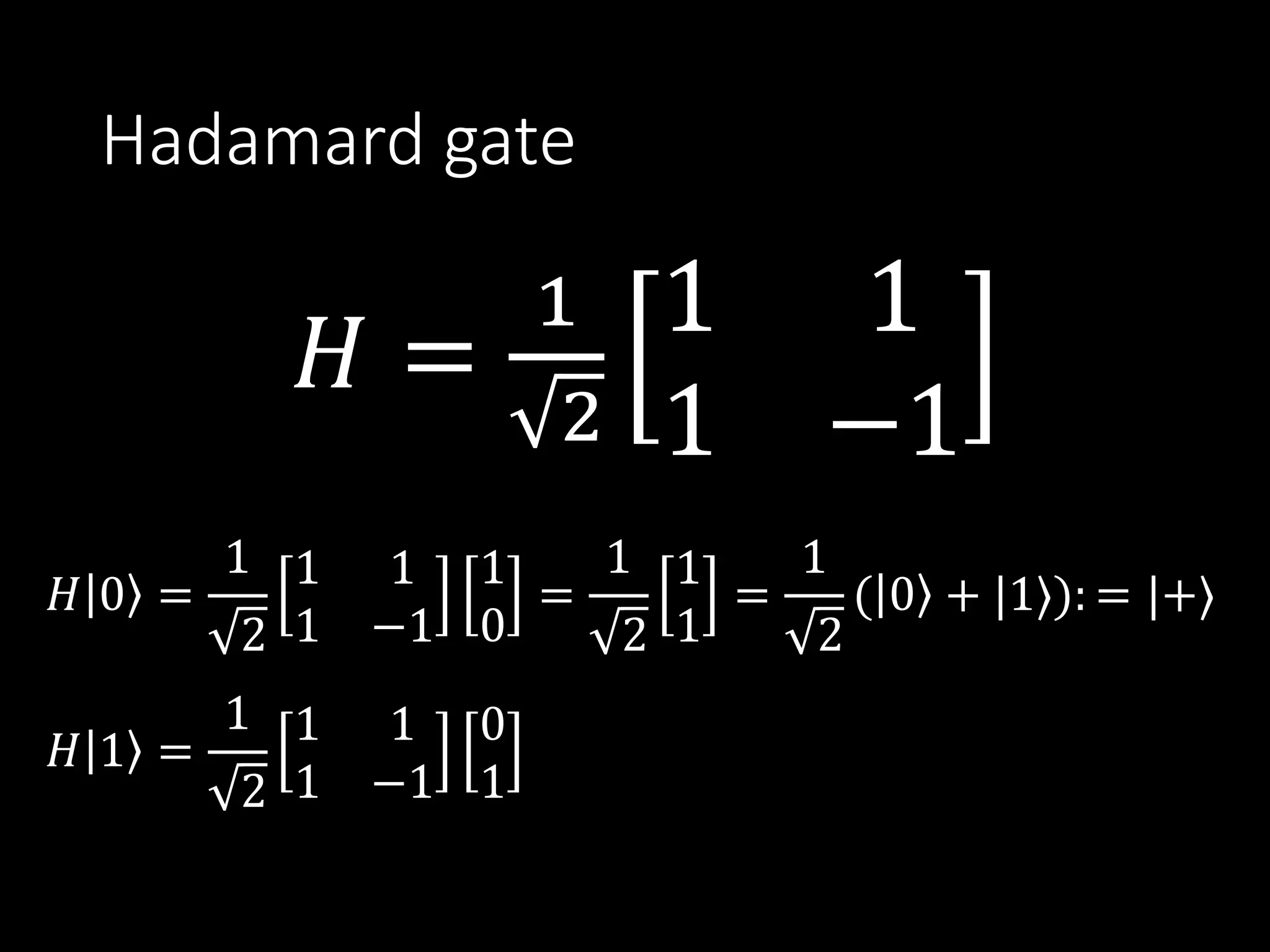
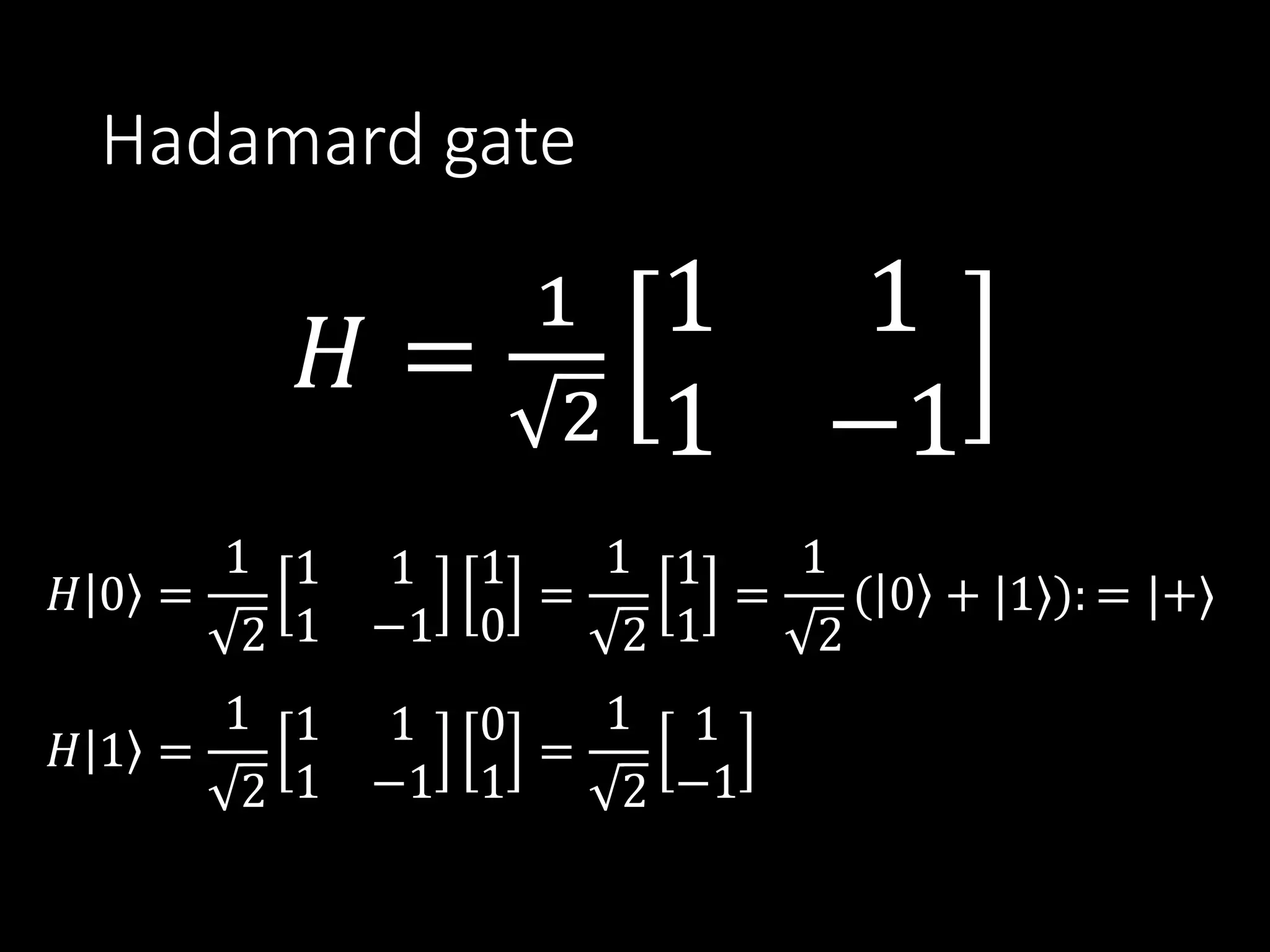
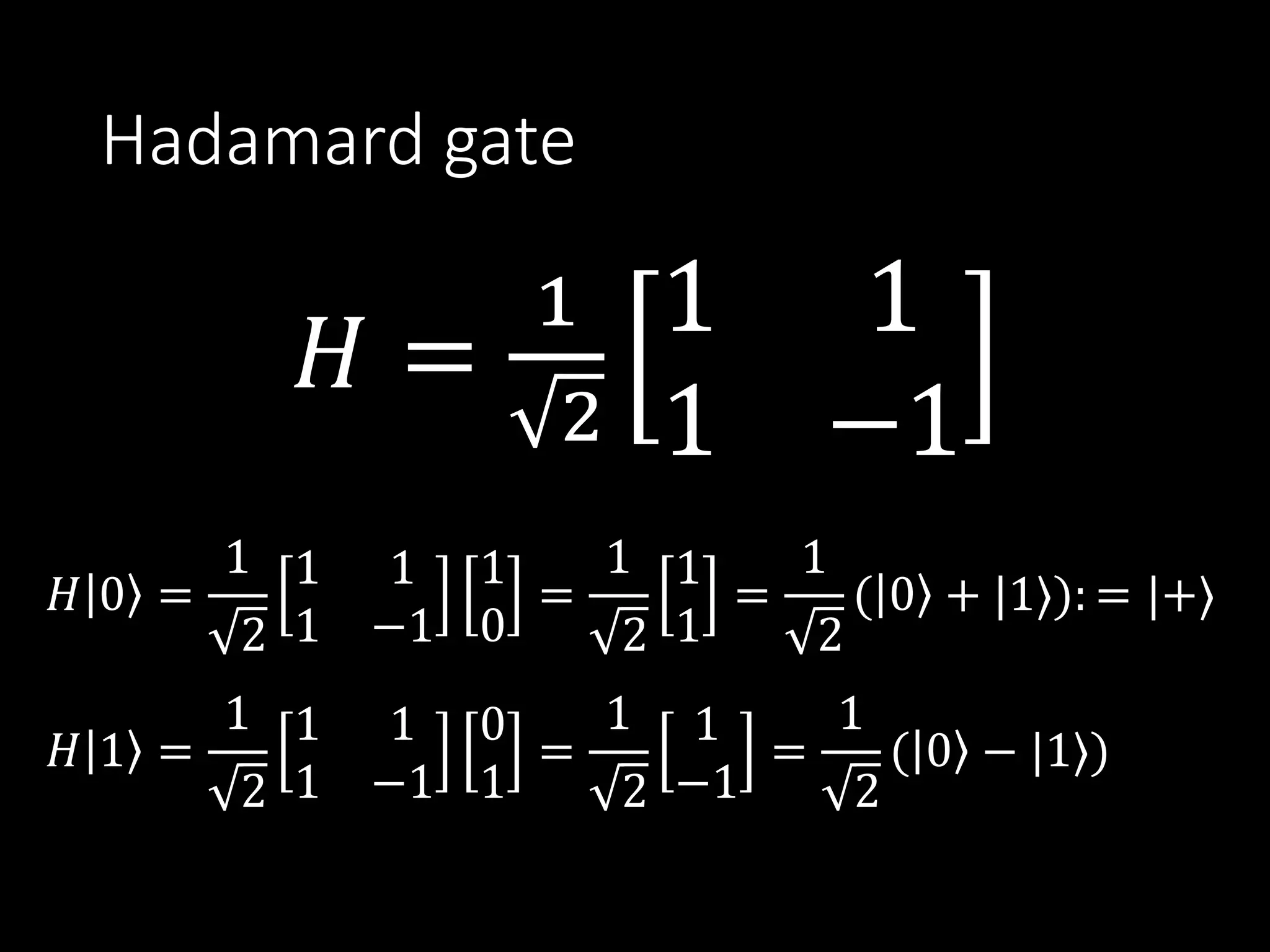
𝐻 0 =
1
2
1 1
1 −1
1
0
=
1
2
1
1
=
1
2
( 0 + |1⟩): = |+⟩
Hadamard gate
𝐻 =
1
2
1 1
1 −1
𝐻 0 =
1
2
1 1
1 −1
1
0
=
1
2
1
1
=
1
2
( 0 + |1⟩): = |+⟩
Hadamard gate
𝐻 =
1
2
1 1
1 −1
𝐻 0 =
1
2
1 1
1 −1
1
0
=
1
2
1
1
=
1
2
( 0 + |1⟩): = |+⟩
Hadamard gate
𝐻 =
1
2
1 1
1 −1
𝐻 0 =
1
2
1 1
1 −1
1
0
=
1
2
1
1
=
1
2
( 0 + |1⟩): = |+⟩
Hadamard gate
𝐻 =
1
2
1 1
1 −1
𝐻 0 =
1
2
1 1
1 −1
1
0
=
1
2
1
1
=
1
2
( 0 + |1⟩): = |+⟩
Hadamard gate
𝐻 =
1
2
1 1
1 −1
𝐻 0 =
1
2
1 1
1 −1
1
0
=
1
2
1
1
=
1
2
( 0 + |1⟩): = |+⟩
𝐻 1 =
1
2
1 1
1 −1
0
1
=
1
2
1
−1
=
1
2
( 0 − |1⟩): = |−⟩
Hadamard gate
𝐻 =
1
2
1 1
1 −1
𝐻 0 =
1
2
1 1
1 −1
1
0
=
1
2
1
1
=
1
2
( 0 + |1⟩): = |+⟩
𝐻 1 =
1
2
1 1
1 −1
0
1
=
1
2
1
−1
=
1
2
( 0 − |1⟩): = |−⟩
Hadamard gate
𝐻 =
1
2
1 1
1 −1
𝐻 0 =
1
2
1 1
1 −1
1
0
=
1
2
1
1
=
1
2
( 0 + |1⟩): = |+⟩
𝐻 1 =
1
2
1 1
1 −1
0
1
=
1
2
1
−1
=
1
2
( 0 − |1⟩): = |−⟩
Hadamard gate
𝐻 =
1
2
1 1
1 −1
𝐻 0 =
1
2
1 1
1 −1
1
0
=
1
2
1
1
=
1
2
( 0 + |1⟩): = |+⟩
𝐻 1 =
1
2
1 1
1 −1
0
1
=
1
2
1
−1
=
1
2
( 0 − |1⟩): = |−⟩
Hadamard gate
𝐻 =
1
2
1 1
1 −1
𝐻 0 =
1
2
1 1
1 −1
1
0
=
1
2
1
1
=
1
2
( 0 + |1⟩): = |+⟩
𝐻 1 =
1
2
1 1
1 −1
0
1
=
1
2
1
−1
=
1
2
( 0 − |1⟩): = |−⟩
Hadamard gate
𝐻 =
1
2
1 1
1 −1
𝐻 0 =
1
2
1 1
1 −1
1
0
=
1
2
1
1
=
1
2
( 0 + |1⟩): = |+⟩
𝐻 1 =
1
2
1 1
1 −1
0
1
=
1
2
1
−1
=
1
2
( 0 − |1⟩): = |−⟩
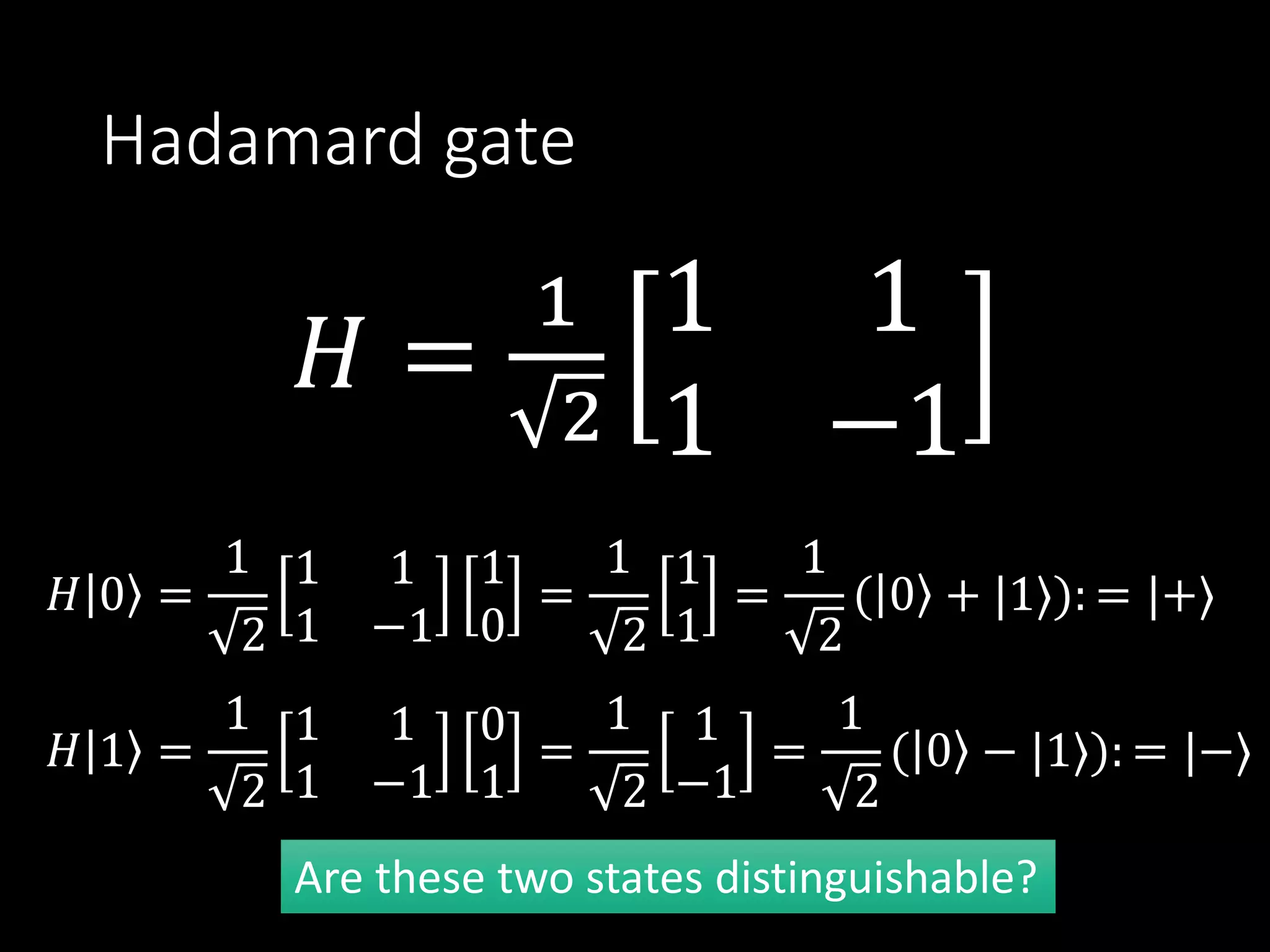
Are these two states distinguishable?
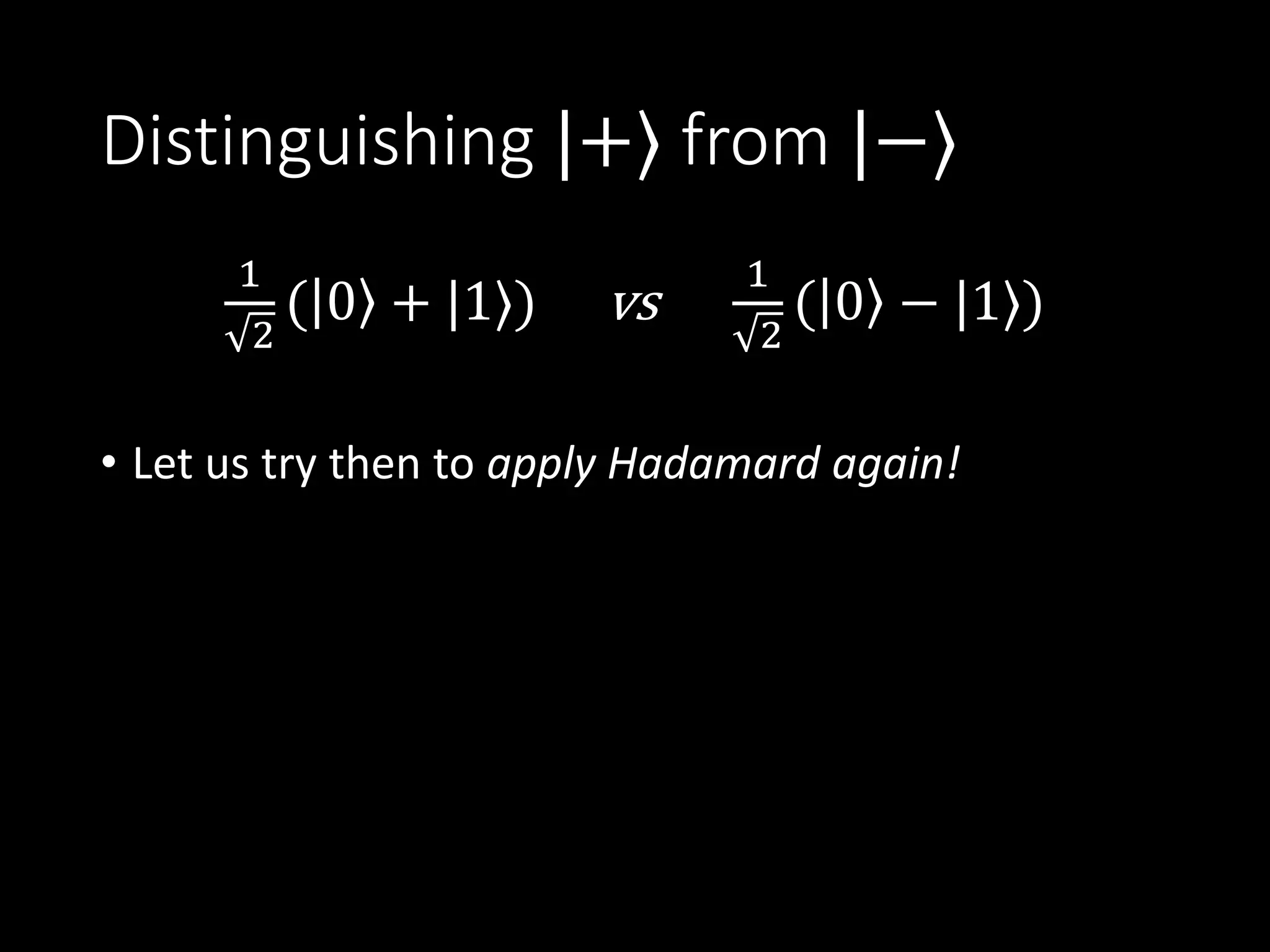
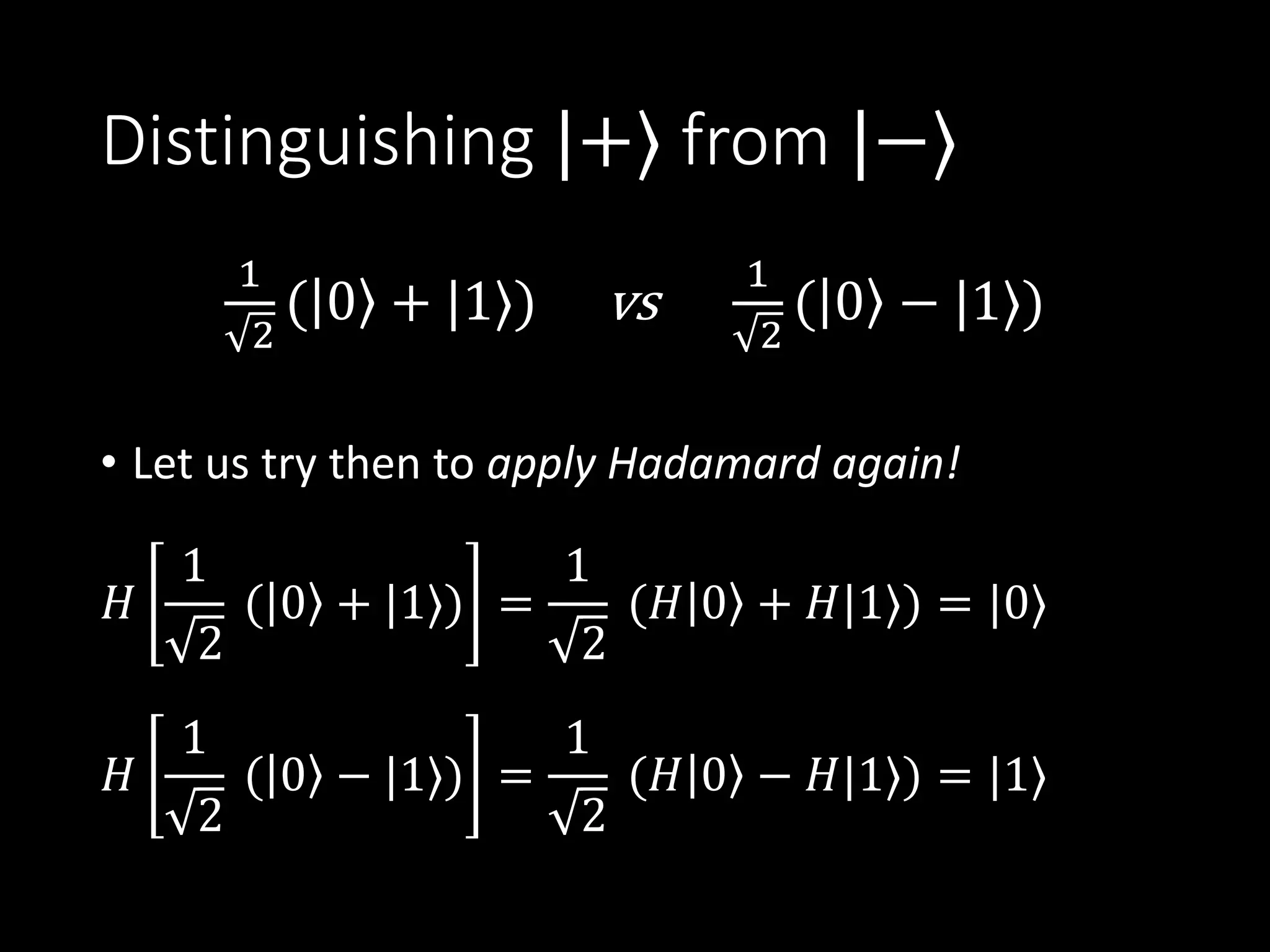
Distinguishing |+⟩ from |−⟩
1
2
( 0 + |1⟩) vs
1
2
( 0 − |1⟩)
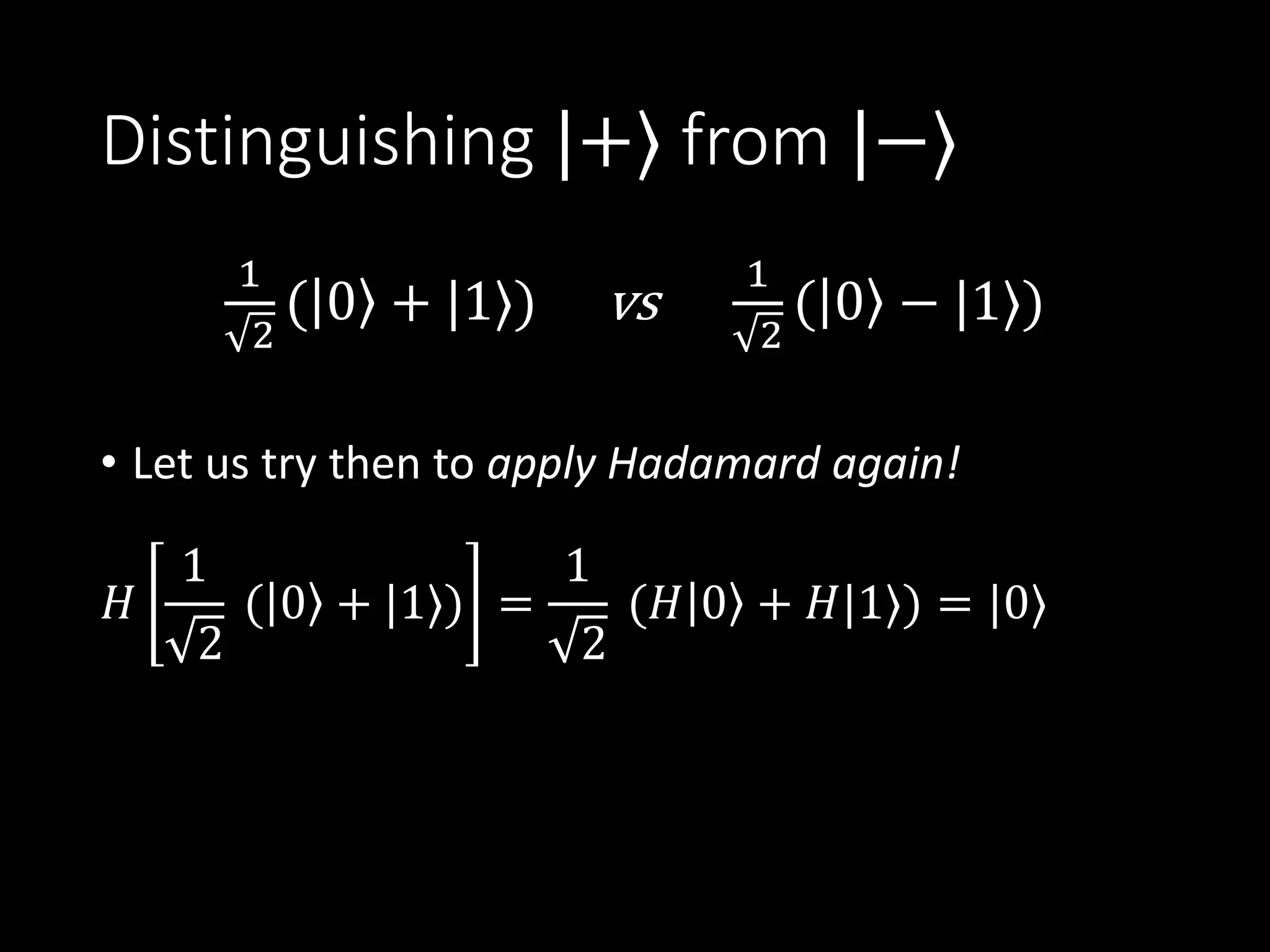
• Let us try then to apply Hadamard again!
𝐻
1
2
( 0 + |1⟩) =
1
2
(𝐻 0 + 𝐻|1⟩) = |0⟩
𝐻
1
2
( 0 − |1⟩) =
1
2
(𝐻 0 − 𝐻|1⟩) = |1⟩
INTERFERENCE!
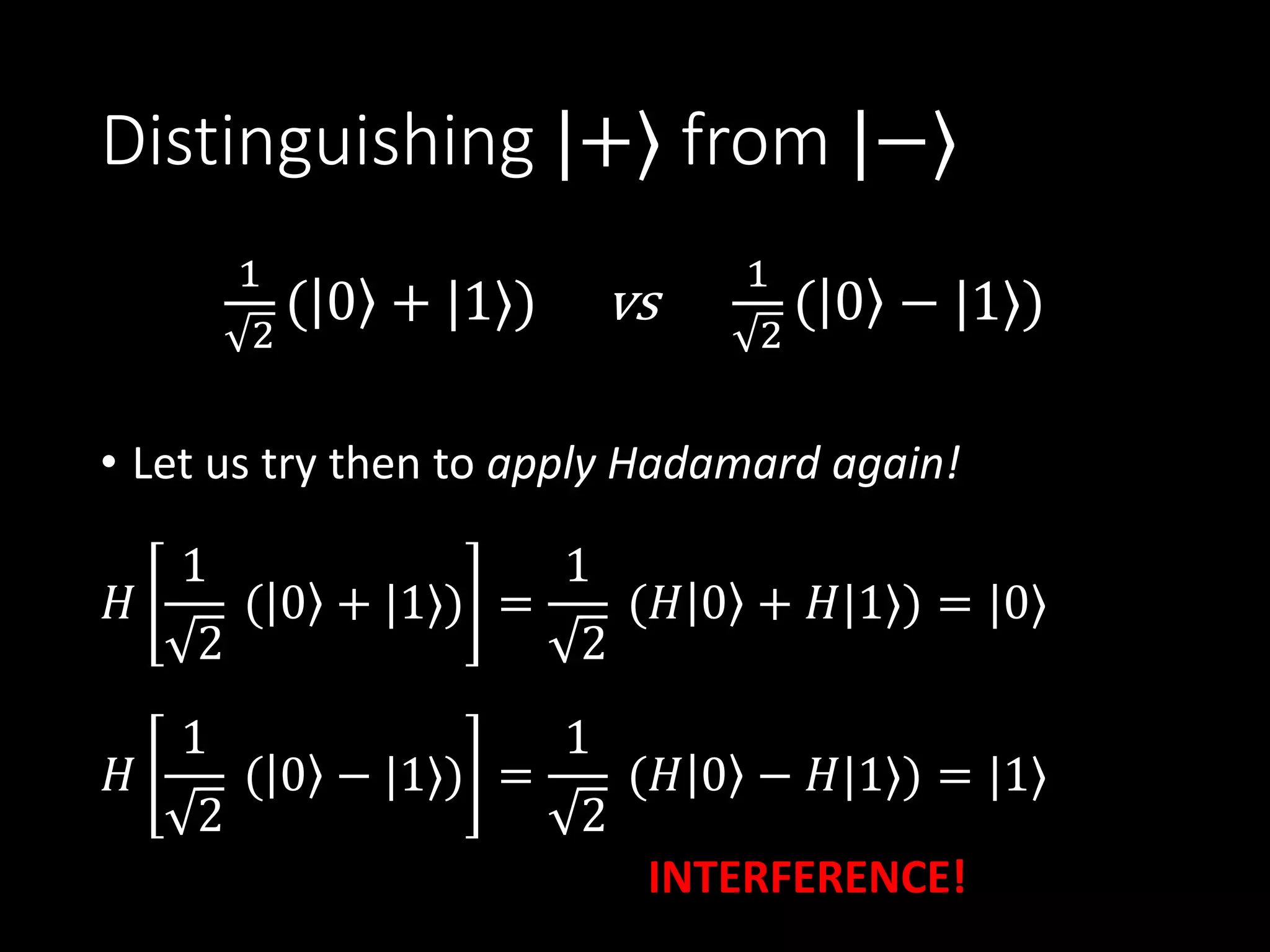
Distinguishing |+⟩ from |−⟩
1
2
( 0 + |1⟩) vs
1
2
( 0 − |1⟩)
• Let us try then to apply Hadamard again!
𝐻
1
2
( 0 + |1⟩) =
1
2
(𝐻 0 + 𝐻|1⟩) = |0⟩
𝐻
1
2
( 0 − |1⟩) =
1
2
(𝐻 0 − 𝐻|1⟩) = |1⟩
INTERFERENCE!
Distinguishing |+⟩ from |−⟩
1
2
( 0 + |1⟩) vs
1
2
( 0 − |1⟩)
• Let us try then to apply Hadamard again!
𝐻
1
2
( 0 + |1⟩) =
1
2
(𝐻 0 + 𝐻|1⟩) = |0⟩
𝐻
1
2
( 0 − |1⟩) =
1
2
(𝐻 0 − 𝐻|1⟩) = |1⟩
INTERFERENCE!
Distinguishing |+⟩ from |−⟩
1
2
( 0 + |1⟩) vs
1
2
( 0 − |1⟩)
• Let us try then to apply Hadamard again!
𝐻
1
2
( 0 + |1⟩) =
1
2
(𝐻 0 + 𝐻|1⟩) = |0⟩
𝐻
1
2
( 0 − |1⟩) =
1
2
(𝐻 0 − 𝐻|1⟩) = |1⟩
INTERFERENCE!
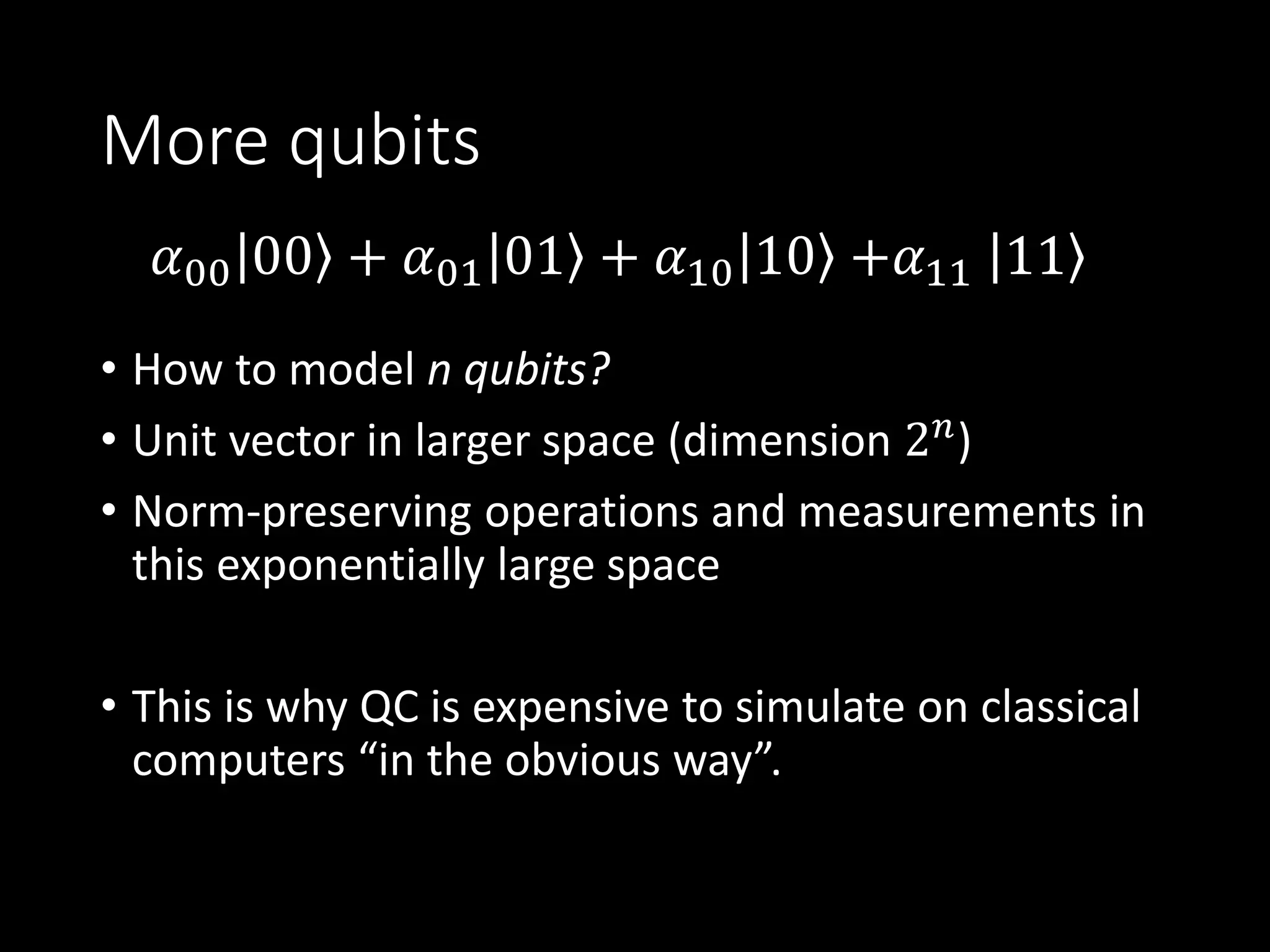
More qubits
• How to model n qubits?
• Unit vector in larger space (dimension 2 𝑛)
• Norm-preserving operations and measurements in
this exponentially large space
• This is why QC is expensive to simulate on classical
computers “in the obvious way”.
𝛼00 00 + 𝛼01 01 + 𝛼10 10 +𝛼11 11
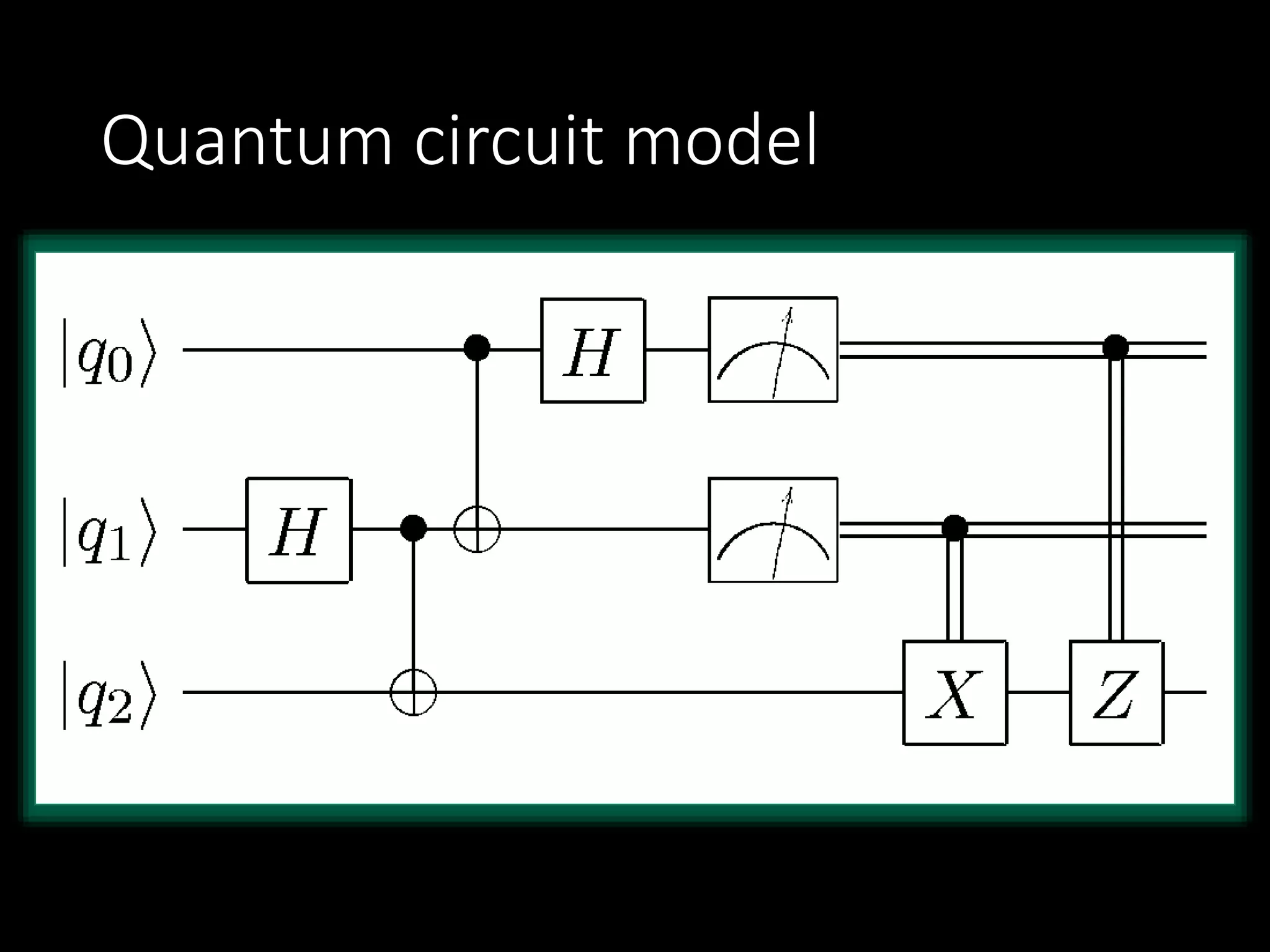
Quantum circuit model
Part II:
Are Quantum Computers
more powerful?
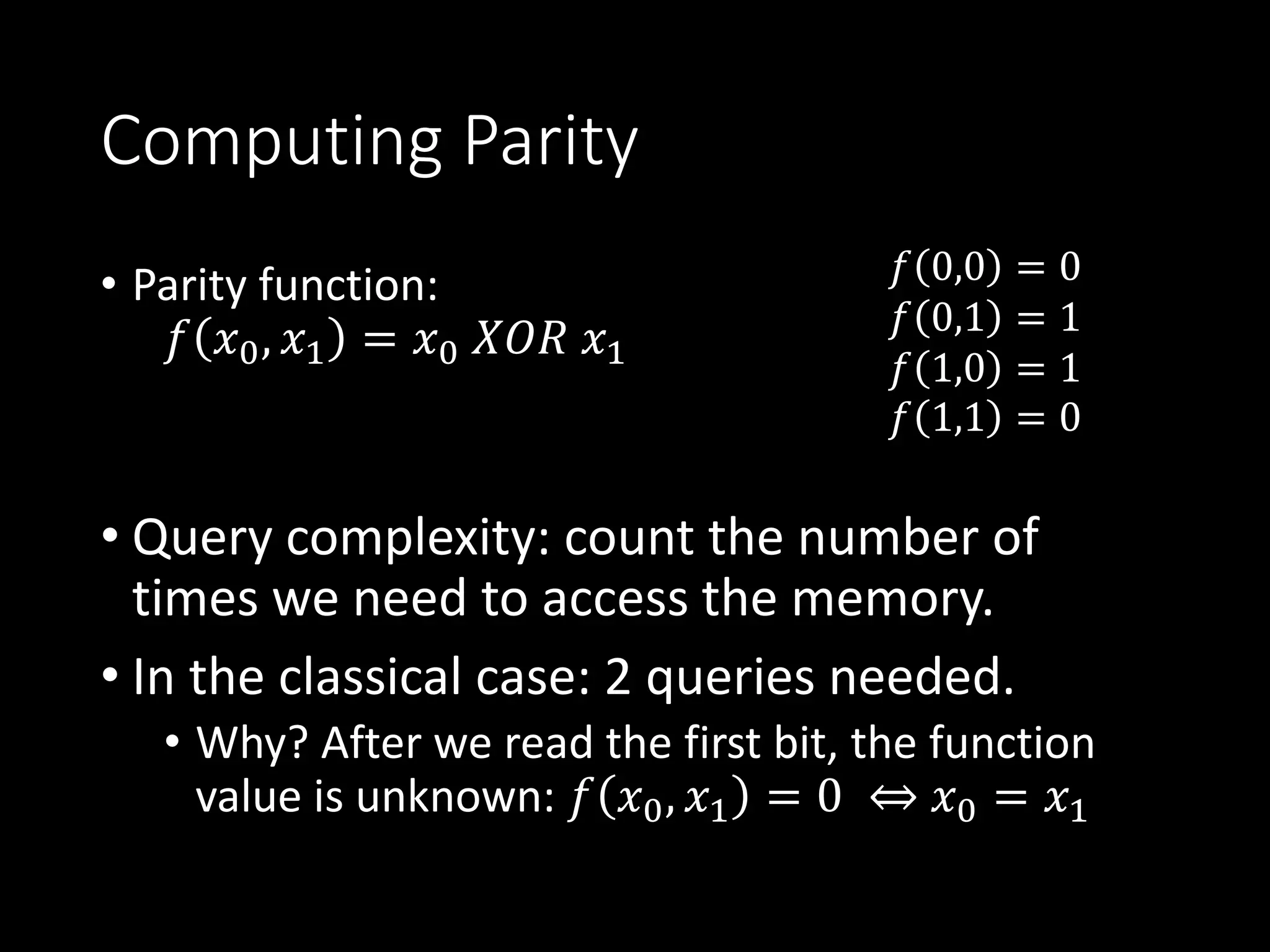
Computing Parity
• Parity function:
𝑓 𝑥0, 𝑥1 = 𝑥0 𝑋𝑂𝑅 𝑥1
• Query complexity: count the number of
times we need to access the memory.
• In the classical case: 2 queries needed.
• Why? After we read the first bit, the function
value is unknown: 𝑓 𝑥0, 𝑥1 = 0 ⇔ 𝑥0 = 𝑥1
𝑓 0,0 = 0
𝑓 0,1 = 1
𝑓 1,0 = 1
𝑓 1,1 = 0
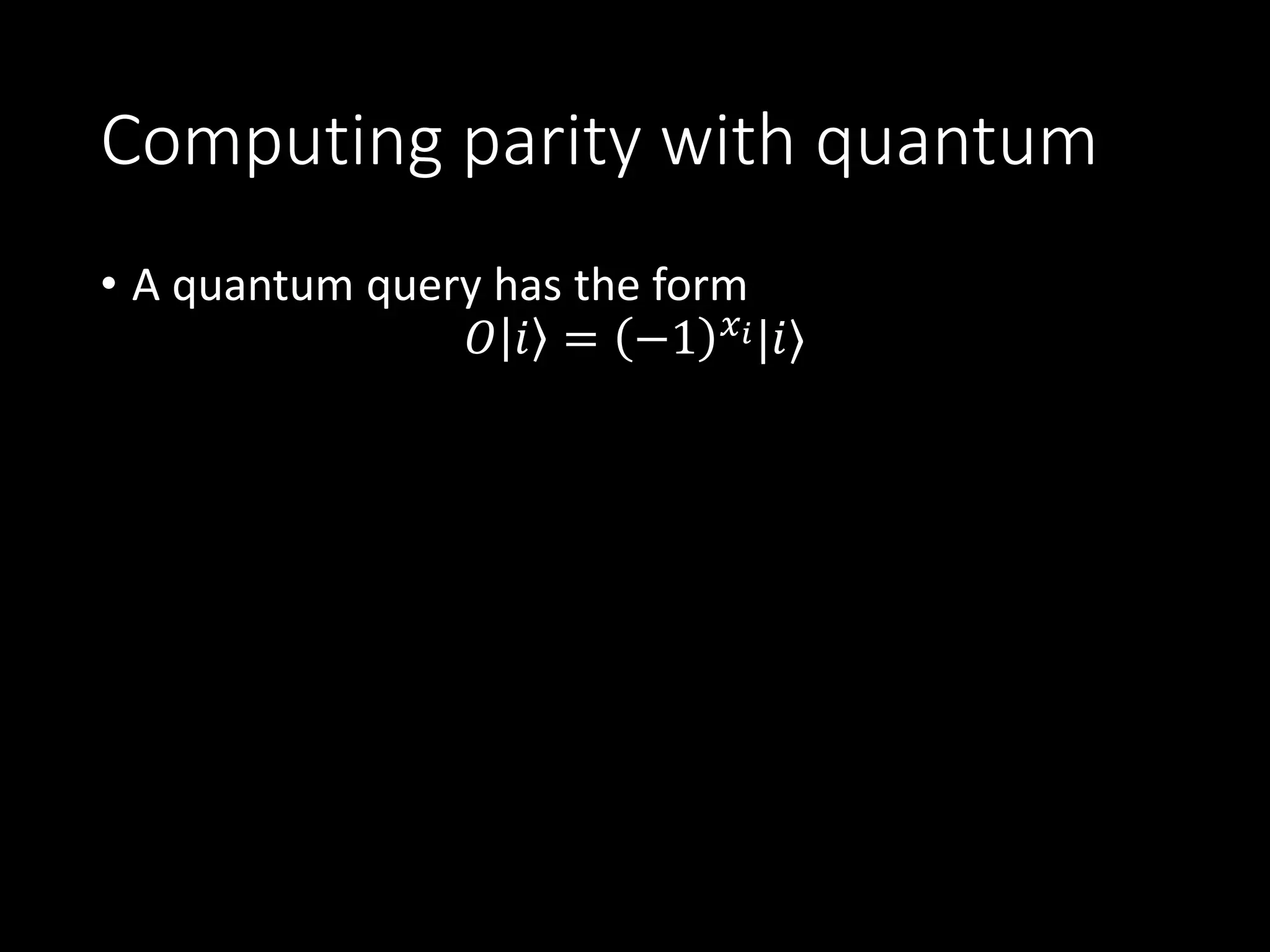
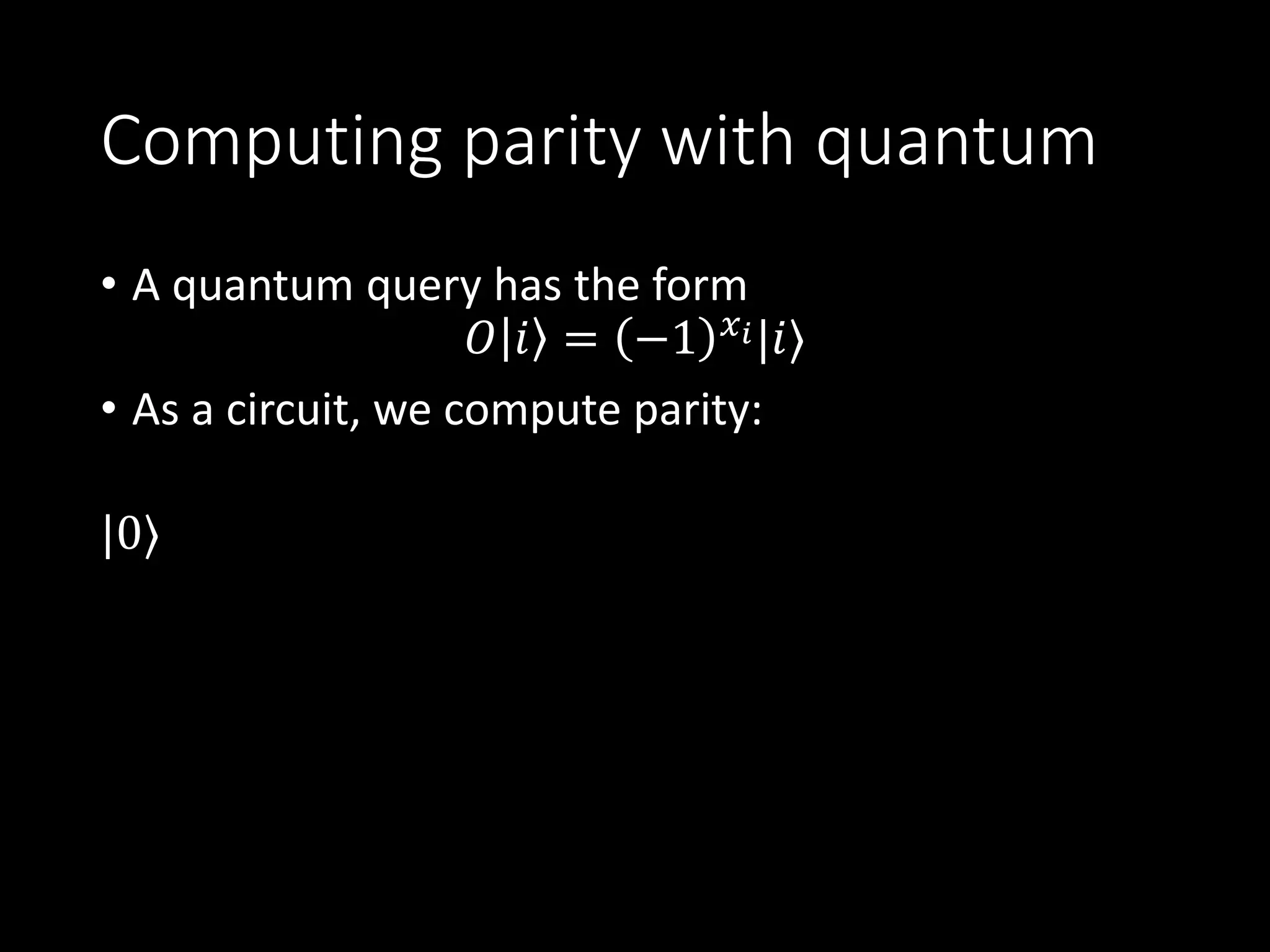
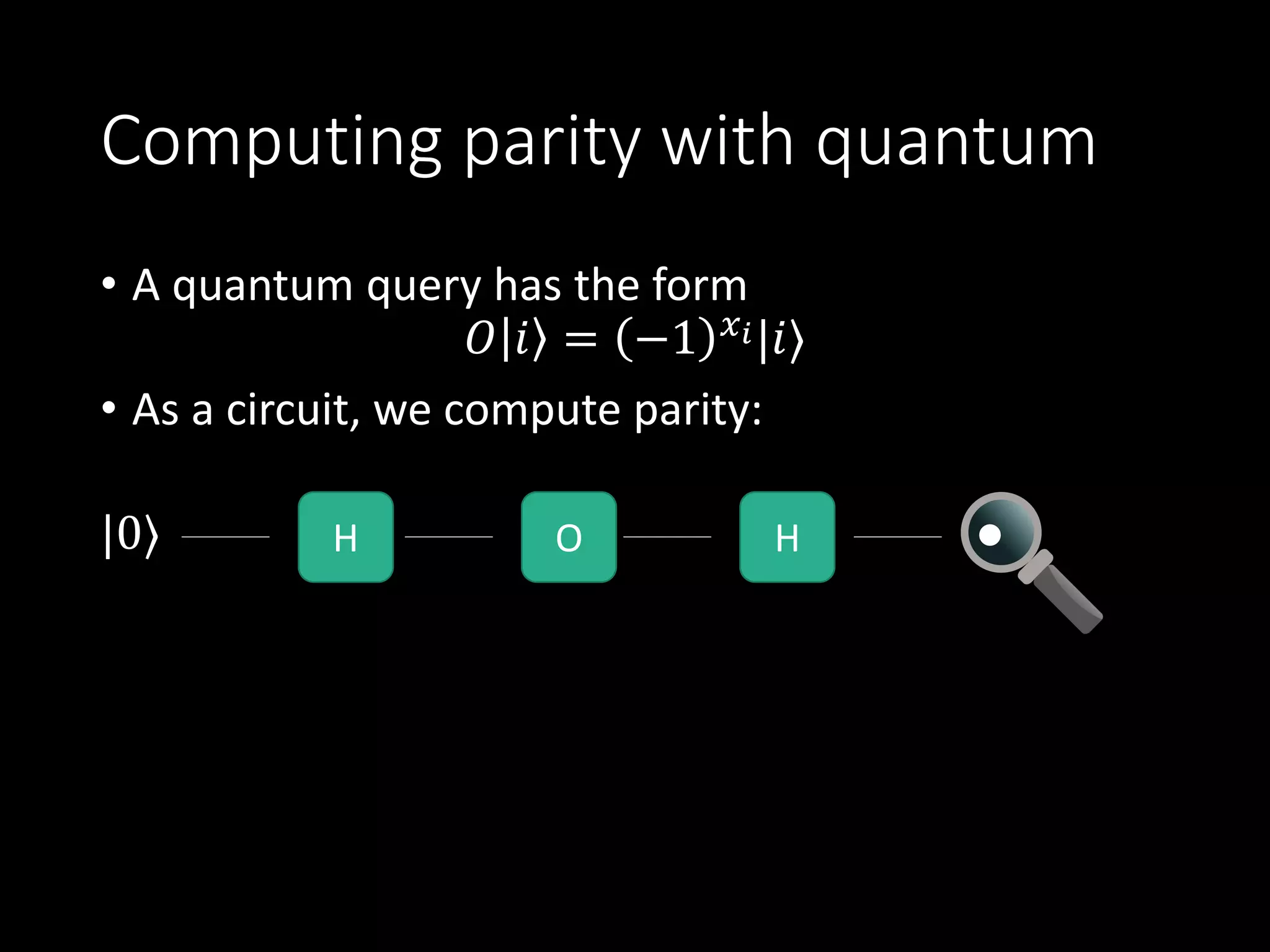
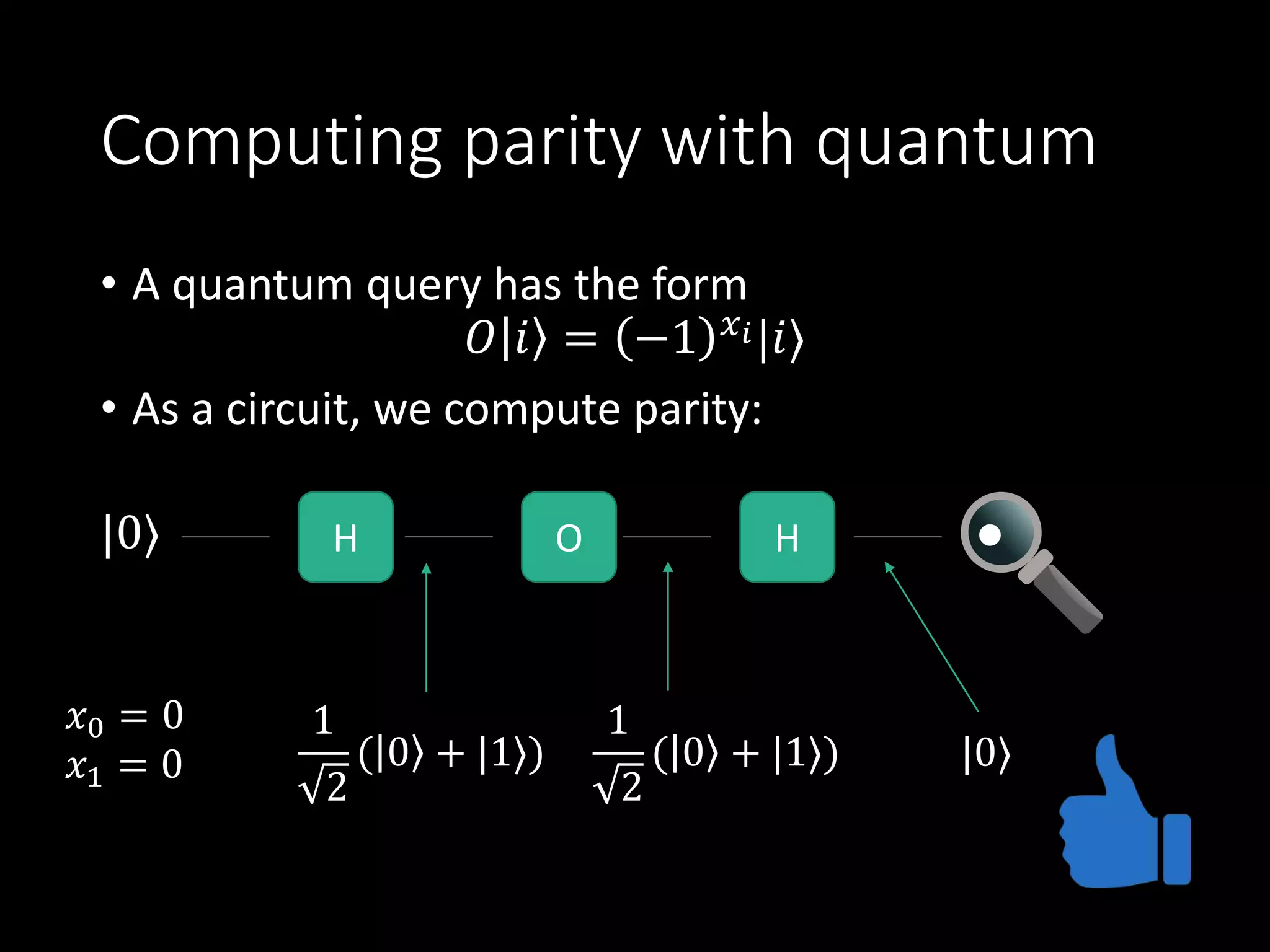
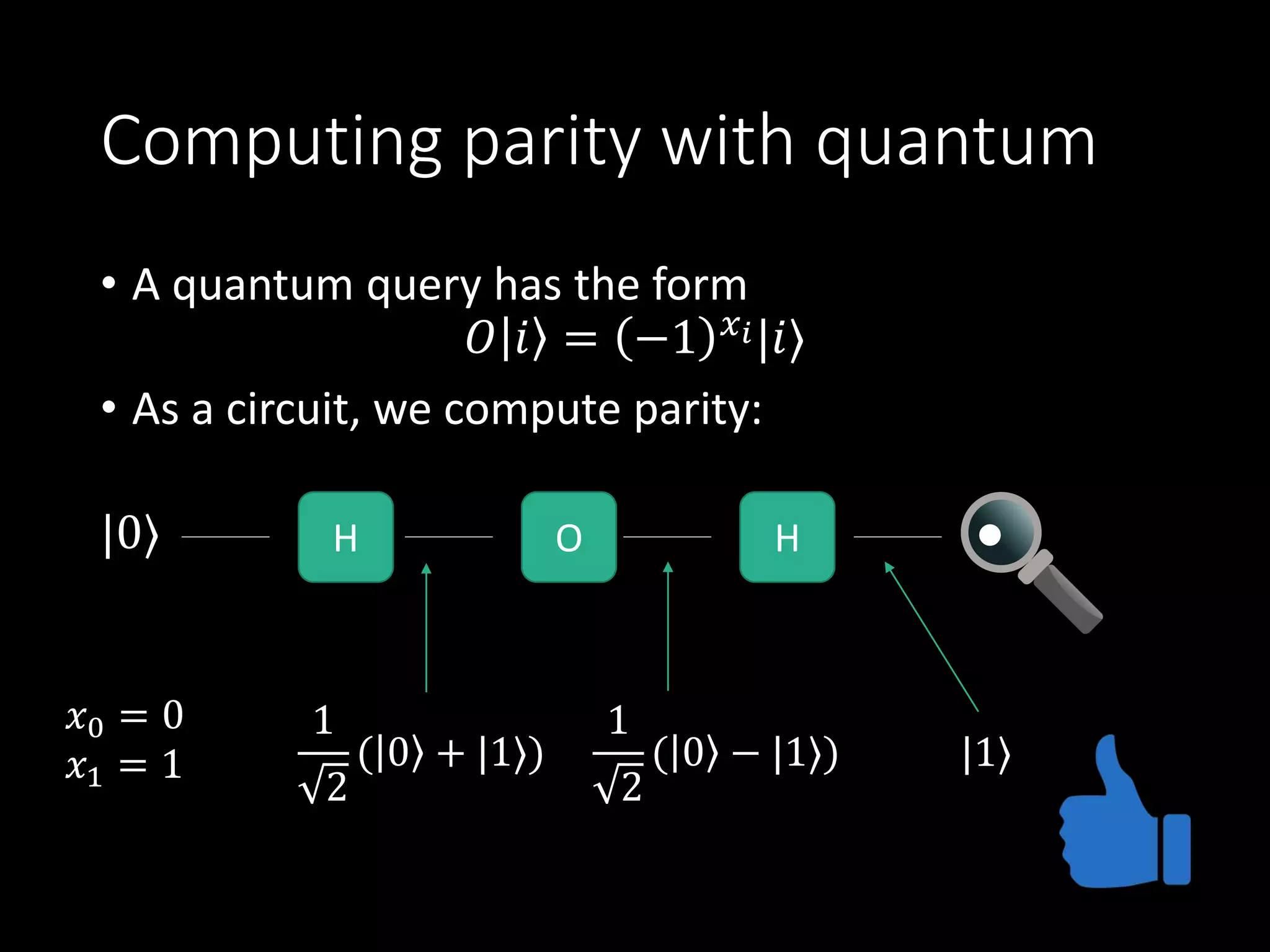
Computing parity with quantum
• A quantum query has the form
𝑂 𝑖 = −1 𝑥 𝑖|𝑖⟩
Computing parity with quantum
• A quantum query has the form
𝑂 𝑖 = −1 𝑥 𝑖|𝑖⟩
• As a circuit, we compute parity:
|0⟩
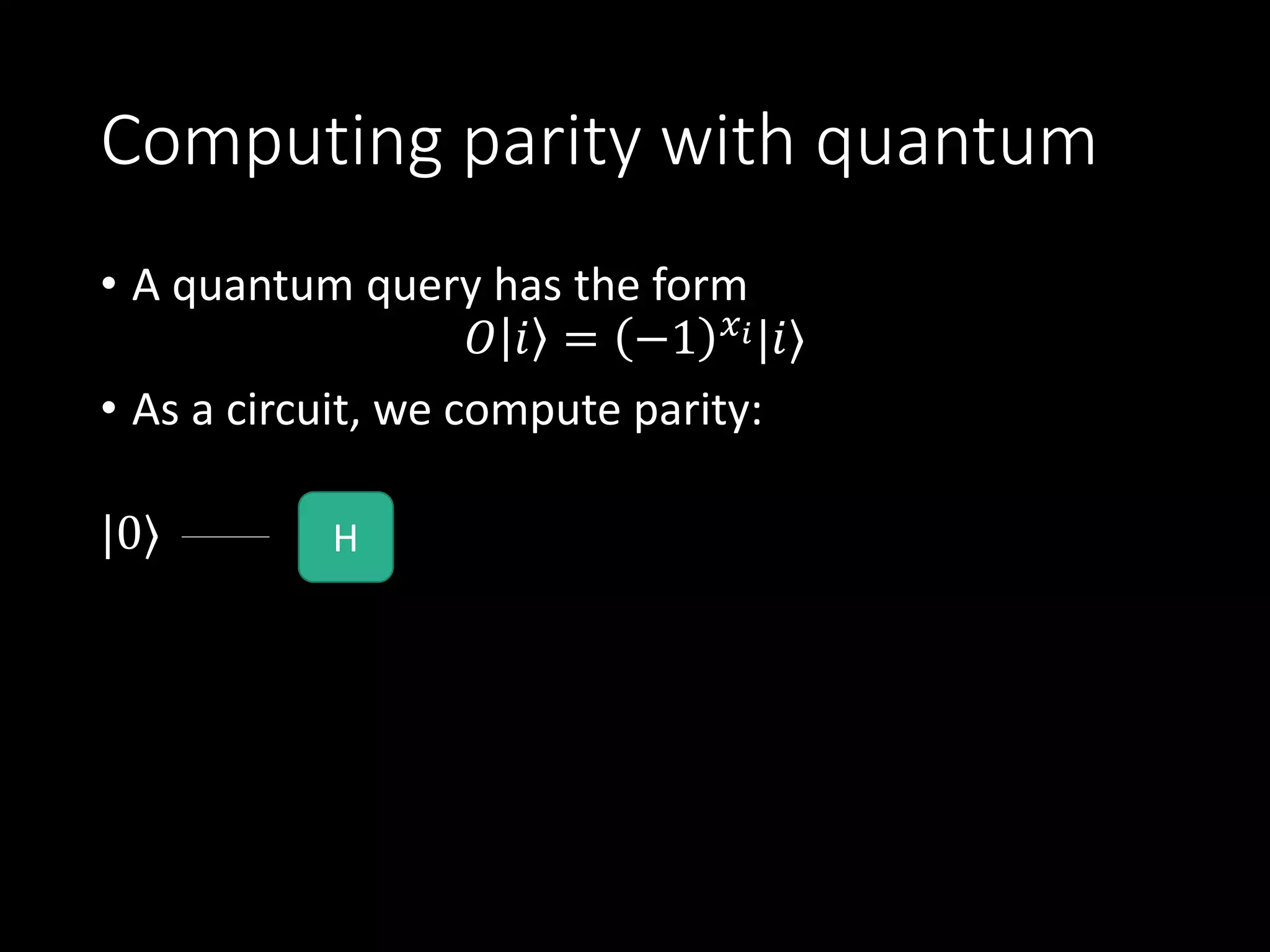
Computing parity with quantum
• A quantum query has the form
𝑂 𝑖 = −1 𝑥 𝑖|𝑖⟩
• As a circuit, we compute parity:
|0⟩ H
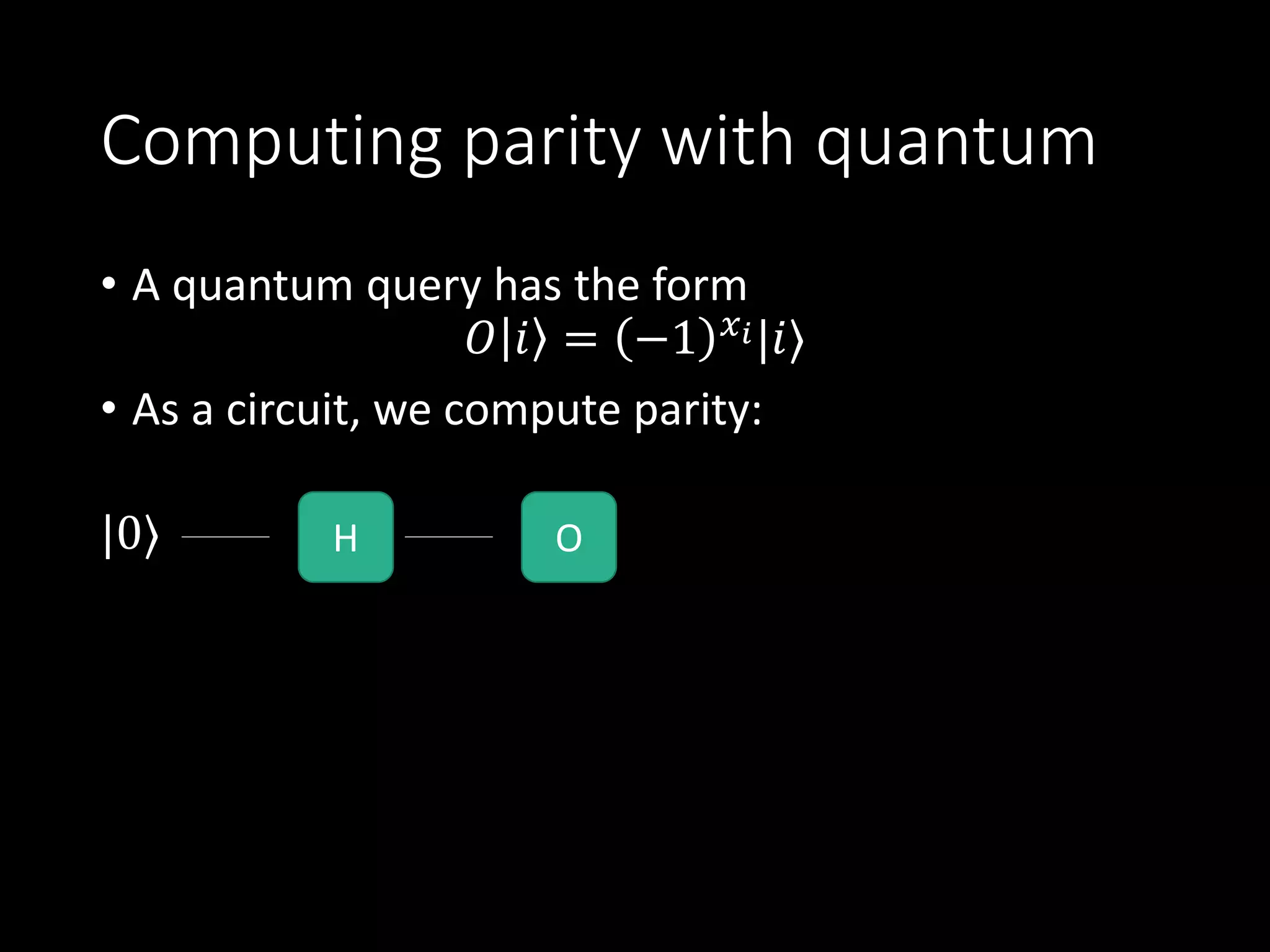
Computing parity with quantum
• A quantum query has the form
𝑂 𝑖 = −1 𝑥 𝑖|𝑖⟩
• As a circuit, we compute parity:
|0⟩ H O
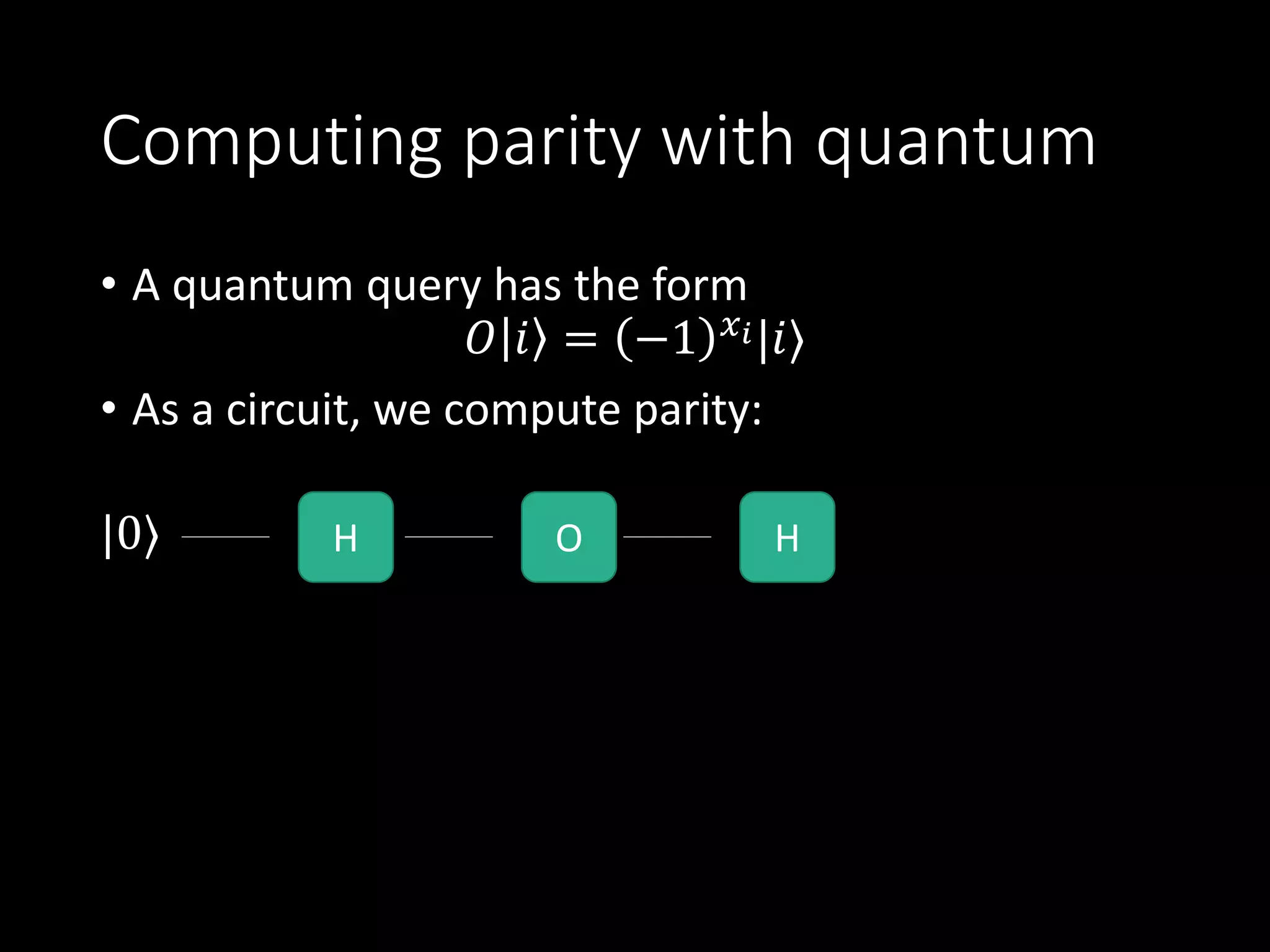
Computing parity with quantum
• A quantum query has the form
𝑂 𝑖 = −1 𝑥 𝑖|𝑖⟩
• As a circuit, we compute parity:
|0⟩ H O H
Computing parity with quantum
• A quantum query has the form
𝑂 𝑖 = −1 𝑥 𝑖|𝑖⟩
• As a circuit, we compute parity:
|0⟩ H O H
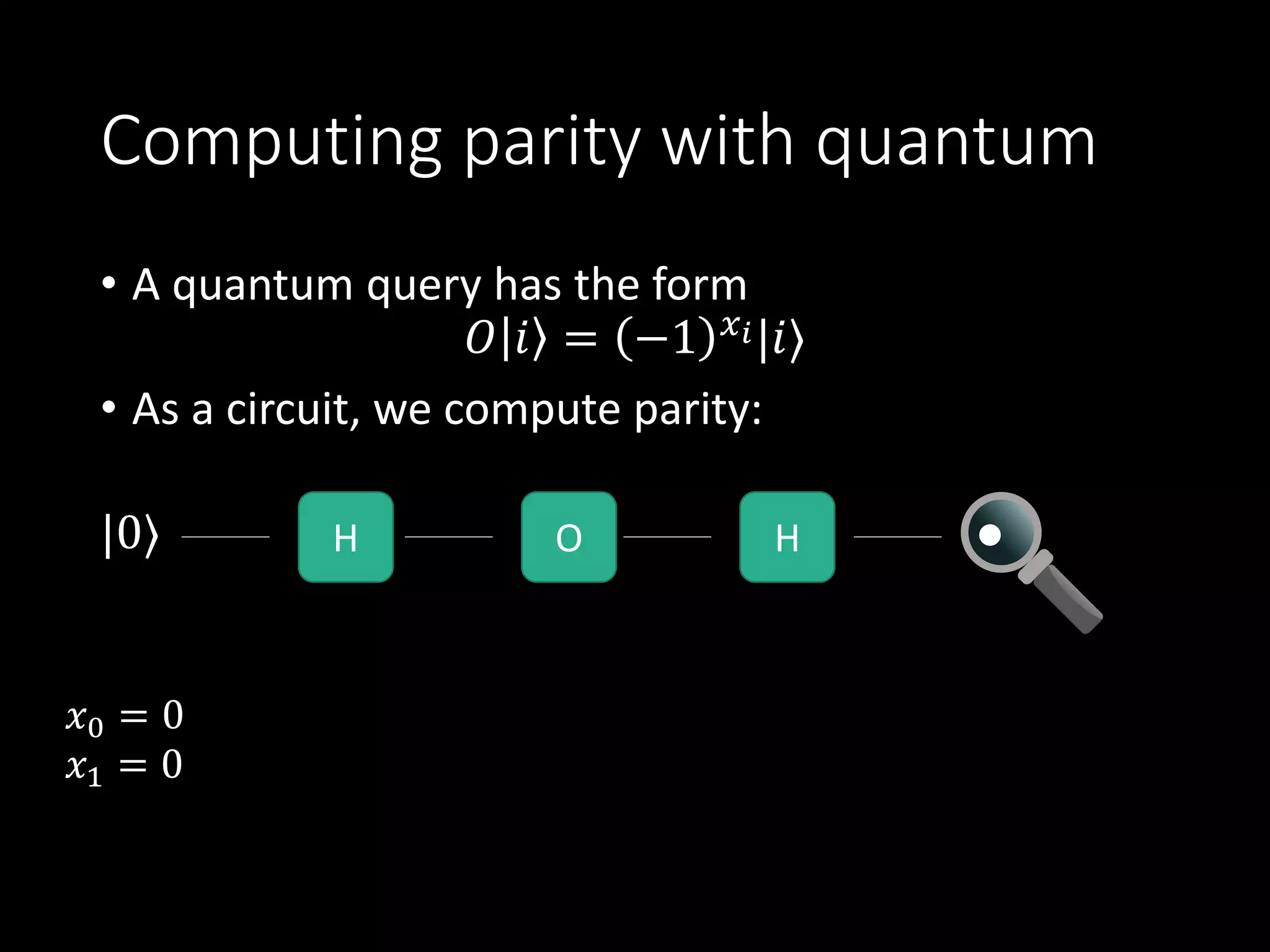
Computing parity with quantum
• A quantum query has the form
𝑂 𝑖 = −1 𝑥 𝑖|𝑖⟩
• As a circuit, we compute parity:
|0⟩ H O H
𝑥0 = 0
𝑥1 = 0
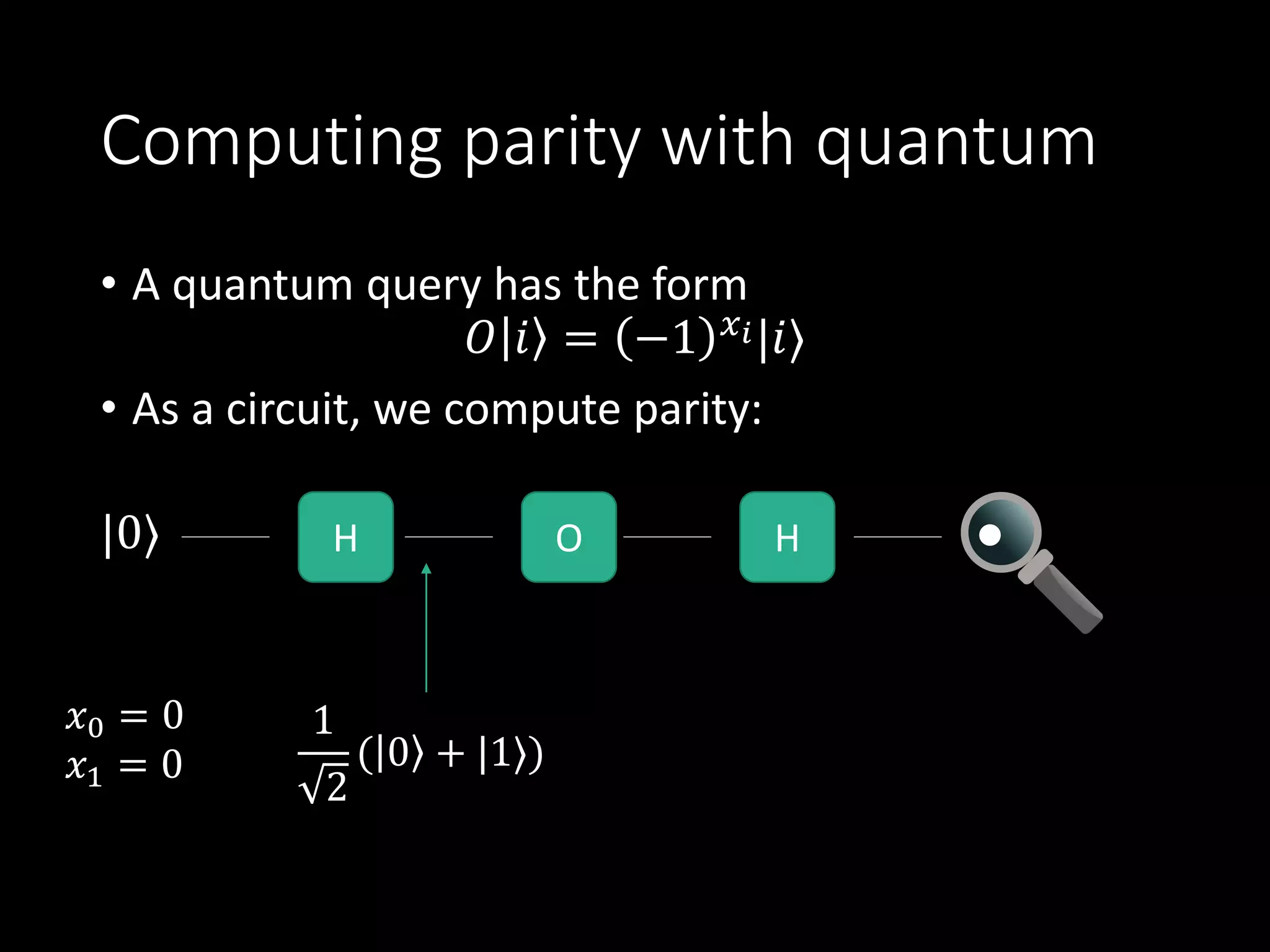
Computing parity with quantum
• A quantum query has the form
𝑂 𝑖 = −1 𝑥 𝑖|𝑖⟩
• As a circuit, we compute parity:
|0⟩ H O H
𝑥0 = 0
𝑥1 = 0
1
2
( 0 + |1⟩)
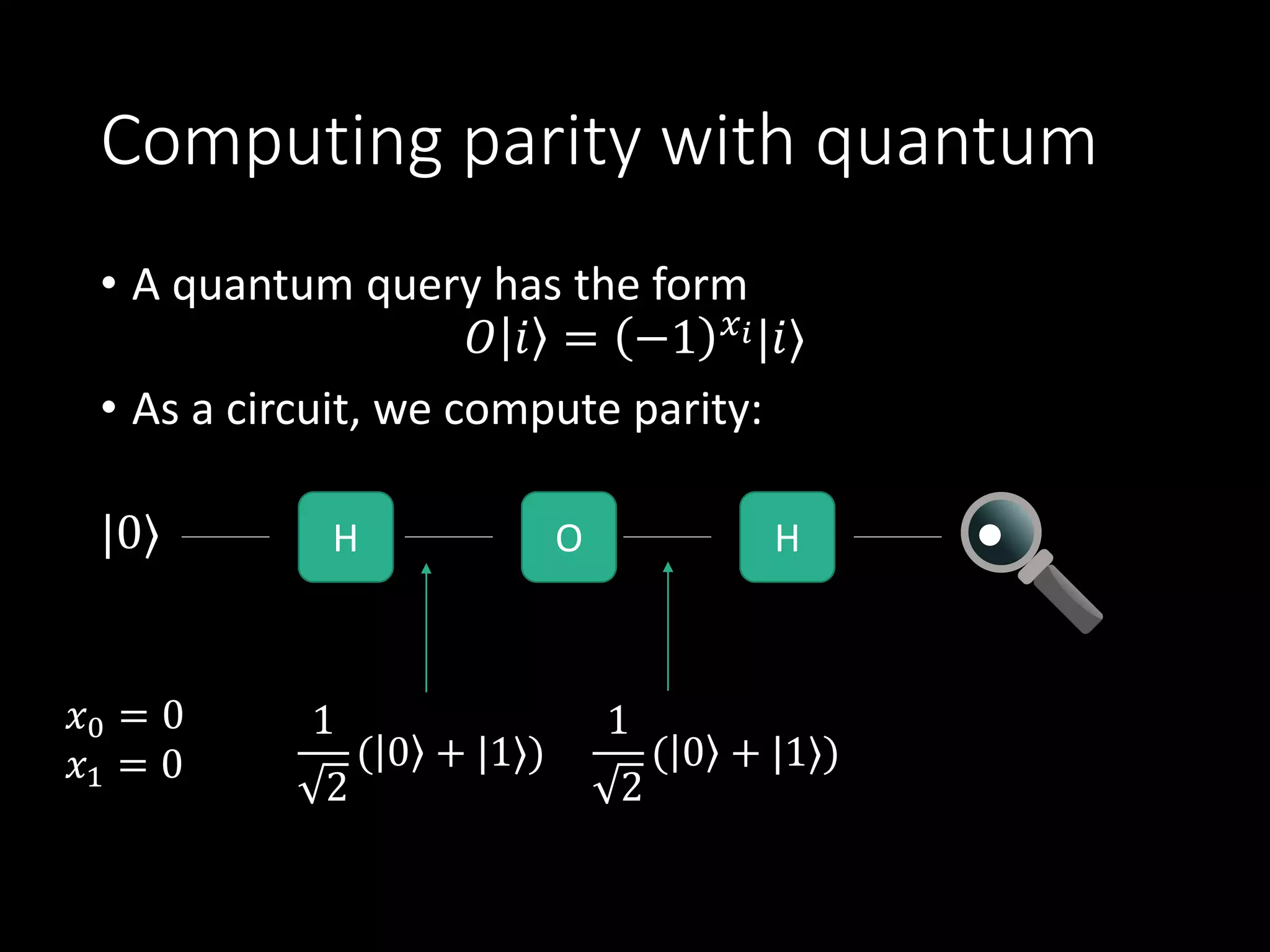
Computing parity with quantum
• A quantum query has the form
𝑂 𝑖 = −1 𝑥 𝑖|𝑖⟩
• As a circuit, we compute parity:
|0⟩ H O H
𝑥0 = 0
𝑥1 = 0
1
2
( 0 + |1⟩)
1
2
( 0 + |1⟩)
Computing parity with quantum
• A quantum query has the form
𝑂 𝑖 = −1 𝑥 𝑖|𝑖⟩
• As a circuit, we compute parity:
|0⟩ H O H
𝑥0 = 0
𝑥1 = 0
1
2
( 0 + |1⟩)
1
2
( 0 + |1⟩) |0⟩
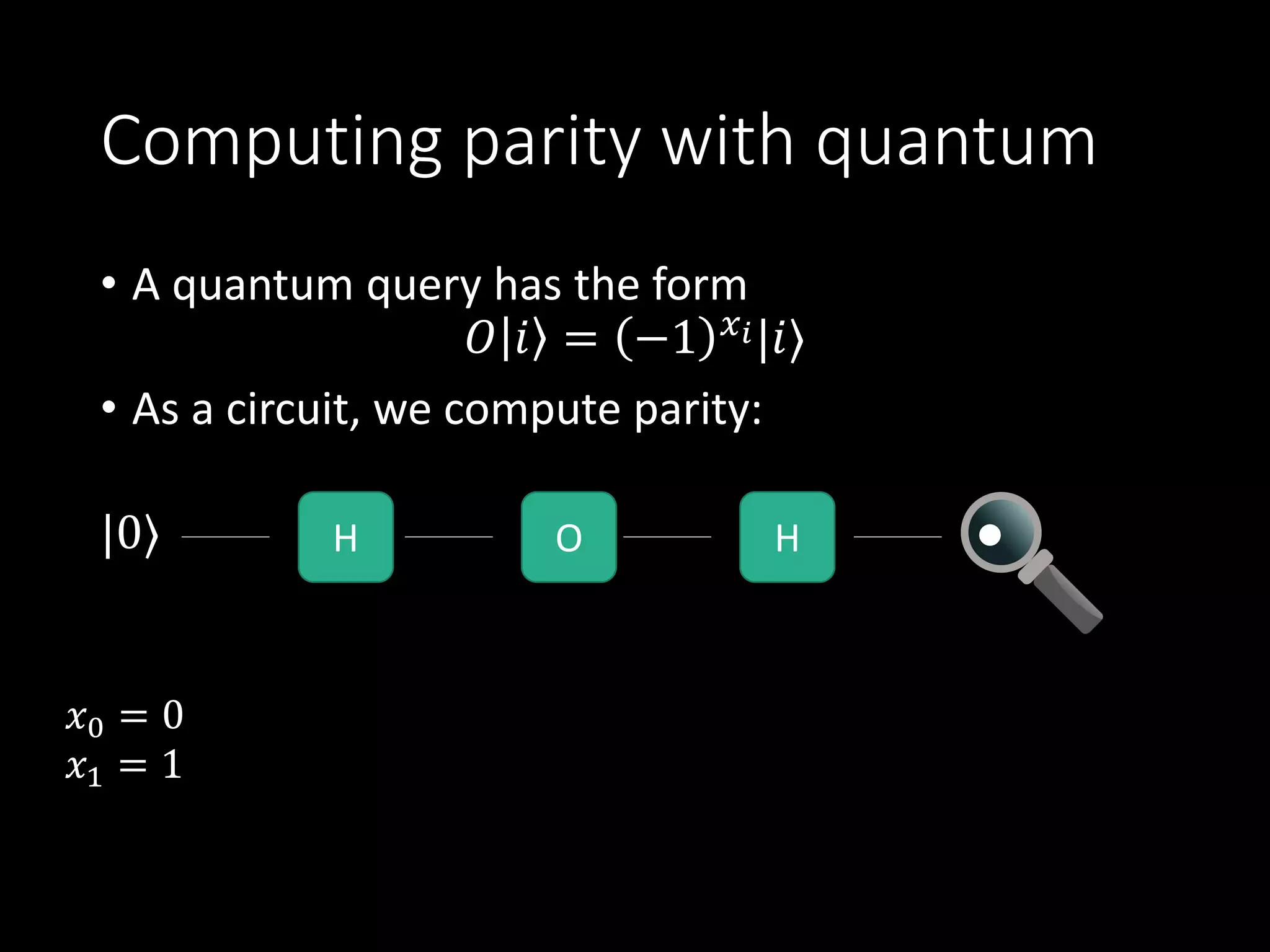
Computing parity with quantum
• A quantum query has the form
𝑂 𝑖 = −1 𝑥 𝑖|𝑖⟩
• As a circuit, we compute parity:
|0⟩ H O H
𝑥0 = 0
𝑥1 = 1
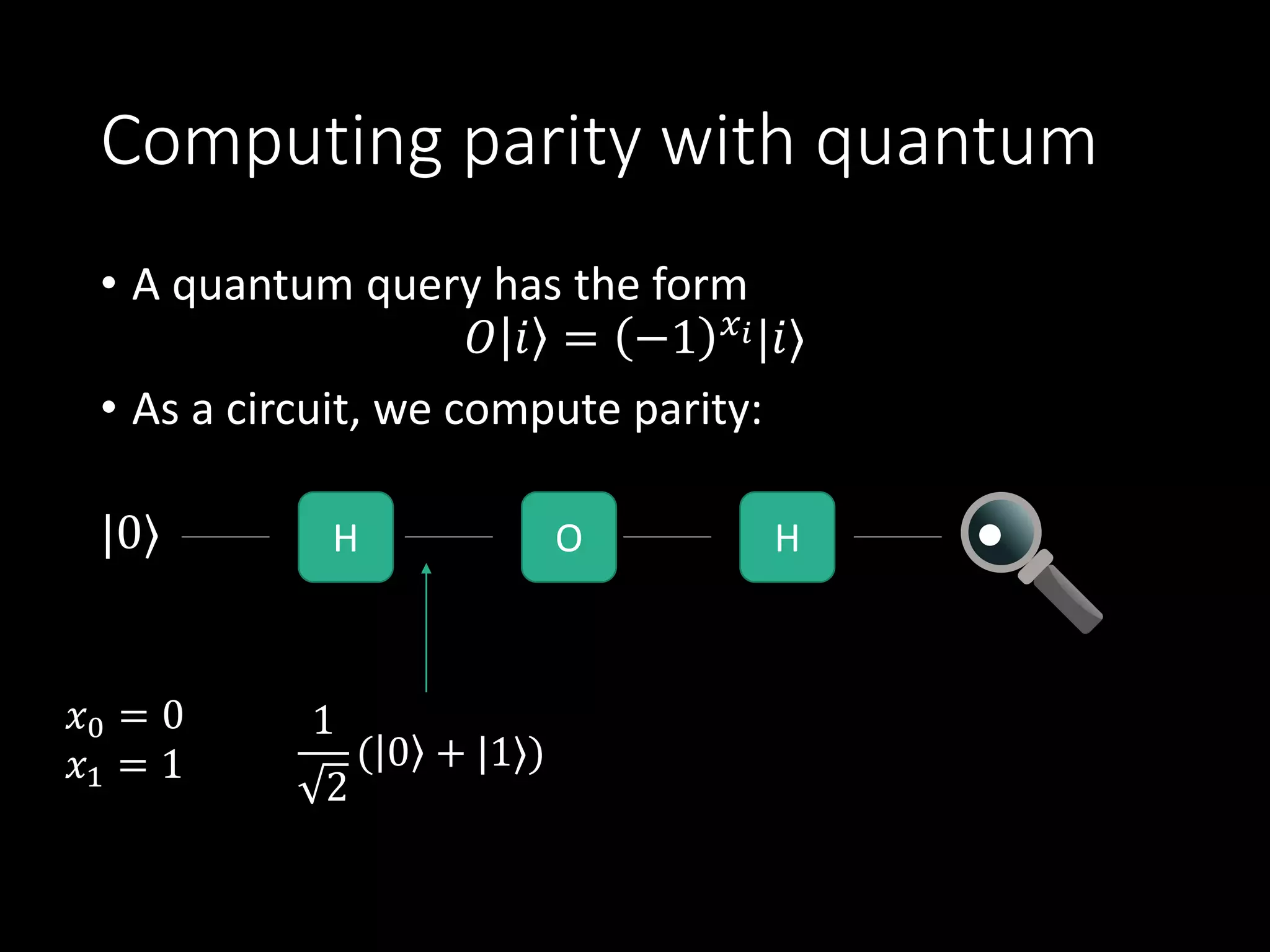
Computing parity with quantum
• A quantum query has the form
𝑂 𝑖 = −1 𝑥 𝑖|𝑖⟩
• As a circuit, we compute parity:
|0⟩ H O H
𝑥0 = 0
𝑥1 = 1
1
2
( 0 + |1⟩)
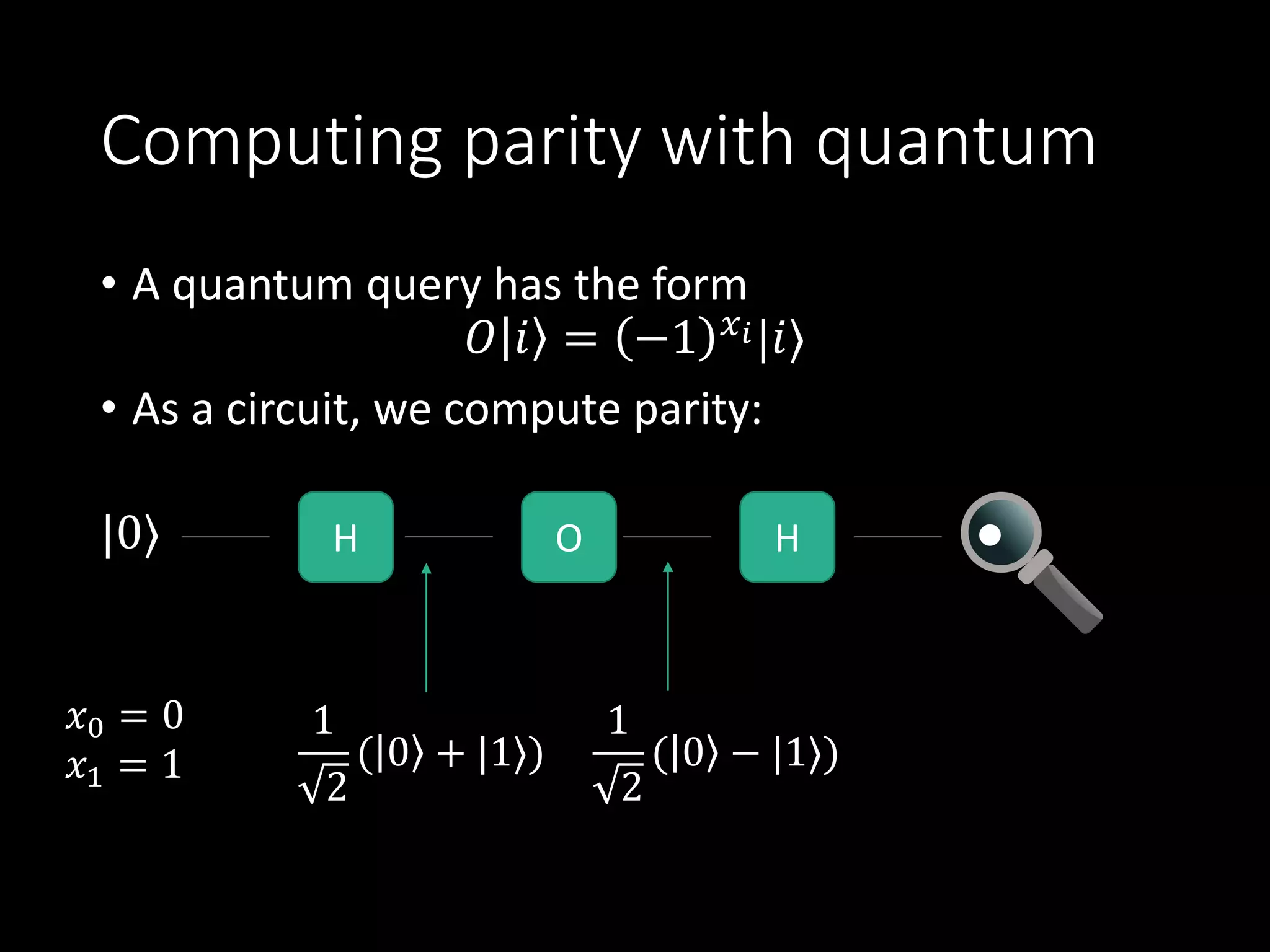
Computing parity with quantum
• A quantum query has the form
𝑂 𝑖 = −1 𝑥 𝑖|𝑖⟩
• As a circuit, we compute parity:
|0⟩ H O H
𝑥0 = 0
𝑥1 = 1
1
2
( 0 + |1⟩)
1
2
( 0 − |1⟩)
Computing parity with quantum
• A quantum query has the form
𝑂 𝑖 = −1 𝑥 𝑖|𝑖⟩
• As a circuit, we compute parity:
|0⟩ H O H
𝑥0 = 0
𝑥1 = 1
1
2
( 0 + |1⟩)
1
2
( 0 − |1⟩) |1⟩
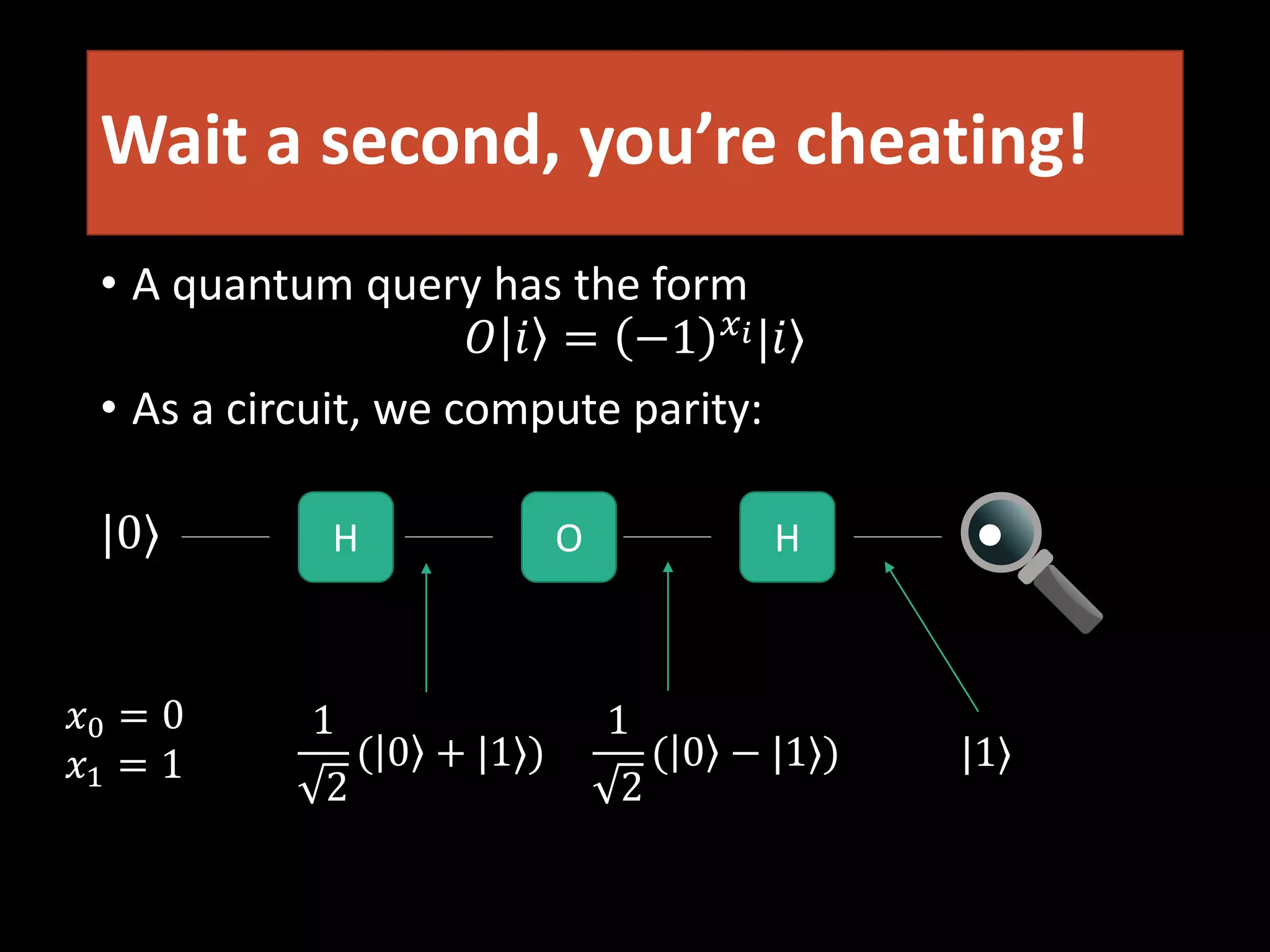
Wait a second, you’re cheating!
• A quantum query has the form
𝑂 𝑖 = −1 𝑥 𝑖|𝑖⟩
• As a circuit, we compute parity:
|0⟩ H O H
𝑥0 = 0
𝑥1 = 1
1
2
( 0 + |1⟩)
1
2
( 0 − |1⟩) |1⟩
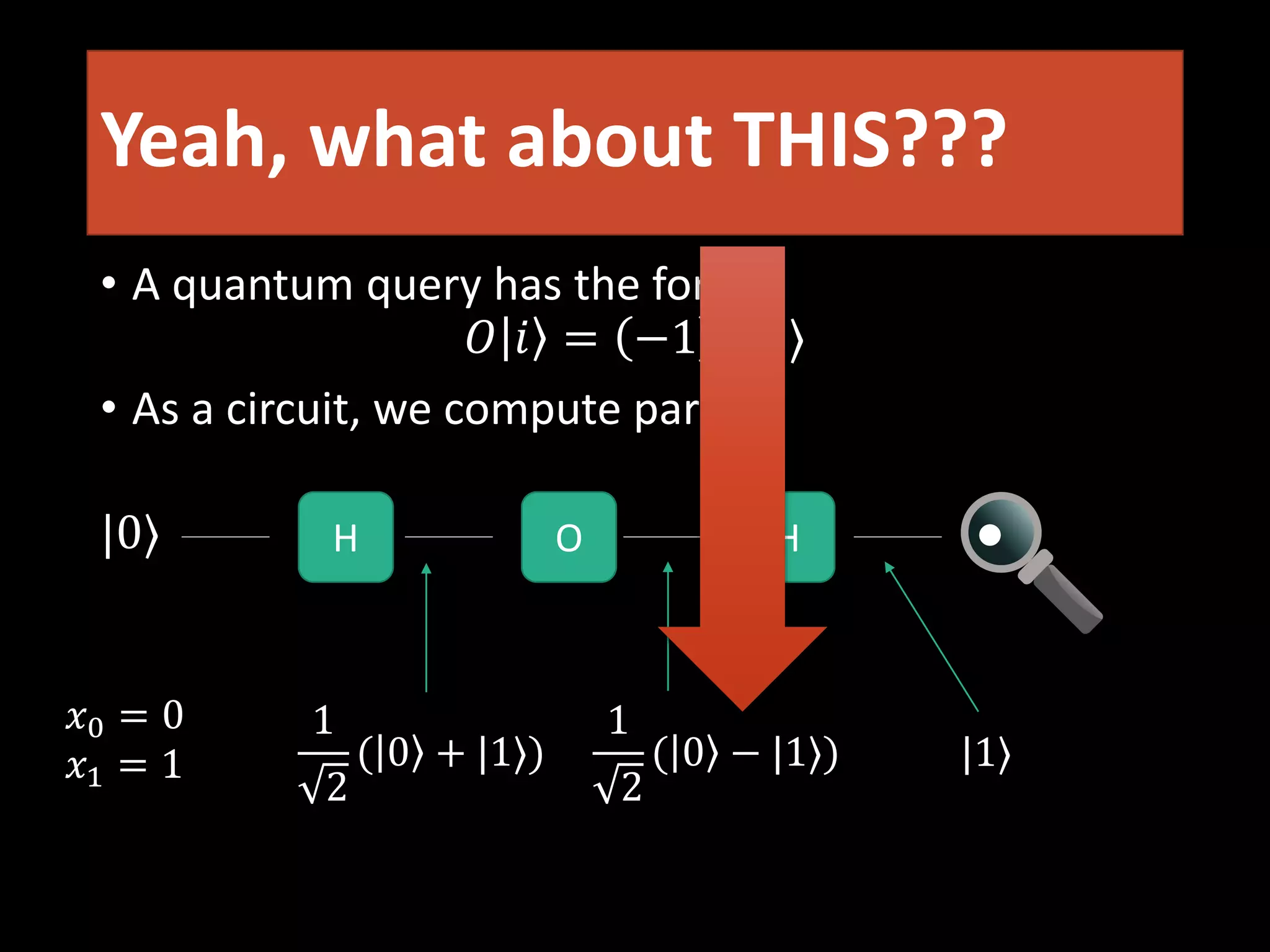
Yeah, what about THIS???
• A quantum query has the form
𝑂 𝑖 = −1 𝑥 𝑖|𝑖⟩
• As a circuit, we compute parity:
|0⟩ H O H
𝑥0 = 0
𝑥1 = 1
1
2
( 0 + |1⟩)
1
2
( 0 − |1⟩) |1⟩
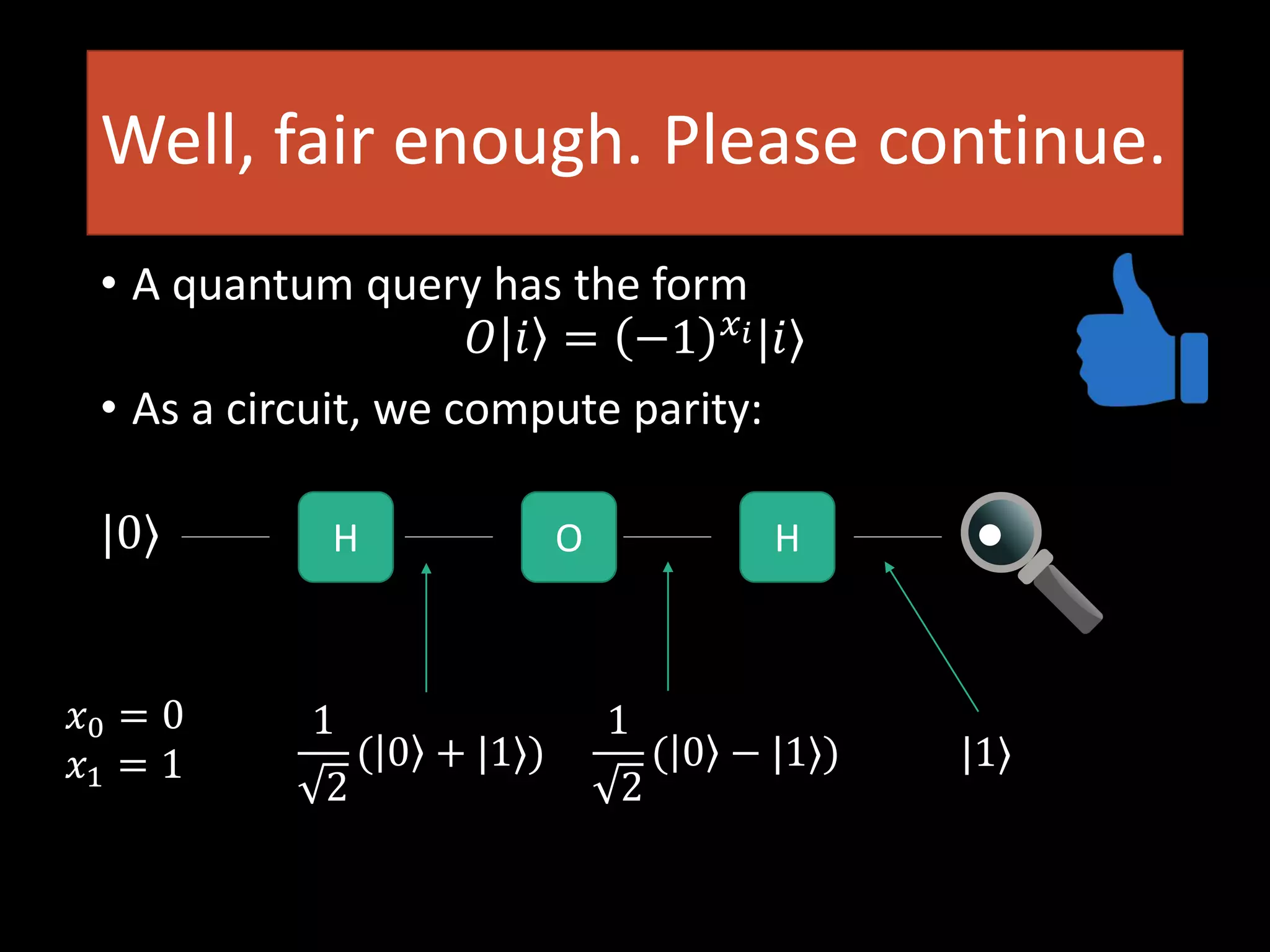
Well, fair enough. Please continue.
• A quantum query has the form
𝑂 𝑖 = −1 𝑥 𝑖|𝑖⟩
• As a circuit, we compute parity:
|0⟩ H O H
𝑥0 = 0
𝑥1 = 1
1
2
( 0 + |1⟩)
1
2
( 0 − |1⟩) |1⟩
Quantum parallelism
• Quantum computers are able to calculate an
exponential number of computations at once.
• Any classical program can be encoded in a quantum
circuit 𝐶 that maps 𝑥 0 ↦ 𝑥 |𝑓 𝑥 ⟩
• Many inputs cane be given in superposition:
𝐶
𝑥
𝛼 𝑥 𝑥 |0⟩ =
𝑥
𝛼 𝑥 𝑥 |𝑓(𝑥)⟩
• Problem: measure collapses to a random 𝑥, 𝑓 𝑥 …
Quantum parallelism
• Quantum computers are able to calculate an
exponential number of computations at once.
• Any classical program can be encoded in a quantum
circuit 𝐶 that maps 𝑥 0 ↦ 𝑥 |𝑓 𝑥 ⟩
• Many inputs cane be given in superposition:
𝐶
𝑥
𝛼 𝑥 𝑥 |0⟩ =
𝑥
𝛼 𝑥 𝑥 |𝑓(𝑥)⟩
• Problem: measure collapses to a random 𝑥, 𝑓 𝑥 …
• Again: QC is the art of using this hidden information
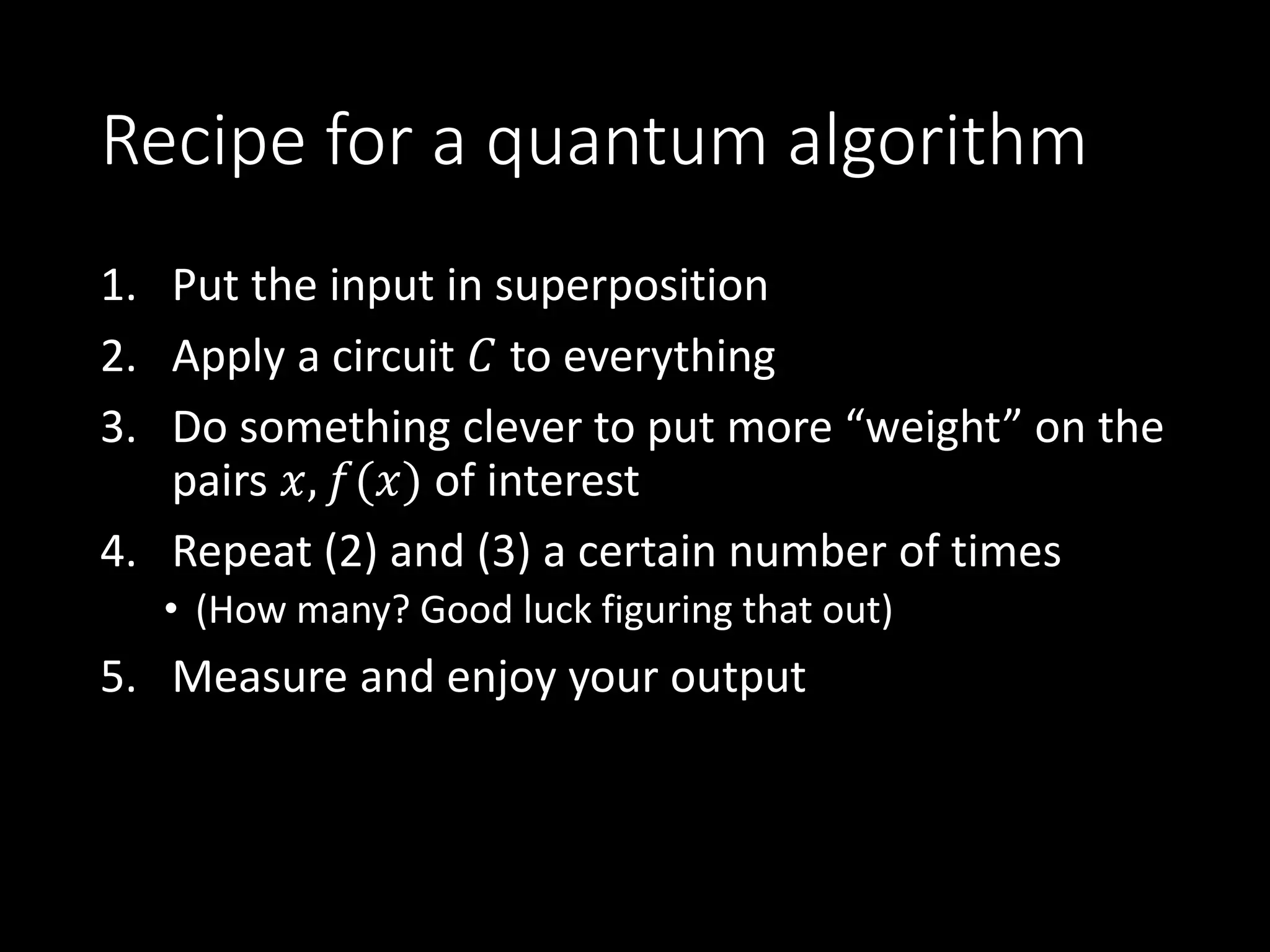
Recipe for a quantum algorithm
1. Put the input in superposition
2. Apply a circuit 𝐶 to everything
3. Do something clever to put more “weight” on the
pairs 𝑥, 𝑓(𝑥) of interest
4. Repeat (2) and (3) a certain number of times
• (How many? Good luck figuring that out)
5. Measure and enjoy your output
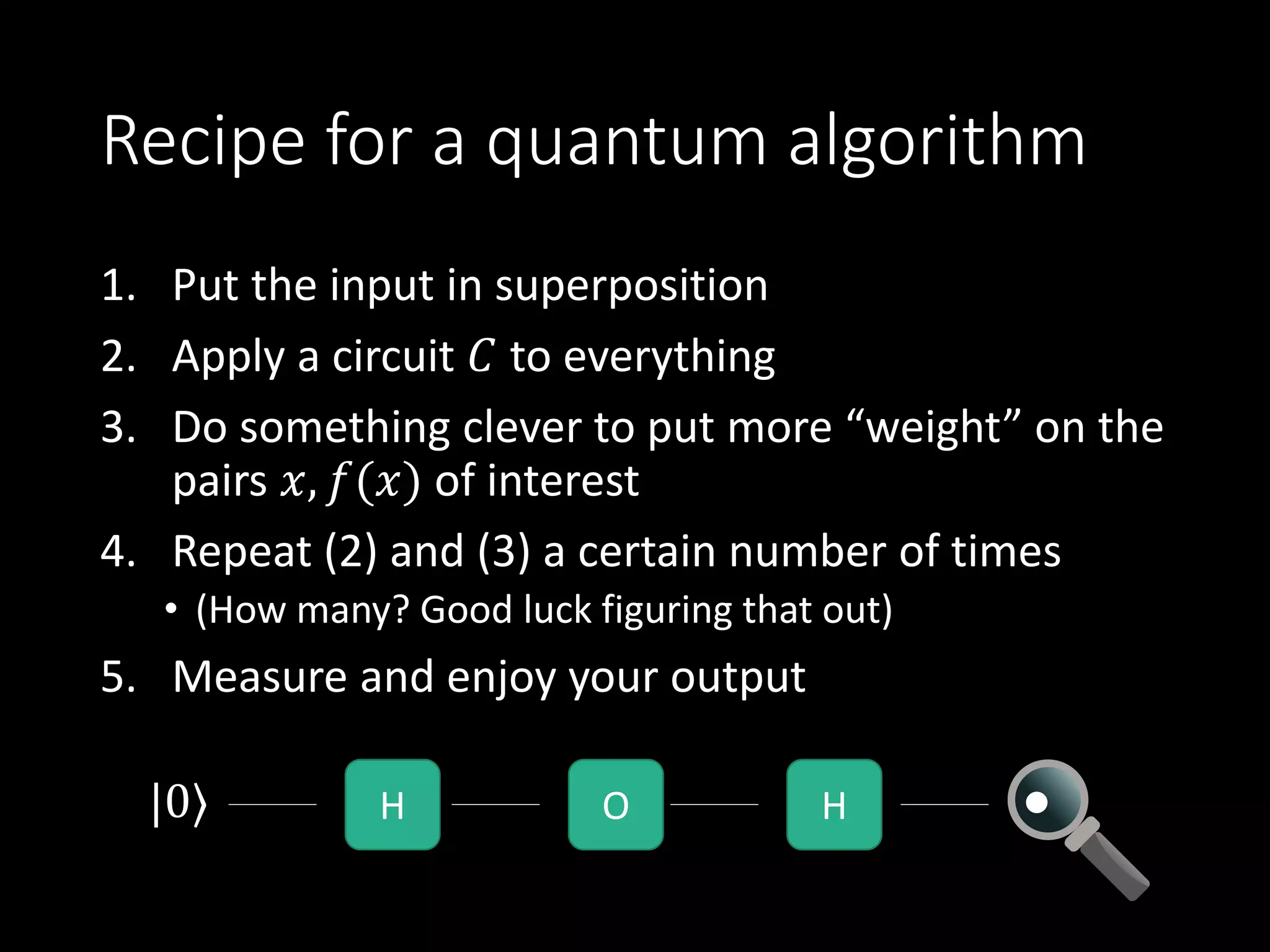
Recipe for a quantum algorithm
1. Put the input in superposition
2. Apply a circuit 𝐶 to everything
3. Do something clever to put more “weight” on the
pairs 𝑥, 𝑓(𝑥) of interest
4. Repeat (2) and (3) a certain number of times
• (How many? Good luck figuring that out)
5. Measure and enjoy your output
H O H|0⟩
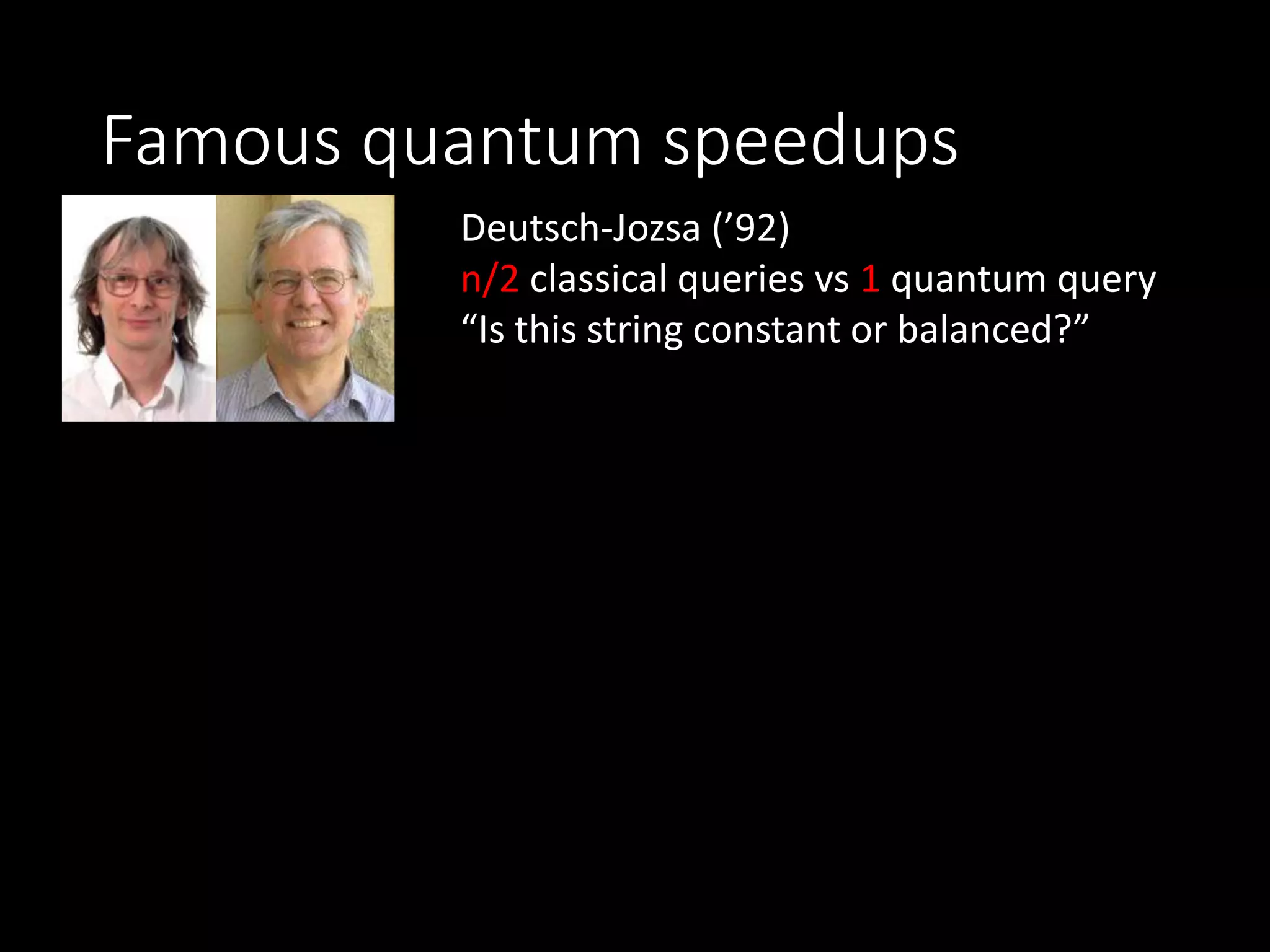
Famous quantum speedups
Deutsch-Jozsa (’92)
n/2 classical queries vs 1 quantum query
“Is this string constant or balanced?”
Famous quantum speedups
Deutsch-Jozsa (’92)
n/2 classical queries vs 1 quantum query
“Is this string constant or balanced?”
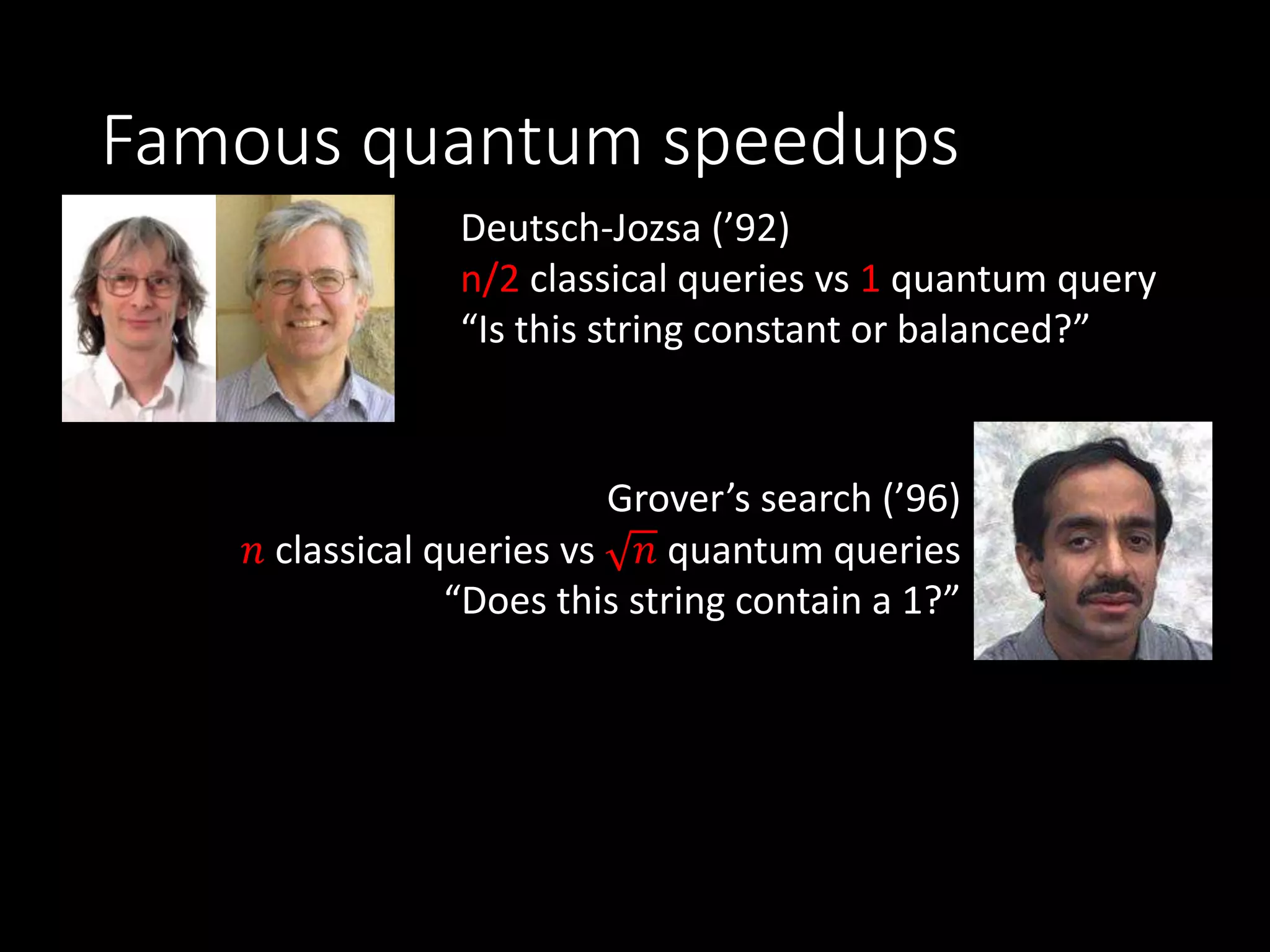
Grover’s search (’96)
𝑛 classical queries vs 𝑛 quantum queries
“Does this string contain a 1?”
Famous quantum speedups
Deutsch-Jozsa (’92)
n/2 classical queries vs 1 quantum query
“Is this string constant or balanced?”
Grover’s search (’96)
𝑛 classical queries vs 𝑛 quantum queries
“Does this string contain a 1?”
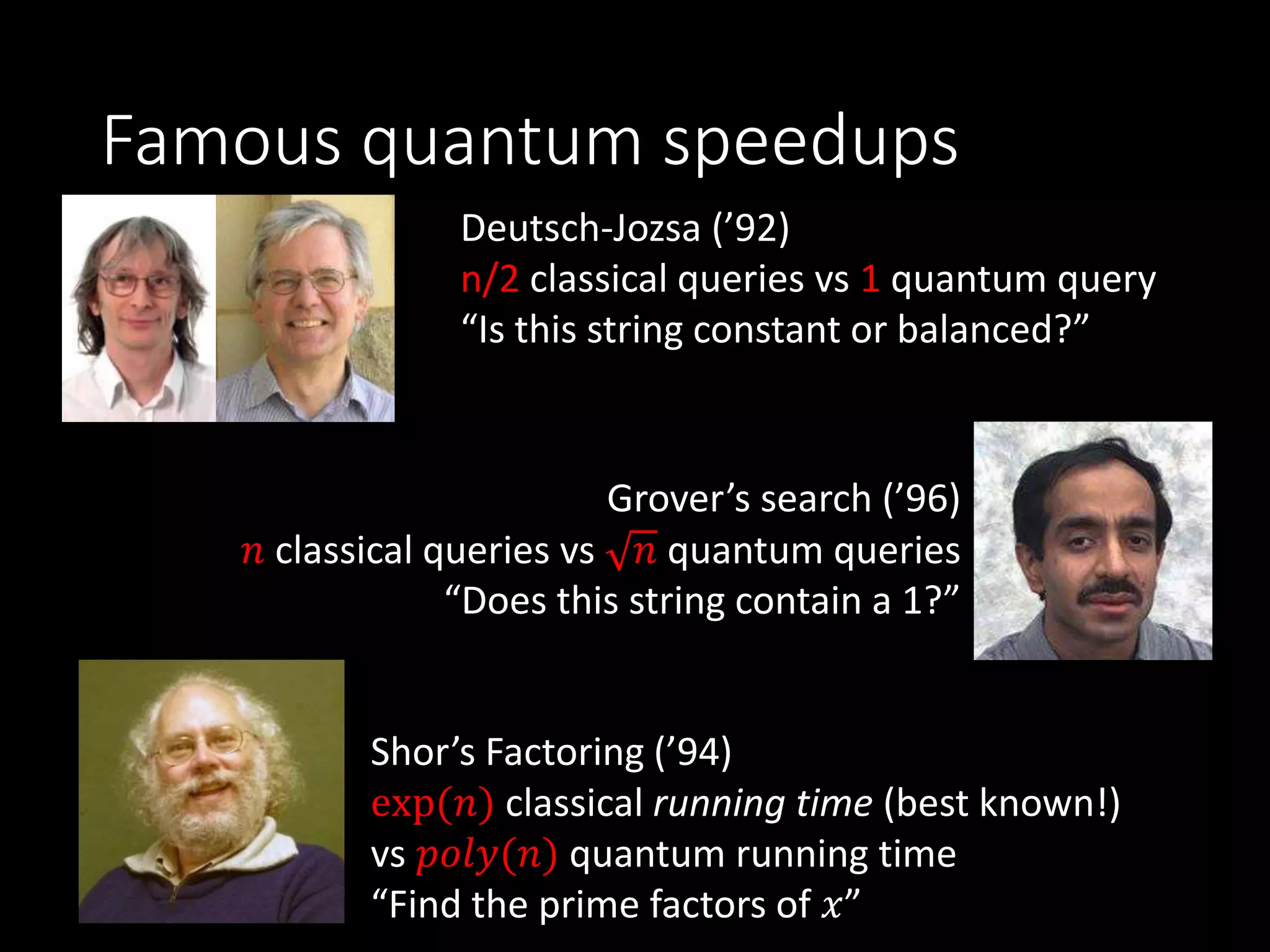
Shor’s Factoring (’94)
exp(𝑛) classical running time (best known!)
vs 𝑝𝑜𝑙𝑦(𝑛) quantum running time
“Find the prime factors of 𝑥”
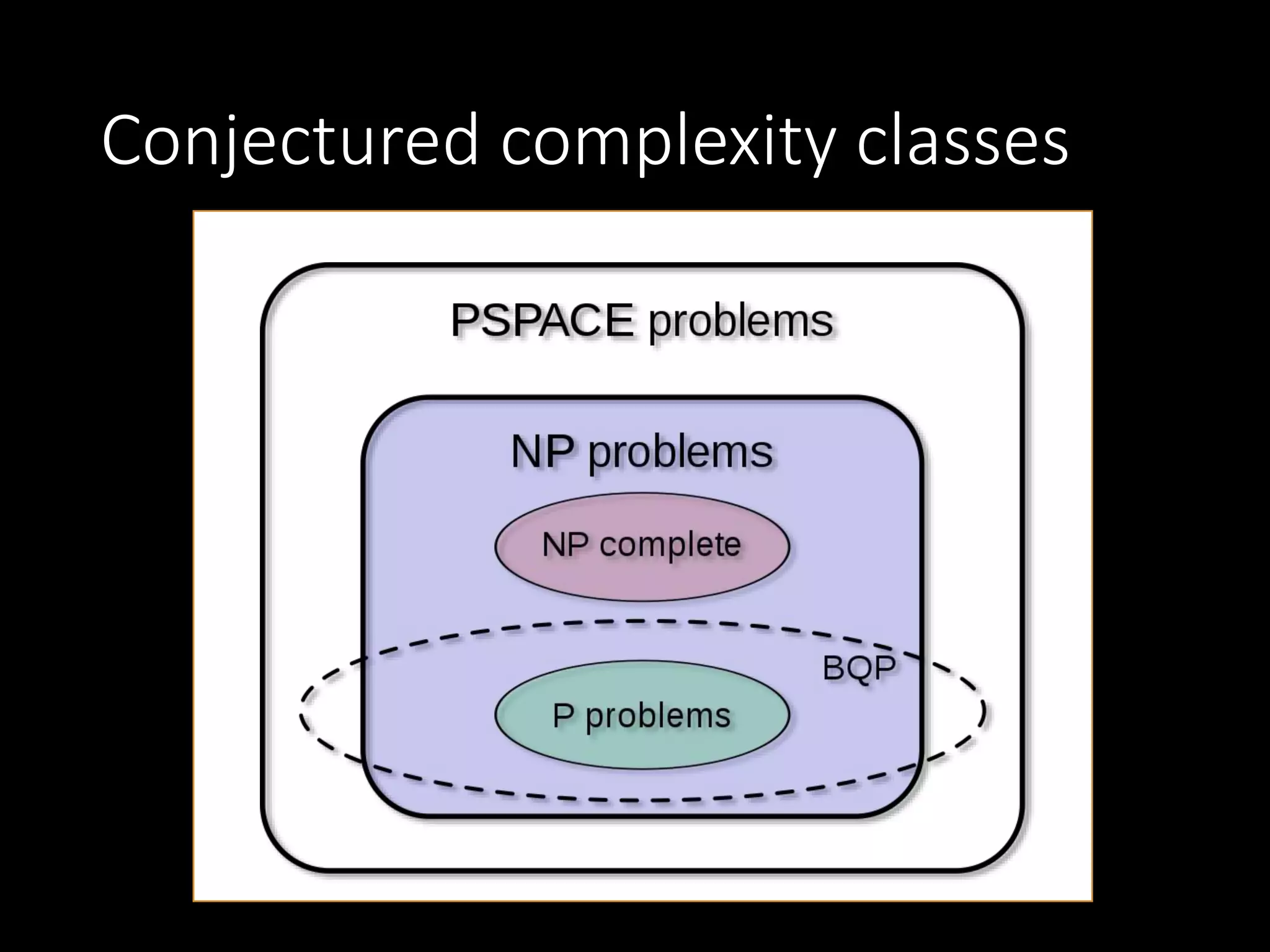
Conjectured complexity classes
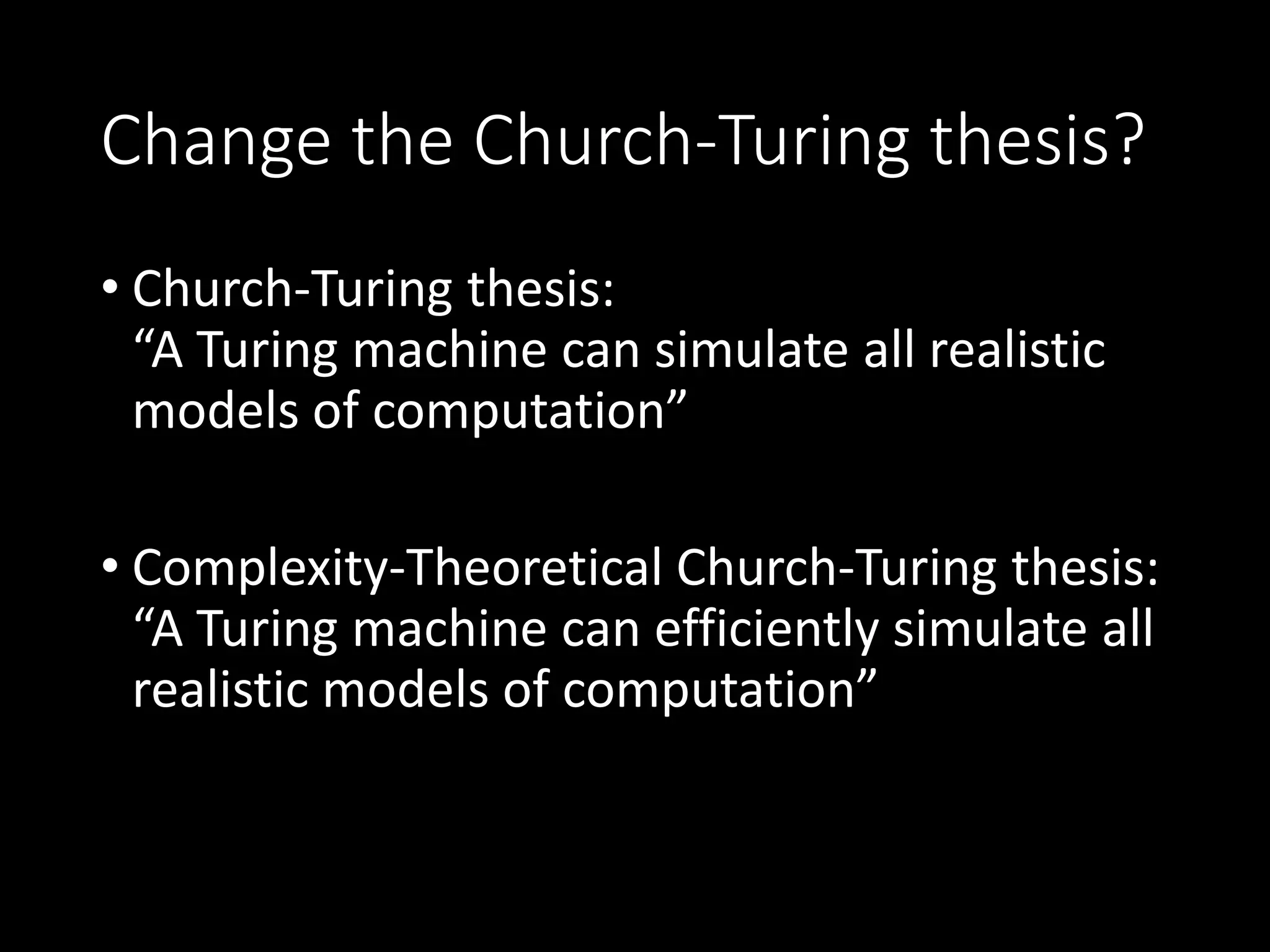
Change the Church-Turing thesis?
• Church-Turing thesis:
“A Turing machine can simulate all realistic
models of computation”
• Complexity-Theoretical Church-Turing thesis:
“A Turing machine can efficiently simulate all
realistic models of computation”
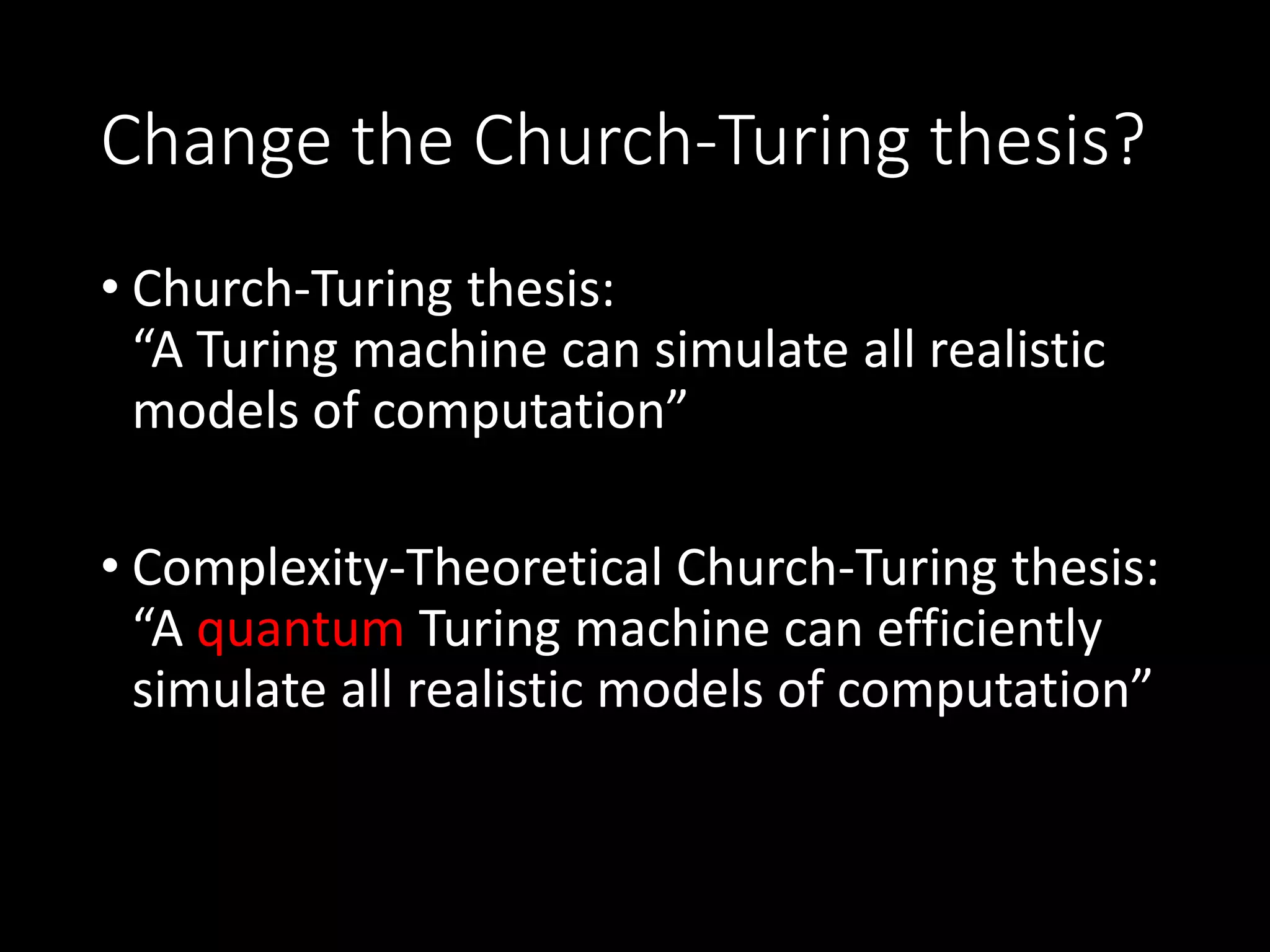
Change the Church-Turing thesis?
• Church-Turing thesis:
“A Turing machine can simulate all realistic
models of computation”
• Complexity-Theoretical Church-Turing thesis:
“A quantum Turing machine can efficiently
simulate all realistic models of computation”
Part III:
Some Quantum
Cryptograhy
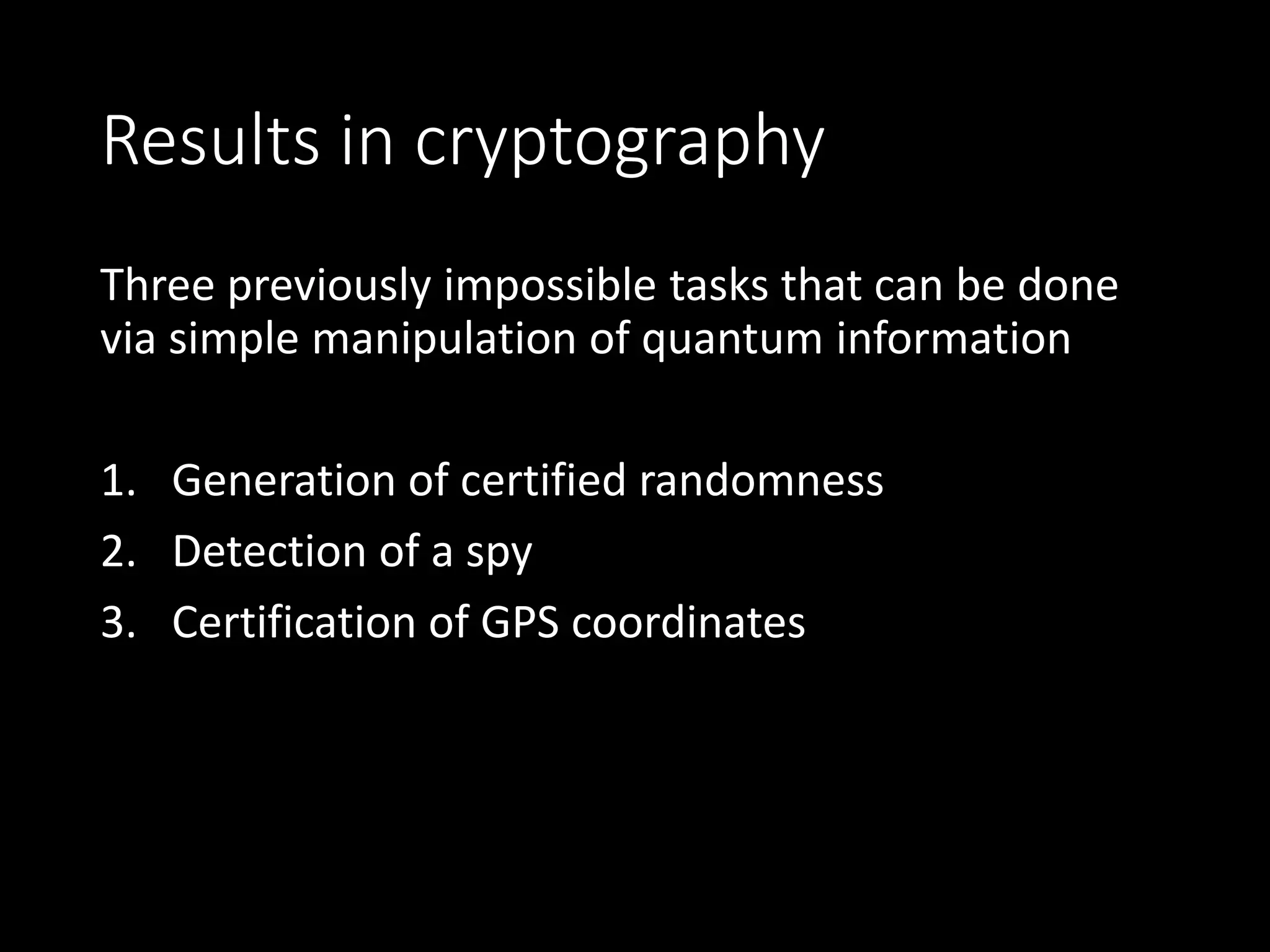
Results in cryptography
Three previously impossible tasks that can be done
via simple manipulation of quantum information
1. Generation of certified randomness
2. Detection of a spy
3. Certification of GPS coordinates
Non-Locality
Can the microscopic have macroscopic
consequences?
• Non-Local game: challenge for collaborating but
non-communicating players
(like when the police cross-checks suspects)
• Bell inequality: upper bound on winning probability
• Quantum players can perform better than the
classical players: they violate the Bell inequality
• An implementation disproves classical physics
• (They have done it, classical physics is officially false)
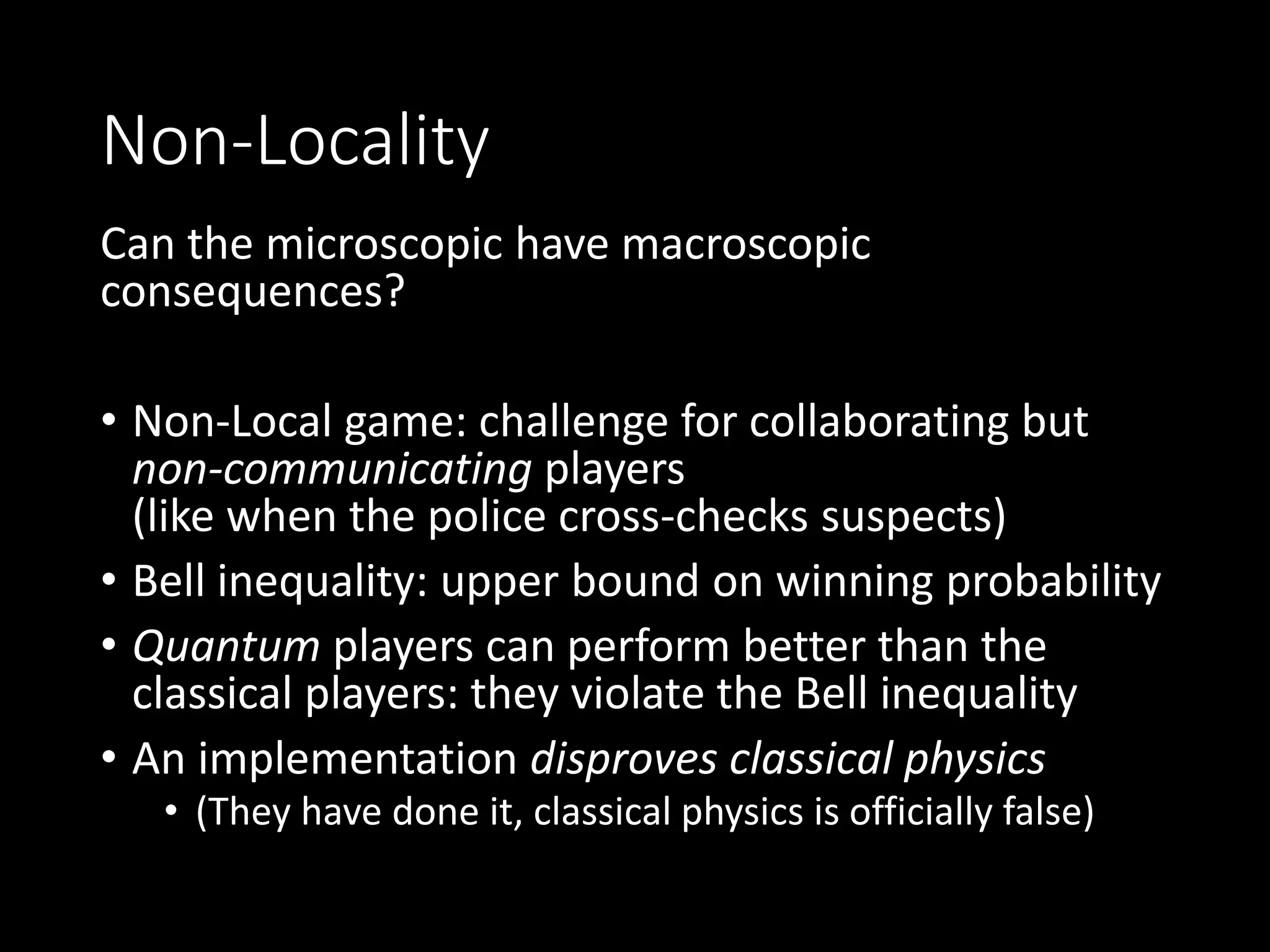
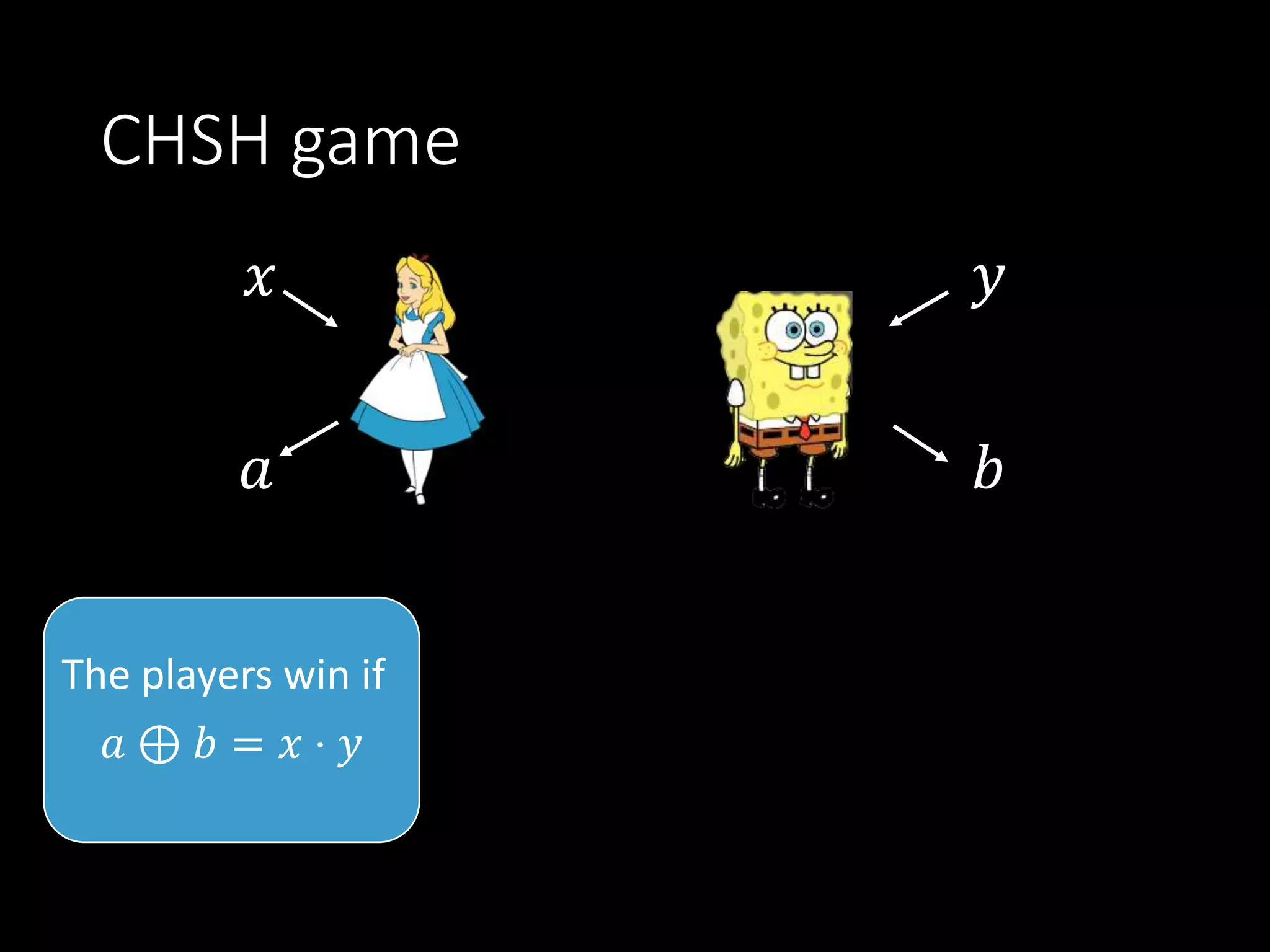
CHSH game
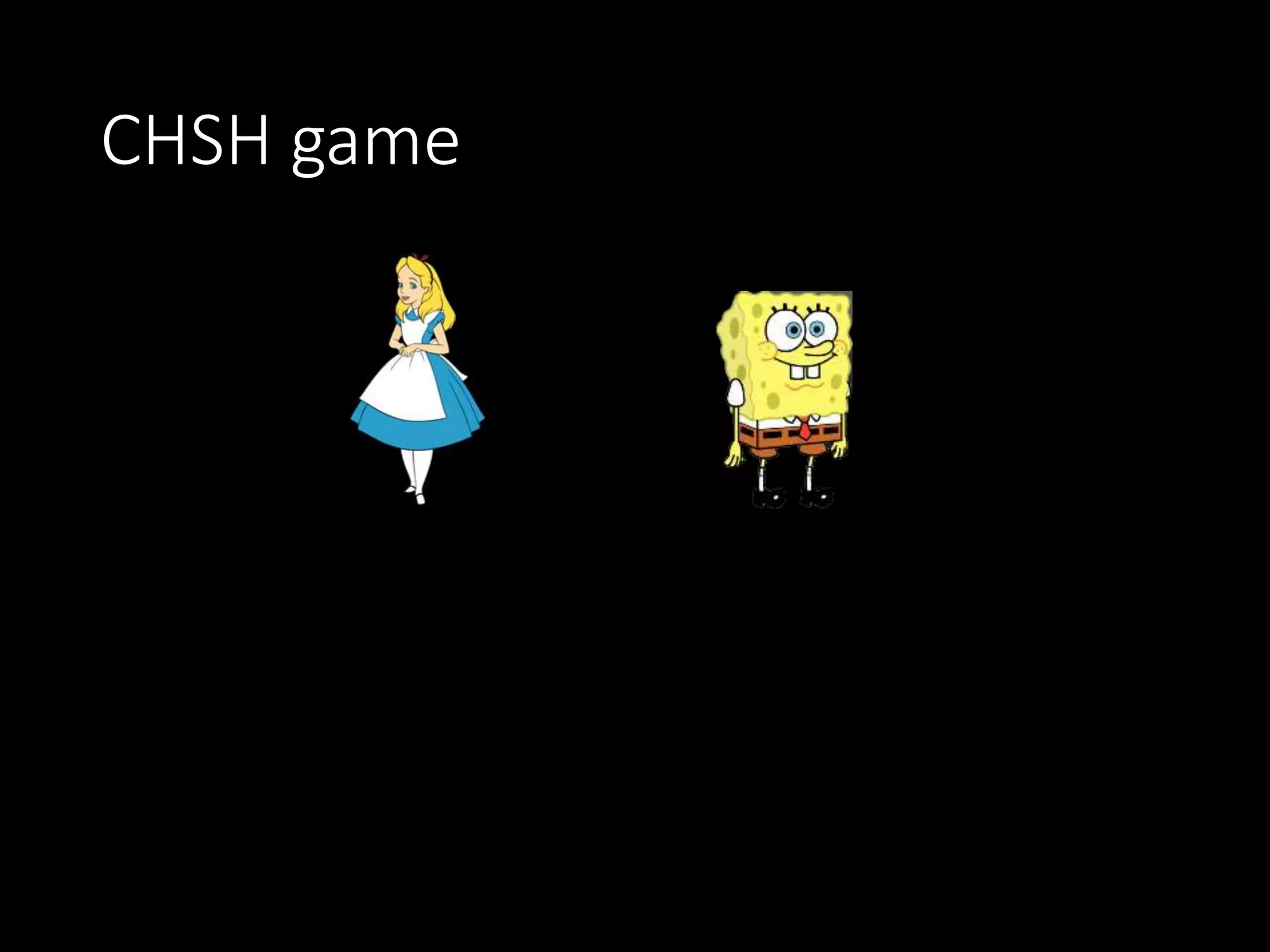
CHSH game
𝑥 𝑦
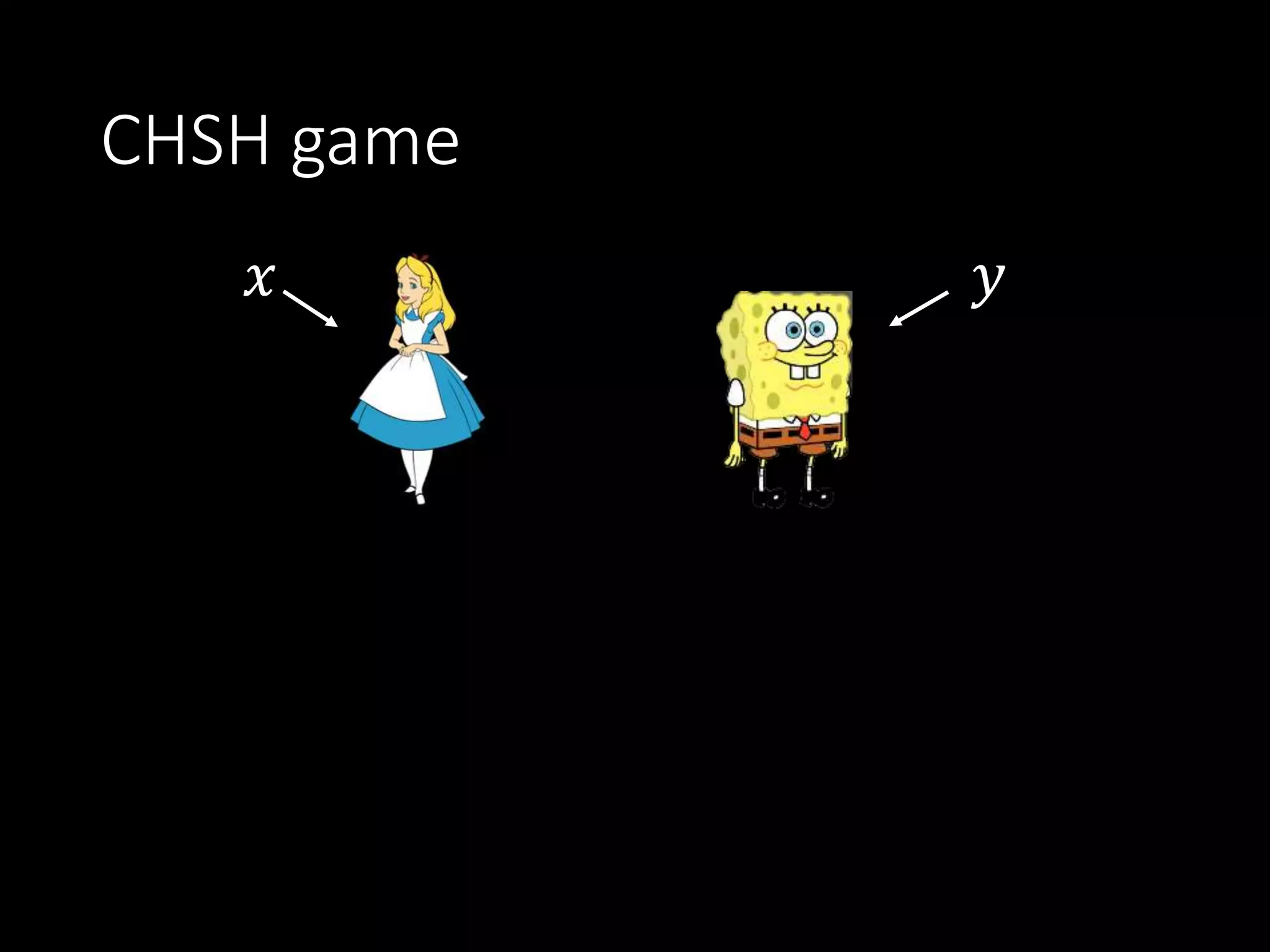
CHSH game
𝑥 𝑦
𝑎 𝑏
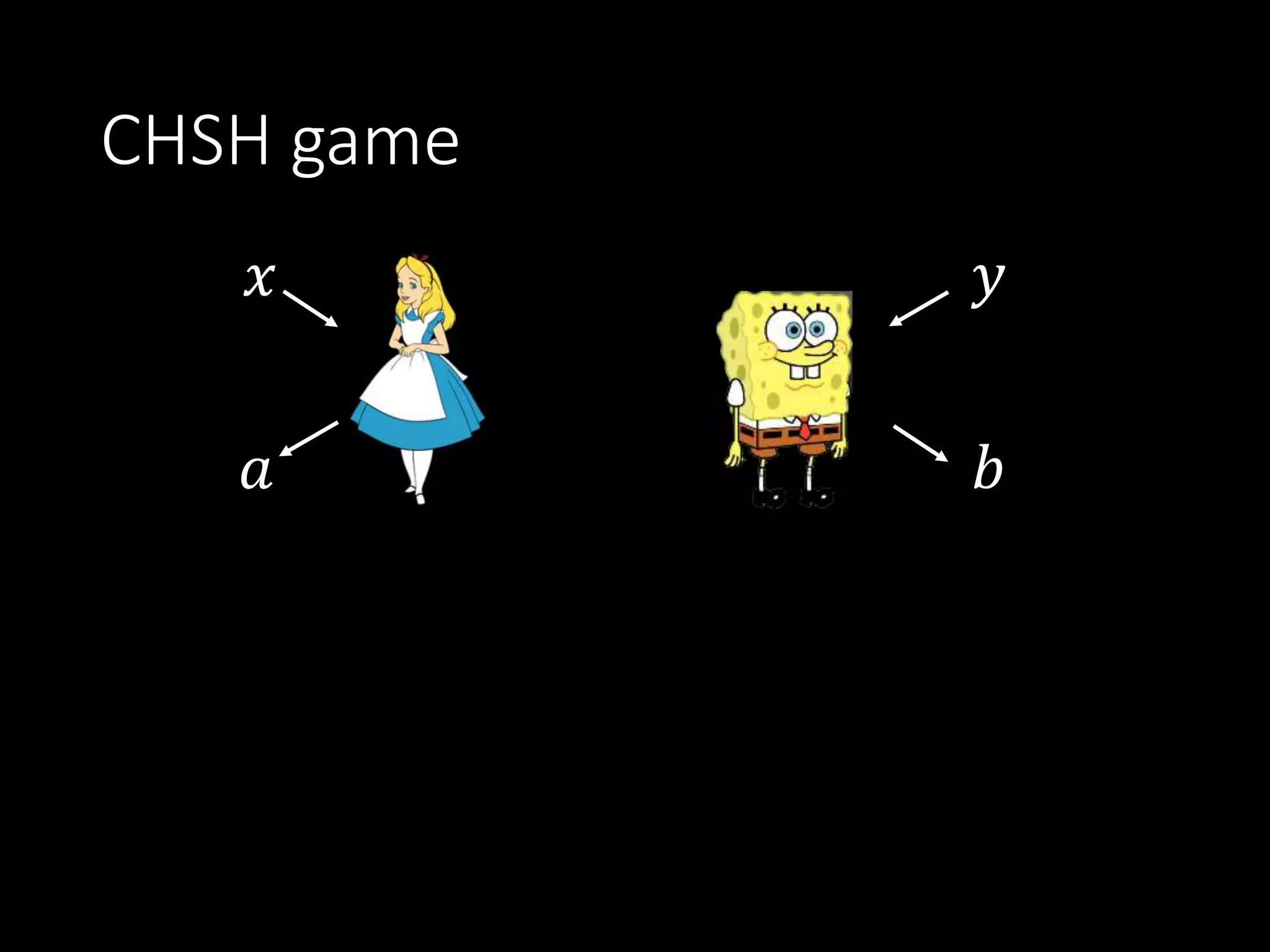
CHSH game
𝑥 𝑦
𝑎 𝑏
The players win if
𝑎 ⊕ 𝑏 = 𝑥 ⋅ 𝑦
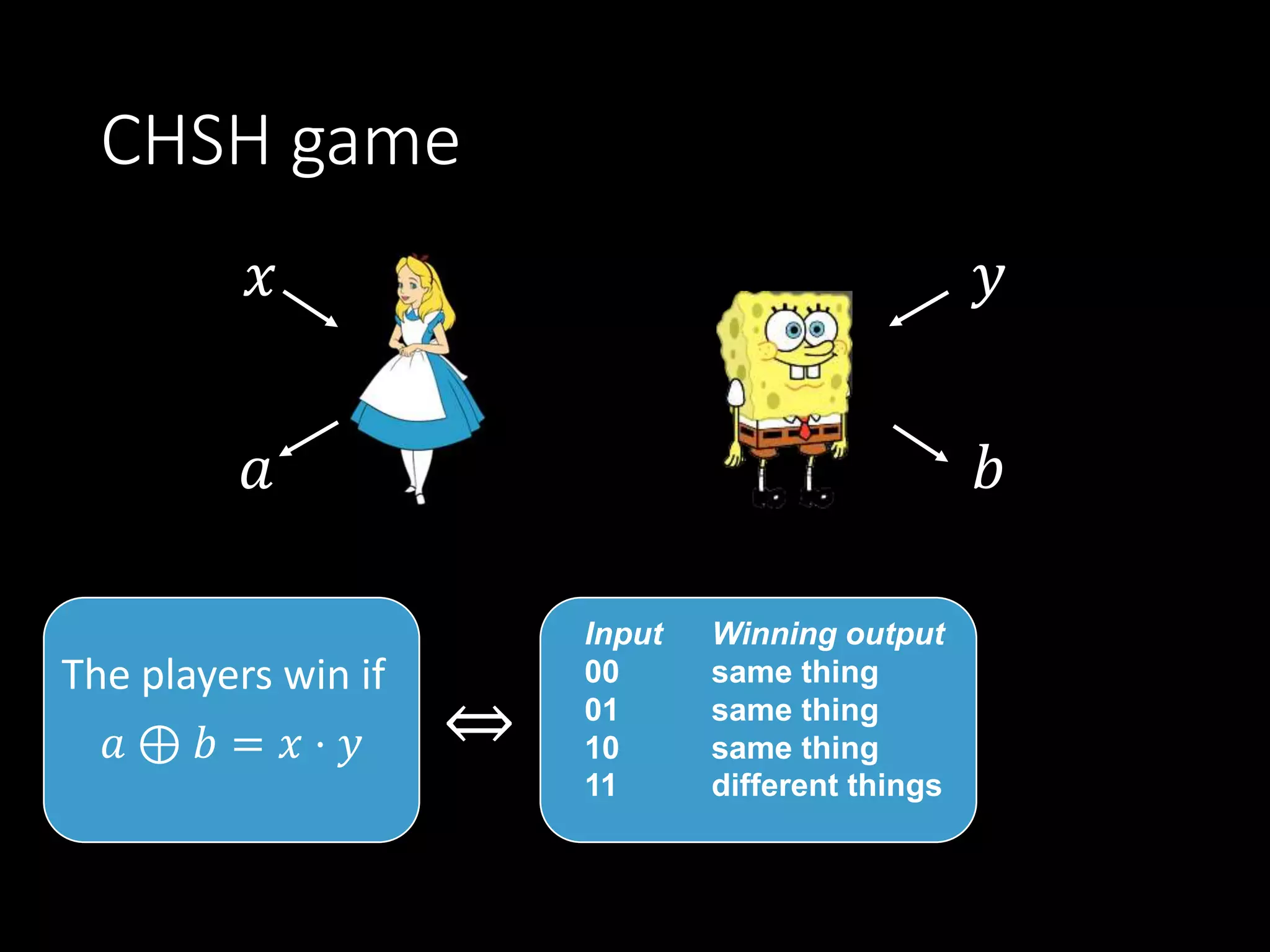
CHSH game
𝑥 𝑦
𝑎 𝑏
The players win if
𝑎 ⊕ 𝑏 = 𝑥 ⋅ 𝑦
Input Winning output
00 same thing
01 same thing
10 same thing
11 different things
⇔
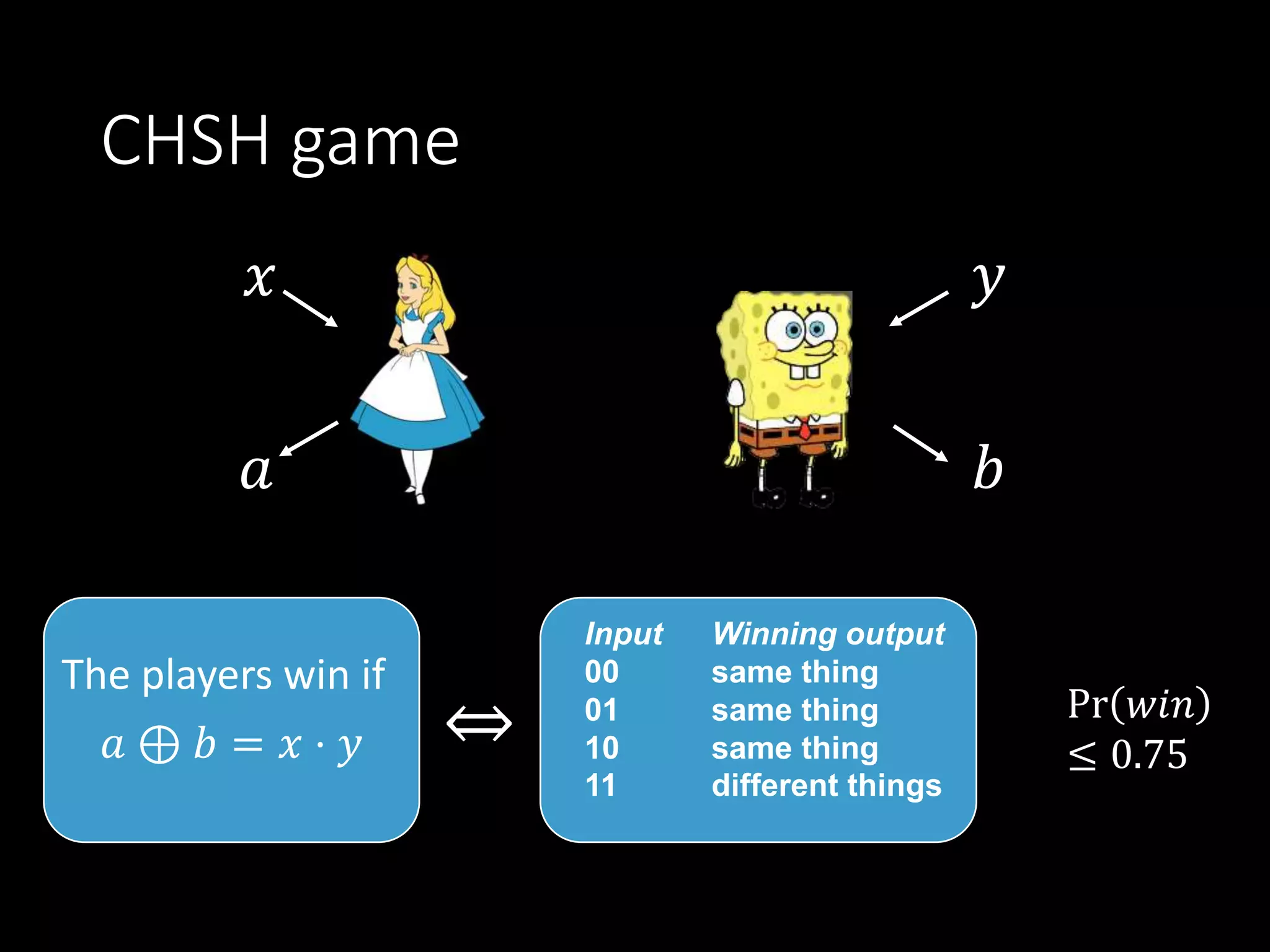
CHSH game
𝑥 𝑦
𝑎 𝑏
The players win if
𝑎 ⊕ 𝑏 = 𝑥 ⋅ 𝑦
Input Winning output
00 same thing
01 same thing
10 same thing
11 different things
⇔ Pr 𝑤𝑖𝑛
≤ 0.75
How do quantum players play?
• We need some technical details…
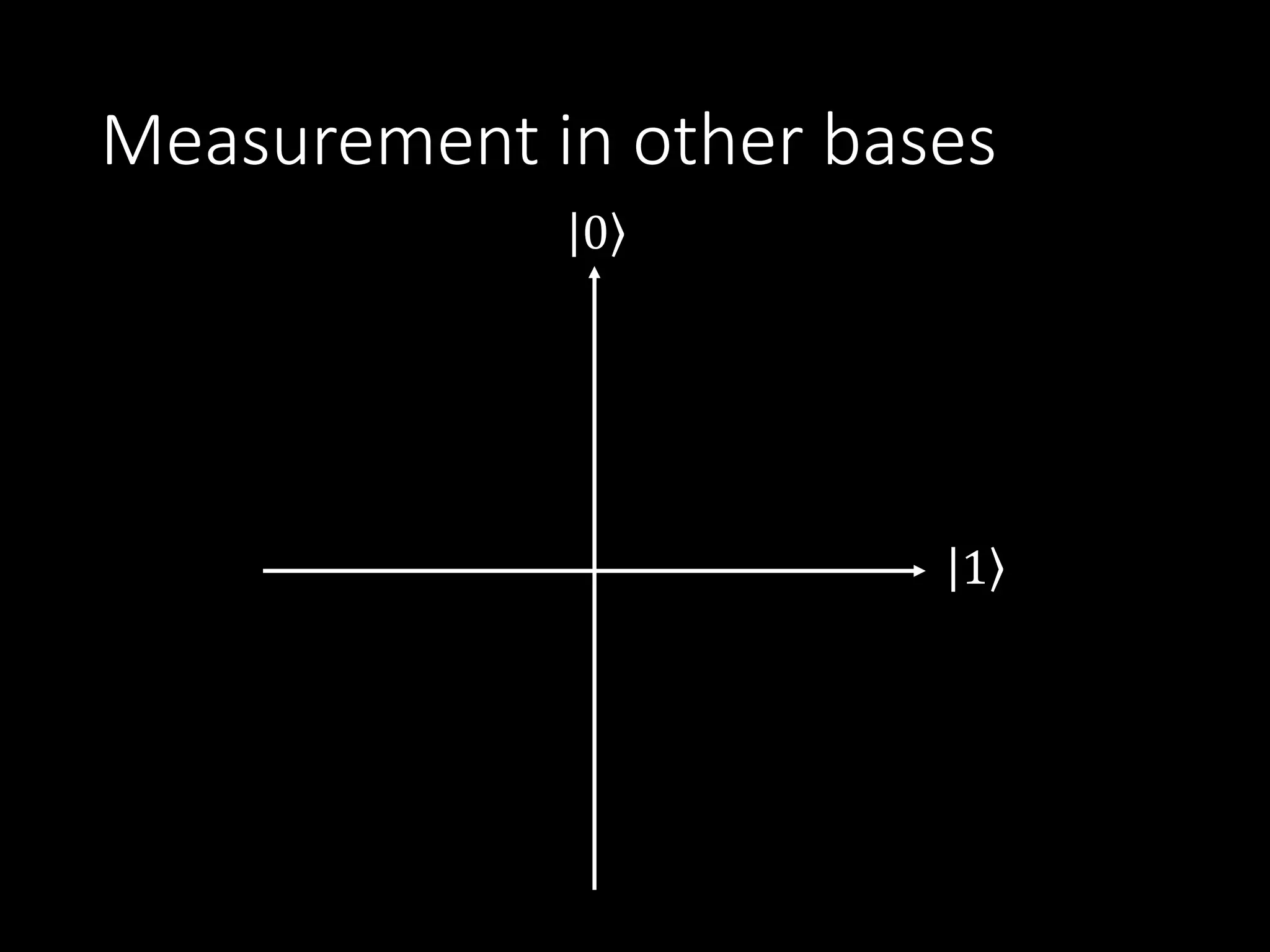
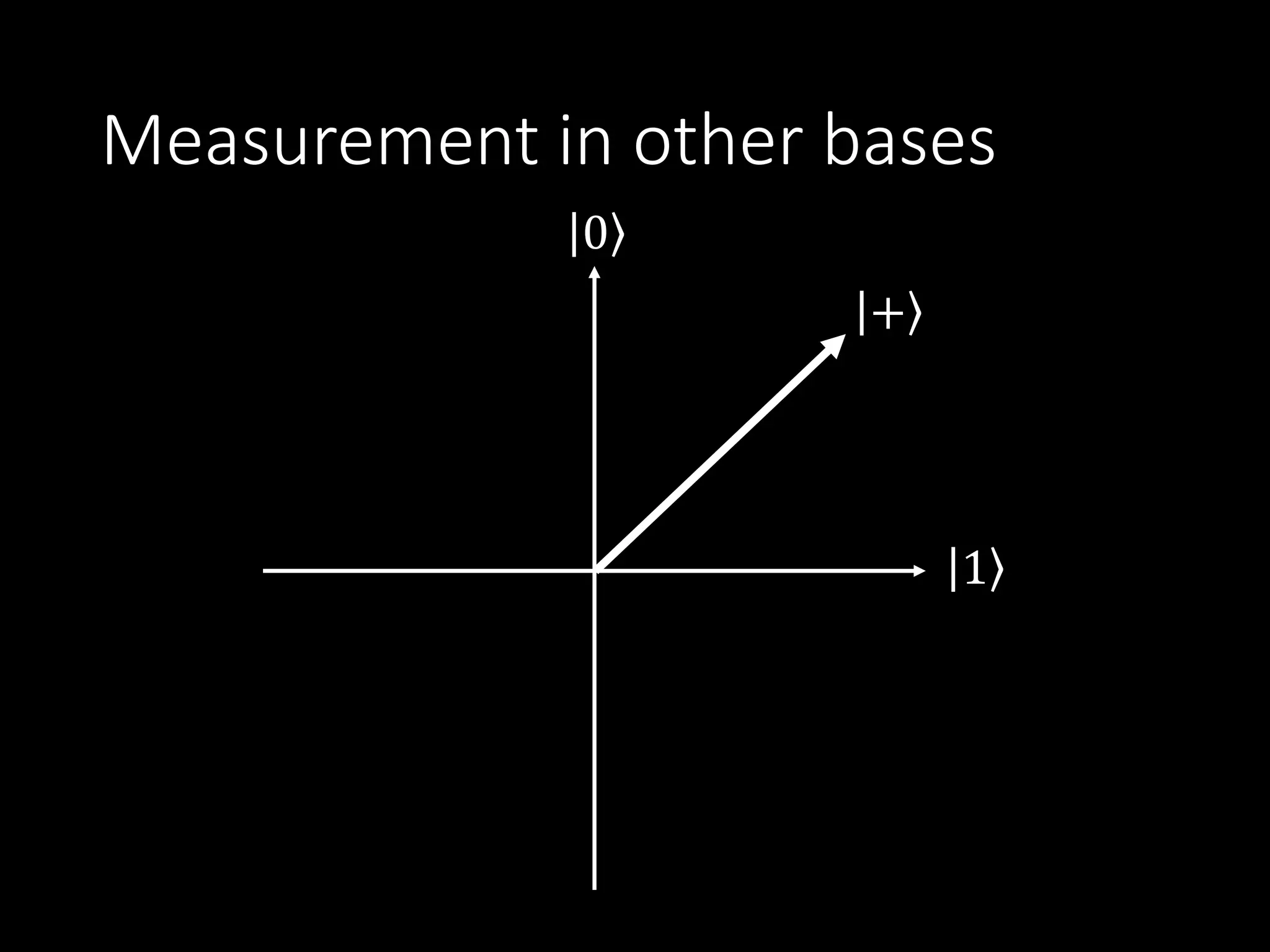
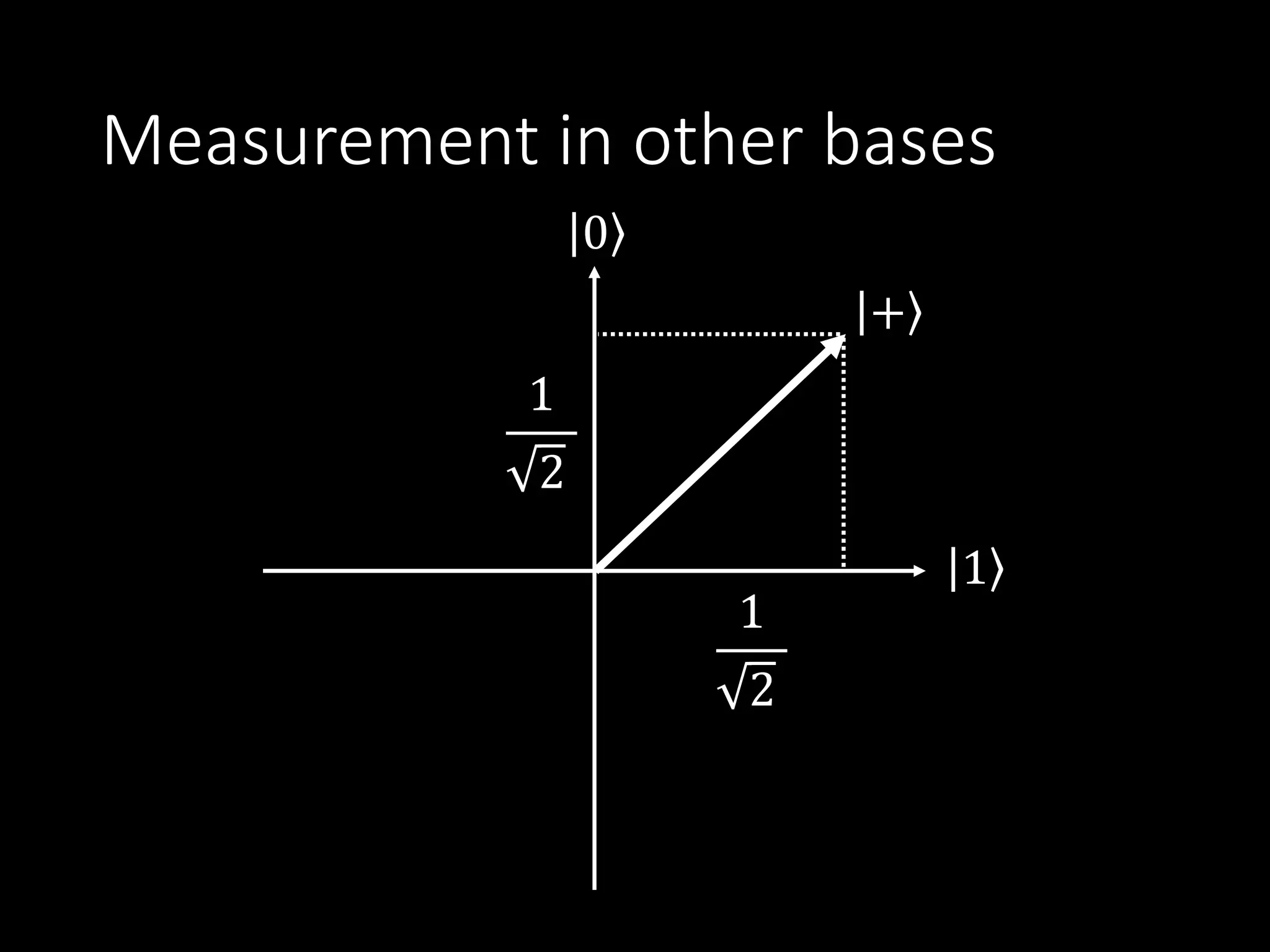
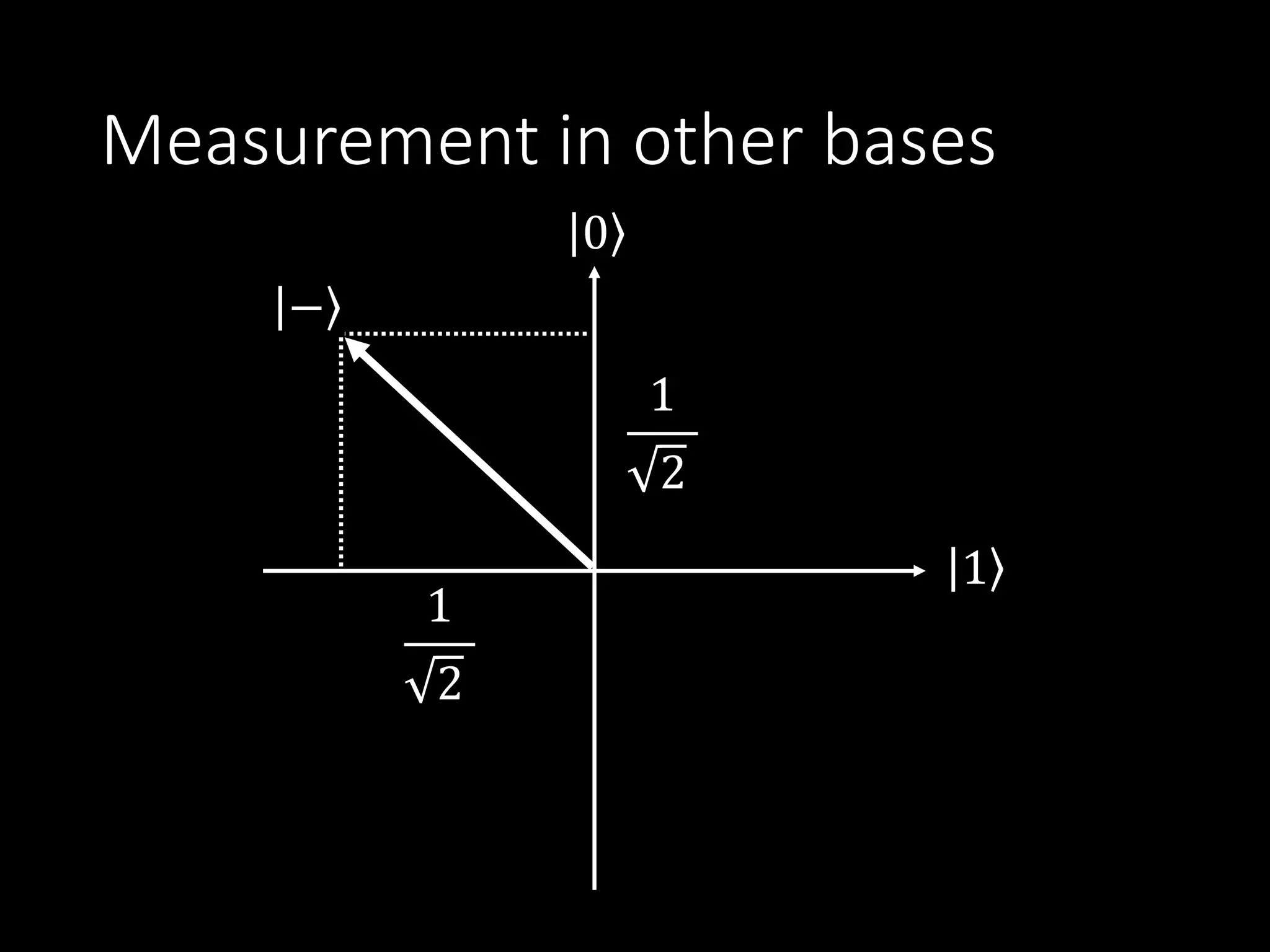
Measurement in other bases
1
0
Measurement in other bases
1
0
+
Measurement in other bases
1
0
+
1
2
1
2
Measurement in other bases
1
0
−
1
2
1
2
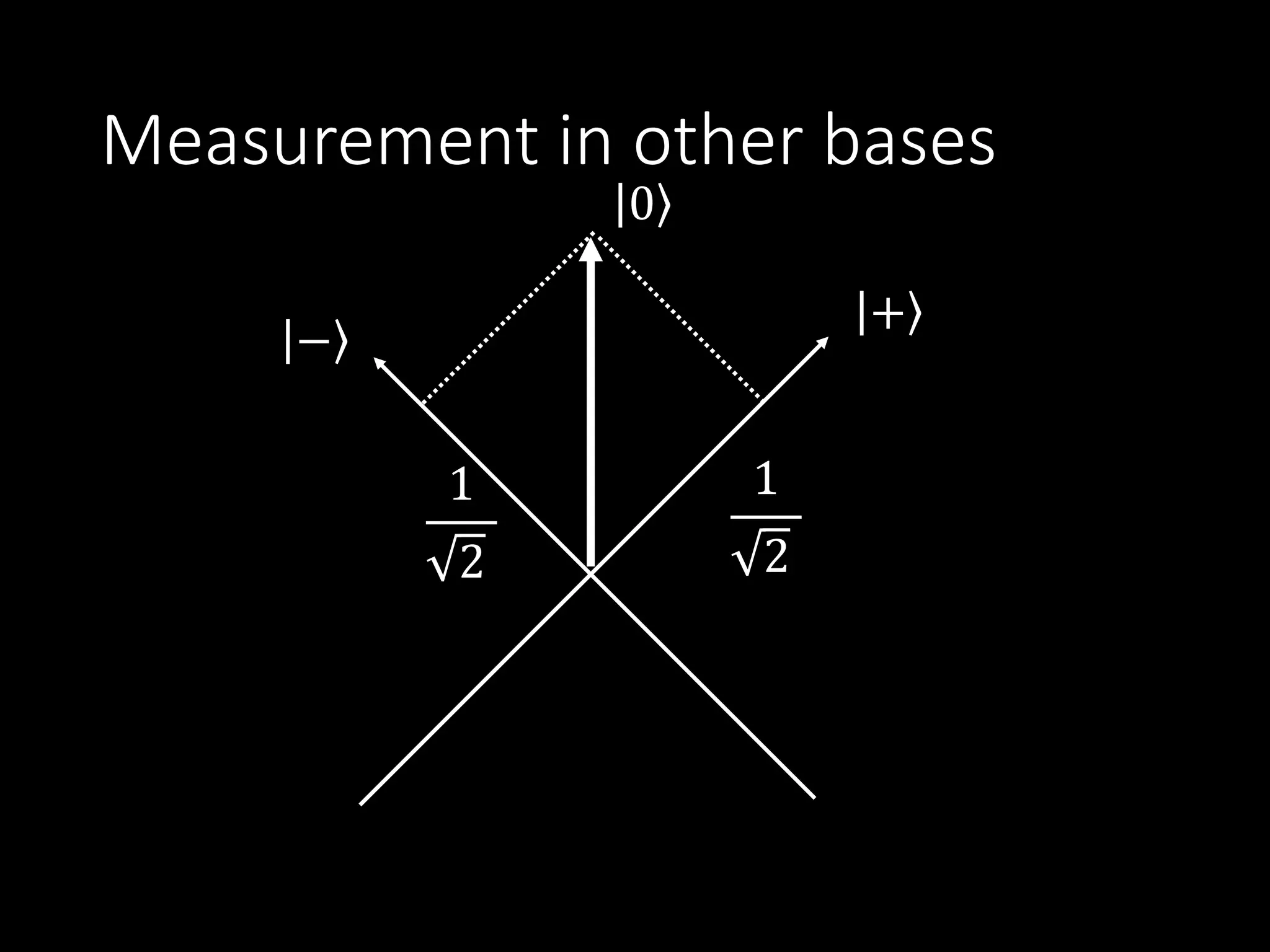
Measurement in other bases
−
0
+
1
2
1
2
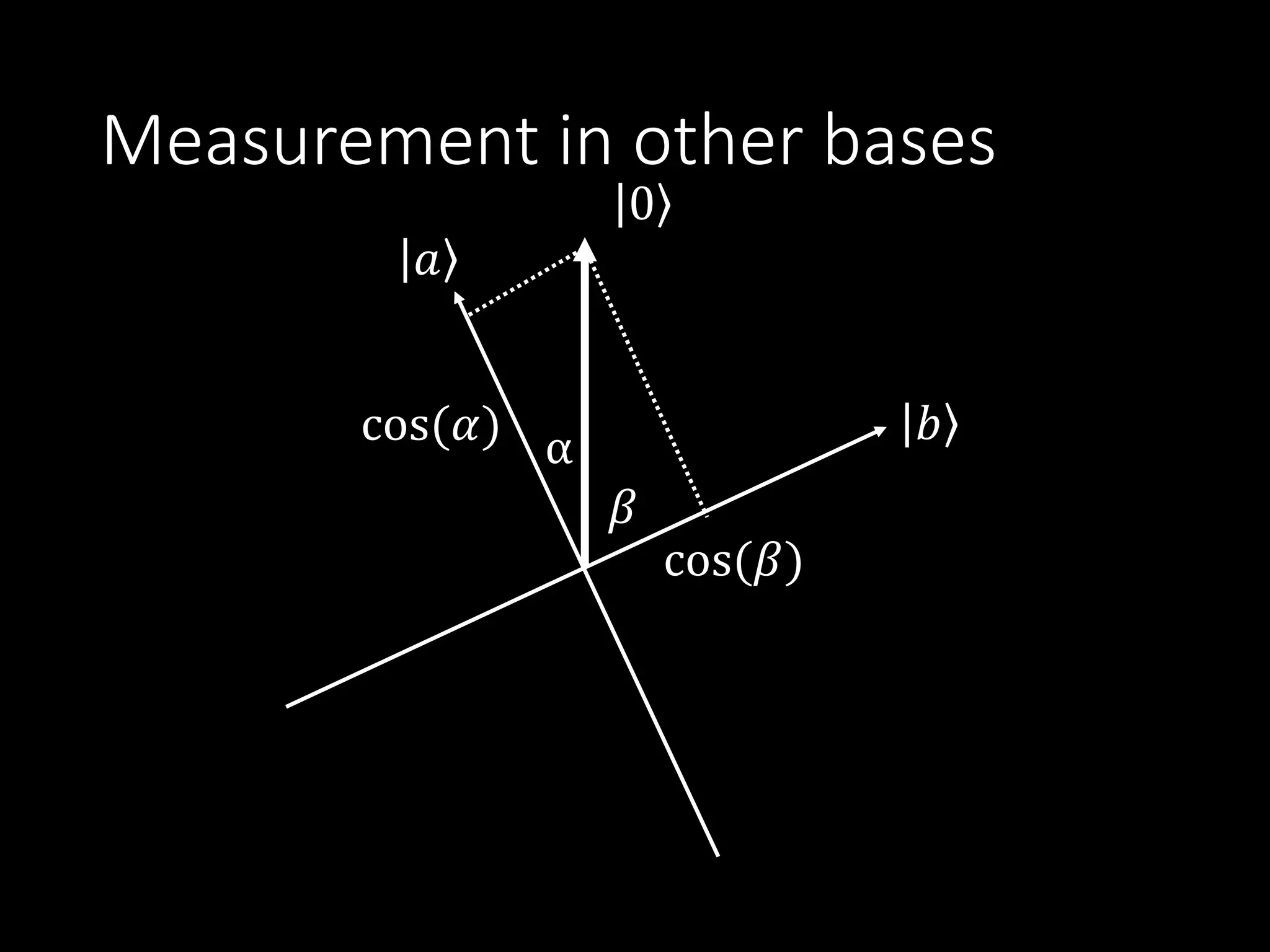
Measurement in other bases
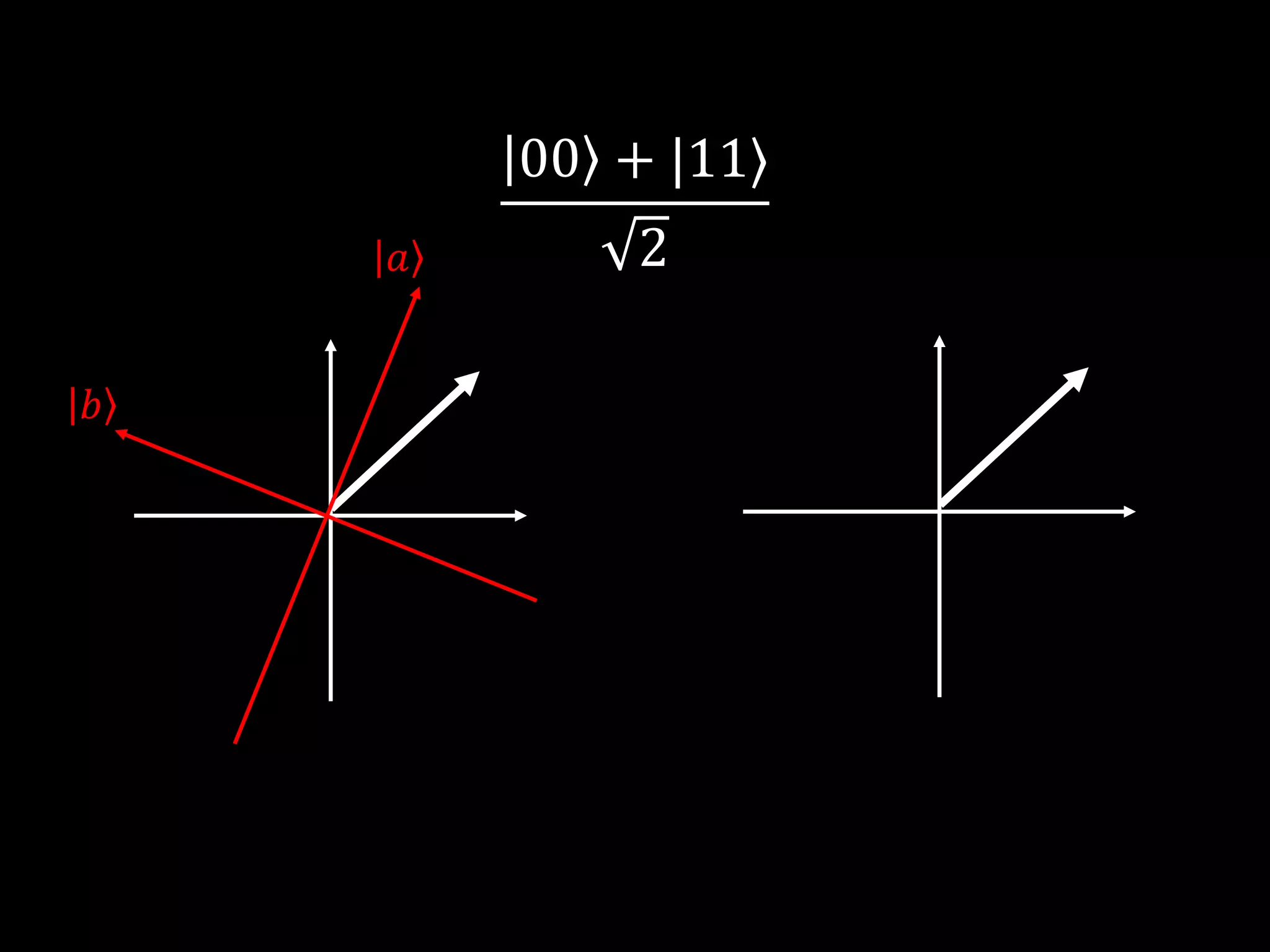
𝑎
0
𝑏
cos(𝛽)
cos(𝛼) α
𝛽
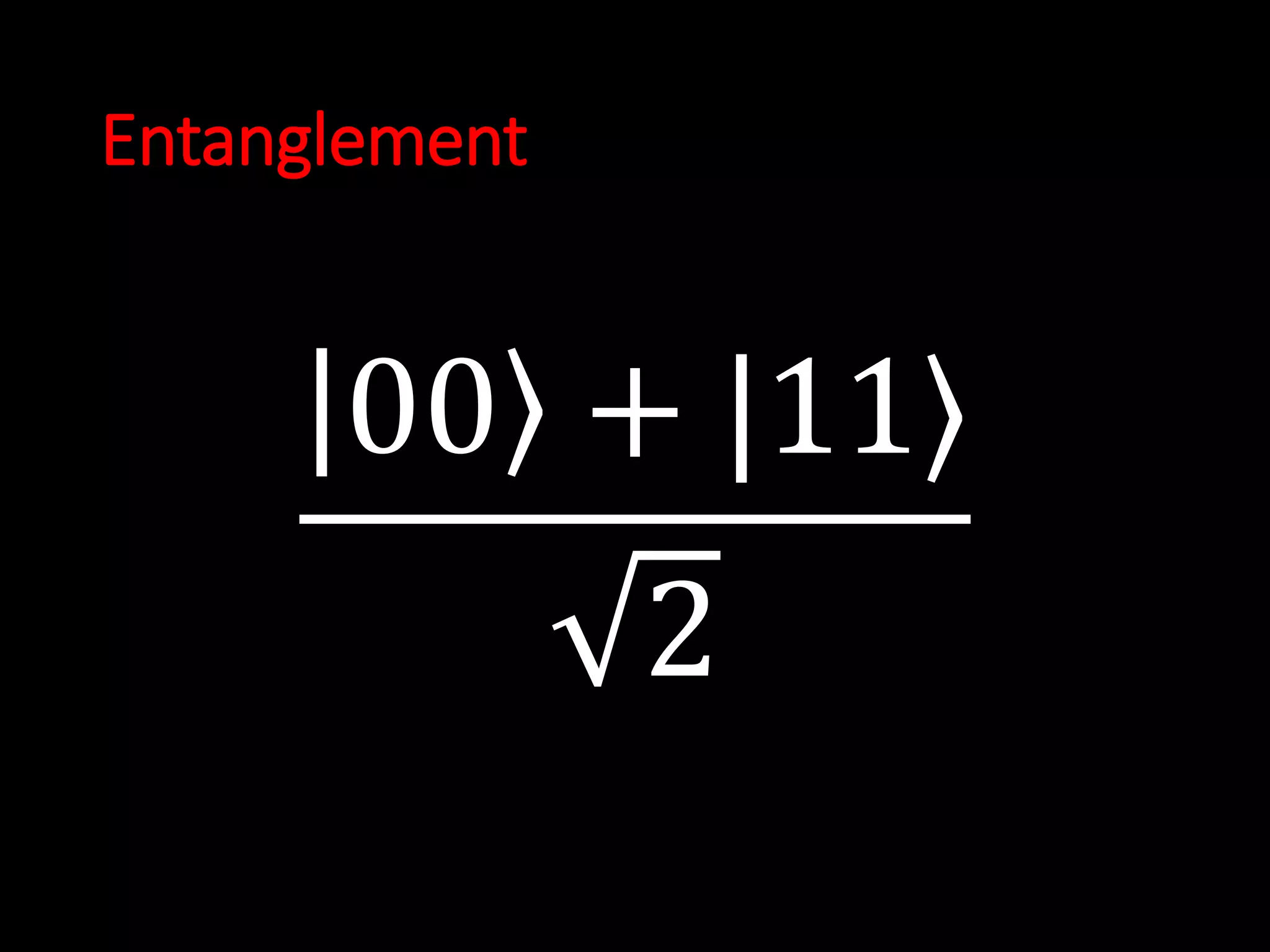
Entanglement
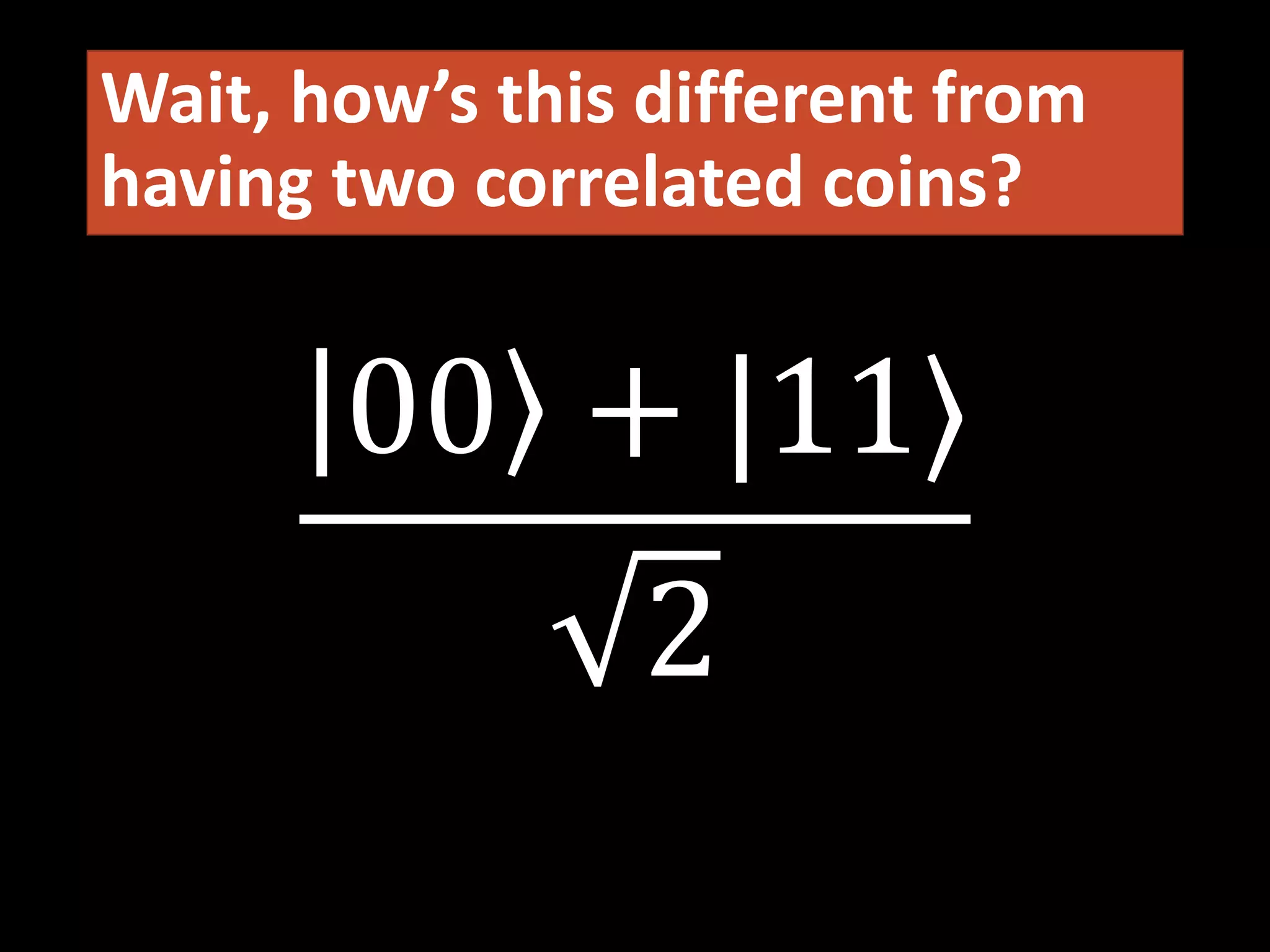
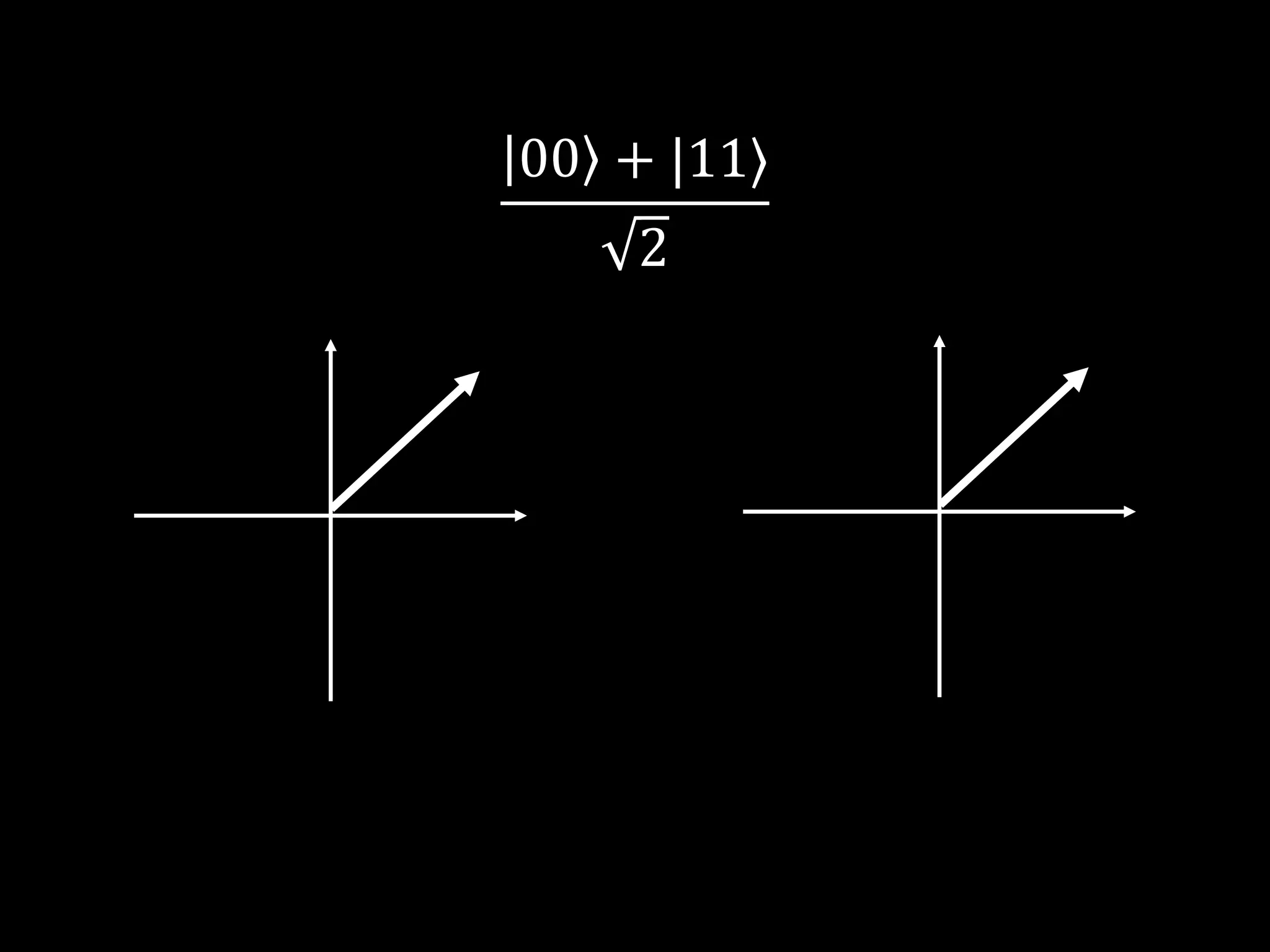
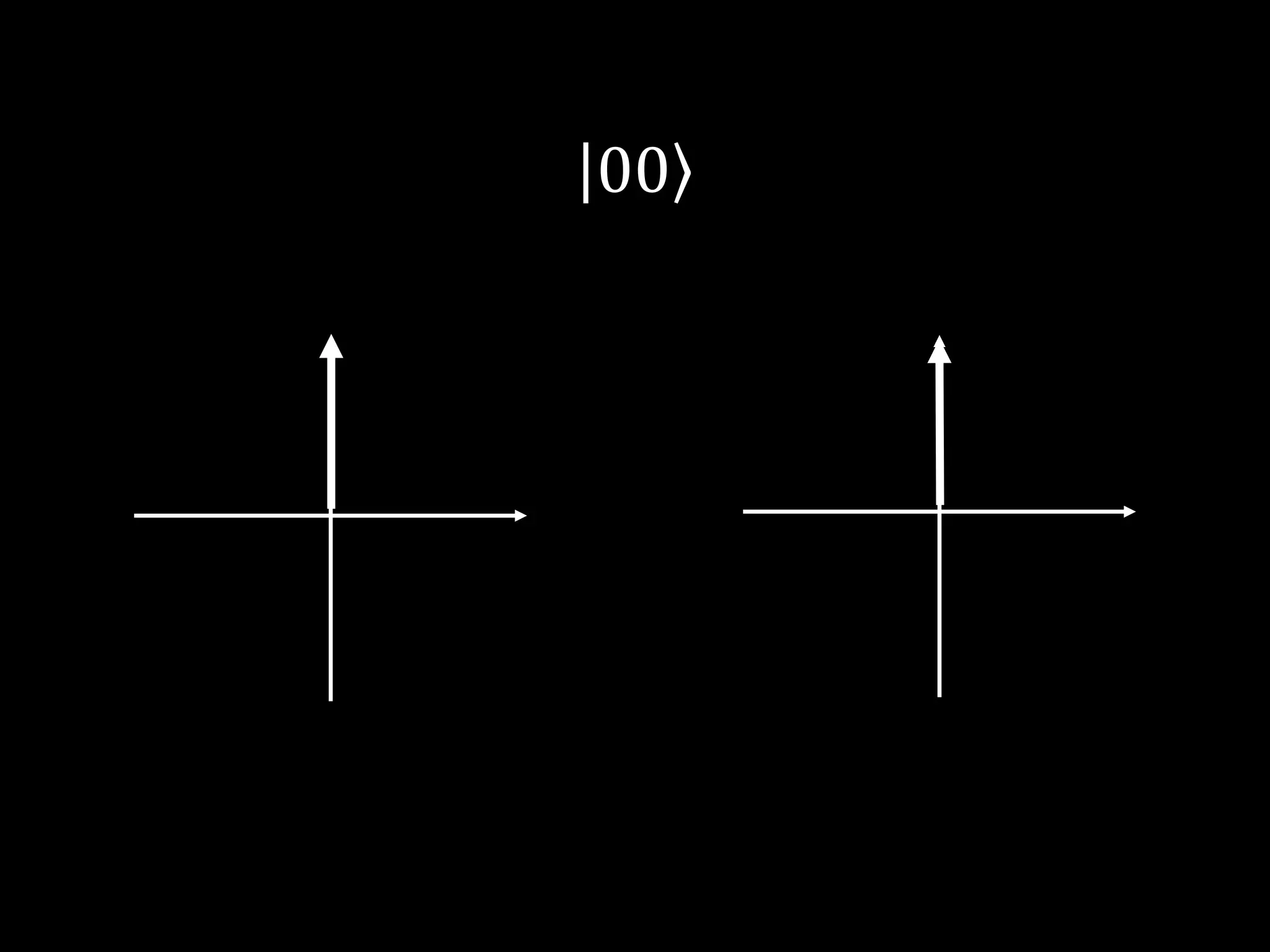
00 + |11⟩
2
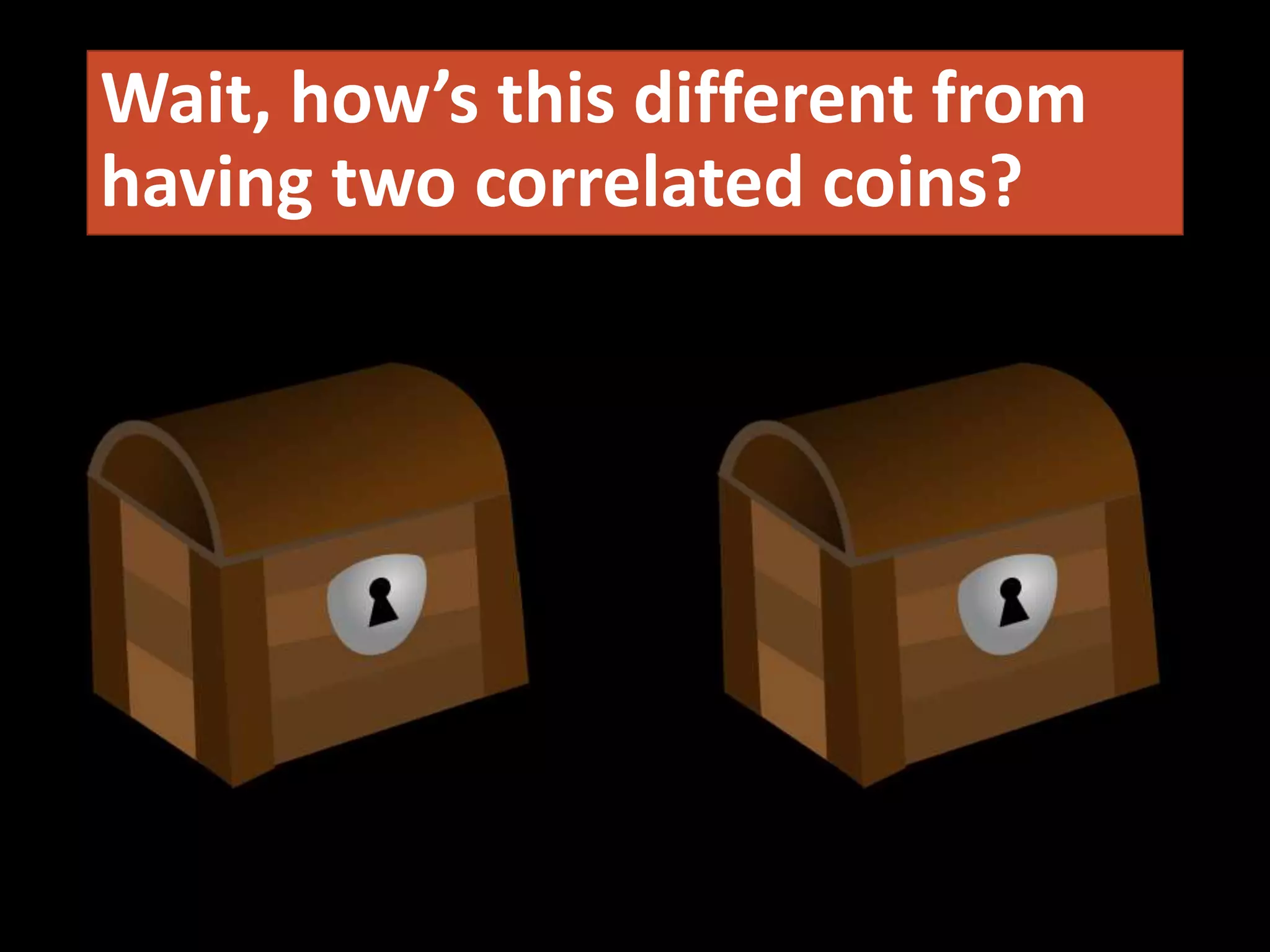
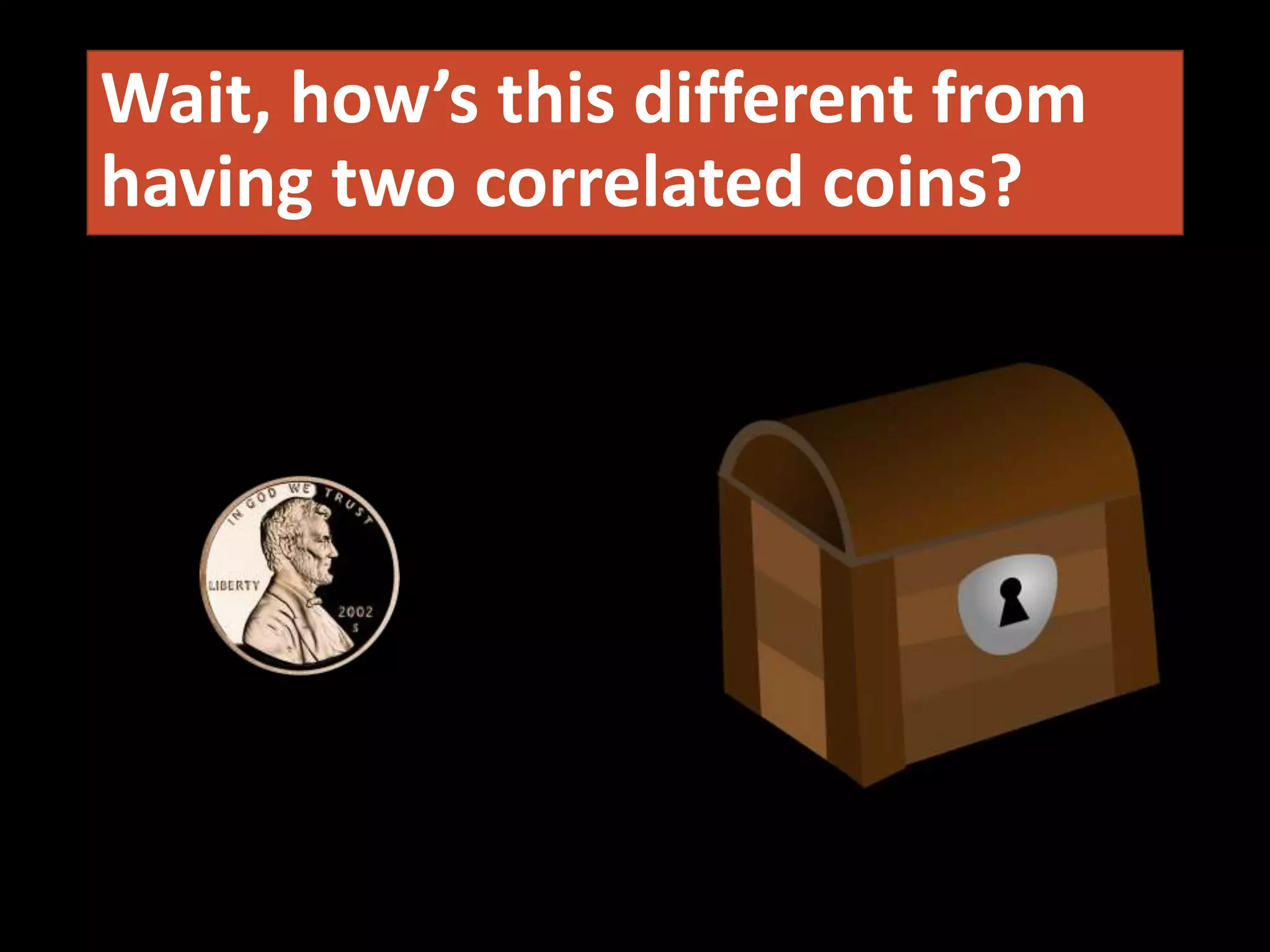
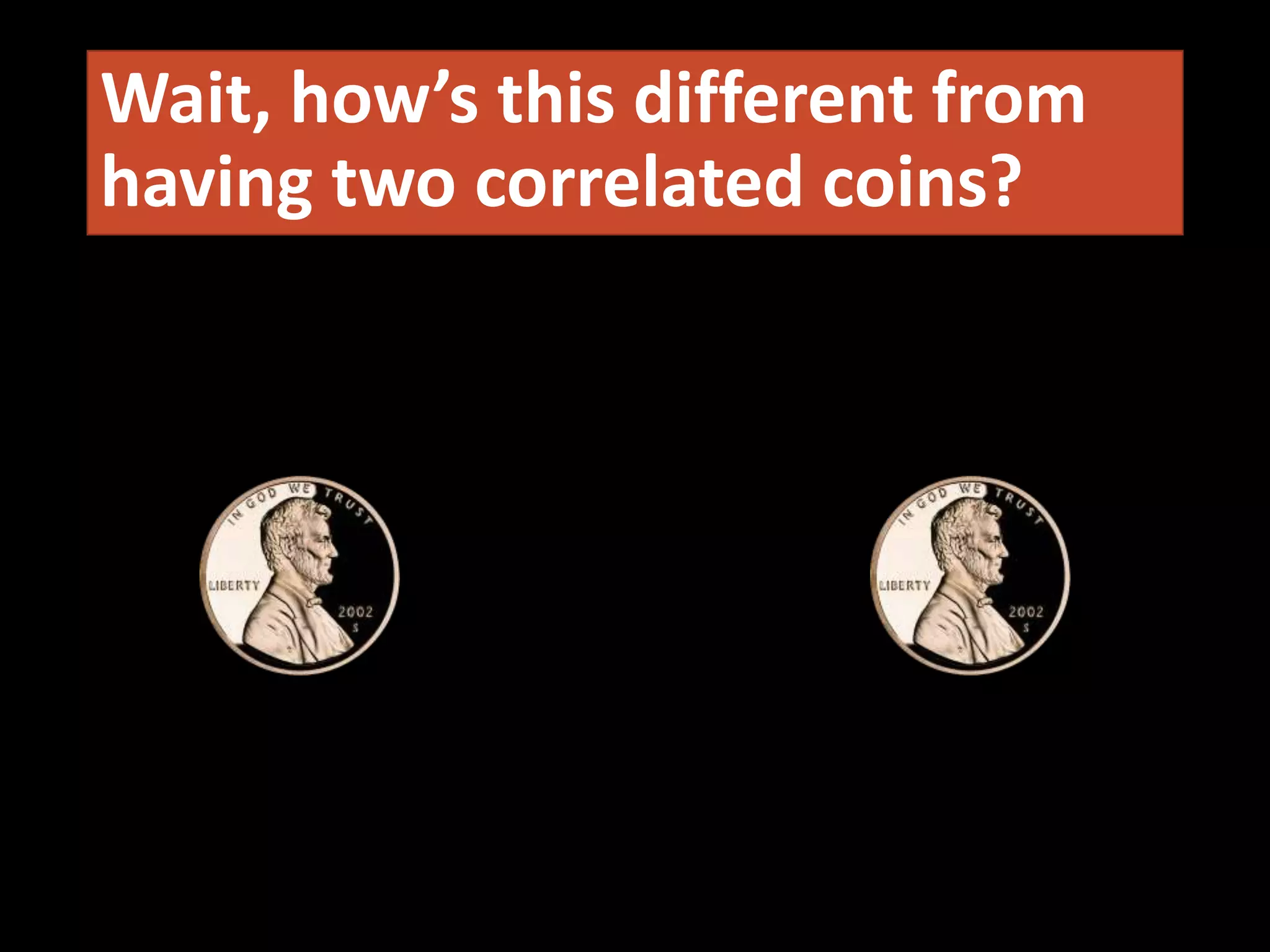
Wait, how’s this different from
having two correlated coins?
00 + |11⟩
2
Wait, how’s this different from
having two correlated coins?
Wait, how’s this different from
having two correlated coins?
Wait, how’s this different from
having two correlated coins?
Wait, how’s this different from
having two correlated coins?
00 + |11⟩
2
00
00 + |11⟩
2𝑎
𝑏
𝑎
𝑎
𝑏
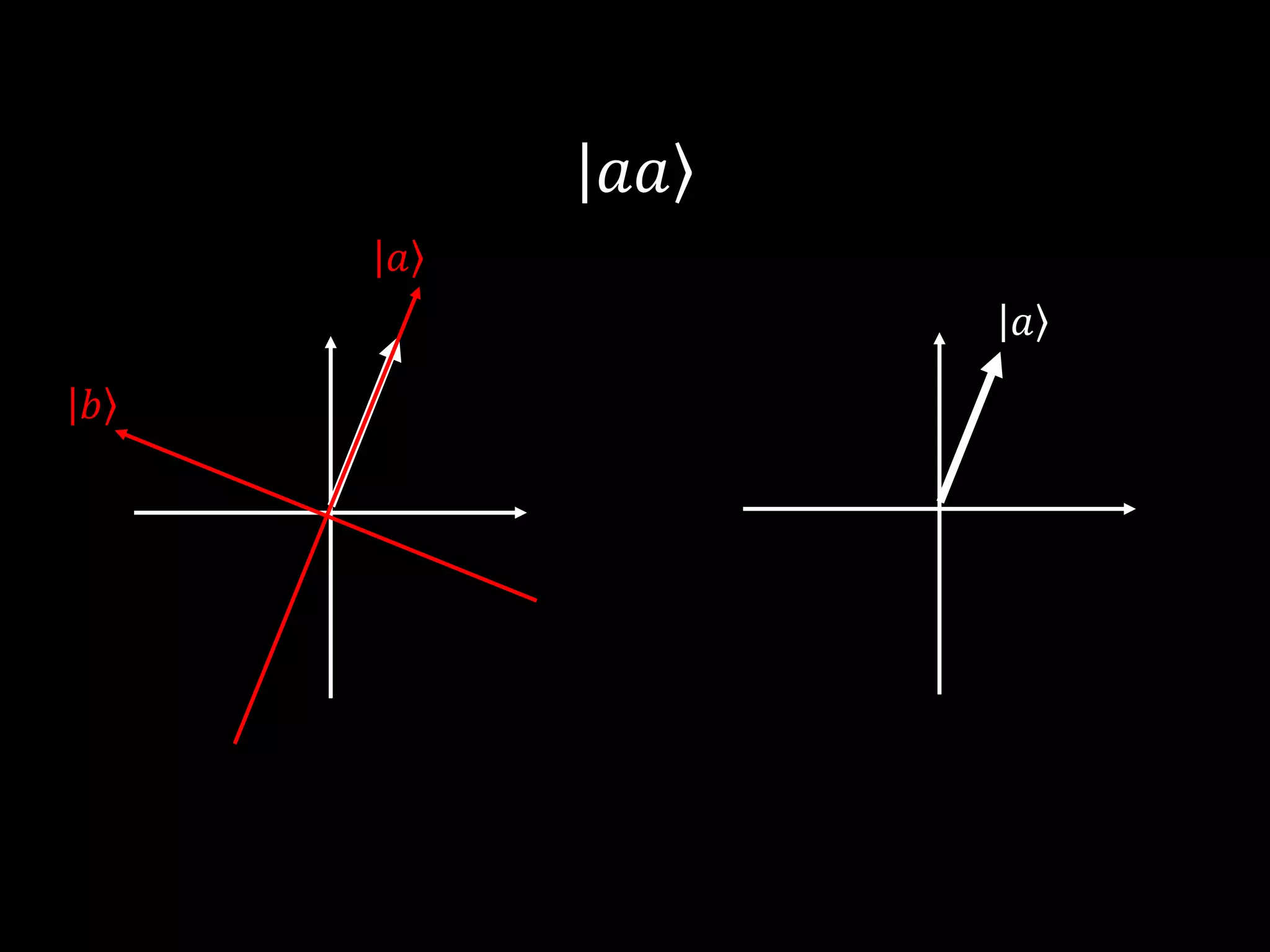
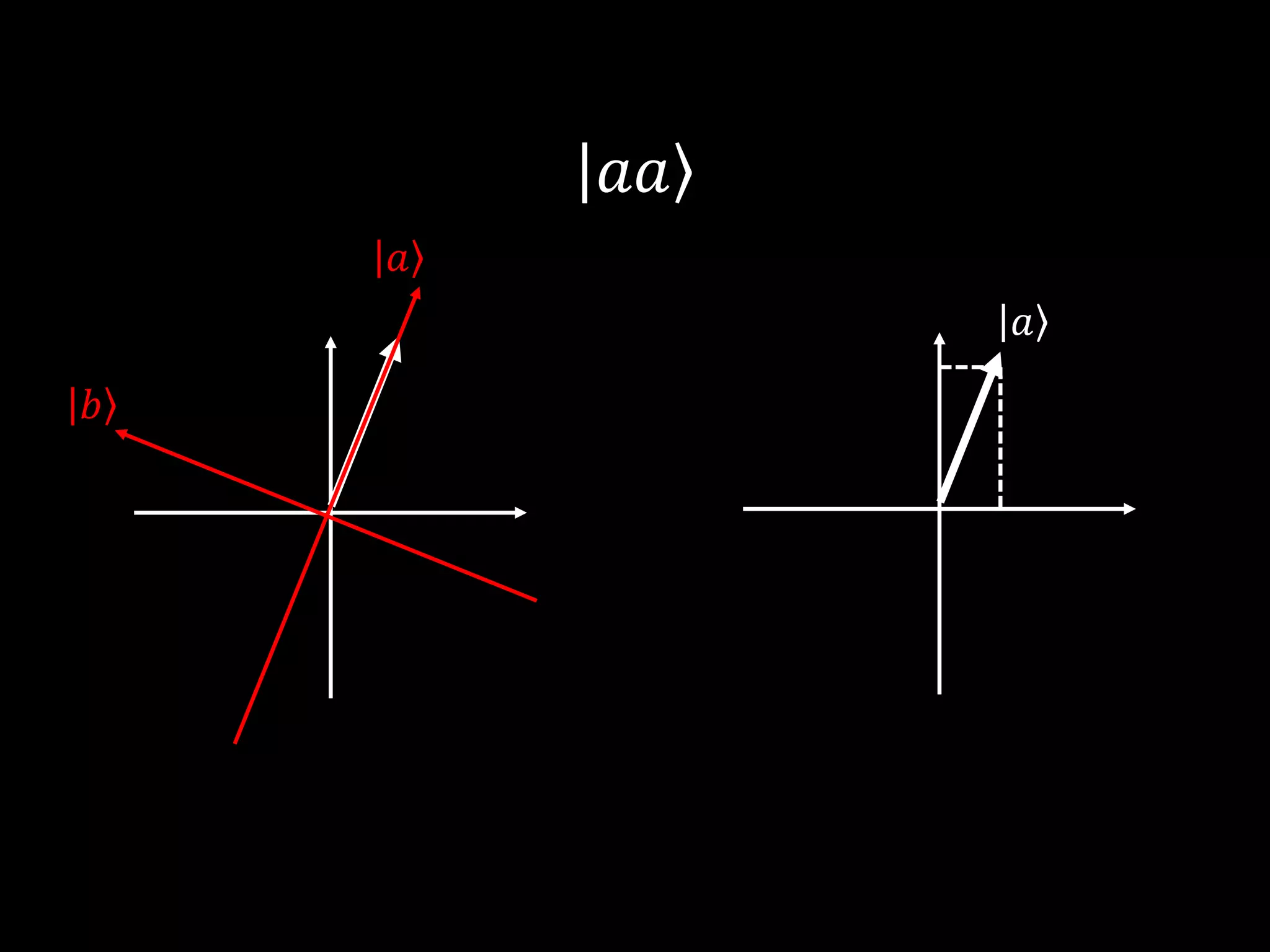
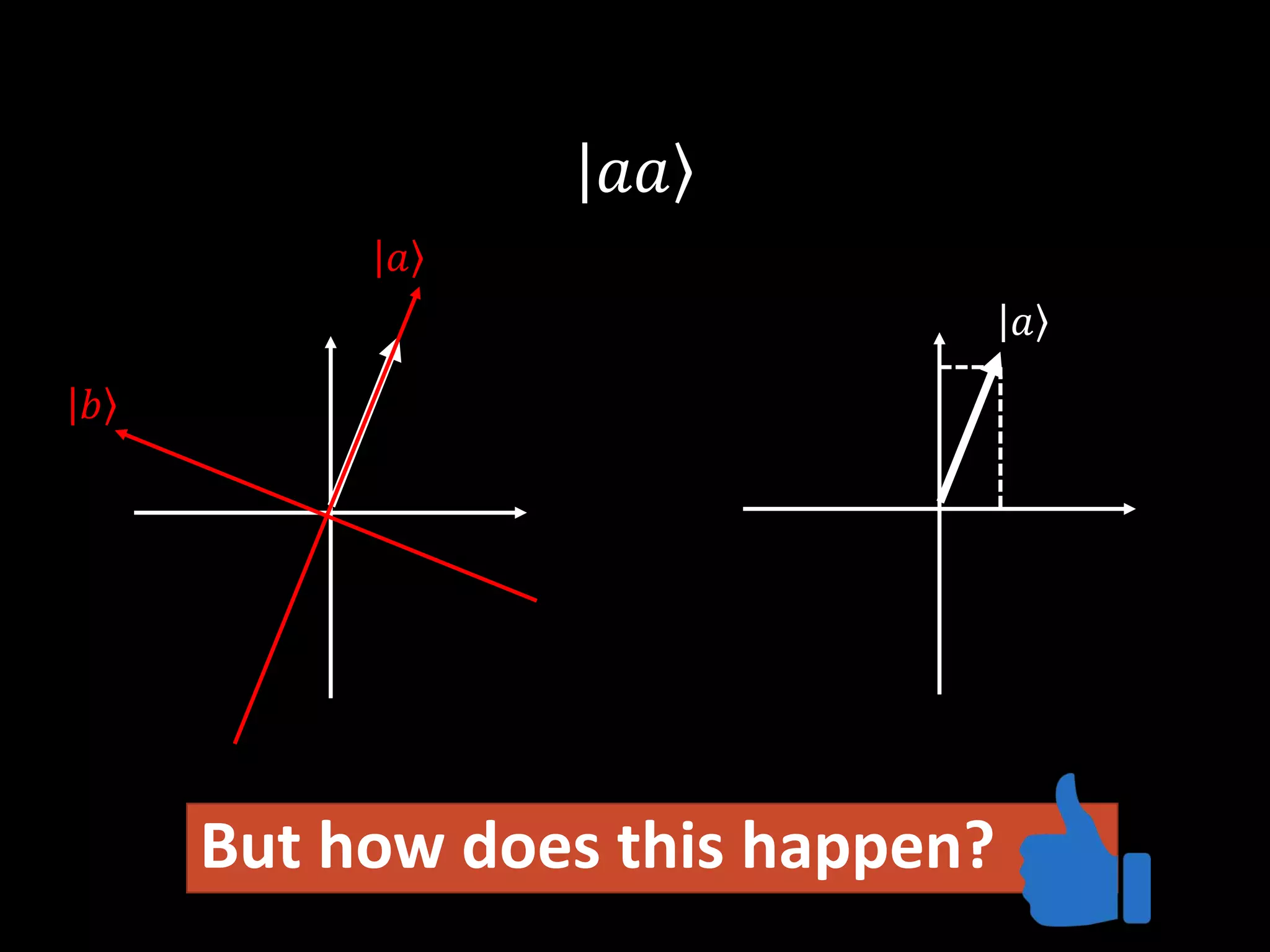
𝑎𝑎
𝑎
𝑎𝑎
𝑎
𝑏
𝑎
𝑎𝑎
𝑎
𝑏
But how does this happen?
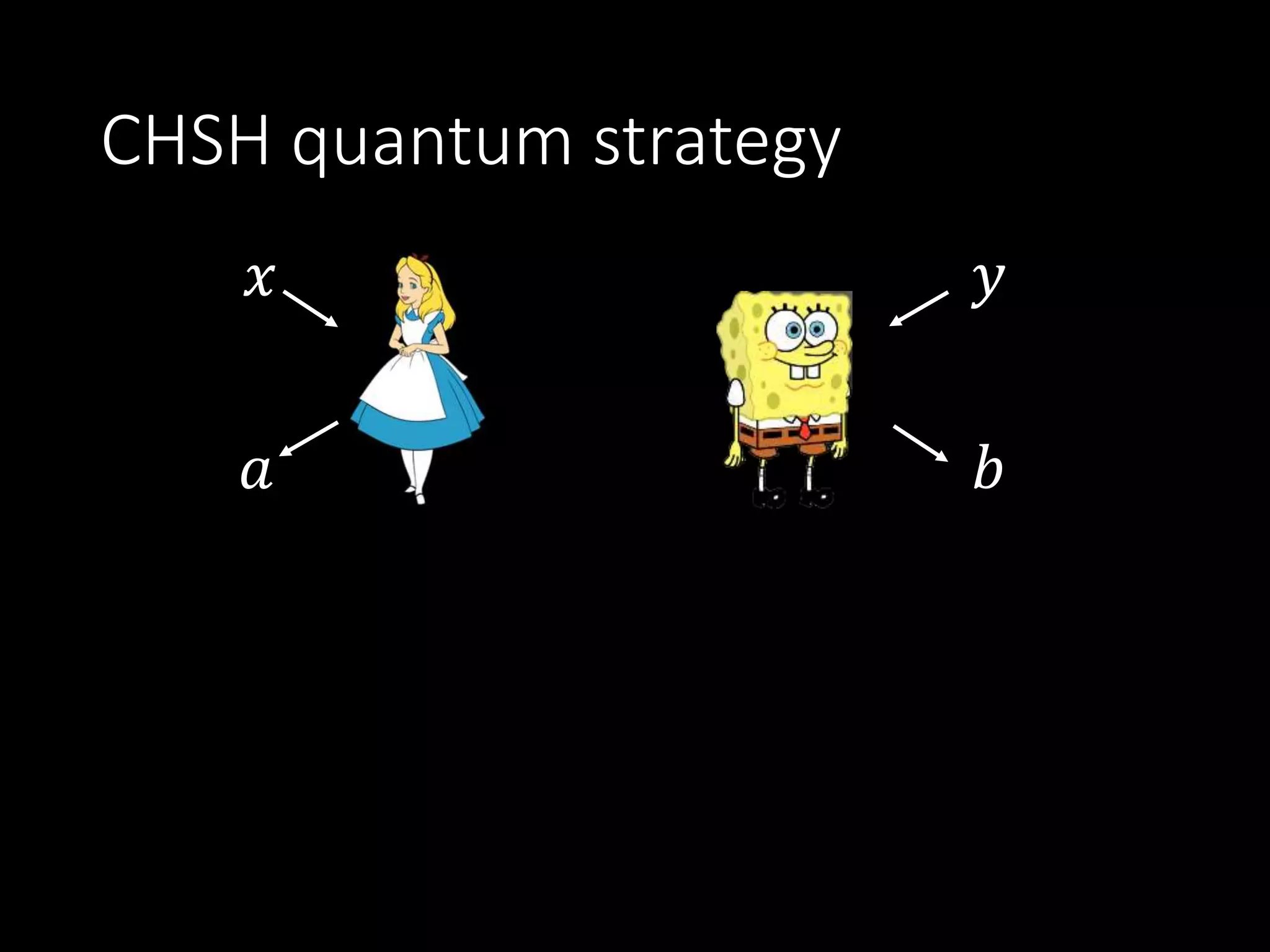
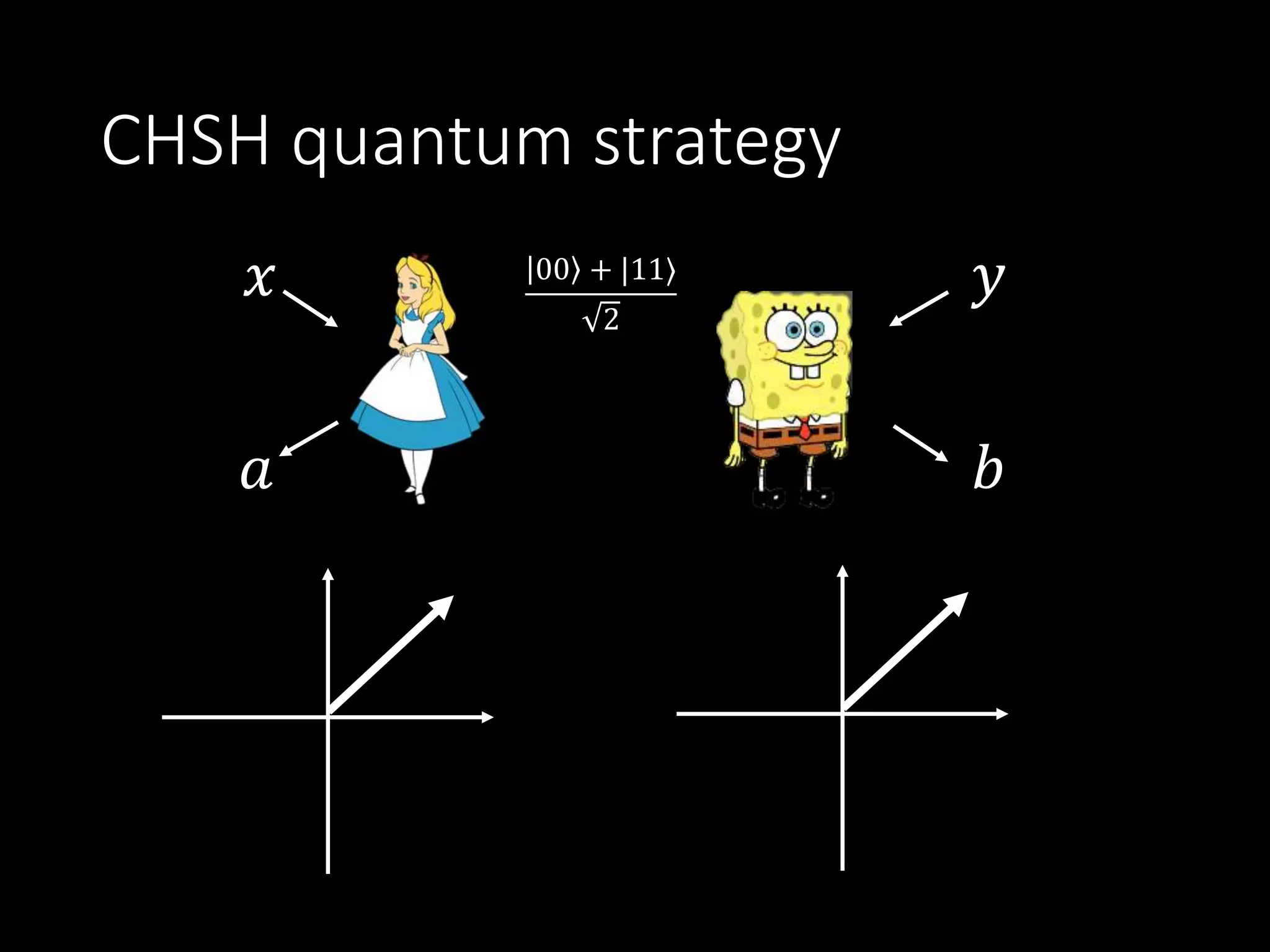
CHSH quantum strategy
𝑥 𝑦
𝑎 𝑏
CHSH quantum strategy
𝑥 𝑦
𝑎 𝑏
00 + |11⟩
2
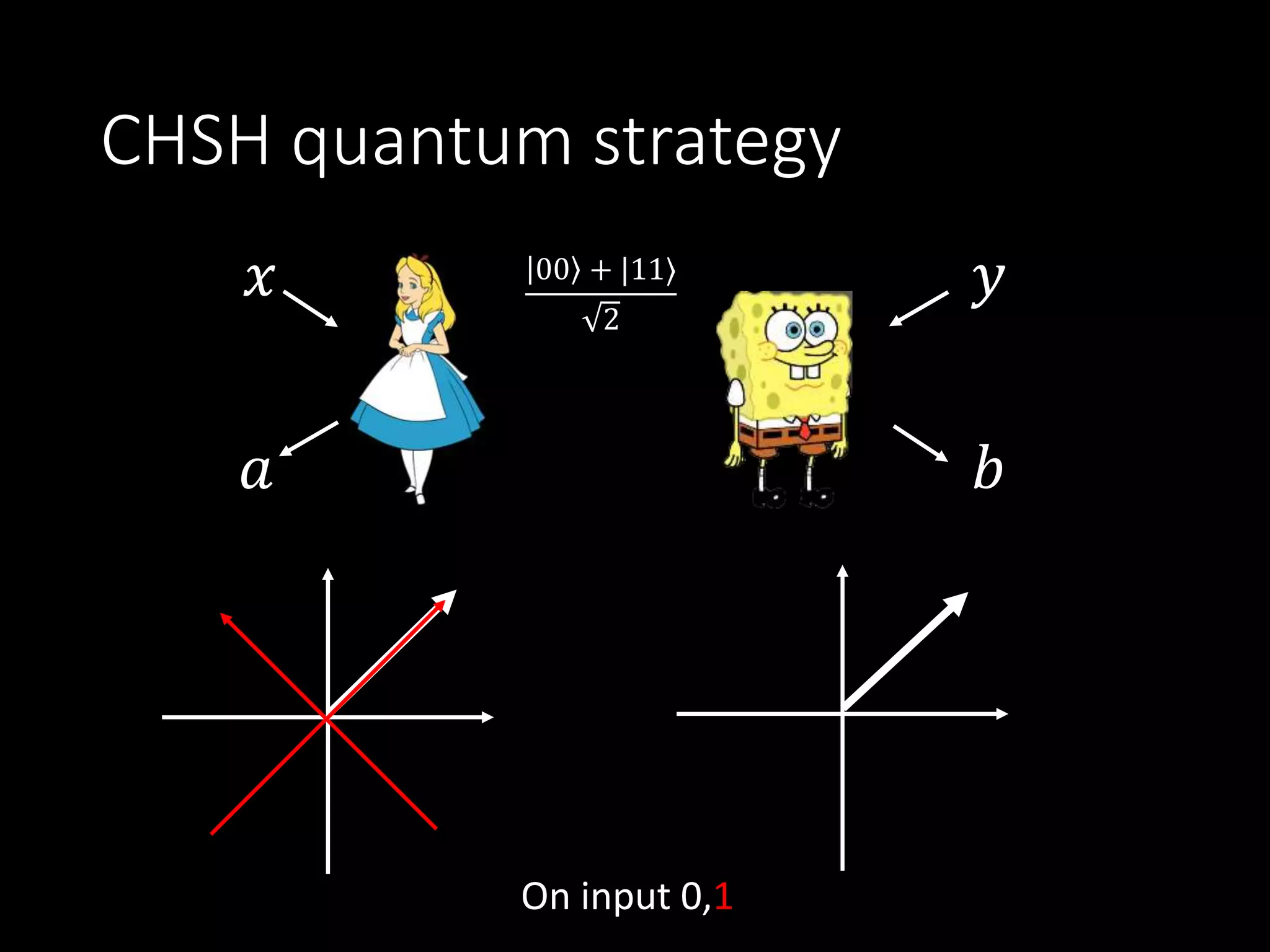
CHSH quantum strategy
𝑥 𝑦
𝑎 𝑏
00 + |11⟩
2
On input 0,1
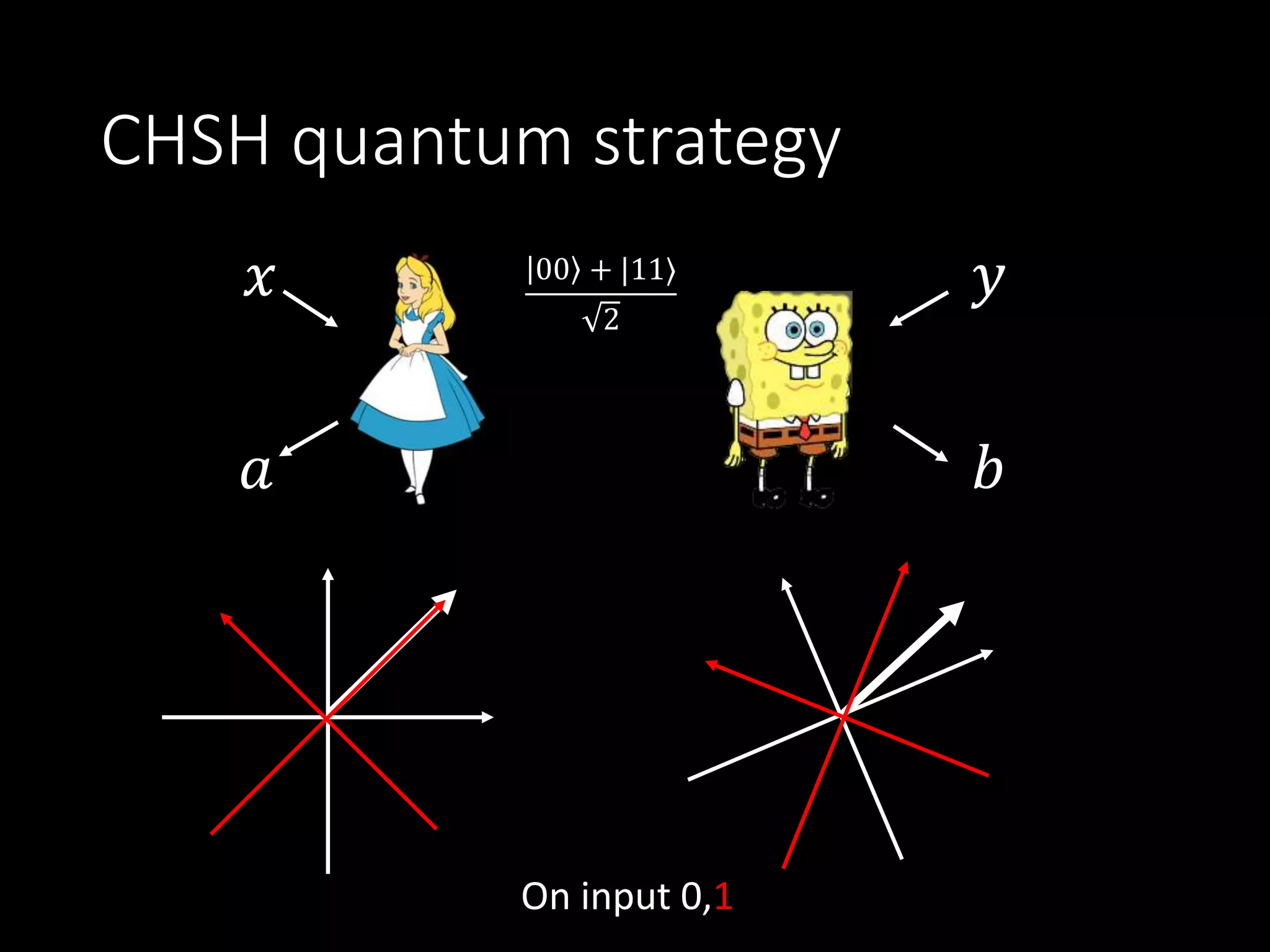
CHSH quantum strategy
𝑥 𝑦
𝑎 𝑏
00 + |11⟩
2
On input 0,1
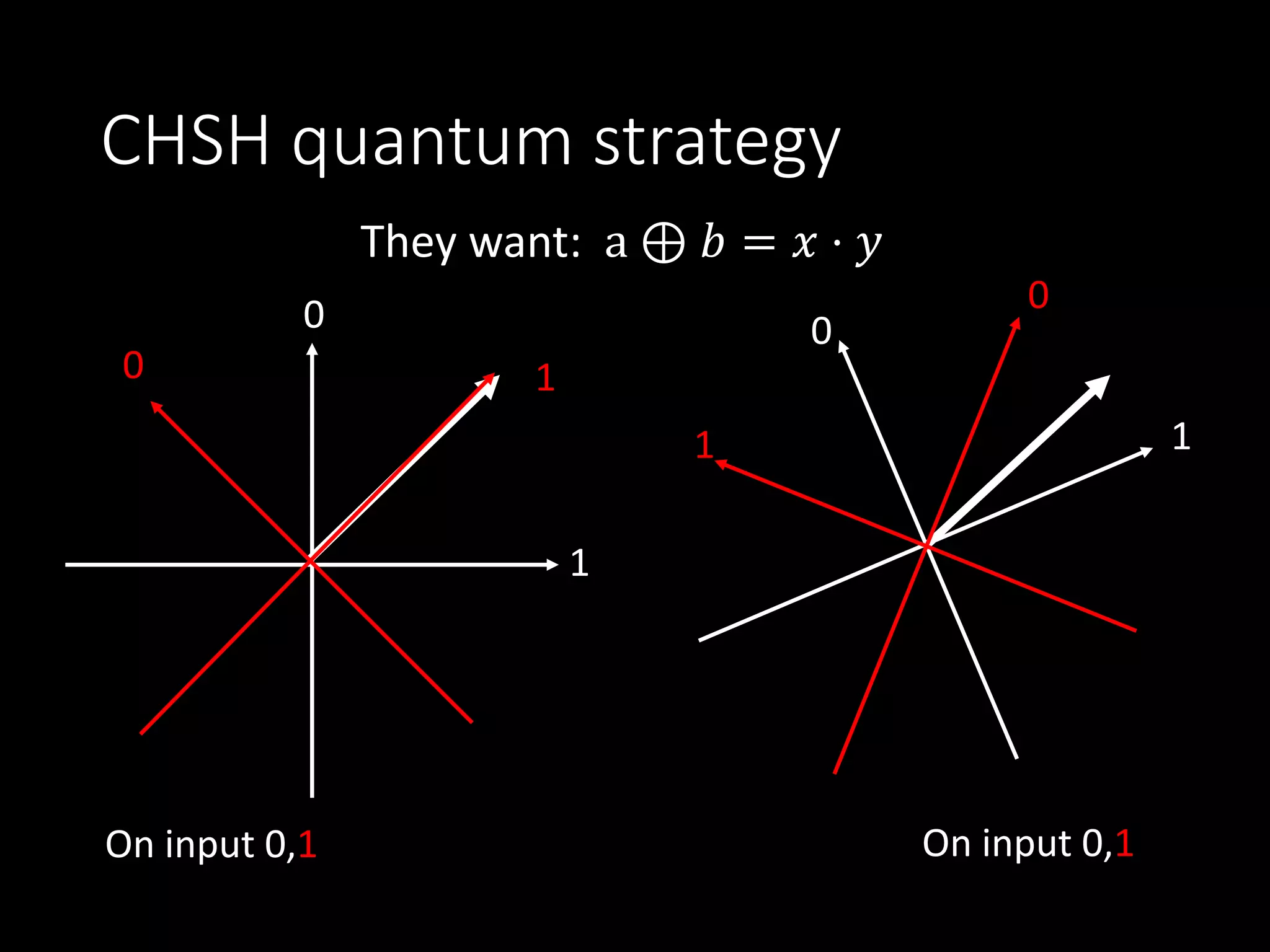
CHSH quantum strategy
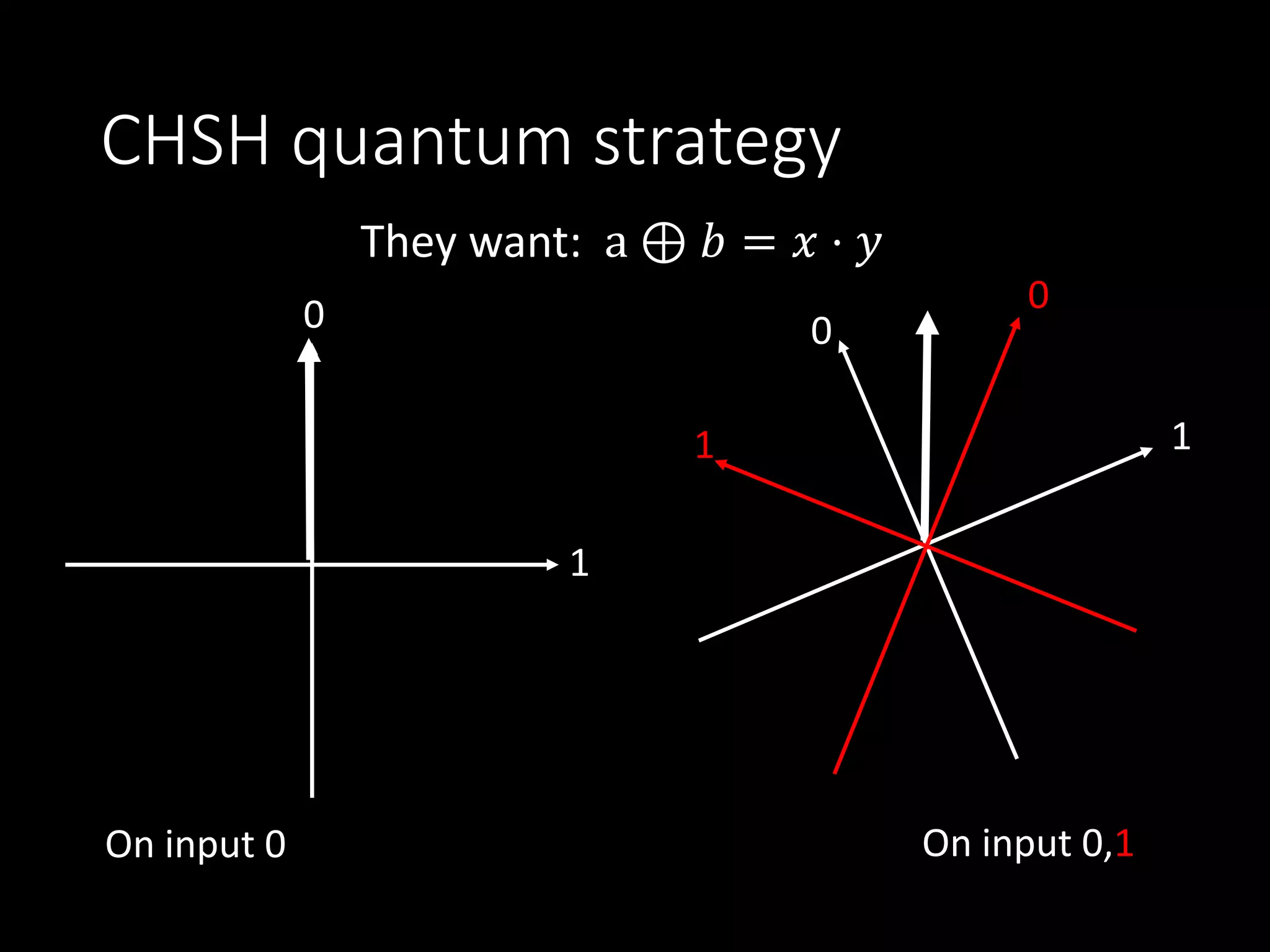
They want: a ⊕ 𝑏 = 𝑥 ⋅ 𝑦
On input 0,1
0
0
1
1
0 0
1
1
On input 0,1
CHSH quantum strategy
They want: a ⊕ 𝑏 = 𝑥 ⋅ 𝑦
On input 0
0
1
0 0
1
1
On input 0,1
CHSH quantum strategy
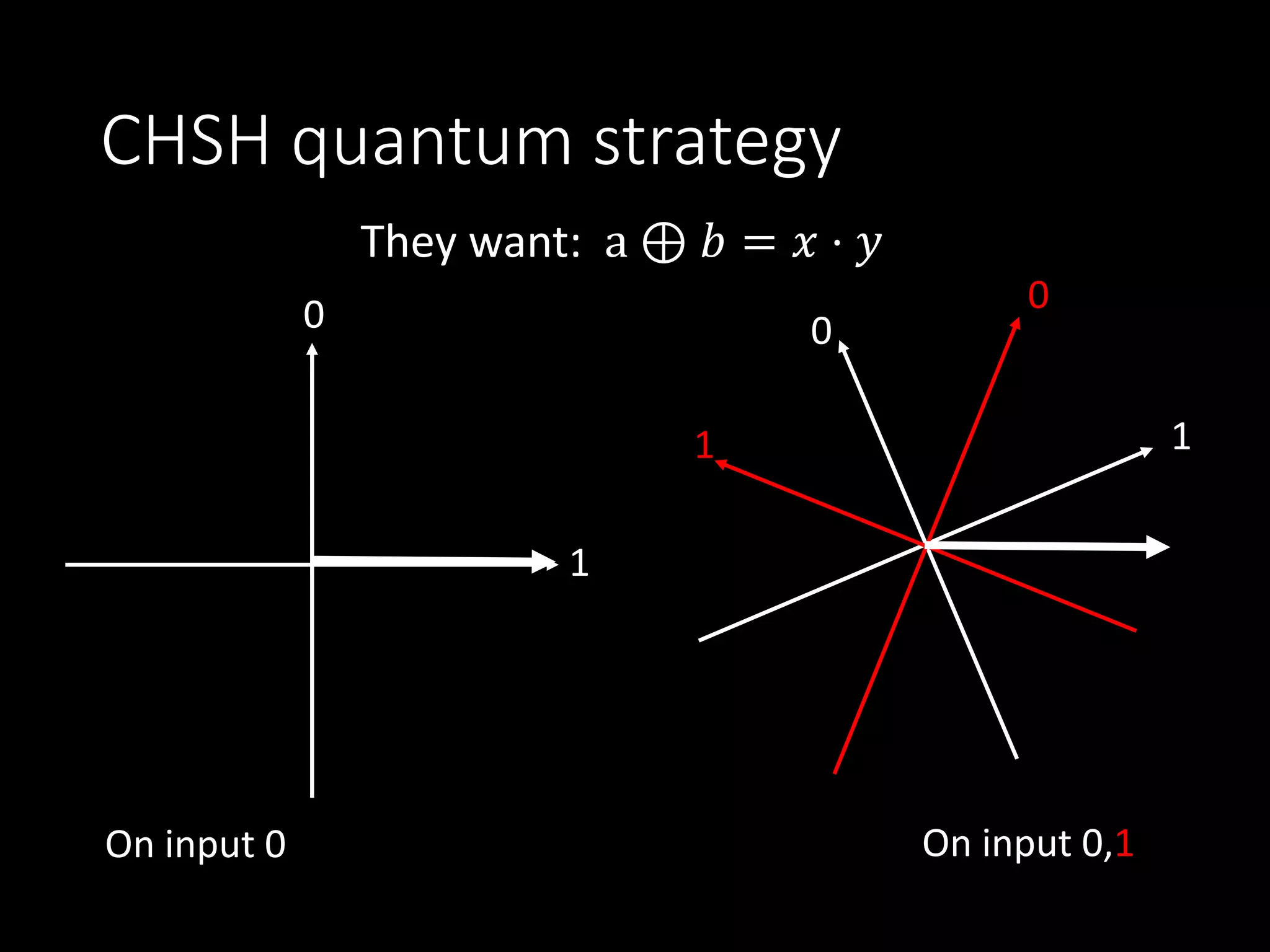
They want: a ⊕ 𝑏 = 𝑥 ⋅ 𝑦
On input 0
0
1
0 0
1
1
On input 0,1
CHSH quantum strategy
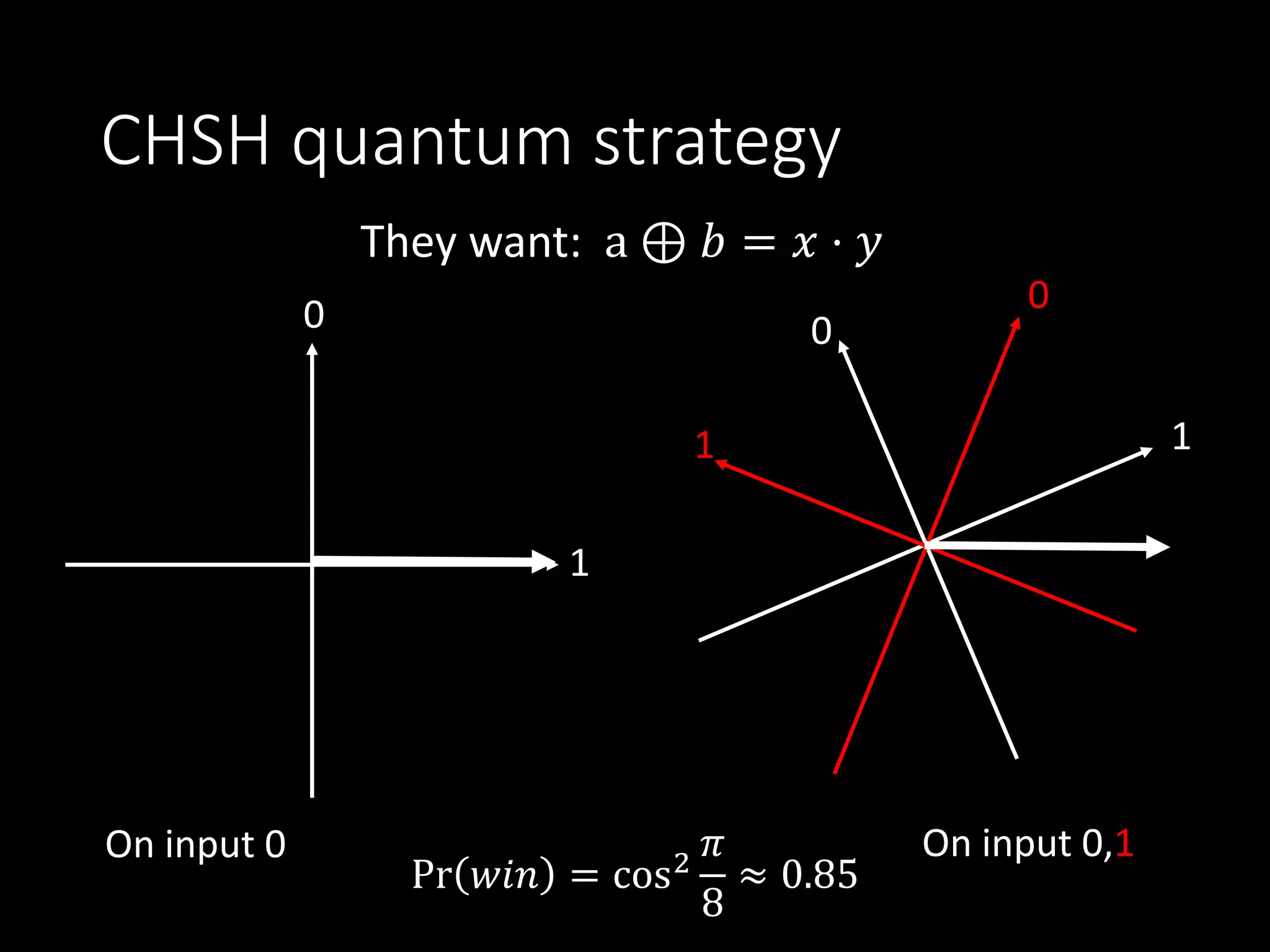
They want: a ⊕ 𝑏 = 𝑥 ⋅ 𝑦
On input 0
0
1
0 0
1
1
On input 0,1
Pr 𝑤𝑖𝑛 = cos2
𝜋
8
≈ 0.85
CHSH quantum strategy
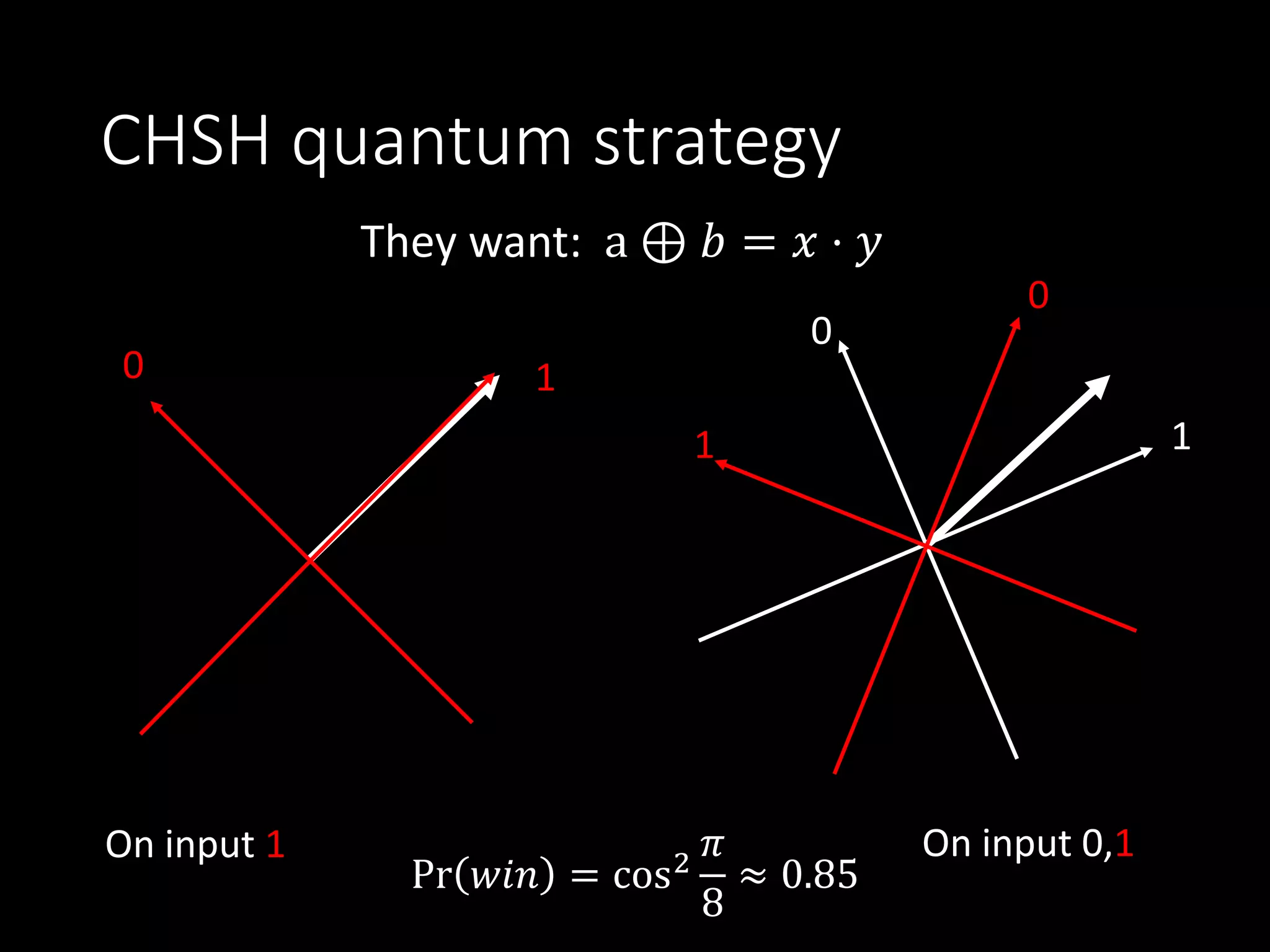
They want: a ⊕ 𝑏 = 𝑥 ⋅ 𝑦
On input 1
0
0
1
1
0
1
On input 0,1
Pr 𝑤𝑖𝑛 = cos2
𝜋
8
≈ 0.85
Bell inequality violation
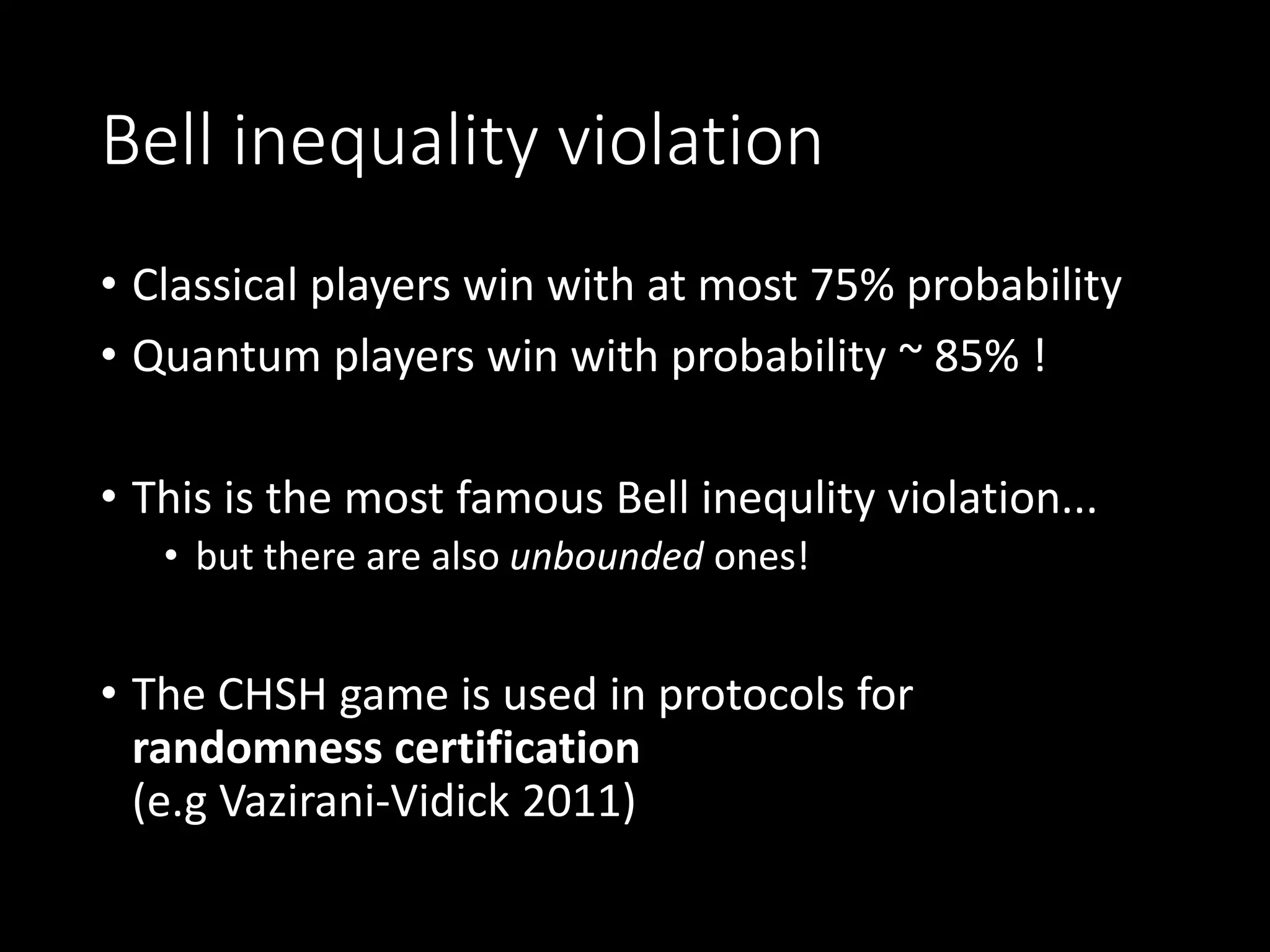
• Classical players win with at most 75% probability
• Quantum players win with probability ~ 85% !
• This is the most famous Bell inequlity violation...
• but there are also unbounded ones!
• The CHSH game is used in protocols for
randomness certification
(e.g Vazirani-Vidick 2011)
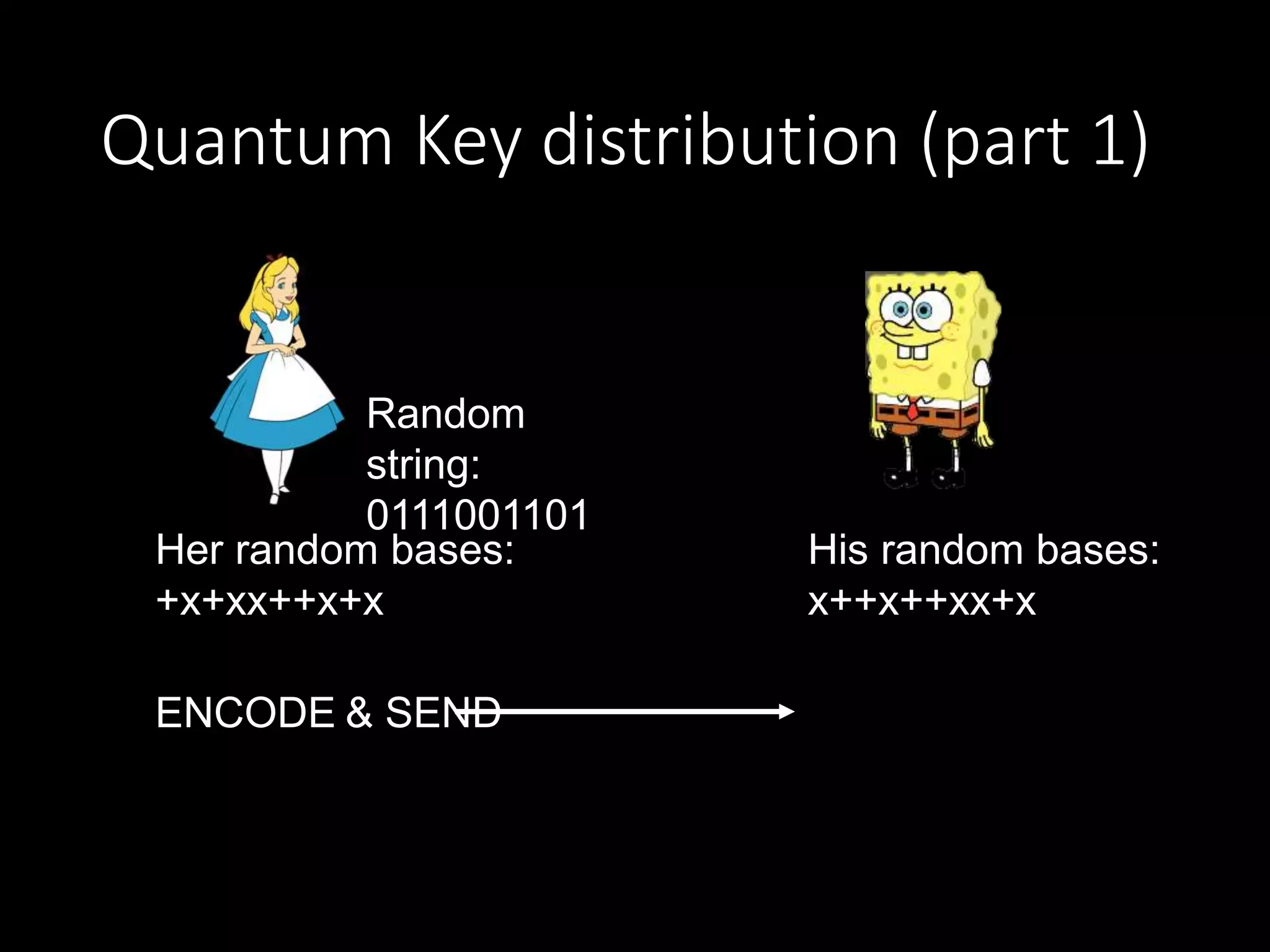
Quantum key distribution [BB’84]
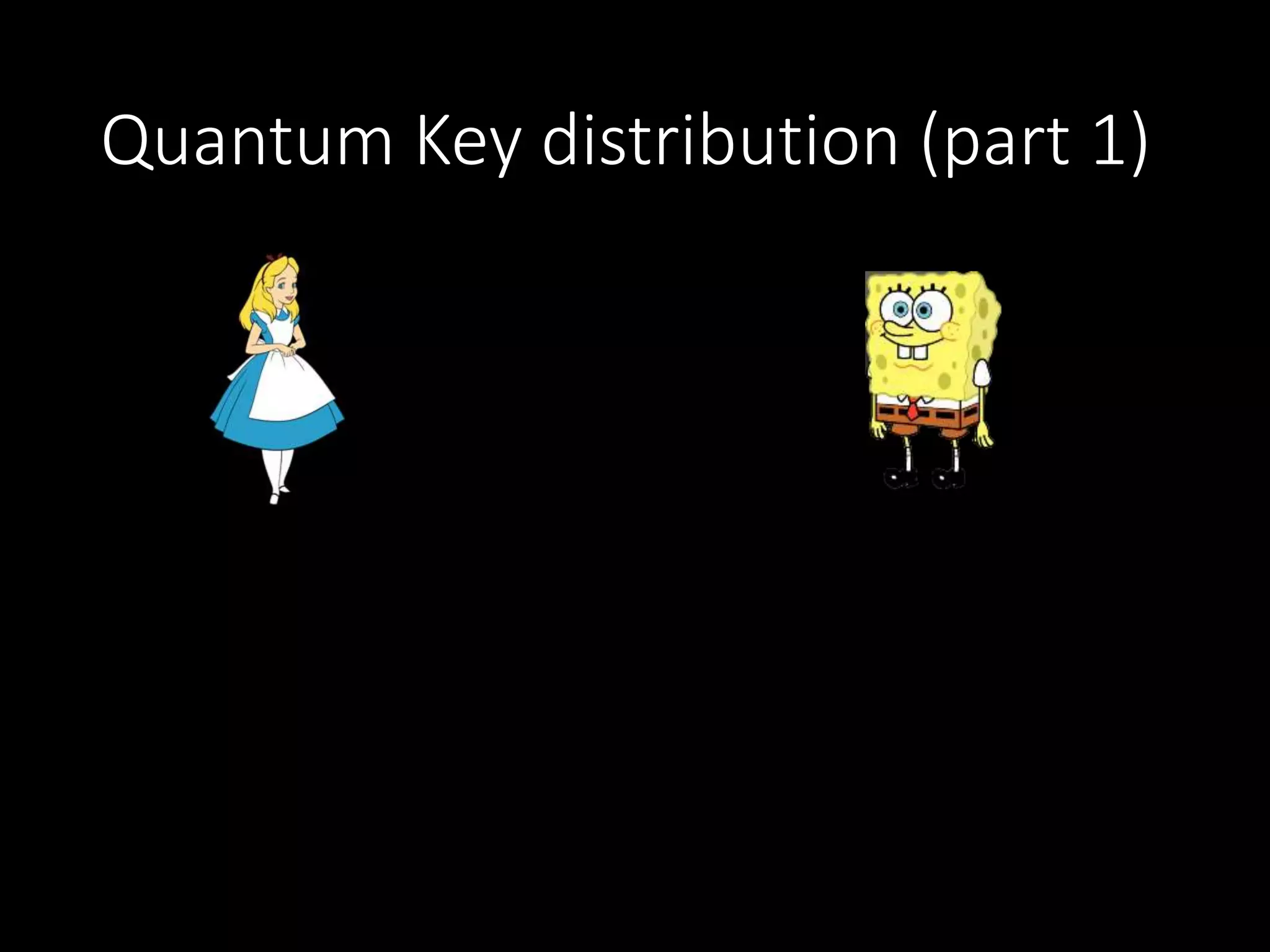
• Alice & Bob want to establish a secret key
• They communicate through a public quantum
channel
• They make use of the following 2 facts:
• No-cloning theorem: one cannot perfectly copy an
unknown quantum state.
• Information disturbance: if one does not know the
encoding basis, one cannot decode a qubit perfectly
without perturbing (collapsing) it.
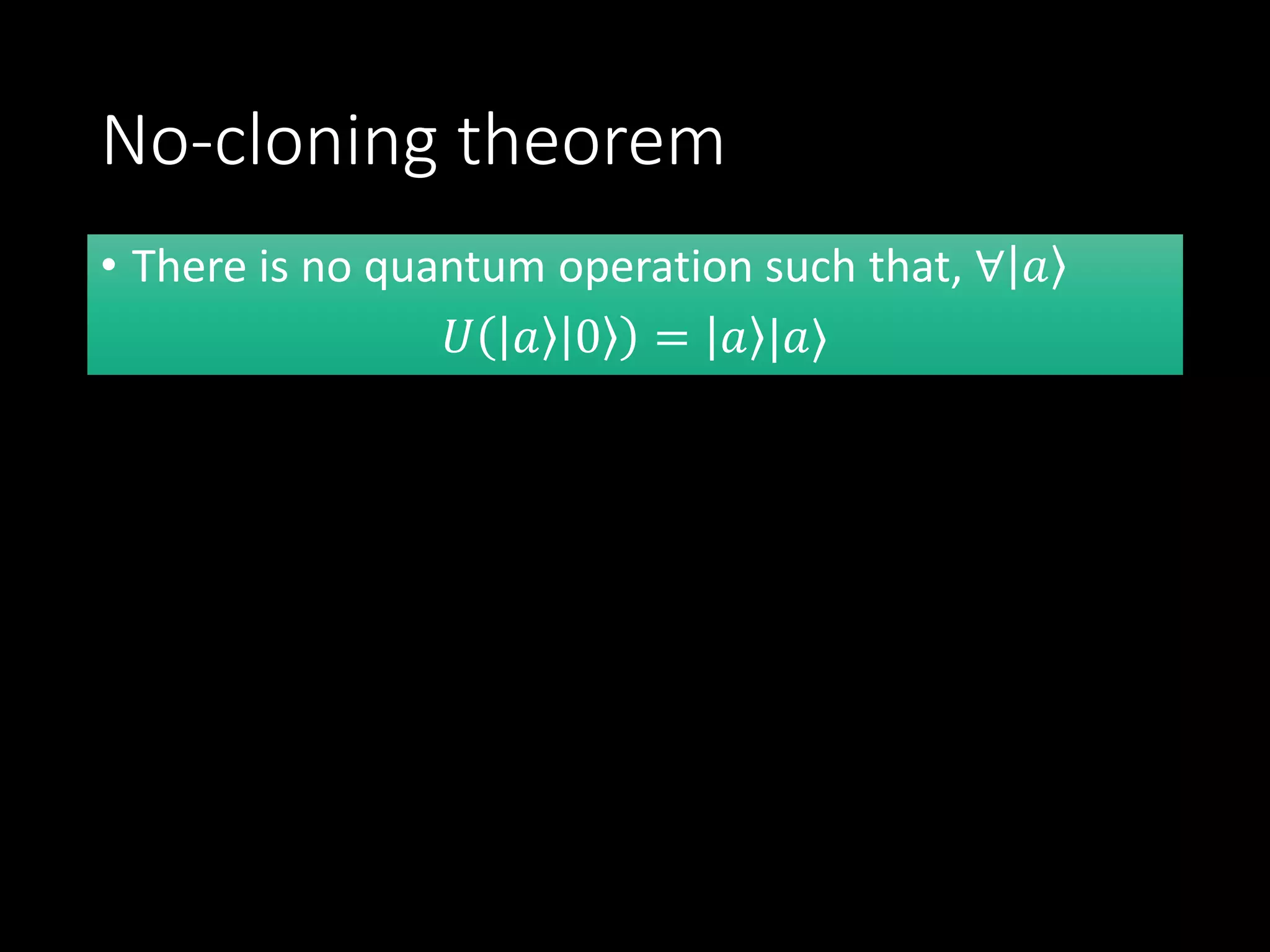
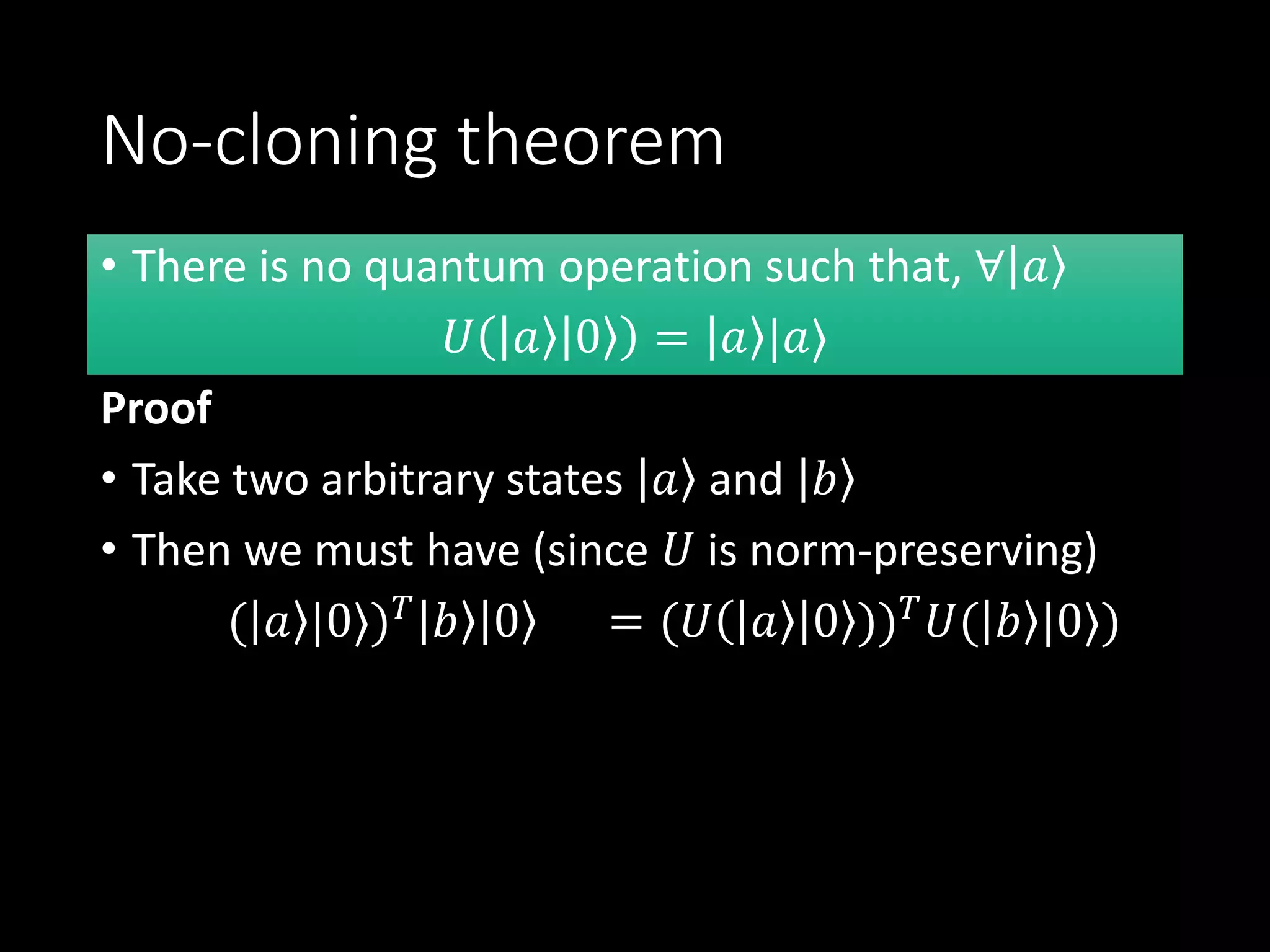
No-cloning theorem
• There is no quantum operation such that, ∀ 𝑎
𝑈 𝑎 0 = 𝑎 |𝑎⟩
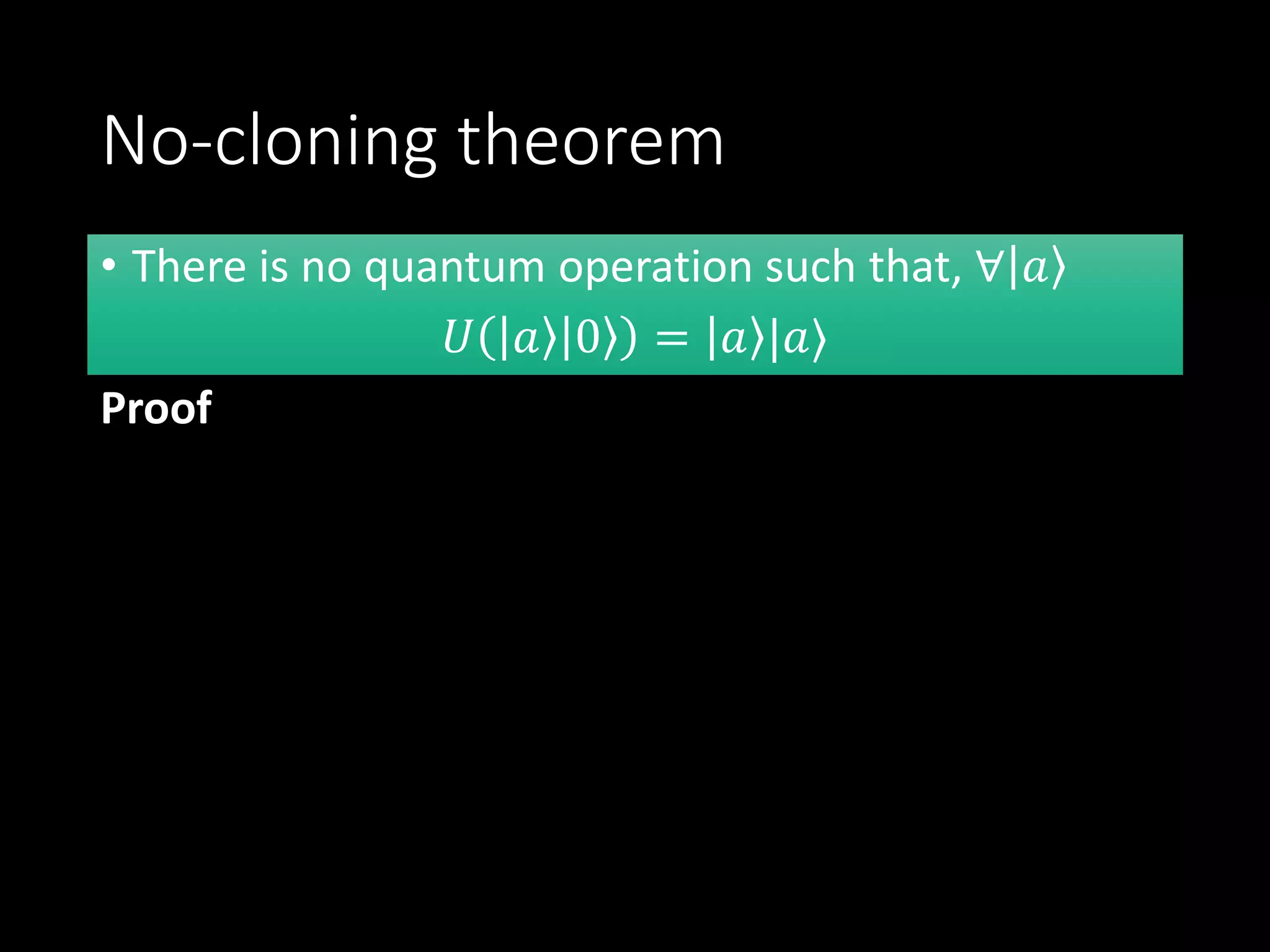
No-cloning theorem
• There is no quantum operation such that, ∀ 𝑎
𝑈 𝑎 0 = 𝑎 |𝑎⟩
Proof
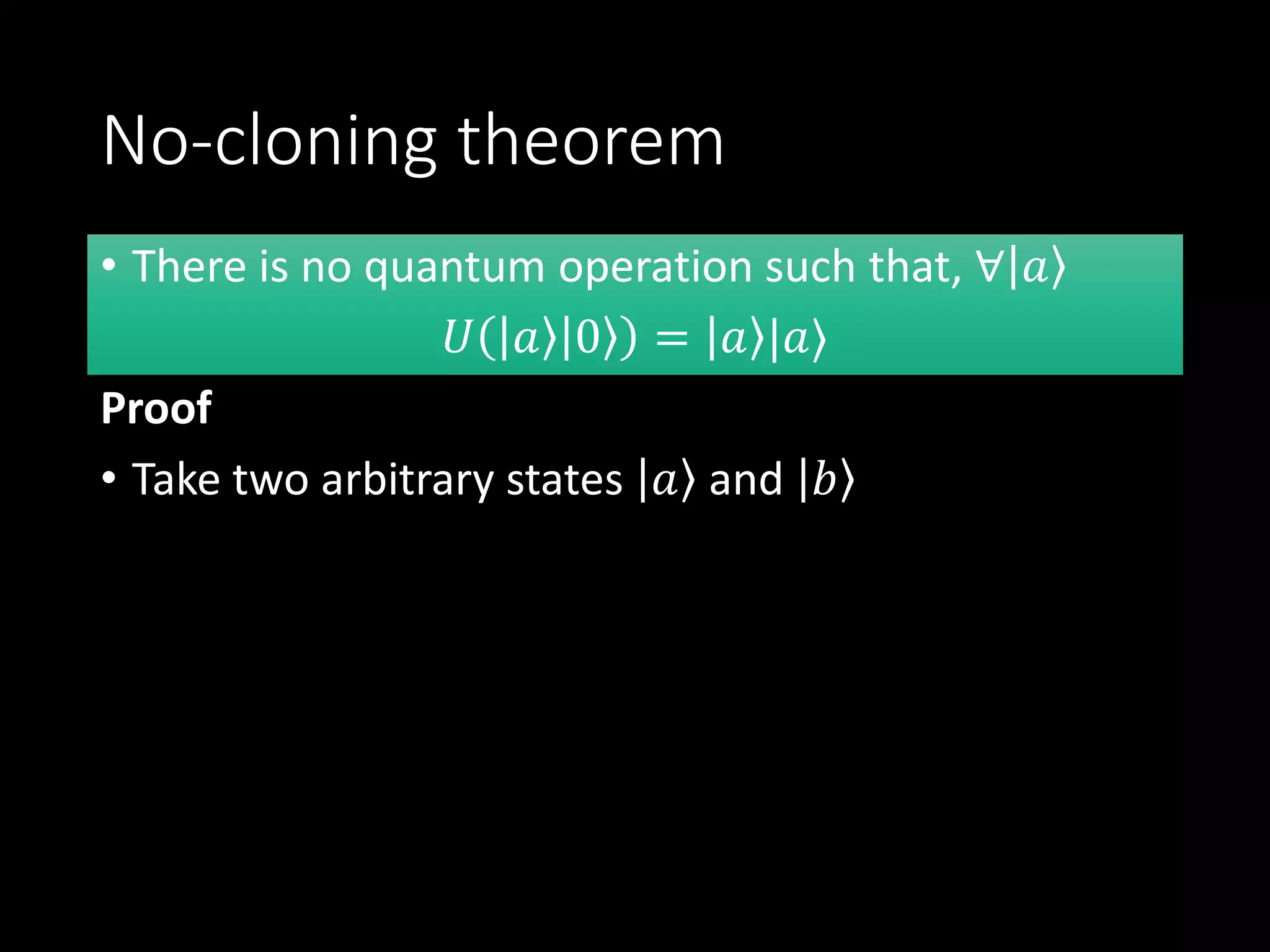
No-cloning theorem
• There is no quantum operation such that, ∀ 𝑎
𝑈 𝑎 0 = 𝑎 |𝑎⟩
Proof
• Take two arbitrary states 𝑎 and 𝑏
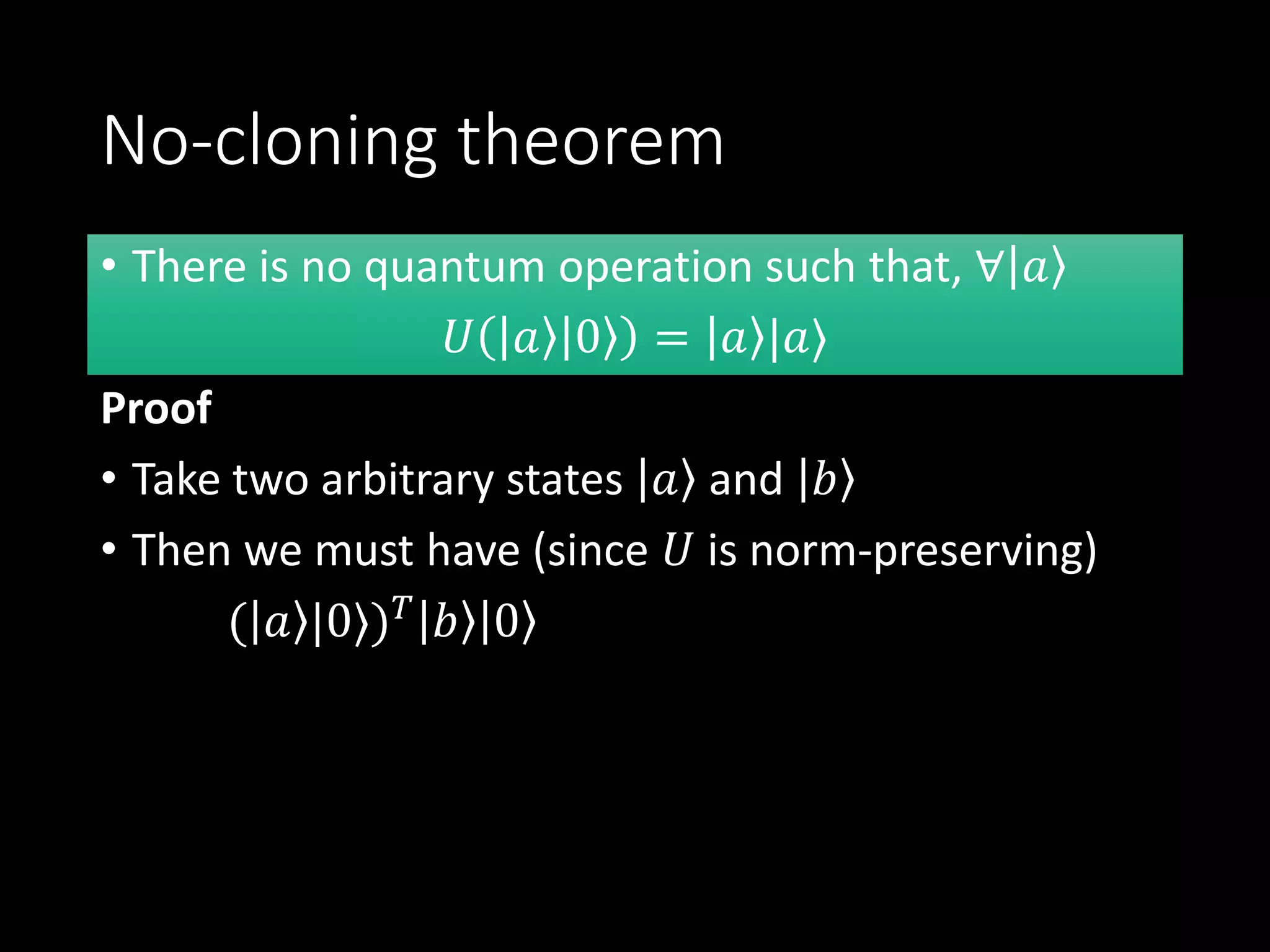
No-cloning theorem
• There is no quantum operation such that, ∀ 𝑎
𝑈 𝑎 0 = 𝑎 |𝑎⟩
Proof
• Take two arbitrary states 𝑎 and 𝑏
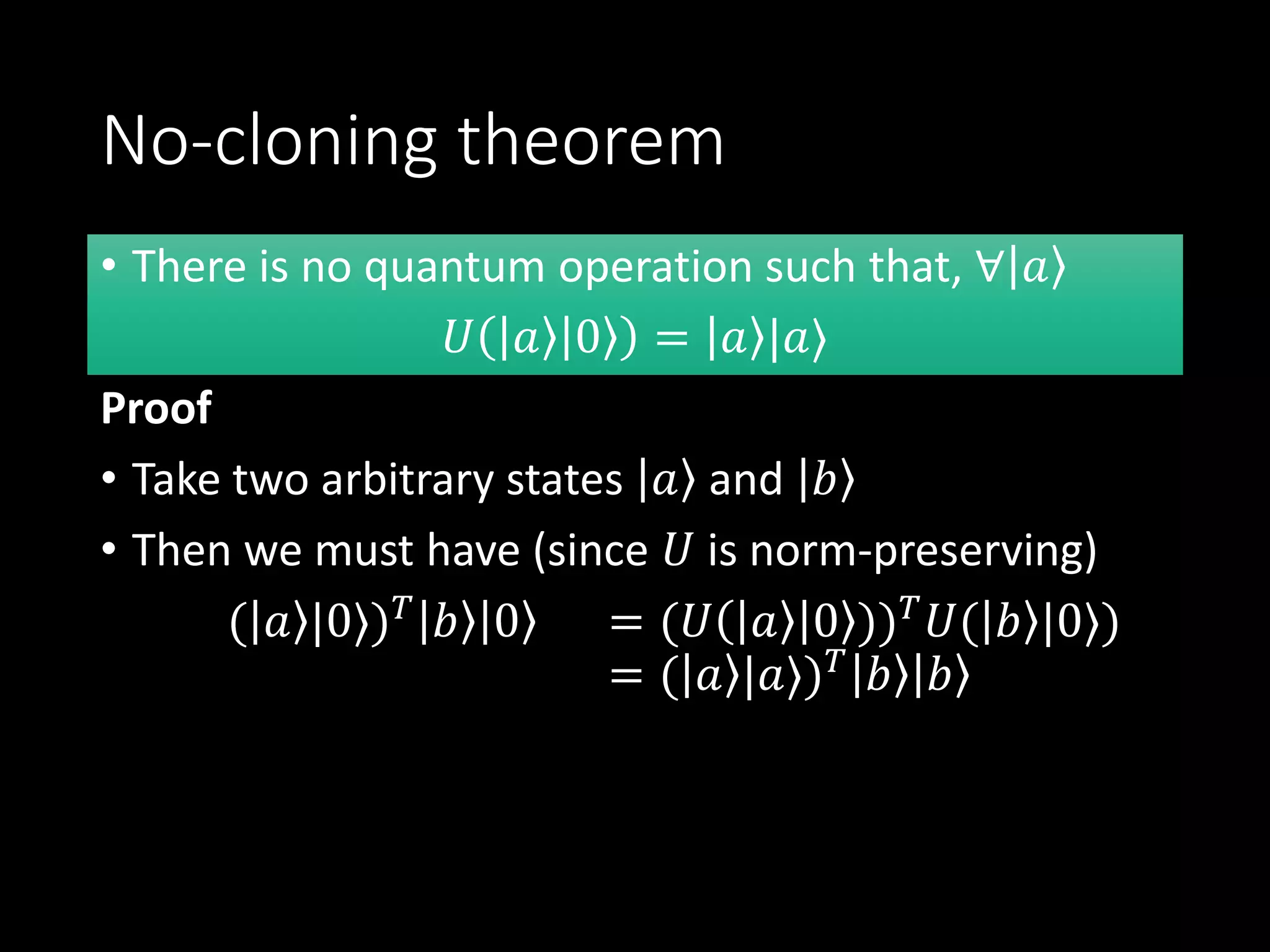
• Then we must have (since 𝑈 is norm-preserving)
( 𝑎 |0⟩) 𝑇 𝑏 0
No-cloning theorem
• There is no quantum operation such that, ∀ 𝑎
𝑈 𝑎 0 = 𝑎 |𝑎⟩
Proof
• Take two arbitrary states 𝑎 and 𝑏
• Then we must have (since 𝑈 is norm-preserving)
( 𝑎 |0⟩) 𝑇 𝑏 0 = (𝑈 𝑎 0 )) 𝑇 𝑈( 𝑏 |0⟩)
No-cloning theorem
• There is no quantum operation such that, ∀ 𝑎
𝑈 𝑎 0 = 𝑎 |𝑎⟩
Proof
• Take two arbitrary states 𝑎 and 𝑏
• Then we must have (since 𝑈 is norm-preserving)
( 𝑎 |0⟩) 𝑇 𝑏 0 = (𝑈 𝑎 0 )) 𝑇 𝑈( 𝑏 |0⟩)
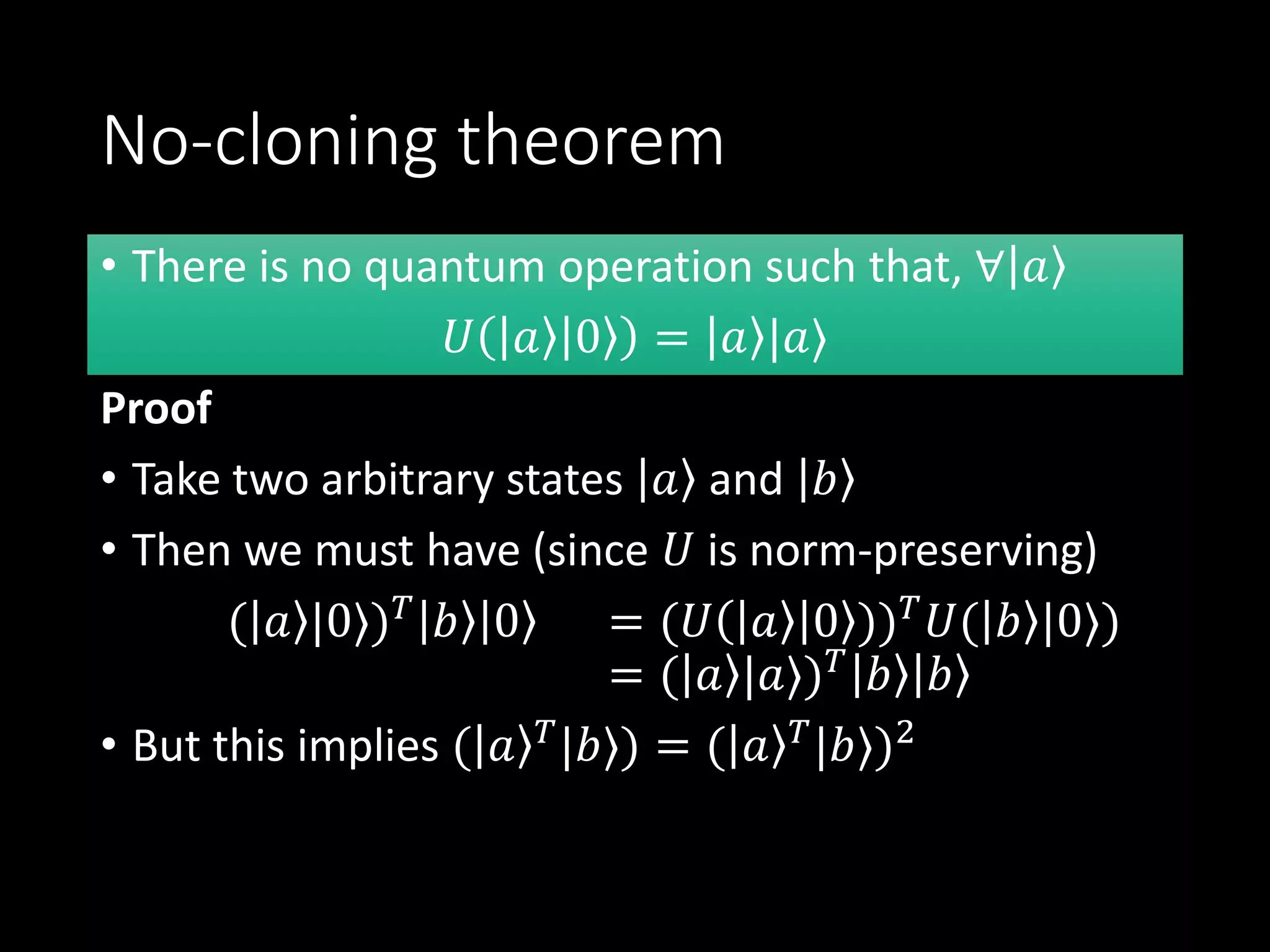
= ( 𝑎 |𝑎⟩) 𝑇 𝑏 𝑏
No-cloning theorem
• There is no quantum operation such that, ∀ 𝑎
𝑈 𝑎 0 = 𝑎 |𝑎⟩
Proof
• Take two arbitrary states 𝑎 and 𝑏
• Then we must have (since 𝑈 is norm-preserving)
( 𝑎 |0⟩) 𝑇 𝑏 0 = (𝑈 𝑎 0 )) 𝑇 𝑈( 𝑏 |0⟩)
= ( 𝑎 |𝑎⟩) 𝑇 𝑏 𝑏
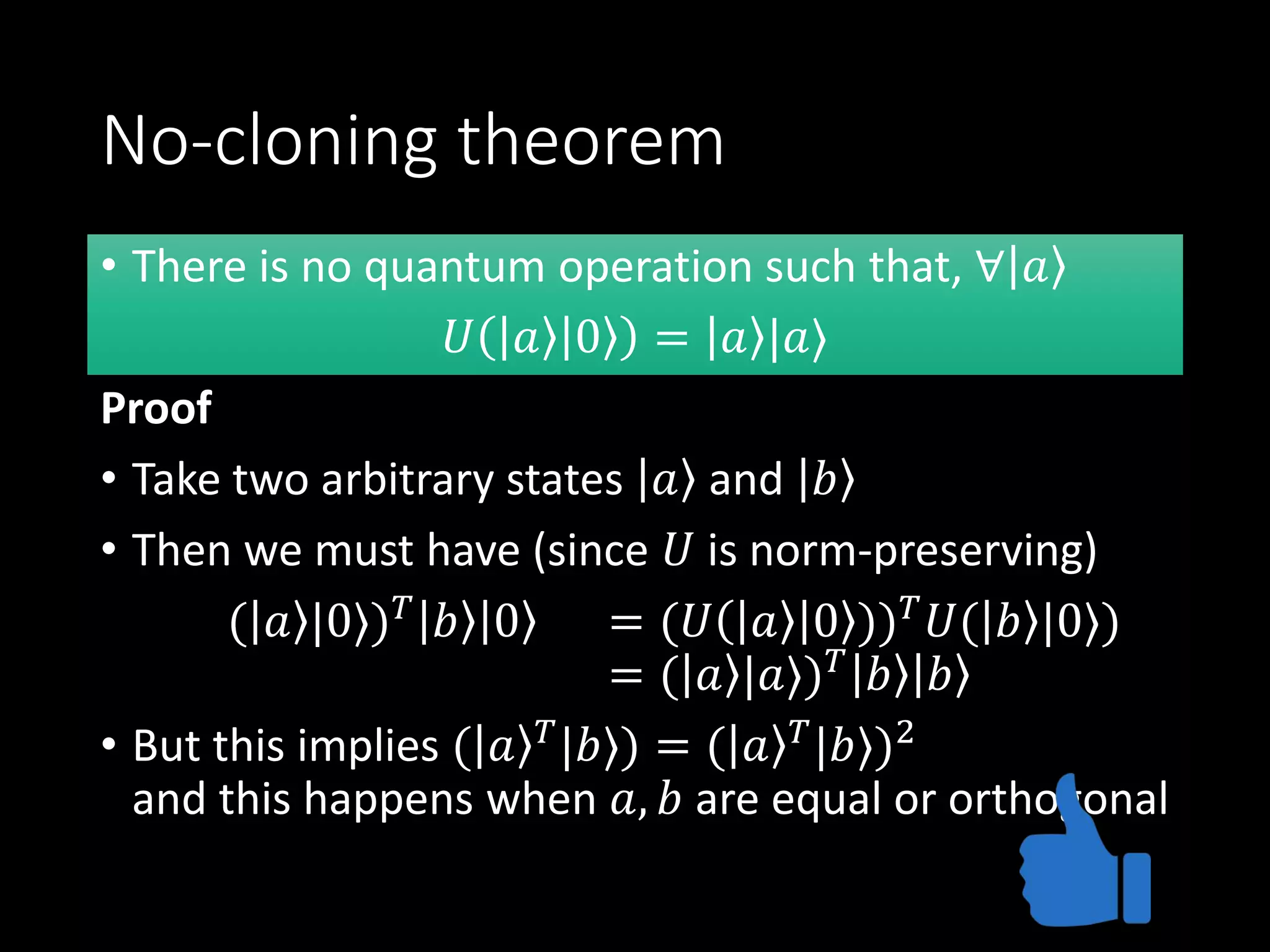
• But this implies ( 𝑎 𝑇|𝑏⟩) = ( 𝑎 𝑇|𝑏⟩)2
No-cloning theorem
• There is no quantum operation such that, ∀ 𝑎
𝑈 𝑎 0 = 𝑎 |𝑎⟩
Proof
• Take two arbitrary states 𝑎 and 𝑏
• Then we must have (since 𝑈 is norm-preserving)
( 𝑎 |0⟩) 𝑇 𝑏 0 = (𝑈 𝑎 0 )) 𝑇 𝑈( 𝑏 |0⟩)
= ( 𝑎 |𝑎⟩) 𝑇 𝑏 𝑏
• But this implies ( 𝑎 𝑇|𝑏⟩) = ( 𝑎 𝑇|𝑏⟩)2
and this happens when 𝑎, 𝑏 are equal or orthogonal
Quantum Key distribution (part 1)
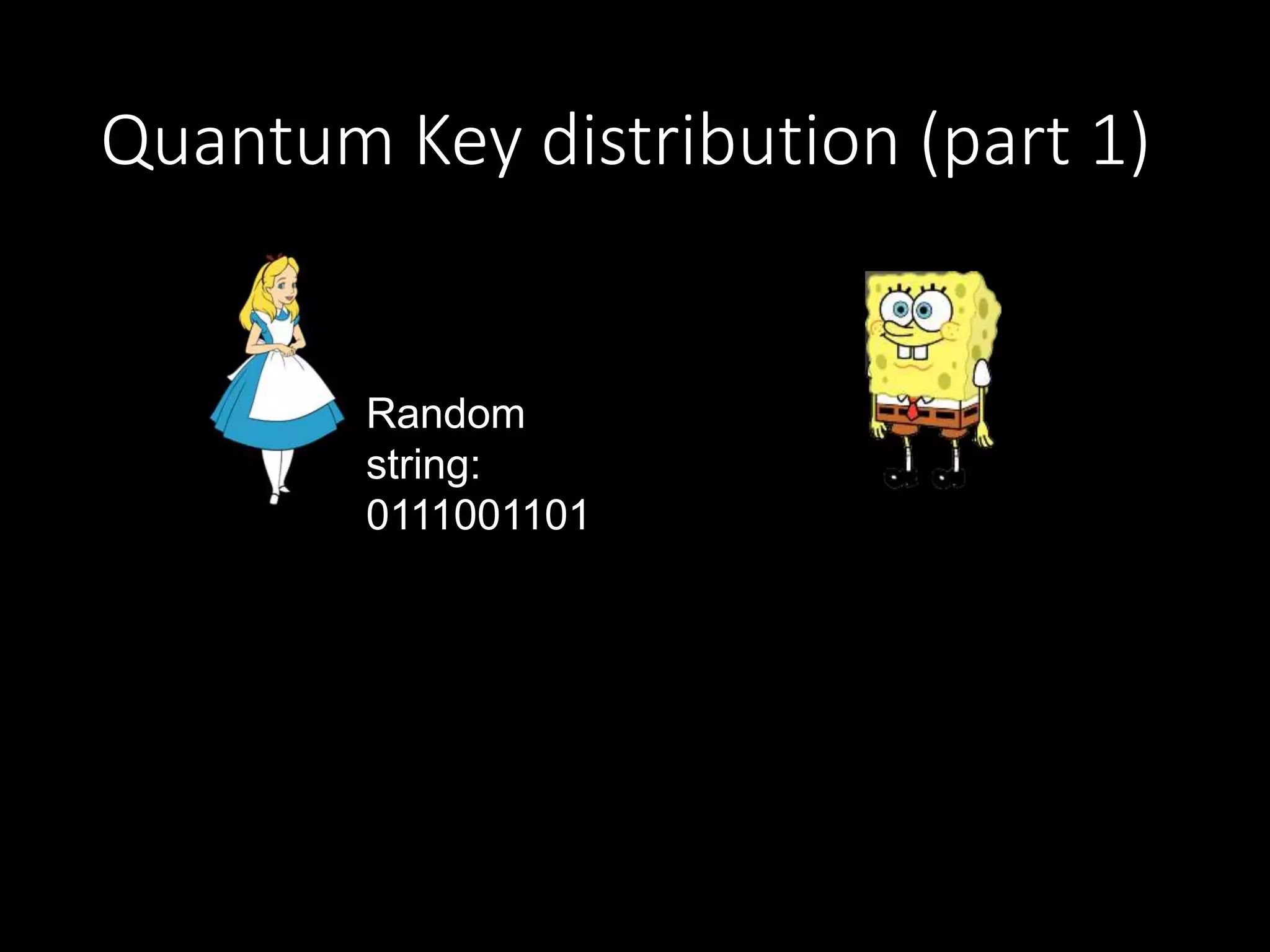
Random
string:
0111001101
Quantum Key distribution (part 1)
Random
string:
0111001101
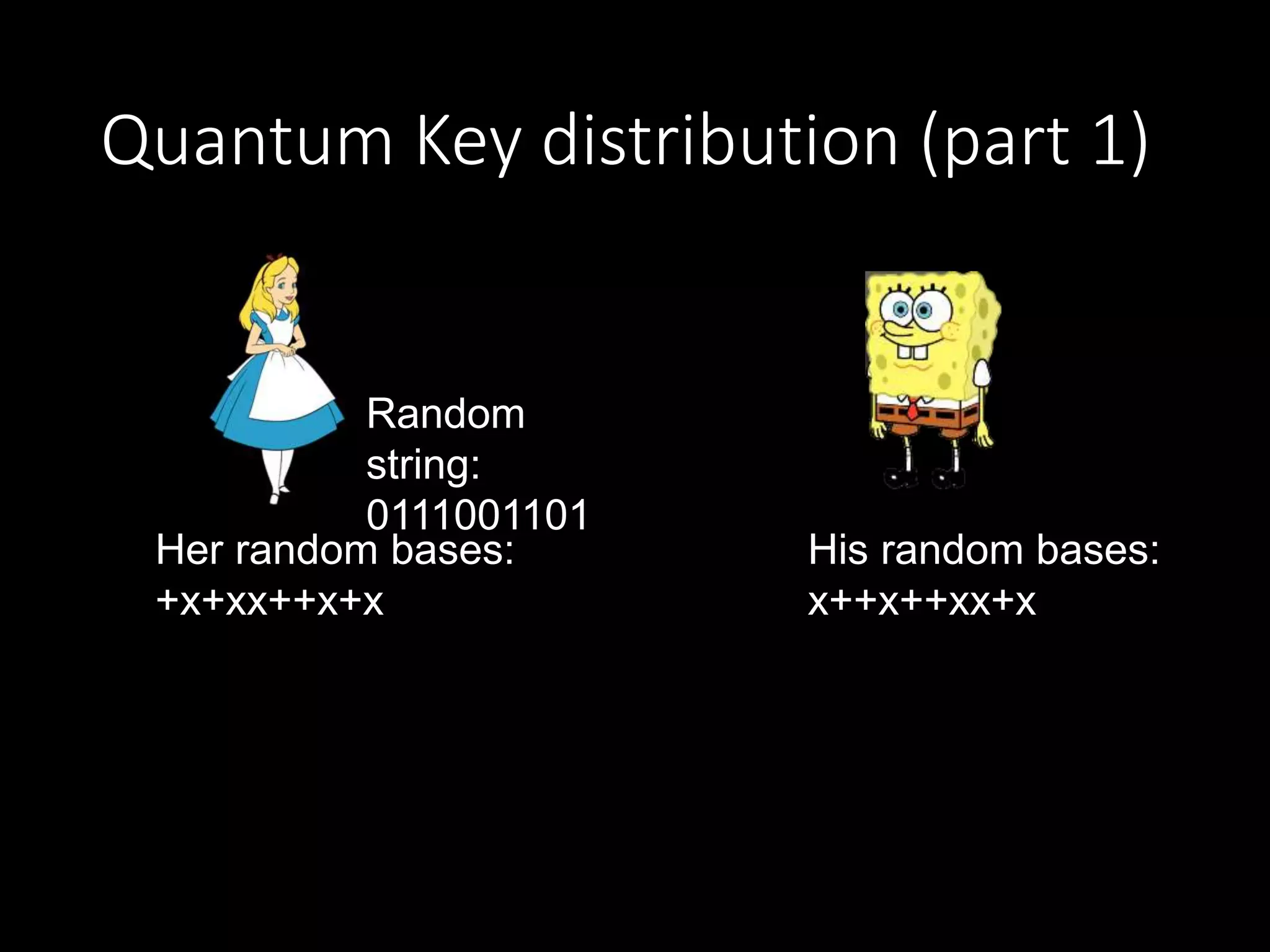
Her random bases:
+x+xx++x+x
His random bases:
x++x++xx+x
Quantum Key distribution (part 1)
Random
string:
0111001101
Her random bases:
+x+xx++x+x
His random bases:
x++x++xx+x
ENCODE & SEND
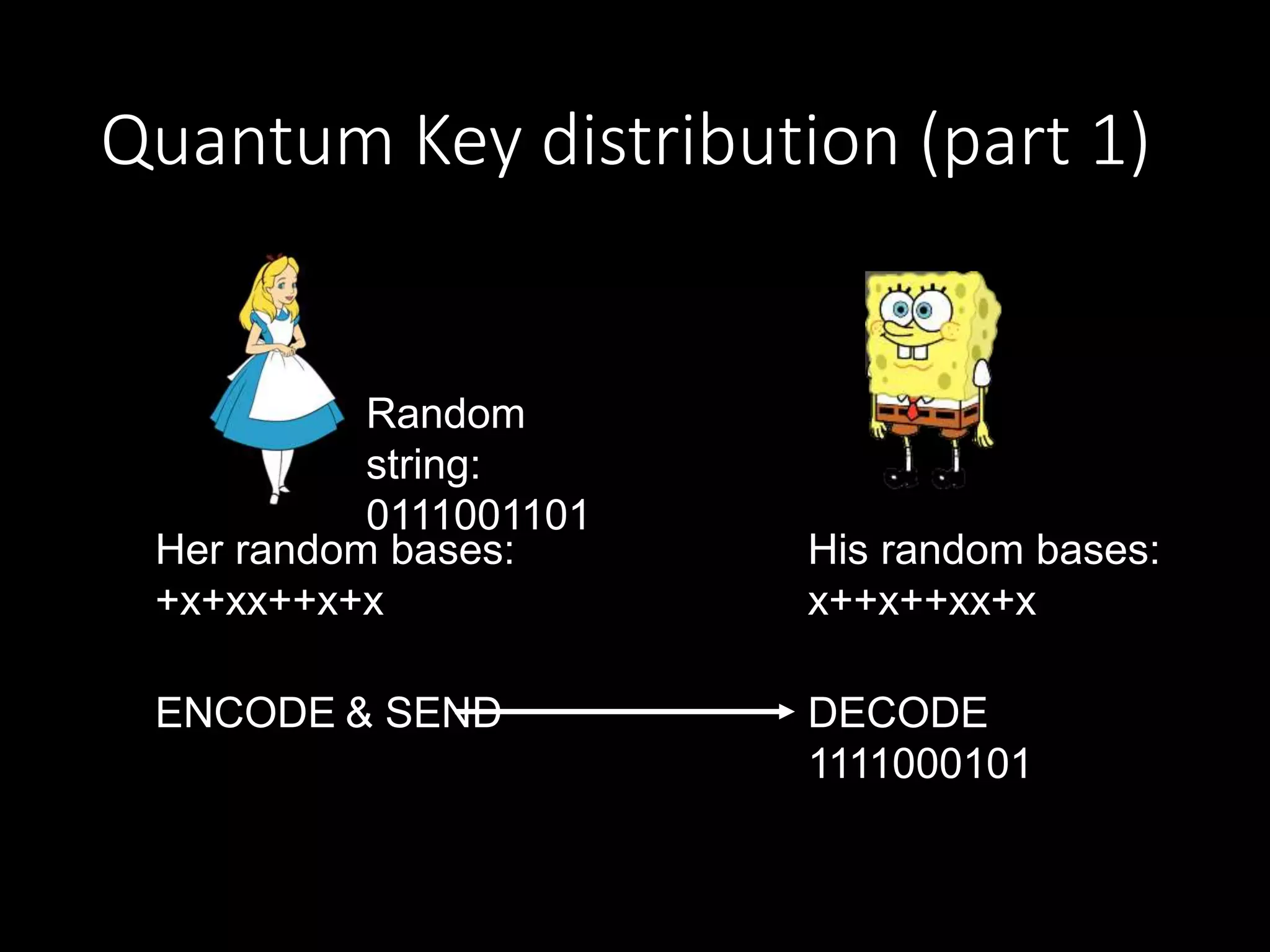
Quantum Key distribution (part 1)
Random
string:
0111001101
Her random bases:
+x+xx++x+x
His random bases:
x++x++xx+x
ENCODE & SEND DECODE
1111000101
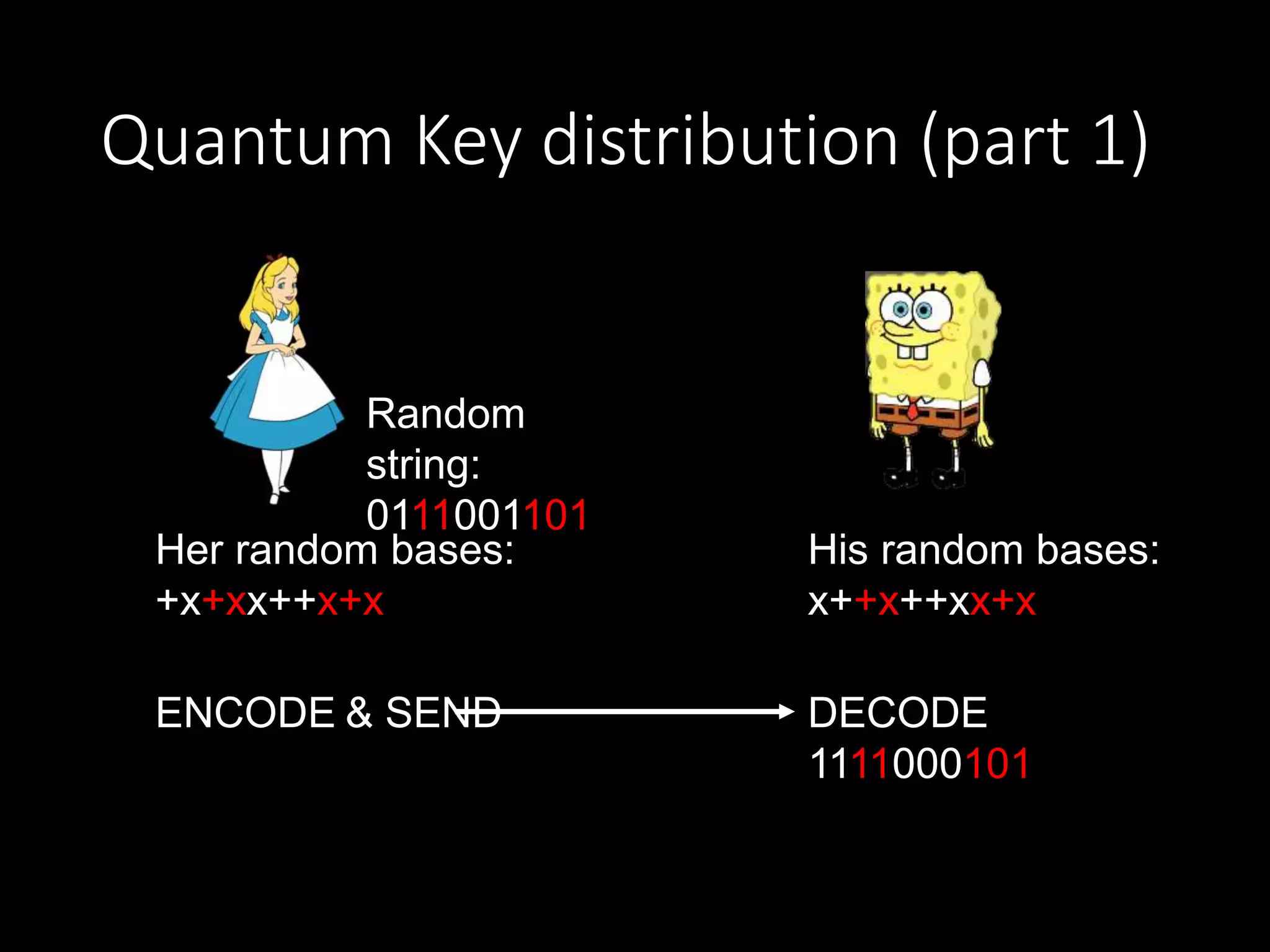
Quantum Key distribution (part 1)
Random
string:
0111001101
Her random bases:
+x+xx++x+x
His random bases:
x++x++xx+x
ENCODE & SEND DECODE
1111000101
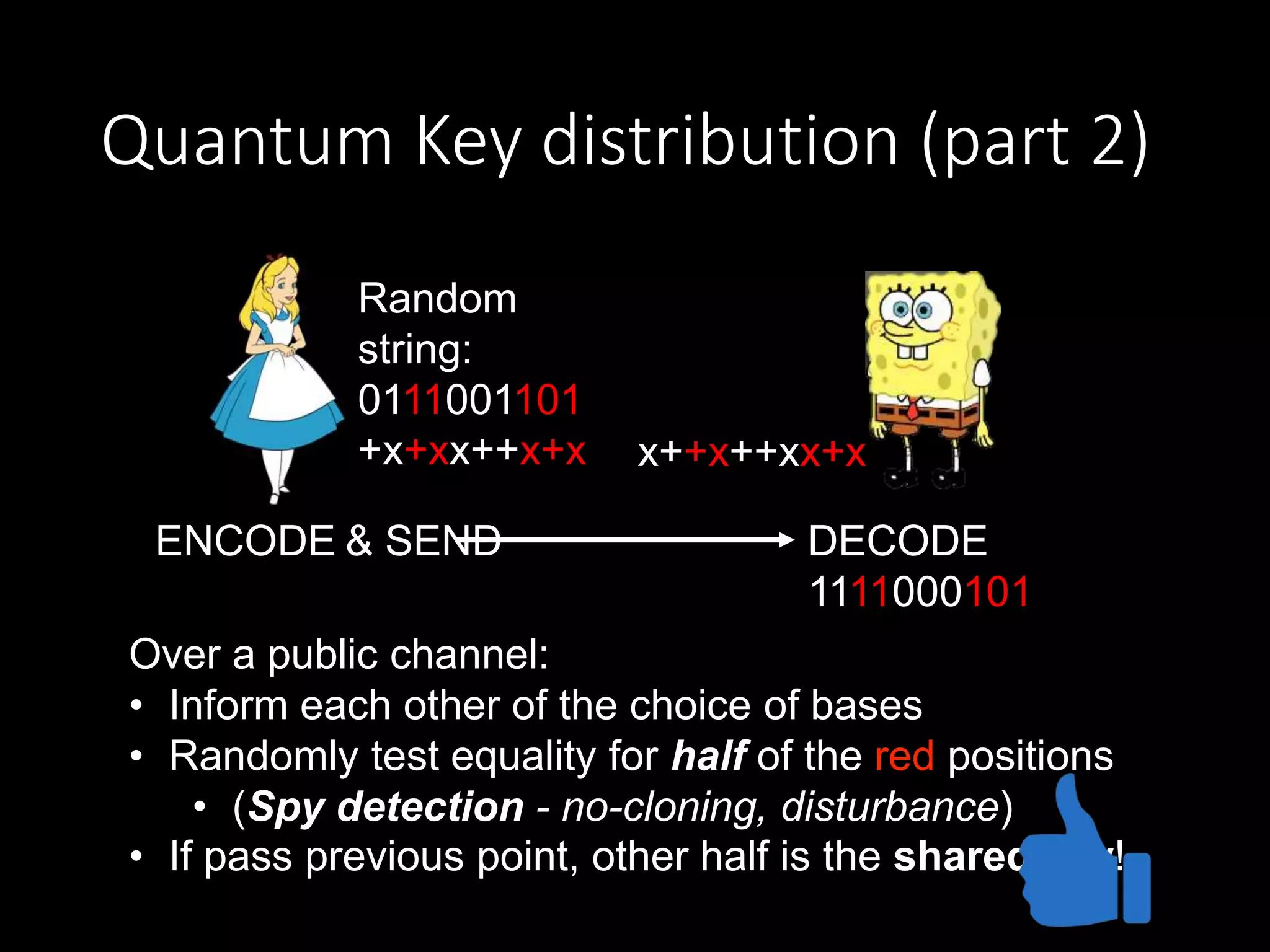
Quantum Key distribution (part 2)
Random
string:
0111001101
+x+xx++x+x x++x++xx+x
ENCODE & SEND DECODE
1111000101
Over a public channel:
• Inform each other of the choice of bases
• Randomly test equality for half of the red positions
• (Spy detection - no-cloning, disturbance)
• If pass previous point, other half is the shared key!
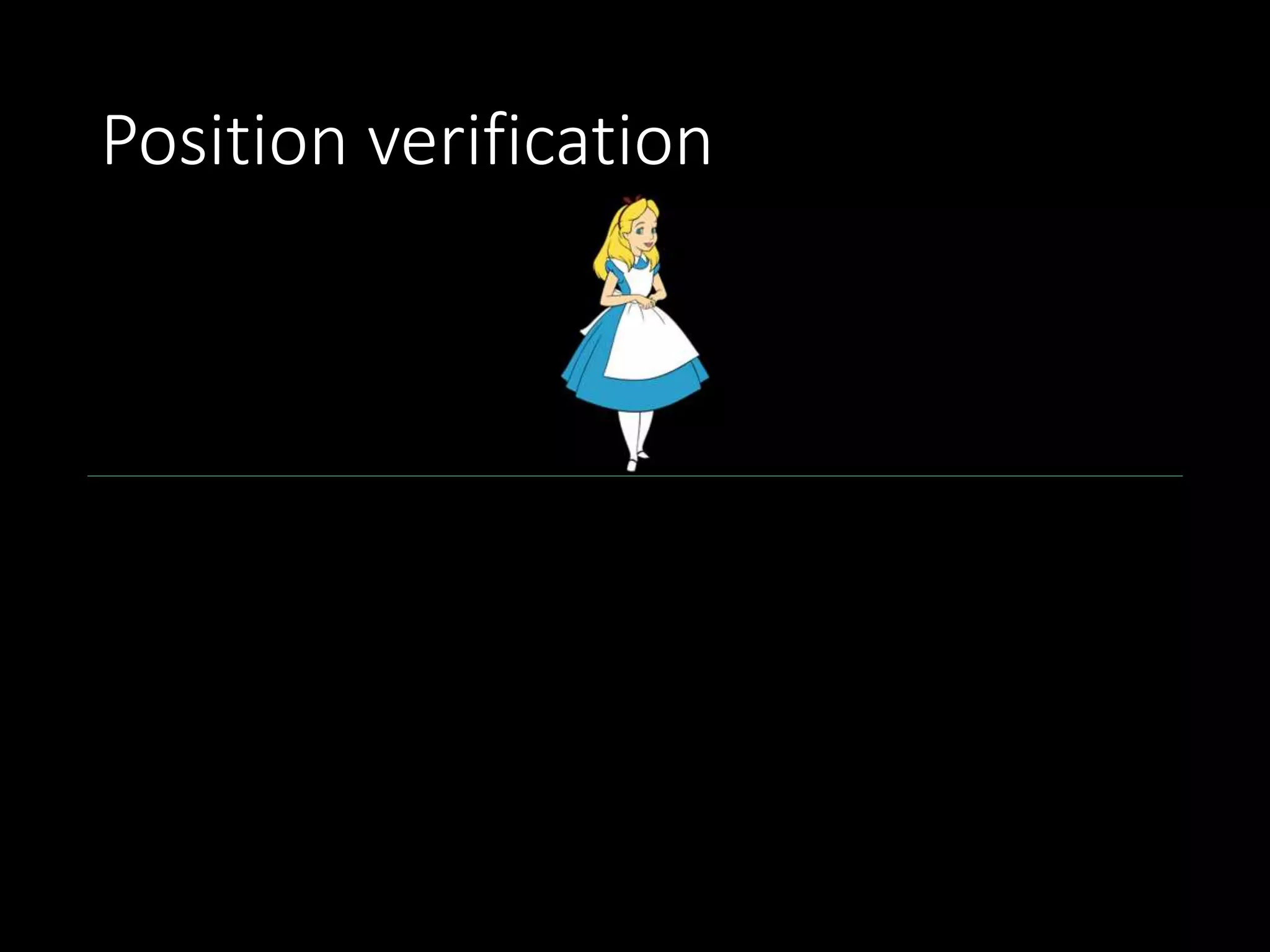
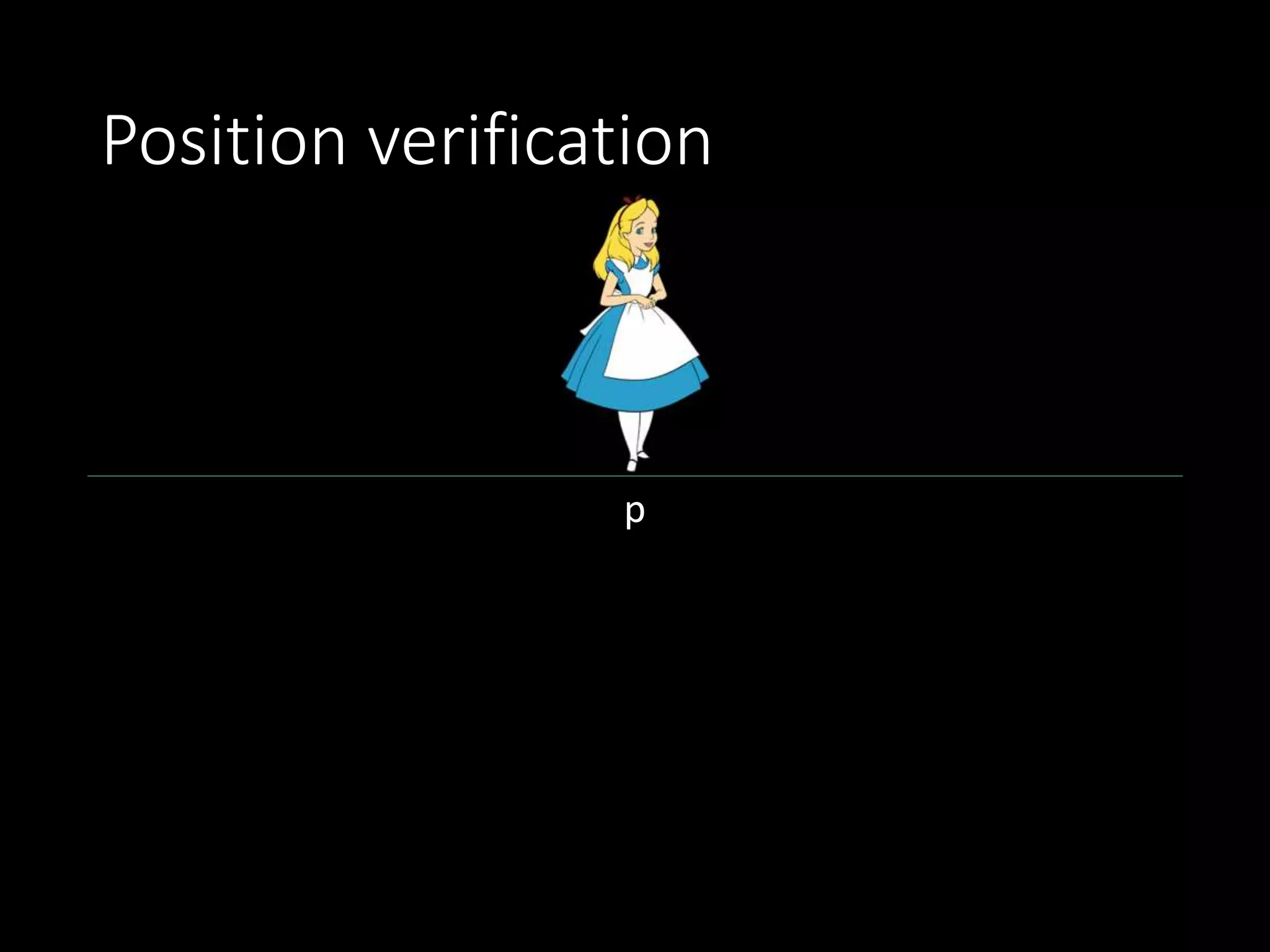
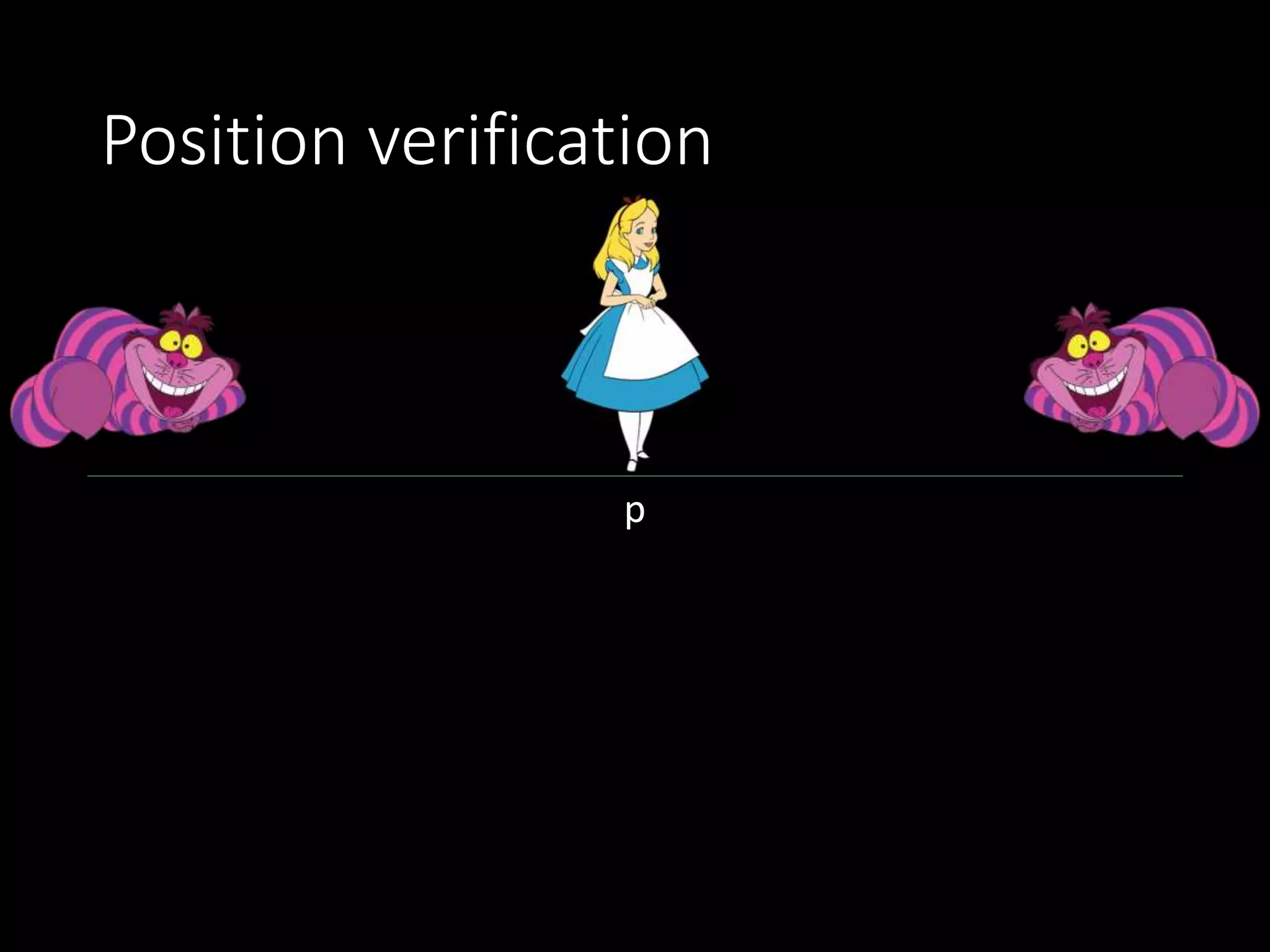
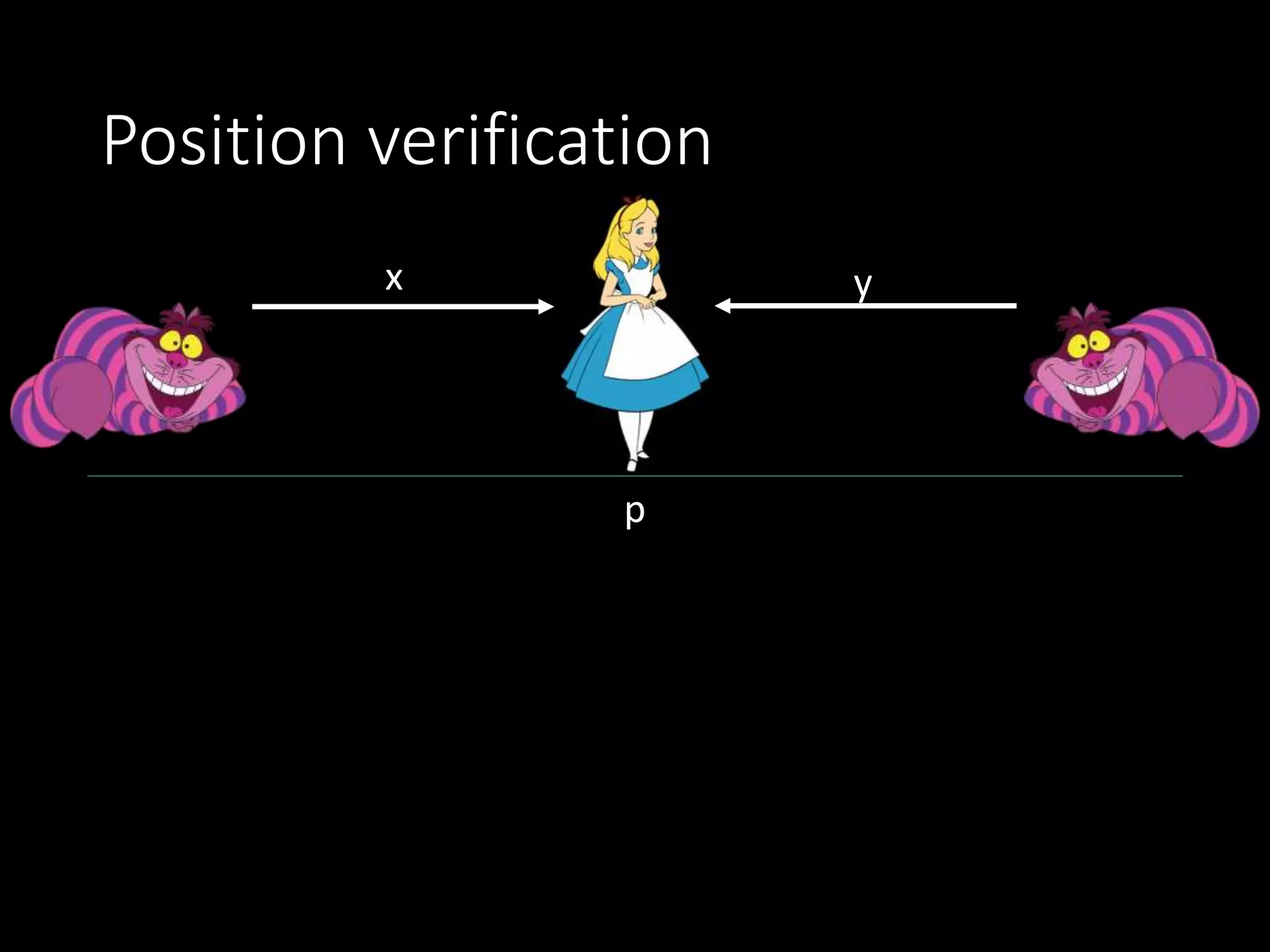
Position verification
p
Position verification
p
Position verification
p
x y
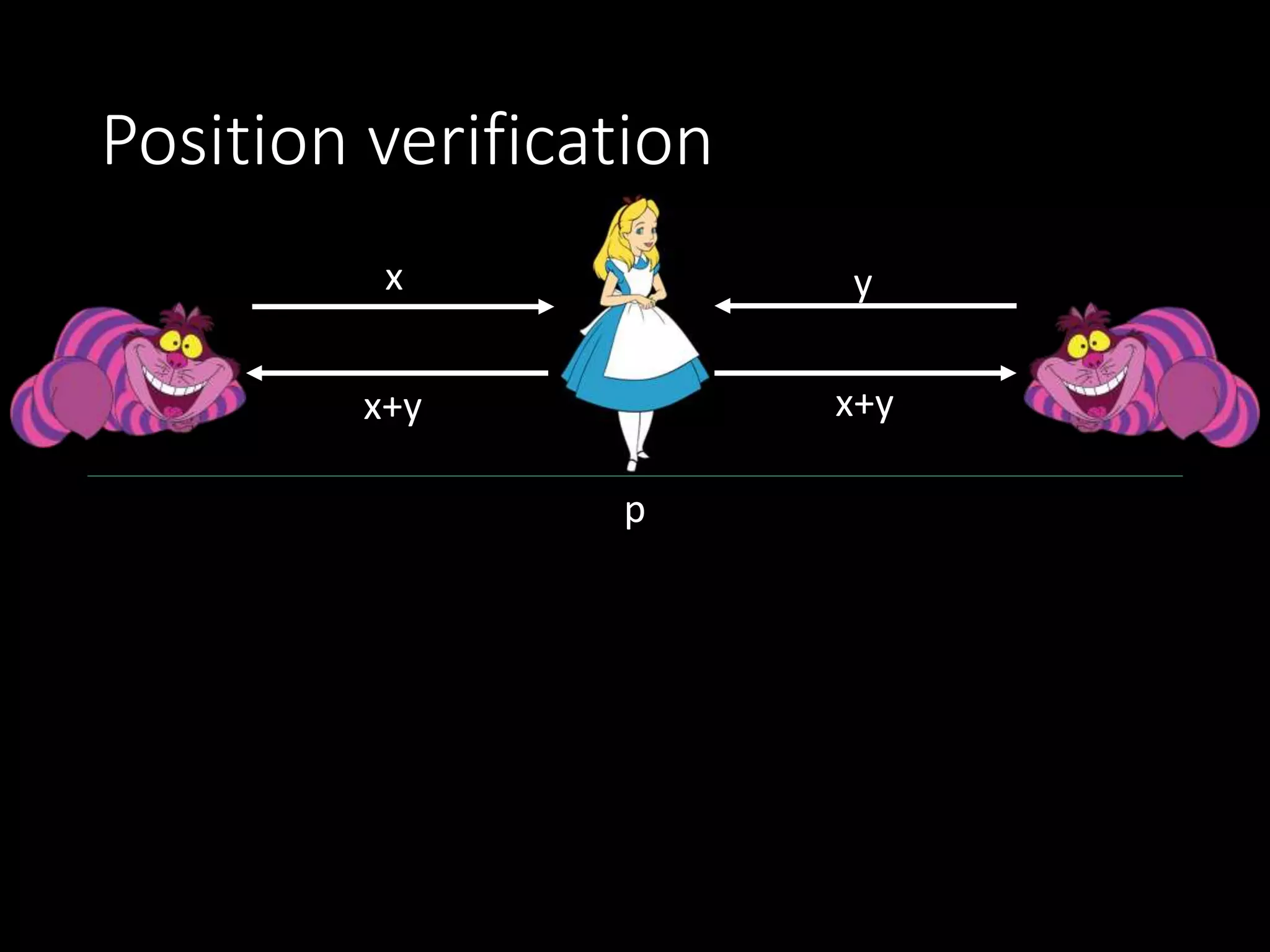
Position verification
p
x y
x+y x+y
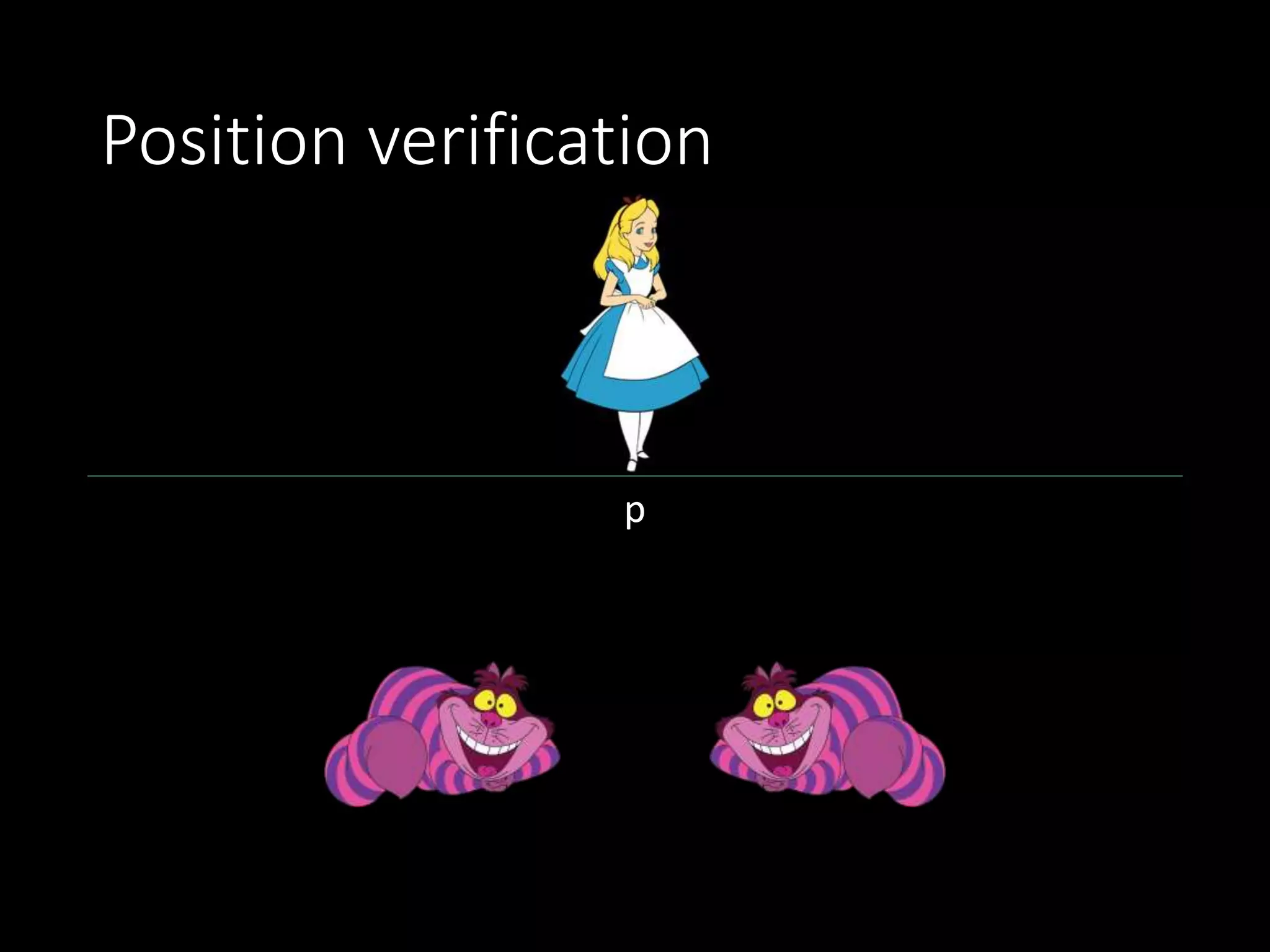
Position verification
p
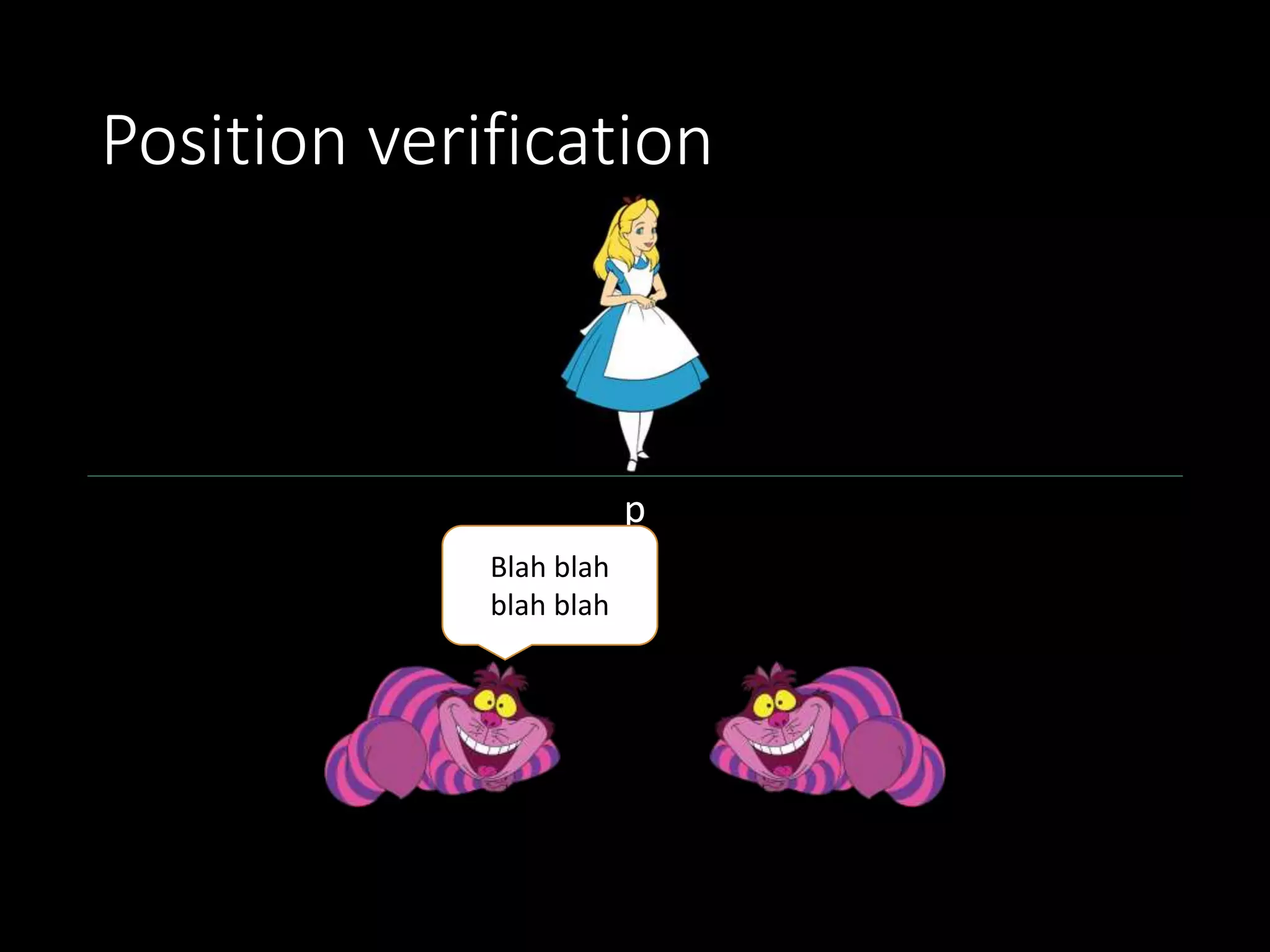
Position verification
p
Blah blah
blah blah
Position verification
p
Blah blah
speed of light
Position verification
p
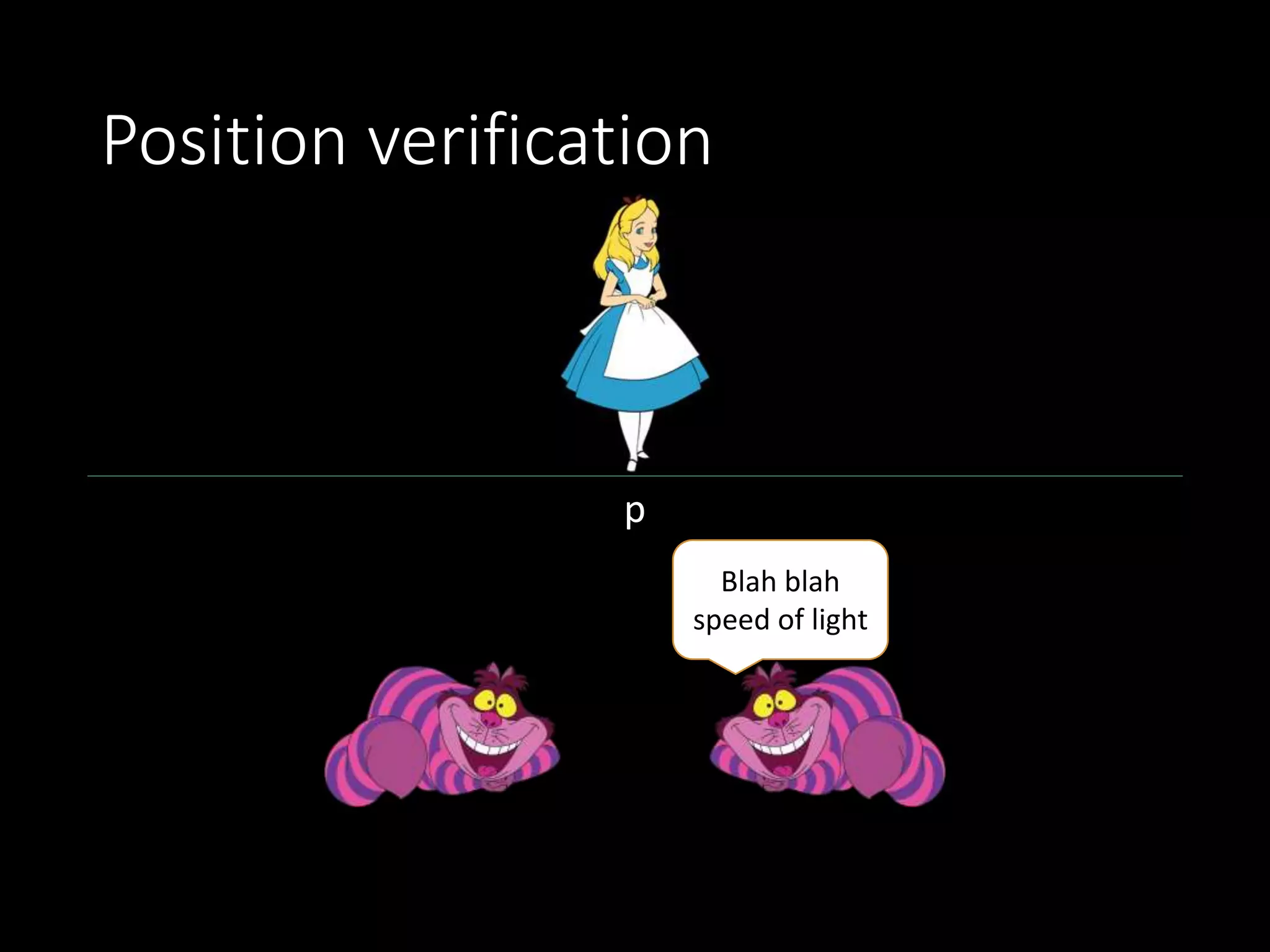
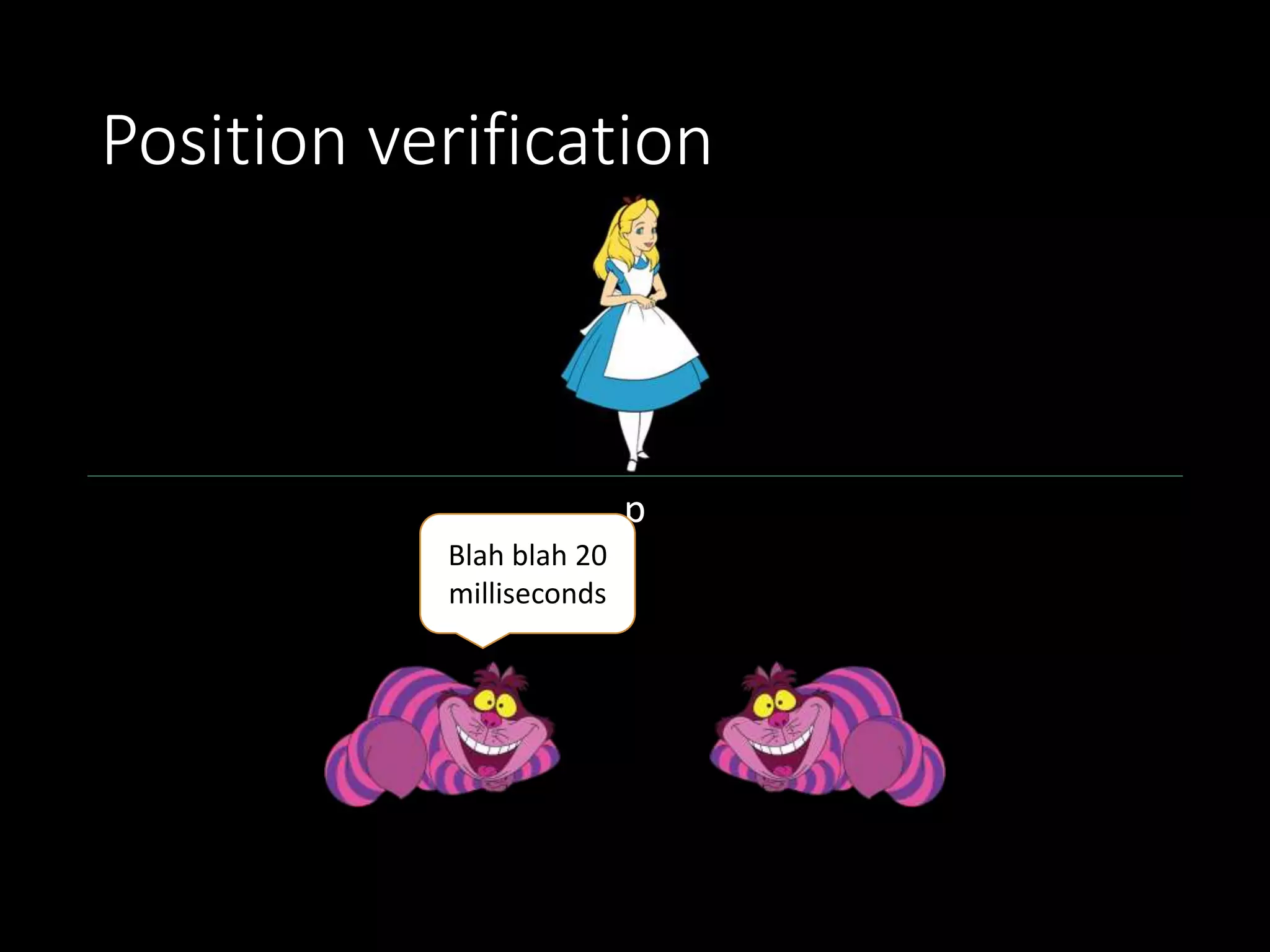
Blah blah 20
milliseconds
Position verification
p
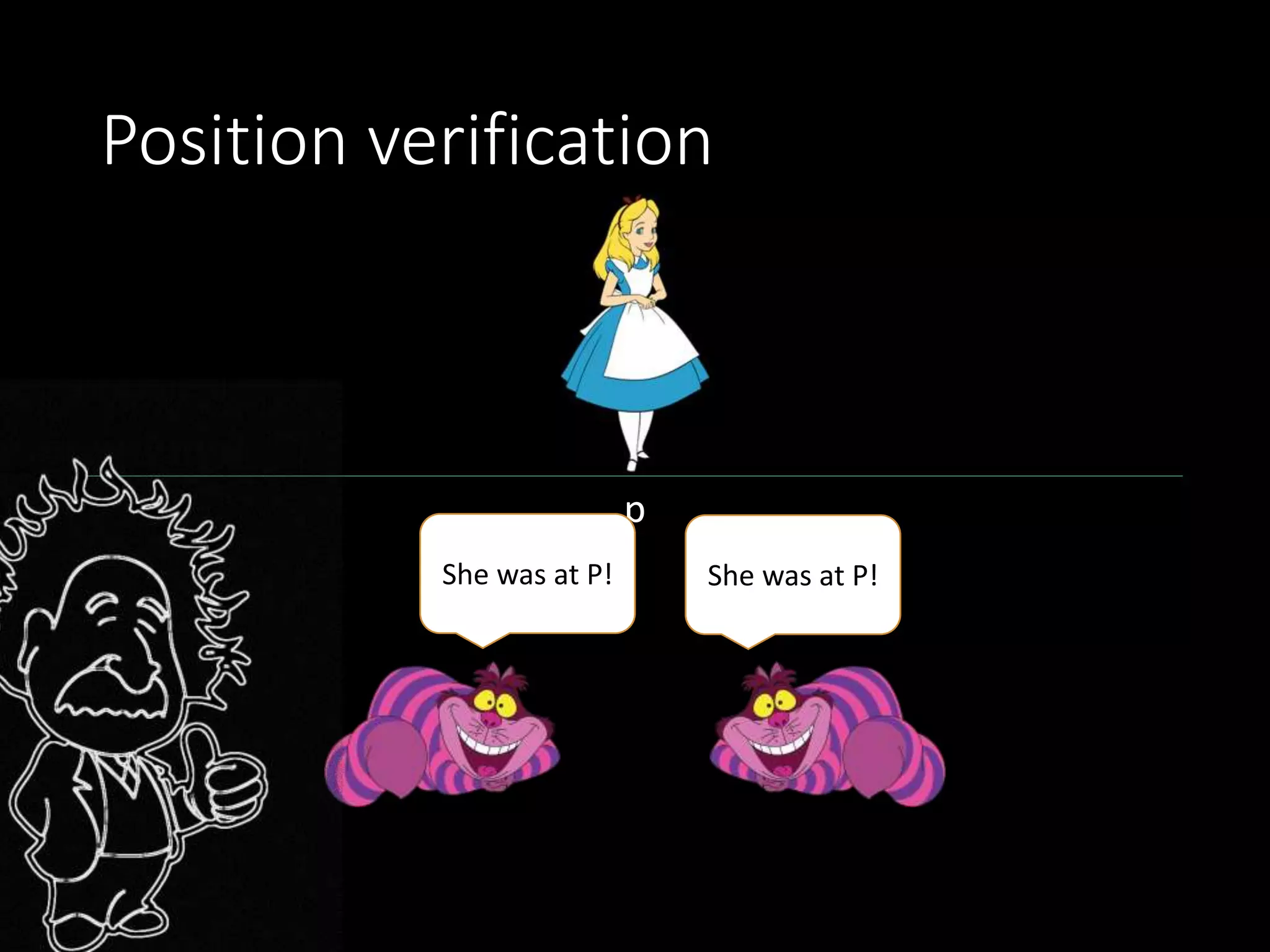
She was at P! She was at P!
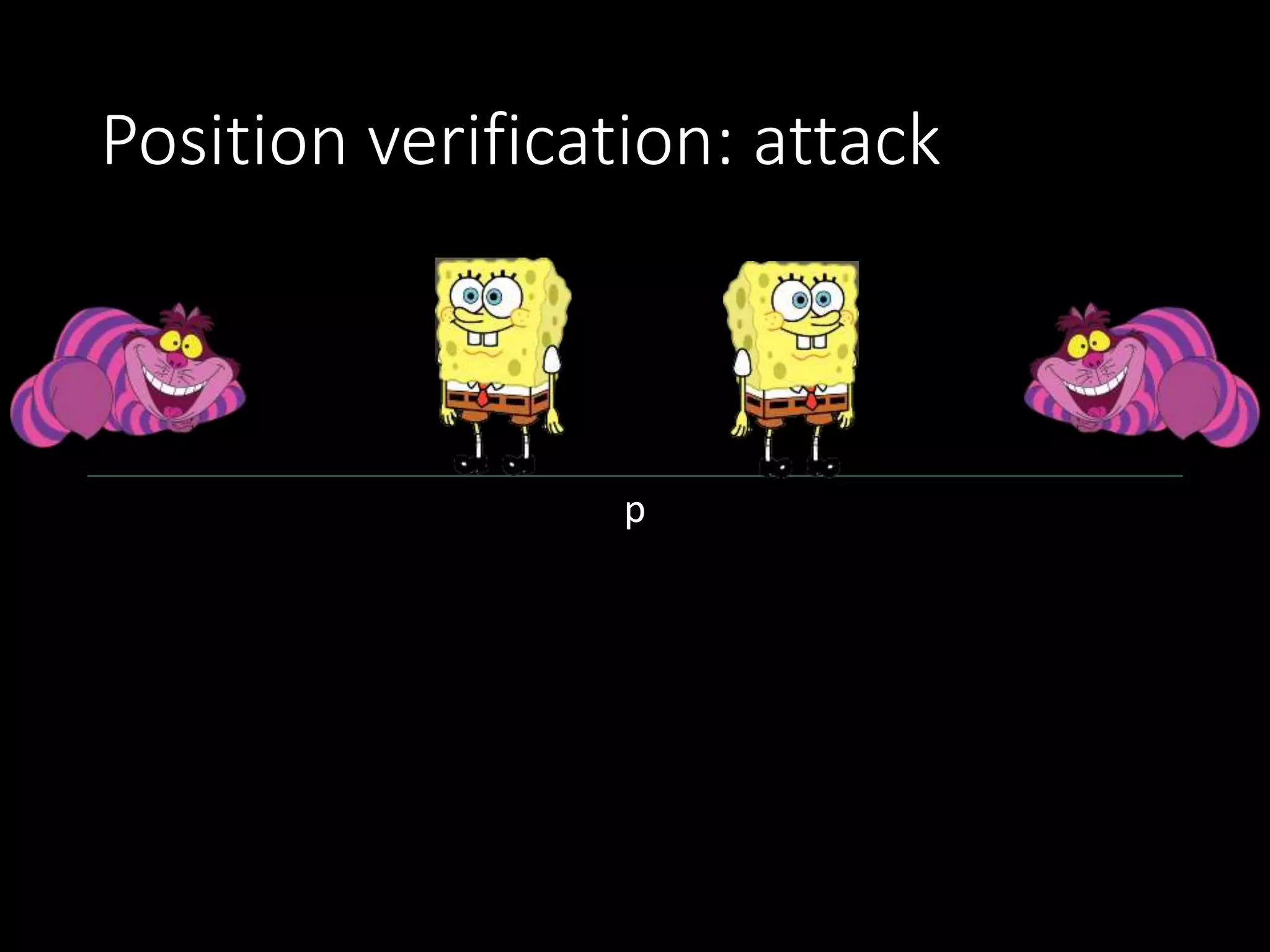
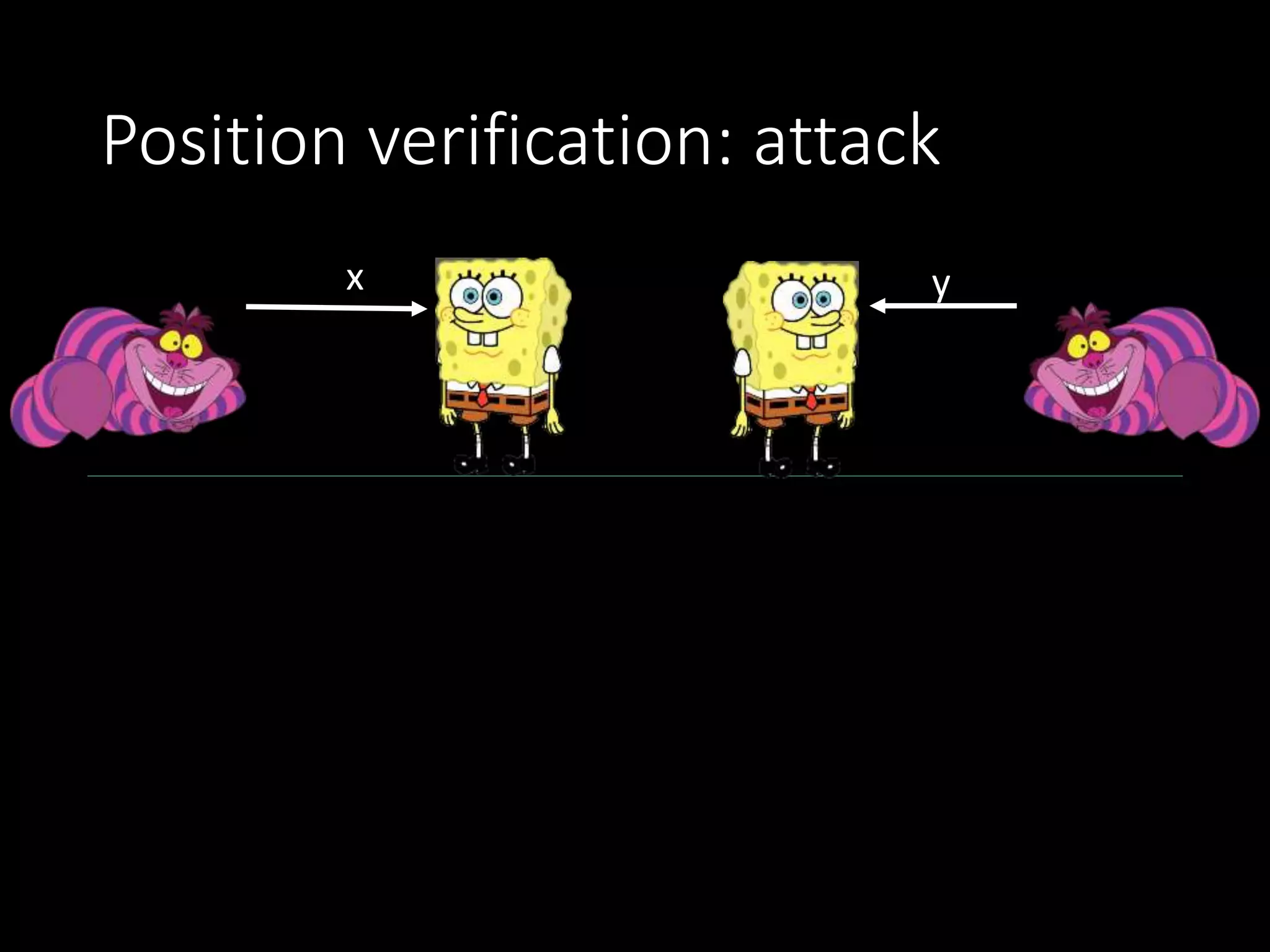
Position verification: attack
p
Position verification: attack
x y
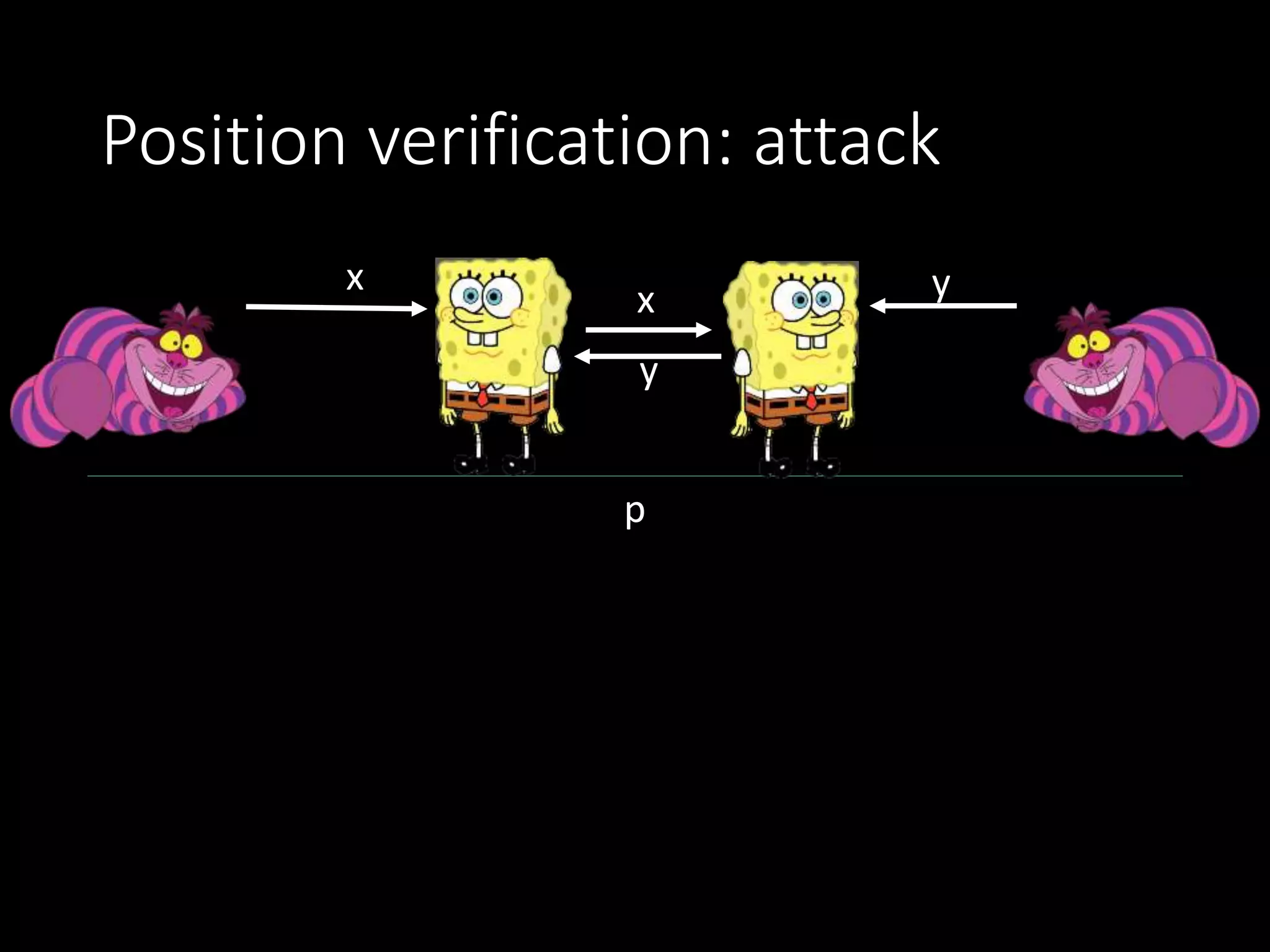
Position verification: attack
p
x yx
y
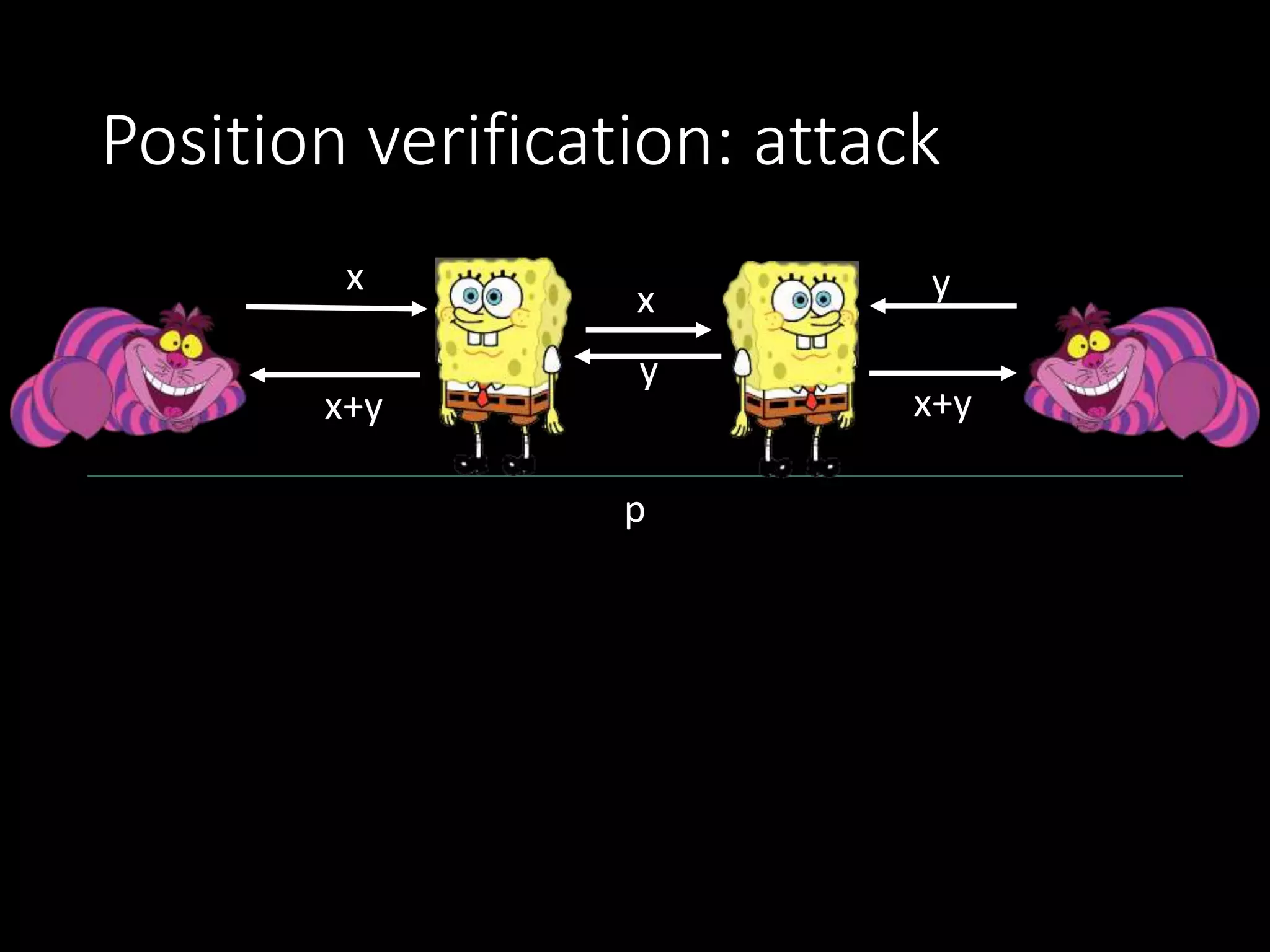
Position verification: attack
p
x yx
y
x+y x+y
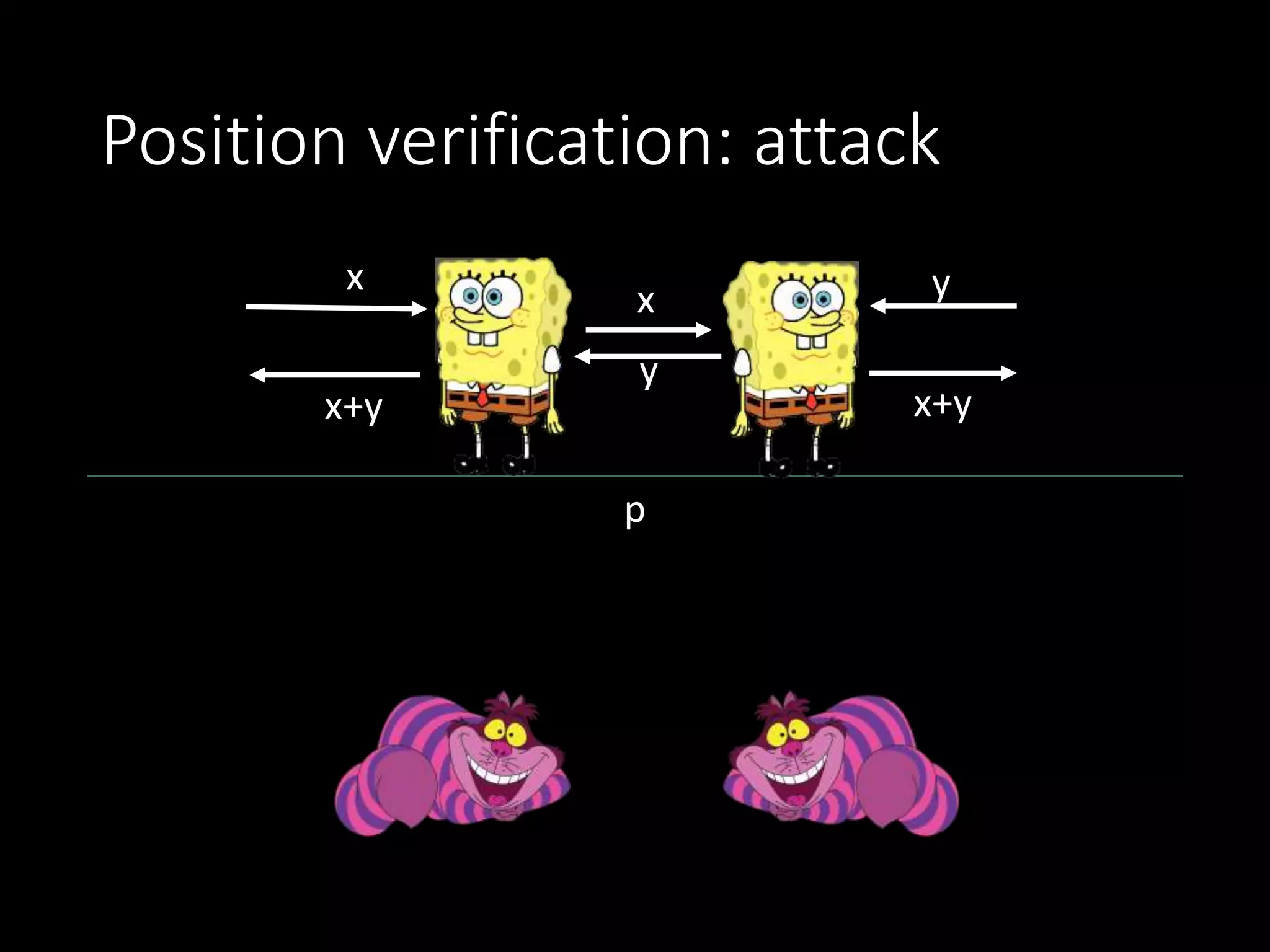
Position verification: attack
p
x y
x+y x+y
x
y
Position verification: attack
p
x y
x+y x+y
x
y
She was at P! She was at P!
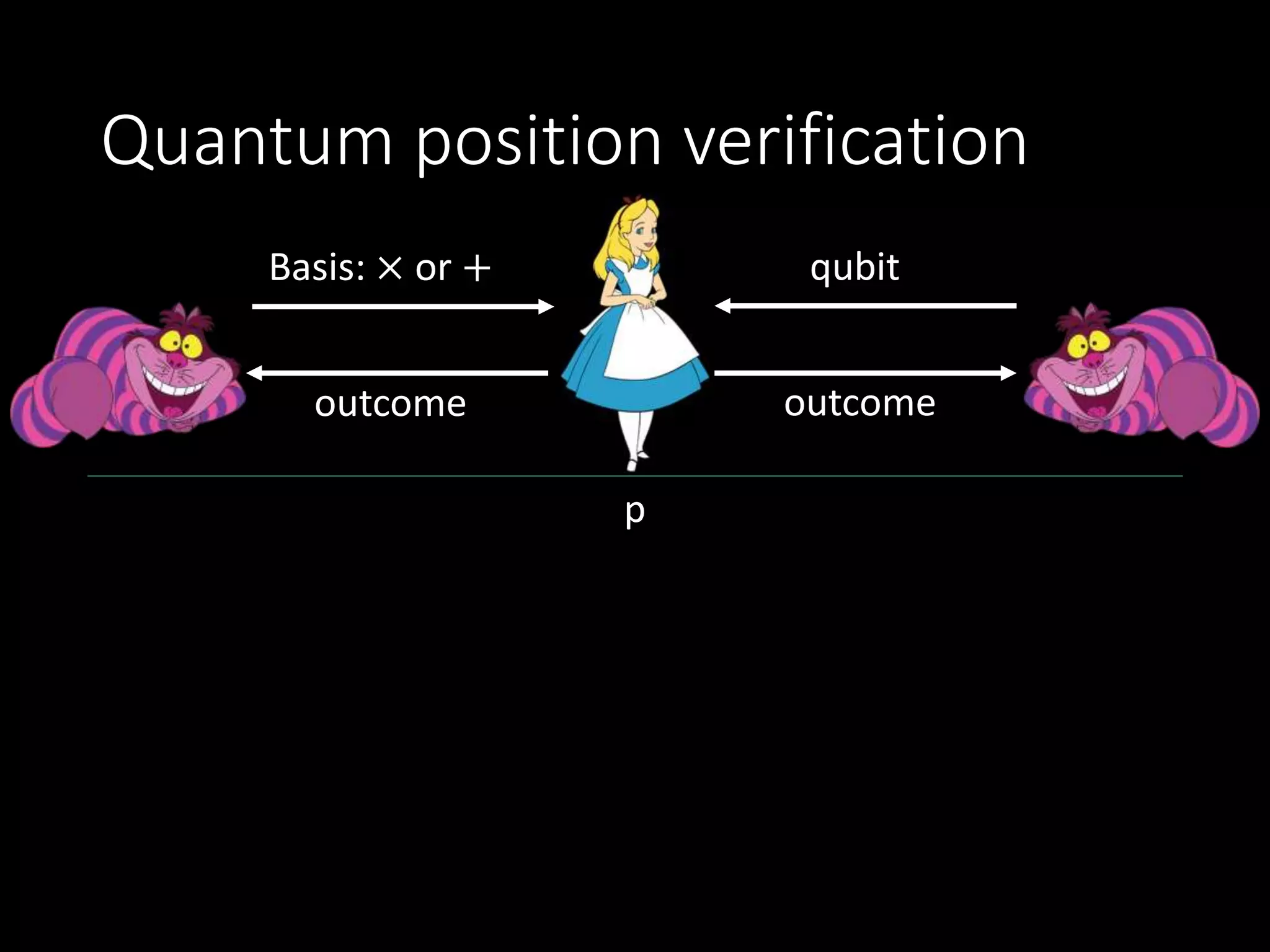
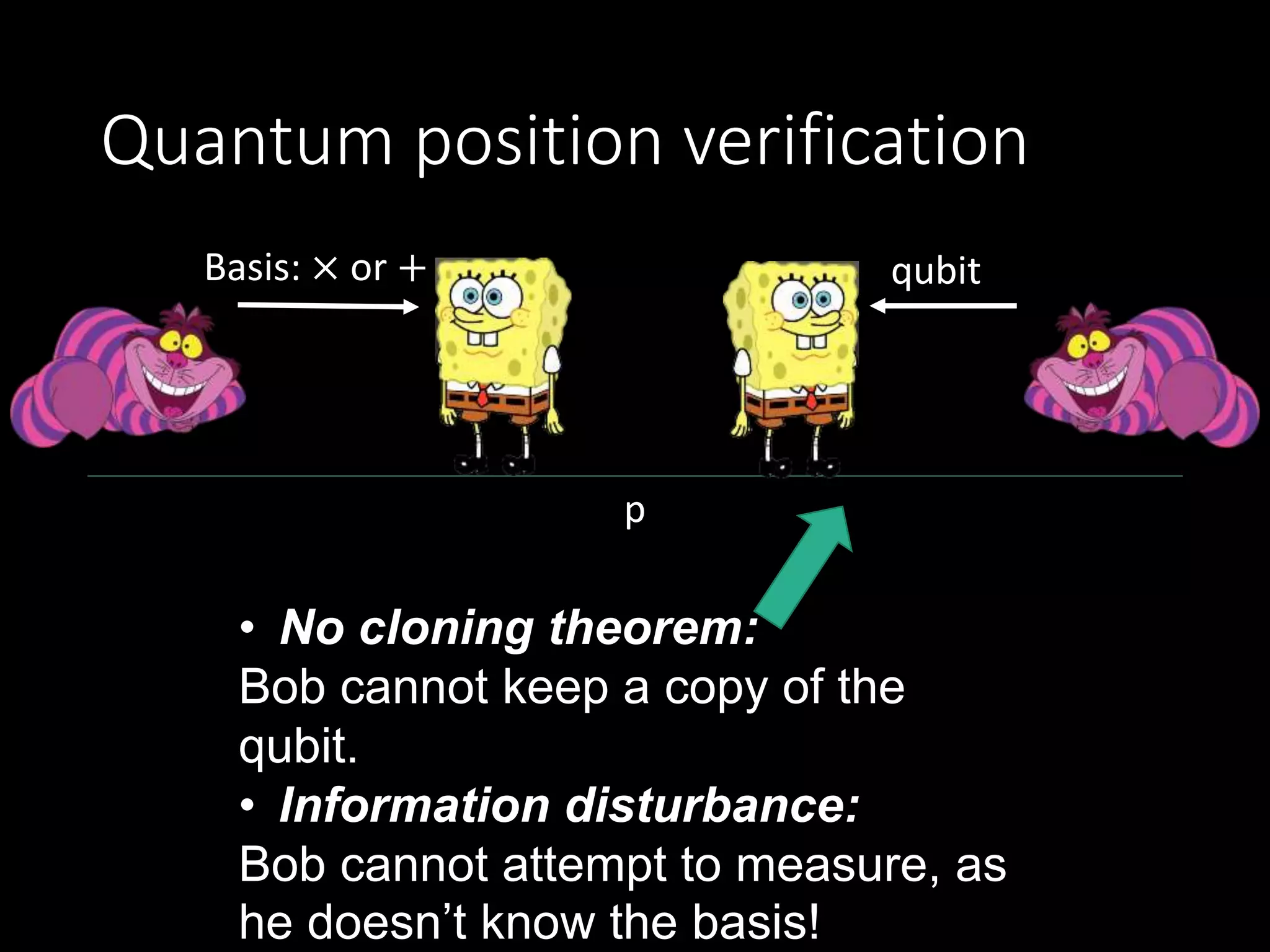
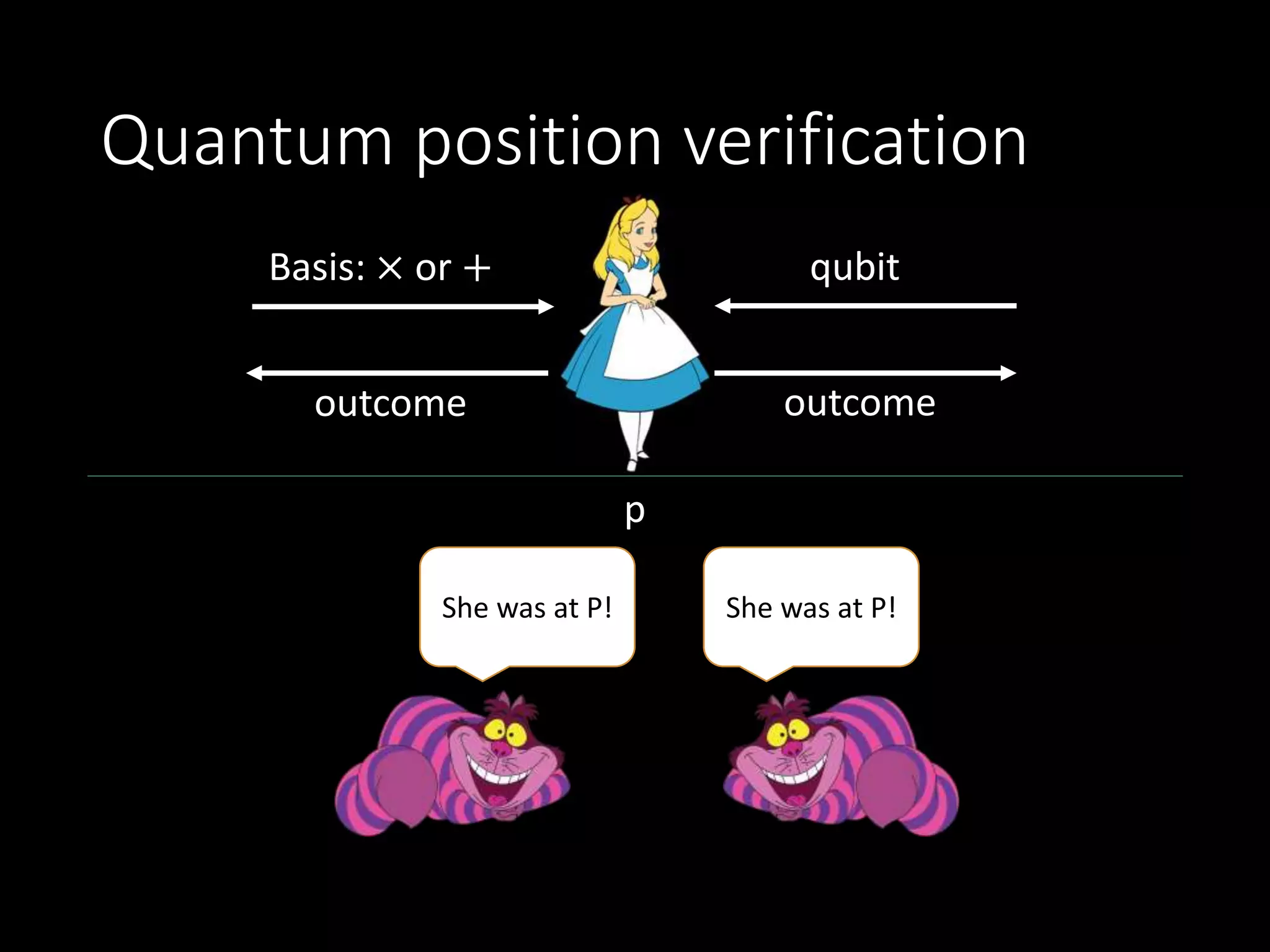
Quantum position verification
p
Quantum position verification
p
Basis: × or +
Quantum position verification
p
Basis: × or + qubit
Quantum position verification
p
Basis: × or + qubit
outcome outcome
Quantum position verification
p
Basis: × or + qubit
outcome outcome
She was at P! She was at P!
Quantum position verification
p
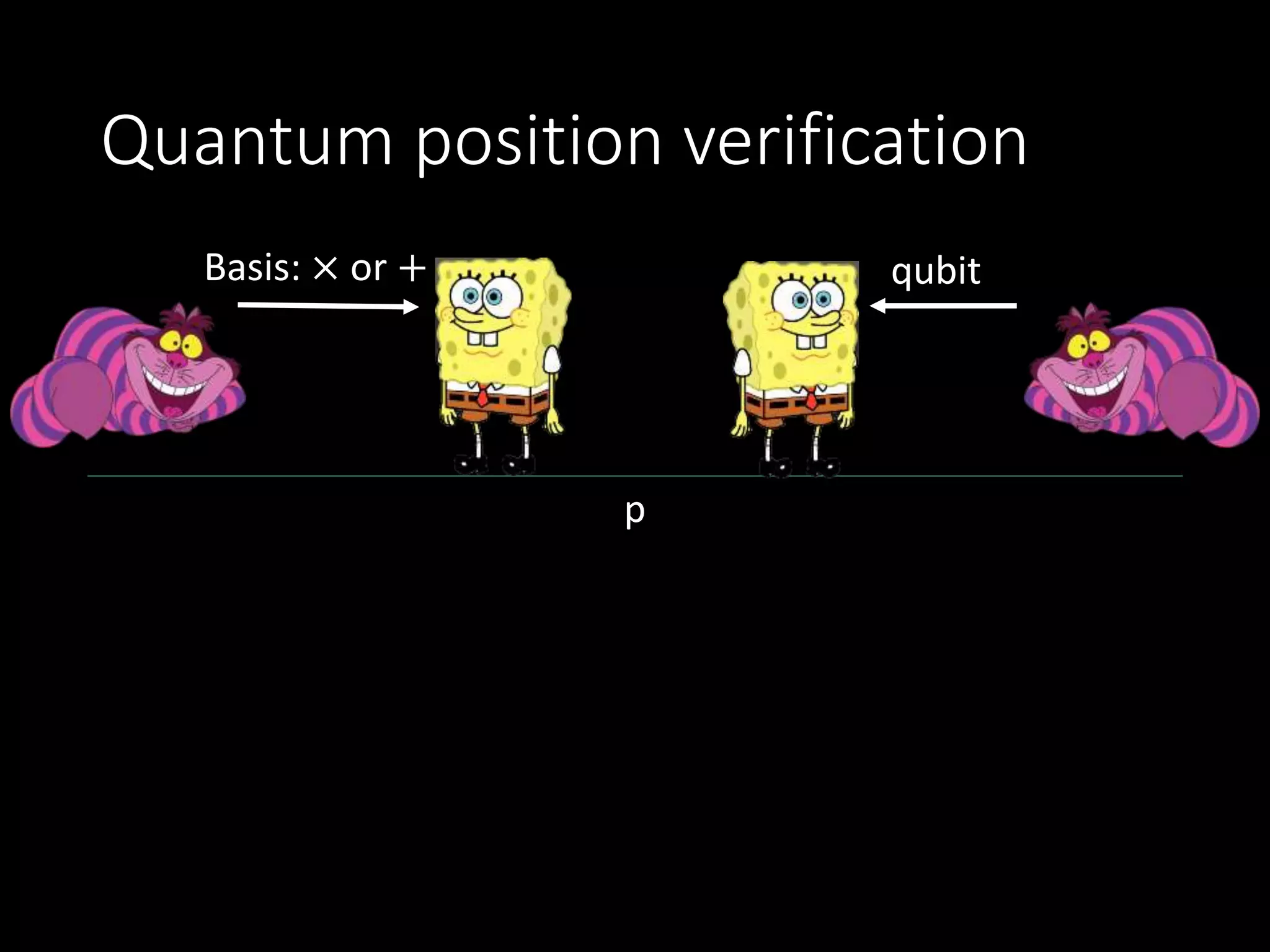
Quantum position verification
p
qubitBasis: × or +
Quantum position verification
p
qubitBasis: × or +
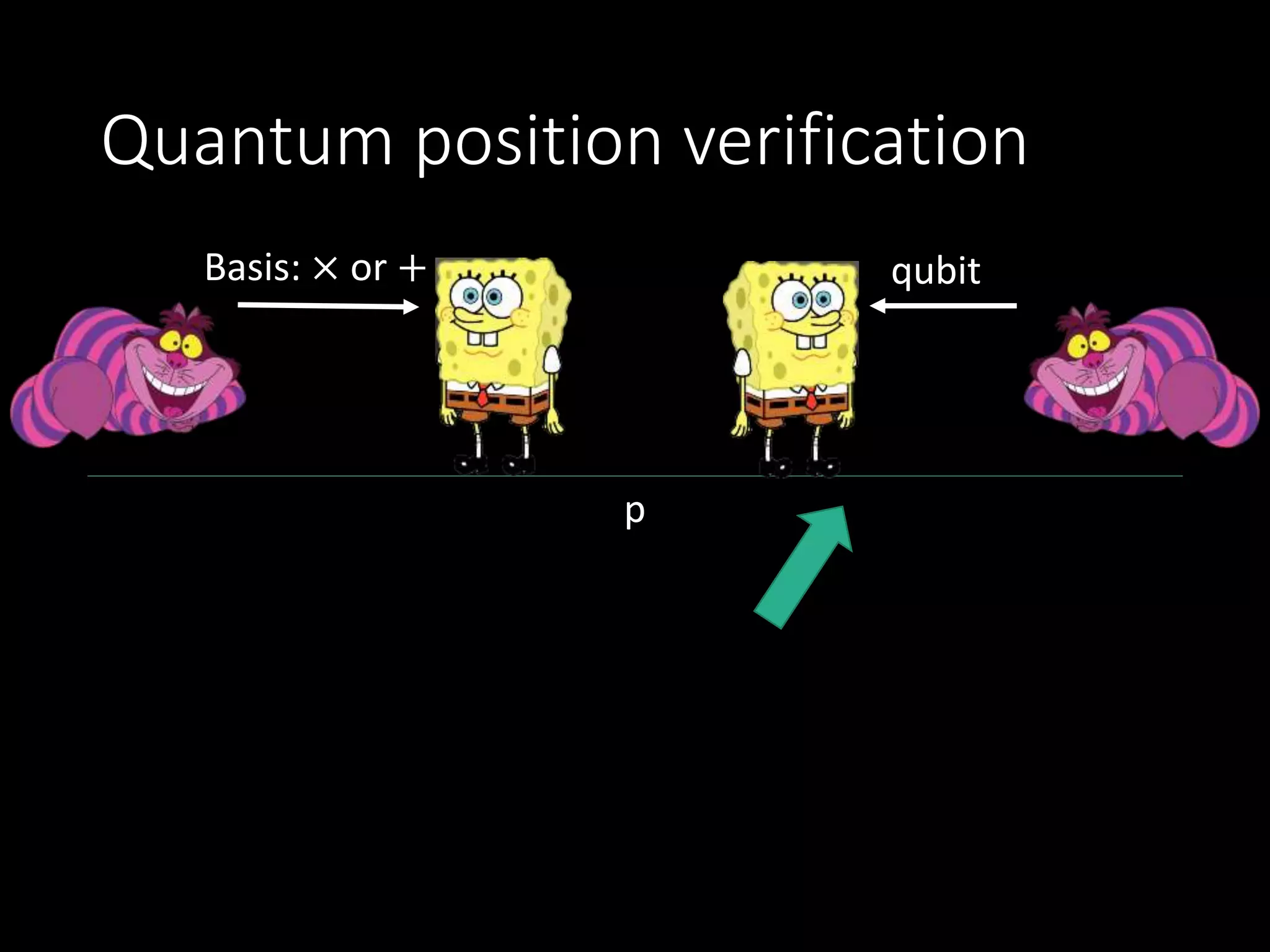
Quantum position verification
p
qubitBasis: × or +
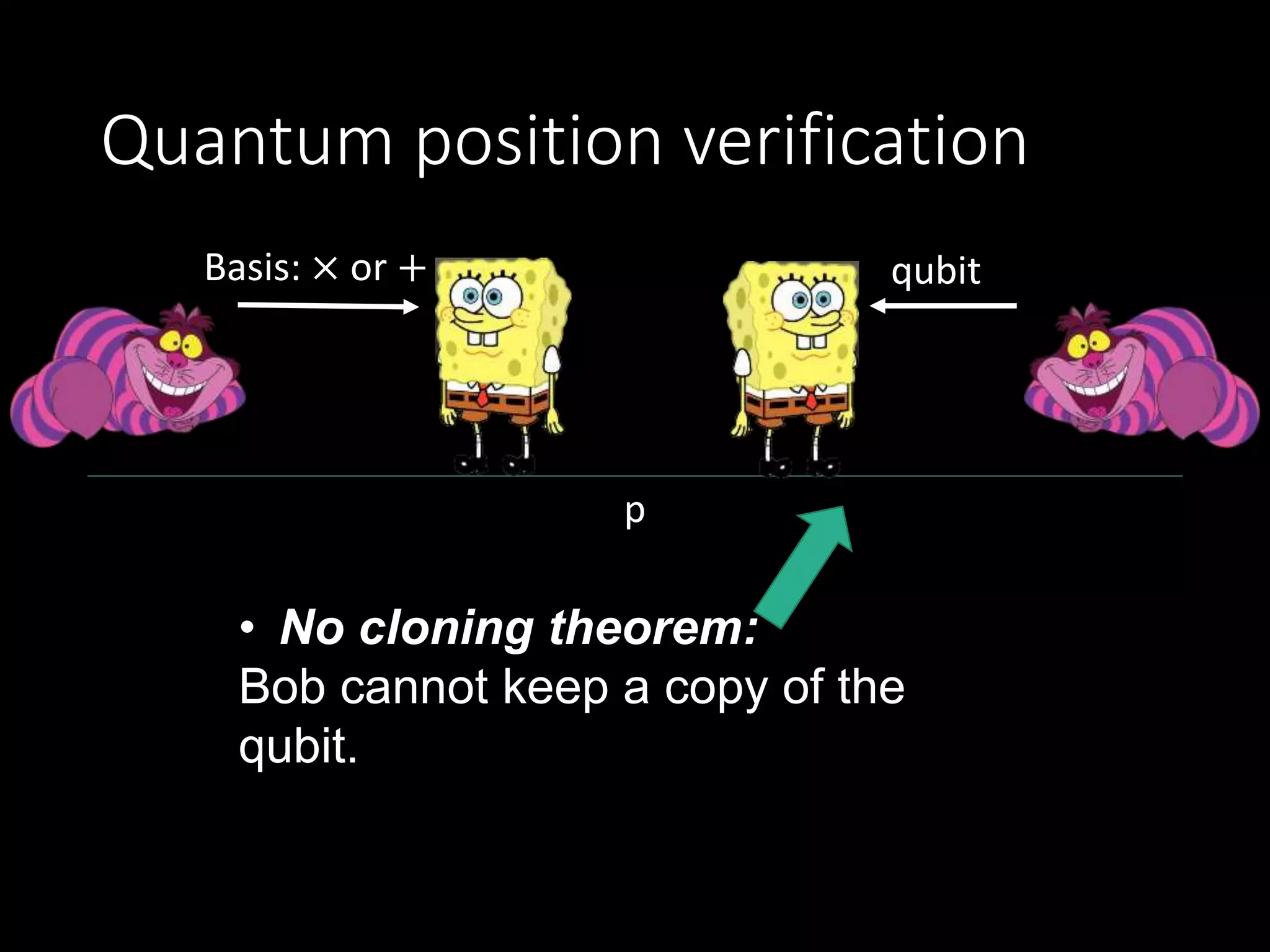
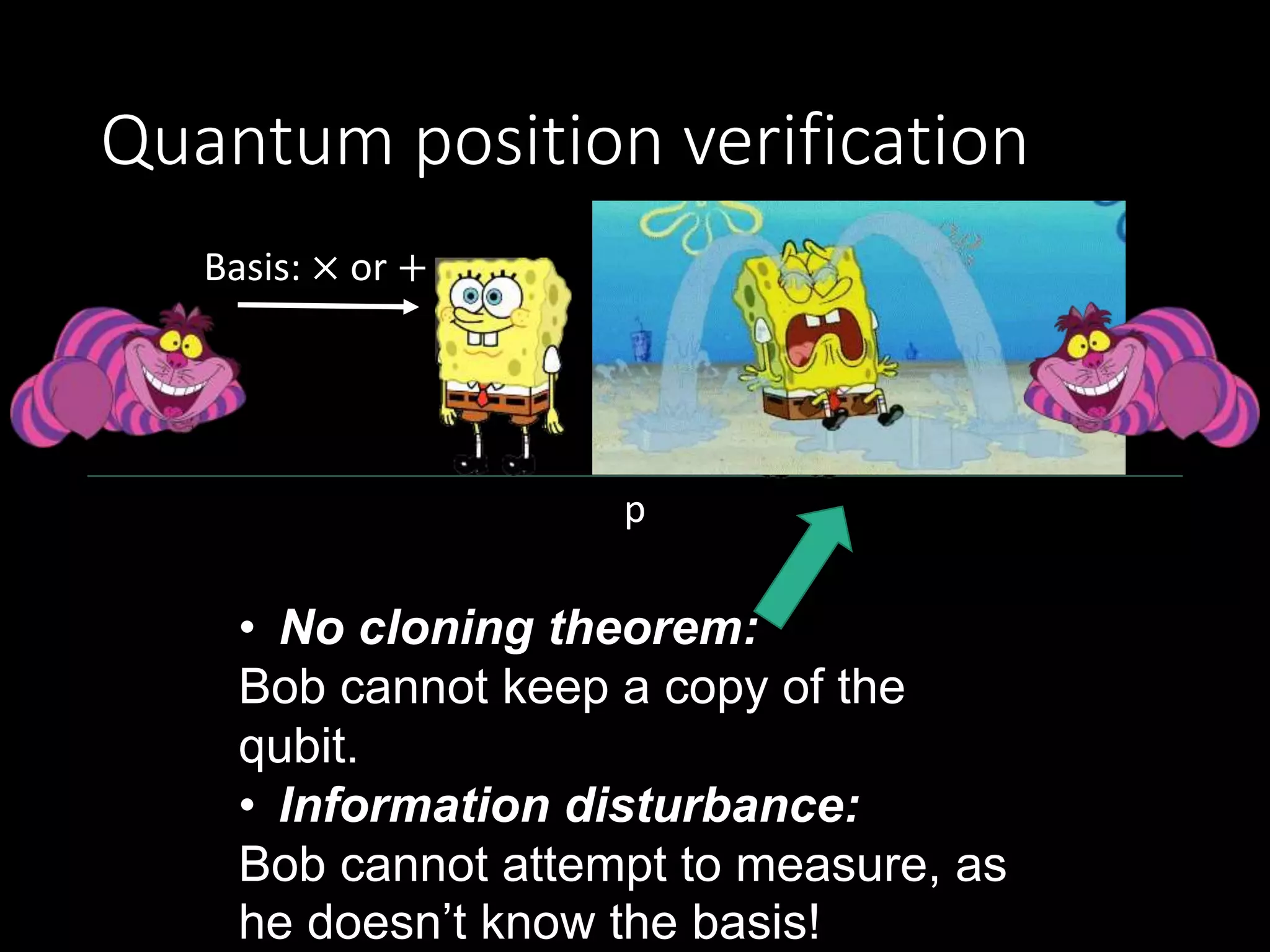
• No cloning theorem:
Bob cannot keep a copy of the
qubit.
Quantum position verification
p
qubitBasis: × or +
• No cloning theorem:
Bob cannot keep a copy of the
qubit.
• Information disturbance:
Bob cannot attempt to measure, as
he doesn’t know the basis!
Quantum position verification
p
qubitBasis: × or +
• No cloning theorem:
Bob cannot keep a copy of the
qubit.
• Information disturbance:
Bob cannot attempt to measure, as
he doesn’t know the basis!
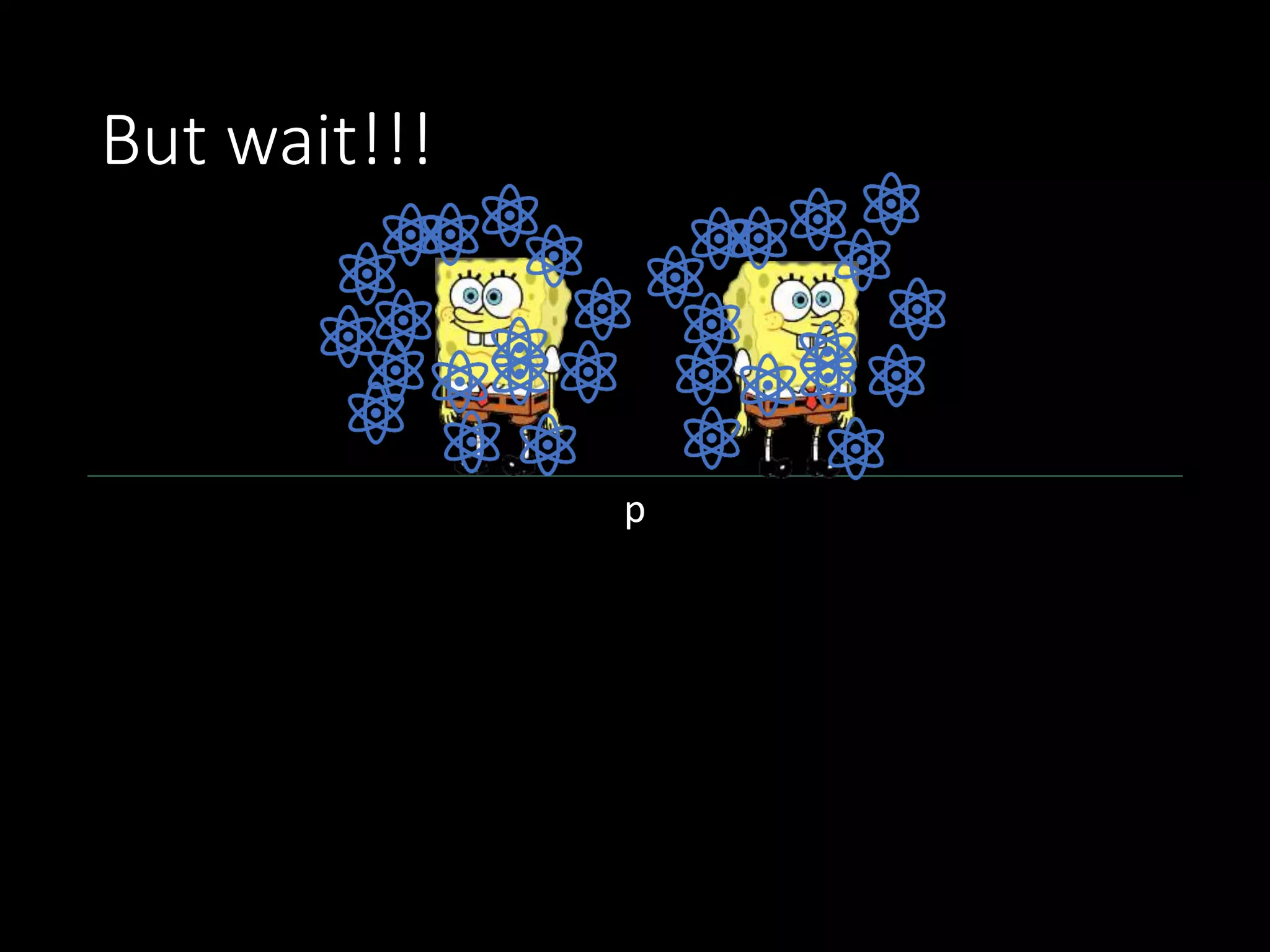
But wait!!!
But wait!!!
p
But wait!!!
p
Open problem: actually prove
the security of this protocol!
[Buhrman et al, 2011]
What to bring home?
• Quantum computing is a model of computation
based on the latest physics
• You do not need deep knowledge of physics to work
with it!
• There are many tasks that do not require a full
quantum computer that are doable today
• QC’s full power is still unknown, but it looks like it
can give some meaningful speedups
• Proving quantum advantage is tricky.
• Careful about big advertisement claims!
FAQs
• Is quantum computing a reality now?
• Will we have a quantum computer in our pockets?
• Do quantum computers solve useful problems?
• Does entanglement allow for faster-than-light
communication? My cousin told me so.

A short introduction to Quantum Computing and Quantum Cryptography

  • 1.
  • 2.
    Overview Part I: Whatis Quantum Computing? • Qubits, quantum operations, measurements Part II: Are quantum computers more powerful? • Simple example, main algorithms, complexity classes Part III: Some quantum cryptography • Non-locality (certified randomness), quantum key distribution, quantum position verification
  • 3.
    Part I: What isQuantum Computation?
  • 4.
  • 5.
  • 6.
    Some History • Firstquantum paper: Max Planck, 1900 • The field developed strongly during the 1920s • A Turing Machine (1936) is a classical object • 1980s: Quantum Computing “updates” the model to the latest physics • Uses some non-intuitive concepts: Superposition, collapse of the wave function, interference, entanglement, no-cloning... • You will know about all of these in a hour or so.
  • 7.
  • 8.
    Classical bit • Quantitythat is either 0 or 1
  • 9.
    Classical bit • Quantitythat is either 0 or 1
  • 10.
    Classical bit • Quantitythat is either 0 or 1
  • 11.
    Classical bit • Quantitythat is either 0 or 1
  • 12.
  • 13.
  • 14.
  • 15.
    Quantum bit • Associate0 and 1 with orthogonal vectors: 0 = 1 0 1 = 0 1 • Quantum bit is a superposition: 𝛼 𝑜 0 + 𝛼1 1 = 𝛼0 𝛼1 • Unit vector in ℂ2: 𝛼0 2 + 𝛼1 2 = 1
  • 16.
  • 17.
  • 18.
    Wait, you’re cheating! 𝛼𝑜 0 + 𝛼1 1 0.0001000101011101100110011…..
  • 19.
    Wait, you’re cheating! 𝛼𝑜 0 + ( 1− ) 1
  • 20.
    Wait, you’re cheating! 𝛼𝑜 0 + ( 1− ) 1 • Valid unit vector, because 𝛼0 2 + 𝛼1 2 = 1
  • 21.
    Wait, you’re cheating! 𝛼𝑜 0 + ( 1− ) 1 • Valid unit vector, because 𝛼0 2 + 𝛼1 2 = 1 • Where’s the catch here?
  • 22.
  • 23.
    Measurement 0 • Measurement collapsesthe qubit • Observe 0 with probability 𝛼0 2 • Observe 1 with probability 𝛼1 2 • QC is the art of using this hidden information
  • 24.
    Operations on classicalbits • What can we do with one bit? • Either we leave it alone, or we flip it! (NOT gate) • What can we do with many bits? • Many things, but AND, OR, NOT are a sufficient set of gates to represent any function as a circuit.
  • 25.
    Operations on onequbit • Quantum mechanics allows to do linear operations on qubits before observing them • Norm-preserving matrices in ℂ2×2 : 𝑈 𝛼0 𝛼1 = 𝛼0 ′ 𝛼1 ′ such that 𝛼0 ′ 2 + 𝛼1 ′ 2 = 1 • NOT gate: 𝑋 = 0 1 1 0 0 1 1 0 𝛼0 𝛼1 = 𝛼1 𝛼0 • Hadamard gate: 𝐻 = 1 2 1 1 1 −1
  • 26.
  • 27.
    Hadamard gate 𝐻 = 1 2 11 1 −1 𝐻 0 = 1 2 1 1 1 −1 1 0 = 1 2 1 1 = 1 2 ( 0 + |1⟩): = |+⟩
  • 28.
    Hadamard gate 𝐻 = 1 2 11 1 −1 𝐻 0 = 1 2 1 1 1 −1 1 0 = 1 2 1 1 = 1 2 ( 0 + |1⟩): = |+⟩
  • 29.
    Hadamard gate 𝐻 = 1 2 11 1 −1 𝐻 0 = 1 2 1 1 1 −1 1 0 = 1 2 1 1 = 1 2 ( 0 + |1⟩): = |+⟩
  • 30.
    Hadamard gate 𝐻 = 1 2 11 1 −1 𝐻 0 = 1 2 1 1 1 −1 1 0 = 1 2 1 1 = 1 2 ( 0 + |1⟩): = |+⟩
  • 31.
    Hadamard gate 𝐻 = 1 2 11 1 −1 𝐻 0 = 1 2 1 1 1 −1 1 0 = 1 2 1 1 = 1 2 ( 0 + |1⟩): = |+⟩
  • 32.
    Hadamard gate 𝐻 = 1 2 11 1 −1 𝐻 0 = 1 2 1 1 1 −1 1 0 = 1 2 1 1 = 1 2 ( 0 + |1⟩): = |+⟩ 𝐻 1 = 1 2 1 1 1 −1 0 1 = 1 2 1 −1 = 1 2 ( 0 − |1⟩): = |−⟩
  • 33.
    Hadamard gate 𝐻 = 1 2 11 1 −1 𝐻 0 = 1 2 1 1 1 −1 1 0 = 1 2 1 1 = 1 2 ( 0 + |1⟩): = |+⟩ 𝐻 1 = 1 2 1 1 1 −1 0 1 = 1 2 1 −1 = 1 2 ( 0 − |1⟩): = |−⟩
  • 34.
    Hadamard gate 𝐻 = 1 2 11 1 −1 𝐻 0 = 1 2 1 1 1 −1 1 0 = 1 2 1 1 = 1 2 ( 0 + |1⟩): = |+⟩ 𝐻 1 = 1 2 1 1 1 −1 0 1 = 1 2 1 −1 = 1 2 ( 0 − |1⟩): = |−⟩
  • 35.
    Hadamard gate 𝐻 = 1 2 11 1 −1 𝐻 0 = 1 2 1 1 1 −1 1 0 = 1 2 1 1 = 1 2 ( 0 + |1⟩): = |+⟩ 𝐻 1 = 1 2 1 1 1 −1 0 1 = 1 2 1 −1 = 1 2 ( 0 − |1⟩): = |−⟩
  • 36.
    Hadamard gate 𝐻 = 1 2 11 1 −1 𝐻 0 = 1 2 1 1 1 −1 1 0 = 1 2 1 1 = 1 2 ( 0 + |1⟩): = |+⟩ 𝐻 1 = 1 2 1 1 1 −1 0 1 = 1 2 1 −1 = 1 2 ( 0 − |1⟩): = |−⟩
  • 37.
    Hadamard gate 𝐻 = 1 2 11 1 −1 𝐻 0 = 1 2 1 1 1 −1 1 0 = 1 2 1 1 = 1 2 ( 0 + |1⟩): = |+⟩ 𝐻 1 = 1 2 1 1 1 −1 0 1 = 1 2 1 −1 = 1 2 ( 0 − |1⟩): = |−⟩ Are these two states distinguishable?
  • 38.
    Distinguishing |+⟩ from|−⟩ 1 2 ( 0 + |1⟩) vs 1 2 ( 0 − |1⟩) • Let us try then to apply Hadamard again! 𝐻 1 2 ( 0 + |1⟩) = 1 2 (𝐻 0 + 𝐻|1⟩) = |0⟩ 𝐻 1 2 ( 0 − |1⟩) = 1 2 (𝐻 0 − 𝐻|1⟩) = |1⟩ INTERFERENCE!
  • 39.
    Distinguishing |+⟩ from|−⟩ 1 2 ( 0 + |1⟩) vs 1 2 ( 0 − |1⟩) • Let us try then to apply Hadamard again! 𝐻 1 2 ( 0 + |1⟩) = 1 2 (𝐻 0 + 𝐻|1⟩) = |0⟩ 𝐻 1 2 ( 0 − |1⟩) = 1 2 (𝐻 0 − 𝐻|1⟩) = |1⟩ INTERFERENCE!
  • 40.
    Distinguishing |+⟩ from|−⟩ 1 2 ( 0 + |1⟩) vs 1 2 ( 0 − |1⟩) • Let us try then to apply Hadamard again! 𝐻 1 2 ( 0 + |1⟩) = 1 2 (𝐻 0 + 𝐻|1⟩) = |0⟩ 𝐻 1 2 ( 0 − |1⟩) = 1 2 (𝐻 0 − 𝐻|1⟩) = |1⟩ INTERFERENCE!
  • 41.
    Distinguishing |+⟩ from|−⟩ 1 2 ( 0 + |1⟩) vs 1 2 ( 0 − |1⟩) • Let us try then to apply Hadamard again! 𝐻 1 2 ( 0 + |1⟩) = 1 2 (𝐻 0 + 𝐻|1⟩) = |0⟩ 𝐻 1 2 ( 0 − |1⟩) = 1 2 (𝐻 0 − 𝐻|1⟩) = |1⟩ INTERFERENCE!
  • 42.
    More qubits • Howto model n qubits? • Unit vector in larger space (dimension 2 𝑛) • Norm-preserving operations and measurements in this exponentially large space • This is why QC is expensive to simulate on classical computers “in the obvious way”. 𝛼00 00 + 𝛼01 01 + 𝛼10 10 +𝛼11 11
  • 43.
  • 44.
    Part II: Are QuantumComputers more powerful?
  • 45.
    Computing Parity • Parityfunction: 𝑓 𝑥0, 𝑥1 = 𝑥0 𝑋𝑂𝑅 𝑥1 • Query complexity: count the number of times we need to access the memory. • In the classical case: 2 queries needed. • Why? After we read the first bit, the function value is unknown: 𝑓 𝑥0, 𝑥1 = 0 ⇔ 𝑥0 = 𝑥1 𝑓 0,0 = 0 𝑓 0,1 = 1 𝑓 1,0 = 1 𝑓 1,1 = 0
  • 46.
  • 47.
    Computing parity withquantum • A quantum query has the form 𝑂 𝑖 = −1 𝑥 𝑖|𝑖⟩
  • 48.
    Computing parity withquantum • A quantum query has the form 𝑂 𝑖 = −1 𝑥 𝑖|𝑖⟩ • As a circuit, we compute parity: |0⟩
  • 49.
    Computing parity withquantum • A quantum query has the form 𝑂 𝑖 = −1 𝑥 𝑖|𝑖⟩ • As a circuit, we compute parity: |0⟩ H
  • 50.
    Computing parity withquantum • A quantum query has the form 𝑂 𝑖 = −1 𝑥 𝑖|𝑖⟩ • As a circuit, we compute parity: |0⟩ H O
  • 51.
    Computing parity withquantum • A quantum query has the form 𝑂 𝑖 = −1 𝑥 𝑖|𝑖⟩ • As a circuit, we compute parity: |0⟩ H O H
  • 52.
    Computing parity withquantum • A quantum query has the form 𝑂 𝑖 = −1 𝑥 𝑖|𝑖⟩ • As a circuit, we compute parity: |0⟩ H O H
  • 53.
    Computing parity withquantum • A quantum query has the form 𝑂 𝑖 = −1 𝑥 𝑖|𝑖⟩ • As a circuit, we compute parity: |0⟩ H O H 𝑥0 = 0 𝑥1 = 0
  • 54.
    Computing parity withquantum • A quantum query has the form 𝑂 𝑖 = −1 𝑥 𝑖|𝑖⟩ • As a circuit, we compute parity: |0⟩ H O H 𝑥0 = 0 𝑥1 = 0 1 2 ( 0 + |1⟩)
  • 55.
    Computing parity withquantum • A quantum query has the form 𝑂 𝑖 = −1 𝑥 𝑖|𝑖⟩ • As a circuit, we compute parity: |0⟩ H O H 𝑥0 = 0 𝑥1 = 0 1 2 ( 0 + |1⟩) 1 2 ( 0 + |1⟩)
  • 56.
    Computing parity withquantum • A quantum query has the form 𝑂 𝑖 = −1 𝑥 𝑖|𝑖⟩ • As a circuit, we compute parity: |0⟩ H O H 𝑥0 = 0 𝑥1 = 0 1 2 ( 0 + |1⟩) 1 2 ( 0 + |1⟩) |0⟩
  • 57.
    Computing parity withquantum • A quantum query has the form 𝑂 𝑖 = −1 𝑥 𝑖|𝑖⟩ • As a circuit, we compute parity: |0⟩ H O H 𝑥0 = 0 𝑥1 = 1
  • 58.
    Computing parity withquantum • A quantum query has the form 𝑂 𝑖 = −1 𝑥 𝑖|𝑖⟩ • As a circuit, we compute parity: |0⟩ H O H 𝑥0 = 0 𝑥1 = 1 1 2 ( 0 + |1⟩)
  • 59.
    Computing parity withquantum • A quantum query has the form 𝑂 𝑖 = −1 𝑥 𝑖|𝑖⟩ • As a circuit, we compute parity: |0⟩ H O H 𝑥0 = 0 𝑥1 = 1 1 2 ( 0 + |1⟩) 1 2 ( 0 − |1⟩)
  • 60.
    Computing parity withquantum • A quantum query has the form 𝑂 𝑖 = −1 𝑥 𝑖|𝑖⟩ • As a circuit, we compute parity: |0⟩ H O H 𝑥0 = 0 𝑥1 = 1 1 2 ( 0 + |1⟩) 1 2 ( 0 − |1⟩) |1⟩
  • 61.
    Wait a second,you’re cheating! • A quantum query has the form 𝑂 𝑖 = −1 𝑥 𝑖|𝑖⟩ • As a circuit, we compute parity: |0⟩ H O H 𝑥0 = 0 𝑥1 = 1 1 2 ( 0 + |1⟩) 1 2 ( 0 − |1⟩) |1⟩
  • 62.
    Yeah, what aboutTHIS??? • A quantum query has the form 𝑂 𝑖 = −1 𝑥 𝑖|𝑖⟩ • As a circuit, we compute parity: |0⟩ H O H 𝑥0 = 0 𝑥1 = 1 1 2 ( 0 + |1⟩) 1 2 ( 0 − |1⟩) |1⟩
  • 63.
    Well, fair enough.Please continue. • A quantum query has the form 𝑂 𝑖 = −1 𝑥 𝑖|𝑖⟩ • As a circuit, we compute parity: |0⟩ H O H 𝑥0 = 0 𝑥1 = 1 1 2 ( 0 + |1⟩) 1 2 ( 0 − |1⟩) |1⟩
  • 64.
    Quantum parallelism • Quantumcomputers are able to calculate an exponential number of computations at once. • Any classical program can be encoded in a quantum circuit 𝐶 that maps 𝑥 0 ↦ 𝑥 |𝑓 𝑥 ⟩ • Many inputs cane be given in superposition: 𝐶 𝑥 𝛼 𝑥 𝑥 |0⟩ = 𝑥 𝛼 𝑥 𝑥 |𝑓(𝑥)⟩ • Problem: measure collapses to a random 𝑥, 𝑓 𝑥 …
  • 65.
    Quantum parallelism • Quantumcomputers are able to calculate an exponential number of computations at once. • Any classical program can be encoded in a quantum circuit 𝐶 that maps 𝑥 0 ↦ 𝑥 |𝑓 𝑥 ⟩ • Many inputs cane be given in superposition: 𝐶 𝑥 𝛼 𝑥 𝑥 |0⟩ = 𝑥 𝛼 𝑥 𝑥 |𝑓(𝑥)⟩ • Problem: measure collapses to a random 𝑥, 𝑓 𝑥 … • Again: QC is the art of using this hidden information
  • 66.
    Recipe for aquantum algorithm 1. Put the input in superposition 2. Apply a circuit 𝐶 to everything 3. Do something clever to put more “weight” on the pairs 𝑥, 𝑓(𝑥) of interest 4. Repeat (2) and (3) a certain number of times • (How many? Good luck figuring that out) 5. Measure and enjoy your output
  • 67.
    Recipe for aquantum algorithm 1. Put the input in superposition 2. Apply a circuit 𝐶 to everything 3. Do something clever to put more “weight” on the pairs 𝑥, 𝑓(𝑥) of interest 4. Repeat (2) and (3) a certain number of times • (How many? Good luck figuring that out) 5. Measure and enjoy your output H O H|0⟩
  • 68.
    Famous quantum speedups Deutsch-Jozsa(’92) n/2 classical queries vs 1 quantum query “Is this string constant or balanced?”
  • 69.
    Famous quantum speedups Deutsch-Jozsa(’92) n/2 classical queries vs 1 quantum query “Is this string constant or balanced?” Grover’s search (’96) 𝑛 classical queries vs 𝑛 quantum queries “Does this string contain a 1?”
  • 70.
    Famous quantum speedups Deutsch-Jozsa(’92) n/2 classical queries vs 1 quantum query “Is this string constant or balanced?” Grover’s search (’96) 𝑛 classical queries vs 𝑛 quantum queries “Does this string contain a 1?” Shor’s Factoring (’94) exp(𝑛) classical running time (best known!) vs 𝑝𝑜𝑙𝑦(𝑛) quantum running time “Find the prime factors of 𝑥”
  • 71.
  • 72.
    Change the Church-Turingthesis? • Church-Turing thesis: “A Turing machine can simulate all realistic models of computation” • Complexity-Theoretical Church-Turing thesis: “A Turing machine can efficiently simulate all realistic models of computation”
  • 73.
    Change the Church-Turingthesis? • Church-Turing thesis: “A Turing machine can simulate all realistic models of computation” • Complexity-Theoretical Church-Turing thesis: “A quantum Turing machine can efficiently simulate all realistic models of computation”
  • 74.
  • 75.
    Results in cryptography Threepreviously impossible tasks that can be done via simple manipulation of quantum information 1. Generation of certified randomness 2. Detection of a spy 3. Certification of GPS coordinates
  • 76.
    Non-Locality Can the microscopichave macroscopic consequences? • Non-Local game: challenge for collaborating but non-communicating players (like when the police cross-checks suspects) • Bell inequality: upper bound on winning probability • Quantum players can perform better than the classical players: they violate the Bell inequality • An implementation disproves classical physics • (They have done it, classical physics is officially false)
  • 77.
  • 78.
  • 79.
  • 80.
    CHSH game 𝑥 𝑦 𝑎𝑏 The players win if 𝑎 ⊕ 𝑏 = 𝑥 ⋅ 𝑦
  • 81.
    CHSH game 𝑥 𝑦 𝑎𝑏 The players win if 𝑎 ⊕ 𝑏 = 𝑥 ⋅ 𝑦 Input Winning output 00 same thing 01 same thing 10 same thing 11 different things ⇔
  • 82.
    CHSH game 𝑥 𝑦 𝑎𝑏 The players win if 𝑎 ⊕ 𝑏 = 𝑥 ⋅ 𝑦 Input Winning output 00 same thing 01 same thing 10 same thing 11 different things ⇔ Pr 𝑤𝑖𝑛 ≤ 0.75
  • 83.
    How do quantumplayers play? • We need some technical details…
  • 84.
  • 85.
  • 86.
  • 87.
    Measurement in otherbases 1 0 + 1 2 1 2
  • 88.
    Measurement in otherbases 1 0 − 1 2 1 2
  • 89.
    Measurement in otherbases − 0 + 1 2 1 2
  • 90.
    Measurement in otherbases 𝑎 0 𝑏 cos(𝛽) cos(𝛼) α 𝛽
  • 91.
  • 92.
    Wait, how’s thisdifferent from having two correlated coins? 00 + |11⟩ 2
  • 93.
    Wait, how’s thisdifferent from having two correlated coins?
  • 94.
    Wait, how’s thisdifferent from having two correlated coins?
  • 95.
    Wait, how’s thisdifferent from having two correlated coins?
  • 96.
    Wait, how’s thisdifferent from having two correlated coins?
  • 97.
  • 98.
  • 99.
  • 100.
  • 101.
  • 102.
  • 103.
  • 104.
    CHSH quantum strategy 𝑥𝑦 𝑎 𝑏 00 + |11⟩ 2
  • 105.
    CHSH quantum strategy 𝑥𝑦 𝑎 𝑏 00 + |11⟩ 2 On input 0,1
  • 106.
    CHSH quantum strategy 𝑥𝑦 𝑎 𝑏 00 + |11⟩ 2 On input 0,1
  • 107.
    CHSH quantum strategy Theywant: a ⊕ 𝑏 = 𝑥 ⋅ 𝑦 On input 0,1 0 0 1 1 0 0 1 1 On input 0,1
  • 108.
    CHSH quantum strategy Theywant: a ⊕ 𝑏 = 𝑥 ⋅ 𝑦 On input 0 0 1 0 0 1 1 On input 0,1
  • 109.
    CHSH quantum strategy Theywant: a ⊕ 𝑏 = 𝑥 ⋅ 𝑦 On input 0 0 1 0 0 1 1 On input 0,1
  • 110.
    CHSH quantum strategy Theywant: a ⊕ 𝑏 = 𝑥 ⋅ 𝑦 On input 0 0 1 0 0 1 1 On input 0,1 Pr 𝑤𝑖𝑛 = cos2 𝜋 8 ≈ 0.85
  • 111.
    CHSH quantum strategy Theywant: a ⊕ 𝑏 = 𝑥 ⋅ 𝑦 On input 1 0 0 1 1 0 1 On input 0,1 Pr 𝑤𝑖𝑛 = cos2 𝜋 8 ≈ 0.85
  • 112.
    Bell inequality violation •Classical players win with at most 75% probability • Quantum players win with probability ~ 85% ! • This is the most famous Bell inequlity violation... • but there are also unbounded ones! • The CHSH game is used in protocols for randomness certification (e.g Vazirani-Vidick 2011)
  • 113.
    Quantum key distribution[BB’84] • Alice & Bob want to establish a secret key • They communicate through a public quantum channel • They make use of the following 2 facts: • No-cloning theorem: one cannot perfectly copy an unknown quantum state. • Information disturbance: if one does not know the encoding basis, one cannot decode a qubit perfectly without perturbing (collapsing) it.
  • 114.
    No-cloning theorem • Thereis no quantum operation such that, ∀ 𝑎 𝑈 𝑎 0 = 𝑎 |𝑎⟩
  • 115.
    No-cloning theorem • Thereis no quantum operation such that, ∀ 𝑎 𝑈 𝑎 0 = 𝑎 |𝑎⟩ Proof
  • 116.
    No-cloning theorem • Thereis no quantum operation such that, ∀ 𝑎 𝑈 𝑎 0 = 𝑎 |𝑎⟩ Proof • Take two arbitrary states 𝑎 and 𝑏
  • 117.
    No-cloning theorem • Thereis no quantum operation such that, ∀ 𝑎 𝑈 𝑎 0 = 𝑎 |𝑎⟩ Proof • Take two arbitrary states 𝑎 and 𝑏 • Then we must have (since 𝑈 is norm-preserving) ( 𝑎 |0⟩) 𝑇 𝑏 0
  • 118.
    No-cloning theorem • Thereis no quantum operation such that, ∀ 𝑎 𝑈 𝑎 0 = 𝑎 |𝑎⟩ Proof • Take two arbitrary states 𝑎 and 𝑏 • Then we must have (since 𝑈 is norm-preserving) ( 𝑎 |0⟩) 𝑇 𝑏 0 = (𝑈 𝑎 0 )) 𝑇 𝑈( 𝑏 |0⟩)
  • 119.
    No-cloning theorem • Thereis no quantum operation such that, ∀ 𝑎 𝑈 𝑎 0 = 𝑎 |𝑎⟩ Proof • Take two arbitrary states 𝑎 and 𝑏 • Then we must have (since 𝑈 is norm-preserving) ( 𝑎 |0⟩) 𝑇 𝑏 0 = (𝑈 𝑎 0 )) 𝑇 𝑈( 𝑏 |0⟩) = ( 𝑎 |𝑎⟩) 𝑇 𝑏 𝑏
  • 120.
    No-cloning theorem • Thereis no quantum operation such that, ∀ 𝑎 𝑈 𝑎 0 = 𝑎 |𝑎⟩ Proof • Take two arbitrary states 𝑎 and 𝑏 • Then we must have (since 𝑈 is norm-preserving) ( 𝑎 |0⟩) 𝑇 𝑏 0 = (𝑈 𝑎 0 )) 𝑇 𝑈( 𝑏 |0⟩) = ( 𝑎 |𝑎⟩) 𝑇 𝑏 𝑏 • But this implies ( 𝑎 𝑇|𝑏⟩) = ( 𝑎 𝑇|𝑏⟩)2
  • 121.
    No-cloning theorem • Thereis no quantum operation such that, ∀ 𝑎 𝑈 𝑎 0 = 𝑎 |𝑎⟩ Proof • Take two arbitrary states 𝑎 and 𝑏 • Then we must have (since 𝑈 is norm-preserving) ( 𝑎 |0⟩) 𝑇 𝑏 0 = (𝑈 𝑎 0 )) 𝑇 𝑈( 𝑏 |0⟩) = ( 𝑎 |𝑎⟩) 𝑇 𝑏 𝑏 • But this implies ( 𝑎 𝑇|𝑏⟩) = ( 𝑎 𝑇|𝑏⟩)2 and this happens when 𝑎, 𝑏 are equal or orthogonal
  • 122.
  • 123.
  • 124.
    Quantum Key distribution(part 1) Random string: 0111001101
  • 125.
    Quantum Key distribution(part 1) Random string: 0111001101 Her random bases: +x+xx++x+x His random bases: x++x++xx+x
  • 126.
    Quantum Key distribution(part 1) Random string: 0111001101 Her random bases: +x+xx++x+x His random bases: x++x++xx+x ENCODE & SEND
  • 127.
    Quantum Key distribution(part 1) Random string: 0111001101 Her random bases: +x+xx++x+x His random bases: x++x++xx+x ENCODE & SEND DECODE 1111000101
  • 128.
    Quantum Key distribution(part 1) Random string: 0111001101 Her random bases: +x+xx++x+x His random bases: x++x++xx+x ENCODE & SEND DECODE 1111000101
  • 129.
    Quantum Key distribution(part 2) Random string: 0111001101 +x+xx++x+x x++x++xx+x ENCODE & SEND DECODE 1111000101 Over a public channel: • Inform each other of the choice of bases • Randomly test equality for half of the red positions • (Spy detection - no-cloning, disturbance) • If pass previous point, other half is the shared key!
  • 130.
  • 131.
  • 132.
  • 133.
  • 134.
  • 135.
  • 136.
  • 137.
  • 138.
  • 139.
  • 140.
  • 141.
  • 142.
  • 143.
  • 144.
  • 145.
  • 146.
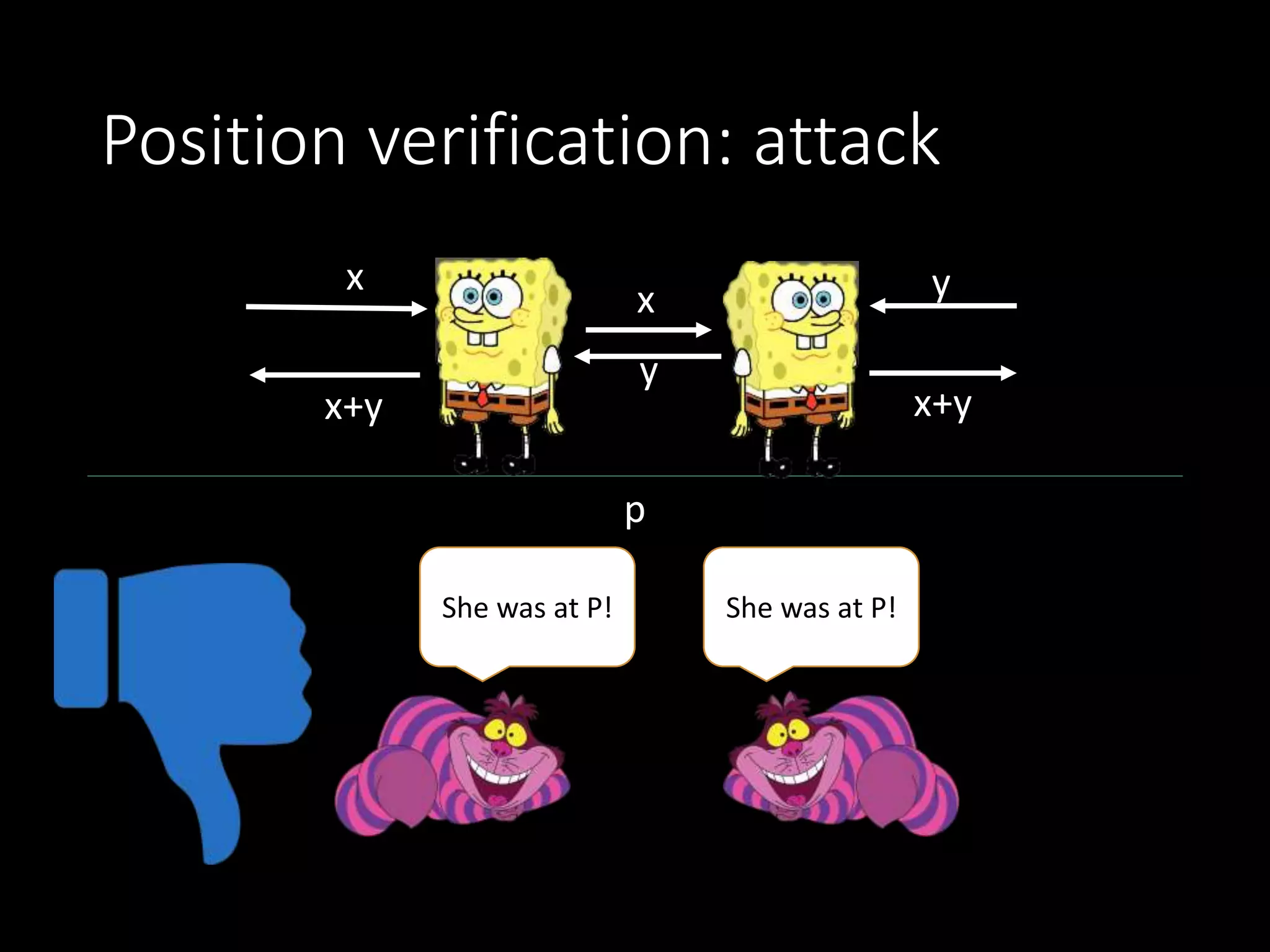
    Position verification: attack p xy x+y x+y x y She was at P! She was at P!
  • 147.
  • 148.
  • 149.
  • 150.
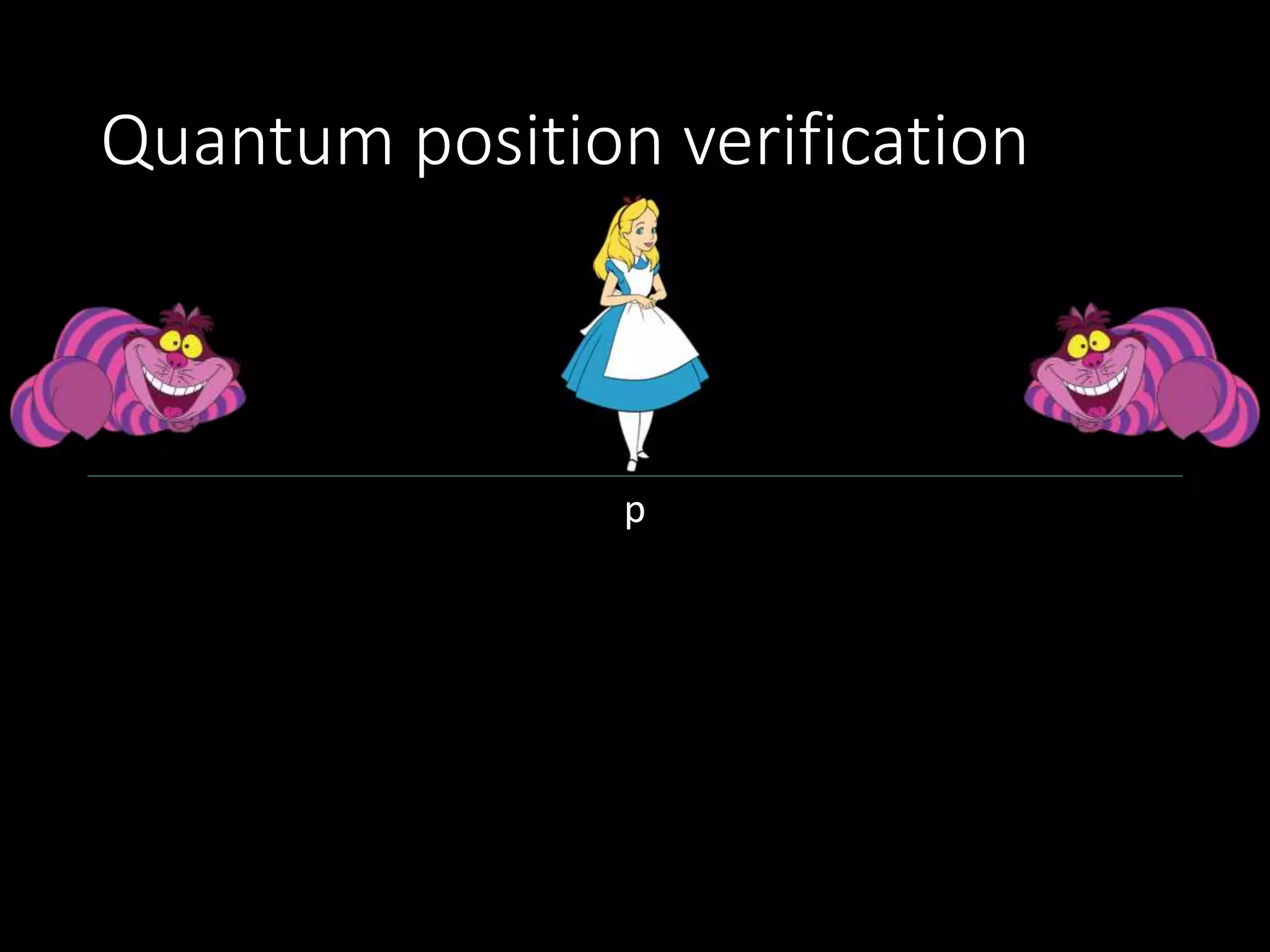
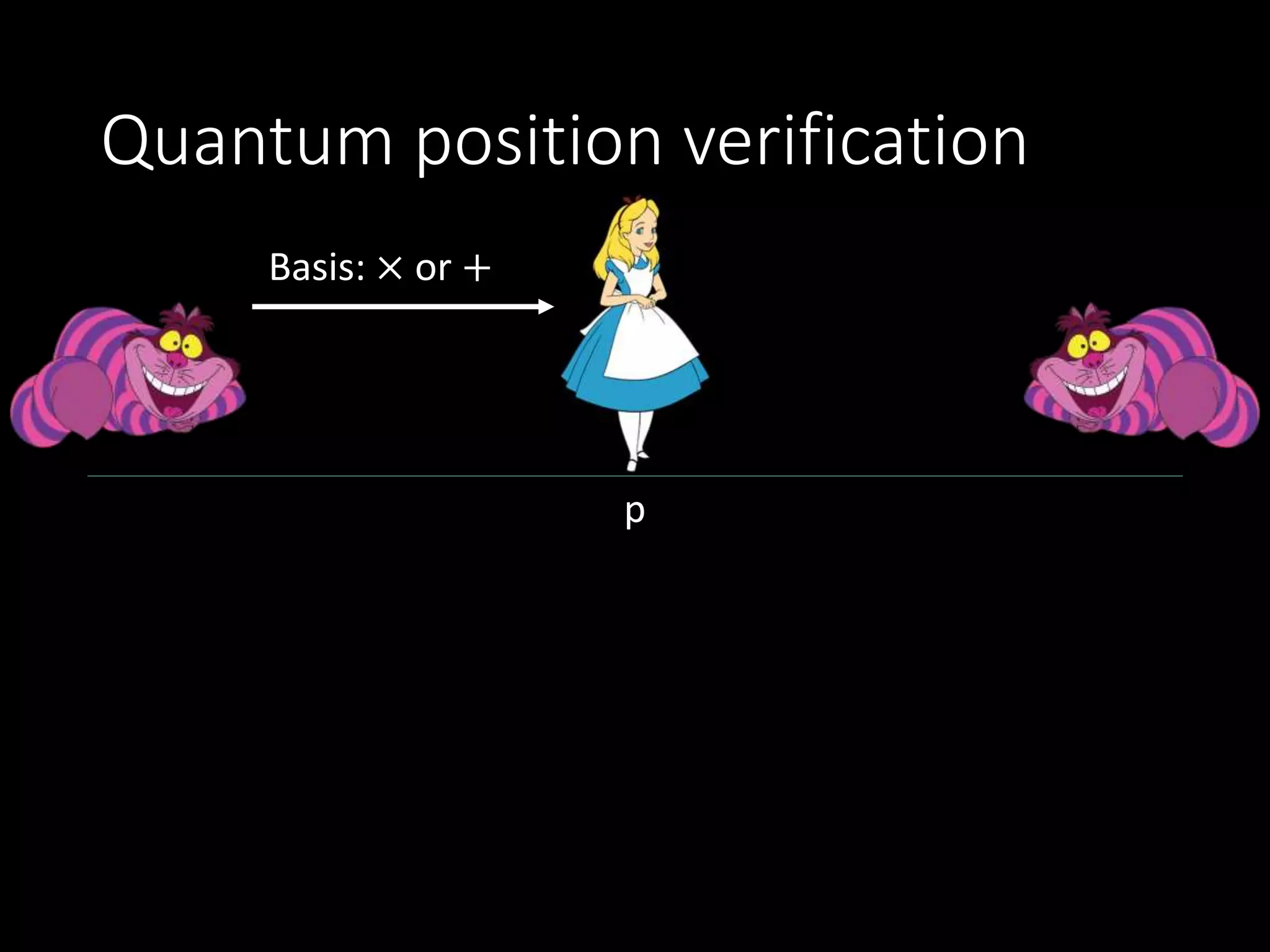
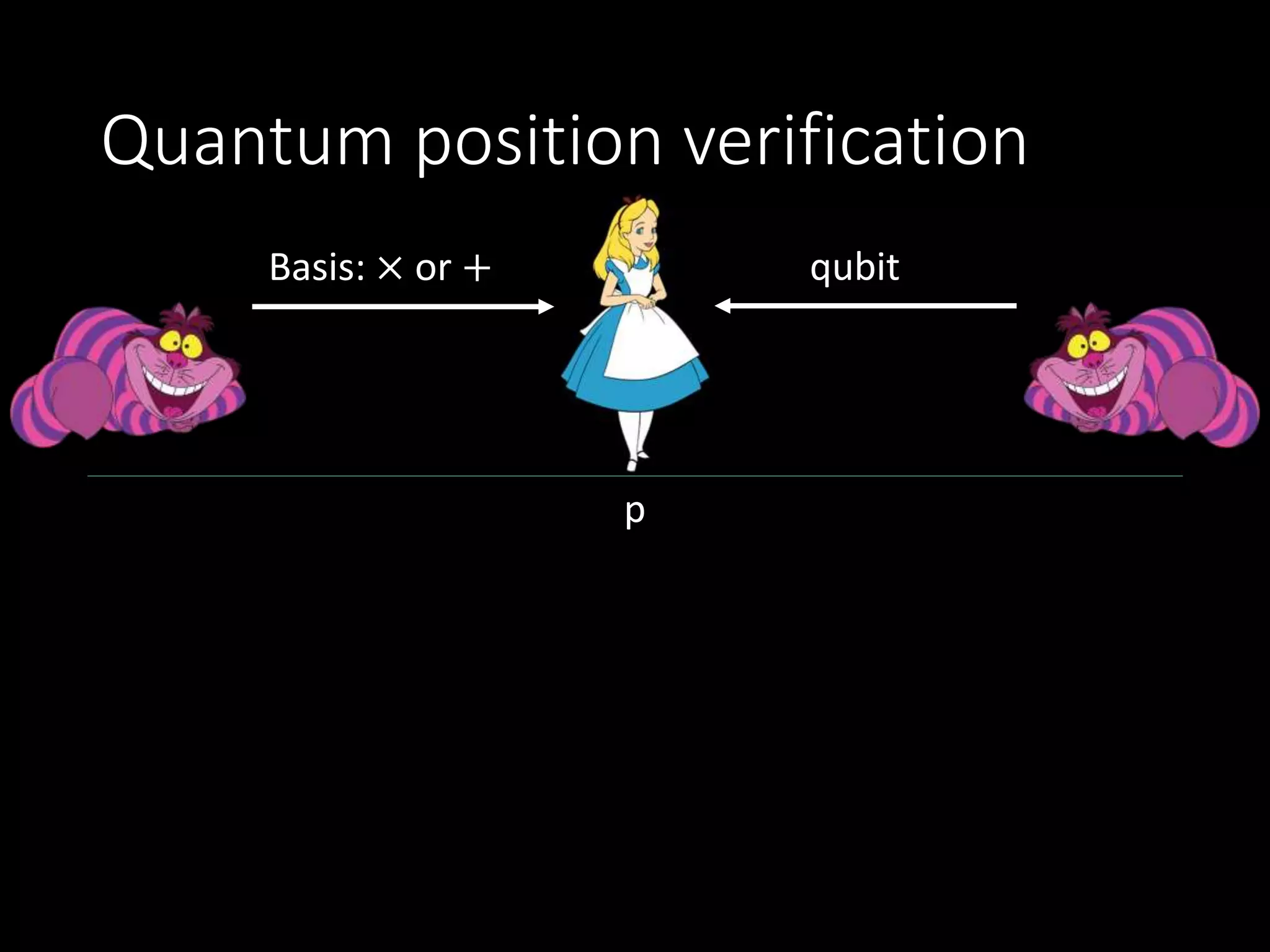
    Quantum position verification p Basis:× or + qubit outcome outcome
  • 151.
    Quantum position verification p Basis:× or + qubit outcome outcome She was at P! She was at P!
  • 152.
  • 153.
  • 154.
  • 155.
    Quantum position verification p qubitBasis:× or + • No cloning theorem: Bob cannot keep a copy of the qubit.
  • 156.
    Quantum position verification p qubitBasis:× or + • No cloning theorem: Bob cannot keep a copy of the qubit. • Information disturbance: Bob cannot attempt to measure, as he doesn’t know the basis!
  • 157.
    Quantum position verification p qubitBasis:× or + • No cloning theorem: Bob cannot keep a copy of the qubit. • Information disturbance: Bob cannot attempt to measure, as he doesn’t know the basis!
  • 158.
  • 159.
  • 160.
    But wait!!! p Open problem:actually prove the security of this protocol! [Buhrman et al, 2011]
  • 161.
    What to bringhome? • Quantum computing is a model of computation based on the latest physics • You do not need deep knowledge of physics to work with it! • There are many tasks that do not require a full quantum computer that are doable today • QC’s full power is still unknown, but it looks like it can give some meaningful speedups • Proving quantum advantage is tricky. • Careful about big advertisement claims!
  • 162.
    FAQs • Is quantumcomputing a reality now? • Will we have a quantum computer in our pockets? • Do quantum computers solve useful problems? • Does entanglement allow for faster-than-light communication? My cousin told me so.