A SEMINAR ON
BASIN EVOLUTION AND TECTONICS
 INTRODUCTION
 SEDIMENTARY EVOLUTION MODEL
 RELATIVE SEA LEVEL CHANGES
 CLASSIFICATION
 SEDIMENTARY BASINS
 SEDIMENTARY BASINS IN INDIA
 SEDIMENTARY basins of Karnataka
 IMPORTANCE OF BASIN EVOLUTION
 CONCLUSION
 REFERENCES
 Sedimentary basins are places where subsidence of
Earth's crust has allowed sediment to accumulate on top
of a basement of igneous and metamorphic rocks. Over
geologic time these sediments and associated fluids are
chemically and mechanically transformed through the
compaction and heating associated with basin subsidence.
The buried materials constitute the sedimentary
stratigraphic record and contain both unique natural
resources and information regarding the history of
tectonic, biologic, oceanographic, and climatic events
during Earth's evolution. Sedimentary basins and
sedimentary materials cover most of Earth's surface.
Understanding the evolution of sedimentary basins, and
the reasons for their existence in particular places at
specific times, can provide fundamental insights into a
wide range of Earth processes. The imprint of geologic
events left on the materials of sedimentary basins is the
most detailed record of the history of Earth's outer shell,
the lithosphere.
Basins come in many shapes and sizes and
form in response to a variety of
processes that influence the elevation of
Earth's surface. Some are filled with
strata deposited entirely in terrestrial
environments, others with strata
deposited below sea level in marine
environments; many basins include both
kinds of sediment. Sedimentary basins
also develop in many different
geodynamic settings, and their
geohistories are diverse. To define the
nature of basin-forming events, it is
essential to understand.
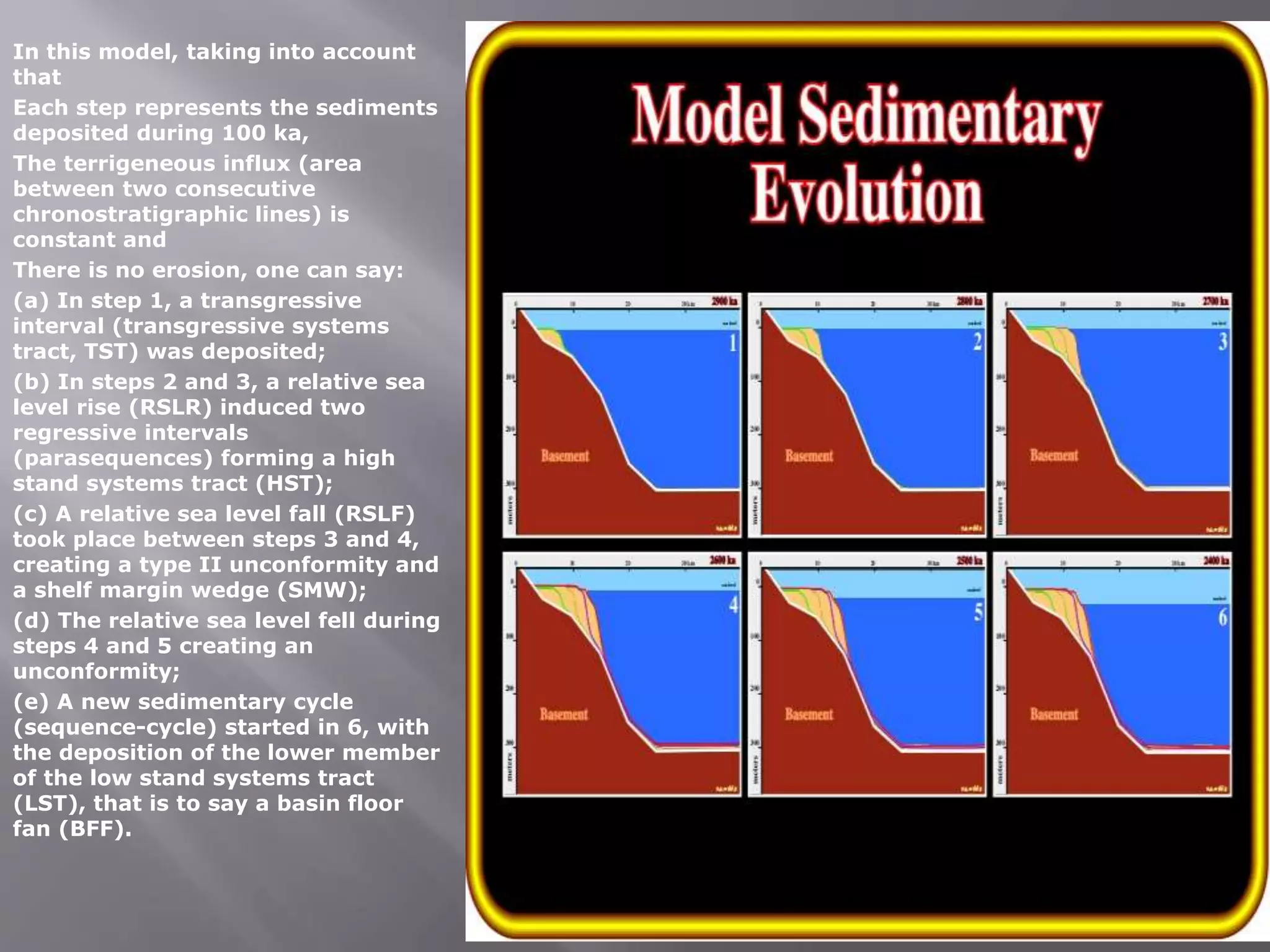
In this model, taking into account
that
Each step represents the sediments
deposited during 100 ka,
The terrigeneous influx (area
between two consecutive
chronostratigraphic lines) is
constant and
There is no erosion, one can say:
(a) In step 1, a transgressive
interval (transgressive systems
tract, TST) was deposited;
(b) In steps 2 and 3, a relative sea
level rise (RSLR) induced two
regressive intervals
(parasequences) forming a high
stand systems tract (HST);
(c) A relative sea level fall (RSLF)
took place between steps 3 and 4,
creating a type II unconformity and
a shelf margin wedge (SMW);
(d) The relative sea level fell during
steps 4 and 5 creating an
unconformity;
(e) A new sedimentary cycle
(sequence-cycle) started in 6, with
the deposition of the lower member
of the low stand systems tract
(LST), that is to say a basin floor
fan (BFF).
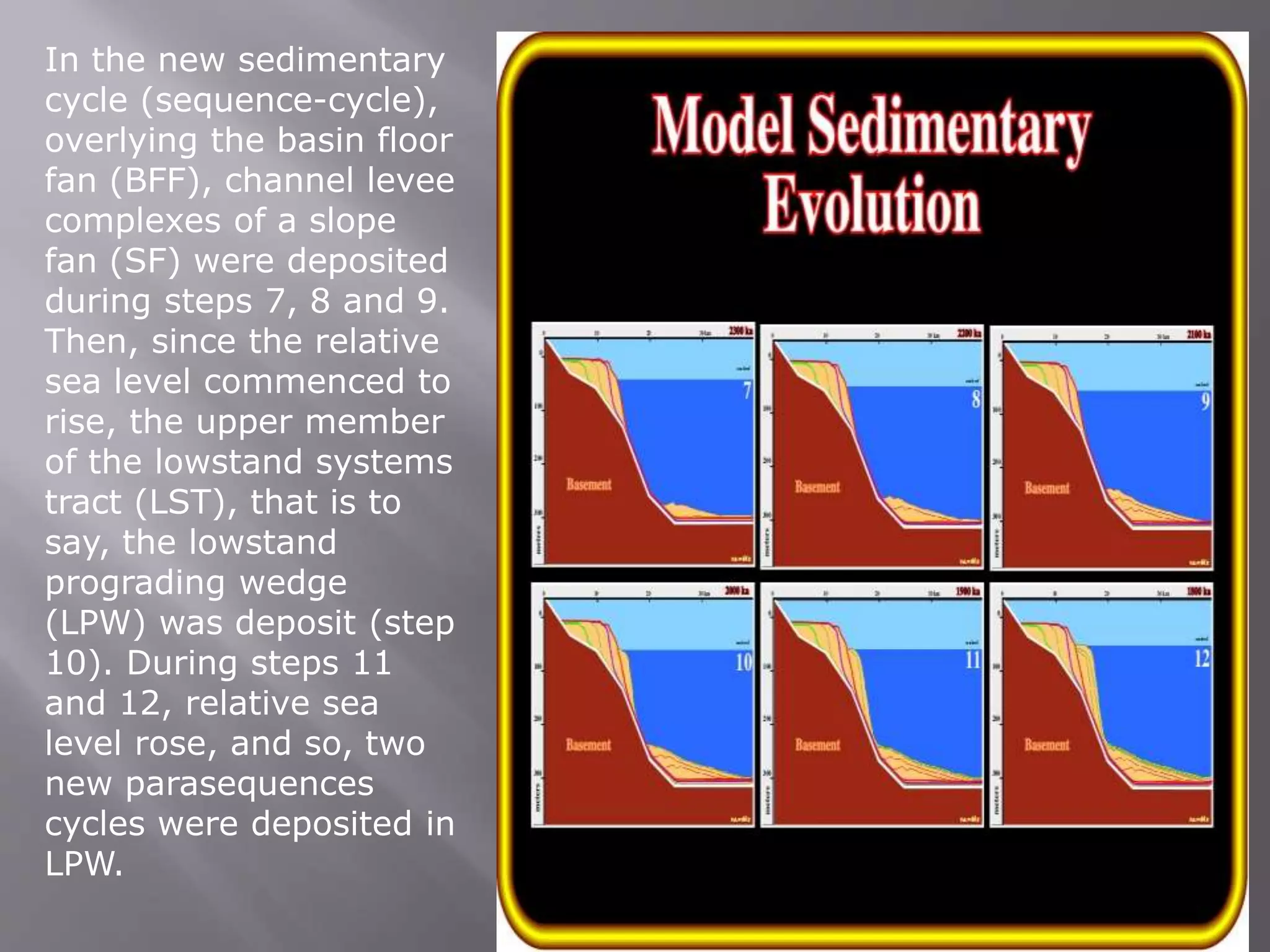
In the new sedimentary
cycle (sequence-cycle),
overlying the basin floor
fan (BFF), channel levee
complexes of a slope
fan (SF) were deposited
during steps 7, 8 and 9.
Then, since the relative
sea level commenced to
rise, the upper member
of the lowstand systems
tract (LST), that is to
say, the lowstand
prograding wedge
(LPW) was deposit (step
10). During steps 11
and 12, relative sea
level rose, and so, two
new parasequences
cycles were deposited in
LPW.
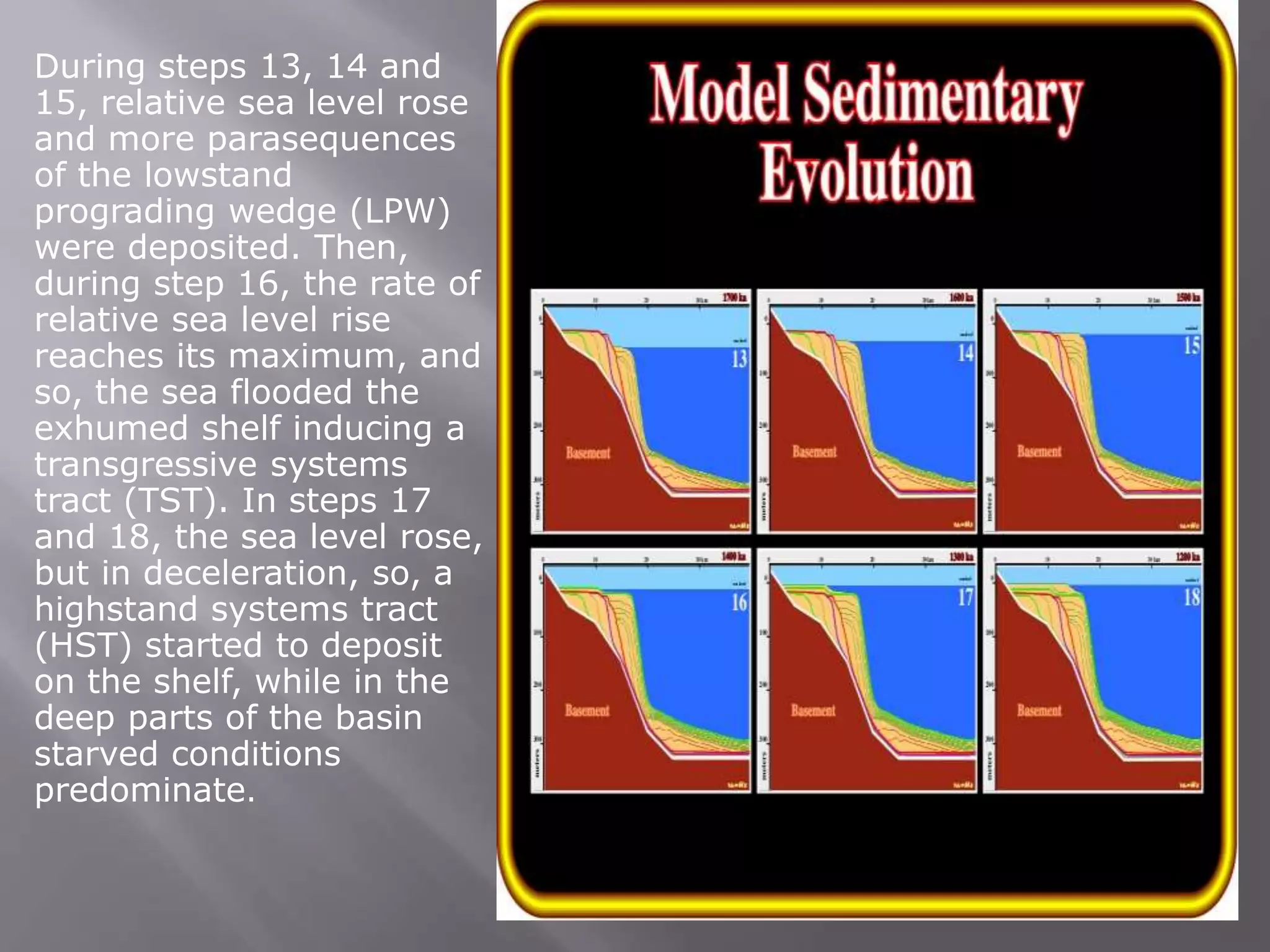
During steps 13, 14 and
15, relative sea level rose
and more parasequences
of the lowstand
prograding wedge (LPW)
were deposited. Then,
during step 16, the rate of
relative sea level rise
reaches its maximum, and
so, the sea flooded the
exhumed shelf inducing a
transgressive systems
tract (TST). In steps 17
and 18, the sea level rose,
but in deceleration, so, a
highstand systems tract
(HST) started to deposit
on the shelf, while in the
deep parts of the basin
starved conditions
predominate.
In step 19, a small relative
sea level fall created a type
II unconformity and, in step
20, a shelf margin wedge
(SMW) was deposited. In
step 21, a relative sea level
fall put the sea level below
the coastal break, which
was coincident with the
shelf break (basin without
shelf), creating a type I
unconformity, which limits
the sequence-cycle. At the
same time (minimum
hiatus), in the deep parts of
the basin a new sequence-
cycle started (step 22) with
the deposition of a basin
floor fan (BFF), i.e., the
lower member of the
lowstand systems tract
(LST). In steps 22 and 23,
channel-levee complexes,
formed a slope fan (SF),
deposited above the basin
floor fan (BFF).
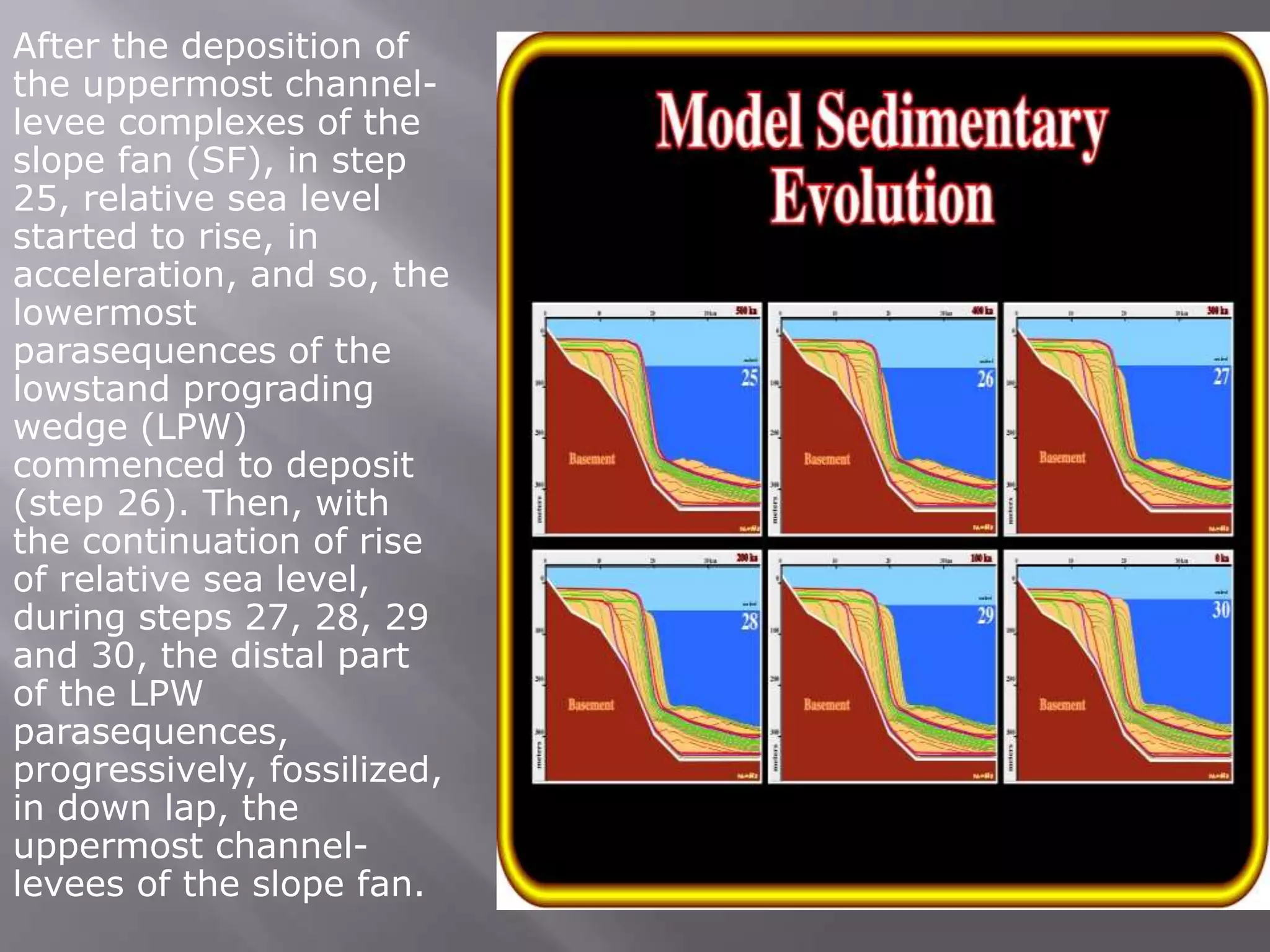
After the deposition of
the uppermost channel-
levee complexes of the
slope fan (SF), in step
25, relative sea level
started to rise, in
acceleration, and so, the
lowermost
parasequences of the
lowstand prograding
wedge (LPW)
commenced to deposit
(step 26). Then, with
the continuation of rise
of relative sea level,
during steps 27, 28, 29
and 30, the distal part
of the LPW
parasequences,
progressively, fossilized,
in down lap, the
uppermost channel-
levees of the slope fan.
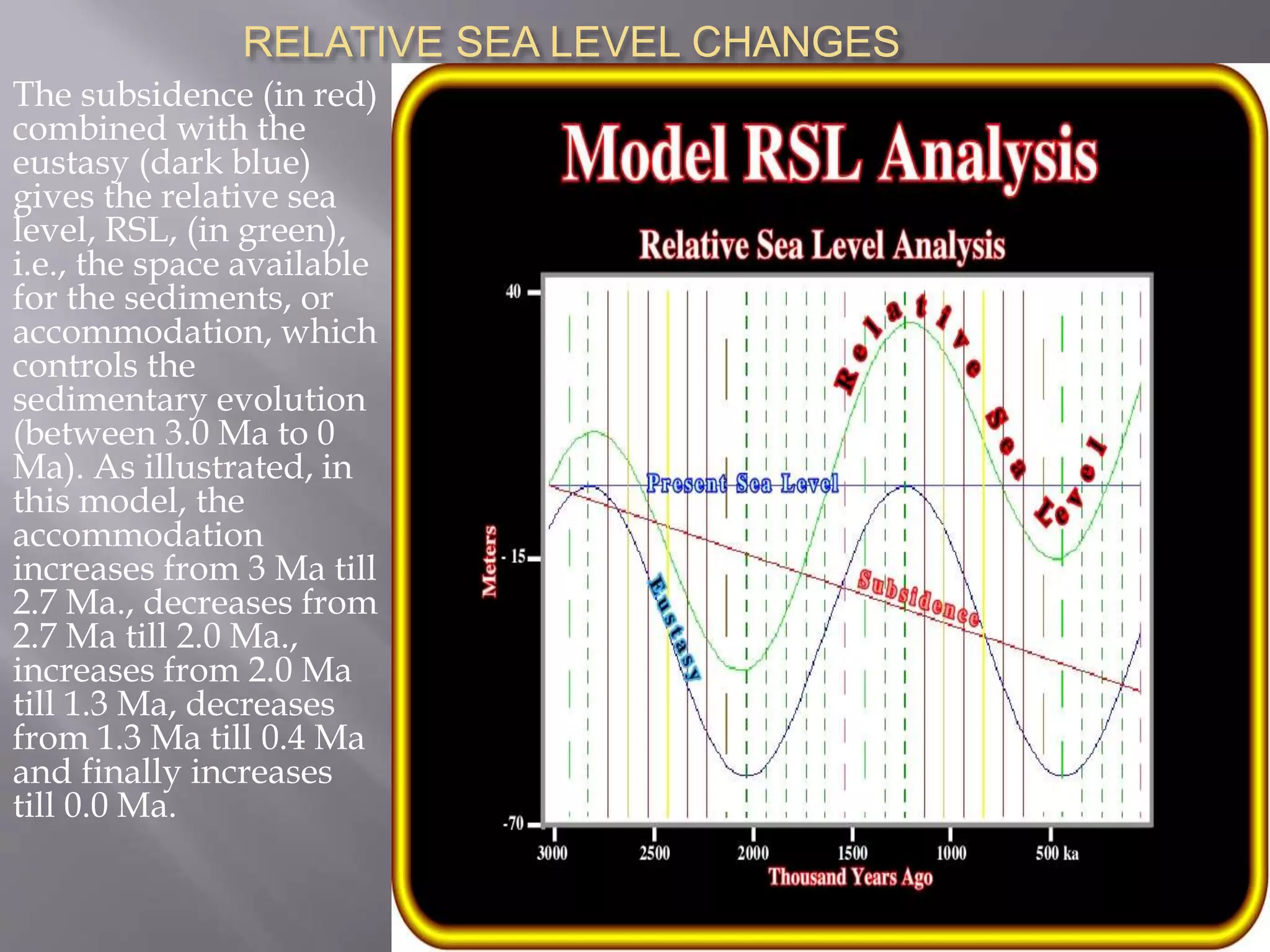
RELATIVE SEA LEVEL CHANGES
The subsidence (in red)
combined with the
eustasy (dark blue)
gives the relative sea
level, RSL, (in green),
i.e., the space available
for the sediments, or
accommodation, which
controls the
sedimentary evolution
(between 3.0 Ma to 0
Ma). As illustrated, in
this model, the
accommodation
increases from 3 Ma till
2.7 Ma., decreases from
2.7 Ma till 2.0 Ma.,
increases from 2.0 Ma
till 1.3 Ma, decreases
from 1.3 Ma till 0.4 Ma
and finally increases
till 0.0 Ma.
The tectonic setting is the premier criterion to
distinguish different types of sedimentary basins.
Extensional basins occur within or between plates
and are associated with increased heat flow due to
hot mantle plumes.
Collisional basins occur where plates collide, either
characterized by subduction of an oceanic plate or
continental collision.
Transtensional basins occur where plates move in
a strike-slip fashion relative to each other.
 Rift basins develop in continental crust and constitute the incipient
extensional basin type; if the process continues it will ultimately
lead to the development of an ocean basin flanked by passive
margins, alternatively an intracratonic basin will form.
 Rift basins consist of a graben or half-graben separated from
surrounding horsts by normal faults; they can be filled with both
continental and marine deposits.
 Intracratonic basins develop when rifting ceases, which leads to
lithospheric cooling due to reduced heat flow; they are commonly
large but not very deep.
 Proto-oceanic troughs form the transitional stage to the
development of large ocean basins, and are underlain by incipient
oceanic crust.
 Passive margins develop on continental margins along the edges of
ocean basins; subsidence is caused by lithospheric cooling and
sediment loading, and depending on the environmental setting
clastic or carbonate facies may dominate.
 Ocean basins are dominated by pelagic deposition (biogenic material
and clays) in the central parts and turbidites along the margins.
 Subduction is a common process at active margins where plates collide and at
least one oceanic plate is involved; several types of sedimentary basins can
be formed due to subduction, including trench basins, fore arc basins, back
arc basins, and retro arc foreland basins
 Trench basins can be very deep, and the sedimentary fill depends primarily on
whether they are intra-oceanic or proximal to a continent
 Accretionary prisms are ocean sediments that are scraped off the subduction
plate; they sometimes form island chains
 Fore arc basins form between the accretionary prism and the volcanic arc and
subside entirely due to sediment loading; like trench basins, their fill depends
strongly on whether they are intra-oceanic or proximal to a continent
 Backarc basins are extensional basins that may form on the overriding plate,
behind the volcanic arc
 Retroarc foreland basins form as a result of lithospheric loading behind a
mountainous arc under a compressional regime; they are commonly filled with
continental deposits
 Continental collision leads to the creation of orogenic (mountain) belts;
lithospheric loading causes the development of peripheral foreland basins,
which typically exhibit a fill from deep marine through shallow marine to
continental deposits
 Foreland basins can accumulate exceptionally thick (~10 km) stratigraphic
successions
 Strike-slip basins form in transtensional
regimes and are usually relatively small
but also deep; they are commonly filled
with coarse facies (e.g., alluvial fans)
adjacent to lacustrine or marine deposits.
The world’s greatest basins include
 The Mississippi in the USA
 The Congo in Africa
 Amazon in South America
 The Yangtze in Asia
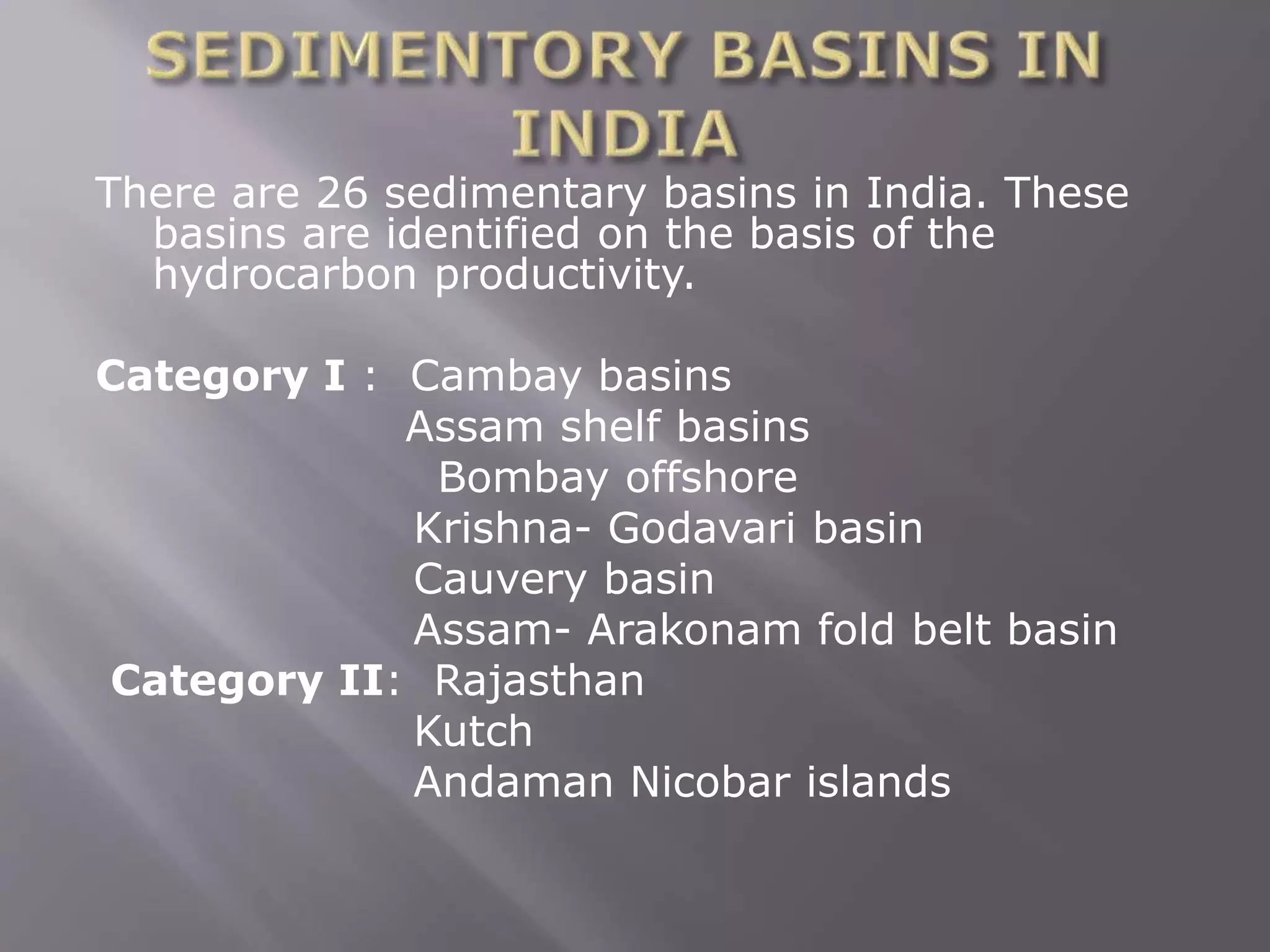
There are 26 sedimentary basins in India. These
basins are identified on the basis of the
hydrocarbon productivity.
Category I : Cambay basins
Assam shelf basins
Bombay offshore
Krishna- Godavari basin
Cauvery basin
Assam- Arakonam fold belt basin
Category II: Rajasthan
Kutch
Andaman Nicobar islands
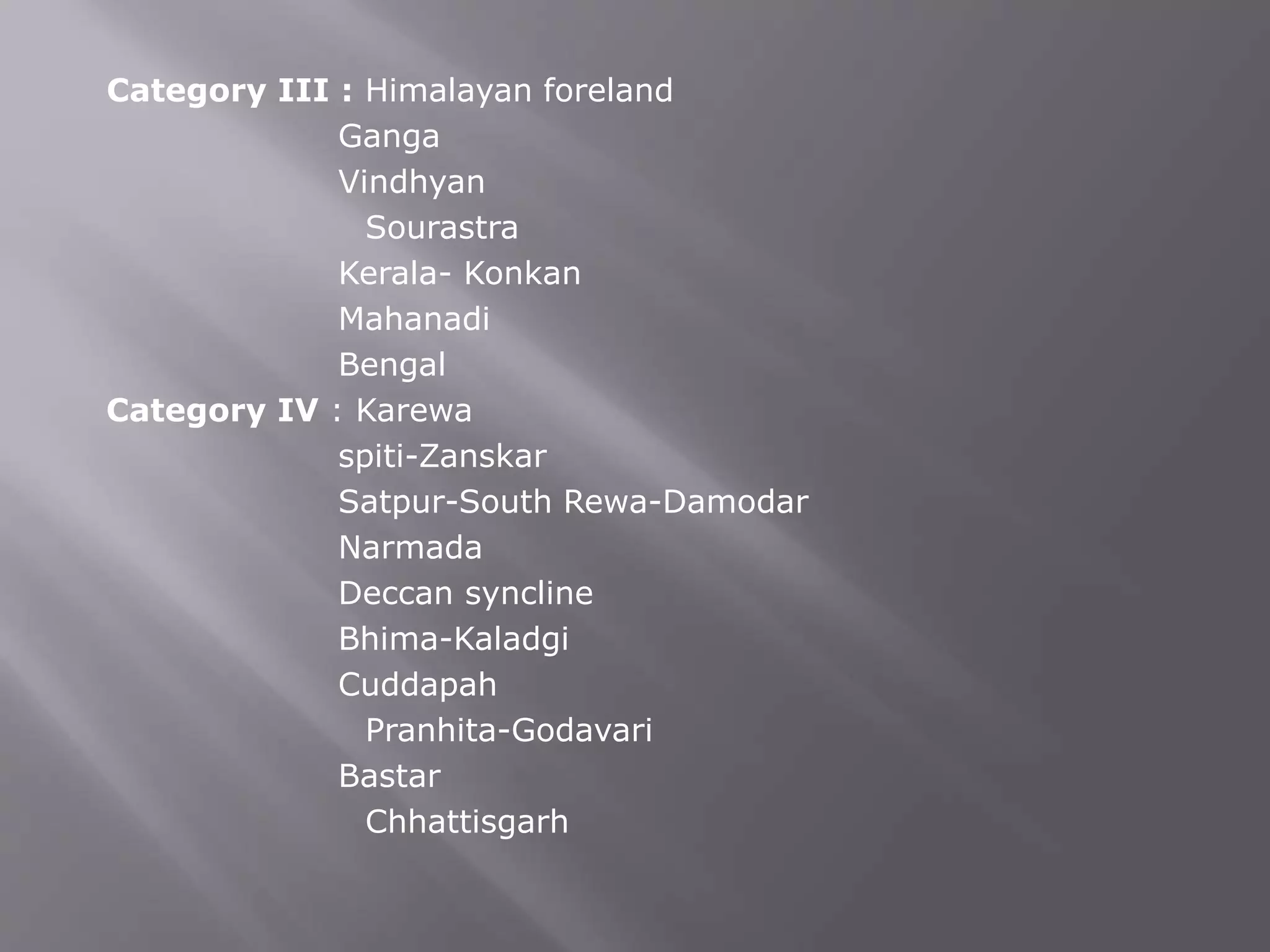
Category III : Himalayan foreland
Ganga
Vindhyan
Sourastra
Kerala- Konkan
Mahanadi
Bengal
Category IV : Karewa
spiti-Zanskar
Satpur-South Rewa-Damodar
Narmada
Deccan syncline
Bhima-Kaladgi
Cuddapah
Pranhita-Godavari
Bastar
Chhattisgarh
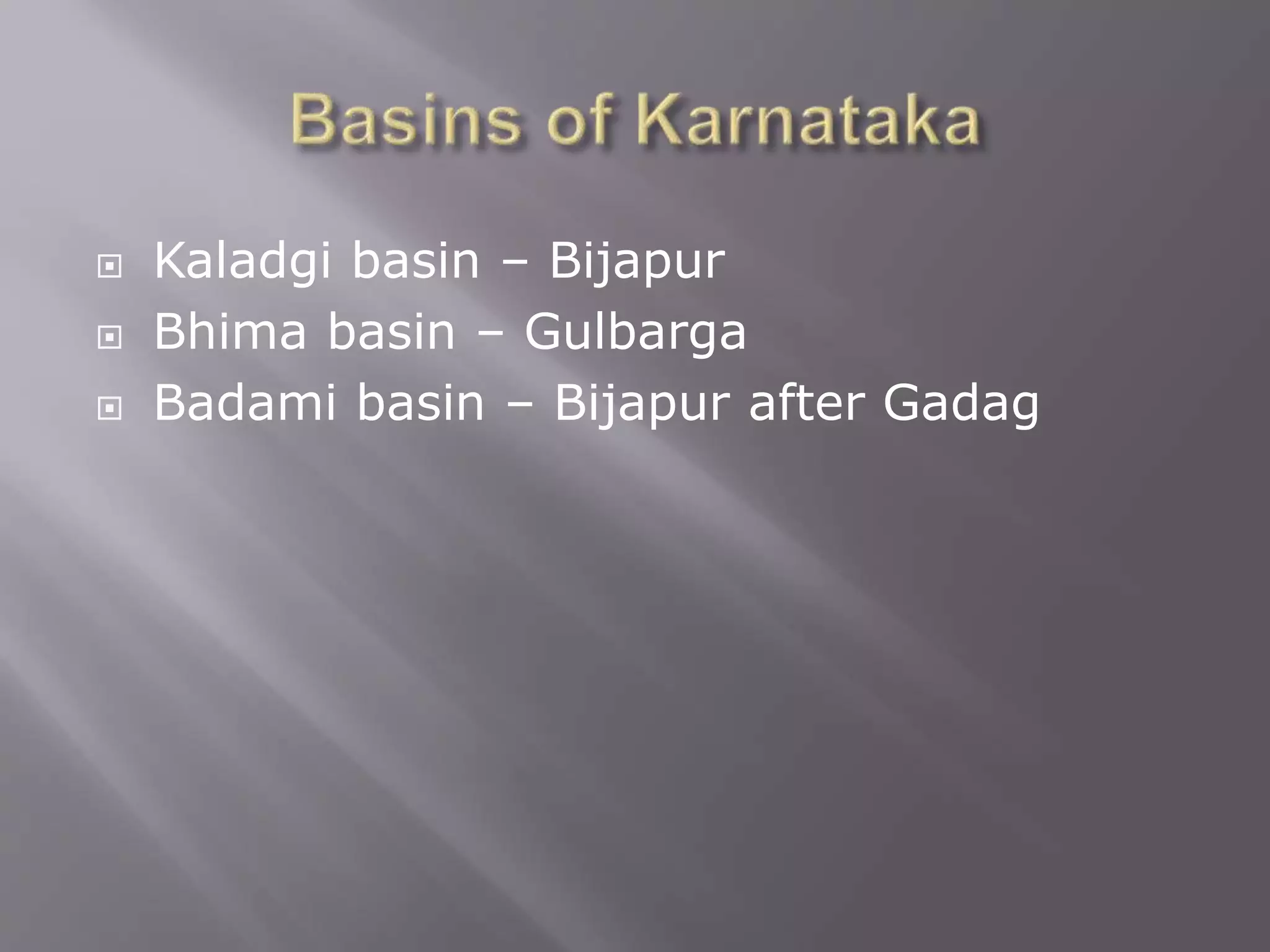
 Kaladgi basin – Bijapur
 Bhima basin – Gulbarga
 Badami basin – Bijapur after Gadag
 sedimentary basins are the location for almost all of the
world's hydrocarbons reserves and as such are the focus
of intense commercial interest.
 A number of basins formed in extensional settings can
undergo inversion which has accounted for a number of
the economically viable oil reserves on earth which were
formerly basins.
 Basin evolution has contributed in understanding the
paleo environmental setup existent during the formation
of the earth and also in interpreting the pale
environmental conditions.
 Many mineral deposits of economic importance occur
during the evolution of these basins.
 Sedimentary basin analysis is a geologic method by
which the history of a sedimentary basin is revealed,
by analyzing the sediments itself.
 The different basinal environments include backarc,
forearc, passive margin, epicontinental, and
extensional basins.
 The study of sedimentary basins as a specific entity
in themselves is often referred to as basin modeling
or sedimentary basin analysis. The need to
understand the processes of basin formation and
evolution are not restricted to the purely academic.
Indeed, sedimentary basins are the location for
almost all of the world's hydrocarbon reserves and
as such are the focus of intense commercial interest.
 Sedimentary rocks by F.J.PETTIJOHN edition II, pp-
605,622.
 Sedimentary Geology by R. PROTHERO & FRED SCHWAB,
pp-276,459,462,467,472,478,479.
 Sedimentary rocks by PETTIJOHN edition III, pp-563.
 Basin analysis and seismic stratigraphy by FISHER &
BROWN, pp645 to 652.
 Principles of sedimentary deposits by FRIEDMON &
SANDERS, pp-197, 305, 627.
 Field Geology by LAHEE, edition VI, pp-131, 197, 217,
356.
 www.google.com
 www.wikipedia.com
 www.geology.com
A seminar on basin evolution and tectonics

A seminar on basin evolution and tectonics

  • 1.
    A SEMINAR ON BASINEVOLUTION AND TECTONICS
  • 2.
     INTRODUCTION  SEDIMENTARYEVOLUTION MODEL  RELATIVE SEA LEVEL CHANGES  CLASSIFICATION  SEDIMENTARY BASINS  SEDIMENTARY BASINS IN INDIA  SEDIMENTARY basins of Karnataka  IMPORTANCE OF BASIN EVOLUTION  CONCLUSION  REFERENCES
  • 3.
     Sedimentary basinsare places where subsidence of Earth's crust has allowed sediment to accumulate on top of a basement of igneous and metamorphic rocks. Over geologic time these sediments and associated fluids are chemically and mechanically transformed through the compaction and heating associated with basin subsidence. The buried materials constitute the sedimentary stratigraphic record and contain both unique natural resources and information regarding the history of tectonic, biologic, oceanographic, and climatic events during Earth's evolution. Sedimentary basins and sedimentary materials cover most of Earth's surface. Understanding the evolution of sedimentary basins, and the reasons for their existence in particular places at specific times, can provide fundamental insights into a wide range of Earth processes. The imprint of geologic events left on the materials of sedimentary basins is the most detailed record of the history of Earth's outer shell, the lithosphere.
  • 4.
    Basins come inmany shapes and sizes and form in response to a variety of processes that influence the elevation of Earth's surface. Some are filled with strata deposited entirely in terrestrial environments, others with strata deposited below sea level in marine environments; many basins include both kinds of sediment. Sedimentary basins also develop in many different geodynamic settings, and their geohistories are diverse. To define the nature of basin-forming events, it is essential to understand.
  • 5.
    In this model,taking into account that Each step represents the sediments deposited during 100 ka, The terrigeneous influx (area between two consecutive chronostratigraphic lines) is constant and There is no erosion, one can say: (a) In step 1, a transgressive interval (transgressive systems tract, TST) was deposited; (b) In steps 2 and 3, a relative sea level rise (RSLR) induced two regressive intervals (parasequences) forming a high stand systems tract (HST); (c) A relative sea level fall (RSLF) took place between steps 3 and 4, creating a type II unconformity and a shelf margin wedge (SMW); (d) The relative sea level fell during steps 4 and 5 creating an unconformity; (e) A new sedimentary cycle (sequence-cycle) started in 6, with the deposition of the lower member of the low stand systems tract (LST), that is to say a basin floor fan (BFF).
  • 6.
    In the newsedimentary cycle (sequence-cycle), overlying the basin floor fan (BFF), channel levee complexes of a slope fan (SF) were deposited during steps 7, 8 and 9. Then, since the relative sea level commenced to rise, the upper member of the lowstand systems tract (LST), that is to say, the lowstand prograding wedge (LPW) was deposit (step 10). During steps 11 and 12, relative sea level rose, and so, two new parasequences cycles were deposited in LPW.
  • 7.
    During steps 13,14 and 15, relative sea level rose and more parasequences of the lowstand prograding wedge (LPW) were deposited. Then, during step 16, the rate of relative sea level rise reaches its maximum, and so, the sea flooded the exhumed shelf inducing a transgressive systems tract (TST). In steps 17 and 18, the sea level rose, but in deceleration, so, a highstand systems tract (HST) started to deposit on the shelf, while in the deep parts of the basin starved conditions predominate.
  • 8.
    In step 19,a small relative sea level fall created a type II unconformity and, in step 20, a shelf margin wedge (SMW) was deposited. In step 21, a relative sea level fall put the sea level below the coastal break, which was coincident with the shelf break (basin without shelf), creating a type I unconformity, which limits the sequence-cycle. At the same time (minimum hiatus), in the deep parts of the basin a new sequence- cycle started (step 22) with the deposition of a basin floor fan (BFF), i.e., the lower member of the lowstand systems tract (LST). In steps 22 and 23, channel-levee complexes, formed a slope fan (SF), deposited above the basin floor fan (BFF).
  • 9.
    After the depositionof the uppermost channel- levee complexes of the slope fan (SF), in step 25, relative sea level started to rise, in acceleration, and so, the lowermost parasequences of the lowstand prograding wedge (LPW) commenced to deposit (step 26). Then, with the continuation of rise of relative sea level, during steps 27, 28, 29 and 30, the distal part of the LPW parasequences, progressively, fossilized, in down lap, the uppermost channel- levees of the slope fan.
  • 10.
    RELATIVE SEA LEVELCHANGES The subsidence (in red) combined with the eustasy (dark blue) gives the relative sea level, RSL, (in green), i.e., the space available for the sediments, or accommodation, which controls the sedimentary evolution (between 3.0 Ma to 0 Ma). As illustrated, in this model, the accommodation increases from 3 Ma till 2.7 Ma., decreases from 2.7 Ma till 2.0 Ma., increases from 2.0 Ma till 1.3 Ma, decreases from 1.3 Ma till 0.4 Ma and finally increases till 0.0 Ma.
  • 11.
    The tectonic settingis the premier criterion to distinguish different types of sedimentary basins. Extensional basins occur within or between plates and are associated with increased heat flow due to hot mantle plumes. Collisional basins occur where plates collide, either characterized by subduction of an oceanic plate or continental collision. Transtensional basins occur where plates move in a strike-slip fashion relative to each other.
  • 12.
     Rift basinsdevelop in continental crust and constitute the incipient extensional basin type; if the process continues it will ultimately lead to the development of an ocean basin flanked by passive margins, alternatively an intracratonic basin will form.  Rift basins consist of a graben or half-graben separated from surrounding horsts by normal faults; they can be filled with both continental and marine deposits.  Intracratonic basins develop when rifting ceases, which leads to lithospheric cooling due to reduced heat flow; they are commonly large but not very deep.  Proto-oceanic troughs form the transitional stage to the development of large ocean basins, and are underlain by incipient oceanic crust.  Passive margins develop on continental margins along the edges of ocean basins; subsidence is caused by lithospheric cooling and sediment loading, and depending on the environmental setting clastic or carbonate facies may dominate.  Ocean basins are dominated by pelagic deposition (biogenic material and clays) in the central parts and turbidites along the margins.
  • 13.
     Subduction isa common process at active margins where plates collide and at least one oceanic plate is involved; several types of sedimentary basins can be formed due to subduction, including trench basins, fore arc basins, back arc basins, and retro arc foreland basins  Trench basins can be very deep, and the sedimentary fill depends primarily on whether they are intra-oceanic or proximal to a continent  Accretionary prisms are ocean sediments that are scraped off the subduction plate; they sometimes form island chains  Fore arc basins form between the accretionary prism and the volcanic arc and subside entirely due to sediment loading; like trench basins, their fill depends strongly on whether they are intra-oceanic or proximal to a continent  Backarc basins are extensional basins that may form on the overriding plate, behind the volcanic arc  Retroarc foreland basins form as a result of lithospheric loading behind a mountainous arc under a compressional regime; they are commonly filled with continental deposits  Continental collision leads to the creation of orogenic (mountain) belts; lithospheric loading causes the development of peripheral foreland basins, which typically exhibit a fill from deep marine through shallow marine to continental deposits  Foreland basins can accumulate exceptionally thick (~10 km) stratigraphic successions
  • 14.
     Strike-slip basinsform in transtensional regimes and are usually relatively small but also deep; they are commonly filled with coarse facies (e.g., alluvial fans) adjacent to lacustrine or marine deposits.
  • 15.
    The world’s greatestbasins include  The Mississippi in the USA  The Congo in Africa  Amazon in South America  The Yangtze in Asia
  • 16.
    There are 26sedimentary basins in India. These basins are identified on the basis of the hydrocarbon productivity. Category I : Cambay basins Assam shelf basins Bombay offshore Krishna- Godavari basin Cauvery basin Assam- Arakonam fold belt basin Category II: Rajasthan Kutch Andaman Nicobar islands
  • 17.
    Category III :Himalayan foreland Ganga Vindhyan Sourastra Kerala- Konkan Mahanadi Bengal Category IV : Karewa spiti-Zanskar Satpur-South Rewa-Damodar Narmada Deccan syncline Bhima-Kaladgi Cuddapah Pranhita-Godavari Bastar Chhattisgarh
  • 18.
     Kaladgi basin– Bijapur  Bhima basin – Gulbarga  Badami basin – Bijapur after Gadag
  • 19.
     sedimentary basinsare the location for almost all of the world's hydrocarbons reserves and as such are the focus of intense commercial interest.  A number of basins formed in extensional settings can undergo inversion which has accounted for a number of the economically viable oil reserves on earth which were formerly basins.  Basin evolution has contributed in understanding the paleo environmental setup existent during the formation of the earth and also in interpreting the pale environmental conditions.  Many mineral deposits of economic importance occur during the evolution of these basins.
  • 20.
     Sedimentary basinanalysis is a geologic method by which the history of a sedimentary basin is revealed, by analyzing the sediments itself.  The different basinal environments include backarc, forearc, passive margin, epicontinental, and extensional basins.  The study of sedimentary basins as a specific entity in themselves is often referred to as basin modeling or sedimentary basin analysis. The need to understand the processes of basin formation and evolution are not restricted to the purely academic. Indeed, sedimentary basins are the location for almost all of the world's hydrocarbon reserves and as such are the focus of intense commercial interest.
  • 21.
     Sedimentary rocksby F.J.PETTIJOHN edition II, pp- 605,622.  Sedimentary Geology by R. PROTHERO & FRED SCHWAB, pp-276,459,462,467,472,478,479.  Sedimentary rocks by PETTIJOHN edition III, pp-563.  Basin analysis and seismic stratigraphy by FISHER & BROWN, pp645 to 652.  Principles of sedimentary deposits by FRIEDMON & SANDERS, pp-197, 305, 627.  Field Geology by LAHEE, edition VI, pp-131, 197, 217, 356.  www.google.com  www.wikipedia.com  www.geology.com