CONSUMER BCI REVIEW !1
A Review of Consumer Brain-Computer Interface Devices
Chih-cheng Yuan
National Taiwan Normal University
CONSUMER BCI REVIEW !2
Abstract
This review looked at the private companies that are developing brain-computer interface
for commercialisztion, either consumer- or researcher-facing. The main discussion is on the
inexpensive, portable, wireless, dry-electrode, off-the-shelf EEG BCI devices. Information
regarding the validity, usability, and application of BCI devices are gathered to review their
receptions. The review encompasses a total of 6 companies’ products, with the primary
focus on Emotiv’s and NeuroSky’s BCIs.
CONSUMER BCI REVIEW !3
A Review of Consumer Brain-Computer Interface Devices
A brain-computer interface (BCI) is a communication system between the brain and
external devices. It bridges the gap between the signals of animal brains and the commands
used by computer systems.
BCIs usually record only signals from the brain, as opposed to neuroprosthetics
which works on signals from peripheral nerves and muscles. Components of a BCI system
usually involves the acquisition of the signals, further processing the signals, and the
translation of signals into computer commands. Both invasive and non-invasive
technologies have been used for the monitoring of brain signals for BCIs, such as
electroencephalograph (EEG) and intracortical brain implants. Mathematical models and
algorithms were developed to aid the processing of the naturally noisy brain signals. Also,
several computer systems were also built to handle the commands from the brain. (Nicolas-
Alonso and Gomez-Gi, 2012)
Since its early work in the 1970s, the development of BCIs has been growing
rapidly. Like many other technologies invented for medical-related purposes, the research of
BCIs has primary been centered around the restoration of damaged sensory or motor
abilities, or the examination of brain functions. There were also less private companies in
this field. However, in recent years, the development of BCIs for non-disabled users are on
the rise. New research are being done in such applications. Private companies are beginning
to looking into it because of the new interests in its potential consumer applications in
entertainment, education, and health care. The first commercialisation attempt is by
Interactive Product Line whose Mindball is a game that utilize BCI headband. (Childers,
2013) There are many companies spawning up in light of the potential of BCI; for example,
NeuroVigil makes iBrain, a EEG monitoring device that’s made for medical purposes;
nielsen, a market research company, is also taking neuroscience approach to gather
information.
This review looks at the efforts done by the private sector in BCIs, comparing the
receptions of different companies and their applications.
The Choice of EEG
BCI requires reception of brain signals captured directly from human brain. There
CONSUMER BCI REVIEW !4
are three different ways to capture these signals, i.e. (i) invasive, (ii) partially invasive, and
(iii) noninvasive. Invasive capture is characterized by introduction of implants into user’s
encephalic mass, directly into the gray matter, providing high quality signal reading;
however it causes great inconvenience and risks to human health. In partially invasive
capture, implants are placed beneath the skull without drilling the brain. Despite its lower
quality signals, this signal capture form presents lower risks to health as compared with
invasive approach. Lastly, noninvasive capture enables gathering information without any
implant since sensors are placed on the scalp, fully external to the body. Noninvasive BCIs
are more convenient and easy to use, and due to technological advancements of current
solutions, provide good quality signal capture. It is also the only one to not present risk to
users’ health. (Ferreira, Miranda, Miranda and Sakamoto, 2013)
One of the intensive focuses of BCIs is the use of EEG because of the its relatively
less costly, non-invasive, and responsive nature. EEG reading is a completely non-invasive
procedure that can be applied repeatedly to patients, normal adults, and children with
virtually no risk or limitation. (Teplan, 2002) These advantages also makes it a rather
suitable option for consumer use. However, while EEG doesn’t require surgery, it still
involves a lot of wires and sticky electrodes which makes it inconvenient and improbable
for commercialization. Companies, such as Emotiv, have made devices with fewer
electrodes and eliminated the need for wires.
General Purpose BCIs
Emotiv
Emotiv is an Australia-based bioinformatics startup which specialized in EEG
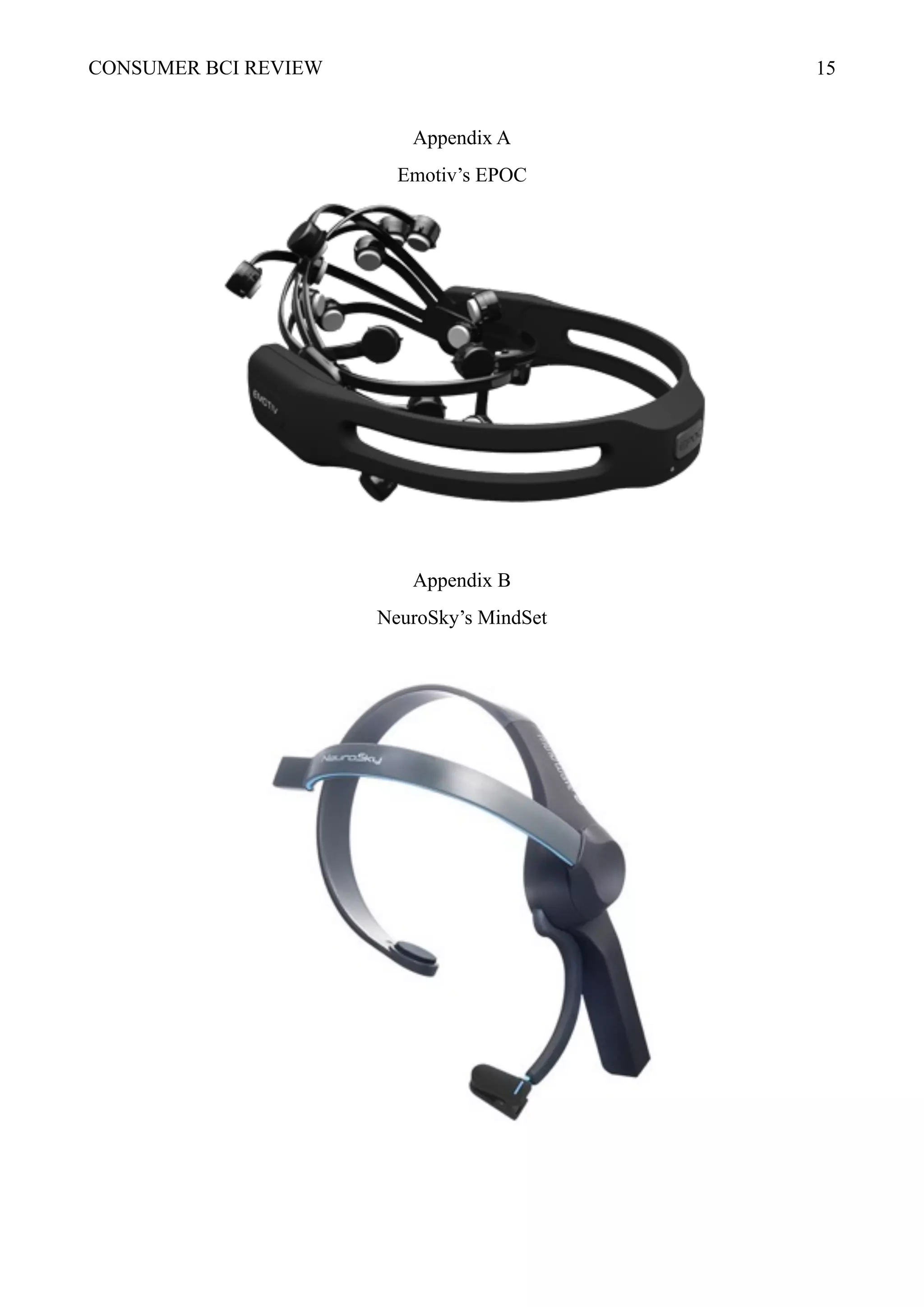
devices. Their primary products are EPOC (Appendix A) and Insight. EPOC, their headset
for scientific EEG monitoring, uses only 14 electrodes and connects to computers
wirelessly. Considering the inconvenient features of traditional EEG, the small-sized
headsets with so few electrodes from Emotiv is certainly impressive but also raises
questions regarding its validity.
Although there are certain differences between headsets which can be resulting from
communication delays and responsiveness of recording software, it is confirmed that the
Emotiv EPOC headset does pick up ‘true’ or ‘real’ EEG. (Ekanayake, 2010) More specific
CONSUMER BCI REVIEW !5
inspection, such as for auditory ERPs, the P1, N1, P2, N2, and P3 measured at the frontal
sites, results of EPOC compares well to that of the research EEG system. (Badcock,
Mousikou, Mahajan, Lissa, Thie and McArthur, 2013) However, there are also research that
suggest EPOC be chosen only for non-critical applications such as games, communication
systems, etc. (Duvinage, Castermans, Petieau, Hoellinger, Cheron and Dutoit, 2013) A
comparison between the EMOTIV headset and six gel-based disc electrodes found that it
shows no overall statistically significant difference between the two modalities although
there is a trend for the Emotiv headset to provide worse performance, but, in terms of set up
time, Emotive headset is twice as fast. The results of the comparison suggest the choice of
modality be decided on a case-by-case basis given. (Mayauda, Congedo, Laghenhovea,
Orlikowski, Figèrea, Azaboub and Cheliout-Heraut, 2013) Therefore, while the Emotiv
EPOC is clearly sufficient for consumer use, whether or not it’s up for serious scientific
inquiry is still debatable.
On the other hand, the fixed position of electrodes of EPOC may pose inconvenience
to the need of EEG related research, as researchers may use locations other that those of
EPOC, or even want to use placement systems other than the popular International 10-20
System, the one used by Emotiv EPOC. That said, this may not be a major problem as the
low spatial frequency is already one of the prominent features of EEG. In addition, Emotiv
said that they chose the locations and the number of electrodes deliberately because the
purpose of the EPOC is to do the best possible BCI job with the least difficulty in fitting for
the average consumer, who does not want to mess around with straps and adjustments, and
that they had done serious stats on the problem and found no crucial need to increase the
number of electrodes. (gmac, 2009)
Many applications of EPOC have been implemented. Its portability liberated the
users from the hassle of traditional EEG devices and opened up possibilities of connection
to mobile devices. Work done in mobile devices suggests that the mobility and simplified
application development may enable completely new research directions for imaging
neuroscience and thus offset the expected reduced signal quality of a mobile off-the-shelf,
low-density neuroheadset relative to more conventional and controlled, high-density
laboratory equipment. (Stopczynski, Stahlhut, Larsen, Petersen and Hansen) A team from
CONSUMER BCI REVIEW !6
Dartmouth College has successfully used neural signals to control iPhones for hands-free,
silent and effortless human-mobile interaction. They implemented an address book dialing
app which works on similar principles to P300-speller, which is a test designed to determine
what the subject is attend to, brain-computer interfaces. (Campbell, Choudhury, Hu, Lu,
Mukerjee, Rabbi and Raizada)
While the immediate and obvious benefit of application of BCI in telepresence
robots is giving disabled patients the ability of navigating environment remotely so that, for
example, they could hang out with their families again, there is much potential for
applications for the non-disabled. A team at Oklahoma State University designed a platform
for "Remote Presence" which enables a person to be present at a remote location through the
embodiment of a humanoid robot. It would help the user to feel total immersion in the
remote environment. This system could immensely benefit a variety of sectors such as
military, medicine, disaster management etc. for carrying out dangerous or physically
intensive tasks. (Thobbi, Kadam and Sheng) More work are being done here, and
optimizations such as giving more autonomy to the telepresent robot can further make the
remote control more efficient. (Shanmugapriya and Senthilkumar, 2013)
As Emotiv claimed, EPOC can also differentiate emotions. So there are potential that
it can be used for pedagogical purposes to monitor students’ frustration or boredom.
(INVENTADO, LEGASPI, SUAREZ and NUMAO, 2011) The monitoring of emotion may
also be helpful in games (Pröll, 2012), where emotional feedback can be used to customize
the player experience. Gaming is also one of the most exciting application of BCIs like
EPOC, with particular features suitable for consumer use. A survey of nearly three hundred
participants that included researchers, game developers and users around the world showed
all three groups agree that games is one the most promising BCI applications. (Ahn, Lee,
Choi and Jun, 2014) Emotiv has provided a online store where games that can be played
with its headsets are available for purchase, and its software development kit (SDK) also
allows developers and third-party companies alike to release games based on the
technology. Several impressive games have been released since, such as Stillalive Studios’
Son of Nor, in which players can control the character and interact with the environment in
game using EPOC.
CONSUMER BCI REVIEW !7
There are also applications in business, such as NeuroSpire, a "neuromarketing"
solution provider which uses EPOC.
NeuroSky
California-based NeuroSky is one of the earliest companies that got into the
commercialization of BCI. They produces similar devices as Emotiv, including MindSet,
MindWave (Appendix B), and several others with some variations, all of which base on
similar EEG technology.
NeuroSky’s products use, like Emotiv, dry electrodes, but they only have single
channel. A study that recognized the validity and fast setup time of MindSet also noted that
there are major trade-offs in terms of the number of recording locations. (Johnstone,
Blackman and Bruggemann, 2012) Although having only one electrode may cause
restrictions, it is shown that the commercially available dry EEG devices produced by
NeuroSky are a viable solution for use in real-world applications. These devices’ ability to
integrate with open source software, such as BCI2000, and flexible script languages, such as
Matlab, make them suitable candidates for further research in the detection of vigilance
states. (Choi, Jones and Schwartz) On the other hand, it’s also suggested that while these
channels might be useful for some applications such as testing the cognitive load, they are
not for general BCI applications. (Alkhater) There is also experiment that report the single
electrode of NeuroSky’s headset is inadequate for classifying various kinds of mental
activities. (Wang and Larsen)
The usability of MindSet, NeuroSky’s 2009 EEG headset, is evaluated in a study
which defined a model of attention to fuse attention signals with user-generated data in a
Second Life assessment exercise. The results of this evaluation suggest that the MindSet
provides accurate readings regarding attention, since there is a positive correlation between
measured and self-reported attention levels. The results also suggest there are some usability
and technical problems with its operation. (Rebolledo-Mendez, Dunwell, Martínez-Mirón,
Vargas-Cerdán, Freitas, Liarokapis and García-Gaona, 2009) Another study, which use the
Mindwave Mobile EEG to test its validity in children with developmental coordination
disorder (DCD), concluded that, though the single-channel, dry-electrode EEG device has
limited scalp recording locations, it could accurately measure the overall level of mental
CONSUMER BCI REVIEW !8
attention in children with DCD clinically with no significant influence of eye blinking, and
that the portable device has a potential utility in special pediatric populations, in which ease
of use is the first priority. (Fong, Tsang, Cheng, Ki, Ma and Macfarlane, 2015)
The first use of NeuroSky’s technology was by the USA Olympic Archery team for
training, which also gained the company much media coverage. Other applications include
tele-operation of robot (Vourvopoulos and Liarokapis), attention exercise (Rebolledo-
Mendez and Freitas, 2013), games, and even software development (Fritz, Begelb, Müller,
Yigit-Elliott and Züger). Neurowear, a Japan fashion-electronic company, also used
NeuroSky’s technology to built the Necomimi, a cat-ear headband that respond to the
wearer’s EEG signals that gained popularity among some niche markets. With its SDK,
there are also many user-made applications.
One of the major focuses of NeuroSky’s products is education. Its MindWave is
designed for use by children in grades 2-7 and is marketed as a device to improve school
performance. (BUTLER, 2012) NeuroSky’s official online store provides several such apps.
Focus Pocus, with the MindWave Mobile headset, is claimed to be a game that would
improve attention, concentration, and information retention ability. However, there have not
been many educational research utilizing it, and, pedagogically, it is still regarded as toy or
novelty rather than serious tool.
BCIs for Meditation
InteraXon
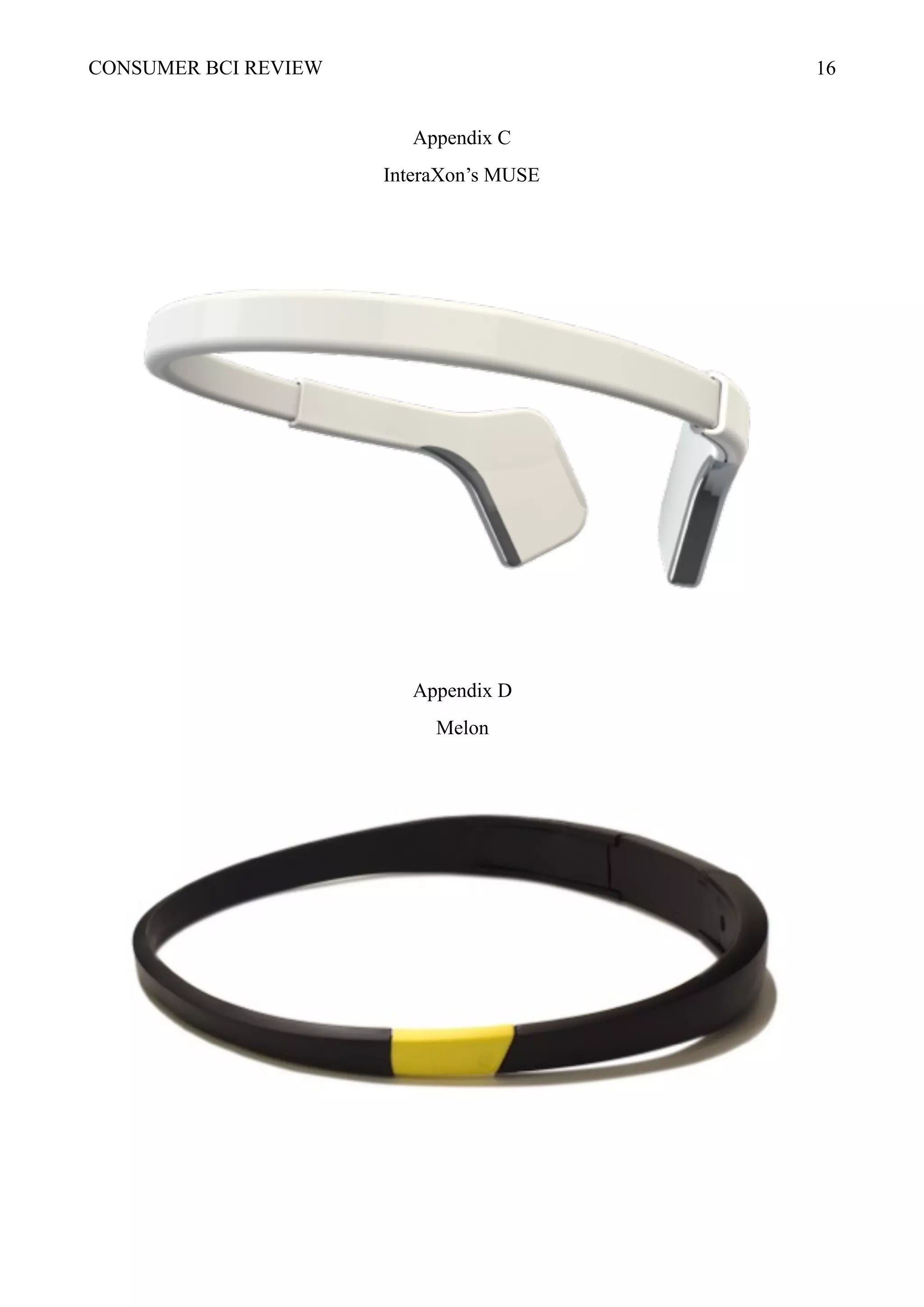
InteraXon is a Toronto-based company whose primary product, MUSE headband
(Appendix C), is a crowdfunded EEG monitoring device that’s made to aid meditation.
There are 7 sensors on the MUSE which all will be placed on the user’s forehead. The
capacity of MUSE is somewhat intermediate, with more electrodes than NeuroSky’s
products and more simple wearing design to better fit general users than Emotiv’s EPOC or
Insight. The fact that the
MUSE is much more consumer-facing than the aforementioned two companies
products, and rarely promote any research potential. Therefore, there’s hardly any study
using the MUSE as a tool, and its applications by third party users or companies are
relatively few, though there are SDK in place. The main slogan of InterAxon is that MUSE
CONSUMER BCI REVIEW !9
would "boost mindfulness" of the user by meditation. MUSE’s meditation training program
is self-contained, with the app also developed by InterAxon, and is marketed as a fully-
fledged mindfulness training product.
While there are little studies to test its usability or validity in academic settings, non-
academic reviews suggest overall mixed reception. A user reached out to the company for
evidence for its claim that the training would help increase mindfulness in absence of the
device but did not receive direct response. (codymclain, 2014) However, user-interface and
product-design-wise, the reviews are mostly positive-hardly a surprise considering
InterAxon’s CEO, Ariel Garten, used to be a fashion designer. Stills, usability concerns are
still present. (Ferriss, 2014)
BCIs for Cognitive Training
Melon
Melon (Appendix D), an eponymous product of the company, is a EEG headband
based on NeuroSky’s chip that claim to help users to gain better focus. Although Melon
came out several years ago, there have been few reviews and none academic mentions. After
being acquired by DAQRI in early 2015, the current status of Melon is unknown.
BCIs for Sleep Tracking
iWink
Based in California, iWink is a rather new and small startup compared with other
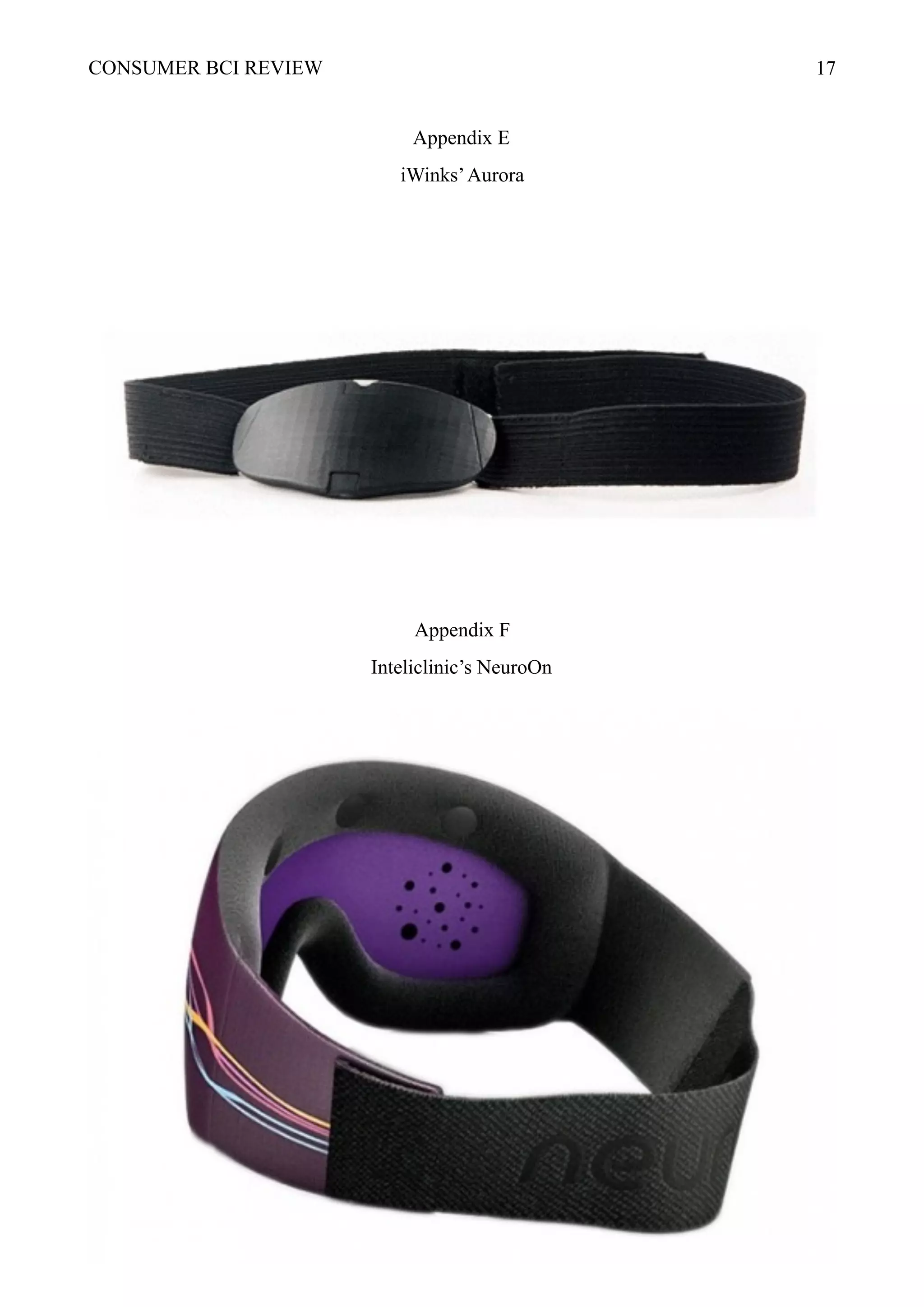
companies. Its primary product, Aurora (Appendix E) headset, is also a crowdfunded EEG
"dream-enhancing headband". They claimed the headset would allow users to better control
and experience "lucid dreaming". Since Aurora is still yet to ship, there is no hard evidence
of whether it will live up to its promise or will it have other applications.
Inteliclinic
Inteliclinic is a Polish startup whose NeuroOn (Appendix F) is claimed to be a EEG
sleep mask designed to help travellers to adjust to new time-zones and non-travellers to
regulate their sleep patterns. NeuroOn is still at "pre-launch" stage, so little information can
be gathered and no implication can be made.
Conclusion
Considering the general-purpose BCIs, though there are still lingering doubts of
CONSUMER BCI REVIEW !10
whether consumer BCIs can produce data as good as the research devices, researchers have
recognized it is sufficient for certain application when consumer products’ particular
advantages are favored, and applications using such devices are also booming in
commercial world. On the other hand, BCIs designed for specific purposes are, albeit some
nebulous efforts, increasingly gaining popularities among certain groups, though, because it
is an even more novel endeavor, reviews are few and the prospect is unclear.
Although the development of BCIs spans decades since its inception, the effort of
the private arm to commercialize BCIs’ potential is still at its infancy. Recent years have
witnessed accelerating growth of off-the-shelf BCIs devices applied to research and
everyday use alike, and several niche markets, gaming, sleep tracking, and cognitive
training, have opened up new opportunities for further intensive progress of BCI technology
that would help both academic researchers and amateur consumers to utilize the devices.
CONSUMER BCI REVIEW !11
References
Nicolas-Alonso, L. F. and Gomez-Gil, J. (2012). Brain Computer Interfaces, a Review.
Sensors. Retrieved from http://www.ncbi.nlm.nih.gov/pmc/articles/PMC3304110/pdf/
sensors-12-01211.pdf
Childers, N. (2013, June 6). The Video Game Helmet That Can Hack Your Brain. Retrieved
from http://motherboard.vice.com/blog/the-video-game-helmet-that-can-hack-your-brain
Ferreira, A. L. S., Miranda, L. C., Miranda, E. E. C. and Sakamoto, S. G. (2013). A Survey
of Interactive Systems based on Brain-Computer Interfaces. SBC Journal on 3D Interactive
Systems. Retrieved from http://seer.ufrgs.br/jis/article/download/40857/26624
Teplan, M. (2002). FUNDAMENTALS OF EEG MEASUREMENT. MEASUREMENT
SCIENCE REVIEW. Retrieved from http://www.measurement.sk/2002/S2/Teplan.pdf
Ekanayake, H. (2010). P300 and Emotiv EPOC: Does Emotiv EPOC
capture real EEG? Retrieved from http://neurofeedback.visaduma.info/emotivresearch.htm
Badcock, N. A., Mousikou, P., Mahajan, Y., Lissa, P., Thie, J. and McArthur, G. (2013).
Validation of the Emotiv EPOC® EEG gaming system for measuring research quality
auditory ERPs. Retrieved from https://peerj.com/articles/38.pdf
Duvinage, M., Castermans, T., Petieau, M., Hoellinger, T., Cheron, G. and Dutoit, T. (2013).
Performance of the Emotiv Epoc headset for P300-based applications. BioMedical
Engineering OnLine. Retrieved from http://www.ncbi.nlm.nih.gov/pmc/articles/
PMC3710229/pdf/1475-925X-12-56.pdf
Mayauda, L., Congedo, M., Laghenhovea, A. V., Orlikowski, D., Figèrea, M., Azaboub, E.
and Cheliout-Heraut, F. (2013). A comparison of recording modalities of P300 event-related
CONSUMER BCI REVIEW !12
potentials (ERP) for brain-computer interface (BCI) paradigm. Neurophysiologie Clinique/
Clinical Neurophysiology. Retrieved from https://www.researchgate.net/publication/
257461697_A_comparison_of_recording_modalities_of_P300_event-
related_potentials_ERP_for_brain-computer_interface_BCI_paradigm
gmac (2009). EPOC Hardware Design Decisions?, Electrode placement and research
recommendations. Retrieved from http://emotiv.com/forum/messages/forum4/topic369/
message1947/#message1947
Stopczynski, A., Stahlhut, C., Larsen, J. E., Petersen, M. K. and Hansen, L. K. The
Smartphone Brain Scanner: A Mobile Real-time Neuroimaging System. Retrieved from
http://arxiv.org/pdf/1304.0357.pdf
Campbell, A. T., Choudhury, T., Hu, S., Lu, H., Mukerjee, M. K., Rabbi, M. and Raizada, R.
D. S. NeuroPhone: Brain-Mobile Phone Interface using a Wireless EEG Headset. Retrieved
from https://www.human.cornell.edu/hd/upload/neurophone.pdf
Thobbi, A., Kadam, R. and Sheng, W. Achieving Remote Presence using a Humanoid Robot
Controlled by a NonInvasive BCI Device. Retrieved from http://anandthobbi.yolasite.com/
resources/ICGST.pdf
Shanmugapriya, T. and Senthilkumar, S. (2013). International Journal of Innovative
Research in Computerand Communication Engineering. A Telepresence Mobile Robot
Controlled With a Non-Invasive Brain-Computer Interface. Retrieved from http://
www.rroij.com/open-access/a-telepresence-mobile-robot-controlledwith-a-noninvasive-
braincomputerinterface.pdf
INVENTADO, P. S., LEGASPI, R., SUAREZ, M., and NUMAO, M. (2011). Research and
Practice in Technology Enhanced Learning. PREDICTING STUDENT EMOTIONS
RESULTING FROM APPRAISAL OF ITS FEEDBACK. Retrieved from http://
CONSUMER BCI REVIEW !13
www.apsce.net/uploaded/filemanager/4fd114ce-96f9-4849-bf1c-a83adc97b139.pdf
Pröll, M. (2012). Using a low-cost gyro and eeg-based input device in interactive game
design. Retrieved from http://xcessity.at/downloads/master_thesis_public.pdf
Ahn, M., Lee, M., Choi, J. and Jun, S. C. (2014). Sensors. A Review of Brain-Computer
Interface Games and an Opinion Survey from Researchers, Developers and Users. Retrieved
from www.mdpi.com/1424-8220/14/8/14601/pdf
Johnstone, S. J., Blackman, R. and Bruggemann, J. (2012). EEG from a single-channel dry-
sensor recording device. Retrieved from http://ro.uow.edu.au/cgi/viewcontent.cgi?
article=1036&context=sspapers
Choi, H. S., Jones, A. and Schwartz, G. Using Brain-Computer Interfaces to Analyze EEG
Data for Safety Improvement. Retrieved from https://www.truststc.org/education/reu/12/
Papers/Choi_Jones_Paper.pdf
Alkhater, R. M. Real-time Detection of P300 Brain Events: Brain-computer Interfaces for
EEG-based Communication Aids. Retrieved from http://aut.researchgateway.ac.nz/
bitstream/handle/10292/4707/AlkhaterRM.pdf
Wang, A. I. and Larsen, E. A. USING BRAIN-COMPUTER INTERFACES IN AN
INTERACTIVE MULTIMEDIAAPPLICATION. Retrieved from http://www.idi.ntnu.no/
~alfw/publications/sea2012-bci-snake.pdf
Rebolledo-Mendez, G., Dunwell, I., Martínez-Mirón, E. A., Vargas-Cerdán, M. D., Freitas,
S., Liarokapis, F. and García-Gaona, A. R. (2009). Assessing NeuroSky’s Usability to
Detect Attention Levels in an Assessment Exercise. Retrieved from http://link.springer.com/
chapter/10.1007%2F978-3-642-02574-7_17
CONSUMER BCI REVIEW !14
Fong, S. S. M., Tsang, W. W. N., Cheng, Y. T. Y., Ki, W. Y., Ma, A. W. W. and Macfarlane,
D. J. (2015). Journal of Novel Physiotherapies. Single-channel Electroencephalographic
Recording in Children with Developmental Coordination Disorder: Validity and Influence
of Eye Blink Artifacts. Retrieved from http://www.omicsgroup.org/journals/singlechannel-
electroencephalographic-recording-in-children-with-developmental-coordination-disorder-
validity-and-influence-of-eye-blinkartifacts-2165-7025-1000270.pdf
Vourvopoulos, A. and Liarokapis, F. Brain-controlled NXT Robot - Tele-operating a robot
through brain electrical activity. Retrieved from http://www.academia.edu/889399/Brain-
controlled_NXT_Robot_-_Tele-operating_a_robot_through_brain_electrical_activity
Rebolledo-Mendez, G. and Freitas, S. (2013). CURVE. Attention modeling using inputs
from a Brain Computer Interface and user-generated data in Second Life. Retrieved from
https://curve.coventry.ac.uk/open/file/066c9b7f-ba65-3017-0825-cbaabacfe7d0/1/Attention
%20modeling.pdf
Fritz, T., Begelb, A., Müller, S. C., Yigit-Elliott, S. and Züger, M. Using Psycho-
Physiological Measures to Assess Task Difficulty in Software Development. Retrieved from
http://research.microsoft.com/pubs/209878/biometricSensors_Submitted-07-03-14.pdf
BUTLER, C. (2012). NEUROSKY MINDWAVE HARDWARE AND SOFTWARE
REDESIGN IMPLEMENTATION. Retrieved from http://superluckycat.com/blog/wp-
content/uploads/2012/10/MindWave_redesign.pdf
codymclain (2014). What a Neuroscientist had to say about the EEG Headband, Muse.
Retrieved from http://mclain.kinja.com/with-all-the-latest-gadgets-that-exist-on-the-market-
wh-1676902889
Ferriss, T. (2014). Can You Rewire Your Brain In Two Weeks? One Man’s Attempt…
Retrieved from http://fourhourworkweek.com/2014/09/12/muse-interaxon/
CONSUMER BCI REVIEW !15
Appendix A
Emotiv’s EPOC
Appendix B
NeuroSky’s MindSet
CONSUMER BCI REVIEW !16
Appendix C
InteraXon’s MUSE
Appendix D
Melon
CONSUMER BCI REVIEW !17
Appendix E
iWinks’Aurora
Appendix F
Inteliclinic’s NeuroOn

A review of consumer brain computer interface devices

  • 1.
    CONSUMER BCI REVIEW!1 A Review of Consumer Brain-Computer Interface Devices Chih-cheng Yuan National Taiwan Normal University
  • 2.
    CONSUMER BCI REVIEW!2 Abstract This review looked at the private companies that are developing brain-computer interface for commercialisztion, either consumer- or researcher-facing. The main discussion is on the inexpensive, portable, wireless, dry-electrode, off-the-shelf EEG BCI devices. Information regarding the validity, usability, and application of BCI devices are gathered to review their receptions. The review encompasses a total of 6 companies’ products, with the primary focus on Emotiv’s and NeuroSky’s BCIs.
  • 3.
    CONSUMER BCI REVIEW!3 A Review of Consumer Brain-Computer Interface Devices A brain-computer interface (BCI) is a communication system between the brain and external devices. It bridges the gap between the signals of animal brains and the commands used by computer systems. BCIs usually record only signals from the brain, as opposed to neuroprosthetics which works on signals from peripheral nerves and muscles. Components of a BCI system usually involves the acquisition of the signals, further processing the signals, and the translation of signals into computer commands. Both invasive and non-invasive technologies have been used for the monitoring of brain signals for BCIs, such as electroencephalograph (EEG) and intracortical brain implants. Mathematical models and algorithms were developed to aid the processing of the naturally noisy brain signals. Also, several computer systems were also built to handle the commands from the brain. (Nicolas- Alonso and Gomez-Gi, 2012) Since its early work in the 1970s, the development of BCIs has been growing rapidly. Like many other technologies invented for medical-related purposes, the research of BCIs has primary been centered around the restoration of damaged sensory or motor abilities, or the examination of brain functions. There were also less private companies in this field. However, in recent years, the development of BCIs for non-disabled users are on the rise. New research are being done in such applications. Private companies are beginning to looking into it because of the new interests in its potential consumer applications in entertainment, education, and health care. The first commercialisation attempt is by Interactive Product Line whose Mindball is a game that utilize BCI headband. (Childers, 2013) There are many companies spawning up in light of the potential of BCI; for example, NeuroVigil makes iBrain, a EEG monitoring device that’s made for medical purposes; nielsen, a market research company, is also taking neuroscience approach to gather information. This review looks at the efforts done by the private sector in BCIs, comparing the receptions of different companies and their applications. The Choice of EEG BCI requires reception of brain signals captured directly from human brain. There
  • 4.
    CONSUMER BCI REVIEW!4 are three different ways to capture these signals, i.e. (i) invasive, (ii) partially invasive, and (iii) noninvasive. Invasive capture is characterized by introduction of implants into user’s encephalic mass, directly into the gray matter, providing high quality signal reading; however it causes great inconvenience and risks to human health. In partially invasive capture, implants are placed beneath the skull without drilling the brain. Despite its lower quality signals, this signal capture form presents lower risks to health as compared with invasive approach. Lastly, noninvasive capture enables gathering information without any implant since sensors are placed on the scalp, fully external to the body. Noninvasive BCIs are more convenient and easy to use, and due to technological advancements of current solutions, provide good quality signal capture. It is also the only one to not present risk to users’ health. (Ferreira, Miranda, Miranda and Sakamoto, 2013) One of the intensive focuses of BCIs is the use of EEG because of the its relatively less costly, non-invasive, and responsive nature. EEG reading is a completely non-invasive procedure that can be applied repeatedly to patients, normal adults, and children with virtually no risk or limitation. (Teplan, 2002) These advantages also makes it a rather suitable option for consumer use. However, while EEG doesn’t require surgery, it still involves a lot of wires and sticky electrodes which makes it inconvenient and improbable for commercialization. Companies, such as Emotiv, have made devices with fewer electrodes and eliminated the need for wires. General Purpose BCIs Emotiv Emotiv is an Australia-based bioinformatics startup which specialized in EEG devices. Their primary products are EPOC (Appendix A) and Insight. EPOC, their headset for scientific EEG monitoring, uses only 14 electrodes and connects to computers wirelessly. Considering the inconvenient features of traditional EEG, the small-sized headsets with so few electrodes from Emotiv is certainly impressive but also raises questions regarding its validity. Although there are certain differences between headsets which can be resulting from communication delays and responsiveness of recording software, it is confirmed that the Emotiv EPOC headset does pick up ‘true’ or ‘real’ EEG. (Ekanayake, 2010) More specific
  • 5.
    CONSUMER BCI REVIEW!5 inspection, such as for auditory ERPs, the P1, N1, P2, N2, and P3 measured at the frontal sites, results of EPOC compares well to that of the research EEG system. (Badcock, Mousikou, Mahajan, Lissa, Thie and McArthur, 2013) However, there are also research that suggest EPOC be chosen only for non-critical applications such as games, communication systems, etc. (Duvinage, Castermans, Petieau, Hoellinger, Cheron and Dutoit, 2013) A comparison between the EMOTIV headset and six gel-based disc electrodes found that it shows no overall statistically significant difference between the two modalities although there is a trend for the Emotiv headset to provide worse performance, but, in terms of set up time, Emotive headset is twice as fast. The results of the comparison suggest the choice of modality be decided on a case-by-case basis given. (Mayauda, Congedo, Laghenhovea, Orlikowski, Figèrea, Azaboub and Cheliout-Heraut, 2013) Therefore, while the Emotiv EPOC is clearly sufficient for consumer use, whether or not it’s up for serious scientific inquiry is still debatable. On the other hand, the fixed position of electrodes of EPOC may pose inconvenience to the need of EEG related research, as researchers may use locations other that those of EPOC, or even want to use placement systems other than the popular International 10-20 System, the one used by Emotiv EPOC. That said, this may not be a major problem as the low spatial frequency is already one of the prominent features of EEG. In addition, Emotiv said that they chose the locations and the number of electrodes deliberately because the purpose of the EPOC is to do the best possible BCI job with the least difficulty in fitting for the average consumer, who does not want to mess around with straps and adjustments, and that they had done serious stats on the problem and found no crucial need to increase the number of electrodes. (gmac, 2009) Many applications of EPOC have been implemented. Its portability liberated the users from the hassle of traditional EEG devices and opened up possibilities of connection to mobile devices. Work done in mobile devices suggests that the mobility and simplified application development may enable completely new research directions for imaging neuroscience and thus offset the expected reduced signal quality of a mobile off-the-shelf, low-density neuroheadset relative to more conventional and controlled, high-density laboratory equipment. (Stopczynski, Stahlhut, Larsen, Petersen and Hansen) A team from
  • 6.
    CONSUMER BCI REVIEW!6 Dartmouth College has successfully used neural signals to control iPhones for hands-free, silent and effortless human-mobile interaction. They implemented an address book dialing app which works on similar principles to P300-speller, which is a test designed to determine what the subject is attend to, brain-computer interfaces. (Campbell, Choudhury, Hu, Lu, Mukerjee, Rabbi and Raizada) While the immediate and obvious benefit of application of BCI in telepresence robots is giving disabled patients the ability of navigating environment remotely so that, for example, they could hang out with their families again, there is much potential for applications for the non-disabled. A team at Oklahoma State University designed a platform for "Remote Presence" which enables a person to be present at a remote location through the embodiment of a humanoid robot. It would help the user to feel total immersion in the remote environment. This system could immensely benefit a variety of sectors such as military, medicine, disaster management etc. for carrying out dangerous or physically intensive tasks. (Thobbi, Kadam and Sheng) More work are being done here, and optimizations such as giving more autonomy to the telepresent robot can further make the remote control more efficient. (Shanmugapriya and Senthilkumar, 2013) As Emotiv claimed, EPOC can also differentiate emotions. So there are potential that it can be used for pedagogical purposes to monitor students’ frustration or boredom. (INVENTADO, LEGASPI, SUAREZ and NUMAO, 2011) The monitoring of emotion may also be helpful in games (Pröll, 2012), where emotional feedback can be used to customize the player experience. Gaming is also one of the most exciting application of BCIs like EPOC, with particular features suitable for consumer use. A survey of nearly three hundred participants that included researchers, game developers and users around the world showed all three groups agree that games is one the most promising BCI applications. (Ahn, Lee, Choi and Jun, 2014) Emotiv has provided a online store where games that can be played with its headsets are available for purchase, and its software development kit (SDK) also allows developers and third-party companies alike to release games based on the technology. Several impressive games have been released since, such as Stillalive Studios’ Son of Nor, in which players can control the character and interact with the environment in game using EPOC.
  • 7.
    CONSUMER BCI REVIEW!7 There are also applications in business, such as NeuroSpire, a "neuromarketing" solution provider which uses EPOC. NeuroSky California-based NeuroSky is one of the earliest companies that got into the commercialization of BCI. They produces similar devices as Emotiv, including MindSet, MindWave (Appendix B), and several others with some variations, all of which base on similar EEG technology. NeuroSky’s products use, like Emotiv, dry electrodes, but they only have single channel. A study that recognized the validity and fast setup time of MindSet also noted that there are major trade-offs in terms of the number of recording locations. (Johnstone, Blackman and Bruggemann, 2012) Although having only one electrode may cause restrictions, it is shown that the commercially available dry EEG devices produced by NeuroSky are a viable solution for use in real-world applications. These devices’ ability to integrate with open source software, such as BCI2000, and flexible script languages, such as Matlab, make them suitable candidates for further research in the detection of vigilance states. (Choi, Jones and Schwartz) On the other hand, it’s also suggested that while these channels might be useful for some applications such as testing the cognitive load, they are not for general BCI applications. (Alkhater) There is also experiment that report the single electrode of NeuroSky’s headset is inadequate for classifying various kinds of mental activities. (Wang and Larsen) The usability of MindSet, NeuroSky’s 2009 EEG headset, is evaluated in a study which defined a model of attention to fuse attention signals with user-generated data in a Second Life assessment exercise. The results of this evaluation suggest that the MindSet provides accurate readings regarding attention, since there is a positive correlation between measured and self-reported attention levels. The results also suggest there are some usability and technical problems with its operation. (Rebolledo-Mendez, Dunwell, Martínez-Mirón, Vargas-Cerdán, Freitas, Liarokapis and García-Gaona, 2009) Another study, which use the Mindwave Mobile EEG to test its validity in children with developmental coordination disorder (DCD), concluded that, though the single-channel, dry-electrode EEG device has limited scalp recording locations, it could accurately measure the overall level of mental
  • 8.
    CONSUMER BCI REVIEW!8 attention in children with DCD clinically with no significant influence of eye blinking, and that the portable device has a potential utility in special pediatric populations, in which ease of use is the first priority. (Fong, Tsang, Cheng, Ki, Ma and Macfarlane, 2015) The first use of NeuroSky’s technology was by the USA Olympic Archery team for training, which also gained the company much media coverage. Other applications include tele-operation of robot (Vourvopoulos and Liarokapis), attention exercise (Rebolledo- Mendez and Freitas, 2013), games, and even software development (Fritz, Begelb, Müller, Yigit-Elliott and Züger). Neurowear, a Japan fashion-electronic company, also used NeuroSky’s technology to built the Necomimi, a cat-ear headband that respond to the wearer’s EEG signals that gained popularity among some niche markets. With its SDK, there are also many user-made applications. One of the major focuses of NeuroSky’s products is education. Its MindWave is designed for use by children in grades 2-7 and is marketed as a device to improve school performance. (BUTLER, 2012) NeuroSky’s official online store provides several such apps. Focus Pocus, with the MindWave Mobile headset, is claimed to be a game that would improve attention, concentration, and information retention ability. However, there have not been many educational research utilizing it, and, pedagogically, it is still regarded as toy or novelty rather than serious tool. BCIs for Meditation InteraXon InteraXon is a Toronto-based company whose primary product, MUSE headband (Appendix C), is a crowdfunded EEG monitoring device that’s made to aid meditation. There are 7 sensors on the MUSE which all will be placed on the user’s forehead. The capacity of MUSE is somewhat intermediate, with more electrodes than NeuroSky’s products and more simple wearing design to better fit general users than Emotiv’s EPOC or Insight. The fact that the MUSE is much more consumer-facing than the aforementioned two companies products, and rarely promote any research potential. Therefore, there’s hardly any study using the MUSE as a tool, and its applications by third party users or companies are relatively few, though there are SDK in place. The main slogan of InterAxon is that MUSE
  • 9.
    CONSUMER BCI REVIEW!9 would "boost mindfulness" of the user by meditation. MUSE’s meditation training program is self-contained, with the app also developed by InterAxon, and is marketed as a fully- fledged mindfulness training product. While there are little studies to test its usability or validity in academic settings, non- academic reviews suggest overall mixed reception. A user reached out to the company for evidence for its claim that the training would help increase mindfulness in absence of the device but did not receive direct response. (codymclain, 2014) However, user-interface and product-design-wise, the reviews are mostly positive-hardly a surprise considering InterAxon’s CEO, Ariel Garten, used to be a fashion designer. Stills, usability concerns are still present. (Ferriss, 2014) BCIs for Cognitive Training Melon Melon (Appendix D), an eponymous product of the company, is a EEG headband based on NeuroSky’s chip that claim to help users to gain better focus. Although Melon came out several years ago, there have been few reviews and none academic mentions. After being acquired by DAQRI in early 2015, the current status of Melon is unknown. BCIs for Sleep Tracking iWink Based in California, iWink is a rather new and small startup compared with other companies. Its primary product, Aurora (Appendix E) headset, is also a crowdfunded EEG "dream-enhancing headband". They claimed the headset would allow users to better control and experience "lucid dreaming". Since Aurora is still yet to ship, there is no hard evidence of whether it will live up to its promise or will it have other applications. Inteliclinic Inteliclinic is a Polish startup whose NeuroOn (Appendix F) is claimed to be a EEG sleep mask designed to help travellers to adjust to new time-zones and non-travellers to regulate their sleep patterns. NeuroOn is still at "pre-launch" stage, so little information can be gathered and no implication can be made. Conclusion Considering the general-purpose BCIs, though there are still lingering doubts of
  • 10.
    CONSUMER BCI REVIEW!10 whether consumer BCIs can produce data as good as the research devices, researchers have recognized it is sufficient for certain application when consumer products’ particular advantages are favored, and applications using such devices are also booming in commercial world. On the other hand, BCIs designed for specific purposes are, albeit some nebulous efforts, increasingly gaining popularities among certain groups, though, because it is an even more novel endeavor, reviews are few and the prospect is unclear. Although the development of BCIs spans decades since its inception, the effort of the private arm to commercialize BCIs’ potential is still at its infancy. Recent years have witnessed accelerating growth of off-the-shelf BCIs devices applied to research and everyday use alike, and several niche markets, gaming, sleep tracking, and cognitive training, have opened up new opportunities for further intensive progress of BCI technology that would help both academic researchers and amateur consumers to utilize the devices.
  • 11.
    CONSUMER BCI REVIEW!11 References Nicolas-Alonso, L. F. and Gomez-Gil, J. (2012). Brain Computer Interfaces, a Review. Sensors. Retrieved from http://www.ncbi.nlm.nih.gov/pmc/articles/PMC3304110/pdf/ sensors-12-01211.pdf Childers, N. (2013, June 6). The Video Game Helmet That Can Hack Your Brain. Retrieved from http://motherboard.vice.com/blog/the-video-game-helmet-that-can-hack-your-brain Ferreira, A. L. S., Miranda, L. C., Miranda, E. E. C. and Sakamoto, S. G. (2013). A Survey of Interactive Systems based on Brain-Computer Interfaces. SBC Journal on 3D Interactive Systems. Retrieved from http://seer.ufrgs.br/jis/article/download/40857/26624 Teplan, M. (2002). FUNDAMENTALS OF EEG MEASUREMENT. MEASUREMENT SCIENCE REVIEW. Retrieved from http://www.measurement.sk/2002/S2/Teplan.pdf Ekanayake, H. (2010). P300 and Emotiv EPOC: Does Emotiv EPOC capture real EEG? Retrieved from http://neurofeedback.visaduma.info/emotivresearch.htm Badcock, N. A., Mousikou, P., Mahajan, Y., Lissa, P., Thie, J. and McArthur, G. (2013). Validation of the Emotiv EPOC® EEG gaming system for measuring research quality auditory ERPs. Retrieved from https://peerj.com/articles/38.pdf Duvinage, M., Castermans, T., Petieau, M., Hoellinger, T., Cheron, G. and Dutoit, T. (2013). Performance of the Emotiv Epoc headset for P300-based applications. BioMedical Engineering OnLine. Retrieved from http://www.ncbi.nlm.nih.gov/pmc/articles/ PMC3710229/pdf/1475-925X-12-56.pdf Mayauda, L., Congedo, M., Laghenhovea, A. V., Orlikowski, D., Figèrea, M., Azaboub, E. and Cheliout-Heraut, F. (2013). A comparison of recording modalities of P300 event-related
  • 12.
    CONSUMER BCI REVIEW!12 potentials (ERP) for brain-computer interface (BCI) paradigm. Neurophysiologie Clinique/ Clinical Neurophysiology. Retrieved from https://www.researchgate.net/publication/ 257461697_A_comparison_of_recording_modalities_of_P300_event- related_potentials_ERP_for_brain-computer_interface_BCI_paradigm gmac (2009). EPOC Hardware Design Decisions?, Electrode placement and research recommendations. Retrieved from http://emotiv.com/forum/messages/forum4/topic369/ message1947/#message1947 Stopczynski, A., Stahlhut, C., Larsen, J. E., Petersen, M. K. and Hansen, L. K. The Smartphone Brain Scanner: A Mobile Real-time Neuroimaging System. Retrieved from http://arxiv.org/pdf/1304.0357.pdf Campbell, A. T., Choudhury, T., Hu, S., Lu, H., Mukerjee, M. K., Rabbi, M. and Raizada, R. D. S. NeuroPhone: Brain-Mobile Phone Interface using a Wireless EEG Headset. Retrieved from https://www.human.cornell.edu/hd/upload/neurophone.pdf Thobbi, A., Kadam, R. and Sheng, W. Achieving Remote Presence using a Humanoid Robot Controlled by a NonInvasive BCI Device. Retrieved from http://anandthobbi.yolasite.com/ resources/ICGST.pdf Shanmugapriya, T. and Senthilkumar, S. (2013). International Journal of Innovative Research in Computerand Communication Engineering. A Telepresence Mobile Robot Controlled With a Non-Invasive Brain-Computer Interface. Retrieved from http:// www.rroij.com/open-access/a-telepresence-mobile-robot-controlledwith-a-noninvasive- braincomputerinterface.pdf INVENTADO, P. S., LEGASPI, R., SUAREZ, M., and NUMAO, M. (2011). Research and Practice in Technology Enhanced Learning. PREDICTING STUDENT EMOTIONS RESULTING FROM APPRAISAL OF ITS FEEDBACK. Retrieved from http://
  • 13.
    CONSUMER BCI REVIEW!13 www.apsce.net/uploaded/filemanager/4fd114ce-96f9-4849-bf1c-a83adc97b139.pdf Pröll, M. (2012). Using a low-cost gyro and eeg-based input device in interactive game design. Retrieved from http://xcessity.at/downloads/master_thesis_public.pdf Ahn, M., Lee, M., Choi, J. and Jun, S. C. (2014). Sensors. A Review of Brain-Computer Interface Games and an Opinion Survey from Researchers, Developers and Users. Retrieved from www.mdpi.com/1424-8220/14/8/14601/pdf Johnstone, S. J., Blackman, R. and Bruggemann, J. (2012). EEG from a single-channel dry- sensor recording device. Retrieved from http://ro.uow.edu.au/cgi/viewcontent.cgi? article=1036&context=sspapers Choi, H. S., Jones, A. and Schwartz, G. Using Brain-Computer Interfaces to Analyze EEG Data for Safety Improvement. Retrieved from https://www.truststc.org/education/reu/12/ Papers/Choi_Jones_Paper.pdf Alkhater, R. M. Real-time Detection of P300 Brain Events: Brain-computer Interfaces for EEG-based Communication Aids. Retrieved from http://aut.researchgateway.ac.nz/ bitstream/handle/10292/4707/AlkhaterRM.pdf Wang, A. I. and Larsen, E. A. USING BRAIN-COMPUTER INTERFACES IN AN INTERACTIVE MULTIMEDIAAPPLICATION. Retrieved from http://www.idi.ntnu.no/ ~alfw/publications/sea2012-bci-snake.pdf Rebolledo-Mendez, G., Dunwell, I., Martínez-Mirón, E. A., Vargas-Cerdán, M. D., Freitas, S., Liarokapis, F. and García-Gaona, A. R. (2009). Assessing NeuroSky’s Usability to Detect Attention Levels in an Assessment Exercise. Retrieved from http://link.springer.com/ chapter/10.1007%2F978-3-642-02574-7_17
  • 14.
    CONSUMER BCI REVIEW!14 Fong, S. S. M., Tsang, W. W. N., Cheng, Y. T. Y., Ki, W. Y., Ma, A. W. W. and Macfarlane, D. J. (2015). Journal of Novel Physiotherapies. Single-channel Electroencephalographic Recording in Children with Developmental Coordination Disorder: Validity and Influence of Eye Blink Artifacts. Retrieved from http://www.omicsgroup.org/journals/singlechannel- electroencephalographic-recording-in-children-with-developmental-coordination-disorder- validity-and-influence-of-eye-blinkartifacts-2165-7025-1000270.pdf Vourvopoulos, A. and Liarokapis, F. Brain-controlled NXT Robot - Tele-operating a robot through brain electrical activity. Retrieved from http://www.academia.edu/889399/Brain- controlled_NXT_Robot_-_Tele-operating_a_robot_through_brain_electrical_activity Rebolledo-Mendez, G. and Freitas, S. (2013). CURVE. Attention modeling using inputs from a Brain Computer Interface and user-generated data in Second Life. Retrieved from https://curve.coventry.ac.uk/open/file/066c9b7f-ba65-3017-0825-cbaabacfe7d0/1/Attention %20modeling.pdf Fritz, T., Begelb, A., Müller, S. C., Yigit-Elliott, S. and Züger, M. Using Psycho- Physiological Measures to Assess Task Difficulty in Software Development. Retrieved from http://research.microsoft.com/pubs/209878/biometricSensors_Submitted-07-03-14.pdf BUTLER, C. (2012). NEUROSKY MINDWAVE HARDWARE AND SOFTWARE REDESIGN IMPLEMENTATION. Retrieved from http://superluckycat.com/blog/wp- content/uploads/2012/10/MindWave_redesign.pdf codymclain (2014). What a Neuroscientist had to say about the EEG Headband, Muse. Retrieved from http://mclain.kinja.com/with-all-the-latest-gadgets-that-exist-on-the-market- wh-1676902889 Ferriss, T. (2014). Can You Rewire Your Brain In Two Weeks? One Man’s Attempt… Retrieved from http://fourhourworkweek.com/2014/09/12/muse-interaxon/
  • 15.
    CONSUMER BCI REVIEW!15 Appendix A Emotiv’s EPOC Appendix B NeuroSky’s MindSet
  • 16.
    CONSUMER BCI REVIEW!16 Appendix C InteraXon’s MUSE Appendix D Melon
  • 17.
    CONSUMER BCI REVIEW!17 Appendix E iWinks’Aurora Appendix F Inteliclinic’s NeuroOn