A Proof of the Generalized Riemann Hypothesis
Charaf Ech-Chatbi
Quantitative Analyst
charaf@melix.net
August 14, 2019
Charaf Ech-Chatbi Generalized Riemann Hypothesis August 14, 2019 1 / 32
Overview
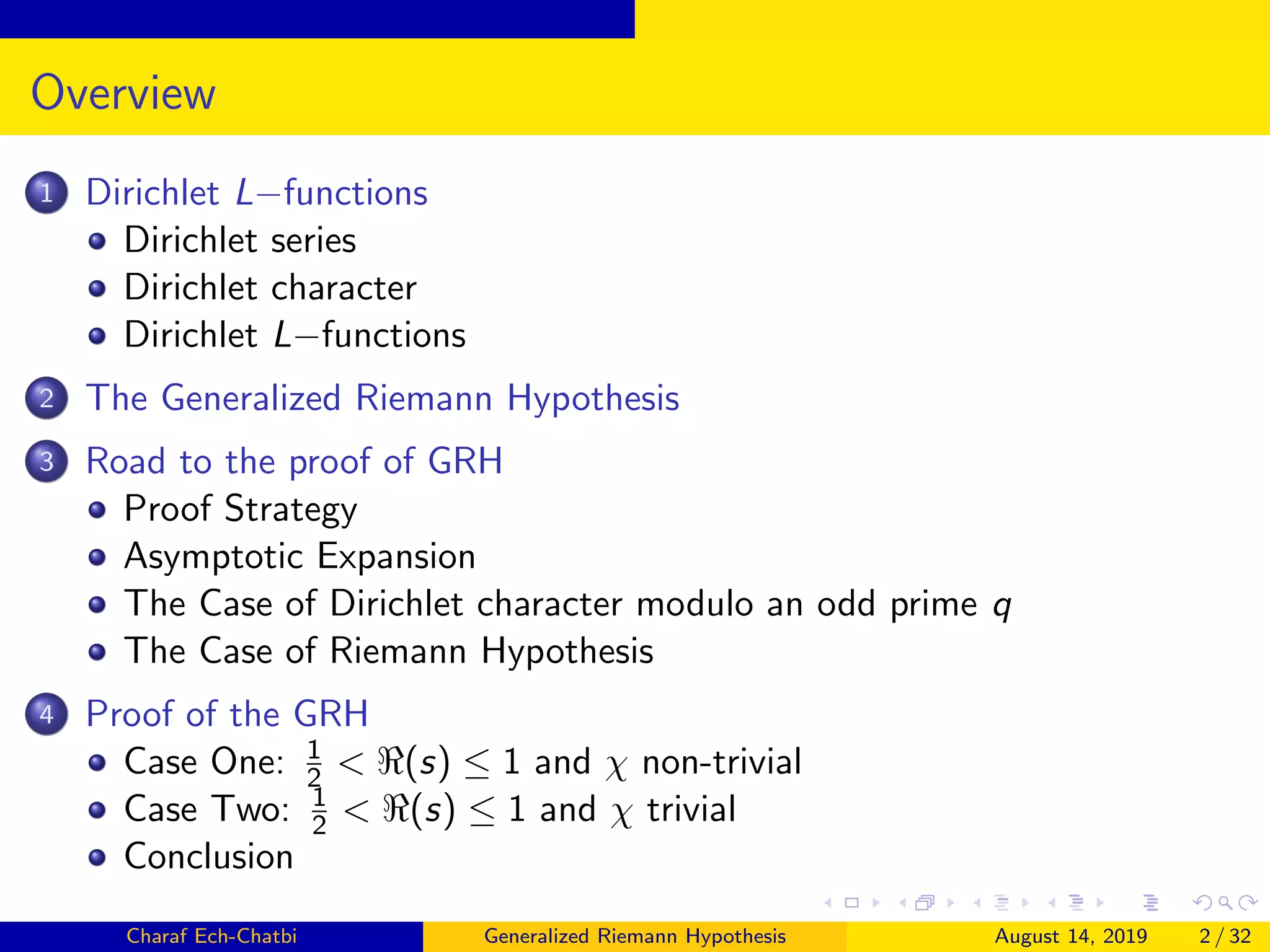
1 Dirichlet L−functions
Dirichlet series
Dirichlet character
Dirichlet L−functions
2 The Generalized Riemann Hypothesis
3 Road to the proof of GRH
Proof Strategy
Asymptotic Expansion
The Case of Dirichlet character modulo an odd prime q
The Case of Riemann Hypothesis
4 Proof of the GRH
Case One: 1
2 < (s) ≤ 1 and χ non-trivial
Case Two: 1
2 < (s) ≤ 1 and χ trivial
Conclusion
Charaf Ech-Chatbi Generalized Riemann Hypothesis August 14, 2019 2 / 32
Dirichlet L−functions Dirichlet series
Dirichlet series
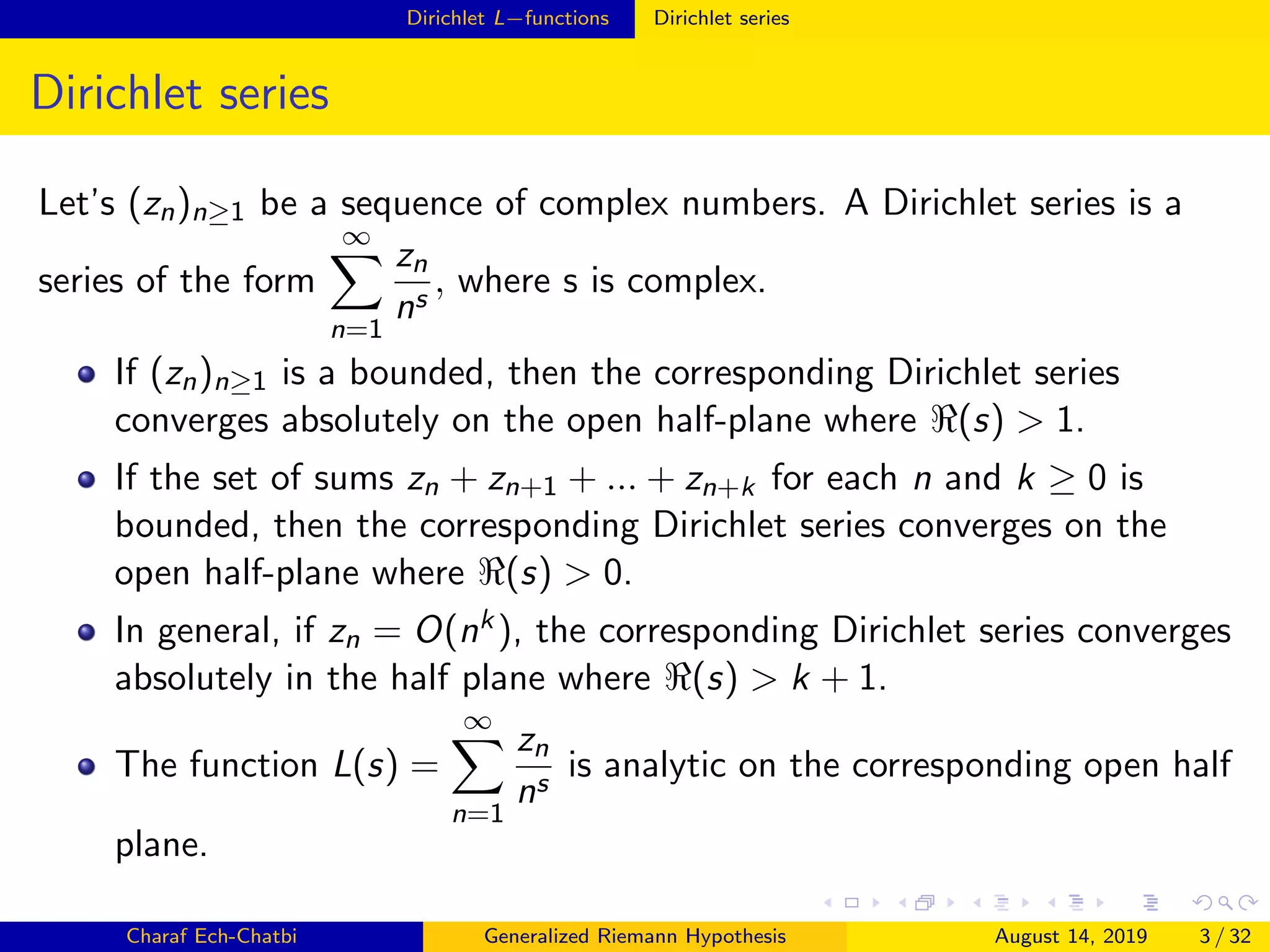
Let’s (zn)n≥1 be a sequence of complex numbers. A Dirichlet series is a
series of the form
∞
n=1
zn
ns
, where s is complex.
If (zn)n≥1 is a bounded, then the corresponding Dirichlet series
converges absolutely on the open half-plane where (s) > 1.
If the set of sums zn + zn+1 + ... + zn+k for each n and k ≥ 0 is
bounded, then the corresponding Dirichlet series converges on the
open half-plane where (s) > 0.
In general, if zn = O(nk), the corresponding Dirichlet series converges
absolutely in the half plane where (s) > k + 1.
The function L(s) =
∞
n=1
zn
ns
is analytic on the corresponding open half
plane.
Charaf Ech-Chatbi Generalized Riemann Hypothesis August 14, 2019 3 / 32
Dirichlet L−functions Dirichlet character
Dirichlet character
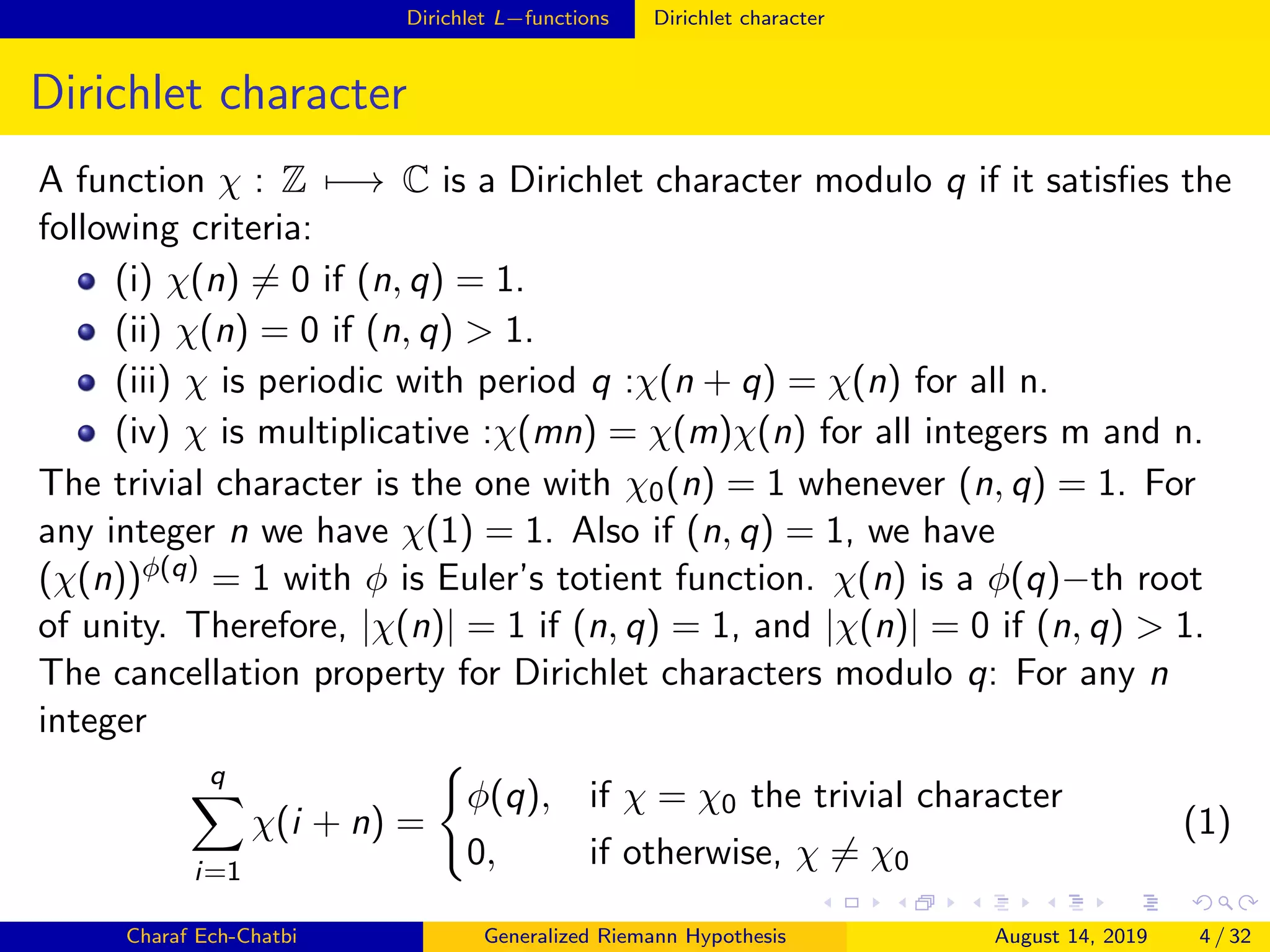
A function χ : Z −→ C is a Dirichlet character modulo q if it satisfies the
following criteria:
(i) χ(n) = 0 if (n, q) = 1.
(ii) χ(n) = 0 if (n, q) > 1.
(iii) χ is periodic with period q :χ(n + q) = χ(n) for all n.
(iv) χ is multiplicative :χ(mn) = χ(m)χ(n) for all integers m and n.
The trivial character is the one with χ0(n) = 1 whenever (n, q) = 1. For
any integer n we have χ(1) = 1. Also if (n, q) = 1, we have
(χ(n))φ(q) = 1 with φ is Euler’s totient function. χ(n) is a φ(q)−th root
of unity. Therefore, |χ(n)| = 1 if (n, q) = 1, and |χ(n)| = 0 if (n, q) > 1.
The cancellation property for Dirichlet characters modulo q: For any n
integer
q
i=1
χ(i + n) =
φ(q), if χ = χ0 the trivial character
0, if otherwise, χ = χ0
(1)
Charaf Ech-Chatbi Generalized Riemann Hypothesis August 14, 2019 4 / 32
Dirichlet L−functions Dirichlet L−functions
Dirichlet L−functions
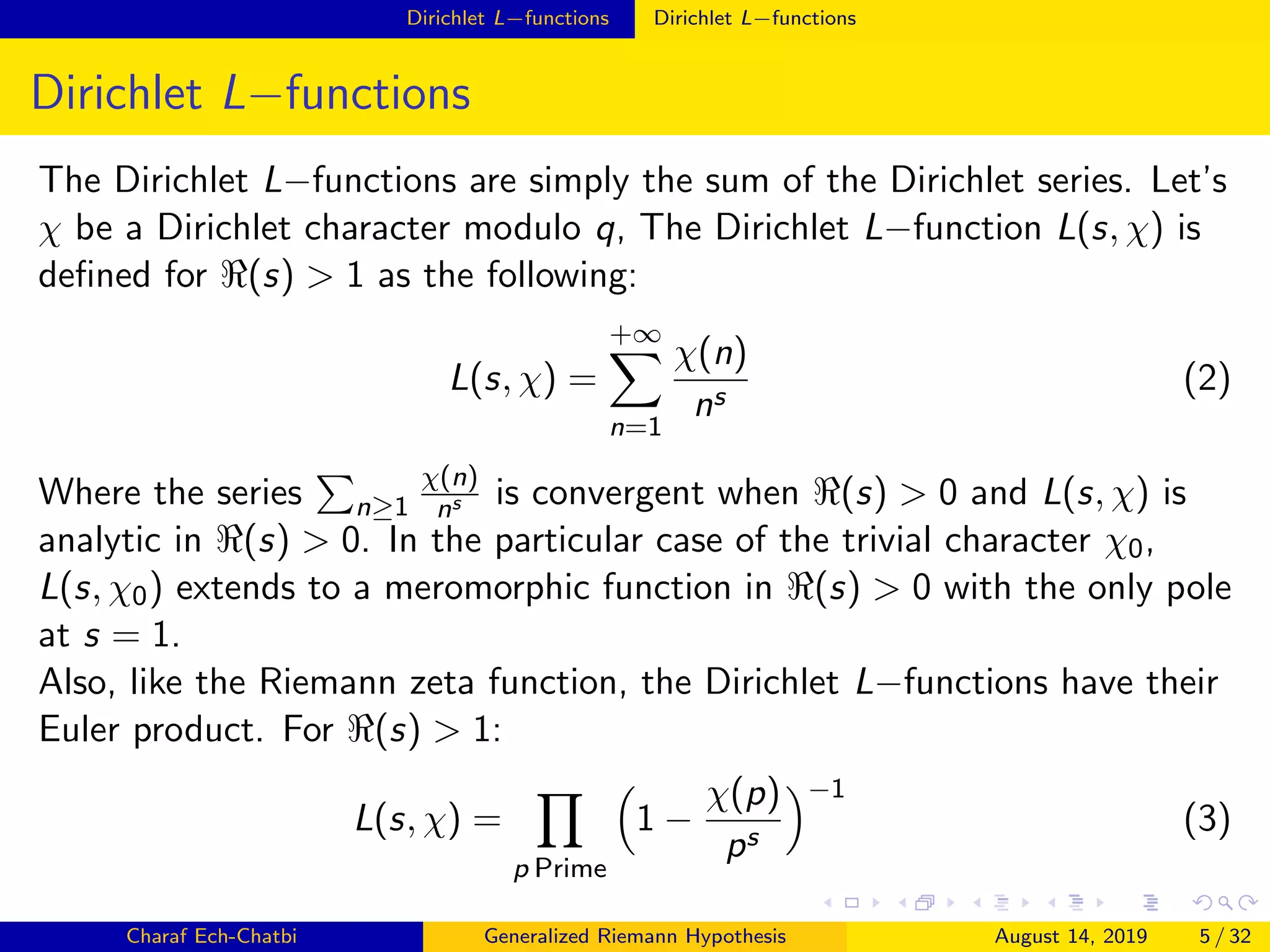
The Dirichlet L−functions are simply the sum of the Dirichlet series. Let’s
χ be a Dirichlet character modulo q, The Dirichlet L−function L(s, χ) is
defined for (s) > 1 as the following:
L(s, χ) =
+∞
n=1
χ(n)
ns
(2)
Where the series n≥1
χ(n)
ns is convergent when (s) > 0 and L(s, χ) is
analytic in (s) > 0. In the particular case of the trivial character χ0,
L(s, χ0) extends to a meromorphic function in (s) > 0 with the only pole
at s = 1.
Also, like the Riemann zeta function, the Dirichlet L−functions have their
Euler product. For (s) > 1:
L(s, χ) =
p Prime
1 −
χ(p)
ps
−1
(3)
Charaf Ech-Chatbi Generalized Riemann Hypothesis August 14, 2019 5 / 32
Dirichlet L−functions Dirichlet L−functions
Functional equation
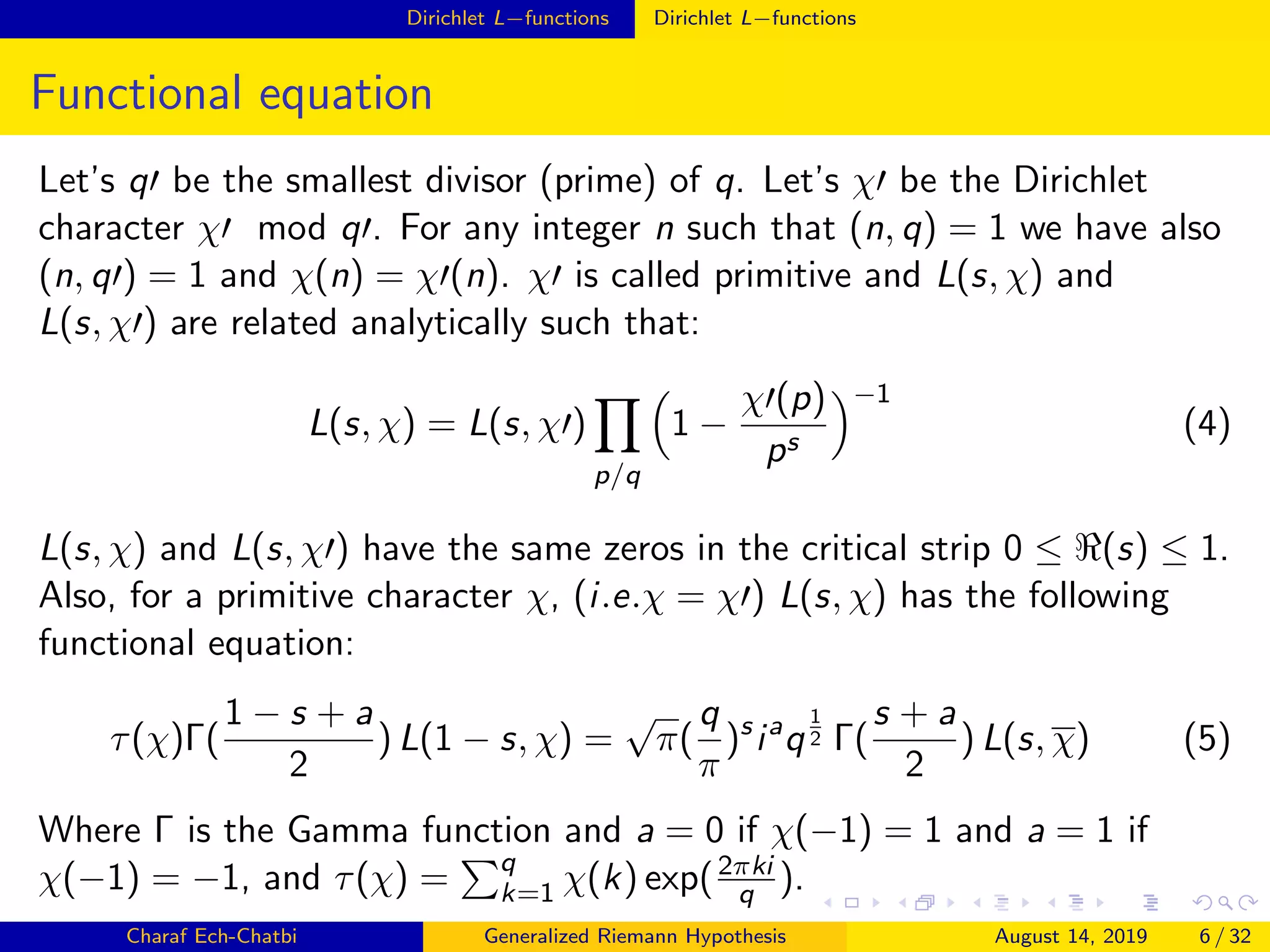
Let’s q be the smallest divisor (prime) of q. Let’s χ be the Dirichlet
character χ mod q . For any integer n such that (n, q) = 1 we have also
(n, q ) = 1 and χ(n) = χ (n). χ is called primitive and L(s, χ) and
L(s, χ ) are related analytically such that:
L(s, χ) = L(s, χ )
p/q
1 −
χ (p)
ps
−1
(4)
L(s, χ) and L(s, χ ) have the same zeros in the critical strip 0 ≤ (s) ≤ 1.
Also, for a primitive character χ, (i.e.χ = χ ) L(s, χ) has the following
functional equation:
τ(χ)Γ(
1 − s + a
2
) L(1 − s, χ) =
√
π(
q
π
)s
ia
q
1
2 Γ(
s + a
2
) L(s, χ) (5)
Where Γ is the Gamma function and a = 0 if χ(−1) = 1 and a = 1 if
χ(−1) = −1, and τ(χ) = q
k=1 χ(k) exp(2πki
q ).
Charaf Ech-Chatbi Generalized Riemann Hypothesis August 14, 2019 6 / 32
The Generalized Riemann Hypothesis
Generalized Riemann Hypothesis (GRH)
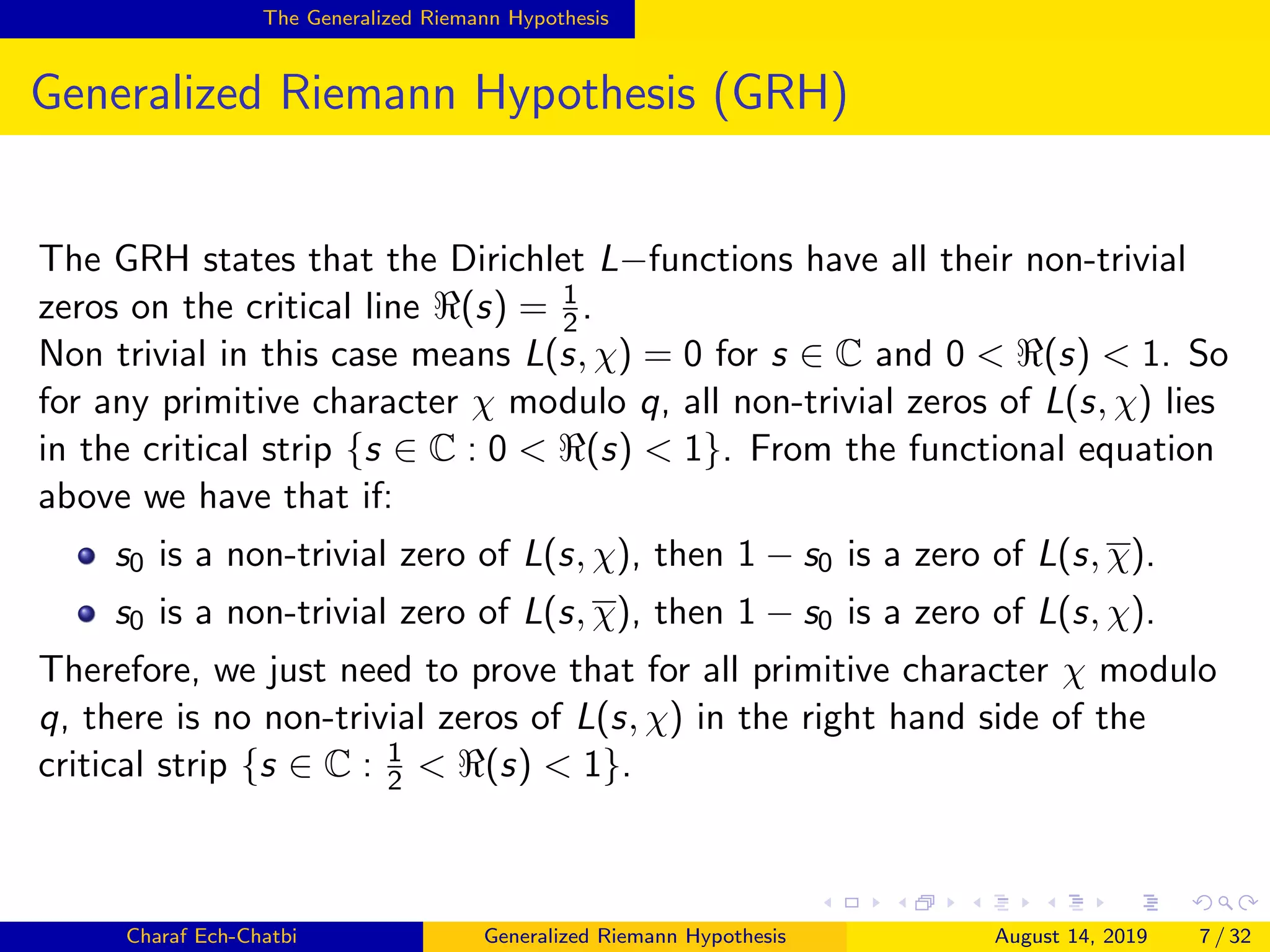
The GRH states that the Dirichlet L−functions have all their non-trivial
zeros on the critical line (s) = 1
2.
Non trivial in this case means L(s, χ) = 0 for s ∈ C and 0 < (s) < 1. So
for any primitive character χ modulo q, all non-trivial zeros of L(s, χ) lies
in the critical strip {s ∈ C : 0 < (s) < 1}. From the functional equation
above we have that if:
s0 is a non-trivial zero of L(s, χ), then 1 − s0 is a zero of L(s, χ).
Therefore, we just need to prove that for all primitive character χ modulo
q, there is no non-trivial zeros of L(s, χ) in the right hand side of the
critical strip {s ∈ C : 1
2 < (s) < 1}.
Charaf Ech-Chatbi Generalized Riemann Hypothesis August 14, 2019 7 / 32
Road to the proof of GRH Proof Strategy
Proof Strategy
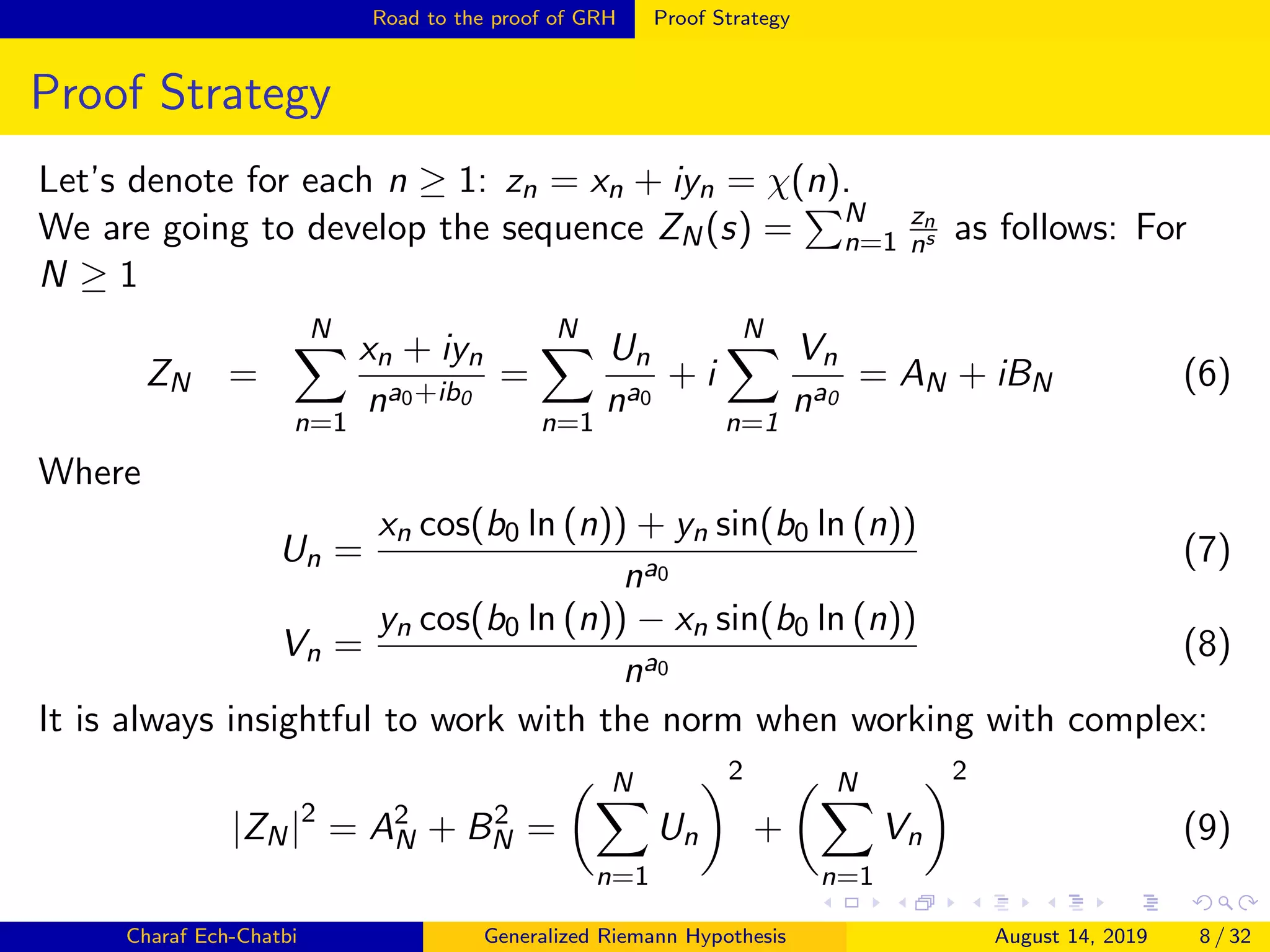
Let’s denote for each n ≥ 1: zn = xn + iyn = χ(n).
We are going to develop the sequence ZN(s) = N
n=1
zn
ns as follows: For
N ≥ 1
ZN =
N
n=1
xn + iyn
na0+ib0
=
N
n=1
Un
na0
+ i
N
n=1
Vn
na0
= AN + iBN (6)
Where
Un =
xn cos(b0 ln (n)) + yn sin(b0 ln (n))
na0
(7)
Vn =
yn cos(b0 ln (n)) − xn sin(b0 ln (n))
na0
(8)
It is always insightful to work with the norm when working with complex:
|ZN|2
= A2
N + B2
N =
N
n=1
Un
2
+
N
n=1
Vn
2
(9)
Charaf Ech-Chatbi Generalized Riemann Hypothesis August 14, 2019 8 / 32
Road to the proof of GRH Proof Strategy
Proof Strategy cont
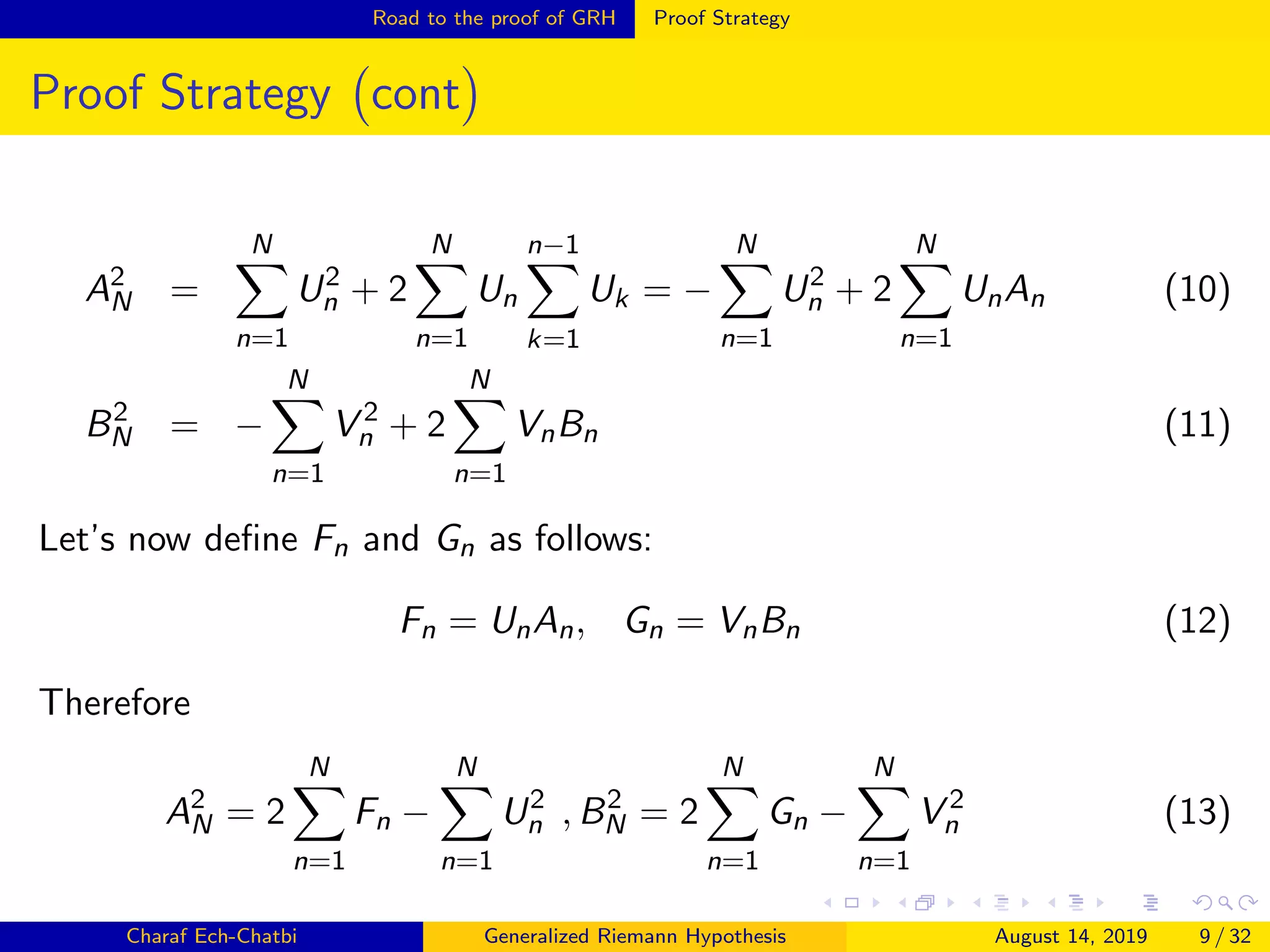
A2
N =
N
n=1
U2
n + 2
N
n=1
Un
n−1
k=1
Uk = −
N
n=1
U2
n + 2
N
n=1
UnAn (10)
B2
N = −
N
n=1
V 2
n + 2
N
n=1
VnBn (11)
Let’s now define Fn and Gn as follows:
Fn = UnAn, Gn = VnBn (12)
Therefore
A2
N = 2
N
n=1
Fn −
N
n=1
U2
n , B2
N = 2
N
n=1
Gn −
N
n=1
V 2
n (13)
Charaf Ech-Chatbi Generalized Riemann Hypothesis August 14, 2019 9 / 32
Road to the proof of GRH Proof Strategy
Proof Strategy cont
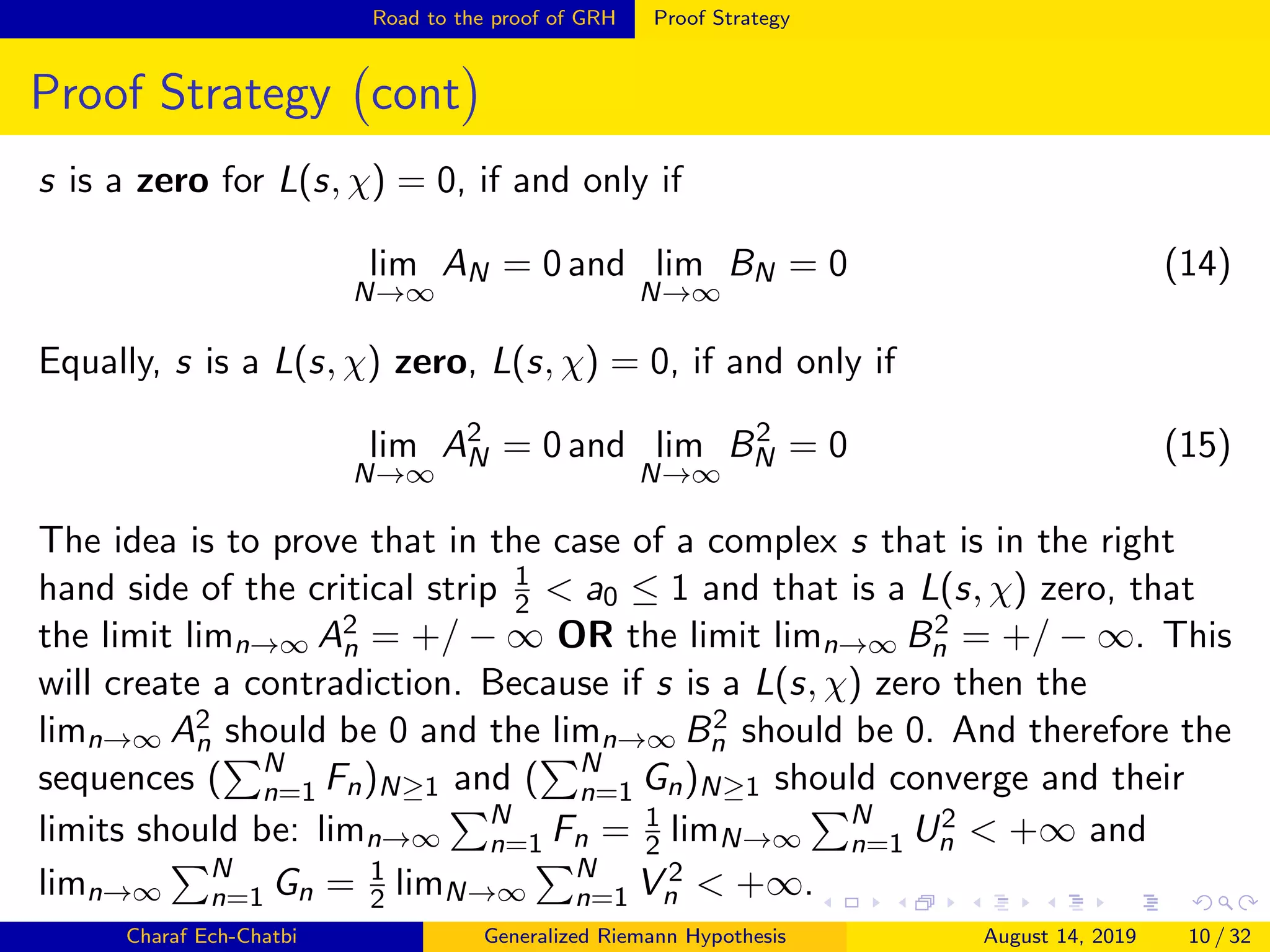
s is a zero for L(s, χ) = 0, if and only if
lim
N→∞
AN = 0 and lim
N→∞
BN = 0 (14)
Equally, s is a L(s, χ) zero, L(s, χ) = 0, if and only if
lim
N→∞
A2
N = 0 and lim
N→∞
B2
N = 0 (15)
The idea is to prove that in the case of a complex s that is in the right
hand side of the critical strip 1
2 < a0 ≤ 1 and that is a L(s, χ) zero, that
the limit limn→∞ A2
n = +/ − ∞ OR the limit limn→∞ B2
n = +/ − ∞. This
will create a contradiction. Because if s is a L(s, χ) zero then the
limn→∞ A2
n should be 0 and the limn→∞ B2
n should be 0. And therefore the
sequences ( N
n=1 Fn)N≥1 and ( N
n=1 Gn)N≥1 should converge and their
limits should be: limn→∞
N
n=1 Fn = 1
2 limN→∞
N
n=1 U2
n < +∞ and
limn→∞
N
n=1 Gn = 1
2 limN→∞
N
n=1 V 2
n < +∞.
Charaf Ech-Chatbi Generalized Riemann Hypothesis August 14, 2019 10 / 32
Road to the proof of GRH Asymptotic Expansion
Asymptotic Expansion
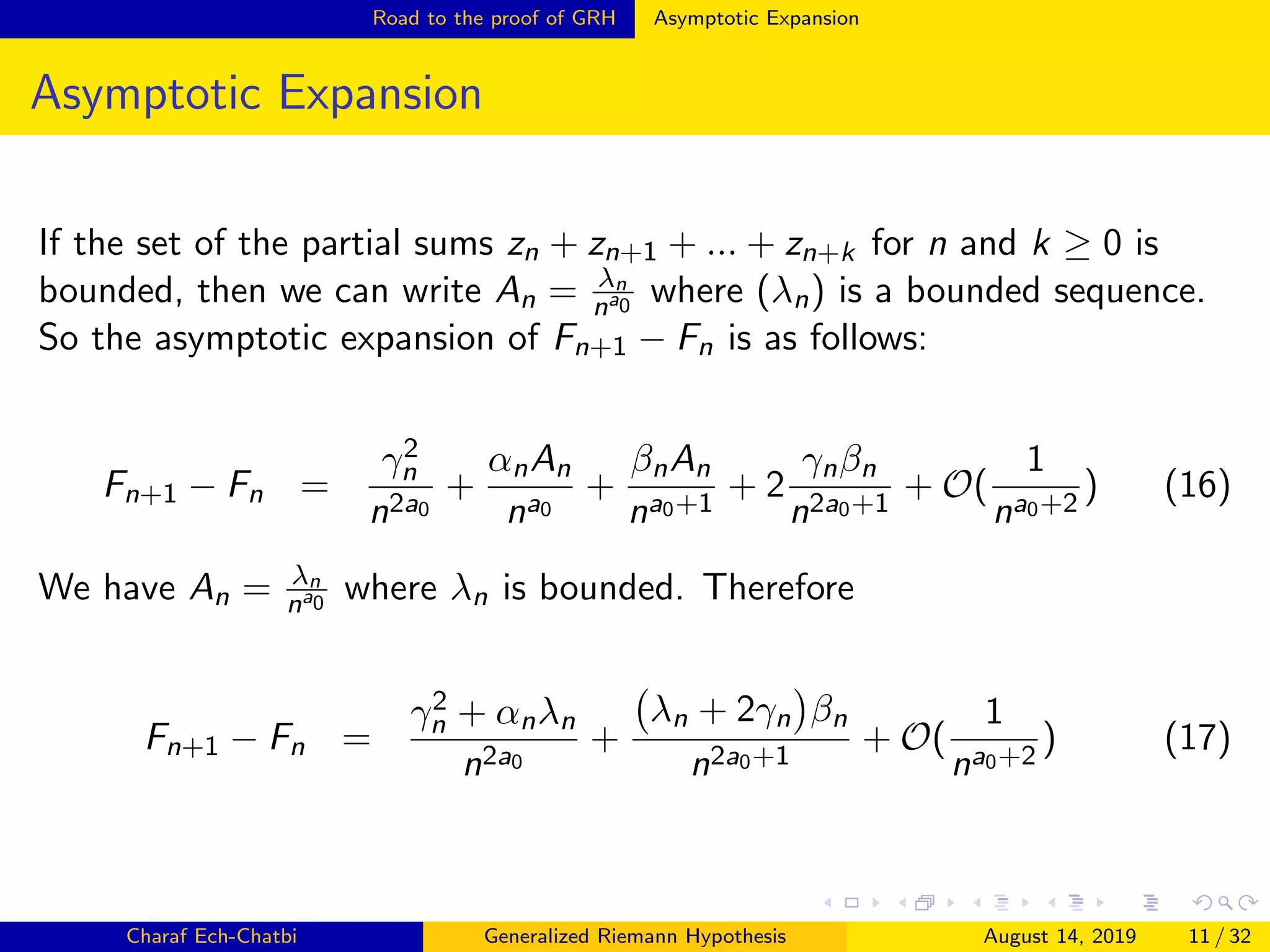
If the set of the partial sums zn + zn+1 + ... + zn+k for n and k ≥ 0 is
bounded, then we can write An = λn
na0 where (λn) is a bounded sequence.
So the asymptotic expansion of Fn+1 − Fn is as follows:
Fn+1 − Fn =
γ2
n
n2a0
+
αnAn
na0
+
βnAn
na0+1
+ 2
γnβn
n2a0+1
+ O(
1
na0+2
) (16)
We have An = λn
na0 where λn is bounded. Therefore
Fn+1 − Fn =
γ2
n + αnλn
n2a0
+
λn + 2γn βn
n2a0+1
+ O(
1
na0+2
) (17)
Charaf Ech-Chatbi Generalized Riemann Hypothesis August 14, 2019 11 / 32
Road to the proof of GRH The Case of Dirichlet character modulo an odd prime q
The Case of Dirichlet character modulo an odd prime q
Let’s q be an odd prime integer. Let’s χ be a non-trivial Dirichlet
character modulo q. Let’s denote that for each k, zk = xk + iyk = χ(k).
Therefore we have the following asymptotic expansion:
q
i=1
γ2
qn+i + αqn+i λqn+i
(nq + i)2a0
+
q
i=1
(λnq+i + 2γqn+i )βnq+i
(nq + i)2a0 + 1
(18)
=
Ta + Tb cos(2b0 ln (qn)) + Tc sin(2b0 ln (qn)
(nq)2a0 + 1
+ O(
1
(qn)2a0+2
) (19)
Where m ∈ [1, q − 2] is defined such that χm(g) = e
2πmi
q−1 where g is the
generator of the cyclic group Z/qZ∗.
Ta =



−a0
2
5q−1
2 −
(q−1) sin( 2πm
q−1
2−2 cos( 2πm
q−1
+ b0
2
q−1
2 +
(q−1) sin( 2πm
q−1
1−cos( 2πm
q−1
, m = q−1
2
−a0
4 5q − 1 + b0
4 (q − 1), m = q−1
2
(20)Charaf Ech-Chatbi Generalized Riemann Hypothesis August 14, 2019 12 / 32
Road to the proof of GRH The Case of Dirichlet character modulo an odd prime q
The Case of Dirichlet character modulo an odd prime q
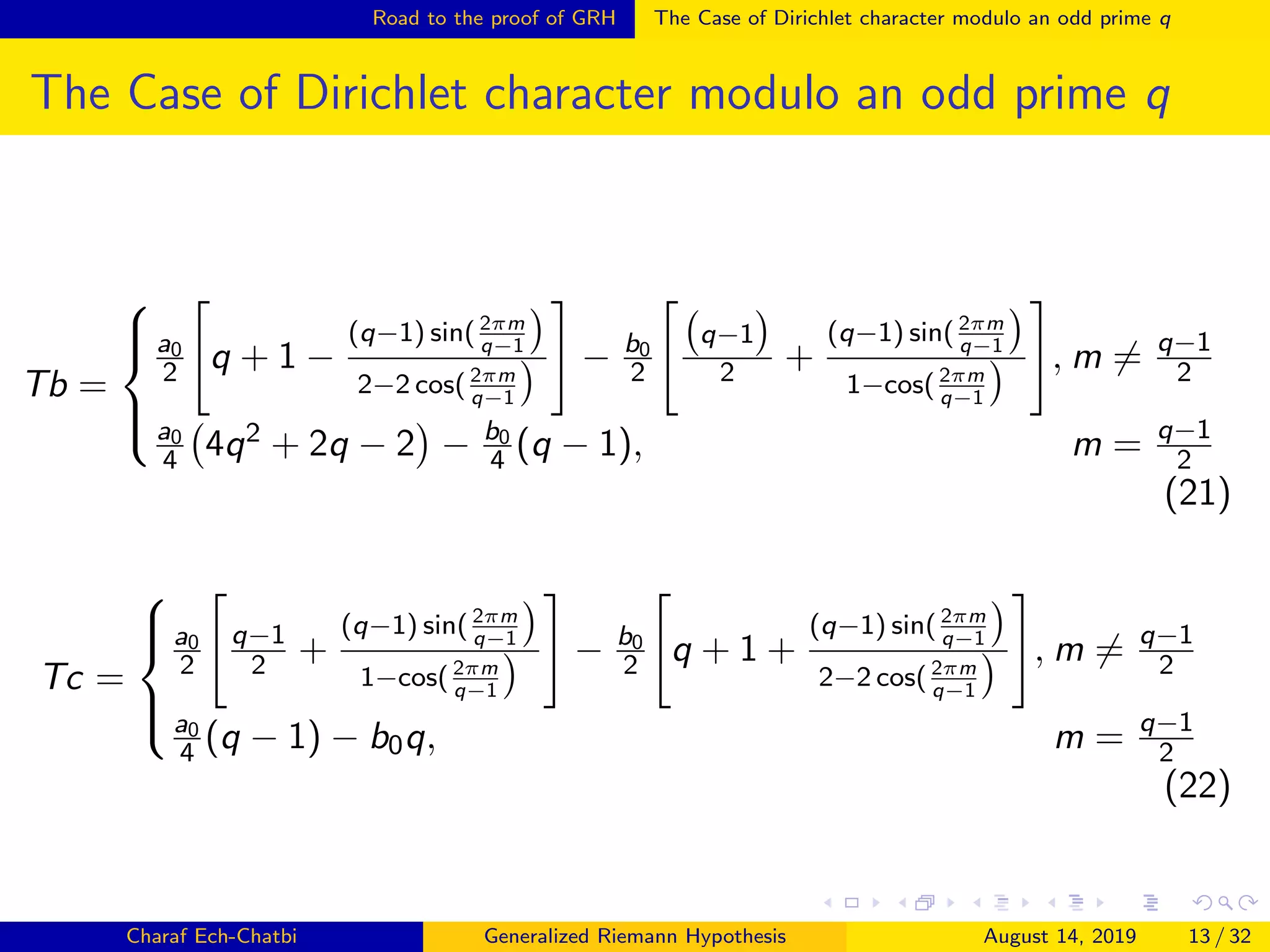
Tb =



a0
2 q + 1 −
(q−1) sin(2πm
q−1
2−2 cos( 2πm
q−1
− b0
2
q−1
2 +
(q−1) sin( 2πm
q−1
1−cos( 2πm
q−1
, m = q−1
2
a0
4 4q2 + 2q − 2 − b0
4 (q − 1), m = q−1
2
(21)
Tc =



a0
2
q−1
2 +
(q−1) sin( 2πm
q−1
1−cos( 2πm
q−1
− b0
2 q + 1 +
(q−1) sin( 2πm
q−1
2−2 cos( 2πm
q−1
, m = q−1
2
a0
4 (q − 1) − b0q, m = q−1
2
(22)
Charaf Ech-Chatbi Generalized Riemann Hypothesis August 14, 2019 13 / 32
Road to the proof of GRH The Case of Riemann Hypothesis
The Case of Riemann Hypothesis
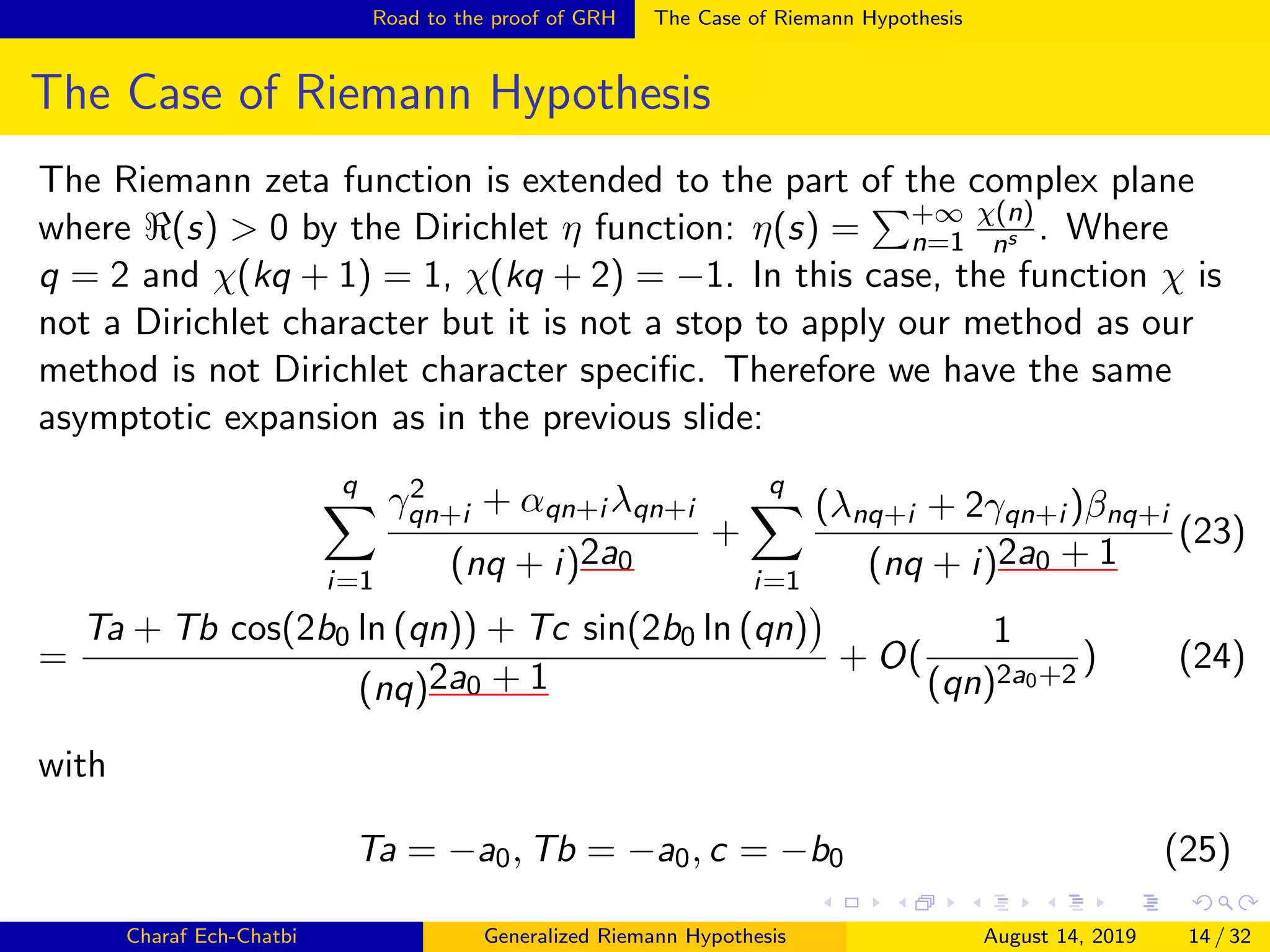
The Riemann zeta function is extended to the part of the complex plane
where (s) > 0 by the Dirichlet η function: η(s) = +∞
n=1
χ(n)
ns . Where
q = 2 and χ(kq + 1) = 1, χ(kq + 2) = −1. In this case, the function χ is
not a Dirichlet character but it is not a stop to apply our method as our
method is not Dirichlet character specific. Therefore we have the same
asymptotic expansion as in the previous slide:
q
i=1
γ2
qn+i + αqn+i λqn+i
(nq + i)2a0
+
q
i=1
(λnq+i + 2γqn+i )βnq+i
(nq + i)2a0 + 1
(23)
=
Ta + Tb cos(2b0 ln (qn)) + Tc sin(2b0 ln (qn)
(nq)2a0 + 1
+ O(
1
(qn)2a0+2
) (24)
with
Ta = −a0, Tb = −a0, c = −b0 (25)
Charaf Ech-Chatbi Generalized Riemann Hypothesis August 14, 2019 14 / 32
Proof of the GRH Case One: 1
2
< (s) ≤ 1 and χ non-trivial
Divergence of n≥1 Fn
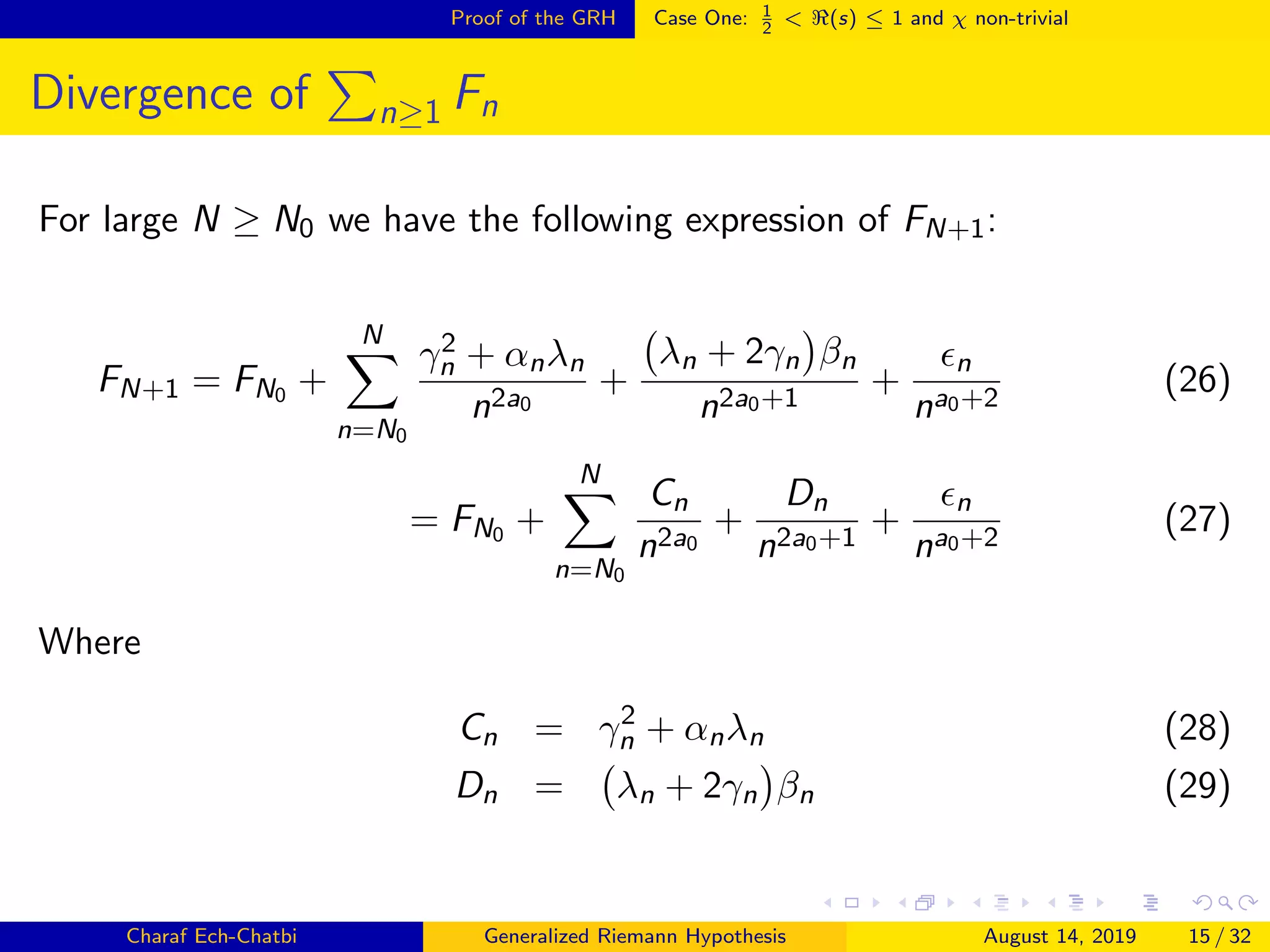
For large N ≥ N0 we have the following expression of FN+1:
FN+1 = FN0 +
N
n=N0
γ2
n + αnλn
n2a0
+
λn + 2γn βn
n2a0+1
+
n
na0+2
(26)
= FN0 +
N
n=N0
Cn
n2a0
+
Dn
n2a0+1
+
n
na0+2
(27)
Where
Cn = γ2
n + αnλn (28)
Dn = λn + 2γn βn (29)
Charaf Ech-Chatbi Generalized Riemann Hypothesis August 14, 2019 15 / 32
Proof of the GRH Case One: 1
2
< (s) ≤ 1 and χ non-trivial
Divergence of n≥1 Fn
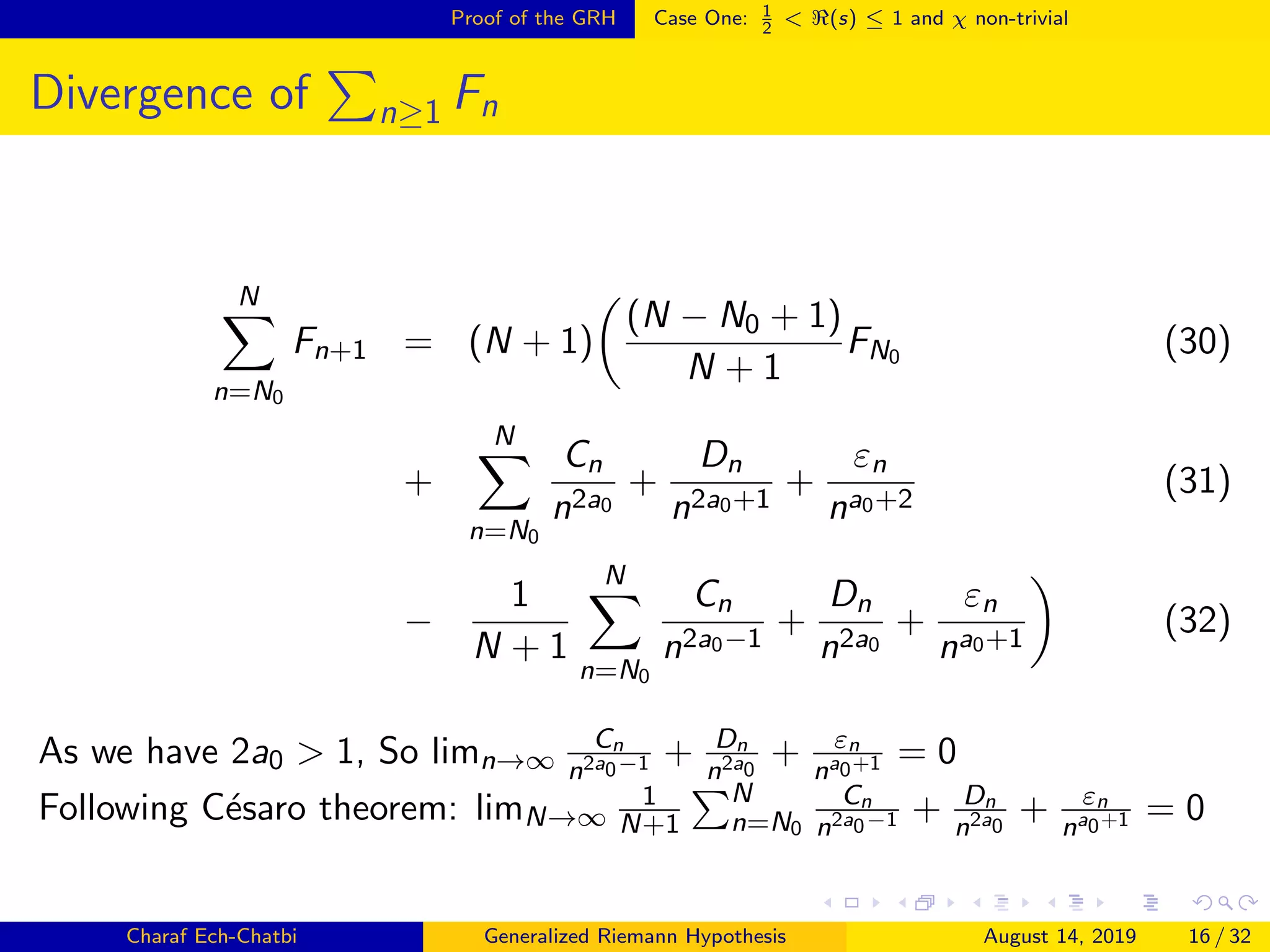
N
n=N0
Fn+1 = (N + 1)
(N − N0 + 1)
N + 1
FN0 (30)
+
N
n=N0
Cn
n2a0
+
Dn
n2a0+1
+
εn
na0+2
(31)
−
1
N + 1
N
n=N0
Cn
n2a0−1
+
Dn
n2a0
+
εn
na0+1
(32)
As we have 2a0 > 1, So limn→∞
Cn
n2a0−1 + Dn
n2a0
+ εn
na0+1 = 0
Following C´esaro theorem: limN→∞
1
N+1
N
n=N0
Cn
n2a0−1 + Dn
n2a0
+ εn
na0+1 = 0
Charaf Ech-Chatbi Generalized Riemann Hypothesis August 14, 2019 16 / 32
Proof of the GRH Case One: 1
2
< (s) ≤ 1 and χ non-trivial
Divergence of n≥1 Fn
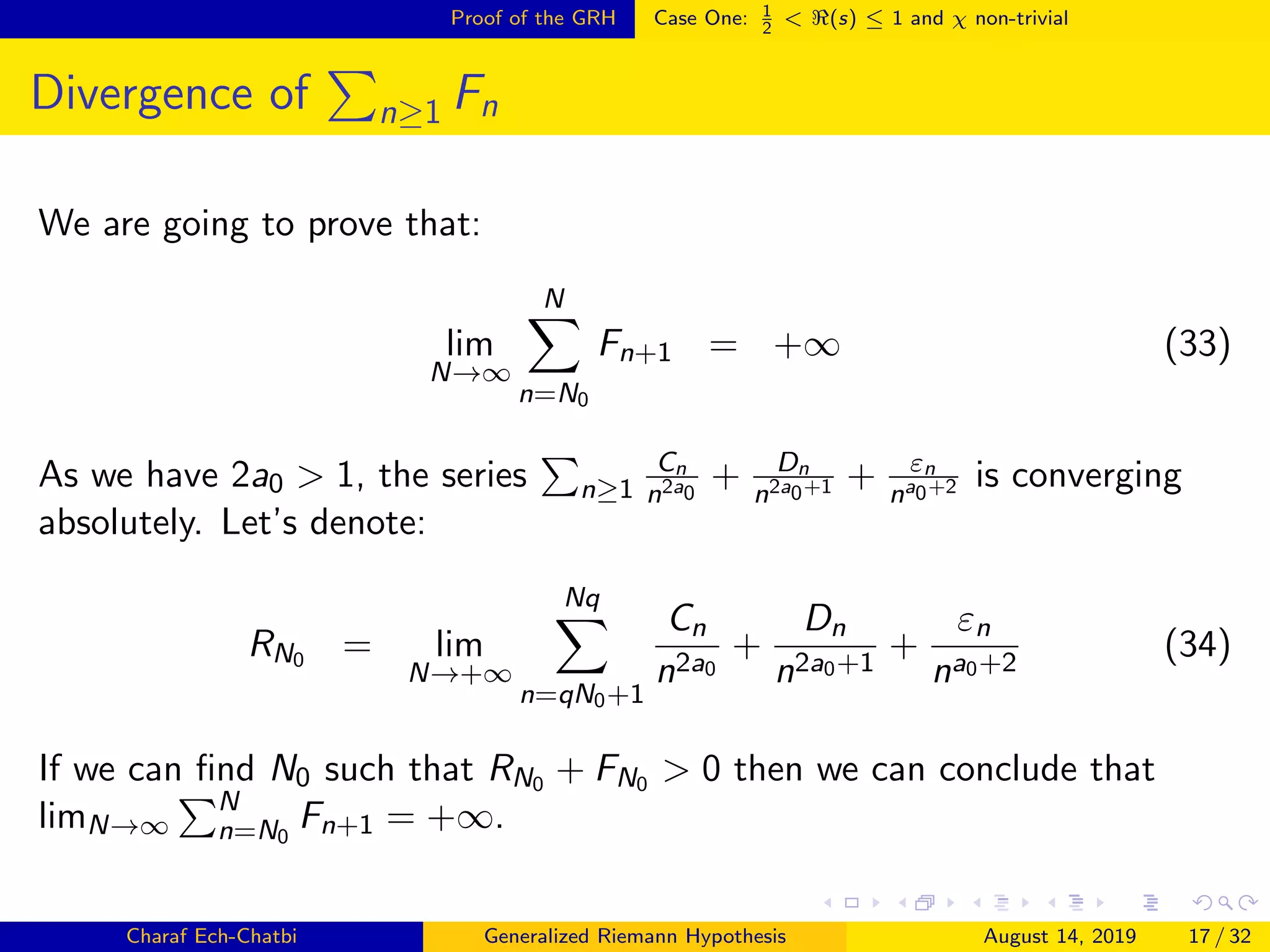
We are going to prove that:
lim
N→∞
N
n=N0
Fn+1 = +∞ (33)
As we have 2a0 > 1, the series n≥1
Cn
n2a0
+ Dn
n2a0+1 + εn
na0+2 is converging
absolutely. Let’s denote:
RN0 = lim
N→+∞
Nq
n=qN0+1
Cn
n2a0
+
Dn
n2a0+1
+
εn
na0+2
(34)
If we can find N0 such that RN0 + FN0 > 0 then we can conclude that
limN→∞
N
n=N0
Fn+1 = +∞.
Charaf Ech-Chatbi Generalized Riemann Hypothesis August 14, 2019 17 / 32
Proof of the GRH Case One: 1
2
< (s) ≤ 1 and χ non-trivial
Divergence of n≥1 Fn
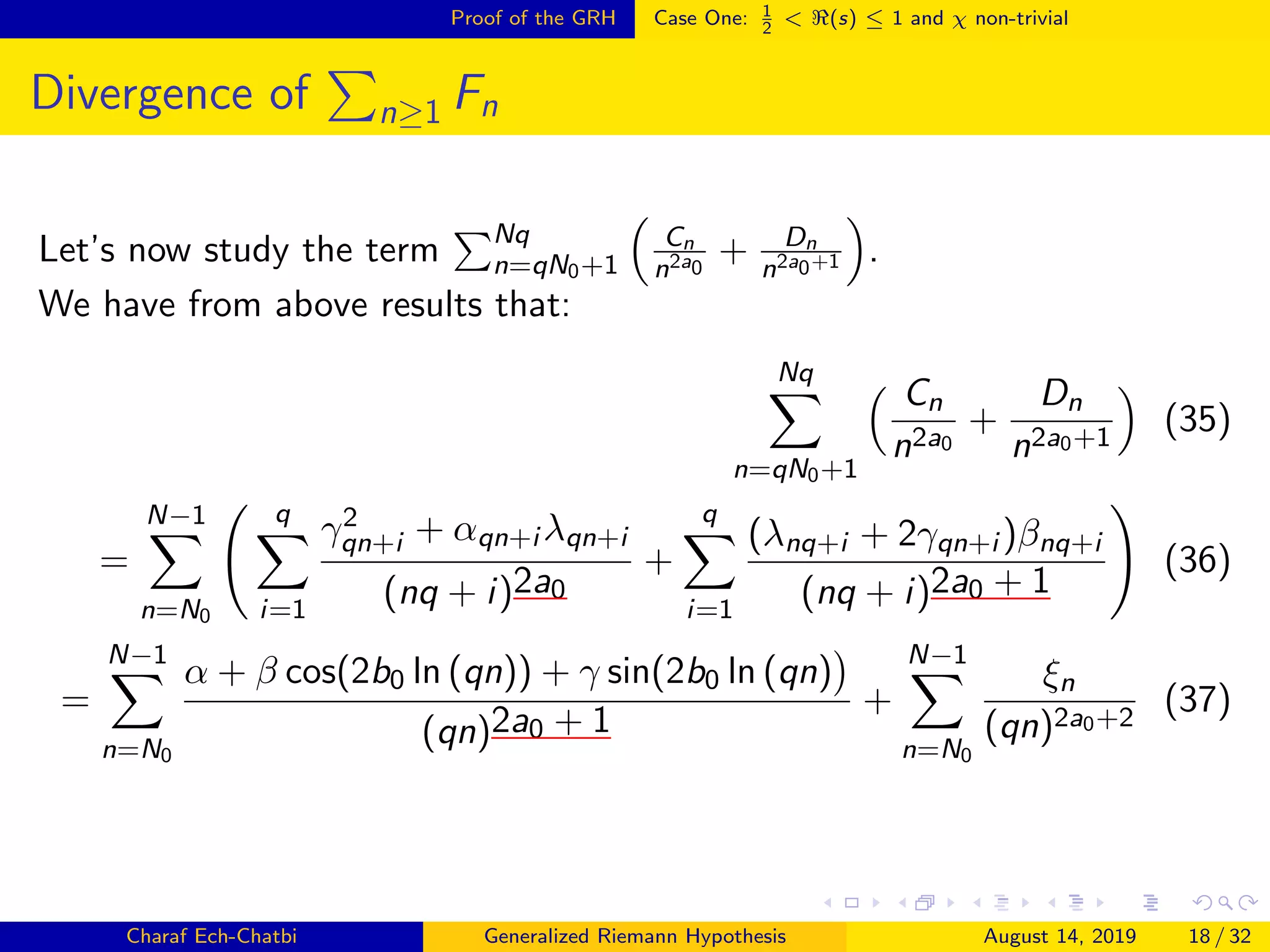
Let’s now study the term Nq
n=qN0+1
Cn
n2a0
+ Dn
n2a0+1 .
We have from above results that:
Nq
n=qN0+1
Cn
n2a0
+
Dn
n2a0+1
(35)
=
N−1
n=N0
q
i=1
γ2
qn+i + αqn+i λqn+i
(nq + i)2a0
+
q
i=1
(λnq+i + 2γqn+i )βnq+i
(nq + i)2a0 + 1
(36)
=
N−1
n=N0
α + β cos(2b0 ln (qn)) + γ sin(2b0 ln (qn)
(qn)2a0 + 1
+
N−1
n=N0
ξn
(qn)2a0+2
(37)
Charaf Ech-Chatbi Generalized Riemann Hypothesis August 14, 2019 18 / 32
Proof of the GRH Case One: 1
2
< (s) ≤ 1 and χ non-trivial
Divergence of n≥1 Fn
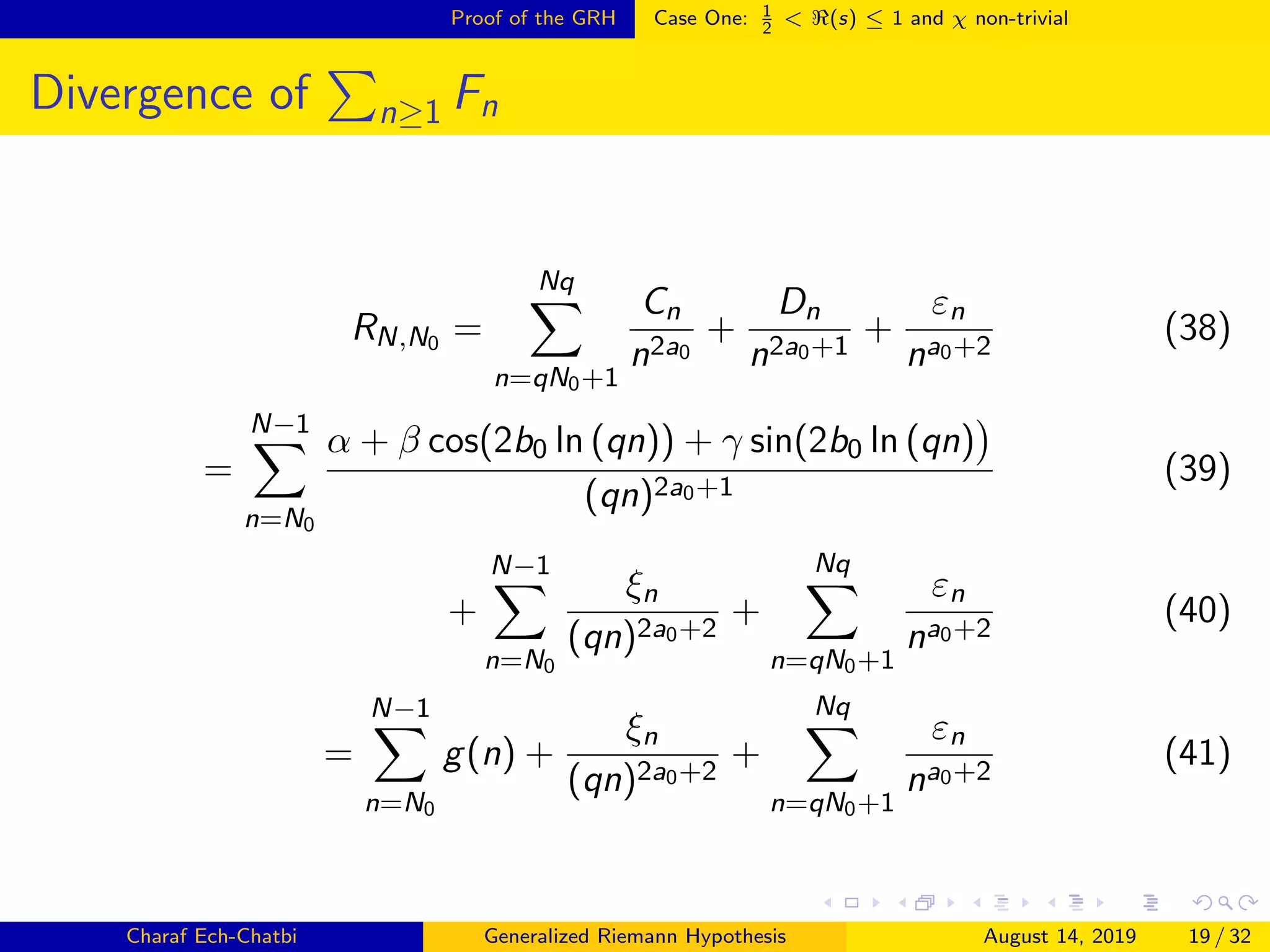
RN,N0 =
Nq
n=qN0+1
Cn
n2a0
+
Dn
n2a0+1
+
εn
na0+2
(38)
=
N−1
n=N0
α + β cos(2b0 ln (qn)) + γ sin(2b0 ln (qn)
(qn)2a0+1
(39)
+
N−1
n=N0
ξn
(qn)2a0+2
+
Nq
n=qN0+1
εn
na0+2
(40)
=
N−1
n=N0
g(n) +
ξn
(qn)2a0+2
+
Nq
n=qN0+1
εn
na0+2
(41)
Charaf Ech-Chatbi Generalized Riemann Hypothesis August 14, 2019 19 / 32
Proof of the GRH Case One: 1
2
< (s) ≤ 1 and χ non-trivial
Divergence of n≥1 Fn
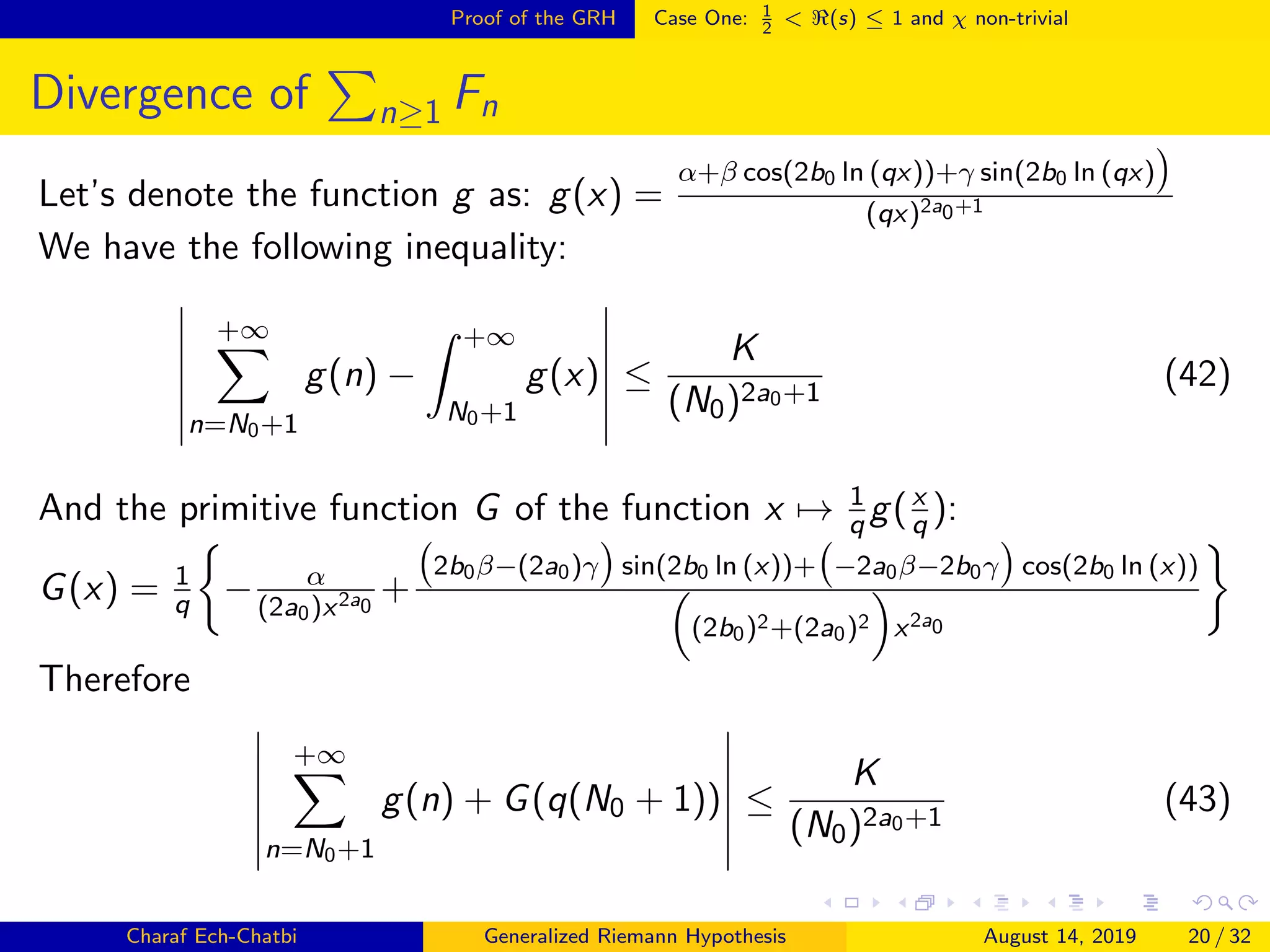
Let’s denote the function g as: g(x) =
α+β cos(2b0 ln (qx))+γ sin(2b0 ln (qx)
(qx)2a0+1
We have the following inequality:
+∞
n=N0+1
g(n) −
+∞
N0+1
g(x) ≤
K
(N0)2a0+1
(42)
And the primitive function G of the function x → 1
q g(x
q ):
G(x) = 1
q − α
(2a0)x2a0
+
2b0β−(2a0)γ sin(2b0 ln (x))+ −2a0β−2b0γ cos(2b0 ln (x))
(2b0)2+(2a0)2 x2a0
Therefore
+∞
n=N0+1
g(n) + G(q(N0 + 1)) ≤
K
(N0)2a0+1
(43)
Charaf Ech-Chatbi Generalized Riemann Hypothesis August 14, 2019 20 / 32
Proof of the GRH Case One: 1
2
< (s) ≤ 1 and χ non-trivial
Divergence of n≥1 Fn
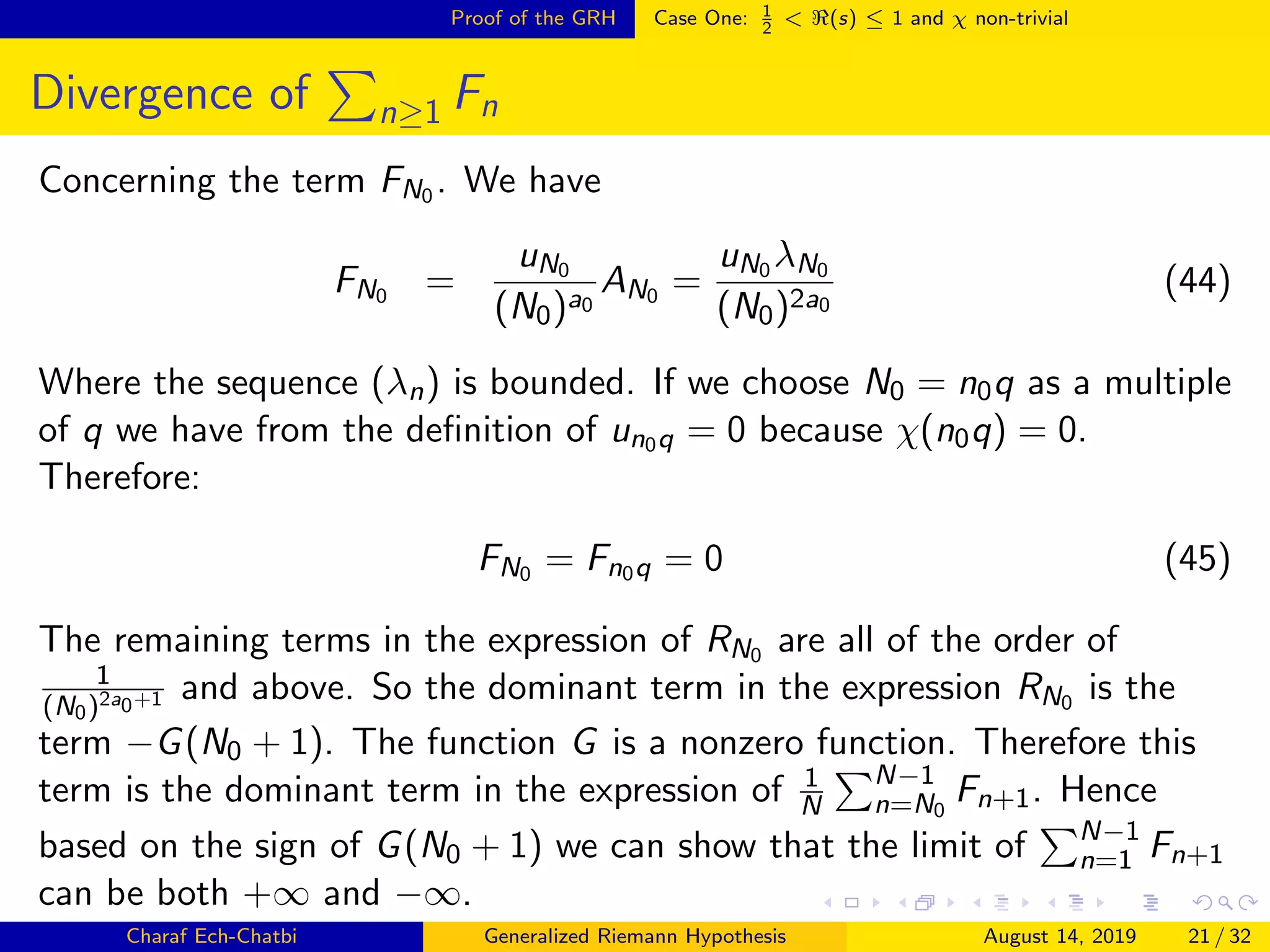
Concerning the term FN0 . We have
FN0 =
uN0
(N0)a0
AN0 =
uN0 λN0
(N0)2a0
(44)
Where the sequence (λn) is bounded. If we choose N0 = n0q as a multiple
of q we have from the definition of un0q = 0 because χ(n0q) = 0.
Therefore:
FN0 = Fn0q = 0 (45)
The remaining terms in the expression of RN0 are all of the order of
1
(N0)2a0+1 and above. So the dominant term in the expression RN0 is the
term −G(N0 + 1). The function G is a nonzero function. Therefore this
term is the dominant term in the expression of 1
N
N−1
n=N0
Fn+1. Hence
based on the sign of G(N0 + 1) we can show that the limit of N−1
n=1 Fn+1
can be both +∞ and −∞.
Charaf Ech-Chatbi Generalized Riemann Hypothesis August 14, 2019 21 / 32
Proof of the GRH Case One: 1
2
< (s) ≤ 1 and χ non-trivial
Divergence of n≥1 Fn
Let’s define the function f :
f (x) = − α
2a0
+
2b0β−(2a0)γ sin(2b0x)+ −2a0β−2b0γ cos(2b0x)
(2b0)2+(2a0)2 . We simplify
further the notations: f (x) = α2 + β2 cos(2b0x) + γ2 sin(2b0x). Without
loss of generality, let’s define β0 = − f (0)
q2a0+1 > 0. See[2] for more detail.
Let’s fix > 0 to be very small such that 0 < < min 1, β0
10000 .
Let’s define γ0 = |β2|+|γ2|
q2a0+1 . Without loss of generality, let’s N1 be such that
|cos(2b0 ln q(N1 + 1)) − 1| ≤ /γ0 and |sin(2b0 ln q(N1 + 1)) − 0| ≤ /γ0.
Therefore:
G q(N1 + 1) −
f (0)
q q(N1 + 1)
2a0
≤
N1 + 1
2a0
(46)
Because...
Charaf Ech-Chatbi Generalized Riemann Hypothesis August 14, 2019 22 / 32
Proof of the GRH Case One: 1
2
< (s) ≤ 1 and χ non-trivial
Divergence of n≥1 Fn
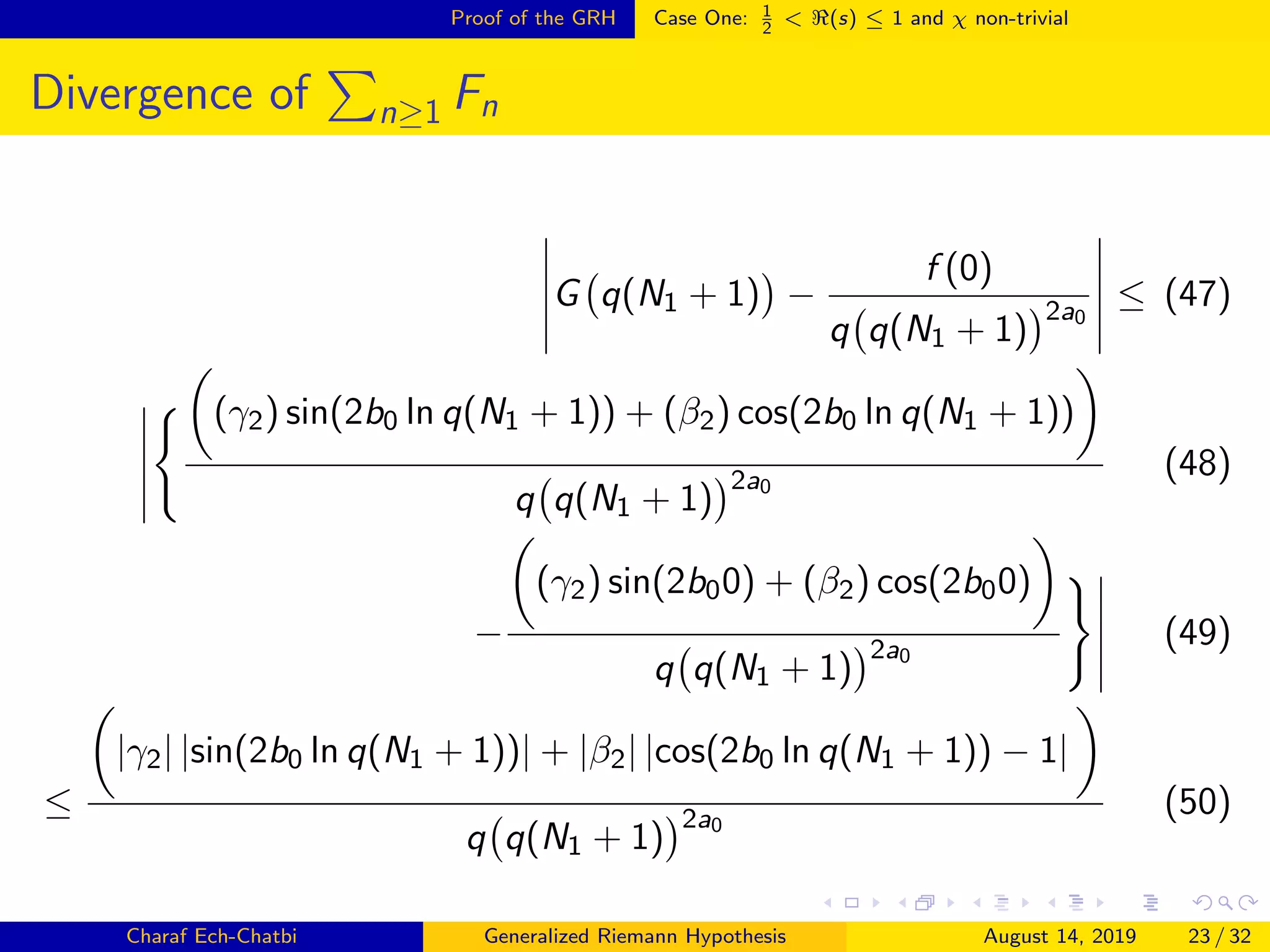
G q(N1 + 1) −
f (0)
q q(N1 + 1)
2a0
≤ (47)
(γ2) sin(2b0 ln q(N1 + 1)) + (β2) cos(2b0 ln q(N1 + 1))
q q(N1 + 1)
2a0
(48)
−
(γ2) sin(2b00) + (β2) cos(2b00)
q q(N1 + 1)
2a0
(49)
≤
|γ2| |sin(2b0 ln q(N1 + 1))| + |β2| |cos(2b0 ln q(N1 + 1)) − 1|
q q(N1 + 1)
2a0
(50)
Charaf Ech-Chatbi Generalized Riemann Hypothesis August 14, 2019 23 / 32
Proof of the GRH Case One: 1
2
< (s) ≤ 1 and χ non-trivial
Divergence of n≥1 Fn
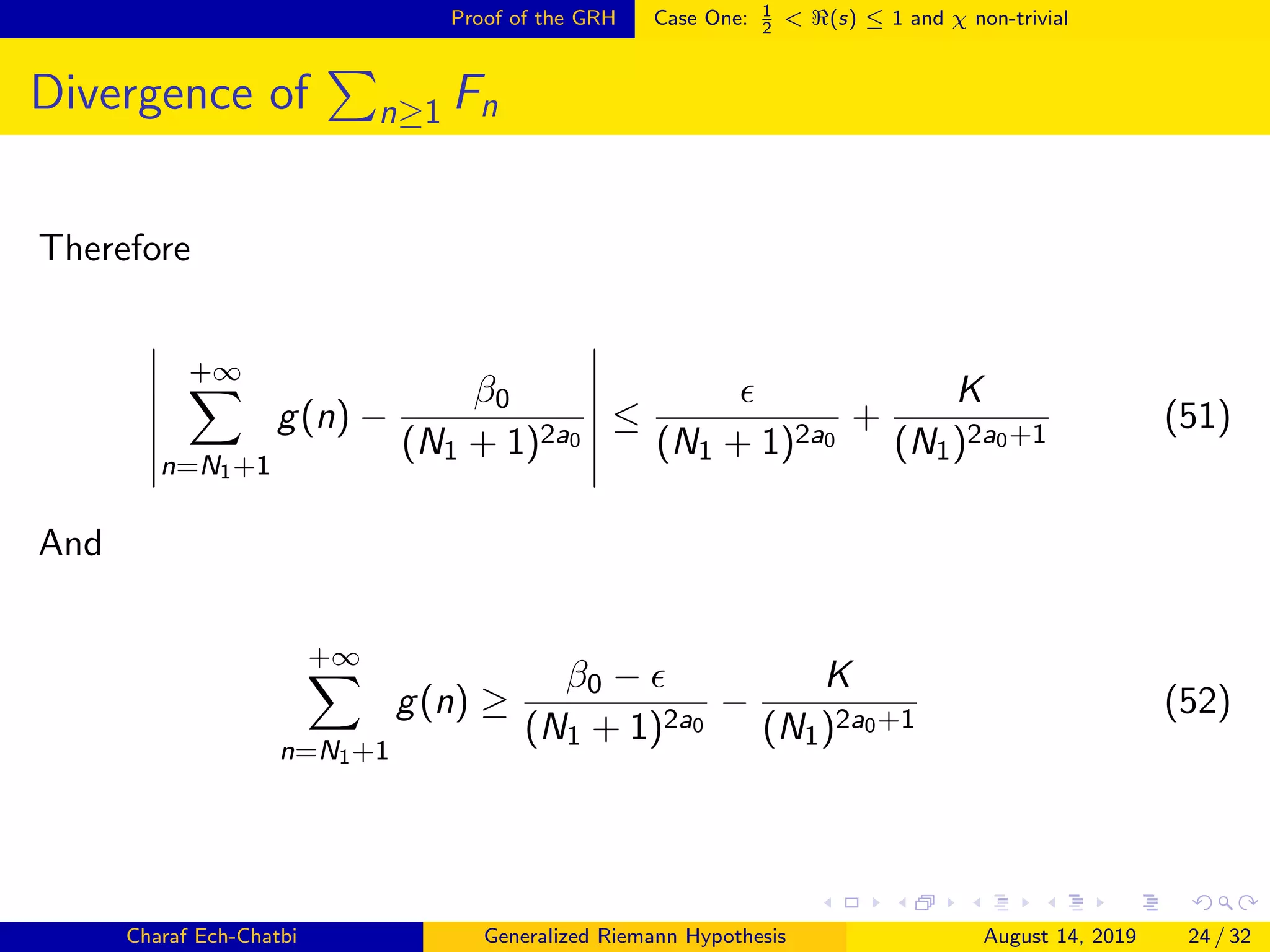
Therefore
+∞
n=N1+1
g(n) −
β0
(N1 + 1)2a0
≤
(N1 + 1)2a0
+
K
(N1)2a0+1
(51)
And
+∞
n=N1+1
g(n) ≥
β0 −
(N1 + 1)2a0
−
K
(N1)2a0+1
(52)
Charaf Ech-Chatbi Generalized Riemann Hypothesis August 14, 2019 24 / 32
Proof of the GRH Case One: 1
2
< (s) ≤ 1 and χ non-trivial
Divergence of n≥1 Fn
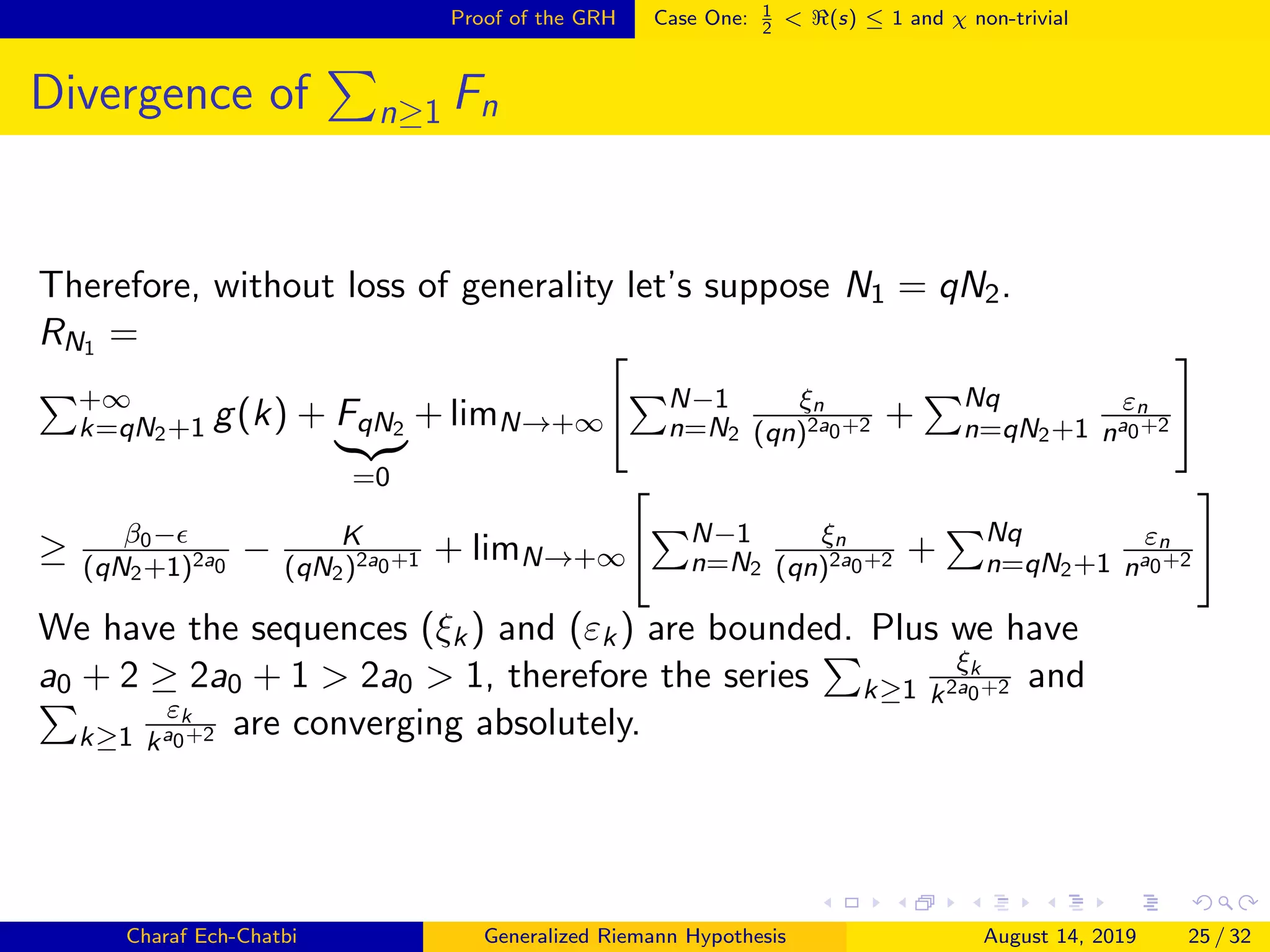
Therefore, without loss of generality let’s suppose N1 = qN2.
RN1 =
+∞
k=qN2+1 g(k) + FqN2
=0
+ limN→+∞
N−1
n=N2
ξn
(qn)2a0+2 + Nq
n=qN2+1
εn
na0+2
≥ β0−
(qN2+1)2a0
− K
(qN2)2a0+1 + limN→+∞
N−1
n=N2
ξn
(qn)2a0+2 + Nq
n=qN2+1
εn
na0+2
We have the sequences (ξk) and (εk) are bounded. Plus we have
a0 + 2 ≥ 2a0 + 1 > 2a0 > 1, therefore the series k≥1
ξk
k2a0+2 and
k≥1
εk
ka0+2 are converging absolutely.
Charaf Ech-Chatbi Generalized Riemann Hypothesis August 14, 2019 25 / 32
Proof of the GRH Case One: 1
2
< (s) ≤ 1 and χ non-trivial
Divergence of n≥1 Fn
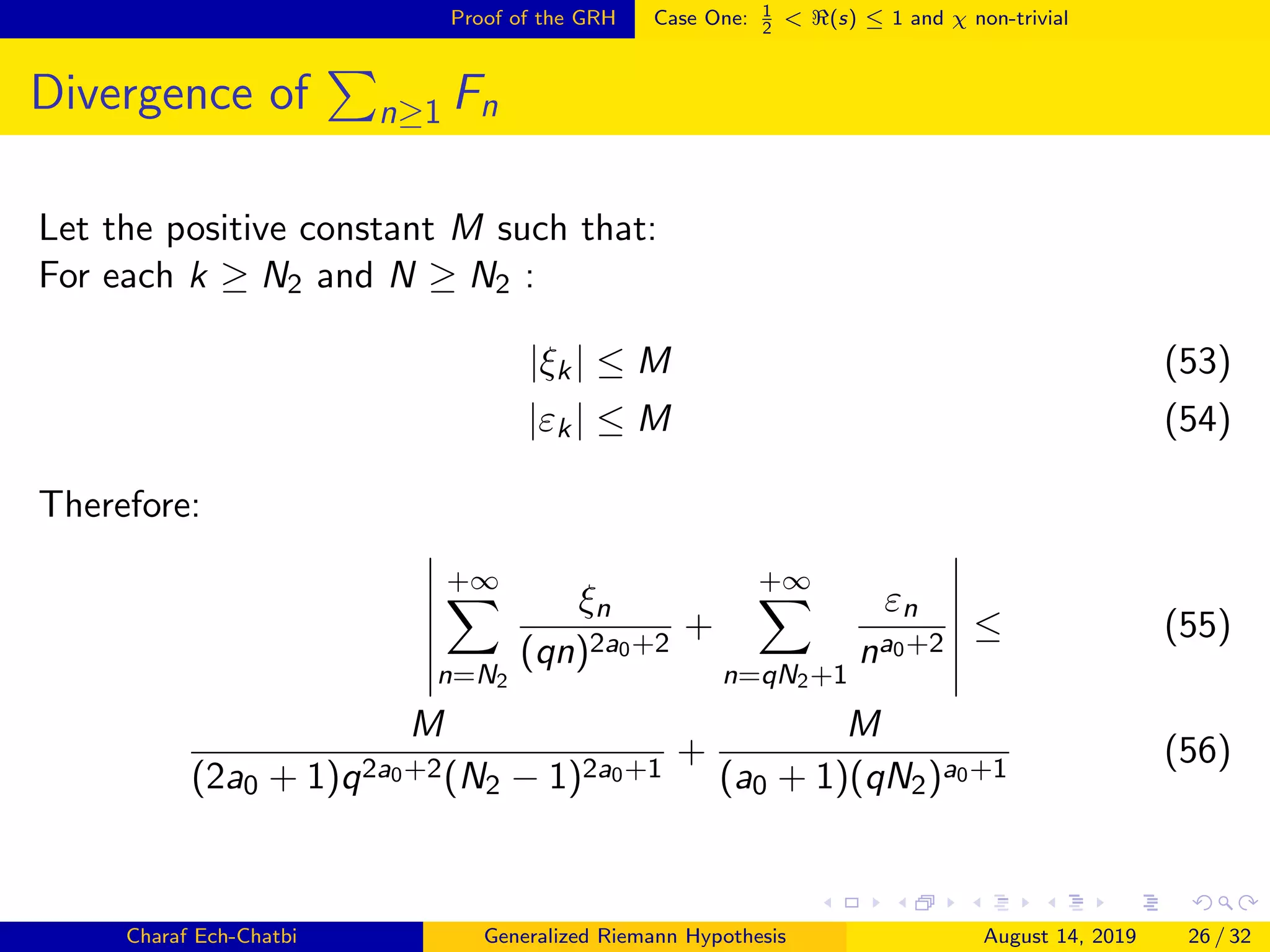
Let the positive constant M such that:
For each k ≥ N2 and N ≥ N2 :
|ξk| ≤ M (53)
|εk| ≤ M (54)
Therefore:
+∞
n=N2
ξn
(qn)2a0+2
+
+∞
n=qN2+1
εn
na0+2
≤ (55)
M
(2a0 + 1)q2a0+2(N2 − 1)2a0+1
+
M
(a0 + 1)(qN2)a0+1
(56)
Charaf Ech-Chatbi Generalized Riemann Hypothesis August 14, 2019 26 / 32
Proof of the GRH Case One: 1
2
< (s) ≤ 1 and χ non-trivial
Divergence of n≥1 Fn
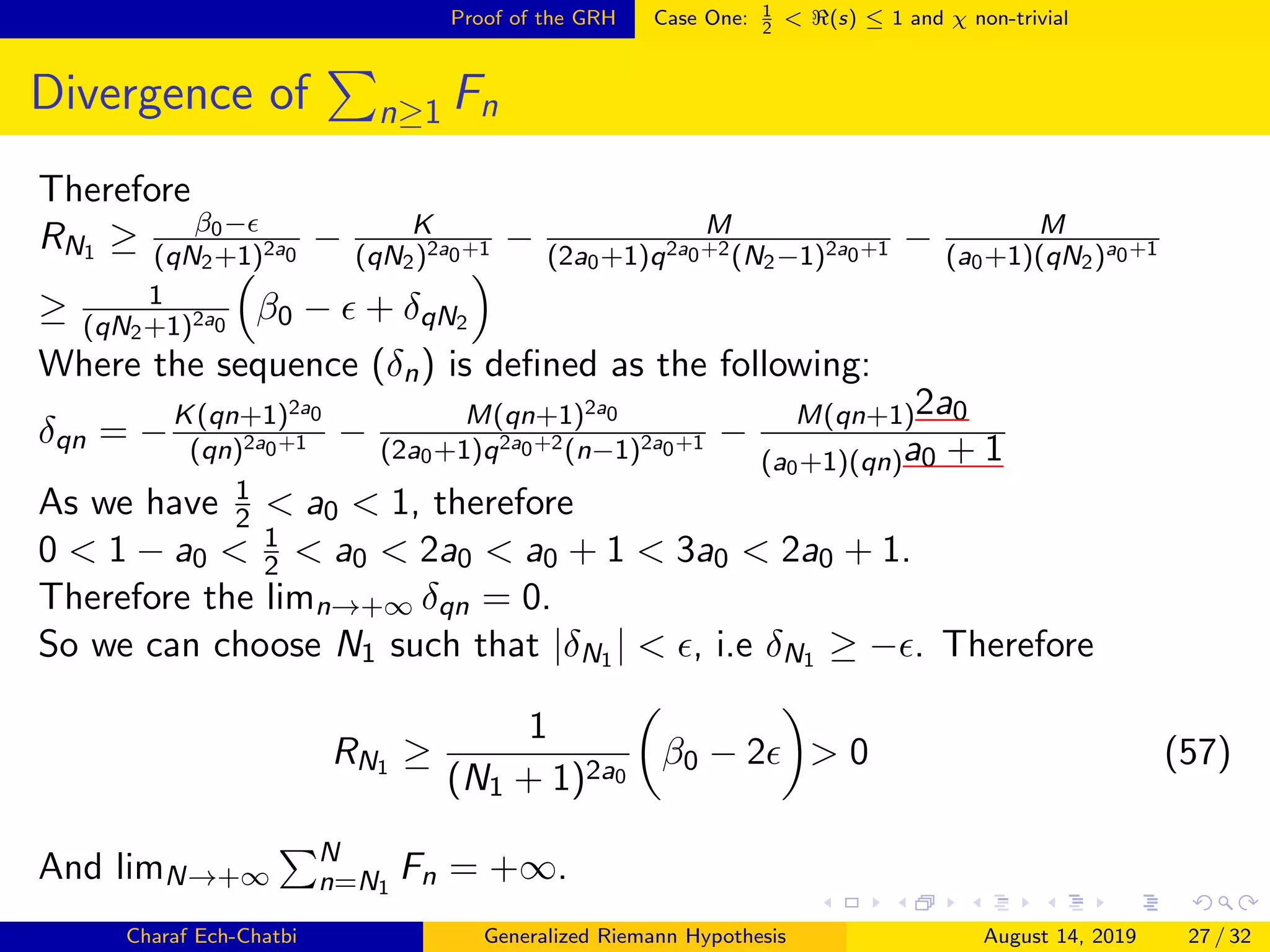
Therefore
RN1 ≥ β0−
(qN2+1)2a0
− K
(qN2)2a0+1 − M
(2a0+1)q2a0+2(N2−1)2a0+1 − M
(a0+1)(qN2)a0+1
≥ 1
(qN2+1)2a0
β0 − + δqN2
Where the sequence (δn) is defined as the following:
δqn = −K(qn+1)2a0
(qn)2a0+1 − M(qn+1)2a0
(2a0+1)q2a0+2(n−1)2a0+1 − M(qn+1)2a0
(a0+1)(qn)a0 + 1
As we have 1
2 < a0 < 1, therefore
0 < 1 − a0 < 1
2 < a0 < 2a0 < a0 + 1 < 3a0 < 2a0 + 1.
Therefore the limn→+∞ δqn = 0.
So we can choose N1 such that |δN1 | < , i.e δN1 ≥ − . Therefore
RN1 ≥
1
(N1 + 1)2a0
β0 − 2 > 0 (57)
And limN→+∞
N
n=N1
Fn = +∞.
Charaf Ech-Chatbi Generalized Riemann Hypothesis August 14, 2019 27 / 32
Proof of the GRH Case One: 1
2
< (s) ≤ 1 and χ non-trivial
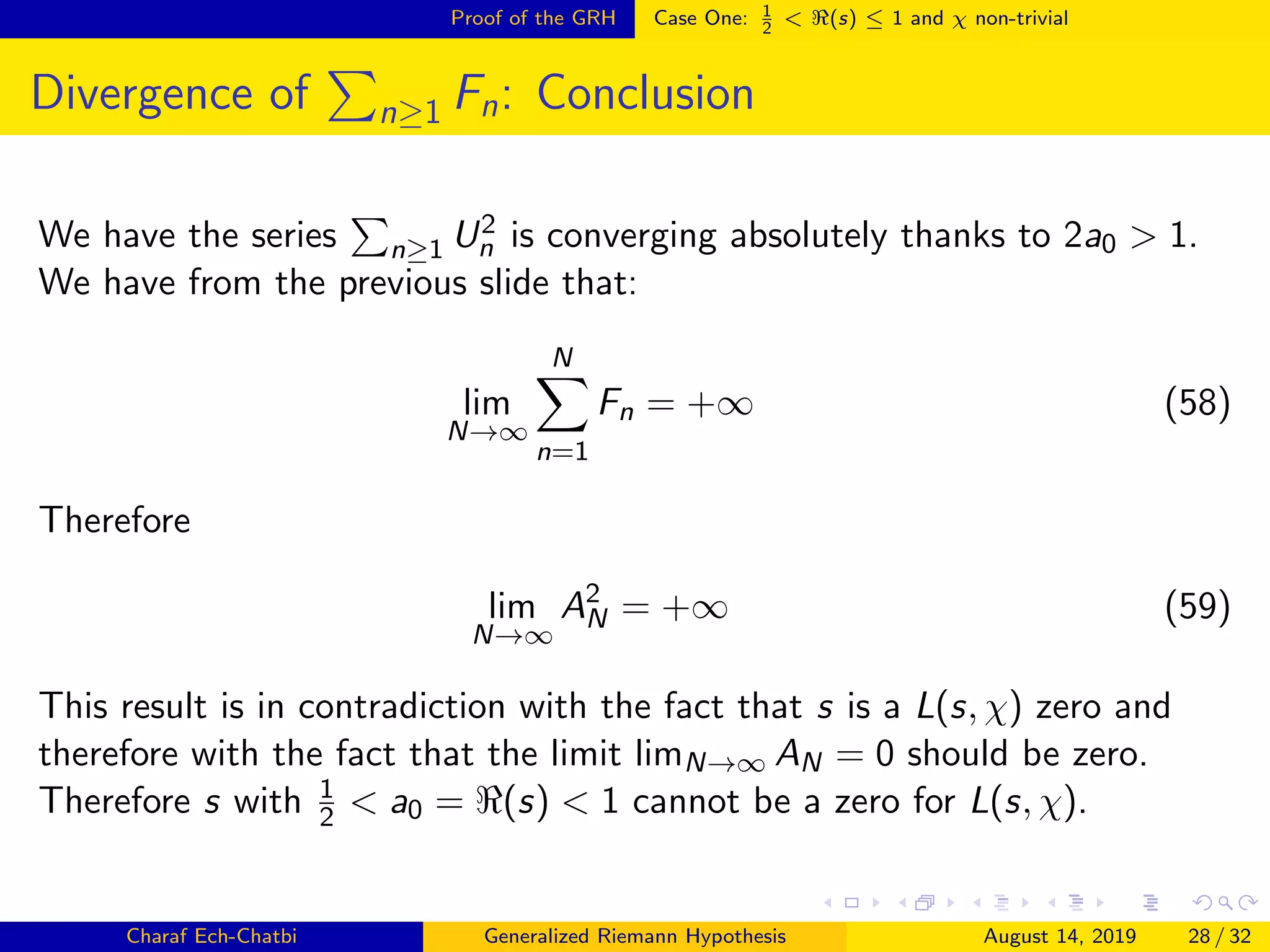
Divergence of n≥1 Fn: Conclusion
We have the series n≥1 U2
n is converging absolutely thanks to 2a0 > 1.
We have from the previous slide that:
lim
N→∞
N
n=1
Fn = +∞ (58)
Therefore
lim
N→∞
A2
N = +∞ (59)
This result is in contradiction with the fact that s is a L(s, χ) zero and
therefore with the fact that the limit limN→∞ AN = 0 should be zero.
Therefore s with 1
2 < a0 = (s) < 1 cannot be a zero for L(s, χ).
Charaf Ech-Chatbi Generalized Riemann Hypothesis August 14, 2019 28 / 32
Proof of the GRH Case Two: 1
2
< (s) ≤ 1 and χ trivial
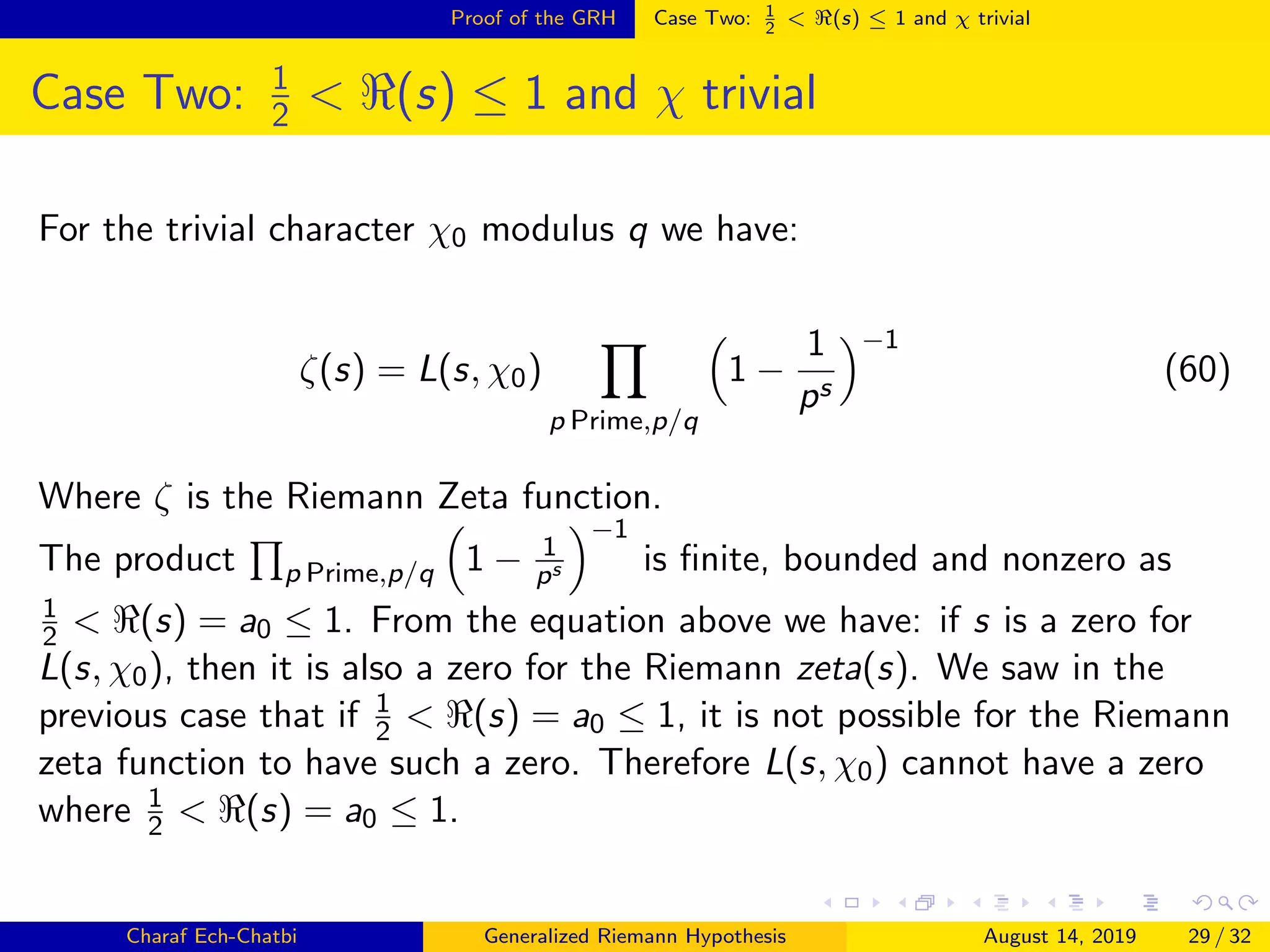
Case Two: 1
2 < (s) ≤ 1 and χ trivial
For the trivial character χ0 modulus q we have:
ζ(s) = L(s, χ0)
p Prime,p/q
1 −
1
ps
−1
(60)
Where ζ is the Riemann Zeta function.
The product p Prime,p/q 1 − 1
ps
−1
is finite, bounded and nonzero as
1
2 < (s) = a0 ≤ 1. From the equation above we have: if s is a zero for
L(s, χ0), then it is also a zero for the Riemann zeta(s). We saw in the
previous case that if 1
2 < (s) = a0 ≤ 1, it is not possible for the Riemann
zeta function to have such a zero. Therefore L(s, χ0) cannot have a zero
where 1
2 < (s) = a0 ≤ 1.
Charaf Ech-Chatbi Generalized Riemann Hypothesis August 14, 2019 29 / 32
Proof of the GRH Conclusion
Conclusion
We saw that if s is a L(s, χ) zero, then real part (s) can only be 1
2 as all
other possibilities can be discarded using the functional equation like in
[1]. Therefore the Generalized Riemann hypothesis is true: The non-trivial
zeros of L(s, χ) have real part equal to 1
2.
Charaf Ech-Chatbi Generalized Riemann Hypothesis August 14, 2019 30 / 32
Proof of the GRH References
References
Charaf Ech-Chatbi (2019)
A Proof of the Riemann’s Hypothesis
Charaf Ech-Chatbi (2019)
A Proof of the Generalized Riemann Hypothesis
Charaf Ech-Chatbi Generalized Riemann Hypothesis August 14, 2019 31 / 32
Proof of the GRH QED
The End
Charaf Ech-Chatbi Generalized Riemann Hypothesis August 14, 2019 32 / 32

A Proof of the Generalized Riemann Hypothesis

  • 1.
    A Proof ofthe Generalized Riemann Hypothesis Charaf Ech-Chatbi Quantitative Analyst charaf@melix.net August 14, 2019 Charaf Ech-Chatbi Generalized Riemann Hypothesis August 14, 2019 1 / 32
  • 2.
    Overview 1 Dirichlet L−functions Dirichletseries Dirichlet character Dirichlet L−functions 2 The Generalized Riemann Hypothesis 3 Road to the proof of GRH Proof Strategy Asymptotic Expansion The Case of Dirichlet character modulo an odd prime q The Case of Riemann Hypothesis 4 Proof of the GRH Case One: 1 2 < (s) ≤ 1 and χ non-trivial Case Two: 1 2 < (s) ≤ 1 and χ trivial Conclusion Charaf Ech-Chatbi Generalized Riemann Hypothesis August 14, 2019 2 / 32
  • 3.
    Dirichlet L−functions Dirichletseries Dirichlet series Let’s (zn)n≥1 be a sequence of complex numbers. A Dirichlet series is a series of the form ∞ n=1 zn ns , where s is complex. If (zn)n≥1 is a bounded, then the corresponding Dirichlet series converges absolutely on the open half-plane where (s) > 1. If the set of sums zn + zn+1 + ... + zn+k for each n and k ≥ 0 is bounded, then the corresponding Dirichlet series converges on the open half-plane where (s) > 0. In general, if zn = O(nk), the corresponding Dirichlet series converges absolutely in the half plane where (s) > k + 1. The function L(s) = ∞ n=1 zn ns is analytic on the corresponding open half plane. Charaf Ech-Chatbi Generalized Riemann Hypothesis August 14, 2019 3 / 32
  • 4.
    Dirichlet L−functions Dirichletcharacter Dirichlet character A function χ : Z −→ C is a Dirichlet character modulo q if it satisfies the following criteria: (i) χ(n) = 0 if (n, q) = 1. (ii) χ(n) = 0 if (n, q) > 1. (iii) χ is periodic with period q :χ(n + q) = χ(n) for all n. (iv) χ is multiplicative :χ(mn) = χ(m)χ(n) for all integers m and n. The trivial character is the one with χ0(n) = 1 whenever (n, q) = 1. For any integer n we have χ(1) = 1. Also if (n, q) = 1, we have (χ(n))φ(q) = 1 with φ is Euler’s totient function. χ(n) is a φ(q)−th root of unity. Therefore, |χ(n)| = 1 if (n, q) = 1, and |χ(n)| = 0 if (n, q) > 1. The cancellation property for Dirichlet characters modulo q: For any n integer q i=1 χ(i + n) = φ(q), if χ = χ0 the trivial character 0, if otherwise, χ = χ0 (1) Charaf Ech-Chatbi Generalized Riemann Hypothesis August 14, 2019 4 / 32
  • 5.
    Dirichlet L−functions DirichletL−functions Dirichlet L−functions The Dirichlet L−functions are simply the sum of the Dirichlet series. Let’s χ be a Dirichlet character modulo q, The Dirichlet L−function L(s, χ) is defined for (s) > 1 as the following: L(s, χ) = +∞ n=1 χ(n) ns (2) Where the series n≥1 χ(n) ns is convergent when (s) > 0 and L(s, χ) is analytic in (s) > 0. In the particular case of the trivial character χ0, L(s, χ0) extends to a meromorphic function in (s) > 0 with the only pole at s = 1. Also, like the Riemann zeta function, the Dirichlet L−functions have their Euler product. For (s) > 1: L(s, χ) = p Prime 1 − χ(p) ps −1 (3) Charaf Ech-Chatbi Generalized Riemann Hypothesis August 14, 2019 5 / 32
  • 6.
    Dirichlet L−functions DirichletL−functions Functional equation Let’s q be the smallest divisor (prime) of q. Let’s χ be the Dirichlet character χ mod q . For any integer n such that (n, q) = 1 we have also (n, q ) = 1 and χ(n) = χ (n). χ is called primitive and L(s, χ) and L(s, χ ) are related analytically such that: L(s, χ) = L(s, χ ) p/q 1 − χ (p) ps −1 (4) L(s, χ) and L(s, χ ) have the same zeros in the critical strip 0 ≤ (s) ≤ 1. Also, for a primitive character χ, (i.e.χ = χ ) L(s, χ) has the following functional equation: τ(χ)Γ( 1 − s + a 2 ) L(1 − s, χ) = √ π( q π )s ia q 1 2 Γ( s + a 2 ) L(s, χ) (5) Where Γ is the Gamma function and a = 0 if χ(−1) = 1 and a = 1 if χ(−1) = −1, and τ(χ) = q k=1 χ(k) exp(2πki q ). Charaf Ech-Chatbi Generalized Riemann Hypothesis August 14, 2019 6 / 32
  • 7.
    The Generalized RiemannHypothesis Generalized Riemann Hypothesis (GRH) The GRH states that the Dirichlet L−functions have all their non-trivial zeros on the critical line (s) = 1 2. Non trivial in this case means L(s, χ) = 0 for s ∈ C and 0 < (s) < 1. So for any primitive character χ modulo q, all non-trivial zeros of L(s, χ) lies in the critical strip {s ∈ C : 0 < (s) < 1}. From the functional equation above we have that if: s0 is a non-trivial zero of L(s, χ), then 1 − s0 is a zero of L(s, χ). s0 is a non-trivial zero of L(s, χ), then 1 − s0 is a zero of L(s, χ). Therefore, we just need to prove that for all primitive character χ modulo q, there is no non-trivial zeros of L(s, χ) in the right hand side of the critical strip {s ∈ C : 1 2 < (s) < 1}. Charaf Ech-Chatbi Generalized Riemann Hypothesis August 14, 2019 7 / 32
  • 8.
    Road to theproof of GRH Proof Strategy Proof Strategy Let’s denote for each n ≥ 1: zn = xn + iyn = χ(n). We are going to develop the sequence ZN(s) = N n=1 zn ns as follows: For N ≥ 1 ZN = N n=1 xn + iyn na0+ib0 = N n=1 Un na0 + i N n=1 Vn na0 = AN + iBN (6) Where Un = xn cos(b0 ln (n)) + yn sin(b0 ln (n)) na0 (7) Vn = yn cos(b0 ln (n)) − xn sin(b0 ln (n)) na0 (8) It is always insightful to work with the norm when working with complex: |ZN|2 = A2 N + B2 N = N n=1 Un 2 + N n=1 Vn 2 (9) Charaf Ech-Chatbi Generalized Riemann Hypothesis August 14, 2019 8 / 32
  • 9.
    Road to theproof of GRH Proof Strategy Proof Strategy cont A2 N = N n=1 U2 n + 2 N n=1 Un n−1 k=1 Uk = − N n=1 U2 n + 2 N n=1 UnAn (10) B2 N = − N n=1 V 2 n + 2 N n=1 VnBn (11) Let’s now define Fn and Gn as follows: Fn = UnAn, Gn = VnBn (12) Therefore A2 N = 2 N n=1 Fn − N n=1 U2 n , B2 N = 2 N n=1 Gn − N n=1 V 2 n (13) Charaf Ech-Chatbi Generalized Riemann Hypothesis August 14, 2019 9 / 32
  • 10.
    Road to theproof of GRH Proof Strategy Proof Strategy cont s is a zero for L(s, χ) = 0, if and only if lim N→∞ AN = 0 and lim N→∞ BN = 0 (14) Equally, s is a L(s, χ) zero, L(s, χ) = 0, if and only if lim N→∞ A2 N = 0 and lim N→∞ B2 N = 0 (15) The idea is to prove that in the case of a complex s that is in the right hand side of the critical strip 1 2 < a0 ≤ 1 and that is a L(s, χ) zero, that the limit limn→∞ A2 n = +/ − ∞ OR the limit limn→∞ B2 n = +/ − ∞. This will create a contradiction. Because if s is a L(s, χ) zero then the limn→∞ A2 n should be 0 and the limn→∞ B2 n should be 0. And therefore the sequences ( N n=1 Fn)N≥1 and ( N n=1 Gn)N≥1 should converge and their limits should be: limn→∞ N n=1 Fn = 1 2 limN→∞ N n=1 U2 n < +∞ and limn→∞ N n=1 Gn = 1 2 limN→∞ N n=1 V 2 n < +∞. Charaf Ech-Chatbi Generalized Riemann Hypothesis August 14, 2019 10 / 32
  • 11.
    Road to theproof of GRH Asymptotic Expansion Asymptotic Expansion If the set of the partial sums zn + zn+1 + ... + zn+k for n and k ≥ 0 is bounded, then we can write An = λn na0 where (λn) is a bounded sequence. So the asymptotic expansion of Fn+1 − Fn is as follows: Fn+1 − Fn = γ2 n n2a0 + αnAn na0 + βnAn na0+1 + 2 γnβn n2a0+1 + O( 1 na0+2 ) (16) We have An = λn na0 where λn is bounded. Therefore Fn+1 − Fn = γ2 n + αnλn n2a0 + λn + 2γn βn n2a0+1 + O( 1 na0+2 ) (17) Charaf Ech-Chatbi Generalized Riemann Hypothesis August 14, 2019 11 / 32
  • 12.
    Road to theproof of GRH The Case of Dirichlet character modulo an odd prime q The Case of Dirichlet character modulo an odd prime q Let’s q be an odd prime integer. Let’s χ be a non-trivial Dirichlet character modulo q. Let’s denote that for each k, zk = xk + iyk = χ(k). Therefore we have the following asymptotic expansion: q i=1 γ2 qn+i + αqn+i λqn+i (nq + i)2a0 + q i=1 (λnq+i + 2γqn+i )βnq+i (nq + i)2a0 + 1 (18) = Ta + Tb cos(2b0 ln (qn)) + Tc sin(2b0 ln (qn) (nq)2a0 + 1 + O( 1 (qn)2a0+2 ) (19) Where m ∈ [1, q − 2] is defined such that χm(g) = e 2πmi q−1 where g is the generator of the cyclic group Z/qZ∗. Ta =    −a0 2 5q−1 2 − (q−1) sin( 2πm q−1 2−2 cos( 2πm q−1 + b0 2 q−1 2 + (q−1) sin( 2πm q−1 1−cos( 2πm q−1 , m = q−1 2 −a0 4 5q − 1 + b0 4 (q − 1), m = q−1 2 (20)Charaf Ech-Chatbi Generalized Riemann Hypothesis August 14, 2019 12 / 32
  • 13.
    Road to theproof of GRH The Case of Dirichlet character modulo an odd prime q The Case of Dirichlet character modulo an odd prime q Tb =    a0 2 q + 1 − (q−1) sin(2πm q−1 2−2 cos( 2πm q−1 − b0 2 q−1 2 + (q−1) sin( 2πm q−1 1−cos( 2πm q−1 , m = q−1 2 a0 4 4q2 + 2q − 2 − b0 4 (q − 1), m = q−1 2 (21) Tc =    a0 2 q−1 2 + (q−1) sin( 2πm q−1 1−cos( 2πm q−1 − b0 2 q + 1 + (q−1) sin( 2πm q−1 2−2 cos( 2πm q−1 , m = q−1 2 a0 4 (q − 1) − b0q, m = q−1 2 (22) Charaf Ech-Chatbi Generalized Riemann Hypothesis August 14, 2019 13 / 32
  • 14.
    Road to theproof of GRH The Case of Riemann Hypothesis The Case of Riemann Hypothesis The Riemann zeta function is extended to the part of the complex plane where (s) > 0 by the Dirichlet η function: η(s) = +∞ n=1 χ(n) ns . Where q = 2 and χ(kq + 1) = 1, χ(kq + 2) = −1. In this case, the function χ is not a Dirichlet character but it is not a stop to apply our method as our method is not Dirichlet character specific. Therefore we have the same asymptotic expansion as in the previous slide: q i=1 γ2 qn+i + αqn+i λqn+i (nq + i)2a0 + q i=1 (λnq+i + 2γqn+i )βnq+i (nq + i)2a0 + 1 (23) = Ta + Tb cos(2b0 ln (qn)) + Tc sin(2b0 ln (qn) (nq)2a0 + 1 + O( 1 (qn)2a0+2 ) (24) with Ta = −a0, Tb = −a0, c = −b0 (25) Charaf Ech-Chatbi Generalized Riemann Hypothesis August 14, 2019 14 / 32
  • 15.
    Proof of theGRH Case One: 1 2 < (s) ≤ 1 and χ non-trivial Divergence of n≥1 Fn For large N ≥ N0 we have the following expression of FN+1: FN+1 = FN0 + N n=N0 γ2 n + αnλn n2a0 + λn + 2γn βn n2a0+1 + n na0+2 (26) = FN0 + N n=N0 Cn n2a0 + Dn n2a0+1 + n na0+2 (27) Where Cn = γ2 n + αnλn (28) Dn = λn + 2γn βn (29) Charaf Ech-Chatbi Generalized Riemann Hypothesis August 14, 2019 15 / 32
  • 16.
    Proof of theGRH Case One: 1 2 < (s) ≤ 1 and χ non-trivial Divergence of n≥1 Fn N n=N0 Fn+1 = (N + 1) (N − N0 + 1) N + 1 FN0 (30) + N n=N0 Cn n2a0 + Dn n2a0+1 + εn na0+2 (31) − 1 N + 1 N n=N0 Cn n2a0−1 + Dn n2a0 + εn na0+1 (32) As we have 2a0 > 1, So limn→∞ Cn n2a0−1 + Dn n2a0 + εn na0+1 = 0 Following C´esaro theorem: limN→∞ 1 N+1 N n=N0 Cn n2a0−1 + Dn n2a0 + εn na0+1 = 0 Charaf Ech-Chatbi Generalized Riemann Hypothesis August 14, 2019 16 / 32
  • 17.
    Proof of theGRH Case One: 1 2 < (s) ≤ 1 and χ non-trivial Divergence of n≥1 Fn We are going to prove that: lim N→∞ N n=N0 Fn+1 = +∞ (33) As we have 2a0 > 1, the series n≥1 Cn n2a0 + Dn n2a0+1 + εn na0+2 is converging absolutely. Let’s denote: RN0 = lim N→+∞ Nq n=qN0+1 Cn n2a0 + Dn n2a0+1 + εn na0+2 (34) If we can find N0 such that RN0 + FN0 > 0 then we can conclude that limN→∞ N n=N0 Fn+1 = +∞. Charaf Ech-Chatbi Generalized Riemann Hypothesis August 14, 2019 17 / 32
  • 18.
    Proof of theGRH Case One: 1 2 < (s) ≤ 1 and χ non-trivial Divergence of n≥1 Fn Let’s now study the term Nq n=qN0+1 Cn n2a0 + Dn n2a0+1 . We have from above results that: Nq n=qN0+1 Cn n2a0 + Dn n2a0+1 (35) = N−1 n=N0 q i=1 γ2 qn+i + αqn+i λqn+i (nq + i)2a0 + q i=1 (λnq+i + 2γqn+i )βnq+i (nq + i)2a0 + 1 (36) = N−1 n=N0 α + β cos(2b0 ln (qn)) + γ sin(2b0 ln (qn) (qn)2a0 + 1 + N−1 n=N0 ξn (qn)2a0+2 (37) Charaf Ech-Chatbi Generalized Riemann Hypothesis August 14, 2019 18 / 32
  • 19.
    Proof of theGRH Case One: 1 2 < (s) ≤ 1 and χ non-trivial Divergence of n≥1 Fn RN,N0 = Nq n=qN0+1 Cn n2a0 + Dn n2a0+1 + εn na0+2 (38) = N−1 n=N0 α + β cos(2b0 ln (qn)) + γ sin(2b0 ln (qn) (qn)2a0+1 (39) + N−1 n=N0 ξn (qn)2a0+2 + Nq n=qN0+1 εn na0+2 (40) = N−1 n=N0 g(n) + ξn (qn)2a0+2 + Nq n=qN0+1 εn na0+2 (41) Charaf Ech-Chatbi Generalized Riemann Hypothesis August 14, 2019 19 / 32
  • 20.
    Proof of theGRH Case One: 1 2 < (s) ≤ 1 and χ non-trivial Divergence of n≥1 Fn Let’s denote the function g as: g(x) = α+β cos(2b0 ln (qx))+γ sin(2b0 ln (qx) (qx)2a0+1 We have the following inequality: +∞ n=N0+1 g(n) − +∞ N0+1 g(x) ≤ K (N0)2a0+1 (42) And the primitive function G of the function x → 1 q g(x q ): G(x) = 1 q − α (2a0)x2a0 + 2b0β−(2a0)γ sin(2b0 ln (x))+ −2a0β−2b0γ cos(2b0 ln (x)) (2b0)2+(2a0)2 x2a0 Therefore +∞ n=N0+1 g(n) + G(q(N0 + 1)) ≤ K (N0)2a0+1 (43) Charaf Ech-Chatbi Generalized Riemann Hypothesis August 14, 2019 20 / 32
  • 21.
    Proof of theGRH Case One: 1 2 < (s) ≤ 1 and χ non-trivial Divergence of n≥1 Fn Concerning the term FN0 . We have FN0 = uN0 (N0)a0 AN0 = uN0 λN0 (N0)2a0 (44) Where the sequence (λn) is bounded. If we choose N0 = n0q as a multiple of q we have from the definition of un0q = 0 because χ(n0q) = 0. Therefore: FN0 = Fn0q = 0 (45) The remaining terms in the expression of RN0 are all of the order of 1 (N0)2a0+1 and above. So the dominant term in the expression RN0 is the term −G(N0 + 1). The function G is a nonzero function. Therefore this term is the dominant term in the expression of 1 N N−1 n=N0 Fn+1. Hence based on the sign of G(N0 + 1) we can show that the limit of N−1 n=1 Fn+1 can be both +∞ and −∞. Charaf Ech-Chatbi Generalized Riemann Hypothesis August 14, 2019 21 / 32
  • 22.
    Proof of theGRH Case One: 1 2 < (s) ≤ 1 and χ non-trivial Divergence of n≥1 Fn Let’s define the function f : f (x) = − α 2a0 + 2b0β−(2a0)γ sin(2b0x)+ −2a0β−2b0γ cos(2b0x) (2b0)2+(2a0)2 . We simplify further the notations: f (x) = α2 + β2 cos(2b0x) + γ2 sin(2b0x). Without loss of generality, let’s define β0 = − f (0) q2a0+1 > 0. See[2] for more detail. Let’s fix > 0 to be very small such that 0 < < min 1, β0 10000 . Let’s define γ0 = |β2|+|γ2| q2a0+1 . Without loss of generality, let’s N1 be such that |cos(2b0 ln q(N1 + 1)) − 1| ≤ /γ0 and |sin(2b0 ln q(N1 + 1)) − 0| ≤ /γ0. Therefore: G q(N1 + 1) − f (0) q q(N1 + 1) 2a0 ≤ N1 + 1 2a0 (46) Because... Charaf Ech-Chatbi Generalized Riemann Hypothesis August 14, 2019 22 / 32
  • 23.
    Proof of theGRH Case One: 1 2 < (s) ≤ 1 and χ non-trivial Divergence of n≥1 Fn G q(N1 + 1) − f (0) q q(N1 + 1) 2a0 ≤ (47) (γ2) sin(2b0 ln q(N1 + 1)) + (β2) cos(2b0 ln q(N1 + 1)) q q(N1 + 1) 2a0 (48) − (γ2) sin(2b00) + (β2) cos(2b00) q q(N1 + 1) 2a0 (49) ≤ |γ2| |sin(2b0 ln q(N1 + 1))| + |β2| |cos(2b0 ln q(N1 + 1)) − 1| q q(N1 + 1) 2a0 (50) Charaf Ech-Chatbi Generalized Riemann Hypothesis August 14, 2019 23 / 32
  • 24.
    Proof of theGRH Case One: 1 2 < (s) ≤ 1 and χ non-trivial Divergence of n≥1 Fn Therefore +∞ n=N1+1 g(n) − β0 (N1 + 1)2a0 ≤ (N1 + 1)2a0 + K (N1)2a0+1 (51) And +∞ n=N1+1 g(n) ≥ β0 − (N1 + 1)2a0 − K (N1)2a0+1 (52) Charaf Ech-Chatbi Generalized Riemann Hypothesis August 14, 2019 24 / 32
  • 25.
    Proof of theGRH Case One: 1 2 < (s) ≤ 1 and χ non-trivial Divergence of n≥1 Fn Therefore, without loss of generality let’s suppose N1 = qN2. RN1 = +∞ k=qN2+1 g(k) + FqN2 =0 + limN→+∞ N−1 n=N2 ξn (qn)2a0+2 + Nq n=qN2+1 εn na0+2 ≥ β0− (qN2+1)2a0 − K (qN2)2a0+1 + limN→+∞ N−1 n=N2 ξn (qn)2a0+2 + Nq n=qN2+1 εn na0+2 We have the sequences (ξk) and (εk) are bounded. Plus we have a0 + 2 ≥ 2a0 + 1 > 2a0 > 1, therefore the series k≥1 ξk k2a0+2 and k≥1 εk ka0+2 are converging absolutely. Charaf Ech-Chatbi Generalized Riemann Hypothesis August 14, 2019 25 / 32
  • 26.
    Proof of theGRH Case One: 1 2 < (s) ≤ 1 and χ non-trivial Divergence of n≥1 Fn Let the positive constant M such that: For each k ≥ N2 and N ≥ N2 : |ξk| ≤ M (53) |εk| ≤ M (54) Therefore: +∞ n=N2 ξn (qn)2a0+2 + +∞ n=qN2+1 εn na0+2 ≤ (55) M (2a0 + 1)q2a0+2(N2 − 1)2a0+1 + M (a0 + 1)(qN2)a0+1 (56) Charaf Ech-Chatbi Generalized Riemann Hypothesis August 14, 2019 26 / 32
  • 27.
    Proof of theGRH Case One: 1 2 < (s) ≤ 1 and χ non-trivial Divergence of n≥1 Fn Therefore RN1 ≥ β0− (qN2+1)2a0 − K (qN2)2a0+1 − M (2a0+1)q2a0+2(N2−1)2a0+1 − M (a0+1)(qN2)a0+1 ≥ 1 (qN2+1)2a0 β0 − + δqN2 Where the sequence (δn) is defined as the following: δqn = −K(qn+1)2a0 (qn)2a0+1 − M(qn+1)2a0 (2a0+1)q2a0+2(n−1)2a0+1 − M(qn+1)2a0 (a0+1)(qn)a0 + 1 As we have 1 2 < a0 < 1, therefore 0 < 1 − a0 < 1 2 < a0 < 2a0 < a0 + 1 < 3a0 < 2a0 + 1. Therefore the limn→+∞ δqn = 0. So we can choose N1 such that |δN1 | < , i.e δN1 ≥ − . Therefore RN1 ≥ 1 (N1 + 1)2a0 β0 − 2 > 0 (57) And limN→+∞ N n=N1 Fn = +∞. Charaf Ech-Chatbi Generalized Riemann Hypothesis August 14, 2019 27 / 32
  • 28.
    Proof of theGRH Case One: 1 2 < (s) ≤ 1 and χ non-trivial Divergence of n≥1 Fn: Conclusion We have the series n≥1 U2 n is converging absolutely thanks to 2a0 > 1. We have from the previous slide that: lim N→∞ N n=1 Fn = +∞ (58) Therefore lim N→∞ A2 N = +∞ (59) This result is in contradiction with the fact that s is a L(s, χ) zero and therefore with the fact that the limit limN→∞ AN = 0 should be zero. Therefore s with 1 2 < a0 = (s) < 1 cannot be a zero for L(s, χ). Charaf Ech-Chatbi Generalized Riemann Hypothesis August 14, 2019 28 / 32
  • 29.
    Proof of theGRH Case Two: 1 2 < (s) ≤ 1 and χ trivial Case Two: 1 2 < (s) ≤ 1 and χ trivial For the trivial character χ0 modulus q we have: ζ(s) = L(s, χ0) p Prime,p/q 1 − 1 ps −1 (60) Where ζ is the Riemann Zeta function. The product p Prime,p/q 1 − 1 ps −1 is finite, bounded and nonzero as 1 2 < (s) = a0 ≤ 1. From the equation above we have: if s is a zero for L(s, χ0), then it is also a zero for the Riemann zeta(s). We saw in the previous case that if 1 2 < (s) = a0 ≤ 1, it is not possible for the Riemann zeta function to have such a zero. Therefore L(s, χ0) cannot have a zero where 1 2 < (s) = a0 ≤ 1. Charaf Ech-Chatbi Generalized Riemann Hypothesis August 14, 2019 29 / 32
  • 30.
    Proof of theGRH Conclusion Conclusion We saw that if s is a L(s, χ) zero, then real part (s) can only be 1 2 as all other possibilities can be discarded using the functional equation like in [1]. Therefore the Generalized Riemann hypothesis is true: The non-trivial zeros of L(s, χ) have real part equal to 1 2. Charaf Ech-Chatbi Generalized Riemann Hypothesis August 14, 2019 30 / 32
  • 31.
    Proof of theGRH References References Charaf Ech-Chatbi (2019) A Proof of the Riemann’s Hypothesis Charaf Ech-Chatbi (2019) A Proof of the Generalized Riemann Hypothesis Charaf Ech-Chatbi Generalized Riemann Hypothesis August 14, 2019 31 / 32
  • 32.
    Proof of theGRH QED The End Charaf Ech-Chatbi Generalized Riemann Hypothesis August 14, 2019 32 / 32