A Course In Analytic Number Theory Marius Overholt
A Course In Analytic Number Theory Marius Overholt
A Course In Analytic Number Theory Marius Overholt
A Course In Analytic Number Theory Marius Overholt
A Course In Analytic Number Theory Marius Overholt
1.
A Course InAnalytic Number Theory Marius
Overholt download
https://ebookbell.com/product/a-course-in-analytic-number-theory-
marius-overholt-5242854
Explore and download more ebooks at ebookbell.com
2.
Here are somerecommended products that we believe you will be
interested in. You can click the link to download.
Topics In Algebraic And Analytic Geometry Mn13 Volume 13 Notes From A
Course Of Phillip Griffiths Phillip A Griffiths John Frank Adams
https://ebookbell.com/product/topics-in-algebraic-and-analytic-
geometry-mn13-volume-13-notes-from-a-course-of-phillip-griffiths-
phillip-a-griffiths-john-frank-adams-51950876
Business Statistics Using Excel A Complete Course In Data Analytics R
Panneerselvam
https://ebookbell.com/product/business-statistics-using-excel-a-
complete-course-in-data-analytics-r-panneerselvam-53860612
Elasticsearch A Complete Guide Endtoend Search And Analytics A Course
In Three Modules Dixit
https://ebookbell.com/product/elasticsearch-a-complete-guide-endtoend-
search-and-analytics-a-course-in-three-modules-dixit-6858710
A Course In Analysis Vol V Functional Analysis Some Operator Theory
Theory Of Distributions Niels Jacob
https://ebookbell.com/product/a-course-in-analysis-vol-v-functional-
analysis-some-operator-theory-theory-of-distributions-niels-
jacob-56850170
3.
A Course InAnalysis Volume I Introductory Calculus Analysis Of
Functions Of One Real Variable 1st Edition Niels Jacob
https://ebookbell.com/product/a-course-in-analysis-volume-i-
introductory-calculus-analysis-of-functions-of-one-real-variable-1st-
edition-niels-jacob-5290358
A Course In Analysis Volume Ii Differentiation And Integration Of
Functions Of Several Variables Vector Calculus 1st Edition Niels Jacob
https://ebookbell.com/product/a-course-in-analysis-volume-ii-
differentiation-and-integration-of-functions-of-several-variables-
vector-calculus-1st-edition-niels-jacob-10046222
A Course In Analysis Volume Iii Measure And Integration Theory
Complexvalued Functions Of A Complex Variable 1st Edition Niels Jacob
https://ebookbell.com/product/a-course-in-analysis-volume-iii-measure-
and-integration-theory-complexvalued-functions-of-a-complex-
variable-1st-edition-niels-jacob-10841472
A Course In Real Analysis John N Mcdonald Neil A Weiss
https://ebookbell.com/product/a-course-in-real-analysis-john-n-
mcdonald-neil-a-weiss-52812132
A Course In Mathematical Analysis Volume I Foundations And Elementary
Real Analysis 1st Edition Djh Garling
https://ebookbell.com/product/a-course-in-mathematical-analysis-
volume-i-foundations-and-elementary-real-analysis-1st-edition-djh-
garling-54792850
5.
A Course inAnalytic
Number Theory
Marius Overholt
Graduate Studies
in Mathematics
Volume 160
+.l:~ll!!M.t,,('
cf~
~.~.~ American Mathematical Society
1)~BD '''I>
Contents
Preface xi
Acknowledgments xiii
Howto use this text xv
Introduction xvii
Chapter 1. Arithmetic Functions 1
§1.1. The method of Chebyshev 1
§1.2. Bertrand's Postulate 6
§1.3. Simple estimation techniques 7
§1.4. The Mertens estimates 10
§1.5. Sums over divisors 16
§1.6. The hyperbola method 21
§1.7. Notes 27
Exercises 33
Chapter 2. Topics on Arithmetic Functions 41
§2.1. *The neighborhood method 41
§2.2. * The normal order method 46
§2.3. * The Mertens function 49
§2.4. Notes 55
Exercises 56
-vii
14.
viii Contents
Chapter 3.Characters and Euler Products 59
§3.1. The Euler product formula 59
§3.2. Convergence of Dirichlet series 64
§3.3. Harmonics 67
§3.4. Group representations 71
§3.5. Fourier analysis on finite groups 76
§3.6. Primes in arithmetic progressions 83
§3.7. Gauss sums and primitive characters 89
§3.8. *The character group 95
§3.9. Notes 99
Exercises 103
Chapter 4. The Circle Method 111
§4.1. Diophantine equations 111
§4.2. The major arcs 116
§4.3. The singular series 123
§4.4. Weyl sums 130
§4.5. An asymptotic estimate 138
§4.6. Notes 144
Exercises 150
Chapter 5. The Method of Contour Integrals 157
§5.1. The Perron formula 157
§5.2. Bounds for Dirichlet L-functions 162
§5.3. Notes 165
Exercises 166
Chapter 6. The Prime Number Theorem 169
§6.1. A zero-free region 169
§6.2. A proof of the PNT 173
§6.3. Notes 177
Exercises 179
Chapter 7. The Siegel-Walfisz Theorem 183
§7.1. Zero-free regions for L-functions 183
§7.2. An idea of Landau 190
§7.3. The theorem of Siegel 193
§7.4. The Borel-Caratheodory lemma 196
15.
Contents
§7.5. The PNTfor arithmetic progressions
§7.6. Notes
Exercises
Chapter 8. Mainly Analysis
§8.1. The Poisson summation formula
§8.2. Theta functions
§8.3. The gamma function
§8.4. The functional equation of ((s)
§8.5. *The functional equation of L(s, x)
§8.6. The Hadamard factorization theorem
§8.7. *The Phragmen-LindelOf principle
§8.8. Notes
Exercises
Chapter 9. Euler Products and Number Fields
§9.1. The Dedekind zeta function
§9.2. The analytic class number formula
§9.3. *Class numbers of quadratic fields
§9.4. *A discriminant bound
§9.5. *The Prime Ideal Theorem
§9.6. *A proof of the Ikehara theorem
§9.7. Induced representations
§9.8. Artin L-functions
§9.9. Notes
Exercises
Chapter 10. Explicit Formulas
§10.1. The von Mangoldt formula
§10.2. The primes and RH
§10.3. The Guinand-Weil formula
§10.4. Notes
Exercises
Chapter 11. Supplementary Exercises
Exercises
Solutions
ix
198
205
205
209
209
216
223
227
231
235
240
243
247
255
255
262
269
275
281
287
293
296
302
303
307
307
314
315
322
324
327
327
330
Preface
This book waswritten for graduate students looking for an introduction to
some basic methods of analytic number theory. It is suitable as a textbook
for an introductory one-semester course at the beginning graduate level, but
contains more material than can be comfortably covered in such a course.
However, by suitably selecting chapters, it is possible to teach courses going
in various directions.
Readers should be familiar with c-8 calculus, have completed an under-
graduate course in complex analysis, and possess the proficiency in abstract
and linear algebra to be expected of a beginning graduate student. No
familiarity with graduate-level analysis is assumed. The first four chapters
presuppose no complex analysis beyond simple properties of the exponential
function.
Each chapter is followed by notes with references and historical remarks.
At the end of many of the sections there are references to more detailed
treatments of the topic under consideration.
I wish to thank anonymous referees for suggestions that have improved
the book. Naturally I alone remain responsible for all errors and imperfec-
tions that remain.
This seems an appropriate place to express my gratitude to Hugh Mont-
gomery, Imre Ruzsa, and the late Sigmund Selberg, from whose teaching of
analytic number theory I have benefited.
Marius Overholt
-xi
19.
Acknowledgments
Except for someexercises, I am indebted to the literature of analytic number
theory for all the material in this textbook.
As references I have chiefly relied on the following works: For arith-
metic functions Introduction to Analytic and Probabilistic Number Theory
by Gerald Tenenbaum, and for prime number theory Multiplicative Number
Theory I. Classical Theory by Hugh L. Montgomery and Robert C. Vaughan
have been the main references. But for an easy proof of the Prime Number
Theorem with an error term I have followed The Distribution ofPrime Num-
bers [Ing90] by A. E. Ingham. For my very modest account of the analytic
properties of the Riemann zeta function I am indebted to The Theory of the
Riemann Zeta-function [Tit86] by E. C. Titchmarsh. The chapter on the
Circle Method owes the most to the second edition of Analytic Methods for
Diophantine Equations and Diophantine Inequalities [Dav05] by H. Daven-
port, edited by T. D. Browning and with a Foreword by D. E. Freeman, D.
R. Heath-Brown and R. C. Vaughan, though in a few particulars I have fol-
lowed the treatment in the second edition of The Hardy-Littlewood Method
[Vau97] by R. C. Vaughan. For the chapter on the Dedekind zeta func-
tion my main sources have been Lectures on Algebraic and Analytic Number
Theory [Gal61] by I. S. Gal, the contribution by H. A. Heilbronn in the
collection Algebraic Number Theory [Hei67] edited by J. W. S. Cassels and
A. Frolich, Algebraic Number Theory [Lan70] by Serge Lang, Elementary
and Analytic Theory of Algebraic Numbers [NarOOb] by W. Narkiewicz,
Algebraic Number Theory by Jurgen Neukirch, and especially the exposi-
tory articles The Analytic Theory of Algebraic Numbers [Sta75] and Galois
Theory, Algebraic Number Theory and Zeta Functions [Sta95] by H. M.
Stark.
-
xiii
20.
xiv Acknowledgments
Beyond theseworks that I have mainly relied on for this book, there
are many other excellent treatments of analytic number theory. It may be
appropriate at this point to mention a few that are particularly important
for one reason or another. Introduction to Analytic Number Theory by Tom
M. Apostol [Apo76] has for decades been the most widely used introduc-
tory text. It carefully develops material needed from elementary number
theory rather than assuming it as a prerequisite, and has many exercises.
Multiplicative Number Theory by Harold Davenport [DavOOJ is a classic ac-
count of the distribution of primes in arithmetic progressions. It has been
in print for more than forty years, and is still one of the more frequently
assigned textbooks for courses in analytic number theory. Analytic Number
Theory by Henryk Iwaniec [IK04] and Emmanuel Kowalski is a broad, deep
and modern treatment. Of outstanding importance to the development of
analytic number theory in its early stages was Handbuch Der Lehre von der
Verteilung der Primzahlen [Lan74] by Edmund Landau.
For information on the historical background I have in addition relied
on these sources: Gauss and Jacobi Sums [BEW98] by B. C. Berndt,
R. J. Evans and K. S. Williams, Pioneers of Representation Theory: Probe-
nius, Burnside, Schur, and Brauer [Cur99] by C. W. Curtis, the survey
paper [DESO] by H. G. Diamond on elementary methods in prime num-
ber theory, History of the Theory of Numbers [Dic34] by L. E. Dickson,
Riemann's Zeta Function [EdwOl] by H. M. Edwards, the sixth edition of
An Introduction to the Theory of Numbers [HW08] by G. H. Hardy and
E. M. Wright and revised by D.R. Heath-Brown and J. H. Silverman, the
introductory notes by H. A. Heilbronn in volume I of the Collected Papers
of G. H. Hardy [Har66], the 1990 edition of The Distribution of Prime
Numbers [Ing90] by A. E. Ingham and with a Foreword by R. C. Vaughan,
Multiplicative Number Theory I. Classical Theory [MV07] by H. L. Mont-
gomery and R. C. Vaughan, and The Development of Prime Number Theory
[NarOOa] by W. Narkiewicz, and the survey paper [VW02] on Waring's
Problem by R. C. Vaughan and T. D. Wooley.
All figures have been made with InkscapeTM and Mathematica™.
Marius Overholt
21.
How to usethis text
Chapters 1, 2, 3, 5 and 6 are suitable for a course emphasizing arithmetic
functions and the two classical highlights of analytic number theory: Dirich-
let's theorem on primes in arithmetic progressions, and the Prime Number
Theorem.
Chapters 1, 2, 3 and 4 are suitable for a syllabus with an emphasis on
elementary methods, for students with little knowledge of analysis. Unfor-
tunately the Prime Number Theorem is not covered.
Chapters 1, 3, 4, 5 and 6 are suitable for a syllabus with a Diophantine
emphasis, but also including a proof of the Prime Number Theorem.
Chapters 1, 3, 5, 6, 8 and 10 are suitable for a syllabus with an emphasis
on analytic methods, concentrating on the Riemann zeta function and the
distribution of primes.
Chapters 1, 3, 5, 8 and 9 are suitable for a syllabus with an emphasis
on the analytic theory of number fields. Students following such a syllabus
should either have some knowledge of algebraic number theory, or else have
a good knowledge of abstract algebra and do some reading. Here the Prime
Number Theorem is established by means of the Ikehara theorem.
Chapters 1, 3, 5 and 7 are suitable for a syllabus aiming at the Prime
Number Theorem for arithmetic progressions. The ordinary Prime Number
Theorem is established as a corollary at the end of the course.
To help with the planning of syllabi a diagram of dependencies between
chapters has been provided; see Figure 1 on page xvi. To supplement this,
more specific comments may prove useful: Unless the material on Artin
L-functions in Chapter 9 is covered, Section 3.8 may be substituted for Sec-
tions 3.4 and 3.5. This saves a little time, and the construction of Dirichlet
-xv
22.
xvi How touse this text
1~
2
3~
4
Figure 1. Diagram of chapter dependencies
characters by means of primitive roots seems less conceptually demanding
than even an epsilon of representation theory. The theorem of Siegel from
Section 7.3 is also needed in Section 9.3. The Borel-Caratheodory lemma
of Section 7.4 is also used to prove the Hadamard factorization theorem of
Section 8.6. The Hadamard factorization theorem is needed in Section 9.4
as well as in Chapter 10. As usual, starred material may be omitted without
loss of continuity.
There are exercises at the end of the chapters, for which solutions are not
provided. In addition to the end-of-chapter exercises, there is a chapter with
a selection of other exercises with solutions. As a caution, some exercises
have been marked with a dagger; because they require more work than the
remainder. But they are for the most part not more difficult in the sense of
it being harder to see what to do.
A Summary of Elementary and Algebraic Number Theory with a con-
densed exposition of those concepts on which the book draws is available
on the web. The Summary presupposes familiarity with groups, rings and
fields. All results from elementary and algebraic number theory that are
actually needed in this book are proved in the Summary.
23.
Introduction
Analytic number theoryis mainly devoted to finding approximate counts
of number theoretical objects in situations where exact counts are out of
reach. Primes, divisors, solutions of Diophantine equations, lattice points
within contours, partitions of integers and ideal classes of algebraic number
fields are some of the objects that have been counted. The prototypical
approximate count in number theory is the Prime Number Theorem (PNT),
stating that
lim 7r(x) = 1
x--++oo f x __Jill._
J2 log(u)
where 7r(x) is the number of primes p :S x. This was proved independently
in 1896 by Jacques Hadamard and Charles de la Vallee Poussin, building on
ideas of Bernhard Riemann, and applying complex analysis to the Riemann
zeta function
00
((s) = L:n-s
n=l
to establish the result. An asymptotic count like the PNT usually attracts
attention with a view to improve it. As the distribution of prime numbers is
one of the central topics in number theory, much effort has been expended
to obtain improvements to the Prime Number Theorem. We shall prove one
of the weaker ones, to the effect that there exist positive constants c, C, xo
such that
1
7r(x) - r ~1 :S Cxe-clogl/lO(x) for x 2: XQ.
12 log(u)
This is more precise, though also more complicated to state, than the as-
ymptotic form of the PNT.
-
xvii
24.
xviii Introduction
n 12 3 4 5 6 7 8 9 10 11 12 13 14 15
d(n) 1 2 2 3 2 4 2 4 3 4 2 6 2 4 4
Table 1. Values of the divisor function
Counting the number of divisors of positive integers leads to a difficult
problem known as the Dirichlet Divisor Problem that is still unsolved today.
Denoting the number of divisors of n by d(n), Table 1 shows that these
counts fluctuate a good deal. But much more regular behavior is revealed
by averaging d(n), and in fact
1
-L d(n) ~ log(x) +21 -1, 1' = 0.5772 ... ,
x
n::;x
with an absolute error that tends to zero as x ---+ +oo. To determine how
fast the error tends to zero is the divisor problem of Dirichlet.
Divisors and primes are the stuff of multiplicative number theory. But
there are also interesting counting problems connected with additive ques-
tions. The eighteenth-century English algebraist Edward Waring stated that
every positive integer may be expressed as a sum of a limited number of k-th
powers of nonnegative integers, the number required depending on k only.
We shall count the number of such representations for large integers when
the number of powers allowed is sufficiently large, finding an asymptotic for-
mula by means of the Circle Method and establishing Waring's claim. This
was first achieved by David Hilbert by a method different from the one used
here. The proof is the most elaborate in the book, though the prerequisites
are surprisingly modest. The Circle Method is related to Fourier theory, but
involves only Fourier series with finitely many terms so convergence issues
do not arise.
The achievements of analytic number theory are not entirely limited
to approximate counts. Some of the quantities estimated are not counting
numbers, and for a few problems exact rather than approximate results have
been attained. We shall cover one such case from algebraic number theory,
that of the analytic class number formula
WKldKl 1/ 2 . (K(s)
hK= hm--
2r1 (K)+r2(K)1l'r2(K)RK s--+1 ((s)
that expresses the number hK of ideal classes of the ring of algebraic integers
of a number field Kin terms of other arithmetic data. This formula is due
to Dirichlet and Richard Dedekind.
25.
Chapter 1
Arithmetic Functions
1.1.The method of Chebyshev
Around 1792 J. K. F. Gauss counted primes in successive blocks of a thou-
sand integers, and noticed that the sequence of primes seems to thin out
according to a definite law. One formulation of his law is that the intervals
(x - h, x] contain about h/ log(x) primes when x is large and h is not too
small. Another way to express the same empirical observation is that the
chance of a randomly chosen large integer n being prime is approximately
1/ log(n). Gauss went on to integrate this density to obtain the approxima-
tion
7r(x)~I:1~li(x)~ r ~
p~x 12 log(u)
for the counting function 7r(x) of the primes. Here li(x) is the integral loga-
rithm. By his counts of primes, Gauss guessed that limx-Hoo 7r(x)/li(x) = 1.
This is simply the statement that the relative error 17r(x) - li(x)l/7r(x) in
the approximation goes to zero as x--+ +oo. Using the notation
J(x) rv g(x) lim f(x) = 1
x-++oo g(x)
of asymptotic equality familiar from analysis, the conjecture can be ex-
pressed as 7r(x) ,..., li(x). This is the Prime Number Theorem (abbreviated
PNT) first proved by J. S. Hadamard and C. G. J. N. de la Vallee Poussin
in 1896. Since li(x) ,..., x/log(x) by l'Hopital's rule, the PNT also has the
formulation 7r(x) rv x/log(x), showing that about 1/log(x) of the positive
integers up to x are prime.
Because the density of the primes near n is approximately 1/ log(n), it
may be more natural to count each prime p with weight log(p) rather than
-1
26.
2 1. ArithmeticFunctions
with weight 1. This gives the weighted counting function
'!9(x) ~ L log(p)
pSx
introduced by P. L. Chebyshev. To obtain nice formulas that are easier to
analyze, it is advantageous also to count prime powers pk with weight log(p).
The von Mangoldt function A given by A(pk) = log(p) when the argument
is a prime power, and zero otherwise, serves this purpose. The weighted
counting function
1/J(x) ~ L log(p) = L A(n)
pkSx nSx
was also introduced by Chebyshev. Since prime powers with exponent higher
than one are quite sparse, 1/J(x) mainly counts primes with weight log(p).
The functions 1/J(x) and '!9(x) are thus approximately equal, and both are
closely related to the counting function 7r(x) of the primes. In particular it
will turn out that the Prime Number Theorem may equally well be expressed
as one of the asymptotic relations 1/J(x) "' x or 19(x) "' x. These formulations
are often more convenient.
The integers n = pm in the interval 0 < n :::; N that are divisible by
a prescribed prime p are given by the integer solutions m of the inequality
0 < m :::; N/ p. The largest integer less than or equal to a real number x is
denoted by [x]. It is called the integer part of x or the Gauss bracket. Clearly
[N/p] is the number of integers n as above. The same reasoning shows that,
of these integers, exactly [N/pk] are divisible by pk. This observation allows
us to write down the prime factorization
N! = IIplN/pk]
pk
of the factorial, due to A.-M. Legendre. The product is taken over all prime
powers, but has only finitely many factors different from 1 because [N/pk] =
0 when pk > N. The importance of the identity lies in the fact that the left-
hand side does not contain the primes explicitly, and is susceptible of being
estimated analytically. Taking the logarithm on both sides of the Legendre
identity yields
L A(n) [~] = Llog(p) [~] = log(N!).
nSN ~ p
Now
27.
1.1. The methodof Chebyshev
by interchanging the order of summation in the double sum. Then
L L A(n) = log(N!) = L log(n).
m$.N n$.N/m n$.N
3
Any mapping f :N ---+ C from the positive integers into the complex numbers
is called an arithmetic function. The functions A and log are examples of
arithmetic functions. Every arithmetic function f has a summatory function
F(x) = L f(n).
Thus 1/; is the summatory function of A. The .summatory function
T(x) ~ L log(n)
of log is also important. The identity
L'l/J(~) = LA(n)[~] =T(x)
m$.x n$_x
holds for nonnegative x since log(N!) = T(x) where N = [x]. This identity
is the starting point for the method of Chebyshev.
Proposition 1.1. The inequalities
log2 (x)
log(2)x - log(4x):::; 1/;(x) :S 2log(2)x + log(2)
hold for x ~ 1.
Proof. The terms in the last sum in the computation
T(x) -2r(~) = I:log(n) - 2 L log(m)
n$.x m$.x/2
= L log(n) - 2 L log(2m) + 2 L log(2)
n$.x 2m$.x 2m$.x
= I:(-1r-1 1og(n) +2[~]log(2)
n$_x
alternate in sign and increase in magnitude. So
lr(x) - 2r(~) - 2[~]1og(2)I:::; log([x])
for x ~ 1. Thus
log(2)x - log(4x):::; T(x) - 2r(~) :::; log(2)x + log(x).
Substituting the expression
T(x) = L 'l/J(~)
n$.x
28.
4 1. ArithmeticFunctions
into T(x) - 2T(x/2) yields
¢(x) -¢(~) +¢(~) - ···= T(x) - 2r(~)·
Then
¢(x) ~ log(2)x - log(4x)
since ¢ is an increasing and nonnegative function, and
¢(x) - ¢(~) ::; log(2)x + log(x)
for the same reason. Adding up the inequalities
¢(~) - ¢(2i:1 ) ::; log(2)rix + log(x)
for j = 0, 1, 2, ... , [log(x)/ log(2)] - 1 yields
[log(x)] log2(x)
¢(x)::; 2log(2)x + log(2) log(x) s 2log(2)x + log(2)
since ¢(x/2i+l) = 0 when x/2i+l < 2. D
The inequalities in Proposition 1.1 and the limits log2(x)/(xlog(2)) -t 0
and log(4x)/ x -t 0 as x -t +oo imply that for every e > 0 there exists some
xo(e) so that log(2) - e < ¢(x)/x < 2log(2) + e for x ~ xo(e). Such e-
xo(e) inequalities are often expressed in a somewhat different but equivalent
way, using concepts from analysis. The limit superior limsup:r:-++oo f(x) of a
bounded real function f(x) on an interval [a, oo) is the unique real number u
such that f(x) < u+e holds for all x sufficiently large, while f(x) < u-e fails
for some x arbitrarily large, no matter how small e > 0 is taken. Similarly
the limit inferior liminfx-++oo f(x) is the unique real number l such that
f(x) > l - e holds for all x sufficiently large, while f(x) > l + e fails for
some x arbitrarily large, no matter how small e > 0 is taken. That u and l
must necessarily exist is a consequence of the completeness property of the
real number system. Define
def 1. . f ¢(x) d A def 1. ¢(x)
a= im1n -- an = imsup--.
:r:-++oo X x-++oo X
Then the e-xo(e) bounds for ¢(x)/x can be reformulated as the statement
that log(2) ::; a::; A ::; 2log(2).
The definitions of ¢ and iJ yield
00
¢(x) = L log(p) = L L log(p) = iJ(x) + iJ(xl/2) + iJ(xl/3) + ... '
pk~x k=l p~xl/k
and so
¢(x) - 2¢(xl/2) = iJ(x) - iJ(xl/2) + iJ(xl/3) - ....
29.
1.1. The methodof Chebyshev 5
The inequality ¢(x)-2¢(x112) :S '!9(x) :S 'ljJ(x) follows since 19 is an increasing
and nonnegative function, and then
log(2) :S liminf '!9(x) :S limsup '!9(x) :S 2log(2)
x-++oo X x-++oo X
by our estimates on 'ljJ(x).
Clearly '!9(x) :S 11'(x)log(x), and so 11'(x)/(x/log(x)) 2: '19(x)/x. Finding
an upper bound for 11'(x) is only slightly more challenging. The inequality
'19(x) 2: L log(p) 2: (11'(x) -11'(y)) log(y)
y<p$x
yields
11'(x) < '19(x) + 11'(y) < '19(x) + y .
x/ log(y) - x x/ log(y) - x x/ log(y)
To obtain the desired upper bound, we must let y increase fast enough with
x so that the left-hand side of the inequality is close to 11'(x)/(x/log(x))
for large x, while the second term on the right-hand side should become
negligible in comparison. The choice y = x/ log2(x) works well, giving
11'(x) '19(x) x/log2(x)
-------- < -- + ------'---'-"'---
x/(log(x) - 2loglog(x)) - x x/(log(x) - 2loglog(x))
The second term on the right-hand side tends to zero, and
'lr(x)
x/(log(x)-21oglog(x)) = log(x) - 2loglog(x) ~ l
~ log(x)
as x ~ +oo. Thus
liminf '!9(x) < liminf 11'(x) < limsup 11'(x) < limsup '!9(x)
x-++oo x - x-++oo x/log(x) - x-++oo x/log(x) - x-++oo X
and so
log(2) :S liminf /~(x~ ) :S limsup /~(x~ ) :S 2log(2).
x-++oo x og x x-++oo x og x
Since limx-++oo li(x)/ (x log(x)) = 1, the last inequality shows that 11'(x) and
li(x) have the same order of growth.
Choosing y = xa with 0 < a < 1 and a otherwise, arbitrarily yields
'19(x) 11'(x) 1 '!9(x) xa
--< <---+ .
x - x/ log(x) - a x x/ log(x)'
thus we see that 11'(x) ,...., x/ log(x), and 11'(x) ,...., li(x), and '!9(x) ,...., x, and
'lfJ(x),...., x, and a= A= 1, are equivalent formulations of the Prime Number
Theorem.
30.
6 1. ArithmeticFunctions
1.2. Bertrand's Postulate
The method of Chebyshev does not prove the Prime Number Theorem,
but it does show that 'lf;(x) has the expected order of growth. By a more
elaborate version of his method Chebyshev obtained bounds such as .921·x S
1/J(x) s l.106·x for all x sufficiently large. He used these bounds to give the
first proof of Bertrand's Postulate. Today Bertrand's Postulate is taken as
the statement that for all x 2 2 there is at least one prime in the interval
(x/2, x]. The weaker bounds in Proposition 1.1 do not suffice to prove this
with Chebyshev's approach. But we shall obtain the result anyway using an
idea of S. A. Ramanujan.
Proposition 1.2 (Bertrand's Postulate). For every x 2 2 there exists at
least one prime p with x/2 < p S x.
Proof. For 2 s x s 797 the interval (x/2, x] contains a prime by a trick of
E. G. H. Landau: The chain 2, 3, 5, 7, 11, 17, 31, 59, 107, 211, 401, 797 consists
of primes and each is smaller than twice its predecessor. To detect primes in
the intervals (x/2, x] for x 2 797 we show that the difference '19(x) -19(x/2)
is positive.
Fetch the inequality
¢(x) - ¢(~) +¢(~) 2 T(x) - 2r(~)
from the proof of Proposition 1.1. Retention of the term 'ljJ(x/3) is an idea
due to Ramanujan. Now
with
'19(x) -19(~) 2 'ljJ(x) - 2¢(x112) - 'l/J(~)
2 T(x) - 2r(~) - ¢(~) - 2¢(x1/2)
x
2 log(2)x - log(4x) - 2log(2)"3
- log2(x/3) - 41 (2) 1/2 - 2log2(x1/2) = f( )
log(2) og x log(2) x
f( ) = log(2) _ 1 (4 ) _ 3log2(x) _ 41 (2) 1/2
x 3 x og x 2log(2) og x ,
by Proposition 1.1 and its proof. The derivative
f'(x) = log(2) _ _!. _ 3log(x) _ 2log(2)
3 x x log(2) xl/2
is an increasing function on x 2 797 since log(x)/ x is decreasing on x 2 e.
Then f'(x) > 0 on x 2 797 because !'(797) = 0.14. Thus f(x) is increasing
on this interval and hence positive there because /(797) = 1.2. D
31.
1.3. Simple estimationtechniques 7
1.3. Simple estimation techniques
In analytic number theory arithmetical questions are characteristically an-
swered by finding estimates that imply the desired conclusions. The proof
of Bertrand's Postulate is typical; we wanted to know that every interval
(x/2, x] for x ~ 2 contains at least one prime, but to obtain this result we
detoured through a lower bound for fi(x) - '!?(x/2). Carrying out an esti-
mate often requires long calculations with inequalities, for which the usual
notation proves cumbersome. The big-0 notation of P. G. H. Bachmann is
well adapted for efficient calculations with long chains of inequalities. The
statement f(x) = O(g(x)) means that there exist some unspecified con-
stants C > 0 and xo such that lf(x)I ~ Cg(x) on the interval x ~ xo. The
bound 'lf;(x) ~ 2log(2)x + log2(x)/log(2) for x ~ 1 would be expressed as
'lf;(x) = O(x) in the big-0 notation. The latter statement is less precise,
but the kind of information suppressed in the big-0 notation is often unim-
portant anyway. The following result is the key to labor-saving calculations
using the big-0 notation.
Proposition 1.3. If fi(x) = O(g(x)) and h(x) = O(g(x)) then fi(x) +
h(x) = O(g(x)). If also f3(x) = O(h(x)) then fi(x)f3(x) = O(g(x)h(x)).
Proof. There are Ci,C2,C3 > 0 and xi,x2,x3 such that lfi(x)I ~ C19(x)
for x ~ x1, lh(x)I ~ C29(x) for x ~ x2 and lf3(x)I ~ C3h(x) for x ~ X3.
Then
lfi(x) +h(x)I ~ lfi(x)I + lh(x)I ~ C19(x) +C29(x) = (C1 +C2)9(x)
for x ~ max(x1, x2) and
lfi(x)f3(x)I = lfi(x)llh(x)I ~ C19(x)C3h(x) = (C1C3)9(x)h(x)
D
Note in particular that the largest of the 0-terms in a sum absorbs
everything smaller. The notation f(x) « g(x) due to I. M. Vinogradov
is synonymous with f(x) = O(g(x)). The notation f(x) ~ g(x) of G.
H. Hardy means that f(x) « g(x) and g(x) « f(x). There is also a
small-o notation due to Landau. The statement f(x) = o(g(x)) means that
limx-Hoo f(x)/g(x) = 0, or equivalently, for any e > 0 there exists some
xo(e) so that lf(x)I ~ eg(x) for x ~ xo(e).
If the function f in an estimate f = O(g) depends on one or more
parameters, say fa(x) = Oa(g(x)), the question of uniformity of the estimate
is often of considerable importance. If it is possible to choose both C and
xo in the statement that
lfa(x)I ~ Cg(x) for x ~ xo
32.
8 1. ArithmeticFunctions
independently of the parameter a, then the estimate is said to be uniform in
a. Neglect of uniformity is a recognized source of error in number theoretical
arguments. The case where C is independent of a while xo depends on a in
some (unobvious) way is especially insidious; the expected inequality may
hold on some such interval for each value of a, but there may be no such
interval on which the inequality holds for all values of a.
From the next section onward, and all through the book, we frequently
encounter integrals that must be estimated. That is to say, be shown to be
small in absolute value, or at least not too big. So some remarks on this
topic are in order at this point.
Let f :I --+ C be a continuous function on some interval I ~ JR.. Consider
the problem of bounding
llf(x) dxl
from above. The inequality
11f(x) dxl S 1lf(x)I dx
is basic here, but we will briefly describe some techniques that go a little
further. Note that
11f(x) dxl S 1lf(x)I dx S 1M dx =MR(!)
if lf(x)I s M for x E /. Here f(I) denotes the length of I. An extension of
this argument yields
11f(x)g(x) dxl SM1lg(x)I dx
if lf(x)I s M for x E /. For integrals where the integrand is the product
of two functions, one of which is oscillatory, integration by parts is often
useful. We have
lbf(x)g(x) dx = f(b)G(b) - lbJ'(x)G(x) dx
assuming f continuously differentiable on [a, b] and putting
G(x) = lxg(u) du.
If g(x) oscillates on [a, b], there is a good possibility that G(x) will grow
slowly on the interval. If in addition f(x) changes fairly slowly on [a, b], its
derivative f'(x) will be small in magnitude, and integration by parts may
yield a very favorable estimate of the integral of f(x)g(x) over [a, b]. This
is a standard technique for estimating Fourier transforms.
33.
1.3. Simple estimationtechniques 9
Proposition 1.4 (Holder inequality). If I is an interval and f and g are
continuous functions on I then
fiif(x)g(x)I dx :S (1if(x)jP dx) l/p (1ig(xW dx) l/q,
where 1 < p, q < oo with 1/p +1/q = 1.
Proof. The case where
fiif(x)jP dx = 0 or fiig(xW dx = 0
is trivial. Multiplying f and g by suitable positive real numbers, we may
therefore assume that
fiif(x)jP dx = fiig(xW dx = 1
by homogeneity. Now
lf(x)g(x)I = (if(x)jP)l/p (jg(x)lq)l/q = (if(x)jP) 11P(jg(xW)1-l/p,
so
log(jf(x)g(x)i) = tlog(jf(x)jP) + (1-t)log(jg(xW).
But the logarithm function is strictly concave, that is to say, all the chords
lie strictly below the graph except for their endpoints. Hence
tlog (if(x)jP) + (1 - t)iog (jg(x)iq)
:Slog (tlog(lf(x)IP) + (1-t)iog(lg(x)lq)),
and so
lf(x)g(x)I :St log (if(x)jP) + (1- t)iog (lg(xW).
Integrating over I yields
1lf(x)g(x)I dx::; t·l + (1- t) ·1=1,
and this proves the inequality. D
The case p = 2 is especially important; this is the Cauchy-Schwarz
inequality. The Holder inequality extends by induction to estimate integrals
of products of more than two functions. We have
fiifi(x)· · ·fn(x)I dx :S (1ifi(x)IP1 dx) l/pi · · · (1lfn(x)IPn dx) l/Pn
if 1 < pi, ... ,Pn < 00 with l/p1 +···+ 1/Pn = 1.
34.
10 1. ArithmeticFunctions
1.4. The Mertens estimates
Sums
Lf(p)
p$x
over primes occur frequently in analytic number theory. In the simpler cases,
f is a positive, continuous, monotone function of a real variable that does
not change rapidly. If the sum diverges as x --+ +oo, its asymptotic behavior
may be guessed from the heuristic
~ ~ f(n) r f(u) du
L.J f(p) rv L.J log(n) rv 12 log(u) ,
p$x 2$n$x
which is inspired by the observation that the density of the primes near n
is close to 1/log(n). The latter statement is a formulation of the Prime
Number Theorem, and indeed the PNT with a good estimate for the error
term is a natural tool with which to estimate such sums. As an example of
the heuristic in action, consider the sum of log(p)/p over primes p :'.S x. The
guess for the asymptotic behavior is
L log(p) rv L log(n)/n rv 1xdu rv log(x),
p$x p 2$n$x log(n) 2 u
and this is actually correct. Indeed, F. C. J. Mertens proved in 1874 that
the absolute error in the asymptotic approximation is bounded. This may
be expressed as
L log(p) = log(x) +0(1)
p$x p
by means of the big-0 notation for the error term.
The heuristic for guessing the asymptotic behavior of sums over primes
will not perform satisfactorily if f does not have the nice properties assumed.
If, for example, f changes sign, there will be cancellation in the sum, and
the underlying rationale for the heuristic does not take account of this.
Partial summation is perhaps the tool most frequently applied in analytic
number theory. The basic version is the identity
n n n-1 m
L ambm = bn Lam - L(bm+l -bm) Lak.
m=l m=l m=l k=l
This is an analogue, for sums, of integration by parts. The partial sum-
mation identity is easily proved by observing that bj(ai + ··· + aj) =
bj(a1 + · ··+aj-1) +ajbj and applying mathematical induction. The partial
summation identity yields a formula that is very convenient for estimating
weighted sums of arithmetic functions.
35.
1.4. The Mertensestimates 11
Proposition 1.5 (Partial summation). Let f be an arithmetic function
and g a continuous function with piecewise continuous derivative on [1, oo).
Then
~ f(n)g(n) = F(x)g(x) - lxF(u)g'(u) du,
where F is the summatory function off.
Proof. Calculate
[x)-1
L f(n)g(n) = F(x)g([x]) - L (g(n + 1) - g(n))F(n)
n$x n=l
[x)-1 n+l
= F(x)g([x]) - L F(n) 1 g'(u) du
n=l n
[x)-1 n+l
= F(x)g([x]) - L 1 F(u)g'(u) du
n=l n
r[x)
= F(x)g([x]) - }1
F(u)g'(u) du
by the partial summation identity and the Fundamental Theorem of Cal-
culus. Then replace [x] by x in the last step, for the resulting changes
cancel. D
The partial summation formula is best understood in terms of the Stielt-
jes integral, but we eschew this refinement. The following bound for integrals
involving the sawtooth function S(x) = x - [x] - 1/2 is sometimes useful.
Proposition 1.6. If 1 ~ a ~ b the estimate
llbS(x) dxl ~ (!+ J&)a-a
a X8 8 16CT
holds for any complex number s = CT +it with positive real part CT.
Proof. If
1 r
f3(x) = 16 +Jo S(u) du
then lf3(x)I ~ 1/16. Integration by parts gives
'l
bS(x) dxl = f3(x) lb -lb(-s) f3(x) dx ~ 2· 1/16 +lb Isl 1/16 dx
xs xs xs+l au xa+l
a a a a
= s~a - i:~ x
1
a1: ~ s~a + i:~:a'
since S(x) is piecewise continuous. D
36.
12 1. ArithmeticFunctions
The last inequality yields asymptotic estimates for the summatory functions
of log(m) and 1/m. The first of these is a weak version of Stirling's formula.
Proposition 1.7. The estimates
t log(m) = nlog(n) - n +login) + 1 + R,,,
m=l
and
n 1 1
L- =log(n)+"t+-
2 +Sn
m=l m n
hold for all positive integers n with IRnl :S 3/16 and IBnl :S 3/(16n2).
Proof. The partial summation formula of Proposition 1.5 gives
n rn d
L log(m) = nlog(n) - li [u]~
m=l 1 U
1 rn du
= nlog(n) - n + 1 + 21og(n) + 11 S(u)u
when f(n) = 1 and g(x) = log(x). The last integral is bounded by 3/16
in absolute value by Proposition 1.6. Using the partial summation formula
again yields
t ~ = n·_!_ - rn[u] (-du)
m=l m n 11 u2
1 1 100
du 100
du
= 1 + log(n) + - - - - S(u)- + S(u)-.
2n 2 1 u2 n u2
The last term is bounded by 3/(16n2) by Proposition 1.6. D
The real number 'Y = 0.5772 ... is known as the Euler-Mascheroni con-
stant. It is unknown whether this is irrational. Note that Proposition 1.7
yields the version T(x) = x log(x) - x + O(log(x)) of Stirling's formula that
is most commonly applied in analytic number theory.
Proposition 1.8 (Euler-Maclaurin summation formula). If A < B are
integers and f a continuous function on the interval [A, B] with f' piecewise
continuous there, then
t f(n) = 1Bf(u) du+ f(A); f(B) +1BS(u)f'(u) du
n=A A A
with S(u) = u - [u] - 1/2 the sawtooth function.
37.
1.4. The Mertensestimates 13
Proof. Partial summation yields
B B
~ f(n) = Bf(B) -1 [u]f'(u) du
and
A A
L f(n) = Af(A) -1 [u]f'(u) du.
n=l 1
Then
B IB B
L[u]f'(u) du= uf(u) A - n~l f(n)
after taking the difference. Now
by integration by parts. Subtracting the next to last formula from the last
formula yields the Euler-Maclaurin summation formula. D
Despite the fact that anything obtainable from the Euler-Maclaurin sum-
mation formula may also be obtained by partial summation, resort to the
former is sometimes more convenient. Moreover, repeated integration by
parts in the Euler-Maclaurin summation formula yields a technique for ob-
taining precise approximations to sums. We make no use of this, so it is not
covered here.
The next two results are due to Mertens. These depend on the Cheby-
shev bound 'l/J(x) = O(x) in an essential way.
Proposition 1.9. The estimates
L log(p) = L A(n) +0(1) = log(x) +0(1)
p$x p n$x n
hold.
Proof. First
because 0 ~ x - [x] < 1. Now
T(x) = L A(m) [~]
m$x
38.
14 1. ArithmeticFunctions
yields
L A~n) = T~x) + 0 ( 1/J~x)) = log(x) +0(1)
n$x
by Stirling's formula and Proposition 1.1. The series
Lflog~p)
p k=2 p
converges, and A(n) is zero off the prime powers. D
Sometimes it is necessary to remove a factor from the terms of a sum.
This is an important application of the partial summation formula, and is
illustrated in the proof of the next result.
Proposition 1.10. The estimate
L ~ = loglog(x) +a+ 0(10
1
(x))
~xp g
holds with some constant a.
Proof. First
L 1 _ L log(p) 1
p$x p- p$x -p- log(p)
= (Llog(p)) _1__ r (Llog(p)) (-l)du
p$x P log(x) 12 p$u p ulog2(u)
by partial summation. Then
""" 1 1 0 ( 1 ) r du
~ p= + log(x) +}2 ulog(u)
+ r (Llog(p) - log(u)) du
12 p$u P ulog2(u)
= 1 + o(iog~x)) +loglog(x) - loglog(2)
+ r)() (Llog(p) - log(u)) du + roo o(1) du
12 p$u P ulog2 (u) ix ulog2(u)
=log log(x) +a+ 0 (i0 g1
(x))
by Proposition 1.9 and integration by parts. D
39.
1.4. The Mertensestimates 15
The next result is of considerable significance in prime number theory for
various considerations of a probabilistic nature. The fact that the constant
b in the formula is positive is important in such contexts. Actually b equals
the Euler-Mascheroni constant"(, though we won't prove this.
Proposition 1.11 (Mertens' formula). The estimate
( 1) e-b
}l 1 - p "' log(x)
holds with some constant b.
Proof. First
log (II (1- ~)) = L:1og (1- ~) = - L:f k
p$:z: p p$:z: p p$:z: k=l p
where
00
1 1 00
1 00
1
-L:L:"kk=-L:--L:L:"kk+L:L:"kk·
p$:z: k=l p p$x p p k=2 p p>x k=2 p
The first term on the right-hand side may be estimated by means of Propo-
sition 1.10, the second term is a convergent infinite series, and the third
term tends to zero as x--+ +oo. Thus
( 1) -b
II 1- - "'exp(-loglog(x)-b) = _e_
p log(x)
p$:z:
by exponentiating. D
About half of all the integers n with y < n :S x for x and x - y large
are even, one third are divisible by three, and so forth. A suggestive way
of phrasing this observation is to say that the chance of a randomly chosen
large integer n being divisible by a prime pis 1/p. An integer n ~ 2 that is
not divisible by any prime p :S fo is itself prime. So if for ../X :S y < n :S x
the events pin and qln for distinct primes p, q :S ../X are independent in the
sense of probability theory, the chance of n being prime should be
(
1) e-'Y 2e-'Y 1.12
II l - p "'log(../X) = log(x) > log(x)'
p$..,/X
But the density of the primes near xis close to 1/log(x) by the Prime Num-
ber Theorem. We conclude that the events pin and qln are not independent.
It is easy to persuade oneself that independence must hold for pairs of dis-
tinct primes that are very small compared with n. Thus Mertens' formula
reveals an aspect of divisibility of integers by comparatively large primes.
40.
16 1. ArithmeticFunctions
1.5. Sums over divisors
We remind the reader that an arithmetic function f is a mapping f : N ---+ <C.
Some arithmetic functions such as log arise by restricting functions of a
real variable to the positive integers. But in most cases of interest f(n) is
determined by arithmetical information about the integer n. The divisor
function d(n) given as the number of positive divisors of the positive integer
n is an example. Each positive integer n has a unique factorization
into primes and the divisors d of n are the integers of the form
d = pfl.•·p~r
where the /3j are integers satisfying 0 ~ /3j ~ Ctj for j = 1, 2, ... ,r. Hence
d(n) = (cr.1+l)(cr.2+1) · · · (cr.r + 1) is a formula for the divisor function d(n)
given in terms of the prime factorization of n.
An arithmetic function f is additive if f(mn) = f(m) + f(n) when-
ever gcd(m, n) = 1. It is multiplicative if f ¢. 0 and f(mn) = f(m)f(n)
whenever gcd(m, n) = 1. It is totally additive or totally multiplicative if the
corresponding property holds without requiring the condition gcd(m, n) = 1.
A multiplicative or additive function can be unambiguously prescribed by
giving its values on the prime powers, and a totally multiplicative or totally
additive function by giving its values on the primes. Note also that /(1) = 1
if f is multiplicative.
The function log(n) and the function O(n) that counts the prime divisors
of n with multiplicity are totally additive. The function w(n) that counts
the distinct prime divisors of n is additive, but not totally additive. The
identity function id given by n t-7 n is totally multiplicative. So is the
Liouville function
.X(n) = (-l)n(n).
The divisor function d(n) is multiplicative, but not totally multiplicative.
The Euler phi-function <P(n) is also multiplicative. Another multiplicative
arithmetic function is the radical
rad(n) = IJp.
pin
It is also called the squarefree kernel.
The von Mangoldt function A(n) is an important arithmetic function
that is neither additive nor multiplicative.
The product of two multiplicative functions is multiplicative and the
sum of two additive functions is additive. But a more important algebraic
41.
1.5. Sums overdivisors 17
operation on arithmetic functions is the Dirichlet convolution. If f and g
are arithmetic functions then
(f *g)(n) = L f(d)g(~) = L f(k)g(m)
din km=n
is their Dirichlet convolution. It is a straightforward exercise to see that
under addition and Dirichlet convolution, the arithmetic functions form a
commutative ring with multiplicative neutral element e where e(l) = 1 and
e(n) = 0 for n ~ 2. This is called the Dirichlet ring. Denoting the constant
function equal to 1 by 1 we note d = 1 * 1 as an example of Dirichlet
convolution. Another convolution identity is 1 * A = log. This is easily
proved by observing that
(1 * A)(n) = LA(d) = L log(p) = log(n),
din pkln
since A is zero off the prime powers. This can replace the Legendre identity
as the point of entry for the method of Chebyshev.
Proposition 1.12. If f and g are multiplicative, so is f *g.
Proof. If gcd(m, n) = 1, then the divisors djmn are precisely those positive
integers of the form d =be where blm and cjn. Hence
(f *g)(mn) = L f(d)g(~n) = L f(bc)g(:;)
dlmn blm,cln
= L f(b)f(c)g(7) g(~)
blm,cln
= Lf(b)g(7) Lf(c)g(~)
blm cln
= (f *g)(m)(f *g)(n)
by the multiplicativity off and g. D
Since 1 is multiplicative, Proposition 1.12 shows that d is also multi-
plicative. The sum-of-divisors function
u(n) = Ld
din
is given by the Dirichlet convolution u = 1*id, so u is multiplicative, because
id is.
Part of the significance of Proposition 1.12 is that for Dirichlet con-
volutions of multiplicative functions it affords a straightforward means of
calculation; it is enough to calculate their values on prime powers. Let
42.
18 1. ArithmeticFunctions
us, for example, calculate the Dirichlet convolution 1 *¢. Both factors are
multiplicative, so the calculation
°'
(1 *<P)(p°') = L 1·¢(p13)=1 + L(P - 1)~-l = p°'
p.Blp"' {3=1
yields the convolution identity 1 *<P = id of Gauss.
The Mobius mu-functionµ is the unique multiplicative arithmetic func-
tion with values µ(p) = -1 on the primes p, and values µ(pk) = 0 on the
prime powers pk with k ;,:::: 2. The Mobius function has a strong combinato-
rial flavor. It is closely connected to the principle of inclusion and exclusion,
and to the fact that the integers form a partially ordered set under the re-
lation of divisibility. The importance of the Mobius function is due to the
convolution identity
Lµ(d) = e(n).
din
There are many ways to establish that 1 *µ = e, but the quickest is to
recall that µ is multiplicative. Then so is 1 * µ, and thus (1 * µ)(p°') -
1+(-1)+0 + 0 + · · · = 0 yields (1 *µ)(n) = 0 for all n;,:::: 2.
Proposition 1.13 (First Mobius inversion formula). If g = 1 * f then
f = µ *g and conversely.
Proof. If g = 1 *f, then µ *g = µ *(1 *!) = (µ *1) *f = e *f = f, and if
f = µ *g then 1 *f = 1 *(µ *g) = (1 *µ) *g = e *g = g. D
This shows that 1 is a unit in the Dirichlet ring, and µis its multiplicative
inverse. An arithmetic function f is a unit if and only if f(l) =f. 0. Under
this condition a Dirichlet inverse g for f may be constructed incrementally
from
g(n) = e(n) - L f (~)g(d).
n=Fdln
The relation f(l)g(l) = e(l) = 1 shows that the condition f(l) =f. 0 is
necessary. Constructing an explicit Dirichlet inverse is usually infeasible,
except in the very important case when f is multiplicative. The first Mobius
inversion formula is often formulated as the statement
"f(n) = Lµ(d)g(~) if and only if g(n) = Lf(d)"
din din
about divisor sums.
43.
1.5. Sums overdivisors 19
Proposition 1.14 (Second Mobius inversion formula). Suppose that Fis a
function on the interval (1, oo). If
G(x) = LF(~)
n:::;x
then
F(x) = L µ(n)G(~)
n:::;x
and conversely on this interval.
Proof. First
Lµ(n)G(~) = Lµ(n) L F(x~n) = L µ(n)F(:n)
n:::;x n:::;x m:::;x/n mn:::;x
= L F(~) Lµ(n) = F(x)
N$x nlN
and then
L F(~) = L L µ(m)G( x~n) = L µ(m)G(:n)
n:::;x n:::;x m$x/n mn:::;x
= L c(~) Lµ(m) = G(x)
N:::;x mlN
since 1 *µ = e. 0
The second Mobius inversion formula throws light on the method of
Chebyshev. The relation
1/J(x) = L µ(n)T(~)
n:::;x
holds by Mobius inversion. Since T(x) is quite precisely known, it might
seem possible to estimate 1/J(x) fairly accurately by means of this formula.
The problem here is that there is a great deal of cancellation in the sum,
due to the oscillation of sign of µ(n). Too little is known about the behavior
of µ(n) for this approach to promise much success. But the estimates of
Chebyshev may be obtained by replacing µ(n) by an approximation of a
particular kind. The approximation associated with the proof of Proposition
1.1 is µ(n) ~ ei(n)-2e2(n) where ek (n) is the arithmetic function that equals
44.
20 1. ArithmeticFunctions
1 for n = k and is zero otherwise. The calculation
I)e1(n) - 2e2(n))T(~) = L(e1(n) - 2e2(n)) L 1f; ( x~n)
n::;x n::;x m::;x/n
= L 1/J(~) L(e1(d) - 2e2(d))
k::;x dlk
= 2:(-l)k-11/J(~)
k::;x
may be taken as the framework of the proof of Proposition 1.1. It can be
generalized by replacing ei - 2e2 with a more complicated linear combination
f of ei,e2, ... ,eN. Then 1 * f is required to take only the values 0,±1,
and the nonzero values of this function should start with (1 *f)(l) = 1 and
alternate. Chebyshev chose the linear combination f = ei - e2 - ea - es+eao
to obtain his better estimates.
We exhibit an example of the use of Mobius inversion to establish an
arithmetically significant estimate. We find a quite precise bound for the
error term in an asymptotic estimate for the summatory function
cI>(x) ~f L <P(n)
n::;x
of the Euler totient. The convolution identity of Gauss yields
2:<I>(~) = 2: 2: <P(d) = 2: <P(d) = 2: 2:<P(d)
n::;x n::;x d::;x/n nd::;x m::;x dim
1
= L (1 *<P)(m) = L m = 2[x]([x] +1),
m::;x m::;x
and then
cI>(x) = L µ(n)~ [~] ( [~] + 1) = ~ L µ(n) (~ + 0(1)) (~ + 0(1))
n::;x n::;x
= x2 ~ µ(n) + o(x~ .!.) = x2 ~ µ(n) + o(x2 ~ _!_)
2 L.; n2 L.; n 2 L.; n2 L.; n2
n::;x n::;x n=l n>x
x2 oo µ(n)
+ O(xlog(x)) = 2 L 7 + O(xlog(x))
n=l
by the second Mobius inversion formula. Absolutely convergent series may
be multiplied together to yield absolutely convergent series, and so
(f,~2) (t.µ~~)) = t.~2 m~Nl·µ(n) = t.e~,l = 1.
45.
1.6. The hyperbolamethod
Then
by the famous formula
of Euler.
3
<P(x) = 2 x2 +O(x log(x))
11"
21
An Introduction to the Theory of Numbers by G. H. Hardy and E. M.
Wright contains interesting material on arithmetic functions and applica-
tions of elementary techniques in number theory. Another good source for
such material is Introduction to the Theory of Numbers by H. N. Shapiro.
1.6. The hyperbola method
Many arithmetic functions fluctuate rapidly and substantially, but we may
still want precise information about their growth. There are various ways
to approach such questions, differing not just in the methods used, but
more fundamentally in the kind of statement at which one aims. A positive
function g is a maximal order for an arithmetic function f if for any c > 0
the inequality lf(n)I ~ (1 +c)g(n) holds for all n sufficiently large, while
the inequality lf(n)I ~ (1 - c)g(n) fails for infinitely many n no matter the
choice of c > 0. For the concept to be useful, the maximal order should be
some simple function that grows reasonably evenly. Otherwise we could just
choose g =f and be done. Naturally there is also an analogous concept of
minimal orders for arithmetic functions, though for functions that fluctuate
greatly, minimal orders are often of little interest. An easy example showing
the strengths and weaknesses of this approach is the function
O(n) = Ll
P"'ln
that counts the prime divisors of n with multiplicity. To see how large O(n)
could be for given n, it is natural to look at integers that have many prime
factors for their size. Because repeated prime factors are counted, this leads
us to the powers of 2. Indeed the inequality
n = pfl.. ·p~r ~ 20:1+··+O!r = 2n(n)
is strict unless n is a power of 2, and it shows that O(n) ~ k for 2k ~ n <
2k+I. So log(n)/log(2) is a maximal order for O(n). The advantage here is
that the statement is valid for all n individually; the disadvantage is that
O(n) is actually very much smaller than the maximal order log(n)/log(2)
for most n; see Proposition 2.7. The analogous question for the divisor func-
tion d(n) lies a little deeper. This function does not itself have a tractable
maximal order, but its logarithm does.
46.
22 1. ArithmeticFunctions
Proposition 1.15. log(d(n)) has maximal orderlog(2)log(n)/loglog(n).
Proof. Write the prime factorization of an arbitrary positive integer n in
logarithmic form
log(n) = 01 log(p1) +···+Or log(pr)·
The inequality Ok log(2) :::; Ok log(pk) :::; log(n) is an immediate consequence,
so Ok :::; log(n)/ log(2). Furthermore
log(d(n)) = log(o1+1) +···+log(or+ 1),
and the inequality log(ok + 1) :::; Ok log(2) also holds. Apply the first in-
equality when log(pk) is comparatively small, and the second inequality
otherwise. Suppose log(pk) :::; c precisely when 1 :::; k :::; m, where c is a
parameter. Then
m r
log(d(n)) = L log(ok + 1) + L log(ok + 1)
k=l k=m+I
:::; ec log (~:g((;)) + 1) + t Ok log(2)
g k=m+l
:::; ec log c:g~;~ + 1) + logc(2) t ok log(pk)
g k=m+l
c1 (log(n) 1) log(2) log(n)
:::; e og log(2) + + c
since m:::; exp(c). Now choose c = (1 - 8) loglog(n) with 0 < 8 < 1. Now
log(d(n)):::; logl-5(n)log(log(n) + 1) + (l-8)-1log(2)log(n).
log(2) loglog(n)
Since 8 may be chosen arbitrarily close to 0, for every e > 0 there is some
n(e) so that log(d(n)) < (1 +e)log(2)log(n)/loglog(n) for n ~ n(e).
Let p be any prime so large that iJ(p) ~ p/e and let n = 2·3· · ·p be the
product of all the primes up to and including p. Then
log(d(n)) = 11'(p) log(2) > 11'(p) log(2)
log(2) log(n) log(2)t9(p) - log 2 7r(p log p
log log(n) log(t9(p)) log t9 p
= log(fJ(p)) > log(p/e) = 1 __
1_.
log(p) - log(p) log(p)
But p can be taken arbitrarily large. D
The above result immediately yields the weaker bound d(n) «e ne, valid
for any e > 0. This bound is usually more convenient in applications.
47.
1.6. The hyperbolamethod 23
Another approach to study the growth of the rapidly fluctuating arith-
metic function d(n) is to consider a local average such as
h
l '"'
L.J d(n).
x-h<n$x
The fluctuations of d(n) are smoothed out by the process of averaging. Then
~ L d(n) = D(x) - ~(x - h)
x-h<n$x
where D(x) is the summatory function of the divisor function. The use of
local averaging to study the growth of arithmetic functions can be traced
back to article 301 in the Disquisitiones Arithmeticae. Gauss was interested
in the growth of the class number and the number of genera for binary
quadratic forms, as (irregularly fluctuating) arithmetic functions of the dis-
criminant. He quoted results on the rate of growth of their local averages,
but judged the proofs to be too difficult to include in the Disquisitiones.
To calculate a local average by differencing an estimate for the associated
summatory function is not always efficient. When his small, one is apt to
run into the same kind of problem as one does in numerics when subtracting
floating-point numbers that are nearly equal.
The bijection d H n/d on the set of divisors d of an integer n is called
the Dirichlet interchange. Since d < ..fii, is equivalent to n/d > ..fii, it is
clear that
d(n) = 2 L 1
yn>dln
unless n is a square. In the latter case the divisor ..fii, is missing and it is
necessary to add 1 on the right-hand side. Applying this formula to the
definition of D(x) gives
D(x) = [VXJ + L 2 L 1=[VXJ+2 L L 1
n$x yn>dln
The latter formula is due to D. F. E. Meissel.
Proposition 1.16. The estimate
D(x) = x log(x) + (21' - l)x +O(x112)
holds.
48.
24 1. ArithmeticFunctions
Proof. We have
D(x) = 2 L [~] -[v'x]2
n::;y'X
= 2 I: (~ +0(1)) - (vx+0(1))2
n::;y'X
= 2x(log(y'X) +'Y +0(1/y'X)) - x +O(x112)
= x log(x) + (2'Y - l)x +O(x112)
by Proposition 1.7. D
This estimate is due to J. P. G. Lejeune Dirichlet. It implies that the
arithmetic average of d(n) over the range 1 ~ n ~xis asymptotic to log(x)
as x --* +oo. One says that d(n) has average order log(x). From Proposition
1.15 it is easy to see that d(n) is sometimes larger than any fixed power of
log(n). But Proposition 1.16 implies that d(n) is only rarely so large. The
notation A(x) = D(x) - x log(x) - (2'Y - l)x is traditional for the error
term in the estimate in Proposition 1.16. The problem of bounding A(x) is
known as the Dirichlet divisor problem. More precisely, the divisor problem
is to find the least {) for which an estimate A(x) = O(x19+e) holds for all
c > 0. The result just proved shows that{)~ 1/2. For x large and h rather
smaller than x, say h < x/2, one obtains
~ L d(n)=D(x)-~(x-h)
x-h<n::;x
x log(x) + (2'Y - l)x + A(x)
h
(x - h) log(x - h) + (2'Y - l)(x - h) +A(x - h)
h
(h) (xl/2)
= log(x) + 2( +0 ; +0 h
by the estimate A(x) = O(x112). The error is a sum of two terms, one of
which dominates when h is large and the other when h is small. In such
situations one would usually try to choose the parameter optimally to obtain
a small error term overall. Minimizing h/x + x112/hover h for x fixed, one
sees that h = x314 is an optimal choice. Thus
~ L d(n) = log(x) + 2( +O(x-114), h = x314 •
x-h<n::;x
The asymptotic law of growth log(x) + 2( for the local average of d(n) was
Dirichlet's main application in his 1849 paper on the divisor problem. The
49.
1.6. The hyperbolamethod 25
asymptotic estimate for the local average may be improved in two different
ways: By shortening the interval or reducing the error term. Modifying the
estimate as it stands by shortening the interval as much as possible, we lose
the error term and obtain the asymptotic estimate
1
h L d(n) ,...., log(x) +2')',
x-h<n$x
h = o(x112/log(x)).
Using a better estimate in the divisor problem, the estimate for the local
average may be improved both by reducing the error term and shortening
the interval.
One may also prove Proposition 1.16 from Dirichlet's formula
D(x) = L 1 = L [~] .
dk$x n$x
That D(x) = x log(x) + O(x) is immediate from this formula. The better
estimate for the error term may be obtained by observing that the sum
equals the number of integer lattice points in the region of the uv-plane
given by the inequalities u 2 1, v 2 1 and uv ~ x. One can then recover
the formula of Meissel by observing that the union of the two subregions
obtained by imposing the inequalities u ~ ft and v ~ ft equals the original
region, while their intersection equals the square given by 1 ~ u ~ ft and
1 ~ v ~ ft. The interpretation of D(x) in terms of the number of lattice
points under a hyperbola is very important for more advanced work on the
divisor problem. See Figure 2 on page 26 for an illustration.
The Dirichlet interchange and the approach to the Meissel formula based
on counting lattice points under a hyperbola are closely connected. The
technique is usually called the Dirichlet hyperbola method. It has other
applications and so we exhibit a more general formulation due to H. G.
Diamond.
Proposition 1.17 (Dirichlet hyperbola method). If f is an arithmetic func-
tion with summatory function F and g an arithmetic function with summa-
tory function G then
L:U*g)(n) =I:f(k)G(~) + I: g(m)F(~) - F(y)G(~)
n$x k$y m$x/y
for 1 ~ y ~ x.
50.
26 1. ArithmeticFunctions
v
u
Figure 2. Lattice points in the divisor problem
Proof. We have
L)f *g)(n) = L L J(k)g(m)
n::;x n::;xkm=n
= L f(k) L g(m) + L L J(k)g(m)
k::;y km::;x k>ykm::;x
= L f(k)G(~) + L g(m) L f(k)
k::;y m::;x/y y<k::;x/m
~~/(k)G(~) +m~yg(m) (Eim/(k) - ~/(k))
= Lf(k)G(~) + L g(m)F(~)-F(y)G(~)
k::;y m::;x/y
for any y with 1 ~ y ~ x. 0
Questions about divisors more delicate than their gross count have also
been studied. The monograph Divisors by R.R. Hall and G. Tenenbaum is
a good source for information of this kind.
51.
1.7. Notes 27
ElementaryMethods in the Analytic Theory of Numbers by A. 0. Gel-
fond and Y. V. Linnik is a classic that covers some of the material of this
chapter in greater depth, and other topics as well. Elementary methods in
number theory by M. B. Nathanson and Not Always Buried Deep by P. Pol-
lack also treat elementary techniques in analytic number theory. Material
of this kind may also be found in Introduction to the Theory of Numbers
by G. H. Hardy and E. M. Wright, Lectures on Elementary Number Theory
by Hans Rademacher, and Introduction to the Theory of Numbers by H. N.
Shapiro.
1.7. Notes
Gauss never published his empirical investigations on the distribution of the primes,
but these are known from a letter that he wrote on Christmas Eve of 1849 to a
former student of his, the astronomer J. F. F. Encke, and also from cryptic jottings
in his research diary and on a flyleaf of a logarithm table. See pages 444-447 of
volume II and pages 11-18 of volume X of his collected works [Gau33].
Legendre published the prime factorization of the factorial in the 1808 edition
of his treatise Essai sur la Theorie des Nombres [Leg08]. There he also proposed
x
11'(x) ~ log(x) - 1.08366
as an excellent approximation. Today it is known that li(x) is a much better
approximation for very large x, and that the asymptotically best approximation to
11'(x) ofthe form x/(log(x)-A) is obtained for A= 1. But Legendre's approximation
is better than Gauss' approximation in the interval between x = 102 and x =
4·106, which stretches beyond the range of the tables of primes available in the
early nineteenth century. Gauss makes a comment in his letter to Encke on the
approximation of Legendre, to the effect that he does not care to commit himself
as to what limit A(x) in
may tend to as x ---7 +oo.
x
11'(x)------
- log(x) - A(x)'
Legendre made yet a third discovery of great importance to the development of
prime number theory. Since antiquity an algorithm had been known for efficiently
constructing tables of primes. The algorithm is called the Sieve of Eratosthenes,
after the Hellenistic scholar Eratosthenes of Cyrene. We will explain how his al-
gorithm may be used to construct a table of primes up to 30. Start with a list of
the integers n with 2 :5 n :5 30. Keep the integer 2 but strike out all its proper
multiples. Then keep the next integer 3, but strike out all its proper multiples.
Next keep 5, but strike out all its proper multiples. The integers left in the list are
the primes 2 :5 p :5 30. For every composite integer n ::::; 30 has some prime divisor
p :5 v'30 < 5.5. Note that we obtain the primes in the interval [6, 30] by remov-
ing from the set of integers in that interval those that lie in the three arithmetic
progressions 2Z, 3Z and 5Z. Legendre reformulated the Sieve of Eratosthenes in
terms of the principle of exclusion and inclusion from combinatorics, potentially
52.
28 1. ArithmeticFunctions
making it available to count primes analytically. A modern version of Legendre's
sieve formula is
rr(x) = rr(vx) -1 + Lµ(d) [SJ,
dlP
p = II p.
p~ft
Though the Legendre sieve formula gives rr(x) exactly, it is difficult to extract
strong information about the distribution of the primes from it and many years
passed before the idea of sieving had any impact on number theory beyond the
preparation of tables and other computational work. The main objective of modern
sieve theory is to find upper and lower bounds on the number of elements of a finite
set of integers remaining after those elements that lie in some prescribed arithmetic
progressions have been removed. This is such a flexible framework that a wide
variety of arithmetical problems are amenable to sieve methods to some extent.
The young French mathematician J. Merlin began making progress on sieve
theory around 1911, but he fell in the Great War. From 1915 V. Brun obtained
results on the primes by means of sieving, that were not accessible by any other
method. Since then, a vast amount of work has been done to improve sieve methods
and develop new and more powerful ones. They have had a very broad impact
on analytic number theory, leading to proofs of many important results, often in
combination with ideas from outside sieve theory. Some of the most striking results
obtained by means of sieves are:
• The series of reciprocals of primes p for which p +2 is prime, is finite or
convergent (Brun (Bru15] in 1915.)
• There are infinitely many primes p for which p +2 has at most two prime
factors (J. R. Chen (Che73] in 1966.)
• For every sufficiently large even integer n there is some prime p and some
integer m with at most two prime factors so that n = p + m (Chen
(Che73] in 1966.)
• There are infinitely many integers m for which m2 + 1 has at most two
prime factors (H. Iwaniec (Iwa78] in 1978.)
• The polynomial m2 +n4 takes infinitely many prime values (J.B. Fried-
lander and H. Iwaniec (FI98] in 1998.)
• The polynomial m3 +2n3 takes infinitely many prime values (D.R. Heath-
Brown (HBOl] in 2001.)
The first two results are related to the twin prime problem, to prove that there
are infinitely many pairs of primes that differ by 2. The third is related to the
binary Goldbach problem, asserting that every even integer n ~ 4 is the sum of
two primes, and the next two are related to the conjecture that the polynomial
m2 + 1 takes infinitely many prime values. All three problems are old, and all
are unsolved. The first of the six results above is nowadays not very difficult to
prove. Indeed M. Ram Murty and N. Saradha (MS87] discovered that even the
sieve of Eratosthenes suffices, when combined with an elementary device due to
R. A. Rankin. There is an exposition of their proof in An Introduction to Sieve
Methods and their Applications by A. C. Cojocaru and M. Ram Murty [CM06].
The proofs of the other five results are much more difficult.
53.
1.7. Notes 29
Chebyshevwas the first mathematician to actually prove any results on the
distribution of the primes of the kind envisioned by Gauss and Legendre. He
published two papers on this topic, in 1848 and in 1850. In the first paper [Che48]
Chebyshev shows that the limit
lim f (7r(n + 1) - 7r(n) - - 1
1( )) logm(n)
s-tl+ n=2 og n n8
exists and is finite for any choice of the integer m. This is a weak formulation
of the statement that the density of the primes is 1/log(x). To prove this result,
he uses the Euler product formula that we shall consider in Chapter 3. He then
deduces that for any c > 0 and any integer m each of the inequalities 7r(x) >
li(x)-t:x/logm(x) and 7r(x) < li(x) +t:x/logm(x) has arbitrarily large solutions x.
Now it is immediately clear that if the ratio 7r(x)/li(x) tends to a limit, that limit
must be 1, so that then the relative error in the approximation of Gauss tends to zero
as x---+ oo. Chebyshev goes on to conclude that if we put 7r(x) = x/(log(x) -A(x))
and A(x) has a limit as x ---+ +oo, then the limit must be 1. So if there is an
asymptotically best approximation of the form 7r(x) ~ x/(log(x) - A) at all, that
must be the approximation with A = 1 rather than with A = 1.08366 as proposed by
Legendre. In his 1850 paper [Che50] Chebyshev proved an unconditional estimate
that is equivalent to 0.921-li(x) :::; 7r(x) :::; l.106·li(x) for all x sufficiently large, by a
rather more elaborate version of the method that we used to prove Proposition 1.16.
Even better upper and lower bounds were obtained by J. J. Sylvester [Syl81] using
Chebyshev's method. Long after this work Diamond and Erdos [DESO] showed by
means of the Prime Number Theorem that with sufficient calculation the method
will yield estimates c1 ·li(x) :::; 7r(x) :::; c2·li(x) with c1 and c2 arbitrarily close to 1.
The formula relating 'ljJ and T was discovered independently of Chebyshev by
A. de Polignac [dP51].
Chebyshev's proof of Bertrand's postulate in his 1850 paper [Che50] inaugu-
rated the study of the local distribution of primes. Any nontrivial bound for the
error term in the Prime Number Theorem implies existence of primes in short inter-
vals. How short one can take the intervals by this approach depends on the quality
of the bound on the error term in the PNT. However, in 1930 G. Hoheisel [Hoh30]
by means of a different, analytic kind of argument succeeded in proving that the
interval (x - x9, x] contains a prime for all x sufficiently large, with the exponent
0 = 1 - 1/33000. Even today, a bound for the error term in the Prime Number
Theorem strong enough to allow this conclusion is not known. The exponent 0
was gradually reduced over the years, by H. A. Heilbronn [Hei33] (0 = 0.996 in
1933), N. G. Chudakov [Chu36] (0 = 3/4 + t: in 1936), A. E. Ingham [Ing37]
(0 = 5/8 + t: in 1937), H. L. Montgomery [Mon71] (0 = 3/5 + c in 1971), M. N.
Huxley [Hux72] (0 = 7/12+t: in 1972), H. Iwaniec and M. Jutila [IJ79] (0 = 13/23
in 1979), Heath-Brown and lwaniec [HBI79] (0 = 11/20 in 1979), J. Pintz [Pin84]
(0 = 17/31-c for some small computable c > 0 in 1984), lwaniec and Pintz [IP84]
(0 = 23/42 in 1984), C. J. Mozzochi [Moz86] (0 = 11/20 - 1/384 in 1986), S. T.
Lou and Q. Yao [LY92, LY93] (0 = 6/11 in 1992 and 0 = 6/11 in 1993), R. C.
Baker and G. Harman [BH96] (0 = .535 in 1996), and Baker, Harman and Pintz
[BHPOl] (0 = 0.525 in 2001.) There are heuristic arguments in favor of stronger
conclusions. See page 422 of Multiplicative Number Theory I. Classical Theory by
54.
30 1. ArithmeticFunctions
H L. Montgomery and R. C. Vaughan [MV07], where the possibility that(}= c
with c > 0 arbitrary is discussed. Also see the paper [Gon93] by S. M. Gonek. An
even stronger conclusion follows if one accepts a probabilistic model of the distribu-
tion of the primes originated by H. Cramer [Cra36], and modified by A. Granville
[Gra95] after work of H. Maier [Mai85]. This indicates that there should be some
constant C > 2e-'Y such that the interval (x - C log2 ( x), xJ contains a prime for all
x sufficiently large, and that possibly any C > 2e-'Y will do.
Defining dk = Pk+l - Pk one may, in view of the above considerations, ask
how large dk can become, say in terms of Pk· It is an immediate consequence of
the Prime Number Theorem that lim supk--t+oo dk/ log(pk) ~ c with c = 1. R. J.
Backlund [Bac29] showed in 1929 that one can take c = 2, and A. T. Brauer and
H. Zeitz [BZ30] achieved c = 4 the year after. E. Westzynthius [Wes31] proved in
1933 that
l. dk > 2 'Y
1msup _ e ,
k-t+oo log(pk) log3 (Pk)
log4 (Pk)
where logm(x) denotes them times iterated logarithm. This was improved to
l. ~ 0
1msup >
k-t+oo log(pk) log3(pk)
by G. Ricci [Ric34]. Further progress was made by Erdos [Erd35], who showed
that
l. dk 0
1msup 1 ( ) 1 ( ) > ,
k-t+oo og Pk oga Pk
(log3(pk))2
and by Rankin [Ran38], who showed in 1938 that
l. dk
1msup ~ c
k-t+oo log(pk) log2 (Pk) log4 (Pk)
(log3(Pk))2
with c = 1/3. Since then, only improvements in the constant c have been obtained,
by A. Schonhage [Sch63], (c = e'Y0 / 2 in 1963), Rankin [Ran63], (c = e'Y0 in 1963),
H. Maier and C. B. Pomerance [MP90], (c = 1.312...e'Y0 in 1990), and Pintz
[Pin97], (c = 2e'Y0 in 1997.)
The question of how small dk can be in the long run is also of interest. If
there are infinitely many twin primes, then dk = 2 infinitely often. Defining E =
lim infn-too dk/ log(pk), it is again an immediate consequence of the Prime Number
Theorem that E ::S 1. Upper bounds for E were obtained by Erdos [Erd40] (E <
1 - c for some small computable c > 0 in 1940), Rankin [Ran50] (E ::S 42/43 in
1950), Ricci [Ric54a] (E ::S 15/16 in 1954), E. Bombieri and H. Davenport [BD66]
(E ::S (2 + -/3)/8 in 1966), G. Z. Pil'tjai [Pil72] (E ::S (21'2-1)/4 in 1972), Huxley
[Hux73, Hux77, Hux84] (E ::S 1/4+rr/16 in 1973, E ::S 0.4425 ... in 1977 and
E ::S 0.4393 ... in 1984), E. Fouvry and F. Grupp [FG86] (E ::S 0.4342 ... in 1986),
H. Maier [Mai88] (E ::S 0.2484 ... in 1988) and finally D. A. Goldston, J. Pintz
and C. Y. Yddmm [GPY09] (E = 0 in 2005.) Recently Y. Zhang [Zha14] proved
that dk ::S 70·106 infinitely often, which was a great advance. In work to appear
in Annals of Mathematics, J. Maynard has shown that Pk+m - Pk ::S Cm infinitely
often for each positive integer m, with c1 = 600 admissible.
In Nova Scotia'sclime they've met
To keep the New Year's night;
The merry lads and lasses crowd
Around the blazing light.
But father and mother sit withdrawn
To let their fancies flee
To the old, old time, and the old, old home
That's far across the sea.
And what strange sights and scenes are these
That sadden their shaded eyes?
Is it only thus they can see again
The land of the Mackays?
O there the red-deer roam at will:
And the grouse whirr on the wing;
And the curlew call, and the ptarmigan
Drink at the mountain spring;
And the hares lie snug on the hillside:
And the lusty blackcock crows;
But the river the children used to love
Through an empty valley flows.
Do they see again a young lad wait
To shelter with his plaid,
When she steals to him in the gathering dusk.
57.
His gentle Highlandmaid?
Do they hear the pipes at the weddings;
Or the low sad funeral wail
As the boat goes out to the island,
And the pibroch tells its tale?
O fair is Naver's strath, and fair
The strath that Mudal laves;
And dear the haunts of our childhood,
And dear the old folks' graves;
And the parting from one's native land
Is a sorrow hard to dree:
God's forgiveness to them that sent us
So far across the sea!
And is bonnie Strath-Naver shining,
As it shone in the bygone years?—
As it shines for us now—ay, ever—
Though our eyes are blind with tears.
Well, her own eyes were moist—though that was but for a moment;
for when she proceeded to walk slowly and meditatively back to the
inn, her mind was busy with many things; and she began to think
that she had not got any way near to the understanding of this man,
whom she had treated in so familiar a fashion, as boatman, and
58.
companion, and gillie—almostas valet. What lay behind those eyes
of his, that glowed with so strange a light at times, and seemed
capable of reading her through and through, only that the slightly
tremulous eyelids came down and veiled them, or that he turned
away his head? And why this strain of pathos in a nature that
seemed essentially joyous and glad and careless? Not only that, but
in the several discussions with her father—occasionally becoming
rather warm, indeed—Ronald had been invariably on the side of the
landlord, as was naturally to be expected. He had insisted that the
great bulk of the land given over to deer was of no possible use to
any other living creature; he had maintained the right of the landlord
to clear any portion of his property of sheep and forest it, if by so
doing he could gain an increase of rental; he had even maintained
the right of the landlord to eject non-paying tenants from holdings
clearly not capable of supporting the ever-increasing families; and so
forth. But was his feeling, after all, with the people—he himself
being one of the people? His stout championship of the claims and
privileges of Lord Ailine—that was not incompatible with a deeper
sense of the cruelty of driving the poor people away from the land of
their birth and the home of their childhood? His natural sentiment as
a man was not to be overborne by the fact that he was officially a
dependant on Lord Ailine? These and a good many other curious
problems concerning him—and concerning his possible future—
occupied her until she had got back to the snug little parlour; and
there, as she found her father seated in front of the blazing fire, and
engaged in getting through the mighty pile of newspapers and
illustrated journals and magazines that had come by the previous
day's mail, she thought she might as well sit down and write a long
59.
letter to herbosom friend in Chicago, through whose intermediation
these verses might discreetly be brought to the notice of Mr. Huysen.
She had reasons for not asking any favour directly.
'DEAREST EM,' she wrote—after having studied a long while as
to how she should begin—'would it surprise you to know that I have
at last found my fate in the very handsome person of a Scotch
gamekeeper? Well, it aint so; don't break the furniture; but the fact
is my poor brain has been wool-gathering a little in this land of wild
storms and legends and romantic ballads; and to-morrow I am
fleeing away to Paris—the region of clear atmosphere, and
reasonable people, and cynicism; and I hope to have any lingering
cobwebs of romance completely blown out of my head. Not that I
would call it romance, even if it were to happen; I should call it
merely the plain result of my father's theories. You know he is
always preaching that all men are born equal; which isn't true
anyhow; he would get a little nearer the truth if he were to say that
all men are born equal except hotel clerks, who are of a superior
race; but wouldn't it be a joke if I were to take him at his word, and
ask him how he would like a gamekeeper as his son-in-law? But you
need not be afraid, my dear Em; this chipmunk has still got a little of
her senses left; and I may say in the words of the poet—
"There is not in this wide world a valet so sweet"—
no, nor any Claude Melnotte of a gardener, nor any handsome
coachman or groom, who could induce me to run away with him. It
would be "playing it too low down on pa," as you used to say;
besides, one knows how these things always end. Another besides;
60.
how do Iknow that he would marry me, even if I asked him?—and I
should have to ask him, for he would never ask me. Now, Em, if you
don't burn this letter the moment you have read it, I will murder
you, as sure as you are alive.
'Besides, it is a shame. He is a real good fellow; and no such
nonsense has got into his head, I know. I know it, because I tried
him twice for fun; I got him to tie my cap under my chin; and I
made him take my pocket-handkerchief out of my breast-pocket
when I was fighting a salmon (I caught five in one day—monsters!),
and do you think the bashful young gentleman was embarrassed
and showed trembling fingers? Not a bit; I think he thought me
rather a nuisance—in the polite phraseology of the English people.
But I wish I could tell you about him, really. It's all very well to say
he is very handsome and hardy-looking and weather-tanned; but
how can I describe to you how respectful his manner is, and yet
always keeping his own self-respect, and he won't quarrel with me—
he only laughs when I have been talking absolute folly—though papa
and he have rare fights, for he has very positive opinions, and sticks
to his guns, I can tell you. But the astonishing thing is his education;
he has been nowhere, but seems to know everything; he seems to
be quite content to be a gamekeeper, though his brother took his
degree at college and is now in the Scotch Church. I tell you he
makes me feel pretty small at times. The other night papa and I
went along to his cottage after dinner, and found him reading
Gibbon's Decline and Fall of the Roman Empire—lent him by his
brother, it appeared. I borrowed the first volume—but, oh, squawks!
it is a good deal too stiff work for the likes of me. And then there is
never the least pretence or show, but all the other way; he will talk
61.
to you aslong as you like about his deerstalking and about what he
has seen his dogs do; but never a word about books or writing—
unless you happen to have found out.
'Now I'm coming to business. I have never seen any writing of
his until this morning, when, after long goading, he showed me a
little poem which I will copy out and enclose in this letter when I
have finished. Now, darling Em, I want you to do me a real
kindness; the first time you see Jack Huysen—I don't want to ask
the favour of him direct—will you ask him to print it in the Citizen,
and to say something nice about it? I don't want any patronage:
understand—I mean let Jack Huysen understand—that Ronald
Strang is a particular friend of both my father and myself; and that I
am sending you this without his authority, but merely to give him a
little pleasant surprise, perhaps, when he sees it in print; and
perhaps to tempt him to give us some more. I should like him to
print a volume,—for he is really far above his present station, and it
is absurd he should not take his place,—and if he did that I know of
a young party who would buy 500 copies even if she were to go
back home without a single Paris bonnet. Tell Jack Huysen there is
to be no patronage, mind; there is to be nothing about the peasant
poet, or anything like that; for this man is a gentleman, if I know
anything about it; and I won't have him trotted out as a
phenomenon—to be discussed by the dudes who smoke cigarettes in
Lincoln Park. If you could only talk to him for ten minutes it would
be better than fifty letters, but I suppose there are attractions nearer
home just at present. My kind remembrances to T.T.
'I forgot to say that I am quite ignorant as to whether
newspapers ever pay for poetry—I mean if a number of pieces were
62.
sent? Or couldJack Huysen find a publisher who would undertake a
volume; my father will see he does not lose anything by it. I really
want to do something for this Ronald, for he has been so kind and
attentive to us; and before long it may become more difficult to do
so; for of course a man of his abilities is not likely to remain as he is;
indeed, he has already formed plans for getting away altogether
from his present way of life, and whatever he tries to do I know he
will do—and easily. But if I talk any more about him, you will be
making very very mistaken guesses; and I won't give you the delight
of imagining even for a moment that I have been caught at last;
when the sad event arrives there will be time enough for you to take
your cake-walk of triumph up and down the room—of course to
Dancing in the Barn, as in the days of old.'
Here followed a long and rambling chronicle of her travels in
Europe since her last letter, all of which may be omitted; the only
point to be remarked was that her very brief experiences of Scotland
took up a disproportionately large portion of the space, and that she
was minute in her description of the incidents and excitement of
salmon-fishing. Then followed an outline of her present plans; a
string of questions; a request for an instant reply; and finally—
'With dearest love, old Em,
'Thine,
'Carry.'
And then she had to copy the verses; but when she had done that,
and risen, and gone to the window for a time, some misgiving
63.
seemed to enterher mind, for she returned to the table, and sate
down again, and wrote this postscript:
'Perhaps, after all, you won't see much in this little piece; if you
were here, among the very places, and affected by all the old stories
and romantic traditions and the wild scenery, it might be different.
Since I've been to Europe I've come to see what's the trouble about
our reading English history and literature at home; why, you can't do
it, you can't understand it, unless you have lived in an atmosphere
that is just full of poetry and romance, and meeting people whose
names tell you they belong to the families who did great things in
history centuries and centuries ago. I can't explain it very well—not
even to myself; but I feel it; why, you can't take a single day's drive
in England without coming across a hundred things of interest—
Norman churches, and the tombs of Saxon Kings, and old abbeys,
and monasteries, and battlefields, and, just as interesting as any,
farm-houses of the sixteenth century in their quaint old-fashioned
orchards. And as for Scotland, why, it is just steeped to the lips in
poetry and tradition; the hills and the glens have all their romantic
stories of the clans, many of them very pathetic; and you want to
see these wild and lonely places before you can understand the
legends. And in southern Scotland too—what could any one at home
make of such a simple couplet as this—
"The King sits in Dunfermline town,
Drinking the blude-red wine;"
but when you come near Dunfermline and see the hill where
Malcolm Canmore built his castle in the eleventh century, and when
64.
you are toldthat it was from this very town that Sir Patrick Spens
and the Scots lords set out for "Norroway o'er the faem," everything
comes nearer to you. In America, I remember very well, Flodden
Field sounded to us something very far away, that we couldn't take
much interest in; but if you were here just now, dear Em, and told
that a bit farther north there was a river that the Earl of Caithness
and his clan had to cross when they went to Flodden, and that the
people living there at this very day won't go near it on the
anniversary of the battle, because on that day the ghosts of the earl
and his men, all clad in green tartan, come home again and are seen
to cross the river, wouldn't that interest you? In America we have
got nothing behind us; when you leave the day before yesterday you
don't want to go back. But here, in the most vulgar superstitions and
customs, you come upon the strangest things. Would you believe it,
less than twenty miles from this place there is a little lake that is
supposed to cure the most desperate diseases—diseases that the
doctors have given up; and the poor people meet at midnight, on
the first Monday after the change of the moon, and then they throw
a piece of money into the lake, and go in and dip themselves three
times, and then they must get home before sunrise. Perhaps it is
very absurd, but they belong to that same imaginative race of
people who have left so many weird stories and poetical legends
behind them; and what I say is that you want to come over and
breathe this atmosphere of tradition and romance, and see the
places, before you can quite understand the charm of all that kind of
literature. And perhaps you don't find much in these verses about
the poor people who have been driven away from their native
strath? Well, they don't claim to be much. They were never meant
65.
for you tosee. But yes, I do think you will like them; and anyhow
Jack Huysen has got to like them, and treat them hospitably, unless
he is anxious to have his hair raised.
'Gracious me, I think I must hire a hall. I have just read this
scrawl over. Sounds rather muzzy, don't it? But it's this poor brain of
mine that has got full of confusion and cobwebs and theories of
equality, when I wasn't attending to it. My arms had the whole day's
work to do—as they remind me at this minute; and the Cerebral
Hemispheres laid their heads, or their half-heads together, when I
was busy with the salmon; and entered into a conspiracy against
me; and began to make pictures—ghosts, phantom earls, and
romantic shepherds and peasant-poets, and I don't know what kind
of dreams of a deer stalker walking down Wabash Avenue. But, as I
said, to-morrow I start for Paris, thank goodness; and in that calmer
atmosphere I hope to come to my senses again; and I will send you
a long account of Lily Selden's marriage—though your last letter to
me was a fraud: what do I care about the C.M.C.A.? This letter,
anyhow, you must burn; I don't feel like reading it over again myself,
or perhaps I would save you the trouble; but you may depend on it
that the one I shall send you from Paris will be quite sane.
'Second P.S.—Of course you must manage Jack Huysen with a
little discretion. I don't want to be drawn into it any more than I can
help; I mean, I would just hate to write to him direct and ask him
for a particular favour; but this is a very little one, and you know him
as well as any of us. And mind you burn this letter—instantly—the
moment you have read it—for it is just full of nonsense and wool-
gathering; and it will not occur again. Toujours a toi. C.H.'
66.
'What have youbeen writing all this time?' her father said, when
she rose.
'A letter—to Emma Kerfoot.'
'It will make her stare. You don't often write long letters.'
'I do not,' said she, gravely regarding the envelope; and then
she added solemnly: 'But this is the record of a chapter in my life
that is now closed for ever—at least, I hope so.'
CHAPTER III.
HESITATIONS.
The waggonette stood at the door; Miss Carry's luggage was put in;
and her father was waiting to see her off. But the young lady herself
seemed unwilling to take the final step; twice she went back into the
inn, on some pretence or another; and each time she came out she
looked impatiently around, as if wondering at the absence of some
one.
'Well, ain't you ready yet?' her father asked.
'I want to say good-bye to Ronald,' she said half angrily.
'Oh, nonsense—you are not going to America. Why, you will be
back in ten days or a fortnight. See here, Carry,' he added, 'are you
sure you don't want me to go part of the way with you?'
'Not at all,' she said promptly. 'It is impossible for Mary to
mistake the directions I wrote to her; and I shall find her in the
Station Hotel at Inverness all right. Don't you worry about me,
pappa.'
67.
She glanced alongthe road again, in the direction of the
keeper's cottage; but there was no one in sight.
'Pappa dear,' she said, in an undertone—for there were one or
two onlookers standing by—'if Ronald should decide on giving up his
place here, and trying what you suggested, you'll have to stand by
him.'
'Oh yes, I'll see him through,' was the complacent answer. 'I
should take him to be the sort of man who can look after himself;
but if he wants any kind of help—well, here I am; I won't go back on
a man who is acting on my advice. Why, if he were to come out to
Chicago——'
'Oh no, not Chicago, pappa,' she said, somewhat earnestly, 'not
to Chicago. I am sure he will be more at home—he will be happier—
in his own country.'
She looked around once more; and then she stepped into the
waggonette.
'He might have come to see me off,' she said, a little proudly.
'Good-bye, pappa dear—I will send you a telegram as soon as I get
to Paris.'
The two horses sprang forward; Miss Carry waved her lily hand;
and then set to work to make herself comfortable with wraps and
rugs, for the morning was chill. She thought it was very unfriendly of
Ronald not to have come to say good-bye. And what was the reason
of it? Of course he could know nothing of the nonsense she had
written to her friend in Chicago.
'Have you not seen Ronald about anywhere?' she asked of the
driver.
68.
'No, mem,' answeredthat exceedingly shy youth, 'he wass not
about all the morning. But I heard the crack of a gun; maybe he
wass on the hill.'
And presently he said—
'I'm thinking that's him along the road—it's two of his dogs
whatever.'
And indeed this did turn out to be Ronald who was coming
striding along the road, with his gun over his shoulder, a brace of
setters at his heels, and something dangling from his left hand. The
driver pulled up his horses.
'I've brought ye two or three golden plover to take with ye, Miss
Hodson,' Ronald said—and he handed up the birds.
Well, she was exceedingly pleased to find that he had not
neglected her, nay, that he had been especially thinking of her and
her departure. But what should she do with these birds in a hotel?
'It's so kind of you,' she said, 'but really I'm afraid they're—
would you not rather give them to my father?'
'Ye must not go away empty-handed,' said he, with good-
humoured insistence; and then it swiftly occurred to her that
perhaps this was some custom of the neighbourhood; and so she
accepted the little parting gift with a very pretty speech of thanks.
He raised his cap, and was going on.
'Ronald,' she called, and he turned.
'I wish you would tell me,' she said—and there was a little touch
of colour in the pretty, pale, interesting face—'if there is anything I
could bring from London that would help you—I mean books about
chemistry—or—or—about trees—or instruments for land-surveying—
I am sure I could get them——'
69.
He laughed, ina doubtful kind of a way.
'I'm obliged to ye,' he said, 'but it's too soon to speak about
that. I havena made up my mind yet.'
'Not yet?'
'No.'
'But you will?'
He said nothing.
'Good-bye, then.'
She held out her hand, so that he could not refuse to take it. So
they parted; and the horses' hoofs rang again in the silence of the
valley; and she sat looking after the disappearing figure and the
meekly following dogs. And then, in the distance, she thought she
could make out some faint sound: was he singing to himself as he
strode along towards the little hamlet?
'At all events,' she said to herself, with just a touch of pique, 'he
does not seem much downhearted at my going away.' And little
indeed did she imagine that this song he was thus carelessly and
unthinkingly singing was all about Meenie, and red and white roses,
and trifles light and joyous as the summer air. For not yet had black
care got a grip of his heart.
But this departure of Miss Carry for the south now gave him
leisure to attend to his own affairs and proper duties, which had
suffered somewhat from his attendance in the coble; and it was not
until all these were put straight that he addressed himself to the
serious consideration of the ambitious and daring project that had
been placed before him. Hitherto it had been pretty much of an idle
speculation—a dream, in short, that looked very charming and
fascinating as the black-eyed young lady from over the seas sate in
70.
the stern ofthe boat and chatted through the idle hours. Her
imagination did not stay to regard the immediate and practical
difficulties and risks; all these seemed already surmounted; Ronald
had assumed the position to which he was entitled by his abilities
and personal character; she only wondered which part of Scotland
he would be living in when next her father and herself visited
Europe; and whether they might induce him to go over with them
for a while to the States. But when Ronald himself, in cold blood,
came to consider ways and means, there was no such plain and
easy sailing. Not that he hesitated about cutting himself adrift from
his present moorings; he had plenty of confidence in himself, and
knew that he could always earn a living with his ten fingers,
whatever happened. Then he had between £80 and £90 lodged in a
savings bank in Inverness; and out of that he could pay for any
classes he might have to attend, or perhaps offer a modest premium
if he wished to get into a surveyor's office for a short time. But there
were so many things to think of. What should he do about Maggie,
for example? Then Lord Ailine had always been a good master to
him: would it not seem ungrateful that he should throw up his
situation without apparent reason? And so forth, and so forth,
through cogitations long and anxious; and many a half-hour on the
hillside and many a half-hour by the slumbering peat-fire was given
to this great project; but always there was one side of the question
that he shut out from his mind. For how could he admit to himself
that this lingering hesitation—this dread, almost, of what lay await
for him in the future—had anything to do with the going away from
Meenie, and the leaving behind him, and perhaps for ever, the hills
and streams and lonely glens that were all steeped in the magic and
71.
witchery of herpresence? Was it not time to be done with idle
fancies? And if, in the great city—in Edinburgh or Glasgow, as the
case might be—he should fall to thinking of Ben Loyal and Bonnie
Strath-Naver, and the long, long days on Clebrig; and Meenie coming
home in the evening from her wanderings by Mudal-Water, with a
few wild-flowers, perhaps, or a bit of white heather, but always with
her beautiful blue-gray Highland eyes so full of kindness as she
stopped for a few minutes' friendly chatting—well, that would be a
pretty picture to look back upon, all lambent and clear in the tender
colours that memory loves to use. A silent picture, of course: there
would be no sound of the summer rills, nor the sweeter sound of
Meenie's voice; but not a sad picture; only remote and ethereal, as if
the years had come between, and made everything distant and pale
and dreamlike.
The first definite thing that he did was to write to his brother in
Glasgow, acquainting him with his plans, and begging him to obtain
some further particulars about the Highland and Agricultural
Society's certificates. The answer that came back from Glasgow was
most encouraging; for the Rev. Alexander Strang, though outwardly
a heavy and lethargic man, had a shrewd head enough, and was an
enterprising shifty person, not a little proud of the position that he
had won for himself, and rather inclined to conceal from his circle of
friends—who were mostly members of his congregation—the fact
that his brother was merely a gamekeeper in the Highlands. Nay,
more, he was willing to assist; he would take Maggie into his house,
so that there might be no difficulty in that direction; and in the
meantime he would see what were the best class-books on the
subjects named, so that Ronald might be working away at them in
72.
these comparatively idlespring and summer months, and need not
give up his situation prematurely. There was even some hint thrown
out that perhaps Ronald might board with his brother; but this was
not pressed; for the fact was that Mrs. Alexander was a severely
rigid disciplinarian, and on the few occasions on which Ronald had
been their guest she had given both brothers to understand that the
frivolous gaiety of Ronald's talk, and the independence of his
manners, and his Gallio-like indifference about the fierce schisms
and heart-burnings in the Scotch Church were not, in her opinion, in
consonance with the atmosphere that ought to prevail in a Free
Church minister's house. But on the whole the letter was very
friendly and hopeful; and Ronald was enjoined to let his brother
know when his decision should be finally taken, and in what way
assistance could be rendered him.
One night the little Maggie stole away through the dark to the
Doctor's cottage. There was a light in the window of Meenie's room;
she could hear the sound of the piano; no doubt Meenie was
practising and alone; and on such occasions a visit from Maggie was
but little interruption. And so the smaller girl went boldly towards the
house and gained admission, and was proceeding upstairs without
any ceremony, when the sudden cessation of the music caused her
to stop. And then she heard a very simple and pathetic air begin—
just touched here and there with a few chords: and was Meenie,
tired with the hard work of the practising, allowing herself this little
bit of quiet relaxation? She was singing too—though so gently that
Maggie could scarcely make out the words. But she knew the song—
had not Meenie sung it many times before to her?—and who but
Meenie could put such tenderness and pathos into the simple air?
73.
She had almostto imagine the words—so gentle was the voice that
went with those lightly-touched chords—
'The sun rase sae rosy, the gray hills adorning,
Light sprang the laverock, and mounted on hie,
When true to the tryst o' blythe May's dewy morning,
Jeanie cam' linking out owre the green lea.
To mark her impatience I crap 'mong the brackens,
Aft, aft to the kent gate she turned her black e'e;
Then lying down dowilie, sighed, by the willow tree,
"I am asleep, do not waken me."'[#]
[#] 'I am asleep, do not waken me' is the English equivalent of the Gaelic name of
the air, which is a very old one, and equally pathetic in its Irish and Highland
versions.
Then there was silence. The little Maggie waited; for this song was a
great favourite with Ronald, who himself sometimes attempted it;
and she would be able to tell him when she got home that she had
heard Meenie sing it—and he always listened with interest to
anything, even the smallest particulars, she could tell him about
Meenie and about what she had done or said. But where were the
other verses? She waited and listened; the silence was unbroken.
And so she tapped lightly at the door and entered.
And then something strange happened. For when Maggie shut
the door behind her and went forward, Meenie did not at once turn
her head to see who this was, but had hastily whipped out her
handkerchief and passed it over her eyes. And when she did turn, it
74.
was with akind of look of bravery—as if to dare any one to say that
she had been crying—though there were traces of tears on her
cheeks.
'Is it you, Maggie? I am glad to see you,' she managed to say.
The younger girl was rather frightened and sorely concerned as
well.
'But what is it, Meenie dear?' she said, going and taking her
hand. 'Are you in trouble?'
'No, no,' her friend said, with an effort to appear quite cheerful,
'I was thinking of many things—I scarcely know what. And now take
off your things and sit down, Maggie, and tell me all about this great
news. It was only this afternoon that my father learnt that you and
your brother were going away; and he would not believe it at first,
till he saw Ronald himself. And it is true, after all? Dear me, what a
change there will be!'
She spoke quite in her usual manner now; and her lips were no
longer trembling, but smiling; and the Highland eyes were clear, and
as full of kindness as ever.
'But it is a long way off, Meenie,' the smaller girl began to
explain quickly, when she had taken her seat by the fire, 'and Ronald
is so anxious to please everybody, and—and that is why I came
along to ask you what you think best.'
'I?' said Meenie, with a sudden slight touch of reserve.
'It'll not be a nice thing going away among strange folk,' said
her companion, 'but I'll no grumble if it's to do Ronald good; and
even among strange folk—well, I don't care as long as I have Ronald
and you, Meenie. And it's to Glasgow, and not to Edinburgh, he
thinks he'll have to go; and then you will be in Glasgow too; so I do
75.
not mind anythingelse. It will not be so lonely for any of us; and we
can spend the evenings together—oh no, it will not be lonely at all
——'
'But, Maggie,' the elder girl said gravely, 'I am not going to
Glasgow.'
Her companion looked up quickly, with frightened eyes.
'But you said you were going, Meenie!'
'Oh no,' the other said gently. 'My mother has often talked of it
—and I suppose I may have to go some time; but my father is
against it; and I know I am not going at present anyway.'
'And you are staying here—and—and Ronald and me—we will
be by ourselves in Glasgow!' the other exclaimed, as if this prospect
were too terrible to be quite comprehended as yet.
'But if it is needful he should go?' Meenie said. 'People have
often to part from their friends like that.'
'Yes, and it's no much matter when they have plenty of friends,'
said the smaller girl, with her eyes becoming moist, 'but, Meenie, I
havena got one but you.'
'Oh no, you must not say that,' her friend remonstrated. 'Why,
there is your brother in Glasgow, and his family; I am sure they will
be kind to you. And Ronald will make plenty of friends wherever he
goes—you can see that for yourself; and do you think you will be
lonely in a great town like Glasgow? It is the very place to make
friends, and plenty of them—
'Oh, I don't know what to do—I don't know what to do, if you
are not going to Glasgow, Meenie!' she broke in. 'I wonder if it was
that that Ronald meant. He asked me whether I would like to stay
here or go with him, for Mrs. Murray has offered to take me in, and I
76.
would have tohelp at keeping the books, and that is very kind of
them, I am sure, for I did not think I could be of any use to
anybody. And you are to be here in Inver-Mudal—and Ronald away
in Glasgow——'
Well, it was a bewildering thing. These were the two people she
cared for most of all in the world; and virtually she was called upon
to choose between them. And if she had a greater loyalty and
reverence towards her brother, still, Meenie was her sole girl-friend,
and monitress, and counsellor. What would her tasks be without
Meenie's approval; how could she get on with her knitting and
sewing without Meenie's aid; what would the days be like without
the witchery of Meenie's companionship—even if that were limited to
a passing word or a smile? Ronald had not sought to influence her
choice; indeed, the alternative had scarcely been considered, for she
believed that Meenie was going to Glasgow also; and with her hero
brother and her beautiful girl-friend both there, what more could she
wish for in the world? But now—-?
Well, Meenie, in her wise and kind way, strove to calm the
anxiety of the girl; and her advice was altogether in favour of
Maggie's going to Glasgow with her brother Ronald, if that were
equally convenient to him, and of no greater expense than her
remaining in Inver-Mudal with Mrs. Murray.
'For you know he wants somebody to look after him,' Meenie
continued, with her eyes rather averted, 'and if it does not matter so
much here about his carelessness of being wet and cold, because he
has plenty of health and exercise, it will be very different in Glasgow,
where there should be some one to bid him be more careful.'
77.
'But he paysno heed to me,' the little sister sighed, 'unless I
can tell him you have been saying so-and-so—then he listens. He is
very strange. He has never once worn the blue jersey that I knitted
for him. He asked me a lot of questions about how it was begun;
and I told him as little as I could about the help you had given me,'
she continued evasively, 'and when the snow came on, I thought he
would wear it; but no—he put it away in the drawer with his best
clothes, and it's lying there all neatly folded up—and what is the use
of that? If you were going to Glasgow, Meenie, it would be quite
different. It will be very lonely there.'
'Lonely!' the other exclaimed; 'with your brother Ronald, and
your other brother's family, and all their friends. And then you will be
able to go to school and have more regular teaching—Ronald spoke
once or twice to me about that.'
'Yes, indeed,' the little Maggie said; but the prospect did not
cheer her much; and for some minutes they both sate silent, she
staring into the fire. And then she said bitterly—
'I wish the American people had never come here. It is all their
doing. It never would have come into Ronald's head to leave Inver-
Mudal but for them. And where else will he be so well known—and—
and every one speaking well of him—and every one so friendly——'
'But, Maggie, these things are always happening,' her
companion remonstrated. 'Look at the changes my father has had to
make.'
'And I wonder if we are never to come back to Inver-Mudal,
Meenie?' the girl said suddenly, with appealing eyes.
Meenie tried to laugh, and said—
78.
'Who can tell?It is the way of the world for people to come and
go. And Glasgow is a big place—perhaps you would not care to
come back after having made plenty of friends there.'
'My friends will always be here, and nowhere else,' the smaller
girl said, with emphasis. 'Oh, Meenie, do you think if Ronald were to
get on well and make more money than he has now, he would come
back here, and bring me too, for a week maybe, just to see every
one again?'
'I cannot tell you that, Maggie,' the elder girl said, rather
absently.
After this their discussion of the strange and unknown future
that lay before them languished somehow; for Meenie seemed
preoccupied, and scarcely as blithe and hopeful as she had striven to
appear. But when Maggie rose to return home—saying that it was
time for her to be looking after Ronald's supper—her friend seemed
to pull herself together somewhat, and at once and cheerfully
accepted Maggie's invitation to come and have tea with her the
following afternoon.
'For you have been so little in to see us lately,' the small Maggie
said; 'and Ronald always engaged with the American people—and
often in the evening too as well as the whole day long.'
'But I must make a great deal of you now that you are going
away,' said Miss Douglas, smiling.
'And Ronald—will I ask him to stay in till you come?'
But here there was some hesitation.
'Oh no, I would not do that—no doubt he is busy just now with
his preparations for going away. I would not say anything to him—
you and I will have tea together by ourselves.'
79.
The smaller girllooked up timidly.
'Ronald is going away too, Meenie.'
Perhaps there was a touch of reproach in the tone; at all events
Meenie said, after a moment's embarrassment—
'Of course I should be very glad if he happened to be in the
house—and—and had the time to spare; but I think he will
understand that, Maggie, without your saying as much to him.'
'He gave plenty of his time to the American young lady,' said
Maggie, rather proudly.
'But I thought you and she were great friends,' Meenie said, in
some surprise.
'It takes a longer time than that to make friends,' the girl said;
and by and by she left.
Then Meenie went up to her room again, and sate down in front
of the dull, smouldering peat-fire, with its heavy lumps of shadow,
and its keen edges of crimson, and its occasional flare of flame and
shower of sparks. There were many pictures there—of distant
things; of the coming spring-time, with all the new wonder and
gladness somehow gone out of it; and of the long long shining
summer days, and Inver-Mudal grown lonely: and of the busy
autumn time, with the English people come from the south, and no
Ronald there, to manage everything for them. For her heart was
very affectionate; and she had but few friends; and Glasgow was a
great distance away. There were some other fancies too, and self-
questionings and perhaps even self-reproaches, that need not be
mentioned here. When, by and by, she rose and went to the piano,
which was still open, it was not to resume her seat. She stood
absently staring at the keys—for these strange pictures followed her;
80.
and indeed thatone half-unconscious trial of 'I am asleep, do not
waken me' had been quite enough for her in her present mood.
CHAPTER IV.
'AMONG THE UNTRODDEN WAYS.'
Yes; it soon became clear that Meenie Douglas, in view of this
forthcoming departure, had resolved to forego something of the too
obvious reserve she had recently imposed on herself—if, indeed, that
maidenly shrinking and shyness had not been rather a matter of
instinct than of will. When Ronald came home on the following
evening she was seated with Maggie in the old familiar way at a
table plentifully littered with books, patterns, and knitting; and when
she shook hands with him, her timidly uplifted eyes had much of the
old friendliness in them, and her smile of welcome was pleasant to
see. It was he who was diffident and very respectful. For if her
mother had enjoined her to be a little more distant in manner
towards this one or the other of those around her—well, that was
quite intelligible; that was quite right; and he could not complain;
but on the other hand, if the girl herself, in this very small domestic
circle, seemed rather anxious to put aside those barriers which were
necessary out of doors, he would not presume on her good-nature.
And yet—and yet—he could not help thawing a little; for she was
very kind, and even merry withal; and her eyes were like the eyes of
the Meenie of old.
81.
'I am sureMaggie will be glad to get away from Inver-Mudal,'
she was saying, 'for she will not find anywhere a schoolmistress as
hard as I have been. But maybe she will not have to go to school at
all, if she has to keep house for you?'
'But she'll no have to keep house for me,' Ronald said at once.
'If she goes to Glasgow, she'll be much better with my brother's
family, for that will be a home for her.'
'And where will you go, Ronald?' she said.
'Oh, into a lodging—I can fend for myself.'
At this she looked grave—nay, she did not care to conceal her
disapproval. For had she not been instructing Maggie in the
mysteries of housekeeping in a town—as far as these were known to
herself: and had not the little girl showed great courage; and
declared there was nothing she would not attempt rather than be
separated from her brother Ronald?
'It would never do,' said he, 'to leave the lass alone in the house
all day in a big town. It's very well here, where she has neighbours
and people to look after her from time to time; but among strangers
——'
Then he looked at the table.
'But where's the tea ye said ye would ask Miss Douglas in to?'
'We were so busy with the Glasgow housekeeping,' Meenie said,
laughing, 'that we forgot all about it.'
'I'll go and get it ready now,' the little Maggie said, and she
went from the room, leaving these two alone.
He was a little embarrassed; and she was also. There had been
no amantium irae of any kind; but all the same the integratio amoris
was just a trifle difficult; for she on her side was anxious to have
82.
their old relationsre-established during the brief period that would
elapse ere he left the neighbourhood, and yet she was hesitating
and uncertain; while he on his side maintained a strictly respectful
reserve. He 'knew his place;' his respect towards her was part of his
own self-respect; and if it did not occur to him that it was rather
hard upon Meenie that all the advances towards a complete
rehabilitation of their friendship should come from her, that was
because he did not know that she was moved by any such wish, and
also because he was completely ignorant of a good deal else that
had happened of late. Of course, certain things were obvious
enough. Clearly the half-frightened, distant, and yet regretful look
with which she had recently met and parted from him when by
chance they passed each other in the road was no longer in her
eyes; there was a kind of appeal for friendliness in her manner
towards him; she seemed to say, 'Well, you are going away; don't let
us forget the old terms on which we used to meet.' And not only did
he quickly respond to that feeling, but also he was abundantly
grateful to her; did not he wish to carry away with him the
pleasantest memories of this beautiful, sweet-natured friend, who
had made all the world magical to him for a while, who had shown
him the grace and dignity and honour of true womanhood, and
made him wonder no less at the charm of her clear-shining simplicity
and naturalness? The very name of 'Love Meenie' would be as the
scent of a rose—as the song of a lark—for him through all the long
coming years.
'It will make a great change about here,' said she, with her eyes
averted, 'your going away.'
83.
'There's no onemissed for long,' he answered, in his downright
fashion. 'Where people go, people come; the places get filled up.'
'Yes, but sometimes they are not quite the same,' said she
rather gently. She was thinking of the newcomer. Would he be the
universal favourite that Ronald was—always good-natured and
laughing, but managing everybody and everything; lending a hand
at the sheep-shearing or playing the pipes at a wedding—anything
to keep life moving along briskly; and always ready to give her
father a day's hare-shooting or a turn at the pools of Mudal-Water
when the spates began to clear? She knew quite well—for often had
she heard it spoken of—that no one could get on as well as Ronald
with the shepherds at the time of the heather-burning: when on the
other moors the shepherds and keepers were growling and
quarrelling like rival leashes of collies, on Lord Ailine's ground
everything was peace and quietness and good humour. And then she
had a vague impression that the next keeper would be merely a
keeper; whereas Ronald was—Ronald.
'I'm sure I was half ashamed,' said he, 'when I got his lordship's
letter. It was as fair an offer as one man could make to another; or
rather, half a dozen offers; for he said he would raise my wage, if
that was what was wrong; or he would let me have another lad to
help me in the kennels; or, if I was tired of the Highlands he would
get me a place at his shooting in the south. Well, I was sweirt to
trouble his lordship with my small affairs; but after that I couldna
but sit down and write to him the real reason of my leaving——'
'And I'm certain,' said she quickly, 'that he will write back and
offer you any help in his power.'
84.
'No, no,' saidhe, with a kind of laugh, 'the one letter is enough
—if it ever comes to be a question of a written character. But it's just
real friendly and civil of him; and if I could win up here for a week or
a fortnight in August, I would like well to lend them a hand and set
them going; for it will be a good year for the grouse, I'm thinking
——'
'Oh, will you be coming to see us in August?' she said, with her
eyes suddenly and rather wistfully lighting up.
'Well, I don't know how I may be situated,' said he. 'And there's
the railway expense—though I would not mind that much if I had
the chance otherwise; for his lordship has been a good master to
me; and I would just like to lend him a hand, and start the new man
with the management of the dogs and the beats. That's one thing
Lord Ailine will do for me, I hope: I hope he will let me have a word
about the man that's coming in my place; I would not like to have a
cantankerous ill-tempered brute of a fellow coming in to have charge
of my dogs. They're the bonniest lot in Sutherlandshire.'
All this was practical enough; and meanwhile she had set to
work to clear the table, to make way for Maggie. When the young
handmaiden appeared with the tea-things he left the room for a few
minutes, and presently returned with a polecat-skin, carefully
dressed and smoothed, in his hand.
'Here's a bit thing,' said he, 'I wish ye would take, if it's of any
use to you. Or if ye could tell me anything ye wished it made into, I
could have that done when I go south. And if your mother would like
one or two of the deer-skins, I'm sure she's welcome to them;
they're useful about a house.'
85.
'Indeed, you arevery kind, Ronald,' said she, flushing
somewhat, 'and too kind, indeed—for you know that ever since we
have known you all these kindnesses have always been on one side
—and—and—we have never had a chance of doing anything in
return for you——'
'Oh, nonsense,' said he good-naturedly. 'Well, there is one thing
your father could do for me—if he would take my gun, and my rifle,
and rods and reels, and just keep them in good working order, that
would be better than taking them to Glasgow and getting them
spoiled with rust and want of use. I don't want to part with them
altogether; for they're old friends; and I would like to have them left
in safe keeping——
She laughed lightly.
'And that is your way of asking a favour—to offer my father the
loan of all these things. Well, I am sure he will be very glad to take
charge of them——'
'And to use them,' said he, 'to use them; for that is the sure way
of keeping them in order.'
'But perhaps the new keeper may not be so friendly?'
'Oh, I will take care about that,' said he confidently; 'and in any
case you know it was his lordship said your father might have a day
on the Mudal-Water whenever he liked. And what do you think, now,
about the little skin there?'
'I think I will keep it as it is—just as you have given it to me,'
she said simply.
In due course they had tea together; but that afternoon or
evening meal is a substantial affair in the north-cold beef, ham,
scones, oatmeal cake, marmalade, jam, and similar things all making
86.
their appearance—and onenot to be lightly hurried over. And Meenie
was so much at home now; and there was so much to talk over; and
she was so hopeful. Of course, Ronald must have holiday-times, like
other people; and where would he spend these, if he did not come
back to his old friends? And he would have such chances as no mere
stranger could have, coming through on the mail-cart and asking
everywhere for a little trout-fishing. Ronald would have a day or
two's stalking from Lord Ailine; and there was the loch; and Mudal-
Water; and if the gentlemen were after the grouse, would they not
be glad to have an extra gun on the hill for a day or two, just to
make up a bag for them?
'And then,' said Meenie, with a smile, 'who knows but that
Ronald may in time be able to have a shooting of his own? Stranger
things have happened.'
When tea was over and the things removed he lit his pipe, and
the girls took to their knitting. And never, he thought, had Meenie
looked so pretty and pleased and quickly responsive with her clear
and happy eyes. He forgot all about Mrs. Douglas's forecast as to the
future estate of her daughter; he forgot all about the Stuarts of
Glengask and Orosay; this was the Meenie whom Mudal knew,
whom Clebrig had charge of, who was the friend and companion of
the birds and the wild-flowers and the summer streams. What a
wonderful thing it was to see her small fingers so deftly at work;
when she looked up the room seemed full of light and
entrancement; her sweet low laugh found an echo in the very core
of his heart. And they all of them, for this one happy evening,
seemed to forget that soon there was to be an end. They were
together; the world shut out; the old harmony re-established, or
87.
nearly re-established; andMeenie was listening to his reading of 'the
Eve of St. Agnes'—in the breathless hush of the little room—or she
was praying, and in vain, for him to bring his pipes and play 'Lord
Lovat's Lament,' or they were merely idly chatting and laughing,
while the busy work of the fingers went on. And sometimes he sate
quite silent, listening to the other two; and her voice seemed to fill
the room with music; and he wondered whether he could carry away
in his memory some accurate recollection of the peculiar, soft, rich
tone, that made the simplest things sound valuable. It was a happy
evening.
But when she rose to go away she grew graver; and as she and
Ronald went along the road together—it was very dark, though there
were a few stars visible here and there—she said to him in rather a
low voice—
'Well, Ronald, the parting between friends is not very pleasant,
but I am sure I hope it will all be for the best, now that you have
made up your mind to it. And every one seems to think you will do
well.'
'Oh, as for that,' said he, 'that is all right. If the worst comes to
the worst, there is always the Black Watch.'
'What do you mean?'
'Well, they're always sending the Forty-Second into the thick of
it, no matter what part of the world the fighting is, so that a man
has a good chance. I suppose I'm not too old to get enlisted;
sometimes I wish I had thought of it when I was a lad—I don't know
that I would like anything better than to be a sergeant in the Black
Watch. And I'm sure I would serve three years for no pay at all if I
could only get one single chance of winning the V.C. But it comes to
88.
Welcome to ourwebsite – the perfect destination for book lovers and
knowledge seekers. We believe that every book holds a new world,
offering opportunities for learning, discovery, and personal growth.
That’s why we are dedicated to bringing you a diverse collection of
books, ranging from classic literature and specialized publications to
self-development guides and children's books.
More than just a book-buying platform, we strive to be a bridge
connecting you with timeless cultural and intellectual values. With an
elegant, user-friendly interface and a smart search system, you can
quickly find the books that best suit your interests. Additionally,
our special promotions and home delivery services help you save time
and fully enjoy the joy of reading.
Join us on a journey of knowledge exploration, passion nurturing, and
personal growth every day!
ebookbell.com







![Acknowledgments
Except for some exercises, I am indebted to the literature of analytic number
theory for all the material in this textbook.
As references I have chiefly relied on the following works: For arith-
metic functions Introduction to Analytic and Probabilistic Number Theory
by Gerald Tenenbaum, and for prime number theory Multiplicative Number
Theory I. Classical Theory by Hugh L. Montgomery and Robert C. Vaughan
have been the main references. But for an easy proof of the Prime Number
Theorem with an error term I have followed The Distribution ofPrime Num-
bers [Ing90] by A. E. Ingham. For my very modest account of the analytic
properties of the Riemann zeta function I am indebted to The Theory of the
Riemann Zeta-function [Tit86] by E. C. Titchmarsh. The chapter on the
Circle Method owes the most to the second edition of Analytic Methods for
Diophantine Equations and Diophantine Inequalities [Dav05] by H. Daven-
port, edited by T. D. Browning and with a Foreword by D. E. Freeman, D.
R. Heath-Brown and R. C. Vaughan, though in a few particulars I have fol-
lowed the treatment in the second edition of The Hardy-Littlewood Method
[Vau97] by R. C. Vaughan. For the chapter on the Dedekind zeta func-
tion my main sources have been Lectures on Algebraic and Analytic Number
Theory [Gal61] by I. S. Gal, the contribution by H. A. Heilbronn in the
collection Algebraic Number Theory [Hei67] edited by J. W. S. Cassels and
A. Frolich, Algebraic Number Theory [Lan70] by Serge Lang, Elementary
and Analytic Theory of Algebraic Numbers [NarOOb] by W. Narkiewicz,
Algebraic Number Theory by Jurgen Neukirch, and especially the exposi-
tory articles The Analytic Theory of Algebraic Numbers [Sta75] and Galois
Theory, Algebraic Number Theory and Zeta Functions [Sta95] by H. M.
Stark.
-
xiii](https://image.slidesharecdn.com/2621427-250607180243-a4cd477d/75/A-Course-In-Analytic-Number-Theory-Marius-Overholt-19-2048.jpg)
![xiv Acknowledgments
Beyond these works that I have mainly relied on for this book, there
are many other excellent treatments of analytic number theory. It may be
appropriate at this point to mention a few that are particularly important
for one reason or another. Introduction to Analytic Number Theory by Tom
M. Apostol [Apo76] has for decades been the most widely used introduc-
tory text. It carefully develops material needed from elementary number
theory rather than assuming it as a prerequisite, and has many exercises.
Multiplicative Number Theory by Harold Davenport [DavOOJ is a classic ac-
count of the distribution of primes in arithmetic progressions. It has been
in print for more than forty years, and is still one of the more frequently
assigned textbooks for courses in analytic number theory. Analytic Number
Theory by Henryk Iwaniec [IK04] and Emmanuel Kowalski is a broad, deep
and modern treatment. Of outstanding importance to the development of
analytic number theory in its early stages was Handbuch Der Lehre von der
Verteilung der Primzahlen [Lan74] by Edmund Landau.
For information on the historical background I have in addition relied
on these sources: Gauss and Jacobi Sums [BEW98] by B. C. Berndt,
R. J. Evans and K. S. Williams, Pioneers of Representation Theory: Probe-
nius, Burnside, Schur, and Brauer [Cur99] by C. W. Curtis, the survey
paper [DESO] by H. G. Diamond on elementary methods in prime num-
ber theory, History of the Theory of Numbers [Dic34] by L. E. Dickson,
Riemann's Zeta Function [EdwOl] by H. M. Edwards, the sixth edition of
An Introduction to the Theory of Numbers [HW08] by G. H. Hardy and
E. M. Wright and revised by D.R. Heath-Brown and J. H. Silverman, the
introductory notes by H. A. Heilbronn in volume I of the Collected Papers
of G. H. Hardy [Har66], the 1990 edition of The Distribution of Prime
Numbers [Ing90] by A. E. Ingham and with a Foreword by R. C. Vaughan,
Multiplicative Number Theory I. Classical Theory [MV07] by H. L. Mont-
gomery and R. C. Vaughan, and The Development of Prime Number Theory
[NarOOa] by W. Narkiewicz, and the survey paper [VW02] on Waring's
Problem by R. C. Vaughan and T. D. Wooley.
All figures have been made with InkscapeTM and Mathematica™.
Marius Overholt](https://image.slidesharecdn.com/2621427-250607180243-a4cd477d/75/A-Course-In-Analytic-Number-Theory-Marius-Overholt-20-2048.jpg)
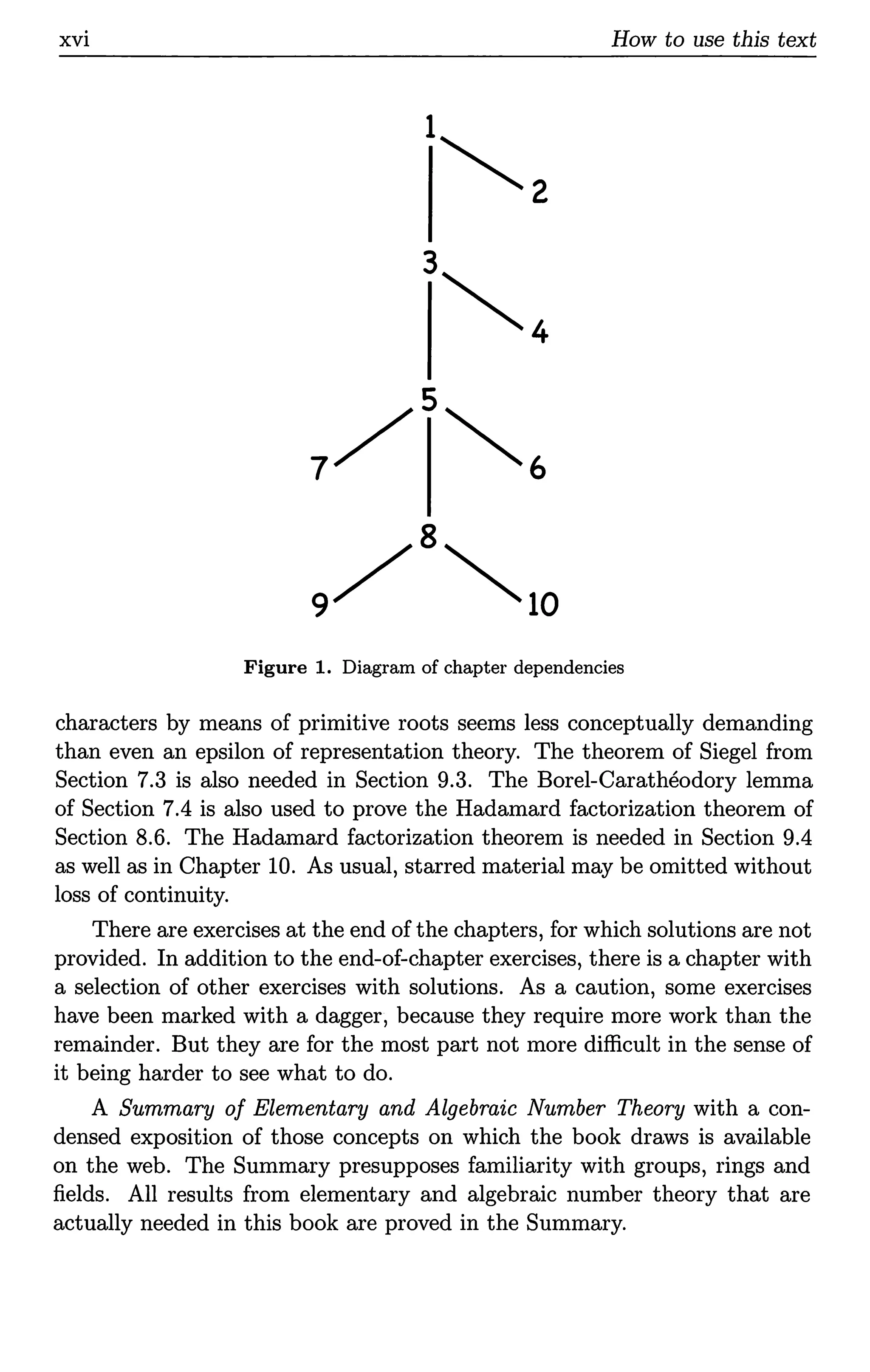
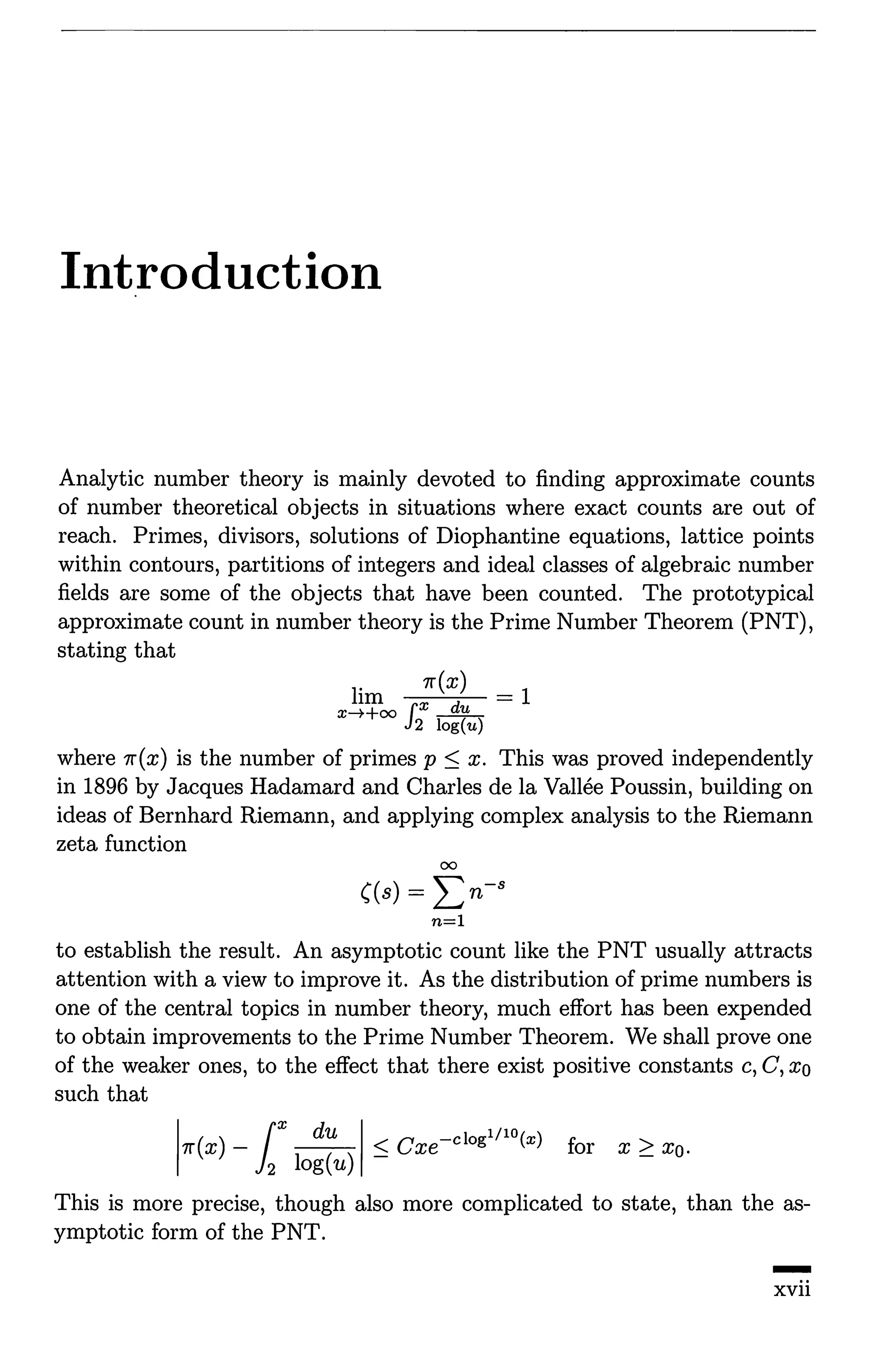
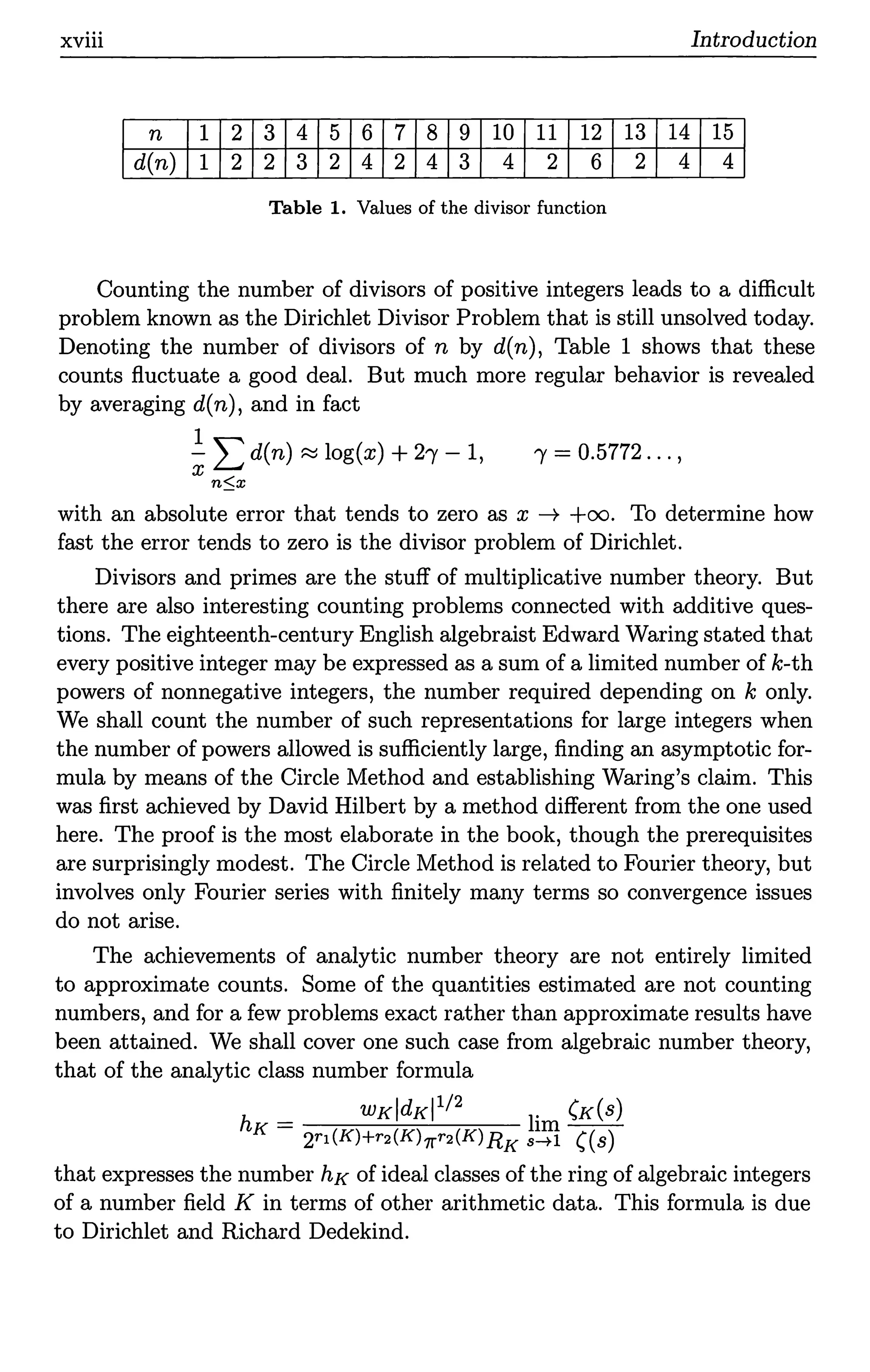
![Chapter 1
Arithmetic Functions
1.1. The method of Chebyshev
Around 1792 J. K. F. Gauss counted primes in successive blocks of a thou-
sand integers, and noticed that the sequence of primes seems to thin out
according to a definite law. One formulation of his law is that the intervals
(x - h, x] contain about h/ log(x) primes when x is large and h is not too
small. Another way to express the same empirical observation is that the
chance of a randomly chosen large integer n being prime is approximately
1/ log(n). Gauss went on to integrate this density to obtain the approxima-
tion
7r(x)~I:1~li(x)~ r ~
p~x 12 log(u)
for the counting function 7r(x) of the primes. Here li(x) is the integral loga-
rithm. By his counts of primes, Gauss guessed that limx-Hoo 7r(x)/li(x) = 1.
This is simply the statement that the relative error 17r(x) - li(x)l/7r(x) in
the approximation goes to zero as x--+ +oo. Using the notation
J(x) rv g(x) lim f(x) = 1
x-++oo g(x)
of asymptotic equality familiar from analysis, the conjecture can be ex-
pressed as 7r(x) ,..., li(x). This is the Prime Number Theorem (abbreviated
PNT) first proved by J. S. Hadamard and C. G. J. N. de la Vallee Poussin
in 1896. Since li(x) ,..., x/log(x) by l'Hopital's rule, the PNT also has the
formulation 7r(x) rv x/log(x), showing that about 1/log(x) of the positive
integers up to x are prime.
Because the density of the primes near n is approximately 1/ log(n), it
may be more natural to count each prime p with weight log(p) rather than
-1](https://image.slidesharecdn.com/2621427-250607180243-a4cd477d/75/A-Course-In-Analytic-Number-Theory-Marius-Overholt-25-2048.jpg)
![2 1. Arithmetic Functions
with weight 1. This gives the weighted counting function
'!9(x) ~ L log(p)
pSx
introduced by P. L. Chebyshev. To obtain nice formulas that are easier to
analyze, it is advantageous also to count prime powers pk with weight log(p).
The von Mangoldt function A given by A(pk) = log(p) when the argument
is a prime power, and zero otherwise, serves this purpose. The weighted
counting function
1/J(x) ~ L log(p) = L A(n)
pkSx nSx
was also introduced by Chebyshev. Since prime powers with exponent higher
than one are quite sparse, 1/J(x) mainly counts primes with weight log(p).
The functions 1/J(x) and '!9(x) are thus approximately equal, and both are
closely related to the counting function 7r(x) of the primes. In particular it
will turn out that the Prime Number Theorem may equally well be expressed
as one of the asymptotic relations 1/J(x) "' x or 19(x) "' x. These formulations
are often more convenient.
The integers n = pm in the interval 0 < n :::; N that are divisible by
a prescribed prime p are given by the integer solutions m of the inequality
0 < m :::; N/ p. The largest integer less than or equal to a real number x is
denoted by [x]. It is called the integer part of x or the Gauss bracket. Clearly
[N/p] is the number of integers n as above. The same reasoning shows that,
of these integers, exactly [N/pk] are divisible by pk. This observation allows
us to write down the prime factorization
N! = IIplN/pk]
pk
of the factorial, due to A.-M. Legendre. The product is taken over all prime
powers, but has only finitely many factors different from 1 because [N/pk] =
0 when pk > N. The importance of the identity lies in the fact that the left-
hand side does not contain the primes explicitly, and is susceptible of being
estimated analytically. Taking the logarithm on both sides of the Legendre
identity yields
L A(n) [~] = Llog(p) [~] = log(N!).
nSN ~ p
Now](https://image.slidesharecdn.com/2621427-250607180243-a4cd477d/75/A-Course-In-Analytic-Number-Theory-Marius-Overholt-26-2048.jpg)
![1.1. The method of Chebyshev
by interchanging the order of summation in the double sum. Then
L L A(n) = log(N!) = L log(n).
m$.N n$.N/m n$.N
3
Any mapping f :N ---+ C from the positive integers into the complex numbers
is called an arithmetic function. The functions A and log are examples of
arithmetic functions. Every arithmetic function f has a summatory function
F(x) = L f(n).
Thus 1/; is the summatory function of A. The .summatory function
T(x) ~ L log(n)
of log is also important. The identity
L'l/J(~) = LA(n)[~] =T(x)
m$.x n$_x
holds for nonnegative x since log(N!) = T(x) where N = [x]. This identity
is the starting point for the method of Chebyshev.
Proposition 1.1. The inequalities
log2 (x)
log(2)x - log(4x):::; 1/;(x) :S 2log(2)x + log(2)
hold for x ~ 1.
Proof. The terms in the last sum in the computation
T(x) -2r(~) = I:log(n) - 2 L log(m)
n$.x m$.x/2
= L log(n) - 2 L log(2m) + 2 L log(2)
n$.x 2m$.x 2m$.x
= I:(-1r-1 1og(n) +2[~]log(2)
n$_x
alternate in sign and increase in magnitude. So
lr(x) - 2r(~) - 2[~]1og(2)I:::; log([x])
for x ~ 1. Thus
log(2)x - log(4x):::; T(x) - 2r(~) :::; log(2)x + log(x).
Substituting the expression
T(x) = L 'l/J(~)
n$.x](https://image.slidesharecdn.com/2621427-250607180243-a4cd477d/75/A-Course-In-Analytic-Number-Theory-Marius-Overholt-27-2048.jpg)
![4 1. Arithmetic Functions
into T(x) - 2T(x/2) yields
¢(x) -¢(~) +¢(~) - ···= T(x) - 2r(~)·
Then
¢(x) ~ log(2)x - log(4x)
since ¢ is an increasing and nonnegative function, and
¢(x) - ¢(~) ::; log(2)x + log(x)
for the same reason. Adding up the inequalities
¢(~) - ¢(2i:1 ) ::; log(2)rix + log(x)
for j = 0, 1, 2, ... , [log(x)/ log(2)] - 1 yields
[log(x)] log2(x)
¢(x)::; 2log(2)x + log(2) log(x) s 2log(2)x + log(2)
since ¢(x/2i+l) = 0 when x/2i+l < 2. D
The inequalities in Proposition 1.1 and the limits log2(x)/(xlog(2)) -t 0
and log(4x)/ x -t 0 as x -t +oo imply that for every e > 0 there exists some
xo(e) so that log(2) - e < ¢(x)/x < 2log(2) + e for x ~ xo(e). Such e-
xo(e) inequalities are often expressed in a somewhat different but equivalent
way, using concepts from analysis. The limit superior limsup:r:-++oo f(x) of a
bounded real function f(x) on an interval [a, oo) is the unique real number u
such that f(x) < u+e holds for all x sufficiently large, while f(x) < u-e fails
for some x arbitrarily large, no matter how small e > 0 is taken. Similarly
the limit inferior liminfx-++oo f(x) is the unique real number l such that
f(x) > l - e holds for all x sufficiently large, while f(x) > l + e fails for
some x arbitrarily large, no matter how small e > 0 is taken. That u and l
must necessarily exist is a consequence of the completeness property of the
real number system. Define
def 1. . f ¢(x) d A def 1. ¢(x)
a= im1n -- an = imsup--.
:r:-++oo X x-++oo X
Then the e-xo(e) bounds for ¢(x)/x can be reformulated as the statement
that log(2) ::; a::; A ::; 2log(2).
The definitions of ¢ and iJ yield
00
¢(x) = L log(p) = L L log(p) = iJ(x) + iJ(xl/2) + iJ(xl/3) + ... '
pk~x k=l p~xl/k
and so
¢(x) - 2¢(xl/2) = iJ(x) - iJ(xl/2) + iJ(xl/3) - ....](https://image.slidesharecdn.com/2621427-250607180243-a4cd477d/75/A-Course-In-Analytic-Number-Theory-Marius-Overholt-28-2048.jpg)
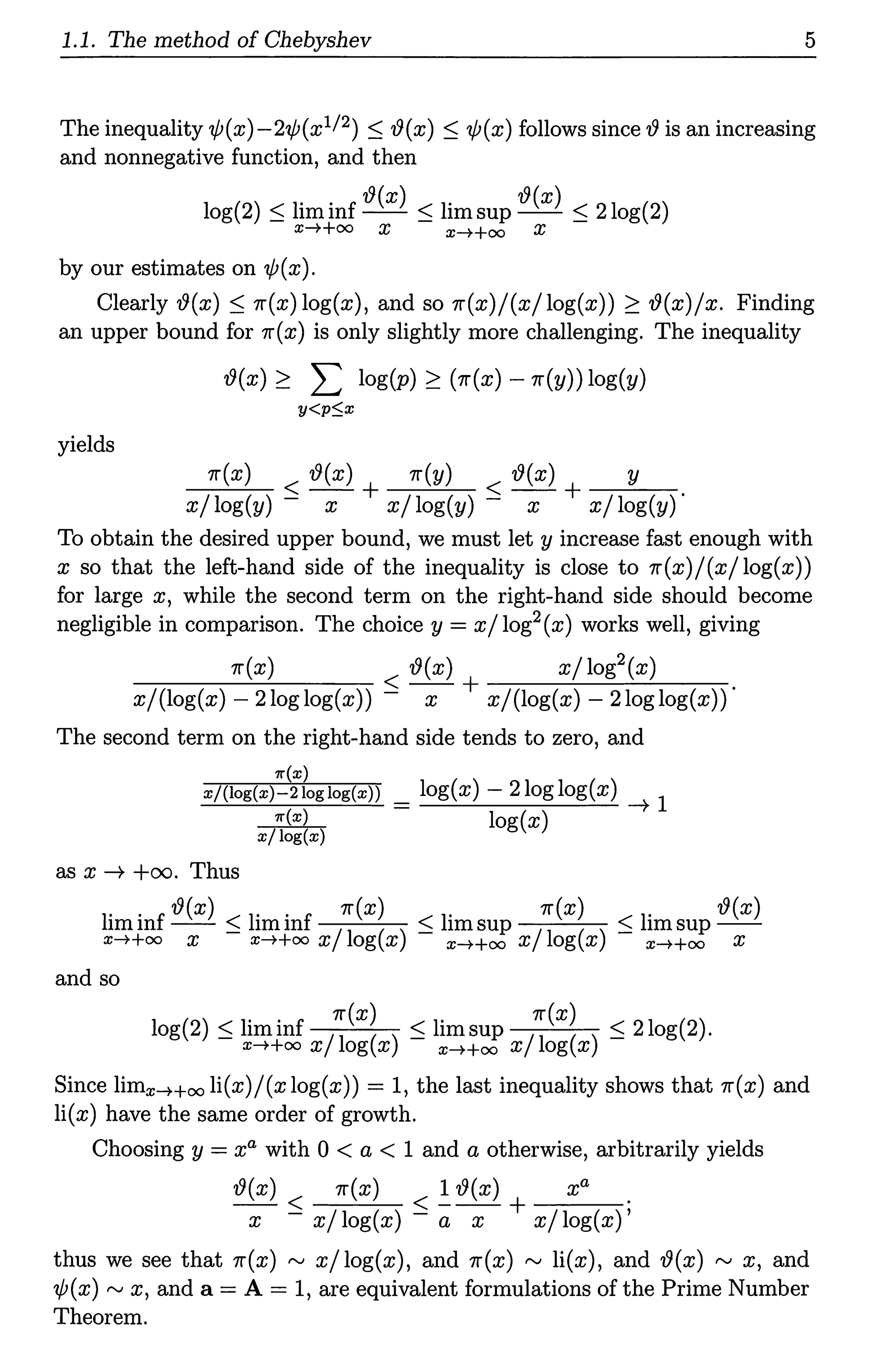
![6 1. Arithmetic Functions
1.2. Bertrand's Postulate
The method of Chebyshev does not prove the Prime Number Theorem,
but it does show that 'lf;(x) has the expected order of growth. By a more
elaborate version of his method Chebyshev obtained bounds such as .921·x S
1/J(x) s l.106·x for all x sufficiently large. He used these bounds to give the
first proof of Bertrand's Postulate. Today Bertrand's Postulate is taken as
the statement that for all x 2 2 there is at least one prime in the interval
(x/2, x]. The weaker bounds in Proposition 1.1 do not suffice to prove this
with Chebyshev's approach. But we shall obtain the result anyway using an
idea of S. A. Ramanujan.
Proposition 1.2 (Bertrand's Postulate). For every x 2 2 there exists at
least one prime p with x/2 < p S x.
Proof. For 2 s x s 797 the interval (x/2, x] contains a prime by a trick of
E. G. H. Landau: The chain 2, 3, 5, 7, 11, 17, 31, 59, 107, 211, 401, 797 consists
of primes and each is smaller than twice its predecessor. To detect primes in
the intervals (x/2, x] for x 2 797 we show that the difference '19(x) -19(x/2)
is positive.
Fetch the inequality
¢(x) - ¢(~) +¢(~) 2 T(x) - 2r(~)
from the proof of Proposition 1.1. Retention of the term 'ljJ(x/3) is an idea
due to Ramanujan. Now
with
'19(x) -19(~) 2 'ljJ(x) - 2¢(x112) - 'l/J(~)
2 T(x) - 2r(~) - ¢(~) - 2¢(x1/2)
x
2 log(2)x - log(4x) - 2log(2)"3
- log2(x/3) - 41 (2) 1/2 - 2log2(x1/2) = f( )
log(2) og x log(2) x
f( ) = log(2) _ 1 (4 ) _ 3log2(x) _ 41 (2) 1/2
x 3 x og x 2log(2) og x ,
by Proposition 1.1 and its proof. The derivative
f'(x) = log(2) _ _!. _ 3log(x) _ 2log(2)
3 x x log(2) xl/2
is an increasing function on x 2 797 since log(x)/ x is decreasing on x 2 e.
Then f'(x) > 0 on x 2 797 because !'(797) = 0.14. Thus f(x) is increasing
on this interval and hence positive there because /(797) = 1.2. D](https://image.slidesharecdn.com/2621427-250607180243-a4cd477d/75/A-Course-In-Analytic-Number-Theory-Marius-Overholt-30-2048.jpg)
![1.3. Simple estimation techniques 7
1.3. Simple estimation techniques
In analytic number theory arithmetical questions are characteristically an-
swered by finding estimates that imply the desired conclusions. The proof
of Bertrand's Postulate is typical; we wanted to know that every interval
(x/2, x] for x ~ 2 contains at least one prime, but to obtain this result we
detoured through a lower bound for fi(x) - '!?(x/2). Carrying out an esti-
mate often requires long calculations with inequalities, for which the usual
notation proves cumbersome. The big-0 notation of P. G. H. Bachmann is
well adapted for efficient calculations with long chains of inequalities. The
statement f(x) = O(g(x)) means that there exist some unspecified con-
stants C > 0 and xo such that lf(x)I ~ Cg(x) on the interval x ~ xo. The
bound 'lf;(x) ~ 2log(2)x + log2(x)/log(2) for x ~ 1 would be expressed as
'lf;(x) = O(x) in the big-0 notation. The latter statement is less precise,
but the kind of information suppressed in the big-0 notation is often unim-
portant anyway. The following result is the key to labor-saving calculations
using the big-0 notation.
Proposition 1.3. If fi(x) = O(g(x)) and h(x) = O(g(x)) then fi(x) +
h(x) = O(g(x)). If also f3(x) = O(h(x)) then fi(x)f3(x) = O(g(x)h(x)).
Proof. There are Ci,C2,C3 > 0 and xi,x2,x3 such that lfi(x)I ~ C19(x)
for x ~ x1, lh(x)I ~ C29(x) for x ~ x2 and lf3(x)I ~ C3h(x) for x ~ X3.
Then
lfi(x) +h(x)I ~ lfi(x)I + lh(x)I ~ C19(x) +C29(x) = (C1 +C2)9(x)
for x ~ max(x1, x2) and
lfi(x)f3(x)I = lfi(x)llh(x)I ~ C19(x)C3h(x) = (C1C3)9(x)h(x)
D
Note in particular that the largest of the 0-terms in a sum absorbs
everything smaller. The notation f(x) « g(x) due to I. M. Vinogradov
is synonymous with f(x) = O(g(x)). The notation f(x) ~ g(x) of G.
H. Hardy means that f(x) « g(x) and g(x) « f(x). There is also a
small-o notation due to Landau. The statement f(x) = o(g(x)) means that
limx-Hoo f(x)/g(x) = 0, or equivalently, for any e > 0 there exists some
xo(e) so that lf(x)I ~ eg(x) for x ~ xo(e).
If the function f in an estimate f = O(g) depends on one or more
parameters, say fa(x) = Oa(g(x)), the question of uniformity of the estimate
is often of considerable importance. If it is possible to choose both C and
xo in the statement that
lfa(x)I ~ Cg(x) for x ~ xo](https://image.slidesharecdn.com/2621427-250607180243-a4cd477d/75/A-Course-In-Analytic-Number-Theory-Marius-Overholt-31-2048.jpg)
![8 1. Arithmetic Functions
independently of the parameter a, then the estimate is said to be uniform in
a. Neglect of uniformity is a recognized source of error in number theoretical
arguments. The case where C is independent of a while xo depends on a in
some (unobvious) way is especially insidious; the expected inequality may
hold on some such interval for each value of a, but there may be no such
interval on which the inequality holds for all values of a.
From the next section onward, and all through the book, we frequently
encounter integrals that must be estimated. That is to say, be shown to be
small in absolute value, or at least not too big. So some remarks on this
topic are in order at this point.
Let f :I --+ C be a continuous function on some interval I ~ JR.. Consider
the problem of bounding
llf(x) dxl
from above. The inequality
11f(x) dxl S 1lf(x)I dx
is basic here, but we will briefly describe some techniques that go a little
further. Note that
11f(x) dxl S 1lf(x)I dx S 1M dx =MR(!)
if lf(x)I s M for x E /. Here f(I) denotes the length of I. An extension of
this argument yields
11f(x)g(x) dxl SM1lg(x)I dx
if lf(x)I s M for x E /. For integrals where the integrand is the product
of two functions, one of which is oscillatory, integration by parts is often
useful. We have
lbf(x)g(x) dx = f(b)G(b) - lbJ'(x)G(x) dx
assuming f continuously differentiable on [a, b] and putting
G(x) = lxg(u) du.
If g(x) oscillates on [a, b], there is a good possibility that G(x) will grow
slowly on the interval. If in addition f(x) changes fairly slowly on [a, b], its
derivative f'(x) will be small in magnitude, and integration by parts may
yield a very favorable estimate of the integral of f(x)g(x) over [a, b]. This
is a standard technique for estimating Fourier transforms.](https://image.slidesharecdn.com/2621427-250607180243-a4cd477d/75/A-Course-In-Analytic-Number-Theory-Marius-Overholt-32-2048.jpg)
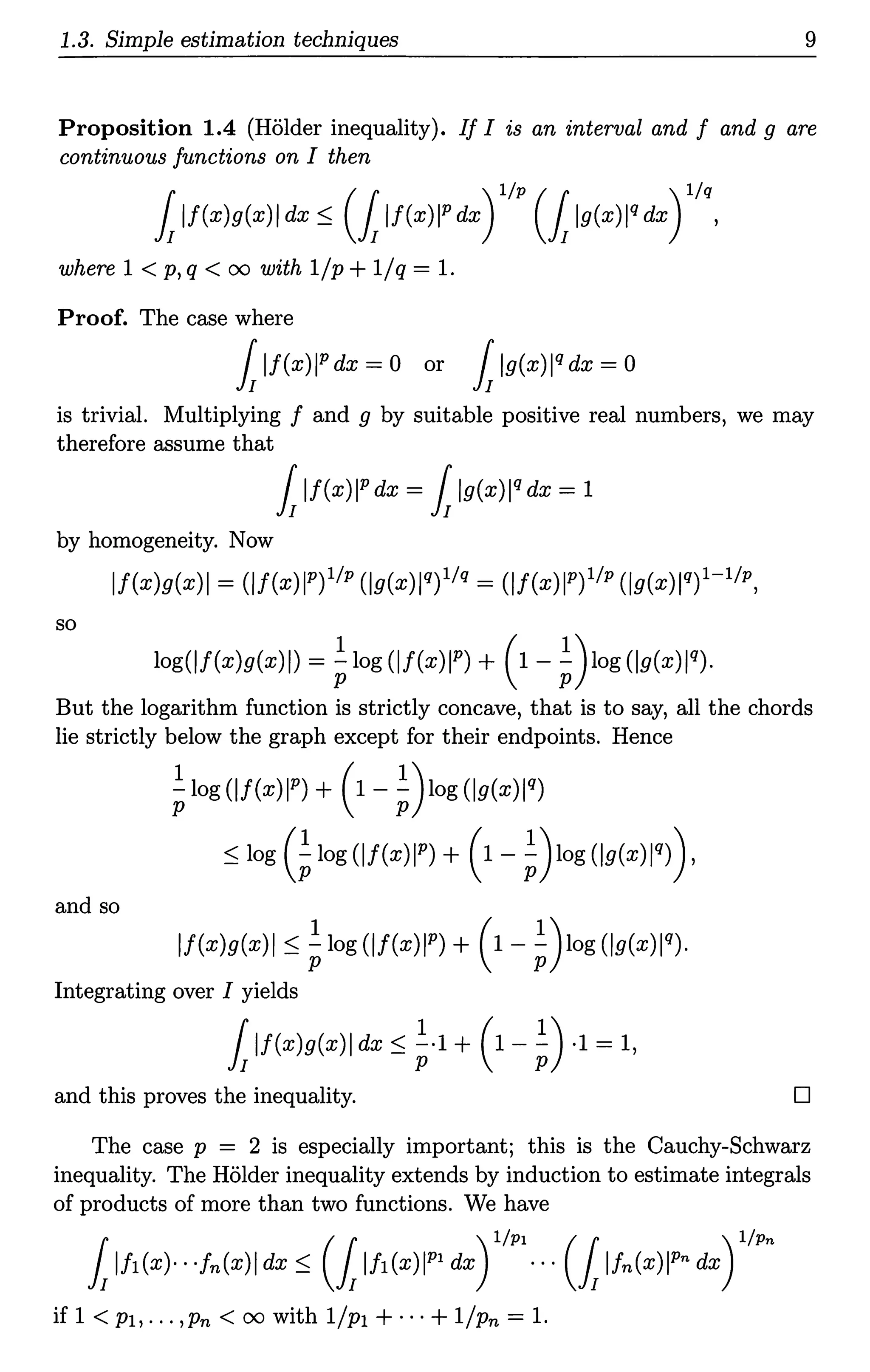
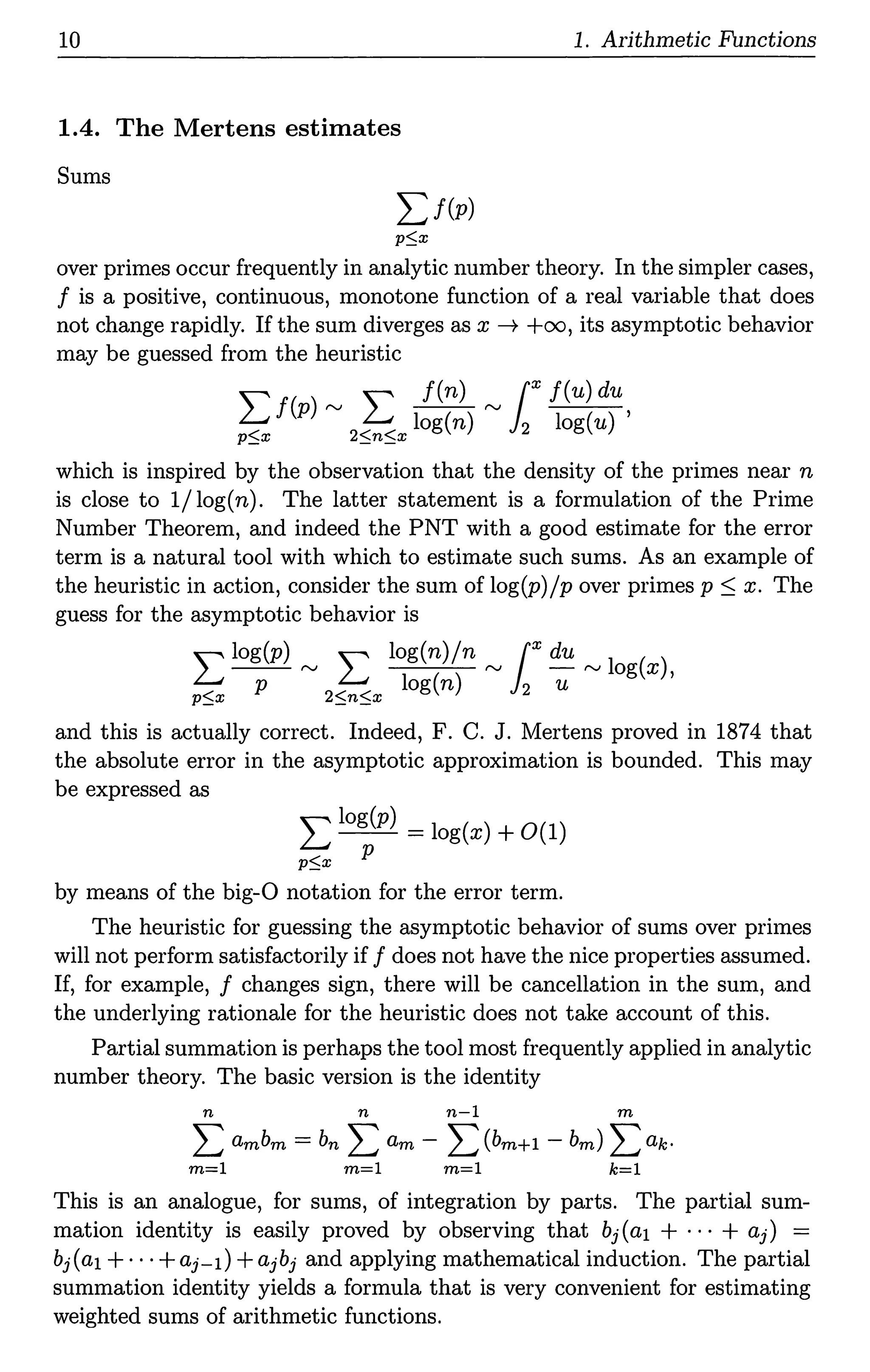
![1.4. The Mertens estimates 11
Proposition 1.5 (Partial summation). Let f be an arithmetic function
and g a continuous function with piecewise continuous derivative on [1, oo).
Then
~ f(n)g(n) = F(x)g(x) - lxF(u)g'(u) du,
where F is the summatory function off.
Proof. Calculate
[x)-1
L f(n)g(n) = F(x)g([x]) - L (g(n + 1) - g(n))F(n)
n$x n=l
[x)-1 n+l
= F(x)g([x]) - L F(n) 1 g'(u) du
n=l n
[x)-1 n+l
= F(x)g([x]) - L 1 F(u)g'(u) du
n=l n
r[x)
= F(x)g([x]) - }1
F(u)g'(u) du
by the partial summation identity and the Fundamental Theorem of Cal-
culus. Then replace [x] by x in the last step, for the resulting changes
cancel. D
The partial summation formula is best understood in terms of the Stielt-
jes integral, but we eschew this refinement. The following bound for integrals
involving the sawtooth function S(x) = x - [x] - 1/2 is sometimes useful.
Proposition 1.6. If 1 ~ a ~ b the estimate
llbS(x) dxl ~ (!+ J&)a-a
a X8 8 16CT
holds for any complex number s = CT +it with positive real part CT.
Proof. If
1 r
f3(x) = 16 +Jo S(u) du
then lf3(x)I ~ 1/16. Integration by parts gives
'l
bS(x) dxl = f3(x) lb -lb(-s) f3(x) dx ~ 2· 1/16 +lb Isl 1/16 dx
xs xs xs+l au xa+l
a a a a
= s~a - i:~ x
1
a1: ~ s~a + i:~:a'
since S(x) is piecewise continuous. D](https://image.slidesharecdn.com/2621427-250607180243-a4cd477d/75/A-Course-In-Analytic-Number-Theory-Marius-Overholt-35-2048.jpg)
![12 1. Arithmetic Functions
The last inequality yields asymptotic estimates for the summatory functions
of log(m) and 1/m. The first of these is a weak version of Stirling's formula.
Proposition 1.7. The estimates
t log(m) = nlog(n) - n +login) + 1 + R,,,
m=l
and
n 1 1
L- =log(n)+"t+-
2 +Sn
m=l m n
hold for all positive integers n with IRnl :S 3/16 and IBnl :S 3/(16n2).
Proof. The partial summation formula of Proposition 1.5 gives
n rn d
L log(m) = nlog(n) - li [u]~
m=l 1 U
1 rn du
= nlog(n) - n + 1 + 21og(n) + 11 S(u)u
when f(n) = 1 and g(x) = log(x). The last integral is bounded by 3/16
in absolute value by Proposition 1.6. Using the partial summation formula
again yields
t ~ = n·_!_ - rn[u] (-du)
m=l m n 11 u2
1 1 100
du 100
du
= 1 + log(n) + - - - - S(u)- + S(u)-.
2n 2 1 u2 n u2
The last term is bounded by 3/(16n2) by Proposition 1.6. D
The real number 'Y = 0.5772 ... is known as the Euler-Mascheroni con-
stant. It is unknown whether this is irrational. Note that Proposition 1.7
yields the version T(x) = x log(x) - x + O(log(x)) of Stirling's formula that
is most commonly applied in analytic number theory.
Proposition 1.8 (Euler-Maclaurin summation formula). If A < B are
integers and f a continuous function on the interval [A, B] with f' piecewise
continuous there, then
t f(n) = 1Bf(u) du+ f(A); f(B) +1BS(u)f'(u) du
n=A A A
with S(u) = u - [u] - 1/2 the sawtooth function.](https://image.slidesharecdn.com/2621427-250607180243-a4cd477d/75/A-Course-In-Analytic-Number-Theory-Marius-Overholt-36-2048.jpg)
![1.4. The Mertens estimates 13
Proof. Partial summation yields
B B
~ f(n) = Bf(B) -1 [u]f'(u) du
and
A A
L f(n) = Af(A) -1 [u]f'(u) du.
n=l 1
Then
B IB B
L[u]f'(u) du= uf(u) A - n~l f(n)
after taking the difference. Now
by integration by parts. Subtracting the next to last formula from the last
formula yields the Euler-Maclaurin summation formula. D
Despite the fact that anything obtainable from the Euler-Maclaurin sum-
mation formula may also be obtained by partial summation, resort to the
former is sometimes more convenient. Moreover, repeated integration by
parts in the Euler-Maclaurin summation formula yields a technique for ob-
taining precise approximations to sums. We make no use of this, so it is not
covered here.
The next two results are due to Mertens. These depend on the Cheby-
shev bound 'l/J(x) = O(x) in an essential way.
Proposition 1.9. The estimates
L log(p) = L A(n) +0(1) = log(x) +0(1)
p$x p n$x n
hold.
Proof. First
because 0 ~ x - [x] < 1. Now
T(x) = L A(m) [~]
m$x](https://image.slidesharecdn.com/2621427-250607180243-a4cd477d/75/A-Course-In-Analytic-Number-Theory-Marius-Overholt-37-2048.jpg)
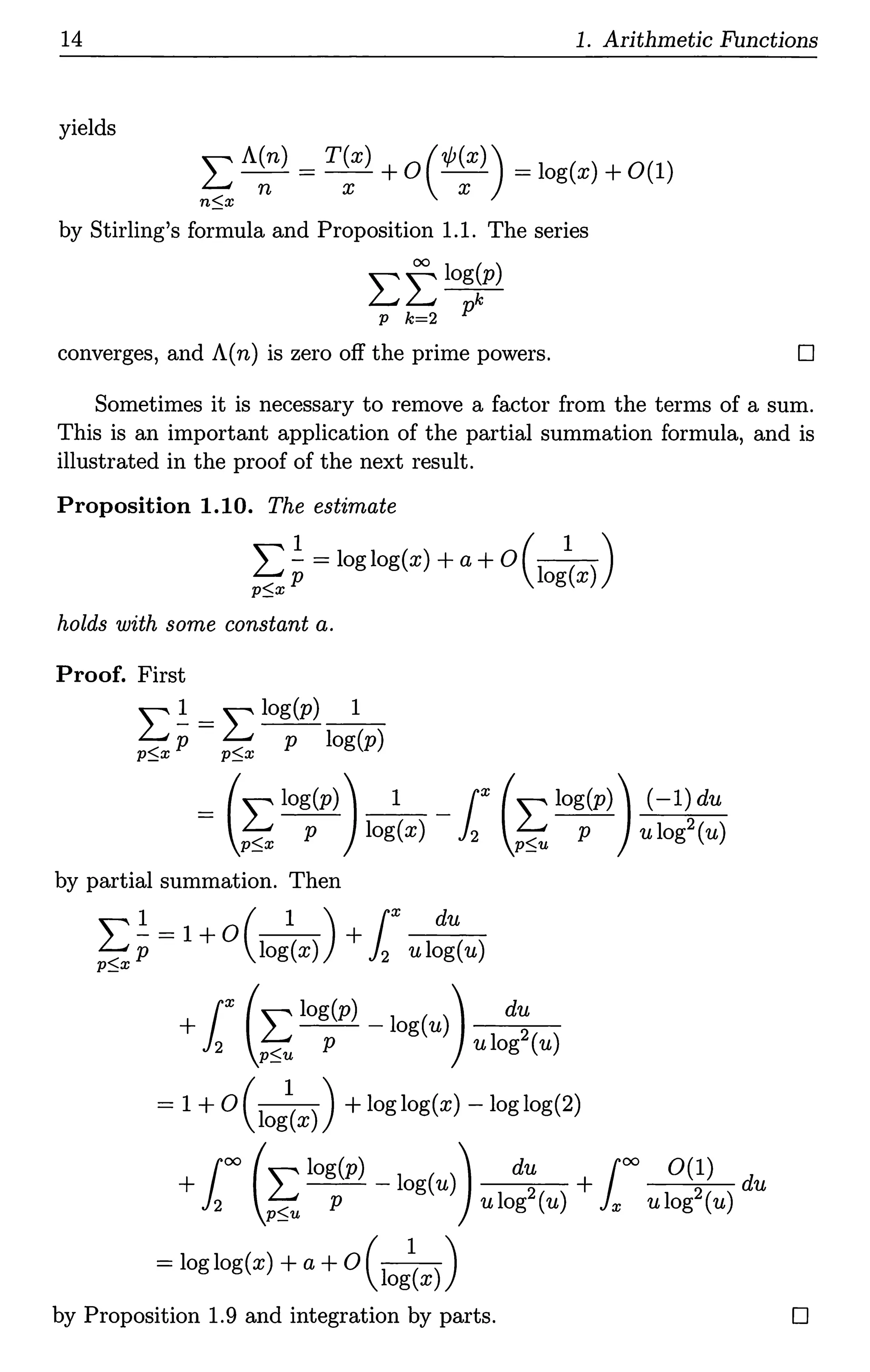
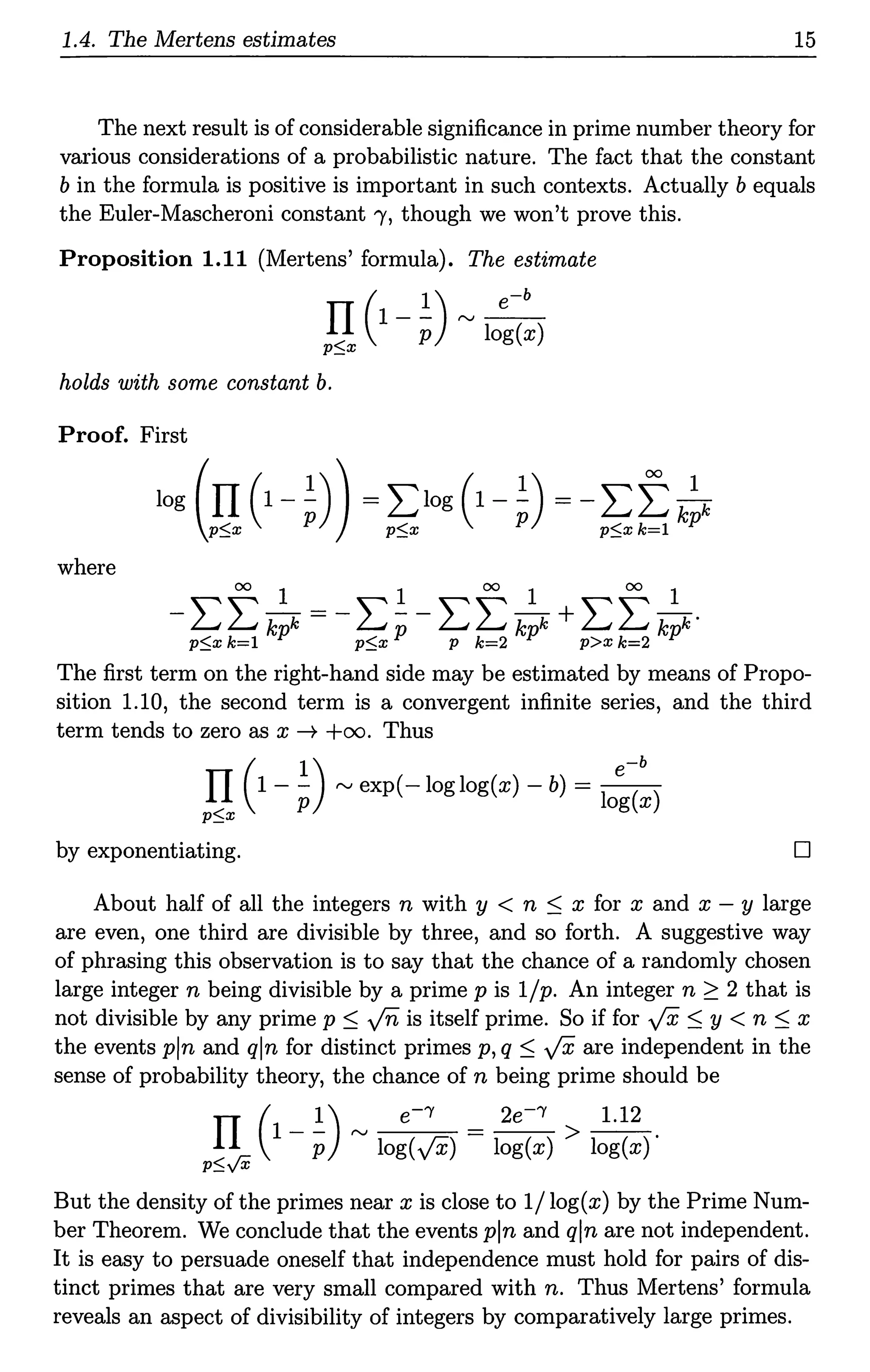
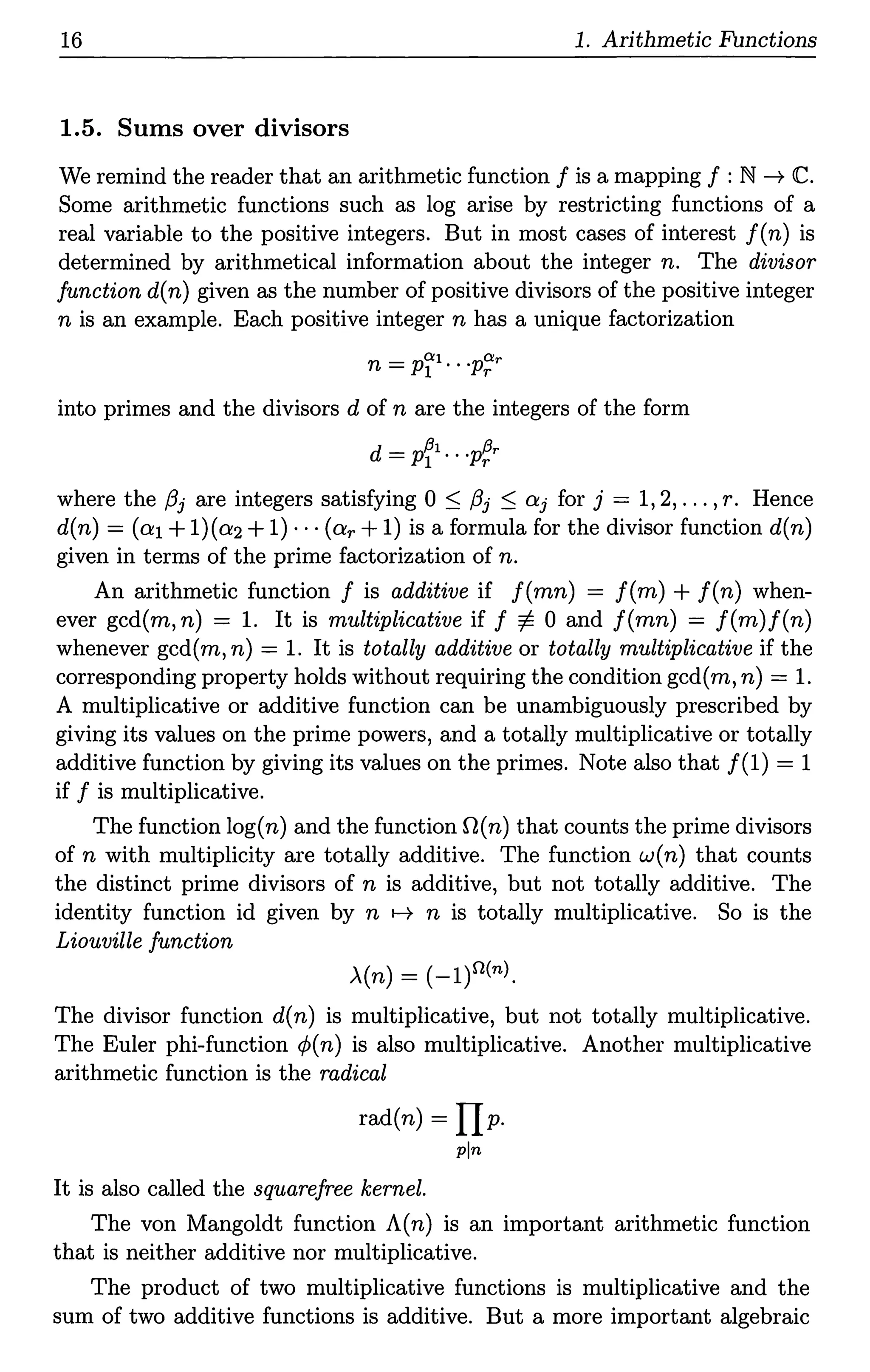
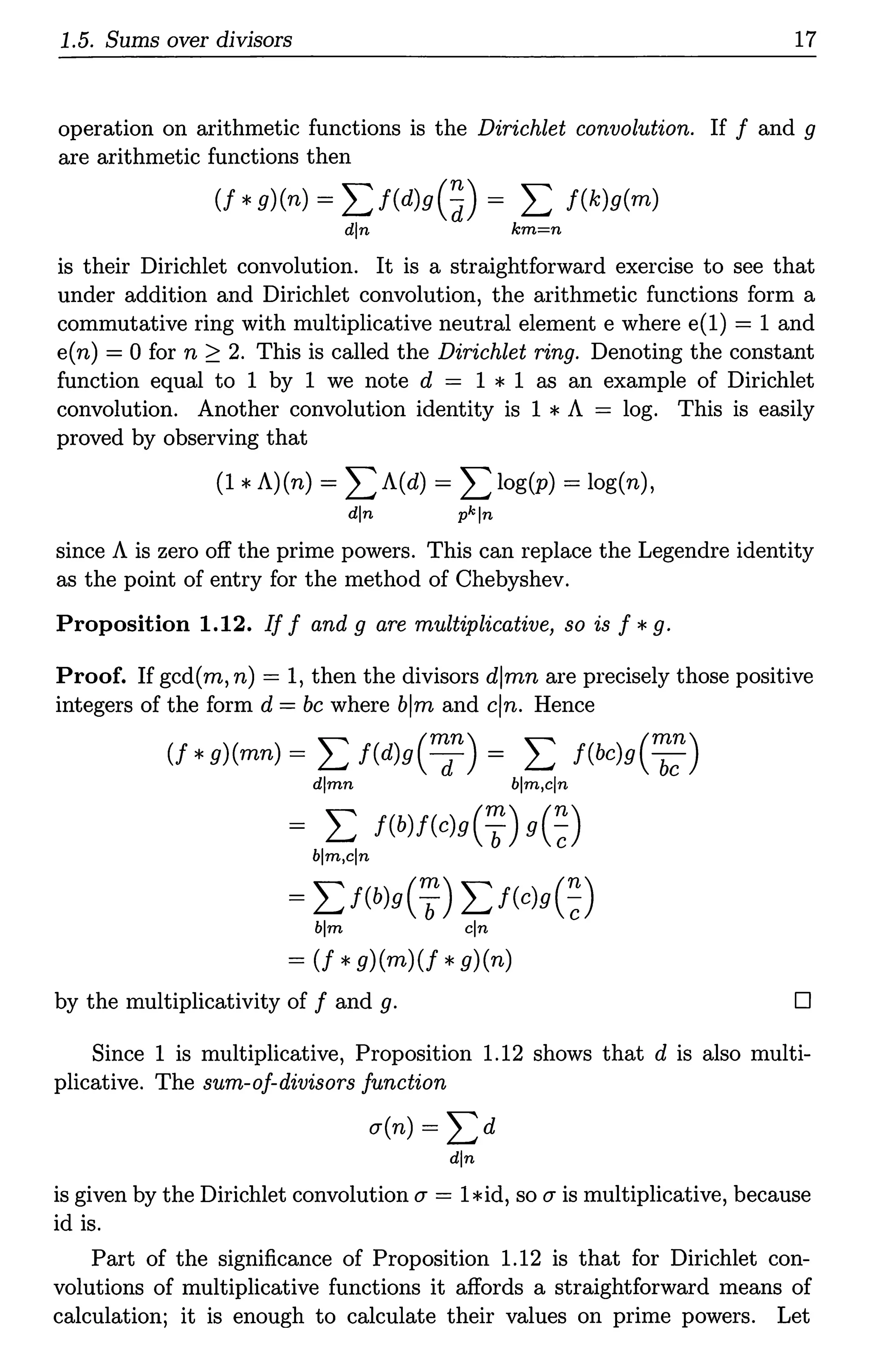
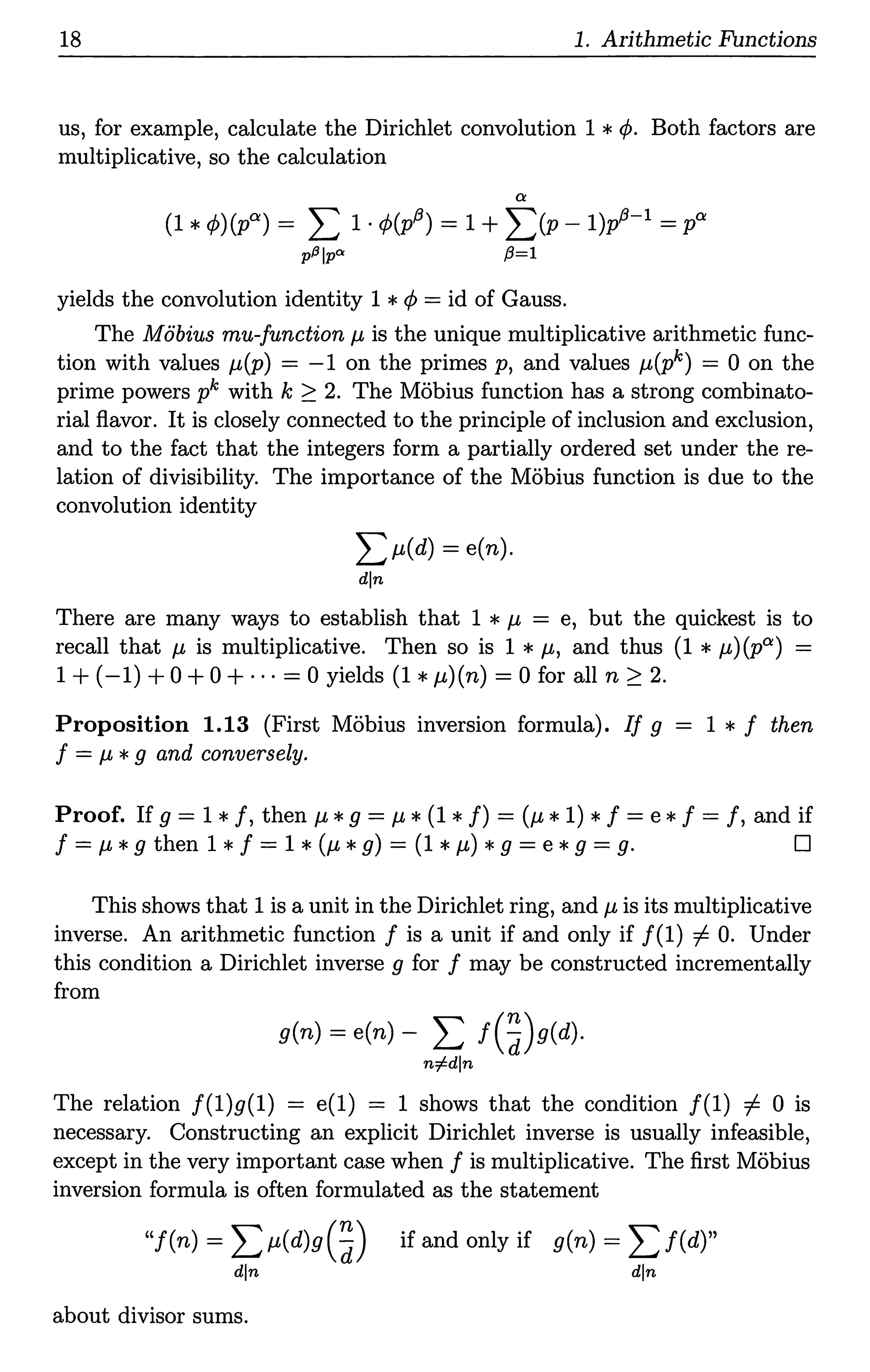
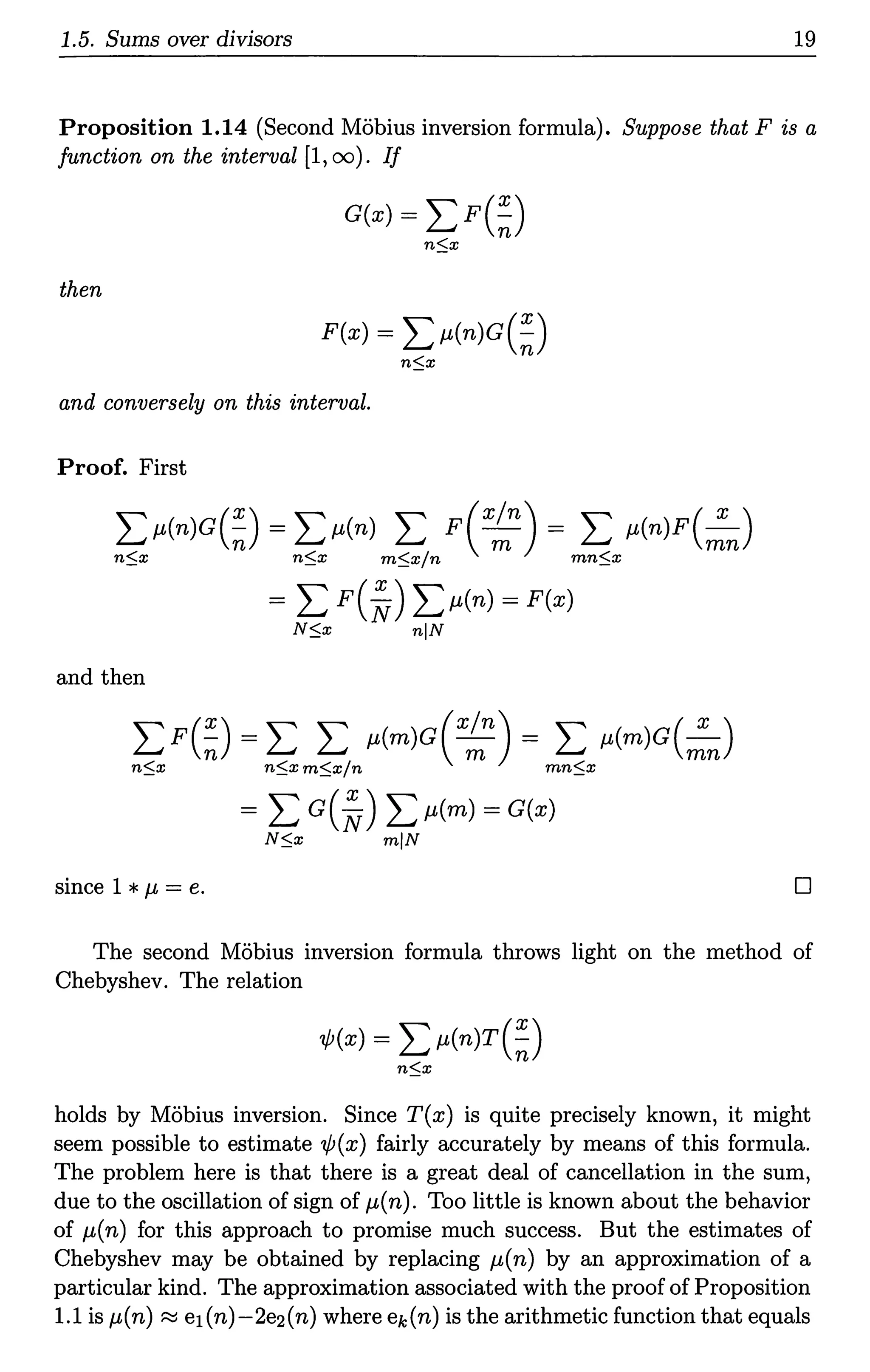
,
m::;x m::;x
and then
cI>(x) = L µ(n)~ [~] ( [~] + 1) = ~ L µ(n) (~ + 0(1)) (~ + 0(1))
n::;x n::;x
= x2 ~ µ(n) + o(x~ .!.) = x2 ~ µ(n) + o(x2 ~ _!_)
2 L.; n2 L.; n 2 L.; n2 L.; n2
n::;x n::;x n=l n>x
x2 oo µ(n)
+ O(xlog(x)) = 2 L 7 + O(xlog(x))
n=l
by the second Mobius inversion formula. Absolutely convergent series may
be multiplied together to yield absolutely convergent series, and so
(f,~2) (t.µ~~)) = t.~2 m~Nl·µ(n) = t.e~,l = 1.](https://image.slidesharecdn.com/2621427-250607180243-a4cd477d/75/A-Course-In-Analytic-Number-Theory-Marius-Overholt-44-2048.jpg)
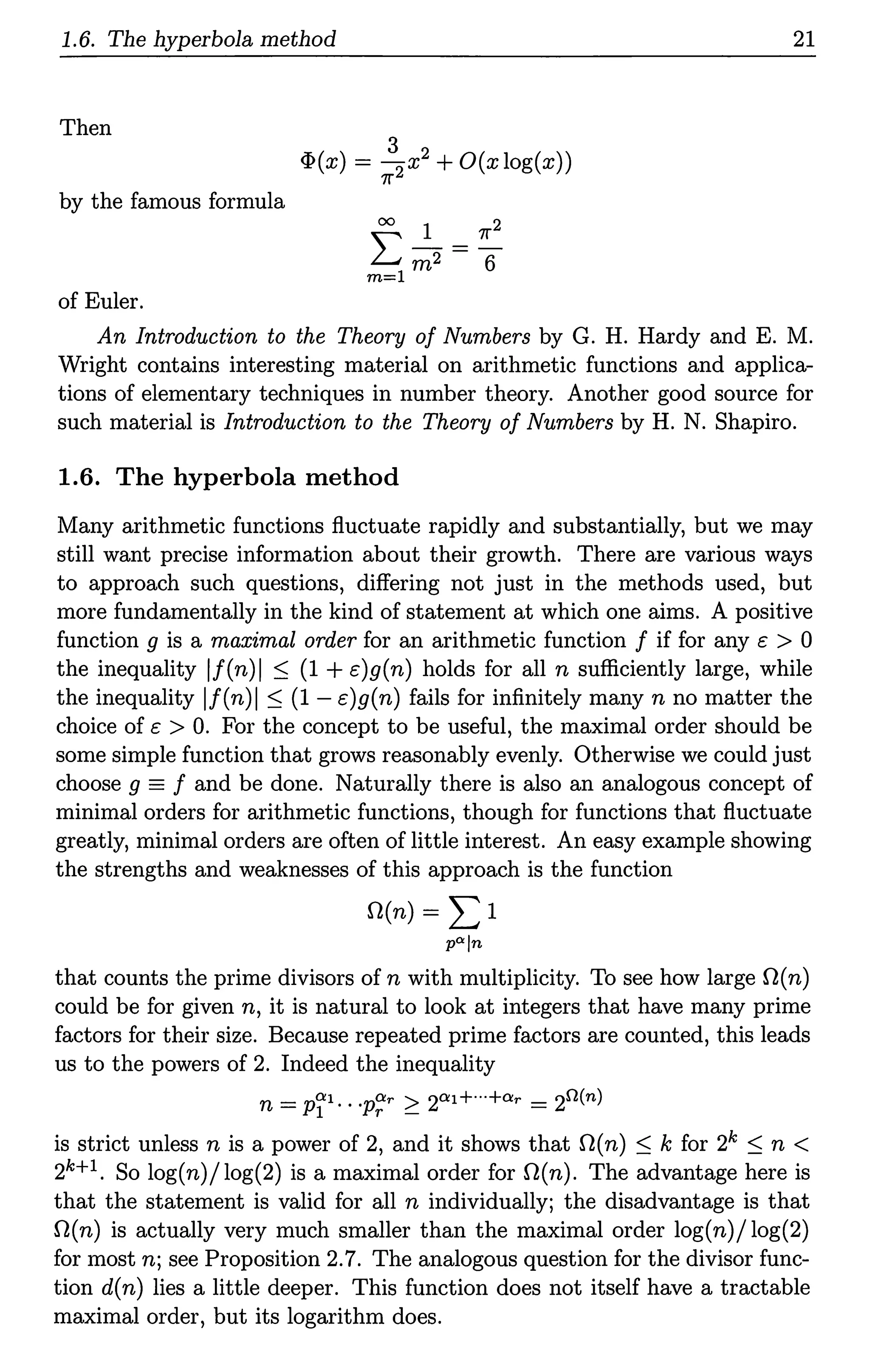
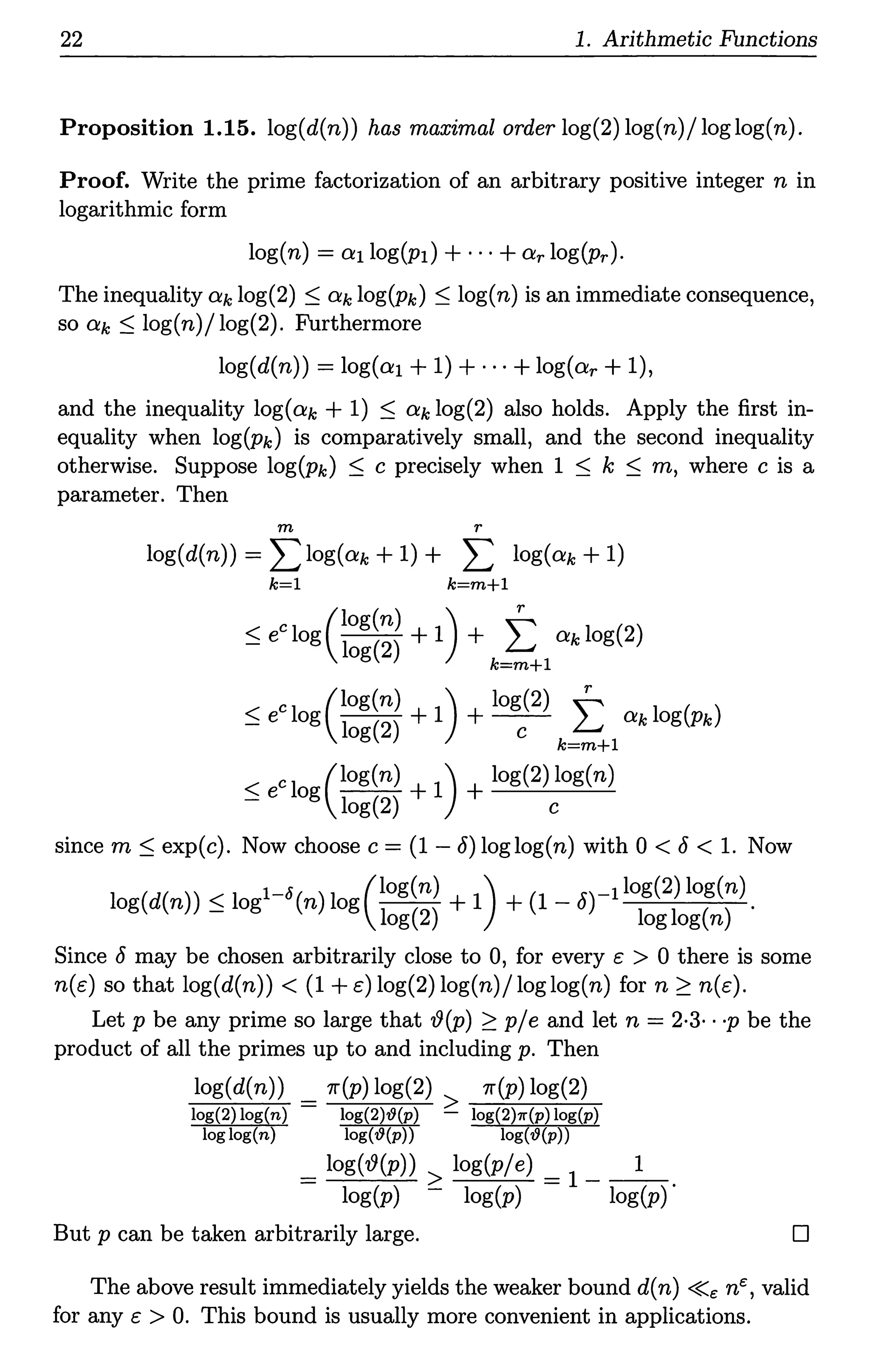
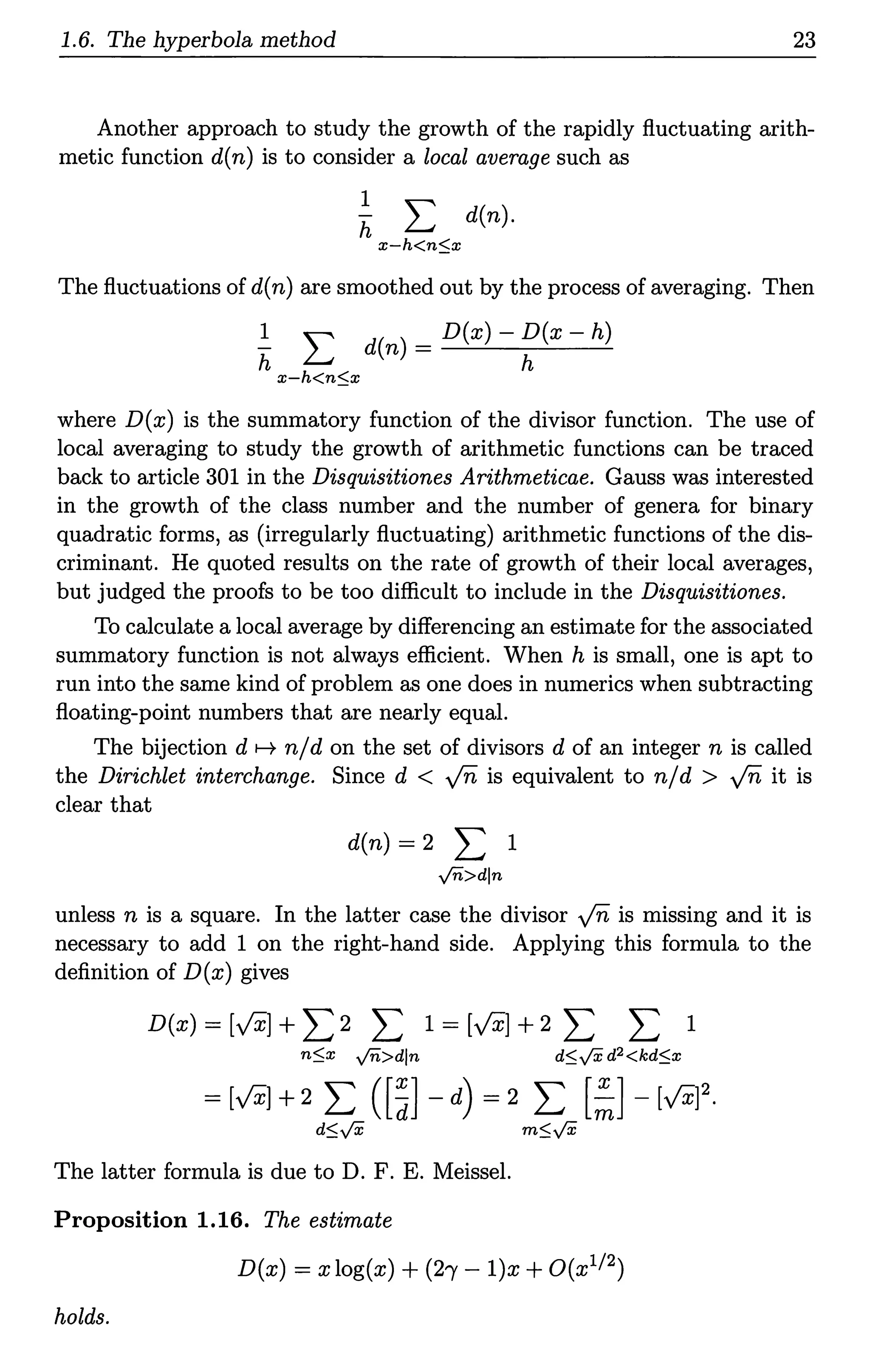
![24 1. Arithmetic Functions
Proof. We have
D(x) = 2 L [~] -[v'x]2
n::;y'X
= 2 I: (~ +0(1)) - (vx+0(1))2
n::;y'X
= 2x(log(y'X) +'Y +0(1/y'X)) - x +O(x112)
= x log(x) + (2'Y - l)x +O(x112)
by Proposition 1.7. D
This estimate is due to J. P. G. Lejeune Dirichlet. It implies that the
arithmetic average of d(n) over the range 1 ~ n ~xis asymptotic to log(x)
as x --* +oo. One says that d(n) has average order log(x). From Proposition
1.15 it is easy to see that d(n) is sometimes larger than any fixed power of
log(n). But Proposition 1.16 implies that d(n) is only rarely so large. The
notation A(x) = D(x) - x log(x) - (2'Y - l)x is traditional for the error
term in the estimate in Proposition 1.16. The problem of bounding A(x) is
known as the Dirichlet divisor problem. More precisely, the divisor problem
is to find the least {) for which an estimate A(x) = O(x19+e) holds for all
c > 0. The result just proved shows that{)~ 1/2. For x large and h rather
smaller than x, say h < x/2, one obtains
~ L d(n)=D(x)-~(x-h)
x-h<n::;x
x log(x) + (2'Y - l)x + A(x)
h
(x - h) log(x - h) + (2'Y - l)(x - h) +A(x - h)
h
(h) (xl/2)
= log(x) + 2( +0 ; +0 h
by the estimate A(x) = O(x112). The error is a sum of two terms, one of
which dominates when h is large and the other when h is small. In such
situations one would usually try to choose the parameter optimally to obtain
a small error term overall. Minimizing h/x + x112/hover h for x fixed, one
sees that h = x314 is an optimal choice. Thus
~ L d(n) = log(x) + 2( +O(x-114), h = x314 •
x-h<n::;x
The asymptotic law of growth log(x) + 2( for the local average of d(n) was
Dirichlet's main application in his 1849 paper on the divisor problem. The](https://image.slidesharecdn.com/2621427-250607180243-a4cd477d/75/A-Course-In-Analytic-Number-Theory-Marius-Overholt-48-2048.jpg)
![1.6. The hyperbola method 25
asymptotic estimate for the local average may be improved in two different
ways: By shortening the interval or reducing the error term. Modifying the
estimate as it stands by shortening the interval as much as possible, we lose
the error term and obtain the asymptotic estimate
1
h L d(n) ,...., log(x) +2')',
x-h<n$x
h = o(x112/log(x)).
Using a better estimate in the divisor problem, the estimate for the local
average may be improved both by reducing the error term and shortening
the interval.
One may also prove Proposition 1.16 from Dirichlet's formula
D(x) = L 1 = L [~] .
dk$x n$x
That D(x) = x log(x) + O(x) is immediate from this formula. The better
estimate for the error term may be obtained by observing that the sum
equals the number of integer lattice points in the region of the uv-plane
given by the inequalities u 2 1, v 2 1 and uv ~ x. One can then recover
the formula of Meissel by observing that the union of the two subregions
obtained by imposing the inequalities u ~ ft and v ~ ft equals the original
region, while their intersection equals the square given by 1 ~ u ~ ft and
1 ~ v ~ ft. The interpretation of D(x) in terms of the number of lattice
points under a hyperbola is very important for more advanced work on the
divisor problem. See Figure 2 on page 26 for an illustration.
The Dirichlet interchange and the approach to the Meissel formula based
on counting lattice points under a hyperbola are closely connected. The
technique is usually called the Dirichlet hyperbola method. It has other
applications and so we exhibit a more general formulation due to H. G.
Diamond.
Proposition 1.17 (Dirichlet hyperbola method). If f is an arithmetic func-
tion with summatory function F and g an arithmetic function with summa-
tory function G then
L:U*g)(n) =I:f(k)G(~) + I: g(m)F(~) - F(y)G(~)
n$x k$y m$x/y
for 1 ~ y ~ x.](https://image.slidesharecdn.com/2621427-250607180243-a4cd477d/75/A-Course-In-Analytic-Number-Theory-Marius-Overholt-49-2048.jpg)
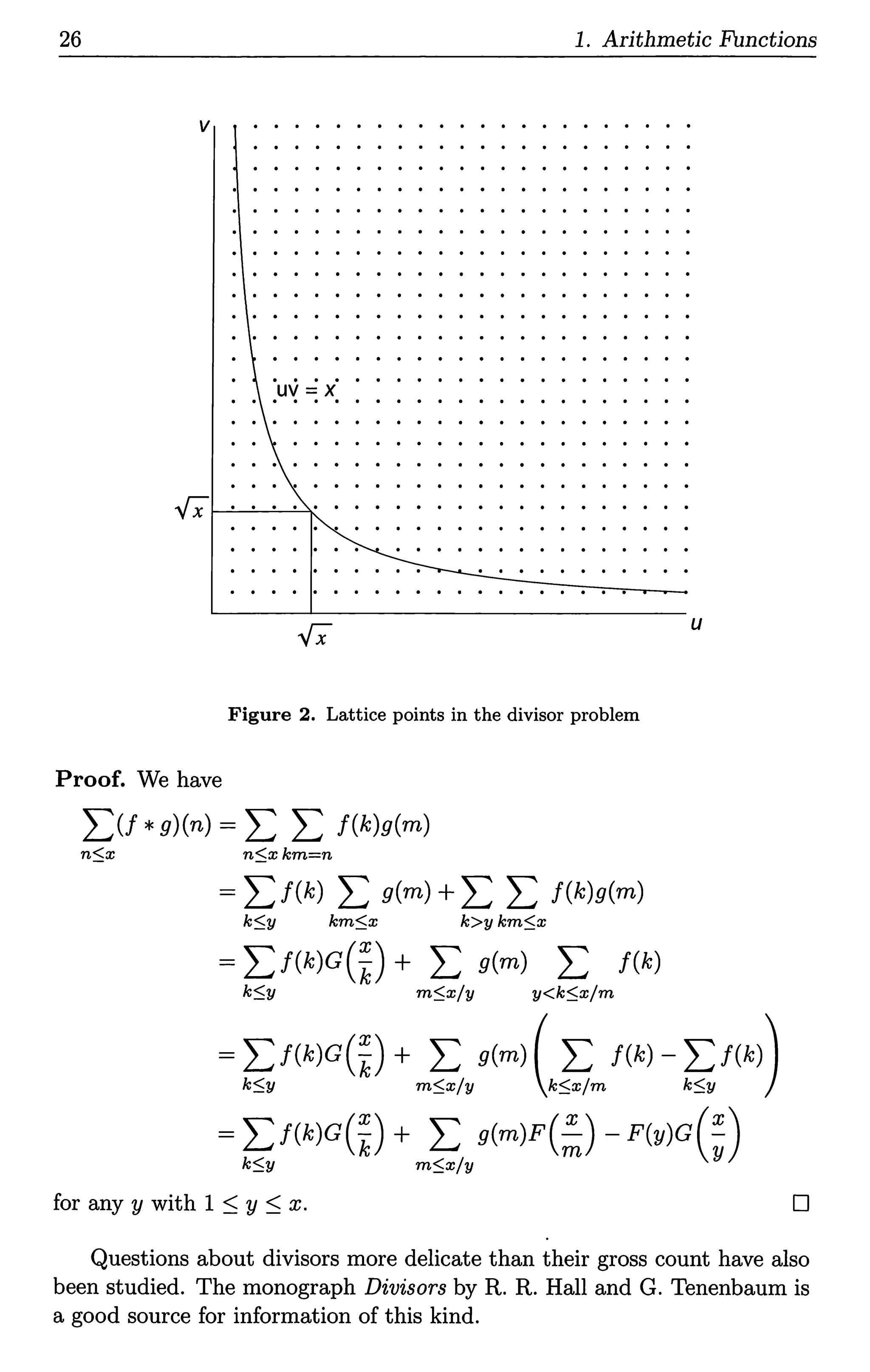
![1.7. Notes 27
Elementary Methods in the Analytic Theory of Numbers by A. 0. Gel-
fond and Y. V. Linnik is a classic that covers some of the material of this
chapter in greater depth, and other topics as well. Elementary methods in
number theory by M. B. Nathanson and Not Always Buried Deep by P. Pol-
lack also treat elementary techniques in analytic number theory. Material
of this kind may also be found in Introduction to the Theory of Numbers
by G. H. Hardy and E. M. Wright, Lectures on Elementary Number Theory
by Hans Rademacher, and Introduction to the Theory of Numbers by H. N.
Shapiro.
1.7. Notes
Gauss never published his empirical investigations on the distribution of the primes,
but these are known from a letter that he wrote on Christmas Eve of 1849 to a
former student of his, the astronomer J. F. F. Encke, and also from cryptic jottings
in his research diary and on a flyleaf of a logarithm table. See pages 444-447 of
volume II and pages 11-18 of volume X of his collected works [Gau33].
Legendre published the prime factorization of the factorial in the 1808 edition
of his treatise Essai sur la Theorie des Nombres [Leg08]. There he also proposed
x
11'(x) ~ log(x) - 1.08366
as an excellent approximation. Today it is known that li(x) is a much better
approximation for very large x, and that the asymptotically best approximation to
11'(x) ofthe form x/(log(x)-A) is obtained for A= 1. But Legendre's approximation
is better than Gauss' approximation in the interval between x = 102 and x =
4·106, which stretches beyond the range of the tables of primes available in the
early nineteenth century. Gauss makes a comment in his letter to Encke on the
approximation of Legendre, to the effect that he does not care to commit himself
as to what limit A(x) in
may tend to as x ---7 +oo.
x
11'(x)------
- log(x) - A(x)'
Legendre made yet a third discovery of great importance to the development of
prime number theory. Since antiquity an algorithm had been known for efficiently
constructing tables of primes. The algorithm is called the Sieve of Eratosthenes,
after the Hellenistic scholar Eratosthenes of Cyrene. We will explain how his al-
gorithm may be used to construct a table of primes up to 30. Start with a list of
the integers n with 2 :5 n :5 30. Keep the integer 2 but strike out all its proper
multiples. Then keep the next integer 3, but strike out all its proper multiples.
Next keep 5, but strike out all its proper multiples. The integers left in the list are
the primes 2 :5 p :5 30. For every composite integer n ::::; 30 has some prime divisor
p :5 v'30 < 5.5. Note that we obtain the primes in the interval [6, 30] by remov-
ing from the set of integers in that interval those that lie in the three arithmetic
progressions 2Z, 3Z and 5Z. Legendre reformulated the Sieve of Eratosthenes in
terms of the principle of exclusion and inclusion from combinatorics, potentially](https://image.slidesharecdn.com/2621427-250607180243-a4cd477d/75/A-Course-In-Analytic-Number-Theory-Marius-Overholt-51-2048.jpg)
![28 1. Arithmetic Functions
making it available to count primes analytically. A modern version of Legendre's
sieve formula is
rr(x) = rr(vx) -1 + Lµ(d) [SJ,
dlP
p = II p.
p~ft
Though the Legendre sieve formula gives rr(x) exactly, it is difficult to extract
strong information about the distribution of the primes from it and many years
passed before the idea of sieving had any impact on number theory beyond the
preparation of tables and other computational work. The main objective of modern
sieve theory is to find upper and lower bounds on the number of elements of a finite
set of integers remaining after those elements that lie in some prescribed arithmetic
progressions have been removed. This is such a flexible framework that a wide
variety of arithmetical problems are amenable to sieve methods to some extent.
The young French mathematician J. Merlin began making progress on sieve
theory around 1911, but he fell in the Great War. From 1915 V. Brun obtained
results on the primes by means of sieving, that were not accessible by any other
method. Since then, a vast amount of work has been done to improve sieve methods
and develop new and more powerful ones. They have had a very broad impact
on analytic number theory, leading to proofs of many important results, often in
combination with ideas from outside sieve theory. Some of the most striking results
obtained by means of sieves are:
• The series of reciprocals of primes p for which p +2 is prime, is finite or
convergent (Brun (Bru15] in 1915.)
• There are infinitely many primes p for which p +2 has at most two prime
factors (J. R. Chen (Che73] in 1966.)
• For every sufficiently large even integer n there is some prime p and some
integer m with at most two prime factors so that n = p + m (Chen
(Che73] in 1966.)
• There are infinitely many integers m for which m2 + 1 has at most two
prime factors (H. Iwaniec (Iwa78] in 1978.)
• The polynomial m2 +n4 takes infinitely many prime values (J.B. Fried-
lander and H. Iwaniec (FI98] in 1998.)
• The polynomial m3 +2n3 takes infinitely many prime values (D.R. Heath-
Brown (HBOl] in 2001.)
The first two results are related to the twin prime problem, to prove that there
are infinitely many pairs of primes that differ by 2. The third is related to the
binary Goldbach problem, asserting that every even integer n ~ 4 is the sum of
two primes, and the next two are related to the conjecture that the polynomial
m2 + 1 takes infinitely many prime values. All three problems are old, and all
are unsolved. The first of the six results above is nowadays not very difficult to
prove. Indeed M. Ram Murty and N. Saradha (MS87] discovered that even the
sieve of Eratosthenes suffices, when combined with an elementary device due to
R. A. Rankin. There is an exposition of their proof in An Introduction to Sieve
Methods and their Applications by A. C. Cojocaru and M. Ram Murty [CM06].
The proofs of the other five results are much more difficult.](https://image.slidesharecdn.com/2621427-250607180243-a4cd477d/75/A-Course-In-Analytic-Number-Theory-Marius-Overholt-52-2048.jpg)
![1.7. Notes 29
Chebyshev was the first mathematician to actually prove any results on the
distribution of the primes of the kind envisioned by Gauss and Legendre. He
published two papers on this topic, in 1848 and in 1850. In the first paper [Che48]
Chebyshev shows that the limit
lim f (7r(n + 1) - 7r(n) - - 1
1( )) logm(n)
s-tl+ n=2 og n n8
exists and is finite for any choice of the integer m. This is a weak formulation
of the statement that the density of the primes is 1/log(x). To prove this result,
he uses the Euler product formula that we shall consider in Chapter 3. He then
deduces that for any c > 0 and any integer m each of the inequalities 7r(x) >
li(x)-t:x/logm(x) and 7r(x) < li(x) +t:x/logm(x) has arbitrarily large solutions x.
Now it is immediately clear that if the ratio 7r(x)/li(x) tends to a limit, that limit
must be 1, so that then the relative error in the approximation of Gauss tends to zero
as x---+ oo. Chebyshev goes on to conclude that if we put 7r(x) = x/(log(x) -A(x))
and A(x) has a limit as x ---+ +oo, then the limit must be 1. So if there is an
asymptotically best approximation of the form 7r(x) ~ x/(log(x) - A) at all, that
must be the approximation with A = 1 rather than with A = 1.08366 as proposed by
Legendre. In his 1850 paper [Che50] Chebyshev proved an unconditional estimate
that is equivalent to 0.921-li(x) :::; 7r(x) :::; l.106·li(x) for all x sufficiently large, by a
rather more elaborate version of the method that we used to prove Proposition 1.16.
Even better upper and lower bounds were obtained by J. J. Sylvester [Syl81] using
Chebyshev's method. Long after this work Diamond and Erdos [DESO] showed by
means of the Prime Number Theorem that with sufficient calculation the method
will yield estimates c1 ·li(x) :::; 7r(x) :::; c2·li(x) with c1 and c2 arbitrarily close to 1.
The formula relating 'ljJ and T was discovered independently of Chebyshev by
A. de Polignac [dP51].
Chebyshev's proof of Bertrand's postulate in his 1850 paper [Che50] inaugu-
rated the study of the local distribution of primes. Any nontrivial bound for the
error term in the Prime Number Theorem implies existence of primes in short inter-
vals. How short one can take the intervals by this approach depends on the quality
of the bound on the error term in the PNT. However, in 1930 G. Hoheisel [Hoh30]
by means of a different, analytic kind of argument succeeded in proving that the
interval (x - x9, x] contains a prime for all x sufficiently large, with the exponent
0 = 1 - 1/33000. Even today, a bound for the error term in the Prime Number
Theorem strong enough to allow this conclusion is not known. The exponent 0
was gradually reduced over the years, by H. A. Heilbronn [Hei33] (0 = 0.996 in
1933), N. G. Chudakov [Chu36] (0 = 3/4 + t: in 1936), A. E. Ingham [Ing37]
(0 = 5/8 + t: in 1937), H. L. Montgomery [Mon71] (0 = 3/5 + c in 1971), M. N.
Huxley [Hux72] (0 = 7/12+t: in 1972), H. Iwaniec and M. Jutila [IJ79] (0 = 13/23
in 1979), Heath-Brown and lwaniec [HBI79] (0 = 11/20 in 1979), J. Pintz [Pin84]
(0 = 17/31-c for some small computable c > 0 in 1984), lwaniec and Pintz [IP84]
(0 = 23/42 in 1984), C. J. Mozzochi [Moz86] (0 = 11/20 - 1/384 in 1986), S. T.
Lou and Q. Yao [LY92, LY93] (0 = 6/11 in 1992 and 0 = 6/11 in 1993), R. C.
Baker and G. Harman [BH96] (0 = .535 in 1996), and Baker, Harman and Pintz
[BHPOl] (0 = 0.525 in 2001.) There are heuristic arguments in favor of stronger
conclusions. See page 422 of Multiplicative Number Theory I. Classical Theory by](https://image.slidesharecdn.com/2621427-250607180243-a4cd477d/75/A-Course-In-Analytic-Number-Theory-Marius-Overholt-53-2048.jpg)
![30 1. Arithmetic Functions
H L. Montgomery and R. C. Vaughan [MV07], where the possibility that(}= c
with c > 0 arbitrary is discussed. Also see the paper [Gon93] by S. M. Gonek. An
even stronger conclusion follows if one accepts a probabilistic model of the distribu-
tion of the primes originated by H. Cramer [Cra36], and modified by A. Granville
[Gra95] after work of H. Maier [Mai85]. This indicates that there should be some
constant C > 2e-'Y such that the interval (x - C log2 ( x), xJ contains a prime for all
x sufficiently large, and that possibly any C > 2e-'Y will do.
Defining dk = Pk+l - Pk one may, in view of the above considerations, ask
how large dk can become, say in terms of Pk· It is an immediate consequence of
the Prime Number Theorem that lim supk--t+oo dk/ log(pk) ~ c with c = 1. R. J.
Backlund [Bac29] showed in 1929 that one can take c = 2, and A. T. Brauer and
H. Zeitz [BZ30] achieved c = 4 the year after. E. Westzynthius [Wes31] proved in
1933 that
l. dk > 2 'Y
1msup _ e ,
k-t+oo log(pk) log3 (Pk)
log4 (Pk)
where logm(x) denotes them times iterated logarithm. This was improved to
l. ~ 0
1msup >
k-t+oo log(pk) log3(pk)
by G. Ricci [Ric34]. Further progress was made by Erdos [Erd35], who showed
that
l. dk 0
1msup 1 ( ) 1 ( ) > ,
k-t+oo og Pk oga Pk
(log3(pk))2
and by Rankin [Ran38], who showed in 1938 that
l. dk
1msup ~ c
k-t+oo log(pk) log2 (Pk) log4 (Pk)
(log3(Pk))2
with c = 1/3. Since then, only improvements in the constant c have been obtained,
by A. Schonhage [Sch63], (c = e'Y0 / 2 in 1963), Rankin [Ran63], (c = e'Y0 in 1963),
H. Maier and C. B. Pomerance [MP90], (c = 1.312...e'Y0 in 1990), and Pintz
[Pin97], (c = 2e'Y0 in 1997.)
The question of how small dk can be in the long run is also of interest. If
there are infinitely many twin primes, then dk = 2 infinitely often. Defining E =
lim infn-too dk/ log(pk), it is again an immediate consequence of the Prime Number
Theorem that E ::S 1. Upper bounds for E were obtained by Erdos [Erd40] (E <
1 - c for some small computable c > 0 in 1940), Rankin [Ran50] (E ::S 42/43 in
1950), Ricci [Ric54a] (E ::S 15/16 in 1954), E. Bombieri and H. Davenport [BD66]
(E ::S (2 + -/3)/8 in 1966), G. Z. Pil'tjai [Pil72] (E ::S (21'2-1)/4 in 1972), Huxley
[Hux73, Hux77, Hux84] (E ::S 1/4+rr/16 in 1973, E ::S 0.4425 ... in 1977 and
E ::S 0.4393 ... in 1984), E. Fouvry and F. Grupp [FG86] (E ::S 0.4342 ... in 1986),
H. Maier [Mai88] (E ::S 0.2484 ... in 1988) and finally D. A. Goldston, J. Pintz
and C. Y. Yddmm [GPY09] (E = 0 in 2005.) Recently Y. Zhang [Zha14] proved
that dk ::S 70·106 infinitely often, which was a great advance. In work to appear
in Annals of Mathematics, J. Maynard has shown that Pk+m - Pk ::S Cm infinitely
often for each positive integer m, with c1 = 600 admissible.](https://image.slidesharecdn.com/2621427-250607180243-a4cd477d/75/A-Course-In-Analytic-Number-Theory-Marius-Overholt-54-2048.jpg)

![She had almost to imagine the words—so gentle was the voice that
went with those lightly-touched chords—
'The sun rase sae rosy, the gray hills adorning,
Light sprang the laverock, and mounted on hie,
When true to the tryst o' blythe May's dewy morning,
Jeanie cam' linking out owre the green lea.
To mark her impatience I crap 'mong the brackens,
Aft, aft to the kent gate she turned her black e'e;
Then lying down dowilie, sighed, by the willow tree,
"I am asleep, do not waken me."'[#]
[#] 'I am asleep, do not waken me' is the English equivalent of the Gaelic name of
the air, which is a very old one, and equally pathetic in its Irish and Highland
versions.
Then there was silence. The little Maggie waited; for this song was a
great favourite with Ronald, who himself sometimes attempted it;
and she would be able to tell him when she got home that she had
heard Meenie sing it—and he always listened with interest to
anything, even the smallest particulars, she could tell him about
Meenie and about what she had done or said. But where were the
other verses? She waited and listened; the silence was unbroken.
And so she tapped lightly at the door and entered.
And then something strange happened. For when Maggie shut
the door behind her and went forward, Meenie did not at once turn
her head to see who this was, but had hastily whipped out her
handkerchief and passed it over her eyes. And when she did turn, it](https://image.slidesharecdn.com/2621427-250607180243-a4cd477d/75/A-Course-In-Analytic-Number-Theory-Marius-Overholt-73-2048.jpg)