

















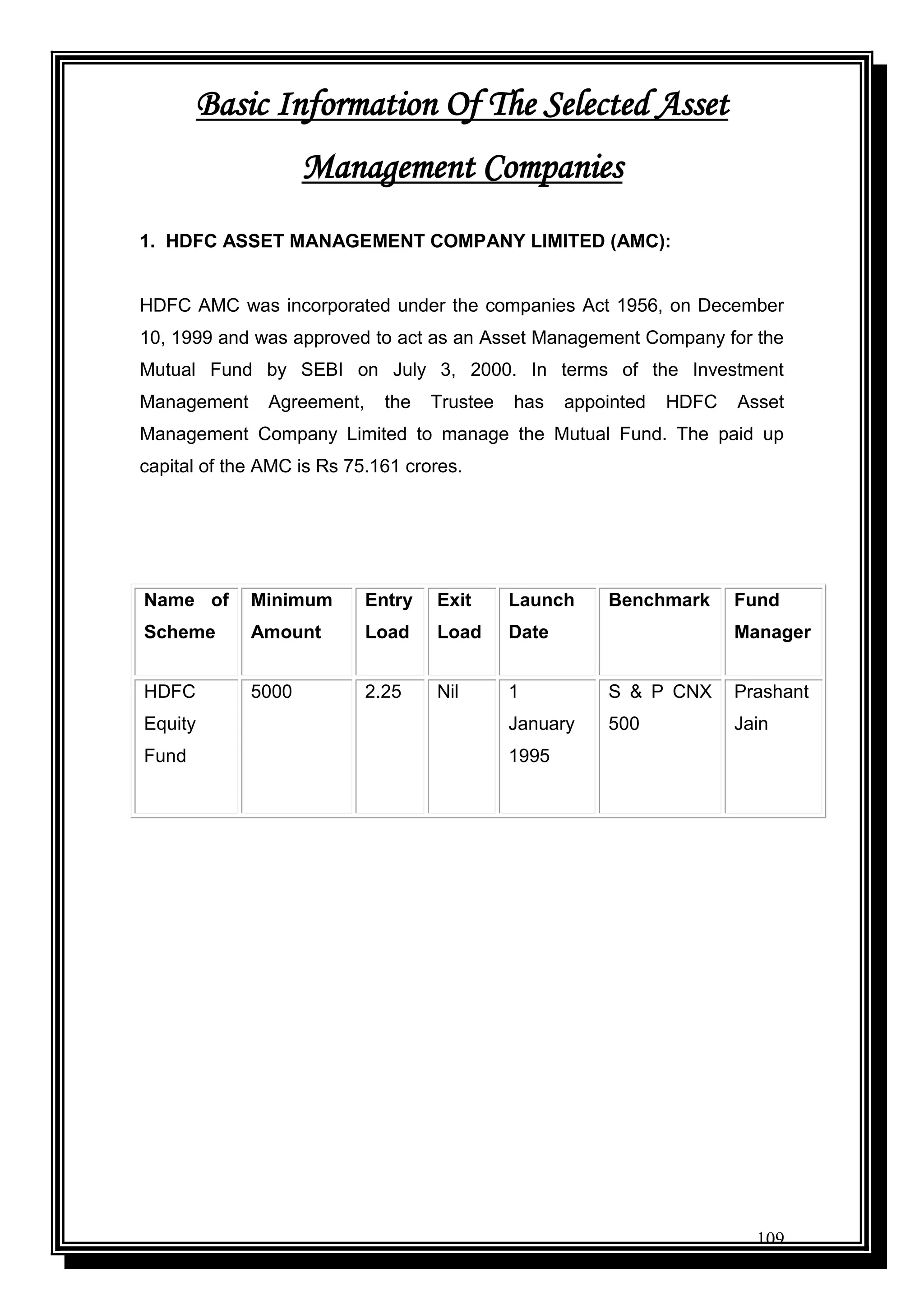
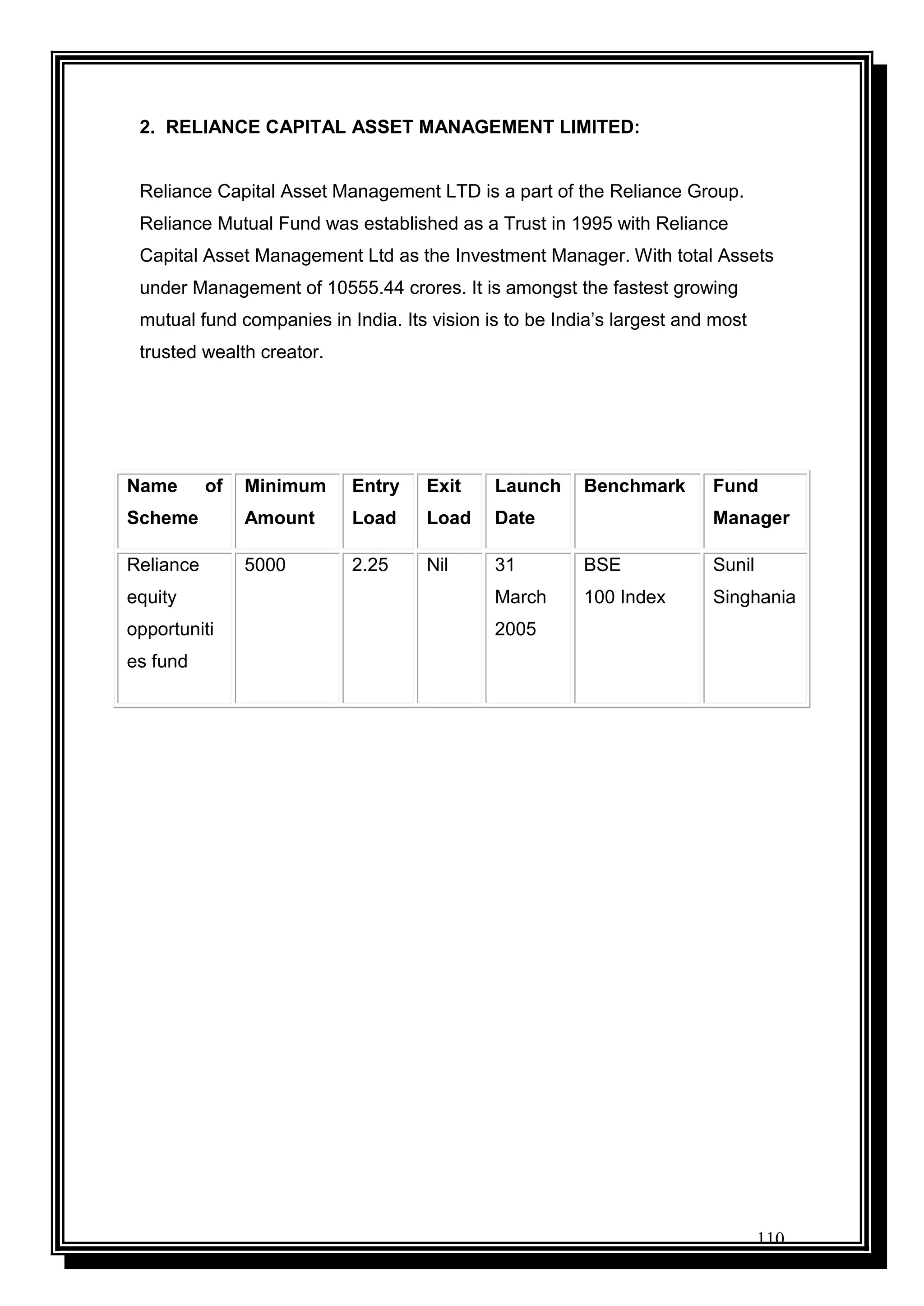
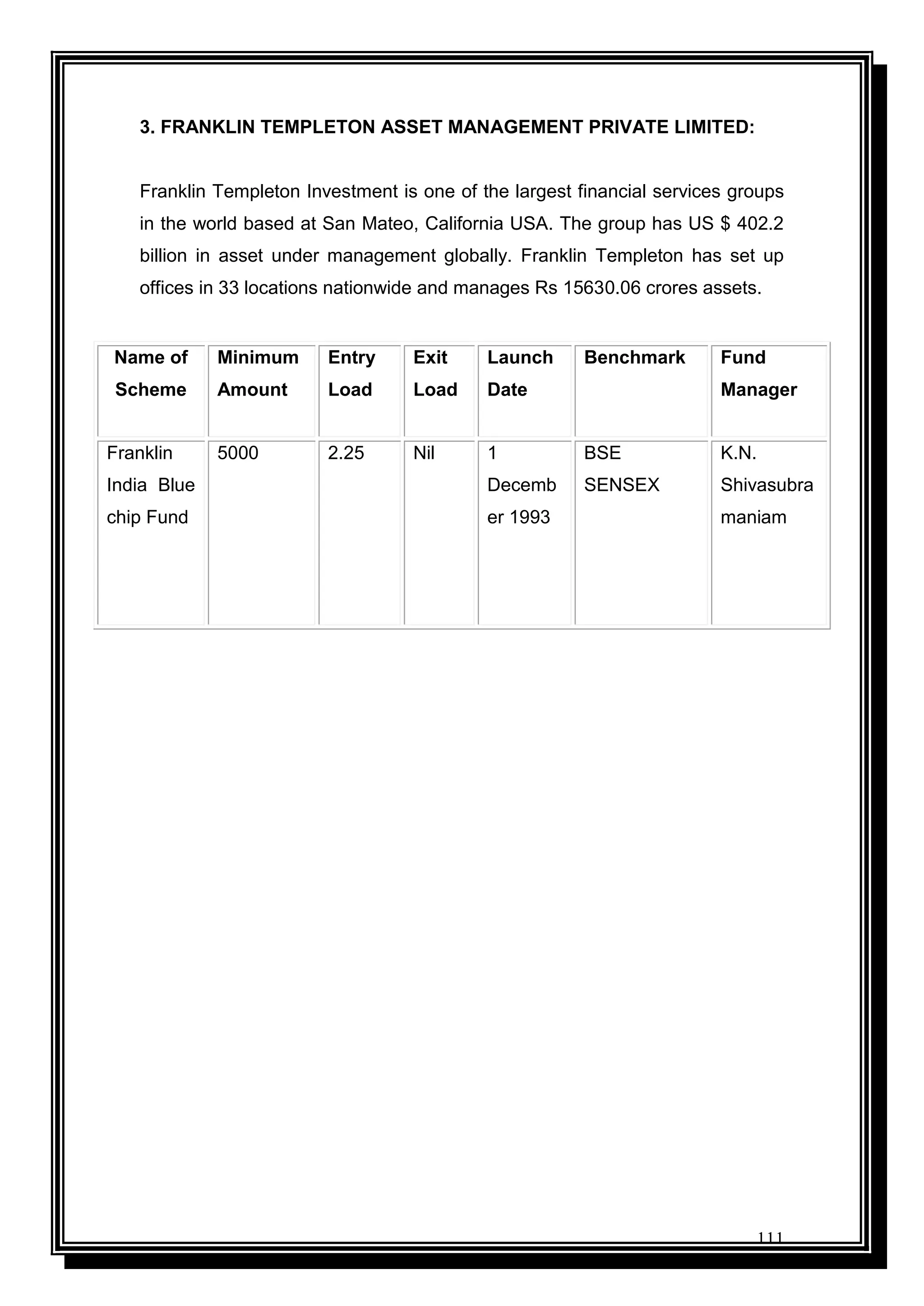
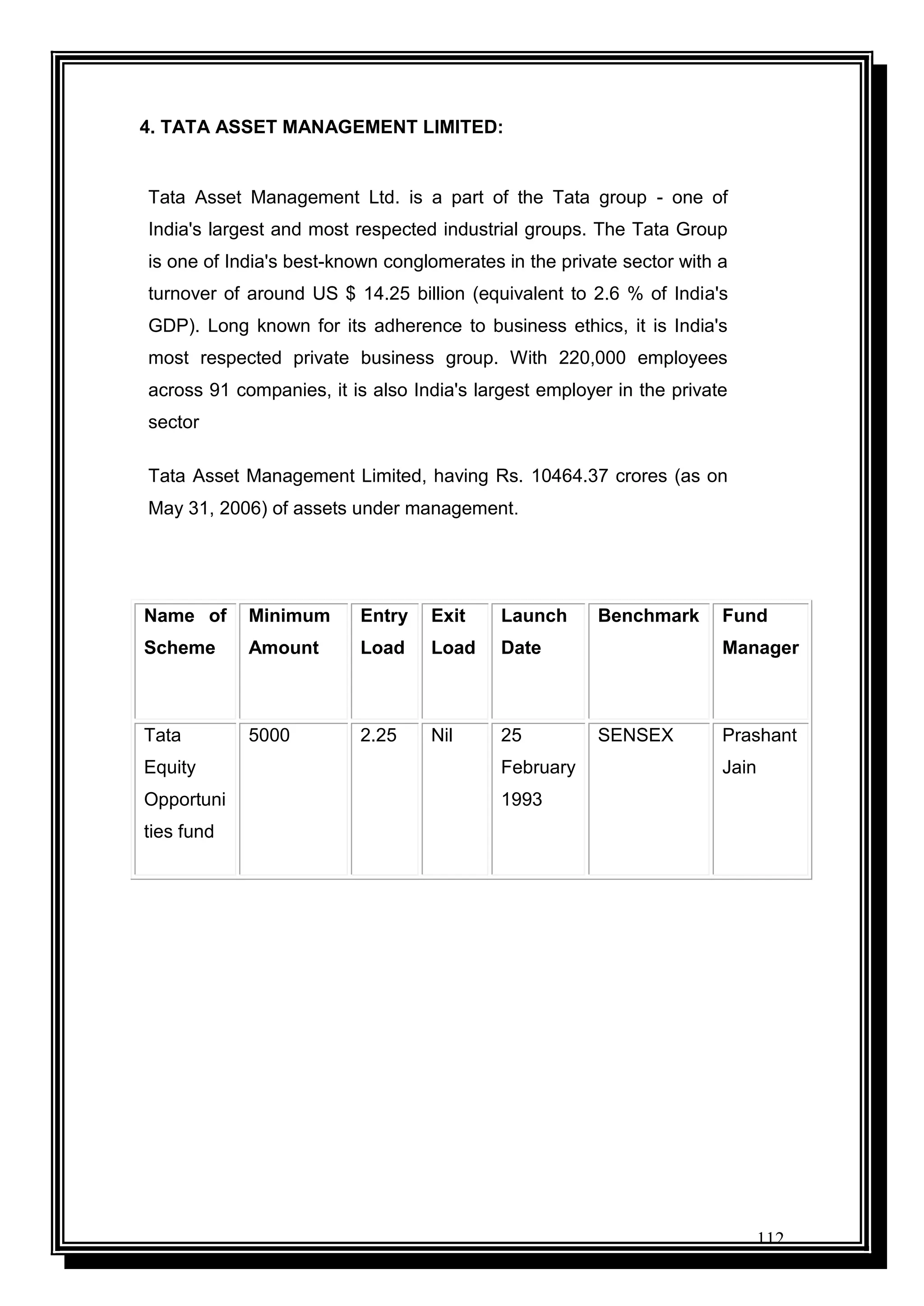
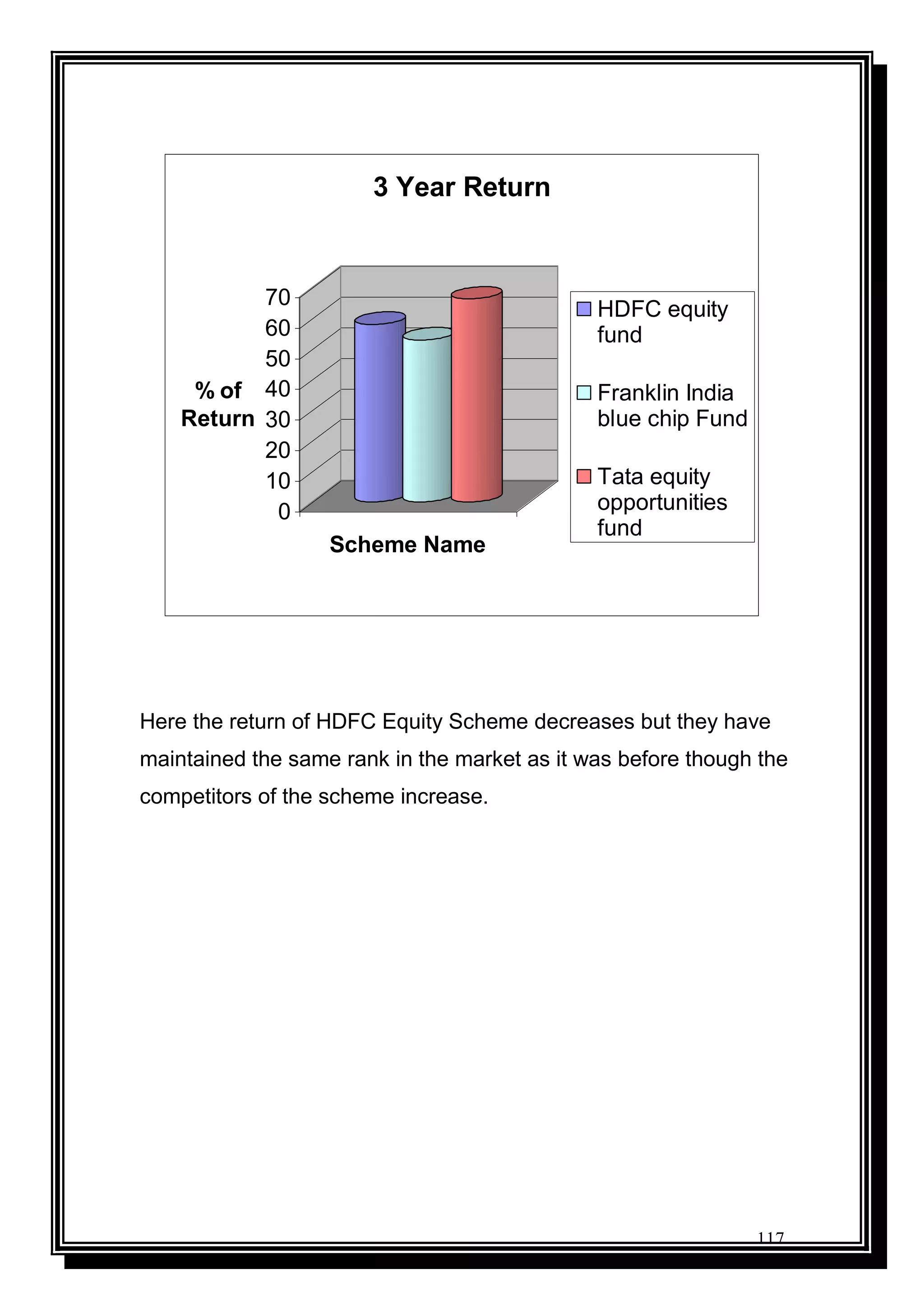
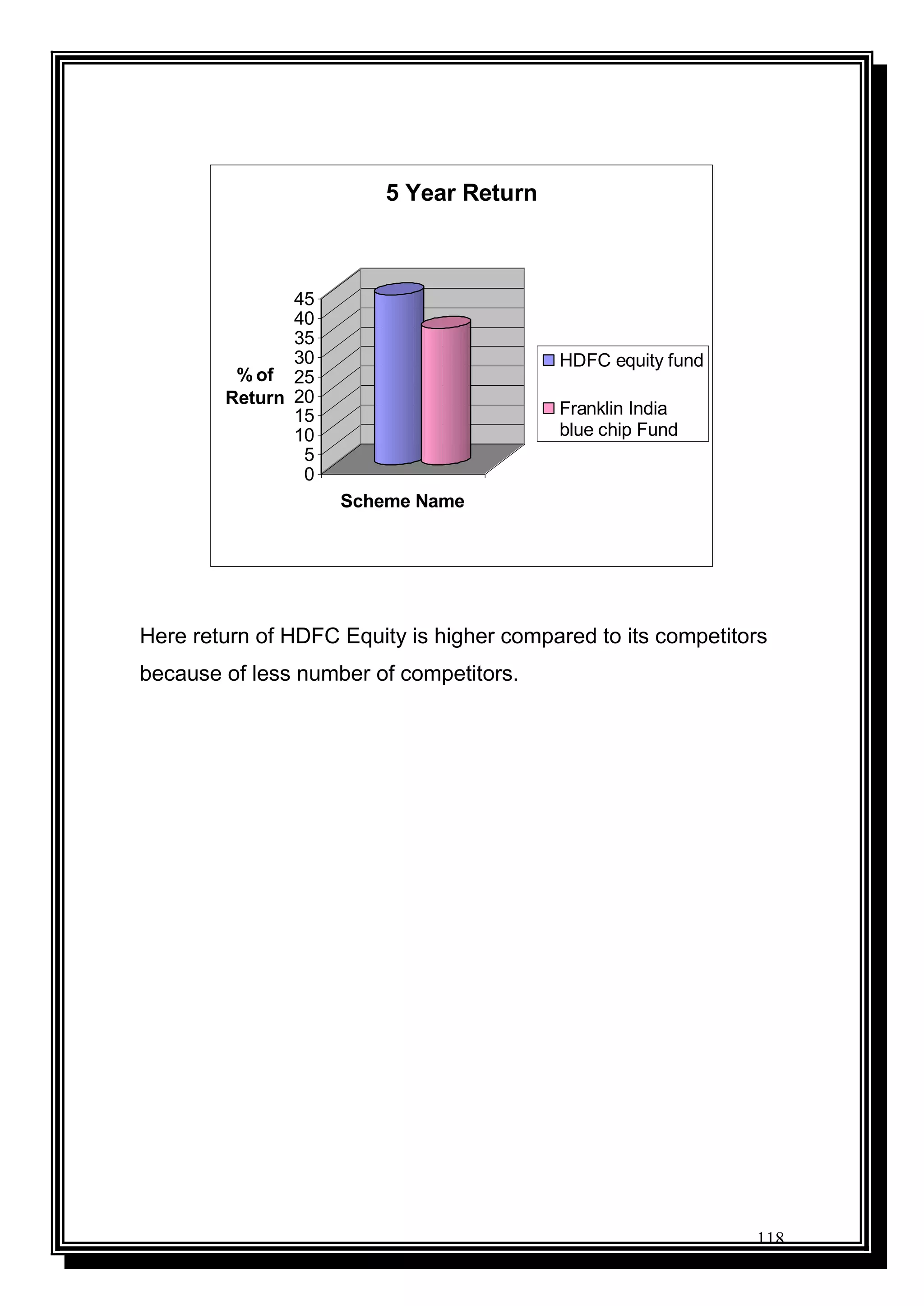
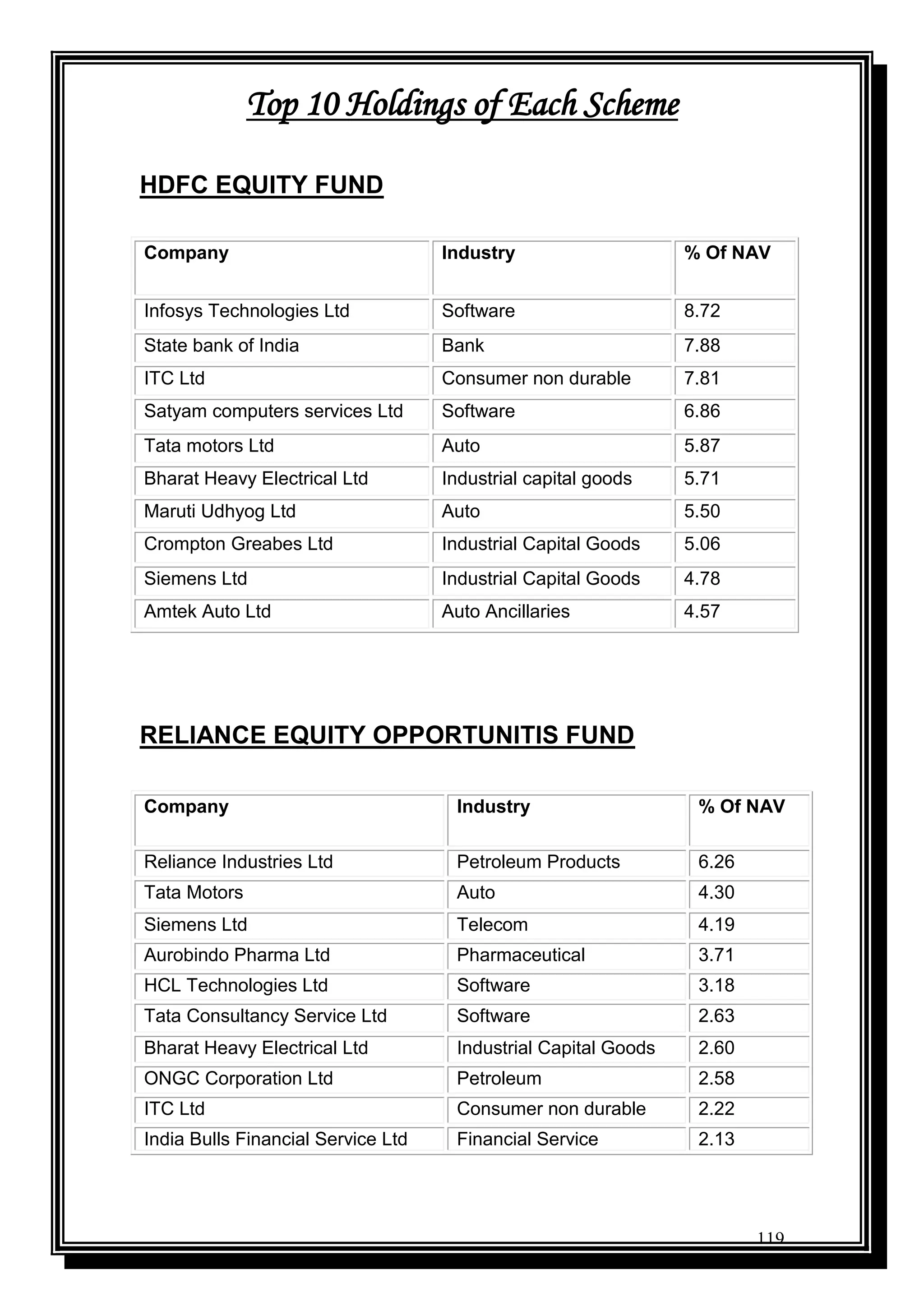
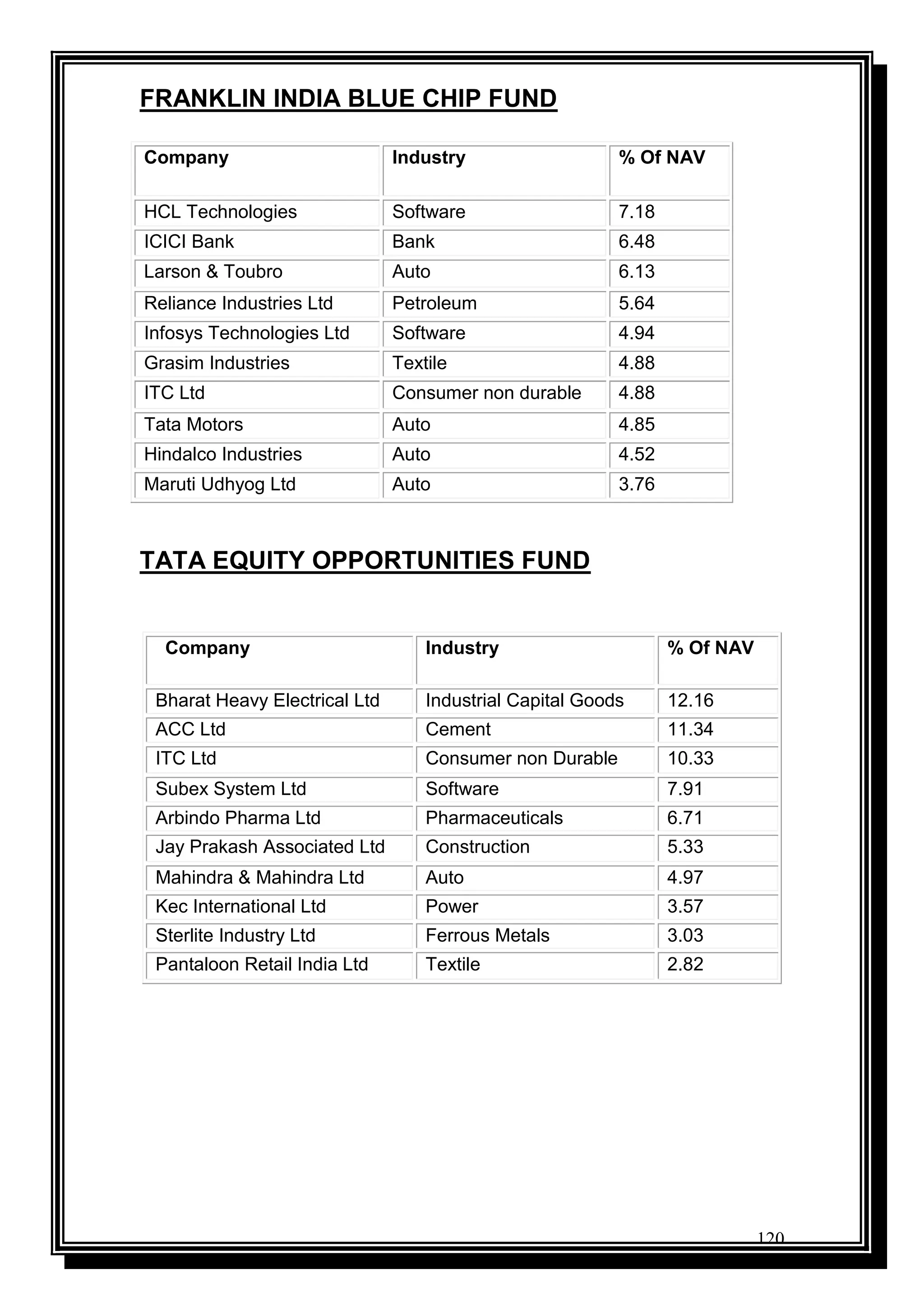
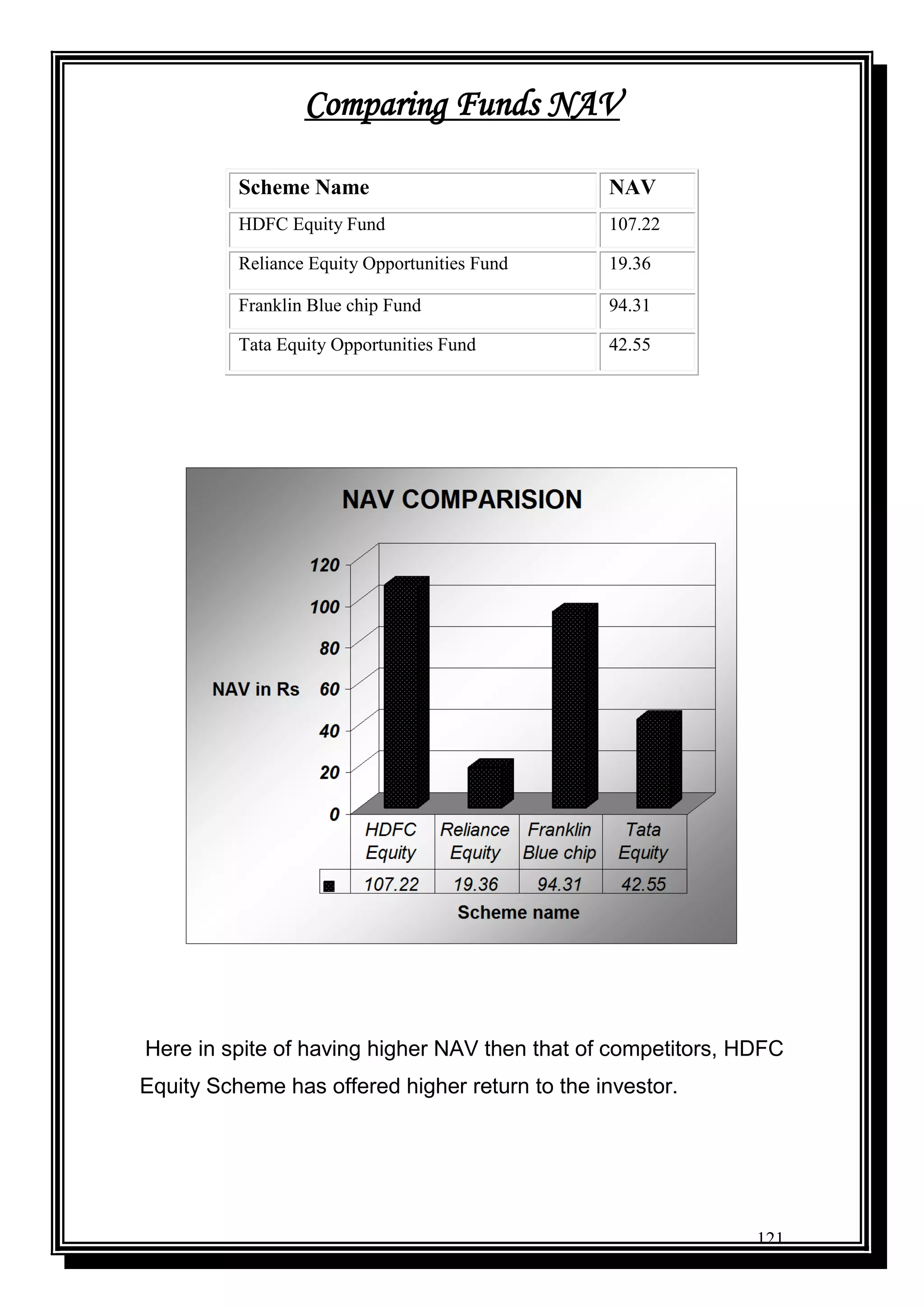
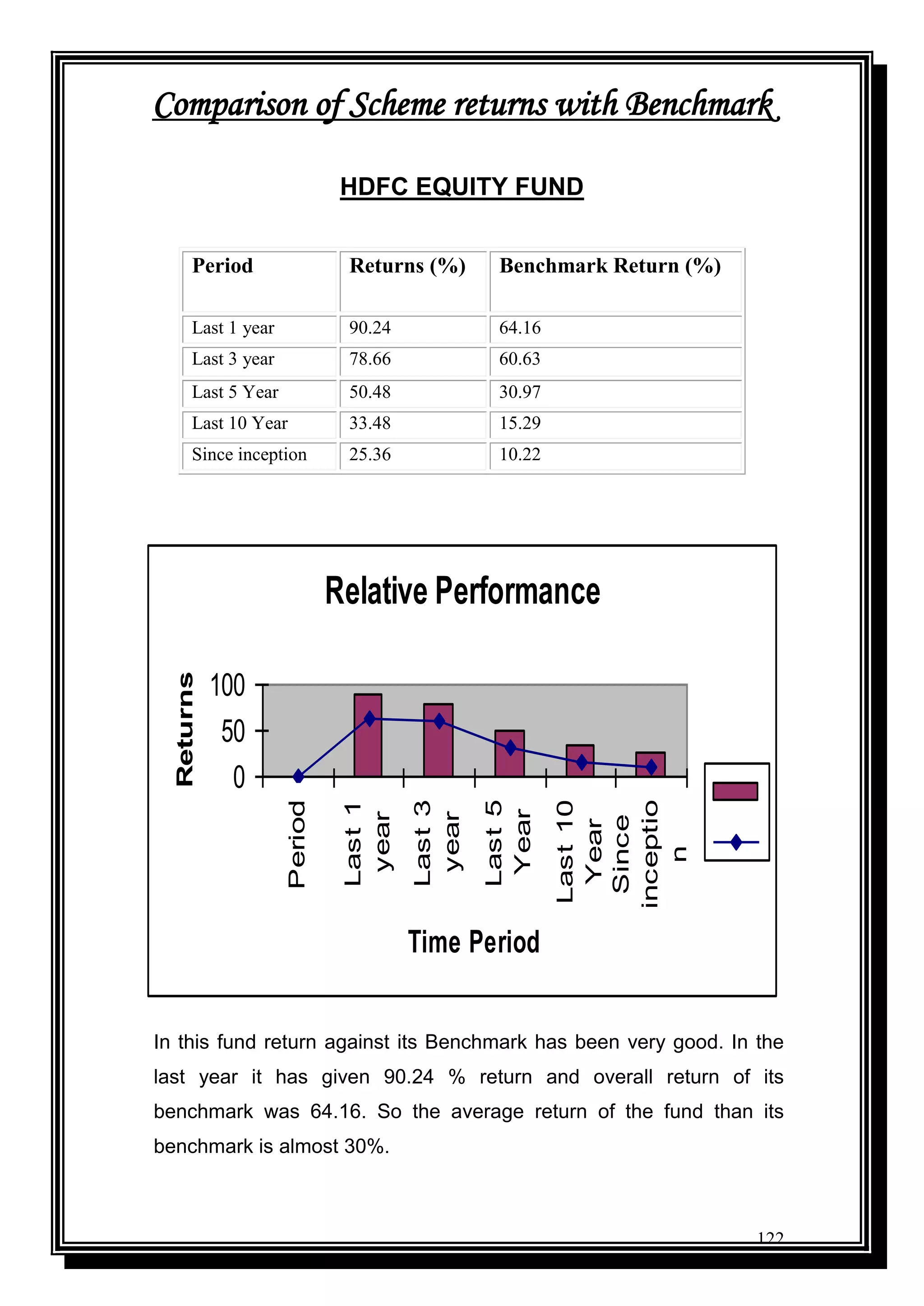
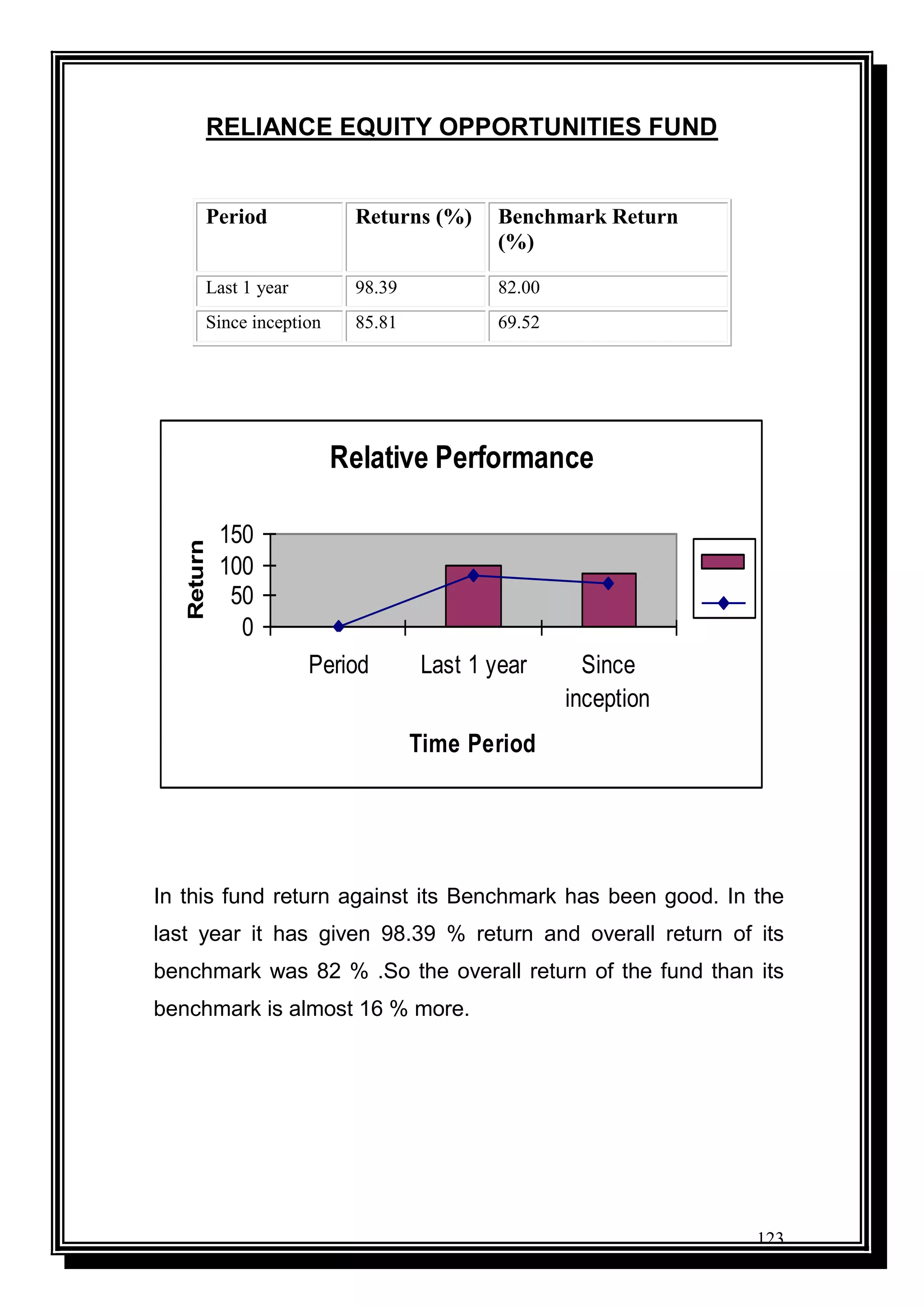
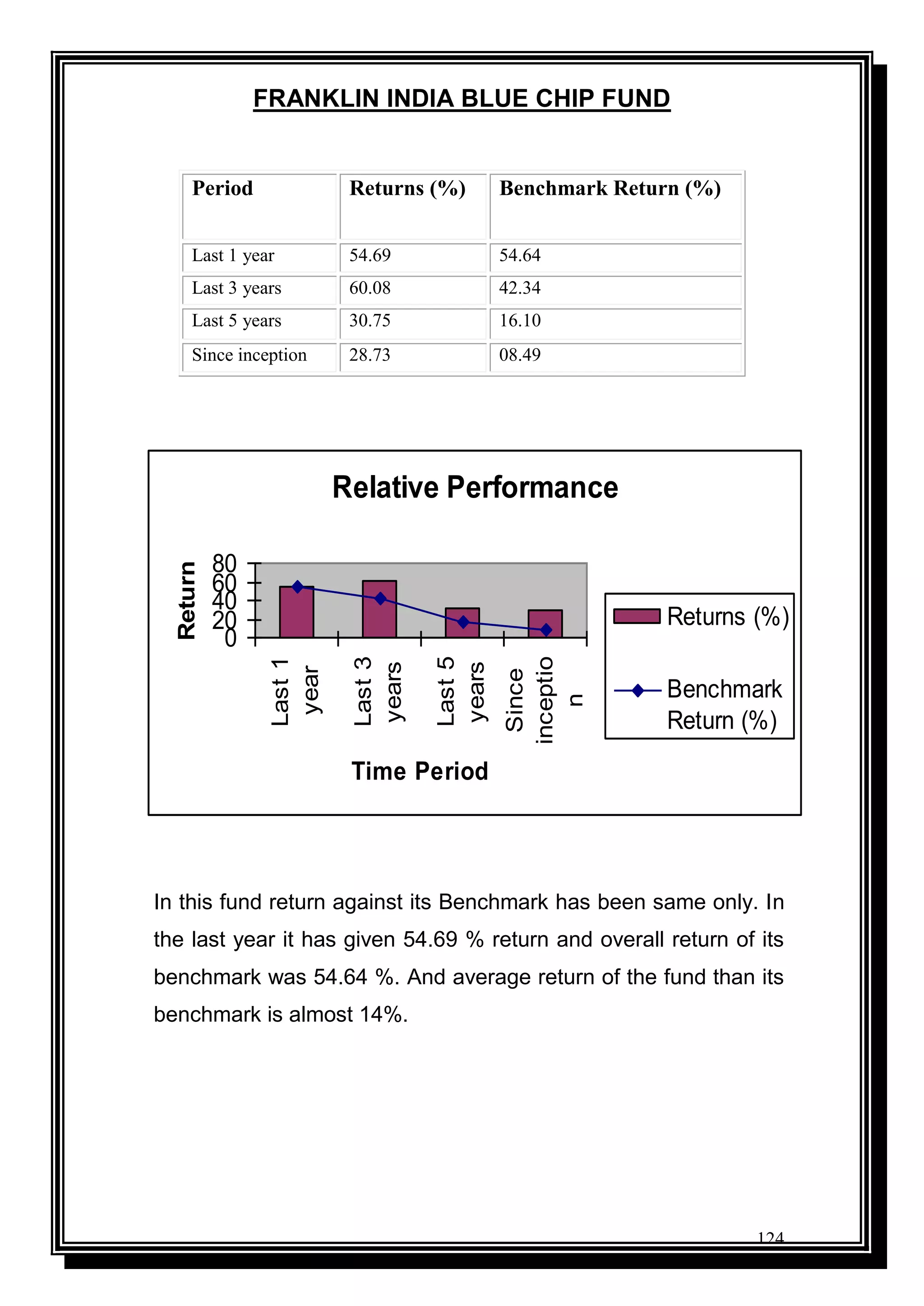

Comparision of hdfc equity schemes with competitor’s equity schemes
HDFC is a leading financial services group in India that was founded in 1977 with a mission to promote home ownership. It has expanded to include companies providing banking, insurance, asset management, securities, and other financial services. The document provides an overview of HDFC's various subsidiaries and their roles in promoting its mission. It describes the history and objectives of HDFC and each of its major subsidiary companies.
Comparision of hdfc equity schemes with competitor’s equity schemes
1.
1
The
Summer Internship Projectreport
“COMPARISION OF HDFC EQUITY
SCHEMES WITH COMPETITOR’S EQUITY
SCHEMES”
At
HDFC BANK.
Submitted By
Bhut Gaurav B.
Enrollment No. 137730592002
Academic Year: 2013-14
MBA Semester III
Institute Name:
Sunshine Group of Institutions,
Faculty of Management, Rajkot
Submitted To
Gujarat Technological University
3
INTRODUCTION
The Indian financialmarket is one of the fastest growing emerging markets of
the world, thanks to the new economic policy - liberalization, deregulation and
measures of restructuring - which has dismantled entry barriers in the
financial markets, allowed the entry of new players and created an
environment for efficient allocation of resources. The major investors in the
markets are the Individual Investors, Corporate Sectors, Charitable Trusts,
etc.
The individual investors are now aware about of the other sources of the
investment avenues rather than the traditional investment avenue. They are
aware about the modern investment avenues.
One of the important investment avenues in the financial market is the „Mutual
Fund‟. Through out the world, Mutual Funds have played a significant role as
far as an investment is concerned. Mutual Funds play a pivotal role in
transforming savings into investments and thereby improving financial health
of a country. One way to measure this role is to analyze performance of
mutual fund schemes. Also understanding of mutual fund structure and
advantages etc. is very important. A Mutual Fund is the ideal instrument
vehicle for today‟s complex and modern financial scenario. Mutual funds offer
many benefits to the small investors such as Diversification, liquidity, low
transaction cost, low risk, transparency, more options and more schemes,
professional management, flexibility, convenience to switch and many more.
Other than Mutual Funds, Bank Deposits, Post Office Schemes, RBI Relief
Bond, Public Provident Fund, Unit Trust of India, Life Insurance, and Equity
are the investment avenues where generally investors invest their savings.
The survey conducted to understand about the Mutual Fund as an investment
Avenue and also generate the awareness of mutual funds in the minds of
individual investors & corporate.
5
MAN WITH AMISSION
If ever there was a man with a mission it was
Hasmukhbhai Parekh, Founder and Chairman-
Emeritus, of HDFC Group who left this earthly
abode on November 18, 1994. Born in a traditional
banking family in Surat, Gujarat, Mr. Parekh started
his financial career at Harkisandass Lukhmidass – a
leading stock broking firm. The firm closed down in
the late seventies, but, long before that, he went on
to become a towering figure on the Indian financial
scene.
In 1956 he began his lifelong financial affair with the economic world,
as General
Manager of the newly formed Industrial Credit and Investment
Corporation of India (ICICI). He
rose to become Chairman and
continued so till his retirement in
1972.
At the ripe age of 60,
Hasmukhbhai started his second
dynamic life, even more illustrious
than his first. His vision for
mortgage finance for housing
gave birth to the Housing
Development Finance
Corporation – it was a trendsetter
for housing finance in the whole
Asian continent.
Mr. H.T. PAREKH is conferred
the Padma Bhushan by the
Government of India in the year
1992.
6.
6
Background and Objectiveof HDFC group
Background
HDFC was incorporated in 1977 with the primary objective of meeting a social
need – that of promoting home ownership by providing long-term finance to
households for their housing needs. HDFC was promoted with an initial share
capital of Rs. 100 million.
Business Objectives
The primary objective of HDFC is to enhance residential housing stock in the
country through the provision of housing finance in a systematic and
professional manner, and to promote home ownership. Another objective is to
increase the flow of resources to the housing sector by integrating the housing
finance sector with the overall domestic financial markets...
Organizational Goals
HDFC‟s main goals are to
a) Develop close relationships with individual households,
b) Maintain its position as the premier housing finance institution in the
country,
c) Transform ideas into viable and creative solutions,
d) Provide consistently high returns to shareholders, and
e) To grow through diversification by leveraging off the existing client base.
7.
7
Key group Companiesand their business
HDFC Reality
HDFC Bank
HDFC Standard Life Insurance
HDFC Mutual Fund
HDFC Chubb General Insurance
Credit Information Bureau (INDIA) Limited
HDFC Securities
HDFC Consultancy Services
Intel net Global
8.
8
HDFC REALTY
Profile
The propertymarket in India abounds with possibilities and potential
but for the large part, it is still highly fragmented and disorganized.
HDFCrealty.com is a / your new, organized electronic marketplace for
properties. We/ It provides the entire gamut of real estate services,
bringing together the "clicks world" and the "bricks world" in a
revolutionary and user-friendly way. Making available the best
guidance and the most professional, transparent, efficient service to
the real estate customer
HDFCrealty.com brings together India's most exhaustive database of
properties. It acts as a one-stop online hub for information, comparative
analyses, transactions, and market reach and comprehensive
professional services. For property anywhere in India. For customers
anywhere in the world HDFCrealty.com, Housing Development
Finance Corporation Limited (HDFC) has formed the company behind
this site.
HDFC is India‟s largest Housing Finance Company and is an expert on
the housing sector, property markets and the real estate business..
This expertise and service orientation has developed and strengthened
over the last 22 years. Today HDFC has an office network of 63 offices
all over the country and an overseas office in Dubai. HDFC has
financed over 1.5 million dwelling units with loan approvals and
disbursements amounting to Rs. 225 billion and Rs. 186 billion
respectively.
9.
9
HDFC Bank
Profile
The HousingDevelopment Finance Corporation
Limited (HDFC) was amongst the first to receive
an 'in principle' approval from the Reserve Bank of
India (RBI) to set up a bank in the private sector,
as part of the RBI's liberalization of the Indian
Banking Industry in 1994. The bank was
incorporated in August 1994 in the name of 'HDFC Bank Limited', with its
registered office in Mumbai, India. HDFC Bank commenced operations as a
Scheduled Commercial Bank in January 1995.
Business Focus
HDFC Bank's mission is to be a World-Class Indian Bank. The objective is to
build sound customer franchises across distinct businesses so as to be the
preferred provider of banking services for target retail and wholesale customer
segments, and to achieve healthy growth in profitability, consistent with the
bank's risk appetite. The bank is committed to maintain the highest level of
ethical standards, professional integrity, corporate governance and regulatory
compliance. HDFC Bank's business philosophy is based on four core values -
Operational Excellence, Customer Focus, Product Leadership and People.
Business
HDFC Bank offers a wide range of commercial and transactional banking
services and treasury products to wholesale and retail customers. The bank
has three key business segments:
1. Wholesale Banking Services
2. Retail Banking Services
3. Treasury
10.
10
HDFC Standard LifeInsurance
Profile
HDFC Standard Life Insurance Company Ltd. is one
of India‟s leading private life insurance companies,
which offers a range of individual and group
insurance solutions. It is a joint venture between
Housing Development Finance Corporation Limited
(HDFC Ltd.), India‟s leading housing finance
institution and The Standard Life Assurance Company, a leading provider of
financial services from the United Kingdom. Both the promoters are well
known for their ethical dealings and financial strength and are thus committed
to being a long-term player in the life insurance industry – all-important factors
to consider when choosing your insurer.
Vision
'The most successful and admired life insurance company, which means that
we are the most trusted company, the easiest to deal with, offer the best value
for money, and set the standards in the industry'.
Values
Values that we observe while we work: Integrity, Innovation Customer
centric, People Care “One for all and all for one”, Team work, Joy and
Simplicity
11.
11
Parentage
HDFC Limited.
HDFC isIndia‟s leading housing finance institution and has helped build more
than 23, 00,000 houses since its incorporation in 1977.
Standard Life Assurance Company
Standard Life has been looking after the financial needs of customers for
more than 180 years. It currently has a customer base of over 7 million
people who rely on the company for their insurance, pension, investment,
banking and health-care needs. Leader in the employee benefit market in
both the UK and Canada. Rated by Standard & Poor as 'strong' with a rating
of A+ and as 'good' with a rating of A1 by Moody‟s.
12.
12
HDFC Mutual Fund
VISION
Tobe a dominant player in the Indian
mutual fund space recognized for its
high levels of ethical and professional
conduct and a commitment towards
enhancing investor interests.
Sponsors
Housing Development Finance Corporation Limited (HDFC)
The Standard Life Assurance Company
Management
HDFC Trustee Company Limited
HDFC Asset Management Company Limited (AMC)
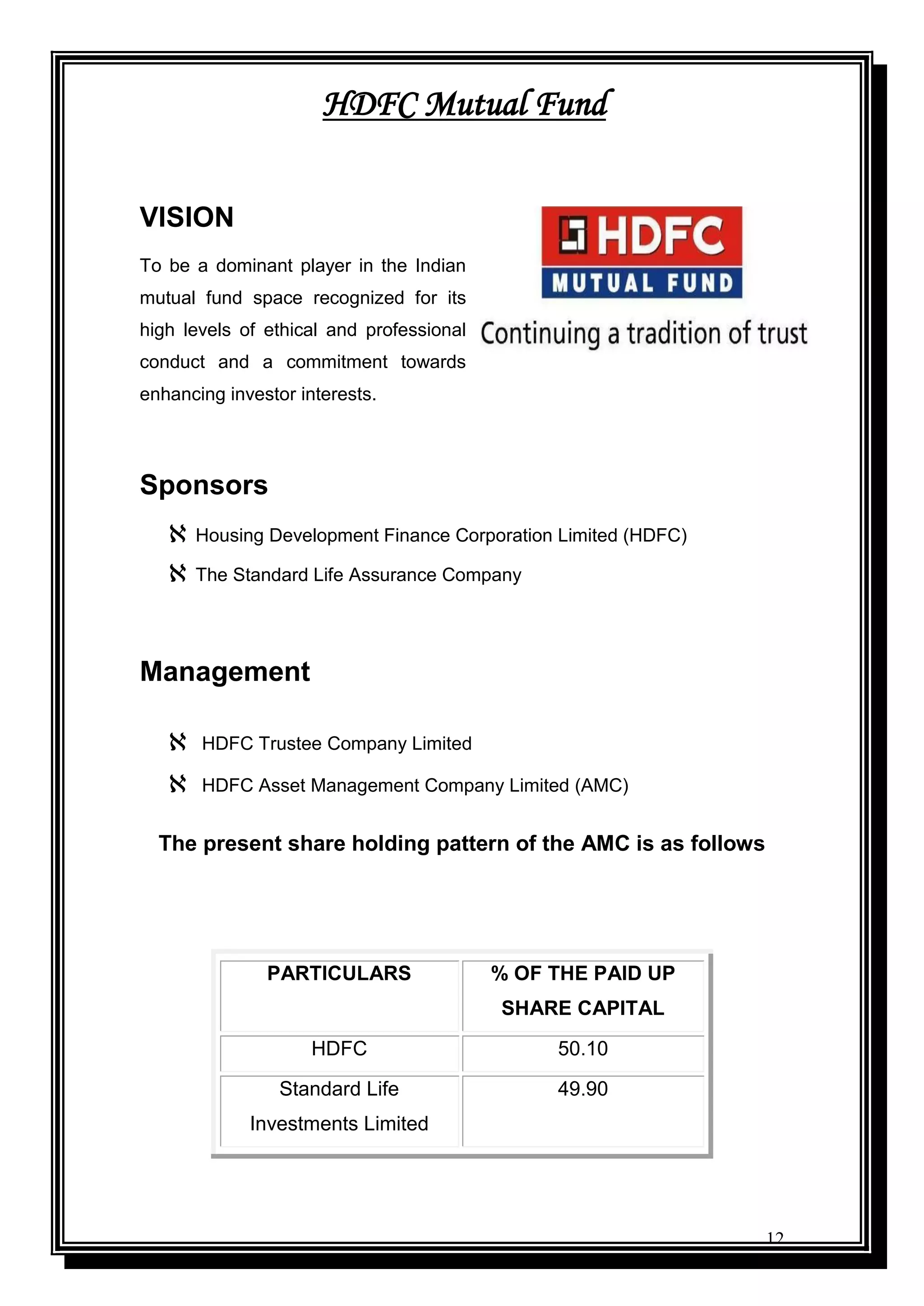
The present share holding pattern of the AMC is as follows
PARTICULARS % OF THE PAID UP
SHARE CAPITAL
HDFC 50.10
Standard Life
Investments Limited
49.90
13.
13
HDFC Chubb GeneralInsurance Company
Limited
HDFC CHUBB
With over one century of experience in the field of
non-life insurance from Chubb and HDFC's expertise
from the financial segment, HDFC Chubb General
Insurance Company Limited has the consumer insight
to make its product range world class and
comprehensive.
HDFC Chubb brings you Insurance solutions that you can rely on. Their
offerings are classified into three categories.
1. The categories comprise
2. Personal Insurance, Accident and Health Insurance and
3. Commercial Insurance.
14.
14
HDFC LTD
HDFC wasincorporated in 1977 with two primary objectives - to enhance
housing stock in the country through housing finance systematically and
professionally and promote home ownership. They also aim to increase the
flow of resources to the housing sector by integrating the housing finance
sector with the overall domestic financial markets. HDFC is also the largest
mobiliser of retail deposits in the private sector outside the banking circle. Our
deposits have been awarded the highest safety credit rating 'FAAA' & 'MAAA'
by CRISIL and ICRA respectively for eight consecutive years.
CHUBB Corporation
With more than $30billion in assets, The Chubb Corporation is one of the
worlds largest, financially strongest, non-life insurance companies. It is noted
for its quality service and innovative insurance products geared to meeting the
changing needs of a broad range of customers in diverse markets. Founded
in New York in 1882, Chubb today provides property and casualty insurance
through more than 10,000 employees in 32 countries of North America, South
America and Asia. Chubb also works closely with 5000 independent agents
and brokers worldwide.
15.
15
Credit Information Bureau(INDIA) Limited
Profile
Credit Information Bureau (India) Limited (CIBIL) was incorporated in 2000.
CIBIL‟s aim is to fulfill the need of credit granting institutions for
comprehensive credit information by collecting, collating and disseminating
credit information pertaining to both commercial and consumer borrowers, to
a closed user group of Members. Banks, Financial Institutions, Non Banking
Financial Companies, Housing Finance Companies and Credit Card
Companies use CIBIL‟s services. Data sharing is based on the Principle of
Reciprocity, which means that only Members who have submitted all their
credit data, may access Credit Information Reports from CIBIL. The
relationship between CIBIL and its Members is that of close interdependence.
Integral Solution
The establishment of CIBIL is an effort made by the Government of India and
the Reserve Bank of India to improve the functionality and stability of the
Indian financial system by containing NPAs while improving credit grantors‟
portfolio quality. CIBIL provides a vital service, which allows its Members to
make informed, objective and faster credit decisions.
MISSION Statement
To be the leader and trendsetter in India, in providing comprehensive credit
information services and related products conforming to global standards,
while adhering to the best practices in terms of confidentiality, propriety and
fair reporting, with a strong technology orientation and seeking to afford the
highest level of customer satisfaction.
16.
16
HDFC SECURITIES
Profile
HDFCsec isa brand brought to you by HDFC
Securities Ltd, which has been promoted by the
HDFC Bank & HDFC with the objective of
providing the diverse customer base of the
HDFC Group and other investors a capability to
transact in the Stock Exchanges &other financial
market transactions.
HDFCsec will equip you with the necessary tools to allocate, select and
manage your investments wisely, and also support it with the highest
standards of service, convenience and hassle-free trading tools.
Mission Statement
Mission is to provide our customers with the most useful investment guidance
and investment-related services available in the country. We want to become
a one-stop solution for all your investment needs, one that will help you get
the most out of your money.
What HDFC SECURITIES
HDFC SECURITIES services comprise online buying and selling of equity
shares on the National Stock Exchange (NSE).
“HDFCsec helps you manage your money in every possible
way. We understand your time is valuable and that
convenience is important. So we’re here to provide high
quality investment services, in a simple, direct and cost-
effective way to help you achieve your financial goals.”
17.
17
HDFC Consultancy Services
HDFCis a unique example of a housing finance company, which has
demonstrated the viability of market-oriented housing finance in a developing
country. It is viewed as an innovative institution and a market leader in the
housing finance sector in India. The World Bank considers HDFC a model
private sector housing finance company in developing countries and a
provider of technical assistance for new and existing institutions, in India and
abroad. HDFC‟s executives have undertaken consultancy assignments
related to housing finance and urban development on behalf of multilateral
agencies all over the world.
HDFC has also served as consultant to international agencies such as World
Bank, United States‟ Agency for International Development (USAID), Asian
Development Bank, United Nations‟ Center for Human Settlements,
Commonwealth Development Corporation (CDC) and United Nations‟
Development Programmed (UNDP). HDFC has also undertaken assignments
for the United Nations‟ Capital Development Fund in Ethiopia, for the UNCHS
in Nairobi, for USAID in Russia and Bulgaria, and projects of the World Bank
in Indonesia and Ghana.
At the national level, HDFC executives have played a key role in formulating
national housing policies and strategies. Recognizing HDFC‟s expertise, the
Government of India has invited HDFC‟s executives to join a number of
committees and task forces related to housing finance, urban development
and capital markets.
18.
18
INTELENET GLOBAL
Profile
Two leadingglobal investors - HDFC and Barclays - provide the financial
backing Intelenet needs to lead in a global marketplace. HDFC is India's
leading financial services conglomerate, while Barclays is a venerable
financial services group headquartered in the United Kingdom, ranking among
the Top 10 banks in the world based on market capitalization. At the same
time, their combined financial strength provides Intelenet with the ability to
remain on the cutting edge of BPO processes while simultaneously
maintaining corporate growth and achieving the goals and objectives set forth
by our customers.
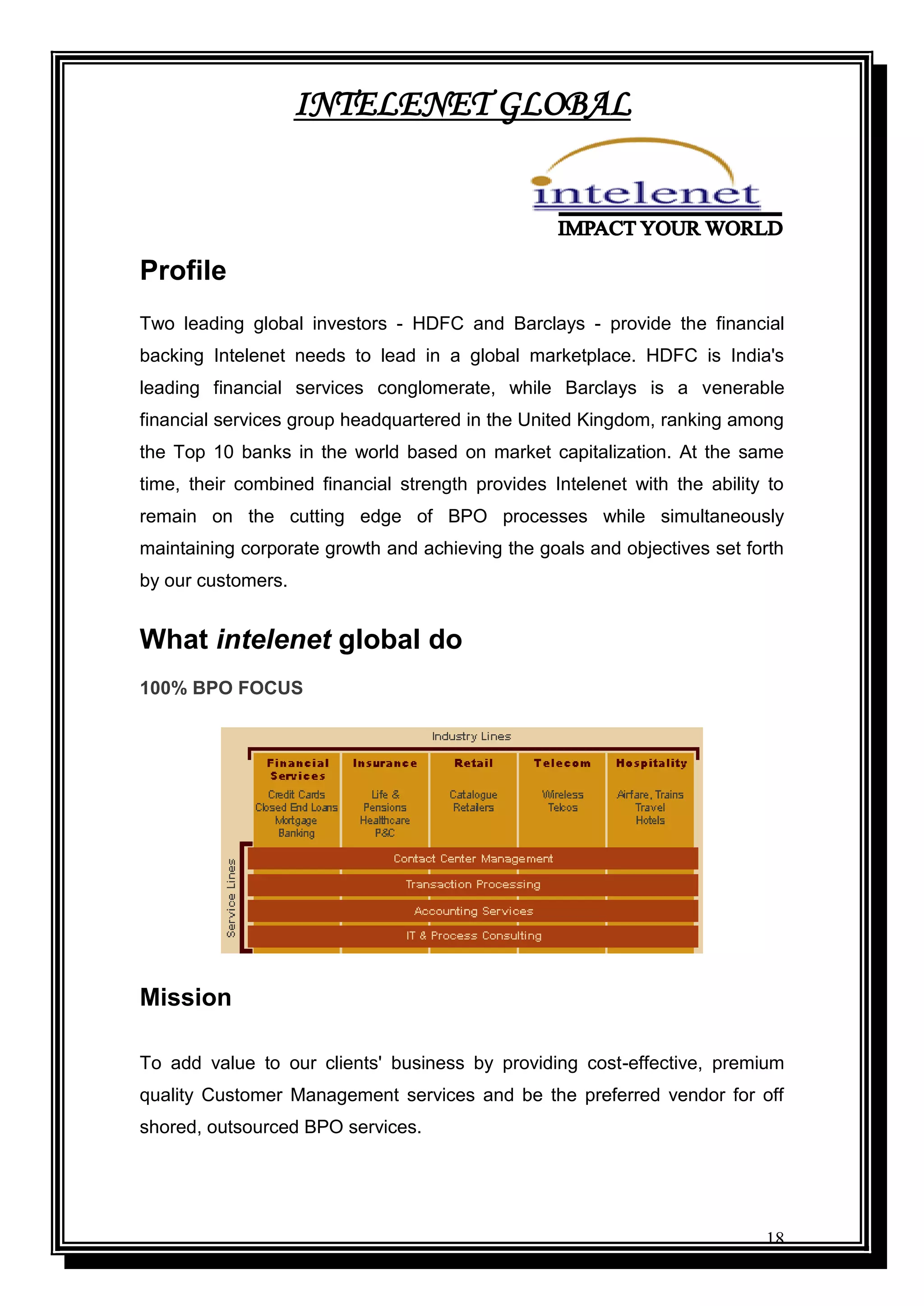
What intelenet global do
100% BPO FOCUS
Mission
To add value to our clients' business by providing cost-effective, premium
quality Customer Management services and be the preferred vendor for off
shored, outsourced BPO services.
19.
19
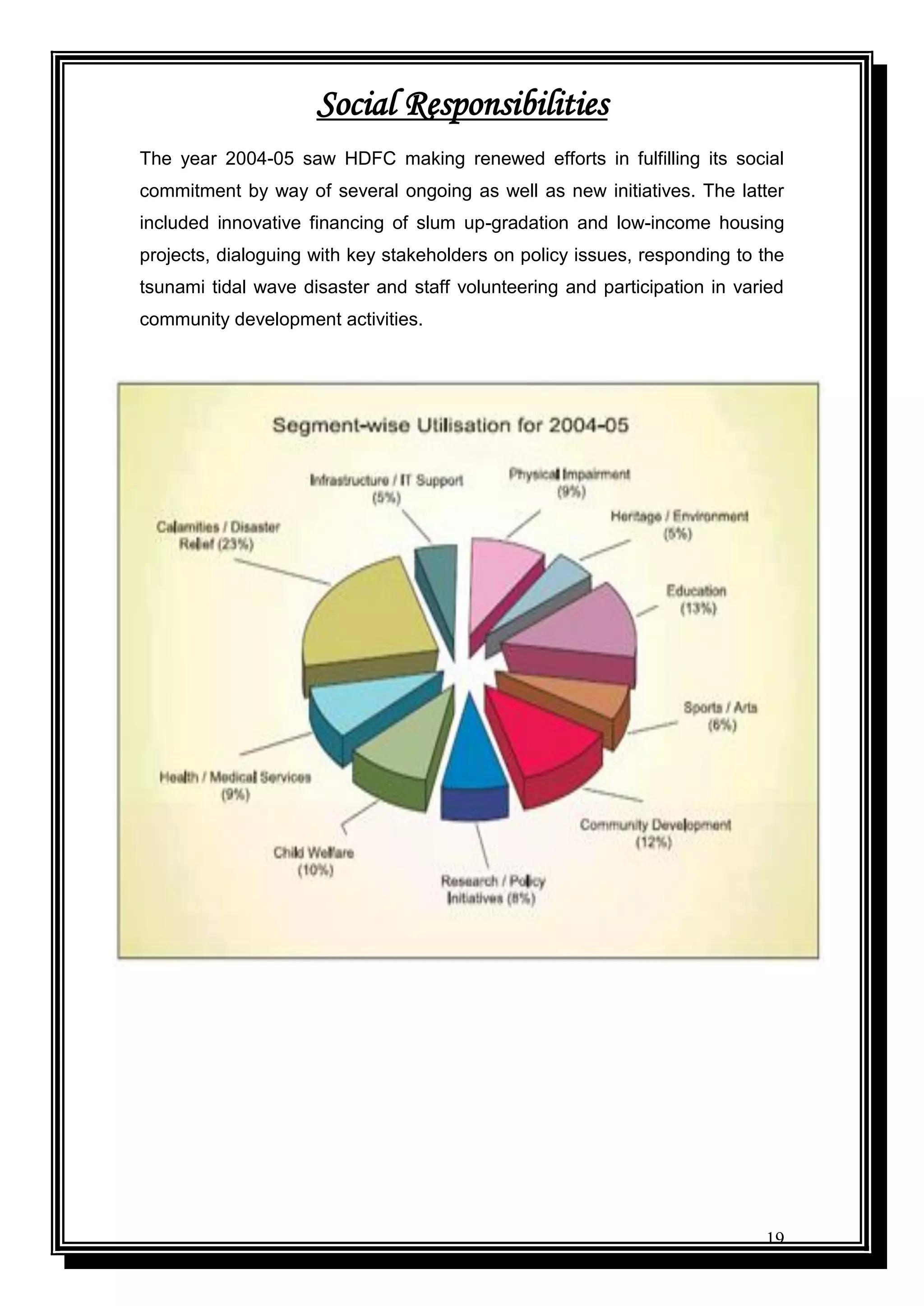
Social Responsibilities
The year2004-05 saw HDFC making renewed efforts in fulfilling its social
commitment by way of several ongoing as well as new initiatives. The latter
included innovative financing of slum up-gradation and low-income housing
projects, dialoguing with key stakeholders on policy issues, responding to the
tsunami tidal wave disaster and staff volunteering and participation in varied
community development activities.
20.
20
SWOT Analysis
Strength
Well-regainedand reputed brand of HDFC.
Experience of Standard Life Investment.
Young and well qualified staff.
Well aware of customer need.
Weakness
Less marketing.
Presence of HDFC MF in very less places.
Comparatively very less staff and very heavy work load.
Opportunities
Day by day increasing knowledge about Mutual Fund.
Only instrument with proper corporate governance and comparatively
high return with lesser risk.
Rural market is totally untapped.
Threat
Presence of nationalized player like UTI and many more.
Increase in competition and competitor.
22
Mutual Fund SectorAnd Financial Market
Overview
Mutual funds have played a significant role in financial intermediation, the
development of capital markets and the growth of the Indian Economy. The
Indian mutual fund industry has been no exception. Though it is relatively
new, it has grown at a dynamic speed, influencing various sectors of the
financial market and the national economy. The Indian economy is under
transition on account of the on going structural adjustment programs and
liberalization. The corporate sector and the investment community play a
major role in the markets today. Economic transition is usually marked by
changes in the market mechanics, institutional integration, market regulations,
relocation of savings and investments and changes in inter-scrotal
relationships. These changes often include negativity and shake investors‟
confidence in the capital market. Mutual funds as efficient allocates of
resources play a crucial role in this transitional period. They have opened new
vistas to investors and imparted much needed liquidity to the system. In the
process, they have challenged the hitherto dominant role of commercial banks
in the financial market and national economy.
Mutual funds are dynamic financial institutions that play a crucial role in an
economy by mobilizing savings and investing them in the capital markets,
thus establishing a link between savings and capital market. Therefore, the
activities of mutual funds have both short and long term impact on the savings
and capital markets and the national economy. They mobilize funds in the
savings market and act as complementary to banks.
23.
23
Emergence Of MutualFund
Mutual funds now represent perhaps the most appropriate investment
opportunity for most investors. As financial markets become more
sophisticated and complex, investors need a financial intermediary who
provides the required knowledge and professional expertise on successful
investing. It is no wonder then that in the birthplace of mutual funds – the
U.S.A. – the fund industry has already overtaken the banking industry, more
funds being under mutual fund management than deposited with banks.
The Indian mutual fund industry has already started opening up many of the
exciting investment opportunities to Indian investors. We have started
witnessing the phenomenon of more savings now being entrusted to the funds
than to the banks. Despite the expected continuing growth in the industry,
mutual funds are still a new financial intermediary in India.
24.
24
Place of MutualFunds in Financial Markets
Indian households started allocating more of their savings to the capital
markets in 1980s, with investments flowing into equity and debt instruments,
besides the conventional mode of bank deposits.
Until 1992, primary market investors were effectively assured good returns, as
the issue price of new equity issues was controlled and low. After introduction
of free pricing of shares, new issue prices were higher and with greater
volatility in the stock markets, many investors who bought highly priced
shares lost money, and withdrew from the markets altogether. Even those
investors who continued as
Direct investors in the stock markets realized that the key to successful
investing in the capital markets lay in building a diversified portfolio, which in
turn required substantial capital. Besides, selecting securities with growth and
income potential from the capital market involved careful research and
monitoring of the market, which was not possible for all investors. Under
similar circumstances in other countries, mutual funds had emerged as
professional intermediaries. Besides providing the expertise in stock market
investing, these funds allow investing in small amounts and yet holding a
diversified portfolio to limit risk, while providing the potential for income and
growth that is associated with the debt and equity instruments. In India, Unit
Trust of India occupied this place as the only capital markets intermediary
from 1964 until late 1987, when the Government started allowing other
sponsors also to set up mutual funds. With some ups and downs, this new
class of intermediary institutions has emerged, in India as elsewhere, as a
good alternative to direct investing in capital markets.
Mutual Funds serve as a link between the saving public and the capital
markets, as they mobilize savings from investors and bring them to borrowers
in the capital markets.
25.
25
Concept of MutualFund: Summary
A mutual fund is a common pool of money into which investors place their
contributions that are to be invested in accordance with a stated objective.
The ownership of the fund is thus joint or “mutual”; the fund belongs to all
investors. He or her bears in the same proportion as the amount of the
contribution make a single investor‟s ownership of the fund to the total amount
of the fund.
A mutual fund uses the money collected from investors to buy those assets,
which are specifically permitted by its stated investment objective. Thus, an
equity fund would buy mainly equity assets – ordinary shares, preference
shares, warrants etc. A bond fund would mainly buy debt instruments such as
debentures, bonds, or government securities. It is these assets, which are
owned by the investors in the same proportion as their contribution bears to
the total contributions of all investors put together.
27
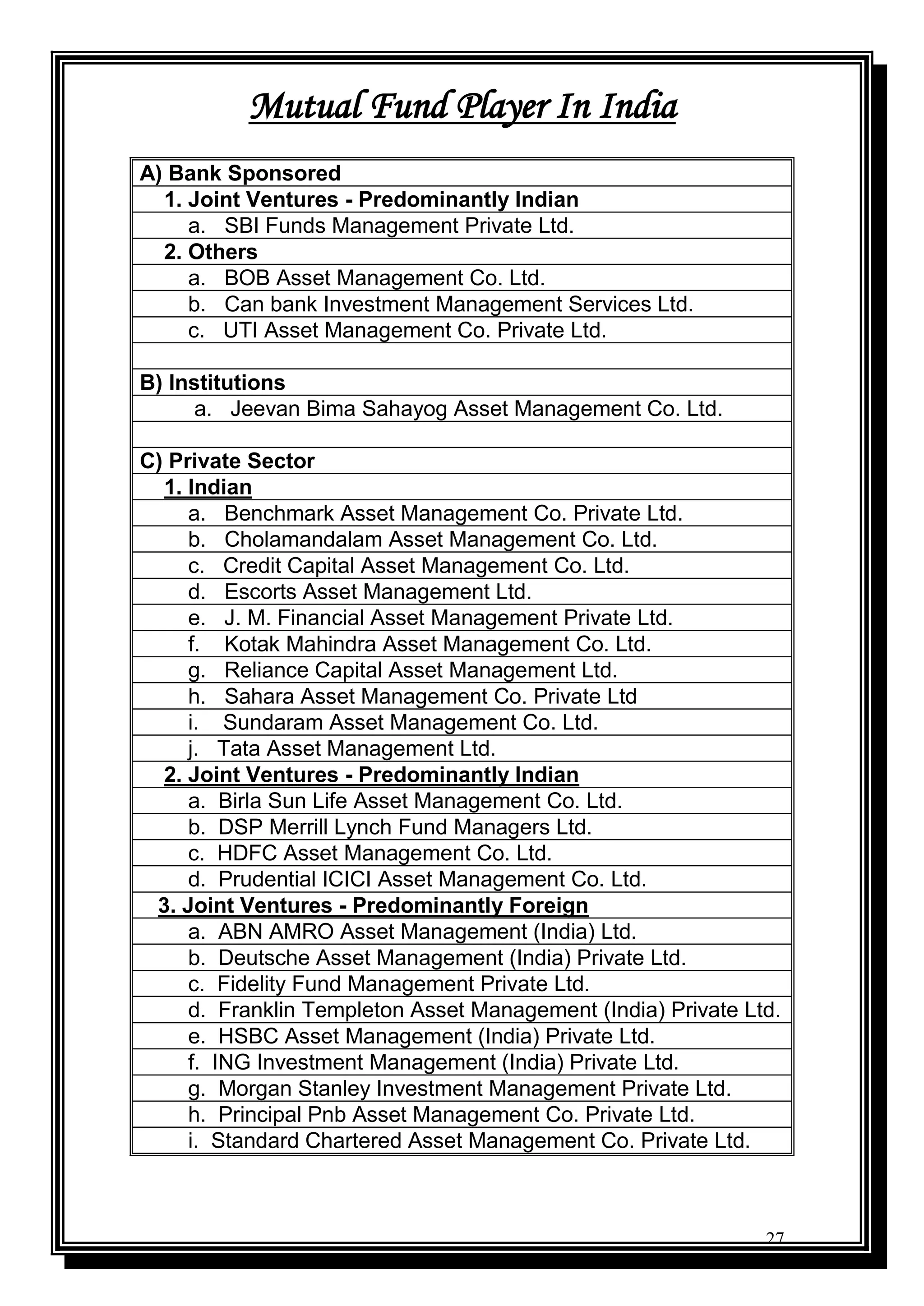
Mutual Fund PlayerIn India
A) Bank Sponsored
1. Joint Ventures - Predominantly Indian
a. SBI Funds Management Private Ltd.
2. Others
a. BOB Asset Management Co. Ltd.
b. Can bank Investment Management Services Ltd.
c. UTI Asset Management Co. Private Ltd.
B) Institutions
a. Jeevan Bima Sahayog Asset Management Co. Ltd.
C) Private Sector
1. Indian
a. Benchmark Asset Management Co. Private Ltd.
b. Cholamandalam Asset Management Co. Ltd.
c. Credit Capital Asset Management Co. Ltd.
d. Escorts Asset Management Ltd.
e. J. M. Financial Asset Management Private Ltd.
f. Kotak Mahindra Asset Management Co. Ltd.
g. Reliance Capital Asset Management Ltd.
h. Sahara Asset Management Co. Private Ltd
i. Sundaram Asset Management Co. Ltd.
j. Tata Asset Management Ltd.
2. Joint Ventures - Predominantly Indian
a. Birla Sun Life Asset Management Co. Ltd.
b. DSP Merrill Lynch Fund Managers Ltd.
c. HDFC Asset Management Co. Ltd.
d. Prudential ICICI Asset Management Co. Ltd.
3. Joint Ventures - Predominantly Foreign
a. ABN AMRO Asset Management (India) Ltd.
b. Deutsche Asset Management (India) Private Ltd.
c. Fidelity Fund Management Private Ltd.
d. Franklin Templeton Asset Management (India) Private Ltd.
e. HSBC Asset Management (India) Private Ltd.
f. ING Investment Management (India) Private Ltd.
g. Morgan Stanley Investment Management Private Ltd.
h. Principal Pnb Asset Management Co. Private Ltd.
i. Standard Chartered Asset Management Co. Private Ltd.
28.
28
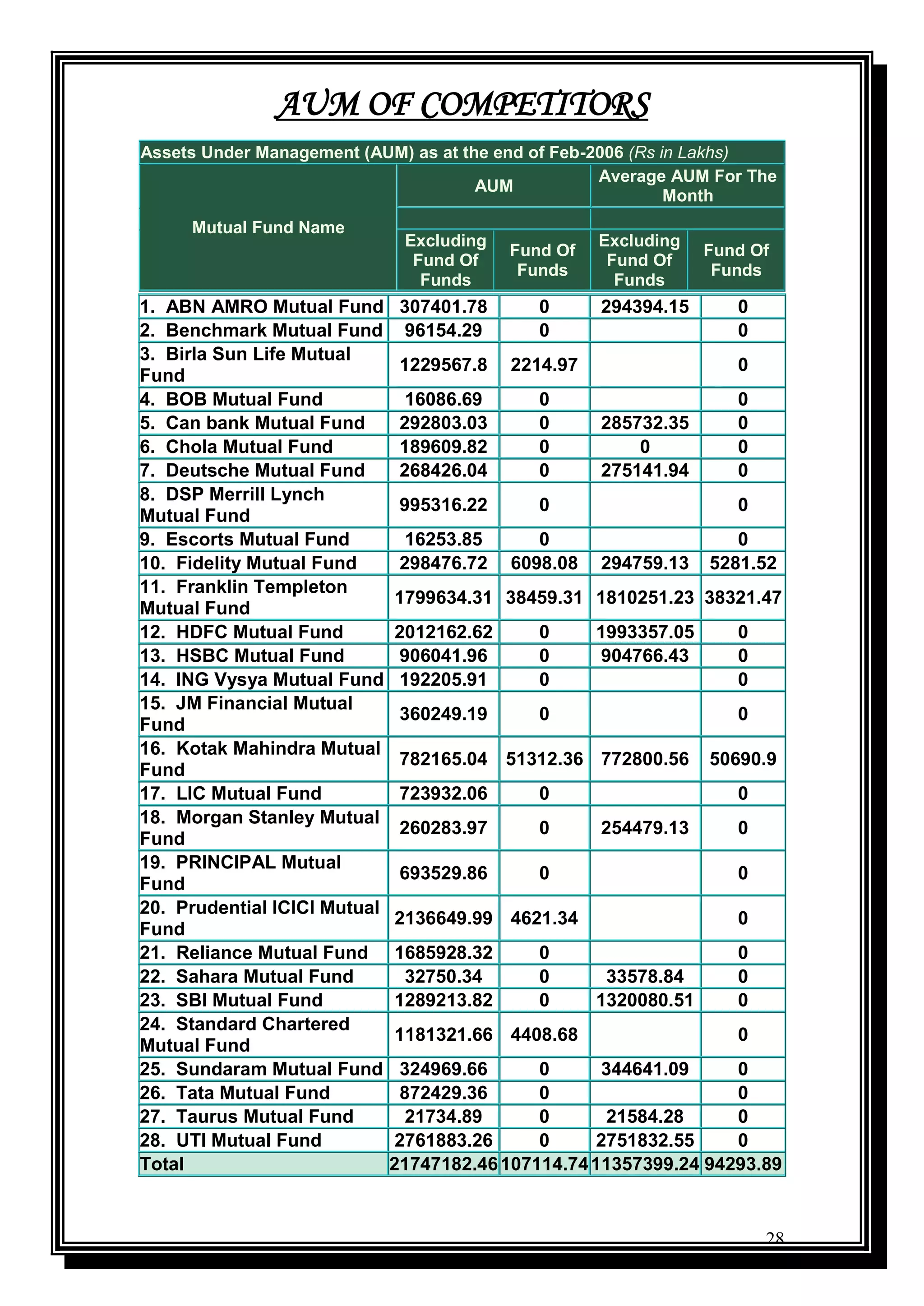
AUM OF COMPETITORS
AssetsUnder Management (AUM) as at the end of Feb-2006 (Rs in Lakhs)
Mutual Fund Name
AUM
Average AUM For The
Month
Excluding
Fund Of
Funds
Fund Of
Funds
Excluding
Fund Of
Funds
Fund Of
Funds
1. ABN AMRO Mutual Fund 307401.78 0 294394.15 0
2. Benchmark Mutual Fund 96154.29 0 0
3. Birla Sun Life Mutual
Fund
1229567.8 2214.97 0
4. BOB Mutual Fund 16086.69 0 0
5. Can bank Mutual Fund 292803.03 0 285732.35 0
6. Chola Mutual Fund 189609.82 0 0 0
7. Deutsche Mutual Fund 268426.04 0 275141.94 0
8. DSP Merrill Lynch
Mutual Fund
995316.22 0 0
9. Escorts Mutual Fund 16253.85 0 0
10. Fidelity Mutual Fund 298476.72 6098.08 294759.13 5281.52
11. Franklin Templeton
Mutual Fund
1799634.31 38459.31 1810251.23 38321.47
12. HDFC Mutual Fund 2012162.62 0 1993357.05 0
13. HSBC Mutual Fund 906041.96 0 904766.43 0
14. ING Vysya Mutual Fund 192205.91 0 0
15. JM Financial Mutual
Fund
360249.19 0 0
16. Kotak Mahindra Mutual
Fund
782165.04 51312.36 772800.56 50690.9
17. LIC Mutual Fund 723932.06 0 0
18. Morgan Stanley Mutual
Fund
260283.97 0 254479.13 0
19. PRINCIPAL Mutual
Fund
693529.86 0 0
20. Prudential ICICI Mutual
Fund
2136649.99 4621.34 0
21. Reliance Mutual Fund 1685928.32 0 0
22. Sahara Mutual Fund 32750.34 0 33578.84 0
23. SBI Mutual Fund 1289213.82 0 1320080.51 0
24. Standard Chartered
Mutual Fund
1181321.66 4408.68 0
25. Sundaram Mutual Fund 324969.66 0 344641.09 0
26. Tata Mutual Fund 872429.36 0 0
27. Taurus Mutual Fund 21734.89 0 21584.28 0
28. UTI Mutual Fund 2761883.26 0 2751832.55 0
Total 21747182.46107114.7411357399.24 94293.89
30
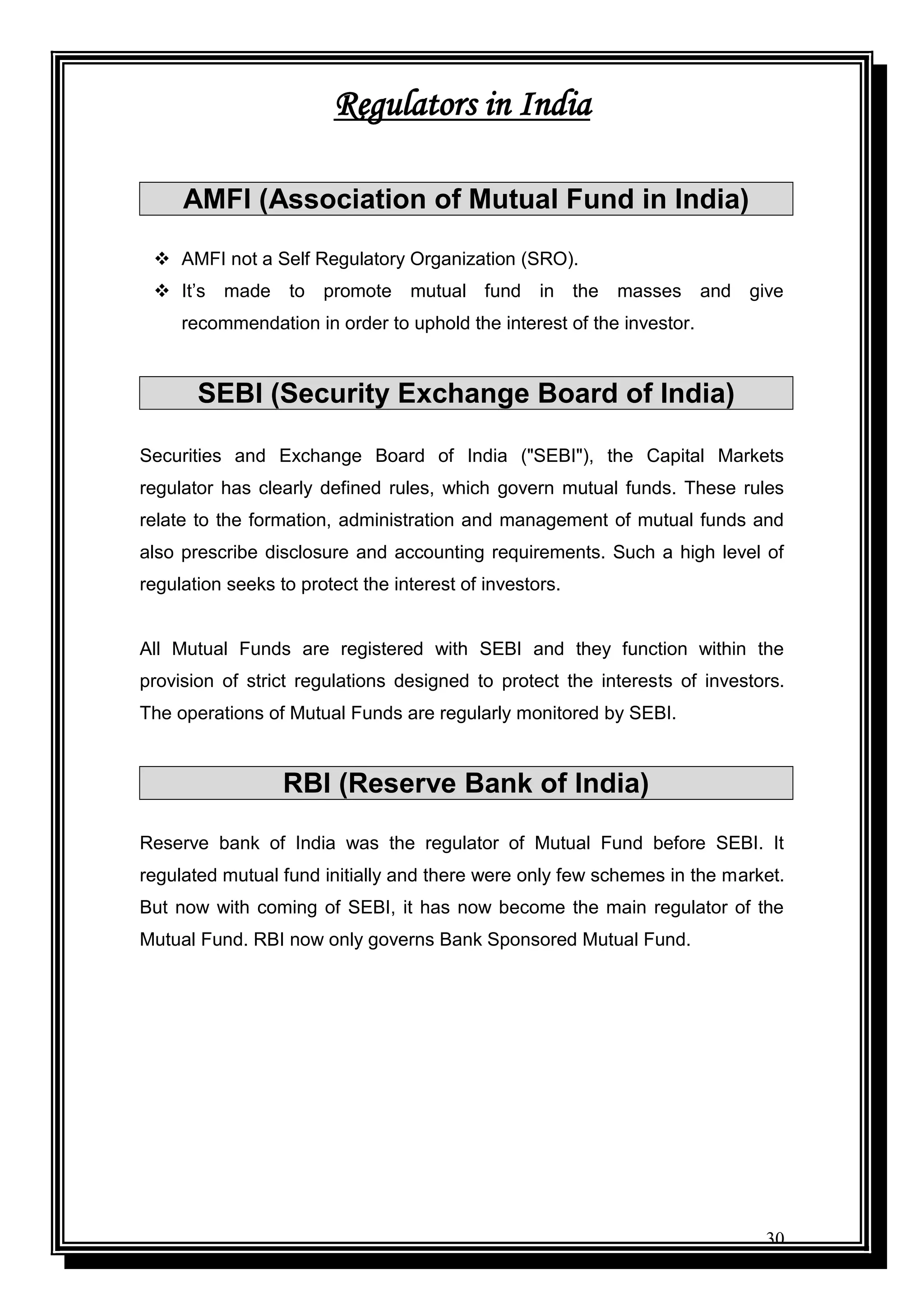
Regulators in India
AMFI(Association of Mutual Fund in India)
AMFI not a Self Regulatory Organization (SRO).
It‟s made to promote mutual fund in the masses and give
recommendation in order to uphold the interest of the investor.
SEBI (Security Exchange Board of India)
Securities and Exchange Board of India ("SEBI"), the Capital Markets
regulator has clearly defined rules, which govern mutual funds. These rules
relate to the formation, administration and management of mutual funds and
also prescribe disclosure and accounting requirements. Such a high level of
regulation seeks to protect the interest of investors.
All Mutual Funds are registered with SEBI and they function within the
provision of strict regulations designed to protect the interests of investors.
The operations of Mutual Funds are regularly monitored by SEBI.
RBI (Reserve Bank of India)
Reserve bank of India was the regulator of Mutual Fund before SEBI. It
regulated mutual fund initially and there were only few schemes in the market.
But now with coming of SEBI, it has now become the main regulator of the
Mutual Fund. RBI now only governs Bank Sponsored Mutual Fund.
31.
31
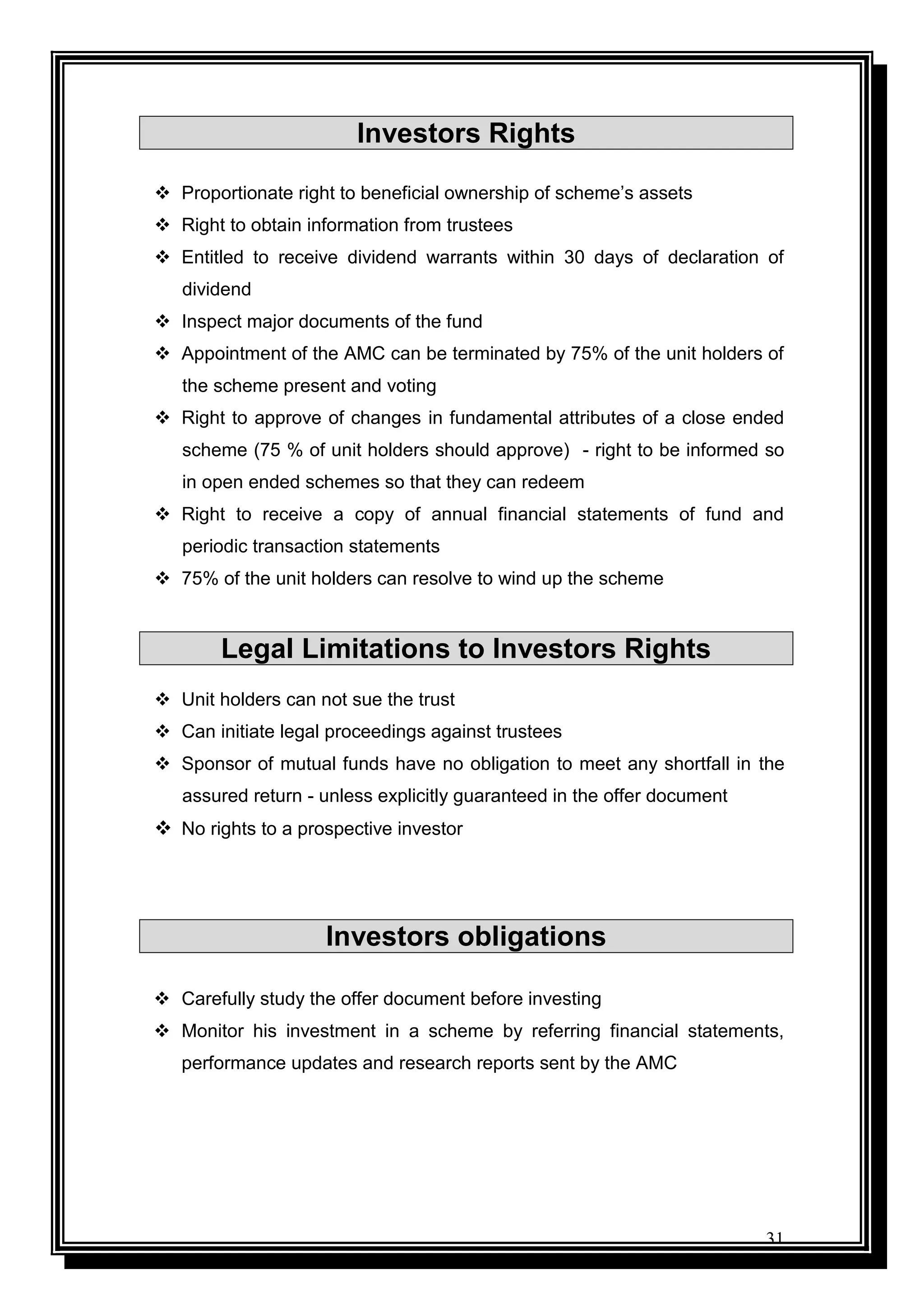
Investors Rights
Proportionateright to beneficial ownership of scheme‟s assets
Right to obtain information from trustees
Entitled to receive dividend warrants within 30 days of declaration of
dividend
Inspect major documents of the fund
Appointment of the AMC can be terminated by 75% of the unit holders of
the scheme present and voting
Right to approve of changes in fundamental attributes of a close ended
scheme (75 % of unit holders should approve) - right to be informed so
in open ended schemes so that they can redeem
Right to receive a copy of annual financial statements of fund and
periodic transaction statements
75% of the unit holders can resolve to wind up the scheme
Legal Limitations to Investors Rights
Unit holders can not sue the trust
Can initiate legal proceedings against trustees
Sponsor of mutual funds have no obligation to meet any shortfall in the
assured return - unless explicitly guaranteed in the offer document
No rights to a prospective investor
Investors obligations
Carefully study the offer document before investing
Monitor his investment in a scheme by referring financial statements,
performance updates and research reports sent by the AMC
34
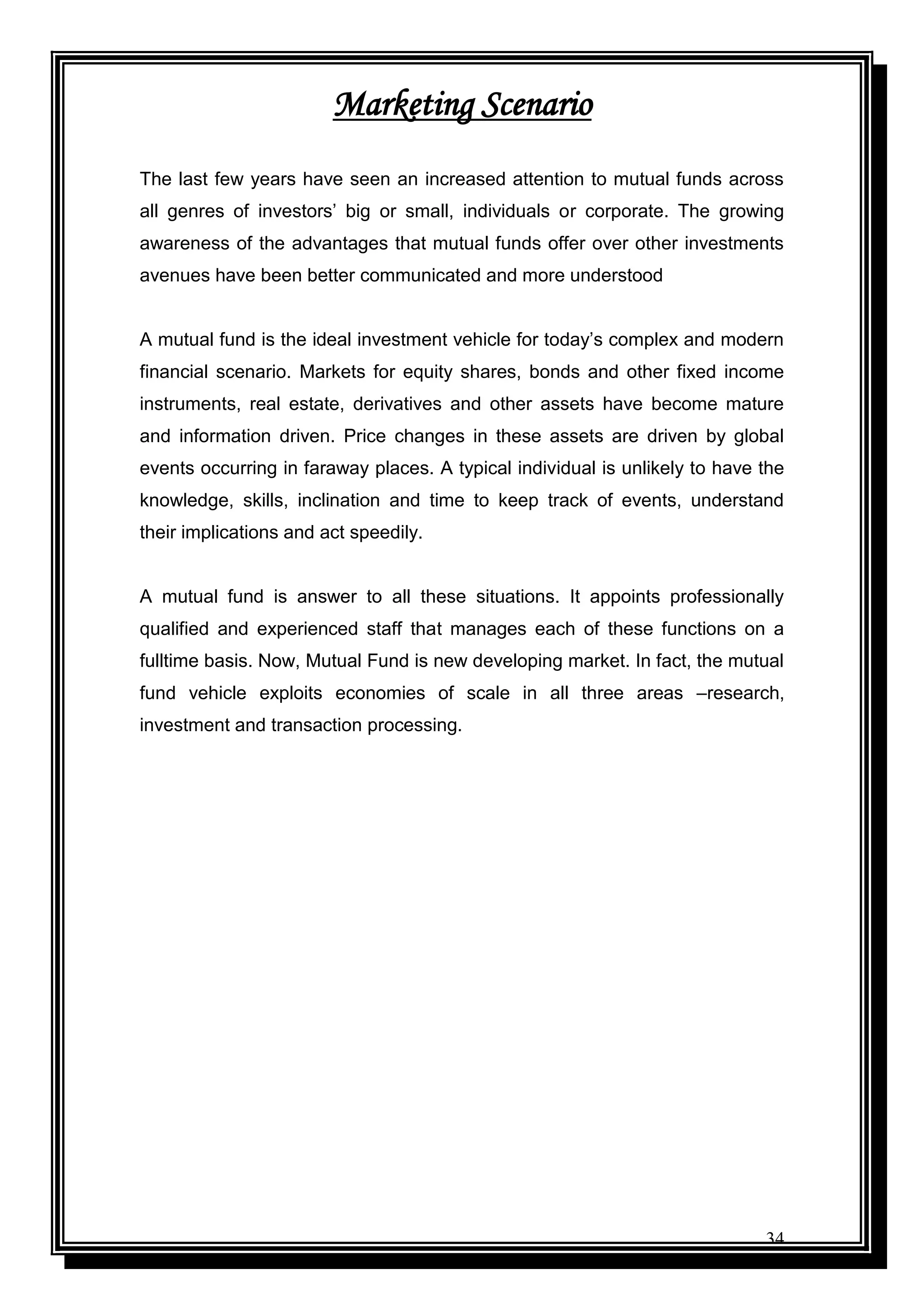
Marketing Scenario
The lastfew years have seen an increased attention to mutual funds across
all genres of investors‟ big or small, individuals or corporate. The growing
awareness of the advantages that mutual funds offer over other investments
avenues have been better communicated and more understood
A mutual fund is the ideal investment vehicle for today‟s complex and modern
financial scenario. Markets for equity shares, bonds and other fixed income
instruments, real estate, derivatives and other assets have become mature
and information driven. Price changes in these assets are driven by global
events occurring in faraway places. A typical individual is unlikely to have the
knowledge, skills, inclination and time to keep track of events, understand
their implications and act speedily.
A mutual fund is answer to all these situations. It appoints professionally
qualified and experienced staff that manages each of these functions on a
fulltime basis. Now, Mutual Fund is new developing market. In fact, the mutual
fund vehicle exploits economies of scale in all three areas –research,
investment and transaction processing.
35.
35
Market Segmentation
Market segmentationis an effort to increase a company‟s precision marketing.
A market segment consists of large identifiable group within a market with
similar wants, purchasing power, buying attitudes or buying habits. As HDFC
mutual fund is a service sector industry they introduce different schemes for
different people. Each person is different in nature and each have differ
criteria for investment like risk factor, return, liquidity, tax benefits etc.
So that HDFC Asset management company have introduced varieties of
scheme like debt scheme, balanced scheme, equity related scheme and each
schemes have option to invest in SIP (Systematic Investment Plan) which
help investor to invest a specific amount for a continuous period, at regular
intervals so that investor has the advantage of rupee cost averaging and also
helps him save compulsorily a fixed amount each amount.
Target Market
HDFC Asset Management Company is a joint venture of HDFC BANK
(50.10%) and Standard Life Investment Limited (49.90%). The joint venture
was formed with the key objective of providing the Indian investor mutual fund
products to suit a variety of investment needs.
HDFC Asset Management Company, have variety of scheme both open
ended and close ended scheme. Both have different objective and different
target market. Equity Mutual Fund Scheme has target market of person
who wants to take high risk and also expect high return. Balanced scheme
have target market of person who wants to take moderate risk and
expect average return and Debt scheme have target market of person who
wants to take less risk. Close-ended scheme have target market of
person who wants long-term equity investment.
36.
36
Customers’ Profile
HDFC AssetManagement Company, have variety scheme and each scheme
have different customer profile.
For Equity related scheme customer profile is young generation, for liquid
scheme customer profile is business man who wants to utilize their money in
effective manner for shorter period, in SIP (Systematic Investment Plan)
customer basically are serviced person who invest regularly and want to earn
more than average return. Thus, HDFC Asset Management Company, have
introduced variety of scheme to suit need of variety of customer.
37.
37
Positioning Strategy
“Positioning isthe act of designing the company‟s offering and image to
occupy a distinctive place in the target market‟s mind.”
Positioning starts with a product. A piece of merchandise, a service, a
company, an institution, or even a person. But positioning is not what you do
to a product. Positioning is what you do the mind of the prospect. That is, you
position the product in the mind of prospect. A company‟s differentiating and
positioning strategy must change as the product, market, and competitors
change over time. Once the company has developed a clear positioning
strategy, it must communicate that positioning effectively. There should be no
under positioning, over positioning, confused positioning or doubtful
positioning.
HDFC Asset Management Company, have positioning strategy of
“Continuing a Tradition of Trust”. It is accurate positioning strategy
because it signifies a trust with its clients. Here is special Relationship
Manager dedicated towards customer service and satisfaction and give them
guidance about various schemes which helps them to get right scheme which
suit their investment needs. In this way it continues to maintain a trust with its
clients.
39
What is aMutual Fund?
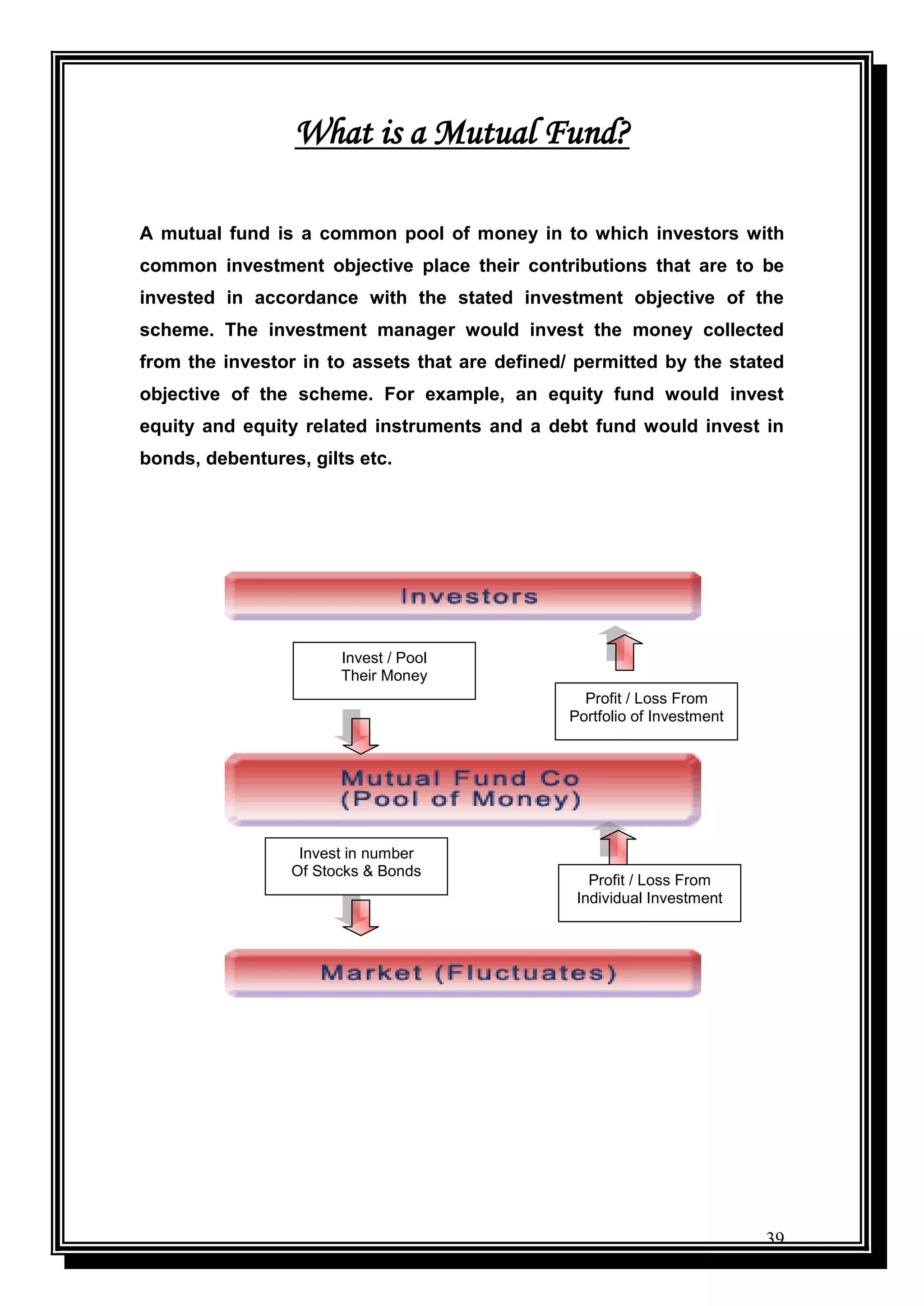
A mutual fund is a common pool of money in to which investors with
common investment objective place their contributions that are to be
invested in accordance with the stated investment objective of the
scheme. The investment manager would invest the money collected
from the investor in to assets that are defined/ permitted by the stated
objective of the scheme. For example, an equity fund would invest
equity and equity related instruments and a debt fund would invest in
bonds, debentures, gilts etc.
Invest / Pool
Their Money
Invest in number
Of Stocks & Bonds
Profit / Loss From
Individual Investment
Profit / Loss From
Portfolio of Investment
40.
40
Mutual fund isa mechanism for pooling the resources by issuing units to the
investors and investing funds in securities in accordance with objectives as
disclosed in offer document.
Investments in securities are spread across a wide cross-section of industries
and sectors and thus the risk is reduced. Diversification reduces the risk
because all stocks may not move in the same direction in the same proportion
at the same time. Mutual fund issues units to the investors in accordance with
quantum of money invested by them. Investors of mutual funds are known as
unit holders.
The investors in proportion to their investments share the profits or losses.
The mutual funds normally come out with a number of schemes with different
investment objectives, which are launched from time to time. A mutual fund is
required to be registered with Securities and Exchange Board of India (SEBI),
which regulates securities markets before it can collect funds from the public.
41.
41
History of theIndian Mutual Fund Industry in
India
The mutual fund industry in India started in 1963 with the
formation of Unit Trust of India, at the initiative of the
Government of India and Reserve Bank the. The history of
mutual funds in India can be broadly divided into four distinct
phases.
First Phase – 1964-87
An Act of Parliament established Unit Trust of India (UTI) on 1963. It was set
up by the Reserve Bank of India and functioned under the Regulatory and
administrative control of the Reserve Bank of India. In 1978 UTI was de-linked
from the RBI and the Industrial Development Bank of India (IDBI) took over
the regulatory and administrative control in place of RBI. The first scheme
launched by UTI was Unit Scheme 1964. At the end of 1988 UTI had Rs.
6, 700 crores of assets under management.
Second Phase – 1987-1993 (Entry of Public
Sector Funds)
1987 marked the entry of non- UTI, public sector mutual funds set up by
public sector banks and Life Insurance Corporation of India (LIC) and General
Insurance Corporation of India (GIC). SBI Mutual Fund was the first non- UTI
Mutual Fund established in June 1987 followed by Can bank Mutual Fund
(Dec 87), Punjab National Bank Mutual Fund (Aug 89), Indian Bank Mutual
Fund (Nov 89), Bank of India (Jun 90), Bank of Baroda Mutual Fund (Oct 92).
LIC established its mutual fund in June 1989 while GIC had set up its mutual
fund in December 1990.
At the end of 1993, the mutual fund industry had assets under management of
Rs.47, 004 crores.
42.
42
Third Phase –1993-2003 (Entry of Private Sector
Funds)
With the entry of private sector funds in 1993, a new era started in the Indian
mutual fund industry, giving the Indian investors a wider choice of fund
families. Also, 1993 was the year in which the first Mutual Fund Regulations
came into being, under which all mutual funds, except UTI were to be
registered and governed. The erstwhile Kothari Pioneer (now merged with
Franklin Templeton) was the first private sector mutual fund registered in July
1993.
The 1993 SEBI (Mutual Fund) Regulations were substituted by a more
comprehensive and revised Mutual Fund Regulations in 1996. The industry
now functions under the SEBI (Mutual Fund) Regulations 1996.
The number of mutual fund houses went on increasing, with many foreign
mutual funds setting up funds in India and also the industry has witnessed
several mergers and acquisitions. As at the end of January 2003, there were
33 mutual funds with total assets of Rs. 1, 21,805 crores. The Unit Trust of
India with Rs.44, 541 crores of assets under management was way ahead of
other mutual funds.
Fourth Phase – since February 2003
In February 2003, following the repeal of the Unit Trust of India Act 1963 UTI
was bifurcated into two separate entities. One is the Specified Undertaking of
the Unit Trust of India with assets under management of Rs.29,835 crores as
at the end of January 2003, representing broadly, the assets of US 64
scheme, assured return and certain other schemes. The Specified
Undertaking of Unit Trust of India, functioning under an administrator and
under the rules framed by Government of India and does not come under the
purview of the Mutual Fund Regulations.
43.
43
The second isthe UTI Mutual Fund Ltd, sponsored by SBI, PNB, BOB and
LIC. It is registered with SEBI and functions under the Mutual Fund
Regulations. With the bifurcation of the erstwhile UTI which had in March
2000 more than Rs.76, 000 crores of assets under management and with the
setting up of a UTI Mutual Fund, conforming to the SEBI Mutual Fund
Regulations, and with recent mergers taking place among different private
sector funds, the mutual fund industry has entered its current phase of
consolidation and growth. As at the end of September 2004, there were 29
funds, which manage assets of Rs.153108 crores under 421 schemes.
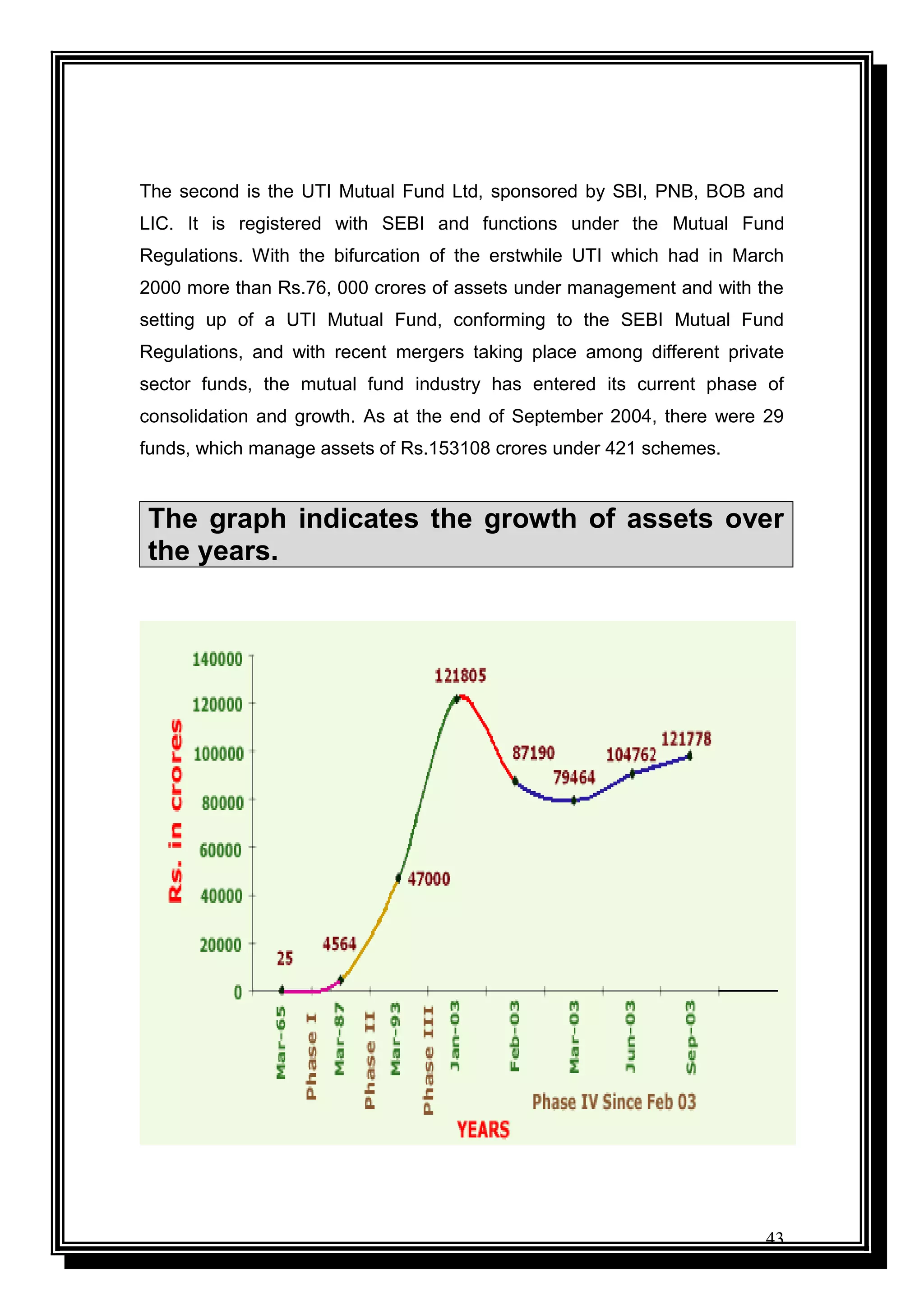
The graph indicates the growth of assets over
the years.
45
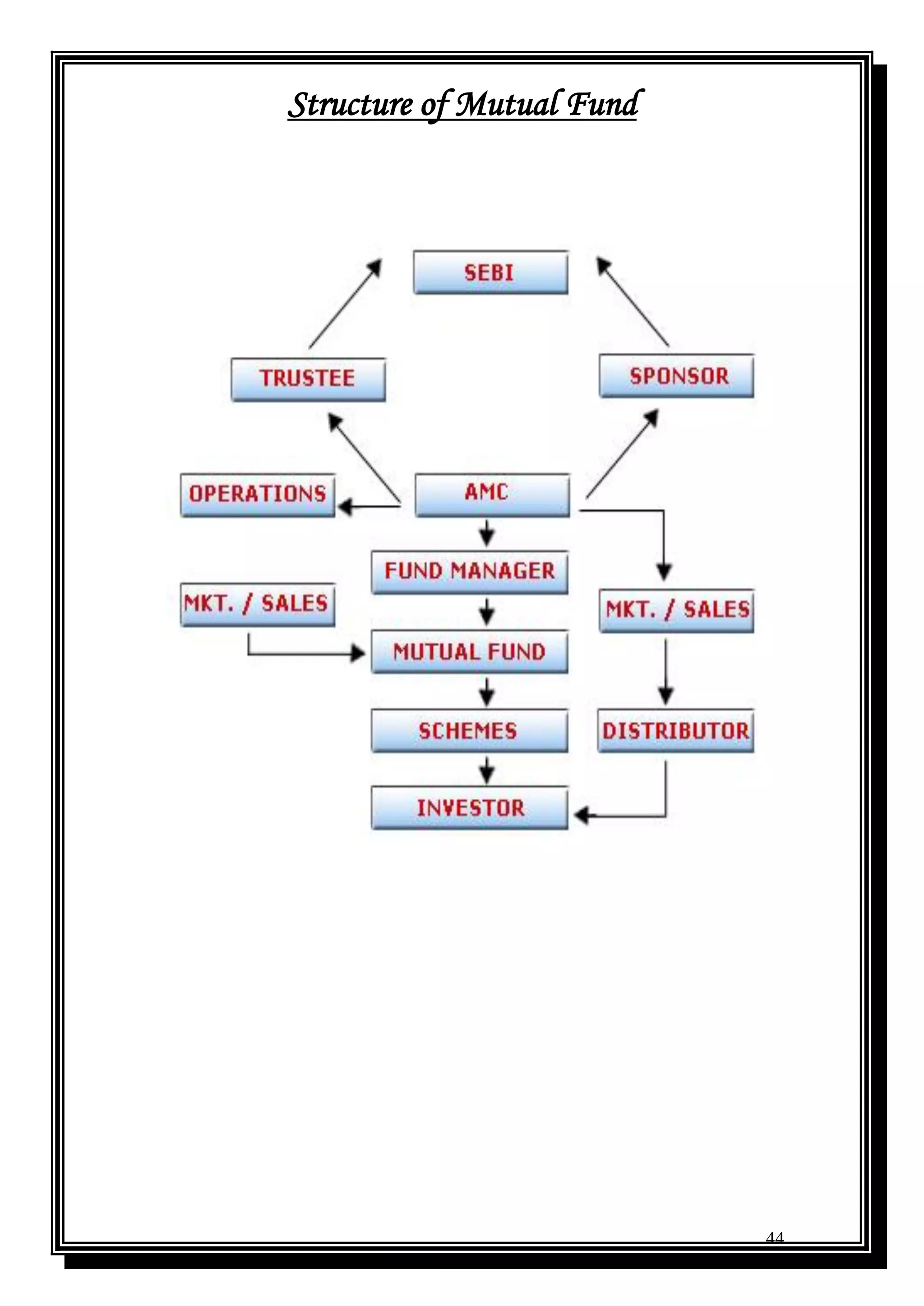
The Structure Consistsof
Sponsor
Sponsor is the person who acting alone or in combination with another body
corporate establishes a mutual fund. Sponsor must contribute at least 40% of
the net worth of the Investment Managed and meet the eligibility criteria
prescribed under the Securities and Exchange Board of India (Mutual Funds)
Regulations, 1996.The Sponsor is not responsible or liable for any loss or
shortfall resulting from the operation of the Schemes beyond the initial
contribution made by it towards setting up of the Mutual Fund.
Trust
The Mutual Fund is constituted as a trust in accordance with the provisions of
the Indian Trusts Act, 1882 by the Sponsor. The trust deed is registered under
the Indian Registration Act, 1908.
Trustee
Trustee is usually a company (corporate body) or a Board of Trustees (body
of individuals). The main responsibility of the Trustee is to safeguard the
interest of the unit holders and inter alia ensure that the AMC functions in the
interest of investors and in accordance with the Securities and Exchange
Board of India (Mutual Funds) Regulations, 1996, the provisions of the Trust
Deed and the Offer Documents of the respective Schemes. At least 2/3rd
directors of the Trustee are independent directors who are not associated with
the Sponsor in any manner.
46.
46
Asset Management Company(AMC)
The Trustee as the Investment Manager of the Mutual Fund appoints the
AMC. The AMC is required to be approved by the Securities and Exchange
Board of India (SEBI) to act as an asset management company of the Mutual
Fund. At least 50% of the directors of the AMC are independent directors who
are not associated with the Sponsor in any manner. The AMC must have a
net worth of at least 10 crores at all times.
Registrar and Transfer Agent
The AMC if so authorized by the Trust Deed appoints the Registrar and
Transfer Agent to the Mutual Fund. The Registrar processes the application
form; redemption requests and dispatches account statements to the unit
holders. The Registrar and Transfer agent also handles communications with
investors and updates investor records.
47.
47
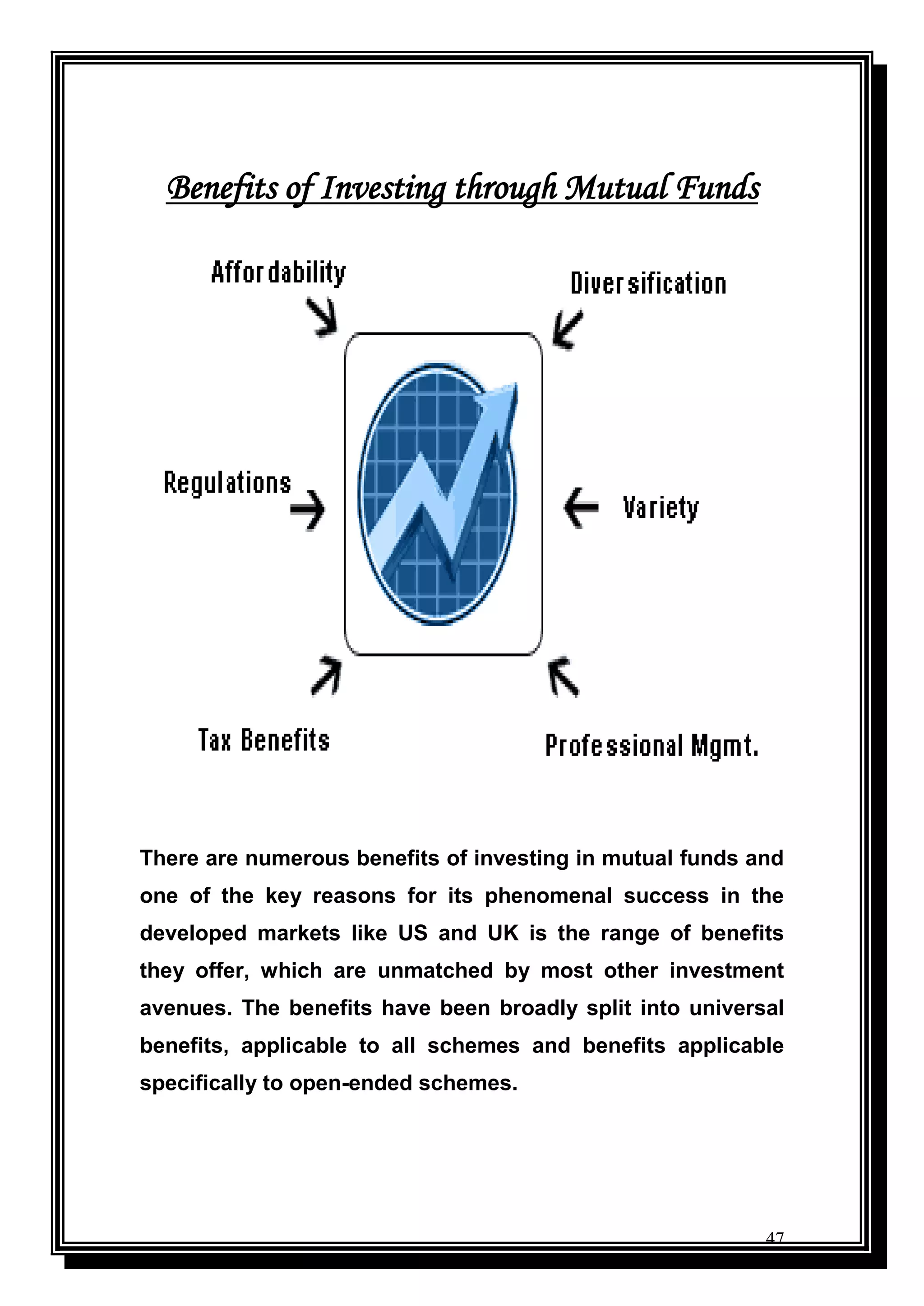
Benefits of Investingthrough Mutual Funds
There are numerous benefits of investing in mutual funds and
one of the key reasons for its phenomenal success in the
developed markets like US and UK is the range of benefits
they offer, which are unmatched by most other investment
avenues. The benefits have been broadly split into universal
benefits, applicable to all schemes and benefits applicable
specifically to open-ended schemes.
48.
48
Affordability
A mutual fundinvests in a portfolio of assets, i.e. bonds, shares, etc.
depending upon the investment objective of the scheme. An investor can buy
in to a portfolio of equities, which would otherwise be extremely expensive.
Each unit holder thus gets an exposure to such portfolios with an investment
as modest as Rs.5000/-. This amount today would get you less than quarter
of an Infosys share! Thus it would be affordable for an investor to build a
portfolio of investments through a mutual fund rather than investing directly in
the stock market.
Diversification
The nuclear weapon in your arsenal for your fight against Risk. It simply
means that you must spread your investment across different securities
(stocks, bonds, money market instruments, real estate, fixed deposits etc.)
and different sectors (auto, textile, information technology etc.). This kind of a
diversification may add to the stability of your returns, for example during one
period of time equities might under performs but bonds and money market
instruments might do well enough to offset the effect of a slump in the equity
markets. Similarly the information technology sector might be faring poorly but
the auto and textile sectors might do well and may protect your principal
investment as well as help you meet your return objectives.
Variety
Mutual funds offer a tremendous variety of schemes. This variety is beneficial
in two ways: first, it offers different types of schemes to investors with different
needs and risk appetites; secondly, it offers an opportunity to an investor to
invest sums across a variety of schemes, both debt and equity. For example,
an investor can invest his money in a Growth Fund (equity scheme) and
Income Fund (debt scheme) depending on his risk appetite and thus create a
balanced portfolio easily or simply just buy a Balanced Scheme.
49.
49
Professional Management
Qualified investmentprofessionals who seek to maximize returns and
minimize risk monitor investor's money. When you buy in to a mutual fund,
you are handing your money to an investment professional that has
experience in making investment decisions. It is the Fund Manager's job to (a)
find the best securities for the fund, given the fund's stated investment
objectives; and (b) keep track of investments and changes in market
conditions and adjust the mix of the portfolio, as and when required.
Tax Benefits
Any income distributed after March 31, 2002 will be subject to tax in the
assessment of all Unit holders. However, as a measure of concession to Unit
holders of open-ended equity-oriented funds, income distributions for the year
ending March 31, 2003, will be taxed at a concessional rate of 10.5%.
In case of Individuals and Hindu Undivided Families a deduction up to Rs.
9,000 from the Total Income will be admissible in respect of income from
investments specified in Section 80L, including income from Units of the
Mutual Fund. Units of the schemes are not subject to Wealth-Tax and Gift-
Tax.
Regulations
Securities Exchange Board of India (“SEBI”), the mutual funds regulator has
clearly defined rules, which govern mutual funds. These rules relate to the
formation, administration and management of mutual funds and also prescribe
disclosure and accounting requirements. Such a high level of regulation seeks
to protect the interest of investors.
50.
50
Disadvantages of MutualFunds
No control over costs:
The funds are managed in huge volume and so the control on expenses
cannot be exercised, as there is lot of formalities and administrative expenses
attached. Though the limit of incurring expenses is predetermined but still it
cannot be kept in control.
No tailor made portfolio:
There is no tailor made portfolio available to any individual. The products and
scheme that is designed by the fund managers is on their philosophy and is
floated in the market with a common goal. No individual can have their own
portfolio maintained separately from the other investors.
Delay in redemption:
The redemption of the funds though has liquidity in 24-hours to 3 days takes
formal application of redemption as well as needs time for redemption. This
becomes cumbersome for the investors.
Non-availability of loans:
Mutual funds are not accepted as security against loan. The investor cannot
deposit the mutual funds against taking any kind of bank loans though they
may be his assets.
52
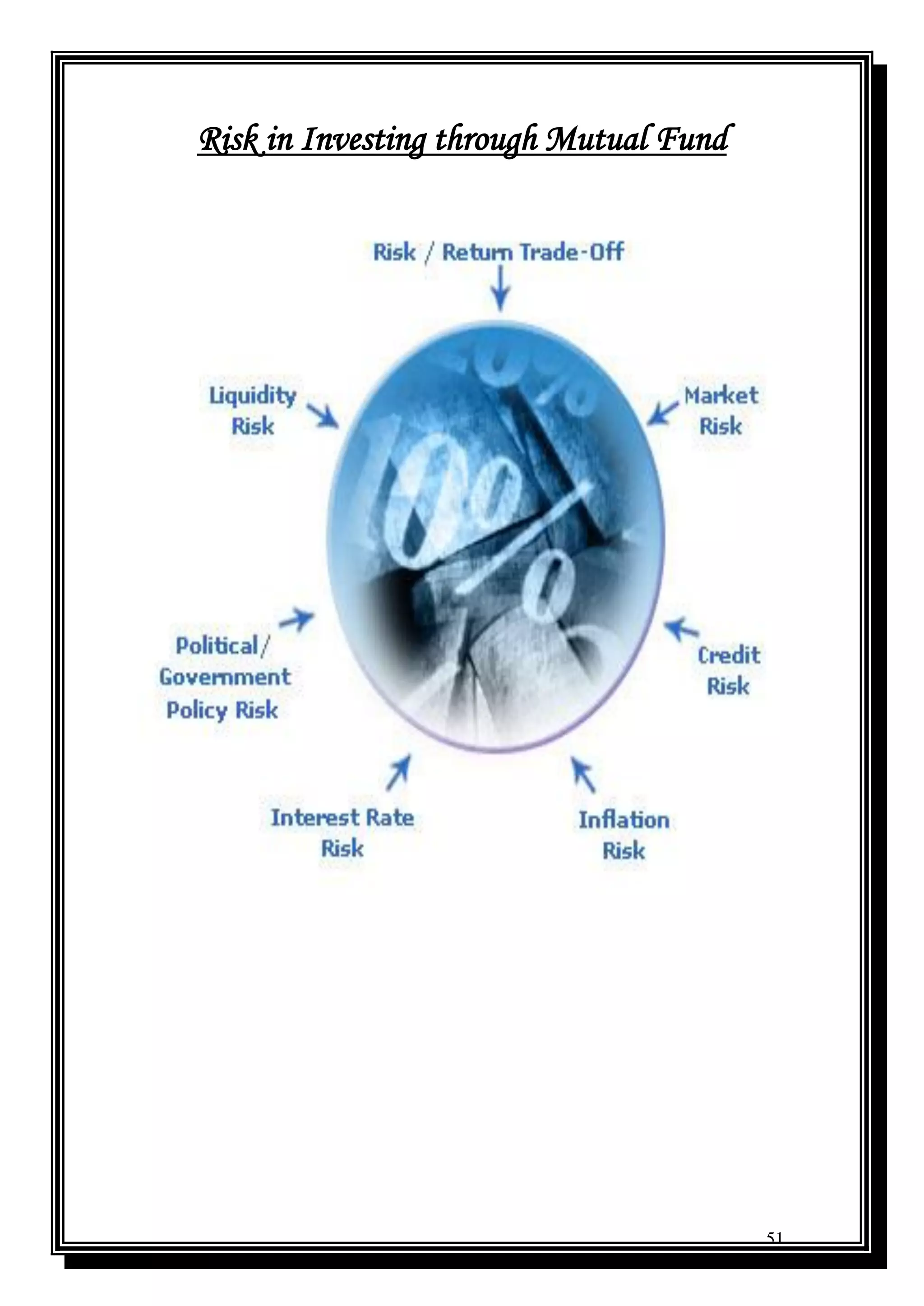
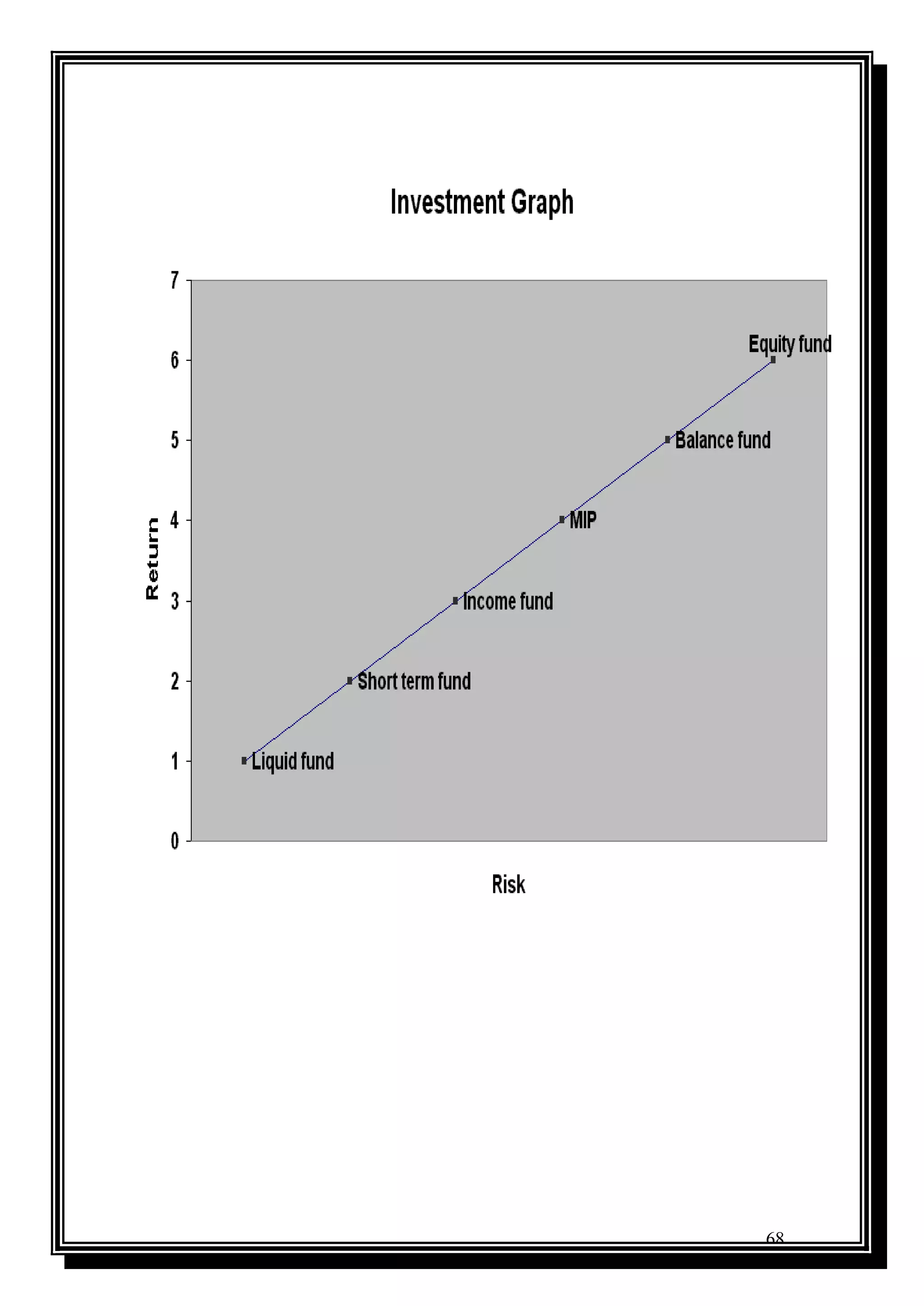
The Risk-Return Trade-off
Themost important relationship to understand is the risk-return trade-off.
Higher the risk greater the returns/loss and lower the risk lesser the
returns/loss.
Hence it is up to investor, the investor to decide how much risk individual is
willing to take. In order to do this investor must first be aware of the different
types of risks involved with particular investment decision.
Market Risk
Sometimes prices and yields of all securities rise and fall. Broad outside
influences affecting the market in general lead to this. This is true, may it be
big corporations or smaller mid-sized companies. This is known as Market
Risk. A Systematic Investment Plan (“SIP”) that works on the concept of
Rupee Cost Averaging (“RCA”) might help mitigate this risk.
Credit Risk
The debt servicing ability (may it be interest payments or repayment of
principal) of a company through its cash flows determines the Credit Risk
faced by you. This credit risk is measured by independent rating agencies like
CRISIL who rate companies and their paper. An „AAA‟ rating is considered the
safest whereas a „D‟ rating is considered poor credit quality. A well-diversified
portfolio might help mitigate this risk.
Inflation Risk
Inflation is the loss of purchasing power over time. A lot of times people make
conservative investment decisions to protect their capital but end up with a
sum of money that can buy less than what the principal could at the time of
the investment. This happens when inflation grows faster than the return on
your investment. A well-diversified portfolio with some investment in equities
might help mitigate this risk.
53.
53
Interest Rate Risk
Ina free market economy interest rates are difficult if not impossible to
predict. Changes in interest rates affect the prices of bonds as well as
equities. If interest rates rise the prices of bonds fall and vice versa. Equity
might be negatively affected as well in a rising interest rate environment. A
well-diversified portfolio might help mitigate this risk.
Political/Government Policy Risk
Changes in government policy and political decision can change the
investment environment. They can create a favorable environment for
investment or vice versa.
Liquidity Risk
Liquidity risk arises when it becomes difficult to sell the securities that one has
purchased. Liquidity Risk can be partly mitigated by diversification, staggering
of maturities as well as internal risk controls that lean towards purchase of
liquid securities.
55
A. Investment Objective
Schemescan be classified by way of their stated investment objective such
as Growth Fund, Balanced Fund, and Income Fund etc.
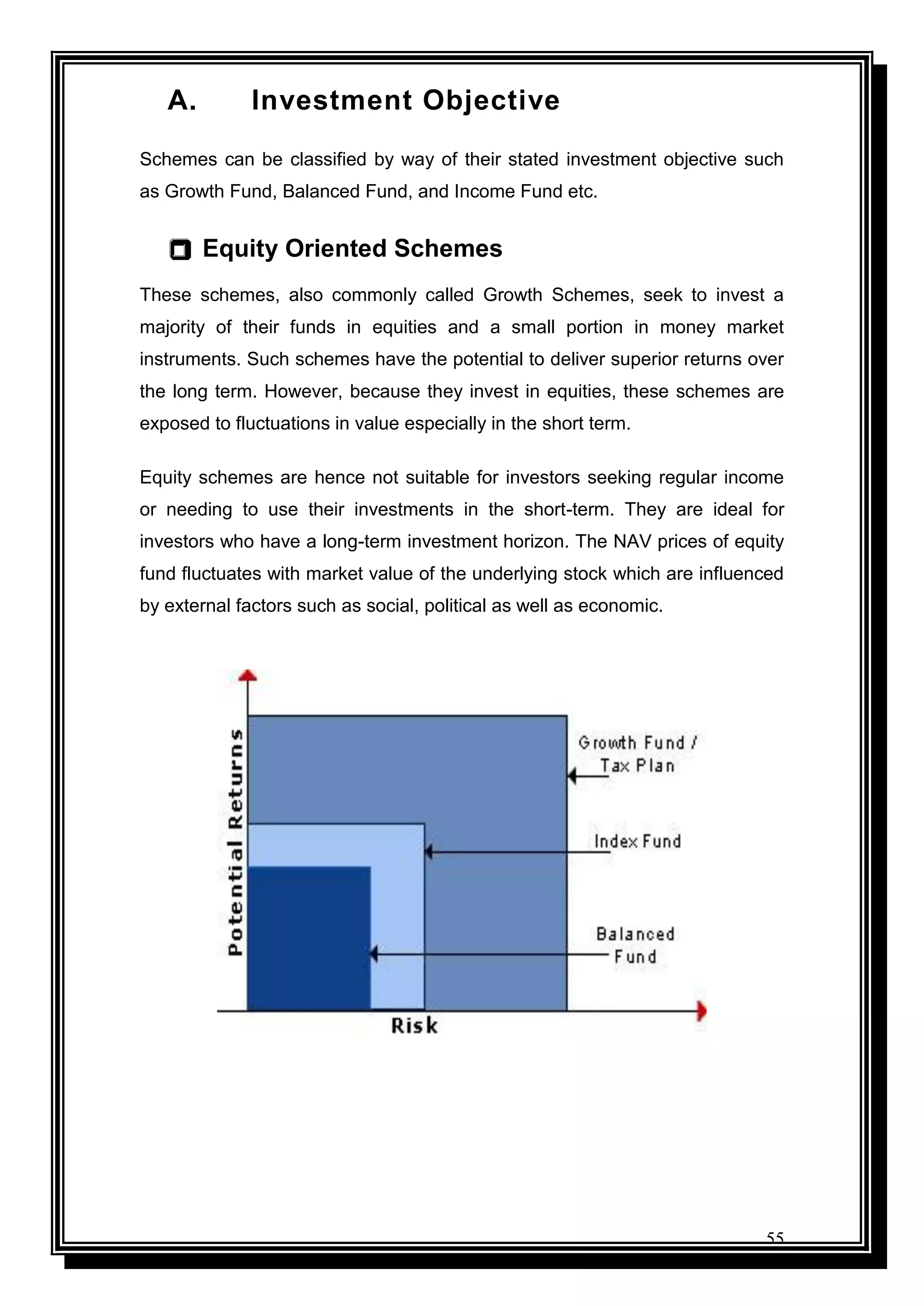
Equity Oriented Schemes
These schemes, also commonly called Growth Schemes, seek to invest a
majority of their funds in equities and a small portion in money market
instruments. Such schemes have the potential to deliver superior returns over
the long term. However, because they invest in equities, these schemes are
exposed to fluctuations in value especially in the short term.
Equity schemes are hence not suitable for investors seeking regular income
or needing to use their investments in the short-term. They are ideal for
investors who have a long-term investment horizon. The NAV prices of equity
fund fluctuates with market value of the underlying stock which are influenced
by external factors such as social, political as well as economic.
56.
56
A.General Purpose
The investmentobjectives of general-purpose equity schemes do not restrict
them to invest in specific industries or sectors. They thus have a diversified
portfolio of companies across a large spectrum of industries. While they are
exposed to equity price risks, diversified general-purpose equity funds seek to
reduce the sector or stock specific risks through diversification. They mainly
have market risk exposure. HDFC Growth Fund is a general-purpose equity
scheme.
B.Sector Specific
These schemes restrict their investing to one or more pre-defined sectors,
e.g. technology sector. Since they depend upon the performance of select
sectors only, these schemes are inherently more risky than general-purpose
schemes. They are suited for informed investors who wish to take a view and
risk on the concerned sector.
C.Special Schemes
Index schemes
The primary purpose of an Index is to serve as a measure of the performance
of the market as a whole, or a specific sector of the market. An Index also
serves as a relevant benchmark to evaluate the performance of mutual funds.
Some investors are interested in investing in the market in general rather than
investing in any specific fund. Such investors are happy to receive the returns
posted by the markets. As it is not practical to invest in each and every stock
in the market in proportion to its size, these investors are comfortable
investing in a fund that they believe is a good representative of the entire
market. Index Funds are launched and managed for such investors. An
example to such a fund is the HDFC Index Fund.
57.
57
Tax saving schemes
Investors(individuals and Hindu Undivided Families (“HUFs”)) are being
encouraged to invest in equity markets through Equity Linked Savings
Scheme (“ELSS”) by offering them a tax rebate. Units purchased cannot be
assigned / transferred/ pledged / redeemed / switched – out until completion
of 3 years from the date of allotment of the respective Units.
The Scheme is subject to Securities & Exchange Board of India (Mutual
Funds) Regulations, 1996 and the notifications issued by the Ministry of
Finance (Department of Economic Affairs), Government of India regarding
ELSS.
Subject to such conditions and limitations, as prescribed under Section 88 of
the Income-tax Act, 1961, subscriptions to the Units not exceeding Rs.10, 000
would be eligible to a deduction, from income tax, of an amount equal to 20%
of the amount subscribed. HDFC Tax Plan 2000 is such a fund.
Real Estate Funds
Specialized real estate funds would invest in real estates directly, or may fund
real estate developers or lend to them directly or buy shares of housing
finance companies or may even buy their securitized assets.
58.
58
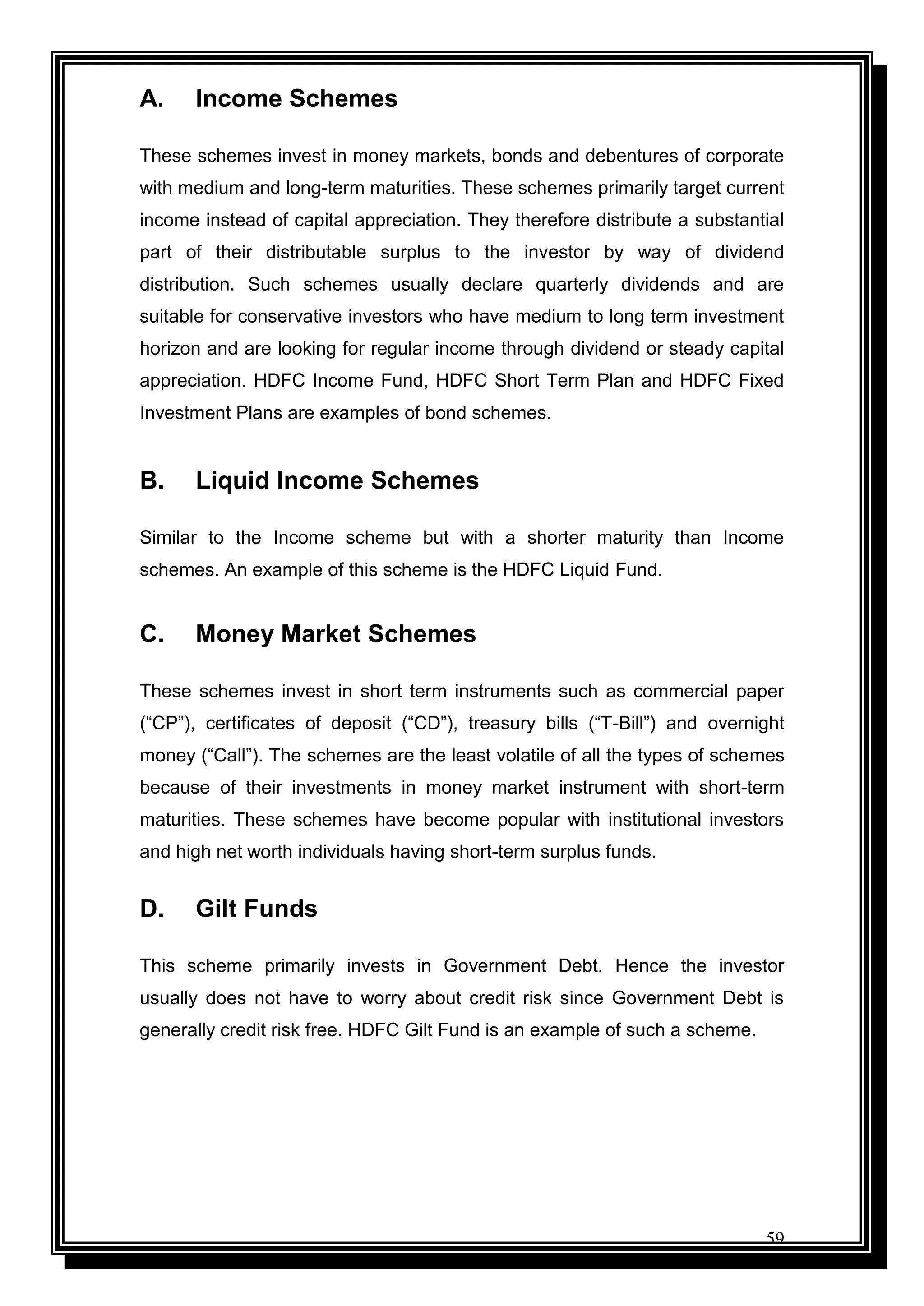
Debt BasedSchemes
These schemes, also commonly called Income Schemes, invest in debt
securities such as corporate bonds, debentures and government securities.
The prices of these schemes tend to be more stable compared with equity
schemes and most of the returns to the investors are generated through
dividends or steady capital appreciation. These schemes are ideal for
conservative investors or those not in a position to take higher equity risks,
such as retired individuals. However, as compared to the money market
schemes they do have a higher price fluctuation risk and compared to a Gilt
fund they have a higher credit risk.
59.
59
A. Income Schemes
Theseschemes invest in money markets, bonds and debentures of corporate
with medium and long-term maturities. These schemes primarily target current
income instead of capital appreciation. They therefore distribute a substantial
part of their distributable surplus to the investor by way of dividend
distribution. Such schemes usually declare quarterly dividends and are
suitable for conservative investors who have medium to long term investment
horizon and are looking for regular income through dividend or steady capital
appreciation. HDFC Income Fund, HDFC Short Term Plan and HDFC Fixed
Investment Plans are examples of bond schemes.
B. Liquid Income Schemes
Similar to the Income scheme but with a shorter maturity than Income
schemes. An example of this scheme is the HDFC Liquid Fund.
C. Money Market Schemes
These schemes invest in short term instruments such as commercial paper
(“CP”), certificates of deposit (“CD”), treasury bills (“T-Bill”) and overnight
money (“Call”). The schemes are the least volatile of all the types of schemes
because of their investments in money market instrument with short-term
maturities. These schemes have become popular with institutional investors
and high net worth individuals having short-term surplus funds.
D. Gilt Funds
This scheme primarily invests in Government Debt. Hence the investor
usually does not have to worry about credit risk since Government Debt is
generally credit risk free. HDFC Gilt Fund is an example of such a scheme.
60.
60
Hybrid Schemes
Theseschemes are commonly known as balanced schemes. These schemes
invest in both equities as well as debt. By investing in a mix of this nature,
balanced schemes seek to attain the objective of income and moderate
capital appreciation and are ideal for investors with a conservative, long-term
orientation. HDFC Balanced Fund and HDFC Children‟s Gift Fund are
examples of hybrid schemes.
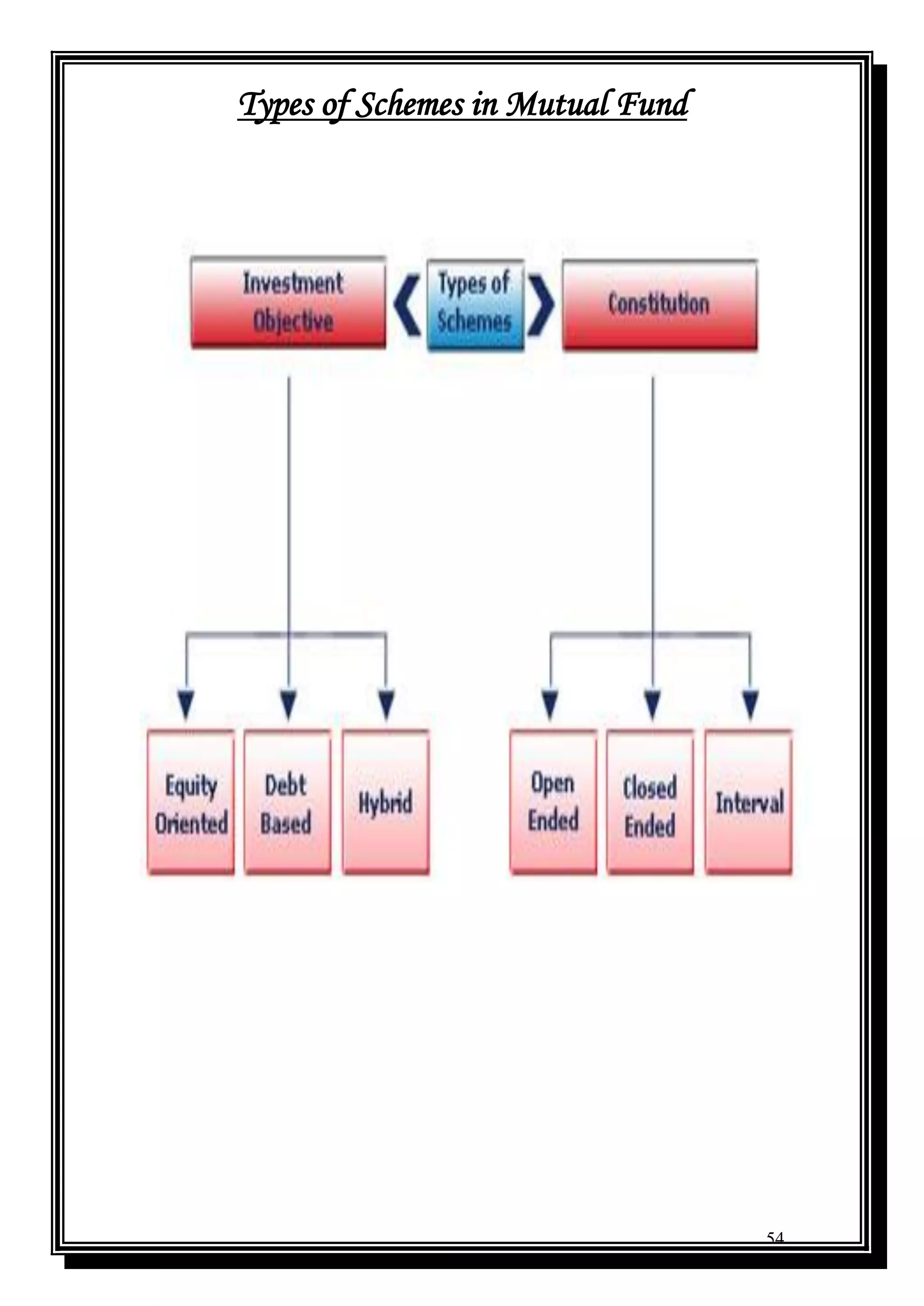
B. Constitution
Schemes can be classified as Closed-ended or Open-ended depending upon
whether they give the investor the option to redeem at any time (open-ended)
or whether the investor has to wait till maturity of the scheme.
Open ended Schemes
The units offered by these schemes are available for sale and repurchase on
any business day at NAV based prices. Hence, the unit capital of the
schemes keeps changing each day. Such schemes thus offer very high
liquidity to investors and are becoming increasingly popular in India. Please
note that an open-ended fund is NOT obliged to keep selling/issuing new units
at all times, and may stop issuing further subscription to new investors. On the
other hand, an open-ended fund rarely denies to its investor the facility to
redeem existing units.
Closed ended Schemes
The unit capital of a close-ended product is fixed as it makes a one-time sale
of fixed number of units. These schemes are launched with an initial public
offer (IPO) with a stated maturity period after which the units are fully
redeemed at NAV linked prices. In the interim, investors can buy or sell units
on the stock exchanges where they are listed. Unlike open-ended schemes,
the unit capital in closed-ended schemes usually remains unchanged. After an
61.
61
initial closed period,the scheme may offer direct repurchase facility to the
investors. Closed-ended schemes are usually more illiquid as compared to
open-ended schemes and hence trade at a discount to the NAV. This
discount tends towards the NAV closer to the maturity date of the scheme.
Interval Schemes
These schemes combine the features of open-ended and closed-ended
schemes. They may be traded on the stock exchange or may be open for sale
or redemption during pre-determined intervals at NAV based prices.
63
Investment Strategy
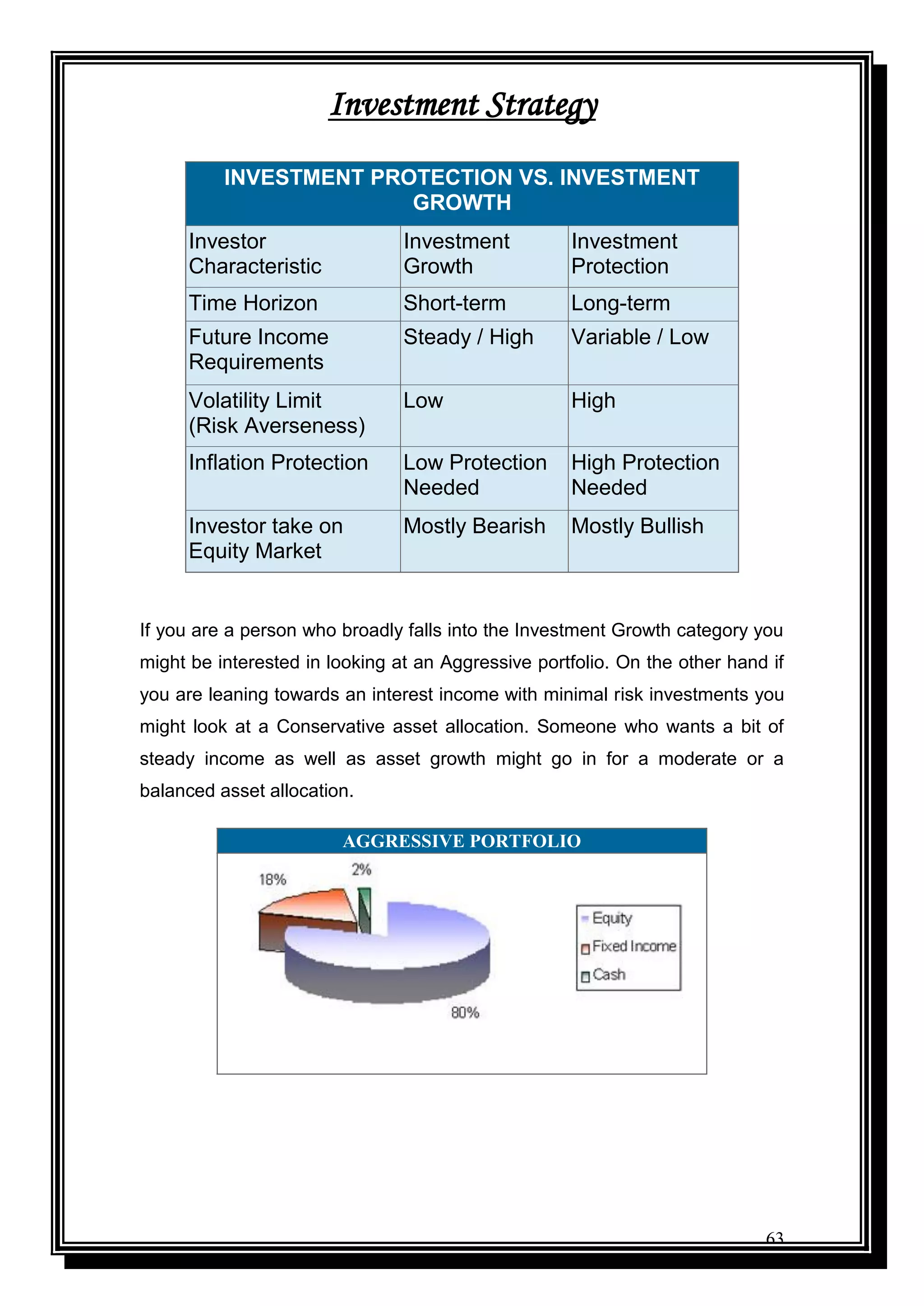
INVESTMENT PROTECTIONVS. INVESTMENT
GROWTH
Investor
Characteristic
Investment
Growth
Investment
Protection
Time Horizon Short-term Long-term
Future Income
Requirements
Steady / High Variable / Low
Volatility Limit
(Risk Averseness)
Low High
Inflation Protection Low Protection
Needed
High Protection
Needed
Investor take on
Equity Market
Mostly Bearish Mostly Bullish
If you are a person who broadly falls into the Investment Growth category you
might be interested in looking at an Aggressive portfolio. On the other hand if
you are leaning towards an interest income with minimal risk investments you
might look at a Conservative asset allocation. Someone who wants a bit of
steady income as well as asset growth might go in for a moderate or a
balanced asset allocation.
AGGRESSIVE PORTFOLIO
64.
64
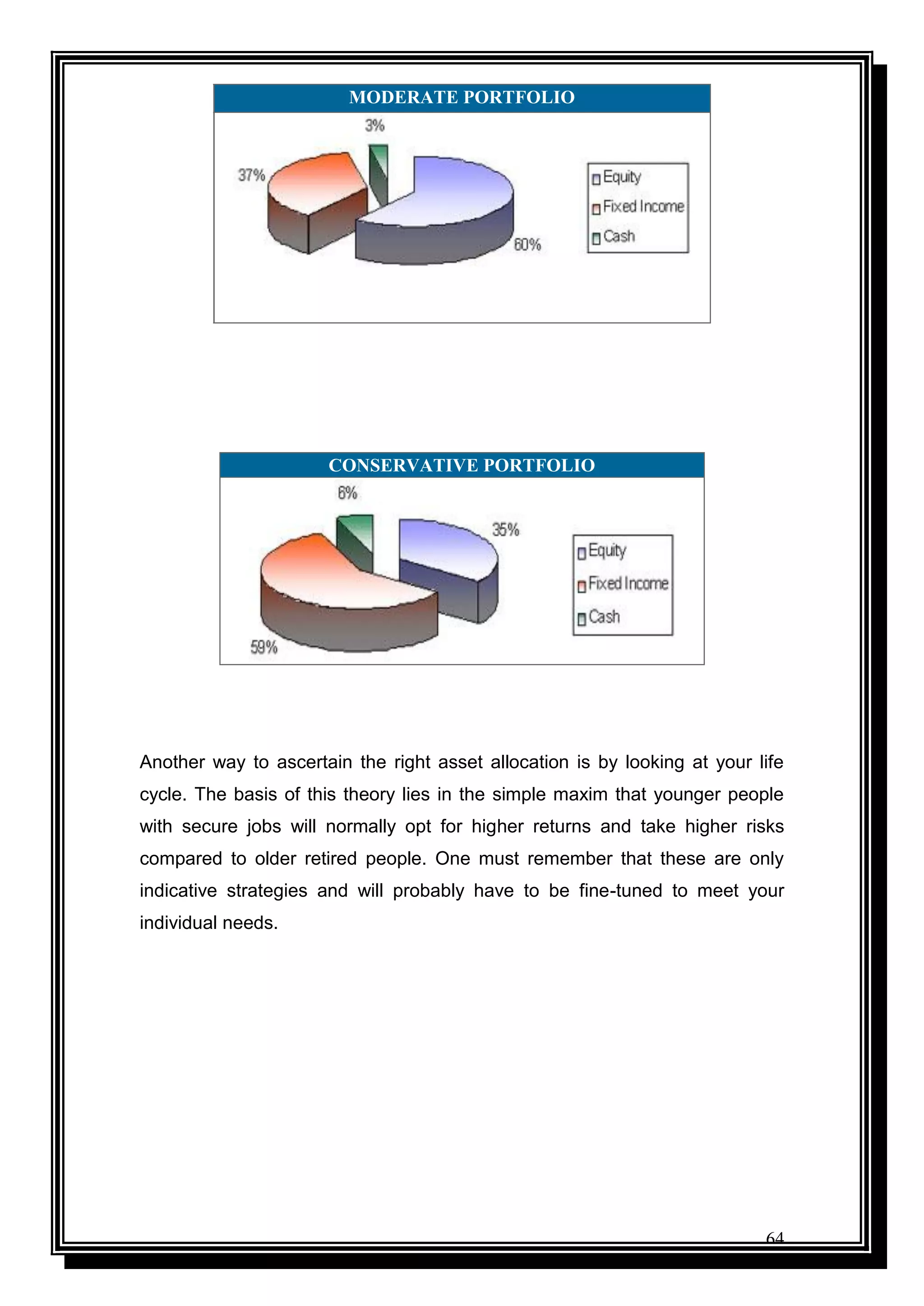
MODERATE PORTFOLIO
CONSERVATIVE PORTFOLIO
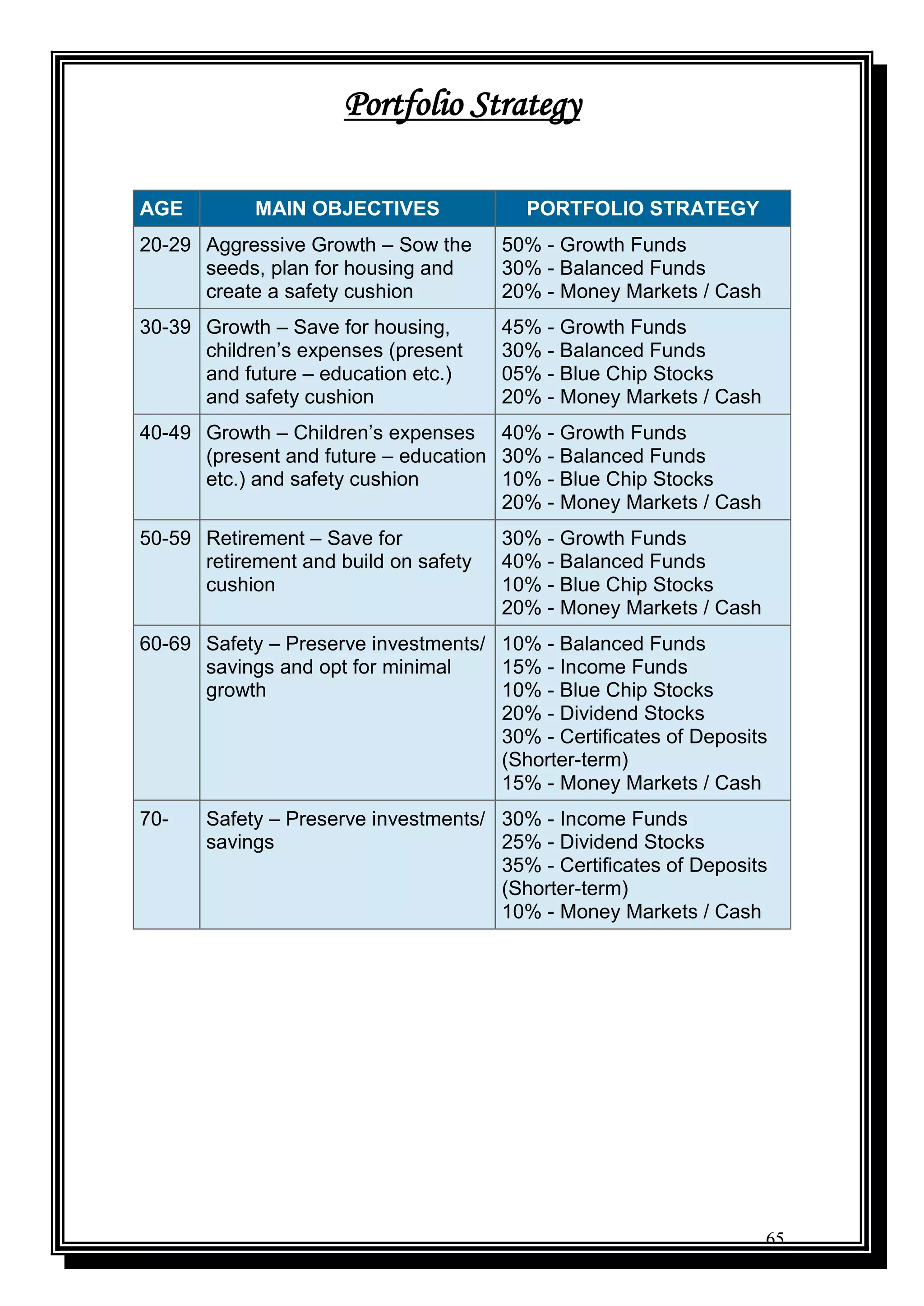
Anotherway to ascertain the right asset allocation is by looking at your life
cycle. The basis of this theory lies in the simple maxim that younger people
with secure jobs will normally opt for higher returns and take higher risks
compared to older retired people. One must remember that these are only
indicative strategies and will probably have to be fine-tuned to meet your
individual needs.
65.
65
Portfolio Strategy
AGE MAINOBJECTIVES PORTFOLIO STRATEGY
20-29 Aggressive Growth – Sow the
seeds, plan for housing and
create a safety cushion
50% - Growth Funds
30% - Balanced Funds
20% - Money Markets / Cash
30-39 Growth – Save for housing,
children‟s expenses (present
and future – education etc.)
and safety cushion
45% - Growth Funds
30% - Balanced Funds
05% - Blue Chip Stocks
20% - Money Markets / Cash
40-49 Growth – Children‟s expenses
(present and future – education
etc.) and safety cushion
40% - Growth Funds
30% - Balanced Funds
10% - Blue Chip Stocks
20% - Money Markets / Cash
50-59 Retirement – Save for
retirement and build on safety
cushion
30% - Growth Funds
40% - Balanced Funds
10% - Blue Chip Stocks
20% - Money Markets / Cash
60-69 Safety – Preserve investments/
savings and opt for minimal
growth
10% - Balanced Funds
15% - Income Funds
10% - Blue Chip Stocks
20% - Dividend Stocks
30% - Certificates of Deposits
(Shorter-term)
15% - Money Markets / Cash
70- Safety – Preserve investments/
savings
30% - Income Funds
25% - Dividend Stocks
35% - Certificates of Deposits
(Shorter-term)
10% - Money Markets / Cash
66.
66
HDFC Mutual FundProducts
Equity Funds
HDFC Growth Fund
HDFC Long Term Advantage Fund
HDFC Index Fund
HDFC Equity Fund
HDFC Capital Builder Fund
HDFC Tax saver
HDFC Top 200 Fund
HDFC Core & Satellite Fund
HDFC Premier Multi-Cap Fund
HDFC Long Term Equity Fund
Balanced Funds
HDFC Children's Gift Fund Investment Plan
HDFC Children's Gift Fund Savings Plan
HDFC Balanced Fund
HDFC Prudence Fund
67.
67
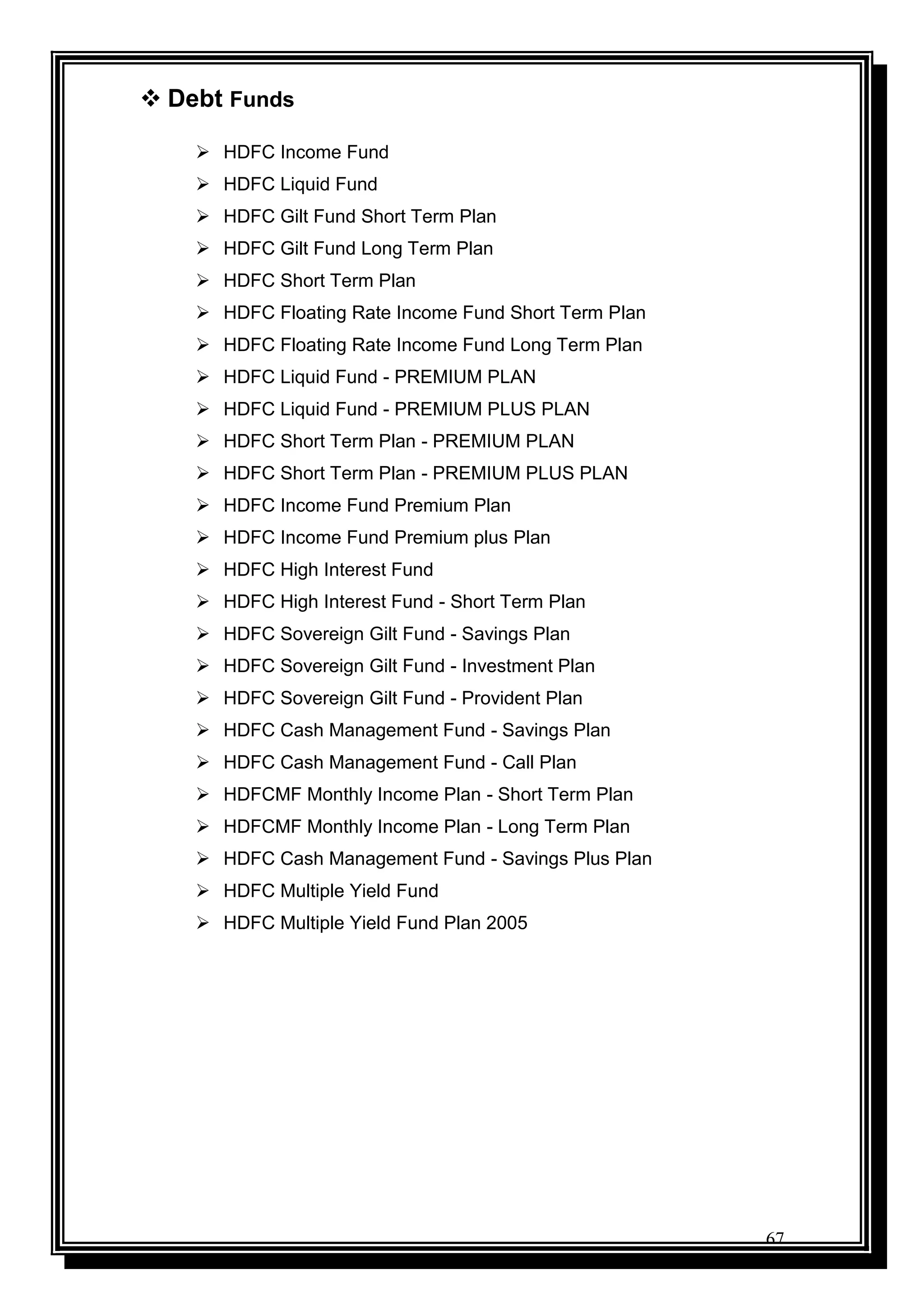
Debt Funds
HDFC Income Fund
HDFC Liquid Fund
HDFC Gilt Fund Short Term Plan
HDFC Gilt Fund Long Term Plan
HDFC Short Term Plan
HDFC Floating Rate Income Fund Short Term Plan
HDFC Floating Rate Income Fund Long Term Plan
HDFC Liquid Fund - PREMIUM PLAN
HDFC Liquid Fund - PREMIUM PLUS PLAN
HDFC Short Term Plan - PREMIUM PLAN
HDFC Short Term Plan - PREMIUM PLUS PLAN
HDFC Income Fund Premium Plan
HDFC Income Fund Premium plus Plan
HDFC High Interest Fund
HDFC High Interest Fund - Short Term Plan
HDFC Sovereign Gilt Fund - Savings Plan
HDFC Sovereign Gilt Fund - Investment Plan
HDFC Sovereign Gilt Fund - Provident Plan
HDFC Cash Management Fund - Savings Plan
HDFC Cash Management Fund - Call Plan
HDFCMF Monthly Income Plan - Short Term Plan
HDFCMF Monthly Income Plan - Long Term Plan
HDFC Cash Management Fund - Savings Plus Plan
HDFC Multiple Yield Fund
HDFC Multiple Yield Fund Plan 2005
69
Distribution channel
Individual Agents
Useof agents has been the most widely prevalent practice for
distribution of funds over the years. By definition an agent acts on behalf
of principal in this case of mutual funds. An agent is essentially a broker
between the fund and the investor. In India we also have the unique
system where by a broker has a number of sub brokers working under
him. The vast sub broker network ensures a large geographic coverage
then otherwise.
Distribution Companies
Availing of the services of established distribution companies is practice
accepted by mutual fund internationally. This practice evolves with a
view to provide the huge administrative mechanism require supporting a
large agent force. Instead of having to deal with several agents, a fund
can interact with distribution companies that have several employees or
sub brokers under it.
Bank & NBFCs
In developed countries, bank are an important marketing vehicles for
mutual funds given that banks themselves had large depositors/ clients
base of their own. We can see the opening up of this new channel now in
India. Several banks, particularly private and foreign banks are involved
in fund distribution by providing services similar to those of distribution
companies, on a commission basis.
70.
70
Direct Marketing
Direct marketingmeans that the mutual funds sell their own products
without any use of intermediateries. Usually, this takes the form of the
sales officer and employees of the AMC who approach the investor and
accept their contribution directly. However in India, independent agents
may really be created as a direct marketing channel in a sense that they
do not form a well knit independent and organized a single entity and act
more like fund employees. Others channel like distribution companies or
banks or even stockbrokers are clearly distinct and independent
intermediaries.
Pricing Policy
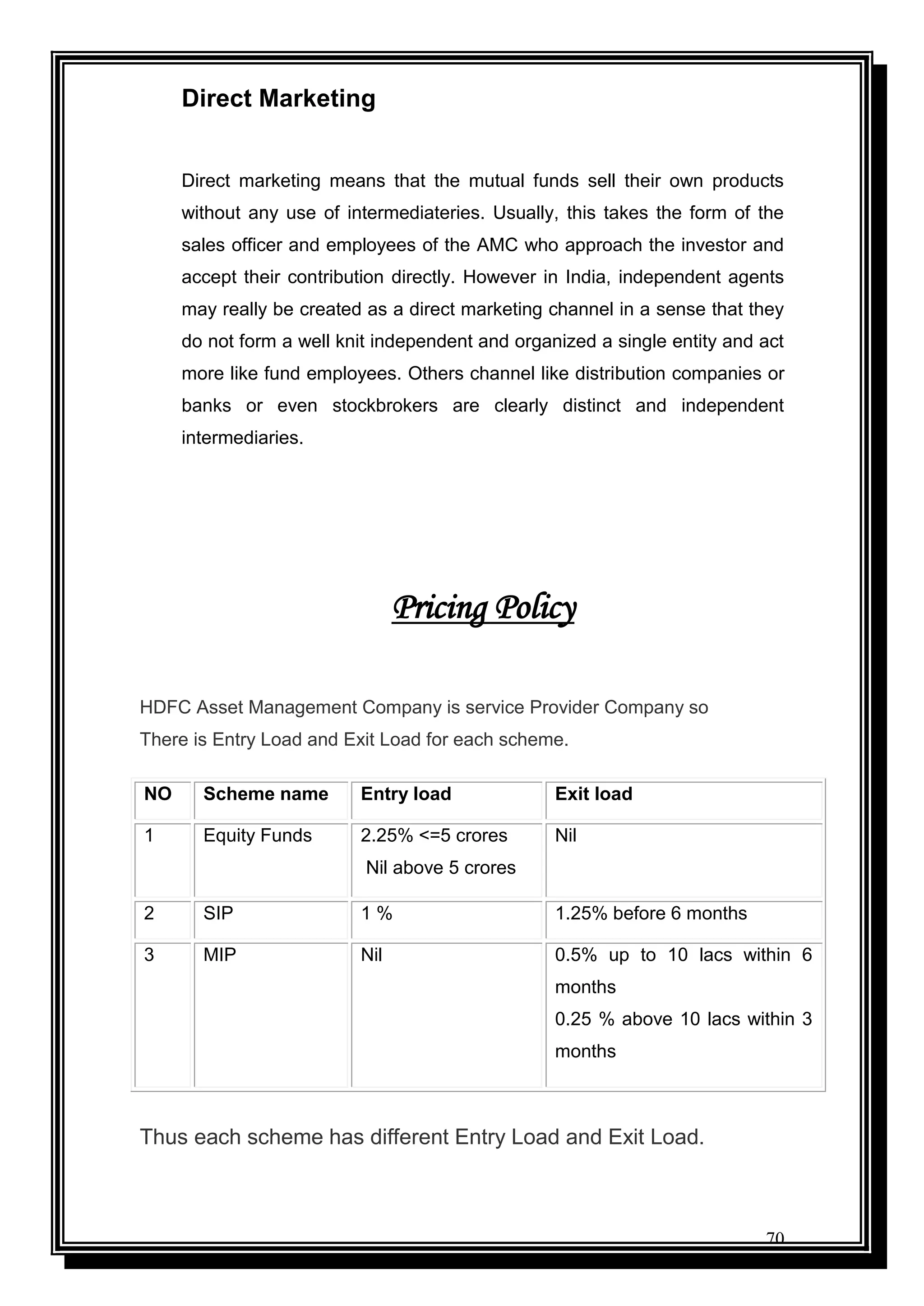
HDFC Asset Management Company is service Provider Company so
There is Entry Load and Exit Load for each scheme.
Thus each scheme has different Entry Load and Exit Load.
NO Scheme name Entry load Exit load
1 Equity Funds 2.25% <=5 crores
Nil above 5 crores
Nil
2 SIP 1 % 1.25% before 6 months
3 MIP Nil 0.5% up to 10 lacs within 6
months
0.25 % above 10 lacs within 3
months
71.
71
Promotional Tools
The objectiveof advertising of HDFC AMC is to create awareness about
services and scheme of HDFC among investors and sub-brokers and
increases sub-brokers of HDFC AMC.
Company does give advertisement in media like Newspapers, and Magazines
etc. when in introduce new scheme or mutual fund IPO and through direct
marketing they advertise and create awareness about their services and new
schemes. HDFC also do presentation about various schemes so that
investors can know more about their product and services.
Another tool of promotion of HDFC AMC is Public Relation involves a variety
of programs designed to promote or protect a company‟s image or its
individual products. HDFC has PR department monitors the attitudes of the
organization‟s publics and distributes information and communications to build
goodwill. They also perform following function:
1. Press relation: Presenting news and
information about the HDFC AMC in the most
positive light.
2. Product publicity: Sponsoring efforts to
publicize specific products.
3. Counseling: Advising management about
public issues and company positions and
image.
Innovative Practices
Relationship Manager for all client base more than 5 lacs. Relationship
marketing is based on the premise that important accounts need focused and
continuous attention. Relationship marketing helps to judge which segments
and which specific customers will respond profitably to relationship
management.
73
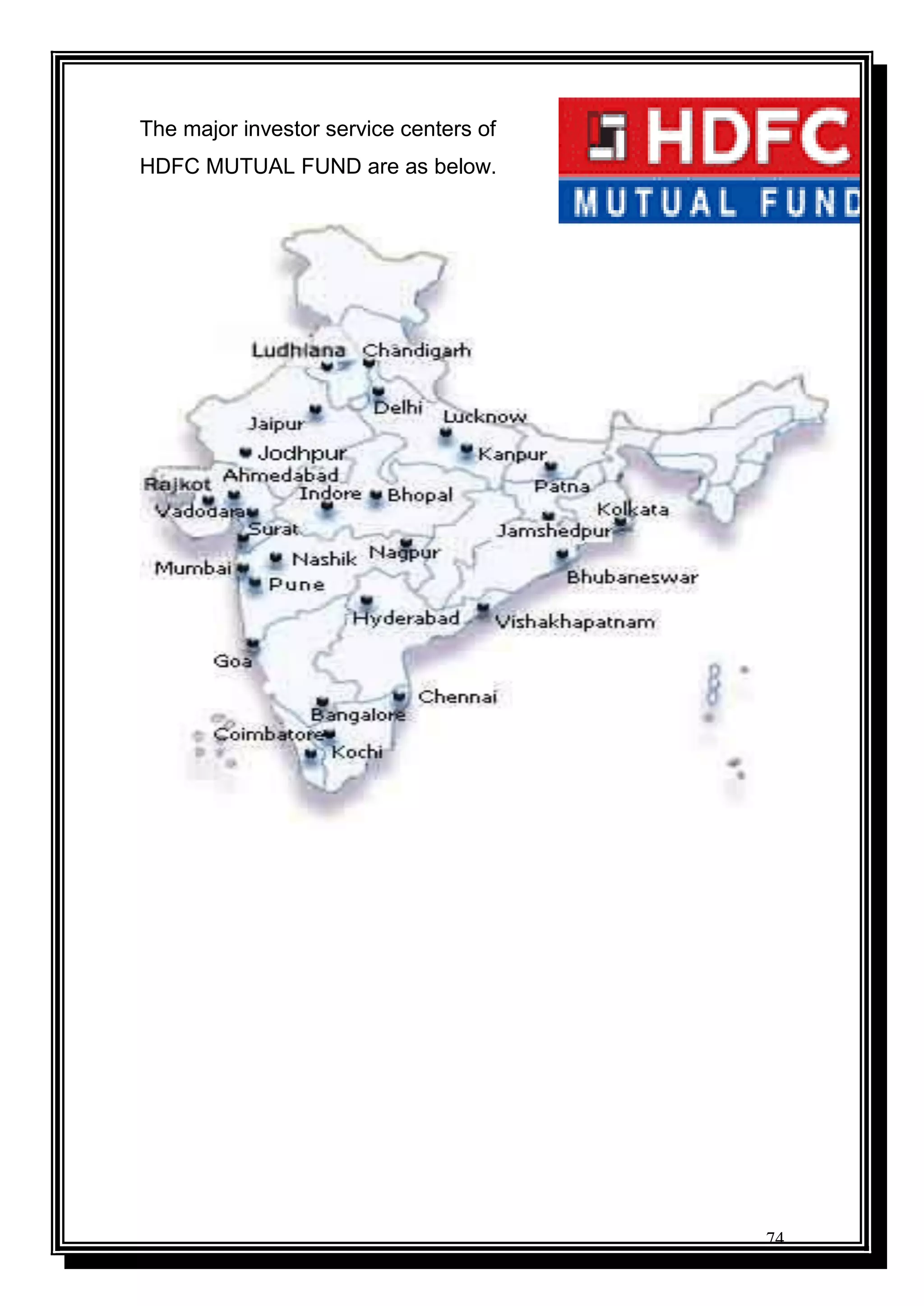
Location Details
HDFC AMCis located at Yagnik road which is in the heart of the city where
service is easily available for all customer and easy access compare with
other place that available in city. Location has major impact on success or
failure of operation. Advantages of this type of location are that service cost
and distribution cost is minimum comparison with other place.
REGISTERED OFFICE OF HDFC ASSET MANAGEMENT COMPANY
LIMITED IS:
RAMON HOUSE, 3RD
FLOOR,
H.T. PAREKH MARG,
169, BACK BAY RECLAMATION,
CHURCHGATE,
MUMBAI 400 020
75
Layout Details
There isa plan of all the act of planning & optimum arrangement of planning
including flow of man & material and customer, operating equipment, storage
space, material handling equipments and all other supporting services along
with the design of best structure to contain all these facilities.
Planning & Controlling
It is useful for effective utilization of resources, to achieve organization goal
and objectives with respect to quality service, cost control timely service.
Other objective is to co-ordinate with other department to ensure continuous
quality service. There is a proper planning and planning with respect o which
type of scheme to be introduced, what are expenses of R&D for finding out
feasibility of that scheme, how many people will work on that particular job,
before introducing new scheme. There is special research department who
carries out analysis of market and there is a fund manager who carrier out all
planning for investing in various sector and he is also responsible controlling
cost of transaction so that it can give return to investors.
76.
76
Maintenance
HDFC AMC isthe service sector industry so all the work is carried out with
the help of computer System. There is contract given to service provider and
staff itself does other maintenance.
Procurement
HDFC AMC is the service sector industry so procurement is only for
computer machinery and computer stationary and other stationary include
brochures of all the schemes and monthly fact sheet is used in daily work.
Procurement of computer machinery is done through central contract of main
branch and procurement for stationary is done through local stationary
distributor
Store Management
HDFC AMC is the service sector industry so storage is only for files and fact
sheet and other document that published by AMC.
78
Acquisition of Funds
&
Utilizationof Funds
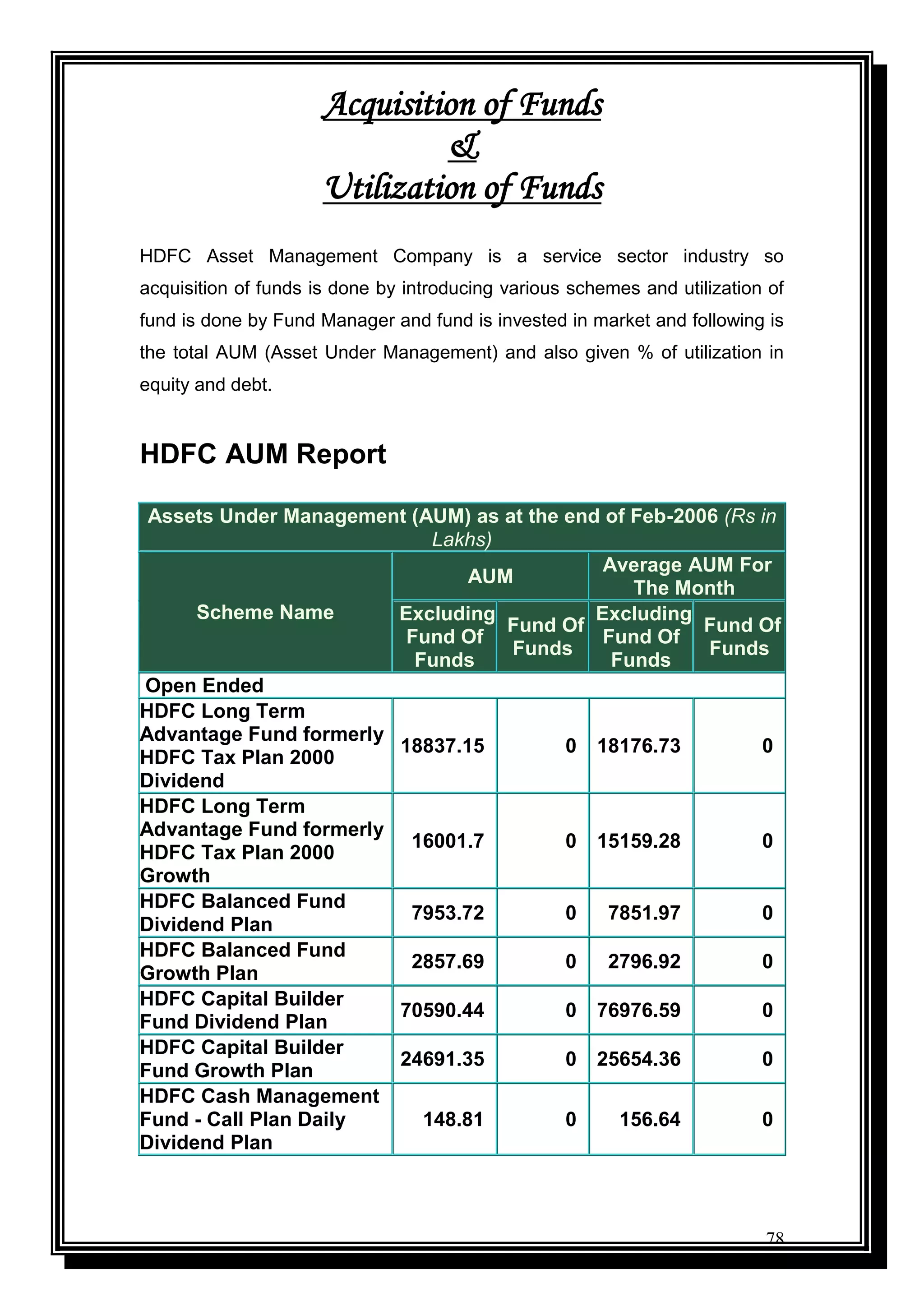
HDFC Asset Management Company is a service sector industry so
acquisition of funds is done by introducing various schemes and utilization of
fund is done by Fund Manager and fund is invested in market and following is
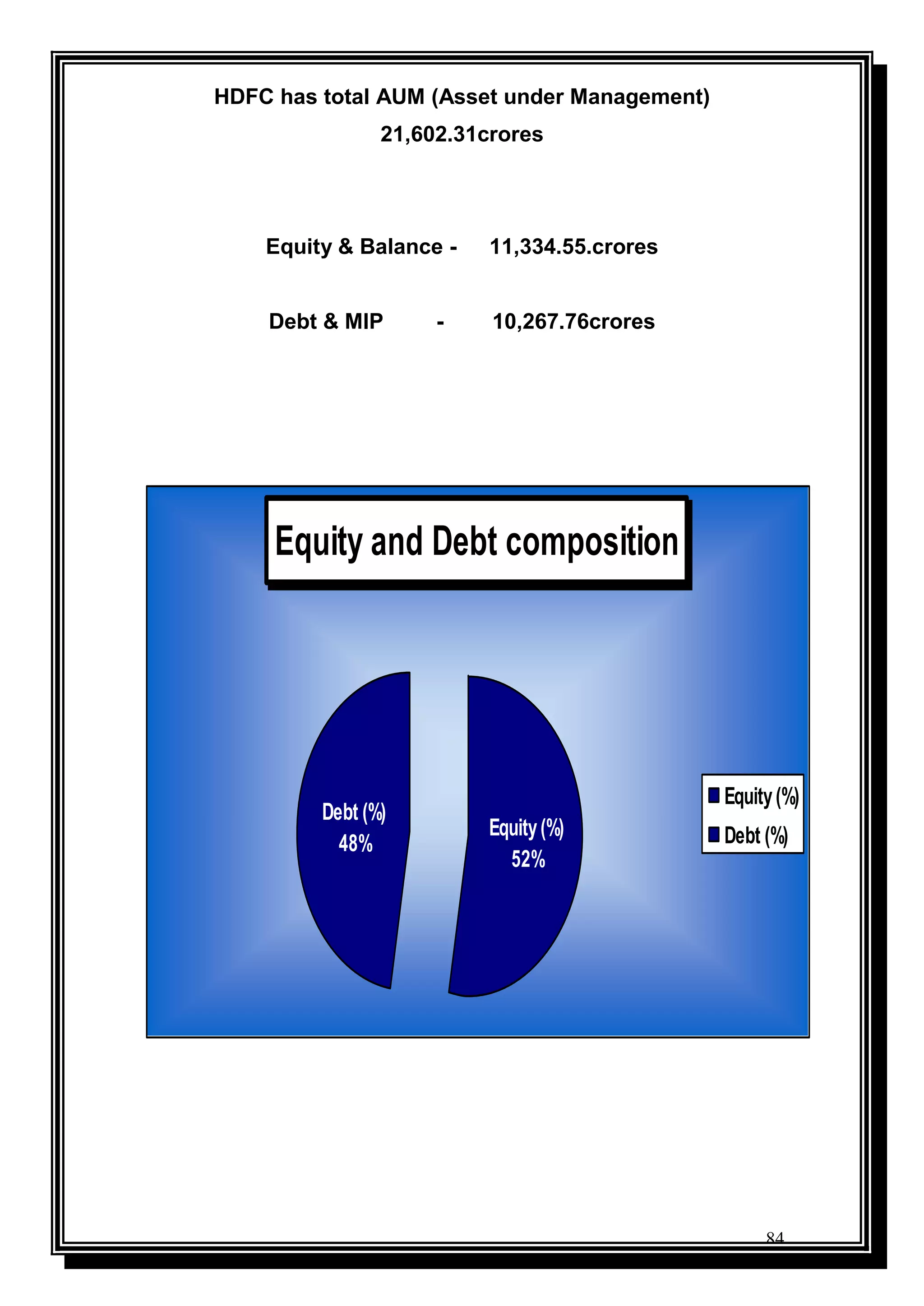
the total AUM (Asset Under Management) and also given % of utilization in
equity and debt.
HDFC AUM Report
Assets Under Management (AUM) as at the end of Feb-2006 (Rs in
Lakhs)
Scheme Name
AUM
Average AUM For
The Month
Excluding
Fund Of
Funds
Fund Of
Funds
Excluding
Fund Of
Funds
Fund Of
Funds
Open Ended
HDFC Long Term
Advantage Fund formerly
HDFC Tax Plan 2000
Dividend
18837.15 0 18176.73 0
HDFC Long Term
Advantage Fund formerly
HDFC Tax Plan 2000
Growth
16001.7 0 15159.28 0
HDFC Balanced Fund
Dividend Plan
7953.72 0 7851.97 0
HDFC Balanced Fund
Growth Plan
2857.69 0 2796.92 0
HDFC Capital Builder
Fund Dividend Plan
70590.44 0 76976.59 0
HDFC Capital Builder
Fund Growth Plan
24691.35 0 25654.36 0
HDFC Cash Management
Fund - Call Plan Daily
Dividend Plan
148.81 0 156.64 0
79.
79
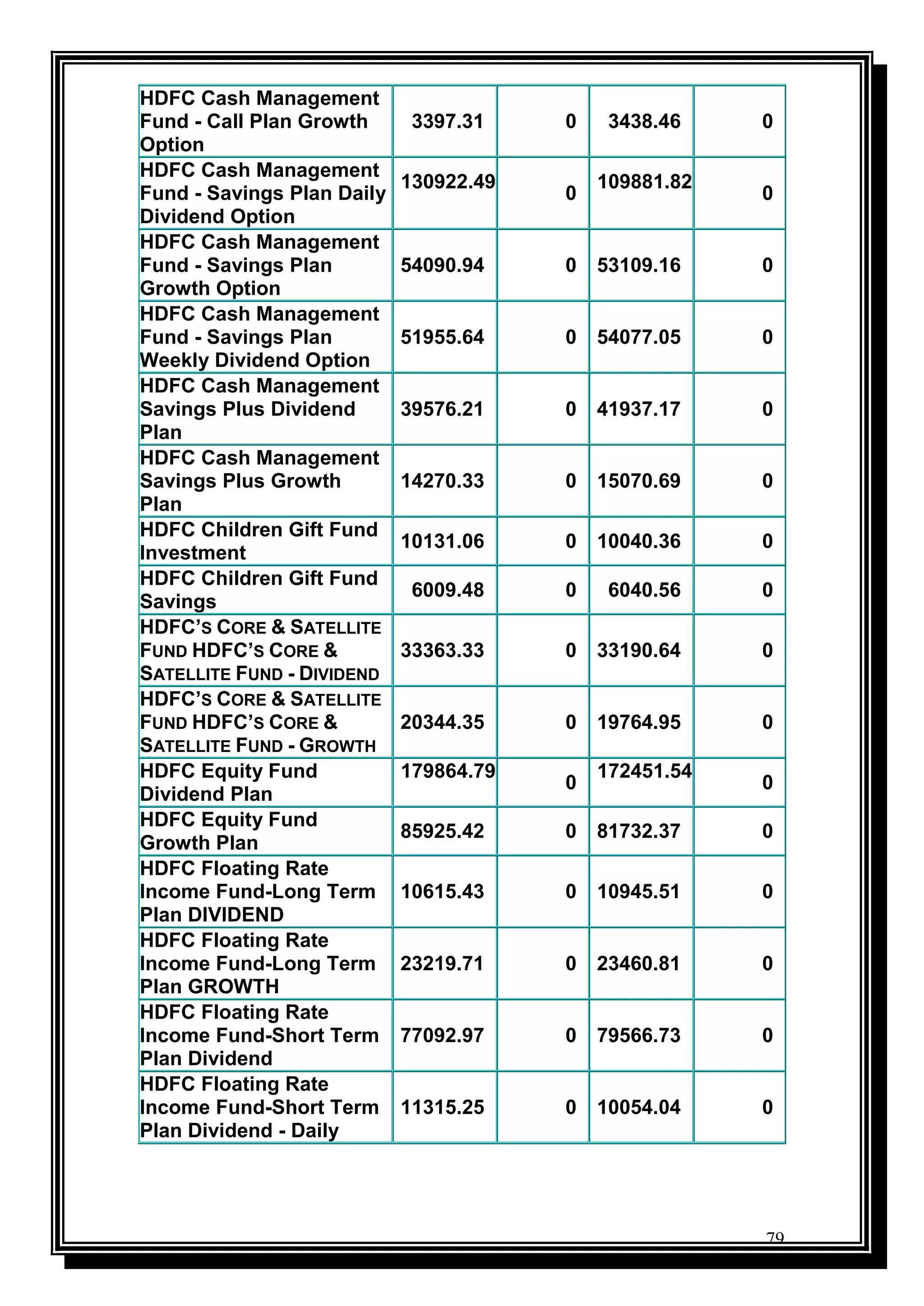
HDFC Cash Management
Fund- Call Plan Growth
Option
3397.31 0 3438.46 0
HDFC Cash Management
Fund - Savings Plan Daily
Dividend Option
130922.49
0
109881.82
0
HDFC Cash Management
Fund - Savings Plan
Growth Option
54090.94 0 53109.16 0
HDFC Cash Management
Fund - Savings Plan
Weekly Dividend Option
51955.64 0 54077.05 0
HDFC Cash Management
Savings Plus Dividend
Plan
39576.21 0 41937.17 0
HDFC Cash Management
Savings Plus Growth
Plan
14270.33 0 15070.69 0
HDFC Children Gift Fund
Investment
10131.06 0 10040.36 0
HDFC Children Gift Fund
Savings
6009.48 0 6040.56 0
HDFC’S CORE & SATELLITE
FUND HDFC’S CORE &
SATELLITE FUND - DIVIDEND
33363.33 0 33190.64 0
HDFC’S CORE & SATELLITE
FUND HDFC’S CORE &
SATELLITE FUND - GROWTH
20344.35 0 19764.95 0
HDFC Equity Fund
Dividend Plan
179864.79
0
172451.54
0
HDFC Equity Fund
Growth Plan
85925.42 0 81732.37 0
HDFC Floating Rate
Income Fund-Long Term
Plan DIVIDEND
10615.43 0 10945.51 0
HDFC Floating Rate
Income Fund-Long Term
Plan GROWTH
23219.71 0 23460.81 0
HDFC Floating Rate
Income Fund-Short Term
Plan Dividend
77092.97 0 79566.73 0
HDFC Floating Rate
Income Fund-Short Term
Plan Dividend - Daily
11315.25 0 10054.04 0
80.
80
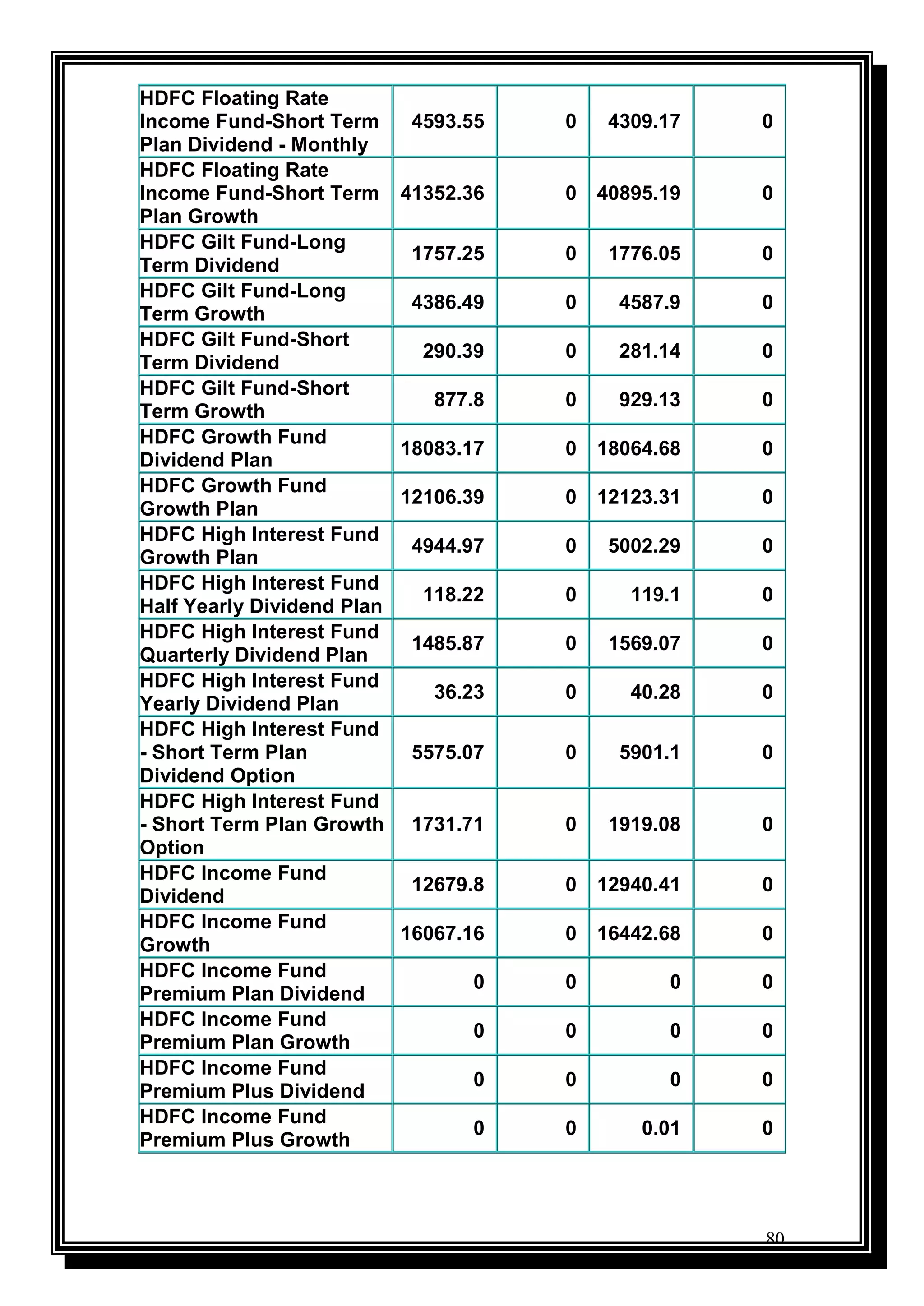
HDFC Floating Rate
IncomeFund-Short Term
Plan Dividend - Monthly
4593.55 0 4309.17 0
HDFC Floating Rate
Income Fund-Short Term
Plan Growth
41352.36 0 40895.19 0
HDFC Gilt Fund-Long
Term Dividend
1757.25 0 1776.05 0
HDFC Gilt Fund-Long
Term Growth
4386.49 0 4587.9 0
HDFC Gilt Fund-Short
Term Dividend
290.39 0 281.14 0
HDFC Gilt Fund-Short
Term Growth
877.8 0 929.13 0
HDFC Growth Fund
Dividend Plan
18083.17 0 18064.68 0
HDFC Growth Fund
Growth Plan
12106.39 0 12123.31 0
HDFC High Interest Fund
Growth Plan
4944.97 0 5002.29 0
HDFC High Interest Fund
Half Yearly Dividend Plan
118.22 0 119.1 0
HDFC High Interest Fund
Quarterly Dividend Plan
1485.87 0 1569.07 0
HDFC High Interest Fund
Yearly Dividend Plan
36.23 0 40.28 0
HDFC High Interest Fund
- Short Term Plan
Dividend Option
5575.07 0 5901.1 0
HDFC High Interest Fund
- Short Term Plan Growth
Option
1731.71 0 1919.08 0
HDFC Income Fund
Dividend
12679.8 0 12940.41 0
HDFC Income Fund
Growth
16067.16 0 16442.68 0
HDFC Income Fund
Premium Plan Dividend
0 0 0 0
HDFC Income Fund
Premium Plan Growth
0 0 0 0
HDFC Income Fund
Premium Plus Dividend
0 0 0 0
HDFC Income Fund
Premium Plus Growth
0 0 0.01 0
81.
81
HDFC Index Fund-Nifty
Plan(FVRs 10.326)
445.49 0 441.24 0
HDFC Index Fund-Sensex
Plus( FV-Rs32.161)
581.89 0 594.26 0
HDFC Index FundSensex
Plan( FV Rs 32.161)
477.65 0 466.37 0
HDFC Liquid Fund
DIVIDEND
45079.48 0 42692.99 0
HDFC Liquid Fund
Dividend - Daily
2745.5 0 2162.67 0
HDFC Liquid Fund
Dividend - Monthly
528.33 0 452.44 0
HDFC Liquid Fund
GROWTH
30447.49 0 27852.59 0
HDFC Liquid Fund
Premium Plan - Dividend-
Daily
15527.11 0 6835.86 0
HDFC Liquid Fund
Premium Plan - Dividend-
Monthly
0 0 0 0
HDFC Liquid Fund
Premium Plus Plan -
Dividend-Daily
0 0 0 0
HDFC Liquid Fund
PREMIUM PLUS-
Dividend
34376.46 0 49412.79 0
HDFC Liquid Fund
PREMIUM PLUS- Growth
44970.15 0 42239.93 0
HDFC Liquid Fund
PREMIUM- Dividend
7121.82 0 6822.45 0
HDFC Liquid Fund
PREMIUM- Growth
8485.41 0 8985.3 0
HDFC MF Monthly Income
Plan Long Term Plan
Growth Option
37408.25 0 38162.77 0
HDFC MF Monthly Income
Plan Long Term Plan
Monthly Dividend Option
15724.56 0 15840.77 0
HDFC MF Monthly Income
Plan Long Term Plan
Quarterly Dividend
Option
25848.35 0 25567.83 0
HDFC MF Monthly Income
Plan Short Term Plan
25455.85 0 25893.1 0
82.
82
Growth Option
HDFC MFMonthly Income
Plan Short Term Plan
Monthly Dividend Option
4855.8 0 4928.51 0
HDFC MF Monthly Income
Plan Short Term Plan
Quarterly Dividend
Option
10083.57 0 10106.27 0
HDFC MULTIPLE YIELD
HDFC MULTIPLE YIELD -
DIVIDEND
13356.83 0 13660.44 0
HDFC MULTIPLE YIELD
HDFC MULTIPLE YIELD -
GROWTH
42746.02 0 45112.66 0
HDFC Multiple Yield Fund
- Plan 2005 Dividend
12806.04 0 14046.78 0
HDFC Multiple Yield Fund
- Plan 2005 Growth
45516.13 0 45699.21 0
HDFC Premier Multi-Cap
Fund Dividend
79709.8 0 81862.4 0
HDFC Premier Multi-Cap
Fund Growth
38533.13 0 39056.86 0
HDFC Prudence Fund
Dividend Plan
125069.82
0 123103.3 0
HDFC Prudence Fund
Growth Plan
39287.52 0 39609.62 0
HDFC Short Term Plan
DIVIDEND
2682.58 0 2732.03 0
HDFC Short Term Plan
GROWTH
4581.45 0 4668.24 0
HDFC Short Term Plan
PREMIUM -Dividend
0 0 0 0
HDFC Short Term Plan
PREMIUM PLUS -
Dividend
0 0 0 0
HDFC Short Term Plan
PREMIUM PLUS -Growth
0 0 0 0
HDFC Short Term Plan
PREMIUM-Growth
0 0 0 0
HDFC Sovereign Gilt
Fund - Investment Plan
Dividend Option
28.59 0 29.65 0
HDFC Sovereign Gilt
Fund - Investment Plan
39.59 0 39.97 0
83.
83
Growth Option
HDFC SovereignGilt
Fund - Provident Plan
Dividend Option
72.53 0 72.56 0
HDFC Sovereign Gilt
Fund - Provident Plan
Growth Option
136.52 0 139.57 0
HDFC Sovereign Gilt
Fund - Savings Plan
Dividend Option
10.49 0 10.55 0
HDFC Sovereign Gilt
Fund - Savings Plan
Growth Option
41.69 0 41.68 0
HDFC Tax saver Dividend
Plan
16825.11 0 15754.16 0
HDFC Tax saver Growth
Plan
15502.62 0 14184.14 0
HDFC Top 200 Fund
Dividend Plan
69327.15 0 70913.26 0
HDFC Top 200 Fund
Growth Plan
31010.76 0 29917.44 0
Close Ended
HDFC LONG TERM
EQUITY FUND Dividend
46242.76 0 46038.13 0
HDFC LONG TERM
EQUITY FUND Growth
99210.33 0 98771.32 0
84.
84
HDFC has totalAUM (Asset under Management)
21,602.31crores
Equity & Balance - 11,334.55.crores
Debt & MIP - 10,267.76crores
Equity and Debt composition
Equity(%)
52%
Debt (%)
48%
Equity(%)
Debt (%)
91
COMPARATIVE ANALYSIS OF3 YEARS
(RATIO ANALYSIS)
Name Formula 2005 2004 2003
N. P. Ratio Net profit/ Sales * 100 50.24
%
46.67 % 30.43 %
Current Ratio Current assets / current
Liabilities
0.71: 1 0.81:1 0.74:1
Return on investment Net profit / Total invt * 100 56.59
%
44.58 % 45.67 %
Earning per share (EPS) Profit available to equity
shareholder / No. Of equity
10.78 10.02 10.05
Note: In absence of any information about sales we have
calculated N. P. ratio based on their main income.
93
Human Resource Department
“HumanResource Management function that helps managers recruits select,
train and develop members for an organization. Obviously, HRM is concerned
with the people‟s dimension in organizations
In all business concerns, there is one common element. I.e., HUMAN
RESOURCE. Work force of an Organization is one of the most important
inputs of components. It is said that people are our single most important
assets. Because of the unique importance of HUMAN RESOURCE and its
complexity due to ever changing psychology, behavior and attitudes of men
and women at work, personnel function, i.e., manpower management function
is becoming increasingly specialized. The personnel function or system can
be broadly defined as the management of people at work- management of
managers and management of workers. Personnel function is particularly
interested in personnel relationship and interaction of employees-human
relations.
In a sense, management is personnel administration. Management is the
development of people, and not mere direction of material resources. Human
capital is the greatest asset of a business enterprise. The essential ingredient
of management is the leadership and direction of people. Each manager of
people has to be his own personnel man. Personnel management is not
something you really turn over to personnel department staff.
94.
94
Manpower Planning
Human ResourcePlanning is the processes by which an organization ensures
that it has the right number and kind of people, at the right place, at the right
time, capable of effectively and efficiently competing those tasks that will help
the organization achieve its overall objectives. Human Resource Planning
translates the organization‟s objectives and plans into the number of workers
meet those objectives. Without a clear-cut planning, estimation of an
organization‟s human resource need is reduced to mere guesswork
Manpower planning is needed with respect to persons who can work as sub-
broker for the companies. Companies focus on Advisors of Mutual Fund
product and ELSS schemes of HDFC AMC and focused on Insurance Advisor
and post office agent, Tax consultants and CAs for making sub-broker.
HDFC AMC follows the following process:
1) The first step is forecasting the need of manpower in terms of divisions,
department or functions. Along with the estimate of the number of the
people required in different departments it is also decided that at which
level they will be needed.
2) After estimating the manpower requirement, next step is to have a look at
the current human resource. The current human resource is assessed so
as to know whether the existing personnel can fill the requirement or not.
3) At last detailed policies for recruitment, selection, training, promotion,
retirement, replacement etc. of existing and new employees to meet the
forecasted needs is made.
95.
95
Recruitment & Selection
Theupper level members like zonal managers, regional managers, branch
managers and senior executives are recruited by publishing recruitment
advertisement in leading national level newspaper. The qualified applicant are
then called for interview and selected.
The regional manager has authority to select lower level employee like peon,
marketing executives, financial accountant etc. by approval of zonal manager.
THE RECRUITMENT PROCESS
Identify as many
prospective
candidates as
possible from multiple
sources.
Be prepared to talk
passionately about
the opportunities of
this career.
Select quality talents
through effective
interviewing,
evaluation & hiring
practices.
Step 1: Prospecting
Step 2: Attracting talent
Step 3: selecting talent
96.
96
Step 1: Prospecting
Itconsists of the following steps:
Generating leads of potential candidates
Contacting the leads and finding out their prima facie interest
Step 2: Attracting talent
Developing your own recruiting style
Developing a resource pool of talent
Creating interest in the potential advisor
Step 3: Selecting talent
Conducting an initial interview
Administrating the candidate
Managing Director conducts final Selection interview.
97.
97
Training
Continuous training andupgrading technical, behavioral and managerial skills is
a way of life in HDFC AMC. HDFC AMC encourages agent or sub-broker to hone
their skills regularly to enable them to face the challenges of the changing
requirements of customers that fit market up and down.
Training needs analysis is done on a regular basis and systematic methodologies
are ensured that skills and capabilities of all agents are constantly upgraded to
enable them to perform in the challenging work. There is special training session
at regular time period in local branch to all financial consultant and agents about
new scheme and to improve their effectiveness.
The successful candidates of the AMFI Exam are given the product training. The
primary purpose is to become quite conversant with the product that one sells. In
other words, product knowledge is very important for any advisor. Product
knowledge is not just about knowing the broad terms and conditions of the
various schemes of mutual fund. The advisors are explained about the schemes,
the terms related with it, the benefits it provides to investor. This training is aimed
at making the advisors fully equipped with the companies‟ product information.
This training is aimed at making the advisors experts in selling the mutual fund
products.
This gives the advisors a systematic framework, which they can follow so as to
attract the customers and be effective in their work. Later the agents are trained
on products; need analyses and how to deliver the message to the market.
98.
98
Performance Appraisal
Objective ofPerformance appraisal if for Developmental uses for agents and
financial consultants, for wages, transfer, promotion, for documentation and
for organizational purpose like Human Resource Planning, Job analysis and
for training and development.
For Performance Appraisal modern method is used like MBO (Management
By Objectives).
100
INTRODUCTION TO RESEARCH
“ALLPROGRESS IS BORN OF INQUIRY”
Research inculcates scientific and inductive thinking and it promotes the
development of logical habits of thinking and organization. The research
methodology has gone through which path to solve the research problem and
which tools have been adopted to achieve the desired objective and more
importantly it tells why only that path or tools have been chosen and not
other?
Many marketing writers confuse the term 'market research' with the term
'marketing research', and sometimes these two terms are used
interchangeably. Thus, it is important to differentiate between the two terms.
Marketing research is defined as "the function that brings the consumer,
customer and public to the market through information - information used to
identify and define marketing objectives and problems; generate, refine and
evaluate marketing actions, monitor marketing performance; and improve
understanding of the marketing process". This clearly shows that marketing
research is wide ranging in its concerns. The term 'market research'
according to Adcock et al is "used to define the specialist activities involved in
collecting information directly through the use of questionnaires and other
associated techniques". They then emphasize that "it is useful to consider
market research as a specialist activity which is within the scope of the
marketing research function" and that it is "concerned with collecting primary
information".
101.
101
TITLE OF THESTUDY
“COMPARISION OF HDFC EQUITY SCHEMES WITH
COMPETITOR’S EQUITY SCHEMES”
102.
102
RESEARCH PROBLEM
HDFC isone of the leading Asset Management Company, which has wide
range of funds to suit variety of investment needs of investors. Facts suggest
that mutual fund industry is a growing industry and there is also increase in
competition. The performance of various funds will decide the preference of
AMC as well as funds offered by the company.
The competition is ever increasing in Mutual Fund Industry. The number of
AMC operating is increasing and there is also increase in the funds offered by
the existing AMC. Every year various AMC floats new funds in the market and
there is a tough competition to get investors money. In such a competitive
scenario the past performance of the fund will definitely affect the future
prospects of that fund. If in the past the performance of the fund is good than
investors would be motivated to invest in that funds in spite of the fact that
past performance does not guarantee future performance of the funds.
Equity fund is offered by almost all AMC. Equity funds are able to gather large
funds and it constitutes larger part of total Asset under Management of the
company. In such a situation the company needs to compare its own fund
with that of fund offered by other AMC. Such a comparison will guide the
company in making necessary changes in investment style and thus can
improve the performance of the funds. The company also needs to know the
preference of investors for Equity funds.
103.
103
Any activity donewithout any objective in a mind cannot turn fruitful. An
objective provides a specific direction to an activity. Objectives may range
form very general to very specific, but they should be clear enough to point
out with reasonable accuracy what researcher wants to achieve through the
study and how it will be helpful to the decision maker in solving problem.
In context of this project study
The main objective of this research is “Comparative Analysis of HDFC
equity schemes with competitor’s equity schemes.”
However the following are the sub objectives:
To analyze the portfolio composition of various selected equity funds.
To evaluate the performance of the various selected equity funds.
To identify the top 10 holdings for equity funds.
To compare the funds NAV.
To know which fund provide best results
Research Objective
104.
104
Research Design
A researchdesign is pattern or an outline of a research project‟s working. It is
a statement of only the essential elements of a study, those that provide the
basic guidelines for the details of the project. It comprises a series of prior
decisions that taken together provide a master plan for executing a research
project.
A research design serves as a bridge between what has been established i.e.
the research objective and what is to be done, in conduct of the study to
realize those objectives. If there were no research design, the research would
have only foggy notion about what is to be done. There are numerous specific
designs, which can be classified into three broad categories.
Research design is the conceptual structure within which the research would
be conducted.
In fact, it is the general blueprint for the collection, measurement and analysis
of data.
In context of this project study
The object of study is to gain familiarity with a phenomenon or to achieve new
insights into it. So, the research design is EXPLORATORY type.
105.
105
Sources Of Data
Collectingthe required information from the right source is very important.
Sources from which the data are collected differ as per the required of
researcher.
Basically there are two types of data collection sources:
1) Primary data source
This data is gathering for the first time for the problem solution. Primary
data has to be collected through well-equipped instruments, as they
are first hand information collected for the research.
2) Secondary data source
It refers to already gathered and collected data. These may be internal
sources within the clients firms. Externally, these sources may include
books or periodicals, data services, reports and computer data banks.
In context of this project study
Secondary data about Mutual Fund have been collected from
the fact sheets of various AMC. Information is also gathered from
various Mutual Fund Reviews, books, magazines and websites.
106.
106
Unit Of Analysis
Collectingthe required information from the right source is very important.
Sources from which the data are collected differ as per the required of
researcher.
Basically there are two types of data collection sources:
1) Sampling Unit:
The sampling unit consists of various schemes of Mutual funds.
2) Sample Size:
Here I have collected the data of 4 different schemes of different mutual
fund companies. They are as follows.
HDFC MUTUAL FUND
RELIANCE MUTUAL FUND
FRANKLIN MUTUAL FUND
TATA MUTUAL FUND
3) Sampling Method:
Stratified random sampling method of choosing the samples has been
adopted.
107.
107
Sampling Design
A sampledesign is a definite plan for obtaining a sample from a given
population. It refers to the technique or the procedure the researcher would
adopt in selecting items for the sample. Sample design may as well lay down
the number of items to be included in the sample i.e. the size of sample.
Sample design is determined before the data are collected. There are many
sample designs from which a researcher can choose. Some designs are
relatively more precise and easier to apply than others. Researcher must
select the sample design, which should be reliable and appropriate for his
research study.
There are different types of sample design based on two factors namely: the
representation basis and element selection technique. On the representation
basic, the PROBABILITY SAMPLING OR NON PROBABILITY SAMPLING.
In context of this project study
A random sample gives every unit of the population a known and non-zero
probability of being selected. Since random sampling equal probability to
every unit in the population, it is necessary that the selection of the sample
must be free from human judgment.
So the sampling procedure that selected for research is PROBABILITY
sampling.
108.
108
Data Collection Methods
Data,which is required for any research, is to be collected very
systematically. Data collection procedure is carried out into order to know the
exact information for the research work. Data collection is done basically in
three ways, which are mentioned as under:
In context of this project study
For the purpose of gathering the data, different fact sheets and brochures are
used.
109.
109
Basic Information OfThe Selected Asset
Management Companies
1. HDFC ASSET MANAGEMENT COMPANY LIMITED (AMC):
HDFC AMC was incorporated under the companies Act 1956, on December
10, 1999 and was approved to act as an Asset Management Company for the
Mutual Fund by SEBI on July 3, 2000. In terms of the Investment
Management Agreement, the Trustee has appointed HDFC Asset
Management Company Limited to manage the Mutual Fund. The paid up
capital of the AMC is Rs 75.161 crores.
Name of
Scheme
Minimum
Amount
Entry
Load
Exit
Load
Launch
Date
Benchmark Fund
Manager
HDFC
Equity
Fund
5000 2.25 Nil 1
January
1995
S & P CNX
500
Prashant
Jain
110.
110
2. RELIANCE CAPITALASSET MANAGEMENT LIMITED:
Reliance Capital Asset Management LTD is a part of the Reliance Group.
Reliance Mutual Fund was established as a Trust in 1995 with Reliance
Capital Asset Management Ltd as the Investment Manager. With total Assets
under Management of 10555.44 crores. It is amongst the fastest growing
mutual fund companies in India. Its vision is to be India‟s largest and most
trusted wealth creator.
Name of
Scheme
Minimum
Amount
Entry
Load
Exit
Load
Launch
Date
Benchmark Fund
Manager
Reliance
equity
opportuniti
es fund
5000 2.25 Nil 31
March
2005
BSE
100 Index
Sunil
Singhania
111.
111
3. FRANKLIN TEMPLETONASSET MANAGEMENT PRIVATE LIMITED:
Franklin Templeton Investment is one of the largest financial services groups
in the world based at San Mateo, California USA. The group has US $ 402.2
billion in asset under management globally. Franklin Templeton has set up
offices in 33 locations nationwide and manages Rs 15630.06 crores assets.
Name of
Scheme
Minimum
Amount
Entry
Load
Exit
Load
Launch
Date
Benchmark Fund
Manager
Franklin
India Blue
chip Fund
5000 2.25 Nil 1
Decemb
er 1993
BSE
SENSEX
K.N.
Shivasubra
maniam
112.
112
4. TATA ASSETMANAGEMENT LIMITED:
Tata Asset Management Ltd. is a part of the Tata group - one of
India's largest and most respected industrial groups. The Tata Group
is one of India's best-known conglomerates in the private sector with a
turnover of around US $ 14.25 billion (equivalent to 2.6 % of India's
GDP). Long known for its adherence to business ethics, it is India's
most respected private business group. With 220,000 employees
across 91 companies, it is also India's largest employer in the private
sector
Tata Asset Management Limited, having Rs. 10464.37 crores (as on
May 31, 2006) of assets under management.
Name of
Scheme
Minimum
Amount
Entry
Load
Exit
Load
Launch
Date
Benchmark Fund
Manager
Tata
Equity
Opportuni
ties fund
5000 2.25 Nil 25
February
1993
SENSEX Prashant
Jain
114
Portfolio Composition
1. HDFCEQUITY FUND
Objective:
The investment objective of the scheme is to achieve capital
appreciation.
Asset allocation:
Type of instruments Normal Allocation
(% of Net Asset)
Equities & Equity related instruments 80- 100
Debt & Money Market instruments 0 – 20
2. RELIANCE EQUITY OPPORTUNITEIS FUND
Objective:
The primary investment of objective of the scheme is to
Seek to generate capital appreciation and provide long-term growth
opportunities by investing in portfolio constituted of equity securities and
equity related securities.
Asset allocation:
Type of instruments Normal Allocation
(% of Net Asset)
Equities & Equity related instruments 90- 100
Debt & Money Market instruments 0 – 10
115.
115
3. FRANKLIN INDIABLUE CHIP FUND
Objective:
An open-end growth scheme with an objective primarily to
provide medium to long-term capital appreciation.
Asset allocation:
Type of instruments Normal Allocation
(% of Net Asset)
Equities & Equity related instruments Above 60
Debt & Money Market instruments Up to 40
4. TATA EQUITY OPPORTUNITIES FUND
Objective:
The scheme focuses on capitalizing on opportunities offered by
equity market from time to time with a proactive fund management strategy.
Asset allocation:
Type of instruments Normal Allocation
(% of Net Asset)
Equities & Equity related instruments 95
Debt & Money Market instruments 5
116.
116
Performance of DifferentEquity Schemes
Name of Scheme 1 year 3 year 5 year
RETURN
(%)
RANK RETURN
(%)
RANK RETURN
(%)
RANK
HDFC equity fund 46.99 15/122 58.03 15/70 43.55 6/55
Reliance equity
opportunities fund
43.20 30/122 ------ ----- ----- ----
Franklin India
blue chip Fund
44.65 23/122 52.93 29/70 34.95 22/55
Tata equity
opportunities fund
37.72 48/122 66.28 6/70 ------ ------
0
10
20
30
40
50
% of
Return
Scheme Name
1 Year Return
HDFC equity
fund
Reliance equity
opportunities
fund
Franklin India
blue chip Fund
Tata equity
opportunities
fund
Here the return of HDFC Equity Scheme is more than other equity
scheme because the fund manager has invested the money in only
that shares which offer higher return.
117.
117
0
10
20
30
40
50
60
70
% of
Return
Scheme Name
3Year Return
HDFC equity
fund
Franklin India
blue chip Fund
Tata equity
opportunities
fund
Here the return of HDFC Equity Scheme decreases but they have
maintained the same rank in the market as it was before though the
competitors of the scheme increase.
119
Top 10 Holdingsof Each Scheme
HDFC EQUITY FUND
Company Industry % Of NAV
Infosys Technologies Ltd Software 8.72
State bank of India Bank 7.88
ITC Ltd Consumer non durable 7.81
Satyam computers services Ltd Software 6.86
Tata motors Ltd Auto 5.87
Bharat Heavy Electrical Ltd Industrial capital goods 5.71
Maruti Udhyog Ltd Auto 5.50
Crompton Greabes Ltd Industrial Capital Goods 5.06
Siemens Ltd Industrial Capital Goods 4.78
Amtek Auto Ltd Auto Ancillaries 4.57
RELIANCE EQUITY OPPORTUNITIS FUND
Company Industry % Of NAV
Reliance Industries Ltd Petroleum Products 6.26
Tata Motors Auto 4.30
Siemens Ltd Telecom 4.19
Aurobindo Pharma Ltd Pharmaceutical 3.71
HCL Technologies Ltd Software 3.18
Tata Consultancy Service Ltd Software 2.63
Bharat Heavy Electrical Ltd Industrial Capital Goods 2.60
ONGC Corporation Ltd Petroleum 2.58
ITC Ltd Consumer non durable 2.22
India Bulls Financial Service Ltd Financial Service 2.13
120.
120
FRANKLIN INDIA BLUECHIP FUND
Company Industry % Of NAV
HCL Technologies Software 7.18
ICICI Bank Bank 6.48
Larson & Toubro Auto 6.13
Reliance Industries Ltd Petroleum 5.64
Infosys Technologies Ltd Software 4.94
Grasim Industries Textile 4.88
ITC Ltd Consumer non durable 4.88
Tata Motors Auto 4.85
Hindalco Industries Auto 4.52
Maruti Udhyog Ltd Auto 3.76
TATA EQUITY OPPORTUNITIES FUND
Company Industry % Of NAV
Bharat Heavy Electrical Ltd Industrial Capital Goods 12.16
ACC Ltd Cement 11.34
ITC Ltd Consumer non Durable 10.33
Subex System Ltd Software 7.91
Arbindo Pharma Ltd Pharmaceuticals 6.71
Jay Prakash Associated Ltd Construction 5.33
Mahindra & Mahindra Ltd Auto 4.97
Kec International Ltd Power 3.57
Sterlite Industry Ltd Ferrous Metals 3.03
Pantaloon Retail India Ltd Textile 2.82
121.
121
Comparing Funds NAV
SchemeName NAV
HDFC Equity Fund 107.22
Reliance Equity Opportunities Fund 19.36
Franklin Blue chip Fund 94.31
Tata Equity Opportunities Fund 42.55
Here in spite of having higher NAV then that of competitors, HDFC
Equity Scheme has offered higher return to the investor.
122.
122
Comparison of Schemereturns with Benchmark
HDFC EQUITY FUND
Period Returns (%) Benchmark Return (%)
Last 1 year 90.24 64.16
Last 3 year 78.66 60.63
Last 5 Year 50.48 30.97
Last 10 Year 33.48 15.29
Since inception 25.36 10.22
Relative Performance
0
50
100
Period
Last1
year
Last3
year
Last5
Year
Last10
Year
Since
inceptio
n
Time Period
Returns
In this fund return against its Benchmark has been very good. In the
last year it has given 90.24 % return and overall return of its
benchmark was 64.16. So the average return of the fund than its
benchmark is almost 30%.
123.
123
RELIANCE EQUITY OPPORTUNITIESFUND
Period Returns (%) Benchmark Return
(%)
Last 1 year 98.39 82.00
Since inception 85.81 69.52
Relative Performance
0
50
100
150
Period Last 1 year Since
inception
Time Period
Return
In this fund return against its Benchmark has been good. In the
last year it has given 98.39 % return and overall return of its
benchmark was 82 % .So the overall return of the fund than its
benchmark is almost 16 % more.
124.
124
FRANKLIN INDIA BLUECHIP FUND
Period Returns (%) Benchmark Return (%)
Last 1 year 54.69 54.64
Last 3 years 60.08 42.34
Last 5 years 30.75 16.10
Since inception 28.73 08.49
Relative Performance
0
20
40
60
80
Last1
year
Last3
years
Last5
years
Since
inceptio
n
Time Period
Return
Returns (%)
Benchmark
Return (%)
In this fund return against its Benchmark has been same only. In
the last year it has given 54.69 % return and overall return of its
benchmark was 54.64 %. And average return of the fund than its
benchmark is almost 14%.
125.
125
TATA EQUITY OPPORTUNITIESFUND
Period Returns (%) Benchmark Return (%)
Last 1 year 103.79 95.67
Last 3 years 94.28 59.58
Last 5 years 44.86 27.88
Since inception 14.13 11.70
Relative Performance
0
50
100
150
Period
Last1
year
Last3
years
Last5
years
Since
inceptio
n
Time Period
Return
In this fund return against its Benchmark has been good. In the
last year it has given 103.79 % return and overall return of its
benchmark was 95.67 %. And the average return of the fund than
its benchmark is almost 18 %.
126.
126
Findings
Following are thefindings of the research-:
1) It is found that Tata Equity Opportunities fund have its maximum
investment 95 % in Equity related Instrument with higher return and
higher risk.
2) In HDFC Equity fund return of 1 year is 46.99 %, 3 year is 58.03 % and
5 year is 43.55 %, which is quite high compared to other equity
schemes.
3) It is also found that because of higher return the rank of HDFC equity
Fund is gradually increased from rank 15 to rank 6.
4) From top 10 holdings of each equity scheme, it is seen that the major
sector in which each scheme has invested are as follows.
Automobile Sector
Software Sector
Industrial Capital Goods
Construction
Petroleum Industry
5) Regarding NAV it is found that the NAV of HDFC Equity Scheme is
very high compared to other Equity Scheme because fund manager
have invested in those sector, which gives higher return and it also,
maintains the portion of equity and debt related instruments.
6) The 1-year return of HDFC Equity Scheme against its Benchmark is
30% more because it maintains its position in the volatile market.
127.
127
Conclusions
Here from thestudy we can conclude about overall study through some
sorting of products and the most likely invested sector and also the good
performance of the funds among our sample size and asset allocation of
the fund and the overall return of the fund against its benchmark.
Following are the conclusions of the research study-:
1) To achieve long-term capital appreciation, most of the Equity Schemes
have invested its large portion in equity & equity related instruments.
2) The last 5-year return of HDFC Equity Scheme is more than any other
Equity Schemes.
3) The Position of HDFC equity scheme increases gradually.
4) Each of the Schemes has diversified sectorial allocation of investment
to achieve safe return as far as possible.
5) The NAV is HDFC Scheme is very high compared to other Equity
Schemes.
6) The overall return of HDFC Equity Scheme against its Benchmark is
more because it maintains its position in the volatile market.
128.
128
Limitations of theStudy
1. This exploratory research is done focusing on the investment scenario
of Rajkot of Saurashtra region of equity schemes only and therefore
findings are suggestions given on the basis of this research and cannot
be considered for the entire Mutual fund Industry.
2. Due to limitation of time and cost constraints a sample size of only 4
equity schemes are chosen.
3. Data Analysis and interpretation done may not be that strong due to
small sample and random sampling method.
4. Major source of data collected is secondary which might limit the study.
5. My own inexperience in the research field might have affected the
results.
129.
129
Recommendations
HDFC MFis doing comparatively very less marketing in MF industry in
compare to other players. Due to this other player are getting the
advantage. Thus it should try to increase the marketing and advertising
related activities time to time or at least at the time of new NFO‟s, at
the time when they are declaring dividends or at the peak time (i.e.
January - March) last quarter of financial year when people are
searching for investing instruments.
A very small part market has been cover by HDFC MF. It can increase
the circle of its business in small and rural areas of every state and
cities of India where they can find a huge business.
To uproot the investment level the company should give training
programme to financial agents who approach the investor for the
investments. And they should be aware of all the benefits of the mutual
Funds.
Company should undertake the Campaign, Road shows,
Advertisement and other type of Publicity for the effective awareness of
different schemes that are available in the market.
The company should arrange seminars and presentations, giving detail
idea about securities and benefits of investment in mutual fund.
The interface among the investors and the Mutual Fund Companies is
the agents. The company should be conducting special training and
motivation programmed so that they are being motivated to work and
their quality of performance is maintained.
131
LIST OF TABLES
Sr.No. Name of Table Page No.
1 SHARE HOLDING OF AMC 11
2 MUTUAL FUND PLAYERS 26
3 AUM OF COMPETITORS 27
4 INVESTMENT STRATEGY 62
5 PORTFOLIA STRATEGY 64
6 PRICING POLICY 69
7 HDFC AUM REPORT 77
8 RATIO ANALYSIS 90
9 HDFC EQUITY SNAPSHOT 108
10 RELIANCE EQUTIY SNAPSHOT 109
11 FRANKLIN INDIA SNAPSHOT 110
12 TATA EQUITY SNAPSHOT 111
13 ASSET ALLOCATION (H & R) 113
14 ASSET ALLOCATION (F & T) 114
15 PERFORMANCE OF EQUITY SCHEMES 115
16 TOP 10 HOLDINGS (H & R) 118
17 TOP 10 HOLDINGS (T & F) 119
18 NAV DETAILS 120
19 HDFC EQUITY VS BENCHMARK 121
20 RELIANCE EQUITY VS BENCHMARK 122
21 FRANKLIN BLUECHIP VS BENCHMARK 123
22 TATA EQUTIY VS BENCHMARK 124
132.
132
LIST OF GRAPHS
Sr.No. Name of Graph Page
No.
1 SOCIAL RESPONSIBLITIES 18
2 GROWTH OF ASSETS 42
3 EQUTIY RISK VS RETURN 54
4 DEBT RISK VS RETURN 57
5 AGGRESSIVE PORTFOLIO 62
6
MODERATE & CONSERVATIVE
PORTFOLIO
63
7 RISK VS RETURN INVESTMENT 67
8 EQUITY & DEBT COMPOSITION 83
9 1 YEAR RETURN 115
10 3 YEAR RETURN 116
11 5 YEAR RETURN 117
12 NAV COMPARISION 120
13 HDFC RELATIVE PERFORMANCE 121
14 RELIANCE RELATIVE PERFORMANCE 122
15 FRANKLIN RELATIVE PERFORMANCE 123
16 TATA RELATIVE PERFORMANCE 124
133.
133
GLOSSARY
Account Statement:
Statement issuedby the mutual fund, in lieu of the unit certificate, giving
details of transactions and holdings of an investor in the different
schemes of the fund.
Adjusted NAV:
The Net Asset Value after adjusting for all changes caused due to
dividend declaration, bonus etc. assuming reinvestment of distributions
made to the investors at the prevailing NAV.
Annual Report:
The yearly record of scheme's performance, and is distributed to
investors and/or shareholders under SEBI regulations.
Applicable NAV:
It is the NAV that will be applied for a transaction depending upon the
cutoff time specified by the Mutual Fund. All investments or redemptions
are processed at that particular NAV. A different NAV holds if received
after the cutoff time.
Asset Allocation:
The distribution of total funds available with the scheme into
instruments of various types such as stocks, bonds etc. based on the
scheme's investment objective as detailed in the offer document.
134.
134
Benchmark:
The investment performanceof the scheme needs to be compared in
relative terms against some indicator, which is called as the benchmark
for the scheme. For example, the performance of an equity fund be
benchmarked against the BSE Sensex.
Capital Gains:
The profit realizations on sale of securities and certain other capital
assets (including units of mutual funds) are called capital gains. The
gains can be classified into long-term, if the investments are held for
more than one year, or short-term, otherwise, and are charged at
different tax rates.
Current Load:
It refers to the load structure applicable currently on any fund. Funds
keep revising the load structures from time to time.
Current Yield:
The ratio of coupon interest to the actual market price, prevailing in the
market, of the bond expressed as a percentage: annual interest/ current
market value = current yield.
Custodian:
SEBI mandates that a Custodian be appointed for safekeeping of a
fund's securities and other assets.
Diversification/Spreading the risk:
Diversification, i.e. investing across a number of asset classes, assets
within a asset class, helps in reducing the risk.
135.
135
Dividend Plan:
Generally ascheme has two plans, Growth Plan and Dividend plan. In
the latter earnings of the scheme are declared as dividends, as and
when there is a distributable surplus available with the scheme as per
the Trustees.
Dividend Payout:
Under the Dividend plan of a scheme there are two options available to
the investor, viz.
Dividend Payout option Under the Dividend Payout option, the
dividend declared is also actually distributed i.e. given to the investor.
Dividend Reinvestment option
Under the Dividend plan of a scheme there are two options available to
the investor, viz. Dividend Payout option and Dividend Reinvestment
option. Under the Dividend Reinvestment option, the dividend declared
is not distributed i.e. given to the investor. but reinvested in the scheme
itself.
Dividend yield:
It refers to the dividend earned per unit in Rupees of a scheme at the
prevailing NAV.
Duration:
This is a tool used to calculate the average holding period of the assets
in a debt scheme, and can help, particularly Modified Duration, in
estimating the sensitivity of a fund to incremental yield movements.
136.
136
Entry Load:
It isthe load charged by the fund when one invests into the fund. It
increases the price of the units to more than the NAV and is expressed
as a percentage of NAV. For example a 1 % entry load will increase the
NAV from Rs 11 to Rs 11.11 and therefore the number of units allotted
will be lesser to that extent.
Expense Ratio:
The Expenses of a scheme include management fees and all the fees
associated with the scheme's daily operations. Expense Ratio refers to
the annual percentage of fund's assets that is paid out in expenses and
can affect the performance of the scheme.
Exit Load:
It is the load charged by the fund when one redeems the units from the
fund. It reduces the price of the units to less than the NAV and is
expressed as a percentage of NAV.
Face Value:
The original issue price of one unit of a scheme, generally Rs 10.
First In First Out:
It is an accounting method which assumes that the units purchased first
are the units sold/redeemed first.
Gilts/Government Securities:
Securities created and issued by the Central Government and/or State
Government, and may include securities unconditionally guaranteed by
the Government. An auction process determines the coupon on these
securities.
137.
137
Guaranteed Returns:
Returns frommutual fund schemes are subject to market and other
investment risks. As such there is no assured/guaranteed return in
mutual funds. This applies even to debt schemes. The launch of
scheme/fund offering guaranteed returns is now subject to certain
restrictions imposed by the SEBI, and generally SEBI does not allow
guaranteed returns.
Inflation Risk:
The probability of the value of an asset being eroded on account of
inflation.
Lock-in period:
The cooling period after investment in fresh units during which the
investor cannot redeem the units.
Management Fee:
The fees charged to a scheme for investment management of the funds
under the scheme, usually expressed as percentage of assets, and are
subject to limits prescribed by SEBI.
Market Risk:
It refers to the risk posed by the market in itself i.e. the risk that the price
of a security will raise or fall due to changing economic, political, or
market conditions.
Money Market:
It refers to a market for very short-term securities less than a year, such
as Treasury Bills and Call Money make up the bulk of trading in the
money markets.
138.
138
No Load:
It refersto the fund that does not charge any load for buying or selling
its units, i.e. the investor can transact at the NAV.
Non Performing Assets:
Assets that do not provide returns are classified as NPAs as per the
provisions of SEBI regulations.
Offer Document:
It is the official document issued by mutual funds prior to the launch of a
fund describing the characteristics of the proposed scheme/fund to all
its prospective investors. It contains information required by SEBI
pertaining to issues such as investment objective and policies, services,
and fees.
Open Ended Fund/Scheme:
It is a type of a scheme/fund where purchase or sale of units is offered
on a continued basis at NAV related prices.
Redemption:
An investor wishing to withdraw his/her investment from a scheme/fund
gives a redemption transaction. The investor is paid a NAV linked price.
Risk Adjusted Returns:
For the purpose of comparing returns across schemes involving varying
levels of risk, the returns are adjusted for the level of risk before
comparison. Such returns (reduced for the level of risk involved) are
called risk-adjusted returns.
139.
139
Sale Price:
The priceat which a fund offers to sell one unit of its scheme to
investors. This NAV is grossed up with the entry load applicable, if any.
Sponsors:
A sponsor is the person who, acting alone or in combination with
another body or corporate, establishes a mutual fund and applies to
SEBI for its registration. As per SEBI regulations, the sponsor has to
contribute a minimum of 40% of the net worth of the AMC.
Systematic Withdrawal Plan (SWP):
It is the opposite of SIP and facilitates regular withdrawals. This helps
investors in meeting their regular financial needs.
Total Return:
Return on investment, calculated after taking into account capital
appreciation, dividends or interest, and individual tax considerations
adjusted for present value and expressed on an annualized basis.
Trustee:
The Trustees comprise the Trust and having an overall supervisory
authority over the AMC. They ensure that the AMC follow the trust
deed, the SEBI regulations and the offer document and the assets of
the funds are held safely.
Yield Curve:
The curve gives the relationship between yields on a group of fixed-
income securities with varying maturities viz. treasury bills, notes, and
bonds. The curve typically slopes upward since longer maturities
normally have higher yields, although it can be flat or even inverted.
140.
140
BIBLIOGRAPHY
BERI G.C. – “MARKETING RESEARCH” – 3RD
EDITION – TATA MC.
GRAW HILL PUBLISHING CO. LTD.
FACT SHEETS OF HDFC AMC, FRANKLIN TEMPLETON AMC,
TATA AMC, RELIANCE AMC
MUTUAL FUND REVIEW OF – 2006
K.ASWATHAPPA “HUMAN RESOURCE MANAGEMENT”
Websites
www.hdfcfund.com
www.mutualfundsindia.com
www.amfiindia.com
www.sebi.gov.in
www.valuresearchonline.com
www.moneycontrol.com