CLIENT REPORT


                                       PLANT HEALTH CARE

                                    Sir Sandford Fleming College

                                         Winter Semester


                                          March 31, 2011


                                         By: David Kearns

                                             10026688


Arborworks- We’ll Tree You Right!                                  Page: _ of _
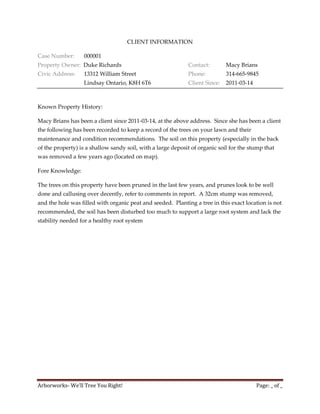
CLIENT INFORMATION

Case Number:      000001
Property Owner: Duke Richards                                Contact:        Macy Brians
Civic Address:    13312 William Street                       Phone:          314-665-9845
                  Lindsay Ontario, K8H 6T6                   Client Since:   2011-03-14


Known Property History:

Macy Brians has been a client since 2011-03-14, at the above address. Since she has been a client
the following has been recorded to keep a record of the trees on your lawn and their
maintenance and condition recommendations. The soil on this property (especially in the back
of the property) is a shallow sandy soil, with a large deposit of organic soil for the stump that
was removed a few years ago (located on map).

Fore Knowledge:

The trees on this property have been pruned in the last few years, and prunes look to be well
done and callusing over decently, refer to comments in report. A 32cm stump was removed,
and the hole was filled with organic peat and seeded. Planting a tree in this exact location is not
recommended, the soil has been disturbed too much to support a large root system and lack the
stability needed for a healthy root system


Arborworks- We’ll Tree You Right!                                                         Page: _ of _
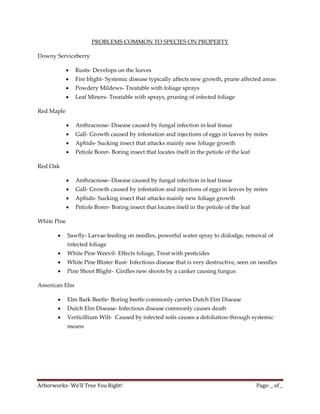
PROBLEMS COMMON TO SPECIES ON PROPERTY

Downy Serviceberry

                Rusts- Develops on the leaves
                Fire blight- Systemic disease typically affects new growth, prune affected areas
                Powdery Mildews- Treatable with foliage sprays
                Leaf Miners- Treatable with sprays, pruning of infected foliage

Red Maple

                Anthracnose- Disease caused by fungal infection in leaf tissue
                Gall- Growth caused by infestation and injections of eggs in leaves by mites
                Aphids- Sucking insect that attacks mainly new foliage growth
                Petiole Borer- Boring insect that locates itself in the petiole of the leaf

Red Oak

                Anthracnose- Disease caused by fungal infection in leaf tissue
                Gall- Growth caused by infestation and injections of eggs in leaves by mites
                Aphids- Sucking insect that attacks mainly new foliage growth
                Petiole Borer- Boring insect that locates itself in the petiole of the leaf

White Pine

            Sawfly- Larvae feeding on needles, powerful water spray to dislodge, removal of
             infected foliage
            White Pine Weevil- Effects foliage, Treat with pesticides
            White Pine Blister Rust- Infectious disease that is very destructive, seen on needles
            Pine Shoot Blight- Girdles new shoots by a canker causing fungus

American Elm

            Elm Bark Beetle- Boring beetle commonly carries Dutch Elm Disease
            Dutch Elm Disease- Infectious disease commonly causes death
            Verticillium Wilt- Caused by infected soils causes a defoliation through systemic
             means


Arborworks- We’ll Tree You Right!                                                              Page: _ of _
PROPOSED WORK REPORT AND PRUNING INFORMATING

1. Downy Serviceberry, Amelanchier arborea
         - Establishment Prune
         - Fertilize to promote root growth (due to Abiotic stresses)

2. Red Maple 1, Acer rubrum
         -Tar spot is present (Biotic)
         -Rake leaves in fall and compost
         -Crown clean to remove deadwood
         -Crown thin to increase air flow in foliage
         -Crown Raise for grass maintenance machine clearance


3. Red Maple 2, Acer rubrum
         -Crown clean for deadwood and Tar spot (Biotic)
         -Rake leaves in fall and compost
         -Crown reduction to stimulate root growth, and restore balance and weight distribution
         -Fertilize to stimulate root growth


4. Red Oak, Quercus rubrum
         -Crown clean to remove deadwood
         -Crown raise over fence
         -Prune branches if contact is made with fence and rubbing is apparent (Abiotic)
         -Prune Eastern side of crown for power lines and service lines (drop crotch pruning)


5. White Pine, Pinus strobes
         -Crown raise for lawn maintenance
         -Irrigate to decrease soil compaction before wet season (Abiotic)
         -Create drainage trench to defer water from pooling around base of Pine


6. White Elm, Ulmus Americana
         -Dutch Elm Disease apparent (Biotic)
         -Crown clean for deadwood and infected branches
         -Injections for Dutch Elm Disease [Arbotect Injecticides]
         -Crown reduction over roof, leave a cover for the window


         I believe the above is observations made to the best of my ability. Any other observations that
are made after the report herein will be added to the package and to this point we’re not omitted to
withhold information.


Worker Signature:____________________                      Date:________________________
                          David Kearns


 Arborworks- We’ll Tree You Right!                                                              Page: _ of _
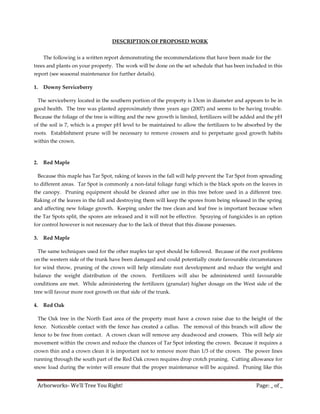
DESCRIPTION OF PROPOSED WORK


     The following is a written report demonstrating the recommendations that have been made for the
trees and plants on your property. The work will be done on the set schedule that has been included in this
report (see seasonal maintenance for further details).

1.   Downy Serviceberry

 The serviceberry located in the southern portion of the property is 13cm in diameter and appears to be in
good health. The tree was planted approximately three years ago (2007) and seems to be having trouble.
Because the foliage of the tree is wilting and the new growth is limited, fertilizers will be added and the pH
of the soil is 7, which is a proper pH level to be maintained to allow the fertilizers to be absorbed by the
roots. Establishment prune will be necessary to remove crossers and to perpetuate good growth habits
within the crown.


2.   Red Maple

 Because this maple has Tar Spot, raking of leaves in the fall will help prevent the Tar Spot from spreading
to different areas. Tar Spot is commonly a non-fatal foliage fungi which is the black spots on the leaves in
the canopy. Pruning equipment should be cleaned after use in this tree before used in a different tree.
Raking of the leaves in the fall and destroying them will keep the spores from being released in the spring
and affecting new foliage growth. Keeping under the tree clean and leaf free is important because when
the Tar Spots split, the spores are released and it will not be effective. Spraying of fungicides is an option
for control however is not necessary due to the lack of threat that this disease possesses.

3.   Red Maple

 The same techniques used for the other maples tar spot should be followed. Because of the root problems
on the western side of the trunk have been damaged and could potentially create favourable circumstances
for wind throw, pruning of the crown will help stimulate root development and reduce the weight and
balance the weight distribution of the crown.        Fertilizers will also be administered until favourable
conditions are met. While administering the fertilizers (granular) higher dosage on the West side of the
tree will favour more root growth on that side of the trunk.

4.   Red Oak

 The Oak tree in the North East area of the property must have a crown raise due to the height of the
fence. Noticeable contact with the fence has created a callus. The removal of this branch will allow the
fence to be free from contact. A crown clean will remove any deadwood and crossers. This will help air
movement within the crown and reduce the chances of Tar Spot infesting the crown. Because it requires a
crown thin and a crown clean it is important not to remove more than 1/3 of the crown. The power lines
running through the south part of the Red Oak crown requires drop crotch pruning. Cutting allowance for
snow load during the winter will ensure that the proper maintenance will be acquired. Pruning like this


 Arborworks- We’ll Tree You Right!                                                                Page: _ of _
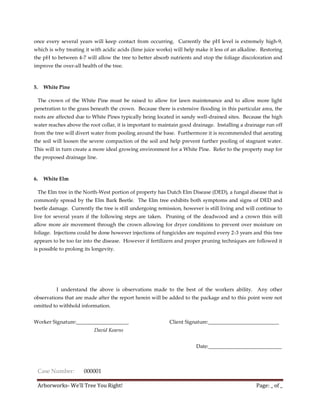
once every several years will keep contact from occurring. Currently the pH level is extremely high-9,
which is why treating it with acidic acids (lime juice works) will help make it less of an alkaline. Restoring
the pH to between 4-7 will allow the tree to better absorb nutrients and stop the foliage discoloration and
improve the over-all health of the tree.


5.   White Pine

 The crown of the White Pine must be raised to allow for lawn maintenance and to allow more light
penetration to the grass beneath the crown. Because there is extensive flooding in this particular area, the
roots are affected due to White Pines typically being located in sandy well-drained sites. Because the high
water reaches above the root collar, it is important to maintain good drainage. Installing a drainage run off
from the tree will divert water from pooling around the base. Furthermore it is recommended that aerating
the soil will loosen the severe compaction of the soil and help prevent further pooling of stagnant water.
This will in turn create a more ideal growing environment for a White Pine. Refer to the property map for
the proposed drainage line.


6.   White Elm

 The Elm tree in the North-West portion of property has Dutch Elm Disease (DED), a fungal disease that is
commonly spread by the Elm Bark Beetle. The Elm tree exhibits both symptoms and signs of DED and
beetle damage. Currently the tree is still undergoing remission, however is still living and will continue to
live for several years if the following steps are taken. Pruning of the deadwood and a crown thin will
allow more air movement through the crown allowing for dryer conditions to prevent over moisture on
foliage. Injections could be done however injections of fungicides are required every 2-3 years and this tree
appears to be too far into the disease. However if fertilizers and proper pruning techniques are followed it
is possible to prolong its longevity.


          I understand the above is observations made to the best of the workers ability. Any other
observations that are made after the report herein will be added to the package and to this point were not
omitted to withhold information.


Worker Signature:____________________                       Client Signature:___________________________
                           David Kearns


                                                                       Date:____________________________


 Case Number:          000001

 Arborworks- We’ll Tree You Right!                                                                Page: _ of _
Property Owner: Duke Richards                                       Contact:         Macy Brians
Civic Address:       13312 William Street                           Phone:           314-665-9845
                     Lindsay, Ontario                               Client Since:    2011-03-14

        _____________________________________________________________________

        For the species of trees on your property there has been information presented on their current
and possible future occurrences that affect the health of your trees. There are things that can be done on a
regular basis along with seasonal precautions that will help improve and strengthen the health of the tree
species included in this report.

        Things that can be done by you the home owner are as follows:

                Raking of leaves in fall and
                Reducing compaction around the base of the White Pine will help alleviate any
                 compaction problems
                Monitoring for any changes (ex. Leaf wilting, sun scortch, ect.)
                Maintaining good plant health care techniques like disposing of infected debris

        Things that can be done by a professional are as follows:

                Fertilizing of species listed in report (refer to Description of Proposed Work)
                Pruning of crown (CR, CT, CrR, EP, Power Line pruning) [refer to specie table]
                Installation of a drainage line to reduce pooling of water around bases of trees
                Aerating soil to reduce compaction

Simple things can be done to alleviate stresses that predispose trees to diseases and pests. Prevention and
monitoring is still by far the best solution to solving tree health care problems.

        To contact us for further information or to report more observations on the species on your
property please refer to the contact information form.

        In this package of information that pertains to the property listed above you will find
observations made by the Urban Forester on your property to the best of their ability. By signing this
form you agree to your liability of performing acts that are recommended by professionals at your own
risk.

        Forester Signature:____________________            Client Signature:________________________

        Forester Name:_______________________              Client Name:___________________________

        Date:_____________________                         Date:_____________________


Arborworks- We’ll Tree You Right!                                                                   Page: _ of _
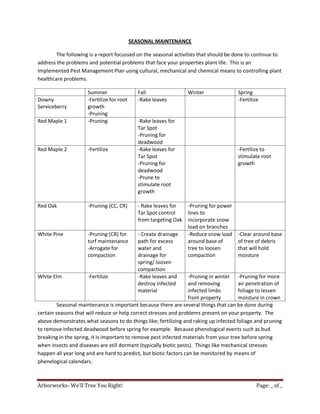
SEASONAL MAINTENANCE

        The following is a report focussed on the seasonal activities that should be done to continue to
address the problems and potential problems that face your properties plant life. This is an
Implemented Pest Management Plan using cultural, mechanical and chemical means to controlling plant
healthcare problems.

                     Summer                  Fall                Winter               Spring
Downy                -Fertilize for root     -Rake leaves                             -Fertilize
Serviceberry         growth
                     -Pruning
Red Maple 1          -Pruning                -Rake leaves for
                                             Tar Spot
                                             -Pruning for
                                             deadwood
Red Maple 2          -Fertilize              -Rake leaves for                         -Fertilize to
                                             Tar Spot                                 stimulate root
                                             -Pruning for                             growth
                                             deadwood
                                             -Prune to
                                             stimulate root
                                             growth

Red Oak              -Pruning (CC, CR)       - Rake leaves for     -Pruning for power
                                             Tar Spot control      lines to
                                             from targeting Oak incorporate snow
                                                                   load on branches
White Pine            -Pruning (CR) for      - Create drainage     -Reduce snow load -Clear around base
                      turf maintenance       path for excess       around base of       of tree of debris
                      -Arrogate for          water and             tree to loosen       that will hold
                      compaction             drainage for          compaction           moisture
                                             spring/ loosen
                                             compaction
White Elm             -Fertilize             -Rake leaves and      -Pruning in winter -Pruning for more
                                             destroy infected      and removing         air penetration of
                                             material              infected limbs       foliage to lessen
                                                                   from property        moisture in crown
         Seasonal maintenance is important because there are several things that can be done during
certain seasons that will reduce or help correct stresses and problems present on your property. The
above demonstrates what seasons to do things like; fertilizing and raking up infected foliage and pruning
to remove infected deadwood before spring for example. Because phenological events such as bud
breaking in the spring, it is important to remove pest infected materials from your tree before spring
when insects and diseases are still dormant (typically biotic pests). Things like mechanical stresses
happen all year long and are hard to predict, but biotic factors can be monitored by means of
phenelogical calendars.


Arborworks- We’ll Tree You Right!                                                              Page: _ of _

Plant Healthcare Client Report

  • 1.
    CLIENT REPORT PLANT HEALTH CARE Sir Sandford Fleming College Winter Semester March 31, 2011 By: David Kearns 10026688 Arborworks- We’ll Tree You Right! Page: _ of _
  • 2.
    CLIENT INFORMATION Case Number: 000001 Property Owner: Duke Richards Contact: Macy Brians Civic Address: 13312 William Street Phone: 314-665-9845 Lindsay Ontario, K8H 6T6 Client Since: 2011-03-14 Known Property History: Macy Brians has been a client since 2011-03-14, at the above address. Since she has been a client the following has been recorded to keep a record of the trees on your lawn and their maintenance and condition recommendations. The soil on this property (especially in the back of the property) is a shallow sandy soil, with a large deposit of organic soil for the stump that was removed a few years ago (located on map). Fore Knowledge: The trees on this property have been pruned in the last few years, and prunes look to be well done and callusing over decently, refer to comments in report. A 32cm stump was removed, and the hole was filled with organic peat and seeded. Planting a tree in this exact location is not recommended, the soil has been disturbed too much to support a large root system and lack the stability needed for a healthy root system Arborworks- We’ll Tree You Right! Page: _ of _
  • 3.
    PROBLEMS COMMON TOSPECIES ON PROPERTY Downy Serviceberry  Rusts- Develops on the leaves  Fire blight- Systemic disease typically affects new growth, prune affected areas  Powdery Mildews- Treatable with foliage sprays  Leaf Miners- Treatable with sprays, pruning of infected foliage Red Maple  Anthracnose- Disease caused by fungal infection in leaf tissue  Gall- Growth caused by infestation and injections of eggs in leaves by mites  Aphids- Sucking insect that attacks mainly new foliage growth  Petiole Borer- Boring insect that locates itself in the petiole of the leaf Red Oak  Anthracnose- Disease caused by fungal infection in leaf tissue  Gall- Growth caused by infestation and injections of eggs in leaves by mites  Aphids- Sucking insect that attacks mainly new foliage growth  Petiole Borer- Boring insect that locates itself in the petiole of the leaf White Pine  Sawfly- Larvae feeding on needles, powerful water spray to dislodge, removal of infected foliage  White Pine Weevil- Effects foliage, Treat with pesticides  White Pine Blister Rust- Infectious disease that is very destructive, seen on needles  Pine Shoot Blight- Girdles new shoots by a canker causing fungus American Elm  Elm Bark Beetle- Boring beetle commonly carries Dutch Elm Disease  Dutch Elm Disease- Infectious disease commonly causes death  Verticillium Wilt- Caused by infected soils causes a defoliation through systemic means Arborworks- We’ll Tree You Right! Page: _ of _
  • 4.
    PROPOSED WORK REPORTAND PRUNING INFORMATING 1. Downy Serviceberry, Amelanchier arborea - Establishment Prune - Fertilize to promote root growth (due to Abiotic stresses) 2. Red Maple 1, Acer rubrum -Tar spot is present (Biotic) -Rake leaves in fall and compost -Crown clean to remove deadwood -Crown thin to increase air flow in foliage -Crown Raise for grass maintenance machine clearance 3. Red Maple 2, Acer rubrum -Crown clean for deadwood and Tar spot (Biotic) -Rake leaves in fall and compost -Crown reduction to stimulate root growth, and restore balance and weight distribution -Fertilize to stimulate root growth 4. Red Oak, Quercus rubrum -Crown clean to remove deadwood -Crown raise over fence -Prune branches if contact is made with fence and rubbing is apparent (Abiotic) -Prune Eastern side of crown for power lines and service lines (drop crotch pruning) 5. White Pine, Pinus strobes -Crown raise for lawn maintenance -Irrigate to decrease soil compaction before wet season (Abiotic) -Create drainage trench to defer water from pooling around base of Pine 6. White Elm, Ulmus Americana -Dutch Elm Disease apparent (Biotic) -Crown clean for deadwood and infected branches -Injections for Dutch Elm Disease [Arbotect Injecticides] -Crown reduction over roof, leave a cover for the window I believe the above is observations made to the best of my ability. Any other observations that are made after the report herein will be added to the package and to this point we’re not omitted to withhold information. Worker Signature:____________________ Date:________________________ David Kearns Arborworks- We’ll Tree You Right! Page: _ of _
  • 5.
    DESCRIPTION OF PROPOSEDWORK The following is a written report demonstrating the recommendations that have been made for the trees and plants on your property. The work will be done on the set schedule that has been included in this report (see seasonal maintenance for further details). 1. Downy Serviceberry The serviceberry located in the southern portion of the property is 13cm in diameter and appears to be in good health. The tree was planted approximately three years ago (2007) and seems to be having trouble. Because the foliage of the tree is wilting and the new growth is limited, fertilizers will be added and the pH of the soil is 7, which is a proper pH level to be maintained to allow the fertilizers to be absorbed by the roots. Establishment prune will be necessary to remove crossers and to perpetuate good growth habits within the crown. 2. Red Maple Because this maple has Tar Spot, raking of leaves in the fall will help prevent the Tar Spot from spreading to different areas. Tar Spot is commonly a non-fatal foliage fungi which is the black spots on the leaves in the canopy. Pruning equipment should be cleaned after use in this tree before used in a different tree. Raking of the leaves in the fall and destroying them will keep the spores from being released in the spring and affecting new foliage growth. Keeping under the tree clean and leaf free is important because when the Tar Spots split, the spores are released and it will not be effective. Spraying of fungicides is an option for control however is not necessary due to the lack of threat that this disease possesses. 3. Red Maple The same techniques used for the other maples tar spot should be followed. Because of the root problems on the western side of the trunk have been damaged and could potentially create favourable circumstances for wind throw, pruning of the crown will help stimulate root development and reduce the weight and balance the weight distribution of the crown. Fertilizers will also be administered until favourable conditions are met. While administering the fertilizers (granular) higher dosage on the West side of the tree will favour more root growth on that side of the trunk. 4. Red Oak The Oak tree in the North East area of the property must have a crown raise due to the height of the fence. Noticeable contact with the fence has created a callus. The removal of this branch will allow the fence to be free from contact. A crown clean will remove any deadwood and crossers. This will help air movement within the crown and reduce the chances of Tar Spot infesting the crown. Because it requires a crown thin and a crown clean it is important not to remove more than 1/3 of the crown. The power lines running through the south part of the Red Oak crown requires drop crotch pruning. Cutting allowance for snow load during the winter will ensure that the proper maintenance will be acquired. Pruning like this Arborworks- We’ll Tree You Right! Page: _ of _
  • 6.
    once every severalyears will keep contact from occurring. Currently the pH level is extremely high-9, which is why treating it with acidic acids (lime juice works) will help make it less of an alkaline. Restoring the pH to between 4-7 will allow the tree to better absorb nutrients and stop the foliage discoloration and improve the over-all health of the tree. 5. White Pine The crown of the White Pine must be raised to allow for lawn maintenance and to allow more light penetration to the grass beneath the crown. Because there is extensive flooding in this particular area, the roots are affected due to White Pines typically being located in sandy well-drained sites. Because the high water reaches above the root collar, it is important to maintain good drainage. Installing a drainage run off from the tree will divert water from pooling around the base. Furthermore it is recommended that aerating the soil will loosen the severe compaction of the soil and help prevent further pooling of stagnant water. This will in turn create a more ideal growing environment for a White Pine. Refer to the property map for the proposed drainage line. 6. White Elm The Elm tree in the North-West portion of property has Dutch Elm Disease (DED), a fungal disease that is commonly spread by the Elm Bark Beetle. The Elm tree exhibits both symptoms and signs of DED and beetle damage. Currently the tree is still undergoing remission, however is still living and will continue to live for several years if the following steps are taken. Pruning of the deadwood and a crown thin will allow more air movement through the crown allowing for dryer conditions to prevent over moisture on foliage. Injections could be done however injections of fungicides are required every 2-3 years and this tree appears to be too far into the disease. However if fertilizers and proper pruning techniques are followed it is possible to prolong its longevity. I understand the above is observations made to the best of the workers ability. Any other observations that are made after the report herein will be added to the package and to this point were not omitted to withhold information. Worker Signature:____________________ Client Signature:___________________________ David Kearns Date:____________________________ Case Number: 000001 Arborworks- We’ll Tree You Right! Page: _ of _
  • 7.
    Property Owner: DukeRichards Contact: Macy Brians Civic Address: 13312 William Street Phone: 314-665-9845 Lindsay, Ontario Client Since: 2011-03-14 _____________________________________________________________________ For the species of trees on your property there has been information presented on their current and possible future occurrences that affect the health of your trees. There are things that can be done on a regular basis along with seasonal precautions that will help improve and strengthen the health of the tree species included in this report. Things that can be done by you the home owner are as follows:  Raking of leaves in fall and  Reducing compaction around the base of the White Pine will help alleviate any compaction problems  Monitoring for any changes (ex. Leaf wilting, sun scortch, ect.)  Maintaining good plant health care techniques like disposing of infected debris Things that can be done by a professional are as follows:  Fertilizing of species listed in report (refer to Description of Proposed Work)  Pruning of crown (CR, CT, CrR, EP, Power Line pruning) [refer to specie table]  Installation of a drainage line to reduce pooling of water around bases of trees  Aerating soil to reduce compaction Simple things can be done to alleviate stresses that predispose trees to diseases and pests. Prevention and monitoring is still by far the best solution to solving tree health care problems. To contact us for further information or to report more observations on the species on your property please refer to the contact information form. In this package of information that pertains to the property listed above you will find observations made by the Urban Forester on your property to the best of their ability. By signing this form you agree to your liability of performing acts that are recommended by professionals at your own risk. Forester Signature:____________________ Client Signature:________________________ Forester Name:_______________________ Client Name:___________________________ Date:_____________________ Date:_____________________ Arborworks- We’ll Tree You Right! Page: _ of _
  • 8.
    SEASONAL MAINTENANCE The following is a report focussed on the seasonal activities that should be done to continue to address the problems and potential problems that face your properties plant life. This is an Implemented Pest Management Plan using cultural, mechanical and chemical means to controlling plant healthcare problems. Summer Fall Winter Spring Downy -Fertilize for root -Rake leaves -Fertilize Serviceberry growth -Pruning Red Maple 1 -Pruning -Rake leaves for Tar Spot -Pruning for deadwood Red Maple 2 -Fertilize -Rake leaves for -Fertilize to Tar Spot stimulate root -Pruning for growth deadwood -Prune to stimulate root growth Red Oak -Pruning (CC, CR) - Rake leaves for -Pruning for power Tar Spot control lines to from targeting Oak incorporate snow load on branches White Pine -Pruning (CR) for - Create drainage -Reduce snow load -Clear around base turf maintenance path for excess around base of of tree of debris -Arrogate for water and tree to loosen that will hold compaction drainage for compaction moisture spring/ loosen compaction White Elm -Fertilize -Rake leaves and -Pruning in winter -Pruning for more destroy infected and removing air penetration of material infected limbs foliage to lessen from property moisture in crown Seasonal maintenance is important because there are several things that can be done during certain seasons that will reduce or help correct stresses and problems present on your property. The above demonstrates what seasons to do things like; fertilizing and raking up infected foliage and pruning to remove infected deadwood before spring for example. Because phenological events such as bud breaking in the spring, it is important to remove pest infected materials from your tree before spring when insects and diseases are still dormant (typically biotic pests). Things like mechanical stresses happen all year long and are hard to predict, but biotic factors can be monitored by means of phenelogical calendars. Arborworks- We’ll Tree You Right! Page: _ of _