DEVELOPING SPEAKING
LESSON PLANS
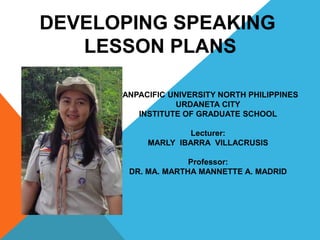
PANPACIFIC UNIVERSITY NORTH PHILIPPINES
URDANETA CITY
INSTITUTE OF GRADUATE SCHOOL
Lecturer:
MARLY IBARRA VILLACRUSIS
Professor:
DR. MA. MARTHA MANNETTE A. MADRID
An effective lesson plan is
the backbone of our repertoire as a
teacher. We want a lesson that motivates
our pupils, provides useful and
necessary language practice and helps
students practice their English skills. The
more organized a teacher is, the more
effective the lesson and writing daily
lesson plans is a huge part of being
an organized teacher.
Steps in creating
topnotch lesson
plans
Before you can create
an effective lesson you first need
to determine your main topic for
the lesson. Anything that students
need to learn to communicate
effectively in English can be the
main topic of the lesson.
The next step is developing a
direction towards attaining the objectives. You
need to decide on how to teach the content
according to the levels and needs of the
learners. You also need to control how you use
your time in the classroom. Effective teachers
must plan for the productive use of classroom
time. The more effective English lesson plan
will incorporate student activities. This is where
the students practice the main topic of the
lesson and use what they learned.
Finally, there should be some kind of
feedback to determine if the lesson has
deficiencies. Feedback will assist the
teacher in finding out if the students have
met the lesson plan objectives.
Evaluations can range from the formal
such as quizzes to the informal like one-
on-one evaluation.
How To Develop Speaking
Skills in Speaking Lessons?
To develop this skill, the
students need intensive practice.
Speaking practice is usually done in
pair & group work.
Class activities for
developing speaking skills
in speaking lessons
DISCUSSION
This is said to be next to lecture. The leader
provides the group with the information
needed for effective decision making and
helps all persons in the study group to
participate in the discussion. It is effective
when students go beyond the yes and no
answers. Good discussions starters can be
WHY, HOW, EXPLAIN and EXPLAIN
FURTHER.
DIFFERENT DISCUSSION METHODS
1. Circle Response – in a circular seating arrangement. The
leader asks a question or requests an opinion from each
person in the group. This can be a great learner’s attention
catcher to get participation from all.
2. Small Group Discussion- Divide the class into groups. Ask
the learners to discuss specific questions in their small
groups. Each group should designate a leader and a
secretary. Have them report a summary of their discussion to
the larger group.
3. Discussion with Listening Teams- Small groups are
selected to listen to a presentation from a particular point of
view. Discussion by the entire group should follow.
4. Lyrics Study – Provide lyrics of a song and discuss those in
light of the study material. Obviously, the song chosen should
be related to the lesson.
5. Problem solving – Formal discussion approach that
facilitates the systematic treatment of a problem that is
significant to the group. The discussion should center on how
to solve the problem presented.
6. Remembering – Ask the class to retell a story they have
just read. Then discuss what they remembered and what they
forgot.
7. Word Association- Say one word based on the lesson
discussed. Have the students respond with the first word that
pops into their minds. Upon hearing the word, discuss that
word.
8. Word Study- Give each small group a word to examine in
the lesson, then discuss their findings.
ROLE PLAY
Students pretend they are in various
contexts and have a variety of social roles. In
role play activities, the teacher gives
information to the learners. This is also a
form of a dialogue. Students may be asked to
play different roles in the form of drama. This
exercise will encourage the students to speak
in real life situation. This is an improvise
scenario based on the story’s lesson.
SIMULATIONS
Very similar to role plays but what
makes it different from role plays is
that they are more elaborate.
Students can bring items to the class
to create a realistic environment.
INFORMATION GAP
Students are supposed to be working
in pairs. One student will have the
information that other partner does
not have and the partners will share
the information.
BRAINSTORMING
Is asking the learners to say out loud different ideas
they can think of about a topic, word or thing. This is
the technique for generating new and useful ideas. It
promotes creative thinking. It can be a problem
solving method in which group members are led to
suggest as many solutions as they can. The good
characteristics of brainstorming is that the students
are not criticized for their ideas so students will be
open to sharing new ideas.
STORYTELLING
Is the art of telling and retelling what
happened in real or imaginary events.
Students can briefly summarize a tale or
story they heard from somebody
beforehand or may create their own
stories to tell their classmates. This
fosters creative thinking.
INTERVIEWS
This is a method where facts and
opinions are shared by a resource person
in response to questions. Conducting
interviews with people gives students a
chance to practice their speaking ability
not only in class but also outside and
helps becoming socialized.
STORY COMPLETION
For this activity, a teacher starts to tell a
story, but after a few sentences, he/she
stops narrating. Then, each student
starts to narrate from the point where
the previous one stopped.
CLASS REPORTING
Before coming to class, students are asked to
read a newspaper or magazine and, in class,
they report to their friends what they find as
the most interesting news. Students can also
talk about whether they have experienced
anything worth telling their friends in their daily
lives before class.
PLAYING CARDS
In this game, students should form
groups of four. Each suit will represent a
topic.
For instance:
• Diamonds: Earning money
• Hearts: Love and relationships
• Spades: An unforgettable memory
• Clubs: Best teacher
PICTURE
SEQUENCING/NARRATING
Students are asked to tell the
story taking place in the
sequential pictures by paying
attention to the criteria provided
by the teacher as a rubric.
PICTURE DESCRIBING
For this activity students can form groups and
each group is given a different picture.•
Students discuss the picture with their groups,
then a spokesperson for each group describes
the picture to the whole class.• This activity
fosters the creativity and imagination of the
learners as well as their public speaking skills.
FIND THE DIFFERENCE
For this activity students can work in
pairs and each couple is given two
different pictures, for example, picture of
boys playing football and another picture
of girls playing tennis.• Students in pairs
discuss the similarities and/or differences
in the pictures.
Suggestions for Teachers in
Teaching Speaking
• Provide maximum opportunity to students to speak the target
language by providing a rich environment that contains
collaborative work, authentic materials and tasks, and shared
knowledge.
• Try to involve each student in every speaking activity; for this
aim, practice different ways of student participation.
• Reduce teacher speaking time in class while increasing
student speaking time. Step back and observe students.
• Indicate positive signs when commenting on a students’
response.
• Ask eliciting questions such as "What do you mean? How did
you reach that conclusion?" in order to prompt students to
speak more.
• Provide written feedback like "Your presentation was really
great. It was a good job. I really appreciated your efforts in
preparing the materials and efficient use of your voice…"
• Do not correct student’s pronunciation mistakes very
often while they are speaking. Correction should not
distract student from his or her speech.
• Involve speaking activities not only in class but also
out of class; contact parents and other people who can
help.
• Circulate around classroom to ensure that students
are on the right track and see whether they need your
help while they work in groups or pairs.
• Provide the vocabulary beforehand that students
need in speaking activities.
• Diagnose problems faced by students who have
difficulty in expressing themselves in the target
language and provide more opportunities to practice
the spoken language.
CONCLUSION:
Teaching speaking is a very important part of
English language learning. The ability to communicate in a
English language clearly and efficiently contributes to the
success of the learner in school and success later in
every phase of life. Therefore, it is essential that language
teachers’ pay great attention to teaching speaking. Rather
than leading students to pure memorization, providing a
rich environment where meaningful communication takes
place is desired. With this aim, various speaking activities
such as those listed above can contribute a great deal to
students in developing basic interactive skills necessary
for life. These activities make students more active in the
learning process and at the same time make their learning
more meaningful and fun for them.
DEVELOPING SPEAKING LESSON PLANS

DEVELOPING SPEAKING LESSON PLANS

  • 1.
    DEVELOPING SPEAKING LESSON PLANS PANPACIFICUNIVERSITY NORTH PHILIPPINES URDANETA CITY INSTITUTE OF GRADUATE SCHOOL Lecturer: MARLY IBARRA VILLACRUSIS Professor: DR. MA. MARTHA MANNETTE A. MADRID
  • 2.
    An effective lessonplan is the backbone of our repertoire as a teacher. We want a lesson that motivates our pupils, provides useful and necessary language practice and helps students practice their English skills. The more organized a teacher is, the more effective the lesson and writing daily lesson plans is a huge part of being an organized teacher.
  • 3.
  • 4.
    Before you cancreate an effective lesson you first need to determine your main topic for the lesson. Anything that students need to learn to communicate effectively in English can be the main topic of the lesson.
  • 5.
    The next stepis developing a direction towards attaining the objectives. You need to decide on how to teach the content according to the levels and needs of the learners. You also need to control how you use your time in the classroom. Effective teachers must plan for the productive use of classroom time. The more effective English lesson plan will incorporate student activities. This is where the students practice the main topic of the lesson and use what they learned.
  • 6.
    Finally, there shouldbe some kind of feedback to determine if the lesson has deficiencies. Feedback will assist the teacher in finding out if the students have met the lesson plan objectives. Evaluations can range from the formal such as quizzes to the informal like one- on-one evaluation.
  • 7.
    How To DevelopSpeaking Skills in Speaking Lessons?
  • 8.
    To develop thisskill, the students need intensive practice. Speaking practice is usually done in pair & group work.
  • 9.
    Class activities for developingspeaking skills in speaking lessons
  • 10.
    DISCUSSION This is saidto be next to lecture. The leader provides the group with the information needed for effective decision making and helps all persons in the study group to participate in the discussion. It is effective when students go beyond the yes and no answers. Good discussions starters can be WHY, HOW, EXPLAIN and EXPLAIN FURTHER.
  • 11.
  • 12.
    1. Circle Response– in a circular seating arrangement. The leader asks a question or requests an opinion from each person in the group. This can be a great learner’s attention catcher to get participation from all. 2. Small Group Discussion- Divide the class into groups. Ask the learners to discuss specific questions in their small groups. Each group should designate a leader and a secretary. Have them report a summary of their discussion to the larger group. 3. Discussion with Listening Teams- Small groups are selected to listen to a presentation from a particular point of view. Discussion by the entire group should follow. 4. Lyrics Study – Provide lyrics of a song and discuss those in light of the study material. Obviously, the song chosen should be related to the lesson.
  • 13.
    5. Problem solving– Formal discussion approach that facilitates the systematic treatment of a problem that is significant to the group. The discussion should center on how to solve the problem presented. 6. Remembering – Ask the class to retell a story they have just read. Then discuss what they remembered and what they forgot. 7. Word Association- Say one word based on the lesson discussed. Have the students respond with the first word that pops into their minds. Upon hearing the word, discuss that word. 8. Word Study- Give each small group a word to examine in the lesson, then discuss their findings.
  • 14.
    ROLE PLAY Students pretendthey are in various contexts and have a variety of social roles. In role play activities, the teacher gives information to the learners. This is also a form of a dialogue. Students may be asked to play different roles in the form of drama. This exercise will encourage the students to speak in real life situation. This is an improvise scenario based on the story’s lesson.
  • 15.
    SIMULATIONS Very similar torole plays but what makes it different from role plays is that they are more elaborate. Students can bring items to the class to create a realistic environment.
  • 16.
    INFORMATION GAP Students aresupposed to be working in pairs. One student will have the information that other partner does not have and the partners will share the information.
  • 17.
    BRAINSTORMING Is asking thelearners to say out loud different ideas they can think of about a topic, word or thing. This is the technique for generating new and useful ideas. It promotes creative thinking. It can be a problem solving method in which group members are led to suggest as many solutions as they can. The good characteristics of brainstorming is that the students are not criticized for their ideas so students will be open to sharing new ideas.
  • 18.
    STORYTELLING Is the artof telling and retelling what happened in real or imaginary events. Students can briefly summarize a tale or story they heard from somebody beforehand or may create their own stories to tell their classmates. This fosters creative thinking.
  • 19.
    INTERVIEWS This is amethod where facts and opinions are shared by a resource person in response to questions. Conducting interviews with people gives students a chance to practice their speaking ability not only in class but also outside and helps becoming socialized.
  • 20.
    STORY COMPLETION For thisactivity, a teacher starts to tell a story, but after a few sentences, he/she stops narrating. Then, each student starts to narrate from the point where the previous one stopped.
  • 21.
    CLASS REPORTING Before comingto class, students are asked to read a newspaper or magazine and, in class, they report to their friends what they find as the most interesting news. Students can also talk about whether they have experienced anything worth telling their friends in their daily lives before class.
  • 22.
    PLAYING CARDS In thisgame, students should form groups of four. Each suit will represent a topic. For instance: • Diamonds: Earning money • Hearts: Love and relationships • Spades: An unforgettable memory • Clubs: Best teacher
  • 23.
    PICTURE SEQUENCING/NARRATING Students are askedto tell the story taking place in the sequential pictures by paying attention to the criteria provided by the teacher as a rubric.
  • 24.
    PICTURE DESCRIBING For thisactivity students can form groups and each group is given a different picture.• Students discuss the picture with their groups, then a spokesperson for each group describes the picture to the whole class.• This activity fosters the creativity and imagination of the learners as well as their public speaking skills.
  • 25.
    FIND THE DIFFERENCE Forthis activity students can work in pairs and each couple is given two different pictures, for example, picture of boys playing football and another picture of girls playing tennis.• Students in pairs discuss the similarities and/or differences in the pictures.
  • 26.
    Suggestions for Teachersin Teaching Speaking
  • 27.
    • Provide maximumopportunity to students to speak the target language by providing a rich environment that contains collaborative work, authentic materials and tasks, and shared knowledge. • Try to involve each student in every speaking activity; for this aim, practice different ways of student participation. • Reduce teacher speaking time in class while increasing student speaking time. Step back and observe students. • Indicate positive signs when commenting on a students’ response. • Ask eliciting questions such as "What do you mean? How did you reach that conclusion?" in order to prompt students to speak more. • Provide written feedback like "Your presentation was really great. It was a good job. I really appreciated your efforts in preparing the materials and efficient use of your voice…"
  • 28.
    • Do notcorrect student’s pronunciation mistakes very often while they are speaking. Correction should not distract student from his or her speech. • Involve speaking activities not only in class but also out of class; contact parents and other people who can help. • Circulate around classroom to ensure that students are on the right track and see whether they need your help while they work in groups or pairs. • Provide the vocabulary beforehand that students need in speaking activities. • Diagnose problems faced by students who have difficulty in expressing themselves in the target language and provide more opportunities to practice the spoken language.
  • 29.
    CONCLUSION: Teaching speaking isa very important part of English language learning. The ability to communicate in a English language clearly and efficiently contributes to the success of the learner in school and success later in every phase of life. Therefore, it is essential that language teachers’ pay great attention to teaching speaking. Rather than leading students to pure memorization, providing a rich environment where meaningful communication takes place is desired. With this aim, various speaking activities such as those listed above can contribute a great deal to students in developing basic interactive skills necessary for life. These activities make students more active in the learning process and at the same time make their learning more meaningful and fun for them.