

A farm-level analysis for carbon sequestration in Ghana using  IMPACT  linked with the  DSSAT ,  Household  and  Ruminant  models E. González-Estrada 1 , V.K. Walen 2 , J. Naab 3 , P.K. Thornton 1  and M. Herrero 1 1 International Livestock Research Institute , PO Box 30709, Nairobi, Kenya 2 University of Florida , PO Box 110570, Gainesville, FL, USA 3 Savanna Agricultural Research Institute , PO Box 494, Wa, Upper West Region, Ghana  
Case study: CRSP-SM field trials in Wa, Upper West region of Ghana Objective: Explore the role of crop-livestock interactions in the carbon dynamics at the farm level
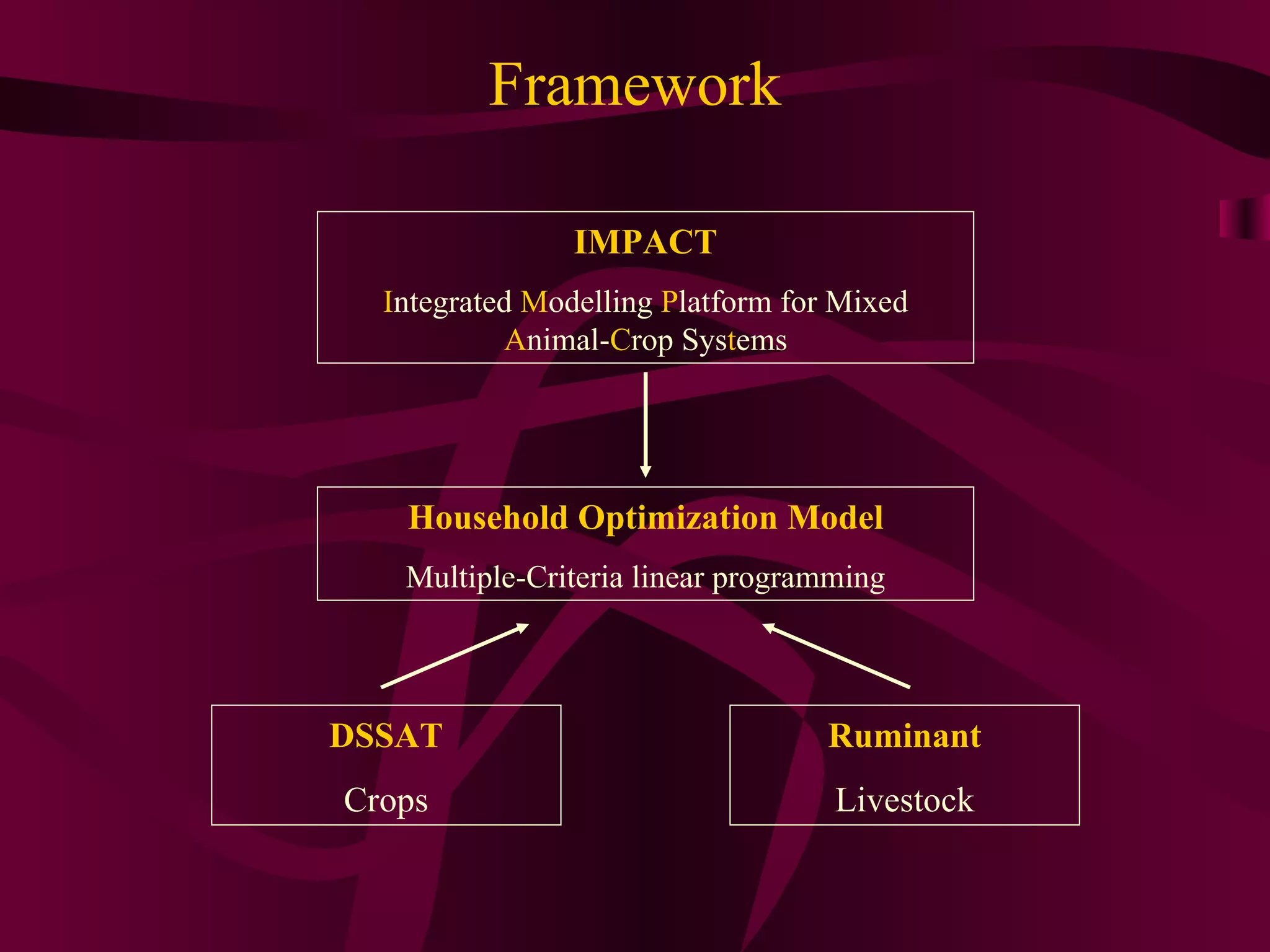
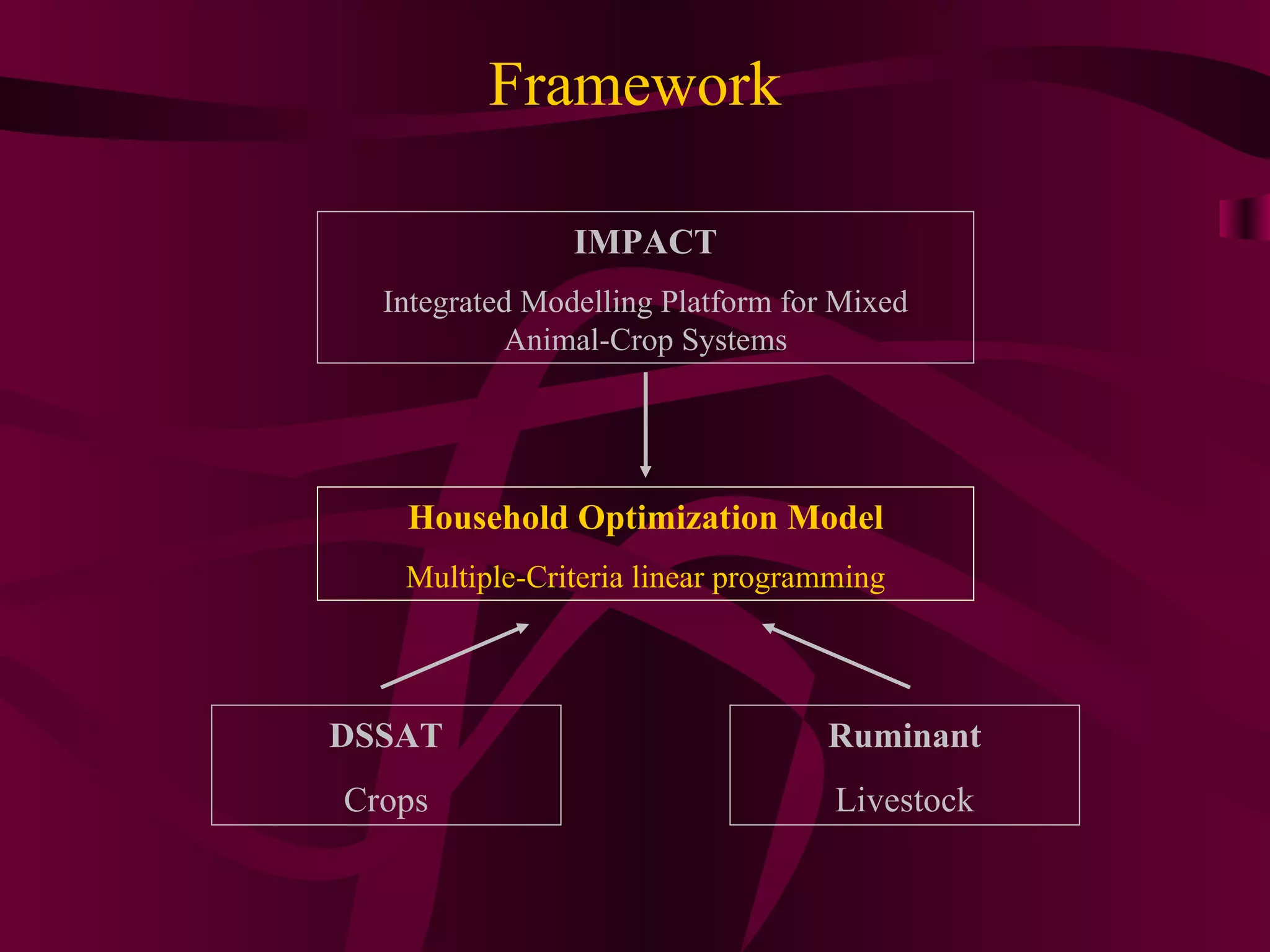
IMPACT I ntegrated  M odelling  P latform for Mixed  A nimal- C rop Sys t ems Framework Household Optimization Model Multiple-Criteria linear programming DSSAT Crops Ruminant Livestock
 
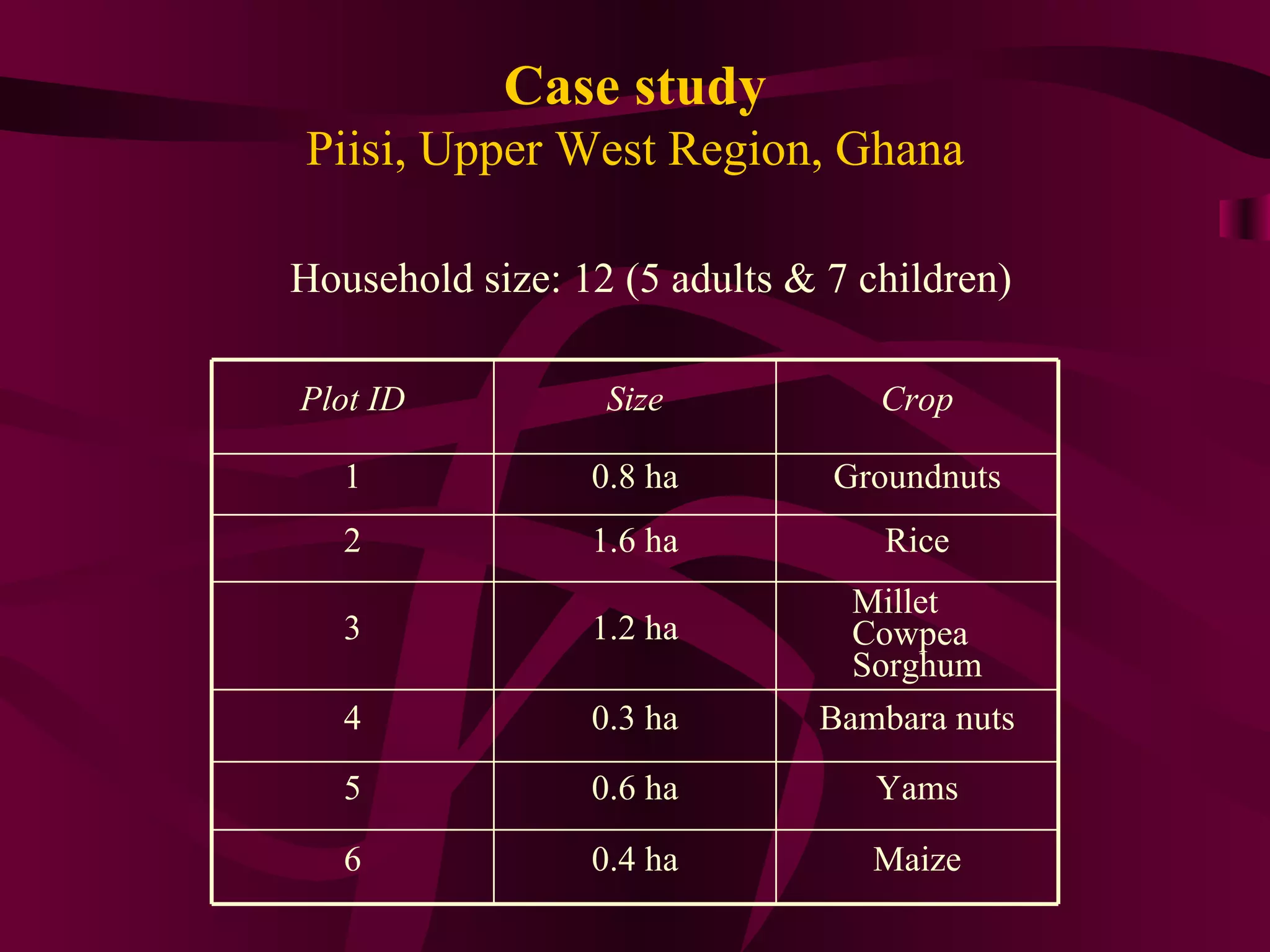
Case study Piisi, Upper West Region, Ghana Household size: 12 (5 adults & 7 children) Plot ID Size Crop 1 0.8 ha Groundnuts 2 1.6 ha Rice 3 1.2 ha Millet Cowpea Sorghum 4 0.3 ha Bambara nuts 5 0.6 ha Yams 6 0.4 ha Maize
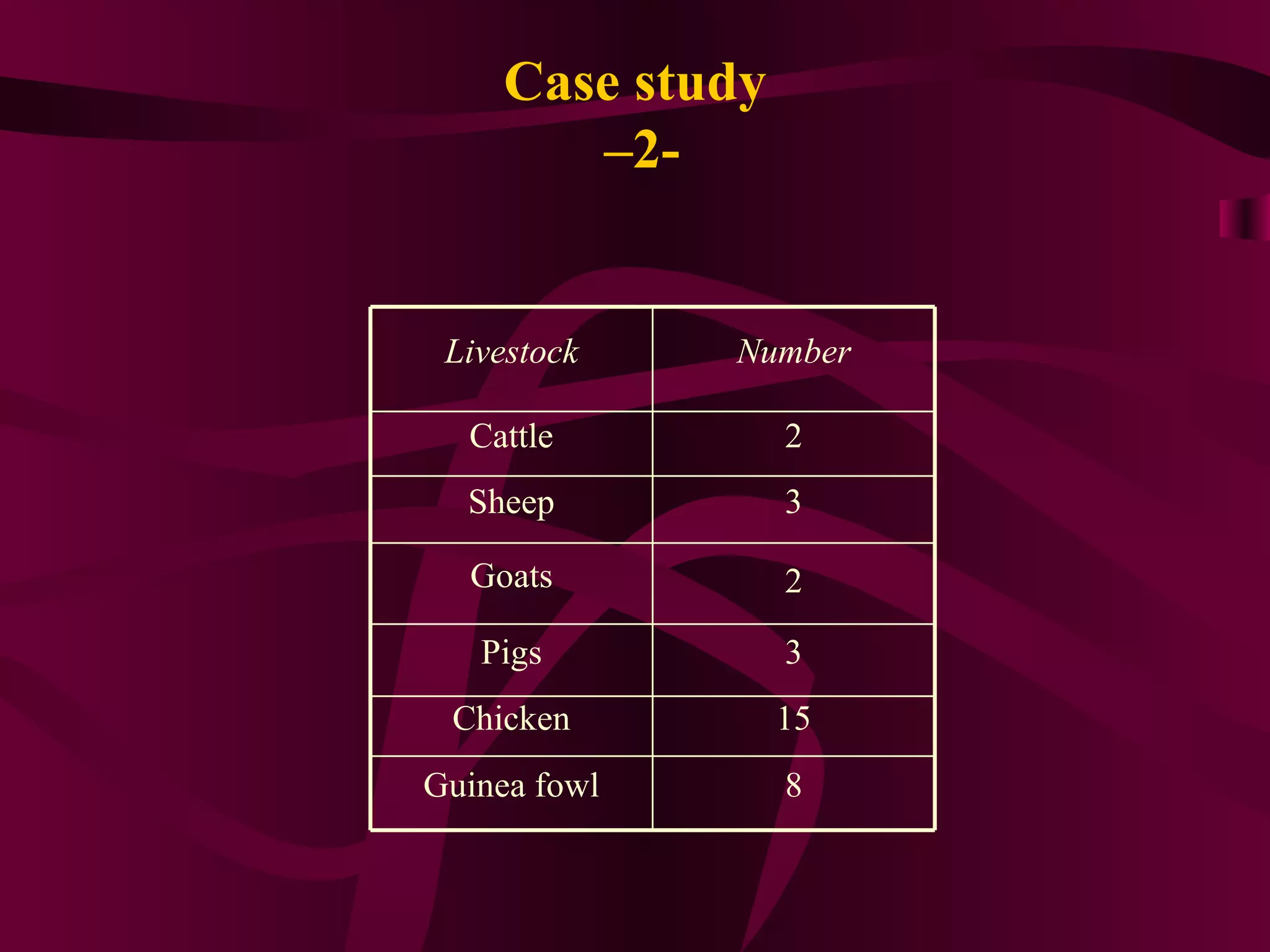
Case study – 2- Livestock Number Cattle 2 Sheep 3 Goats 2 Pigs 3 Chicken 15 Guinea fowl 8
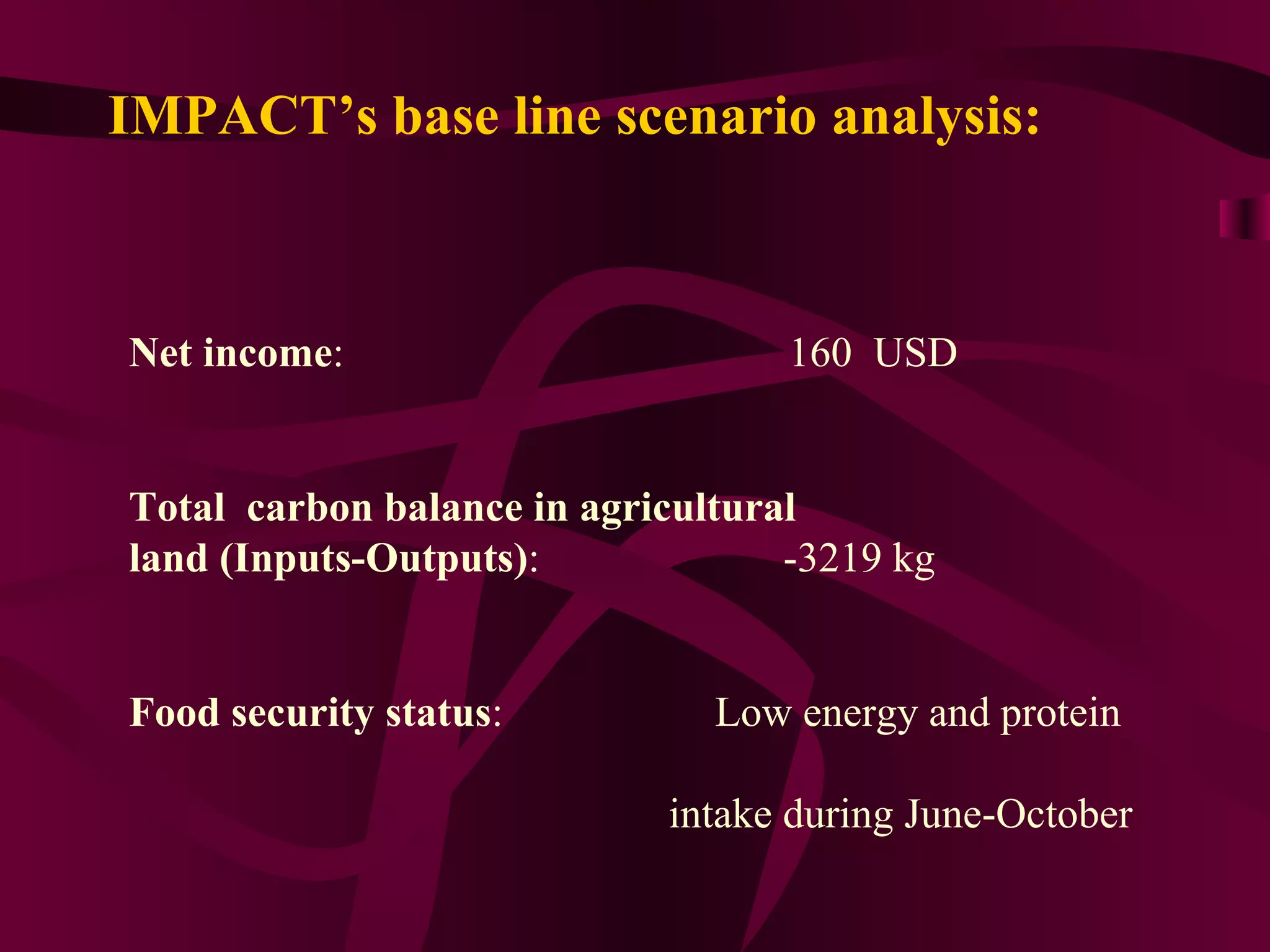
IMPACT’s base line scenario analysis: Net income :  160  USD Total  carbon balance in agricultural land (Inputs-Outputs) :  -3219 kg Food security status :  Low energy and protein  intake during June-October
IMPACT Integrated Modelling Platform for Mixed Animal-Crop Systems Household Optimization Model Multiple-Criteria linear programming Framework DSSAT Crops Ruminant Livestock
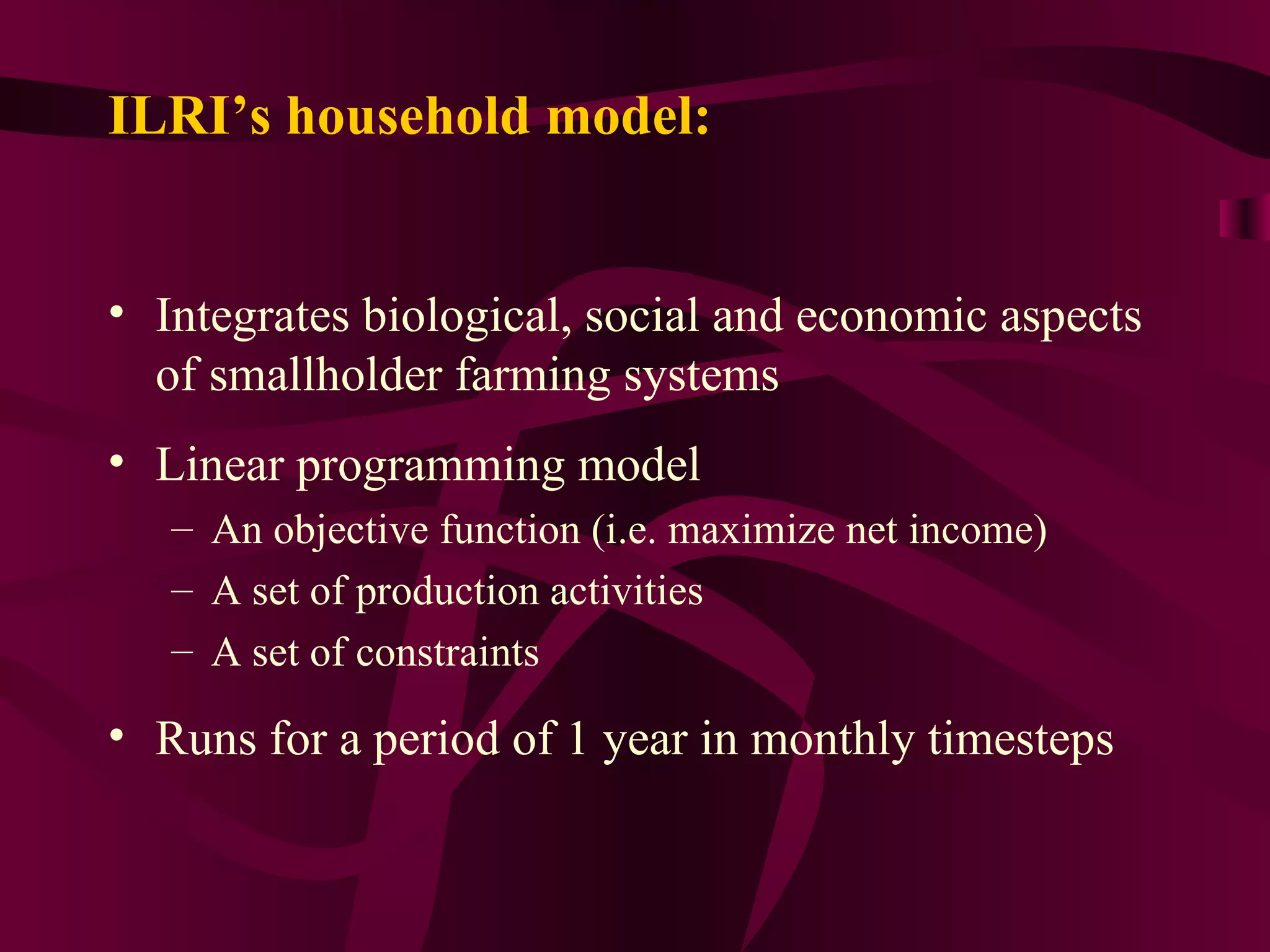
ILRI’s household model: Integrates biological, social and economic aspects of smallholder farming systems Linear programming model An objective function (i.e. maximize net income) A set of production activities A set of constraints Runs for a period of 1 year in monthly timesteps
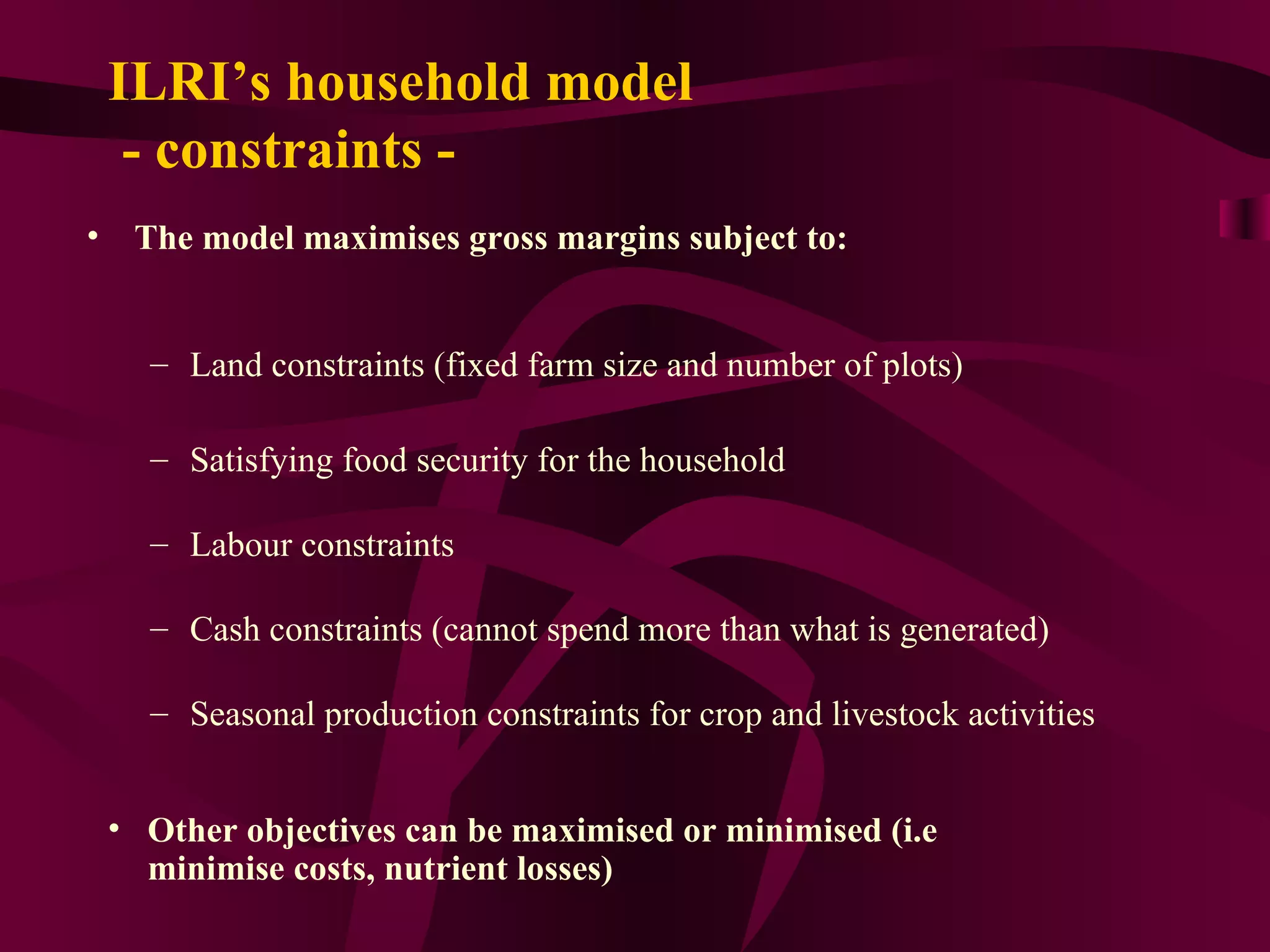
The model maximises gross margins subject to: Land constraints (fixed farm size and number of plots)  Satisfying food security for the household Labour constraints Cash constraints (cannot spend more than what is generated) Seasonal production constraints for crop and livestock activities Other objectives can be maximised or minimised (i.e minimise costs, nutrient losses) ILRI’s household model  - constraints -
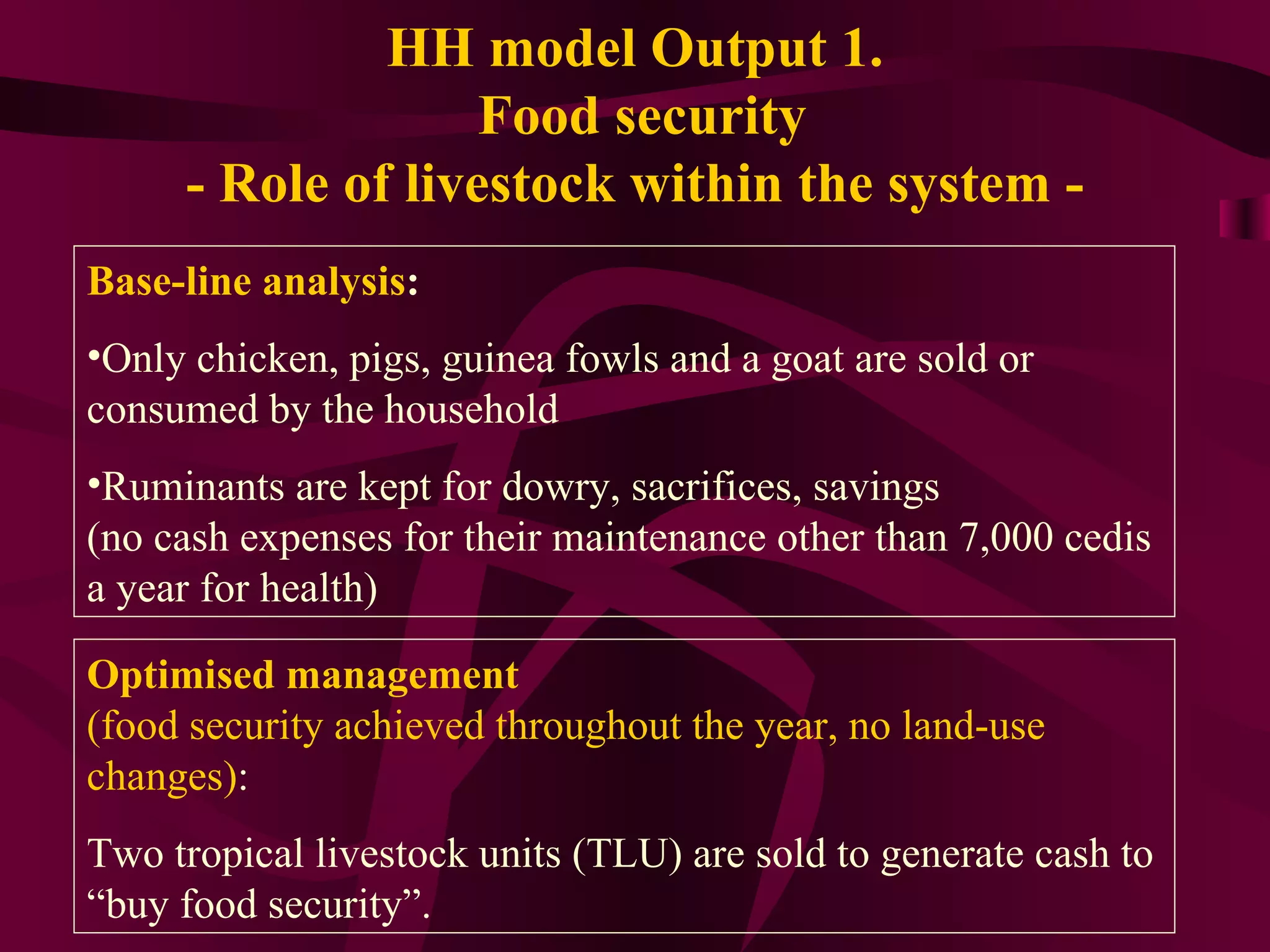
HH model Output 1. Food security - Role of livestock within the system - Base-line analysis : Only chicken, pigs, guinea fowls and a goat are sold or consumed by the household Ruminants are kept for dowry, sacrifices, savings  (no cash expenses for their maintenance other than 7,000 cedis a year for health) Optimised management  (food security achieved throughout the year, no land-use changes) : Two tropical livestock units (TLU) are sold to generate cash to “buy food security”.
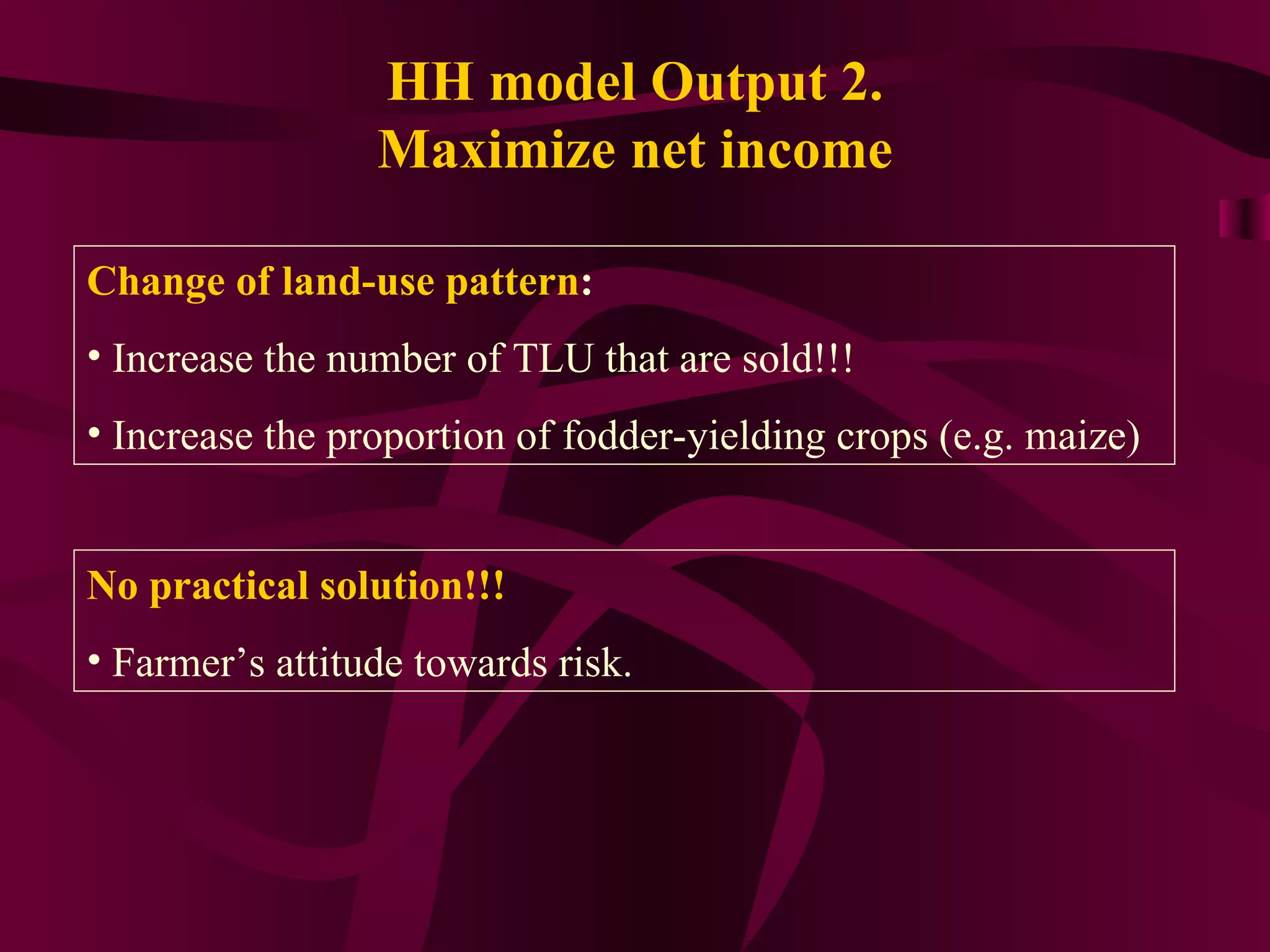
HH model Output 2. Maximize net income Change of land-use pattern : Increase the number of TLU that are sold!!! Increase the proportion of fodder-yielding crops (e.g. maize) No practical solution!!! Farmer’s attitude towards risk.
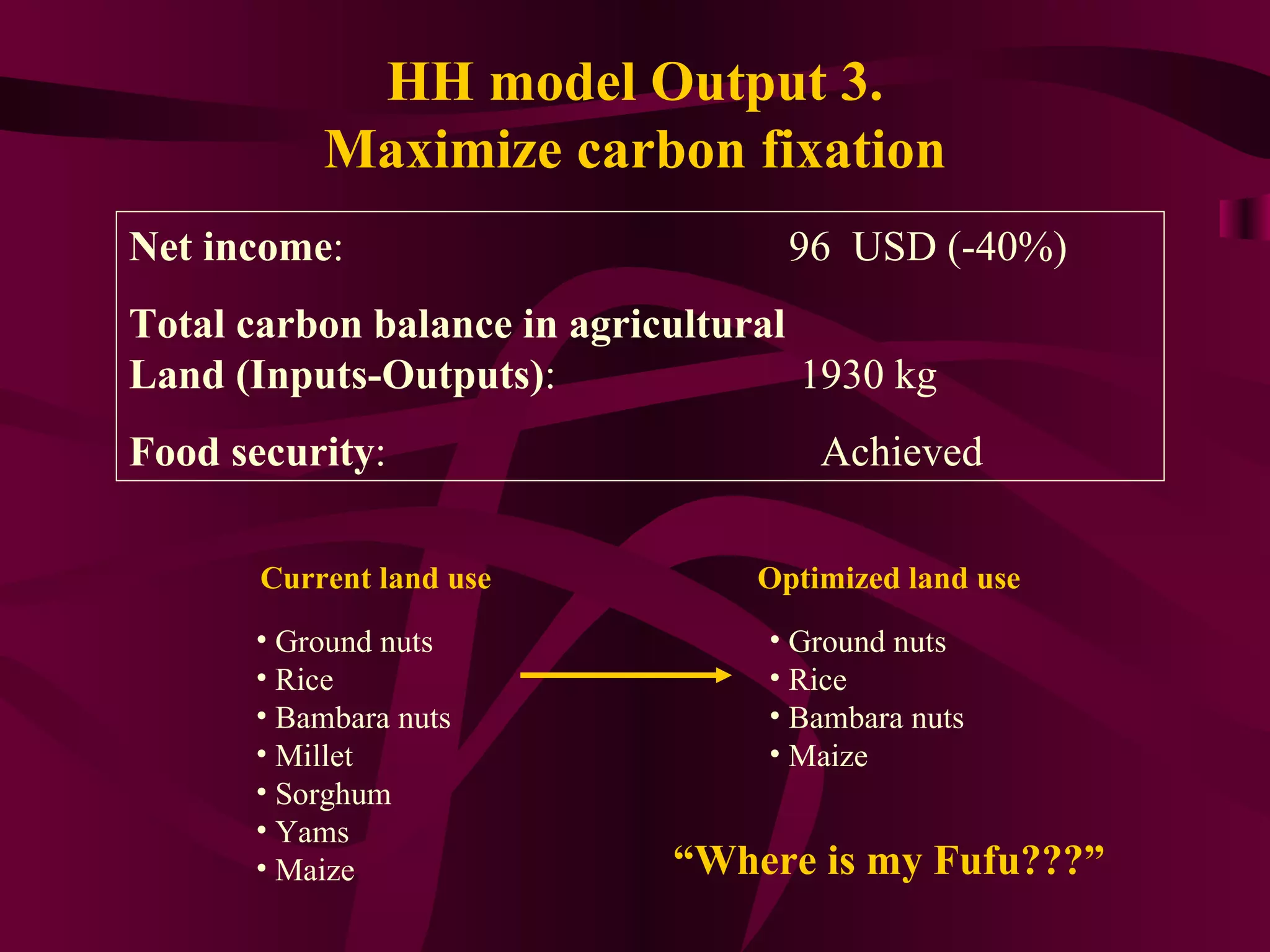
HH model Output 3. Maximize carbon fixation Net income :  96  USD (-40%) Total carbon balance in agricultural Land (Inputs-Outputs) :  1930 kg Food security :  Achieved “ Where is my Fufu???” Ground nuts Rice Bambara nuts Millet Sorghum Yams Maize Current land use Ground nuts Rice Bambara nuts Maize Optimized land use
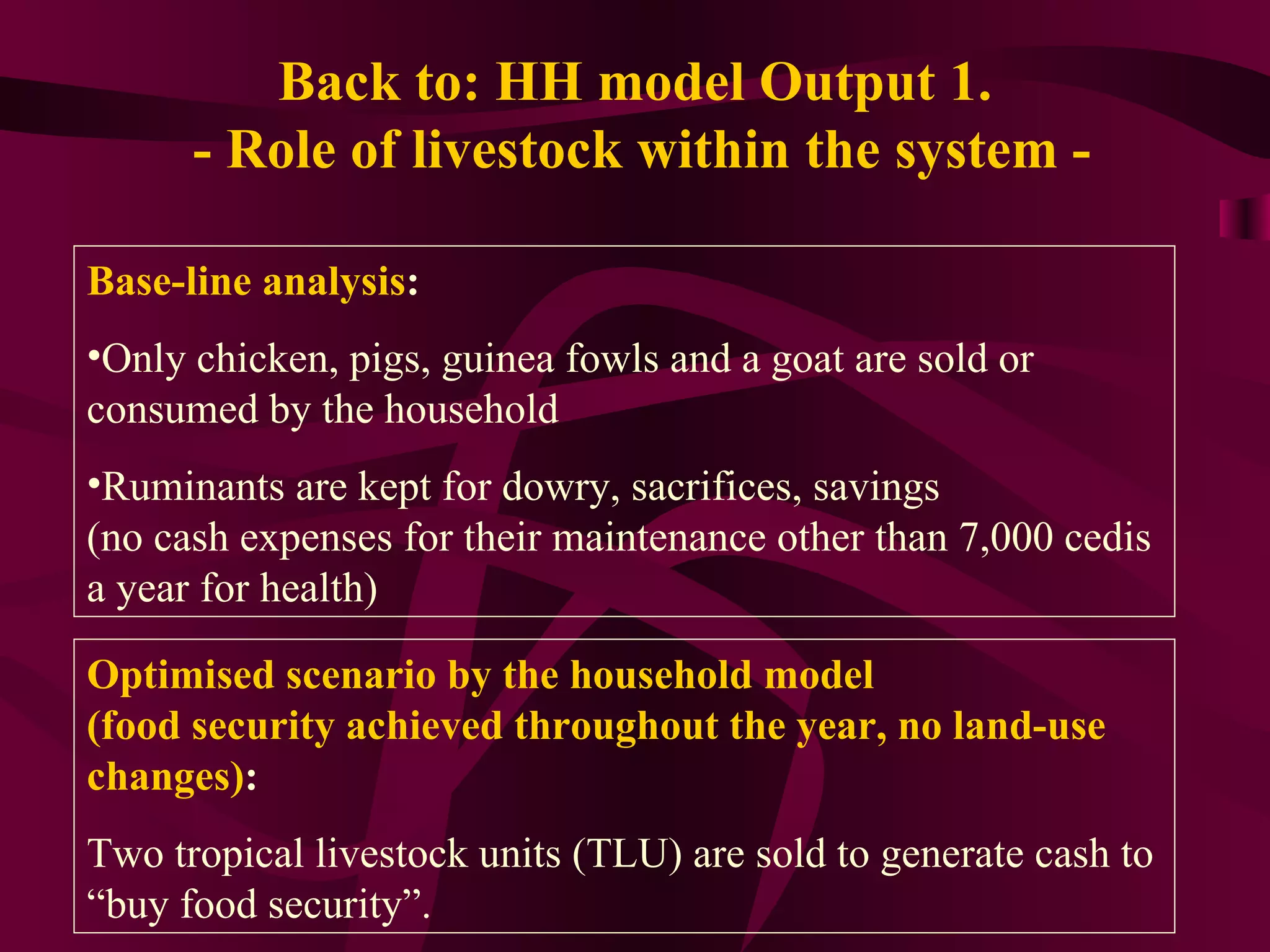
Back to: HH model Output 1. - Role of livestock within the system - Base-line analysis : Only chicken, pigs, guinea fowls and a goat are sold or consumed by the household Ruminants are kept for dowry, sacrifices, savings  (no cash expenses for their maintenance other than 7,000 cedis a year for health) Optimised scenario by the household model  (food security achieved throughout the year, no land-use changes) : Two tropical livestock units (TLU) are sold to generate cash to “buy food security”.
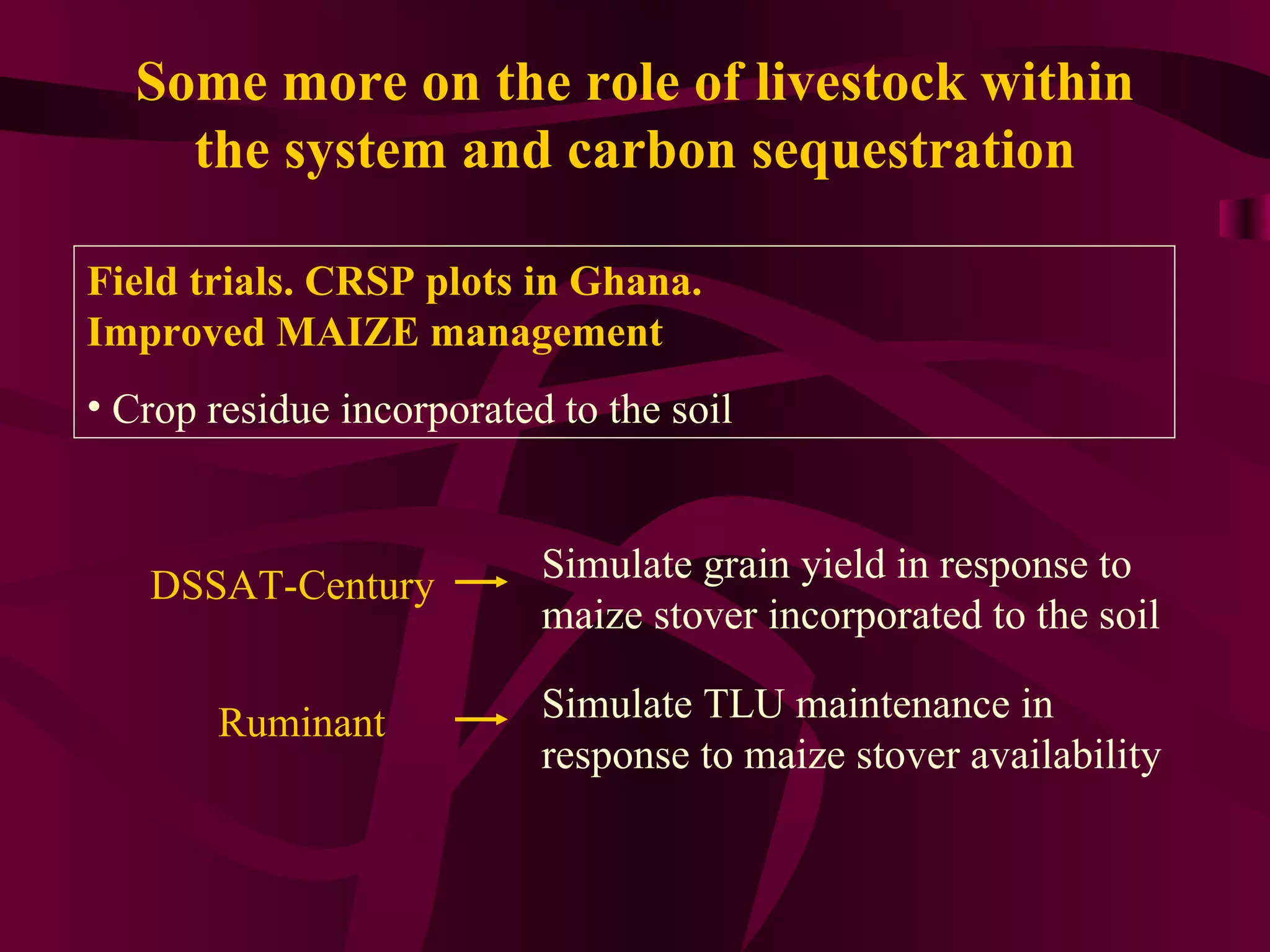
Some more on the role of livestock within the system and carbon sequestration Field trials. CRSP plots   in Ghana. Improved MAIZE management Crop residue incorporated to the soil  Simulate grain yield in response to maize stover incorporated to the soil  DSSAT-Century Simulate TLU maintenance in response to maize stover availability  Ruminant
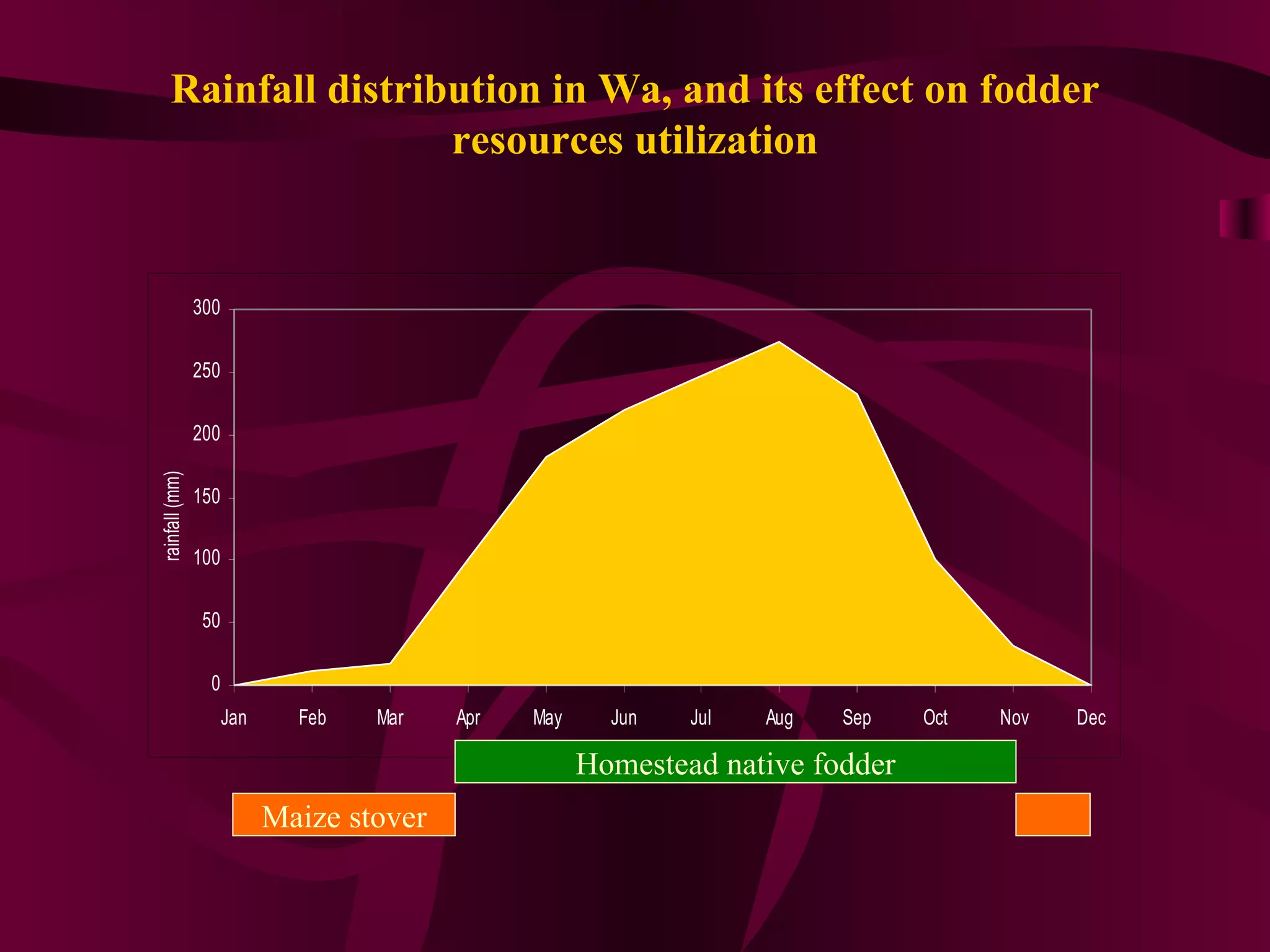
Rainfall distribution in Wa, and its effect on fodder resources utilization Homestead native fodder Maize stover
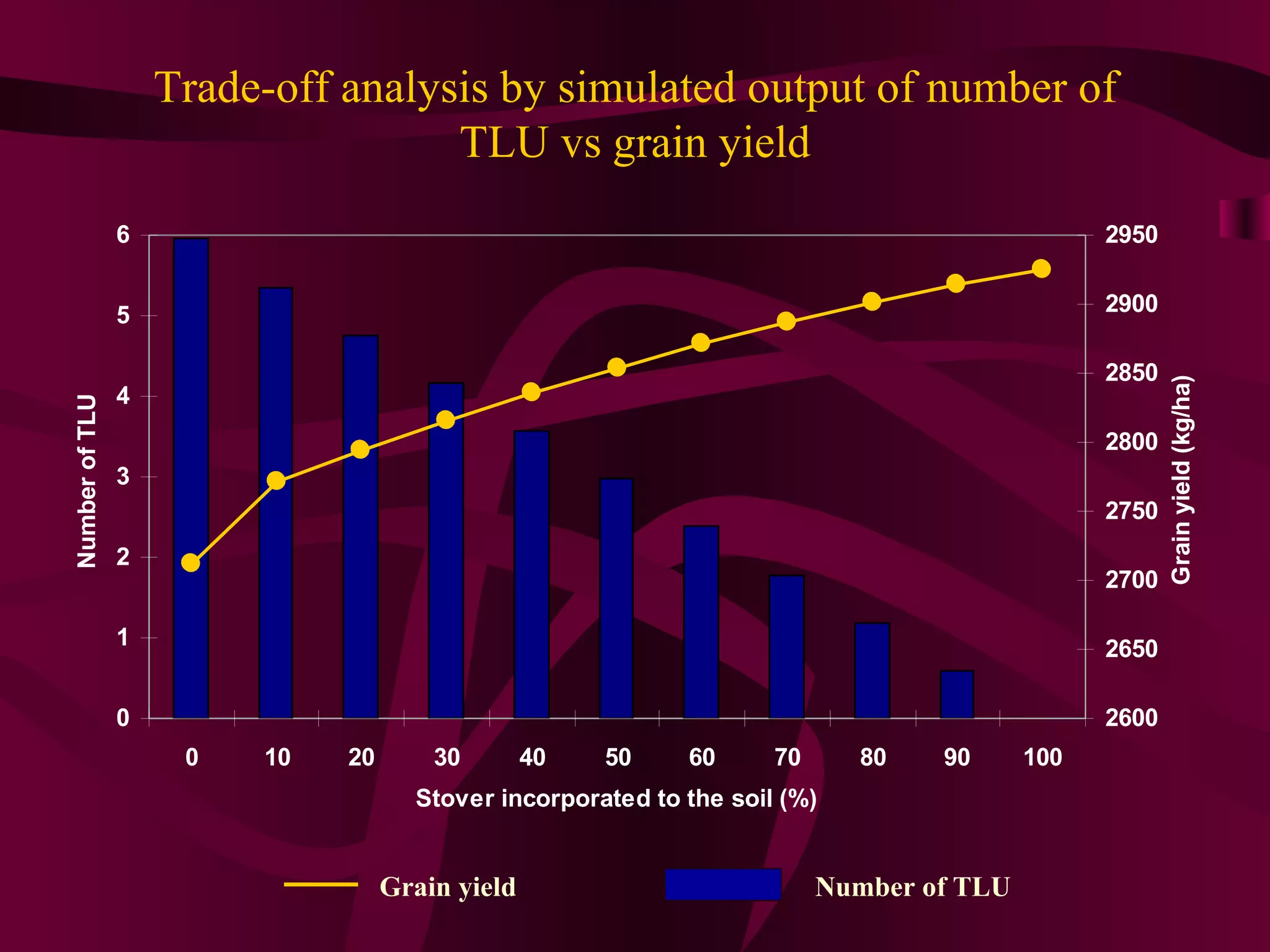
Trade-off analysis by simulated output of number of TLU vs grain yield Grain yield Number of TLU
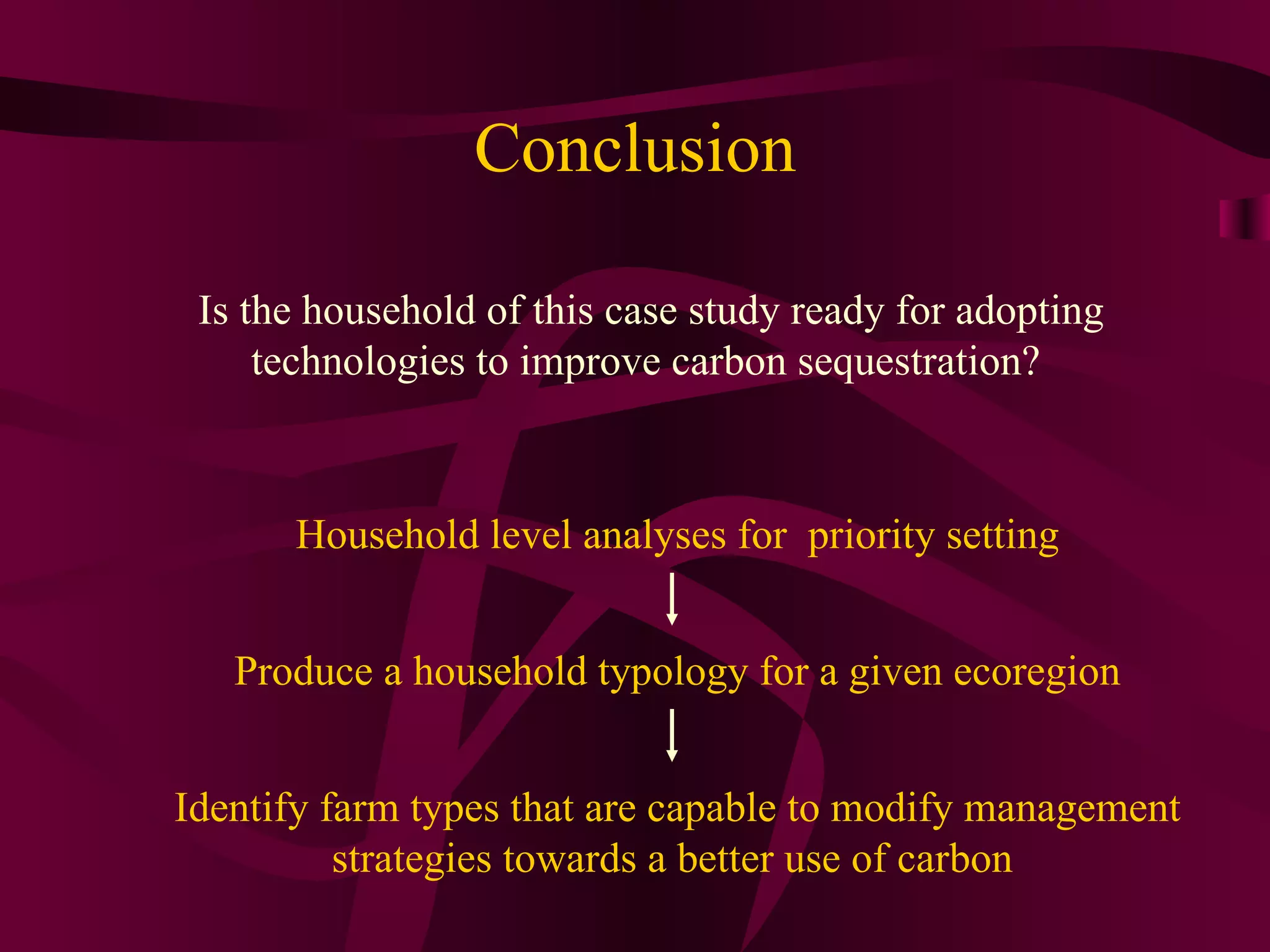
Conclusion Is the household of this case study ready for adopting technologies to improve carbon sequestration? Household level analyses for  priority setting Produce a household typology for a given ecoregion Identify farm types that are capable to modify management strategies towards a better use of carbon
La fin Merci!

A farm-level analysis of carbon sequestration in Ghana using IMPACT linked to the DSSAT-Century, Household and Ruminant models

  • 1.
    A farm-level analysisfor carbon sequestration in Ghana using IMPACT linked with the DSSAT , Household and Ruminant models E. González-Estrada 1 , V.K. Walen 2 , J. Naab 3 , P.K. Thornton 1 and M. Herrero 1 1 International Livestock Research Institute , PO Box 30709, Nairobi, Kenya 2 University of Florida , PO Box 110570, Gainesville, FL, USA 3 Savanna Agricultural Research Institute , PO Box 494, Wa, Upper West Region, Ghana  
  • 2.
    Case study: CRSP-SMfield trials in Wa, Upper West region of Ghana Objective: Explore the role of crop-livestock interactions in the carbon dynamics at the farm level
  • 3.
    IMPACT I ntegrated M odelling P latform for Mixed A nimal- C rop Sys t ems Framework Household Optimization Model Multiple-Criteria linear programming DSSAT Crops Ruminant Livestock
  • 4.
  • 5.
    Case study Piisi,Upper West Region, Ghana Household size: 12 (5 adults & 7 children) Plot ID Size Crop 1 0.8 ha Groundnuts 2 1.6 ha Rice 3 1.2 ha Millet Cowpea Sorghum 4 0.3 ha Bambara nuts 5 0.6 ha Yams 6 0.4 ha Maize
  • 6.
    Case study –2- Livestock Number Cattle 2 Sheep 3 Goats 2 Pigs 3 Chicken 15 Guinea fowl 8
  • 7.
    IMPACT’s base linescenario analysis: Net income : 160 USD Total carbon balance in agricultural land (Inputs-Outputs) : -3219 kg Food security status : Low energy and protein intake during June-October
  • 8.
    IMPACT Integrated ModellingPlatform for Mixed Animal-Crop Systems Household Optimization Model Multiple-Criteria linear programming Framework DSSAT Crops Ruminant Livestock
  • 9.
    ILRI’s household model:Integrates biological, social and economic aspects of smallholder farming systems Linear programming model An objective function (i.e. maximize net income) A set of production activities A set of constraints Runs for a period of 1 year in monthly timesteps
  • 10.
    The model maximisesgross margins subject to: Land constraints (fixed farm size and number of plots) Satisfying food security for the household Labour constraints Cash constraints (cannot spend more than what is generated) Seasonal production constraints for crop and livestock activities Other objectives can be maximised or minimised (i.e minimise costs, nutrient losses) ILRI’s household model - constraints -
  • 11.
    HH model Output1. Food security - Role of livestock within the system - Base-line analysis : Only chicken, pigs, guinea fowls and a goat are sold or consumed by the household Ruminants are kept for dowry, sacrifices, savings (no cash expenses for their maintenance other than 7,000 cedis a year for health) Optimised management (food security achieved throughout the year, no land-use changes) : Two tropical livestock units (TLU) are sold to generate cash to “buy food security”.
  • 12.
    HH model Output2. Maximize net income Change of land-use pattern : Increase the number of TLU that are sold!!! Increase the proportion of fodder-yielding crops (e.g. maize) No practical solution!!! Farmer’s attitude towards risk.
  • 13.
    HH model Output3. Maximize carbon fixation Net income : 96 USD (-40%) Total carbon balance in agricultural Land (Inputs-Outputs) : 1930 kg Food security : Achieved “ Where is my Fufu???” Ground nuts Rice Bambara nuts Millet Sorghum Yams Maize Current land use Ground nuts Rice Bambara nuts Maize Optimized land use
  • 14.
    Back to: HHmodel Output 1. - Role of livestock within the system - Base-line analysis : Only chicken, pigs, guinea fowls and a goat are sold or consumed by the household Ruminants are kept for dowry, sacrifices, savings (no cash expenses for their maintenance other than 7,000 cedis a year for health) Optimised scenario by the household model (food security achieved throughout the year, no land-use changes) : Two tropical livestock units (TLU) are sold to generate cash to “buy food security”.
  • 15.
    Some more onthe role of livestock within the system and carbon sequestration Field trials. CRSP plots in Ghana. Improved MAIZE management Crop residue incorporated to the soil Simulate grain yield in response to maize stover incorporated to the soil DSSAT-Century Simulate TLU maintenance in response to maize stover availability Ruminant
  • 16.
    Rainfall distribution inWa, and its effect on fodder resources utilization Homestead native fodder Maize stover
  • 17.
    Trade-off analysis bysimulated output of number of TLU vs grain yield Grain yield Number of TLU
  • 18.
    Conclusion Is thehousehold of this case study ready for adopting technologies to improve carbon sequestration? Household level analyses for priority setting Produce a household typology for a given ecoregion Identify farm types that are capable to modify management strategies towards a better use of carbon
  • 19.