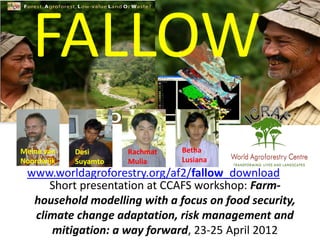
FALLOW
Meine van   Desi      Rachmat   Betha
Noordwijk   Suyamto   Mulia     Lusiana
 www.worldagroforestry.org/af2/fallow_download
     Short presentation at CCAFS workshop: Farm-
  household modelling with a focus on food security,
  climate change adaptation, risk management and
     mitigation: a way forward, 23-25 April 2012
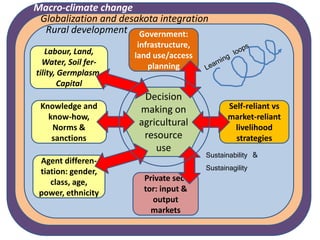
Macro-climate change
 Globalization and desakota integration
  Rural development Government:
                       infrastructure,
   Labour, Land,      land use/access
  Water, Soil fer-        planning
tility, Germplasm,
        Capital
                        Decision
 Knowledge and         making on               Self-reliant vs
   know-how,                                   market-reliant
    Norms &
                       agricultural              livelihood
    sanctions           resource                 strategies
                           use
                                         Sustainability &
 Agent differen-
 tiation: gender,                        Sustainagility
    class, age,         Private sec-
 power, ethnicity       tor: input &
                          output
                          markets
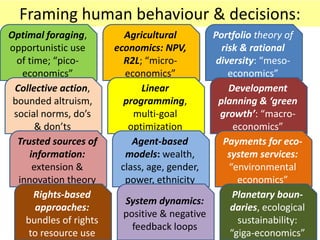
Framing human behaviour & decisions:
Optimal foraging,         Agricultural        Portfolio theory of
opportunistic use       economics: NPV,         risk & rational
  of time; “pico-         R2L; “micro-         diversity: “meso-
   economics”             economics”              economics”
 Collective action,           Linear              Development
 bounded altruism,        programming,         planning & ‘green
 social norms, do’s         multi-goal          growth’: “macro-
       & don’ts            optimization             economics”
  Trusted sources of        Agent-based          Payments for eco-
     information:         models: wealth,         system services:
      extension &        class, age, gender,      “environmental
  innovation theory       power, ethnicity           economics”
       Rights-based                                 Planetary boun-
                          System dynamics:
       approaches:                                 daries, ecological
                          positive & negative
    bundles of rights                                sustainability:
                            feedback loops
     to resource use                               “giga-economics”
Framing human behaviour & decisions:
Optimal foraging,         Agricultural        Portfolio theory of
opportunistic use       economics: NPV,         risk & rational
  of time; “pico-         R2L; “micro-         diversity: “meso-
   economics”             economics”              economics”
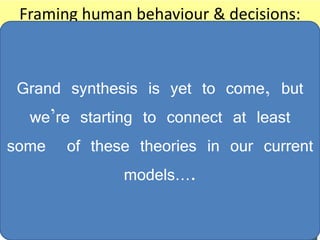
 Grand synthesis is yet to come, but
 Collective action,
 bounded altruism,
                              Linear
                          programming,
                                                  Development
                                               planning & ‘green
  we’re starting to connect at least
 social norms, do’s
       & don’ts
                            multi-goal
                           optimization
                                                growth’: “macro-
                                                    economics”

some of these theories in our current
  Trusted sources of
     information:
                            Agent-based
                          models: wealth,
                                                 Payments for eco-
                                                  system services:
      extension &        class, age, gender,       environmental
               models….
  innovation theory       power, ethnicity           economics”
       Rights-based                                 Planetary boun-
                          System dynamics:
       approaches:                                 daries, ecological
                          positive & negative
    bundles of rights                                sustainability:
                            feedback loops
     to resource use                               “giga-economics”
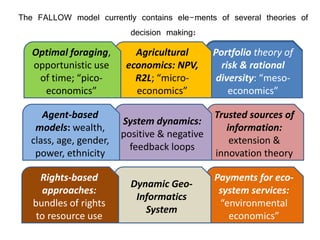
The FALLOW model currently contains ele-ments of several theories of
                        decision making:
   Optimal foraging,       Agricultural       Portfolio theory of
   opportunistic use     economics: NPV,        risk & rational
    of time; “pico-        R2L; “micro-        diversity: “meso-
     economics”            economics”             economics”

     Agent-based                              Trusted sources of
                        System dynamics:
   models: wealth,                               information:
                        positive & negative
  class, age, gender,                             extension &
                          feedback loops
   power, ethnicity                           innovation theory

     Rights-based                             Payments for eco-
                          Dynamic Geo-
     approaches:                               system services:
                           Informatics
   bundles of rights                           “environmental
                             System
    to resource use                              economics”
www.agralin.nl/ojs/index.php/njas/article/view/588/302
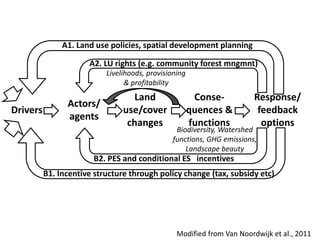
A1. Land use policies, spatial development planning

                      A2. LU rights (e.g. community forest mngmnt)
                           Livelihoods, provisioning
                                 & profitability
                                  Land                  Conse-          Response/
                Actors/
Drivers                         use/cover              quences &         feedback
                agents
                                 changes               functions          options
                                                Biodiversity, Watershed
                                               functions, GHG emissions,
                                                   Landscape beauty
                       B2. PES and conditional ES incentives
          B1. Incentive structure through policy change (tax, subsidy etc)


                                                 Modified from Van Noordwijk et al., 2011
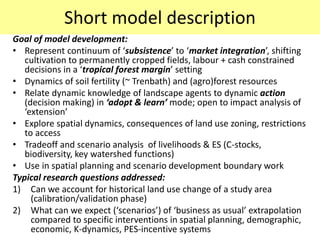
Short model description
Goal of model development:
• Represent continuum of ‘subsistence’ to ‘market integration’, shifting
   cultivation to permanently cropped fields, labour + cash constrained
   decisions in a ‘tropical forest margin’ setting
• Dynamics of soil fertility (~ Trenbath) and (agro)forest resources
• Relate dynamic knowledge of landscape agents to dynamic action
   (decision making) in ‘adopt & learn’ mode; open to impact analysis of
   ‘extension’
• Explore spatial dynamics, consequences of land use zoning, restrictions
   to access
• Tradeoff and scenario analysis of livelihoods & ES (C-stocks,
   biodiversity, key watershed functions)
• Use in spatial planning and scenario development boundary work
Typical research questions addressed:
1) Can we account for historical land use change of a study area
     (calibration/validation phase)
2) What can we expect (‘scenarios’) of ‘business as usual’ extrapolation
     compared to specific interventions in spatial planning, demographic,
     economic, K-dynamics, PES-incentive systems
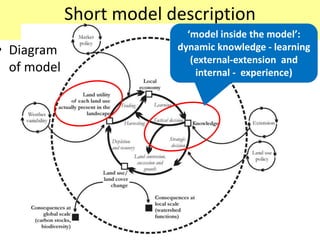
Short model description
       maximizing ‘utility’     ‘model inside the model’:
         (profitability)
• Diagram                     dynamic knowledge - learning
                                 (external-extension and
  of model                        internal - experience)


                     ≈
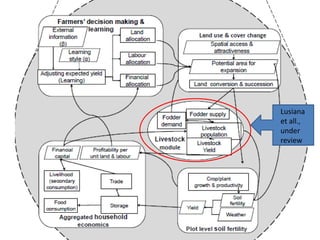
Lusiana
et all.,
under
review
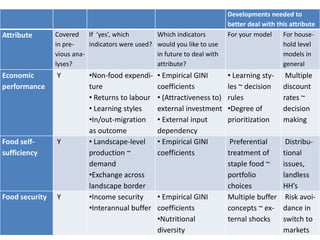
Developments needed to
                                                                            better deal with this attribute
Attribute       Covered If ‘yes’, which            Which indicators         For your model     For house-
                in pre-    indicators were used?   would you like to use                       hold level
                vious ana-                         in future to deal with                      models in
                lyses?                             attribute?                                  general
Economic        Y          •Non-food expendi-      • Empirical GINI         • Learning sty-     Multiple
performance                ture                    coefficients             les ~ decision     discount
                           • Returns to labour     • (Attractiveness to)    rules              rates ~
                           • Learning styles       external investment      •Degree of         decision
                           •In/out-migration       • External input         prioritization     making
                           as outcome              dependency
Food self-      Y          • Landscape-level       • Empirical GINI          Preferential       Distribu-
sufficiency                production ~            coefficients             treatment of       tional
                           demand                                           staple food ~      issues,
                           •Exchange across                                 portfolio          landless
                           landscape border                                 choices            HH’s
Food security   Y          •Income security        • Empirical GINI         Multiple buffer     Risk avoi-
                           •Interannual buffer     coefficients             concepts ~ ex-     dance in
                                                   •Nutritional             ternal shocks      switch to
                                                   diversity                                   markets
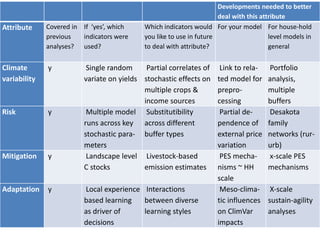
Developments needed to better
                                                                      deal with this attribute
Attribute     Covered in If ‘yes’, which    Which indicators would For your model For house-hold
              previous   indicators were    you like to use in future                   level models in
              analyses? used?               to deal with attribute?                     general


Climate       y           Single random     Partial correlates of     Link to rela-     Portfolio
variability              variate on yields stochastic effects on     ted model for     analysis,
                                           multiple crops &          prepro-           multiple
                                           income sources            cessing           buffers
Risk          y           Multiple model Substitutibility             Partial de-       Desakota
                         runs across key across different            pendence of       family
                         stochastic para- buffer types               external price    networks (rur-
                         meters                                      variation         urb)
Mitigation    y           Landscape level Livestock-based             PES mecha-        x-scale PES
                         C stocks          emission estimates        nisms ~ HH        mechanisms
                                                                     scale
Adaptation    y          Local experience Interactions                Meso-clima-       X-scale
                         based learning   between diverse            tic influences    sustain-agility
                         as driver of     learning styles            on ClimVar        analyses
                         decisions                                   impacts
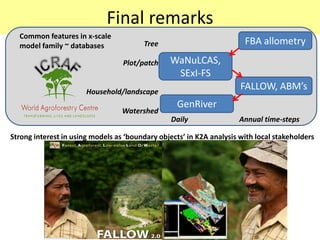
Final remarks
  Common features in x-scale
  model family ~ databases              Tree                           FBA allometry
                                  Plot/patch    WaNuLCAS,
                                                 SExI-FS
                       Household/landscape
                                                                      FALLOW, ABM’s
                                                   GenRiver
                                  Watershed
                                                 Daily                Annual time-steps

Strong interest in using models as ‘boundary objects’ in K2A analysis with local stakeholders
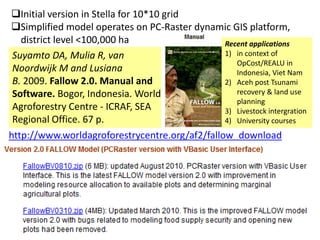
Initial version in Stella for 10*10 grid
Simplified model operates on PC-Raster dynamic GIS platform,
   district level <100,000 ha                   Recent applications
 Suyamto DA, Mulia R, van                       1) in context of
                                                   OpCost/REALU in
 Noordwijk M and Lusiana                           Indonesia, Viet Nam
 B. 2009. Fallow 2.0. Manual and                2) Aceh post Tsunami
 Software. Bogor, Indonesia. World                 recovery & land use
                                                   planning
 Agroforestry Centre - ICRAF, SEA               3) Livestock intergration
 Regional Office. 67 p.                         4) University courses
http://www.worldagroforestrycentre.org/af2/fallow_download
Multipurpose agroforestry as a climate
change resiliency option for farmers: an
example of local adaptation in Vietnam
  Quan Nguyen, Minh Ha Hoang, Ingrid Öborn, and Meine van Noordwijk
Recently, the Commission on Sustainable
  Agriculture and Climate Change (Beddington
  et al. 2011) launched its recommendations for
  ensuring food security under a changing
  climate. The report does not mention trees,
  forests or agroforestry as important for food
  security. This is in contrast to the ways farming
  traditions have evolved (van Noordwijk et al.
  2011) and how farmers currently try to adapt
  to further climate change.
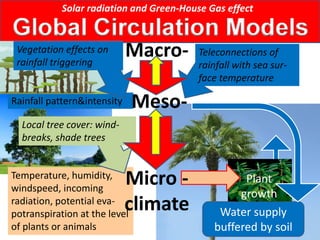
Solar radiation and Green-House Gas effect


 Vegetation effects on
 rainfall triggering
                             Macro-       Teleconnections of
                                          rainfall with sea sur-
                                          face temperature

Rainfall pattern&intensity     Meso-
  Local tree cover: wind-
  breaks, shade trees


Temperature, humidity,
windspeed, incoming
                             Micro -               Plant
                                                  growth
radiation, potential eva-
potranspiration at the level
                             climate          Water supply
of plants or animals                         buffered by soil
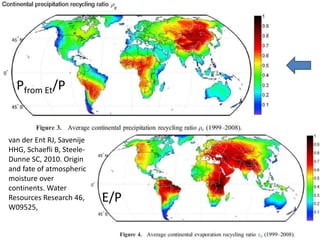
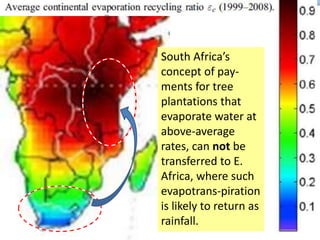
Pfrom Et/P


van der Ent RJ, Savenije
HHG, Schaefli B, Steele‐
Dunne SC, 2010. Origin
and fate of atmospheric
moisture over
continents. Water
Resources Research 46,     E/P
W09525,
South Africa’s
concept of pay-
ments for tree
plantations that
evaporate water at
above-average
rates, can not be
transferred to E.
Africa, where such
evapotrans-piration
is likely to return as
rainfall.
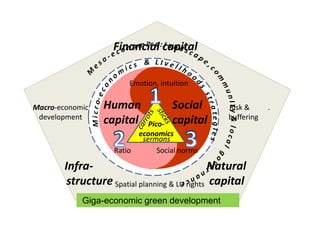
Financial capital

                       Emotion, intuition


Macro-economic   Human              Social       Risk &      .
 development                                     buffering
                 capital    Pico-   capital
                         economics
                          sermons
                   Ratio       Social norms

       Infra-                                 Natural
        structure Spatial planning & LU rights capital
            Giga-economic green development
Van noordwijk fallow_modelingworkshopamsterdam_2012-04-23

Van noordwijk fallow_modelingworkshopamsterdam_2012-04-23

  • 1.
    FALLOW Meine van Desi Rachmat Betha Noordwijk Suyamto Mulia Lusiana www.worldagroforestry.org/af2/fallow_download Short presentation at CCAFS workshop: Farm- household modelling with a focus on food security, climate change adaptation, risk management and mitigation: a way forward, 23-25 April 2012
  • 2.
    Macro-climate change Globalizationand desakota integration Rural development Government: infrastructure, Labour, Land, land use/access Water, Soil fer- planning tility, Germplasm, Capital Decision Knowledge and making on Self-reliant vs know-how, market-reliant Norms & agricultural livelihood sanctions resource strategies use Sustainability & Agent differen- tiation: gender, Sustainagility class, age, Private sec- power, ethnicity tor: input & output markets
  • 3.
    Framing human behaviour& decisions: Optimal foraging, Agricultural Portfolio theory of opportunistic use economics: NPV, risk & rational of time; “pico- R2L; “micro- diversity: “meso- economics” economics” economics” Collective action, Linear Development bounded altruism, programming, planning & ‘green social norms, do’s multi-goal growth’: “macro- & don’ts optimization economics” Trusted sources of Agent-based Payments for eco- information: models: wealth, system services: extension & class, age, gender, “environmental innovation theory power, ethnicity economics” Rights-based Planetary boun- System dynamics: approaches: daries, ecological positive & negative bundles of rights sustainability: feedback loops to resource use “giga-economics”
  • 4.
    Framing human behaviour& decisions: Optimal foraging, Agricultural Portfolio theory of opportunistic use economics: NPV, risk & rational of time; “pico- R2L; “micro- diversity: “meso- economics” economics” economics” Grand synthesis is yet to come, but Collective action, bounded altruism, Linear programming, Development planning & ‘green we’re starting to connect at least social norms, do’s & don’ts multi-goal optimization growth’: “macro- economics” some of these theories in our current Trusted sources of information: Agent-based models: wealth, Payments for eco- system services: extension & class, age, gender, environmental models…. innovation theory power, ethnicity economics” Rights-based Planetary boun- System dynamics: approaches: daries, ecological positive & negative bundles of rights sustainability: feedback loops to resource use “giga-economics”
  • 5.
    The FALLOW modelcurrently contains ele-ments of several theories of decision making: Optimal foraging, Agricultural Portfolio theory of opportunistic use economics: NPV, risk & rational of time; “pico- R2L; “micro- diversity: “meso- economics” economics” economics” Agent-based Trusted sources of System dynamics: models: wealth, information: positive & negative class, age, gender, extension & feedback loops power, ethnicity innovation theory Rights-based Payments for eco- Dynamic Geo- approaches: system services: Informatics bundles of rights “environmental System to resource use economics”
  • 6.
  • 7.
    A1. Land usepolicies, spatial development planning A2. LU rights (e.g. community forest mngmnt) Livelihoods, provisioning & profitability Land Conse- Response/ Actors/ Drivers use/cover quences & feedback agents changes functions options Biodiversity, Watershed functions, GHG emissions, Landscape beauty B2. PES and conditional ES incentives B1. Incentive structure through policy change (tax, subsidy etc) Modified from Van Noordwijk et al., 2011
  • 8.
    Short model description Goalof model development: • Represent continuum of ‘subsistence’ to ‘market integration’, shifting cultivation to permanently cropped fields, labour + cash constrained decisions in a ‘tropical forest margin’ setting • Dynamics of soil fertility (~ Trenbath) and (agro)forest resources • Relate dynamic knowledge of landscape agents to dynamic action (decision making) in ‘adopt & learn’ mode; open to impact analysis of ‘extension’ • Explore spatial dynamics, consequences of land use zoning, restrictions to access • Tradeoff and scenario analysis of livelihoods & ES (C-stocks, biodiversity, key watershed functions) • Use in spatial planning and scenario development boundary work Typical research questions addressed: 1) Can we account for historical land use change of a study area (calibration/validation phase) 2) What can we expect (‘scenarios’) of ‘business as usual’ extrapolation compared to specific interventions in spatial planning, demographic, economic, K-dynamics, PES-incentive systems
  • 9.
    Short model description maximizing ‘utility’ ‘model inside the model’: (profitability) • Diagram dynamic knowledge - learning (external-extension and of model internal - experience) ≈
  • 11.
  • 13.
    Developments needed to better deal with this attribute Attribute Covered If ‘yes’, which Which indicators For your model For house- in pre- indicators were used? would you like to use hold level vious ana- in future to deal with models in lyses? attribute? general Economic Y •Non-food expendi- • Empirical GINI • Learning sty- Multiple performance ture coefficients les ~ decision discount • Returns to labour • (Attractiveness to) rules rates ~ • Learning styles external investment •Degree of decision •In/out-migration • External input prioritization making as outcome dependency Food self- Y • Landscape-level • Empirical GINI Preferential Distribu- sufficiency production ~ coefficients treatment of tional demand staple food ~ issues, •Exchange across portfolio landless landscape border choices HH’s Food security Y •Income security • Empirical GINI Multiple buffer Risk avoi- •Interannual buffer coefficients concepts ~ ex- dance in •Nutritional ternal shocks switch to diversity markets
  • 14.
    Developments needed tobetter deal with this attribute Attribute Covered in If ‘yes’, which Which indicators would For your model For house-hold previous indicators were you like to use in future level models in analyses? used? to deal with attribute? general Climate y Single random Partial correlates of Link to rela- Portfolio variability variate on yields stochastic effects on ted model for analysis, multiple crops & prepro- multiple income sources cessing buffers Risk y Multiple model Substitutibility Partial de- Desakota runs across key across different pendence of family stochastic para- buffer types external price networks (rur- meters variation urb) Mitigation y Landscape level Livestock-based PES mecha- x-scale PES C stocks emission estimates nisms ~ HH mechanisms scale Adaptation y Local experience Interactions Meso-clima- X-scale based learning between diverse tic influences sustain-agility as driver of learning styles on ClimVar analyses decisions impacts
  • 15.
    Final remarks Common features in x-scale model family ~ databases Tree FBA allometry Plot/patch WaNuLCAS, SExI-FS Household/landscape FALLOW, ABM’s GenRiver Watershed Daily Annual time-steps Strong interest in using models as ‘boundary objects’ in K2A analysis with local stakeholders
  • 16.
    Initial version inStella for 10*10 grid Simplified model operates on PC-Raster dynamic GIS platform, district level <100,000 ha Recent applications Suyamto DA, Mulia R, van 1) in context of OpCost/REALU in Noordwijk M and Lusiana Indonesia, Viet Nam B. 2009. Fallow 2.0. Manual and 2) Aceh post Tsunami Software. Bogor, Indonesia. World recovery & land use planning Agroforestry Centre - ICRAF, SEA 3) Livestock intergration Regional Office. 67 p. 4) University courses http://www.worldagroforestrycentre.org/af2/fallow_download
  • 18.
    Multipurpose agroforestry asa climate change resiliency option for farmers: an example of local adaptation in Vietnam Quan Nguyen, Minh Ha Hoang, Ingrid Öborn, and Meine van Noordwijk Recently, the Commission on Sustainable Agriculture and Climate Change (Beddington et al. 2011) launched its recommendations for ensuring food security under a changing climate. The report does not mention trees, forests or agroforestry as important for food security. This is in contrast to the ways farming traditions have evolved (van Noordwijk et al. 2011) and how farmers currently try to adapt to further climate change.
  • 19.
    Solar radiation andGreen-House Gas effect Vegetation effects on rainfall triggering Macro- Teleconnections of rainfall with sea sur- face temperature Rainfall pattern&intensity Meso- Local tree cover: wind- breaks, shade trees Temperature, humidity, windspeed, incoming Micro - Plant growth radiation, potential eva- potranspiration at the level climate Water supply of plants or animals buffered by soil
  • 20.
    Pfrom Et/P van derEnt RJ, Savenije HHG, Schaefli B, Steele‐ Dunne SC, 2010. Origin and fate of atmospheric moisture over continents. Water Resources Research 46, E/P W09525,
  • 21.
    South Africa’s concept ofpay- ments for tree plantations that evaporate water at above-average rates, can not be transferred to E. Africa, where such evapotrans-piration is likely to return as rainfall.
  • 22.
    Financial capital Emotion, intuition Macro-economic Human Social Risk & . development buffering capital Pico- capital economics sermons Ratio Social norms Infra- Natural structure Spatial planning & LU rights capital Giga-economic green development