Introduction to Project Management
(Framework and Processes )
By Qussay K.MohammedTaqi
Iraq-Baghdad
Email : qussay4pmp@gmail.com
1
References
• PMBOK - Project Management Body of Knowledge BOOK Fifth edition.
• Rita PMP® Exam Prep 8th Edition Rita Mulcahy
• Celia L.Desmond Project Management for Telecommunication Managers.
• Leadership Principles for Project Success by Thomas Juli .
2
Project Management Framework
3
4
What is a Project?
It is a temporary endeavor undertaken to create a unique product, service, or result.
The temporary mean project has a definite beginning and end. The end is reached when:
1- The project's objectives have been achieved .
2 - The project is terminated because its objectives will not or cannot be met, or The need
for the project no longer exists(ex:the customer refuses accepting the product; there’re
some technical issues that can’t be resolved by using existing tools and technologies).
3- If the client (customer) wishes to terminate the project (ex :Budget cuts and
downsizing , Schedule delays)
4- Security issue .
.
4
5
What is a Project?
A project can create a unique product, service, or result :
the difference between cost , time , resources , location
,…,etc.
Examples of projects include, but are not limited :
• Developing a new product, service, or result ( ex : swap sites from 2G
technology to 3G technology )’
• Constructing a new network ( FTTH , DWDM, Safe city project, ….,
etc).
• Developing or acquiring a new system or modified information system
(hardware or software);
5
6
PROJECT EXAMPLES
6
7
What is Project Management?
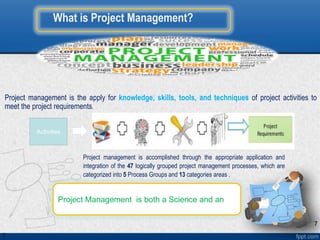
Project management is the apply for knowledge, skills, tools, and techniques of project activities to
meet the project requirements.
Project management is accomplished through the appropriate application and
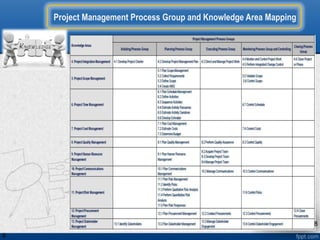
integration of the 47 logically grouped project management processes, which are
categorized into 5 Process Groups and 13 categories areas .
Activities
Project Management is both a Science and Art
7
8
Project Management Process Group and Knowledge Area Mapping
Rev.0 127
8
9
9
10
What is Project Management?
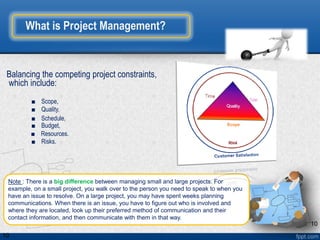
Balancing the competing project constraints,
which include:
■ Scope,
■ Quality,
■ Schedule,
■ Budget,
■ Resources.
■ Risks.
Note : There is a big difference between managing small and large projects. For
example, on a small project, you walk over to the person you need to speak to when you
have an issue to resolve. On a large project, you may have spent weeks planning
communications. When there is an issue, you have to figure out who is involved and
where they are located, look up their preferred method of communication and their
contact information, and then communicate with them in that way.
10
11
Scope Vs. Schedule
11
12
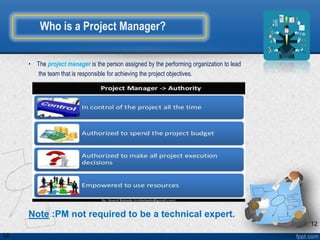
Who is a Project Manager?
• The project manager is the person assigned by the performing organization to lead
the team that is responsible for achieving the project objectives.
Note :PM not required to be a technical expert.
Rev.0
12
13
Competencies of the Project Manager
 Knowledge = what the project manager knows about project management.
 Performance = what the project manager is able to do or accomplish while applying
his or her project management knowledge.
 Personal = Interpersonal skills
Knowledge Performance Personal
13
14
Project Manager
Skills
Political and
cultural
awareness
Communic--
ation
Negotiation
learning
from failure
Coaching
Conflict
manageme-
nt
Trust
building
Decision
making
InfluencingMotivation
Team
building
Resolve
technical
skills
Leadership
Interpersonal skills of a project manager
14
15
Project
Manager
Skills
Motivation
HOW :
1- set the targets .
2-measure performance .
3-celebrate success
4-know your team
Interpersonal skills of a project manager
15
16
Interpersonal skills of a project manager
Project
Manager
Skills
16
17
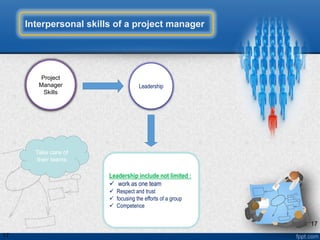
Leadership
Leadership include not limited :
 work as one team
 Respect and trust
 focusing the efforts of a group
 Competence
Take care of
their teams
Interpersonal skills of a project manager
Project
Manager
Skills
17
18
Influencing
Influencing include not limited :
> Lead by example, and follow through with
commitments.
> Clarify how a decision will be made.
> Use a flexible interpersonal style and
adjust the style to the
Interpersonal skills of a project manager
Project
Manager
Skills
18
19
Steps :
 Define the Problem
 Determine the Causes
 Generate Ideas
 Select the Best Solution
 Take Action
Resolve
"A project is a
problem
scheduled for
solution."
Interpersonal skills of a project manager
Project
Manager
Skills
19
20
Negotiation
Negotiation Include not limited :
> Analyze the situation.
> Differentiate between wants and needs, both theirs and yours.
> Focus on interests and issues rather than on positions.
> Ask high and offer low, but be realistic.
> When you make a concession, act as if you are yielding something of value, don’t just
give in.
> Both parties should feel as if they have won. This win-win negotiating style is preferred
but not always achievable. If possible, don’t let the other party leave feeling as though
he or she has been taken advantage of.
> Listen attentively and communicate articulately.
Interpersonal skills of a project manager
Project
Manager
Skills
20
21
Trust
building
Some actions project managers can take to help build trust:
> Engage in open and direct communications to resolve problems.
> Keep all stakeholders informed, especially when fulfilling commitments is at risk.
> Spend time directly engaged with the team asking non assumptive questions to
gain a better understanding of the situations affecting the team.
> Be direct and explicit about what you need or expect.
> Do not withhold information out of a fear of being wrong but be willing to share
information even if you may be wrong.
> Be receptive to innovation and address any issues or concerns in a forthright
manner.
> Look beyond your own interests.
> Demonstrate a true concern for others and avoid engaging in pursuits that could
be viewed as being detrimental to the interest of others.
speak truth to power
Interpersonal skills of a project manager
Project
Manager
Skills
21
22
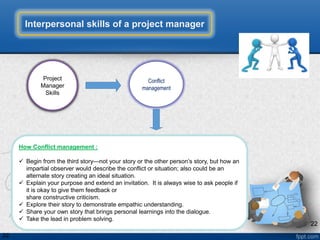
Conflict
management
How Conflict management :
 Begin from the third story—not your story or the other person’s story, but how an
impartial observer would describe the conflict or situation; also could be an
alternate story creating an ideal situation.
 Explain your purpose and extend an invitation. It is always wise to ask people if
it is okay to give them feedback or
share constructive criticism.
 Explore their story to demonstrate empathic understanding.
 Share your own story that brings personal learnings into the dialogue.
 Take the lead in problem solving.
Interpersonal skills of a project manager
Project
Manager
Skills
22
23
Coaching
Coaching Include not limited :
 developing the project team to higher levels of competency and performance.
 formal or informal training may be developed to increase technical skills or assist
team-building efforts and facilitate consistent interpersonal interactions.
Interpersonal skills of a project manager
Project
Manager
Skills
23
24
Some suggested activities to develop the strengths within a team
are to:
 Select and identify team members based on clear strengths
 Determine what skills and strengths are needed to achieve the
results of the team
 Start to find out how you can best make an individual’s strengths
contribute to the results the team needs to achieve
 Explore what the team need to be good
Team
building
Interpersonal skills of a project manager
Project
Manager
Skills
24
25
it's been estimated that project manager's spend 90%
of their time on communication related activities!
Examples of Project Communication
 Reports
 Presentations
 Meetings
 Email
 Phone call
 chatting
Communication
Interpersonal skills of a project manager
Project
Manager
Skills
25
26
Reasons :
• Spent too much and get too little.
• Time schedule is Funny.
• Scope of work is ambiguous.
• It Is impossible to track key project.
• Performance drops.
• Are our best performers de-motivated?
• Many problems become crises
• There isn’t enough time to solve all the problems
• Solutions are incomplete
• Project communication is world of chaos.
We have too many projects and too few completed , Why ?
As a project manager, you need to collect and review lessons learned
from similar projects before starting work on a new project. NO need
make the same mistakes or face the same problems others have faced
,You can benefit from others’ experience.
26
27
27
28
project manager priorities
 Priorities include tasks , deliverables , meeting stockholders ,schedules ,…..,etc.
 Priorities classified to Low , medium and high (0,1,2,3,….,etc. )
Problems with priorities : we facing below
1- every thing is high priority ( active 1,2,3…..etc. )
2-over committing with priority ( yes , sure , …. etc. ) .
Reasons of priority problem :
1-we don’t have organization framework .
2-we let guilt rule and afraid to say No .
3-we don’t place our self as priority .
Control on Priority :
1- we need to know organization framework .
2-priortize work by follow schedule and classified priorities (low , medium and high )
3-train other ,share documents and distribute priorities .
28
29
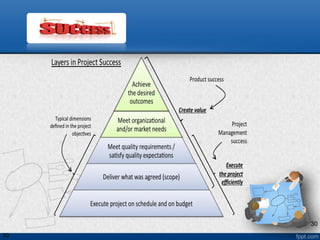
Project Success
• The of the project should be measured in terms of completing the project within
the constraints of scope, time, cost, quality, resources, and risk as approved between the project managers
and senior management.
• Project success should be referred to the last baselines approved by the authorized stakeholders.
• The project manager is responsible and accountable for setting realistic and achievable boundaries for the
project and to accomplish the project within the approved baselines.
29
30
30
31
1- un aligned expectations .
2- implementation before project approve .
3- inexperienced resources .
4- team conflict .
5- switching priorities .
6- uncontrolled
The reasons project targets not achieve
31
32
What is a Program?
• A project may or may not be part of program but a program will always have projects.
Rev.0
• Program is defined as a group of related projects managed in coordinated way to
obtain benefits and control not available from managing them individually.
• Programs may include elements of related work outside the scope of the discrete
projects in the program (other related work )
32
33
What is a Program Management?
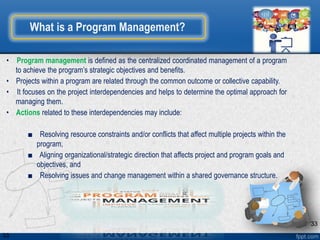
• Program management is defined as the centralized coordinated management of a program
to achieve the program’s strategic objectives and benefits.
• Projects within a program are related through the common outcome or collective capability.
• It focuses on the project interdependencies and helps to determine the optimal approach for
managing them.
• Actions related to these interdependencies may include:
■ Resolving resource constraints and/or conflicts that affect multiple projects within the
program,
■ Aligning organizational/strategic direction that affects project and program goals and
objectives, and
■ Resolving issues and change management within a shared governance structure.
33
34
Project Management Office (PMO)
• A project management office (PMO) is an organizational body or entity.
• PMO is a management structure that standardizes the project-related governance
processes and facilitates the sharing of resources, methodologies, tools, and
techniques.
• The responsibilities of a PMO can range from providing project management support
functions to actually being responsible for the direct management of one or more
projects.
• The PMO integrates data and information from corporate strategic projects and
evaluates how higher level strategic objectives are being fulfilled.
• The PMO is the natural liaison between the organization’s portfolios, programs,
projects, and the corporate measurement systems (e.g. balanced scorecard).
• The projects supported or administered by the PMO may not be related, other than by
being managed together.
• A PMO may have the authority to act as an integral stakeholder and a key decision
maker throughout the life of each project, to make recommendations, or to terminate
projects or take other actions, as required, to remain aligned with the business
objectives. In addition, the PMO may be involved in the selection, management, and
deployment of shared or dedicated project resources. 34
35
Project Management Office Structures
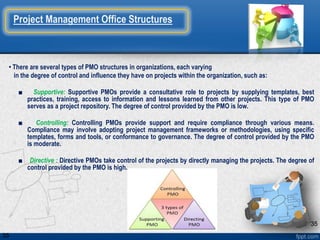
• There are several types of PMO structures in organizations, each varying
in the degree of control and influence they have on projects within the organization, such as:
■ Supportive: Supportive PMOs provide a consultative role to projects by supplying templates, best
practices, training, access to information and lessons learned from other projects. This type of PMO
serves as a project repository. The degree of control provided by the PMO is low.
■ Controlling: Controlling PMOs provide support and require compliance through various means.
Compliance may involve adopting project management frameworks or methodologies, using specific
templates, forms and tools, or conformance to governance. The degree of control provided by the PMO
is moderate.
■ Directive : Directive PMOs take control of the projects by directly managing the projects. The degree of
control provided by the PMO is high.
35
36
Project Management Office Functions
1) Managing shared resources across all projects administered by the PMO.
2) Identifying and developing project management methodology, best practices, and
standards.
3) Coaching, mentoring, training, and oversight.
4) Monitoring compliance with project management standards, policies, procedures,
and templates by means of project audits.
5) Developing and managing project policies, procedures, templates, and other
shared documentation (organizational process assets).
6) Coordinating communication across projects.
36
37
37
38
Test yourself! Read the description of the PMO and try to determine whether it is most likely
to be supportive, controlling, or directive, or a combination of the three.
Description Type of PMO
I Manages all projects throughout the organization
2
Provides support and guidance, requires all projects within the
organization to use designated project management software and
templates, but doesn’t otherwise exert control over the project
3 Coordinates all projects within the organization
4
Recommends common terminology, templates, and reporting and
other procedures to be used on projects throughout the organization
to promote consistency and streamline effort
5 Appoints project manager
6 Prioritizes projects
7 Has the highest level of control over projects
Answer (bottom to up )
Game:
38
39
Project Stakeholders
• A stakeholder is an individual, group, or organization who may affect, be affected by, or perceive itself to be
affected by a decision, activity, or outcome of a project.
•. Stakeholders may be actively involved in the project or have interests that may be positively or negatively
affected by the performance or completion of the project
Rev.0
39
40
Example of Stakeholders
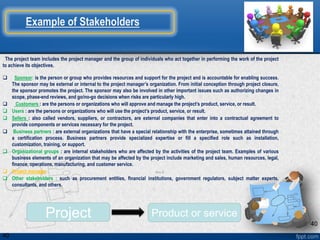
The project team includes the project manager and the group of individuals who act together in performing the work of the project
to achieve its objectives.
 Sponsor: is the person or group who provides resources and support for the project and is accountable for enabling success.
The sponsor may be external or internal to the project manager’s organization. From initial conception through project closure,
the sponsor promotes the project. The sponsor may also be involved in other important issues such as authorizing changes in
scope, phase-end reviews, and go/no-go decisions when risks are particularly high.
 Customers : are the persons or organizations who will approve and manage the project’s product, service, or result.
 Users : are the persons or organizations who will use the project’s product, service, or result.
 Sellers : also called vendors, suppliers, or contractors, are external companies that enter into a contractual agreement to
provide components or services necessary for the project.
 Business partners : are external organizations that have a special relationship with the enterprise, sometimes attained through
a certification process. Business partners provide specialized expertise or fill a specified role such as installation,
customization, training, or support.
 Organizational groups : are internal stakeholders who are affected by the activities of the project team. Examples of various
business elements of an organization that may be affected by the project include marketing and sales, human resources, legal,
finance, operations, manufacturing, and customer service.
 Project manager
 Other stakeholders : such as procurement entities, financial institutions, government regulators, subject matter experts,
consultants, and others.
Rev.0
Project Product or service
40
41
Balancing Stakeholder Interests
 Do not tell customers -NO , when asked about a request.
 PM should do what they have documented that they want.
 If they are willing to encounter a delay, or pay more to get the change implemented, that is
their decision, not yours as the Project Manager.
 Listen to wishes of the Stakeholders.
 Figure out what they want, and what the timeframes and cost parameters or constraints
might be.
41
42
Operations
Operations are ongoing endeavors that produce repetitive outputs, Unlike the ongoing
nature of operations, projects are temporary endeavors.
 Operational work is ongoing work to support the business and systems of the
organization, and project work ends when the project is closed.
• When a project is finished, the product is handed off to operations, which could
require employee training or adjustments to the operational processes for those
who will use the project’s product or service .
• OPERATIONS MANAGER are responsible for ensuring that business operations
are efficient.
42
43
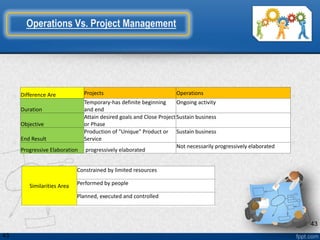
Operations Vs. Project Management
Rev.0 53
Difference Are Projects Operations
Duration
Temporary-has definite beginning
and end
Ongoing activity
Objective
Attain desired goals and Close Project
or Phase
Sustain business
End Result
Production of "Unique" Product or
Service
Sustain business
Progressive Elaboration progressively elaborated
Not necessarily progressively elaborated
Similarities Area
Constrained by limited resources
Performed by people
Planned, executed and controlled
43
44
Senior Management
• Help prioritize projects and make sure the project manager has the proper
authority and access to resources.
• Issues strategic plans and goals and makes sure that the company's
projects are aligned with them.
• May be called upon to resolve conflicts within the organization, with the
Sponsor, Customer.
Rev.0
44
45
• Project coordinators have power to make some decisions, have some authority, and
report to a higher-level manager.
• Weaker than a project manager
• May not be allowed to make budget decisions or overall project decisions
• May have some authority to reassign resources
• Acts as the communication link to Senior Management
• Found in weak matrix or functional organizations
Project Coordinator
46
47
 Organizations are systematic arrangements of entities (persons and/or
departments) aimed at accomplishing a purpose, which may involve
undertaking projects.
 An organization’s culture and style affect how it conducts projects.
 Project management success in an organization is highly dependent on an
effective organizational communication style.
Organizational Structures
The company or any department of the company can considered a
form of organization
47
48
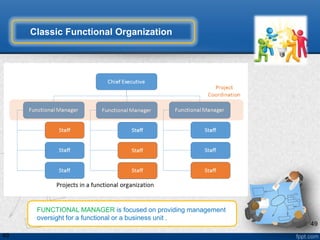
 Functional Organization is a hierarchy where each employee has one clear
superior.
• Each department in a functional organization will do its project work independently
of other departments.
• Staff members are grouped by specialty, such as production, marketing, engineering,
and accounting at the top level.
• Specialties may be further subdivided into focused functional units, such as
mechanical and electrical engineering.
• The project manager is a part-timer with little or no authority and resources.
Classic Functional Organization
Within Functional Organization, Projects generally occur within a single
department. If information or project work is needed from another
department, employees transmit the request to the head of the
department, who communicates the request to the other department head.
Otherwise, communication stays within the project. Team members
complete project work in addition to normal departmental work. 48
49
Classic Functional Organization
FUNCTIONAL MANAGER is focused on providing management
oversight for a functional or a business unit .
49
50
Advantages Disadvantages
Easier management of specialists
People place more emphasis on their
functional specialty to the detriment of the
project
Team members report to only one supervisor No career path in project management
Similar resources are centralized, as the
company is grouped by specialties
The project manager has little or no authority
Clearly defined career paths in areas of work
specialization
Advantages and Disadvantage of Functional Organization
50
51
• Project managers have a GREAT deal of independence and authority.
• Team members complete only project work, and when the project is over, they
do not have a department to go back to. They need to be assigned to another
project or get a job with a different employer ( NO HOMES ).
• Team members are often co-located.
• Communication primarily occurs within the project.
Projectized Organizations often have organizational units called
departments, but they can either report directly to the project manager or
provide support services to the various projects.
Projectized Organization
51
52
Projectized Organization
52
53
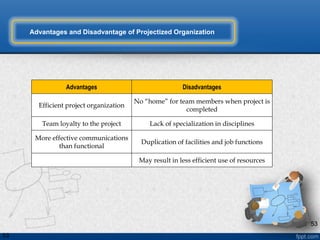
Advantages Disadvantages
Efficient project organization
No “home” for team members when project is
completed
Team loyalty to the project Lack of specialization in disciplines
More effective communications
than functional
Duplication of facilities and job functions
May result in less efficient use of resources
Advantages and Disadvantage of Projectized Organization
53
54
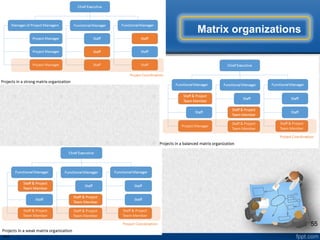
Depending on the relative level of power and influence between functional
and project managers. Matrix organizations can be classified as
Weak matrix organizations
 Maintain many of the characteristics of a functional organization.
 The role of the project manager is more of a coordinator or expediter.
Balanced matrix organization
 Project Manager does not provide the project manager with the full
authority over the project and project funding.
 the power is shared between the functional manager and the project
manager.
Strong matrix organizations
 Have many of the characteristics of the projectized organization.
 Have full-time project managers with considerable authority and
full-time project administrative staff.
Matrix organizations
54
55
Matrix organizations
55
56
Advantages Disadvantages
Highly visible project objectives Extra administration is required
Improved project manager control over
resources
Project team members have more than
one boss
More support from functional areas More complex to monitor and control
Maximum utilization of scarce resources Resource allocation is more complex
Better coordination
Extensive policies and procedures are
needed
Better horizontal and vertical
dissemination of information
Functional managers may have different
priorities than project managers
Team members maintain a “home” Higher potential for conflict
Advantages and Disadvantage of Matrix Organization
56
57
• Many organizations involve ALL these structures AT VARIOUS LEVELS, often
referred to as a composite organization,
• For example, even a fundamentally functional organization may create a
special project team to handle a critical project.
• The team may include full-time staff from different functional departments, may
develop its own set of operating procedures, and may even operate outside of
the standard, formalized reporting structure during the project.
Organization may manage most of its projects in a strong matrix,
but allow small projects to be managed by functional departments.
Composite Organization
57
58
Composite Organization
58
59
Game:
Share your company organization ?
59
60
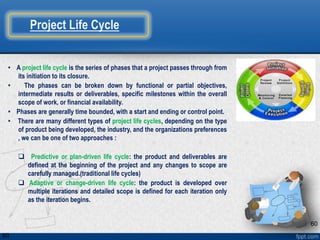
Project Life Cycle
• A project life cycle is the series of phases that a project passes through from
its initiation to its closure.
• The phases can be broken down by functional or partial objectives,
intermediate results or deliverables, specific milestones within the overall
scope of work, or financial availability.
• Phases are generally time bounded, with a start and ending or control point.
• There are many different types of project life cycles, depending on the type
of product being developed, the industry, and the organizations preferences
, we can be one of two approaches :
 Predictive or plan-driven life cycle: the product and deliverables are
defined at the beginning of the project and any changes to scope are
carefully managed.(traditional life cycles)
 Adaptive or change-driven life cycle: the product is developed over
multiple iterations and detailed scope is defined for each iteration only
as the iteration begins.
60
61
Project Life Cycle Structure Characteristics
• Cost and staffing levels are low at the start, peak as the work is carried out, and drop rapidly as the
project draws to a close.
• Risk and uncertainty are greatest at the start of the project.
• The ability to influence the final characteristics of the project’s product, without significantly
impacting cost, is highest at the start of the project and decreases as the project progresses
towards completion.
61
62
Risk , stockholders and cost effects during life cycle
62
63
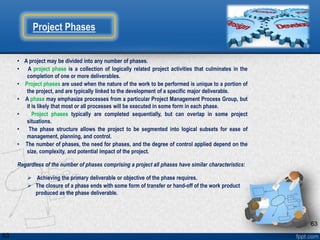
Project Phases
• A project may be divided into any number of phases.
• A project phase is a collection of logically related project activities that culminates in the
completion of one or more deliverables.
• Project phases are used when the nature of the work to be performed is unique to a portion of
the project, and are typically linked to the development of a specific major deliverable.
• A phase may emphasize processes from a particular Project Management Process Group, but
it is likely that most or all processes will be executed in some form in each phase.
• Project phases typically are completed sequentially, but can overlap in some project
situations.
• The phase structure allows the project to be segmented into logical subsets for ease of
management, planning, and control.
• The number of phases, the need for phases, and the degree of control applied depend on the
size, complexity, and potential impact of the project.
Regardless of the number of phases comprising a project all phases have similar characteristics:
 Achieving the primary deliverable or objective of the phase requires.
 The closure of a phase ends with some form of transfer or hand-off of the work product
produced as the phase deliverable.
63
64
There are two basic categories to consider
Categories of phases
Single Phase
Multi-Phase
64
65
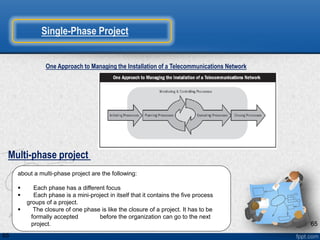
Single-Phase Project
One Approach to Managing the Installation of a Telecommunications Network
about a multi-phase project are the following:
 Each phase has a different focus
 Each phase is a mini-project in itself that it contains the five process
groups of a project.
 The closure of one phase is like the closure of a project. It has to be
formally accepted before the organization can go to the next
project.
Multi-phase project
65
66
Phase-to-Phase Relationships
• Sequential relationship: In a sequential relationship, a phase starts only when the previous phase is complete.
The step by-step nature of this approach reduces uncertainty, but may eliminate
options for reducing the overall schedule.
66
67
Phase-to-Phase Relationships
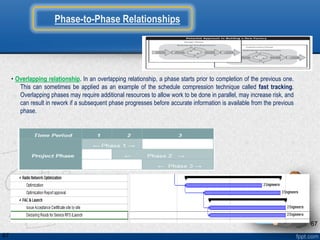
• Overlapping relationship. In an overlapping relationship, a phase starts prior to completion of the previous one.
This can sometimes be applied as an example of the schedule compression technique called fast tracking.
Overlapping phases may require additional resources to allow work to be done in parallel, may increase risk, and
can result in rework if a subsequent phase progresses before accurate information is available from the previous
phase.
67
68
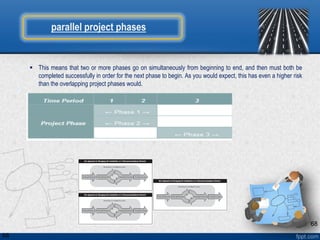
 This means that two or more phases go on simultaneously from beginning to end, and then must both be
completed successfully in order for the next phase to begin. As you would expect, this has even a higher risk
than the overlapping project phases would.
parallel project phases
68
The differences between the three types of life cycles
69
The differences between the three types of life cycles
70
71
Predictive Life Cycles
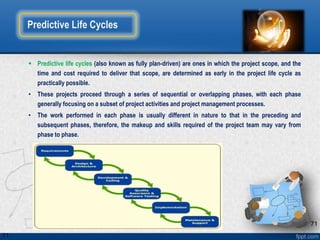
 Predictive life cycles (also known as fully plan-driven) are ones in which the project scope, and the
time and cost required to deliver that scope, are determined as early in the project life cycle as
practically possible.
• These projects proceed through a series of sequential or overlapping phases, with each phase
generally focusing on a subset of project activities and project management processes.
• The work performed in each phase is usually different in nature to that in the preceding and
subsequent phases, therefore, the makeup and skills required of the project team may vary from
phase to phase.
71
72
Iterative and Incremental Life Cycles
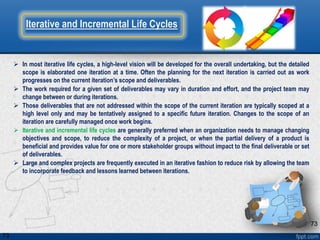
 Iterative and incremental life cycles are ones in which project phases (also called iterations) intentionally repeat
one or more project activities as the project team’s understanding of the product increases.
 Iterations develop the product through a series of repeated cycles, while increments successively add to the
functionality of the product.
 These life cycles develop the product both iteratively and incrementally.
 Iterative and incremental projects may proceed in phases, and the iterations themselves will be performed in a
sequential or overlapping fashion.
 During an iteration, activities from all Project Management Process Groups will be performed. At the end of each
iteration, a deliverable or set of deliverables will be completed.
 Future iterations may enhance those deliverables or create new ones.
 Each iteration incrementally builds the deliverables until the exit criteria for the phase are met, allowing the
project team to incorporate feedback.
72
73
 In most iterative life cycles, a high-level vision will be developed for the overall undertaking, but the detailed
scope is elaborated one iteration at a time. Often the planning for the next iteration is carried out as work
progresses on the current iteration’s scope and deliverables.
 The work required for a given set of deliverables may vary in duration and effort, and the project team may
change between or during iterations.
 Those deliverables that are not addressed within the scope of the current iteration are typically scoped at a
high level only and may be tentatively assigned to a specific future iteration. Changes to the scope of an
iteration are carefully managed once work begins.
 Iterative and incremental life cycles are generally preferred when an organization needs to manage changing
objectives and scope, to reduce the complexity of a project, or when the partial delivery of a product is
beneficial and provides value for one or more stakeholder groups without impact to the final deliverable or set
of deliverables.
 Large and complex projects are frequently executed in an iterative fashion to reduce risk by allowing the team
to incorporate feedback and lessons learned between iterations.
Iterative and Incremental Life Cycles
73
74
Iterative and Incremental Life Cycles
74
75
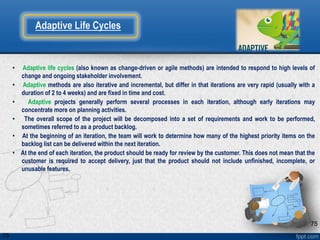
• Adaptive life cycles (also known as change-driven or agile methods) are intended to respond to high levels of
change and ongoing stakeholder involvement.
• Adaptive methods are also iterative and incremental, but differ in that iterations are very rapid (usually with a
duration of 2 to 4 weeks) and are fixed in time and cost.
• Adaptive projects generally perform several processes in each iteration, although early iterations may
concentrate more on planning activities.
• The overall scope of the project will be decomposed into a set of requirements and work to be performed,
sometimes referred to as a product backlog.
• At the beginning of an iteration, the team will work to determine how many of the highest priority items on the
backlog list can be delivered within the next iteration.
• At the end of each iteration, the product should be ready for review by the customer. This does not mean that the
customer is required to accept delivery, just that the product should not include unfinished, incomplete, or
unusable features.
Adaptive Life Cycles
75
76
• The sponsor and customer representatives should be continuously engaged with the project to provide feedback
on deliverables as they are created and to ensure that the product backlog reflects their current needs.
• Adaptive methods are generally preferred when dealing with a rapidly changing environment, when requirements
and scope are difficult to define in advance, and when it is possible to define small incremental improvements that
will deliver value to stakeholders.
Adaptive Life Cycles
Adaptive
76
77
Adaptive Life Cycles
77
78
Project Management Processes
78
79
What is a Process?
• A process is a set of interrelated actions and activities performed to achieve
a prespecified product, result, or service.
• All the processes fall within one of the 10 knowledge areas.
• Each process is characterized by:
■ Inputs (example OPA )
■ Tools and Techniques
■ Outputs
Below example :
Rev.0
79
80
Knowledge Areas
80
81
Project Management Process Groups
The Project Management Framework: The Five
Process Groups
1- Initiation
2- Planning
3- Executing
4- Controlling
5- Closing
126
81
82
Project Management Process Group and Knowledge Area Mapping
Rev.0 127
82
83
Project Management Process Groups
 These five Process Groups have clear dependencies and are typically
performed in each project and highly interact with one another.
 These five Process Groups are independent of application areas or industry
focus.
 Individual Process Groups and individual processes are often iterated prior
to completing the project and can have interactions within a Process Group
and among Process Groups.
 The nature of these interactions varies from project to project and may or
may not be performed in a particular order.
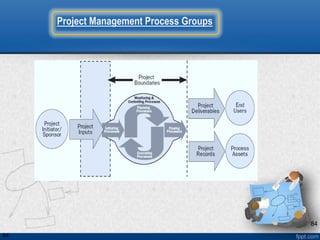
 The project management processes are linked by specific inputs and outputs
where the result or outcome of one process becomes the input to another
process but not necessarily in the same Process Group.
The Process Groups are not project life cycle phases. In fact, it is possible
that all Process Groups could be conducted within a phase.
83
84
Project Management Process Groups
84
Feasibility
Appoint
Architect
Project Manager
Goals
Building Plan
Estimation
Funding
Govt Approval
Schedules
Budget
Resources
Risks
Staffing
Construction
Sub-contractor
management
Commissioning
Managing Resources
Managing Changes
Completion Certificate
Contract Closure
Administrative
Closure
Hand Over
Project Management Process Groups
85
Project Management Process Groups
86
Project Management Process Groups
87
88
We need to know :
 The business case for the project (the reason why project was started)
 The product description or project statement of work detailing the product requirements as they
are known up to this point; in other words, what is the project supposed to do?
 How the project fits into or supports the company’s strategic plan
 A list of likely stakeholder
 Any known constraints (e.g., imposed schedule, budget, or resources), risks, and assumptions
 Any relevant agreements, including contracts, if the work will be done under a contract
 Industry standards
 Marketplace trends
 The company’s change control system
 Defined processes and procedures for how the company operates
 Past relationships with the sponsor of the project, likely stakeholders, and possible team
members
 Templates from past projects
 Historical WBSs
 Historical estimates
 Lessons learned from previous projects
 What is going on in the company today, the major projects, and the potential impact current and
planned initiatives could have on this project
 Understanding of the company’s future
 Understanding of the company’s culture
 A list of people who may be good team members
What do you think you would need to know or have before you initiate a
project?
88
89
Initiating Process Group
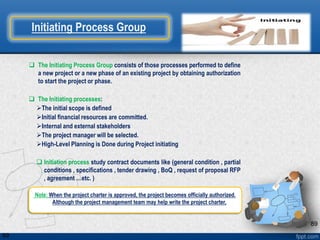
 The Initiating Process Group consists of those processes performed to define
a new project or a new phase of an existing project by obtaining authorization
to start the project or phase.
 The Initiating processes:
The initial scope is defined
Initial financial resources are committed.
Internal and external stakeholders
The project manager will be selected.
High-Level Planning is Done during Project initiating
 Initiation process study contract documents like (general condition , partial
conditions , specifications , tender drawing , BoQ , request of proposal RFP
, agreement …etc. )
Note: When the project charter is approved, the project becomes officially authorized.
Although the project management team may help write the project charter,
89
90
Initiating Process Group
Why project initiating is begun ? (Reasons)
Business need
Begin a new phase of
the project
Project has so many
problems that you re-
evaluate the business
need
Project initiating
90
91
Initiating Process Group
91
92
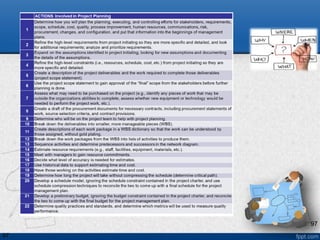
Also ACTIONS Involved in Project Initiating
• Select the project manager.
• Determine the authority of the project manager.
• Collect historical information.
• Divide large projects into phases.
• Identify stakeholders and determine their influences, expectations, and impact.
• Determine high-level requirements, constraints, assumptions, and risks.
• Turn high-level stakeholder needs, wants, and expectations into requirements.
• Make sure the business case and the analysis supporting the need for the project are
documented and understood.
• Ensure the product scope is as final as practical (this will most likely be documented in
the project statement of work).
• Understand how the project supports the organizations strategic objectives.
• Collect and use any relevant existing agreements (including contracts) that might be
generating the project or will be required during the project.
• Determine measurable project and product objectives.
• Facilitate the resolution of conflicting objectives.
Game :
Let’s go beyond inputs, outputs, and tools and techniques. What are the specific
ACTIONS required to complete project initiating?
•DevelopProjectCharter+IdentifyStakeholders
Answer
92
93
Planning Process Group
 The Planning Process Group consists of those processes performed to
1) establish the total scope of the effort
2) define and refine the objectives.
3) develop the course of action required to attain those objectives.
 The Planning processes develop the project management plan and the project
documents that will be used to carry out the project.
 The complex nature of project management may require the use of repeated
feedback loops for additional analysis.
 As more project information or characteristics are gathered and understood,
additional planning will likely be required. Significant changes occurring throughout
the project life cycle trigger a need to revisit one or more of the planning processes
and possibly some of the initiating processes (progressive elaboration).
 The key benefit of this Process Group is to delineate the strategy and tactics as
well as the course of action or path to successfully complete the project or phase.
When the Planning Process Group is well managed, it is much easier to get
stakeholder buy-in and engagement. These processes express how this will be
done, setting the route to the desired objective.
 The project management plan and project documents developed as outputs from
the Planning Process Group will explore all aspects of the scope, time, cost, quality,
communications, human resources, risks, procurements, and stakeholder
engagement.
93
94
Planning Process Group
Project initiating is
complete
Project planning
The reason for entering project planning Or when you might enter project executing ?
94
95
Planning Process Group
95
96
Game :
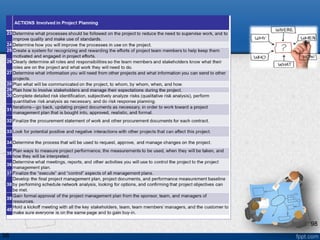
Let’s go beyond inputs, outputs, and tools and techniques. What are the specific
ACTIONS required to complete project planning?
Answer
96
97
97
98
98
99
Executing Process Group
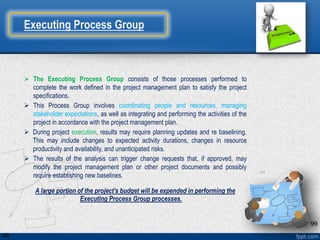
 The Executing Process Group consists of those processes performed to
complete the work defined in the project management plan to satisfy the project
specifications.
 This Process Group involves coordinating people and resources, managing
stakeholder expectations, as well as integrating and performing the activities of the
project in accordance with the project management plan.
 During project execution, results may require planning updates and re baselining.
This may include changes to expected activity durations, changes in resource
productivity and availability, and unanticipated risks.
 The results of the analysis can trigger change requests that, if approved, may
modify the project management plan or other project documents and possibly
require establishing new baselines.
A large portion of the project’s budget will be expended in performing the
Executing Process Group processes.
134
99
100
.
Executing Process Group
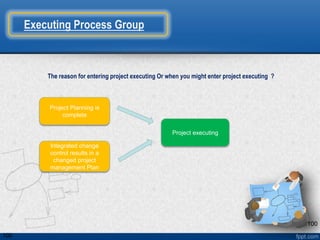
The reason for entering project executing Or when you might enter project executing ?
Project Planning is
complete
Project executing
Integrated change
control results in a
changed project
management Plan
100
101
Executing Process Group
101
102
Game:
Imagine you are about to begin project executing. What type
of ACTIONS must be taken?
Answer
102
103
ACTIONS Involved in Project Executing
1 Communicate your expectations for stakeholders and the project, and manage the involvement and
needs of all stakeholders throughout the project to ensure everyone has a common understanding
of the work.
2 Implement the original project management plan or the project management plan that was revised
as a result of control activities.
3 Complete work packages.
4 Collect and document lessons learned.
5 Establish and manage communication channels.
6 Evaluate how effectively the team members function as a team.
7 Implement approved changes, including corrective actions, preventive actions, and defect repair.
8 Perform quality assurance to ensure the defined practices and procedures are being followed and
are still appropriate for the project.
9 Produce and distribute reports on project performance.
10 Hold team-building activities.
11 Follow ground rules at team meetings.
12 Obtain needed training for team members.
13 Exchange information about the project according to the plan, and solicit feedback to ensure
communication needs are being met.
14 Remove roadblocks.
15 Achieve work results that meet requirements.
16 Meet with managers to reconfirm resource commitments.
17 Keep managers apprised of when their resources will be needed on the project.
18 Commit and release project resources in accordance with the project management plan.
19 Guide, assist, communicate, lead, negotiate, facilitate, and coach.
103
104
ACTIONS Involved in Project Executing
20 Utilize your technical knowledge.
21 Hold meetings to identify or address issues, assess risks, and keep the project work moving
forward.
22 Manage stakeholder engagement and expectations, increase project support, and prevent
possible problems.
23 Focus on preventing problems rather than just dealing with them as they arise.
24 Make sure all team members have the skills, information, and equipment needed to complete
their work.
25 Focus on looking for exceptions to the approved project management plan in team members’
performance, rather than checking up on every persons work or babysitting.
26 Recommend changes to be evaluated in the Perform Integrated Change Control process.
27 Follow organizational policies, processes, and procedures.
28 Increase the effectiveness of processes.
29 Make updates to the project management plan and project documents to reflect current
information about the project.
30 Create recommendations for the performing organization that increase its effectiveness.
31 Ensure continued agreement from the stakeholders to the project management plan.
32 Keep everyone focused on completing the project to the project charter and project management
plan.
33 Keep the projects business case in focus while managing the project, especially when problems
occur.
34 Solve problems.
35 Stop during the project to see where changes are coming from and what you can do to eliminate
the root cause of the need for change.
36 Implement the recognition and reward system created during the planning processes.
37 Determine team members who could not be named during the planning processes.
38 Gather initial measurements and details about activities of project work (work performance data).
104
105
ACTIONS Involved in Project Executing
39 Implement approved process improvements.
40 Use an issue log to record project issues and details about their resolution, including who is
responsible for resolving each issue and the expected timeline.
41 Obtain seller responses to procurement documents.
42 Review bids and quotes, negotiate contract terms with prospective sellers, and select sellers.
43 Expend and manage project funds.
44 Facilitate conflict resolution using conflict resolution techniques.
45 Assess individual team member performance.
105
106
The Monitoring and Controlling Process Group consists of those processes required
to track, review, and orchestrate the progress and performance of the project; identify
any areas in which changes to the plan are required; and initiate the corresponding
changes.
 The key benefit of this Process Group is that project performance is measured
and analyzed at regular intervals, appropriate events, or exception conditions to
identify variances from the project management plan.
 The Monitoring and Controlling Process Group also involves:
 Controlling changes and recommending corrective or preventive action in
anticipation of possible problems,
 Monitoring the ongoing project activities against the project management plan
and the project performance measurement baseline.
This continuous monitoring provides the project team insight into the health of the
project and identifies any areas requiring additional attention.
Monitoring and Controlling Process Group
106
107
 The reason for entering project Monitoring and Controlling Or when you might enter project
Monitoring and Controlling ?
 What Next Steps after Monitoring and Controlling ?
Monitoring and Controlling Process Group
Deliverables
Project Monitoring and
Controlling
Work performance date
Request change
Project initiating to
review project chart
Project executing to
clear snags and repair
defect
Project closing if
project completed
107
108
Monitoring and Controlling Process Group
108
109
Game
What are the specific ACTIONS required as part of
project monitoring and controlling?
109
110
ACTIONS Involved in Project Monitoring and controlling
1 Measure project performance according to the planned measures in the management plans.
2 Measure against the performance measurement baseline.
3 Analyze and evaluate work performance data.
4 Determine variances.
5 Exercise judgment to determine what variances are important and if they warrant
recommending a change or corrective action.
6 Recommend changes, including defect repair and preventive and corrective actions. Do not just
wait for others to recommend them.
7 Make or obtain a decision in integrated change control about whether changes should be
approved or rejected.
8 Manage configuration to ensure everyone knows which version of the project or product
documentation is the latest version.
9 Control scope, schedule, and cost to their baselines.
10 Perform procurement inspections.
11 Refine control limits as needed.
12 Identify the root causes of problems.
13 Obtain formal acceptance of interim deliverables from the customer.
14 Identify the need for replanning.
15 Replan and make updates to the project management plan and project documents to reflect
approved changes and updates to the project.
16 Evaluate stakeholder relationships and involvement to determine if they require improvement.
17 Manage the time and cost reserves.
18
Recalculate how much the project will cost and how long it will take, and create forecasts.
19 Obtain additional funding if needed.
20 Prepare work performance reports from the analyzed data and measurements.
21 Hold periodic inspections.
110
111
ACTIONS Involved in Project Monitoring and controlling
22 Make decisions to accept or reject work.
23 Evaluate the effectiveness of implemented corrective actions.
24 Reassess the effectiveness of project control systems.
25 Spend time trying to improve quality.
26
Get information from stakeholders to determine if project controls need to be updated.
27 Identify and analyze trends.
28 Evaluate the effectiveness of risk responses in a risk audit.
29 Look for newly arising risks.
30 Reanalyze existing risks.
31 Use milestones as a project control tool.
32 Observe and analyze.
33 Use variance reports to help correct small problems before they become serious.
34 Calculate estimate to complete.
35 Use and interpret earned value calculations.
36
Use quality control tools—inspections, Pareto charts, cause and effect diagrams, etc.
37 Influence any factors that could result in the projects change control and configuration
management measures being circumvented.
38 Control changes.
39 Control to make sure that only approved changes are implemented.
40 Work with the change control board.
41 Evaluate customer satisfaction.
42 Control procurements through actions like reviewing, approving, and paying invoices;
administering claims; and performing inspections and audits.
43 Validate defect repair.
44 Stop during the project to see where changes are coming from and what you can do to eliminate
the root cause of the need for change.
45 Consider the project’s business case and the organization’s strategic objectives when analyzing
change requests.
111
112
Closing Process Group
 The Closing Process Group consists of those processes performed to conclude all
activities across all Project Management Process Groups to formally complete the
project, phase, or contractual obligations.
 This Process Group, when completed, verifies that the defined processes are completed
within a l of the Process Groups to close the project or a project phase, as appropriate,
and formally establishes that the project or project phase is complete.
 This Process Group also formally establishes the premature closure of the project
(aborted projects, and cancelled projects)
 In specific cases, when some contracts cannot be formally closed (e.g. claims,
termination clauses, etc.) or some activities are to be transferred to other organizational
units, specific hand-over procedures may be arranged and finalized.
Rev.0
112
113
The reason for entering project closing Or when you might enter project
closing ?
Closing Process Group
Project phase is
complete
Project closing
Project is complete
Procurement is
complete
Project or Procurement
is terminated
113
114
Closing Process Group
114
115
 Historical information (or data) is a record of past projects. It is used to plan and
manage future projects, thereby improving the process of project management.
Historical information can include( Activities ,WBSs , Benchmarks ,Reports , Risks
and risk response plans , Estimates , Resources used , Project management plans
and Correspondence.
 Lessons learned are an essential asset to managing a project; they are taken into
account as well as created throughout a project.
Organizational Process Assets (OPA)
• Organizational Process Assets (OPA) are inputs to the majority of processes in all the project
management process groups. They provide direction and guidance in planning and help the project
benefit from past company experience.
• Example of organizational process assets: Historical Information and Lessons Learned
115
116
enterprise environmental factors(EEF) as what they really are—company culture and existing
systems that the project will have to deal with or can make use of. are inputs to the majority of
processes ,They could also be thought of as the company “baggage” that comes with the project
and is outside the control of the project team.
Project Management Information System (PMIS) An organizations project management
information system is part of its enterprise environmental factors. The PMIS includes automated
tools, such as scheduling software, a configuration management system, shared workspaces for
file storage or distribution, work authorization software, time-tracking software, and procurement
management software, plus repositories for historical information.
enterprise environmental factors (EEF)
116
117
ACTIONS Involved in Project Closing
1 Confirm that all project requirements have been met.
2
Verify and document that the project, or project phase, meets completion or exit criteria set in place
during project planning.
3
Obtain formal (legal) sign-off and final acceptance of the product of the project from the customer.
4
If the project was terminated before completion, document the reasons for termination and the
status of the project and deliverables.
5 Make final payments, and complete cost records.
6 Gather final lessons learned.
7 Update project records.
8 Ensure all the project management processes are complete.
9 Update corporate processes, procedures, and templates based on lessons learned.
10 Add new skills acquired to team members’ human resource records.
11 Complete procurement closure and project (or phase) closure.
12 Analyze and document the success and effectiveness of the project.
13 Create and distribute a final report of project (or phase) performance.
14 Index and archive project records.
15 Evaluate customer satisfaction regarding the project and the deliverables.
16
Hand off the completed project deliverables to the appropriate stakeholders (e.g., the customer,
operations and maintenance, etc.).
17 Celebrate!
117
118
Game determine if below is done in initiating, planning, executing, monitoring and controlling,
or closing.
Actions
During Which Process Group Is This Done?
Answer
Actions
During Which
Process Group
Is This Done?
1 Use the project scope statement to gain approval of the “final” scope from
stakeholders before further planning is done.
2 Determine high-level requirements, constraints, assumptions, and risks.
3 Measure against the performance measurement baseline.
4 Implement approved changes, including corrective actions, preventive actions,
and defect repair.
5 Reanalyze existing risks.
6 Use the high-level planning and estimating data to determine whether the
product can be achieved within the given constraints.
7 Verify and document that the project, or project phase, meets completion or exit
criteria set in place during project planning.
8 Hold team-building activities.
9 Evaluate the effectiveness of risk responses in a risk audit.
10
Determine how you will plan the planning, executing, and controlling efforts for
stakeholders, requirements, scope, schedule, cost, quality, process
improvement, human resources, communications, risk, procurement, changes,
and configuration, and put that information into the beginnings of management
plans.
11 Obtain formal (legal) sign-off and final acceptance of the product of the project
from the customer.
12 Increase the effectiveness of processes.
13 Recalculate how much the project will cost and how long it will take, and create
forecasts.
14 Plan what will be communicated on the project, to whom, by whom, when, and
how.
15 Spend time trying to improve quality.
Answer (bottom to up )
118
119
Actions During Which Process
Group Is This Done?
16
Make sure the business case and the analysis supporting the need for the
project are documented and understood.
17 Evaluate how effectively the team members function as a team.
18 Determine how you will improve the processes in use on the project.
19 Determine measurable project and product objectives.
20 Manage the time and cost reserves.
21
Focus on looking for exceptions to the approved project management plan in
team members’ performance, rather than checking up on every persons work
or babysitting.
22
Develop the final project management plan, project documents, and
performance measurement baseline by performing schedule network
analysis, looking for options, and confirming that project objectives can be
met.
23 Gather final lessons learned.
24
Keep everyone focused on completing the project to the project charter and
project management plan.
25 Calculate estimate to complete.
26 Understand how the project supports the organizations strategic objectives.
27 Implement approved process improvements.
28
Identify stakeholders and determine their influences, expectations, and
impact.
29 Determine variances.
30 Add new skills acquired to team members’ human resource records.
31 Meet with managers to gain resource commitments.
32 Use and interpret earned value calculations.
33
Ensure the product scope is as final as practical (this will most likely be
documented in the project statement of work).
34 Create and distribute a final report of project (or phase) performance.
35
Exercise judgement to determine what variances are important and if they
warrant recommending a change or corrective action.
36 Finalize the “execute” and “control” aspects of all management plans.
37 Index and archive project records.
38
Keep managers apprised of when their resources will be needed on the
project.
Answer (bottom to up )
119
120
Actions During Which Process
Group Is This Done?
39 Perform procurement inspections.
40 Turn high-level stakeholder needs, wants, and expectations into
requirements.
41 Look for newly arising risks.
42 Determine what processes should be followed on the project to
reduce the need to supervise work, and to improve quality and
make use of standards.
43 Obtain formal acceptance of interim deliverables from the
customer.
44 Identify the need for replanning.
45 Determine what specifically will constitute project success.
46 Assess individual team member performance.
47 Make or obtain a decision in integrated change control about
whether changes should be approved or rejected.
48 Perform quality assurance to ensure the defined practices and
procedures are being followed and are still appropriate for the
project.
49 Evaluate the effectiveness of implemented corrective actions.
50 Manage stakeholder engagement and expectations, increase
project support, and prevent possible problems.
51 Plan ways to measure project performance, the measurements
to be used, when they will be taken, and how they will be
interpreted.
52 Keep the projects business case in focus while managing the
project, especially when problems occur.
53 Determine the process that will be used to request, approve, and
manage changes on the project.
54 Obtain seller responses to procurement documents.
Answer (bottom to up )
120
Initiation Planning
Executing and
controlling
Closing
 Business opportunity  Project charter
 Lessons learned
 Project charter
 Project
management plan
and documents
 Performance results
 Project progress
 Deliverables
Initiation Steps :
1- know your project
2-set Vision
3-create charter
4-get formal sign off .
5-great project notebook.
6- build relationships
Planning Steps :
1-have I/P( charter and
lessons ) .
2-project management
plan within scope ,time ,
cost ,..etc. ( use templates
).
3-determind risks ,
resources and paths .
4-create communication
(everyone should know
plan )
5-implementation
processes
6- create and update
templates .
7-setup repository ( server
for documents ).
Executing Steps :
1-have I/P.
2-Go..GO
3-communication timely
4-Meeting
5-address issues , risks and
recourses .
6-manage ( scope , time and
cost )
7-take sign from customer for
any change .
8-get status reports .
controlling steps :
1-moniter implementation .
2-compare actual performance
with plan ( use check list ) .
3-maintanace and clear snags
4-provide update of cost and
time .
Closing steps :
1-have I/P
2-get users
acceptance and
all approval (ATP
and FTP)
3-handover
4-get final status
reports
5-celebrate
121
122
122

Introduction to project management( framework and processes )

  • 1.
    Introduction to ProjectManagement (Framework and Processes ) By Qussay K.MohammedTaqi Iraq-Baghdad Email : qussay4pmp@gmail.com 1
  • 2.
    References • PMBOK -Project Management Body of Knowledge BOOK Fifth edition. • Rita PMP® Exam Prep 8th Edition Rita Mulcahy • Celia L.Desmond Project Management for Telecommunication Managers. • Leadership Principles for Project Success by Thomas Juli . 2
  • 3.
  • 4.
    4 What is aProject? It is a temporary endeavor undertaken to create a unique product, service, or result. The temporary mean project has a definite beginning and end. The end is reached when: 1- The project's objectives have been achieved . 2 - The project is terminated because its objectives will not or cannot be met, or The need for the project no longer exists(ex:the customer refuses accepting the product; there’re some technical issues that can’t be resolved by using existing tools and technologies). 3- If the client (customer) wishes to terminate the project (ex :Budget cuts and downsizing , Schedule delays) 4- Security issue . . 4
  • 5.
    5 What is aProject? A project can create a unique product, service, or result : the difference between cost , time , resources , location ,…,etc. Examples of projects include, but are not limited : • Developing a new product, service, or result ( ex : swap sites from 2G technology to 3G technology )’ • Constructing a new network ( FTTH , DWDM, Safe city project, …., etc). • Developing or acquiring a new system or modified information system (hardware or software); 5
  • 6.
  • 7.
    7 What is ProjectManagement? Project management is the apply for knowledge, skills, tools, and techniques of project activities to meet the project requirements. Project management is accomplished through the appropriate application and integration of the 47 logically grouped project management processes, which are categorized into 5 Process Groups and 13 categories areas . Activities Project Management is both a Science and Art 7
  • 8.
    8 Project Management ProcessGroup and Knowledge Area Mapping Rev.0 127 8
  • 9.
  • 10.
    10 What is ProjectManagement? Balancing the competing project constraints, which include: ■ Scope, ■ Quality, ■ Schedule, ■ Budget, ■ Resources. ■ Risks. Note : There is a big difference between managing small and large projects. For example, on a small project, you walk over to the person you need to speak to when you have an issue to resolve. On a large project, you may have spent weeks planning communications. When there is an issue, you have to figure out who is involved and where they are located, look up their preferred method of communication and their contact information, and then communicate with them in that way. 10
  • 11.
  • 12.
    12 Who is aProject Manager? • The project manager is the person assigned by the performing organization to lead the team that is responsible for achieving the project objectives. Note :PM not required to be a technical expert. Rev.0 12
  • 13.
    13 Competencies of theProject Manager  Knowledge = what the project manager knows about project management.  Performance = what the project manager is able to do or accomplish while applying his or her project management knowledge.  Personal = Interpersonal skills Knowledge Performance Personal 13
  • 14.
    14 Project Manager Skills Political and cultural awareness Communic-- ation Negotiation learning fromfailure Coaching Conflict manageme- nt Trust building Decision making InfluencingMotivation Team building Resolve technical skills Leadership Interpersonal skills of a project manager 14
  • 15.
    15 Project Manager Skills Motivation HOW : 1- setthe targets . 2-measure performance . 3-celebrate success 4-know your team Interpersonal skills of a project manager 15
  • 16.
    16 Interpersonal skills ofa project manager Project Manager Skills 16
  • 17.
    17 Leadership Leadership include notlimited :  work as one team  Respect and trust  focusing the efforts of a group  Competence Take care of their teams Interpersonal skills of a project manager Project Manager Skills 17
  • 18.
    18 Influencing Influencing include notlimited : > Lead by example, and follow through with commitments. > Clarify how a decision will be made. > Use a flexible interpersonal style and adjust the style to the Interpersonal skills of a project manager Project Manager Skills 18
  • 19.
    19 Steps :  Definethe Problem  Determine the Causes  Generate Ideas  Select the Best Solution  Take Action Resolve "A project is a problem scheduled for solution." Interpersonal skills of a project manager Project Manager Skills 19
  • 20.
    20 Negotiation Negotiation Include notlimited : > Analyze the situation. > Differentiate between wants and needs, both theirs and yours. > Focus on interests and issues rather than on positions. > Ask high and offer low, but be realistic. > When you make a concession, act as if you are yielding something of value, don’t just give in. > Both parties should feel as if they have won. This win-win negotiating style is preferred but not always achievable. If possible, don’t let the other party leave feeling as though he or she has been taken advantage of. > Listen attentively and communicate articulately. Interpersonal skills of a project manager Project Manager Skills 20
  • 21.
    21 Trust building Some actions projectmanagers can take to help build trust: > Engage in open and direct communications to resolve problems. > Keep all stakeholders informed, especially when fulfilling commitments is at risk. > Spend time directly engaged with the team asking non assumptive questions to gain a better understanding of the situations affecting the team. > Be direct and explicit about what you need or expect. > Do not withhold information out of a fear of being wrong but be willing to share information even if you may be wrong. > Be receptive to innovation and address any issues or concerns in a forthright manner. > Look beyond your own interests. > Demonstrate a true concern for others and avoid engaging in pursuits that could be viewed as being detrimental to the interest of others. speak truth to power Interpersonal skills of a project manager Project Manager Skills 21
  • 22.
    22 Conflict management How Conflict management:  Begin from the third story—not your story or the other person’s story, but how an impartial observer would describe the conflict or situation; also could be an alternate story creating an ideal situation.  Explain your purpose and extend an invitation. It is always wise to ask people if it is okay to give them feedback or share constructive criticism.  Explore their story to demonstrate empathic understanding.  Share your own story that brings personal learnings into the dialogue.  Take the lead in problem solving. Interpersonal skills of a project manager Project Manager Skills 22
  • 23.
    23 Coaching Coaching Include notlimited :  developing the project team to higher levels of competency and performance.  formal or informal training may be developed to increase technical skills or assist team-building efforts and facilitate consistent interpersonal interactions. Interpersonal skills of a project manager Project Manager Skills 23
  • 24.
    24 Some suggested activitiesto develop the strengths within a team are to:  Select and identify team members based on clear strengths  Determine what skills and strengths are needed to achieve the results of the team  Start to find out how you can best make an individual’s strengths contribute to the results the team needs to achieve  Explore what the team need to be good Team building Interpersonal skills of a project manager Project Manager Skills 24
  • 25.
    25 it's been estimatedthat project manager's spend 90% of their time on communication related activities! Examples of Project Communication  Reports  Presentations  Meetings  Email  Phone call  chatting Communication Interpersonal skills of a project manager Project Manager Skills 25
  • 26.
    26 Reasons : • Spenttoo much and get too little. • Time schedule is Funny. • Scope of work is ambiguous. • It Is impossible to track key project. • Performance drops. • Are our best performers de-motivated? • Many problems become crises • There isn’t enough time to solve all the problems • Solutions are incomplete • Project communication is world of chaos. We have too many projects and too few completed , Why ? As a project manager, you need to collect and review lessons learned from similar projects before starting work on a new project. NO need make the same mistakes or face the same problems others have faced ,You can benefit from others’ experience. 26
  • 27.
  • 28.
    28 project manager priorities Priorities include tasks , deliverables , meeting stockholders ,schedules ,…..,etc.  Priorities classified to Low , medium and high (0,1,2,3,….,etc. ) Problems with priorities : we facing below 1- every thing is high priority ( active 1,2,3…..etc. ) 2-over committing with priority ( yes , sure , …. etc. ) . Reasons of priority problem : 1-we don’t have organization framework . 2-we let guilt rule and afraid to say No . 3-we don’t place our self as priority . Control on Priority : 1- we need to know organization framework . 2-priortize work by follow schedule and classified priorities (low , medium and high ) 3-train other ,share documents and distribute priorities . 28
  • 29.
    29 Project Success • Theof the project should be measured in terms of completing the project within the constraints of scope, time, cost, quality, resources, and risk as approved between the project managers and senior management. • Project success should be referred to the last baselines approved by the authorized stakeholders. • The project manager is responsible and accountable for setting realistic and achievable boundaries for the project and to accomplish the project within the approved baselines. 29
  • 30.
  • 31.
    31 1- un alignedexpectations . 2- implementation before project approve . 3- inexperienced resources . 4- team conflict . 5- switching priorities . 6- uncontrolled The reasons project targets not achieve 31
  • 32.
    32 What is aProgram? • A project may or may not be part of program but a program will always have projects. Rev.0 • Program is defined as a group of related projects managed in coordinated way to obtain benefits and control not available from managing them individually. • Programs may include elements of related work outside the scope of the discrete projects in the program (other related work ) 32
  • 33.
    33 What is aProgram Management? • Program management is defined as the centralized coordinated management of a program to achieve the program’s strategic objectives and benefits. • Projects within a program are related through the common outcome or collective capability. • It focuses on the project interdependencies and helps to determine the optimal approach for managing them. • Actions related to these interdependencies may include: ■ Resolving resource constraints and/or conflicts that affect multiple projects within the program, ■ Aligning organizational/strategic direction that affects project and program goals and objectives, and ■ Resolving issues and change management within a shared governance structure. 33
  • 34.
    34 Project Management Office(PMO) • A project management office (PMO) is an organizational body or entity. • PMO is a management structure that standardizes the project-related governance processes and facilitates the sharing of resources, methodologies, tools, and techniques. • The responsibilities of a PMO can range from providing project management support functions to actually being responsible for the direct management of one or more projects. • The PMO integrates data and information from corporate strategic projects and evaluates how higher level strategic objectives are being fulfilled. • The PMO is the natural liaison between the organization’s portfolios, programs, projects, and the corporate measurement systems (e.g. balanced scorecard). • The projects supported or administered by the PMO may not be related, other than by being managed together. • A PMO may have the authority to act as an integral stakeholder and a key decision maker throughout the life of each project, to make recommendations, or to terminate projects or take other actions, as required, to remain aligned with the business objectives. In addition, the PMO may be involved in the selection, management, and deployment of shared or dedicated project resources. 34
  • 35.
    35 Project Management OfficeStructures • There are several types of PMO structures in organizations, each varying in the degree of control and influence they have on projects within the organization, such as: ■ Supportive: Supportive PMOs provide a consultative role to projects by supplying templates, best practices, training, access to information and lessons learned from other projects. This type of PMO serves as a project repository. The degree of control provided by the PMO is low. ■ Controlling: Controlling PMOs provide support and require compliance through various means. Compliance may involve adopting project management frameworks or methodologies, using specific templates, forms and tools, or conformance to governance. The degree of control provided by the PMO is moderate. ■ Directive : Directive PMOs take control of the projects by directly managing the projects. The degree of control provided by the PMO is high. 35
  • 36.
    36 Project Management OfficeFunctions 1) Managing shared resources across all projects administered by the PMO. 2) Identifying and developing project management methodology, best practices, and standards. 3) Coaching, mentoring, training, and oversight. 4) Monitoring compliance with project management standards, policies, procedures, and templates by means of project audits. 5) Developing and managing project policies, procedures, templates, and other shared documentation (organizational process assets). 6) Coordinating communication across projects. 36
  • 37.
  • 38.
    38 Test yourself! Readthe description of the PMO and try to determine whether it is most likely to be supportive, controlling, or directive, or a combination of the three. Description Type of PMO I Manages all projects throughout the organization 2 Provides support and guidance, requires all projects within the organization to use designated project management software and templates, but doesn’t otherwise exert control over the project 3 Coordinates all projects within the organization 4 Recommends common terminology, templates, and reporting and other procedures to be used on projects throughout the organization to promote consistency and streamline effort 5 Appoints project manager 6 Prioritizes projects 7 Has the highest level of control over projects Answer (bottom to up ) Game: 38
  • 39.
    39 Project Stakeholders • Astakeholder is an individual, group, or organization who may affect, be affected by, or perceive itself to be affected by a decision, activity, or outcome of a project. •. Stakeholders may be actively involved in the project or have interests that may be positively or negatively affected by the performance or completion of the project Rev.0 39
  • 40.
    40 Example of Stakeholders Theproject team includes the project manager and the group of individuals who act together in performing the work of the project to achieve its objectives.  Sponsor: is the person or group who provides resources and support for the project and is accountable for enabling success. The sponsor may be external or internal to the project manager’s organization. From initial conception through project closure, the sponsor promotes the project. The sponsor may also be involved in other important issues such as authorizing changes in scope, phase-end reviews, and go/no-go decisions when risks are particularly high.  Customers : are the persons or organizations who will approve and manage the project’s product, service, or result.  Users : are the persons or organizations who will use the project’s product, service, or result.  Sellers : also called vendors, suppliers, or contractors, are external companies that enter into a contractual agreement to provide components or services necessary for the project.  Business partners : are external organizations that have a special relationship with the enterprise, sometimes attained through a certification process. Business partners provide specialized expertise or fill a specified role such as installation, customization, training, or support.  Organizational groups : are internal stakeholders who are affected by the activities of the project team. Examples of various business elements of an organization that may be affected by the project include marketing and sales, human resources, legal, finance, operations, manufacturing, and customer service.  Project manager  Other stakeholders : such as procurement entities, financial institutions, government regulators, subject matter experts, consultants, and others. Rev.0 Project Product or service 40
  • 41.
    41 Balancing Stakeholder Interests Do not tell customers -NO , when asked about a request.  PM should do what they have documented that they want.  If they are willing to encounter a delay, or pay more to get the change implemented, that is their decision, not yours as the Project Manager.  Listen to wishes of the Stakeholders.  Figure out what they want, and what the timeframes and cost parameters or constraints might be. 41
  • 42.
    42 Operations Operations are ongoingendeavors that produce repetitive outputs, Unlike the ongoing nature of operations, projects are temporary endeavors.  Operational work is ongoing work to support the business and systems of the organization, and project work ends when the project is closed. • When a project is finished, the product is handed off to operations, which could require employee training or adjustments to the operational processes for those who will use the project’s product or service . • OPERATIONS MANAGER are responsible for ensuring that business operations are efficient. 42
  • 43.
    43 Operations Vs. ProjectManagement Rev.0 53 Difference Are Projects Operations Duration Temporary-has definite beginning and end Ongoing activity Objective Attain desired goals and Close Project or Phase Sustain business End Result Production of "Unique" Product or Service Sustain business Progressive Elaboration progressively elaborated Not necessarily progressively elaborated Similarities Area Constrained by limited resources Performed by people Planned, executed and controlled 43
  • 44.
    44 Senior Management • Helpprioritize projects and make sure the project manager has the proper authority and access to resources. • Issues strategic plans and goals and makes sure that the company's projects are aligned with them. • May be called upon to resolve conflicts within the organization, with the Sponsor, Customer. Rev.0 44
  • 45.
  • 46.
    • Project coordinatorshave power to make some decisions, have some authority, and report to a higher-level manager. • Weaker than a project manager • May not be allowed to make budget decisions or overall project decisions • May have some authority to reassign resources • Acts as the communication link to Senior Management • Found in weak matrix or functional organizations Project Coordinator 46
  • 47.
    47  Organizations aresystematic arrangements of entities (persons and/or departments) aimed at accomplishing a purpose, which may involve undertaking projects.  An organization’s culture and style affect how it conducts projects.  Project management success in an organization is highly dependent on an effective organizational communication style. Organizational Structures The company or any department of the company can considered a form of organization 47
  • 48.
    48  Functional Organizationis a hierarchy where each employee has one clear superior. • Each department in a functional organization will do its project work independently of other departments. • Staff members are grouped by specialty, such as production, marketing, engineering, and accounting at the top level. • Specialties may be further subdivided into focused functional units, such as mechanical and electrical engineering. • The project manager is a part-timer with little or no authority and resources. Classic Functional Organization Within Functional Organization, Projects generally occur within a single department. If information or project work is needed from another department, employees transmit the request to the head of the department, who communicates the request to the other department head. Otherwise, communication stays within the project. Team members complete project work in addition to normal departmental work. 48
  • 49.
    49 Classic Functional Organization FUNCTIONALMANAGER is focused on providing management oversight for a functional or a business unit . 49
  • 50.
    50 Advantages Disadvantages Easier managementof specialists People place more emphasis on their functional specialty to the detriment of the project Team members report to only one supervisor No career path in project management Similar resources are centralized, as the company is grouped by specialties The project manager has little or no authority Clearly defined career paths in areas of work specialization Advantages and Disadvantage of Functional Organization 50
  • 51.
    51 • Project managershave a GREAT deal of independence and authority. • Team members complete only project work, and when the project is over, they do not have a department to go back to. They need to be assigned to another project or get a job with a different employer ( NO HOMES ). • Team members are often co-located. • Communication primarily occurs within the project. Projectized Organizations often have organizational units called departments, but they can either report directly to the project manager or provide support services to the various projects. Projectized Organization 51
  • 52.
  • 53.
    53 Advantages Disadvantages Efficient projectorganization No “home” for team members when project is completed Team loyalty to the project Lack of specialization in disciplines More effective communications than functional Duplication of facilities and job functions May result in less efficient use of resources Advantages and Disadvantage of Projectized Organization 53
  • 54.
    54 Depending on therelative level of power and influence between functional and project managers. Matrix organizations can be classified as Weak matrix organizations  Maintain many of the characteristics of a functional organization.  The role of the project manager is more of a coordinator or expediter. Balanced matrix organization  Project Manager does not provide the project manager with the full authority over the project and project funding.  the power is shared between the functional manager and the project manager. Strong matrix organizations  Have many of the characteristics of the projectized organization.  Have full-time project managers with considerable authority and full-time project administrative staff. Matrix organizations 54
  • 55.
  • 56.
    56 Advantages Disadvantages Highly visibleproject objectives Extra administration is required Improved project manager control over resources Project team members have more than one boss More support from functional areas More complex to monitor and control Maximum utilization of scarce resources Resource allocation is more complex Better coordination Extensive policies and procedures are needed Better horizontal and vertical dissemination of information Functional managers may have different priorities than project managers Team members maintain a “home” Higher potential for conflict Advantages and Disadvantage of Matrix Organization 56
  • 57.
    57 • Many organizationsinvolve ALL these structures AT VARIOUS LEVELS, often referred to as a composite organization, • For example, even a fundamentally functional organization may create a special project team to handle a critical project. • The team may include full-time staff from different functional departments, may develop its own set of operating procedures, and may even operate outside of the standard, formalized reporting structure during the project. Organization may manage most of its projects in a strong matrix, but allow small projects to be managed by functional departments. Composite Organization 57
  • 58.
  • 59.
    59 Game: Share your companyorganization ? 59
  • 60.
    60 Project Life Cycle •A project life cycle is the series of phases that a project passes through from its initiation to its closure. • The phases can be broken down by functional or partial objectives, intermediate results or deliverables, specific milestones within the overall scope of work, or financial availability. • Phases are generally time bounded, with a start and ending or control point. • There are many different types of project life cycles, depending on the type of product being developed, the industry, and the organizations preferences , we can be one of two approaches :  Predictive or plan-driven life cycle: the product and deliverables are defined at the beginning of the project and any changes to scope are carefully managed.(traditional life cycles)  Adaptive or change-driven life cycle: the product is developed over multiple iterations and detailed scope is defined for each iteration only as the iteration begins. 60
  • 61.
    61 Project Life CycleStructure Characteristics • Cost and staffing levels are low at the start, peak as the work is carried out, and drop rapidly as the project draws to a close. • Risk and uncertainty are greatest at the start of the project. • The ability to influence the final characteristics of the project’s product, without significantly impacting cost, is highest at the start of the project and decreases as the project progresses towards completion. 61
  • 62.
    62 Risk , stockholdersand cost effects during life cycle 62
  • 63.
    63 Project Phases • Aproject may be divided into any number of phases. • A project phase is a collection of logically related project activities that culminates in the completion of one or more deliverables. • Project phases are used when the nature of the work to be performed is unique to a portion of the project, and are typically linked to the development of a specific major deliverable. • A phase may emphasize processes from a particular Project Management Process Group, but it is likely that most or all processes will be executed in some form in each phase. • Project phases typically are completed sequentially, but can overlap in some project situations. • The phase structure allows the project to be segmented into logical subsets for ease of management, planning, and control. • The number of phases, the need for phases, and the degree of control applied depend on the size, complexity, and potential impact of the project. Regardless of the number of phases comprising a project all phases have similar characteristics:  Achieving the primary deliverable or objective of the phase requires.  The closure of a phase ends with some form of transfer or hand-off of the work product produced as the phase deliverable. 63
  • 64.
    64 There are twobasic categories to consider Categories of phases Single Phase Multi-Phase 64
  • 65.
    65 Single-Phase Project One Approachto Managing the Installation of a Telecommunications Network about a multi-phase project are the following:  Each phase has a different focus  Each phase is a mini-project in itself that it contains the five process groups of a project.  The closure of one phase is like the closure of a project. It has to be formally accepted before the organization can go to the next project. Multi-phase project 65
  • 66.
    66 Phase-to-Phase Relationships • Sequentialrelationship: In a sequential relationship, a phase starts only when the previous phase is complete. The step by-step nature of this approach reduces uncertainty, but may eliminate options for reducing the overall schedule. 66
  • 67.
    67 Phase-to-Phase Relationships • Overlappingrelationship. In an overlapping relationship, a phase starts prior to completion of the previous one. This can sometimes be applied as an example of the schedule compression technique called fast tracking. Overlapping phases may require additional resources to allow work to be done in parallel, may increase risk, and can result in rework if a subsequent phase progresses before accurate information is available from the previous phase. 67
  • 68.
    68  This meansthat two or more phases go on simultaneously from beginning to end, and then must both be completed successfully in order for the next phase to begin. As you would expect, this has even a higher risk than the overlapping project phases would. parallel project phases 68
  • 69.
    The differences betweenthe three types of life cycles 69
  • 70.
    The differences betweenthe three types of life cycles 70
  • 71.
    71 Predictive Life Cycles Predictive life cycles (also known as fully plan-driven) are ones in which the project scope, and the time and cost required to deliver that scope, are determined as early in the project life cycle as practically possible. • These projects proceed through a series of sequential or overlapping phases, with each phase generally focusing on a subset of project activities and project management processes. • The work performed in each phase is usually different in nature to that in the preceding and subsequent phases, therefore, the makeup and skills required of the project team may vary from phase to phase. 71
  • 72.
    72 Iterative and IncrementalLife Cycles  Iterative and incremental life cycles are ones in which project phases (also called iterations) intentionally repeat one or more project activities as the project team’s understanding of the product increases.  Iterations develop the product through a series of repeated cycles, while increments successively add to the functionality of the product.  These life cycles develop the product both iteratively and incrementally.  Iterative and incremental projects may proceed in phases, and the iterations themselves will be performed in a sequential or overlapping fashion.  During an iteration, activities from all Project Management Process Groups will be performed. At the end of each iteration, a deliverable or set of deliverables will be completed.  Future iterations may enhance those deliverables or create new ones.  Each iteration incrementally builds the deliverables until the exit criteria for the phase are met, allowing the project team to incorporate feedback. 72
  • 73.
    73  In mostiterative life cycles, a high-level vision will be developed for the overall undertaking, but the detailed scope is elaborated one iteration at a time. Often the planning for the next iteration is carried out as work progresses on the current iteration’s scope and deliverables.  The work required for a given set of deliverables may vary in duration and effort, and the project team may change between or during iterations.  Those deliverables that are not addressed within the scope of the current iteration are typically scoped at a high level only and may be tentatively assigned to a specific future iteration. Changes to the scope of an iteration are carefully managed once work begins.  Iterative and incremental life cycles are generally preferred when an organization needs to manage changing objectives and scope, to reduce the complexity of a project, or when the partial delivery of a product is beneficial and provides value for one or more stakeholder groups without impact to the final deliverable or set of deliverables.  Large and complex projects are frequently executed in an iterative fashion to reduce risk by allowing the team to incorporate feedback and lessons learned between iterations. Iterative and Incremental Life Cycles 73
  • 74.
  • 75.
    75 • Adaptive lifecycles (also known as change-driven or agile methods) are intended to respond to high levels of change and ongoing stakeholder involvement. • Adaptive methods are also iterative and incremental, but differ in that iterations are very rapid (usually with a duration of 2 to 4 weeks) and are fixed in time and cost. • Adaptive projects generally perform several processes in each iteration, although early iterations may concentrate more on planning activities. • The overall scope of the project will be decomposed into a set of requirements and work to be performed, sometimes referred to as a product backlog. • At the beginning of an iteration, the team will work to determine how many of the highest priority items on the backlog list can be delivered within the next iteration. • At the end of each iteration, the product should be ready for review by the customer. This does not mean that the customer is required to accept delivery, just that the product should not include unfinished, incomplete, or unusable features. Adaptive Life Cycles 75
  • 76.
    76 • The sponsorand customer representatives should be continuously engaged with the project to provide feedback on deliverables as they are created and to ensure that the product backlog reflects their current needs. • Adaptive methods are generally preferred when dealing with a rapidly changing environment, when requirements and scope are difficult to define in advance, and when it is possible to define small incremental improvements that will deliver value to stakeholders. Adaptive Life Cycles Adaptive 76
  • 77.
  • 78.
  • 79.
    79 What is aProcess? • A process is a set of interrelated actions and activities performed to achieve a prespecified product, result, or service. • All the processes fall within one of the 10 knowledge areas. • Each process is characterized by: ■ Inputs (example OPA ) ■ Tools and Techniques ■ Outputs Below example : Rev.0 79
  • 80.
  • 81.
    81 Project Management ProcessGroups The Project Management Framework: The Five Process Groups 1- Initiation 2- Planning 3- Executing 4- Controlling 5- Closing 126 81
  • 82.
    82 Project Management ProcessGroup and Knowledge Area Mapping Rev.0 127 82
  • 83.
    83 Project Management ProcessGroups  These five Process Groups have clear dependencies and are typically performed in each project and highly interact with one another.  These five Process Groups are independent of application areas or industry focus.  Individual Process Groups and individual processes are often iterated prior to completing the project and can have interactions within a Process Group and among Process Groups.  The nature of these interactions varies from project to project and may or may not be performed in a particular order.  The project management processes are linked by specific inputs and outputs where the result or outcome of one process becomes the input to another process but not necessarily in the same Process Group. The Process Groups are not project life cycle phases. In fact, it is possible that all Process Groups could be conducted within a phase. 83
  • 84.
  • 85.
    Feasibility Appoint Architect Project Manager Goals Building Plan Estimation Funding GovtApproval Schedules Budget Resources Risks Staffing Construction Sub-contractor management Commissioning Managing Resources Managing Changes Completion Certificate Contract Closure Administrative Closure Hand Over Project Management Process Groups 85
  • 86.
  • 87.
  • 88.
    88 We need toknow :  The business case for the project (the reason why project was started)  The product description or project statement of work detailing the product requirements as they are known up to this point; in other words, what is the project supposed to do?  How the project fits into or supports the company’s strategic plan  A list of likely stakeholder  Any known constraints (e.g., imposed schedule, budget, or resources), risks, and assumptions  Any relevant agreements, including contracts, if the work will be done under a contract  Industry standards  Marketplace trends  The company’s change control system  Defined processes and procedures for how the company operates  Past relationships with the sponsor of the project, likely stakeholders, and possible team members  Templates from past projects  Historical WBSs  Historical estimates  Lessons learned from previous projects  What is going on in the company today, the major projects, and the potential impact current and planned initiatives could have on this project  Understanding of the company’s future  Understanding of the company’s culture  A list of people who may be good team members What do you think you would need to know or have before you initiate a project? 88
  • 89.
    89 Initiating Process Group The Initiating Process Group consists of those processes performed to define a new project or a new phase of an existing project by obtaining authorization to start the project or phase.  The Initiating processes: The initial scope is defined Initial financial resources are committed. Internal and external stakeholders The project manager will be selected. High-Level Planning is Done during Project initiating  Initiation process study contract documents like (general condition , partial conditions , specifications , tender drawing , BoQ , request of proposal RFP , agreement …etc. ) Note: When the project charter is approved, the project becomes officially authorized. Although the project management team may help write the project charter, 89
  • 90.
    90 Initiating Process Group Whyproject initiating is begun ? (Reasons) Business need Begin a new phase of the project Project has so many problems that you re- evaluate the business need Project initiating 90
  • 91.
  • 92.
    92 Also ACTIONS Involvedin Project Initiating • Select the project manager. • Determine the authority of the project manager. • Collect historical information. • Divide large projects into phases. • Identify stakeholders and determine their influences, expectations, and impact. • Determine high-level requirements, constraints, assumptions, and risks. • Turn high-level stakeholder needs, wants, and expectations into requirements. • Make sure the business case and the analysis supporting the need for the project are documented and understood. • Ensure the product scope is as final as practical (this will most likely be documented in the project statement of work). • Understand how the project supports the organizations strategic objectives. • Collect and use any relevant existing agreements (including contracts) that might be generating the project or will be required during the project. • Determine measurable project and product objectives. • Facilitate the resolution of conflicting objectives. Game : Let’s go beyond inputs, outputs, and tools and techniques. What are the specific ACTIONS required to complete project initiating? •DevelopProjectCharter+IdentifyStakeholders Answer 92
  • 93.
    93 Planning Process Group The Planning Process Group consists of those processes performed to 1) establish the total scope of the effort 2) define and refine the objectives. 3) develop the course of action required to attain those objectives.  The Planning processes develop the project management plan and the project documents that will be used to carry out the project.  The complex nature of project management may require the use of repeated feedback loops for additional analysis.  As more project information or characteristics are gathered and understood, additional planning will likely be required. Significant changes occurring throughout the project life cycle trigger a need to revisit one or more of the planning processes and possibly some of the initiating processes (progressive elaboration).  The key benefit of this Process Group is to delineate the strategy and tactics as well as the course of action or path to successfully complete the project or phase. When the Planning Process Group is well managed, it is much easier to get stakeholder buy-in and engagement. These processes express how this will be done, setting the route to the desired objective.  The project management plan and project documents developed as outputs from the Planning Process Group will explore all aspects of the scope, time, cost, quality, communications, human resources, risks, procurements, and stakeholder engagement. 93
  • 94.
    94 Planning Process Group Projectinitiating is complete Project planning The reason for entering project planning Or when you might enter project executing ? 94
  • 95.
  • 96.
    96 Game : Let’s gobeyond inputs, outputs, and tools and techniques. What are the specific ACTIONS required to complete project planning? Answer 96
  • 97.
  • 98.
  • 99.
    99 Executing Process Group The Executing Process Group consists of those processes performed to complete the work defined in the project management plan to satisfy the project specifications.  This Process Group involves coordinating people and resources, managing stakeholder expectations, as well as integrating and performing the activities of the project in accordance with the project management plan.  During project execution, results may require planning updates and re baselining. This may include changes to expected activity durations, changes in resource productivity and availability, and unanticipated risks.  The results of the analysis can trigger change requests that, if approved, may modify the project management plan or other project documents and possibly require establishing new baselines. A large portion of the project’s budget will be expended in performing the Executing Process Group processes. 134 99
  • 100.
    100 . Executing Process Group Thereason for entering project executing Or when you might enter project executing ? Project Planning is complete Project executing Integrated change control results in a changed project management Plan 100
  • 101.
  • 102.
    102 Game: Imagine you areabout to begin project executing. What type of ACTIONS must be taken? Answer 102
  • 103.
    103 ACTIONS Involved inProject Executing 1 Communicate your expectations for stakeholders and the project, and manage the involvement and needs of all stakeholders throughout the project to ensure everyone has a common understanding of the work. 2 Implement the original project management plan or the project management plan that was revised as a result of control activities. 3 Complete work packages. 4 Collect and document lessons learned. 5 Establish and manage communication channels. 6 Evaluate how effectively the team members function as a team. 7 Implement approved changes, including corrective actions, preventive actions, and defect repair. 8 Perform quality assurance to ensure the defined practices and procedures are being followed and are still appropriate for the project. 9 Produce and distribute reports on project performance. 10 Hold team-building activities. 11 Follow ground rules at team meetings. 12 Obtain needed training for team members. 13 Exchange information about the project according to the plan, and solicit feedback to ensure communication needs are being met. 14 Remove roadblocks. 15 Achieve work results that meet requirements. 16 Meet with managers to reconfirm resource commitments. 17 Keep managers apprised of when their resources will be needed on the project. 18 Commit and release project resources in accordance with the project management plan. 19 Guide, assist, communicate, lead, negotiate, facilitate, and coach. 103
  • 104.
    104 ACTIONS Involved inProject Executing 20 Utilize your technical knowledge. 21 Hold meetings to identify or address issues, assess risks, and keep the project work moving forward. 22 Manage stakeholder engagement and expectations, increase project support, and prevent possible problems. 23 Focus on preventing problems rather than just dealing with them as they arise. 24 Make sure all team members have the skills, information, and equipment needed to complete their work. 25 Focus on looking for exceptions to the approved project management plan in team members’ performance, rather than checking up on every persons work or babysitting. 26 Recommend changes to be evaluated in the Perform Integrated Change Control process. 27 Follow organizational policies, processes, and procedures. 28 Increase the effectiveness of processes. 29 Make updates to the project management plan and project documents to reflect current information about the project. 30 Create recommendations for the performing organization that increase its effectiveness. 31 Ensure continued agreement from the stakeholders to the project management plan. 32 Keep everyone focused on completing the project to the project charter and project management plan. 33 Keep the projects business case in focus while managing the project, especially when problems occur. 34 Solve problems. 35 Stop during the project to see where changes are coming from and what you can do to eliminate the root cause of the need for change. 36 Implement the recognition and reward system created during the planning processes. 37 Determine team members who could not be named during the planning processes. 38 Gather initial measurements and details about activities of project work (work performance data). 104
  • 105.
    105 ACTIONS Involved inProject Executing 39 Implement approved process improvements. 40 Use an issue log to record project issues and details about their resolution, including who is responsible for resolving each issue and the expected timeline. 41 Obtain seller responses to procurement documents. 42 Review bids and quotes, negotiate contract terms with prospective sellers, and select sellers. 43 Expend and manage project funds. 44 Facilitate conflict resolution using conflict resolution techniques. 45 Assess individual team member performance. 105
  • 106.
    106 The Monitoring andControlling Process Group consists of those processes required to track, review, and orchestrate the progress and performance of the project; identify any areas in which changes to the plan are required; and initiate the corresponding changes.  The key benefit of this Process Group is that project performance is measured and analyzed at regular intervals, appropriate events, or exception conditions to identify variances from the project management plan.  The Monitoring and Controlling Process Group also involves:  Controlling changes and recommending corrective or preventive action in anticipation of possible problems,  Monitoring the ongoing project activities against the project management plan and the project performance measurement baseline. This continuous monitoring provides the project team insight into the health of the project and identifies any areas requiring additional attention. Monitoring and Controlling Process Group 106
  • 107.
    107  The reasonfor entering project Monitoring and Controlling Or when you might enter project Monitoring and Controlling ?  What Next Steps after Monitoring and Controlling ? Monitoring and Controlling Process Group Deliverables Project Monitoring and Controlling Work performance date Request change Project initiating to review project chart Project executing to clear snags and repair defect Project closing if project completed 107
  • 108.
  • 109.
    109 Game What are thespecific ACTIONS required as part of project monitoring and controlling? 109
  • 110.
    110 ACTIONS Involved inProject Monitoring and controlling 1 Measure project performance according to the planned measures in the management plans. 2 Measure against the performance measurement baseline. 3 Analyze and evaluate work performance data. 4 Determine variances. 5 Exercise judgment to determine what variances are important and if they warrant recommending a change or corrective action. 6 Recommend changes, including defect repair and preventive and corrective actions. Do not just wait for others to recommend them. 7 Make or obtain a decision in integrated change control about whether changes should be approved or rejected. 8 Manage configuration to ensure everyone knows which version of the project or product documentation is the latest version. 9 Control scope, schedule, and cost to their baselines. 10 Perform procurement inspections. 11 Refine control limits as needed. 12 Identify the root causes of problems. 13 Obtain formal acceptance of interim deliverables from the customer. 14 Identify the need for replanning. 15 Replan and make updates to the project management plan and project documents to reflect approved changes and updates to the project. 16 Evaluate stakeholder relationships and involvement to determine if they require improvement. 17 Manage the time and cost reserves. 18 Recalculate how much the project will cost and how long it will take, and create forecasts. 19 Obtain additional funding if needed. 20 Prepare work performance reports from the analyzed data and measurements. 21 Hold periodic inspections. 110
  • 111.
    111 ACTIONS Involved inProject Monitoring and controlling 22 Make decisions to accept or reject work. 23 Evaluate the effectiveness of implemented corrective actions. 24 Reassess the effectiveness of project control systems. 25 Spend time trying to improve quality. 26 Get information from stakeholders to determine if project controls need to be updated. 27 Identify and analyze trends. 28 Evaluate the effectiveness of risk responses in a risk audit. 29 Look for newly arising risks. 30 Reanalyze existing risks. 31 Use milestones as a project control tool. 32 Observe and analyze. 33 Use variance reports to help correct small problems before they become serious. 34 Calculate estimate to complete. 35 Use and interpret earned value calculations. 36 Use quality control tools—inspections, Pareto charts, cause and effect diagrams, etc. 37 Influence any factors that could result in the projects change control and configuration management measures being circumvented. 38 Control changes. 39 Control to make sure that only approved changes are implemented. 40 Work with the change control board. 41 Evaluate customer satisfaction. 42 Control procurements through actions like reviewing, approving, and paying invoices; administering claims; and performing inspections and audits. 43 Validate defect repair. 44 Stop during the project to see where changes are coming from and what you can do to eliminate the root cause of the need for change. 45 Consider the project’s business case and the organization’s strategic objectives when analyzing change requests. 111
  • 112.
    112 Closing Process Group The Closing Process Group consists of those processes performed to conclude all activities across all Project Management Process Groups to formally complete the project, phase, or contractual obligations.  This Process Group, when completed, verifies that the defined processes are completed within a l of the Process Groups to close the project or a project phase, as appropriate, and formally establishes that the project or project phase is complete.  This Process Group also formally establishes the premature closure of the project (aborted projects, and cancelled projects)  In specific cases, when some contracts cannot be formally closed (e.g. claims, termination clauses, etc.) or some activities are to be transferred to other organizational units, specific hand-over procedures may be arranged and finalized. Rev.0 112
  • 113.
    113 The reason forentering project closing Or when you might enter project closing ? Closing Process Group Project phase is complete Project closing Project is complete Procurement is complete Project or Procurement is terminated 113
  • 114.
  • 115.
    115  Historical information(or data) is a record of past projects. It is used to plan and manage future projects, thereby improving the process of project management. Historical information can include( Activities ,WBSs , Benchmarks ,Reports , Risks and risk response plans , Estimates , Resources used , Project management plans and Correspondence.  Lessons learned are an essential asset to managing a project; they are taken into account as well as created throughout a project. Organizational Process Assets (OPA) • Organizational Process Assets (OPA) are inputs to the majority of processes in all the project management process groups. They provide direction and guidance in planning and help the project benefit from past company experience. • Example of organizational process assets: Historical Information and Lessons Learned 115
  • 116.
    116 enterprise environmental factors(EEF)as what they really are—company culture and existing systems that the project will have to deal with or can make use of. are inputs to the majority of processes ,They could also be thought of as the company “baggage” that comes with the project and is outside the control of the project team. Project Management Information System (PMIS) An organizations project management information system is part of its enterprise environmental factors. The PMIS includes automated tools, such as scheduling software, a configuration management system, shared workspaces for file storage or distribution, work authorization software, time-tracking software, and procurement management software, plus repositories for historical information. enterprise environmental factors (EEF) 116
  • 117.
    117 ACTIONS Involved inProject Closing 1 Confirm that all project requirements have been met. 2 Verify and document that the project, or project phase, meets completion or exit criteria set in place during project planning. 3 Obtain formal (legal) sign-off and final acceptance of the product of the project from the customer. 4 If the project was terminated before completion, document the reasons for termination and the status of the project and deliverables. 5 Make final payments, and complete cost records. 6 Gather final lessons learned. 7 Update project records. 8 Ensure all the project management processes are complete. 9 Update corporate processes, procedures, and templates based on lessons learned. 10 Add new skills acquired to team members’ human resource records. 11 Complete procurement closure and project (or phase) closure. 12 Analyze and document the success and effectiveness of the project. 13 Create and distribute a final report of project (or phase) performance. 14 Index and archive project records. 15 Evaluate customer satisfaction regarding the project and the deliverables. 16 Hand off the completed project deliverables to the appropriate stakeholders (e.g., the customer, operations and maintenance, etc.). 17 Celebrate! 117
  • 118.
    118 Game determine ifbelow is done in initiating, planning, executing, monitoring and controlling, or closing. Actions During Which Process Group Is This Done? Answer Actions During Which Process Group Is This Done? 1 Use the project scope statement to gain approval of the “final” scope from stakeholders before further planning is done. 2 Determine high-level requirements, constraints, assumptions, and risks. 3 Measure against the performance measurement baseline. 4 Implement approved changes, including corrective actions, preventive actions, and defect repair. 5 Reanalyze existing risks. 6 Use the high-level planning and estimating data to determine whether the product can be achieved within the given constraints. 7 Verify and document that the project, or project phase, meets completion or exit criteria set in place during project planning. 8 Hold team-building activities. 9 Evaluate the effectiveness of risk responses in a risk audit. 10 Determine how you will plan the planning, executing, and controlling efforts for stakeholders, requirements, scope, schedule, cost, quality, process improvement, human resources, communications, risk, procurement, changes, and configuration, and put that information into the beginnings of management plans. 11 Obtain formal (legal) sign-off and final acceptance of the product of the project from the customer. 12 Increase the effectiveness of processes. 13 Recalculate how much the project will cost and how long it will take, and create forecasts. 14 Plan what will be communicated on the project, to whom, by whom, when, and how. 15 Spend time trying to improve quality. Answer (bottom to up ) 118
  • 119.
    119 Actions During WhichProcess Group Is This Done? 16 Make sure the business case and the analysis supporting the need for the project are documented and understood. 17 Evaluate how effectively the team members function as a team. 18 Determine how you will improve the processes in use on the project. 19 Determine measurable project and product objectives. 20 Manage the time and cost reserves. 21 Focus on looking for exceptions to the approved project management plan in team members’ performance, rather than checking up on every persons work or babysitting. 22 Develop the final project management plan, project documents, and performance measurement baseline by performing schedule network analysis, looking for options, and confirming that project objectives can be met. 23 Gather final lessons learned. 24 Keep everyone focused on completing the project to the project charter and project management plan. 25 Calculate estimate to complete. 26 Understand how the project supports the organizations strategic objectives. 27 Implement approved process improvements. 28 Identify stakeholders and determine their influences, expectations, and impact. 29 Determine variances. 30 Add new skills acquired to team members’ human resource records. 31 Meet with managers to gain resource commitments. 32 Use and interpret earned value calculations. 33 Ensure the product scope is as final as practical (this will most likely be documented in the project statement of work). 34 Create and distribute a final report of project (or phase) performance. 35 Exercise judgement to determine what variances are important and if they warrant recommending a change or corrective action. 36 Finalize the “execute” and “control” aspects of all management plans. 37 Index and archive project records. 38 Keep managers apprised of when their resources will be needed on the project. Answer (bottom to up ) 119
  • 120.
    120 Actions During WhichProcess Group Is This Done? 39 Perform procurement inspections. 40 Turn high-level stakeholder needs, wants, and expectations into requirements. 41 Look for newly arising risks. 42 Determine what processes should be followed on the project to reduce the need to supervise work, and to improve quality and make use of standards. 43 Obtain formal acceptance of interim deliverables from the customer. 44 Identify the need for replanning. 45 Determine what specifically will constitute project success. 46 Assess individual team member performance. 47 Make or obtain a decision in integrated change control about whether changes should be approved or rejected. 48 Perform quality assurance to ensure the defined practices and procedures are being followed and are still appropriate for the project. 49 Evaluate the effectiveness of implemented corrective actions. 50 Manage stakeholder engagement and expectations, increase project support, and prevent possible problems. 51 Plan ways to measure project performance, the measurements to be used, when they will be taken, and how they will be interpreted. 52 Keep the projects business case in focus while managing the project, especially when problems occur. 53 Determine the process that will be used to request, approve, and manage changes on the project. 54 Obtain seller responses to procurement documents. Answer (bottom to up ) 120
  • 121.
    Initiation Planning Executing and controlling Closing Business opportunity  Project charter  Lessons learned  Project charter  Project management plan and documents  Performance results  Project progress  Deliverables Initiation Steps : 1- know your project 2-set Vision 3-create charter 4-get formal sign off . 5-great project notebook. 6- build relationships Planning Steps : 1-have I/P( charter and lessons ) . 2-project management plan within scope ,time , cost ,..etc. ( use templates ). 3-determind risks , resources and paths . 4-create communication (everyone should know plan ) 5-implementation processes 6- create and update templates . 7-setup repository ( server for documents ). Executing Steps : 1-have I/P. 2-Go..GO 3-communication timely 4-Meeting 5-address issues , risks and recourses . 6-manage ( scope , time and cost ) 7-take sign from customer for any change . 8-get status reports . controlling steps : 1-moniter implementation . 2-compare actual performance with plan ( use check list ) . 3-maintanace and clear snags 4-provide update of cost and time . Closing steps : 1-have I/P 2-get users acceptance and all approval (ATP and FTP) 3-handover 4-get final status reports 5-celebrate 121
  • 122.