The Basic Language of Functions
A function is a procedure that assigns each input
exactly one output.
The Basic Language of Functions
A function is a procedure that assigns each input
exactly one output. In mathematics, usually we name
functions as f, g, h…
The Basic Language of Functions
A function is a procedure that assigns each input
exactly one output. In mathematics, usually we name
functions as f, g, h…and by default we let x represent
the input and y represent the output.
Example A.
a. The inputs are driver-license numbers x,
the outputs y are the names of the license-holders.
The Basic Language of Functions
A function is a procedure that assigns each input
exactly one output. In mathematics, usually we name
functions as f, g, h…and by default we let x represent
the input and y represent the output.
Example A.
a. The inputs are driver-license numbers x,
the outputs y are the names of the license-holders.
This is a function because for each license number,
there is exactly one owner of that license.
The Basic Language of Functions
A function is a procedure that assigns each input
exactly one output. In mathematics, usually we name
functions as f, g, h…and by default we let x represent
the input and y represent the output.
Example A.
a. The inputs are driver-license numbers x,
the outputs y are the names of the license-holders.
This is a function because for each license number,
there is exactly one owner of that license.
The Basic Language of Functions
b. The inputs are driver-license numbers x,
the outputs y are the names of all the siblings of the
license-holders.
A function is a procedure that assigns each input
exactly one output. In mathematics, usually we name
functions as f, g, h…and by default we let x represent
the input and y represent the output.
Example A.
a. The inputs are driver-license numbers x,
the outputs y are the names of the license-holders.
This is a function because for each license number,
there is exactly one owner of that license.
The Basic Language of Functions
b. The inputs are driver-license numbers x,
the outputs y are the names of all the siblings of the
license-holders. This is not a function because for
some inputs of license numbers, there might be many
outputs of names of the siblings of the license holders.
A function is a procedure that assigns each input
exactly one output. In mathematics, usually we name
functions as f, g, h…and by default we let x represent
the input and y represent the output.
Given a function, the set D of all the inputs is called
the domain of the function.
The Basic Language of Functions
Given a function, the set D of all the inputs is called
the domain of the function. The domain D of the
license-number-to-name function in example A
are all valid driver license numbers.
The Basic Language of Functions
Given a function, the set D of all the inputs is called
the domain of the function. The domain D of the
license-number-to-name function in example A
are all valid driver license numbers. The set R of all
the outputs is called the range and the range R of the
license-number-to-name function are all the names
of drivers with a valid license.
The Basic Language of Functions
Given a function, the set D of all the inputs is called
the domain of the function. The domain D of the
license-number-to-name function in example A
are all valid driver license numbers. The set R of all
the outputs is called the range and the range R of the
license-number-to-name function are all the names
of drivers with a valid license.
A function may be given by a chart where
the input and outputs are listed explicitly.
The Basic Language of Functions
x y
–1 4
2 3
5 –3
6 4
7 2
Given a function, the set D of all the inputs is called
the domain of the function. The domain D of the
license-number-to-name function in example A
are all valid driver license numbers. The set R of all
the outputs is called the range and the range R of the
license-number-to-name function are all the names
of drivers with a valid license.
A function may be given by a chart where
the input and outputs are listed explicitly.
From the table we see that 3 is the output for
the input 2.
The Basic Language of Functions
x y
–1 4
2 3
5 –3
6 4
7 2
Given a function, the set D of all the inputs is called
the domain of the function. The domain D of the
license-number-to-name function in example A
are all valid driver license numbers. The set R of all
the outputs is called the range and the range R of the
license-number-to-name function are all the names
of drivers with a valid license.
A function may be given by a chart where
the input and outputs are listed explicitly.
From the table we see that 3 is the output for
the input 2. The domain D = {–1, 2, 5, 6, 7}
and the range is R = {4, 3, –3, 2}.
The Basic Language of Functions
x y
–1 4
2 3
5 –3
6 4
7 2
Given a function, the set D of all the inputs is called
the domain of the function. The domain D of the
license-number-to-name function in example A
are all valid driver license numbers. The set R of all
the outputs is called the range and the range R of the
license-number-to-name function are all the names
of drivers with a valid license.
A function may be given by a chart where
the input and outputs are listed explicitly.
From the table we see that 3 is the output for
the input 2. The domain D = {–1, 2, 5, 6, 7}
and the range is R = {4, 3, –3, 2}.
Note that we may have the same output 4
for two different inputs –1 and 6.
The Basic Language of Functions
x y
–1 4
2 3
5 –3
6 4
7 2
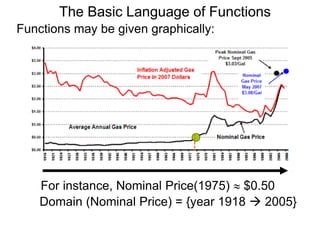
Functions may be given graphically:
The Basic Language of Functions
Functions may be given graphically:
For instance, Nominal Price(1975)  $0.50
The Basic Language of Functions
Functions may be given graphically:
Domain (Nominal Price) = {year 1918  2005}
For instance, Nominal Price(1975)  $0.50
The Basic Language of Functions
Functions may be given graphically:
Domain (Nominal Price) = {year 1918  2005}
Range (Nominal Price) = {$0.20$2.51}
For instance, Nominal Price(1975)  $1.00
The Basic Language of Functions
Functions may be given graphically:
Inflation Adjusted Price(1975)  $1.85
The Basic Language of Functions
Functions may be given graphically:
Inflation Adjusted Price(1975)  $1.85
Domain (Inflation Adjusted Price) = {1918  2005}
The Basic Language of Functions
Functions may be given graphically:
Domain (Inflation Adjusted Price) = {1918  2005}
Range (Inflation Adjusted Price) = {$1.25$3.50}
Inflation Adjusted Price(1975)  $1.85
The Basic Language of Functions
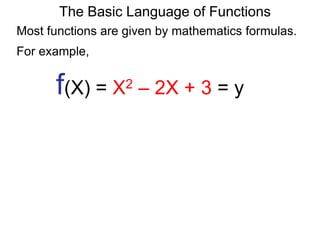
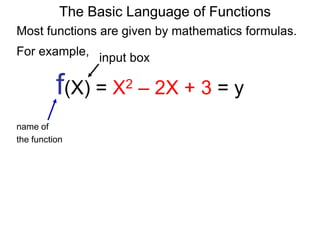
Most functions are given by mathematics formulas.
For example,
f(X) = X2 – 2X + 3 = y
The Basic Language of Functions
Most functions are given by mathematics formulas.
For example,
f(X) = X2 – 2X + 3 = y
name of
the function
The Basic Language of Functions
Most functions are given by mathematics formulas.
For example,
f(X) = X2 – 2X + 3 = y
name of
the function
The Basic Language of Functions
Most functions are given by mathematics formulas.
input box
For example,
f(X) = X2 – 2X + 3 = y
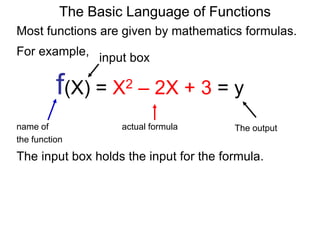
name of actual formula
the function
The Basic Language of Functions
Most functions are given by mathematics formulas.
input box
For example,
f(X) = X2 – 2X + 3 = y
name of actual formula
the function
The output
The Basic Language of Functions
Most functions are given by mathematics formulas.
input box
For example,
f(X) = X2 – 2X + 3 = y
name of actual formula
the function
The output
The Basic Language of Functions
Most functions are given by mathematics formulas.
input box
The input box holds the input for the formula.
For example,
f(X) = X2 – 2X + 3 = y
name of actual formula
the function
The output
The Basic Language of Functions
Most functions are given by mathematics formulas.
input box
The input box holds the input for the formula.
Hence f (2) means to replace x by (2) in the formula,
so f(2) =
For example,
f(X) = X2 – 2X + 3 = y
name of actual formula
the function
The output
The Basic Language of Functions
Most functions are given by mathematics formulas.
input box
The input box holds the input for the formula.
Hence f (2) means to replace x by (2) in the formula,
so f(2) = (2)2 – 2(2) + 3 = 3 = y.
For example,
f(X) = X2 – 2X + 3 = y
name of actual formula
the function
The output
The Basic Language of Functions
Most functions are given by mathematics formulas.
input box
The input box holds the input for the formula.
Hence f (2) means to replace x by (2) in the formula,
so f(2) = (2)2 – 2(2) + 3 = 3 = y.
The domain of this f(x) is the set of all real numbers.
For example,
f(X) = X2 – 2X + 3 = y
name of actual formula
the function
The output
The Basic Language of Functions
Most functions are given by mathematics formulas.
input box
The input box holds the input for the formula.
Hence f (2) means to replace x by (2) in the formula,
so f(2) = (2)2 – 2(2) + 3 = 3 = y.
Function names are used with the +, –, /, and *
with the obvious interpretation.
The domain of this f(x) is the set of all real numbers.
The Basic Language of Functions
Example B. Let f(x) = –3x – 3, g(x) = –2x2 – 3.
a. Evaluate f(–2)
The Basic Language of Functions
Example B. Let f(x) = –3x – 3, g(x) = –2x2 – 3.
a. Evaluate f(–2)
f(x) = –3x – 3
The Basic Language of Functions
Example B. Let f(x) = –3x – 3, g(x) = –2x2 – 3.
a. Evaluate f(–2)
f(x) = –3x – 3
f(–2)
The Basic Language of Functions
Example B. Let f(x) = –3x – 3, g(x) = –2x2 – 3.
a. Evaluate f(–2)
f(x) = –3x – 3
f(–2)
copy the input
The Basic Language of Functions
Example B. Let f(x) = –3x – 3, g(x) = –2x2 – 3.
a. Evaluate f(–2)
f(x) = –3x – 3
f(–2)
copy the input then paste the input
where the x is
The Basic Language of Functions
Example B. Let f(x) = –3x – 3, g(x) = –2x2 – 3.
a. Evaluate f(–2)
f(x) = –3x – 3
f(–2) = –3(–2) – 3
The Basic Language of Functions
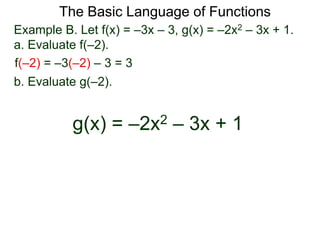
Example B. Let f(x) = –3x – 3, g(x) = –2x2 – 3x + 1.
a. Evaluate f(–2).
f(–2) = –3(–2) – 3 = 3
The Basic Language of Functions
Example B. Let f(x) = –3x – 3, g(x) = –2x2 – 3x + 1.
a. Evaluate f(–2).
f(–2) = –3(–2) – 3 = 3
b. Evaluate g(–2).
The Basic Language of Functions
Example B. Let f(x) = –3x – 3, g(x) = –2x2 – 3x + 1.
a. Evaluate f(–2).
f(–2) = –3(–2) – 3 = 3
b. Evaluate g(–2).
g(x) = –2x2 – 3x + 1
The Basic Language of Functions
Example B. Let f(x) = –3x – 3, g(x) = –2x2 – 3x + 1.
a. Evaluate f(–2).
f(–2) = –3(–2) – 3 = 3
b. Evaluate g(–2).
g(x) = –2x2 – 3x + 1
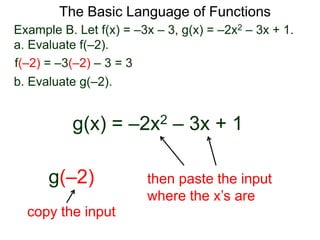
g(–2)
The Basic Language of Functions
Example B. Let f(x) = –3x – 3, g(x) = –2x2 – 3x + 1.
a. Evaluate f(–2).
f(–2) = –3(–2) – 3 = 3
b. Evaluate g(–2).
g(x) = –2x2 – 3x + 1
g(–2)
copy the input
The Basic Language of Functions
Example B. Let f(x) = –3x – 3, g(x) = –2x2 – 3x + 1.
a. Evaluate f(–2).
f(–2) = –3(–2) – 3 = 3
b. Evaluate g(–2).
g(x) = –2x2 – 3x + 1
g(–2)
copy the input
then paste the input
where the x’s are
The Basic Language of Functions
Example B. Let f(x) = –3x – 3, g(x) = –2x2 – 3x + 1.
a. Evaluate f(–2).
f(–2) = –3(–2) – 3 = 3
b. Evaluate g(–2).
g(x) = –2x2 – 3x + 1
g(–2) = –2(–2)2 – 3(–2) + 1
copy the input
The Basic Language of Functions
Example B. Let f(x) = –3x – 3, g(x) = –2x2 – 3x + 1.
a. Evaluate f(–2).
f(–2) = –3(–2) – 3 = 3
b. Evaluate g(–2).
g(–2) = –2(–2)2 – 3(–2) + 1
The Basic Language of Functions
Example B. Let f(x) = –3x – 3, g(x) = –2x2 – 3x + 1.
a. Evaluate f(–2).
f(–2) = –3(–2) – 3 = 3
b. Evaluate g(–2).
g(–2) = –2(–2)2 – 3(–2) + 1
= –8 + 6 + 1 = –1
The Basic Language of Functions
Example B. Let f(x) = –3x – 3, g(x) = –2x2 – 3x + 1.
a. Evaluate f(–2).
f(–2) = –3(–2) – 3 = 3
b. Evaluate g(–2).
g(–2) = –2(–2)2 – 3(–2) + 1
= –8 + 6 + 1 = –1
c. Evaluate f(–2) – g(–2).
The Basic Language of Functions
Example B. Let f(x) = –3x – 3, g(x) = –2x2 – 3x + 1.
a. Evaluate f(–2).
f(–2) = –3(–2) – 3 = 3
b. Evaluate g(–2).
g(–2) = –2(–2)2 – 3(–2) + 1
= –8 + 6 + 1 = –1
c. Evaluate f(–2) – g(–2).
Using the outputs of parts a and b we’ve
f(–2) – g(–2)
=
The Basic Language of Functions
Example B. Let f(x) = –3x – 3, g(x) = –2x2 – 3x + 1.
a. Evaluate f(–2).
f(–2) = –3(–2) – 3 = 3
b. Evaluate g(–2).
g(–2) = –2(–2)2 – 3(–2) + 1
= –8 + 6 + 1 = –1
c. Evaluate f(–2) – g(–2).
Using the outputs of parts a and b we’ve
f(–2) – g(–2)
= 3 – (–1) = 4
The Basic Language of Functions
Example B. Let f(x) = –3x – 3, g(x) = –2x2 – 3x + 1.
a. Evaluate f(–2).
f(–2) = –3(–2) – 3 = 3
b. Evaluate g(–2).
g(–2) = –2(–2)2 – 3(–2) + 1
= –8 + 6 + 1 = –1
c. Evaluate f(–2) – g(–2).
Using the outputs of parts a and b we’ve
f(–2) – g(–2)
= 3 – (–1) = 4
The function f(x) = c where c is a number is called
a constant function.
The Basic Language of Functions
Example B. Let f(x) = –3x – 3, g(x) = –2x2 – 3x + 1.
a. Evaluate f(–2).
f(–2) = –3(–2) – 3 = 3
b. Evaluate g(–2).
g(–2) = –2(–2)2 – 3(–2) + 1
= –8 + 6 + 1 = –1
c. Evaluate f(–2) – g(–2).
Using the outputs of parts a and b we’ve
f(–2) – g(–2)
= 3 – (–1) = 4
The function f(x) = c where c is a number is called
a constant function. The outputs of such functions
do not change.
There are two main things to consider when
determining the domains of functions of real numbers.
The Basic Language of Functions
There are two main things to consider when
determining the domains of functions of real numbers.
1. The denominators can't be 0.
The Basic Language of Functions
There are two main things to consider when
determining the domains of functions of real numbers.
1. The denominators can't be 0.
2. The radicand of square root (or any even root)
can't be negative.
The Basic Language of Functions
There are two main things to consider when
determining the domains of functions of real numbers.
1. The denominators can't be 0.
2. The radicand of square root (or any even root)
can't be negative.
Example C. Find the domain of the following functions.
a. f(x) = 1/(2x + 6)
b. f (X) =  2x + 6
The Basic Language of Functions
There are two main things to consider when
determining the domains of functions of real numbers.
1. The denominators can't be 0.
2. The radicand of square root (or any even root)
can't be negative.
Example C. Find the domain of the following functions.
a. f(x) = 1/(2x + 6)
The denominator can’t be 0
b. f (X) =  2x + 6
The Basic Language of Functions
There are two main things to consider when
determining the domains of functions of real numbers.
1. The denominators can't be 0.
2. The radicand of square root (or any even root)
can't be negative.
Example C. Find the domain of the following functions.
a. f(x) = 1/(2x + 6)
The denominator can’t be 0 i.e. 2x + 6 = 0  x = -3
b. f (X) =  2x + 6
The Basic Language of Functions
There are two main things to consider when
determining the domains of functions of real numbers.
1. The denominators can't be 0.
2. The radicand of square root (or any even root)
can't be negative.
Example C. Find the domain of the following functions.
a. f(x) = 1/(2x + 6)
The denominator can’t be 0 i.e. 2x + 6 = 0  x = -3
So the domain = {all numbers except x = -3}.
b. f (X) =  2x + 6
The Basic Language of Functions
There are two main things to consider when
determining the domains of functions of real numbers.
1. The denominators can't be 0.
2. The radicand of square root (or any even root)
can't be negative.
Example C. Find the domain of the following functions.
a. f(x) = 1/(2x + 6)
The denominator can’t be 0 i.e. 2x + 6 = 0  x = -3
So the domain = {all numbers except x = -3}.
b. f (X) =  2x + 6
We must have square root of nonnegative numbers.
The Basic Language of Functions
There are two main things to consider when
determining the domains of functions of real numbers.
1. The denominators can't be 0.
2. The radicand of square root (or any even root)
can't be negative.
Example C. Find the domain of the following functions.
a. f(x) = 1/(2x + 6)
The denominator can’t be 0 i.e. 2x + 6 = 0  x = -3
So the domain = {all numbers except x = -3}.
b. f (X) =  2x + 6
We must have square root of nonnegative numbers.
Hence 2x + 6 > 0  x > -3
The Basic Language of Functions
There are two main things to consider when
determining the domains of functions of real numbers.
1. The denominators can't be 0.
2. The radicand of square root (or any even root)
can't be negative.
Example C. Find the domain of the following functions.
a. f(x) = 1/(2x + 6)
The denominator can’t be 0 i.e. 2x + 6 = 0  x = -3
So the domain = {all numbers except x = -3}.
b. f (X) =  2x + 6
We must have square root of nonnegative numbers.
Hence 2x + 6 > 0  x > -3
So the domain = {all numbers x > -3}
The Basic Language of Functions
Graphs of Functions
The Basic Language of Functions
Graphs of Functions
The plot of all points (x, y)’s
that satisfy a given function
y = f(x) is the graph of the
function y = f(x).
The Basic Language of Functions
Graphs of Functions
The plot of all points (x, y)’s
that satisfy a given function
y = f(x) is the graph of the
function y = f(x).
For example, let the function
f(x) = x + 1,
The Basic Language of Functions
Graphs of Functions
The plot of all points (x, y)’s
that satisfy a given function
y = f(x) is the graph of the
function y = f(x).
For example, let the function
f(x) = x + 1, set y = f(x) and
make a table of few of the
ordered pairs (x, y)’s that
satisfy the equation y = f(x).
The Basic Language of Functions
Graphs of Functions
The plot of all points (x, y)’s
that satisfy a given function
y = f(x) is the graph of the
function y = f(x).
For example, let the function
f(x) = x + 1, set y = f(x) and
make a table of few of the
ordered pairs (x, y)’s that
satisfy the equation y = f(x).
x 0 1 2 3
y = f(x) 1 2 3 4
The Basic Language of Functions
Graphs of Functions
The plot of all points (x, y)’s
that satisfy a given function
y = f(x) is the graph of the
function y = f(x).
For example, let the function
f(x) = x + 1, set y = f(x) and
make a table of few of the
ordered pairs (x, y)’s that
satisfy the equation y = f(x).
x 0 1 2 3
y = f(x) 1 2 3 4
Plot the (x, y)’s and we have the graph of f(x) = x + 1,
a line.
The Basic Language of Functions
Graphs of Functions
The plot of all points (x, y)’s
that satisfy a given function
y = f(x) is the graph of the
function y = f(x).
For example, let the function
f(x) = x + 1, set y = f(x) and
make a table of few of the
ordered pairs (x, y)’s that
satisfy the equation y = f(x).
x 0 1 2 3
y = f(x) 1 2 3 4
y = x + 1
Plot the (x, y)’s and we have the graph of f(x) = x + 1,
a line.
The Basic Language of Functions
Graphs of Functions
The plot of all points (x, y)’s
that satisfy a given function
y = f(x) is the graph of the
function y = f(x).
For example, let the function
f(x) = x + 1, set y = f(x) and
make a table of few of the
ordered pairs (x, y)’s that
satisfy the equation y = f(x).
x 0 1 2 3
y = f(x) 1 2 3 4
y = x + 1
Plot the (x, y)’s and we have the graph of f(x) = x + 1,
a line. Note that the graph of a function may cross any
vertical line at most at one point because for each x
there is only one corresponding output y.
The Basic Language of Functions
Graphs of Functions
The plot of all points (x, y)’s
that satisfy a given function
y = f(x) is the graph of the
function y = f(x).
For example, let the function
f(x) = x + 1, set y = f(x) and
make a table of few of the
ordered pairs (x, y)’s that
satisfy the equation y = f(x).
x 0 1 2 3
y = f(x) 1 2 3 4
y = x + 1
Plot the (x, y)’s and we have the graph of f(x) = x + 1,
a line. Note that the graph of a function may cross any
vertical line at most at one point because for each x
there is only one corresponding output y.
The Basic Language of Functions
The equation x = y2, treating x
as the input, is not a function.
The Basic Language of Functions
The equation x = y2, treating x
as the input, is not a function.
For instance, for the input
x = 4, there are two outputs,
y’s that satisfy 4 = y2,
The Basic Language of Functions
The equation x = y2, treating x
as the input, is not a function.
For instance, for the input
x = 4, there are two outputs,
y’s that satisfy 4 = y2, namely
y = 2 and y = –2.
The Basic Language of Functions
The equation x = y2, treating x
as the input, is not a function.
For instance, for the input
x = 4, there are two outputs,
y’s that satisfy 4 = y2, namely
y = 2 and y = –2. So x = y2 is
not a function.
The Basic Language of Functions
The equation x = y2, treating x
as the input, is not a function.
For instance, for the input
x = 4, there are two outputs,
y’s that satisfy 4 = y2, namely
y = 2 and y = –2. So x = y2 is
not a function.
Plot the graph by the table
shown.
x 0 1 1 4 4
y 0 1 -1 2 -2
The Basic Language of Functions
The equation x = y2, treating x
as the input, is not a function.
For instance, for the input
x = 4, there are two outputs,
y’s that satisfy 4 = y2, namely
y = 2 and y = –2. So x = y2 is
not a function.
Plot the graph by the table
shown.
x 0 1 1 4 4
y 0 1 -1 2 -2
x 0 1 1 4 4
y 0 1 -1 2 -2
x = y2
The Basic Language of Functions
The equation x = y2, treating x
as the input, is not a function.
For instance, for the input
x = 4, there are two outputs,
y’s that satisfy 4 = y2, namely
y = 2 and y = –2. So x = y2 is
not a function.
Plot the graph by the table
shown. In particular, if we
draw the vertical line x = 4,
x 0 1 1 4 4
y 0 1 -1 2 -2
x 0 1 1 4 4
y 0 1 -1 2 -2
x = y2
it intersects the graph at two points (4, 2) and (4, –2).
The Basic Language of Functions
The equation x = y2, treating x
as the input, is not a function.
For instance, for the input
x = 4, there are two outputs,
y’s that satisfy 4 = y2, namely
y = 2 and y = –2. So x = y2 is
not a function.
Plot the graph by the table
shown. In particular, if we
draw the vertical line x = 4,
x 0 1 1 4 4
y 0 1 -1 2 -2
x 0 1 1 4 4
y 0 1 -1 2 -2
x = y2
it intersects the graph at two points (4, 2) and (4, –2).
In general, if any vertical line crosses a graph at two
or more points, then the graph does not represent
any function.
The Basic Language of Functions
Since for functions each
input x has exactly one
output, therefore each
vertical line can only
intersect it’s graph at exactly
one location (e.g. y = x + 1).
The Basic Language of Functions
Since for functions each
input x has exactly one
output, therefore each
vertical line can only
intersect it’s graph at exactly
one location (e.g. y = x + 1).
y = x + 1
The Basic Language of Functions
Since for functions each
input x has exactly one
output, therefore each
vertical line can only
intersect it’s graph at exactly
one location (e.g. y = x + 1).
y = x + 1
However, if any vertical line
intersects a graph at two or
more points, i.e. there are two
or more outputs y associated
to one input x (eg. x = y2),
The Basic Language of Functions
Since for functions each
input x has exactly one
output, therefore each
vertical line can only
intersect it’s graph at exactly
one location (e.g. y = x + 1).
y = x + 1
However, if any vertical line
intersects a graph at two or
more points, i.e. there are two
or more outputs y associated
to one input x (eg. x = y2),
then the graph must not be
the graph of a function.
The Basic Language of Functions
Since for functions each
input x has exactly one
output, therefore each
vertical line can only
intersect it’s graph at exactly
one location (e.g. y = x + 1).
x 0 1 1 4 4
y 0 1 -1 2 -2
y = x + 1
However, if any vertical line
intersects a graph at two or
more points, i.e. there are two
or more outputs y associated
to one input x (eg. x = y2),
then the graph must not be
the graph of a function.
The Basic Language of Functions
Exercise A. For problems 1 – 6, determine if the
given represents a function. If it’s not a function,
give a reason why it’s not.
x y
2 4
2 3
4 3
1. x y
2 4
3 4
4 4
2. 3. 4.
x
y y
6. For any real number input x that is a rational
number, the output is 0, otherwise the output is 1
5. For any input x that is a positive integer, the
outputs are it’s factors.
x
All the (x, y)’s on the curve
The Basic Language of Functions
Exercise B.
Given the functions
f, g and h, find the
outcomes of the
following expressions.
If it’s not defined,
state so.
x y = g(x)
–1 4
2 3
5 –3
6 4
7 2
y = h(x)
f(x) = –3x + 7
1. f(–1) 2. g(–1) 3.h(–1)
4. –f(3) 5. –g(3) 6. –h(3)
7. 3g(6) 8. 2f(2) 9. h(3) + h(0)
10. 2f(4) + 3g(2) 11. –f(4) + f(–4) 12. h(6)*[f(2)]2
The Basic Language of Functions
1. f(x) =
1
2x – 6 2. f (x) =  2x – 6
C. Find the domain of the following functions.
5. f(x) =
1
(x – 2)(x + 6)
7. f (x) =  (x – 2)(x + 6)
3. f(x) =
1
3 – 2x 4. f (x) =  3 – 2x
6. f(x) = 1
x2 – 1
8. f (x) =  1 – x2
9. f (x) =  (x – 2)/(x + 6) 10. f (x) = 4x2 – 9
For problem 7-10, draw sign charts (section 1.6)
to solve for the domains.
The Basic Language of Functions
1. –f(3) 2. –g(3) 3. –h(3)
4. 3g(2) 5. 2f(2) 6. h(3) + h(0)
7. 2f(4) + 3g(2) 8. f(–3/2) 9. g(1/2)
13. f(3 + a) 14. g(3 + a) 15. g(3 + a)
16. f(a – b) 17. g(a – b)
18. f( )a
1 19. f(a)
1
11. h(–3/2) 12. g(–1/2)10. 1/g(2)
Exercise D. Given the functions f, g and h, find the
outcomes of the following expressions. If it’s not
defined, state so.
f(x) = –2x + 3 g(x) = –x2 + 3x – 2 h(x) =
x + 2
x – 3
The Basic Language of Functions
(Answers to odd problems) Exercise A.
1. It’s a function 3. Not a function
5. Not a function
Exercise B.
1. f(–1) = 10 3. h(–1) = 2 5. Not defined
7. 3g(6) = 12 9. h(3) + h(0) = 2 11. –f(4) + f(–4) = 24
1. x ≠ 3
Exercise C.
5. x ≠ 2 and x ≠ -63. x ≠ 3/2
The Basic Language of Functions
7. (𝑥 – 2)(𝑥 + 6)
x=-6 x=2
++
The domain of f(x) =  (x – 2)(x + 6) is −∞, −6 ∪ [2, ∞)
9. (𝑥 – 2)/(𝑥 + 6)
x=-6 x=2
++
The domain of f(x) =  (x – 2)/(x + 6) is (−∞, −6) ∪ [2, ∞)
The Basic Language of Functions
1. –f(3) = 3 3. Not defined 5. 2f(2) = –2
7. 2f(4) + 3g(2) = –10 9. g(1/2) = –1/4
13. f(3 + a) = –2a – 3
15. g(3 + a) = a2 – 3a – 2
17. g(a – b) = –a2 + 2ab – b2 + 3a – 3b – 2
19. f(a)
1 = 1
11. h(–3/2) = –1/9
Exercise D.
–2a+3

9 the basic language of functions

  • 1.
    The Basic Languageof Functions
  • 2.
    The Basic Languageof Functions A function is a procedure that assigns each input exactly one output.
  • 3.
    The Basic Languageof Functions A function is a procedure that assigns each input exactly one output. In mathematics, usually we name functions as f, g, h…
  • 4.
    The Basic Languageof Functions A function is a procedure that assigns each input exactly one output. In mathematics, usually we name functions as f, g, h…and by default we let x represent the input and y represent the output.
  • 5.
    Example A. a. Theinputs are driver-license numbers x, the outputs y are the names of the license-holders. The Basic Language of Functions A function is a procedure that assigns each input exactly one output. In mathematics, usually we name functions as f, g, h…and by default we let x represent the input and y represent the output.
  • 6.
    Example A. a. Theinputs are driver-license numbers x, the outputs y are the names of the license-holders. This is a function because for each license number, there is exactly one owner of that license. The Basic Language of Functions A function is a procedure that assigns each input exactly one output. In mathematics, usually we name functions as f, g, h…and by default we let x represent the input and y represent the output.
  • 7.
    Example A. a. Theinputs are driver-license numbers x, the outputs y are the names of the license-holders. This is a function because for each license number, there is exactly one owner of that license. The Basic Language of Functions b. The inputs are driver-license numbers x, the outputs y are the names of all the siblings of the license-holders. A function is a procedure that assigns each input exactly one output. In mathematics, usually we name functions as f, g, h…and by default we let x represent the input and y represent the output.
  • 8.
    Example A. a. Theinputs are driver-license numbers x, the outputs y are the names of the license-holders. This is a function because for each license number, there is exactly one owner of that license. The Basic Language of Functions b. The inputs are driver-license numbers x, the outputs y are the names of all the siblings of the license-holders. This is not a function because for some inputs of license numbers, there might be many outputs of names of the siblings of the license holders. A function is a procedure that assigns each input exactly one output. In mathematics, usually we name functions as f, g, h…and by default we let x represent the input and y represent the output.
  • 9.
    Given a function,the set D of all the inputs is called the domain of the function. The Basic Language of Functions
  • 10.
    Given a function,the set D of all the inputs is called the domain of the function. The domain D of the license-number-to-name function in example A are all valid driver license numbers. The Basic Language of Functions
  • 11.
    Given a function,the set D of all the inputs is called the domain of the function. The domain D of the license-number-to-name function in example A are all valid driver license numbers. The set R of all the outputs is called the range and the range R of the license-number-to-name function are all the names of drivers with a valid license. The Basic Language of Functions
  • 12.
    Given a function,the set D of all the inputs is called the domain of the function. The domain D of the license-number-to-name function in example A are all valid driver license numbers. The set R of all the outputs is called the range and the range R of the license-number-to-name function are all the names of drivers with a valid license. A function may be given by a chart where the input and outputs are listed explicitly. The Basic Language of Functions x y –1 4 2 3 5 –3 6 4 7 2
  • 13.
    Given a function,the set D of all the inputs is called the domain of the function. The domain D of the license-number-to-name function in example A are all valid driver license numbers. The set R of all the outputs is called the range and the range R of the license-number-to-name function are all the names of drivers with a valid license. A function may be given by a chart where the input and outputs are listed explicitly. From the table we see that 3 is the output for the input 2. The Basic Language of Functions x y –1 4 2 3 5 –3 6 4 7 2
  • 14.
    Given a function,the set D of all the inputs is called the domain of the function. The domain D of the license-number-to-name function in example A are all valid driver license numbers. The set R of all the outputs is called the range and the range R of the license-number-to-name function are all the names of drivers with a valid license. A function may be given by a chart where the input and outputs are listed explicitly. From the table we see that 3 is the output for the input 2. The domain D = {–1, 2, 5, 6, 7} and the range is R = {4, 3, –3, 2}. The Basic Language of Functions x y –1 4 2 3 5 –3 6 4 7 2
  • 15.
    Given a function,the set D of all the inputs is called the domain of the function. The domain D of the license-number-to-name function in example A are all valid driver license numbers. The set R of all the outputs is called the range and the range R of the license-number-to-name function are all the names of drivers with a valid license. A function may be given by a chart where the input and outputs are listed explicitly. From the table we see that 3 is the output for the input 2. The domain D = {–1, 2, 5, 6, 7} and the range is R = {4, 3, –3, 2}. Note that we may have the same output 4 for two different inputs –1 and 6. The Basic Language of Functions x y –1 4 2 3 5 –3 6 4 7 2
  • 16.
    Functions may begiven graphically: The Basic Language of Functions
  • 17.
    Functions may begiven graphically: For instance, Nominal Price(1975)  $0.50 The Basic Language of Functions
  • 18.
    Functions may begiven graphically: Domain (Nominal Price) = {year 1918  2005} For instance, Nominal Price(1975)  $0.50 The Basic Language of Functions
  • 19.
    Functions may begiven graphically: Domain (Nominal Price) = {year 1918  2005} Range (Nominal Price) = {$0.20$2.51} For instance, Nominal Price(1975)  $1.00 The Basic Language of Functions
  • 20.
    The Basic Languageof Functions Functions may be given graphically: Inflation Adjusted Price(1975)  $1.85
  • 21.
    The Basic Languageof Functions Functions may be given graphically: Inflation Adjusted Price(1975)  $1.85 Domain (Inflation Adjusted Price) = {1918  2005}
  • 22.
    The Basic Languageof Functions Functions may be given graphically: Domain (Inflation Adjusted Price) = {1918  2005} Range (Inflation Adjusted Price) = {$1.25$3.50} Inflation Adjusted Price(1975)  $1.85
  • 23.
    The Basic Languageof Functions Most functions are given by mathematics formulas.
  • 24.
    For example, f(X) =X2 – 2X + 3 = y The Basic Language of Functions Most functions are given by mathematics formulas.
  • 25.
    For example, f(X) =X2 – 2X + 3 = y name of the function The Basic Language of Functions Most functions are given by mathematics formulas.
  • 26.
    For example, f(X) =X2 – 2X + 3 = y name of the function The Basic Language of Functions Most functions are given by mathematics formulas. input box
  • 27.
    For example, f(X) =X2 – 2X + 3 = y name of actual formula the function The Basic Language of Functions Most functions are given by mathematics formulas. input box
  • 28.
    For example, f(X) =X2 – 2X + 3 = y name of actual formula the function The output The Basic Language of Functions Most functions are given by mathematics formulas. input box
  • 29.
    For example, f(X) =X2 – 2X + 3 = y name of actual formula the function The output The Basic Language of Functions Most functions are given by mathematics formulas. input box The input box holds the input for the formula.
  • 30.
    For example, f(X) =X2 – 2X + 3 = y name of actual formula the function The output The Basic Language of Functions Most functions are given by mathematics formulas. input box The input box holds the input for the formula. Hence f (2) means to replace x by (2) in the formula, so f(2) =
  • 31.
    For example, f(X) =X2 – 2X + 3 = y name of actual formula the function The output The Basic Language of Functions Most functions are given by mathematics formulas. input box The input box holds the input for the formula. Hence f (2) means to replace x by (2) in the formula, so f(2) = (2)2 – 2(2) + 3 = 3 = y.
  • 32.
    For example, f(X) =X2 – 2X + 3 = y name of actual formula the function The output The Basic Language of Functions Most functions are given by mathematics formulas. input box The input box holds the input for the formula. Hence f (2) means to replace x by (2) in the formula, so f(2) = (2)2 – 2(2) + 3 = 3 = y. The domain of this f(x) is the set of all real numbers.
  • 33.
    For example, f(X) =X2 – 2X + 3 = y name of actual formula the function The output The Basic Language of Functions Most functions are given by mathematics formulas. input box The input box holds the input for the formula. Hence f (2) means to replace x by (2) in the formula, so f(2) = (2)2 – 2(2) + 3 = 3 = y. Function names are used with the +, –, /, and * with the obvious interpretation. The domain of this f(x) is the set of all real numbers.
  • 34.
    The Basic Languageof Functions Example B. Let f(x) = –3x – 3, g(x) = –2x2 – 3. a. Evaluate f(–2)
  • 35.
    The Basic Languageof Functions Example B. Let f(x) = –3x – 3, g(x) = –2x2 – 3. a. Evaluate f(–2) f(x) = –3x – 3
  • 36.
    The Basic Languageof Functions Example B. Let f(x) = –3x – 3, g(x) = –2x2 – 3. a. Evaluate f(–2) f(x) = –3x – 3 f(–2)
  • 37.
    The Basic Languageof Functions Example B. Let f(x) = –3x – 3, g(x) = –2x2 – 3. a. Evaluate f(–2) f(x) = –3x – 3 f(–2) copy the input
  • 38.
    The Basic Languageof Functions Example B. Let f(x) = –3x – 3, g(x) = –2x2 – 3. a. Evaluate f(–2) f(x) = –3x – 3 f(–2) copy the input then paste the input where the x is
  • 39.
    The Basic Languageof Functions Example B. Let f(x) = –3x – 3, g(x) = –2x2 – 3. a. Evaluate f(–2) f(x) = –3x – 3 f(–2) = –3(–2) – 3
  • 40.
    The Basic Languageof Functions Example B. Let f(x) = –3x – 3, g(x) = –2x2 – 3x + 1. a. Evaluate f(–2). f(–2) = –3(–2) – 3 = 3
  • 41.
    The Basic Languageof Functions Example B. Let f(x) = –3x – 3, g(x) = –2x2 – 3x + 1. a. Evaluate f(–2). f(–2) = –3(–2) – 3 = 3 b. Evaluate g(–2).
  • 42.
    The Basic Languageof Functions Example B. Let f(x) = –3x – 3, g(x) = –2x2 – 3x + 1. a. Evaluate f(–2). f(–2) = –3(–2) – 3 = 3 b. Evaluate g(–2). g(x) = –2x2 – 3x + 1
  • 43.
    The Basic Languageof Functions Example B. Let f(x) = –3x – 3, g(x) = –2x2 – 3x + 1. a. Evaluate f(–2). f(–2) = –3(–2) – 3 = 3 b. Evaluate g(–2). g(x) = –2x2 – 3x + 1 g(–2)
  • 44.
    The Basic Languageof Functions Example B. Let f(x) = –3x – 3, g(x) = –2x2 – 3x + 1. a. Evaluate f(–2). f(–2) = –3(–2) – 3 = 3 b. Evaluate g(–2). g(x) = –2x2 – 3x + 1 g(–2) copy the input
  • 45.
    The Basic Languageof Functions Example B. Let f(x) = –3x – 3, g(x) = –2x2 – 3x + 1. a. Evaluate f(–2). f(–2) = –3(–2) – 3 = 3 b. Evaluate g(–2). g(x) = –2x2 – 3x + 1 g(–2) copy the input then paste the input where the x’s are
  • 46.
    The Basic Languageof Functions Example B. Let f(x) = –3x – 3, g(x) = –2x2 – 3x + 1. a. Evaluate f(–2). f(–2) = –3(–2) – 3 = 3 b. Evaluate g(–2). g(x) = –2x2 – 3x + 1 g(–2) = –2(–2)2 – 3(–2) + 1 copy the input
  • 47.
    The Basic Languageof Functions Example B. Let f(x) = –3x – 3, g(x) = –2x2 – 3x + 1. a. Evaluate f(–2). f(–2) = –3(–2) – 3 = 3 b. Evaluate g(–2). g(–2) = –2(–2)2 – 3(–2) + 1
  • 48.
    The Basic Languageof Functions Example B. Let f(x) = –3x – 3, g(x) = –2x2 – 3x + 1. a. Evaluate f(–2). f(–2) = –3(–2) – 3 = 3 b. Evaluate g(–2). g(–2) = –2(–2)2 – 3(–2) + 1 = –8 + 6 + 1 = –1
  • 49.
    The Basic Languageof Functions Example B. Let f(x) = –3x – 3, g(x) = –2x2 – 3x + 1. a. Evaluate f(–2). f(–2) = –3(–2) – 3 = 3 b. Evaluate g(–2). g(–2) = –2(–2)2 – 3(–2) + 1 = –8 + 6 + 1 = –1 c. Evaluate f(–2) – g(–2).
  • 50.
    The Basic Languageof Functions Example B. Let f(x) = –3x – 3, g(x) = –2x2 – 3x + 1. a. Evaluate f(–2). f(–2) = –3(–2) – 3 = 3 b. Evaluate g(–2). g(–2) = –2(–2)2 – 3(–2) + 1 = –8 + 6 + 1 = –1 c. Evaluate f(–2) – g(–2). Using the outputs of parts a and b we’ve f(–2) – g(–2) =
  • 51.
    The Basic Languageof Functions Example B. Let f(x) = –3x – 3, g(x) = –2x2 – 3x + 1. a. Evaluate f(–2). f(–2) = –3(–2) – 3 = 3 b. Evaluate g(–2). g(–2) = –2(–2)2 – 3(–2) + 1 = –8 + 6 + 1 = –1 c. Evaluate f(–2) – g(–2). Using the outputs of parts a and b we’ve f(–2) – g(–2) = 3 – (–1) = 4
  • 52.
    The Basic Languageof Functions Example B. Let f(x) = –3x – 3, g(x) = –2x2 – 3x + 1. a. Evaluate f(–2). f(–2) = –3(–2) – 3 = 3 b. Evaluate g(–2). g(–2) = –2(–2)2 – 3(–2) + 1 = –8 + 6 + 1 = –1 c. Evaluate f(–2) – g(–2). Using the outputs of parts a and b we’ve f(–2) – g(–2) = 3 – (–1) = 4 The function f(x) = c where c is a number is called a constant function.
  • 53.
    The Basic Languageof Functions Example B. Let f(x) = –3x – 3, g(x) = –2x2 – 3x + 1. a. Evaluate f(–2). f(–2) = –3(–2) – 3 = 3 b. Evaluate g(–2). g(–2) = –2(–2)2 – 3(–2) + 1 = –8 + 6 + 1 = –1 c. Evaluate f(–2) – g(–2). Using the outputs of parts a and b we’ve f(–2) – g(–2) = 3 – (–1) = 4 The function f(x) = c where c is a number is called a constant function. The outputs of such functions do not change.
  • 54.
    There are twomain things to consider when determining the domains of functions of real numbers. The Basic Language of Functions
  • 55.
    There are twomain things to consider when determining the domains of functions of real numbers. 1. The denominators can't be 0. The Basic Language of Functions
  • 56.
    There are twomain things to consider when determining the domains of functions of real numbers. 1. The denominators can't be 0. 2. The radicand of square root (or any even root) can't be negative. The Basic Language of Functions
  • 57.
    There are twomain things to consider when determining the domains of functions of real numbers. 1. The denominators can't be 0. 2. The radicand of square root (or any even root) can't be negative. Example C. Find the domain of the following functions. a. f(x) = 1/(2x + 6) b. f (X) =  2x + 6 The Basic Language of Functions
  • 58.
    There are twomain things to consider when determining the domains of functions of real numbers. 1. The denominators can't be 0. 2. The radicand of square root (or any even root) can't be negative. Example C. Find the domain of the following functions. a. f(x) = 1/(2x + 6) The denominator can’t be 0 b. f (X) =  2x + 6 The Basic Language of Functions
  • 59.
    There are twomain things to consider when determining the domains of functions of real numbers. 1. The denominators can't be 0. 2. The radicand of square root (or any even root) can't be negative. Example C. Find the domain of the following functions. a. f(x) = 1/(2x + 6) The denominator can’t be 0 i.e. 2x + 6 = 0  x = -3 b. f (X) =  2x + 6 The Basic Language of Functions
  • 60.
    There are twomain things to consider when determining the domains of functions of real numbers. 1. The denominators can't be 0. 2. The radicand of square root (or any even root) can't be negative. Example C. Find the domain of the following functions. a. f(x) = 1/(2x + 6) The denominator can’t be 0 i.e. 2x + 6 = 0  x = -3 So the domain = {all numbers except x = -3}. b. f (X) =  2x + 6 The Basic Language of Functions
  • 61.
    There are twomain things to consider when determining the domains of functions of real numbers. 1. The denominators can't be 0. 2. The radicand of square root (or any even root) can't be negative. Example C. Find the domain of the following functions. a. f(x) = 1/(2x + 6) The denominator can’t be 0 i.e. 2x + 6 = 0  x = -3 So the domain = {all numbers except x = -3}. b. f (X) =  2x + 6 We must have square root of nonnegative numbers. The Basic Language of Functions
  • 62.
    There are twomain things to consider when determining the domains of functions of real numbers. 1. The denominators can't be 0. 2. The radicand of square root (or any even root) can't be negative. Example C. Find the domain of the following functions. a. f(x) = 1/(2x + 6) The denominator can’t be 0 i.e. 2x + 6 = 0  x = -3 So the domain = {all numbers except x = -3}. b. f (X) =  2x + 6 We must have square root of nonnegative numbers. Hence 2x + 6 > 0  x > -3 The Basic Language of Functions
  • 63.
    There are twomain things to consider when determining the domains of functions of real numbers. 1. The denominators can't be 0. 2. The radicand of square root (or any even root) can't be negative. Example C. Find the domain of the following functions. a. f(x) = 1/(2x + 6) The denominator can’t be 0 i.e. 2x + 6 = 0  x = -3 So the domain = {all numbers except x = -3}. b. f (X) =  2x + 6 We must have square root of nonnegative numbers. Hence 2x + 6 > 0  x > -3 So the domain = {all numbers x > -3} The Basic Language of Functions
  • 64.
    The Basic Languageof Functions Graphs of Functions
  • 65.
    The Basic Languageof Functions Graphs of Functions The plot of all points (x, y)’s that satisfy a given function y = f(x) is the graph of the function y = f(x).
  • 66.
    The Basic Languageof Functions Graphs of Functions The plot of all points (x, y)’s that satisfy a given function y = f(x) is the graph of the function y = f(x). For example, let the function f(x) = x + 1,
  • 67.
    The Basic Languageof Functions Graphs of Functions The plot of all points (x, y)’s that satisfy a given function y = f(x) is the graph of the function y = f(x). For example, let the function f(x) = x + 1, set y = f(x) and make a table of few of the ordered pairs (x, y)’s that satisfy the equation y = f(x).
  • 68.
    The Basic Languageof Functions Graphs of Functions The plot of all points (x, y)’s that satisfy a given function y = f(x) is the graph of the function y = f(x). For example, let the function f(x) = x + 1, set y = f(x) and make a table of few of the ordered pairs (x, y)’s that satisfy the equation y = f(x). x 0 1 2 3 y = f(x) 1 2 3 4
  • 69.
    The Basic Languageof Functions Graphs of Functions The plot of all points (x, y)’s that satisfy a given function y = f(x) is the graph of the function y = f(x). For example, let the function f(x) = x + 1, set y = f(x) and make a table of few of the ordered pairs (x, y)’s that satisfy the equation y = f(x). x 0 1 2 3 y = f(x) 1 2 3 4 Plot the (x, y)’s and we have the graph of f(x) = x + 1, a line.
  • 70.
    The Basic Languageof Functions Graphs of Functions The plot of all points (x, y)’s that satisfy a given function y = f(x) is the graph of the function y = f(x). For example, let the function f(x) = x + 1, set y = f(x) and make a table of few of the ordered pairs (x, y)’s that satisfy the equation y = f(x). x 0 1 2 3 y = f(x) 1 2 3 4 y = x + 1 Plot the (x, y)’s and we have the graph of f(x) = x + 1, a line.
  • 71.
    The Basic Languageof Functions Graphs of Functions The plot of all points (x, y)’s that satisfy a given function y = f(x) is the graph of the function y = f(x). For example, let the function f(x) = x + 1, set y = f(x) and make a table of few of the ordered pairs (x, y)’s that satisfy the equation y = f(x). x 0 1 2 3 y = f(x) 1 2 3 4 y = x + 1 Plot the (x, y)’s and we have the graph of f(x) = x + 1, a line. Note that the graph of a function may cross any vertical line at most at one point because for each x there is only one corresponding output y.
  • 72.
    The Basic Languageof Functions Graphs of Functions The plot of all points (x, y)’s that satisfy a given function y = f(x) is the graph of the function y = f(x). For example, let the function f(x) = x + 1, set y = f(x) and make a table of few of the ordered pairs (x, y)’s that satisfy the equation y = f(x). x 0 1 2 3 y = f(x) 1 2 3 4 y = x + 1 Plot the (x, y)’s and we have the graph of f(x) = x + 1, a line. Note that the graph of a function may cross any vertical line at most at one point because for each x there is only one corresponding output y.
  • 73.
    The Basic Languageof Functions The equation x = y2, treating x as the input, is not a function.
  • 74.
    The Basic Languageof Functions The equation x = y2, treating x as the input, is not a function. For instance, for the input x = 4, there are two outputs, y’s that satisfy 4 = y2,
  • 75.
    The Basic Languageof Functions The equation x = y2, treating x as the input, is not a function. For instance, for the input x = 4, there are two outputs, y’s that satisfy 4 = y2, namely y = 2 and y = –2.
  • 76.
    The Basic Languageof Functions The equation x = y2, treating x as the input, is not a function. For instance, for the input x = 4, there are two outputs, y’s that satisfy 4 = y2, namely y = 2 and y = –2. So x = y2 is not a function.
  • 77.
    The Basic Languageof Functions The equation x = y2, treating x as the input, is not a function. For instance, for the input x = 4, there are two outputs, y’s that satisfy 4 = y2, namely y = 2 and y = –2. So x = y2 is not a function. Plot the graph by the table shown. x 0 1 1 4 4 y 0 1 -1 2 -2
  • 78.
    The Basic Languageof Functions The equation x = y2, treating x as the input, is not a function. For instance, for the input x = 4, there are two outputs, y’s that satisfy 4 = y2, namely y = 2 and y = –2. So x = y2 is not a function. Plot the graph by the table shown. x 0 1 1 4 4 y 0 1 -1 2 -2 x 0 1 1 4 4 y 0 1 -1 2 -2 x = y2
  • 79.
    The Basic Languageof Functions The equation x = y2, treating x as the input, is not a function. For instance, for the input x = 4, there are two outputs, y’s that satisfy 4 = y2, namely y = 2 and y = –2. So x = y2 is not a function. Plot the graph by the table shown. In particular, if we draw the vertical line x = 4, x 0 1 1 4 4 y 0 1 -1 2 -2 x 0 1 1 4 4 y 0 1 -1 2 -2 x = y2 it intersects the graph at two points (4, 2) and (4, –2).
  • 80.
    The Basic Languageof Functions The equation x = y2, treating x as the input, is not a function. For instance, for the input x = 4, there are two outputs, y’s that satisfy 4 = y2, namely y = 2 and y = –2. So x = y2 is not a function. Plot the graph by the table shown. In particular, if we draw the vertical line x = 4, x 0 1 1 4 4 y 0 1 -1 2 -2 x 0 1 1 4 4 y 0 1 -1 2 -2 x = y2 it intersects the graph at two points (4, 2) and (4, –2). In general, if any vertical line crosses a graph at two or more points, then the graph does not represent any function.
  • 81.
    The Basic Languageof Functions Since for functions each input x has exactly one output, therefore each vertical line can only intersect it’s graph at exactly one location (e.g. y = x + 1).
  • 82.
    The Basic Languageof Functions Since for functions each input x has exactly one output, therefore each vertical line can only intersect it’s graph at exactly one location (e.g. y = x + 1). y = x + 1
  • 83.
    The Basic Languageof Functions Since for functions each input x has exactly one output, therefore each vertical line can only intersect it’s graph at exactly one location (e.g. y = x + 1). y = x + 1 However, if any vertical line intersects a graph at two or more points, i.e. there are two or more outputs y associated to one input x (eg. x = y2),
  • 84.
    The Basic Languageof Functions Since for functions each input x has exactly one output, therefore each vertical line can only intersect it’s graph at exactly one location (e.g. y = x + 1). y = x + 1 However, if any vertical line intersects a graph at two or more points, i.e. there are two or more outputs y associated to one input x (eg. x = y2), then the graph must not be the graph of a function.
  • 85.
    The Basic Languageof Functions Since for functions each input x has exactly one output, therefore each vertical line can only intersect it’s graph at exactly one location (e.g. y = x + 1). x 0 1 1 4 4 y 0 1 -1 2 -2 y = x + 1 However, if any vertical line intersects a graph at two or more points, i.e. there are two or more outputs y associated to one input x (eg. x = y2), then the graph must not be the graph of a function.
  • 86.
    The Basic Languageof Functions Exercise A. For problems 1 – 6, determine if the given represents a function. If it’s not a function, give a reason why it’s not. x y 2 4 2 3 4 3 1. x y 2 4 3 4 4 4 2. 3. 4. x y y 6. For any real number input x that is a rational number, the output is 0, otherwise the output is 1 5. For any input x that is a positive integer, the outputs are it’s factors. x All the (x, y)’s on the curve
  • 87.
    The Basic Languageof Functions Exercise B. Given the functions f, g and h, find the outcomes of the following expressions. If it’s not defined, state so. x y = g(x) –1 4 2 3 5 –3 6 4 7 2 y = h(x) f(x) = –3x + 7 1. f(–1) 2. g(–1) 3.h(–1) 4. –f(3) 5. –g(3) 6. –h(3) 7. 3g(6) 8. 2f(2) 9. h(3) + h(0) 10. 2f(4) + 3g(2) 11. –f(4) + f(–4) 12. h(6)*[f(2)]2
  • 88.
    The Basic Languageof Functions 1. f(x) = 1 2x – 6 2. f (x) =  2x – 6 C. Find the domain of the following functions. 5. f(x) = 1 (x – 2)(x + 6) 7. f (x) =  (x – 2)(x + 6) 3. f(x) = 1 3 – 2x 4. f (x) =  3 – 2x 6. f(x) = 1 x2 – 1 8. f (x) =  1 – x2 9. f (x) =  (x – 2)/(x + 6) 10. f (x) = 4x2 – 9 For problem 7-10, draw sign charts (section 1.6) to solve for the domains.
  • 89.
    The Basic Languageof Functions 1. –f(3) 2. –g(3) 3. –h(3) 4. 3g(2) 5. 2f(2) 6. h(3) + h(0) 7. 2f(4) + 3g(2) 8. f(–3/2) 9. g(1/2) 13. f(3 + a) 14. g(3 + a) 15. g(3 + a) 16. f(a – b) 17. g(a – b) 18. f( )a 1 19. f(a) 1 11. h(–3/2) 12. g(–1/2)10. 1/g(2) Exercise D. Given the functions f, g and h, find the outcomes of the following expressions. If it’s not defined, state so. f(x) = –2x + 3 g(x) = –x2 + 3x – 2 h(x) = x + 2 x – 3
  • 90.
    The Basic Languageof Functions (Answers to odd problems) Exercise A. 1. It’s a function 3. Not a function 5. Not a function Exercise B. 1. f(–1) = 10 3. h(–1) = 2 5. Not defined 7. 3g(6) = 12 9. h(3) + h(0) = 2 11. –f(4) + f(–4) = 24 1. x ≠ 3 Exercise C. 5. x ≠ 2 and x ≠ -63. x ≠ 3/2
  • 91.
    The Basic Languageof Functions 7. (𝑥 – 2)(𝑥 + 6) x=-6 x=2 ++ The domain of f(x) =  (x – 2)(x + 6) is −∞, −6 ∪ [2, ∞) 9. (𝑥 – 2)/(𝑥 + 6) x=-6 x=2 ++ The domain of f(x) =  (x – 2)/(x + 6) is (−∞, −6) ∪ [2, ∞)
  • 92.
    The Basic Languageof Functions 1. –f(3) = 3 3. Not defined 5. 2f(2) = –2 7. 2f(4) + 3g(2) = –10 9. g(1/2) = –1/4 13. f(3 + a) = –2a – 3 15. g(3 + a) = a2 – 3a – 2 17. g(a – b) = –a2 + 2ab – b2 + 3a – 3b – 2 19. f(a) 1 = 1 11. h(–3/2) = –1/9 Exercise D. –2a+3