By-
Garima Jain
   Abstract Data Type
   Information Hiding
   Encapsulation
   Type Definition
   Static and Stack-Based Storage Management
   Fixed and Variable size heap Storage Management
   Garbage Collection
An abstract data type is:

A set of data objects,
A set of abstract operations on those data
objects
Encapsulation of the whole in such a way that
the user of the data object cannot manipulate data
objects of the type except by the use of operation
defined.
When information is encapsulated in an abstraction,
it means that the user of the abstraction

   1. Does not need to know the hidden
   information in order to use the abstraction

   2. Is not permitted to directly use or
   manipulate the hidden information even if
   desiring to do so.
Subprograms

Type definitions
   Encapsulation by Subprograms
     Subprograms as abstract operations
     Subprogram definition and invocation


   Type Definitions
Subprogram:
A mathematical function that maps each particular set of
arguments into a particular set of results.
   the name of the subprogram
   the signature of the subprogram: arguments, results
   the action performed by the subprogram
Type checking: similar to type checking for primitive
operations.

Difference: types of operands and results are
explicitly stated in the program
   Implicit arguments in the form of non-local
    variables
   Implicit results – changes in non-local variables
   History sensitiveness – results may depend on
    previous executions
   Uses the data structures and operation provided by the
    language
   Defined by the subprogram body
     Local data declarations
     Statements defining the actions over the data
   Interface with the user: arguments and returned result
A simple (but not efficient) approach:
   Each time the subprogram is invoked, a copy
   of its executable statements, constants and
   local variables is created.

A better approach:
   The executable statements and constants are
   invariant part of the subprogram - they do
   not need to be copied for each execution of the
   subprogram.
Subprogram definition: the set of statements
constituting the body of the subprogram.
Static property; the only information available
during translation.

Subprogram activation: a data structure (record)
created upon invoking the subprogram.
It exists while the subprogram is being executed.
After that the activation record is destroyed.
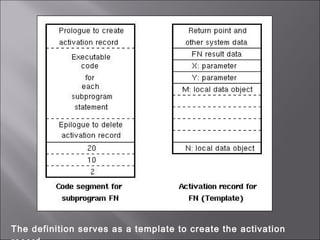
The definition serves as a template to create the activation
A single copy is used for all activations of the subprogram.
This copy is called code segment. This is the static part.

The activation record contains only the parameters,
results and local data.
This is the dynamic part. It has same structure, but
different values for the variables.
Type definitions are used for definition of a new type in
terms of already defined type.

They do not define a complete abstract data type, because the
definitions of the operations are not included.

Format:    typedef definition name

Meaning: definition is already defined type.
           name is substituted with definition.
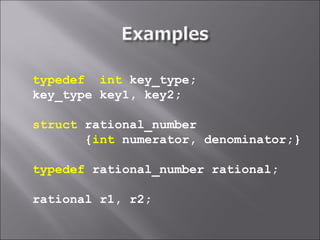
typedef int key_type;
key_type key1, key2;

struct rational_number
       {int numerator, denominator;}

typedef rational_number rational;

rational r1, r2;
Two questions to be answered:

•When are two types the same?

•When do 2 objects have the same value?
Two data types are considered equivalent only if
they have the same name.


Issues
Every object must have an assigned type, there can
be no anonymous types.

A singe type definition must serve all or large parts
of a program.
Two data types are considered equivalent if they define
data objects that have the same internal components.

Issues
• Do components need to be exact duplicates?
• Can field order be different in records?
• Can field sizes vary?
Two objects are equal if each member in one object
is identical to the corresponding member of the
other object.


The compiler has no way to know how to compare data
values of user-defined type. It is the task of the
programmer that has defined that particular data type to
define also the operations with the objects of that type.
Parameters allow for user to prescribe the size of
data types needed – array sizes.

Implementation

Type definition with parameters is used as a
template as any other type definition during
compilation.
Different features in a language causes different
storage management techniques to be used.
   FORTRAN: no recursive calls, no dynamic
   storage management.
   Pascal: stack-based storage management.
   LISP: garbage collection.
   Language implementers decide about the
   details.
   Programmers don’t know about it.
   Initial allocation
   Recovery
   Compaction and reuse
Static allocation :
Allocation during translation that remains fixed
throughout execution.
 Does not allow recursive subprograms
   Simplest
   static allocation
   no run-time storage management
   no concern for recovery and reuse
   efficient
   in COBOL and FORTRAN
   In FORTRAN
     each subprogram is compiled separately,
     the code segment includes an activation record
         compiled program,
         its data areas,
         return point location,
         miscellaneous items of system data.
   Simplest run-time storage management technique.
   Based on the nested last in first out structure in
    subprograms calls and returns.
   Automatic compaction.
   In Pascal : a single central stack of activation records,
    and a statically allocated area for subprogram code
    segments and system programs.
Memory used for dynamic allocation of data objects
in somewhat unstructured manner is called heap
storage.

                    OS

                  HEAP


                  STACK
Tasks:
    allocation,
    recovery,
          dangling references
          garbage collection

     compaction,
     reuse

Fixed size elements
Variable size elements
   A heap is a block of storage within which pieces are
    allocated and freed in some relatively unstructured
    manner.
   Need for heap , when a language permits storage to
    be allocated and freed at execution time.
   Fixed size elements allocated => no need for
    compaction.
The problem: identification of reusable element,
  solutions:
 Explicit return by programmer or system.

   Natural, but cause        garbage and dangling
    reference.
 Reference counts.

   Cost of maintaining.
   popular with parallel processing systems.
 Garbage collection.
   Dangling references more dangerous
   Two stages
     Mark
       garbage collection bit, set off if it is active.
     Sweep
       links the “on” elements to the free list.
    When is a heap element active?
       There is a pointer to it from
         outside the heap
         another active heap element
   Three critical assumptions
     any active element must be reachable by a chain
      of pointers beginning outside the heap.
     It must be possible to identify every pointer
      outside the heap that points to an element inside
      the heap.
     It must be possible to identify within any active
      heap element the fields that contain pointers to
      other heap elements.
   More difficult
   if space for programmer defined data structures      is
    sequential, like arrays or activation records.
   Major difficulty : reuse of recovered space.
   Initial allocation and reuse.
   reuse directly from a free-space list.
     First-fit method
     best-fit method
    keeping free-space list in size order.
   Recovery with variable-size blocks.
     In first word of each block: a length indicator.
   Compaction and memory fragmentation problem.
   Compaction approaches:
     Partial compaction
       only adjacent free blocks
     Full compaction
       active blocks may be shifted
Unit 5

Unit 5

  • 1.
  • 2.
    Abstract Data Type  Information Hiding  Encapsulation  Type Definition  Static and Stack-Based Storage Management  Fixed and Variable size heap Storage Management  Garbage Collection
  • 3.
    An abstract datatype is: A set of data objects, A set of abstract operations on those data objects Encapsulation of the whole in such a way that the user of the data object cannot manipulate data objects of the type except by the use of operation defined.
  • 4.
    When information isencapsulated in an abstraction, it means that the user of the abstraction 1. Does not need to know the hidden information in order to use the abstraction 2. Is not permitted to directly use or manipulate the hidden information even if desiring to do so.
  • 5.
  • 6.
    Encapsulation by Subprograms  Subprograms as abstract operations  Subprogram definition and invocation  Type Definitions
  • 7.
    Subprogram: A mathematical functionthat maps each particular set of arguments into a particular set of results.
  • 8.
    the name of the subprogram  the signature of the subprogram: arguments, results  the action performed by the subprogram
  • 9.
    Type checking: similarto type checking for primitive operations. Difference: types of operands and results are explicitly stated in the program
  • 10.
    Implicit arguments in the form of non-local variables  Implicit results – changes in non-local variables  History sensitiveness – results may depend on previous executions
  • 11.
    Uses the data structures and operation provided by the language  Defined by the subprogram body  Local data declarations  Statements defining the actions over the data  Interface with the user: arguments and returned result
  • 12.
    A simple (butnot efficient) approach: Each time the subprogram is invoked, a copy of its executable statements, constants and local variables is created. A better approach: The executable statements and constants are invariant part of the subprogram - they do not need to be copied for each execution of the subprogram.
  • 13.
    Subprogram definition: theset of statements constituting the body of the subprogram. Static property; the only information available during translation. Subprogram activation: a data structure (record) created upon invoking the subprogram. It exists while the subprogram is being executed. After that the activation record is destroyed.
  • 14.
    The definition servesas a template to create the activation
  • 15.
    A single copyis used for all activations of the subprogram. This copy is called code segment. This is the static part. The activation record contains only the parameters, results and local data. This is the dynamic part. It has same structure, but different values for the variables.
  • 16.
    Type definitions areused for definition of a new type in terms of already defined type. They do not define a complete abstract data type, because the definitions of the operations are not included. Format: typedef definition name Meaning: definition is already defined type. name is substituted with definition.
  • 17.
    typedef int key_type; key_typekey1, key2; struct rational_number {int numerator, denominator;} typedef rational_number rational; rational r1, r2;
  • 18.
    Two questions tobe answered: •When are two types the same? •When do 2 objects have the same value?
  • 19.
    Two data typesare considered equivalent only if they have the same name. Issues Every object must have an assigned type, there can be no anonymous types. A singe type definition must serve all or large parts of a program.
  • 20.
    Two data typesare considered equivalent if they define data objects that have the same internal components. Issues • Do components need to be exact duplicates? • Can field order be different in records? • Can field sizes vary?
  • 21.
    Two objects areequal if each member in one object is identical to the corresponding member of the other object. The compiler has no way to know how to compare data values of user-defined type. It is the task of the programmer that has defined that particular data type to define also the operations with the objects of that type.
  • 22.
    Parameters allow foruser to prescribe the size of data types needed – array sizes. Implementation Type definition with parameters is used as a template as any other type definition during compilation.
  • 23.
    Different features ina language causes different storage management techniques to be used. FORTRAN: no recursive calls, no dynamic storage management. Pascal: stack-based storage management. LISP: garbage collection. Language implementers decide about the details. Programmers don’t know about it.
  • 24.
    Initial allocation  Recovery  Compaction and reuse
  • 25.
    Static allocation : Allocationduring translation that remains fixed throughout execution.  Does not allow recursive subprograms
  • 26.
    Simplest  static allocation  no run-time storage management  no concern for recovery and reuse  efficient  in COBOL and FORTRAN
  • 27.
    In FORTRAN  each subprogram is compiled separately,  the code segment includes an activation record  compiled program,  its data areas,  return point location,  miscellaneous items of system data.
  • 28.
    Simplest run-time storage management technique.  Based on the nested last in first out structure in subprograms calls and returns.  Automatic compaction.  In Pascal : a single central stack of activation records, and a statically allocated area for subprogram code segments and system programs.
  • 29.
    Memory used fordynamic allocation of data objects in somewhat unstructured manner is called heap storage. OS HEAP STACK
  • 30.
    Tasks: allocation, recovery, dangling references garbage collection compaction, reuse Fixed size elements Variable size elements
  • 31.
    A heap is a block of storage within which pieces are allocated and freed in some relatively unstructured manner.  Need for heap , when a language permits storage to be allocated and freed at execution time.  Fixed size elements allocated => no need for compaction.
  • 32.
    The problem: identificationof reusable element, solutions:  Explicit return by programmer or system.  Natural, but cause garbage and dangling reference.  Reference counts.  Cost of maintaining.  popular with parallel processing systems.  Garbage collection.
  • 33.
    Dangling references more dangerous  Two stages  Mark  garbage collection bit, set off if it is active.  Sweep  links the “on” elements to the free list. When is a heap element active?  There is a pointer to it from  outside the heap  another active heap element
  • 34.
    Three critical assumptions  any active element must be reachable by a chain of pointers beginning outside the heap.  It must be possible to identify every pointer outside the heap that points to an element inside the heap.  It must be possible to identify within any active heap element the fields that contain pointers to other heap elements.
  • 35.
    More difficult  if space for programmer defined data structures is sequential, like arrays or activation records.  Major difficulty : reuse of recovered space.  Initial allocation and reuse.  reuse directly from a free-space list.  First-fit method  best-fit method keeping free-space list in size order.  Recovery with variable-size blocks.  In first word of each block: a length indicator.  Compaction and memory fragmentation problem.
  • 36.
    Compaction approaches:  Partial compaction  only adjacent free blocks  Full compaction  active blocks may be shifted